Archives for category: Texas

Governor Gregg Abbott went all in and all out to pass vouchers, so that public money would fund religious schools, private schools, and homeschools. His proposal passed in the State Senate.

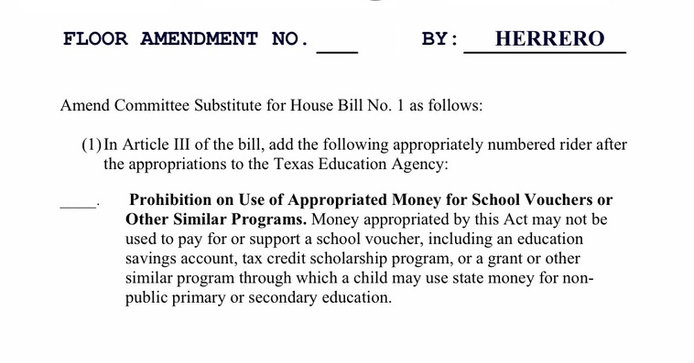
But it in trouble in the House of Representatives, where rural Republicans are standing with urban Democrats against vouchers for nonpublic schools. The House today passed the Herrero Amendment, prohibiting public funding for vouchers.

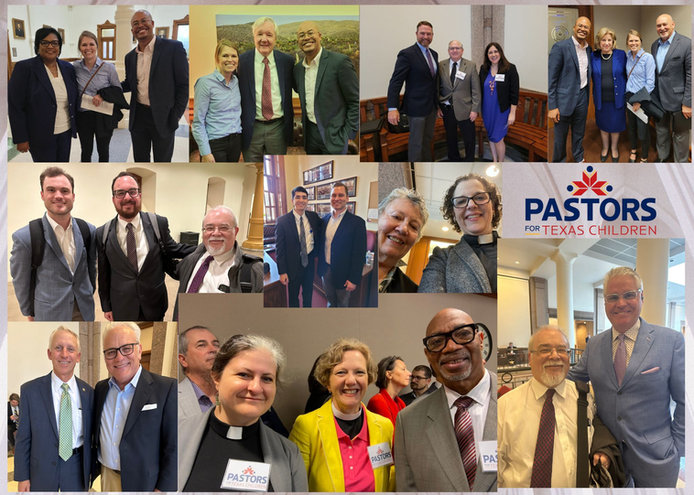
The Pastors for Texas Children have worked tirelessly to protect public funding for public schools. Five million children attend public schools. Three hundred thousand students are enrolled in private schools. they issued the following statement about today’s events:


FOR IMMEDIATE RELEASE

CONTACT: Rev. Charles Foster Johnson

210-379-1066

Johnson.cfj@gmail.com


Herrero Amendment Blocking Voucher Funding Passes Overwhelmingly


The Herrero Amendment prohibiting tax money for private school vouchers passed the Texas House of Representatives this afternoon on an 86-52 vote.

The Texas House has once again repudiated a private school voucher program, as they have many times over the past 25 years.

This rejection of vouchers is particularly powerful because Gov. Greg Abbott made the passage of a voucher policy an “emergency item” this legislative session, and personally lobbied House members on the chamber floor to advance it.

“Texans abhor private school vouchers,” said the Rev. Charles Foster Johnson, Founder and Executive Director of Pastors for Texans Children. “For public dollars to be diverted to subsidize the private education of affluent children and to pay for religious education, particularly that contrary to one’s own, is fundamentally unjust.”

“Unfortunately, Gov. Abbott has tied up the entire legislature this session, at the cost of millions of tax dollars, for in his own petty personal political agenda.”

The Texas State Constitution, in Article 7, Section 1, calls for the suitable provision for “public free schools.” There is no consideration whatsoever for public funding diverted to private schools.

Using public tax dollars, taken from our 5.4 million Texas schoolchildren, to underwrite the private education of a few, is an egregious moral violation.

We find it particularly troubling for public funding to advance and establish religious programs in private schools. This is a clear violation of the First Amendment to the United States Constitution and God’s Moral Law.

Pastors for Texas Children is grateful that the Texas House of Representatives once again stood firm for the true Texas conservative value of universal education for all Texas schoolchildren, provided and protected by the public.

+++


Pastors for Texas Children mobilizes the faith community for public education ministry and advocacy. http://www.pastorsfortexaschildren.com

PO Box 471155 – Fort Worth, Texas 76147

http://www.pastorsfortexaschildren.com

Governor Gregg Abbott has pushed very hard for vouchers to fund religious schools, homeschooling, and anything else that calls itself a school. Texas has a state constitution that requires public schools, but voucher advocates abandon the language of state constitutions when they get in the way of their goal.

We know from experience that most vouchers will be used by students already enrolled in private or religious schools. We know that the cost of funding kids already in private schools will be enormous. More than 300,000 students attend private schools in Texas. Add in home schoolers, and you are looking at an annual cost of nearly $3 billion before any public school student has asked for a voucher.

We know from research studies that most of the public school kids who take vouchers will drop out of their religious school and return to their public school far behind their peers.

No group has been more effective in fighting to preserve public schools than Pastors for Texas Children. They have mobilized rural Republicans to stand strong for their public schools, which are the hub of their community.

PTC released the following report today:

Call and Write Your Senator and Representative TODAY!

The SB 8 education savings account voucher bill will likely pass out of the Senate Education Committee today or tomorrow, then go to the Senate floor for a vote. It’s been astonishing that the bill has been stalled in the Senate for the past week! As you know, the Texas Senate, under the leadership of Lt. Gov. Dan Patrick, has long supported private school vouchers. Contact your State Senator anyway! Our job is to influence and educate them!

Vouchers stop and die in the Texas House of Representatives. They will vote on Thursday on an amendment to the budget bill preventing public money from funding private schools. Here it is:

Call and email your State Representative before Thursday and urge him or her to support the Herrero Amendment prohibiting private school voucher funding.

You can find their Austin office numbers here.

PTC pastor Rev. Julio Guarneri, the pastor of Calvary Baptist Church in McAllen, has written a powerful letter to his state senator. It gives us all a good, succinct script for our talking points as we contact our policymakers.

It’s our job before God to speak truth to power. God bless us all as we bear witness to God’s truth and justice this week!


Senator Hinojosa,

I hope you had a good weekend. I attempted to call you on the phone this morning but you were in a meeting and I know this is a busy week for you. I hope to still be able to talk to you over the phone but in the meantime, let me share with you what I am calling about.

I am the Lead Pastor at Calvary Baptist Church in McAllen. I am also currently serving as president of the Baptist General Convention of Texas (Texas Baptists), to whom the Christian Life Commission relates. And I am with Pastors for Texas Children as well.

I am writing you in regard to SB 8 (Education savings account/school voucher bill). As a Baptist, as a pastor, and as a religious leader, I am opposed to SB 8 for several reasons. My conviction is that church and state should be separate. A free church in a free state is our ideal. Thus, I do not believe tax dollars should be used to fund religious education. Public tax dollars should be used for public schools. Religious causes should be supported by donations from private individuals.

There are only two choices for religious schools who receive help from tax credits. They either receive oversight from the government, which violates the separation of church and state, or they receive the benefit without accountability, which is wrong.

Furthermore, this measure seems to mostly benefit middle to upper class families, leaving lower income families either without enough of a tax credit to afford a private school or with an underfunded public school system. We will do a disservice to Texas if we leave lower income families at an educational disadvantage.

I know you have historically opposed school vouchers and I am thankful for that. I respectfully ask you to hold your position. As a religious leader I believe it is the right thing.

Please do not hesitate to call me or email me.

May you have a blessed Holy Week and a Happy Easter!

For our Texas children and our Texas future,

Julio S. Guarneri, Ph.D.

Calvary Baptist Church

McAllen, Texas

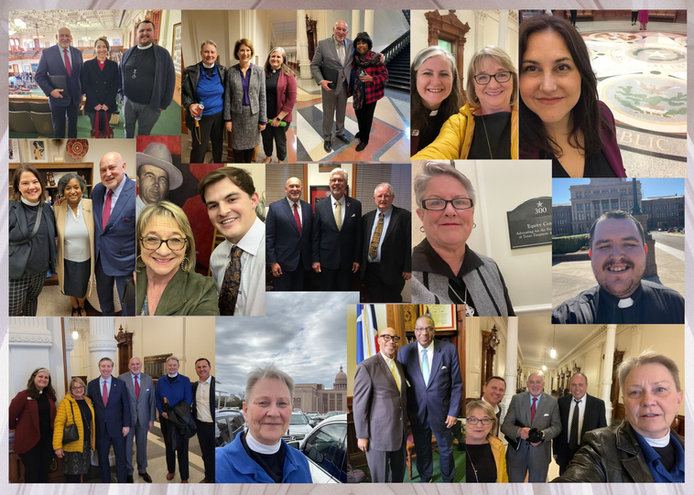
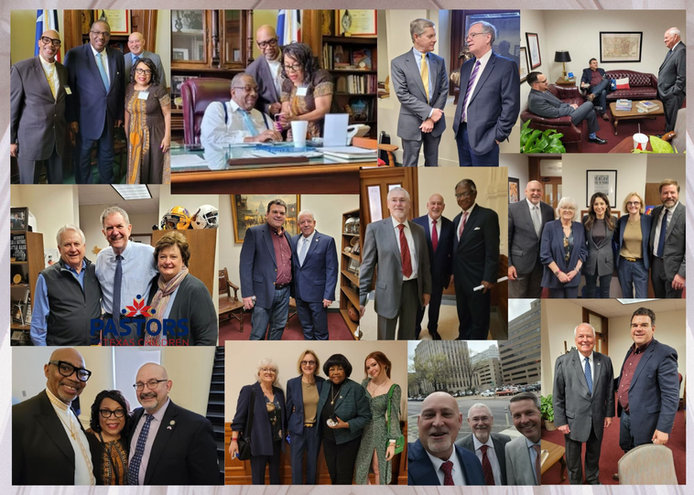
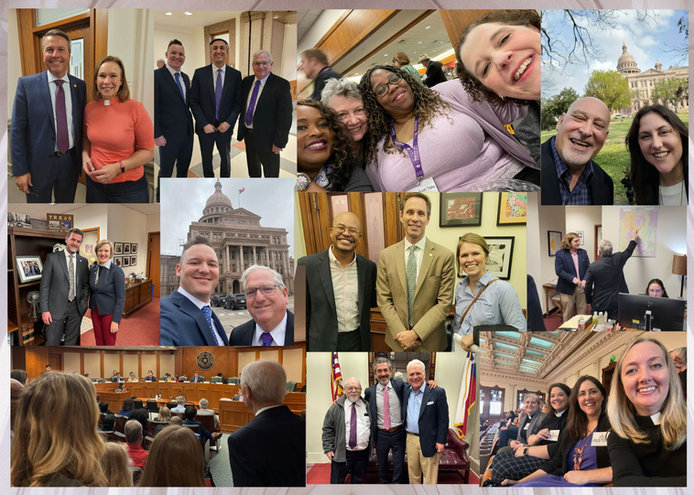
Pastors at the Capitol

DONATE TO PTC


PO Box 471155, Fort Worth, Texas, 76147

Check out our website  

The latest wave of book banning in Texas high school libraries is led by people who don’t read much. Now, they’ve gone and set up a bar that even the beloved classic Texas novel—Lonesome Dove by Larry McMurtry—can’t get past.

In a recent legislative hearing, the book banners put their aliteracy on public display.

Christopher Hooks writes in the invaluable Texas Monthly:

State representative Jared Patterson has never claimed, through campaign literature or any other medium, to be a reader. If he had, he might not have walked into the trap set for him last night during a House Public Education Committee hearing on his inaptly named READER Act. That proposal would add several new bureaucratic controls on the kinds of books that could be kept in or borrowed from public-school libraries. When Democratic state representative James Talarico, of Round Rock, prodded the Frisco Republican during debate, Patterson took the bait. “There should be no sexually explicit books” in a high school library, he said.

Talarico replied that there’s content that could be viewed as sexually explicit in many very good books. (Though he didn’t mention it, the Bible ranks high among them.) Take Talarico’s favorite book, Larry McMurtry’s 1985 novel Lonesome Dove, about two retired Texas Rangers on a cattle drive during the twilight years of the Old West, which has become totemic to generations of Texans. The book includes characters who are prostitutes and scenes of sexual assault and its consequences. It includes birds and bees and all that kind of filth. Talarico asked: Would Lonesome Dove be banned in Texas high schools under Patterson’s bill?

Patterson hadn’t read Lonesome Dove, he replied, committing his first error. But if it contained the ribald passages Talarico indicated it did, well, then, “they might need to ban Lonesome Dove.” There were a lot of interested parties following this hearing, and it was widely understood among Patterson’s allies and enemies alike that he had stepped in it. Lonesome Dove is an easily comprehensible example of the kind of book that deals with difficult subjects but enhances the reader’s understanding of life, and of other Texans. The thought of the novel coming out of high school libraries in a brown paper bag, like a copy of Maxim, made Patterson’s whole bill seem more ridiculous than it already was.

Patterson’s allies apparently thought he needed help digging himself out of his hole, so they jumped in with him. Christin Bentley, a member of the State Republican Executive Committee, had an idea. Apparently not having read the book either, she tweeted that she had “bought Lonesome Dove on Kindle and did keyword searches.” She searched for “f—,” “p—y,” “sex,” and “vagina,” which don’t appear in the novel, and posted screenshots to prove it. After this deep engagement with the text, she was happy to report on Twitter that the book was not sexually explicit and, therefore, would not be banned under the bill.

Of course, Lonesome Dove is set in the 1870s: Bentley was searching for the wrong words. Twitter users helpfully suggested she search for the word “poke.” (Hard to picture Gus yelling “p—y” across the range.) But even a better search would have been of limited value. With a short summary, you can make Lonesome Dove sound like smut or a wholesome novel. The only way to evaluate it properly, as with any book, is to read it and think about it in its totality. That’s the point of books: You can step into the lives of characters unlike you. You can think about what it’s like to be a woman or a man, consider issues you had never given thought to, and step back into your life at the end of it, your horizons a little wider.

Some folks, however, prefer their horizons narrow and dark. For several years, the crusade against books in school libraries has had the most power when targeting literature that discusses LGBTQ issues and racism. Few animated by this debate actually seem to care whether kids are reading about heterosexual sex. Indeed, Patterson has put rhetorical emphasis in his pitch for his bill on books that have “sexual indoctrination,” a euphemism for ones about gender-nonconforming or gay kids. The fear he and allies are stoking seems to be that by reading these books, formerly immaculate daughters and sons will become transgender. His bill’s case depends on circling off “scary” books from “normal” ones. This works well enough for him because few adults have encountered, say, Gender Queer, a graphic novel he’s also put in his cross hairs. But enough Texans have read Lonesome Dove to know that while the book is challenging, it is enriching, and being able to make sense of its challenges is part of growing up, especially in this state.

Patterson’s snafu makes clear that the bill’s sponsors don’t really care about books—or that they don’t understand them. Which is fine. That’s why we have Netflix. But maybe they should leave the regulation of literature to Texans who read.

Please open the link and read the rest of the article. It’s a good one!

This is a shocking story about the precarious position of rural schools in the age of vouchers. Legislators who represent rural districts in Texas know that their constituents don’t want vouchers. Their public school is the heart of their town. It’s where everyone comes together.

But in this story, a couple of billionaires who want all children in church schools, decided to take out one of these rural Republicans who stood by his local public schools. The legislator saw the amount of money arrayed against him, and he retired. He was replaced by a man who supports vouchers, even though the people in his district don’t.

Mike Hixenbaugh explains why rural districts oppose vouchers:

ROBERT LEE, Texas — After a bus driver called in sick one recent afternoon, Robert Lee Independent School District Superintendent Aaron Hood filled in for her. Slipping behind the wheel in a button-up shirt and tie, he rumbled down country roads, past ranches and wind farms to shuttle a few dozen students home in this tiny West Texas town.

Out here, where cattle outnumber children 20 to 1, no one is hollering about critical race theory in textbooks or pornography in the library. But those battles raging 250 miles away in the state capital and in far-away suburbs have galvanized a political movement that Hood fears could deal a devastating blow to rural school districts like his.

Backed by a surge of campaign spending from far-right Christian megadonors, Republicans in Texas and nationwide are pushing legislation that would siphon money from public education under the banner of “parents’ rights.” These plans, commonly known as vouchers, would give parents the money the state would have spent educating their children in public schools — between $8,000 and $10,000 per child per year in Texas — and allow them to put it toward homeschooling expenses, private school tuition or college savings accounts.

Officials in communities like Robert Lee, which has a population of about 1,000, warn these policies will chip away at already razor-thin public school budgets. With only 250 students — about 18 children per grade — even a slight drop in enrollment and funding can force rural schools like Robert Lee to make hard decisions, Hood said.

“We don’t have the same economy of scale as larger districts,” he said, which is one reason he obtained a commercial driver’s license to serve as a substitute bus driver. “If we lose five or 10 students, that’s a teacher salary. But we can’t afford to have one less teacher, so now we’re cutting academic programs, we’re cutting sports, we’re cutting the things that this community relies on.”

As president of the Texas Association of Rural Schools, a collection of 362 public school districts that are united in their opposition to vouchers, Hood and his fellow small-town superintendents have been trying to sound an alarm in Austin. They see the state GOP’s push for what advocates call “school choice” or “education freedom” as a betrayal of the party’s rural base in favor of wealthy campaign donors.

Carol Burris, executive director of the Network for Public Education, recently joined parents, students, and teachers at a rally in Austin, Texas, to protest the state’s decision to take control of the Houston Independent School District. The district is no longer “independent,” since the state asserted its control. And Republicans showed that they don’t really believe in “local control,” any more than they believe in “parents rights.”

As a graduate of HISD, I feel especially outraged by the state takeover on flimsy grounds. Governor Abbott and Commissioner Mike Morath are playing politics. These kids are the future of Texas. Why are they being used as pawns?

Burris wrote the following explanation of the state takeover. It appeared on Valerie Strauss’s “Answer Sheet” blog at the Washington Post website.

Strauss begins:

The administration of Texas Gov. Greg Abbott (R) announced this month that the state was taking over the public school district in Houston even though the Texas Education Agency last year gave the district a “B” rating. The district, the eighth-largest in the country, has nearly 200,000 students, the overwhelming majority of them Black or Hispanic, and opposition to the move in the city, which votes Democratic, has been strong.


Texas Education Agency Commissioner Mike Morath said the takeover was necessary because of the poor performance of some schools in the district — even though most of the troubled schools have made significant progress recently.


Here is the real story of the takeover, written by Carol Burris, an award-winning former New York school principal who is executive director of the Network for Public Education. The nonprofit alliance of organizations advocates the improvement of public education and sees charter schools — which are publicly funded but privately operated — as part of a movement to privatize public education.


By Carol Burris


Houston parents, teachers, and community leaders are protesting the decision by Texas Education Agency Commissioner Mike Morath to take over the Houston Independent School District. Some see the takeover as grounded in racism and retribution; others as big-government intrusion.


For Houston mom Kourtney Revels, the decision represents a hypocritical dismissal of parents by Gov. Greg Abbott (R). “How can Governor Abbott pretend to support parent empowerment and rights when he has just taken away the rights of over 200,000 parents in Houston ISD against their will and has not listened to our concerns or our voice?” she asked.

The takeover is the latest move in a long list of actions by Abbott’s administration to attack public school districts and expand privatized alternatives, including poorly regulated charter schools and now a proposed voucher program that would use public money for private and religious education. And critics see them all as connected.


State Rep. Ron Reynolds, a Houston Democrat, told the Houston Chronicle, that the takeover of the Houston district is part of Abbott’s attempt “to push” vouchers and charter schools, and to “promote and perpetuate the things that Governor Abbott believes and hears about, and that obviously isn’t diversity, equity and inclusion.”

The first takeover forum sponsored by the Texas Education Agency, which Morath leads, was described in the Houston Chronicle as “emotional and chaotic.” This week, the Greater Houston Coalition for Justice is leading a protest march before another TEA hearing. U.S. Rep. Sheila Jackson Lee (D), who represents the city, has asked the Biden administration to open a civil rights investigation into the takeover.

Background

The Houston Independent School District is Texas’s largest school district, with 284 schools and almost 200,000 students. It is also the eighth-largest district in the nation. Eight in 10 students come from economically disadvantaged families, and more than 1 in 3 students are not proficient in English. Fewer than 10 percent of the students are White.

The first attempted takeover of HISD by Morath was in 2019. The rationale for the takeover was school board misconduct and the seven negative ratings of Phillis Wheatley High School, one of the district’s 284 schools. Wheatley had been rated “academically acceptable” almost every other year until the YES Prep charter school opened nearby in 2011. During the 2021-2022 school year, Wheatley served 10 times as many Black students and more than twice as many students with disabilities as YES Prep, located just a five-minute drive away.

The district went to court to stop the takeover, and the debate wove through the courts until the Texas Supreme Court gave the green light for the takeover in January.

Almost four years have passed since the first takeover attempt, and the district has made impressive strides. The electorate replaced the 2019 school board, and a highly respected superintendent, Millard House, was appointed.

By every objective measure, the district is on a positive trajectory. The district is B-rated, and in less than two years, 40 of 50 Houston schools that had previously received a grade of D or F received a grade of C or better. Wheatley High School’s grade, the school that triggered that 2019 takeover attempt, moved from an F to a C, just two points from a B rating.

While there is a law that triggers a TEA response when a school repeatedly fails, the state Supreme Court did not mandate the takeover of the district. Under Texas law, Morath had two options — close the school or take over the district by appointing a new Board of Managers and a superintendent. He chose to strip local control. For those who have followed the decisions of Morath, his choice, the harsher of the two, comes as no surprise.

Mike Morath and charter schools

Mike Morath, a former software developer, was appointed education commissioner by Abbott in 2015. Morath had served a short stint on the Dallas school board, proposing that the public school district become a home-rule charter system, thus eliminating the school board and replacing it will a board appointed by then-Mayor Mike Rawlings, the former chief executive of Pizza Hut. Transformation into a charter system would also eliminate the rights and protections of Dallas teachers, making it easier to fire staff at will.

Morath and the mayor were supported in their quest to privatize the Dallas school system by a group ironically called Support Our Public Schools. While many of its donors remained anonymous, one did not — Houston billionaire John Arnold. Morath admitted encouraging the development of Support Our Public Schools and soliciting Arnold’s help in founding the organization.

Arnold, a former Enron executive and Houston resident, is a major donor and board member of the City Fund, a national nonprofit that believes in disruptive change and “nonprofit governing structures” for schools rather than traditional school boards. The City Fund touts New Orleans as the greatest school reform success. Arnold is joined on the board of the City Fund by billionaire and former Netflix CEO Reed Hastings, who has blamed public school woes on elected school boards and said 90 percent of all students should be in charter schools.

The plot to turn the Dallas school system into a charter system fizzled by January 2015. In December of that year, Abbott plucked Morath from the school board to become Texas education commissioner based on his record as a “change-agent.”

As commissioner, Morath has unilaterally approved charter schools at what many consider to be an alarming rate. Patti Everitt is a Texas education policy consultant who closely follows the decisions of the Texas Education Agency. Everitt noted that Morath “has the sole authority to approve an unlimited number of new charter campuses in Texas — without general public notice, no community meeting, and no vote by any democratic entity.” According to Everitt, he has used this power more frequently than his predecessors. “Since Mike Morath became Commissioner, data from TEA shows that he has approved 75 percent of all requests from existing charter operators to open new campuses, a total of 547 new campuses across the state,” she said.

In 2021, according to Everitt, Morath approved 11 new campuses for International Leadership of Texas Charter Schools, even though 28 percent of the chain’s schools had received D or F grades in prior ratings.


Georgina Cecilia Pérez served two terms on the Texas State Board of Education, from 2017 to 2022. During that time, she observed the Texas Education Agency up close. A 2017 state law provides financial incentives for districts to partner with open-enrollment charter schools, institutions of higher education, nonprofit organizations or government entities. She said that several charter partnerships with the Houston school district have been in the works waiting for the state takeover. She predicts Morath will approve them, “with no public vote.”


Abbott, Morath, and vouchers

Few were surprised this year when Abbott declared that establishing an Education Savings Account (ESA) voucher program would be one of his highest priorities this legislative session. ESA vouchers, the most controversial of all voucher programs, provide substantial taxpayer dollars, through an account or via a debit card, to private school and home-school parents to spend on educational services. Eight states presently have ESA vouchers, with three new programs in Arkansas, Iowa and Utah approved to begin in coming academic years. Other legislatures in red states, notably New Hampshire and Florida, are pushing for ESA program expansion.

Abbott had been reluctant to embrace vouchers — possibly because of a lot of opposition in Texas, especially in rural areas — causing some to speculate that his newly expressed support for them is linked to presidential ambitions. School choice is a pet cause of one potential rival for the Republican presidential nomination, Florida Gov. Ron DeSantis (R).

Two voucher bills are now weaving their way through the Texas Senate. S.B. 8 would give families a voucher of $8,000 per child a year and institute a parents’ “bill of rights” that allows parents to review public school curriculums through parent portals. A second bill, S.B. 176, would give private school and home-school families a $10,000-per-child annual voucher. Although Abbott has not endorsed either bill, he has made it clear that he supports a universal voucher program, promoting universal vouchers in speeches at some of the state’s most expensive private Christian schools.

Last year, Morath gave tacit support for vouchers, claiming that “there is no evidence” that vouchers would reduce public school funding. In February 2023, however, when questioned during a state Senate hearing, the commissioner admitted that voucher programs could have a negative fiscal impact on public schools.

That same month, his second-in-command, Deputy Commissioner Steve Lecholop, encouraged an unhappy parent from the Joshua Independent School District to work with the governor’s speechwriter to promote vouchers, saying it would be a great way to “stick it to” the school district.

The lack of success of district takeovers

Regardless of Abbott’s and Morath’s ultimate objective — whether it be flipping some or all of Houston’s public schools to charters — research on state takeovers has consistently shown that state takeovers nearly always occur in majority-minority districts and rarely improve student achievement. Student results in takeover districts, with only a few exceptions, have remained the same or decreased. That was the conclusion of a comprehensive cross-state study published in 2021. The study’s authors, Beth Schueler of the University of Virginia and Joshua Bleiberg of Brown University found “no evidence that takeover generates academic benefits.”

This intervention does not help students, and it mutes community voices, undermines democracy in Black and Hispanic communities, and pushes charter schools and other privatized alternatives to democratically governed schools.

An example is the takeover of Philadelphia’s public schools in 2001. Then-Gov. Tom Ridge (R) hired Edison Learning, a for-profit management company led by Chris Whittle, to study the district at the cost of $2 million. Edison Learning made a recommendation that it play a significant role in the reform and proposed running up to 70 schools. After community outrage, the number was reduced to 20. A few years later, the number of managed schools increased to 22. It was not long, however, before Edison Learning and the district were embroiled in a lawsuit concerning liability damages after a student was sexually assaulted in an Edison-operated school. By 2008, all for-profit management companies, including Edison, were gone. By 2017, the state takeover experiment ended.

Retired teacher Karel Kilimnik of Philadelphia had a first-row seat. She taught at a school taken over by the for-profit management company called Victory Co., which ran six schools under the School Reform Commission. The Reform Commission “promised academic and financial improvements that failed to materialize over their 16 years of control,” Kilimnik said. “Instead of improving the district, they opened the door to privatization and charter expansion and laid out the welcome mat for graduates of the uncertified Broad Superintendents Academy. They paved the way for the doomsday budget resulting in massive layoffs, larger class sizes, and the elimination of art and music.”

In his 2017 book, “Takeover,” New York University professor Domingo Morel concluded that, based on his extensive research, state takeovers are driven more by the desire of state actors to take political control away from Black and Hispanic communities than about school improvement. Recently in the Conversation, Morel described the seizure of the Houston school district as motivated by a need by the Republican establishment to thwart the growing empowerment of Black and Latinos as their numbers increase in Texas.

“The Houston public school system is not failing,” Morel said. “Rather, Republican Gov. Greg Abbott, Education Commissioner Mike Morath, and the Republican state legislature are manufacturing an education crisis to prevent people of color in Houston from exercising their citizenship rights and seizing political power.”

Allison Newport, a Houston mother of two Houston public school elementary students, agrees. “The commissioner should be congratulating Houston ISD and Wheatley High School for such incredible improvement in performance instead of punishing the students, parents, and teachers who worked so hard to make it happen.”

Cecily Riesenberg, a teacher at Caprock High School in Amarillo, Texas, wrote an opinion article for the Amarillo Globe-News. She explained why vouchers will benefit the most affluent families and offer low-quality schools to most other students.

She wrote:

Both sides of the aisle agree that education needs reform. At first glance, vouchers seem like a great solution. Who wouldn’t think that parents should have “freedom,” and “choices,” and that more “competition” will make the market stronger. But that simply isn’t what the data shows.

Data shows that vouchers benefit the wealthy who need it the least, hurt the disadvantaged the most, abuse taxpayer dollars, and erase the separation between church and state. Vouchers act like a discount for wealthy students already in private schools. Picture a country club that won’t allow any new members, but now their current members get to use taxpayer money to subsidize part of their dues. Not only is everyone else stuck at the public pool, but now we’re all paying for a few people to go to the country club, and we have less money to maintain or upgrade the public pool. That’s how vouchers work in the states that have them.

There are three kinds of private schools. The first type are elite, exclusive, “country-club” schools that don’t want or need more students and won’t accept vouchers at all. These schools are able to stay elite because of their exclusivity. Then there are new private schools that pop up after states implement vouchers. New private schools don’t focus on quality education at all – they use taxpayer money to market themselves to attract more students and take more public money. After a few months, families realize these schools can’t offer what they were selling. Students withdraw, but the school keeps the money. Most of these schools close within four years, but not until after they’ve made a profit, and the students are left further behind. The third type of private schools are subprime schools that need taxpayer money just to stay afloat. These schools have a 40% failure rate.

Vouchers only offer the illusion of choice.

Many states have tried vouchers, the data shows they failed and abused public resources. Not only do charters and private schools in Arizona, Indiana, Ohio, and Louisiana, have worse educational outcomes than public schools, but when so many programs receive public money, it’s impossible to monitor where the money goes in the same way that public schools are held accountable. In Arizona, for example, an audit showed that parents were using taxpayer dollars to buy kayaks and take vacations. We can’t claim to value fiscal responsibility and support a shady cash grab for corporate charters, “service providers,” and bank fees.

Rural areas will be harmed the most by vouchers, because there aren’t enough students to make opening new schools profitable. But rural public schools would still lose enrollment and funding as some parents use vouchers for homeschooling or online schooling. Again, the quality of these options is almost always lower than public schools.

Lieutenant Governor Dan Patrick and Governor Abbott are always ready to listen to their wealthy donors and the corporations that are lined up like vultures to make a buck. Recently, Governor Abbott has been on a whirlwind tour of private Christian schools to sell his agenda. He even came to Amarillo on March 2nd to speak at San Jacinto Christian Academy, a tiny school that serves less than 400 students. But the governor refused an invitation to tour Amarillo ISD public schools and listen to the tens of thousands of teachers, students, and parents who would be harmed by vouchers. Even if San Jacinto offered a world-class education, they would never have the capacity to serve a significant number of Amarillo’s students.

There are answers on how to actually reform education. We can follow the lead of countries like Finland that consistently rank high on international measures of reading and math skills. Finland doesn’t have vouchers. They don’t even have private schools. There, every school is public and wellfunded. Every student can get a quality education from their neighborhood school, and every student has an equal opportunity to achieve. Finland attracts the best and brightest to the teaching profession by requiring a masters degree and paying them as much as doctors or lawyers. Finnish teachers are empowered, respected, and trusted – essentially the opposite of how teachers are treated in Texas.

Imagine Texas as a state that consistently ranks higher in education than other states and countries, where students excel academically and socially, and find fulfilling careers post-graduation. We can get there, but it will not be by following Governor Abbott’s orders. The governor’s orders will only lead to the wealthy donor class pocketing taxpayer money while the average student falls further behind.

We know what works. So why don’t politicians want to do it? Simple – it’s impossible to monetize and profit from this approach the way they can with vouchers.

Reach out to your state senators and representatives to let them know that public schools are the bedrock of our communities. We need to make them stronger instead of tearing them down and selling them for parts.

The right to public education is enshrined in our constitution. We have to guarantee that right to every child, regardless of race, income, or zip code, and the best way to do that is by fully funding public schools.

In 2025, Texas passed a ridiculous law stating that if a school district had even one school that was deemed to be “failing,” the state could take over the entire school district. Houston has one high school, Wheatley High School, that has persistently low test scores (and also unusually high percentages of students with special needs and other groups of high-needs students).

The State Department of Education has been trying for years to seize control of the Houston public schools. The state superintendent, appointed by callous Governor Gregg Abbott is software engineer Mike Morath, whose sole claim to educational “experience” is having served on the Dallas school board.

These Republicans do not believe in local control of schools. They believe the state should take away local control, the easier to erode democracy and advance privatization.

Ruth Kravetz, a former teacher and administrator in the Houston Independent School District, now leads an organization called Community Voices for Public Schools. She wrote an editorial in The Texas Observer (where I published my first article) denouncing the threatened takeover as “unfair, racist, and wasteful.”

As a 1956 graduate of HISD, I take this personally.

After years of wrangling and legal battles, the state took control of HISD a few days ago.

Kravetz writes:

I am a parent and teacher with Community Voices for Public Education, a Houston-based nonprofit rooted in the belief that our community schools are a public good, not a commodity to be sold off to the highest bidder. That is why we, along with many other Houstonians, have protested the attempted state takeover of Houston ISD for years—a dramatic assault on local control that may take place this week.

At a February protest, HISD student Elizabeth Rodriguez stated, “Instead of punishing us with a takeover, our schools should be better funded to make sure students have all the support we need and the facilities we deserve. We are not just test scores.”

Contrary to what you may hear from some Republican leaders, Houston Independent School District (HISD) is not a failing district. HISD received a B grade in the most recent state school ratings and is AAA bond-rated.

Why, then, is Houston ISD even under threat of a takeover?

In 2015, Texas passed a law that allows the state to take over an entire school district if even one campus is rated F in standardized test performance for five years. The state says the rationale for the takeover is Wheatley High School’s low 2019 accountability rating and problems with the HISD school board. Since 2019, when the takeover bid began, Houston ISD had successfully delayed Texas’ efforts, but the GOP-controlled state Supreme Court cleared the state’s legal path in January.

In the past few years, HISD already proved that local control works: Since 2019, voters elected an almost entirely new school board, and students and teachers worked to bring Wheatley’s state score up to a C in 2022. Since 2015, HISD reduced its number of low-performing schools from 58 to nine, which is fewer than are found in Dallas ISD. Even using the state’s deeply flawed accountability system to rate schools, Houston ISD comes out fine.

Nevertheless, the state’s takeover efforts persist. If successful, a state-appointed board of managers will make all policy decisions with Texas Education Agency (TEA) Commissioner Mike Morath pulling the strings behind the scenes. HISD’s democratically elected board will only have a ceremonial role with no voting authority. And the kicker is that the unelected Morath, who’s appointed by Governor Greg Abbott, has full discretion to expand the takeover. The superintendent could also be replaced, and individual schools could be parceled off to charter school operators—such as YES, KIPP, IDEA, and churches—with the usual consequences as seen around the country.

Charter schools often purposefully underenroll students with disabilities and other at-risk children, inflating their state accountability ratings. Should this occur in Houston following a takeover, the state will likely take the credit in its accountability shell game.

A takeover may also lead to teachers leaving the district, creating more classroom vacancies. The chances for a bond to replace older elementary schools will go out the window. If other takeovers are any indication, we can also expect more of our taxpayer dollars to go to costly consultants than to the needs of children.

If all this doesn’t make you mad, how about this? Over and over again, the governor and the TEA commissioner have moved the goalposts in the middle of the game.

In 2019, Wheatley High initially received a passing grade from the TEA, but the agency later changed its scoring criteria and applied them retroactively. And in January, TEA publicly announced more rule changes that will be implemented immediately and applied retroactively to last year’s seniors, whose data is counted in this year’s accountability rating. At the high school level, schools that were projecting a B rating are now projecting a D. School districts around the state are raising the alarm about the change.

We tell our children they have to be honest and to play by the rules; we should expect the governor and TEA commissioner to do the same.

Unfortunately, the state takeover of Houston ISDhas nothing to do with student needs. It is about power, profits, and a willful disregard for children living in poverty.

As I ponder the district’s future, I am reminded of a student I once taught. When I went to his house to help him think about college, he had no electricity and the only furniture in the house was a bed, an engine block, and a chair. He did his homework by a street lamp outside. The last thing he needed was more pressure to meet arbitrary standardized testing goals or for the state to punish his school for serving low-income students like himself.

From Beaumont to New Orleans to Detroit, takeovers—which disproportionately target districts with high Black and Brown political participation—do not improve student achievement and experiences.

Please open the link to finish this excellent article.

Governor Abbott and Mike Morath don’t have any idea how to improve schools or districts. They do know how to loot them and privatize them for the benefit of their cronies and campaign donors.

Shame on you, Governor Abbott and Mike Morath!

Carol Burris, the executive director of the Network for Public Education, was invited by the Texas AFT (American Federation of Teachers) to speak about pending voucher legislation.

This is what she said:

I lived in Texas for ten years–not far from here in a little town called Martindale when my husband was a Southwest Texas State University student. Then we moved to Houston, where two of our three daughters were born.

The Texas that I remember was a conservative state. Taxpayers didn’t like footing the bill for anything they did not need to.

So now I am back in Texas 40 years later, and I am wondering where all the conservatives have gone. Because all of the proposed voucher bills to give taxpayer money for private schools and homeschools are multi-billion dollar entitlementprograms that would make socialists blush.

Now, for my part, I like most entitlement programs like the GI Bill that members of our military earn or food stamps because no one in America should go hungry.

But these voucher bills are giveaways to people to pay for private schools even though there is a perfectly good public school just down the road.

But that good neighborhood public school, where most Texans send their children, will disappear. Because you can have a multi-billion dollar voucher program or well-funded public schools, but you can’t have both.

Let’s look at some of the voucher bills being pushed in Texas right now. These bills were not written by Texans for Texas. I read voucher bills. Your bills are all pretty much the same bills I see being proposed in other states. Earlier today, Corey DeAngelis, who works for Betsy De Vos, was rallying a small crowd at the capitol. Corey, bless his heart, is the Where’s Waldo of the voucher world. If there is a voucher bill, Corey will show up to sing its praises. But he will never tell you what it will cost. So I will.

Texas Senator Middleton proposed a voucher bill. Mr. Middleton’s voucher would give parents $10,000 a year and create a new taxpayer-funded bureaucracy to dole out the money.

Currently, in Texas, there are 309,000 private school students and 750,000 homeschooled students. There are 9.9 million Texas households. I did the math. If all private school and homeschool families take that $10,000, this voucher system will cost ten billion dollars–that is over $1,000 a household a year.

The Lt Governor is pushing a more modest voucher bill that would give $8,000 a year to families. Do you feel much better knowing that every Texas household could fund vouchers at over 800 dollars a year?

If one of these bills passes, Texas will fund a public school system, a charter school system, and a voucher school system. Something has to give. Because unless Governor Abbott says he will pay for billions of dollars of vouchers by raising taxes, that money is coming out of your public schools.

At the Network for Public Education, we have been studying voucher programs for years and know a few things about them.

First, they always grow. Every program that begins with restrictions grows each year.

Arizona began with special education students. Now it has a universal ESA voucher program.

Indiana insisted that students try public schools first. It was limited to low-income students. Now 77% of all Indiana families are eligible and the legislature is now trying to raise the income cap to make the wealthiest Indiana families eligible.

The second thing we know is that vouchers always cost a lot more than politicians say. When New Hampshire’s program was passed, it was estimated to cost about $3 million in year two. The actual cost came in at $22.7 million, a cost increase of 756%. In Arizona, they are still trying to figure out how to pay for this year’s vouchers that came in way over budget at a half billion dollars.

Third, most of the money goes to families that were perfectly willing and able to pay for a private school anyway. That percentage in most states is between 75% and 80%. The vast majority of voucher recipients are families whose children are already enrolled in private schools.

And if one of these bills passes, you will also see all of the waste and sketchy spending we have seen in other states—taxpayer funds used for horseback riding lessons, trampolines, big screen TVs, and items being bought only to be returned for a store gift card. And Texas politicians know it! Senate Bill 8 tells parents they cannot sell the items they buy with vouchers for a year.

When our daughters attended public schools, they had to return their books at the end of the year. With these voucher programs, you get taxpayer money to buy books and other items, sell them, and pocket the cash.

Finally, let’s talk about the more important cost that goes beyond financial concerns.

The Texas I remember was proud of its diversity. It embraced it. Whether you were a Baptist or a Catholic, Chicano, Black or white, a Texas identity glued everyone together. It formed the basis of a civil democracy.

Understanding others and tolerating different points of view cannot be learned by reading books; you learn empathy and tolerancethrough shared life experiences with those who are different fromyou. And that starts in public schools where every child—Christian, Jewish, gay, straight, kids with disabilities all have a place. Read Senate Bill 8. It is an invitation to state-funded discrimination. Do not publicly fund a private school system that gets to sort and select children and shut those it does not want out.

Go with what you know and want to conserve. Texas public schools made Texans great.

The following parody was written by Sara Stevenson, a retired middle school teacher and librarian in Austin, Texas. She usually writes about the dangers of vouchers, but here she takes a new tack. She calls it “My Modest Proposal.”

She writes:

Randan Steinhauser of Young Americans for Liberty at the February 16 Texas Tribune Panel on School Choice:

“… things the Texas Association of School Boards or other entities are proposing, such as gender pronouns, or Marxist curriculum, there are things that are happening that are causing parents to react… (Laughter)”

After attending the above panel discussion, I read the following excellent parody from master teacher, Liz Meitl, in Kansas. I wished I’d thought of something so clever, so with full credit to Liz, I’ve written my own parody, Texas style.

As a former Texas educator, I read with interest Mayes Middleton’s (R Galveston) 33-page S.B. 176, which outlines the Texas Parent Empowerment Program, offering an ESA (Educational Savings Accounts) of $10,000 of taxpayer money for parents to pay towards tuition to any private or religious school. At a recent Texas Tribune panel on School Choice, Randan Steinhauser’s words (above) resonated so strongly that I’ve made an important decision about my future.

I am the new founder of Austin Marxist Academy. Surely, in what my dad called “The People’s Republic of Austin,” I can find 15 students willing to join my micro-school academy. At $10,000 per student, I can make $150,000 a year.

As a public school teacher with 25 years of experience and a Masters degree, the most I ever made was $55,000. This will almost triple what I made before. And to think of all the poor suckers at my former middle school who still have to teach six classes a day with up to thirty kids per class for a total 180 vs my 15.

Furthermore, I’m elated at all the things I won’t have to do or worry about. No state curriculum, TEKS, to follow; no benchmarks or STAAR tests; no discipline problems or ARDs because I don’t have to accept those students. And if any Special Ed students decide to enroll, I won’t have to follow any accommodations or services required by federal and state law because, upon accepting an ESA, students waive those rights under IDEA (Individuals with Disabilities Act) passed in 1975.

As a former librarian, I’m so happy to provide my students with any “pornographic” books they might want to read. Governor Abbott proposes School Choice as a way for parents to escape their children’s “indoctrination” in public schools, but I will be completely free, as will all other private and religious schools, including madrasas, to indoctrinate all I want.

At some point I’ll have to seek some kind of accreditation, but there are so many ways to go about it, and on average, the process takes at least three years. Plus, I’m certain after Texas gives tax breaks to the 305,000 children who already attend private schools, the state will have $3 billion fewer dollars to spend on any oversight of all the new schools popping up in strip malls to take the people’s money.

I’m just so excited to finally be free of all the rules, regulations, and scrutiny of working in a public school. No differentiating lessons or accommodating students with learning differences. I won’t even have to give grades if I don’t want to. And the repetitive, poorly-written pledge of allegiance to the Texas flag we’re required to recite every day? No more.

Come to think of it, S.B. 176 makes no mention of required classroom hours, so my school could just meet half days and take Fridays off. And since I won’t be subjected to the scrutiny of daily attendance measures, upon which per student allotment in Texas public schools is based, my students don’t even have to show up.

I’m so thankful to Governor Abbott, Lt. Governor Dan Patrick, and state Senator Mayes Middleton for prioritizing the Texas Parent Empowerment Program. I can’t wait to put into practice the (slightly revised) Texas TEACHER Empowerment Program. I can be free to discriminate at last.

Texas Governor Greg Abbott and Lt. Gov. Dan Patrick have been pushing voucher legislation hard this year. Texas is one of the few red states that has not adopted voucher legislation for religious and private school tuition. The big stumbling block in the past has been a sturdy coalition of urban Democrats and rural Republicans.

Writing for ReformAustin, Jovanka Palacios explains here what Governor Abbott does not understand about rural schools.

Gov. Greg Abbott believes that touring rural areas where Republican members of the Texas House or Senate are against vouchers is enough to get them and their constituents on board with the “school choice” idea. But he seems to be overlooking one small detail: “rural public schools are the lifeblood of their communities.”

Keith Bryant, Superintendent of Schools in Lubbock-Cooper ISD, illustrates the effect of a voucher program in rural public schools best:

“They are unifiers, gathering places, and information providers. Many times they are the largest employers in their communities, and, often, school events are the largest draw of visitors to their towns. Disruptions to funding for rural schools are disruptions to the fabric of life in rural communities.”

In a state where the money follows the child, students dropping out of public schools would inevitably affect – an already scarce – budget. Those who oppose a “school choice” program argue that the Legislature should focus on increasing public school education funding, instead of diverting those dollars into a system that holds no accountability.

School funding isn’t that complex, Bryant told RA News, who explains school funding as a pie that everyone in public schools in Texas is sharing.

“Every public school in Texas is sharing this pie. If someone takes a slice out of the pie to fund vouchers for private schools or homeschooling, there is less pie remaining for Texas public schools.”

Open up the link at the Network for Public Education blog, where you will see the article as well as a link to the original.

Consider subscribing to the Network for Public Education blog, which is able to cover many more stories about education across the nation than I do. The blog is curated by the wonderful Peter Greene, who has an eye for great stories.