A reader who calls himself “Gitapik” shares his experience with the introduction of new technology into the special education programs for which he was responsible in New York City public schools.
He wrote:
As a former tech guy for our five District 75 special education sites in Brooklyn, I had quite a ride on this tech roller coaster. I was in on it from the beginning.
I applied for and received multiple very large state grants in technology. Once the money was received, I would choose, order, and facilitate installation of what technology went where in all the sites. From classroom computers, iPads, laptops, Attainment Stations, and Smartboards to full scale labs. It was a very big undertaking.
This also included conducting professional development classes and individual training session sessions…very often to an unappreciative audience.
My sales pitch was always the same: this is a wonderful tool for you to incorporate into your standard every day teaching methods. You can turn it on and off in order to create interest and spur on new ideas. I would even give examples of how I, a teacher, would do a class, using the different devices.
This would’ve been all well and good if it hadn’t been so naïve on my part. I witnessed firsthand how the technology went from being a tool for the teacher to the teacher being the tool of the technology. Might sound like a catchy phrase, but looking back on it I can’t help but see it for what it was. A planned takeover of the school systems.
I could go into specifics, but this is getting pretty lengthy as it is.
Michael Mulgrew, the president of the United Federation of Teachers in New York City recently endorsed the use of AI in the classroom. He said he had met with top officials who had assured him that teachers and administrators would have a voice in how the technology would be applied. I would like to have his ear, knowing what I know. It’s the same sales pitch as was given to me. They just want to get their foot in the door
The Century Foundation published an analysis of Trump’s federal voucher program, which explains why it is a hoax and a fraud. The authors are Kayla Patrick and Loredana Valtierra.
The promise it makes is that families and students will choose schools that are just right for them, but the reality is that schools choose the students they want.
The promise is that school choice will benefit black and brown children, as well as children with disabilities, but children abandon all civil rights protections when they enroll in private schools.
The promise is that schools of choice will produce better academic outcomes but typically they produce worse outcomes (see Josh Cowen, The Privateers).
The promise is that school choice represents accountability but it usually means no accountability at all, because nonpublic schools don’t take national or state tests.
Kayla Patrick and Loredana Valtierra write:
Modern school voucher programs are often framed as a response to declining academic achievement and a way to expand “parent choice” by enabling private educators to operate within the public system. But in practice, vouchers operate quite differently than advertised. It’s the private schools, not families, who ultimately decide who enrolls, and they do so outside the accountability systems that govern public education and public dollars and ensure every student has equal opportunity to learn.
The Federal Tax Credit Scholarship Program (FTCS), passed as part of the Republican Party’s “One Big Beautiful Bill” (OBBBA), scales this model for camouflaged privatization to the national level. Though branded as a tax incentive, it functions as a nationwide voucher system that diverts public dollars to private schools while allowing those schools to play by different rules than public providers—evading civil rights protections, academic oversight, and any requirement to provide meaningful evidence to the public of their students’ outcomes.
A National Voucher Program Disguised as a Tax Credit
The FTCS nationalizes a model that at least twenty states and counting –including Arizona, Georgia, Louisiana, and Pennsylvania – have already adopted, one which functions by siphoning public dollars through scholarship granting organizations (SGOs). Under this law, individual taxpayers can donate up to $1,700 annually to SGOs in exchange for a 100 percent federal tax credit, effectively turning private donations into reimbursed public expenditures.
SGOs then will distribute “scholarships” to K–12 students to use toward private school tuition, books, curriculum materials, tutoring or other educational classes, and educational therapies provided by licensed providers. While the program is optional for states, at least twenty-seven have already signaled their intent to participate.
[To see which states have expressed their intent to participate, open the link.]
Despite its branding, this design drains public revenue that would otherwise support public schools—which still educate roughly 90 percent of American students—and redirects it to private, religious, and largely unregulated providers.
The program model also ignores what parents time and again have told us they want for their children. When given a direct choice at the ballot box, voters have repeatedly rejected school vouchers and related private-school subsidy measures. In the 2024 election, proposals to authorize or expand voucher-style programs in Colorado, Kentucky, and Nebraska were defeated, and historical ballot measure data show that voters have rejected every statewide private voucher or education tax credit initiative placed before them since 1970. This opposition is reflected in polling that shows nearly 70 percent of voters say they would rather increase federal funding for public schools than expand government-funded vouchers, including majorities across party lines.
[Open the link to see which states have held referenda on vouchers.]
Broad Eligibility, Few Quality Controls, and Limited Public Benefit
Even measured against its stated goal of affordability, the FTCS program misses the mark. But if the goal is to make education more affordable for families under real financial strain, this program is also ineffective. Private K–12 tuition averages nearly $13,000 per year nationwide, placing private schooling out of reach for many families even with a modest subsidy. Yet the tax credit is not targeted to families facing affordability pressures. It allows households earning up to 300 percent of area median income to qualify, a threshold that would make roughly 90 percent of U.S. households eligible. In high-income regions, families earning as much as $500,000 per year could receive publicly subsidized support for private education, while in a city like New York—where median income is about $81,000—families earning nearly $244,000 would qualify. At a time when families are struggling to afford groceries, housing, and child care, this program directs public dollars toward a limited use—private education subsidies for households that largely do not need the financial help—rather than toward measures that would help most families, like lowering child care or housing costs.
At a time when families are struggling to afford groceries, housing, and child care, this program directs public dollars toward a limited use—private education subsidies for households that largely do not need the financial help—rather than toward measures that would help most families, like lowering child care or housing costs.
At the same time, the program imposes no meaningful accountability requirements on participating schools. There are no academic performance standards, no transparency obligations, and no requirement to evaluate outcomes. In contrast to nearly every other federal program serving children, from Title I to Head Start, this is public spending without public oversight. Federal programs historically are monitored for fiscal, quality, and sometimes for safety compliance by the agency with charge over the program. In this case, U.S Department of Education (ED) expertise plays no role in oversight of new national policy for education.1
What State Leaders Can and Cannot Control
FTCS offers a tempting hook for well-intentioned state policymakers as well: Some governors and state legislatures may view the tax credit as a way to unlock new resources for priorities like tutoring or after-school programs. In practice, however, it offers no new, flexible funding for states and gives them little control over how public dollars are used. The law defines “scholarship-granting organizations” so broadly that states cannot meaningfully restrict eligibility, set standards, or influence whether funds flow primarily to high-cost private schools rather than unmet public needs.
Once a state opts in, its role is largely administrative and unfunded. States receive no resources to carry out oversight, cannot impose safeguards, and must submit eligible organizations to the U.S. Treasury without authority to shape program design or accountability. Far from being additional education funding that states need, opting in requires that states absorb the fiscal, administrative, and equity consequences of a federal program they are unable to direct or correct. It is not “free money” for states. The opt-in decision is therefore the only meaningful leverage states have—and governors should use their right to refuse to play along in order to protect their public education systems.
Why Oversight and Accountability Matters
Public funding should never function on a good-faith system. It’s very simple: in good policymaking, whenever taxpayer dollars are allocated, oversight measures are put in place to make sure those dollars are spent in the way intended. We already know from numerous examples in the school choice policy space itself that no accountability means that those who need the help the least receive the most benefit.
Eighteen states have a universal private school choice program. Unfortunately, states that have expanded vouchers or education savings accounts with minimal oversight have already seen waste, fraud, and abuse. Arizona’s universal Empowerment Scholarship Account (ESA) program, for instance, has minimal controls, audit practices that automatically approve reimbursements, and has been linked to purchases of non-educational items like diamond rings, televisions, and even lingerie with taxpayer funds, prompting investigations by the state attorney general. Rather than lowering costs for families, the program has generated ballooning expenses for the state and contributed to a growing budget crisis—with no measurable benefit to students at all.
Similarly, the federal Charter Schools Program has repeatedly been shown to lack meaningful accountability, with investigations and audits documenting hundreds of millions of dollars wasted on schools that never opened or closed prematurely, and charter networks facing conservatorship over financial mismanagement and self-dealing. These outcomes are the predictable result of public dollars flowing to private operators without meaningful oversight.
Decades of research on voucher programs show mixed or negative academic outcomes, particularly in math and reading, and no evidence that vouchers close opportunity gaps. In Louisiana, Indiana, and Ohio, studies found declines in student achievement following expansions in voucher programs. Students in Louisiana’s voucher program experienced drops in both math and reading in their first two years, while voucher students in Indiana and Ohio performed worse than comparable peers who remained in public schools.
The program nationalizes an unproven experiment while insulating it from the very safeguards that exist to protect students and taxpayers alike.
Taken together, these examples underscore why oversight and accountability are not optional when public dollars are at stake. The FTCS program includes no meaningful accountability, evaluation, or research requirements to justify an estimated $26 billion cost to taxpayers. Without data on student learning, fiscal integrity, or long-term outcomes, the public has no way to assess whether this investment is helping students or simply reshuffling them across systems while diverting resources away from the public schools that serve most children and toward unknown corporate interests.2 In effect, the program nationalizes an unproven experiment while insulating it from the very safeguards that exist to protect students and taxpayers alike.
Who Profits When Public Dollars Become Private Subsidies?
Another consequence of turning public education dollars into private subsidies is that it creates a lucrative marketplace for the companies that manage these voucher systems. A handful of firms have seized on state voucher expansions to secure multimillion-dollar contracts, turning what was pitched as a cost-saving policy into a business opportunity for tech and finance intermediaries. These companies often have limited experience running education programs, and in some states have faced scrutiny over operational problems, questionable spending controls, and high administrative costs.
This track record raises questions about whether families truly benefit from FTCS’s model. It would seem the opposite: it diverts taxpayer dollars into private profit streams instead of lowering education costs for struggling families. Instead of more wasteful government contracts, these dollars should be used to improve neighborhood schools by hiring high-quality educators, increasing after school programs, expanding pre-K, and hiring mental health professionals.
A Tax Policy Not Designed to Support Education
Congress gave sole interpretive authority for this program to the U.S. Treasury Department, deliberately excluding the U.S. Department of Education and its education-specific expertise. As a result, a major national education policy will be implemented through the tax code, with limited attention to accountability, equity, or educational impact. While advocates have urged the Treasury Department to include stronger transparency, safeguards, and state authority, it is unlikely those measures will be adopted to address the program’s core design flaws.
This use of the tax code stands in sharp contrast to prior policies that successfully supported children and families. The 2021 expanded Federal Child Tax Credit helped to lift more than 2 million childrenout of poverty and reduced the country’s child poverty level to a historic low of 5.2 percent. This program will likely do the opposite. Research shows that private school voucher programs disproportionately benefit wealthy families. Consistent with many other provisions in the law, Congressional Republicans have chosen to prioritize a tax break that disproportionately benefits the wealthy, over nearly every other form of charitable giving, such as donations to food pantries, hospitals, or community services.
By incentivizing families to exit public schools, the voucher tax credit also undermines the financial stability of those schools, particularly in rural and high-need communities. Because education funding is largely enrollment-based, even modest shifts can lead to school closures, consolidations, and reduced services. This leaves behind those families who don’t have the time or resources to navigate private systems, and asks taxpayers to reimburse private donations on top of existing public education costs.
Civil Rights Protections Are Excluded
Public schools that receive federal funding are required to comply with federal civil rights laws, including Title VI and Title IX of the Civil Rights Act, the Individuals with Disabilities Education Act (IDEA), and Section 504 of the Rehabilitation Act. In 2024, ED received 22,687 civil rights complaints, including about 8,400 related to disability discrimination, reflecting just how often students and families rely on these protections.
These laws require schools to take corrective action to prevent and respond to discrimination, provide accommodations and services to students, investigate complaints, and offer families meaningful avenues for recourse. This is what public accountability looks like in practice, and its success depends on ED’s legal authority and the staff capacity to respond when families ask for help.
By contrast, the OBBA does not require scholarship-granting organizations or the private schools and programs they fund to comply with these federal civil rights protections, even though they benefit from publicly subsidized dollars. This means that if a student experiences harassment or discrimination based on race, national origin, sex, religion, or disability, families may have little or no ability to hold private schools accountable or seek remedies comparable to those guaranteed in public schools.
Evidence from state voucher programs shows why this gap matters. An investigation in North Carolina found that voucher funds flowed to private schools that were significantly whiter than the communities they serve, reinforcing racial segregation rather than expanding opportunity. In the absence of enforceable civil rights guardrails, public funding supports exclusionary practices that would be unlawful in public schools.
The Cost to Public Schools and Communities
Ultimately, this voucher/tax credit perpetuates a broader pattern of states, in addition to the federal government, stepping back from their responsibility to fully fund and strengthen public schools. Rather than address the systemic problems that perpetuate low-performing schools, it treats educational inequity as a series of individual problems to be solved by sending public dollars to private education. No matter how the administration spins it, these programs fail to prioritize students from lower-income families while simultaneously subsidizing private education for higher-income families. It invites taxpayers to feel as though they are helping children access opportunity, while leaving the underlying inequities in public education unresolved and, in many cases, deepened.
[Open the link to see data on source of insurance.]
This tax credit is projected to cost $26 billion, which is a high price tag that instead could be doing real good in public schools. If Congress instead invested this through Title I, that money would amount to roughly $1,238 per student in schools serving low-income communities. Research shows that investments of this size improve reading and math outcomes. In other words, we know how to use public dollars to help students succeed. This policy chooses not to.
Imagine putting that $26 billion, the lowest estimated cost of the tax credit over ten years, toward Title I, the federal program that benefits most public schools. That would more than double Title I’s current funding at $18.4 billion. Title I’s flexibility allows schools to meet their specific needs to improve student achievement: more teachers, aides, professional development, wraparound services, and more.
IDEA is supposed to fund 40 percent of each student’s special education each year, but the federal government has never met that promise. Current funding at $14.2 billion amounts to less than 12 percent of the promise. However, adding $26 billion to IDEA would almost triple current funding and completely close the gap.
We know that the unprecedented funding from the American Rescue Plan and other COVID relief packages will make a major return on investment: every $1,000 invested per student will be worth $1,238 in future earnings. That funding also required states to at least maintain their education budgets at prior funding so that the federal investment would not replace their responsibility and effort, but work together. The FTCS model completely disregards these precedents, and their values.
The Federal Tax Credit Scholarship Is a Heist Taken Straight from the Right’s Privatization Playbook
The Federal Tax Credit Scholarship program follows a familiar privatization strategy. It routes public dollars to private actors while stripping away the oversight, transparency, and civil rights protections that normally accompany public investment. Framed as generosity and choice, it instead creates a system in which taxpayers assume the cost while private schools and intermediaries operate largely beyond public accountability.
The program recreates many risks at a national scale. The schools and organizations receiving these publicly subsidized funds are not required to demonstrate academic results, comply with federal civil rights law, or provide transparency about how dollars are spent. Families are left without protections, taxpayers without accountability, and policymakers without evidence that the investment is improving student outcomes.
When public dollars are transformed into lightly regulated private subsidies, they invite exploitation. The Federal Tax Credit Scholarship is not an isolated policy choice: it follows a pattern of policies that weaken, and normalize weakening, public education while insulating private actors from responsibility. History shows where this path leads: higher costs, weaker safeguards, and fewer assurances that public investments serve the public good.
Notes
The Trump administration has taken multiple actions to reduce the role of the U.S. Department of Education, including firing staff and reassigning education programs and staff to other agencies through interagency agreements (IAAs) without congressional authorization. Such actions raise legal and governance concerns and further erode the education-specific expertise, oversight, and accountability that Congress has historically vested in ED.
Under the OBBA, the federal tax credit for contributions to SGOs applies to individual taxpayers. The law does not provide separate federal tax credit rules for corporate contributions; whether and how corporations might participate or benefit may depend on future Treasury and IRS regulations and state tax policies. Many states currently allow corporate contributions to SGOs.
Senator Maxie K. Hirono of Hawaii conducted a forum on Trump’s illegal demolition of the U.S. Department of Education.
Trump promised to eliminate the U.S. Department of Education but he needs the approval of the U.S. Congress to wipe out a Department authorized by Congress. There are Republicans who would not support this reactionary step, so Trump bypassed Congress and took a different, blatantly illegal path.
Acting through his Secretary of Education, wrestling entrepreneur Linda McMahon, he began laying off employees. Then his DOGE crew closed down whole sections of the Department, including its historic mission, the collection of data and statistics about education, as well as its research arm.
The legal way to achieve his goal was to seek Congressional action. Instead, he broke up the Department and handed its functions to other Departments.
McMahon likes to say that the Department spends lots of money, but test scores haven’t gone up. That’s not the purpose of the Department. it exists to equalize funding to some extent, to add extra funding for students who are low-income, who have disabilities, or who have other needs. It also funds postsecondary education and, though its Office for Civil Rights, protects students against discrimination. OCR is now in the hands of the Justice Department’s Civil Rights Division, which is hostile to the traditional definition of civil rights; its highest priority appears to be the protection of the straight white makes.
WASHINGTON, D.C. –Today, U.S. Senator Mazie K. Hirono (D-HI) held a spotlight forum titled, “Dismantling Education: What the Trump Administration’s Illegal Attacks on Federal Programs Mean for Students, Families, and Educators,” highlighting the dangerous consequences of the Trump Administration’s efforts to dismantle the U.S. Department of Education (ED) for our nation’s students, families, educators, and schools—among others. During the forum, a panel of witnesses comprised of K-12 education leaders and civil rights experts spoke about how abolishing ED and moving these programs to other federal agencies would harm students across the country, especially those who come from low-income, rural, Native, migrant, and federally-impacted communities.
“From Day One, President Trump and his regime have been illegally attacking and undermining the Department of Education, in an attempt to abolish the Department altogether,” said Senator Hirono. “Trump has sown and continues to sow chaos for students across the country: directing the closure of the Department of Education; firing nearly half the Department workforce; slashing, withholding and rescinding funding for federal education programs; and creating a national school voucher program—to name a few things. In the process, he has jeopardized our children’s futures. Today’s forum provided an important opportunity to inform individuals and communities about the destructive actions he has taken so far. Every child in our country deserves access to a quality education, and I will continue working with my colleagues to make sure that is the case.”
Specifically, the forum focused on this administration’s recent proposal to illegally move nearly all federal K-12 programs and many higher education programs to other federal agencies that have limited capacity to run these programs and have no experience with dealing with them. ED announced last month that it would partner with the Departments of Labor, Interior, Health and Human Services, and State to conduct the transfer of these programs. This move would essentially fulfill Trump’s promise to eliminate the Department altogether and remove the federal government’s role in helping to ensure that all students have access to a quality education.
The forum featured testimony from:
Randi Weingarten, President, American Federation of Teachers
Rachel Gittleman, President, American Federation of Government Employees Local 252
Denise Forte, President and CEO, The Education Trust
Dr. Amy Loyd, CEO, All4Ed
Chad Rummel, Executive Director, Council for Exceptional Children
Angelica Infante-Green, Rhode Island Commissioner of Elementary and Secondary Education, Rhode Island Department of Education
At the forum, Senator Hirono was joined by a number of her colleagues, including Senators Peter Welch (D-VT), Jack Reed (D-RI), Chris Van Hollen (D-MD), Elizabeth Warren (D-MA), Richard Blumenthal (D-CT), Jeff Merkley (D-OR), Amy Klobuchar (D-MN), and Dick Durbin (D-IL).
“The Trump Administration has taken a wrecking ball to essential federal education programs like Title I, which ensure first-generation, rural, and lower-income students get an equal opportunity to learn and grow. Despite our taxpayers spending one of the highest rates in the country for our students’ education, Vermont now ranks well below the national average on reading and math scores. Just a decade ago, our students scored the 4th highest in the country,” said Senator Welch. “Instead of trying to dismantle the Department of Education, we should be doing everything in our power to give students the resources they need to succeed.”
“The Trump Administration’s plan to dismantle the Department of Education isn’t about streamlining or efficiency. It’s whittling down or just completely abandoning critical programs and support for public school students, teachers, and entire communities,” said Senator Reed. “I’m fighting to ensure our teachers and schools have the support and resources they need to give every child a top-notch education that prepares them for success. I am grateful for Rhode Island’s Education Commissioner Angelica Infante-Green and education leaders from across the nation who joined us today to discuss their work protecting and preserving opportunity for our students.”
“After a year that included mass firings, cancelling critical grant funds for our local schools, and cutting access to student loans, the Trump Administration is trying to make good on their promise to shutter the Department of Education,” said Senator Van Hollen. “While there are many ways to improve our education system, dismantling the department piece by piece only threatens our longstanding goal of ensuring that every child has access to a quality education. We should be investing more in this objective, not less – for the success of today’s students and the future of our country.”
“The Trump administration’s attempts to dismantle the Education Department are an attack on public education and public schools,” said Senator Warren. “I’m fighting to ensure every kid, no matter their zip code or how much money their family makes, has a shot at a quality education.”
“When I was young, my father took me to the doors of the schoolhouse and told me ‘If you walk through those doors and work hard, you can do just about anything because we are fortunate to live in America,’” said Senator Merkley. “I’m grateful that a public school education opened the doors of opportunity for me, but today that dream is harder and harder to achieve as the Trump Administration undermines the tools and resources students need to succeed. We must fight to protect programs like TRIO that expand opportunity for all and strengthen the four foundations working families need to thrive – including health care, housing, good-paying jobs, and education.”
“A good education for every American is one of the very best investments we can make in our future as a nation,” said Senator Klobuchar.“That is why I so strongly oppose President Trump’s attempts to dismantle the Department of Education and retreat from our commitment to education and our nation’s future. Instead of working with states and school districts to support students, this administration is adding more layers of bureaucracy that will make it even harder for students and schools to succeed.”
“The Trump Administration is sabotaging our nation’s future by dismantling the Department of Education,” saidSenator Durbin. “So many students rely on the programs and protections provided by the Department, and without that support, the next generation will have less access to the resources they need to thrive.”
“No government agency is perfect, and the Department of Education is no exception. Improvements and efficiencies can always be made. But what we are seeing now is not reform—it is abandonment. The administration is walking away from the federal role in education and effectively selling it off for parts,” said AFT President Randi Weingarten. “Families deserve safe and welcoming public schools that are relevant, engaging, and inclusive. These schools, along with thriving universities, are the bedrock of our children’s future and the nation’s economic, scientific, and medical success. We must strengthen—not abandon—public education. Our economy, our democracy and our children depend on it. Every American deserves nothing less.”
“The Trump Administration’s plan to dismantle the Congressionally created U.S. Department of Education is unlawful and an insult to the tens of millions of students who rely on it to protect access to a quality education,” said AFGE 252 President Rachel Gittleman. Splintering the Department’s core responsibilities across agencies that lack the expertise to carry them out creates more red tape for states and communities, not less. After attempting to fire the public servants who do this critical work, the Administration is now pushing those responsibilities onto agencies unequipped to serve students and families—creating confusion, eroding public trust, and leaving students and families to pay the price.”
“The focus of this Administration has been to deliver on the Great American Heist. The administration’s talk of efficiency and bureaucratic bloat is a cover for stripping students of civil rights, destabilizing millions of student borrowers, and pushing privatization through massive tax credits that subsidize wealthy families’ private and religious schooling,” said Denise Forte, President and CEO of EdTrust. “The federal government should be working with States to improve and strengthen public education for all students, instead of cruel attempts to steal students’ futures.”
“At a time when the U.S. Department of Education faces unprecedented threats—weakening oversight, equity protections, and student supports—every policy decision matters,” said Dr. Amy Loyd, CEO of All4Ed.“The Trump Administration’s attempt to dismantle the Department is illegal, ineffective, and reckless. Rather than one agency coordinating federal education funding, accountability, and oversight, responsibilities are scattered across five departments—Labor, HHS, Interior, State—and a hollowed-out Department of Education. This is not streamlining government; it is fragmenting our national commitment to learners of all ages. I applaud Senator Hirono’s leadership in sounding the alarm and urge Congress to halt these unlawful actions and restore the Department of Education.”
“Special education is facing a five-alarm fire,” saidChad Rummel,Council for Exceptional Children Executive Director. “Current actions to close the U.S. Department of Education, fire nearly everyone in the Office of Special Education Programs and deplete the Office for Civil Rights are fracturing the federal education system designed to support all children, and pose a cruel and unnerving threat to the education of children with disabilities.”
“As a state education chief, a daughter of immigrants, a lifelong educator, and a mother of two school-aged multilingual children, including one who is on the autism spectrum, I know that a quality education can make all the difference in a child’s life,”said Angelica Infante-Green, Rhode Island Commissioner of Elementary and Secondary Education. “During this critical time for our students, the federal government should be finding ways to better support local school communities rather than providing less and creating chaos and concern by proposing to dismantle the U.S. Department of Education. Federal support is not optional; it is essential for continued academic recovery and for advancing the success of children in Rhode Island and across the nation.”
Video of the full forum can be found here and photos can be found here.
I am reposting this article because I posted it before I had finished preparing it, omitting the name of the author and the publication.
Trump decided long before the 2024 election to close the Department of Education. Like many others, I predicted that Congress would not allow him to close the Department. I said, even Republicans will oppose closing the Department. What I did not anticipate was that Trump would destroy the Department by firing its employees and transferring its functions to other agencies.
Warning: if Trump turns funding for special education into block grants to states without strings, the money could be used for charters and vouchers, not for children with disabilities.
Earlier this month, the Trump Administration took aim at a vital program with deep bipartisan support that provides screening, accommodations, and interventions for 7.5 million disabled children each year, imperiling their access to the accommodations and services they need to succeed at school. The Administration announced that it intends to fire nearly all the staff responsible for distributing federal funding and ensuring states use it to provide disabled students the supports and services they need to succeed in school, from assistive technology to specialized teachers. Their work makes it possible for students with disabilities to get the free, appropriate public education they are guaranteed by the Individuals with Disabilities Education Act (IDEA).
Gutting the staff who administer IDEA not only threatens the quality education disabled children need, but also undermines Congress’s constitutional authority — and underscores why legislators must enact safeguards to ensure that the Administration follows the laws Congress passes.
This reckless and illegal action is another step toward the Administration’s goal of dismantling the Department of Education, which started with firing nearly half its staff in March, including the legal staff in the Office of Special Education Programs (OSEP), who protect disabled students’ rights. With this latest action, the Trump Administration is effectively shuttering OSEP, which distributed $15 billion in federal grants to schools in 2025. These grants pay for special education teachers and aides, speech and occupational therapists, assistive technology, screening and early intervention for infants and toddlers, and other critical services and supports that millions of families rely upon.
IDEA requires that the Education Department verify that states are lawfully supporting students with disabilities before granting funds, and to require states to take corrective action if they are not. Without OSEP staff, it is unclear who will review and certify states’ grant applications and ensure funds are lawfully distributed and that states are using them appropriately.
OSEP staff use a system of reporting, analysis, and auditing to ensure children’s needs are being met. They intervene if a school district systematically isn’t providing an accommodation that students need — for example, not hiring enough speech therapists or purchasing devices that allow non-verbal students to communicate. These cuts come as funding for public schools and the students they serve is already under threat from a growing list of sources, including state tax cuts, private school vouchers, and other federal actions.
About 15 percent of students receive services under IDEA. They have conditions such as vision and hearing impairments, speech and language delays, learning disabilities, and developmental disabilities such as autism, Down Syndrome, and intellectual disability. Meeting their needs requires not only funding, but continual oversight and assistance, because school districts often struggle to comply with the law’s requirements. OSEP gives states and school districts the assistance and assurance they need to avoid penalties or prevent a loss of federal funds in the future and, most importantly, to meet the needs of their disabled students.
IDEA has a long history of bipartisan support. Congress and President George H.W. Bush enacted the law on an overwhelmingly bipartisan basis in 1990. In 2004, President George W. Bush and Congress reauthorized IDEA with substantial amendments, again with strong bipartisan approval. Despite President Trump’s call during the shutdown to end “Democrat programs,” federal IDEA funding benefits students and families in every state and across all political affiliations.
The Administration has been vocal about its desire to dismantle the Education Department, but it lacks the legal authority to make such a change. The President issued an executive order calling for the dissolution of the department, and he has spoken about moving IDEA administration to the Department of Health and Human Services. Office of Management and Budget Director Russell Vought’s Project 2025 proposed turning IDEA into a block grant with “no strings attached.”
But an act of Congress is required to dismantle the Department of Education or undo the statutory requirements for the department to administer IDEAand maintain an Office of Special Education and Rehabilitative Services. The Administration has not requested these changes, including as part of its 2026 budget request. And Congress has shown no interest in either ending the Department of Education or moving the special education office. The 2026 education funding bills approved by the House and Senate Appropriations Committees would not defund the Department of Education nor change its legal responsibility to implement IDEA.
This latest harmful and unlawful action by the Trump Administration will cause needless uncertainty and turmoil: they have fired the staff tasked with overseeing special education programs with no plan for fulfilling their statutory responsibilities. This is another illustration of why Congress must assert its authority to ensure that the Administration faithfully execute the laws it passes, including on federal agency structure, functions, and personnel. Congress should not let the Trump Administration take yet another step that undermines their role, at the expense of disabled children and their families.
Secretary of Education Linda McMahon took advantage of the federal government shutdown to impose additional cuts to the Department of Education. The deepest cuts were imposed on the Office for Civil Rights. Another office that was hard hit was the Office of Special Education and Rehabilitative Services.
During the draconian budget-cutting days of Elon Musk and DOGE, the Education Department’s personnel was almost cut in half, from 4,000 to 2,400. DOE is one of the smallest Departments in the federal government. The latest reduction-in-force cuts terminated the jobs of 466 employees of the Department, including the remaining 20 or so employees overseeing special education programs.
Project 2025 called for all funding streams–especially Title I and special education–to be turned over to the states as block grants, which the states could spend as they choose. Eliminating federal oversight is a significant step towards that goal.
The Education Law Center of Pennsylvania released this statement:
Widespread layoffs in the Office of Special Education and Rehabilitative Services (OSERS) have effectively eviscerated federal enforcement of the Individuals with Disabilities Education Act (IDEA), which requires that the U.S. Department of Education bear the ultimate responsibility for ensuring that local school districts and charter schools comply with special education laws.
OSERS, which includes the Office of Special Education Programs (OSEP), provides essential guidance, reviews and monitors state compliance with federal special education laws, and issues corrective action to states. The impact of its dismantling cannot be overstated: without staff to oversee legal compliance and equitably distribute federal funds, children with disabilities will lack critical federal protections, and become more likely to be excluded and left behind. The Department currently administers more than $15 billion in IDEA funds for special education programs nationwide; OSERS provided essential guidance to ensure effective and equitable use of those funds.
The deep slashing of OSERS’ staff is part of a broad effort by this administration to dismantle the Department of Education (“ED”) and unlawfully flout Congress’ authority; in this case, by abandoning enforcement required under IDEA, a law enacted 50 years ago next month. The IDEA guarantees all children with disabilities access to a free and appropriate education and importantly, this landmark legislation remains the law of the land, requiring continued compliance by states, school districts, and charter schools.
Schools remain legally mandated to follow both federal and state special education laws. This includes identifying and serving children with disabilities, protecting them from discrimination, and ensuring that they are educated in the least restrictive environment alongside their non-disabled peers. Importantly, Pennsylvania’s Department of Education must continue to ensure schools’ compliance with federal and state special education laws, which may now require increased oversight.
ELC-PA urges federal legislators to push back against this unlawful dismantling of OSERS and ED. Federal enforcement and oversight is needed to sustain key civil rights protections for children with disabilities. Under our Constitution, only Congress has the authority to create or eliminate federal agencies. These unlawful mass layoffs and dismantling of the Department undertaken by the executive branch will substantially diminish federal enforcement of disability laws and is a devasting setback for students with disabilities who thrive in supportive, inclusive classrooms. Without ED’s enforcement authority, state agencies that fail to meet their legal obligations could face fewer consequences and be less likely to undertake systemic reforms. However, parents will continue to bring administrative complaints and federal court actions against schools and the state to uphold the rights of their children.
We look to Congress and the courts to reject the administration’s efforts to undermine the rights of students with disabilities, restore robust federal oversight, and reaffirm the nation’s commitment to educational equity and to all students with disabilities. The time to push back is now.
*****************************************
The Education Law Center-PA (ELC-PA) is a nonprofit, legal advocacy organization with offices in Philadelphia and Pittsburgh, dedicated to ensuring that all children in Pennsylvania have access to a quality public education. Through legal representation, impact litigation, community engagement, and policy advocacy, ELC advances the rights of underserved children, including children living in poverty, children of color, children in the foster care and juvenile justice systems, children with disabilities, English learners, LGBTQ+ students, and children experiencing homelessness. For more information, visit elc-pa.org.
Ashana Bigard is a parent activist in New Orleans. From her perspective as a parent leader and as the parent of a child with special needs, the New Orleans experiment has been a very expensive flop.
Twenty years after Hurricane Katrina, the nation’s most radical education overhaul has produced stunning inequality alongside modest test gains
As I sit in Bricolage Academy’s office, frustrated but trying to remain pleasant, I’m having the same conversation again about my son. He’s on the autism spectrum. He is high performing, extremely quiet, and sweet. Despite his IEP, he wasn’t receiving the required services. The special education coordinator had quit in frustration, the school counselor was cut due to budget issues, and my fifth-grader was falling through the cracks.
I’m not just any parent. I’m an advocate who has worked with the CEO since the school’s creation. I have written for national magazines about our system’s problems and challenged the school’s “diversity by design” narrative. Yet here I was, fighting for basic services. If this is my experience, imagine what average parents face.
The Numbers Don’t Add Up
Twenty years after Hurricane Katrina replaced New Orleans’ traditional public schools with the nation’s first all-charter system, the grand experiment presents a troubling paradox. With half the students and double the funding, the system has achieved modest academic gains while disempowering the communities it promised to serve.
“When you have half the students and twice the resources, you should see transformational results,” says Neil Ranu, a civil rights attorney with the Southern Poverty Law Center. “Instead, we see money flowing upward to administrators while classrooms struggle.”
Antonio Travis, director of Black Man Rising, mentored several affected students. “There was shame, self-blame. Many felt they wouldn’t be successful in college.” Families canceled graduation celebrations, uncertain about the future.
Right now, Louisiana U.S. District Judge Jay Zainey is currently presiding over the dissolution of the special-needs consent decree related to New Orleans schools. Because New Orleans public schools have no oversight, and no unions to fight to ensure the law is followed, we, as parents of children with special needs, have to fight to get our stories to the judge so hopefully he will keep it in place.
Walk through charter schools and notice what’s absent or insufficient. Arts programs have declined; fewer offer pre-kindergarten, and students average 35-minute bus commutes. Basic skills, such as cursive instruction—required by state law for signing legal documents—are often ignored. “The children only learn what’s tested,” observes one advocate. “Everything else gets cut.”
“When people ask if they should move out of the city for better education,” says one advocate, “my answer is: if you can afford to move, you should. This system is not built to support our children.”
The comment hangs like an indictment not just of a school system, but of a 20-year experiment that promised everything and delivered prosperity for some, displacement for others, and continued struggle for families who need excellent public education most.
Ashana Bigard is a fifth generation New Orleanian and lifelong resident of the Crescent City. A mother of three, Ashana is a tireless advocate for equity and social justice, especially in her work advocating for children and families in New Orleans and Louisiana. She leads the Education Justice Project of New Orleans, where she organizes and advocates for the rights of students and parents. Ashana is an adult ally advisor to United Students of New Orleans. She also serves as a Community Faculty member with Tulane University’s Center for Public Service.
On May 10, Dana Goldstein wrote a long article in The New York Times about how education disappeared as a national or federal issue. Why, she wondered, did the two major parties ignore education in the 2024 campaign? Kamala Harris supported public schools and welcomed the support of the two big teachers’ unions, but she did not offer a flashy new program to raise test scores. Trump campaigned on a promise to privatize public funding, promote vouchers, charter schools, religious schools, home schooling–anything but public schools, which he regularly attacked as dens of iniquity, indoctrination, and DEI.
Goldstein is the best education writer at The Times, and her reflections are worth considering.
She started:
What happened to learning as a national priority?
For decades, both Republicans and Democrats strove to be seen as champions of student achievement. Politicians believed pushing for stronger reading and math skills wasn’t just a responsibility, it was potentially a winning electoral strategy.
At the moment, though, it seems as though neither party, nor even a single major political figure, is vying to claim that mantle.
President Trump has been fixated in his second term on imposing ideological obedience on schools.
On the campaign trail, he vowed to “liberate our children from the Marxist lunatics and perverts who have infested our educational system.”Since taking office, he has pursued this goal with startling energy — assaulting higher education while adopting a strategy of neglect toward the federal government’s traditional role in primary and secondary schools. He has canceled federal exams that measure student progress, and ended efforts to share knowledge with schools about which teaching strategies lead to the best results. A spokeswoman for the administration said that low test scores justify cuts in federal spending. “What we are doing right now with education is clearly not working,” she said.
Mr. Trump has begun a bevy of investigations into how schools handle race and transgender issues, and has demanded that the curriculum be “patriotic” — a priority he does not have the power to enact, since curriculum is set by states and school districts.
Actually, federal law explicitly forbids any federal official from attempting to influence the curriculum or textbooks in schools.
Of course, Trump never worries about the limits imposed by laws. He does what he wants and leaves the courts to decide whether he went too far.
Goldstein continued:
Democrats, for their part, often find themselves standing up for a status quo that seems to satisfy no one. Governors and congressional leaders are defending the Department of Education as Mr. Trump has threatened to abolish it. Liberal groups are suing to block funding cuts. When Kamala Harris was running for president last year, she spoke about student loan forgiveness and resisting right-wing book bans. But none of that amounts to an agenda on learning, either.
All of this is true despite the fact that reading scores are the lowest they have been in decades, after a pandemic that devastated children by shuttering their schools and sending them deeper and deeper into the realm of screens and social media. And it is no wonder Americans are increasingly cynical about higher education. Forty percent of students who start college do not graduate, often leaving with debt and few concrete skills.
“Right now, there are no education goals for the country,” said Arne Duncan, who served as President Barack Obama’s first secretary of education after running Chicago’s public school system. “There are no metrics to measure goals, there are no strategies to achieve those goals and there is no public transparency.”
I have been writing about federal education policy for almost fifty years. There are things we have learned since Congress passed the Elementary and Secondary Education Act in 1965. That law was part of President Lyndon B. Johnson’s agenda. Its purpose was to send federal funds to the schools enrolling the poorest students. Its purpose was not to raise test scores but to provide greater equity of resources.
Over time, the federal government took on an assertive role in defending the rights of students to an education: students with disabilities; students who did not speak English; and students attending illegally segregated schools.
In 1983, a commission appointed by President Reagan’s Secretary of Education Terrell Bell declared that American schools were in crisis because of low academic standards. Many states began implementing state tests and raising standards for promotion and graduation.
President George H.W. Bush convened a meeting of the nation’s governors, and they endorsed an ambitious set of “national goals” for the year 2000. E.g., the U.S. will be first in the world by the year 2000; all children will start school ready to learn by 2000. None of the goals–other than the rise of the high school graduation rate to 90%–was met.
The Clinton administration endorsed the national goals and passed legislation (“Goals 2000”) to encourages states to create their own standards and tests. President Clinton made clear, however, that he hoped for national standards and tests.
President George W. Bush came to office with a far-reaching, unprecedented plan called “No Child Left Behind” to reform education by a heavy emphasis on annual testing of reading and math. He claimed that because of his test-based policy, there had been a “Texas Miracle,” which could be replicated on a national scale. NCLB set unreachable goals, saying that every school would have 100% of their students reach proficiency by the year 2014. And if they were not on track to meet that impossible goals, the schools would face increasingly harsh punishments.
In no nation in the world have 100% of all students ever reached proficiency.
Scores rose, as did test-prep. Many untested subjects lost time in the curriculum or disappeared. Reading and math were tested every year from grades 3-8, as the law prescribed. What didn’t matter were science, history, civics, the arts, even recess.
Some schools were sanctioned or even closed for falling behind. Schools were dominated by the all-important reading and math tests. Some districts cheated. Some superintendents were jailed.
In 2001, there were scholars who warned that the “Texas Miracle” was a hoax. Congress didn’t listen. In time the nation learned that there was no Texas Miracle, never had been. But Congress clung to NCLB because they had no other ideas.
When Obama took office in 2009, educators hoped for relief from the annual testing mandates but they were soon disappointed. Obama chose Arne Duncan, who had led the Chicago schools but had never been a teacher. Duncan worked with consultants from the Gates and Broad Foundations and created a national competition for the states called Race to the Top. Duncan had a pot of $5 billion that Congress had given him for education reform.
Race to the Top offered big rewards to states that applied and won. To be eligible, states had to authorize the creation of charter schools (almost every state did); they had to agree to adopt common national standards (that meant the Common Core standards, funded wholly by the Gates Foundation and not yet completed); sign up for one of two federally funded standardized tests (PARCC or Smarter Balanced) ; and agree to evaluate their teachers by the test scores of their students. Eighteen states won huge rewards. There were other conditions but these were the most consequential.
Tennessee won $500 million. It is hard to see what, if anything, is better in Tennessee because of that audacious prize. The state put $100 million into an “Achievement School District,” which gathered the state’s lowest performing schools into a new district and turned them into charters. Chris Barbic, leader of the YES Prep charter chain in Houston was hired to run it. He pledged that within five years, the lowest-performing schools in the state would rank among the top 20% in the state. None of them did. The ASD was ultimately closed down.
Duncan had a great fondness for charter schools because they were the latest thing in Chicago; while superintendent, he had launched a program he called Renaissance 2010, in which he pledged to close 80 public schools and open 100 charter schools. Duncan viewed charters as miraculous. Ultimately Chicago’s charter sector produced numerous scandals but no miracles.
I have written a lot about Race to the Top over the years. It was layered on top of Bush’s NCLB, but it was even more punitive. It targeted teachers and blamed them if students got low scores. Its requirement that states evaluate teachers by student test scores was a dismal failure. The American Statistical Association warned against it from the outset, pointing out that students’ home life affected test scores more than their teachers.
Race to the Top failed. The proliferation of charter schools, aided by a hefty federal subsidy, drained students and resources from public schools. Charter schools close their doors at a rapid pace: 26% are gone in their first five years; 39% in their first ten years. In addition, due to lax accountability, charters have demonstrated egregious examples of waste, fraud, and abuse.
The Common Core was supposed to lift test scores and reduce achievement gaps, but it did neither. Conservative commentator Mike Petrilli referred to 2007-2017 as “the lost decade.” Scores stagnated and achievement gaps barely budged.
So what have we learned?
This is what I have learned: politicians are not good at telling educators how to teach. The Department of Education (which barely exists as of now) is not made up of educators. It was not in a position to lead school reform. Nor is the Secretary of Education. Nor is the President. Would you want the State legislature or Congress telling surgeons how to do their job?
The most important thing that the national government can do is to ensure that schools have the funding they need to pay their staff, reduce class sizes, and update their facilities.
The federal government should have a robust program of data collection, so we have accurate information about students, teachers, and schools.
The federal government should not replicate its past failures.
What Congress can do very effectively is to ensure that the nation’s schools have the resources they need; that children have access to nutrition and medical care; and that pregnant women get prenatal care so that their babies are born healthy.
Project 2025’s section on education proposes that the U.S. Department of Education’s largest funding streams for K-12 schools be turned into block grants to the states with minimal oversight. The two big programs are Title 1 for poor kids and the funding for students with disabilities (IDEA).
The states would be free to convert these funds into vouchers, instead of spending them on low-income students or students with disabilities.
The National Education Association explains here:
Block Grant Overview
Typically, the deal between the federal government and states when specific program funds are block-granted is that the federal government will provide less funding in return for less regulation and requirements. With less regulation, the assumption is that states should be able to do as much or more with less money. While it may be appealing initially to those who administer federal grants at the state and local level, in reality, fewer dollars mean fewer programs and services. States and school districts may have more flexibility in using federal funds but it comes at the expense of the students the federal grant program was designed to help in the first place.
Many states already underfund their commitment to public education. If states and districts don’t cover the shortfall, students receiving Title I and IDEA services will suffer. Furthermore, both Title I and IDEA have maintenance of effort and supplement, not supplant requirements to ensure states and districts hold up their levels of spending when receiving federal funds. Those requirements will fall away, too, and, most likely, so will the funding commitments by states and districts.
Title I of the ESEA and IDEA were created to ensure all students have equal access to an education, regardless of family income or disability. Many states were failing to adequately educate students in these populations, if at all. The federal role here was clear: where a student lived or their circumstances should not determine the quality of their education. ESEA and IDEA enshrined this principle and attached specific conditions and requirements that states must follow, in return for federal financial assistance, to ensure that students from lower-income families and communities and those with disabilities have the same opportunity to learn as any other student. “No-strings-attached” block grant funding turns the clock back 60 years on education policy and progress, and turns its back on our nation’s commitment to educating all students. While one would like to think that we can trust states to do the right thing on behalf of all students, history tells us differently.
Providing states with federal aid and fewer requirements leaves the door open for states to do as they wish. Title I of ESEA and IDEA include important requirements and protections for students and families precisely because they were lacking previously. At its core, the Department of Education is a civil rights agency, providing dollars, regulations, requirements, guidance, technical assistance, research, monitoring, and compliance enforcement to preserve and protect students’ access to a free and appropriate education. Strip it away, and you strip away the rights of certain students to a meaningful education.
Jess Piper lives on a farm in Missouri. She has been fighting for years against the mean-spirited policies of the Republicans in her state. She’s also pushed hard to persuade the Democrats to run candidates in rural counties, which they have written off.
In this post, she calls on parents, teachers, and decent folks to speak out against the lawsuit to kill Section 504, which protects the rights of people with disabilities.
She writes:
I loved my Kentucky-born grandma. She was one of 12 kids who lived in a small cabin in a valley next to a creek in Harlan. She made bologna gravy and fried chicken, but every time I visited, she made potato soup and a German Chocolate Cake. She knew they were my favorites.
She called me Jessie and I loved to sit and listen to her talk. You had to pry the stories out, but once she started, her narratives always kept me laughing or crying.
I miss her.
My grandma pictured with her siblings and parents. Harlan, Kentucky — 1930 something.
I was one of the first on that side of my family to graduate from college. When I received my MA in Education, my grandparents came all the way down to Arkansas to celebrate the day with me. They were very proud, but especially Grandma. She was proud to have a teacher in the family.
One day, years later, she asked me a question, “Jessie, what happened to education? The kids I went to school with could all read and write. Now, there are so many in school who can’t read well or do math.”
Grandma wasn’t trying to berate me or public schools — she did watch Fox News though and was getting some ideas in her head that didn’t live in reality. Fox regularly ran stories on kids in urban areas falling behind and that part isn’t necessarily untrue, but you and I both know why they focused on urban kids and not rural kids.
I reminded her of a few things about schools back in the 30s and 40s in Kentucky. Her school was poor but not nearly as poor as the Black schools in surrounding counties. I also asked her if she could remember any kids with disabilities in her class or school. She did not remember anyone with a disability, but she did say there were quite a few boys who couldn’t read well and they always dropped out by 6th or 8th grade to go to work on the farm or in a coal mine.
There you go, Grandma. There it is.
I will never forget that scene in “Forrest Gump” when Forrest’s mom had to have sex with the local Principal so her child could be enrolled in school. I know that is likely a stretch, but how far of a stretch?
There were no accommodations back then. If a child presented with a disability, they were most often turned away. Children could legally work on a farm at any age and they could work in a mine by 14.
The poor kids went to work and the kids with disabilities were shut out.
Grandma understood immediately after our talk…she just hadn’t thought about it much.
Fast forward to 2025 and Missouri is under the boot of a GOP supermajority and an Attorney General with few morals but a lot of hate that he directs at women, minorities, and folks with disabilities…even children.
Missouri AG Andrew Bailey was appointed in 2022 when Eric Schmitt won his Senate race. Don’t get me wrong — Eric Schmitt was nearly as bad and sued Missouri schools to force them to remove mask mandates in 2020. You know, when folks were dying from a global pandemic.
But, in my opinion, Andrew Bailey is the worst AG we have had in recent memory and that’s saying a lot because Josh Hawley was also a Missouri AG.
We have scraped the bottom of the barrel with Andrew Bailey.
Bailey is suing China for failing to supply our state with masks during COVID though Bailey has repeatedly said that masks didn’t prevent the spread of COVID.
Bailey is suing Costco for their DEI policies, saying that the private company should be forced to hire more white men because hiring women and people of color is discriminatory.
Bailey is suing Starbucks because he argues that, “Starbucks diversity initiatives have caused higher prices and longer lines,” and that, “Starbucks workforce is more female and less white.”
Yes, you read that right. I mean, it’s as condescending and racist as it sounds, but his first statement also goes against the Republican mantra of the “free market.” If folks don’t like a line or think the coffee is too high, they can just run over to a Scooter’s or McDonald’s.
But, it only goes downhill from there…Missouri’s AG has joined a suit to gut the 504 program.
What is Section 504 in plain language?
Section 504 is an important law that protects people with disabilities. 504 says you can’t discriminate against disabled people if you get money from the United States government. Section 504 says you cannot mistreat people because of their disabilities.
Section 504 has rules that explain what disability discrimination is. The rules say that schools, hospitals, and doctors’ offices have to include people with disabilities.
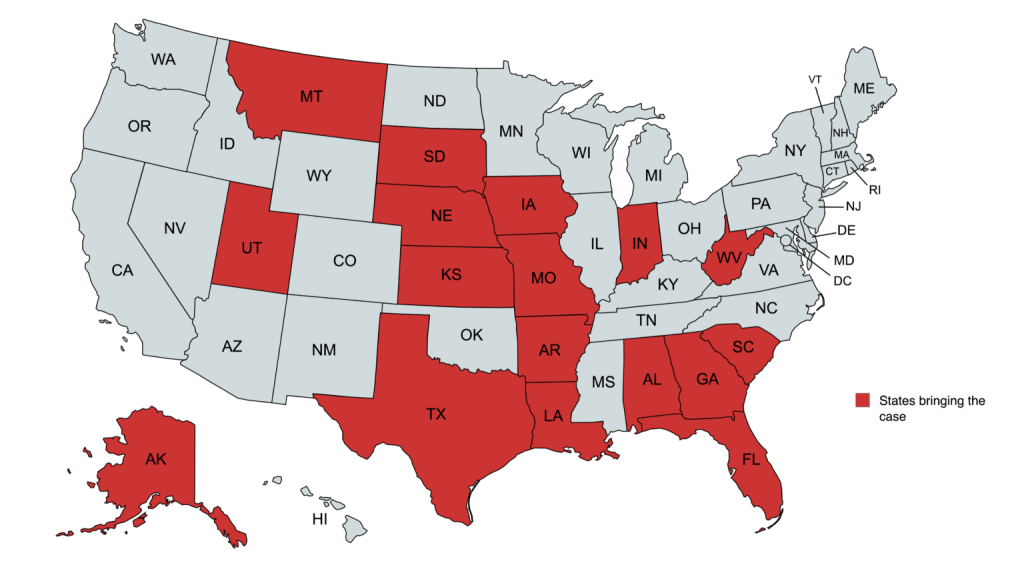
In the suit, my AG and sixteen other state AGs are suing because they want to eliminate gender dysphoria from a protected status under 504 — a Biden era addition to protect trans kids. But, the suit asks the court to get rid of all the updated rules – and to get rid of Section 504 altogether. The lawsuit says that Section 504 goes against the United States Constitution.
This will impact so many students in the country. The point is to offer no accommodations for any disability. For any child.
This is what they meant when they said Make America Great Again. They meant Kentucky in the 1930s.
There are a few things you can do: Call your AG if you live in Alaska, Alabama, Arkansas, Florida, Georgia, Indiana, Iowa, Kansas, Louisiana, Missouri, Montana, Nebraska, South Carolina, South Dakota, Texas, Utah, or West Virginia. Demand that they drop from the lawsuit.
The bright side of this suit is that it is bringing disability and accommodations in front of everyday Americans. Folks who may not understand DEI, understand a 504 — they should know diversity, equity, and inclusion efforts include disability.
Another positive note: my AG has rarely won any suit he has filed or joined. He is very bad at his job because he doesn’t seem to understand the Constitution. I hope this suit ends like most of them do…Bailey, with his tail tucked between his knees, running from cameras.
You can help get the word out by sharing this post or the others I will list at the bottom of this post.
Tell everyone you know and then start calling. We can’t do everything, but we can do one thing.
I should warn you, however, that the Office of Civil Rights may not exist anymore. It will probably be transferred to the Civil Rights Division of the Justice Department. The person nominated to lead that office is hostile to many of the civil rights protections that have been law for many years.
Here is a plain language explanation of the lawsuit, prepared by the Disability Rights Education and Defense Fund.
If the suit is successful, it would affect students and everyone else in every state, not just those where the suit was launched.
Wherever you live, join with other parents to protest. Contact all organizations that defend disability rights. Call your local officials.
Don’t let them get away with this attack on the disability rights of your child, which have been the law since 1973.





 Diane Ravitch's blog