Remember back in the day when vouchers were sold as a way to “save poor kids from failing schools”? Those days are over. The new Republican pitch is “universal vouchers,” vouchers for all, regardless of family income, regardless of whether the students ever attended public schools.
Florida is one of several Republican-led states that have passed universal vouchers. With the new money free-for-all, public schools are hiring marketing directors and communications staff to persuade students to enroll in public schools.
For first time, the Palm Beach County School District will actually need to start convincing parents to send their kids to public school.
That’s because Florida’s expanded school voucher program, which went into effect July 1, opens the door for parents of all incomes to use taxpayer money for tuition at private schools. That money is taken away from the student’s public school district at a cost of about $8,000 per student. In March, Gov. Ron DeSantis signed legislation that removed the previous income and enrollment limits on the program.
Superintendent Mike Burke announced an idea in the spring to market public schools to families weighing their options. The district launched a kindergarten registration campaign to get Palm Beach County’s youngest students in public school classrooms. Their thinking was that if students start in public school, they’re more likely to stay.
Among the first orders of business for the district’s new chief communications strategist will be expanding its marketing campaign to try to prove to parents considering vouchers that public schools are their best choice.
“I think we’re going to have to dedicate real resources to this beyond our website,” Burke said. “We’ve been competing with charter schools for 20 years. We’ve never competed with private schools.”
New voucher options arrive on Florida’s education scene at a time when public school districts are fighting pressure from fringe candidates, library book bans and new limitations on what teachers can talk about in the classroom.
Coupled with new obligations to pay millions for private school vouchers, some education experts say Florida is eroding its public education system altogether.
“It’s hard not to look at all of this and grieve,” said Joshua Cowen, a professor of education policy at Michigan State University. “Every school has a pitch. What’s different now, particularly in Florida, you’re going to see schools thinking very carefully about how to market themselves vis-à-vis the culture war stuff.”
Not all private schools in Palm Beach County are religious schools, and they’re also separate from charter schools, which are public schools run by private companies.
Palm Beach County is home to 161 private schools registered with the Florida Department of Education as of July 6. Of those schools, 44% are religiously affiliated.
And most accept vouchers.
While 109 private schools accept Family Empowerment Scholarships right now, Burke anticipates that number growing over the next several months.
“I think we’re going to see proliferation of small, ‘mom-and-pop’ private schools,” he said. “Private schools in a strip mall where people think they can turn a profit.”
Please open the link to finish reading the article.
The Virginia Democratic Party took a strong and well-informed stand in opposition to attacks on public schools.
It issued the following statement:
The Democratic Party of Virginia
Condemns the Right-Wing, Dark Money-Funded, Republican Agenda to Dismantle Public Education, Divert Public Education Funding to Private Education Management, and
Eliminate Critical Thinking and Evidence-based Curricula from America’s Public Schools
Whereas,
GOP leaders have for decades sought to dismantle public education by reducing public support to facilitate moving public funds from public to for-profit schools.
Rather than focusing explicitly on promoting privatization, the coordinated, right-wing, special-interest-bankrolled, decades-long effort has established such schemes as the annual “National School Choice Week” event and deployed “parent” groups such as “Moms for Liberty,” “Parents Defending Education” and the “Independent Women’s Forum” to make it appear that there is wide opposition to public school policies. Their current tactics are to attack public schools by opposing masking policies, remote learning, and evidence-based curricula; harassing school board members, administrators, and staff; and threatening to burn books. “School choice” is rooted in efforts to keep schools segregated by race, class, and disability.
Truthout wrote, “’Shock Doctrine author Naomi Klein predicted in March 2020 that COVID-19 presented an ideal opportunity for ‘disaster capitalism,’ a tactic pushed by school privatizers in the wake of the last financial crisis. She identified the global pandemic as a ‘shock,’ or disruptive event that global elites often use to introduce free-market ‘solutions’ that redistribute wealth upwards.” Vindicating Klein’s prediction, since the pandemic, a Koch-funded group produced an “Opportunity on Crisis” report listing numerous school privatization schemes.
Education is a multibillion-dollar market, and the private sector is eager to get its hands on those dollars. Shrinking public education also furthers the overarching Republican Party goal of drastically reducing the public sector overall. Privatization also significantly undermines teacher unions, thereby reducing the voice and power of teachers to affect the terms and conditions of their workplace. Unions are also a strong and active part of the Democratic base and hobbling them hobbles their capacity to support Democrats.
Corporate-focused extreme-right Republican leaders want to censor, control, and narrow the exposure of most students to the broad knowledge base that would enable them to analyze, understand and accurately evaluate, and manage the forces that affect their lives. They want to consign the masses of America’s children to for-profit, unregulated, unaccredited, tax-funded “schools,” with large classes of inexperienced staff or digital platforms with no teachers at all, designed to supply a less-educated, malleable citizenry and subservient labor pool. Meanwhile, the children of the financial and corporate elite are to be taught a broad, rich curriculum in small classes led by experienced teachers in exclusive private schools.
Preparing people for democratic citizenship was a major reason for the creation of public schools. The Founding Fathers maintained that the success of American democracy would depend on the competency of its citizens and that preserving democracy would require an educated population that could understand political and social issues, participate wisely in civic life, and resist tyrants. Early leaders proposed the creation of a more formal and unified system of publicly funded schools.
Thomas Jefferson wrote: “Above all things I hope the education of the common people will be attended to; convinced that on their good sense we may rely with the most security for the preservation of a due degree of liberty.” Jefferson further explained: “The object is to bring into action that mass of talents which lies buried in poverty in every country, for want of the means of development, and thus give activity to a mass of mind, which, in proportion to our population, shall be double or treble of what it is in most countries.”
In the 1830s, Massachusetts legislator Horace Mann advocated for the creation of public schools that would be universally available to all children, free of charge, and funded by the state. He emphasized that a public investment in education would benefit the whole nation by preparing students to obtain jobs that will strengthen the nation’s economic position and promote cohesion across social classes. Proponents later reasoned that public schools would not serve as a unifying force if private schools drew off substantial numbers of students, resources, and parental support from the most advantaged groups. To succeed, a system of common schooling would require children from all social classes, and educating children from different religious, and European ethnic backgrounds in the same
schools would also help them learn to get along. Despite its founding ideals, throughout the historical development of early public education, there was discrimination against access for girls, children of color, new immigrants, minority religious groups, children with disabilities and others. However, the founding rationale has guided the evolution of the public-school mission to promoting equity of access to all in the mid-20th century, addressing social needs after WW II and ensuring that all students receive a high-quality education in the 21st century.
The original reasons for public schools — preparing people for jobs and citizenship, unifying a diverse population, and promoting equity–remain relevant and urgent today. The Republican agenda to dismantle public education will reverse all of these.
Virginia Governor Glenn Youngkin is facilitating this ongoing right-wing scheme of school privatization and blocking of evidenced-based curricula with his executive orders allowing parents to opt out of mask mandates in Virginia schools, and ending “the use of divisive concepts, including critical race theory, in public education.” Meanwhile, Virginia’s Democratic legislators are introducing and protecting legislation that supports and promotes public schools with enriched and broad curricula to prepare students for citizenship and work in the 21st century.
Most American parents, students, and teachers do not agree with this privatization and curricula-limiting scheme, and many are standing up for schools that protect kids’ health, teach the truth, and promote equality for all. Our democracy
requires informed citizens. Public education enables its citizens to develop their full potential, which enables our democracy to flourish. It enables individuals to learn and grow and creates a successful and prosperous society.
Therefore, be it resolved that the Democratic Party of Virginia:
1. Calls on local, state, and federal officials, within the purview of their offices and roles, to:
a. Investigate, expose, and prosecute all individuals and groups who deploy intimidation tactics, threats of violence and violence against school board members, administrators, teachers, and others;
b. Initiate a public campaign, including forums, social and other media, etc., to highlight the historical compact establishing universal primary and secondary public education as a necessity to prepare an informed citizenry for their role in a democracy; illuminate the accomplishments of many decades of public education and the benefit to our country’s democracy; and provide a platform for people, including doctors, scientists, business leaders, and religious leaders, to relate their stories of the public school teachers who were instrumental in their success;
c. Increase funding and support for public schools and educator, administrator, and staff compensation; and
d. Introduce legislation and support an enriched, broad, public-school curricula for all students in liberal arts, science, technology, engineering, and mathematics (STEM), and career and technical education.
2. Commends Officials at all levels, including democratically elected school boards, who implement and parents who support an enriched, broad, public-school curricula for all students in liberal arts, science, technology, engineering, and mathematics (STEM), and career and technical education.
3. Calls on grassroots activists and organizations to launch a campaign to expose the right-wing, special-interest funded, Republican agenda to dismantle public education, divert public education tax dollars to private management of public schools, and to eliminate critical thinking and evidence-based curricula from America’s public schools.
4. Calls on grassroots activists, organizations, community and faith groups, parents, and the public to support increased funding for public schools and educator, administrator, and staff compensation, and to support an enriched, broad, public-school curricula for all students in liberal arts, science, technology, engineering, and mathematics (STEM), and career and technical education.
Peter Greene was a teacher in Pennsylvania for 39 years. He is now a regular writer at Forbes and a super star blogger. This column appeared on his blog. He responded to Rick Hess’s claim that school choice is not an attack on public education but part of a long history of trying to improve them. From my perspective, it’s hard to understand how public schools improve by defunding them and replacing them with religious schools, low-quality private schools, home schooling, and cyber charters.
This is what Peter Greene wrote:
Rick Hess (American Enterprise Institute) is one of those occupants of the reformy camp that I take seriously, even when I think he’s wrong. So when he raises the question of whether or not school choice is an “attack” on public education, I think it’s a question worth talking about, because I think the answer is a little bit complicated. So let me walk through his recent piece on that very question bit by bit.
After an intro suggesting that choice expansion flows directly from the pandemic while ascribing opposition to choice to a shadowy cabal that flows from teachers unions, Hess gets to his point, which is that seeing choice as an anti-public school is “misleading and misguided.”
Hess puts choice in the context of a century’s worth of public school fixer-uppers, “a barrage of reforms.” He offers a list–“compulsory attendance, district consolidation, larger schools, smaller schools, magnet schools, standards, test-based accountability, merit pay, and more.”
Some of these ideas were good. Some weren’t. But in hindsight, it’s pretty clear that they weren’t “attacks” on public education; rather, they were attempts to improve it.
I disagree. Some of these ideas were offered with sincere hope for the best. But I’m going to single out the standards movement and test-based accountability for special recognition here.
If you weren’t teaching during the rise of No Child Left Behind, Common Core, and Race To The Top, I’m not sure if I can really capture for you the dawning sense of horror, frustration and futility among teachers at the time.
Word came down that new regulations required us to get test scores up– a little bit per year for starters, then ramping up to an impossible climb, until somehow every single student would be above average. If not, there would be penalties, maybe the complete dismantling and rebuilding of the district, perhaps as a privately-run charter school. “This is not possible,” educators said. “All will learn all,” replied the Powers That Be. “Don’t you believe that students can learn? And which child do you propose to leave behind.”
Then there were the tests themselves. Not very good, and with results coming back with so little detail–and so very late in the game–that they were less than no help at all. “Well, if we just teach the standards, the tests scores will follow,” said some optimistic educators. That didn’t happen. Schools rejiggered curriculum, pulled students away from untested material like art and recess so that they could be double-whammied with test prep.
“Maybe Obama will fix it,” we hoped. He did not. He doubled down. And 2014–the year for 100%–came closer and closer, the year when anyone dealing with educational reality knew that every district in the country would be either a) failing or B) cheating.
And through those years, one at a time or in small groups, teachers arrived at an unpleasant conclusion.
They are setting us up for failure. They want us to fail.
Why would they want that? The rhetoric had already been around on the far right, back all the way to Milton Friedman and on through his intellectual spawn– public education should be dismantled. There was a new push for vouchers and especially charter schools, and that coincided with rising noise about “failing” public schools. There was very little “let’s expand the educational ecosystem” and an awful lot of “we must help students escape failing public schools.” The constant refrain of “school choice will force public schools to improve because competition” was also an omnipresent crock, a slap in the face to educators who were already working their butts off and resented the suggestion that they were either incompetent or lazy. And that thread runs all the way up guys like Christopher Rufo arguing that to get to universals school choice, you have to get to universal distrust of public schools.
Maybe school choice wasn’t in and of itself an attack on public education, but it certainly seemed as if attacking public education was a means of promoting school choice.
I have no doubt that there are people who believe that education would work better if handled by the free market (I think their belief is magical, misguided and wrong, but I do believe it’s sincere). I believe there are technocrats who believe that standards, tests and data would improve education (ditto).
But to be a public school educator on the receiving end of all this (and more) absolutely felt like an attack. The irony is that when reformsters eventually figured out that the attack-filled rhetoric wasn’t helping and they dialed it back, the attacks themselves had become more real.
But let’s get back to Hess.
Public education can encompass a lot of approaches, and it can be organized in many different ways. Rather than blindly insist that “defending public schooling” requires clinging to outdated policies from decades (or centuries) past, we would do better to clarify principles, examine particulars, and then debate proposals.
All of this language is doing a lot of work, but as far as it goes, Hess and I probably agree more than we disagree. But the disagree part comes in the very next paragraph.
Indeed, the pandemic was a stark reminder that there are lots of ways to deliver schooling, including innovations such as learning pods, microschools, virtual tutors, and education savings accounts.
Learning pods and microschools are okay if you’re wealthy. As policy ideas in the vein of the DeVosian, “Well, your voucher may not be enough to get into a good private school, but you can always start a microschool,” they suck. I don’t think there are more than a hundred people in the country who came out of the pandemic thinking virtual education is a great idea. And education savings accounts are just vouchers with extra super-powers and porcine lip gloss. And none of these are really new ideas. They also all suffer from the same issue, which is the notion that any school choice system must be done free market style. We can do a great choice system without the free market at all (but that’s a post for another day).
Hess identifies one of the issues as the fuzziness of the word “public.” On this point, I think he gets some things wrong.
Choice opponents assert that public schools are “public” because they’re funded by public tax dollars.
No, that’s choicers. It’s been part of the charter school argument that charter schools are public schools because they are funded with public dollars. This pro-public ed writer (I’m not anti-choice, but I am anti-most-of-the-versions-of-choice-with-which-we’ve-been-presented) would say that public schools are public because they the public funds them, owns them, and operates them via representatives. Furthermore, they are public schools because they have a responsibility to the public to serve all students.
You can argue, as Hess and others do, that districts regularly hire outside firms to handle certain functions and occasionally outsource the teaching of certain students with exceptional special needs. But in all those cases, the responsibility for the management of those outside contracts rests with the public school district. A charter or private voucher-fed school carries no such responsibility. A public school district cannot, as can charters and voucher schools may, simply show parents the door and say, “Good luck. Your child is not our problem.” Do all public systems meet that responsibility as well as they ought to? Absolutely not. But at least the responsibility exists. A parent who thinks the public system is short-changing their child can (and often will) sue the district. They have no such option in a choice system, as such systems are currently conceived.
Hess is correct in calling public education “a pretty expansive category.” But it hinges on far more than whose money is being used.
In fact, I’d argue that it is the responsibility portion that is the big difference in the brand of choice being pushed by many these days. Our public system is based, however imperfectly, on the notion that we bear a collective responsibility for educating the young. Modern choice, particularly the current version sold under the culture warrior parental right brand, is about saying that getting a child an education is the responsibility of the parents, and that’s it. Yes, many choicers are also trying to privatize the ownership and provision of education, but it is the privatizing of responsibility for a child’s education that is perhaps the most profound and fundamental shift.
More importantly, simply calling something “public” doesn’t make it a good thing. While the phrase “public schooling” is suffused with happy notions of inclusivity and fairness, “public” isn’t a magic word.
Ain’t it that truth. Public education has a wide variety of issues–though some of those are the direct result of reformster attempts to “fix” things (see above re: standards and testing). But I’ve never argued that I’m against modern school choice and ed reform because public schools are perfect the way they are and everything else sucks. My most fundamental issue is that public schools have some serious issues, and modern ed reform and school choice don’t solve any of them (yes, that is also another long post). They just weaken public school’s ability to work on them while blowing through a giant pile of taxpayer money.
The point isn’t to play word games but to understand that things are less clear-cut than defenders of the status quo are prone to acknowledge. There are many ways to provide and serve the aims of public education.
After all these decades in the ed biz, I’m inclined to assert, repeatedly, that everything in education is less clear-cut that the vast majority of people acknowledge. Some folks on my side of the aisle are quick to infer nefarious and/or greedy motives when, sincere ideology is sufficient explanation (much as some folks in the choice camp assume that the only reason someone would stick up for public ed is because she’s on the union payroll). Some choicers are simply ignorant of how any of this school stuff works. Some are up against a particularly dysfunctional local version of public education. Some are anti-democrats for whom this is just one issue of many, one more way in which the government steals their money to spend it on Those People. Some want to recapture education for a particularly conservative version of christianist religion. Some want to social engineer their way to a more efficient society. Some are serious people, and some are not.
In short, the choicer and reformster camp contains a great variety of individuals.
Are some of those individuals interested promoting school choice as a way of making public education better? Is it possible to make public education better by incorporating some choice ideas? I believe that latter is true, and I swear I’m going to post about it in the not too distant future, and as for the former, well… yes, but.
But for all the variety in the choicer camp, they mostly adhere to two flawed premises– that a choice landscape should rest on a bedrock of free market mechanics and that the resulting system shouldn’t cost a cent more than the current one. As long as we start with those premises, school choice must be a zero sum game, and even if all the people who have spent the past four decades trying to tear public ed down so that choice will look better–even if all those people shut up, the zero sum game feature seems guaranteed to turn school choice into an attack on public education.
Nebraska was one of the few states that managed to resist privatization. But it is a well-known fact that the privatization industry cannot tolerate any state that devotes its resources to public schools open to all students. Nebraska had no charter schools, no vouchers, no Common Core, and no grounds for dissatisfaction: its scores on NAEP are strong.
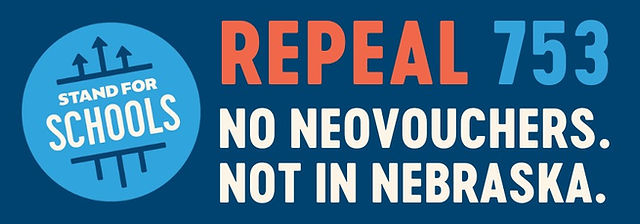
We have some very bad news to share with you, and there’s no way to sugarcoat it: Our legislature has passed Nebraska’s first school privatization bill.
Just a while ago, 33 senators voted to pass LB 753. But we aren’t deterred; we’re determined. Over 300,000 students attend a public school in Nebraska. And there are hundreds of thousands of Nebraskans who, like us, support public schools and will stand up for what’s right.
If you’re one of those Nebraskans (and we think you are), please support our work today for Give To Lincoln Day. A gift of $20 or more will send the school privatizers a strong message: NOT IN NEBRASKA.
Right now, somewhere not in Nebraska, DeVos and other billionaires who backed this bill are undoubtedly celebrating. Our state was one of the last to fall for their privatization schemes.
While the mega-donors like DeVos break open their champagne, our team at Stand For Schools is still hard at work – fighting to advance public education in Nebraska for ALL and getting fired up for the Support Our Schools Nebraska effort.
Please support our work today with a gift of $20 or more for Give To Lincoln Day. We can honestly say we’ve never needed your help more than we do today. Our team is ready to win this fight – whether it’s in a courtroom or at the ballot box – but we can’t do it without you.
Here is Stand for Schools statement, released today:
Today’s passage of LB 753 marks a dark new era for schooling in Nebraska.
The Legislature’s Education Committee considered proposals this year to make school lunches free, broadly prohibit discrimination, include student voices in curriculum decisions, and increase the poverty allowance in TEEOSA. But instead of improving the schools that serve 9 out of 10 children in our state, instead of addressing the needs of over300,000 students attending Nebraska public schools, 33 senators chose todayto prioritize giving tax breaks to the wealthy and corporations by sending tax dollars to unaccountable private schools.
They did so despite overwhelming and constantly mounting evidence that the implementation of tax-credit voucher schemes does not improve access to private schools or academic outcomes but rather marks the beginning of a devastating dismantling and defunding of public education, as it has in dozens of other states.
Policymakers who voted to pass LB 753 made the wrong choice. Statewide polling consistently shows a strong majority of Nebraskans firmly oppose school privatization measures. From Omaha to Ogallala, and Spencer to Sidney, Nebraskans take pride in our public schools because we know they are the head and heart of our urban and rural communities.
Like our fellow Nebraskans, Stand For Schools remains committed to a vision of public education that is welcoming to all students regardless of their race, religion, gender, or ability. Realizing that vision is neither easy nor politically expedient. It is, for instance, far easier to lean on out-of-state bill mills and think tanks than it is to grow our own nonpartisan solutions to nonpartisan Nebraska problems. It is far easier to demonize the education professionals who work hard in our public schools every day than it is to address crisis-level staff shortages by recruiting and retaining the qualified teachers and school psychologists our students need. It is far easier to restrict the ability of school districts to raise revenue than to finally, fully fund our K-12 public education system. And it is far easier to offload the duties of educating the next generation of Nebraskans to unaccountable private schools than to do the hard work of providing a free, fair, equitable, and excellent public school system that works for all.
Today, 33 senators chose what was easy over what was right. The consequences of their decision will be far-reaching and long-lasting. The hours the Legislature spent debating LB 735 will not compare to the years it will take to undo the damage done to public schools and the harm caused to students, their families, and their communities.
Thankfully, there are hundreds of thousands of Nebraskans who aren’t afraid of hard work, who are undeterred by today’s decision and determined to make it right. Stand For Schools is proud to join them. Together with theSupport Our Schools Nebraska coalition, we will work to put LB 753 on the 2024 ballot and ensure voters’ voices are heard: Not in Nebraska.
The national Democratic Party was once a strong champion of public schools, it once understood the importance of resources and funding for needy students and schools, it was once skeptical about the value of standardized testing.
Democratic governors jumped aboard the standards-and-testing bandwagon, led by Governor Bill Clinton of Arkansas. When Clinton became president in 1993, his major education legislation was Goals 2000, which put the Democratic Party firmly into the standards-and-testing camp with Republicans. Clinton was a “third way” Democrat, and he also enthusiastically endorsed charter schools run by private entities. His Goals 2000 program included a small program to support charter start-ups. That little subsidy—$4-6 milllion—has grown to $440 million, which is a slush fund mainly for big charter chains that don’t need the money.
George W. Bush’s No Child Left Behind legislation was supported by Democrats; it encompassed their own party’s stance, but had teeth. Obama’s Race to the Top rolled two decades of accountability/choice policy into one package. By 2008-2020, there was no difference between the two national parties on education. From Clinton in 1992 (with his call for national standards and testing) to NCLB to Race to the Top, the policies of the two parties were the same: testing, accountability, closing schools, choice. And let us not forget the Common Core, which was supposed to lift test scores everywhere while closing achievement gaps. It didn’t.
Democrats nationally are adrift, unmoored, while Republicans have seized on vouchers for religious and private schools that are completely unregulated and unaccountable. Despite evidence (Google “Josh Cowen vouchers”) that most vouchers are used by students who never attended public schools and that their academic results are harmful for public school kids who transfer into low-cost, low-quality private schools, red states are endorsing them.
Mayor Johnson of Chicago represents the abandoned Democratic tradition of investing in students, teachers, communities, and schools.
Fred Klonsky writes:
In his speech yesterday, Mayor Johnson addressed the issue of schools and education, an issue that as a retired career school teacher, is near and dear to my heart.
“Let’s create a public education system that resources children based on need and not just on numbers,” Johnson said.
I hope so.
Some have predicted that the election of Brandon to be mayor of a city with the fourth largest school district in the country might represent a shift in Democratic Party education policy.
Chicago under Mayors Daley and Emanuel gave the country Arne Duncan and Paul Vallas who together were the personifications of the worst kinds of top-down, one-size-fits-all curriculum, reliance on standardized testing as accountability and union busting.
Corporate school reform groups like Democrats for Education Reform and Stand for Children dominated the Democratic Party’s education agenda for two decades.
Joe Biden’s Department of Education has mostly been silent on these issues.
If Chicago’s election of Brandon Johnson does reflect a national shift, let alone a local one, it must do it in the face of a MAGA assault on free expression, historical truths and teacher rights.
None of this will be easy.
So, yes. I wish the Mayor the best and will do what I can to help.
I remember when the idea of charter schools was first introduced. Charters would provide innovative schools whose basic purpose was “to save poor kids from failing public schools.” Vouchers had the same rationale.
Charters would provide better academics, more transparency, and more accountability. Charters would require less funding than public schools because they would be free of bureaucracy. Parents would hold them accountable by pulling their kids out. The competition with charters would improve public schools.
A large crowd was on hand in January to see the Gray Collegiate Academy War Eagles basketball teams play in the school’s new on-campus gymnasium in West Columbia. No more bus rides downtown to Allen University, where Gray played most of its home games since opening in 2014.
“It brings everything that we have been working toward for nine years, full force,” Gray Collegiate athletic director and football coach Adam Holmes said. “There is nothing that we don’t have and can’t work toward to get.
“Our academics is second to none. Now, we have a turf football and soccer stadium, state-of-the-art gym, baseball, softball fields on campus. Hopefully, this will elevate us even more.” Less than two months later, Gray’s boys and girls basketball teams won state championships.
In the past 12 months, Gray also won state titles in softball and competitive cheer, and it won the 2021 football state title.
What once was a dream for Gray Collegiate was now reality. But for many of the high school teams that have had to play the War Eagles, the milestone of Gray adding new on-campus facilities might sound like more of a nightmare.
In their eyes, here is a burgeoning Goliath in athletics, a public charter school with advantages in attendance guidelines and whispers of recruiting tactics that result in all-star rosters that can dominate opponents. Gray and other charter schools — along with several private schools that compete in the public school league — are increasingly dominating small school athletics in South Carolina.
In the current school year, 13 of the 16 S.C. High School League fall and winter sports team championships in Class A and Class 2A were won by charter or private schools.
Administrators at traditional schools are starting to push back. One, the superintendent of Fairfield County schools, said he would not force teams in his district to play games against Gray if they didn’t want to.
The tension is pushing high school sports in South Carolina to a tipping point that could reshape not only their structure and oversight but force a fundamental reckoning on how the state deals with core issues such as fairness, sportsmanship and the boundaries of competition.
State law for public schools prohibits discrimination on these very same grounds. In other words, public schools may not discriminate against these two groups, but publicly-funded voucher schools may and do.
Among the voucher schools, discrimination against gay students and families is usually on religious grounds. Voucher schools may exclude students with disabilities for any reason, such as lack of staff or resources.
Wisconsin has funds 52,000 students in 373 private voucher schools, or 6% of all students in publicly funded schools. This year the state spent $444 million on vouchers. “About one-fifth of voucher schools have 90% or more of their students on vouchers, what one scholar describes as “private in name only.” Republicans want to expand voucher availability by removing any limits, so that public funds underwrite tuition for rich kids.
Wisconsin is considered the birthplace of the “school choice” movement. The nation’s first publicly funded private voucher program began in Milwaukee in 1990. Initial restrictions, such as limiting vouchers to secular schools, have disappeared as the program has expanded. Today, 32 schools — including at least one with an anti-LGBTQ+ stance — have their entire student bodies on publicly funded vouchers.
Legal discrimination against students who are LGBTQ+ or have disabilities results from a lack of state-level protections; a federal exemption that allows religious entities to discriminate against LGBTQ+ students and another that requires schools taking federal funds to make only minor adjustments for students with disabilities; and a state education agency constrained by punctilious rules and decades of litigation.
One of the cardinal goals of publicly-funded education is equal opportunity for all. In voucher schools, it’s equal opportunity for some. We are reminded once again that “school choice” means SCHOOLS CHOOSE.
The Texas Monthly asks the question: Why is Governor Greg Abbott pitching vouchers only at private Christian schools? Could it be that he knows that vouchers are a subsidy for the tuition the family is already paying? If tuition is $12,500 per child, a voucher of $8,000 is a nice chunk of change. Maybe he knows that in other states, 75-80% of vouchers are used by students already enrolled in private schools. He knows this is a reward to his evangelical base. He doesn’t give a hoot about the 5.4 students in public schools, most of whom are not white. He cares a lot about the 300,000 kids in private schools. He criticizes public schools for “indoctrinating” students. What does he think happens in religious schools? It is spelled I-N-D-O-C-T-R-I-N-A-T-I-O-N.
Who would school vouchers really benefit?
Governor Greg Abbott is helping to answer that question, not so much through his rhetoric, which is relentlessly on-message (“educational freedom,” “parental rights,” “school choice”) as through his actions. Over the last few months, the governor has been taking his case for school vouchers on the road, traveling around the state to talk up the benefits of education savings accounts, the wonky name for a program that would offer taxpayer dollars to parents who enroll their kids in private schools.
But it’s impossible not to notice that Abbott has only visited expensive private Christian institutions—all Protestant—in front of friendly audiences of parents who have opted out of public education. Of the seven schools the governor has visited on his “Parent Empowerment Tour,” not a single one has been a public school or a secular private school or a religious school affiliated with Catholicism, Islam, or Judaism. Not even a Montessori. If the goal was to reassure critics that Abbott’s embrace of vouchers wasn’t a recipe for draining the public school system while subsidizing the children of wealthy Christian conservatives in private schools of their choice, well, none of those critics were around to hear it. The governor was quite literally preaching to the choir.
A recent appearance, at Brazos Christian School in Bryan, is representative. Brazos Christian is a private school serving kids from prekindergarten through high school, whose mission is “training, equipping, and educating students to impact the world for Jesus.” Tuition costs more than $12,500 a year for high-school students. Applicants for seventh through twelfth grade at Brazos Christian “must evidence a relationship with Jesus Christ” and provide a reference from a pastor to have a shot at acceptance. When Abbott showed up in early March, he spoke at a dais emblazoned with a sign reading “Parents Matter,” the kind of focus-group-tested slogan beloved by politicians and marketers. Hovering behind the governor’s head was the school’s cross-centric emblem.
Imagine your tax dollars supporting a school that will not accept your child because he or she does not have a “relationship with Jesus Christ.”
In recent months, state legislatures across the country have broadened efforts to subsidize private school tuition with taxpayer dollars. New proposals for these programs—collectively called school vouchers—have appeared in more than a dozen states and passed as major priorities for Republican governors like Kim Reynolds in Iowa and Sarah Huckabee Sanders in Arkansas. Since 2021, Arizona, Florida, Utah and West Virginia have also created or expanded voucher plans. Meanwhile, a handful states like Indiana, Louisiana, Ohio and Wisconsin have run voucher programs for years. But do school vouchers actually work? We need to focus on what research shows, and what that means for kids moving forward.
As an analyst who has studied these and other forms of school choice for nearly two decades, I’m in a good position to give an answer. And based on data from existing voucher programs, the answer is almost unambiguously negative.
Let’s start with who benefits. First and foremost, the answer is: existing private school students. Small, pilot voucher programs with income limits have been around since the early 1990s, but over the last decade they have expanded to larger statewide initiatives with few if any income-eligibility requirements. Florida just passed its version of such a universal voucher program, following Arizona’s passage in the fall of 2022. In Arizona, more than 75% of initial voucher applicants had never been in public school—either because they were new kindergartners or already in private school before getting a voucher. That’s a problem because many voucher advocatesmarket these plans as ways to improve educational opportunities for public school children.
And what about the students who do leave public schools? Some plans, like the currently proposed bill in Texas, restrict eligibility to students in public school for at least one year. But for the children who do transfer using a voucher, the academic results in the recent scaled-up statewide programs are catastrophic. Although small, pilot-phase programs showed some promise two decades ago, new evaluations of vouchers in Washington, D.C.,Indiana, Louisiana, and Ohio show some of the largest test score drops ever seen in the research record—between -0.15 and -0.50 standard deviations of learning loss. That’s on par with what the COVID-19 pandemic did to test scores, and larger than Hurricane Katrina’s impacts on academics in New Orleans.
And these harmful voucher impacts from existing statewide vouchers lasted for years, with little else on balance to show for it.
What explains these extraordinarily large voucher-induced declines? Aren’t private schools supposed to be elite educational opportunities? When it comes to private schools accepting voucher payments, the answer is clearly no. That’s because elite private schools with strong academics and large endowments often decline to participate in voucher plans. Instead the typical voucher school is a financially distressed, sub-prime private provider often jumping at the chance for a tax bailout to stay open a few extra years.
In Wisconsin, 41% of voucher schools have closed since the program’s inception in 1990. And that includes the large number of pop-up schools opening just to cash in on the new voucher pay-out. For those pop-up schools, average survival time is just 4 years before their doors close for good.
Here’s another problem: for most students, using a voucher is a temporary choice to begin with. In states that have reported data on the question–Indiana, Louisiana, and Wisconsin—roughly 20% of students leave voucher programs each year, either because they give up the payment or because schools push them out. In Florida, where vouchers just expanded, that number is even higher: around 30% per year in pre-expansion data.
That kind of turnover is bad for kids, even when they’re leaving under-performing voucher schools. Not least because kids who leave voucher programs tend to be students of color, lower income children, and kids struggling academically in the first place.
And it’s not just the academic results that call into question any rhetoric around opportunities created by vouchers. Private schools can decline to admit children for any reason. One example of that is tied to the latest culture wars around LGBTQ youth, and strengthened in current voucher legislation. In Florida, a voucher-funded school made national news last summer when it banned LGBTQ children. In Indiana, pre-pandemic estimates showed that more than $16 million in taxpayer funding had already gone to voucher schools with explicit anti-LGBTQ admissions rules.
Voucher schools also rarely enroll children with special academic needs. Special education children tend to need more resources than vouchers provide, which can be a problem in public schools too. But public schools are at least obliged under federal law to enroll and assist special needs children—something private schools can and do avoid.
When we look at all the challenges to accessing education with these programs it’s clear that actually winning admission to a particular private school is not about parental school choice. It’s the school’s choice.
That is what research on school vouchers tells us. Vouchers are largely tax subsidies for existing private school families, and a tax bailout for struggling private schools. They have harmful test score impacts that persist for years, and they’re a revolving door of school enrollment. They’re public funds that support a financially desperate group of private schools, including some with active discriminatory admissions in place.
And public support for these programs is tenuous at best, highly dependent on state contexts. Recent media reports indicate that the latest voucher push is at least partly the result of well-funded campaigns led by Betsy DeVos, the conservative billionaire and U.S. Education Secretary under Donald Trump. DeVos has championed vouchers for decades as an alternative to traditional public education in what she, Trump, and other supporters call “government schools.”
But DeVos has acknowledged the poor track record for vouchers—at least when it comes to academic impacts. Asked about the dismal results of the Louisiana voucher plan while she was a public official, DeVos avoided detailed comment, but her answer back then was as good a summary as any that a voucher expert like me could provide. That program, she said, was “not very well-conceived.”
That goes for school voucher plans today, currently spreading across the country.
The Network for Public Education has its own blog, where it posts timely articles about the attacks on public schools and ongoing strife over privatization. This is an important article by Maurice Cunningham about the continuing interest of the Walton Family Foundation in Massachusetts. Walton (and other billionaires) tried but failed to win a state referendum to allow unlimited expansion of charter schools in 2016; Maurice Cunningham played an important role by exposing the Dark Money behind the referendum, which was pitched as “saving poor minority kids from failing public schools.” When school boards, civil rights groups, teachers’ unions, parent associations and other friends of public schools saw who was paying the bills, they overwhelmingly defeated the referendum. It would have been quite a coup to plant the flag for privatization in Massachusetts, the birthplace of Horace Mann.
Maurice Cunningham is a retired professor and experienced tracker of dark and murky money in education politics. Periodically he rolls out some of the information that some media outlets never quite get around to publishing.
We all love us some Market Basket so imagine if the Walton family of Arkansas (d/b/a WalMart) bankrolled a takeover of our local grocer! News coverage would be constant—the Globe, the two NPR radio stations, local TV descending on shoppers to ask about their favorite possum pie recipes (it’s an Arkansas delicacy). But the Waltons spend millions to privatize Massachusetts public schools and what do we get for coverage? Bupkis.
So read on if you dare, you’ll see this information nowhere else, the super-secret 2021 WALTON POLITICAL TEAM!
What is the 2021 Walton political team? It is America’s wealthiest family underwriting fronts that seek to influence government to achieve the policy goal of school privatization. As political scientists Kristin A. Goss and Jeffrey M. Berry teach us philanthropies sometimes act as interest groups. This political spending constitutes, as Robert Reich has written in Just Giving: Why Philanthropy Is Failing and How It Can Do Better, a little recognized and unaccountable form of oligarchic power.
The National Parents Union is one of his favorite groups to track, and he’s adding another to the mix.
Mea culpa, mea culpa, mea maxima culpa! Because I’ve been leaving Educators for Excellence out of these equations. E4E is a billionaire funded “teacher” house operation intended to undermine real democratic unions. Diane Ravitch explains E4E here: “It is funded by the reactionary anti-union Walton Family Foundation, the Rightwing William E. Simon Foundation, the anti-union Bodman Foundation, and the Arnold Foundation, which wants to eliminate pensions.” From 2017-2021 E4E took in $5,495,000 from the Waltons, some of which probably found its way to Boston.
As to that asterisk in 2020 the Waltons sent $400,000 to Massachusetts Parents United to establish National Parents Union, installing MPU president Keri Rodrigues as co-founder (the other co-founder mysteriously disappeared, to be replaced as treasurer my Rodrigues’s husband). In 2021 the Waltons duked NPU another $1,200,000.
I did a search for “Walton Family Foundation” from 2017-present in the Boston Globe archives and found only five references[1] for Walton Family Foundation. None covered Massachusetts WFF’s political largess but for one letter to the editor (in response to a letter from NPU/MPU/Walton agent Keri Rodrigues) and a snippet from AP. Except . . .
For a 2021 op-ed by free-lance journalist Amy Crawford titled Do-it-yourself education is on the rise. Crawford offers a big plug for Rodrigues and wrote that WFF “channeled $700,000 into direct grants (to NPU) for technology, training, and supplies for homeschooling families, cooperatives, and learning pods, in which families pool resources to hire a private teacher.” But what I think Crawford meant was the $700,000 invested in NPU by the Vela Fund, a joint venture of the Waltons and Charles Koch. Both the Waltons and Koch seek the privatization of public schools.
The post is filled with detail and specifics of particular interest to folks who follow education in Massachusetts.
Bottom line: The Waltons spend millions to influence education policy in Massachusetts and the Globe not only keeps its readers in the dark about that but promotes DFER and Rodrigues/National Parents Union/Massachusetts Parents United as authentic voices of Democrats and parents.