Archives for category: Racism

I had the pleasure of speaking by Zoom to a meeting of the Pastors for Florida Children. The event was reported by Baptist Global News.

The morning session was also addressed by Baptist minister and retired Arkansas Judge Wendell Griffen. Although we have never met, our messages were in synch: Do not let the authoritarian Governor Ron DeSantis intimidate you!

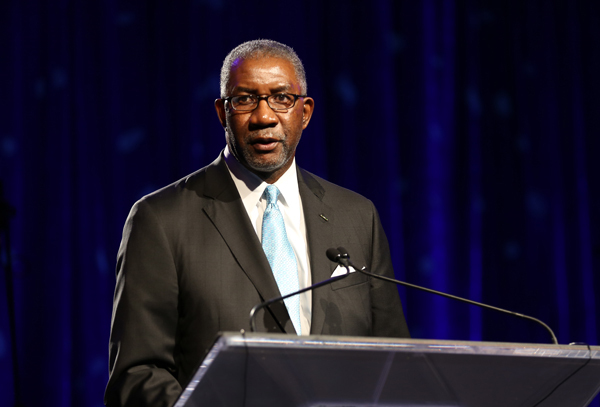
Baptist minister and retired Arkansas judge Wendell Griffen stood before an audience of faith leaders and education advocates in Tallahassee, Fla., March 9, pointed to his lapel and dared Gov. Ron DeSantis to have him apprehended for being politically and racially aware.

“I wore a ‘woke’ button on purpose. I want to get arrested for being woke. I plead guilty to being woke. I want to be convicted of being woke,” Griffen said during a prayer breakfast sponsored by Pastors for Florida Children.

Wendell Griffen

Griffen, a BNG columnist and pastor of New Millennium Church in Little Rock, urged the in-person and virtual interfaith and multiracial audience to be equally defiant of Florida’s political leaders. “Be a community of prophets but teach as one and correct, confront, organize, interact, defy, dissent, disrupt.”

Jewish, Christian and Muslim participants who prayed ahead of the speeches by Griffen and education historian Diane Ravitch focused on DeSantis’ prohibition of books that teach about racial injustice and inclusion….

Please open the link and read his bold, wise, and brave advice.

Ravitch opened with a double-barreled barrage at DeSantis’ efforts to dismantle freedom of inquiry in public schools.

“I write a daily blog, and I find that it’s being overwhelmed by the bad news from Florida,” she said. “There doesn’t seem to be anything good coming from your elected officials. If anything, it seems to be building a more and more authoritarian empire to control the thinking of everybody in the state.”

She said DeSantis seems to be going out of his way to disprove Martin Luther King Jr.’s famous saying that “the arc of the moral universe is long, but it bends toward justice.”

“Your governor and your legislature are trying to flatten that arc so that it does not bend
towards justice,” she declared.

Current political events in Florida do not impact public schools alone, Ravitch said. “Florida today is at the very apex of a movement to turn the clock back a century, to turn the clock back on religious freedom, on racial justice and on all the evolution we have experienced over this past century to make ours a more just society. Your governor is creating a model of thought control and calling it freedom. Every time I see him standing in front of a banner that says ‘freedom,’ I’m reminded of George Orwell’s 1984, where freedom equals slavery.”

The conservative attack on the concept of “woke” is another sign of burgeoning authoritarianism, she said.

“We have to redeem that word. It means being awake — awake to injustice, awake to history, awake to all the things that are wrong in our society and that have been wrong over the centuries. And his (DeSantis’) idea of woke is simply to eliminate critical thinking about history and even knowledge of history. And this is very dangerous.”

And that’s only the beginning.

The Arkansas Legislature, controlled by Republicans, passed Governor Sarah Huckabee Sanders “education” bill, dubbed LEARNS, which authorizes vouchers. The first two hearings were held during school hours. The bill sailed through the legislature. The third hearing, where students were able to attend, was limited to a six-page amendment.

The students wanted to oppose the bill, but State Senator Jane English tried to shut them down, interrupting them, cutting them off.

Students found clever ways to work around her brusque treatment but their objections were ignored.

“I’m sorry, you just don’t get to talk on the bill,” English told the students. “If you want to talk on this amendment, specifically things that are in this amendment, you’re free to do that, but you cannot speak on the bill….”

“I’d like to speak on the amendments, and how they do not go far enough to tear down and decimate this bill,” said student Ethan Walker, over repeated interruptions by English. “These petty little wording rearrangements don’t do anything to address how bad this bill actually is….”

Another student, sophomore Rhone Kuta, worked around English’s objections by referencing a specific line on a specific page, as the Republican chair repeatedly interrupted him.

“Where it deletes ‘and’ and substitutes ‘or,’ the reasons I believe this amendment is bad is, this should actually say we are deleting the voucher program on section 63 because the voucher program absolutely reallocates resources from the working class Americans and Arkansans and reallocates it to the upper class,” Kuta said.

The students showed themselves to be far more intelligent than their elected officials. They were treated shamefully. The bill was a fair accompli.

If you do only one thing today at my request, please watch the video in the Alternet post, where you will see an adult bullying high school students.

Harvard professor Henry Louis Gates Jr. reviews the long debate about how to teach Black history in an article in the New York Times. The debate began as rationales by sympathizers of the Confederacy, who changed the Civil War into “The War Between the States.” In a visit to Charleston, South Carolina, not long ago, I heard the war described in a historic home as “The War of Northern Aggression.”

Dr. Gates writes:

Lurking behind the concerns of Ron DeSantis, the governor of Florida, over the content of a proposed high school course in African American studies, is a long and complex series of debates about the role of slavery and race in American classrooms.

“We believe in teaching kids facts and how to think, but we don’t believe they should have an agenda imposed on them,” Governor DeSantis said. He also decried what he called “indoctrination.”

School is one of the first places where society as a whole begins to shape our sense of what it means to be an American. It is in our schools that we learn how to become citizens, that we encounter the first civics lessons that either reinforce or counter the myths and fables we gleaned at home. Each day of first grade in my elementary school in Piedmont, W.Va., in 1956 began with the Pledge of Allegiance to the flag, followed by “America (My Country, ’Tis of Thee).” To this day, I cannot prevent my right hand from darting to my heart the minute I hear the words of either.

It is through such rituals, repeated over and over, that certain “truths” become second nature, “self-evident” as it were. It is how the foundations of our understanding of the history of our great nation are constructed.

Even if we give the governor the benefit of the doubt about the motivations behind his recent statements about the content of the original version of the College Board’s A.P. curriculum in African American studies, his intervention falls squarely in line with a long tradition of bitter, politically suspect battles over the interpretation of three seminal periods in the history of American racial relations: the Civil War; the 12 years following the war, known as Reconstruction; and Reconstruction’s brutal rollback, characterized by its adherents as the former Confederacy’s “Redemption,” which saw the imposition of Jim Crow segregation, the reimposition of white supremacy and their justification through a masterfully executed propaganda effort.

Undertaken by apologists for the former Confederacy with an energy and alacrity that was astonishing in its vehemence and reach, in an era defined by print culture, politicians and amateur historians joined forces to police the historical profession. The so-called Lost Cause movement was, in effect, a take-no-prisoners social media war. And no single group or person was more pivotal to “the dissemination of the truths of Confederate history, earnestly and fully and officially,” than the historian general of the United Daughters of the Confederacy, Mildred Lewis Rutherford, of Athens, Ga. Rutherford was a descendant of a long line of slave owners; her maternal grandfather owned slaves as early as 1820, and her maternal uncle, Howell Cobb, secretary of the Treasury under President James Buchanan, owned some 200 enslaved women and men in 1840. Rutherford served as the principal of the Lucy Cobb Institute (a school for girls in Athens) and vice president of the Stone Mountain Memorial project, the former Confederacy’s version of Mount Rushmore.

As the historian David Blight notes, “Rutherford gave new meaning to the term ‘die-hard.’” Indeed, she “considered the Confederacy ‘acquitted as blameless’ at the bar of history, and sought its vindication with a political fervor that would rival the ministry of propaganda in any twentieth-century dictatorship.” And she felt that the crimes of Reconstruction “made the Ku Klux Klan a necessity.” As I pointed out in a PBS documentary on the rise and fall of Reconstruction, Rutherford intuitively understood the direct connection between history lessons taught in the classroom and the Lost Cause racial order being imposed outside it, and she sought to cement that relationship with zeal and efficacy. She understood that what is inscribed on the blackboard translates directly to social practices unfolding on the street.

“Realizing that the textbooks in history and literature which the children of the South are now studying, and even the ones from which many of their parents studied before them,” she wrote in “A Measuring Rod to Test Text Books, and Reference Books in Schools, Colleges and Libraries,” “are in many respects unjust to the South and her institutions, and that a far greater injustice and danger is threatening the South today from the late histories which are being published, guilty not only of misrepresentations but of gross omissions, refusing to give the South credit for what she has accomplished, … I have prepared, as it were, a testing or measuring rod.” And Rutherford used that measuring rod to wage a systematic campaign to redefine the Civil War not as our nation’s war to end the evils of slavery, but as “the War Between the States,” since as she wrote elsewhere, “the negroes of the South were never called slaves.” And they were “well-fed, well-clothed and well-housed.”

Of the more than 25 books and pamphlets that Rutherford published, none was more important than “A Measuring Rod.” Published in 1920, her user-friendly pamphlet was meant to be the index “by which every textbook on history and literature in Southern schools should be tested by those desiring the truth.” The pamphlet was designed to make it easy for “all authorities charged with the selection of textbooks for colleges, schools and all scholastic institutions to measure all books offered for adoption by this ‘Measuring Rod,’ and adopt none which do not accord full justice to the South.” What’s more, her campaign was retroactive. As the historian Donald Yacovone tells us in his recent book, “Teaching White Supremacy,” Rutherford insisted that librarians “should scrawl ‘unjust to the South’ on the title pages” of any “unacceptable” books “already in their collections.”

On a page headed ominously by the word “Warning,” Rutherford provides a handy list of what a teacher or a librarian should “reject” or “not reject.”

“Reject a book that speaks of the Constitution other than a compact between Sovereign States.”

“Reject a textbook that does not give the principles for which the South fought in 1861, and does not clearly outline the interferences with the rights guaranteed to the South by the Constitution, and which caused secession.”

“Reject a book that calls the Confederate soldier a traitor or rebel, and the war a rebellion.”

“Reject a book that says the South fought to hold her slaves.”

“Reject a book that speaks of the slaveholder of the South as cruel and unjust to his slaves.”

And my absolute favorite, “Reject a textbook that glorified Abraham Lincoln and vilifies Jefferson Davis, unless,” she adds graciously, “a truthful cause can be found for such glorification and vilification before 1865.”

And what of slavery? “This was an education that taught the negro self-control, obedience and perseverance — yes, taught him to realize his weaknesses and how to grow stronger for the battle of life,” Rutherford writes in 1923 in “The South Must Have Her Rightful Place.” “The institution of slavery as it was in the South, far from degrading the negro, was fast elevating him above his nature and race.” For Rutherford, who lectured wearing antebellum hoop gowns, the war over the interpretation of the meaning of the recent past was all about establishing the racial order of the present: “The truth must be told, and you must read it, and be ready to answer it.” Unless this is done, “in a few years there will be no South about which to write history.”

In other words, Rutherford’s common core was the Lost Cause. And it will come as no surprise that this vigorous propaganda effort was accompanied by the construction of many of the Confederate monuments that have dotted the Southern landscape since.

While it’s safe to assume that most contemporary historians of the Civil War and Reconstruction are of similar minds about Rutherford and the Lost Cause, it’s also true that one of the most fascinating aspects of African American studies is the rich history of debate over issues like this, and especially over what it has meant — and continues to mean — to be “Black” in a nation with such a long and troubled history of human slavery at the core of its economic system for two-and-a-half centuries.

Heated debates within the Black community, beginning as early as the first decades of the 19th century, have ranged from what names “the race” should publicly call itself (William Whipper vs. James McCune Smith) and whether or not enslaved men and women should rise in arms against their masters (Henry Highland Garnet vs. Frederick Douglass). Economic development vs. political rights? (Booker T. Washington vs. W.E.B. Du Bois). Should Black people return to Africa? (Marcus Garvey vs. W.E.B. Du Bois). Should we admit publicly the pivotal role of African elites in enslaving our ancestors? (Ali Mazrui vs. Wole Soyinka).

Add to these repeated arguments over sexism, socialism and capitalism, reparations, antisemitism and homophobia. It is often surprising to students to learn that there has never been one way to “be Black” among Black Americans, nor have Black politicians, activists and scholars ever spoken with one voice or embraced one ideological or theoretical framework. Black America, that “nation in a nation,” as the Black abolitionist Martin R. Delany put it, has always been as varied and diverse as the complexions of the people who have identified, or been identified, as its members.

I found these debates so fascinating, so fundamental to a fuller understanding of Black history, that I coedited a textbook that features them, and designed Harvard’s Introduction to African American Studies course, which I teach with the historian Evelyn Brooks Higginbotham, to acquaint students with a wide range of them in colorful and sometimes riotous detail. More recent debates over academic subjects like Kimberlé Crenshaw’s insightful theory of “intersectionality,” reparations, Black antisemitism, critical race theory and the 1619 Project — several of which made Mr. DeSantis’s hit list — will be included in the next edition of our textbook and will no doubt make it onto the syllabus of our introductory course.

As a consultant to the College Board as it developed its A.P. course in African American studies, I suggested the inclusion of a “pro and con” debate unit at the end of its curriculum because of the inherent scholarly importance of many of the contemporary hot-button issues that conservative politicians have been seeking to censor, but also as a way to help students understand the relation between the information they find in their textbooks and efforts by politicians to say what should and what should not be taught in the classroom.

Why shouldn’t students be introduced to these debates? Any good class in Black studies seeks to explore the widest range of thought voiced by Black and white thinkers on race and racism over the long course of our ancestors’ fight for their rights in this country. In fact, in my experience, teaching our field through these debates is a rich and nuanced pedagogical strategy, affording our students ways to create empathy across differences of opinion, to understand “diversity within difference,” and to reflect on complex topics from more than one angle. It forces them to critique stereotypes and canards about who “we are” as a people and what it means to be “authentically Black.” I am not sure which of these ideas has landed one of my own essays on the list of pieces the state of Florida found objectionable, but there it is.

The Harvard-trained historian Carter G. Woodson, who in 1926 invented what has become Black History Month, was keenly aware of the role of politics in the classroom, especially Lost Cause interventions. “Starting after the Civil War,” he wrote, “the opponents of freedom and social Justice decided to work out a program which would enslave the Negroes’ mind inasmuch as the freedom of the body has to be conceded.”

“It was well understood,” Woodson continued, “that if by the teaching of history the white man could be further assured of his superiority and the Negro could be made to feel that he had always been a failure and that the subjection of his will to some other race is necessary the freedman, then, would still be a slave.”

“If you can control a man’s thinking,” Woodson concluded, “you do not have to worry about his action.”

Is it fair to see Governor DeSantis’s attempts to police the contents of the College Board’s A.P. curriculum in African American studies in classrooms in Florida solely as little more than a contemporary version of Mildred Rutherford’s Lost Cause textbook campaign? No. But the governor would do well to consider the company that he is keeping. And let’s just say that he, no expert in African American history, seems to be gleefully embarked on an effort to censor scholarship about the complexities of the Black past with a determination reminiscent of Rutherford’s. While most certainly not embracing her cause, Mr. DeSantis is complicitous in perpetuating her agenda.

As the Rev. Dr. Martin Luther King Jr. so aptly put it, “No society can fully repress an ugly past when the ravages persist into the present.” Addressing these “ravages,” and finding solutions to them — a process that can and should begin in the classroom — can only proceed with open discussions and debate across the ideological spectrum, a process in which Black thinkers themselves have been engaged since the earliest years of our Republic.

Throughout Black history, there has been a long, sad and often nasty tradition of attempts to censor popular art forms, from the characterization of the blues, ragtime and jazz as “the devil’s music” by guardians of “the politics of respectability,” to efforts to censor hip-hop by C. Delores Tucker, who led a campaign to ban gangsta rap music in the 1990s. Hip-hop has been an equal opportunity offender for potential censors: Mark Wichner, the deputy sheriff of Florida’s Broward County, brought 2 Live Crew up on obscenity charges in 1990. But there is a crucial difference between Ms. Tucker, best known as a civil rights activist, and Mr. Wichner, an administrator of justice on behalf of the state, a difference similar to that between Rutherford and Mr. DeSantis.

While the urge to censor art — a symbolic form of vigilante policing — is colorblind, there is no equivalence between governmental censorship and the would-be censorship of moral crusaders. Many states are following Florida’s lead in seeking to bar discussions of race and history in classrooms. The distinction between Mildred Lewis Rutherford and Governor DeSantis? The power differential.

Rutherford wished for nothing less than the power to summon the apparatus of the state to impose her strictures on our country’s narrative about the history of race and racism. Mr. DeSantis has that power and has shown his willingness to use it. And it is against this misguided display of power that those of us who cherish the freedom of inquiry at the heart of our country’s educational ideal must take a stand.

Dr. Gates is the director of the Hutchins Center for African and African American Research at Harvard. He is the host of the PBS television series “Finding Your Roots.”
Stephen J. Klees is Distinguished Scholar-Teacher and Professor of International Education Policy at the University of Maryland. Klees recently gave a talk at the Comparative and International Education Society’s (CIES) annual meeting in Washington D.C.. He considers the privatization of education to be a juggernaut of patriarchal racial neoliberal capitalism. Dr. Klees shared his talk with me.

Privatization is a scourge. Basic services should be public, publicly owned and run. It is not a question of effectiveness or costs. Privatized basic services are inequitable and violate human rights.

In education, the advent of neoliberalism in the 1980s drastically changed the narrative. Before neoliberalism, it was generally believed that basic education (primary and secondary) should usually be provided by governments, with private schooling mostly the preserve of the wealthy and religious schools. The changed narrative brought by neoliberalism no longer asked whether privatization was necessary; instead, it asked when and how should we privatize? This assault on public sector motivations, competence, and budgets happened almost overnight – due completely to ideology, there was no evidence for this shift.

This shift has led to the massive expansion of private schooling around the world, most especially in developing countries, with critics fighting a rear-guard action against this juggernaut. The fight has given us efforts like the work of PEHRCand others that led to the Abidjan Principles, Education International’s Global Response campaign, high-level reports by UN Special Rapporteurs, as well as groups in most countries challenging the privatization of education. Have all these efforts slowed the juggernaut? Perhaps, but not noticeably. Have they changed the narrative? Perhaps some, but certainly not enough.

Critical researchers have responded to the slew of studies by privatization advocates pointing out their ideological biases and methodological flaws and pointing to contrary evidence. While we critics must respond to the advocates, to me, all this research is in many ways a waste of time and money. In terms of the narrow measurement of “learning,” embodied in test scores in a few subjects, the conclusion is what we all know – with similar students, sometimes private schools perform a little better, sometimes public schools do, and often there are no important differences. The other conclusion, hardly challenged by the right, is that privatization, even with low-cost private schools, further stratifies the system exacerbating inequality. But has this critical research changed the narrative or slowed the juggernaut? Perhaps a little, but far from enough.

What can slow or stop the juggernaut and change the story? I see more hope in increased mobilization across sectors. In 2019, there was a conference in Amsterdam that brought together public service advocates and this past December an even bigger one in Santiago, Chile that had over a thousand representatives from over one hundred countries fighting for public services in education, health, water, energy, housing, food, transportation, social protection, and care sectors. The Global Manifesto produced prior to the meeting and the Santiago Declaration produced after are marvelous documents with excellent analyses of the problem and principles for universal quality public services that will hopefully serve as a rallying cry for cross-sector mobilization by civil society and social movements around the world. The argument that there is not enough money to fund needed public services is simply a refusal to change priorities and tax those who are well-off.

However, the underlying reason we don’t have essential basic public services – the big picture – are the structures of patriarchal racial neoliberal capitalism. Neoliberalism exalts the market, but what does this mean? The market is a euphemism. It means the private sector should basically run the world. Critics of capitalism are accused of believing in a conspiracy by the rich and powerful; the critics response is there is no need for conspiracy. The reproduction of poverty and inequality, environmental destruction, racism, sexism, and more are built into the very structures that surround us.

Yet let’s not dismiss conspiracies too soon. What is the World Economic Forum but the rich and powerful getting together to set an agenda for the world? How many have heard of the Trilateral Commission? It’s the same people as the WEF getting together without much publicity each year to do the same. The WEF has been pushing its 2010 Global Redesign Initiative which essentially wants to turn the UN itself into a giant PPP – with quite a bit of success. These patriarchal racial capitalist institutions, run essentially by rich white men, may not have bad intentions but they are deluded into the self-interest of believing that all we need are win-win solutions to reform current polices, supposedly for everyone – without, of course, changing any of the structures that maintain their wealth and power.

We will not stop or reverse the privatization of education juggernaut without system change. Under patriarchal racial capitalism, especially the neoliberal version, privatization is the solution to most of our ills. But business leaders are singularly unqualified to deal with education or other social problems that have no simple bottom line (like profits) and whose real solution may threaten their dominance and power. While system change is very difficult, there are many groups, organizations, and movements around the world working on exactly that. The Santiago Declaration explicitly recognizes that the battle for public services means we need to “move away from the racial, patriarchal, and colonial patterns of capitalism and towards socio-economic justice, ecological sustainability, human rights, and public services.”

In what kind of world is it considered legitimate to charge the poorest for basic services? The answer is in a patriarchal, racist, capitalist world. I hope and believe that future generations will look back in horror at the fundamentally uncivilized nature of today’s world.

Governor Ron DeSantis is doing his best to crush academic freedom and the expression of views that differ from his own. He won a sweeping re-election victory in 2022, and his party has a super-majority in both houses of the legislature. Whatever DeSantis wants, the legislature will give him.

But that’s not enough. The Democratic Party is powerless and supine, but they have the nerve to speak out against the Governor’s authoritarian policies. He can’t tolerate any nay-sayers.

Fabiola Santiago, a journalist for the Miami Herald, wrote with incredulity about the GOP’s fascist ambitions:

Now, I can truly affirm that I have seen it all in Gov. DeSantis’ Florida.

The state’s Republican Party is no longer a fan of multiparty American democracy — and they feel no shame in saying so in public. Nor in proposing legislation to dismantle it.

When the Florida GOP’s tweet appeared on my Twitter news feed, I thought it was a joke or a parody. But what Republicans are up to this legislative season is no laughing matter.

After easily winning the gubernatorial election and obtaining a Republican super-majority in the Legislature that allows the party to act unimpeded, GOP chairman Chris M. Ziegler says he’ll take nothing less than eradicating the Democratic Party. His threat to give Democrats no seat at all at the table is very real.

Republicans are acting like the hemisphere’s evil regimes. They know it, but don’t care.

On February 25, 2023, at 11:30 a.m., the chairman of the Florida GOP, Chris Ziegler, posted a tweet @FloridaGOP in which he wrote:

from Chairman @ChrisMZiegler: “Until we get every Democrat out of office and no Democrat considers running for office, we’re going to continue to step on the gas and move forward in Florida.”

Chris Ziegler’s wife Bridget is the founder of the extremist group Moms for Liberty, which is deeply involved in protests against masks, in book banning, in fighting “critical race theory,” and in attacking gays and the teaching of Black history.

Santiago continues:

The U.S. Constitution and the system of checks and balances be damned. There was immediate pushback on Twitter.

A person identifying as @k_kojei answered Ziegler: “I disagree. We need dissenting voices. That’s what a democracy is about. The problem is not helped by a one-sided view of things. Polarization is just that, no matter who does it! There has to be dialog and balance or we remain only half represented!”

Ziegler doubled down.

“We are doing just fine not giving Democrats a seat at the table in Florida,” he said, mimicking what the planet’s dictators, who think countries are their personal fiefdoms, say about the opposition.

“I recommend other states to do the same!”

More people enter the conversation, at first, remarkably civil in tone, given the sewer speech Twitter attracts.

Some of the horrified were Republican.

“That is extreme and Totalitarian by definition. Not a good look!” tweeted a man who describes himself as a “patriot” with “a recently restored account after two years. Starting from scratch. Unapologetically Conservative American!! #MAGA

“No, it’s DEMOCRACY!” retorts Ziegler, the kind of Florida man who lives in an alternate universe, and so dumb — or sure of his party’s power — that he accuses the Republicans who disagree with him of being “leftist.”

Finally, a ‘fighting for our republic” Floridian from the Treasure Coast brings a fitting hashtag to the conversation — #FloridaWhereFreedomDies. She posts a checklist of tactics Nazis used in their rise to power.

It’s eerily familiar, but nothing new to those of us who have visited museums in Israel and Germany. It all begins with religious, ethnic and lifestyle persecution, silencing the media and obliterating political opposition.

The Florida GOP and DeSantis’ ballyhooed platform is ticking off a whole lot of unimaginably undemocratic boxes.

''

TAMARA LUSH • AP

Pictured in this April 14, 2017 photo, Christian Ziegler, 33, a marketing professional from Sarasota, has become the Florida GOP chairman going into the 2024 presidential race. He made the constitutionally questionable vow to eradicate Florida’s Democratic Party and defended a one-party state. (AP Photo/Tamara Lush)

Legislator files bill

Unfortunately, talk is only the beginning.

Destroying the Democratic Party is no empty threat.

As if the new GOP chairman acting like a two-bit Third World dictator-wannabe wasn’t egregious enough, his words were quickly followed by legislative action.

Former GOP chairman, Blaise Ingoglia, 2015-2019, threw the law behind Ziegler’s words.

Now Ingoglia, a 52-year-old Spring Hills home builder — named one of Tampa Bay’s most influential politicians — filed Tuesday “The Ultimate Cancel Act,” SB 1248, creating the conditions to force the Division of Elections to declare the Democratic Party illegal in Florida.

Reading the dangerous gobbledygook contained in Ingoglia’s bill is an exercise similar to interpreting Cuba’s repressive laws, where the bureaucratic entwining of edicts achieves the goal of making the repression look reasonable to the outside world.

Ingoglia has concocted a ruse: Rule the Democratic Party racist, claiming it’s because Southern Democrats supported slavery in the 1800s, and order it dismantled the way Confederate monuments are forced to come down.

His legal maneuvering is purely a power trip. Sad to say, but it’s unnecessary. The inept Florida Democrats, the 2020 midterms showed, aren’t a serious political threat.

The GOP, however, should scare every Floridian — and, given DeSantis’ 2024 ambitions, every American. We’re just a stepping stone.

The Florida GOP is DeSantis’ party. Nothing happens behind his back. This hardened, fascist Florida is a carefully planned, if sometimes stupidly executed, plot to destroy the United States as we know it.

This isn’t unlike the Jan. 6 attack on the Capitol in 2021, only the men leading the charge are in suits instead of camouflage.

What institution will defend Floridians from tyranny when the GOP has so cleverly staged a takeover of every sector in the state?

Emboldened Florida Republicans aren’t happy with simply winning by big margins.

They want what every dictator has: total domination over what people think, whom they love, what they read. Total political control over law and policy without organized opposition to offer an alternative.

Floridians must wake up. It’s imperative.

''
The author Fabiola Santiago

None of this is happening without DeSantis’s knowledge and support. It sounds insane and fascist, but it is real. Ron DeSantis shows his true colors.

Mercedes Schneider writes here about Governor Ron DeSantis’s shameless moves to wipe out courses in K-12 and in higher education that he does not like. He is leading an audacious attack on academic freedom that has not been seen in this country since the early 1950s during the Joe McCarthy era. Then the enemy was Communism, now it is fear of those who want to investigate the roots and practices of social and political injustice.

Such people, to DeSantis, are enemies of the social order. They are WOKE, awake to inequity; they make students want to change the status quo. They cannot be tolerated. Their ideas must be eliminated. DeSantis is leading this purge, he says, to protect “freedom.” The language is Orwellian. He means to stamp out the freedom to teach and learn while boasting of his love of freedom.

In addition, he wants to transfer the power to hire new faculty from the faculty to college presidents, whom he appoints. The entire state university would become subservient to his authoritarian impulses.

Schneider describes what is happening, mostly under the radar, as DeSantis wages war on freedom of inquiry:

The current ultra-conservative education platform seeks to stifle all formal or informal discussion of diversity, equity, or inclusion in public K12 and postsecondary education, with Florida apparently leading such efforts.

Though as of yet not a formally-declared 2024 candidate, Florida governor, Ron DeSantis is in the GOP polls as an assumed and formidible GOP presidential primary candidate.

DeSantis, and the Florida legislature are working hard to exercise power over what courses or majors could exist in Florida universities, with legislative efforts to kill womens and gender studies and, as the Insider notes, “gut” a variety of majors. Meanwhile, the February 24, 2023, Tampa Bay Times reports that the Florida Department of Education (FDOE) “told school districts to produce detailed information about the programs and materials they use to address some of the state’s most hotly debated subjects.” Continuing:

In an email delivered late Tuesday, the department instructed superintendents to fill out a 34-question survey identifying titles of books and programs they have relating to sex education, social-emotional learning, culturally relevant teaching and diversity, and equity and inclusion, among other topics. It asked for specifics for student courses and employee training.

The department requested names and examples from district and charter schools.

FDOE wants the information by Monday, February 27, 2023, though it did not offer any reason.

The FDOE request came on the same day that Florida HB 999 was filed by Alex Andrade (R-Pensacola). The bill would remove faculty input from the hiring process; prohibit hiring based on diversity, equity, and inclusion (DEI); remove majors and minors related to Critical Race Theory, gender studies or intersectionailty.

This rewrite of the previous bill seeks to remove any mention of “politics,” including striking through statements such as, “Motivate students throughout the Florida State University to become aware of the significance of government and civic engagement at all levels and politics in general”; “Provide students with an opportunity to be politically active and civically engaged”, and “Nurture a greater awareness of and passion for public service and politics.”

DeSantis does not want to encourage students to become engaged in civic action. He wants to nurture complacence and passivity “in this best of all possible worlds.

Please open her post to read the gory details of this audacious attempt to put the governor of the state in charge of whatever is taught in his state.

What DeSantis is doing is not conservative. It is radical. It is authoritarian. He shows no respect for critical thinking or debate. He is unwilling to allow students to learn anything he does not like. His desire for control of what can be taught or learned is dangerous to democracy. He is attempting to establish a dictatorship and has a super-majority of both houses in the legislature who will give him whatever he wants.

A recap: The College Board is the owner of the Advanced Placement program, which provides a syllabus and an examination based on that syllabus. The organization is officially nonprofit, but it is a business that pays large salaries ($1 million+) to its top executives and relies on its revenue stream from the SAT and AP.

The College Board has engaged with leading scholars over the past two years. As the course grew closer to completion, it held meetings with state officials to collect feedback.

Florida has sought to be in the forefront of states banning a vague concept called “critical race theory,” which many teachers see as censorship of any discussion of racism in the past or present.

Florida officials denounced the early draft of the College Board syllabus. When the final draft was released on February 1, all of the topics and names that Florida singled out were either eliminated or made optional.

The College Board insisted that it did not cave to political pressure but stood its ground.

Unpersuaded, more than 1,000 scholars and supporters of African American studies signed a letter of protest to the College Board.

More than 1000 African American studies faculty members, administrators and supporters in higher education condemned the College Board’s capitulation to the Florida Department of Education in the creation of the Advanced Placement African American studies course.

In a letter addressed to College Board CEO David Coleman, the collective called for the current curriculum to be rescinded, resources be made available for students “confronting censored AP content,” to stop making false claims that the current class properly teaches African American studies and to fight “widespread efforts by states to censor anti-racist thought.”

“African American Studies is the study of the persistence of anti-Blackness and the connections between historical and contemporary efforts to resist structural racism,” the letter read. “It is an interdisciplinary engagement with the ways in which people of African descent remade and re-envisioned the world through ideas, art, politics and social movements despite the enduring character of white supremacy.”

The letter said the College Board did not uphold its “commitments against politically-motivated meddling” and specifically took issue with the removal of terms like systemic racism and intersectionality at Florida’s request, which “demean, malign and caricature Black life and the study of it.”

Signees contend that the current curriculum now lacks the fundamental aspects of African American studies and if not rescinded, some faculty will advise their institutions against accepting the AP credit.

“As a result, students may take the course without ever encountering key words and related concepts in the field including intersectionality, Black feminism, racial color blindness, institutional racism, and Black Lives Matter,” the letter read.

“Students and educators cannot engage these topics and ideas if the terms themselves are censored, as the terms themselves convey critical insights that are central to African American Studies. African American Studies is more than the study of the Black past.’”

Read more at: https://www.miamiherald.com/news/politics-government/article272531681.html#storylink=cpy

Jamelle Bouie is an opinion writer for the New York Times. He is brilliant. He writes essays about politics, philosophy, and culture. I subscribe to his opinion feed, where he writes about which books he is reading and what he’s cooking. I have never met him but I love him.

He published his thoughts about why transgender people deserve the same rights, respect, and dignity as others.

Over the past year, we have seen a sweeping and ferocious attack on the rights and dignity of transgender people across the country.

In states led by Republicans, conservative lawmakers have introduced or passed dozens of laws that would give religious exemptions for discrimination against transgender people, prohibit the use of bathrooms consistent with their gender identity and limit access to gender-affirming care.

In lashing out against L.G.B.T.Q. people, lawmakers in at least eight states have even gone as far as to introduce bans on “drag” performance that are so broad as to threaten the ability of gender-nonconforming people simply to exist in public.

Some of the most powerful Republicans in the country want to go even further. Donald Trump has promised to radically limit transgender rights if he is returned to the White House in 2024. In a video address to supporters, he said he would push Congress to pass a national ban on gender-affirming care for transgender youth and restrict Medicare and Medicaid funding for hospitals and medical professionals providing that care.

He wants to target transgender adults as well. “I will sign a new executive order instructing every federal agency to cease all programs that promote the concept of sex and gender transition at any age,” Trump said. “I will ask Congress to pass a bill establishing that the only genders recognized by the United States government are male and female, and they are assigned at birth.”

There is plenty to say about the reasoning and motivation for this attack — whether it comes from Trump, Gov. Ron DeSantis in Florida or Gov. Greg Abbott in Texas — but the important thing to note, for now, is that it is a direct threat to the lives and livelihoods of transgender people. It’s the same for other L.G.B.T.Q. Americans, who once again find themselves in the cross-hairs of an aggressive movement of social conservatives who have become all the more emboldened in the aftermath of the Supreme Court’s decision to overturn Roe v. Wade last year.

This is no accident. The attacks on transgender people and L.G.B.T.Q. rights are of a piece with the attack on abortion and reproductive rights. It is a singular assault on the bodily autonomy of all Americans, meant to uphold and reinforce traditional hierarchies of sex and gender.

Politicians and those of us in the media tend to frame these conflicts as part of a “culture war,” which downplays their significance to our lives — not just as people living in the world, but as presumably equal citizens in a democracy.

Democracy, remember, is not just a set of rules and institutions, but a way of life. In the democratic ideal, we meet one another in the public sphere as political and social equals, imbued with dignity and entitled to the same rights and privileges.

I have referred to dignity twice now. That is intentional. Outside of certain select phrases (“the dignity of labor”), we don’t talk much about dignity in American politics, despite the fact that the demands of many groups for dignity and respect in public life have been a driving force in American history since the beginning. To that point, one of the great theorists of dignity and democracy in the United States was none other than Frederick Douglass, whose experience in bondage gave him a lifelong preoccupation with the ways that dignity is either cultivated or denied.

Douglass observed “that although dignity seems to be woven into human nature, it is also something one possesses to the degree that one is conscious of having it,” the historian Nicholas Knowles Bromell writes in “The Powers of Dignity: The Black Political Philosophy of Frederick Douglass,” “and one’s own consciousness of having it depends in part on making others conscious of it. Others’ recognition of it then flows back and confirms one’s belief in having it, but conversely their refusal to recognize it has the opposite effect of weakening one’s confidence in one’s own dignity.”

Nicole Walker, a writer and editor, in “My Abortion at 11 Wasn’t a Choice. It Was My Life.”Read the guest essay.

“It’s important that the government is in sync with the public opinion, but I don’t think they are.”

Dwyarrn, one of the participants in an Opinion focus group with 12 pro-life voters.Read the focus group’s discussion.

“Sometime soon, I am going to meet a patient who has no ability to leave the state, and I am going to have to tell her that her baby has a lethal condition, and she is going to have to carry a pregnancy to term against her will.”

David N. Hackney, a maternal-fetal medicine specialist, in “I’m a High-Risk Obstetrician, and I’m Terrified for My Patients.”Read the guest essay.

“There are more of us than there are of them. That’s especially true if American men recognize that their way of life is also under attack. Men also have sex for pleasure. This is not just a women’s issue.”

“My fellow pro-lifers and I will also need to make the case to expectant mothers, and fathers too, that their unborn children are, like the rest of us, dependent and needy persons.”

Erika Bachiochi, a conservative legal scholar, in “What Makes a Fetus a Person?”Read the guest essay.

“The overturning of Roe v. Wade reveals the Supreme Court’s neglectful reading of the amendments that abolished slavery and guaranteed all people equal protection under the law. It means the erasure of Black women from the Constitution.”

It is easy to see how this relates to chattel slavery, a totalizing system in which enslaved Black Americans struggled to assert their dignity and self-respect in the face of a political, social and economic order that sought to rob them of both. But Douglass explored this idea in other contexts as well.

Michele Goodwin, a professor of law at the University of California, in “No, Justice Alito, Reproductive Justice Is in the Constitution.”Read the guest essay.

Writing after the Civil War on women’s suffrage, Douglass asked his readers to see the “plain” fact that “women themselves are divested of a large measure of their natural dignity by their exclusion from and participation in Government.” To “deny woman her vote,” Douglass continued, “is to abridge her natural and social power, and to deprive her of a certain measure of respect.” A woman, he concluded, “loses in her own estimation by her enforced exclusion from the elective franchise just as slaves doubted their own fitness for freedom, from the fact of being looked down upon as fit only for slaves.”

Similarly, in her analysis of Douglass’s political thought — published in the volume “African-American Political Thought: A Collected History” — the political theorist Sharon R. Krause shows how Douglass “clearly believed that slavery and prejudice can degrade an individual against his will” and generate, in his words, “poverty, ignorance and degradation.”

Although Douglass never wrote a systematic account of his vision of democracy, Bromell contends that we can extrapolate such an account from the totality of his writing and activism. “A democracy,” Douglass’s work suggests, “is a polity that prizes human dignity,” Bromell writes. “It comes into existence when a group of persons agrees to acknowledge each other’s dignity, both informally, through mutually respectful comportment, and formally, through the establishment of political rights.” All of our freedoms, in Bromell’s account of Douglass, “are meanstoward the end of maintaining a political community in which all persons collaboratively produce their dignity.”

The denial of dignity to one segment of the political community, then, threatens the dignity of all. This was true for Douglass and his time — it inspired his support for women’s suffrage and his opposition to the Chinese Exclusion Act — and it is true for us and ours as well. To deny equal respect and dignity to any part of the citizenry is to place the entire country on the road to tiered citizenship and limited rights, to liberty for some and hierarchy for the rest.

Put plainly, the attack on the dignity of transgender Americans is an attack on the dignity of all Americans. And like the battles for abortion rights and bodily autonomy, the stakes of the fight for the rights and dignity of transgender people are high for all of us. There is no world in which their freedom is suppressed and yours is sustained.

Ron DeSantis responds to critics of his campaign to stamp out “critical race theory” by saying that Florida mandates a high school course in Black history. What he doesn’t say is that the course is offered in only 11 of the state’s 67 districts.

It isn’t offered because the state has not funded the development of a curriculum and has ignored the “mandate.”

The unenforced mandate was passed in 1994 in an attempt to make amends for the atrocities that occurred in Rosewood, Florida, exactly 100 years ago.

In 1923, 200 white terrorists sacked and burned the all-black town of Rosewood, Florida. The town was burned to the ground, and some who resisted were lynched.

Mary Ellen Klas wrote in The Miami Herald:

The painful details of the unpunished lynchings and vigilante violence went from being family secrets to the foundation for legislation awarding the first reparations paid by a state in the nation’s history to survivors of racial violence. They also became the catalyst for the 1994 law requiring the teaching of Florida’s Black history in K-12 schools. The law requires that courses comprise five components: African beginnings, the passage to America, slavery, the Reconstruction period after the Civil War and the “contributions of African Americans to society.”

DeSantis and his education commissioner Manny Diaz, Jr. object to any mention of the state’s violent racist history, and they certainly don’t want people today to know that the state agreed to pay reparations to the few survivors of the Rosewood massacre. That may be why they objected vehemently to any mention of the reparations movement in the AP course. They have a guilty conscience.

As DeSantis defends against charges that he is “erasing the state’s Black history,” he cites the 1994 law as evidence that it is required to be taught, but he is confronted with contradictions:

▪ Budget records show that the implementation of the law that has been on the books for decades has been not only understaffed and barely enforced, but DeSantis and legislative leaders have rejected requests to beef up resources to expand the teaching of Black history in Florida.

▪ The word “reparation,” which is central to the Rosewood saga that spawned the Black history law, is now considered off-limits in Florida classrooms because state officials have determined that discussion of the reparation movement, which involves offering financial restitution to the descendants of enslaved people for the harms of slavery and racial discrimination, is an attempt at “indoctrination.”

“We proudly require the teaching of African American history. We do not accept woke indoctrination masquerading as education,’’ wrote Education Commissioner Manny Diaz on Twitter last month as he defended the Department of Education’s decision to reject the Advanced Placement course in African-American Studies because it “lacked educational value.”

Hypocrites. DeSantis is hoping to become President by appealing to racism and to white grievances and resentment towards Blacks. He has amplified false claims about critical race theory, which involves the study of racism. He wants to make open bigotry respectable by loudly proclaiming that anyone who wants factual history and wants to eliminate racism is “woke.”

Lincoln spoke to “the better angels of our nature.” DeSantis appeals to the worst instincts of our nature.

Read more at: https://www.miamiherald.com/news/politics-government/article271882322.html#storylink=cpy

Linda Lyon, former president of the Arizona School Boards Association, writes in her blog “Restore Reason” about the newly elected State Superintendent of Public Instruction Tom Horne, who held the same office from 2003 to 2013.

He intends, she says, to stop “critical race theory” and “social-emotional learning.” He seems to think that “diversity, equity, and inclusion” are nothing more than left wing propganda. He’s a get-tough guy who will crack down on students and teachers.

She writes:

You’ve heard it said that an old dog can’t learn new tricks. AZ Superintendent of Public Instruction Tom Horne is the living embodiment of this saying. His campaign gave us a preview that he was not going to change his ways. After all, he didn’t tout plans to improve our public schools (he was vying for the position overseeing “public” instruction after all), but rather, posted countless campaign signs shouting, “STOP CRITICAL RACE THEORY”. Never mind that actual CRT, (which rests on the premise that racial bias – intentional or not – is baked into U.S. laws and institutions), is not taught in elementary or secondary schools, but at the university level, most often in law schools. For Republicans, however, the term became synonymous with being “woke” and their focus on “owning the libs” carried Horne back to his old office.

This isn’t a new fight for Horne. After his recent election, MSNBC called him,

a pioneer in the right-wing crusade against school teachings centered on nonwhite people and social inequality.

As evidence, MSNBC cited his fight against “ethnic studies” which led to a ban on such instruction in Arizona schools in 2010. He also banned bilingual education services that same year which the Justice Department found illegal. The ban on ethnic studies held until 2017, when a federal judge overturned it, finding that it had an,

invidious discriminatory racial purpose, and a politically partisan purpose.

At 77, it is no surprise Horne hasn’t changed his spots. After all, it mostly works for him as evidenced by his previous elections to serve as State Superintendent from 2003 to 2011, as well as his election to a term as AZ Attorney General. Now, he’s swept into office on his STOP CRT broom, promising to,

eradicate teaching on diversity and equity and eliminate the use of social emotional learning in Arizona schools.

He’s off to a running start, canceling previously approved diversity presentations at the education conference hosted by his department and wrapping up today. Michaela Rose Classen, an education consultant originally scheduled to speak, expressed worry to the AZ Daily Star about excising social-emotional learning from schools saying,

When students enter the classroom, I think the assumption by some folks is that they just enter ready to learn. But there are different levels of experiences and often trauma that students are bringing into the classroom with them,’ Claussen said. ‘And they’re not quite developed yet emotionally, like we are as adults, to leave it at the door. So we have to really be cautious about how are we paying attention to student needs.

Horne doesn’t believe this type of learning has any place in the classroom. A 2022 Pew Research Poll, however, showed that about two-thirds of parents believe it is important their children’s school teaches social-emotional skills. These skills, in a nutshell, are:

  • Self-Management – managing emotions and behaviors to achieve one’s goals
  • Self-Awareness – recognizing one’s emotions and values as well as one’s strengths and challenges
  • Responsible Decision Making – making ethical, constructive choices about personal and social behavior
  • Relationship Skills – forming positive relationships, working in teams, dealing effectively with conflict
  • Social Awareness – Showing understanding and empathy

As a school board member in my 11th year of service, I can unequivocally say that many of our students need help with social-emotional skills. Should parents and communities teach these skills? YES, ABSOLUTELY!! But, in many cases, this isn’t happening and the global pandemic exacerbated difficulties with students trying to learn and interact with friends remotely. In fact, I’m guessing most would agree that our society in general needs help with these skills more than ever.

Horne, no doubt, thinks our kids just need to “man up” and stick to learning “readin’, writin’, and ‘rithmatic” with his stated focus on improving academics and increasing test scores. Unfortunately, the narrowing of curriculum and “teaching to the test” are making our students less prepared for the real world. And speaking of that, I noted he allowed presentations on suicide prevention at the education conference. Does he not understand the relationship social-emotional learning has on student mental health relating to not only suicide prevention but also the mass shootings plaguing our schools?

Another of Horne’s first acts was to eliminate the Diversity, Equity, and Inclusion Department at ADE, stating that in the context of CRT “equity has come to mean equal outcomes by racial groups”. That may be how sees it, but Google’s Dictionary defines equity as “the quality of being fair and impartial”. Doesn’t this mean we recognize not every child is born with the same opportunities to succeed and we should do what we can to make the opportunities available for those who are willing to apply themselves?

There will no doubt be many battles to fight with Horne, (with his “politically partisan purpose”), leading Arizona’s public schools. The inefficiency of jerking our teachers and students around with policy reversals is frustrating. But it is the potential for setting back another generation of our students that really worries me. As the slogan for the United Negro College Fund states, “A mind is a terrible thing to waste.”