Archives for category: Racism

The College Board released this letter last night. It seeks to demonstrate that it did not cave in to Florida’s demands. It does not explain why all of Florida’s targeted names and topics were deleted.

Our commitment to AP African American Studies, the scholars, and the field

COLLEGE BOARD COMMUNICATIONSFebruary 11, 2023

Our commitment to AP African American Studies is unwavering. This will be the most rigorous, cohesive immersion that high school students have ever had in this discipline. Many more students than ever before will go on to deepen their knowledge in African American Studies programs in college. 

Teachers and students piloting this course are everywhere voicing their enthusiasm for the discoveries they are making. They are thriving in the openness and respect of the classroom environments they have built.

There is always debate about the content of a new AP course. That is good and healthy; these courses matter. But the dialogue surrounding AP African American Studies has moved from healthy debate to misinformation. 

We are proud of this course. But we have made mistakes in the rollout that are being exploited.

We need to clear the air and set the record straight.

  1. We deeply regret not immediately denouncing the Florida Department of Education’s slander, magnified by the DeSantis administration’s subsequent comments, that African American Studies “lacks educational value.” Our failure to raise our voice betrayed Black scholars everywhere and those who have long toiled to build this remarkable field.
  2. We should have made clear that the framework is only the outline of the course, still to be populated by the scholarly articles, video lectures, and practice questions that we assemble and make available to all AP teachers in the summer for free and easy assignment to their students. This error triggered a conversation about erasing or eliminating Black thinkers. The vitriol aimed at these scholars is repulsive and must stop.

    Rather, scholars are essential to this course, and each AP teacher must select works by scholars to include in the syllabus they submit for AP course authorization, as they do in a range of other AP courses that require secondary sources in the syllabus. We are requesting copyright permission to include works on our AP Classroom digital platform by every author mentioned in any iteration of the framework, bringing these readings to students worldwide by enabling AP teachers to assign them with one click.
  3. We should have made clear that contemporary events like the Black Lives Matter movement, reparations, and mass incarceration were optional topics in the pilot course. Our lack of clarity allowed the narrative to arise that political forces had “downgraded” the role of these contemporary movements and debates in the AP class. The actual pilot course materials teachers used were completed on April 29, 2022—far prior to any pushback. In these pilot materials, teachers were told to pick only one such topic. This topic could be assigned after the exam since it didn’t count and would have no impact on the student’s AP score.

    The official framework is a significant improvement, rather than a watering down: three weeks are now dedicated to a research project of the student’s choice, which counts as 20% of the student’s AP Exam score for college credit. This model better aligns with the flexibility colleges themselves often provide students to do an extended paper on a topic of their choice. We encourage students to focus their projects on contemporary issues and debates to ensure their application of knowledge to the present.
  4. We have not succeeded in focusing the conversation on the remarkable work and flexibility of the pilot teachers in different states. The fact is that pilot teachers everywhere are introducing the core concepts of this discipline with skill and care. Sadly, in some states teachers have more room to maneuver than others. We recognize that in some states teachers and students will be able to draw more widely on Black Studies scholarship than in others. But we must resist the narrative that teachers in states with restrictions are not doing exceptional work with their students, introducing them to so much and preparing them for so much more.

    By filling the course with concrete examples of the foundational concepts in this discipline, we have given teachers the flexibility to teach the essential content without putting their livelihoods at risk. The committee will continue to evaluate this approach, making further changes to the framework if they decide to do so.
  5. While it has been claimed that the College Board was in frequent dialogue with Florida about the content of AP African American Studies, this is a false and politically motivated charge. Our exchanges with them are actually transactional emails about the filing of paperwork to request a pilot course code and our response to their request that the College Board explain why we believe the course is not in violation of Florida laws.

    We had no negotiations about the content of this course with Florida or any other state, nor did we receive any requests, suggestions, or feedback.

    We were naive not to announce Florida’s rejection of the course when FDOE first notified us on September 23, 2022, in a letter entitled “CB Letter AP Africain [sic] Studies.” This letter, like all written communications we received from Florida, contained no explanation of the rejection. Instead, Florida invited us to call them if we had any questions.

    We made those calls, as we would to any state that says they have unstated concerns about an AP course. These phone calls with FDOE were absent of substance, despite the audacious claims of influence FDOE is now making. In the discussion, they did not offer feedback but instead asked vague, uninformed questions like, “What does the word ‘intersectionality’ mean?” and “Does the course promote Black Panther thinking?” FDOE did not bring any African American Studies scholars or teachers to their call with us, despite the presence in their state of so many renowned experts in this discipline.

    Since FDOE did not make any requests or suggestions during the calls, we asked them if they could share specific concerns in writing. They said they had to check with their supervisors and get permission. They never sent us any feedback, but instead sent a second letter to us on January 12, 2023, as a PR stunt which repeated the same rejection but now with inflated rhetoric and posturing, saying the course lacked “educational value.”

    On the day after Florida sent us that second letter, the AP executive overseeing the process of developing this course—the only AP leader who participated in the telephone calls with FDOE—followed up with the College Board’s FDOE liaison to ask whether we should ever expect any actual feedback from Florida. This is the response:

    “I don’t think they [FDOE] intend to provide any notes. My guess is that [the FDOE staff member] shared his notes with leadership (as he told us he would) and they shut it down. He might have even been instructed not to share notes.”
    We have made the mistake of treating FDOE with the courtesy we always accord to an education agency, but they have instead exploited this courtesy for their political agenda. After each written or verbal exchange with them, as a matter of professional protocol, we politely thanked them for their feedback and contributions, although they had given none.

    In Florida’s effort to engineer a political win, they have claimed credit for the specific changes we made to the official framework. In their February 7, 2023, letter to us, which they leaked to the media within hours of sending, Florida expresses gratitude for the removal of 19 topics, none of which they ever asked us to remove, and most of which remain in the official framework.

    They also claimed that we removed terms like “systemic marginalization” and “intersectionality” at their behest. This is not true. The notion that we needed Florida to enlighten us that these terms are politicized in several states is ridiculous. We took a hard look at these terms because they often are misunderstood, misrepresented, and co-opted as political weapons. Instead we focused throughout the framework on providing concrete examples of these important concepts. Florida is attempting to claim a political victory by taking credit retroactively for changes we ourselves made but that they never suggested to us.

    FDOE’s most recent letter continues to deride the field of African American Studies by describing key topics as “historically fictional.” We have asked them what they meant by that accusation, and they have failed to answer. The College Board condemns this uninformed caricature of African American Studies and the harm it does to scholars and students.

This new AP course can be historic—what makes history are the lived experiences of millions of African Americans, and the long work of scholars who have built this field. We hope our future efforts will unmistakably and unequivocally honor their work.

APTag

Contact

All Accessallaccess@collegeboard.org

The College Board respects your privacy, and we are committed to protecting it. Access our Data Privacy Principles, Privacy Statement, and Program-Specific Privacy Policies here.
Writing in the Tampa Bay Times, journalist Jeff Solochek reports that the College Board released a letter last night denouncing the Florida State Department of Education. The College Board says it was naive in trusting the latter agency, which wanted to score political points.

Taken aback by Florida’s attacks against its new AP African American studies course, the College Board late Saturday denounced the state Department of Education, saying it used the course to advance a politically motivated agenda.

The organization’s letter, published at 8 p.m. Saturday, came just two days after it released another statement that did not take such a harsh tone as it pushed back against the department’s claims that portions of the course are “historically fictional.”

“There continue to be conversations and misinformation, and we felt the urgency to set the record straight and not wait another day to do so,” a College Board spokesperson said. The College Board publishes AP courses and exams.

In its latest unsigned statement, the College Board said it is proud of its “historic” course, which has been crafted by renowned scholars. It acknowledged it made mistakes during the rollout and accused Florida of exploiting the situation.

Gov. Ron DeSantis has criticized the course and said Florida would not accept it without revisions. DeSantis has been using attacks against the way race is taught in schools, calling it “woke,” in many speeches amid wide speculation that he will use the issue as part of a presidential campaign.

Neither the governor’s office nor the Department of Education could be reached for comments late Saturday on the College Board’s statement.

Related: Florida claims about AP African American studies are false, College Board says

The College Board stated in its latest letter that it regrets not having denounced the Florida Department of Education’s “slander” that the course “lacks educational value.” The failure to speak up “betrayed Black scholars everywhere,” College Board wrote.

It said it also should have made more clear that the course outline did not include all the scholarly articles, lectures and other materials that will be part of the course. That led to the idea that some important thinkers were eliminated, it said — something Florida officials claimed credit for.

“The vitriol aimed at these scholars is repulsive and must stop,” the group wrote.

College Board made other defenses of the materials and the course preparation. Then it turned its sights on Florida’s interaction with the course.

It called the Department of Education’s claims that it had been in frequent dialogue with College Board over the course content “a false and politically motivated charge.”

Florida officials have claimed credit for changes made to the course outline.

“We had no negotiations about the content of this course with Florida or any other state, nor did we receive any requests, suggestions or feedback,” College Board wrote.

It said the organization was “naive” not to publicize Florida’s course rejection when it first came in September. It said the letter misspelled the word “African” and contained no explanation of the rejection.

The article continues with more detail. What it does not explain is why every objection raised by Florida was met by either a deletion of the name or topic, or a shift from “included” to optional.

Did the College Board cave to Florida or reject Florida’s demands? You decide.

Here is a brief interview about what should never be taught in school.

Jeff Bryant is a professional journalist who has written extensively about the failures of corporate-style school reform. This story recounts the experience of a family that accepted vouchers in Maine and learned that school choice meant that students abandon their civil rights protections when they enroll in a private school. Please open the link and read the complete article.

The harrowing story of a Maine family shows the potential perils families face when they transfer to privately run schools that are less subject to government oversight.

By Jeff Bryant

“I am the type of parent who always made sure my kids had the good teachers and always took the right classes,” said Esther Kempthorne in an interview with Our Schools. So, in 2014, when she moved with her husband and two daughters to their new home in Washington County, Maine, in a bucolic corner of the state, near the Canadian border, she made it a top priority to find a school that would be the right educational fit for their children.

“We settled in Washington County hoping to give our children the experience of attending one high school, making lasting friendships, and finally putting down some roots,” said Esther’s husband, Nathan, whose career in the military had sent the Kempthorne family traveling the world, changing schools more than 20 times in 17 years. “Both of our children were born on military bases while I was on active duty with the U.S. Navy and the U.S. Air Force,” said Nathan, whose role in military intelligence often meant that he was deployed to high-risk assignments in war zones.

“We said that when we got to Maine, we weren’t going to keep bouncing from school to school,” said Esther.

But after some firsthand experience with the education programs provided by the local public schools, the Kempthornes decided to investigate other options the state offers. One of those options was the state’s provision that allows parents who live in a district that doesn’t have a school matching their child’s grade level the choice to leave the public system and transfer their children to private schools, with the “home” public school district picking up the cost of tuition and transportation, subject to state allowance.

Because the rural district the Kempthornes lived in did not have a high school, they took advantage of that option to enroll their daughters—at taxpayer expense—in Washington Academy, an elite private school founded in 1792 that offersa college track curriculum and access to classes taught by faculty members from a nearby university.

Their decision to leave the public school system for Washington Academy seemed all the better when Esther, a naturalized U.S. citizen born in Mexico, got a full-time job teaching Spanish at the school.

Thinking back on how the Kempthorne family negotiated the school choice landscape in Maine, Nathan recalled, “I thought we were finally going to be okay.”

But the Kempthornes weren’t okay. Far from it, in 2021, the Kempthornes found themselves in the front seat of their car while they were traveling in another state, using Nathan’s iPhone to call in via Zoom and provide testimony to a Maine legislative committee on why Washington Academy, and other schools like it, pose significant threats to families like theirs and how the state needs to more heavily regulate privately operated schools that get taxpayer funding.

Fighting through tears, they spoke of “racism” and “bullying” at Washington Academy and the school administration’s unwillingness to acknowledge and address the school’s culture.

In his written testimony, Nathan wrote of “a disturbing pattern of systemic racism and institutionalized oppression, harassment, and bullying behavior based on race, ethnicity, country of origin, gender, and sexual orientation that has occurred for years at [Washington Academy].”

In her letter of resignation from the school, presented to the committee, Esther wrote of a school environment where she and her daughters, who identify as Hispanic, experienced “racist, anti-immigrant sentiments.” She wrote, “As the racist anti-immigrant rhetoric became more mainstream, we had to teach our daughters how to defend themselves without our intervention, and they did. However, such self-defense has been exhausting and stressful for my children, and it should not be their responsibility to constantly deflect harassment; rather they should be guaranteed a safe educational environment by school leaders.”

Although their daughters eventually graduated from Washington Academy and went on to college, the family became totally uprooted because of their experience at the school. Nine years after building their dream home in rural Maine, they now find themselves living in an apartment in New York City, embroiled in a years-long battle with Washington Academy and Maine officials, which has absorbed countless hours of their time and thousands of dollars of their life savings.

Esther has been unable to reenter the classroom as a full-time teacher due to the lingering effects of the traumatic experiences she had from teaching at Washington Academy, and both parents and daughters speak of long-term adverse mental health effects stemming from the years they spent at the school.

“We sold everything,” Nathan said in his spoken testimony to the committee. “We lost everything in your state and we left for our safety. Our children are completely traumatized. They lost all their friends.”

The Kempthornes’ story about the consequences of leaving the public education system for a private school is a cautionary tale about what can happen when a system designed to provide parents with taxpayer-supported private school options fails to consider the potential risks when students and parents transfer to these schools that are less subject to government oversight.

Their story is even more significant given the current trend across the country where states have increasingly been adopting charter schools, voucher programs, education savings accounts, “backpack funding,” and other so-called school choice options that use taxpayer money to fund alternatives to the public system.

These options are favored by politicians on the right and left, and, at least one state, Arizona, has a voucher program called the Empowerment Scholarship Account Program, which every student in the state is eligible to tap.

This rapid expansion of school choice options is taking place even though there is ample anecdotal evidence and a growing body of research showing that parents in a school choice marketplace often make questionable choices they sometimes come to regret.

As the Kempthornes came to learn, private education providers that are not governed within the public domain pose legal problems that parents often either don’t know about or don’t understand, and local and state government officials often either have no authority to intercede on parents’ behalf or are reluctant to assert what little authority they do have.

The Kempthorne family’s saga, which is still enduring, is a sharp counterpoint to advocates who promote school choice as a simplistic solution for families without acknowledging that transferring taxpayer-funded education services from the public to the private realm will actually complicate parents’ and students’ lives.

Bryant goes in to describe a school culture that was implicitly racist and unwilling to act in complaints of racism.

Washington Academy is one of several Maine “town academies” that benefit from what’s known as “town tuitioning,” in which private schools receive public funding from districts that “tuition out” students to the schools rather than paying to educate them in their “home” district. These Maine academies had from 80.4 to 99.3 percent of their student enrollments funded with public dollars in the fiscal year 2020-2021. Most of them also obtain additional income by operating expensive residential programs that enroll students, often from countries outside the U.S.

The practice of using town tuitioning programs as alternatives to providing public schools started in Vermont, according to Education Week, but has since spread to New Hampshire, Massachusetts, and Connecticut, as well as Maine.

Supporters of these programs call them a “model of educational choice,” according to Education Week, and although supporters of vouchers haven’t always held up town academies as their ideal, they’ve more recently been describing them as the “oldest school choice program in the nation” and calling for expanding them so that all students are eligible to attend the town academies.

But the rationale for having town academies and funding them with public money seems to no longer hold, if it ever did.

‘A Common Myth’

“A common myth is that town academies in New England exist in rural areas which have a scarcity of public schools due to the relatively low population density of families with school-aged children and a lack of funding to support district schools,” according to Bruce Baker, an education professor at the University of Miami in Florida. “But that’s not the reality.”

According to Baker, many of these schools started in the early 1800s, or earlier, as private secondary schools for their communities prior to the existence of public high schools “and in many cases,” prior to the creation of the nation’s system of public common schools. “Some, like Burr and Burton Academy in Manchester, Vermont, were originally funded by local businessmen,” he noted.

Given that origin, town academies that are in operation today are “holdovers,” according to Baker, “of what were once proxy public schools that never converted to district public schools,” although a few have, such as Bellows Free Academy in St. Albans, Vermont, which converted from private to public in 2008.

Contrary to the town academy narrative, some of the schools are in communities that have sufficient populations to educate school-aged children. For instance, New Bedford Academy in New Bedford, Massachusetts, is located in a city with a population exceeding 100,000, according to the 2021 U.S. census. Norwich Free Academy is located in Norwich, Connecticut, a community with a population of more than 40,000.

Also, the notion that town academies are needed in Maine because public schools are few and far between seems hardly the case. “The distances between publicly funded town academies and competing public high schools in Maine is often negligible,” Nathan Kempthorne wrote in an email, pointing out that the distance between Washington Academy and Machias Memorial High School in Machias is only 4.2 miles, and John Bapst Memorial High School, a town academy in Bangor, is only 2.5 miles from Bangor High School and 2.1 miles from Brewer High School.

Public schools in rural communities are quite commonplace. “More than 9.3 million—or nearly one in five students in the U.S.—attend a rural school,” according to a 2019 reportby the Rural School and Community Trust. “This means that more students in the U.S. attend rural schools than in the nation’s 85 largest school districts combined.”

Whereas rural public schools are subject to the same government oversight that all public schools are subject to, that oversight does not extend to private schools, even when they get a substantial portion of their funding from the public.

“In private schools, students end up losing basic constitutional rights and essentially don’t have due process rights,” Todd DeMitchell told Our Schools. DeMitchell is a professor emeritus at the University of New Hampshire at Manchester who studies laws governing school policies and the impact of court cases on these policies.

According to him, if the Kempthornes had their children enrolled in public schools they would have had access to certain rights protected by the U.S. Constitution, including Title 6, which addresses race, and Title 9, which addresses discrimination on the basis of sex. Washington Academy, being a private school, is exempt from these protections.

DeMitchell pointed to a 1987 decision by a federal courtthat ruled a private academy in New Hampshire had the right to fire a teacher who, contrary to school policy, grew a beard, because the school argued successfully that it was “not a state actor,” according to DeMitchell. That ruling’s logic has been extended to a potential 2023 U.S. Supreme Court case in which a North Carolina charter school is arguing that it has the right to require girl students to wear skirts at school because it also is not a state actor. (Charter schools are also privately operated schools that are funded almost exclusively with public money.)

Along with their problematic funding rationale, town academies also have issues with being truly diverse and inclusive schools. For instance, they’ve “long struggled” to serve students with disabilities, according to Baker. And the student populations of these town academies tend to be more white and affluent than their surrounding communities, with any purported claims of student diversity being largely due to their enrollments of international students in residential programs.

Please open the link to read this important article.

Jeff Bryant is a writing fellow and chief correspondent for Our Schools. He is a communications consultant, freelance writer, advocacy journalist, and director of the Education Opportunity Network, a strategy and messaging center for progressive education policy. His award-winning commentary and reporting routinely appear in prominent online news outlets, and he speaks frequently at national events about public education policy. Follow him on Twitter @jeffbcdm.

Time and again, Florida Governor Ron DeSantis has exceeded his authority by one-man stunts, created to win national publicity and demonstrate that he’s more fascist than Trump.

Now, his puppet legislature is meeting in special session to clean up the mess DeSantis left behind.

The Miami Herald editorial board excoriates his authoritarian control of weak-kneed legislators.

With Gov. DeSantis’ iron-fisted control of the legislative process in Florida, it’s not elected officials who must conform to the limits of the law; it’s the law that gets modified according to the whims of elected officials.

If you pass a half-baked bill in vengeful haste, someone will clean up your mess. When you get sued for allegedly violating your own migrant-relocation program, no worries, your friends in the Legislature will expand that program and give you ample power — and cash — to make it “right.” When you tout illegal voting arrests of people who the state allowed to vote, and it turns out you might have chosen the wrong prosecutors to bring those charges, you simply change the law.

That’s the story of the special legislative session that began this week in the Florida Capitol. The urgent matter the Republican-controlled Legislature must address is cleaning up the governor’s most controversial policies. Lawmakers couldn’t even wait another month until their regular two-month session that starts in March.

To be fair, there are other valid issues being discussed: providing relief for Hurricane Ian victims and expanding a law that allows college athletes to sign endorsement deals. But this is no ordinary special session. The bulk of it is about giving DeSantis more — and unchecked — power.

Take the law that tried to dissolve the Reedy Creek Improvement District in Central Florida last year. Created in the 1960s, the special taxing district is controlled by Disney and serves as the governing body for the Walt Disney World Resort. Was it time to revisit this unusual arrangement that ceded so much power to a private company (the district can even build its own nuclear power plant)? Maybe, but good governance wasn’t really top of mind. The Legislature, egged on by DeSantis, was retaliating against Disney for opposing the parental-rights law critics nicknamed “Don’t say gay.”

When lawmakers passed a bill to dissolve Reedy Creek last year, they didn’t hash out what to do with Disney’s $1 billion debt that, without the company’s ability to tax itself, would fall on the residents of Orange and Osceola counties.

There’s no mea culpa on the part of Republicans, though they did give themselves until June 1 to make changes to the law. They now want to maintain the district under a different name, take away Disney’s power to control it and give it to our almighty governor, who would nominate the five people who make up the district’s board. We suppose there’s one silver lining: The board would lose the authority to build a nuclear plant.

House Bill 5B and Senate Bill 6B are another gift to the governor from lawmakers. The state is defending a lawsuit filed by a Democratic state senator challenging the taxpayer-funded flights of mostly Venezuelan migrants from Texas to Martha’s Vineyard. Those migrants were duped into believing they would find jobs and resources on the island.

The lawsuit centers on a key component of the relocation program lawmakers funded last year at DeSantis’ urging: that it relocate migrants from Florida, not other states.

Republicans want to get rid of that fine print and give DeSantis the unchecked authority to relocate migrants from anywhere in the country as long as they have been released by the federal government pending the resolution of their case. He also would get $10 million and the possibility to access $500 million in emergency funds because he signed an executive order declaring an immigration emergency in January, the Herald reported.

This gives DeSantis the ability to tap into millions of dollars to target any voter-rich Republican primary state in his expected presidential run, courtesy of taxpayers. The premise of the program is that the border crisis presents a threat to Floridians, but whether or not those migrants would ever make it to the Sunshine State is inconsequential at this point.

The other legislative clean-up relates to the state’s new election-crimes office, created by the Legislature after Donald Trump’s lies about widespread voter fraud in the 2020 election became a major plank in the Republican Party platform. Last year, DeSantis proudly boasted the office had arrested 20 felons who voted illegally.

Those voters told the Herald and other news outlets they were given voter registration cards by their local election offices. DeSantis’ own administration didn’t flag them as ineligible. Some cases were dismissed by judges who found that the statewide prosecutors who filed the charges didn’t have the jurisdiction to do so.

The Legislature’s first order should be to prevent more ineligible voters from slipping through the cracks. Instead, its solution is to make it easier to prosecute them after they have already cast ballots. Legislation would clarify that the Office of Statewide Prosecution can investigate voting-related crimes. The office reports to a Republican, Attorney General Ashley Moody, and is a safer way for DeSantis to score wins than going through Florida’s 20 states attorney, prosecutors who are elected locally.

One-party control of Florida’s government is nothing new. What’s new is that the Legislature has become just another arm of the governor’s office. Its role isn’t to serve as a check on the executive power anymore, but to rubber stamp and inflate the man whose ambition and thirst for the spotlight have turned governing into a power-grabbing spectacle.

Governor Ron DeSantis and his Education Commissioner Manny Diaz Jr. denounced the new AP African American Studies course in January. They listed specific objections to the syllabus. When the College Board released its final draft on February 1, everything that Florida opposed had been deleted.

The College Board insisted that it did not bow to political pressure because the revisions were made before Florida officials denounced the original.

The New York Times reported that the College Board and Florida officials were in frequent contact between September and February 1. The first attack on the AP course was written by Stanley Kurtz and published in the National Review on September 12. Kurtz warned that the AP course was “NeoMarxist” and takes “leftist indoctrination to a whole new level.”

About the same time, the College Board and Florida officials began negotiations.

The Times said today:

While the College Board was developing its first Advanced Placement course in African American studies, the group was in repeated contact with the administration of Gov. Ron DeSantis of Florida, often discussing course concepts that the state said it found objectionable, a newly released letter shows.

When the final course guidelines were released last week, the College Board had removed or significantly reduced the presence of many of those concepts — like intersectionality, mass incarceration, reparations and the Black Lives Matter movement — though it said that political pressure played no role in the changes.

The specifics about the discussions, over the course of a year, were outlined in a Feb. 7 letter from the Florida Department of Education to the College Board.

The existence of the letter was first reported by The Daily Caller, aconservative news site. A copy of the letter was posted on Scribd. Its authenticity was verified by a spokeswoman for the Florida Department of Education, which released a copy early Thursday.

The College Board responded to the letter with one of its own, released on Thursday, saying that Florida’s concerns had not influenced any revisions to the course, which had been shaped instead by feedback from educators.

“We provide states and departments of Education across the country with the information they request for inclusion of courses within their systems,” the letter said, adding, “We need to clarify that no topics were removed because they lacked educational value. We believe all the topics listed in your letter have substantial educational value.”

The discussions between the College Board and the state took place as right-wing activists across the country were increasingly taking aim at school lessons that emphasize race and racism in America. Governor DeSantis, who has presidential ambitions, has cast himself as the voice of parents who are fed up with what he has called “woke indoctrination” from progressive educators.

The back and forth between Florida and the College Board is sure to add to the controversy over the Advanced Placement curriculum, which has prompted a debate among academics in the fields of Black studies, U.S. history and beyond. It has also cast suspicion on the College Board, long criticized for producing exams that seemed to favor white and affluent students.

Supporters of the new A.P. course — which can yield college credit for high school students who do well in it — say it encourages the study of Black history and culture, which have often had only a limited place in high schools. They see another advantage as well, saying that the class will attract Black and Hispanic students, who have not enrolled in A.P. classes as frequently as white students, enriching their study skills and potentially enabling them to amass college credit.

The Florida letter suggests discrepancies with the College Board’s account of events. Florida publicly announced that it had rejected the A.P. course in January, a few weeks before the College Board released its final guidelines — too little time, the board said, to make any politically motivated revisions. But according to the letter, the state informed the College Board months before, in September 2022, that it would not add the African American Studies class to the state’s course directory without revisions.

The Florida letter also outlines a key Nov. 16 meeting to air differences between the state and the College Board over the course. In the meeting, the state claimed that the A.P. African American Studies course violated regulations requiring that “instruction on required topics must be factual and objective and may not suppress or distort significant historical events.”

According to the state, the College Board acknowledged that the course would undergo revisions, while pushing back against the state’s request to remove concepts like “systemic marginalization” and “intersectionality,” which the College Board saw as integral to the class.

Nevertheless, by the time the course’s final framework was released on Feb. 1, those terms had largely been removed, except that intersectionality was listed as an optional subject for the course’s required final project, in which students can choose their area of focus.

In its response to the Florida letter, the College Board said, “We are confident in the historical accuracy of every topic included in the pilot framework, as well as those now in the official framework.” The board has also said that students and teachers could still engage with ideas like intersectionality through optional lessons or projects and through A.P. Classroom, a free website that will serve as a repository for important texts for the class.

Even so, many scholars have noted the omission of terms that, according to the College Board’s own research documents, are considered central to African American Studies as it is taught on college campuses.

Intersectionality, for example, is an influential theory first laid out by the legal scholar Kimberlé Crenshaw in 1989. It posits that race, class, gender, sexuality and other forms of identity intersect in ways that shape individuals’ experience of the world.

Professor Crenshaw’s work is important to several disciplines, including African American studies, gender studies and legal studies. She is also closely associated with critical race theory, a concept that has become a lightning rod among conservative curriculum activists, who object to schools emphasizing the concepts of racism or white privilege.

Ron DeSantis threw his weight around, and the College Board capitulated. He is now the official arbiter of what history may be taught to advanced students in American high schools.

Congressman Jamaal Bowman (D-NY) released the following statement about the College Board’s decision to remove segments of the African American Studies AP course to placate Florida Governor Ron DeSantis:

NEWS: Rep. Bowman Statement on the College Board’s 

Decision to Revise Its AP African American Studies Curriculum

NEW YORK, NY – The College Board recently revised its Advanced Placement course in African American studies eliminating some of the most important aspects of American history. 


Rep. Bowman released the following statement in response: 


“The College Board’s decision to surrender to the political pressure of Florida Governor Ron DeSantis and water down AP African American Studies has serious national implications,” said Congressman Jamaal Bowman Ed.D (NY-16). “To remove some of the most rigorous and historically significant Black history and scholarship from millions of students across the country is a crime against education and democracy. Truthful public education is the single best investment we can make as a country to build prosperous, healthy and equitable societies however, the College Board has shown us yet again that their interest is in sustaining and increasing profits and not in providing an ethical, insightful, and comprehensive curriculum that meets the needs of all students.”


“African American studies is critical to ensuring all students feel seen in their educational experiences, and is fundamental to our ability to address ongoing injustices and improve our society for all people. Because of the College Board’s decision to acquiesce to fear, students all over the country will now not have access to African American literature from prolific authors that have shaped American life. To deliberately strip our children of the opportunity to build a better future for the next generation is a recipe for disaster for this country and the world. African American history is American history. Removing any part of African American history in any curriculum removes a critical lifeline of America.”


Nikole Hannah-Jones‘ edited book The 1619 Project is easily the most controversial book in many years, maybe decades. I can’t think of another book that has been banned by conservative legislatures.

It first appeared as a special issue of the New York Times Magazine, where Hannah-Jones is a contributing writer. Soon after its publication, it was criticized by several eminent historians, who disagreed with the assertion that some Founding Fathers supported the Revolution to protect slavery. They had other objections and were no doubt miffed that a journalist had written a new history of the United States. The Times triple-checked, made some revisions, then The 1619 Project was published as a book and promptly denounced by conservative politicians, who hated the idea that Black people played a major role in the nation’s history, let alone a central role.

President Trump responded in September 2020 by announcing that he would create a “1776 Commission” to write a “patriotic curriculum.” Teaching that systemic racism exists, he said, was “a form of child abuse.” The day before the election, November 2, he established the commission by executive order.

However, he was busy trying to overturn the election and didn’t get around to appointing the members of the 1776 Commission until December 18. The president of the commission was Larry Arnn, president of conservative Hillsdale College. The commission included no professional historians of the United States. It held its first meeting on January 5 and released its new curriculum on January 18, no doubt a world record for the development of a course curriculum.

Hours after Joe Biden was inaugurated on January 20, he signed an executive order disbanding the 1776 Commission.

Now The 1619 Project has been turned into a six-part series, streaming on HULU. In states where it has not been banned, it should be a great tesaching tool. Count me as an admirer of the book. I have read many books about African American history, and I learned a lot by reading it.

Jesse J. Holland, a veteran journalist, reviews it here. He says that it’s a shame that the people who most need to see it are least likely to watch it.

Dan Rather and Elliott Kirschner write a blog called Steady. Their voice is always thoughtful, reasonable, informed, and…steady. I think that they, like me, are old enough to remember when we believed that overt racism was ebbing and that white supremacy was dead. Our hopes have been shattered since 2016. It takes the use of critical race theory to understand why we were so naive. Here is their take on the big Education story of the day:

Photo credit: Octavio Jones

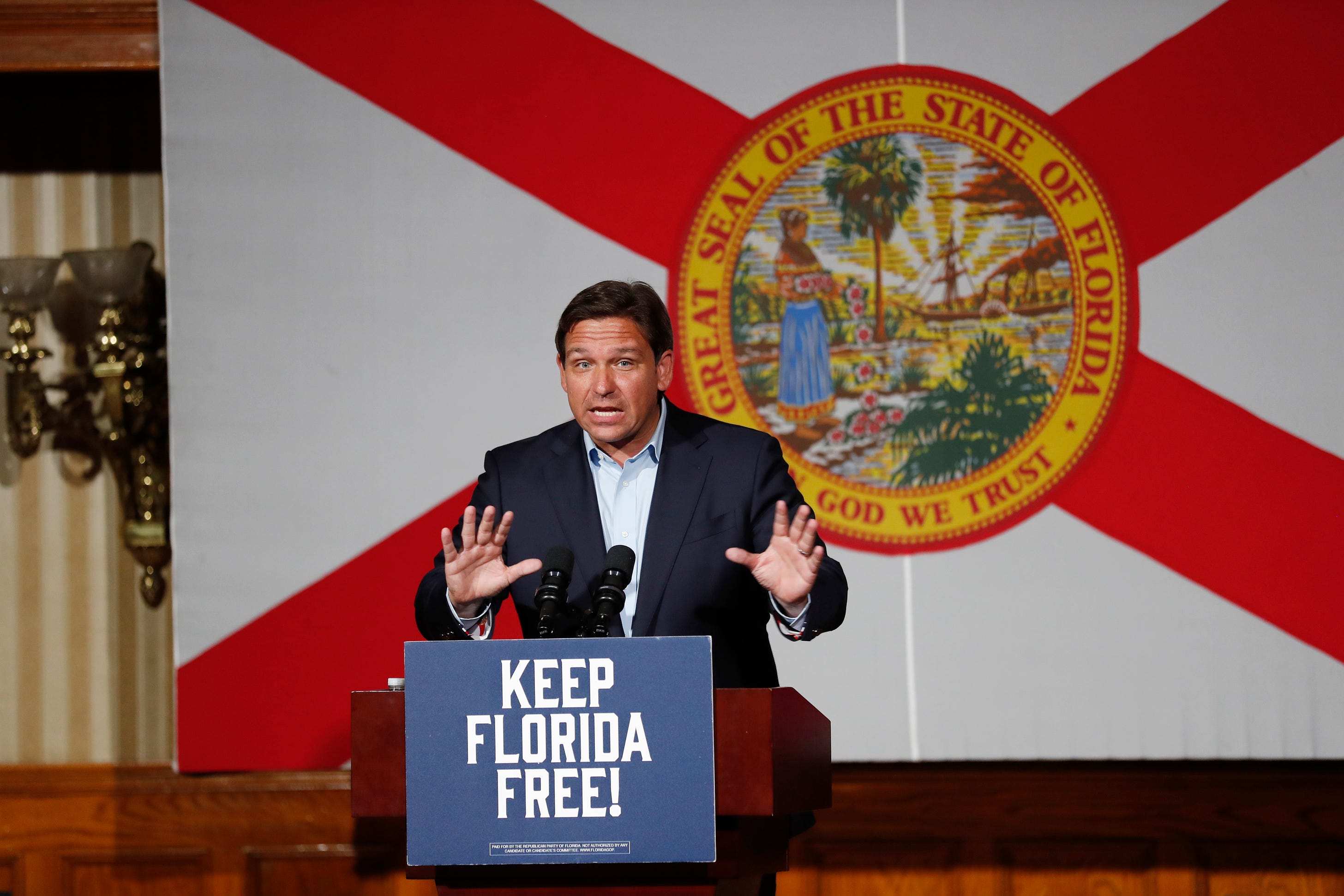
Editor’s note: this is an ironic banner in front of DeSantis. Florida is not free for those who don’t share his ideology. If you think racism exists today in Florida, you are not free to discuss it in school or college. You are free to agree with him.

Rather and Kirschner write:

Much of American history is entangled with racism and white supremacy. That is the reality of our beloved nation, no matter how much we wish it were not.

As we sit here nearly a quarter of the way through the 21st century, it is obvious that we need to have the maturity to look back to our past as well as ahead to the future. Can we do this with our eyes wide open? Will we study and learn from the lessons of history?

You can’t grapple with the truth if you hide it from view. Yes, our national narrative is an inspiring one — of freedom, rights, and new opportunities. But it is also a narrative of pain — of the bondage, rape, and murder of enslaved people. It is a story of mass death, broken treaties, and land stolen from Native people. And it is a story of persecution of the “other,” time and again.

The chasm between the noble promises of our founding documents and our historical realities continues to obstruct our national journey toward a more perfect union.

Yes, ours is a country that has facilitated exploration, innovation, and growth, but it is also one built upon families torn apart at the auction block, bodies whipped, and police dogs and fire hoses set against children.

Cities were redlined. Public schools were segregated. And despite our carefully cultivated national image as a meritocracy, throughout our history we have seen talent overlooked and our common humanity diminished on account of people’s race, religion, and sexual orientation.

The ripples of injustice continue to destabilize our society.

It shouldn’t be controversial to say any of this. But acknowledging these truths today is a political act, because it threatens the privileged narratives of those who seek to sugarcoat our past. These are men and women who serve their own ambitions by fortifying their cynical holds on power, delighting in division, feeding off fear, and applauding anger.

And that brings us to Florida’s Governor Ron DeSantis.

Listing all of his efforts to leverage the power of his office to attack equity, empathy, and justice would stretch this post immeasurably. But doing so would also jeopardize the central point: DeSantis is an opportunist. He is not weighing the merits of any one campaign. Rather, he wants headlines as a culture warrior standing up to “wokeness,” a term he has eagerly redefined to suit his own purposes. It allows him to sneer at and dismiss any attempt to reckon with American injustice.

DeSantis has focused his assaults on two of our society’s most traditionally marginalized groups: Black Americans and the LGBTQ community. While these populations have thus far felt the brunt of his targeting, we need to see clearly that his rhetoric is a threat to all who care about a democratic, peaceful, empathetic, and just America. Those of us with the greatest privilege should bear a special burden in rejecting this hate.

DeSantis’s pugilism has enabled him to consolidate power in Florida. Any opposition to his toxic initiatives must contend with the uncomfortable truth that voters validated his message and style via his landslide win in November. Now DeSantis thinks he can take his show on the road with a presidential bid. That remains to be seen. Florida has been trending Republican in recent years, and success there might not translate to the current battleground states, many of which saw big Democratic wins in the midterms.

All that being said, there is a great danger to framing this struggle primarily through the lens of electoral politics. This normalizes a discourse that should be rejected by society’s mainstream. Just as the outright bigotry of the past became socially unacceptable, so too should these latest attempts at divisiveness.

It should not surprise us that DeSantis is making schools — both K-12 and college — a central target. He wants to teach a distorted view of America. He wants to make dissenting speech not only suspect but even criminal. He wants to silence the voices of his critics and of critical thinking more generally. This is a playbook that has been followed by demagogues before to very dangerous ends.

It is essential that DeSantis not be covered by the press through a false equivalence paradigm. We can debate what we should teach and how to teach it. But we can’t replace the truth, as unsavory as it may be, with sanitized narratives that suit those already in power. This is a battle for the minds of the voters of the future. This is about what kind of nation we will become.

But DeSantis primarily cares about what kind of country we are now. He wants to appeal to fear because he thinks he can mine that fear for votes. That is his game plan. And he’s not hiding it. There can be no appeasement. DeSantis has already shown that he isn’t interested in deliberations or good faith compromise. Those would disrupt his approach of means to an end.

History illustrates that hatred can be taught, but so can empathy and justice. We are on a winding journey as a nation. And we have much farther to go. But we have made progress in the face of bigots and autocrats because people had the courage to forge the inequities of our past into a more equitable future.

This history, this truth, is what scares people like DeSantis the most. But it is one that can give us hope if we are determined not to look away.

I wrote today’s 9 a.m. post about the College Board capitulating to conservative critics. I wrote it without seeing the revised curriculum because I was in an airplane all day. Late last night, I opened an email and discovered that Michael Hiltzik of the Los Angeles Times had written a similar but more informative column, because he was able to do the comparison that I had not done. He pointed out that the rightwing attacks on the AP African American Studies course began in September, and the very names and topics that the right and DeSantis had condemned were either excised or made optional in the revised course.

He wrote:

One might have expected a leading national educational institution to have the gumption to push back against right-wingers like Florida Gov. RonDeSantis when they try to stick their noses into decisions about how to teach important subjects.

Sadly, no.

On Wednesday, the College Board issued its final curriculum for what should have been a ground-breaking high school course in African American studies. The College Board called the course “an unflinching encounter with the facts and evidence of African American history and culture.”

The final curriculum appears suspiciously to have been tailored to objections raised by DeSantis, Florida’s culture warrior Republican governor, and other right-wingers, after the board issued a draft version in December.

DeSantis, through his secretary of Education, called the draft “inexplicably contrary to Florida law” and forbade its use in Florida schools. The state’s education secretary, Manny Diaz Jr., attacked it for being “filled with Critical Race Theory and other obvious violations of Florida law.”

The arch-conservative National Review labeled the course part of “a new and sweeping effort to infuse leftist radicalism into America’s K–12 curriculum.”

The curriculum is part of College Board’s Advanced Placement program, which gives college-bound high schoolers exposure to university-level coursework.

The board says AP courses are “aimed at enabling students to develop as independent thinkers and to draw their own conclusions.”

To be fair, the board’s actions related to the African American Studies course are as good a workshop in allowing students to draw their own conclusions as one might hope. Any reasonably bright AP student is likely to see this affair as a demonstration of abject cowardice.

Disgustingly, the College Board released the final curriculum on the first day of Black History Month, as though trawling for praise for its unflinching devotion to truth. The board took pains to deny that the alterations in the draft curriculum had anything to do with criticism from DeSantis, the National Review or the right wing generally.

“No states or districts have seen the official framework that is released, much less provided feedback on it,” the board said. “This course has been shaped only by the input of experts and long-standing AP principles and practices.”

Raise your hand if you believe the College Board. Me neither.

The board said the final version had been completed in December. DeSantis issued his rejection of the course on Jan. 19. But criticism of the course outline had been circulating in conservative quarters for months — the National Review’s attack, for instance, was published on Sept. 12.

A preliminary, unflinching examination of the differences between the draft and the final version can only raise suspicions that the College Board refashioned the African American studies course to assuage the conservatives.

State Senator Manny Diaz Jr. posted a tweet on January 20 listing the state’s concerns about the AP course.

As a template, let’s use the list of “concerns” issued by Diaz on Jan. 20.

Diaz complained about the inclusion in the draft curriculum of writers and social activists Kimberlé Crenshaw, Angela Davis, Roderick Ferguson, Leslie Kay Jones, bell hooks , and Robin D.G. Kelley. Every single one of them has been excised from the final version.

Diaz’s list objected to the treatment, or even inclusion, of topics including the reparation debate, movements such as Black Lives Matter, Black Queer studies and “intersectionality,” which places racism and discrimination in a broadly social context.

Those topics have all been downgraded from required topics to “sample project topics” — that is, optional topics that fall outside requirements and won’t appear on the AP test. Those topics, the curriculum says, “can be refined by states and districts.”

Here’s a safe bet: None of them will be taught in Florida schools.

DeSantis has made no secret of his determination to turn Florida education into a shallow pool redolent of white supremacy by avoiding any hint that American society and politics have been infused with racism and class discrimination.

The shame of the College Board’s rewriting of its AP course is that it effectively places DeSantis and his henchmen in the position of dictating educational standards to the rest of the country.

There was scant political pushback against DeSantis when he rejected the draft curriculum, other than a letter from Illinois Gov. JB Pritzker, a Democrat, warning the College Board that his state would “reject any curriculum modifications designed to appease extremists like the Florida Governor and his allies.”

Pritzker observed, properly, that “ignoring and censoring the accurate reporting of history will not change the realities of the country in which we live.” (Like DeSantis, Pritzker is being talked up as a potential presidential candidate in 2024.)

Now that the final curriculum has been published and its dilutions can be closely scrutinized, perhaps the scope of the College Board’s capitulation will become clearer.

But the College Board has already flunked this all-important test of character. As we’ve noted before, acts of cowardice in the face of DeSantis’ goonish bullying won’t appease him, but will only encourage him.

As he works to destroy the independence and quality of the Florida K-12 and university systems, parents elsewhere around the country can take perverse satisfaction in knowing that students will emerge from Florida schools without the skill to compete with their own kids in intelligent society.

But if institutions like the College Board continue to let DeSantis transmit his virus of ignorance beyond Florida’s borders, no one will be safe from the contagion.