Former President Barack Obama and his wife Michelle Obama released a statement about the murder of Alex Pretti.
Will we hear from former President George W. Bush?
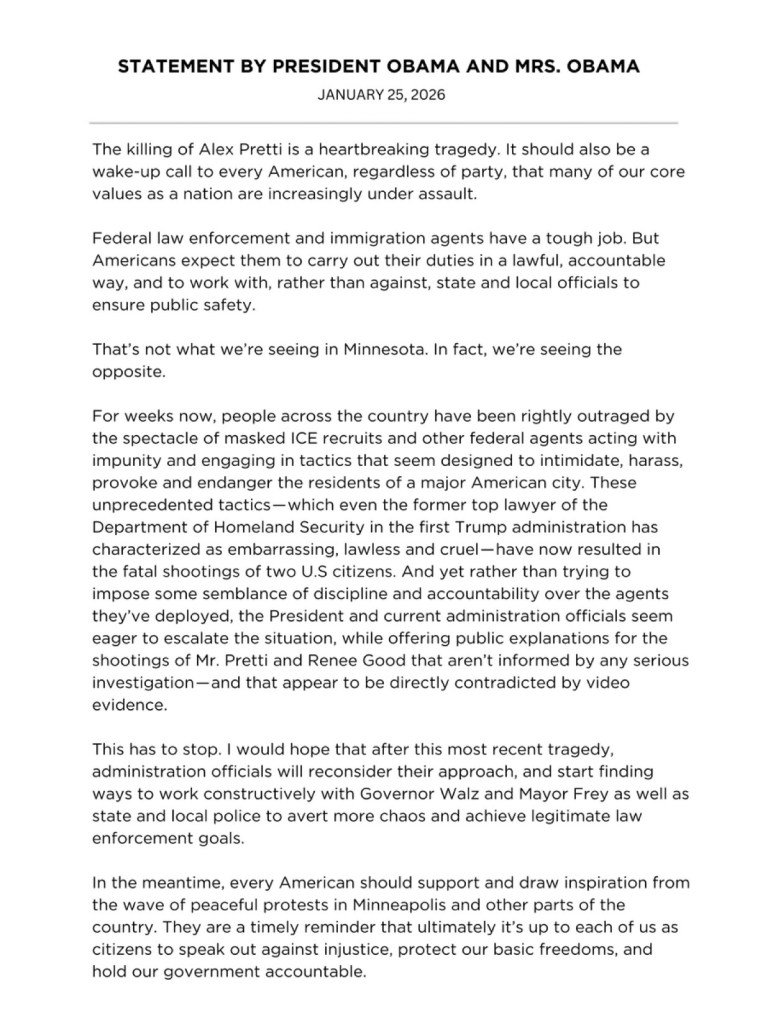
Former President Barack Obama and his wife Michelle Obama released a statement about the murder of Alex Pretti.
Will we hear from former President George W. Bush?
Former President Barack Obama met the annual honor flight of veterans on Veterans Day. This is a flight full of veterans, all-expenses paid, to visit D.C. and tour memorials to their service.
The veterans on the flight were stunned to see President Obama and hear him on the PA system. He thanked each veteran with a handshake as they left the plane.
The expressions on their faces are priceless.
President Obama didn’t do it for money or to win votes. He wanted to say thank you for your service.
The extended shutdown of the Federal government was caused by the Democrats’ efforts to save the Affordable Care Act, known as Obamacare. Unless Republicans agree, the price of subsidies for these policies will soar. Many who can’t afford the health insurance are likely to drop their policy and have none at all.
Republicans have wanted to kill Obamacare for years. Not because it doesn’t work, but because it does. They want to eliminate any Democratic successes. Trump hates Obama and always has. First, because Obama was more popular than Trump, and second, because Obama is Black and more popular even now than Trump.
The Substack blog called Wonkette reported that Trump claims to have a plan to replace Obamacare. Or a concept of a plan.
Simple: Eliminate Obamacare and let everyone buy their own insurance.
Too simple: Insurance works by creating large pools of the insured, many of whom will never claim insurance.
Trump’s plan will protect those who can afford to buy insurance and leave behind those who can’t.
Read the column. Apparently Republicans are drafting a bill already.
Beware.
Heather Cox Richardson makes two important points in this post:
I wonder: How can we survive another 3 and one-half years of this craziness?
No matter what Trump does or says, he will stil be President. The Republicans who control the House and Senate will not impeach him, no matter what. His Cabinet of lapdogs will not invoke the 25th Amendment to remove him. The best we can hope for is a Democratic sweep of both houses of Congress in 2026 so Trump is not allowed to get away with lying and grifting and destroying the global economy.
On Friday, G. Elliott Morris of Strength in Numbers reported that “polls show Trump’s position plummeting.” On Friday morning, the average job approval rating for Trump was 42.6% with 53.5% disapproving.
Those numbers break down by policy like this: Gallup polls show that only 35% of Americans approve of Trump’s immigration policy with 62% opposed. A new poll out from CBS News/ YouGov today shows that support for Trump’s deportations has dropped ten points from the start of his term, from 59% to 49%. Fifty-eight percent of Americans oppose the administration’s use of detention facilities. The numbers in a CNN/SSRS poll released today are even more negative for the administration: 59% of Americans oppose deporting undocumented immigrants without a criminal record while only 23% support such deportations, and 57% are opposed to building new detention facilities while only 26% support such a plan.
American approval of Immigration and Customs Enforcement (ICE) is unlikely to rise as news spreads that last Monday, the government gave ICE unprecedented access to the records of nearly 80 million people on Medicaid, allegedly to enable ICE to find undocumented immigrants. Kimberly Kindy and Amanda Seitz of the Associated Press reported that the Centers for Medicare and Medicaid Services signed an agreement with the Department of Homeland Security that enables ICE to access Medicaid recipients’ name, ethnicity and race, birthdate, home address, and social security number.
Undocumented immigrants are not eligible for Medicaid, although they may use it in an emergency to cover lifesaving services in a hospital emergency room. The release of personal information from Medicaid lists is unprecedented. Senator Adam Schiff (D-CA) warned: “The massive transfer of the personal data of millions of Medicaid recipients should alarm every American…. It will harm families across the nation and only cause more citizens to forego lifesaving access to health care.”
Trump’s tariffs are not popular. An Associated Press–NORC poll on Thursday found that 49% of Americans thought Trump’s policies have made them worse off while only 27% think his policies have helped.
And then there are the Epstein files.
A YouGov poll from Tuesday showed that 79% of Americans think the government should release all the documents it has about the Epstein case while only 4% think it should not. Those numbers included 85% of Democrats, but also 76% of Independents and 75% of Republicans. And that was BEFORE the publication of the Wall Street Journal article detailing the lewd and suggestive birthday letter Trump apparently contributed to Epstein’s fiftieth birthday album.
As Morris notes, Trump is underwater on all the issues of his presidency, but he is most dramatically underwater over Epstein.
You don’t need polls to see that Trump, at least, is panicking. He is throwing red meat to his base in what appears to be an attempt to regain control of the narrative. After his July 12 threat to strip comedian and talk show host Rosie O’Donnell of her citizenship (she was born in New York, and he does not have that power), he has kept up a stream of social media posts that seem designed to distract his wavering followers from the news around them.
On Wednesday, Trump announced on social media: “I have been speaking to Coca-Cola about using REAL Cane Sugar in Coke in the United States, and they have agreed to do so. I’d like to thank all of those in authority at Coca-Cola. This will be a very good move by them—You’ll see. It’s just better!”
But Coca-Cola had apparently not gotten the memo. It uses cane sugar in a number of foreign markets but has used high-fructose corn syrup in U.S. products since 1985. On its website, it wrote: “We appreciate President Trump’s enthusiasm for our iconic Coca‑Cola brand. More details on new innovative offerings within our Coca‑Cola product range will be shared soon.”
Social media users posted memes of Coke bottles emblazoned with the words “Trump is on the List” and, in small letters below, “Now with cane sugar.”
On Thursday, after observers had noted both the president’s swollen ankles and what appeared to be makeup covering up something on his hand, the White House announced that Trump has been diagnosed with chronic venous insufficiency, a condition that his physician described as a “benign” and common condition in which veins don’t move blood back to the heart efficiently.
Trump has never offered any information about his health, and his doctors have presented accounts of his physical exams that are hard to believe, making observers receive this announcement at this moment with skepticism. “Chronic venous insufficiency is a condition where the veins in the legs have difficulty drawing attention from the fact that the Epstein Files still haven’t been released,” one social media meme read.
Today, Trump posted on social media: “The Washington ‘Whatever’s’ should IMMEDIATELY change their name back to the Washington Redskins Football Team. There is a big clamoring for this. Likewise, the Cleveland Indians, one of the six original baseball teams, with a storied past. Our great Indian people, in massive numbers, want this to happen. Their heritage and prestige is systematically being taken away from them. Times are different now than they were three or four years ago. We are a Country of passion and common sense. OWNERS, GET IT DONE!!!”
Hours later, he posted that his post “has totally blown up, but only in a very positive way.” Then he threatened to block the deal to move the Commanders back to Washington, D.C., from a Maryland suburb unless they “change the name back to the original ‘Washington Redskins.’”
At the turn of the last century, those worried that industrialization was destroying masculinity encouraged sports to give men an arena for manly combat. Sports teams dominated by Euro-Americans often took names that invoked Indigenous Americans because those names seemed to them to harness the idea of “savagery” in the safe space of a playing field. By the end of the twentieth century, the majority of Americans had come to recognize the racism inherent in those names, and colleges started to retire Native American team names and mascots. In 2020 the Washington football team retired its former name, becoming the Commanders two years later. At about the same time, the Cleveland baseball team became the Cleveland Guardians in honor of the four pairs of art deco statues installed on the city’s Hope Memorial Bridge in 1932.
Trump’s attempt to control the narrative didn’t work. “The thing about the Redskins and Indians is that Donald Trump is on the Epstein list,” one social media user wrote. The post was representative of reactions to Trump’s post.
Today marked the end of the first six months of Trump’s second term, and he marked it with a flurry of social media posts praising his performance as “6 months of winning,” and attacking those he sees as his opponents. He again went after the Wall Street Journal, which ran the story about Epstein’s birthday album. He complained the paper had run a “typically untruthful story” when it said Treasury Secretary Scott Bessent had had to explain to Trump that firing Fed chair Jerome Powell would be bad for markets. Trump took exception to the idea he did not understand the interplay of the Fed and markets, despite his repeated threats against Powell.
“Nobody had to explain that to me,” he wrote. “I know better than anybody what’s good for the Market, and what’s good for the U.S.A. if it weren’t for me, the Market wouldn’t be at Record Highs right now, it probably would have CRASHED! So, get your information CORRECT. People don’t explain to me, I explain to them!”
Tonight, Trump’s social media posts seemed to project his own fears on Democrats he perceives as enemies. He once again claimed Senator Schiff, who managed one of the impeachment cases against Trump when he was a representative, had falsified loan documents in 2011 and should go to prison. In 2023, a judge determined that the Trump Organization had falsified loan documents. Trump posted: “Adam Schiff is a THIEF! He should be prosecuted, just like they tried to prosecute me, and everyone else—the only difference is, WE WERE TOTALLY INNOCENT, IT WAS ALL A GIANT HOAX!”
On Late Night with Stephen Colbert last night, Schiff said: “Donald, piss off…. But Donald, before you piss off, would you release the Epstein files?”
Trump also posted an image of intelligence agents and politicians in prison garb as if in mug shots, and reposted both an image of what appears to be lawmakers in handcuffs and an AI-generated video showing former president Barack Obama being arrested by FBI agents and then being held in a jail cell.
Meidas Touch posted: “The crazy thing about Donald Trump posting an AI video of Obama getting arrested is that Trump once had someone organize a party for him and invite a bunch of ‘young women’ and it turned out Jeffrey Epstein was his only other guest.” Alan Feuer and Matthew Goldstein broke the story of that party in Saturday’s New York Times.
—
On May 10, Dana Goldstein wrote a long article in The New York Times about how education disappeared as a national or federal issue. Why, she wondered, did the two major parties ignore education in the 2024 campaign? Kamala Harris supported public schools and welcomed the support of the two big teachers’ unions, but she did not offer a flashy new program to raise test scores. Trump campaigned on a promise to privatize public funding, promote vouchers, charter schools, religious schools, home schooling–anything but public schools, which he regularly attacked as dens of iniquity, indoctrination, and DEI.
Goldstein is the best education writer at The Times, and her reflections are worth considering.
She started:
What happened to learning as a national priority?
For decades, both Republicans and Democrats strove to be seen as champions of student achievement. Politicians believed pushing for stronger reading and math skills wasn’t just a responsibility, it was potentially a winning electoral strategy.
At the moment, though, it seems as though neither party, nor even a single major political figure, is vying to claim that mantle.
President Trump has been fixated in his second term on imposing ideological obedience on schools.
On the campaign trail, he vowed to “liberate our children from the Marxist lunatics and perverts who have infested our educational system.”Since taking office, he has pursued this goal with startling energy — assaulting higher education while adopting a strategy of neglect toward the federal government’s traditional role in primary and secondary schools. He has canceled federal exams that measure student progress, and ended efforts to share knowledge with schools about which teaching strategies lead to the best results. A spokeswoman for the administration said that low test scores justify cuts in federal spending. “What we are doing right now with education is clearly not working,” she said.
Mr. Trump has begun a bevy of investigations into how schools handle race and transgender issues, and has demanded that the curriculum be “patriotic” — a priority he does not have the power to enact, since curriculum is set by states and school districts.
Actually, federal law explicitly forbids any federal official from attempting to influence the curriculum or textbooks in schools.
Education lawyer Dan Gordon wrote about the multiple laws that prevent any federal official from trying to dictate, supervise, control or interfere with curriculum. There is no sterner prohibition in federal law than the one that keeps federal officials from trying to dictate what schools teach.
Of course, Trump never worries about the limits imposed by laws. He does what he wants and leaves the courts to decide whether he went too far.
Goldstein continued:
Democrats, for their part, often find themselves standing up for a status quo that seems to satisfy no one. Governors and congressional leaders are defending the Department of Education as Mr. Trump has threatened to abolish it. Liberal groups are suing to block funding cuts. When Kamala Harris was running for president last year, she spoke about student loan forgiveness and resisting right-wing book bans. But none of that amounts to an agenda on learning, either.
All of this is true despite the fact that reading scores are the lowest they have been in decades, after a pandemic that devastated children by shuttering their schools and sending them deeper and deeper into the realm of screens and social media. And it is no wonder Americans are increasingly cynical about higher education. Forty percent of students who start college do not graduate, often leaving with debt and few concrete skills.
“Right now, there are no education goals for the country,” said Arne Duncan, who served as President Barack Obama’s first secretary of education after running Chicago’s public school system. “There are no metrics to measure goals, there are no strategies to achieve those goals and there is no public transparency.”
I have been writing about federal education policy for almost fifty years. There are things we have learned since Congress passed the Elementary and Secondary Education Act in 1965. That law was part of President Lyndon B. Johnson’s agenda. Its purpose was to send federal funds to the schools enrolling the poorest students. Its purpose was not to raise test scores but to provide greater equity of resources.
Over time, the federal government took on an assertive role in defending the rights of students to an education: students with disabilities; students who did not speak English; and students attending illegally segregated schools.
In 1983, a commission appointed by President Reagan’s Secretary of Education Terrell Bell declared that American schools were in crisis because of low academic standards. Many states began implementing state tests and raising standards for promotion and graduation.
President George H.W. Bush convened a meeting of the nation’s governors, and they endorsed an ambitious set of “national goals” for the year 2000. E.g., the U.S. will be first in the world by the year 2000; all children will start school ready to learn by 2000. None of the goals–other than the rise of the high school graduation rate to 90%–was met.
The Clinton administration endorsed the national goals and passed legislation (“Goals 2000”) to encourages states to create their own standards and tests. President Clinton made clear, however, that he hoped for national standards and tests.
President George W. Bush came to office with a far-reaching, unprecedented plan called “No Child Left Behind” to reform education by a heavy emphasis on annual testing of reading and math. He claimed that because of his test-based policy, there had been a “Texas Miracle,” which could be replicated on a national scale. NCLB set unreachable goals, saying that every school would have 100% of their students reach proficiency by the year 2014. And if they were not on track to meet that impossible goals, the schools would face increasingly harsh punishments.
In no nation in the world have 100% of all students ever reached proficiency.
Scores rose, as did test-prep. Many untested subjects lost time in the curriculum or disappeared. Reading and math were tested every year from grades 3-8, as the law prescribed. What didn’t matter were science, history, civics, the arts, even recess.
Some schools were sanctioned or even closed for falling behind. Schools were dominated by the all-important reading and math tests. Some districts cheated. Some superintendents were jailed.
In 2001, there were scholars who warned that the “Texas Miracle” was a hoax. Congress didn’t listen. In time the nation learned that there was no Texas Miracle, never had been. But Congress clung to NCLB because they had no other ideas.
When Obama took office in 2009, educators hoped for relief from the annual testing mandates but they were soon disappointed. Obama chose Arne Duncan, who had led the Chicago schools but had never been a teacher. Duncan worked with consultants from the Gates and Broad Foundations and created a national competition for the states called Race to the Top. Duncan had a pot of $5 billion that Congress had given him for education reform.
Race to the Top offered big rewards to states that applied and won. To be eligible, states had to authorize the creation of charter schools (almost every state did); they had to agree to adopt common national standards (that meant the Common Core standards, funded wholly by the Gates Foundation and not yet completed); sign up for one of two federally funded standardized tests (PARCC or Smarter Balanced) ; and agree to evaluate their teachers by the test scores of their students. Eighteen states won huge rewards. There were other conditions but these were the most consequential.
Tennessee won $500 million. It is hard to see what, if anything, is better in Tennessee because of that audacious prize. The state put $100 million into an “Achievement School District,” which gathered the state’s lowest performing schools into a new district and turned them into charters. Chris Barbic, leader of the YES Prep charter chain in Houston was hired to run it. He pledged that within five years, the lowest-performing schools in the state would rank among the top 20% in the state. None of them did. The ASD was ultimately closed down.
Duncan had a great fondness for charter schools because they were the latest thing in Chicago; while superintendent, he had launched a program he called Renaissance 2010, in which he pledged to close 80 public schools and open 100 charter schools. Duncan viewed charters as miraculous. Ultimately Chicago’s charter sector produced numerous scandals but no miracles.
I have written a lot about Race to the Top over the years. It was layered on top of Bush’s NCLB, but it was even more punitive. It targeted teachers and blamed them if students got low scores. Its requirement that states evaluate teachers by student test scores was a dismal failure. The American Statistical Association warned against it from the outset, pointing out that students’ home life affected test scores more than their teachers.
Duncan’s Renaissance 2010 failed. It destroyed communities. Its strategy of closing neighborhood schools and dispersing students encountered growing resistance. The first schools that Duncan launched as his exemplars were eventually closed. In 2021, the Chicago Board of Education voted unanimously to end its largest “school turnaround” program, managed by a private group, and return its 31 campuses to district control. Duncan’s fervent belief in “turnaround” schools was derided as a historical relic.
Race to the Top failed. The proliferation of charter schools, aided by a hefty federal subsidy, drained students and resources from public schools. Charter schools close their doors at a rapid pace: 26% are gone in their first five years; 39% in their first ten years. In addition, due to lax accountability, charters have demonstrated egregious examples of waste, fraud, and abuse.
The Common Core was supposed to lift test scores and reduce achievement gaps, but it did neither. Conservative commentator Mike Petrilli referred to 2007-2017 as “the lost decade.” Scores stagnated and achievement gaps barely budged.
So what have we learned?
This is what I have learned: politicians are not good at telling educators how to teach. The Department of Education (which barely exists as of now) is not made up of educators. It was not in a position to lead school reform. Nor is the Secretary of Education. Nor is the President. Would you want the State legislature or Congress telling surgeons how to do their job?
The most important thing that the national government can do is to ensure that schools have the funding they need to pay their staff, reduce class sizes, and update their facilities.
The federal government should have a robust program of data collection, so we have accurate information about students, teachers, and schools.
The federal government should not replicate its past failures.
What Congress can do very effectively is to ensure that the nation’s schools have the resources they need; that children have access to nutrition and medical care; and that pregnant women get prenatal care so that their babies are born healthy.
If your memory is good, you may recall Arne Duncan’s Race to the Top, which had $5 billion of unrestricted funds with which to spur education reform. Duncan had a contest in which states competed for a piece of that big pie. To be eligible to compete, states had to pass a law authorizing charter schools, and almost every state did. They had to agree to adopt national standards, which meant the unfinished, untried Common Core State Standards, as well as the tests based on the standards. They had to agree to evaluate individual teachers based on the rise or fall of the test scores of their students.
Eighteen states “won.”
The biggest winner was Tennessee, which won $500 million. Tennessee’s biggest new program was the creation of its so-called Achievement School District. The ASD would gather the lowest performing schools in the state into a non-contiguous district and turn them into charter schoools.
The ASD hired Chris Barbic, leader of Houston’s YES Prep charter chain, to run the ASD. Barbic pledged that he would raise the state’s lowest-performing schools into top-performing schools in five years.
He failed. The state’s lowest performing schools continued to have low scores. In 2015, he resigned, saying he needed to focus on his health and family.
The ASD limped along for another decade, without success. Nonetheless, some other states–including Nevada and North Carolina–copied the model, creating their own all-charter districts. They also failed.
The Tennessee Legislature voted this week to shut down the ASD.
The ASD removed low-performing schools from local control and placed them under a state-run district, with the goal to push Tennessee’s bottom 5% of schools to the top 25%. Many of the schools were turned over to charter operators to run under 10-year contracts.
Research showed the ASD led to high teacher turnover, and did not generate long-term improvements for students. The district also faced community backlash for taking over schools in districts that served mostly low-income communities and predominantly Black student populations. The ASD cost taxpayers over $1 billion. Only three schools remain in the ASD.
Every other part of Race to the Top failed. Evaluating teachers by test scores was a disaster: it rewarded teachers in affluent districts and schools while penalizing those who taught the neediest students. Charter schools did not have higher scores than public schools unless they chose their students carefully, excluding the neediest. The Common Core standards, with which tests, textbooks and teacher education were aligned, had no impact on test scores. The U.S. Department of Education evaluated Race to the Top and declared it a failure., in a report quietly released on the last day of the Obama administration.
On to vouchers! Since voucher students don’t take state tests, no one will know that this is a boondoggle that benefits those already in private and religious schools.
The search for miracles and panaceas goes on.
Trump’s answer. Parents know best.
Next time you get surgery, make sure the surgeon is not licensed. Next time you take a flight, be sure to fly with an unlicensed pilot.
Before the inauguration of Trump, The New York Review of Books invited me to write about his education agenda. I read three important documents in which his views and goal were spelled out: the education chapter in Project 2025; Agenda 47, Trump’s campaign document; and the website of the America First Policy Institute, the organization led by Linda McMahon, Trump’s choice for Secretary of Education. The three documents overlap, of course. Trump intends to privatize education; he despises public schools. He wants to eliminate the Department of Education. He and his supporters are obsessed with “radical gender ideology,” and they blame public schools for the very existence of transgender students. The election of Trump, it was clear, would mean the end of civil rights protections for LGBT students and a determined effort to defund and destroy public schools.
I posted the article yesterday.
The NYRB invited me to participate in an interview.
This article is part of a regular series of conversations with the Review’s contributors; read past entries here and sign up for our e-mail newsletter to get them delivered to your inbox each week.
In “‘Their Kind of Indoctrination,’” published on the NYR Online shortly before Donald Trump’s second inauguration, Diane Ravitch writes about the troubling future of American public education. Referring to the president’s infamous remark from his first campaign—“I love the poorly educated”—Ravitch warns that his second term is likely to lead to “more of them to love.”
A historian of education, Ravitch worked on education policy in both George H. W. Bush’s and Bill Clinton’s administrations. She has spent her career analyzing the national and state policies that reshape public schools, like laws that implement high-stakes testing or that divert taxpayer money to charter schools. In addition to writing nearly two dozen books—including The Troubled Crusade: American Education, 1945–1980 (1983), Reign of Error: The Hoax of the Privatization Movement and the Danger to America’s Public Schools (2013), and, most recently, Slaying Goliath: The Passionate Resistance to Privatization and the Fight to Save America’s Public Schools (2020)—Ravitch posts regularly about American education policy on her widely read blog. Her memoirs will be published later this year by Columbia University Press.
I reached out to Ravitch to discuss the current state of American education, the forces threatening it, and her vision for how public schools can better fulfill their democratic promise.
Regina Martinez: How did you start writing about education? Were you influenced by your time in public schools in the South?
Diane Ravitch: I started writing about education when I was in college. The first paper I ever wrote was for a political science class in my freshman year at Wellesley in 1956. It was about the politics of the Houston public school system in the early 1950s, when I was a student there. Voters elected a new school board every two years, and control went back and forth between a group of far-right extremists, who saw Communists lurking everywhere, and moderates who just wanted to make sure that the schools were running well. At one point, books about Russia were removed from the high school library’s shelves. Under the moderates, we heard assembly speakers who spoke of racial and religious tolerance; under the Minute Women, the female wing of the John Birch Society, we were warned to beware of Communist influence. Also, while I was attending them, the schools were racially segregated.
In “Their Kind of Indoctrination,” you write, “One can only imagine the opprobrium that will be visited upon teachers who are not certified as patriots.” How do you imagine this will impact the teaching profession? What might it mean for teacher recruitment in the future?
The threat of political surveillance is chilling, as it would be in every profession. In many states, especially “red” states, teachers have to be careful about what they teach, what reading they assign, and how they handle topics related to race and gender. Trump recently issued an executive order stating that he would cut off the funding of schools that “indoctrinate” their students by teaching about “radical gender ideology” and racism. His effort to impose thought control is illegal but that hasn’t stopped him from trying.
This sort of political censorship is happening in K–12 schools but also in higher education. The number of people choosing to prepare to be teachers plummeted in the wake of the Bush-Obama emphasis on standardized testing. The threat of political loyalty screening can only make matters worse.
One of President Trump’s recent executive orders reauthorized federal agents to detain children at schools. What actions if any can schools, families, and students take to resist the incursion of the security state into schools?
The determination of the Trump administration to raid schools is terrifying for children and for their teachers, whose job it is to protect their students. Imagine a child being arrested in his or her classroom. It is indeed frightening. Many districts have urged teachers to get legal advice from the district legal officers. At the very least, educators should demand to see a warrant. If ICE agents are armed, resistance may be futile. Elected leaders will have to develop contingency plans, if they have not done so already.
You worked on education policy under both President George H. W. Bush and President Bill Clinton. What, if anything, was different about your work between a Republican and a Democratic administration? How do you think the Department of Education—and federal education policy more generally—has changed since the early 1990s?
I served as assistant secretary for education research and improvement under President Bush. Then President Clinton appointed me to the national testing board, known as the National Assessment Governing Board. There was a continuity of policy from the first President Bush to Clinton, and then from Clinton to the second President Bush to President Obama.
The first President Bush wanted to reform American education through voluntary measures. He convened a meeting of the nation’s governors in 1989, and they agreed on a set of six goals for the year 2000. He thought that the goals could be reached by exhortation, at no cost. The goals were indeed aspirational (they hoped, for example, that American students would be first in the world in mathematics and science by the year 2000), but no one had a plan for how to reach them, nor was there any new funding. President Clinton got credit for drafting them, so he and Bush shared that commitment. He was willing to spend real money to help states improve their schools, and added two more goals (one about teacher training, another about parent participation). He also believed that the nation should have national standards and tests. None of the goals was reached by the year 2000, except for having 90 percent of students graduate from high school. But that goal was a matter of definition. If it meant that 90 percent should graduate high school in four years, we did not meet that goal. If you counted the students who graduated in five or even six years, we surpassed it.
Since you launched your education blog in 2012, it has become a popular forum for discussions about education and democracy. Looking back, are there any positions you’ve shared on the blog that you would reconsider or approach differently today? Are there positions you took or predictions you made that you’re particularly proud of?
I started blogging two years after publication of The Death and Life of the Great American School System: How Testing and Choice Have Undermined Education. In that book, I renounced views that I had advocated for decades: competition between schools, relying on standardized testing as the measure of students, merit pay, and many other policies connected to accountability and standardization.
What I have learned in the past fifteen years has made me even more alarmed than I was then about the organized efforts to destroy public education. That book has a chapter about “The Billionaire Boys Club.” I focused on the venture philanthropy of the Bill and Melinda Gates Foundation, the Eli and Edythe Broad Foundation, and the Walton Family Foundation. These billionaires used their philanthropy strategically to fund privately managed charter schools, high-stakes standardized testing, and a system that evaluates teachers by the test scores of their students and closes schools where students got low scores. I opposed all of these measures, which were endorsed by both the second Bush administration and the Obama administration. I demonstrated in that book and subsequent books that these strategies have been failures and are enormously demoralizing to teachers. They also turned schools into testing factories, crushing creative thinking and the joy of teaching and learning.
In the years since, I have learned that “the Billionaire Boys Club” is far larger than the three families that I mentioned. In my last book, Slaying Goliath, I tried to make a list of all the billionaires and the foundations that support charter schools and vouchers, and it was long indeed. Even now, I continue to come across billionaires and foundations that should be added to the list. What I suspected was that charter schools paved the way for vouchers by treating schooling as a consumer good, not a civic responsibility. What I did not realize was that the voucher movement is even more powerful than the charter movement. Its constituency is not just right-wing billionaires like the Koch brothers and the DeVos family, but Christian nationalists, white supremacists, extremist organizations like the Alliance Defending Freedom and the American Legislative Executive Council, affluent parents who want the state to subsidize their private school tuition, and Catholic leaders who have always believed that the state should underwrite Catholic schools.
There has been a lot of discourse recently about declining rates of literacy due to AI, the pandemic, phones, or a host of other causes. How significant do you think this risk is? What might be done to reverse the trend?
I too am concerned about declining rates of literacy, as well as declining interest in literature. In my field of study, I believe that standardized testing has been a culprit in shortening the attention span of children of all ages. Students are expected to read short snippets, then to answer questions about those limited passages. In the early decades of the twentieth century, the College Board sponsored college entrance examinations in which students were assigned works of literature in advance, then asked to write about what they had read. Teachers and professors read their essays and graded them. Now the exam answers may be read by a machine or by a person hired off Craigslist to read swiftly, giving only a minute or two to each written answer.
In my dreams, I would change expectations and ask high school teachers to assign books that are worth reading, then require students to write three or four pages about why they did or did not like the book.
While I welcome the expansion of the canon to include works by women and by people of color, I would also welcome a revival of interest in the great works that were once considered the classics of Western literature. In too many high schools, the classics have not just been marginalized, they have been ousted. That is as grave an error as ignoring the works of those who are not white men.
Given the increasing momentum behind the privatization of education, how do you envision the next generation advancing public school advocacy? What do you anticipate will be their greatest challenge?
Public schools are one of the most important democratic institutions of our society. In many states, they enroll 90 percent of all students. They have always enabled children and adolescents to learn together with others who come from backgrounds different from their own. There is a major movement today, funded by right-wing billionaires, to destroy public schools and to replace them with religious schools, private schools, and homeschooling. It is called “school choice,” but the schools choose, not the students or families. Private schools are allowed to discriminate on any grounds and are not bound by federal laws that prohibit discrimination and that protect those with disabilities. Racial and religious segregation will increase. More students will attend schools whose purpose is indoctrination, not building a democratic society.
The greatest challenge facing those who believe in the value of public education is that the money behind privatization is enormous, and it is spent strategically to win political allies. To my knowledge, there is no billionaire funder for public education as there are for privatization. In the world of public education advocacy, there are no equivalents to the Koch money, the DeVos money, the Walton money, the Texas evangelical billionaires Tim Dunn and Farris Wilks, the Pennsylvania billionaire Jeff Yass. I have been president of an organization called the Network for Public Education since 2013, and our annual budget is a pittance compared to the privatizers’ organizations. One pro–school choice organization spent as much on their annual dinner party as our entire annual budget.
The other side of this struggle to save public education is the reality that important Democrats still believe that school choice helps poor Black and Hispanic kids, despite overwhelming evidence that this claim is not true and is in fact part of the hustle. Representative Hakeem Jeffries, Senator Cory Booker, Governor Jared Polis, and Senator Michael Bennett are a few of the Democrats who have dampened the interest of their party in fighting for public schools.
What makes me hopeful is that the reality is becoming clearer with every passing day: those who are concerned for the common good must support public schools, not undertake to pay the tuition of every student who chooses not to attend public schools. Privatization benefits some, not all, not even most. Public money should pay for public schools. Private money should pay for private schools.
I was standing in line for early voting this morning, and a friend asked, “Did you hear the great speeches in Kalamazoo yesterday by Michelle and Kamala?” I had not. When I got home, after voting for Kamala, I listened to both women.
I hope you watch and listen.
The enthusiasm of the crowd was amazing! They will, as Michelle said, “Do something!”
They referred to their city as Kamalazoo. Good one!
Barack Obama is a skilled orator, probably the best of our time. In this 3-minute clip, he asks the quintessential question. Trump says to Kamala, “You were there for four years, why didn’t you solve the border problem?” Obama asks of Trump, “Dude, you were there for four years, why didn’t you solve the problem?”
Jan Resseger writes here about the failure of ranking and rating schools by test scores and other metrics. These rankings cause parents to flee low-rated schools, making them even more segregated by income and race. If “reformers” intended to help struggling schools, they didn’t. They made it harder for those schools to improve.
She writes:
Here is the lead in a story in the Washington City Paper (Washington, D.C.) that describes not only how public school ratings and rankings work in the nation’s capital but also their impact in every public school district in the United States. Read this carefully:
“Before the pandemic shut down D.C. schools, each public school, like each student, got a report card. Every fall the school report card included a STAR rating, from one through five. The rating was based on a formula designed and used by the Office of the State Superintendent of Education (OSSE), D.C.’s education agency. Federal law requires OSSE to identify the ‘bottom 5 percent’ of District schools, so that they can receive additional funding. In effect, OSSE’s STAR Framework ratings used a measurement of need to indicate a measurement of quality. And as a measurement of quality, the formula failed.” (Emphasis is mine.)
The author of the commentary is Ruth Wattenberg, who formerly served on the Washington, D.C. State Board of Education (SBOE). She explains that the 2015 federal education law, the Every Student Succeeds Act—the version that replaced the 2002, No Child Left Behind Act—requires all states to assign school ratings which are said to be a measure of need for the bottom 5 percent of “struggling” schools. However, in a place like Washington, D.C. with universal school choice, while ESSA requires states to rate schools to target the bottom scorers for improvement, parents use the ratings as an advertisement for the best schools in the system—perhaps the only evidence some parents consider as they choose a school for their children.
The ratings are always understood by the general public as a measure of school quality.
In a large city school district, when parents choose a school according to the ratings, these measures help resegregate the school district by income and race. Wattenberg explains: “In D.C., where families can choose to send their kids to any public school in the district, this flawed rating system is especially consequential. ‘Many kids have left their neighborhood schools’ because of the ratings, says Sheila Carr… grandparent of current D.C. students… A small exodus can trigger budget, staffing, and program cuts that have the potential to drive more families away from a particular school, triggering yet more cuts. A decade ago Carr remembers, this meant multiple school closings. Although DCPS (D.C. Public Schools) has avoided more closures recently, enrollments at some schools are way down. Anacostia High School enrolls just 287 students.”
Across metropolitan areas where numerous suburban school districts surround the central city, the ratings redline the poorer and most segregated school districts and encourage anybody who can afford it to seek the the school districts with the highest ratings: the homogeneously white and wealthy exurban school districts.
Across the states, legislatures and departments of education have developed their own rating systems to comply with the federal mandate, but these systems almost always feature each district’s aggregate standardized test scores, which have been documented to reflect primarily family income. Wattenberg explains the research she and her colleagues explored as they set out to redesign their rating system: “One expert showed us how high-poverty schools disproportionately got low ratings, even when test scores reported that their students had learned more than average. Education researcher and D.C. public school parent Betsy Wolf concluded that ‘our accountability system measures family income more than it measures school quality.’ Based on these findings, the SBOE resolved in 2022 that the rating system was ‘fundamentally flawed’ and recommended eliminating it… Education and poverty expert Sean Reardon says that average test scores ‘are the results of all the opportunities kids have had to learn their whole lives, at home, in the neighborhood, in preschool and in the school year. So it’s misleading to attribute average test scores solely to the school where they take the test.’”
Apparently in Washington, D.C. the board came up with a new system that is not likely to be much better: “At the SBOE’s early January meeting, some parents’ hopes of pushing to revamp the report cards faded. OSSE surfaced its new report card, and, instead of labeling schools with stars, the new proposal assigns each school a number, one to 100, called an ‘accountability score.’ The number will still be highlighted on each school’s online profile and on the central School Report Card, where it will be among the first and primary impressions of a school that parents will see. The formula that produces the new accountability score, while slightly revised and less toxic, is still biased against low-income schools. It is still the same formula OSSE uses to identify the neediest schools for the U.S. Department of Education.”
Wattenberg adds: “Less biased data on school quality measures educational practices and conditions known to promote student learning, such as teacher retention and the extent to which a school offers instruction on a variety of subjects, including social studies, science, and the arts, rather than an overly narrow focus on math and reading (which is what end-of-year tests focus on). Survey data showing student perceptions, such as the extent to which students feel academically challenged and supported is also an effective metric.”
From a parent’s point of view, the new summative grade tells no more about the teachers or the curriculum or students’ experiences at school. It is really no different than the five star rating system Wattenberg remembers in Washington, D.C.’s previous system. Here in Ohio, where I live, we have a five star system, which is no better than the A, B, C, D, F system we had before we got the new five stars. In Washington, DC, the new 1-100 rating number Wattenberg describes being earned by each school will only cue up competative parents to go for the highest rated schools in a giant competition. Most people choosing a school on the basis of the ratings will not be able to discern how the metric balances all the variables in each school or whether the rating really say anything about what is happening at the school.
Having attended school in a small Montana town, where we all went to the same middle school and high school, and having parented two children who attended our neighborhood elementary and middle school and came together at our community’s only high school here in a Cleveland, Ohio inner suburb, I prefer the old and more radical solution to the whole problem of school choice driven by metrics published in the newspaper or school report cards. In fact, for the majority of families in the United States, neighborhood schools are still the norm. A system of neighborhood schools embodies the idea that parents’ responsibility is to help their children embrace the opportunities at the school where they are assigned.
As parents when my children were in elementary school, we used the PTA meetings as places to strategize about how we could better support innovations and special programs to make school more fun and challenging for all the students. A district-wide school support agency in our community provides a tutoring program for students who need extra help, and there is a community supported, district-wide music camp for a week in June when the high school orchestra director and his staff, along with a raft of graduates from the high school music program, help students from across the middle schools to prepare for joining the high school band and orchestra. People from across the school district turn out for the concert that culminates the summer music camp.
This kind of community involvement connects parents with the community’s public schools in a qualitative way. When people engage personally with a school, the teachers and the students, parents can learn so much more about a school than any metric can expose.
At the very least, it is time for the U.S. Department of Education to stop demanding that states rate and rank their public schools. Wattenberg is correct that the ratings—a measurement of need—are misinterpreted by the press and misunderstood by the public as a measurement of quality.

 Diane Ravitch's blog