Archives for category: Literacy

Read!

If you want to open your mind, read!

If you want to travel through time and space, read!

If you want to learn about other people and other cultures, read!

If you want to supercharge your creativity and imagination, read!

If you want to learn how other people see the world, read!

If you want to travel through time and space, read!

If you want to understand history, read!

Some people think these are dangerous activities. They want to control what students think. They censor books. They remove them from school libraries and public libraries. They forget that young people today have access to the Internet, which is not censored.

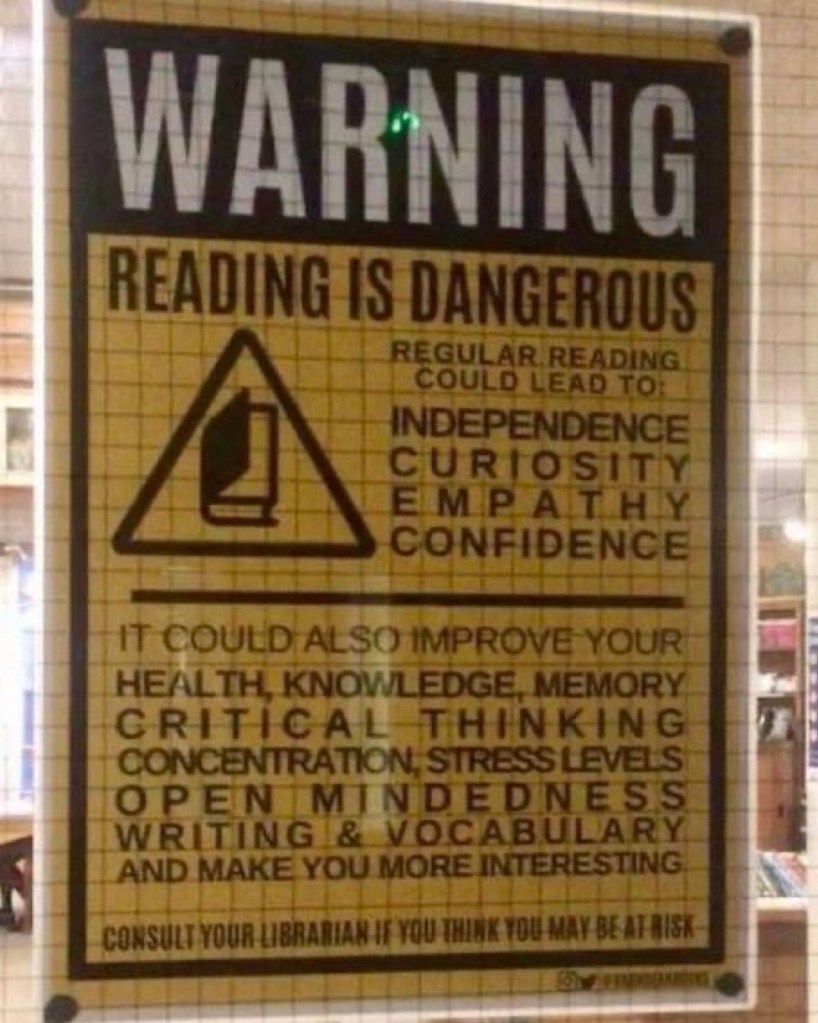
Live dangerously! Read books!

John Merrow is sick of the “reading wars.” So am I. I studied them intensively and wrote about their history in my book Left Back: A Century of Battles Over School Reform (2000).

In my opinion, Jeanne Chall (kindergarten teacher turned Harvard professor of literacy) settled the issues in her book called Learning to Read: The Great Debate. Her authoritative book, commissioned by the Carnegie Corporation, was published in 1967. She came out in favor of both early phonics and a rapid transition to children’s literature. She insisted that learning to read was never either-or. I wish she were alive to slap down the journalists and pundits who are now insisting that phonics and phonics alone is “the science of reading.” I feel sure she would laugh and say there is no science of reading. She warned that if we didn’t avoid either-or thinking, we would continue to swing from one extreme to another.

I am patiently waiting for evidence of any district (not counting affluent suburban districts) where “the science of reading” brought every child of every demographic and economic group to proficiency (not grade level, proficiency). The New York City Department of Education recently announced that it was mandating “the science of reading” across the entire city school system. We will be sure to check back in a few years and see how that worked out. Under Michael Bloomberg, Chancellor Joel Klein mandated “balanced literacy” (specifically, the work of Lucy Calkins of Teachers College, Columbia University, which was heavy on “whole word” and light on phonics). Phonics advocates were outraged, but they were ignored. Now the NYC Department of Education is swinging to the other extreme; balanced literacy is out, phonics is in.

John Merrow’s recent post about the “reading wars” reminded me of Jeanne Chall, who was a good friend.

I will post here a bit of it and urge you to open the link and read it all.

Learning the alphabet is a straightforward 2-step process: Shapes and Sounds. One must learn to recognize the shapes of the 26 letters and what each letter sounds like. There’s no argument about this, and certainly there has never been and never will be an “Alphabet War.”

The same rule–Shapes and Sounds–applies to reading. Would-be readers must apply what they learned about Sounds–formally called Phonics and Phonemic Awareness–to combinations of letters–i.e., words. They must also learn to recognize some words by their Shapes, because many English words do not follow the rules of Phonics. (One quick example: By the rules of Phonics, ‘Here’ and ‘There’ should rhyme; they do not, and readers must learn how to pronounce both.) To become a competent, confident reader, one must rely on both Phonics and Word Recognition.

Ergo, there’s absolutely no need, justification, or excuse for “Reading Wars” between Phonics and Word Recognition. None! And yet American educators, policy-makers, and politicians have been waging their “Reading Crusades” for close to 200 years. As a consequence, uncounted millions of adults have lived their lives in the darkness of functional illiteracy and semi-literacy.

Here’s something most Reading Crusaders don’t understand: Almost without exception, every first grader wants to be able to read, because they understand that reading gives them some measure of control over their world, in the same way walking does. And skilled teachers can teach almost all children–including the 5-20 percent who are dyslexic–to become confident readers.

Skilled teachers understand what the Reading Crusaders do not: Reading–again like walking–is not the goal. It’s the means to understanding, confidence, and control. Children don’t “first learn to read and then read to learn,” as some pedants maintain. That’s a false dichotomy: they learn to read to learn. And so skilled teachers use whatever strategies are called for: Phonics, Word Recognition, what one might call Reading as Liberation, and more.

Good news! The legislature in Illinois has passed a law to withhold state funds from institutions that ban books. Governor J.B. Pritzker is expected to sign it.

Illinois Gov. JB Pritzker (D) is expected to sign a bill that would withhold state funds from institutions that ban books amid nationwide efforts to pull some titles from shelves.

“Illinois is one step closer to preventing book banning in Illinois libraries,” said Illinois Secretary of State Alexi Giannoulias.

“Under this bill, we can support our state’s libraries and librarians and protect them against attempts to ban, remove or restrict access to books and resources,” he said.

The state’s H.B. 2789 would require libraries to adopt the American Library Association’s Library Bill of Rights — which “indicates materials should not be proscribed or removed because of partisan or doctrinal disapproval,” according to the proposed text — or develop their own such statement against book banning in order to be eligible for state grants.

The bill has cleared the state legislature and now heads to the governor’s desk. Pritzker has previously said he supports the bill, according to the secretary of State’s office.

“Banning books is a devastating attempt to erase our history and the authentic stories of many. Students across this state deserve to see themselves reflected in the pages of stories that teach and entertain. I’m proud to support House Bill 2789 and ensure that Illinois’ libraries remain sources of knowledge, creativity, and fact,” Pritzker said in a March release….

“Our nation’s libraries have been under attack for too long—they are bastions of knowledge and proliferate the spread of ideas. That is why I am so proud that my measure to prevent the banning of books passed in the senate today,” said Illinois state Sen. Laura Murphy, one of the bill’s sponsors.

Bill Gates, as is well known, is an expert on everything. The media breathlessly reports his thoughts on every subject, assuming that he must be as smart as he is rich. And he is very, very rich.

He predicts that in eighteen months, artificial intelligence will be sufficiently developed to teach reading and writing more effectively and at less cost than a human. this far, none of his educational predictions and initiatives have succeeded, so we will see how this works out.

Soon, artificial intelligence could help teach your kids and improve their grades.

That’s according to billionaire Microsoft co-founder Bill Gates, who says AI chatbots are on track to help children learn to read and hone their writing skills in 18 months time.

“The AI’s will get to that ability, to be as good a tutor as any human ever could,” Gates saidin a keynote talk on Tuesday at the ASU+GSV Summit in San Diego.

AI chatbots, like OpenAI’s ChatGPT and Google’s Bard, have developed rapidly over the past several months, and can now compete with human-level intelligence on certain standardized tests. That growth has sparked both excitement over the technology’s potential and debate over the possible negative consequences.

Count Gates in the camp of people who are impressed. Today’s chatbots have “incredible fluency at being able to read and write,” which will soon help them teach students to improve their own reading and writing in ways that technology never could before, he said.

“At first, we’ll be most stunned by how it helps with reading — being a reading research assistant — and giving you feedback on writing,” said Gates….

It may take some time, but Gates is confident the technology will improve, likely within two years, he said. Then, it could help make private tutoring available to a wide swath of students who might otherwise be unable to afford it.

That’s not to say it’ll be free, though. ChatGPT and Bing both have limited free versions now, but the former rolled out a $20-per-month subscription plan called ChatGPT Plus in February.

Still, Gates said it’ll at least be more affordable and accessible than one-on-one tutoring with a human instructor.

“This should be a leveler,” he said. “Because having access to a tutor is too expensive for most students — especially having that tutor adapt and remember everything that you’ve done and look across your entire body of work.”

Someone will make money, that’s for sure.

Paul Bonner, retired career educator, debunks the “science of reading” prattle;

Then the New York Times published this…https://www.nytimes.com/2023/04/16/us/science-of-reading-literacy-parents.html

Ignorance about the circumstances that hinder student learning is pervasive among the national media. They report again and again on failed “one size fits all” remedies without understanding that these fail because they do not address the root cause of public school challenges: Poverty.

Advocacy for “The science of reading”, Lucy Caulkins, or whole language all miss the point. Until we are willing to change the instructional delivery system that allows for K-12 class sizes of 20-30+ students per class, a teaching professional day that does not allow meaningful classroom preparation except beyond the school day, equal high quality resources and facilities for all students, and an understanding that this hyper focus on reading fluency actually demonstrates low expectations for our students.

Perhaps the greatest inaccuracy on the NYTimes report is that somehow schools have not been engaged in this “Science of reading” rabbit hole.

The two large districts I served in were all in with massive resources given to administrative and teacher professional development for the purpose of institutionalizing the practice. Yet, scores never moved despite efforts to show improvement through numerous changes in the standardized tests being implemented.

The confirmation bias so prevalent in this ongoing reporting has been troubling since the Clinton Administration introduced the “Standards Movement.” Any challenges to such bias continue to be ignored and often attacked.

The fact that Emily Hanford, Arne Duncan, Bill Gates, Margaret Spellings continue to act as “go to” interviews when their profession experience as practicing educators is woeful at best, demonstrates the little regard reporters have for the professionalism required to teach and administer instructional outcomes.

It is in fact these arbiters of “data” who use anecdotal reporting to misinform politicians and institutions such as the NAACP to continue this malpractice.

Perhaps the one method we have been reticent to use should be to support teaching, adequately resource school facilities everywhere, and get the hell out of the way for the educators who actually know their craft.

Paul Waldman and Greg Sergeant of the Washington Post described the social pressure within the community that cause dthe book censors in the county to back off.

It isn’t every day that the ruminations of local bureaucrats in a small rural Texas county become national news. But when commissioners in Llano County — population 21,000 — voted Thursday to keep its three-branch library system open, the moment was closely monitored by the biggest news organizations in the country.

That’s because Llano County has become a national symbol of local right-wing censorship efforts after officials threatened to close its libraries entirely rather than allow offending materials to remain on shelves. Under intense scrutiny, the commission blinked. Its leader acknowledged feeling pressure from “social media” and “news media.”

The commissioners’ apparent reluctance for Llano to be seen as a locus of censorship points to an unexpected development: Skirmishes emanating from book bans at schools and libraries in red states and counties, once localized affairs, are becoming viral national sensations. And the American mainstream appears to be paying attention.

Like many other similar conflicts, this one was triggered by a single Llano resident, Bonnie Wallace, who objected in 2021 to library books she pronounced “pornographic filth.” A bunch were removed, including unobjectionable materials such as Maurice Sendak’s “In the Night Kitchen” and Isabel Wilkerson’s “Caste: The Origins of Our Discontents.”

The county also dissolved its libraries’ advisory board and reconstituted it with advocates of book removal, including Wallace herself. After other residents sued for the books’ return, a judge ordered the books placed back on the shelf, prompting the county to consider shutting the libraries pending the suit’s resolution.

At Thursday’s hearing, several of Llano’s self-designated commissars of book purging read explicit sex scenes from young adult books, but they went further, advocating for closure. One said: “I am for closing the library until we get this filth off the shelves.”

When the national media paid attention, other residents of Llano County realized that extremists were taking the lead and giving their community a bad name. Shame is a strong motivator.

But one of the big surprises of these sagas has been outbreaks of resistance to book purges in the reddest places, and here again, some locals dissented. One said: “We have to be a community that values knowledge.” Another fretted: “We are all over the media, and this is making us look pretty bad as a community.”

It turns out that even in an overwhelmingly conservative place (Donald Trump won nearly 80 percent of Llano’s votes in 2020), plenty of people value free expression. Many Republicans aren’t on board with the right’s censorship agenda. And these folks can organize.

To be fair to Llano County’s conservatives, many insist they don’t want to burn or censor books. As they told one of us (Paul Waldman) in interviews in Llano last fall, they only wanted material to be age-appropriate.

But that doesn’t explain opposition to books about racism. And even if some conservative voters are more measured, these efforts are open to abuse. In places such as Florida, they have allowed lone conservative activists to remove dozens of books from schools based on flimsy or absurd objections.

The book-banning impulse is taking on a crazed life of its own. At a Llano County tea party meeting in November, Waldman witnessed Wallace passionately pleading that “I need more conservative friends” to help get “pornography out of the library,” adding: “We must, must, must keep fighting.” It was obvious that, for people like Wallace, the prospect of controlling which books their community can access has been a thrill.

Such right-wing activists thought they had good reason for confidence. After Republican Glenn Youngkin was elected Virginia governor in 2021 on a dishonestly termed “parental rights” platform, some censorship-minded activists imagined they had a national mandate. But arguably only the GOP base was paying attention to that issue at the time (swing voters were focused on school closures).

Now, the national media — and perhaps the mainstream of the country — are watching these local abuses unfold. “Every day it seems there’s a new book banned, an art exhibit canceled, or a drag performance under threat,” Jonathan Friedman of PEN America told us. “People are waking up to the fact that state and local governments are running rampant.”

National opinion isn’t cooperating with the censors. In the 2022 elections, many prominent culture-warring GOP candidates lost. (Florida Gov. Ron DeSantis is an exception.) Polls show large percentages of parents are concerned about schools banning books and that Americans overwhelmingly reject bans based on teachings about history and race.

Therein lies a trap for the GOP. The activist base is demanding increasingly reactionary censorship measures, and officials such as DeSantis are obliging for 2024 primary purposes. Yet as these local far-right lurches attract attention, they taint the national GOP as extreme.

Democrats should take heed. Some still appear skittish about culture-war issues, as evidenced when Education Secretary Miguel Cardona told TPM’s Hunter Walker that “we want to stay above” censorship controversies, as if ignoring them would make them go away or is good politics.

But when the national spotlight falls on censorship, the right is exposed, the left is energized and moderates balk at seeing their communities controlled by a small band of extremists.

Democrats must speak to those resisting these outbreaks of hysteria in deep-red places such as Llano. In some of them, fundamental liberal values still endure. The way to respond to this wave of censorship isn’t to hope it burns out, but to flush it into the light and confront it head on.

Overall, the story in Llano County is encouraging. It shows that civic leaders don’t want their community to be known for book banning.

But what’s really discouraging is the loud silence from the U.S. Department of Education. Why is Secretary Cardona silent? Why does he want to stay out of censorship controversies? Why isn’t he defending teachers and librarians? Why isn’t he standing up for the right to read?

This is a perilous time. American schools, teachers, and librarians need a champion not milquetoast. Teachers and librarians know that their jobs are at risk if they stand up to the vigilantes. What does Secretary Cardona have to lose? He should be speaking out against vouchers. He should be speaking out against censorship. He should be defending the accurate teaching of American history. He cannot float above the issues without appearing weak.

Democrats must speak out against censorship and privatization. That is a winning strategy.

Peter Greene discovered a conservative making a case for public education. Was it inadvertent?

Peter writes:

Okay–where do you think this next excerpt came from?

Our public schools are one of the few unifying institutions that we have left. If we allow [something] to continue to individualize and atomize the classroom, we shouldn’t be surprised if our culture and political climate follow suit. In a traditional classroom with central texts, common knowledge, and routinized behavioral norms, our children learn to let another finish speaking before interrupting, no matter how much they might disagree. How many complete strangers could spark up a conversation over their shared love—or perhaps disdain—for the Great Gatsby because so many of us have read it in high school?

Traditional literature classrooms in particular seem all the more important as technology advances. When children spend ever more timeisolated in their rooms, endlessly scrolling on their phone, depressed and anxious, the act of putting a phone away, reading together, and then making eye contact to discuss the text could be the very “social and emotional” support that they need. When artificial technology can accomplish evermore tasks, enjoying a book with friends is one of the few remaining, distinctly human pleasures.

Is this me, arguing against current versions of school choice, particularly tech-based versions like micro-schools?

Nope. This is Daniel Buck, rising star conservative education writer on the AEI/Fordham circuit. I’ve written about him before, and you can check that out if you want more of his story or the story of his website, but for right now, mostly what you need to know is that Buck’s specialty is arguing against straw versions of progressive education stuff, which is what he says he’s railing at. My impression is that Buck means well, but doesn’t spend near enough time reading actual non-conservatives about education.

Here he’s railing against progressives who, in his telling, are out there letting students in classes pick all sort of different texts and do different things and follow different muses and while I have no doubt such teachers exist (in a pool of 4 million, you can find examples of anything), I’ll bet that most teachers, conservative or not, find the idea of overseeing 130 different individual reading units the stuff of nightmares.

No, the place you’re much more likely to find an array of students following an atomized assortment of varied educational paths would be a city that offers dozens of school choices, from “classical” whiteness to computer-driven whatever to contemporary diverse authors to neo-Nazi home schooling.

The argument he makes in this latest piece–that the nation benefits from having students share core experiences together while learning some of the same material even as they learn how to function in a mini-community of different people from different backgrounds–that’s an argument familiar to advocates of public education. The “agonizing individualism” and personalized selfishness that he argues against are, for many people, features of modern school choice–not public schools.

Open the link to read the rest of this post.

Steve Hinnefeld writes about a threat in Indiana to ban books and to criminalize librarians who allow anyone to check out a banned book.

Hat’s off to Indiana’s librarians. They turned out in force last week when legislators considered making it easier to ban books and prosecute people who provide material that’s “harmful to minors.” And they pushed back when lawmakers suggested they didn’t know what they were saying.

The legislation was written and ready to roll. For now, though, it’s off the table. Steve warns that it could be attached to another bill. Hoosier librarians are watching.

The Indiana legislature is considering a bill that would empower parents to censor books they find objectionable and to criminalize librarians who allow such books in libraries. The story was originally reported on WYFI, the NPR station in Indiana.

Chalkbeat reported:

The House Education Committee heard hours of testimony Wednesday from school employees, librarians, and others across Indiana who expressed opposition to a proposed amendment to a bill that would strip these employees of a legal defense against charges they distributed material harmful to minors.

The hearing was the latest evolution in a months-long legislative process driven by concerns among some parents that pornography is rampant in schools. While lawmakers have drafted legislation to address these concerns, they’ve presented little evidence to suggest it’s a widespread problem. The latest iteration of the legislation also targets public libraries.

Rep. Becky Cash (R-Zionsville), who crafted the amendment, said she’s heard from “thousands” of parents who have lodged complaints with their schools over books they believed were objectionable.

“Parents have testified in school board meetings and come to me, and many members of this committee and assembly many, many times over the last couple of years saying that the system did not work for them,” Cash said.

She explained that the amendment mandates schools and public libraries lay out a transparent process for parents and residents to lodge complaints.

But several Democratic members of the committee expressed concern that the bill would empower some parents and disempower others by creating a system in which some parents could control access to books for all children. They also expressed opposition to a portion of the amendment that strips librarians and school employees from a legal defense.

“We are not the court of appeals from parents who are unhappy with school board decisions,” said Rep. Ed DeLaney (D-Indianapolis). “But if we were the Court of Appeals, we would want evidence. What parent? What school? What book? What hearing? What process? Not this vague discontent.”

These attacks on librarians and on the freedom to read are despicable. The red states are empowering ignorant censors who want to impose their values on people who don’t share them.

There is a popular stereotype of librarians: Mild-mannered, quiet, unassuming, and of course, bookish. But the Republicans in the Texas legislature seem to think that behind that compliant demeanor lies a sinister purveyor of dangerous ideas and books. What other explanation can there be for proposed legislation that would place book selection in the hands of a parent committee? And why strip away the legal protections accorded to librarians doing their job?

Sara Stevenson, a retired middle school librarian in Austin, wrote the following article, which was published in the Dallas Morning News.

As a former school librarian and mother, I have always believed parents have total control over what their children select to read from the school library.

However, Senate Bill 13 goes too far. Between July 2021 and June 2022, only 22 of 1,650 Texas school districts experienced formal book challenges in the past school year, less than 2%. All school districts already have formal challenge and reconsideration policies in place.

SB 13 transfers the decisions for acquiring library materials into the hands of a council of parents, the majority of whom do not work for the district but only have children attending. What possible experience or credentials or rights does this committee have to make decisions on what children can and can’t read in an entire school district? After a long, convoluted process spelled out in the bill, the school board must then approve the list of library books before they may be purchased.

First of all, it is clear the authors of this bill have a poor understanding of school library programs. In Austin ISD, there are 116 schools. This Local School Library Advisory Council, appointed by the school board, is required to meet only twice a year to decide on the library collections for all 116 schools. A single campus librarian purchases materials throughout the year. It’s not a one and done process.

This bill will greatly delay the timeline between ordering books and getting them into the hands of children. The additional 30-day waiting period further impedes the process. As a librarian, I had the freedom to pre-order the next book in a popular series so that I could add it to our collection the very day it was published. Kids clamoring for the next book in a beloved series will now have to wait for months if not all year.

The bill also invites parents to opt in to a program in which the librarian emails them each time their child checks out a book, including the book’s title and author. One elementary school in south Austin averages 196 checkouts per day. How is it possible for the librarian to send these emails while also running her library program? Instead, why not integrate the library catalog information into the parent portal, the website which parents already access to see their child’s grades? Parents can then look up their students’ library records. It would even help librarians with the bane of our existence: long overdue books.

The portion of the bill that enables anyone to prosecute individual librarians for distributing “harmful material” under the Texas penal code (Sec. 43.24) is the most shocking and destructive piece in this bill. It removes affirmative defenses for educational purposes. Does this also remove legal protections from members of the advisory council if a “bad” book slips through the cracks?

I can’t believe the state of Texas wants to allow frivolous lawsuits against librarians, school boards, principals, and teachers. We are already experiencing a teacher shortage, with at least 59 districts switching to four-day weeks.

If passed, this bill will bring a culture of fear and intimidation to our schools.

The men and women who choose to serve as school librarians are among the most intelligent and ethical people I know. They are not just serving the children of the five parents on the Local School Advisory Committee; they are representing the interests of all children and the parental rights of all families at their schools, upholding their First Amendment Rights to read.

If the Senate Public Education Committee had only consulted in good faith with the vast majority of school librarians whose patrons are extremely satisfied with the library collections they curate, this bill would have been able to find a balance between respecting parental rights and ensuring better oversight in purchasing materials without adding unwieldy, impractical layers of bureaucracy and red tape that will prevent children from having ready access to the books they want and need to read.

Sara Stevenson is a former school librarian in Austin ISD. She wrote this column for The Dallas Morning News.