Archives for category: Literacy

Nicholas Kristof is a columnist who is terrific on many issues but consistently wrong when he writes about education. As far back as 2009, I criticized Kristoff for a column in which he called American education “our greatest national shame,” citing Eric Hanushek’s since-discredited work on teachers (the best get students to produce high test scores, bad teachers don’t). Peter Greene took Kristoff to task in 2015 for being an educational tourist, making quick visits and issuing pronouncements that are wrong. I also chastised him in 2017 for endorsing for-profit schools in Africa.

Now, he has outdone all of his previous gaffes. He has discovered the amazing, miraculous, astonishing transformation of Mississippi.

Based on the impressive rise of 4th grade reading scores on NAEP, Kristof proclaims that Mississippi has lessons for the nation.

With an all-out effort over the past decade to get all children to read by the end of third grade and by extensive reliance on research and metrics, Mississippi has shown that it is possible to raise standards even in a state ranked dead last in the country in child poverty and hunger and second highest in teen births.

In the National Assessment of Educational Progress, a series of nationwide tests better known as NAEP, Mississippi has moved from near the bottom to the middle for most of the exams — and near the top when adjusted for demographics. Among just children in poverty, Mississippi fourth graders now are tied for best performers in the nation in NAEP reading tests and rank second in math.

Its success wasn’t because of smaller classes. That would cost money.

It wasn’t because of increased funding.

It wasn’t because Mississippi reduced child poverty.

It wasn’t because of desegregation.

It was because Mississippi embraced the “science of reading,” strict discipline, relentlessly focusing on test scores, and using behavioral methods that sound akin to a “no excuses” charter school.

In 2000, Mississippi received a gift of $100 million from a Mississippi-born tech entrepreneur to launch a statewide reading initiative. In 2013, the legislature invested in full-day pre-K, where children got a start on letters, numbers, and sounds.

The 2013 legislation also enacted third-grade retention. Any child who didn’t pass the third-grade reading test was retained. Most researchers think retention is a terrible, humiliating policy. But Kristof assures readers that failing students get a second chance to pass. 9% of students in third grade flunked. He considers this policy to be a great success, inspiring third graders to try harder, citing a study funded by Jeb Bush’s foundation (Florida also practices third grade retention, which lifts its fourth grade reading scores on NAEP).

Kristof writes:

“Mississippi is a huge success story and very exciting,” David Deming, a Harvard economist and education expert, told me. What’s so significant, he said, is that while Mississippi hasn’t overcome poverty or racism, it still manages to get kids to read and excel.

“You cannot use poverty as an excuse. That’s the most important lesson,” Deming added. “It’s so important, I want to shout it from the mountaintop.” What Mississippi teaches, he said, is that “we shouldn’t be giving up on children.”

The lessons: it’s okay to forget about poverty; forget about segregation; forget about funding. Rely on “the science of reading” and third-grade retention. It’s cheap to follow Mississippi’s lead, which Kristof considers an advantage.

But!

Kristof minimizes Mississippi’s eighth-grade scores on NAEP. He writes: “One challenge is that while Mississippi has made enormous gains in early grades, the improvement has been more modest in eighth-grade NAEP scores.

That’s an understatement.

Eighth grade reading scores in Mississippi have gone up over the past two decades, but scores went up everywhere. In the latest national assessment (NAEP), 37 states had scores higher than those of Mississippi on the NAEP eighth grade reading test. Only one state (New Mexico) was lower. The other 13 were tied. In Mississippi, 25% of the state’s students in 2019 (pre-pandemic) were at or above proficient, compared to 20% in 2003. Nationally, in 2019, 29% of students were at or above proficient*.

In 2019, 42 states and jurisdictions outperformed Mississippi in percentage of students at or above proficient in eighth grade math, eight were tied, and only two scored below Mississippi. 24% were at or above proficient in 2019, a big increase over 2009 when it was 15%. But Mississippi still lags the national average, because scores were rising in other states.

Has Mississippi made progress in the past decade? Yes. Is it a model for the nation? No. When impressive fourth grade scores are followed by not-so-impressive scores in eighth grade, it suggests that the fourth grade scores were anti Oakley boosted by holding back the 9% who were the least successful readers. A neat trick but not an upfront way to measure progress.

It seems fairly obvious that the big gains in NAEP in fourth grade were fueled by the policy of holding back third graders. Jeb Bush boasted of the “Florida Miracle,” which was based on the same strategy: juice up fourth grade scores by holding back the lowest performing third graders.

In 2019, fourth graders in Florida scored 7th in reading and 5th in math on NAEP, by scale scores. However, Florida’s eighth grade scores, like those of Mississippi, are middling, compared to other states. Florida eighth graders ranked #35 in eighth grade math. In eighth grade reading, 21 states and jurisdictions ranked higher than Florida, 21 are not significantly different, and 10 were below Florida.

Florida’s eighth grade reading scores have been flat since 2009; so have its its eighth grade math scores. Florida is a state that has gamed the system. Mississippi is following its lead.

Mississippi has made progress, to be sure. But it is not a national model. Not yet.

What’s worrisome about this article is that Kristof asserts that poverty doesn’t matter (it does); funding doesn’t matter (it does); class size doesn’t matter (it does). In his account, states that want to improve test scores can do it without raising teachers’ salaries, without upgrading buildings, without spending a nickel to improve the conditions of the schools or the well-being of children. Children who are hungry, lack medical care, and are homeless or ill-housed are not likely to learn as well as those who have advantages.

Does this explain why so many rightwingers love “the science of reading”? Publishers are rolling out new programs. Education can be reformed in the cheap. Can’t expect taxpayers to foot the bill, can you?

Kristof’s fundamental error is his determination to find miracles, silver bullets, solutions that fix everything. He did it again.

The U.S. Department of Education appends this disclaimer to every NAEP publication.

*NAEP achievement levels are performance standards that describe what students should know and be able to do. Results are reported as percentages of students performing at or above three achievement levels (NAEP Basic, NAEP Proficient, andNAEP Advanced). Students performing at or above the NAEP Proficient level on NAEP assessments demonstrate solid academic performance and competency over challenging subject matter. It should be noted that the NAEP Proficient achievement level does not represent grade level proficiency as determined by other assessment standards (e.g., state or district assessments). NAEP achievement levels are to be used on a trial basis and should be interpreted and used with caution. Find out more about the NAEP reading achievement levels.

Three literacy experts—David Reinking, Peter Smagorinsky, and David B. Yaden—wrote in opposition to the current “science of reading” frenzy. Unfortunately, their article does not mention the journalist Emily Hanford, who has zealously promoted the idea that American students don’t learn to read because their teachers do not utilize the “science of reading.” Google her name and you will find numerous articles repeating this claim. I wish I had been as successful in alerting the public and the media to the dangers of privatization as she has been in building a public campaign for phonics-as-silver-bullet. She is truly the Rudolf Flesch of our day (he published the best-selling Why Johnny Can’t Read in 1955.)

As I have often written here, I strongly support phonics. I was persuaded long ago by Jeanne Chall in her book Learning to Read: The Great Debate that students need to learn the sounds of letters and letter-combinations so they can decode unfamiliar words without thinking about it. But I am not a believer in “the science of reading.” Different children learn different ways. Phonics adherents cite the report of the National Reading Panel (2000), which consisted of university-based scholars and only one practitioner, Joanne Yatvin, who wrote a dissent. The phonics cheerleaders ignore the ignominious fate of NCLB’s Reading First program, which doled out nearly $6 billion to promote the recommendations of the National Reading Panel but failed to achieve anything.

There is no “science of reading.” There is no “science of teaching math” or any other academic skill or study. If someone can identify a district where every single student reads at a proficient level on state tests, I will change my view. I await the evidence.

This post by Reinking, Smagorinsky, and Yaden appeared on Valerie Strauss’s Washington Post blog, “The Answer Sheet.”

Strauss introduced their article:

The “reading wars” have been around for longer than you might think. In the 1800s, Horace Mann, the “father of public education” who was the first state education secretary in the country (in Massachusetts), advocated that children learn to read whole words and learn to read for meaning before they are taught the explicit sounds of each letter. Noah Webster, the textbook pioneer whose “blue-back speller” taught children how to spell and read for generations, supported phonics. So it started.

In the last century and now again, we have gone in and out of debates about the best way to teach reading — as if there was a single best way for all children — with the arguments focusing on phonics, whole language and balanced literacy. We’re in another cycle: Just this week, New York City, the largest school district in the country, announced it would require all elementary schools to employ phonics programs in reading instruction.

This post — written by David Reinking, Peter Smagorinsky, and David B. Yaden — looks at the debate on phonics in a different way than is most often voiced these days. It notes, among other things, that the National Reading Panel report of 2000, which is often cited in arguments for putting phonics front and center in school reading curriculum, says many things about the importance of systematic phonics instruction but it also says this: “Phonics should not become the dominant component in a reading program, neither in the amount of time devoted to it nor in the significance attached.”

Reinking is a professor of education emeritus at Clemson University, a former editor of Reading Research Quarterly and the Journal of Literacy Research, a former president of the Literacy Research Association and an elected member of the Reading Hall of Fame.

Smagorinsky is a research professor emeritus at the University of Georgia, a visiting scholar at the University of Guadalajara, a former editor of the journal Research in the Teaching of English, and an elected member of the National Academy of Education.

Yaden is a literacy professor in the College of Education at the University of Arizona, a former editor of the Journal of Literacy Research, and a past president of the Literacy Research Association.

Reinking, Smagorinsky and

Reinking, Smagorinsky, and Yaden wrote:

Two of the nation’s most trustworthy news sources, the New York Times and The Washington Post, recently ran opinion pieces asserting that there is a national reading crisis and a single solution: more phonics instruction. The Times followed with a news article about how a “science of reading” movement is sweeping the United States in support of more phonics instruction.

These claims have clearly impressed many politicians, journalists, educational leaders and parents. Phonics has become political fodder with copycat legislation in state after state mandating more of it. There is now a firmly rooted popular narrative of a national crisis in reading achievement supposedly linked to inadequate phonics instruction and unequivocally supported by a science of reading. Those who question it and ask for more evidence are portrayed as unenlightened or even as science deniers, including many experienced, dedicated and successful teachers who contend daily with the complex, multifaceted challenges of teaching children how to read.

As researchers and teacher educators, we, like many of our colleagues, shake our heads in resigned frustration. We believe phonics plays an important role in teaching children to read. But, we see no justifiable support for its overwhelming dominance within the current narrative, nor reason to regard phonics as a panacea for improving reading achievement.

Specifically, we do not see convincing evidence for a reading crisis, and certainly none that points to phonics as the single cause or a solution. We are skeptical of any narrowly defined science that authoritatively dictates exactly how reading should be taught in every case. Most of all, we are concerned that ill-advised legislation will unnecessarily constrain teachers’ options for effective reading instruction.

As for a crisis (always useful for promoting favored causes), the National Assessment of Educational Progress (NAEP) has been tracking reading achievement in the United States since 1972. Until the coronavirus pandemic began in 2020, the scores were mostly flat for decades, even trending slightly upward before covid-19 shut down schools. The decline since the pandemic is a clear example of how societal factors influence reading achievement. Given the nation’s increasing linguistic and cultural diversity and widening economic disparities, that upward trend might even suggest encouraging progress.

Less absurd, but no less arbitrary, is using NAEP scores to argue that two-thirds of students are not proficient in reading. Diane Ravitch, a former member of the NAEP governing board, has equated scores at the proficient level with a solid A. Peggy Carr, commissioner of the National Center for Education Statistics, which administers NAEP, has said that basic level is generally seen as grade-level achievement. Adding students who achieve at a Basic level (interpreted as a B) or above, two-thirds of students have solid reading skills. In other words, the argument only holds if we expect every student to get an A. We can always do better, but there is neither no convincing evidence of a crisis nor magic that eliminates inevitable variation in achievement.

But crisis or not, is there evidence that more phonics instruction is the elixir guaranteed to induce higher reading achievement? The answer isn’t just no. There are decades of empirical evidence that it hasn’t and won’t.

In the mid-1960s, the federal government funded two landmark national studies of early reading instruction in the United States at 23 sites (districts or regions) carefully chosen to represent a cross section of the nation’s students. One purpose was to determine which of several approaches to teaching reading was most effective, including a strict phonics approach.

The conclusion? All approaches worked well at some sites and less so in others. Phonics worked best when it was integrated with other approaches and is most effective with beginning readers. The researchers leading these multiple studies concluded “that future research should focus on teacher and learning situation characteristics rather than method and materials.”

In the 1980s, Dolores Durkin, an iconic reading researcher, found that phonics lessons dominated reading instruction and that the problem is not phonics-or-not, but ineffective instruction that, as she concluded, “turns phonics instruction into an end in itself but also deprives children of the opportunity to experience the value of phonics.”

The subsequent National Reading Panel report of 2000, much cited today for its support of phonics instruction, actually reported that teaching phonics had only moderate effects, limited to first grade. The report also advocated for balanced reading instruction in which phonics was only one of many components. In Chapter 2, page 97, the report stated unequivocally, “Phonics should not become the dominant component in a reading program, neither in the amount of time devoted to it nor in the significance attached.” And it says this: “Finally, it is important to emphasize that systematic phonics instruction should be integrated with other reading instruction to create a balanced reading program. Phonics instruction is never a total reading program.”

In the early 2000s, there was the evaluation of the massive Reading First program implemented across six years in grades 1 through 3 in more than 5,000 schools across all 50 states and implemented with federal funding north of $5 billion. Teachers were carefully trained to deliver “scientific” reading instruction that included a numbing 1.5 to 3 hours of phonics instruction each day. Yet, students receiving this extensive phonics instruction scored no better on tests of reading comprehension than did students in schools providing more conventional instruction.

These findings do not mean that phonics is unnecessary or unimportant. They simply suggest that there is no basis for the conclusions that the absence of phonics is the cause for a reading crisis and that the sole solution to reading difficulties is intensive phonics instruction for all readers. Nor is there a reason to believe that more phonics is the linchpin to raising reading achievement.

Rather, the lack of evidence supporting an increase in phonics may indicate that there is already enough phonics being taught in schools. Despite nebulous claims that there is widespread neglect of phonics in classrooms, no recent data substantiate those claims. But, beyond phonics, what other factors might inhibit greater reading achievement — factors that could be addressed more appropriately through legislation? There are possibilities, grounded in data, that are at least as reliable and convincing as increasing phonics.

Here are a few examples. There is hard evidence that in schools with a good library and librarians, reading scores are relatively high. Unfortunately, in a growing number of states, libraries are defunded, sometimes for ideological reasons. The number of school nurses has declined during the ongoing assault on school budgets, which we know increases absenteeism, which in turn, decreases achievement. Kids can’t learn phonics or any other academic skill if they are not in school.

What about poverty and hunger? We know that kids who do poorly on standardized reading tests tend to come from the nation’s least affluent homes. And, there is considerable evidence that educational reforms focused only on classrooms and not broader social factors like poverty often fail. What does help is the availability of free meals, which are associated with enhanced academic performance, including reading and math test scores.

So, to boost reading achievement, why not legislate more funding for libraries, school nurses and programs to feed hungry children? The evidence that such legislation would increase achievement is no less, and arguably more, than increasing phonics. The recent declines in NAEP scores during the pandemic, which raise concerns, sharpen the point. Possible explanations include lack of internet connections, distractions inherent to home learning, and untrained and overworked teachers, not phonics.

When pressed on these points, inveterate phonics advocates play a final trump card: the science of reading. They cash in on the scientific cachet of esoteric cognitive and neurological research, often collectively referred to as “brain science.”

There are several reasons to discount that response. Many brain researchers concede that their work is in its infancy using marginally reliable methods with small samples, leading to debatable interpretations that are difficult to translate into classroom practice. They are only beginning to investigate how social factors influence brain activity.

Further, as our colleague Timothy Shanahan has argued, there is a difference between a basic science of reading and a science of how to teach reading. The two are not entirely in sync. He cites several examples of empirical research validating effective reading instruction that is inconsistent with brain studies. Just as hummingbirds fly, even when aeronautical science concludes they can’t, brain research doesn’t negate the reality of instructional practice that works.

But, like the snark, the nonexistent creature in Alice in Wonderland, the narrative about phonics persists, because enough people say so, over and over. For at least 70 years, demanding more phonics has become a shibboleth among those who see, or want to see, reading as essentially a readily taught technical skill. We’ve been fiddling with phonics ever since, while more consequential societal factors burn brightly in the background.
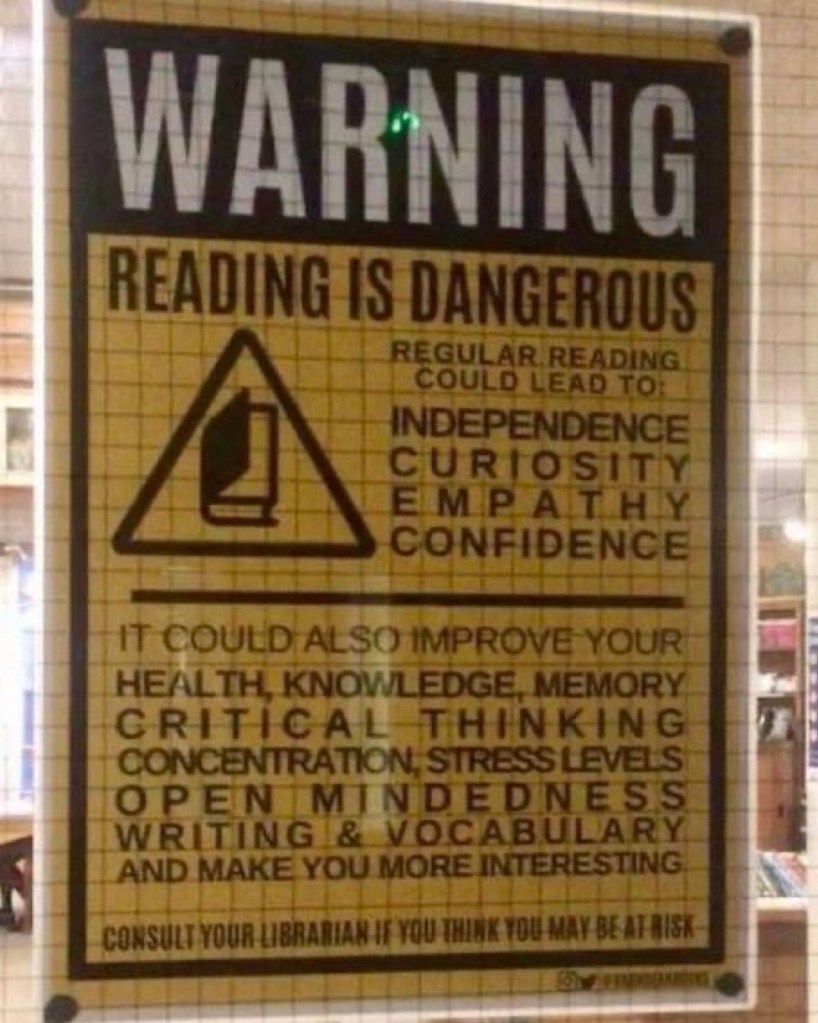
Read!

If you want to open your mind, read!

If you want to travel through time and space, read!

If you want to learn about other people and other cultures, read!

If you want to supercharge your creativity and imagination, read!

If you want to learn how other people see the world, read!

If you want to travel through time and space, read!

If you want to understand history, read!

Some people think these are dangerous activities. They want to control what students think. They censor books. They remove them from school libraries and public libraries. They forget that young people today have access to the Internet, which is not censored.

Live dangerously! Read books!

John Merrow is sick of the “reading wars.” So am I. I studied them intensively and wrote about their history in my book Left Back: A Century of Battles Over School Reform (2000).

In my opinion, Jeanne Chall (kindergarten teacher turned Harvard professor of literacy) settled the issues in her book called Learning to Read: The Great Debate. Her authoritative book, commissioned by the Carnegie Corporation, was published in 1967. She came out in favor of both early phonics and a rapid transition to children’s literature. She insisted that learning to read was never either-or. I wish she were alive to slap down the journalists and pundits who are now insisting that phonics and phonics alone is “the science of reading.” I feel sure she would laugh and say there is no science of reading. She warned that if we didn’t avoid either-or thinking, we would continue to swing from one extreme to another.

I am patiently waiting for evidence of any district (not counting affluent suburban districts) where “the science of reading” brought every child of every demographic and economic group to proficiency (not grade level, proficiency). The New York City Department of Education recently announced that it was mandating “the science of reading” across the entire city school system. We will be sure to check back in a few years and see how that worked out. Under Michael Bloomberg, Chancellor Joel Klein mandated “balanced literacy” (specifically, the work of Lucy Calkins of Teachers College, Columbia University, which was heavy on “whole word” and light on phonics). Phonics advocates were outraged, but they were ignored. Now the NYC Department of Education is swinging to the other extreme; balanced literacy is out, phonics is in.

John Merrow’s recent post about the “reading wars” reminded me of Jeanne Chall, who was a good friend.

I will post here a bit of it and urge you to open the link and read it all.

Learning the alphabet is a straightforward 2-step process: Shapes and Sounds. One must learn to recognize the shapes of the 26 letters and what each letter sounds like. There’s no argument about this, and certainly there has never been and never will be an “Alphabet War.”

The same rule–Shapes and Sounds–applies to reading. Would-be readers must apply what they learned about Sounds–formally called Phonics and Phonemic Awareness–to combinations of letters–i.e., words. They must also learn to recognize some words by their Shapes, because many English words do not follow the rules of Phonics. (One quick example: By the rules of Phonics, ‘Here’ and ‘There’ should rhyme; they do not, and readers must learn how to pronounce both.) To become a competent, confident reader, one must rely on both Phonics and Word Recognition.

Ergo, there’s absolutely no need, justification, or excuse for “Reading Wars” between Phonics and Word Recognition. None! And yet American educators, policy-makers, and politicians have been waging their “Reading Crusades” for close to 200 years. As a consequence, uncounted millions of adults have lived their lives in the darkness of functional illiteracy and semi-literacy.

Here’s something most Reading Crusaders don’t understand: Almost without exception, every first grader wants to be able to read, because they understand that reading gives them some measure of control over their world, in the same way walking does. And skilled teachers can teach almost all children–including the 5-20 percent who are dyslexic–to become confident readers.

Skilled teachers understand what the Reading Crusaders do not: Reading–again like walking–is not the goal. It’s the means to understanding, confidence, and control. Children don’t “first learn to read and then read to learn,” as some pedants maintain. That’s a false dichotomy: they learn to read to learn. And so skilled teachers use whatever strategies are called for: Phonics, Word Recognition, what one might call Reading as Liberation, and more.

Good news! The legislature in Illinois has passed a law to withhold state funds from institutions that ban books. Governor J.B. Pritzker is expected to sign it.

Illinois Gov. JB Pritzker (D) is expected to sign a bill that would withhold state funds from institutions that ban books amid nationwide efforts to pull some titles from shelves.

“Illinois is one step closer to preventing book banning in Illinois libraries,” said Illinois Secretary of State Alexi Giannoulias.

“Under this bill, we can support our state’s libraries and librarians and protect them against attempts to ban, remove or restrict access to books and resources,” he said.

The state’s H.B. 2789 would require libraries to adopt the American Library Association’s Library Bill of Rights — which “indicates materials should not be proscribed or removed because of partisan or doctrinal disapproval,” according to the proposed text — or develop their own such statement against book banning in order to be eligible for state grants.

The bill has cleared the state legislature and now heads to the governor’s desk. Pritzker has previously said he supports the bill, according to the secretary of State’s office.

“Banning books is a devastating attempt to erase our history and the authentic stories of many. Students across this state deserve to see themselves reflected in the pages of stories that teach and entertain. I’m proud to support House Bill 2789 and ensure that Illinois’ libraries remain sources of knowledge, creativity, and fact,” Pritzker said in a March release….

“Our nation’s libraries have been under attack for too long—they are bastions of knowledge and proliferate the spread of ideas. That is why I am so proud that my measure to prevent the banning of books passed in the senate today,” said Illinois state Sen. Laura Murphy, one of the bill’s sponsors.

Bill Gates, as is well known, is an expert on everything. The media breathlessly reports his thoughts on every subject, assuming that he must be as smart as he is rich. And he is very, very rich.

He predicts that in eighteen months, artificial intelligence will be sufficiently developed to teach reading and writing more effectively and at less cost than a human. this far, none of his educational predictions and initiatives have succeeded, so we will see how this works out.

Soon, artificial intelligence could help teach your kids and improve their grades.

That’s according to billionaire Microsoft co-founder Bill Gates, who says AI chatbots are on track to help children learn to read and hone their writing skills in 18 months time.

“The AI’s will get to that ability, to be as good a tutor as any human ever could,” Gates saidin a keynote talk on Tuesday at the ASU+GSV Summit in San Diego.

AI chatbots, like OpenAI’s ChatGPT and Google’s Bard, have developed rapidly over the past several months, and can now compete with human-level intelligence on certain standardized tests. That growth has sparked both excitement over the technology’s potential and debate over the possible negative consequences.

Count Gates in the camp of people who are impressed. Today’s chatbots have “incredible fluency at being able to read and write,” which will soon help them teach students to improve their own reading and writing in ways that technology never could before, he said.

“At first, we’ll be most stunned by how it helps with reading — being a reading research assistant — and giving you feedback on writing,” said Gates….

It may take some time, but Gates is confident the technology will improve, likely within two years, he said. Then, it could help make private tutoring available to a wide swath of students who might otherwise be unable to afford it.

That’s not to say it’ll be free, though. ChatGPT and Bing both have limited free versions now, but the former rolled out a $20-per-month subscription plan called ChatGPT Plus in February.

Still, Gates said it’ll at least be more affordable and accessible than one-on-one tutoring with a human instructor.

“This should be a leveler,” he said. “Because having access to a tutor is too expensive for most students — especially having that tutor adapt and remember everything that you’ve done and look across your entire body of work.”

Someone will make money, that’s for sure.

Paul Bonner, retired career educator, debunks the “science of reading” prattle;

Then the New York Times published this…https://www.nytimes.com/2023/04/16/us/science-of-reading-literacy-parents.html

Ignorance about the circumstances that hinder student learning is pervasive among the national media. They report again and again on failed “one size fits all” remedies without understanding that these fail because they do not address the root cause of public school challenges: Poverty.

Advocacy for “The science of reading”, Lucy Caulkins, or whole language all miss the point. Until we are willing to change the instructional delivery system that allows for K-12 class sizes of 20-30+ students per class, a teaching professional day that does not allow meaningful classroom preparation except beyond the school day, equal high quality resources and facilities for all students, and an understanding that this hyper focus on reading fluency actually demonstrates low expectations for our students.

Perhaps the greatest inaccuracy on the NYTimes report is that somehow schools have not been engaged in this “Science of reading” rabbit hole.

The two large districts I served in were all in with massive resources given to administrative and teacher professional development for the purpose of institutionalizing the practice. Yet, scores never moved despite efforts to show improvement through numerous changes in the standardized tests being implemented.

The confirmation bias so prevalent in this ongoing reporting has been troubling since the Clinton Administration introduced the “Standards Movement.” Any challenges to such bias continue to be ignored and often attacked.

The fact that Emily Hanford, Arne Duncan, Bill Gates, Margaret Spellings continue to act as “go to” interviews when their profession experience as practicing educators is woeful at best, demonstrates the little regard reporters have for the professionalism required to teach and administer instructional outcomes.

It is in fact these arbiters of “data” who use anecdotal reporting to misinform politicians and institutions such as the NAACP to continue this malpractice.

Perhaps the one method we have been reticent to use should be to support teaching, adequately resource school facilities everywhere, and get the hell out of the way for the educators who actually know their craft.

Paul Waldman and Greg Sergeant of the Washington Post described the social pressure within the community that cause dthe book censors in the county to back off.

It isn’t every day that the ruminations of local bureaucrats in a small rural Texas county become national news. But when commissioners in Llano County — population 21,000 — voted Thursday to keep its three-branch library system open, the moment was closely monitored by the biggest news organizations in the country.

That’s because Llano County has become a national symbol of local right-wing censorship efforts after officials threatened to close its libraries entirely rather than allow offending materials to remain on shelves. Under intense scrutiny, the commission blinked. Its leader acknowledged feeling pressure from “social media” and “news media.”

The commissioners’ apparent reluctance for Llano to be seen as a locus of censorship points to an unexpected development: Skirmishes emanating from book bans at schools and libraries in red states and counties, once localized affairs, are becoming viral national sensations. And the American mainstream appears to be paying attention.

Like many other similar conflicts, this one was triggered by a single Llano resident, Bonnie Wallace, who objected in 2021 to library books she pronounced “pornographic filth.” A bunch were removed, including unobjectionable materials such as Maurice Sendak’s “In the Night Kitchen” and Isabel Wilkerson’s “Caste: The Origins of Our Discontents.”

The county also dissolved its libraries’ advisory board and reconstituted it with advocates of book removal, including Wallace herself. After other residents sued for the books’ return, a judge ordered the books placed back on the shelf, prompting the county to consider shutting the libraries pending the suit’s resolution.

At Thursday’s hearing, several of Llano’s self-designated commissars of book purging read explicit sex scenes from young adult books, but they went further, advocating for closure. One said: “I am for closing the library until we get this filth off the shelves.”

When the national media paid attention, other residents of Llano County realized that extremists were taking the lead and giving their community a bad name. Shame is a strong motivator.

But one of the big surprises of these sagas has been outbreaks of resistance to book purges in the reddest places, and here again, some locals dissented. One said: “We have to be a community that values knowledge.” Another fretted: “We are all over the media, and this is making us look pretty bad as a community.”

It turns out that even in an overwhelmingly conservative place (Donald Trump won nearly 80 percent of Llano’s votes in 2020), plenty of people value free expression. Many Republicans aren’t on board with the right’s censorship agenda. And these folks can organize.

To be fair to Llano County’s conservatives, many insist they don’t want to burn or censor books. As they told one of us (Paul Waldman) in interviews in Llano last fall, they only wanted material to be age-appropriate.

But that doesn’t explain opposition to books about racism. And even if some conservative voters are more measured, these efforts are open to abuse. In places such as Florida, they have allowed lone conservative activists to remove dozens of books from schools based on flimsy or absurd objections.

The book-banning impulse is taking on a crazed life of its own. At a Llano County tea party meeting in November, Waldman witnessed Wallace passionately pleading that “I need more conservative friends” to help get “pornography out of the library,” adding: “We must, must, must keep fighting.” It was obvious that, for people like Wallace, the prospect of controlling which books their community can access has been a thrill.

Such right-wing activists thought they had good reason for confidence. After Republican Glenn Youngkin was elected Virginia governor in 2021 on a dishonestly termed “parental rights” platform, some censorship-minded activists imagined they had a national mandate. But arguably only the GOP base was paying attention to that issue at the time (swing voters were focused on school closures).

Now, the national media — and perhaps the mainstream of the country — are watching these local abuses unfold. “Every day it seems there’s a new book banned, an art exhibit canceled, or a drag performance under threat,” Jonathan Friedman of PEN America told us. “People are waking up to the fact that state and local governments are running rampant.”

National opinion isn’t cooperating with the censors. In the 2022 elections, many prominent culture-warring GOP candidates lost. (Florida Gov. Ron DeSantis is an exception.) Polls show large percentages of parents are concerned about schools banning books and that Americans overwhelmingly reject bans based on teachings about history and race.

Therein lies a trap for the GOP. The activist base is demanding increasingly reactionary censorship measures, and officials such as DeSantis are obliging for 2024 primary purposes. Yet as these local far-right lurches attract attention, they taint the national GOP as extreme.

Democrats should take heed. Some still appear skittish about culture-war issues, as evidenced when Education Secretary Miguel Cardona told TPM’s Hunter Walker that “we want to stay above” censorship controversies, as if ignoring them would make them go away or is good politics.

But when the national spotlight falls on censorship, the right is exposed, the left is energized and moderates balk at seeing their communities controlled by a small band of extremists.

Democrats must speak to those resisting these outbreaks of hysteria in deep-red places such as Llano. In some of them, fundamental liberal values still endure. The way to respond to this wave of censorship isn’t to hope it burns out, but to flush it into the light and confront it head on.

Overall, the story in Llano County is encouraging. It shows that civic leaders don’t want their community to be known for book banning.

But what’s really discouraging is the loud silence from the U.S. Department of Education. Why is Secretary Cardona silent? Why does he want to stay out of censorship controversies? Why isn’t he defending teachers and librarians? Why isn’t he standing up for the right to read?

This is a perilous time. American schools, teachers, and librarians need a champion not milquetoast. Teachers and librarians know that their jobs are at risk if they stand up to the vigilantes. What does Secretary Cardona have to lose? He should be speaking out against vouchers. He should be speaking out against censorship. He should be defending the accurate teaching of American history. He cannot float above the issues without appearing weak.

Democrats must speak out against censorship and privatization. That is a winning strategy.

Peter Greene discovered a conservative making a case for public education. Was it inadvertent?

Peter writes:

Okay–where do you think this next excerpt came from?

Our public schools are one of the few unifying institutions that we have left. If we allow [something] to continue to individualize and atomize the classroom, we shouldn’t be surprised if our culture and political climate follow suit. In a traditional classroom with central texts, common knowledge, and routinized behavioral norms, our children learn to let another finish speaking before interrupting, no matter how much they might disagree. How many complete strangers could spark up a conversation over their shared love—or perhaps disdain—for the Great Gatsby because so many of us have read it in high school?

Traditional literature classrooms in particular seem all the more important as technology advances. When children spend ever more timeisolated in their rooms, endlessly scrolling on their phone, depressed and anxious, the act of putting a phone away, reading together, and then making eye contact to discuss the text could be the very “social and emotional” support that they need. When artificial technology can accomplish evermore tasks, enjoying a book with friends is one of the few remaining, distinctly human pleasures.

Is this me, arguing against current versions of school choice, particularly tech-based versions like micro-schools?

Nope. This is Daniel Buck, rising star conservative education writer on the AEI/Fordham circuit. I’ve written about him before, and you can check that out if you want more of his story or the story of his website, but for right now, mostly what you need to know is that Buck’s specialty is arguing against straw versions of progressive education stuff, which is what he says he’s railing at. My impression is that Buck means well, but doesn’t spend near enough time reading actual non-conservatives about education.

Here he’s railing against progressives who, in his telling, are out there letting students in classes pick all sort of different texts and do different things and follow different muses and while I have no doubt such teachers exist (in a pool of 4 million, you can find examples of anything), I’ll bet that most teachers, conservative or not, find the idea of overseeing 130 different individual reading units the stuff of nightmares.

No, the place you’re much more likely to find an array of students following an atomized assortment of varied educational paths would be a city that offers dozens of school choices, from “classical” whiteness to computer-driven whatever to contemporary diverse authors to neo-Nazi home schooling.

The argument he makes in this latest piece–that the nation benefits from having students share core experiences together while learning some of the same material even as they learn how to function in a mini-community of different people from different backgrounds–that’s an argument familiar to advocates of public education. The “agonizing individualism” and personalized selfishness that he argues against are, for many people, features of modern school choice–not public schools.

Open the link to read the rest of this post.

Steve Hinnefeld writes about a threat in Indiana to ban books and to criminalize librarians who allow anyone to check out a banned book.

Hat’s off to Indiana’s librarians. They turned out in force last week when legislators considered making it easier to ban books and prosecute people who provide material that’s “harmful to minors.” And they pushed back when lawmakers suggested they didn’t know what they were saying.

The legislation was written and ready to roll. For now, though, it’s off the table. Steve warns that it could be attached to another bill. Hoosier librarians are watching.