Archives for category: Koch Brothers

Peter Greene looks into the Koch-funded voucher lobby in West Virginia and finds a fairly accurate portrayal of the dystopian future that lies ahead.

First, he details the background of the leaders of the voucher lobby. All have long-time connections to rightwing causes. Most were hired to push West Virginia’s expansive voucher plan, which passed in 2021.

If ever there was a state that needs a strong public school system, it’s West Virginia. But with big Koch money, the Koch puppets will make that impossible.

Instead of good public schools, West Virginians will have the “freedom” to find a good education on their own!

After identifying the staff and board, Greene writes:

So we’ve got the picture now– Cardinal Institute for West Virginia Policy (which belongs to the State Policy Network) is a Koch organization.

Cardinal Institute is all for the usual Koch version of liberty. They are pushing a West Virginia Miracle, and the four pillars are “Economic Freedom, Labor Freedom, Education Freedom, and Montani Semper Liberi – a culture of freedom.” They would like to promote “limited government, economic freedom, and personal responsibility.” They’ve got a podcast– “Forgotten America.” And they promise a “new paradigm”–

An “island” of poverty in the wealthiest country the world, West Virginia’s brighter future depends on a new paradigm – a new way of looking at the world with new ideas and a philosophy built on innovation, human flourishing, and a recognition that freedom is the greatest alleviator of poverty the world has ever seen. Ours is a philosophy built on the entrepreneur, the tinkerer in the garage, and the idea that small government means more room for people to create and build their own futures.

It’s a curious pitch in a state that is not exactly known for government overreach. West Virginia is a state with a history of labor struggles and a history of state government that exerts its power mostly to aid guys like Charles Koch. Regular people have always had plenty of room in this state that is renowned for its poverty— worst healthworst education levelsworst employment, and geography that makes it hard for basic infrastructure like roads and water and electricity and internet to reach some citizens. (And at least one community gutted by the departure of its WVU college campus–but hey, they’re free now.) It’s hard to imagine that any of these problems would be solved by less government, but libertarians gotta libertarian.

So what does Ballangee say about Mount Everest?

In his Education Next piece, Ballangee comes close to honesty about the larger goals of his particular arm of the school voucher movement. 

There is a common misconception among education reform advocates that passing universal choice legislation is akin to summiting Mount Everest. Upon universal choice’s enactment into law, it is done. Time to exhale and pop the champagne, for the mountain has been scaled.

In other words, voucher laws are not the end game. Simply making a voucher program available is not enough.

Next, the program has to be pushed and promoted. There will be a urge, then a steady growth “as families become aware of the program and hear from neighbors, fellow church attendees, and other connections about their new options” (just in case you had doubts about voucher ties to religion). Nut awareness must be built and PR must be provided to popularize the program.

Failure for an education choice program does not often come in the form of mistakes, fraud, or incompetence. More frequently, the problems are apathy and ignorance.

I don’t know. There’s an awful lot of fraud and incompetence in the school choice world. Nor am I sure how the lack of interest in a choice program is not the same thing as a lack of market demand. But of course modern marketing means creating a demand for your product. So, Ballangee asserts, somebody will need to work on that.

Someone will also need to build/attract a supply of educational “providers.” “Help private schools sign up,” he says, skipping over the question of why a successful private school would want to sign up. Somebody has to reach out to edupreneurs and get them signed up, too. Basically, be an education broker.

Now that choicers need to spend less time lobbying legislators, “the nexus of a successful program [he means a privatizing program, not an educational program] will shift somewhat from legislative considerations, lobbying, and bill design towards family outreach and relationship cultivation, specific government agency relationships, and broad marketing campaigns.”

Also, you’ll have to prepare for those “legions of entities” looking to “besmirch” the program (public education establishment, unions, union-friendly media). 

And this–

You have to figure out how – not if – to help the families about to embark on this journey for the first time…

You must figure out how to manage each “case” not only for the sake of the family and child but also for the overall health of the program.

There will be grandparents who have never used a computer now asked to upload a birth certificate on their grandchild’s behalf. There will be parents with limited education who know only one thing when it comes to navigating this fresh bureaucratic concoction: “my child needs something different.” Be sympathetic, but, more importantly, develop competence.

Learn the law and accompanying statutes backwards and forwards or find someone who does. You must have a path or contact for families to use. “I don’t know the answer, but I know someone who might” will become one of the most useful phrases in your reform handbook.

In short, Ballengee is outlining all the new business opportunities available on the mountaintop voucher peak. The only one he left out was the booming business in K-12 education loans for all those parents for whom state’s voucher won’t cover the cost of their education provider. Not only will government stop providing public education, but there are many opportunities to make a buck or ten in the newly free and unregulated marketplace of education stuff.

The Koch mountaintop

Because here’s what “freedom” means on Koch mountain– you are free to try to get to the top if you can, and I am free to ignore any of your problems (unless you pay me to help you), because the dream remains a world in which I have no responsibility to my fellow travelers on the earth (and certainly don’t have to pay taxes to provide services for Those People). 

Ballangee isn’t going to have any discussion of how well vouchers work as far as education goes (hint: not very well). But that’s okay, because, as he says, “education choice is good and a moral necessity.” I’m of the opinion that guaranteeing each child a decent education is the moral necessity, and, as always, I question the assumption that “education choice” must somehow involve the free market, one of the great unexamined assumptions of the modern choicer movement. Are choice and freedom important values in life? Damn right they are–which is why we as a society bear a responsibility for getting every child an education that will help them freely access more choices.

In the end, Ballengee’s mountain is one that Ayn Rand would probably approve of.

Though the last few steps up the mountain are the steepest and most difficult, they are also closest to what we are looking for when we embark on our journey: helping children find their own path to their own personal summit.

In other words, I’ve got my summit, Jack. Go find your own. 

“Helping” I suppose could mean choice advocates just helping out of the goodness of their hearts (though their hearts, bless them, don’t know much about actual education). But I suspect that help will be provided, for a price (or a cut of your voucher), to those who can find it and access it while navigating a sprawling unregulated complicated marketplace. It’s funny, because another thing we could do is collect all the experts in delivering education under one roof, where they’d be easy to find. And we could pay them with public tax dollars, and recruit and hire them with the understanding that they are there to help students climb their own personal mountain. But then some of us would have to pay taxes to fund it, and they might not be willing to make it all about christianist ideas. 

So instead, Koch-trained folks imagine a mountain, an Everest. By the way, do you know what Everest looks like these days? It’s a crowded mess of wealthy, resource-rich tourists who are hiring someone else to guide them. Well, that’s Everest.

The peak of the school voucher mountain looks a lot like wealthy, well-resourced folks looking down at the folks struggling on the slopes of other mountains and saying, “Well, don’t they look free. I wonder if they’ll make it.”

Historian Heather Cox Richardson brilliantly contrasts the views of Republicans and Democrats on the role of government. Republicans want it to be as minimal as possible. Democrats want it to use its powers and resources to improve people’s lives. Understanding this difference helps illuminate why Republicans want to get rid of public schools and why billionaires like Charles Koch and Betsy DeVos support vouchers and libertarianism in a society where everyone is on their own.

Yesterday, the Republican Study Committee, a 175-member group of far-right House members, released their 2024 “Blueprint to Save America” budget plan. It calls for slashing the federal budget by raising the age at which retirees can start claiming Social Security benefits from 67 to 69, privatizing Medicare, and enacting dramatic tax cuts that will starve the federal government.

I’m actually not going to rehash the 122-page plan. Let’s take a look at the larger picture.

This budget dismisses the plans of “President Joe Biden and the left” as a “march toward socialism.” It says that “[t]he left’s calls to increase taxes to close the deficit would be…catastrophic for our nation.” Asserting that “the path to prosperity does not come from the Democrats’ approach of expanding government,” it claims that “[o]ver the past year and a half, the American people have seen that experiment fail firsthand.”

Instead, it says, “the key to growth, innovation, and flourishing communities” is “[i]ndividuals, free from the burdens of a burdensome government.” 

It is?

Our history actually tells us how these two contrasting visions of the government play out.

Grover Norquist, one of the key architects of the Republican argument that the solution to societal ills is tax cuts, in 2010 described to Rebecca Elliott of the Harvard Crimson how he sees the role of government. “Government should enforce [the] rule of law,” he said. “It should enforce contracts, it should protect people bodily from being attacked by criminals. And when the government does those things, it is facilitating liberty. When it goes beyond those things, it becomes destructive to both human happiness and human liberty.”

Norquist vehemently opposed taxation, saying that “it’s not any of the government’s business who earns what, as long as they earn it legitimately,” and proposed cutting government spending down to 8% of gross national product, or GDP, the value of the final goods and services produced in the United States. 

The last time the level of government spending was at that 8% of GDP was 1933, before the New Deal. In that year, after years of extraordinary corporate profits, the banking system had collapsed, the unemployment rate was nearly 25%, prices and productivity were plummeting, wages were cratering, factories had shut down, farmers were losing their land to foreclosure. Children worked in the fields and factories, elderly and disabled people ate from garbage cans, unregulated banks gambled away people’s money, business owners treated their workers as they wished. Within a year the Great Plains would be blowing away as extensive deep plowing had damaged the land, making it vulnerable to drought. Republican leaders insisted the primary solution to the crisis was individual enterprise and private charity. 

When he accepted the Democratic nomination for president in July 1932, New York governor Franklin Delano Roosevelt vowed to steer between the radical extremes of fascism and communism to deliver a “New Deal” to the American people. 

The so-called alphabet soup of the New Deal gave us the regulation of banks and businesses, protections for workers, an end to child labor in factories, repair of the damage to the Great Plains, new municipal buildings and roads and airports, rural electrification, investment in painters and writers, and Social Security for workers who were injured or unemployed. Government outlays as a percentage of GDP began to rise. World War II shot them off the charts, to more than 40% of GDP, as the United States helped the world fight fascism. 

That number dropped again after the war, and in 1975, federal expenditures settled in at about 20% of GDP. Except for short-term spikes after financial crises (spending shot up to 24% after the 2008 crash, for example, and to 31% during the 2020 pandemic, a high from which it is still coming down), the spending-to-GDP ratio has remained at about that set point.

So why is there a growing debt?

Because tax revenues have plummeted. Tax cuts under the George W. Bush and Trump administrations are responsible for 57% of the increase in the ratio of the debt to the economy, 90% if you exclude the emergency expenditures of the pandemic. The United States is nowhere close to the average tax burden of the 38 other nations in the Organization of Economic Cooperation and Development (OECD), all of which are market-oriented democracies. And those cuts have gone primarily to the wealthy and corporations. 

Republicans who backed those tax cuts now insist that the only way to deal with the growing debt is to get rid of the government that regulated business, provided a basic social safety net, promoted infrastructure, and eventually promoted civil rights, all elements that stabilized the nation after the older system gave us the Depression. Indeed, the Republican Study Committee calls for making the Trump tax cuts, scheduled to expire in 2025, permanent. 

“There are two ways of viewing the government’s duty in matters affecting economic and social life,” FDR said in his acceptance speech. “The first sees to it that a favored few are helped and hopes that some of their prosperity will leak through, sift through, to labor, to the farmer, to the small businessman.” The other “is based upon the simple moral principle: the welfare and the soundness of a nation depend first upon what the great mass of the people wish and need; and second, whether or not they are getting it.”

When the Republican Study Committee calls Biden’s policies—which have led to record employment, a booming economy, and a narrowing gap between rich and poor— “leftist,” they have lost the thread of our history. The system that restored the nation after 1933 and held the nation stable until 1981 is not socialism or radicalism; it is one of the strongest parts of our American tradition.

Notes:

A reader of the blog uses the sobriquet “Democracy” to protect his or her anonymity. His/her comments are always thoughtful.

The attack on public schools — in Virginia and across the country — is not some spontaneous “parent rights” outburst. It’s orchestrated. It’s being funded and set into motion by right-wing “Christians” at the Council for National Policy, a far-right group that had outsized-influence with the Trump administration.

Richard DeVos, husband of Betsy, has been president of CNP twice. Ed Meese, who helped Reagan cover up the Iran-Contra scandal, has been president of CNP. So has Pat Robertson. And Tim LaHaye.

Current and former CNP members include Cleta Mitchell, the Trump lawyer who was on that call to the Georgia Secretary of State demanding that he find Trump more than 11,780 votes, and Charlie Kirk, head of Turning Point USA who bragged about bussing tens of thousands of people to the January 6th ‘Stop the Steal’ rally and insurrection. Two of the top peeps at the Federalist Society, Eugene Meyer and Leonard Leo, are also CNP members. (Brett Kavanaugh and Amy Coney Barrett were high priorities for the Federalist Society and for CNP). Ginni Thomas, the wife of Supreme Court Justice Clarence Thomas, is a member. So is Stephen Moore, the wack-boy “economist” that Trump wanted to appoint to the Federal Reserve but ultimately didn’t because he owed his ex-wife $300,000 in back alimony and child support, and who was an “advisor” Glenn Youngkin in his campaign for Virginia governor even though he’s been dead wrong about virtually all of his economic predictions and who helped Sam Brownback ruin the economy of Kansas.

The Council for National Policy is interconnected to the American Legislative Exchange Council (ALEC) and the State Policy Network and Tea Party Patriots and a host of other right-wing groups. This is – in fact – the vast “right-wing conspiracy” that Hillary Clinton complained about. Glenn Youngkin made himself all very much a part of this.

Did this “new” Republican Southern Strategy work? Well, Youngkin won the Virginia governorship, and exit polls showed that Youngkin won 62 percent of white voters, and 76 percent of non-college graduate whites. And, Youngkin got way more of the non-college white women votes (75 percent) than his Democratic opponent, Terry McAuliffe.

Here’s how the NY Times explained it:

“Republicans have moved to galvanize crucial groups of voters around what the party calls ‘parental rights’ issues in public schools, a hodgepodge of conservative causes ranging from eradicating mask mandates to demanding changes to the way children are taught about racism…Glenn Youngkin, the Republican candidate in Virginia, stoked the resentment and fear of white voters, alarmed by efforts to teach a more critical history of racism in America…he released an ad that was a throwback to the days of banning books, highlighting objections by a white mother and her high-school-age son to ‘Beloved,’ the canonical novel about slavery by the Black Nobel laureate Toni Morrison…the conservative news media and Republican candidates stirred the stew of anxieties and racial resentments that animate the party’s base — thundering about equity initiatives, books with sexual content and transgender students on sports teams.”

Republicans and racism. Who knew?

Lots of people.

Yale historian David Blight put it this way:

“Changing demographics and 15 million new voters drawn into the electorate by Obama in 2008 have scared Republicans—now largely the white people’s party—into fearing for their existence. With voter ID laws, reduced polling places and days, voter roll purges, restrictions on mail-in voting, an evisceration of the Voting Rights Act of 1965, and a constant rant about ‘voter fraud’ without evidence, Republicans have soiled our electoral system with undemocratic skullduggery…The Republican Party has become a new kind of Confederacy.”

And this Republican “Confederacy” hates public education.

Jan Resseger spent her waking years as a warrior for social justice in her church. Now she writes a brilliant and thoughtful blog.

Her recent post made me reflect on the fact that groups like “Moms for Liberty” and “Parents Defending Education” create turmoil and chaos over the issue of the day (masking, vaccines, school closings, trans kids, books about race or gender identity), then use the issues and conflict they created to demand vouchers to send their kids to schools with like-minded parents.

These Astroturf groups are funded handsomely by the Walton Family Foundation, Charles Koch, Betsy DeVos, and other billionaires to act as shock troops for their paymasters.

Jan Resseger wrote recently:

I cannot even keep track of all the press coverage I have seen in the past couple of weeks about school privatization proposals under discussion in the state legislatures. And in almost all of the articles I read, the move to privatize schools is accompanied by descriptions of culture war fights about book banning, interference with curricular standards, and elimination of programs that encourage “diversity, equity, and inclusion” in public schools and public universities. I have a stack of very recent articles about Florida, Ohio, Virginia, Texas, Missouri, Iowa, Kansas, Nebraska, and New Hampshire, and I am sure I have missed others.

What is the cause of today’s attack on public schools and the kind of programming that many of us believe is essential to help our children live well in our diverse society?

In her Washington Post piece about a battle between two parent groups, Concerned Taxpayersand Support Education, in Mentor, Ohio——Hannah Natanson blames COVID for the controversy: COVID Changed Parents’ View of Schools—and Ignited the Education Culture Wars.

And in a powerful report from the Network for Public Education, Merchants of Deception, political scientist Maurice Cunningham identifies the role of Astroturf parents’ groups that present themselves as though they are a spontaneous welling up of parent outrage. Even though financial support for these groups is untraceable dark money, here is how Cunningham tracks evidence that these supposedly local groups are well connected from place to place and supported by powerful, far-right political interests: “First we should watch for groups that have “grown at a pace that only a corporation’s monetary resources could manage.” Then we should identify the group’s allies to “get a better idea of the real powers behind” the organization. Additionally: “We’ll use another tool to draw telling inferences about these fronts: identification of their key vendors, such as law firms, pollsters, and public relations firms, which we’ll see are often instruments of conservative… networks… Another recurring clue… is the ‘creation story.’ A new non-profit group bursts forth with some version of claiming that two or three moms began talking over what they see as problems in schools and resolve to start a nonprofit to take on the teachers’ unions, administration, or school board. By some form of miracle, they almost immediately receive hundreds of thousands, if not millions, of dollars in funding from billionaires. Next, they find themselves gaining favorable coverage on right-wing media—Daily Caller, Breitbart, and Fox News…. ”

Of course both the disruption COVID thrust upon our communities and the use of parents by far-right groups trying to ban “WOKE” policies represent what many of us have been watching in the past couple of years. But on a deeper level, it is not a coincidence that the outrageous school board disruptions and the attempts by the far right to scrub the textbooks, and the legislatures considering parents’ bill of rights legislation also seem to be happening in places where slate lawmakers are also pushing vouchers, and not merely the old-fashioned tuition vouchers for private schools, but the new Education Savings Account universal programs to provide wider parental “freedom” and lack of oversight of the public dollars being diverted to these plans. These new vouchers are being designed to give parents the ultimate latitude in school choice—homeschooling and micro-schools where parents put their vouchers together to pay for a teacher for several families. Lack of regulation is a key ingredient in most of these plans. In every case the worldview underneath the proposals involves extreme individualism along with marketplace consumerism.

In her new book, The Teachers: A Year Inside America’s Most Vulnerable, Important Profession, Alexandra Robbins describes parents who view themselves and their children as the customers teachers must please: “At a candidate forum during the COVID pandemic, a Maryland school board member called students the ‘customers in our school system,’ as if teachers existed to satisfy students rather than to educate them… On a broader level, the student-as-customer attitude has contributed to a growing politicized movement pushing for parents to have authority over what is taught in schools.” (pp. 66-67) Believing your child is the client who must be pleased by services rendered is a very different conception of the parent-teacher relationship than believing that the teacher is a professional whose expertise and cooperation you can and should consult for guidance about your child’s education.

Please open the link and read the remainder of this very important post.

Randi Weingarten, president of the American Federation of Teachers, delivered the following remarks today at the National Press Club in Washington, D.C. She vigorously defended public schools against current efforts to destroy them. She named names. She explained the purpose of public schools, which makes them a precious part of our democratic aspirations but also a target for those who hate democracy.

Randi said:

Today, we once again grieve for families shattered by senseless gun violence. Please join me in a moment of silence for the lives lost at the Covenant School in Nashville, and for all victims of gun violence.

Today we renew our call for commonsense gun safety legislation including a ban on assault weapons. This is an epidemic that our great nation must solve.

There’s a saying: You don’t have to love everything about someone to love them. I’m sure my wife doesn’t love everything about me, but she loves me. (I, on the other hand, love everything about her.) Nothing is perfect. Banks aren’t. Congress isn’t. And neither are our public schools—not even our most well-resourced and highest-performing schools. Those of us involved in public schools work hard to strengthen them to be the best they can be. But only public schools have as their mission providing opportunity for all students. And by virtually any measure—conversations, polls, studies and elections—parents and the public overwhelmingly like public schools, value them, need them, support them—and countless Americans love them.

Public schools are more than physical structures. They are the manifestation of our civic values and ideals: The ideal that education is so important for individuals and for society that a free education must be available to all. That all young people should have opportunities to prepare for life, college, career and citizenship. That, in a pluralistic society such as the United States, people with different beliefs and backgrounds must learn to bridge differences. And that, as the founders believed, an educated citizenry is essential to protect our democracy from demagogues.

Thomas Jefferson argued general education was necessary to “enable every man to judge for himself what will secure or endanger his freedom.” Franklin D. Roosevelt said: “The real safeguard of democracy … is education.” And Martin Luther King Jr., in accepting the United Federation of Teachers’ John Dewey Award, made clear, “Education is the road to equality and citizenship.”

When kids go to school together, they become part of a community; their families become part of a community. That community comes together at school concerts, basketball games and science fairs, and for shelter and comfort, when people are displaced by natural disasters or, far too often, at vigils for victims of gun violence. In good times and bad, public schools are cornerstones of community, of our democracy, our economy and our nation.

But some people want that cornerstone to crumble—and they’re wielding the sledgehammers.

II. ATTACKS ON PUBLIC EDUCATION AND DEMOCRACY

Attacks on public education are not new. The difference today is that the attacks are intended to destroy it. To make it a battlefield, a political cudgel. After former President Trump lost re-election, Steve Bannon, his key ally, declared that their fight goes through school boards. In a speech last year, culture war operative and Governor Ron DeSantis’ appointee Christopher Rufo put it bluntly, “To get to universal school choice, you really need to operate from a premise of universal public school distrust.” To this end, he says, his side has “to be ruthless and brutal.”

And, I would add, well-funded, which it is. The DeVos, Bradley, Koch, Uihlein and Walton family foundations and others have poured many millions of dollars into anti-public education, pro-privatization groups like the American Federation for Children and EdChoice.

The Betsy DeVos wing of the school privatization movement is methodically working its plan: Starve public schools of the funds they need to succeed. Criticize them for their shortcomings. Erode trust in public schools by stoking fear and division, including attempting to pit parents against teachers. Replace them with private, religious, online and home schools. All toward their end goal of destroying public education as we know it, atomizing and balkanizing education in America, bullying the most vulnerable among us and leaving the students with the greatest needs in public schools with the most meager resources.

It’s an extremist scheme by a very vocal minority of Americans.It’s hurting our efforts to do the work we need to do, which is educating the nearly 50 million kids who attend America’s public schools. And the urgent work of helping kids recover from learning loss, sadness, depression and other effects of the pandemic.

And it’s not what parents or the public want.

Let’s start with defunding: This year alone, 29 state legislatures are considering bills to either create or expand existing voucher programs. This is on top of the 72 voucher and tax credit programs in 33 states already subsidizing private and home schooling, costing billions every year. Voucher programs are proliferating even though research shows that, on average,vouchers negatively affect achievement—the declines are worse than pandemic learning loss. In fact, vouchers have caused “some of the largest academic drops ever measured in the research record.”

Proponents of vouchers used to argue that they were a way for low-income and minority families to transfer out of low-performing schools. No longer. Today most vouchers go to families who already send their kids to private schools. And private schools are not required to follow most federal civil rights laws protecting students, so they can—and many do—discriminate, especially against LGBTQ students and students with special needs.

The universal voucher program signed by Florida Gov. DeSantis yesterday will divert $4 billion from the state’s public schools. Florida ranks 44th in the nation in per pupil spending, and 48thin average teacher salaries. DeSantis is sending taxpayers’ dollars in the wrong direction.

And then there are the culture wars. What started as fights over pandemic-era safety measures has morphed into fearmongering: False claims that elementary and secondary schools are teaching critical race theory; disgusting, unfounded claims that teachers are grooming and indoctrinating students; and pronouncements that public schools push a “woke” agenda, even though they can’t or won’t define what they mean. Banning books and bullying vulnerable children. School board meetings descending into screaming matches. This is an organized and dangerous effort to undermine public schools.

Over the last three years, legislators in 45 states proposed hundreds of laws placing public schools at the center of culture wars: laws seeking to ban books from school libraries—even books about Ruby Bridges and Anne Frank and Roberto Clemente; laws restricting what teachers can teach and students can learn—particularly about about race, gender, LGBTQ issues, current events and American history; and laws attacking kids who are transgender. Students and staff should feel welcome, safe and respected in school—but the culture wars are fueling hostility and fear.

A torrent of enacted and proposed legislation targeting even the mention of “controversial” topics—sweeping and open-ended restrictions on what can be taught—has teachers teaching on eggshells. In Florida, the Department of Education has threatened teachers and librarians with felony prosecution if they provide students with books that the state later decides are inappropriate. If Florida lawmakers have their way, colleges will no longer have diversity, equity or inclusion policies; or tenure;or academic freedom. And AP courses and the mere utterance of LGBTQ will be banned in all K-12 schools. And forget about facts. Many laws and pending bills allow any individual to sue schools and teachers for perceived violations. The intent and effect are to create a climate of fear and intimidation.

This takes a toll on the quality of education teachers can provide our students, and on the trust and connection that are so important. Shouldn’t teachers be free to talk with students who are withdrawn or in distress, and to answer students’ questions? Don’t we want students to learn both our nation’s achievements that make us proud and the failings that make us strive to do better? Isn’t that our job?

Teachers should have the freedom to teach. And students should have the freedom to learn.

These same governors who are pushing vouchers and culture wars are also trying to defund and weaken teachers unions, so educators don’t have the wherewithal to fight back against censorship, attacks on their academic freedom, threats to their livelihoods and criminal prosecution.

These attacks aren’t about protecting kids. If they were, they would be working with us to address learning loss and the youth mental health crisis. They would be working with us to take on social media companies for contributing to that crisis.

If these attacks were about protecting kids, they would be working with us to fight against the leading cause of death for American children—gun violence.

If this were about protecting kids, instead of putting LGBTQ youth at risk and banning books about Black people and by Black authors, they would give a damn about these kids’ safety and well-being, including the youth suicide crisis.

Forty-five percent of LGBTQ youth seriously considered suicidein the last year. And the suicide rate among Black youth of all sexual orientations has been increasing as well.

This is literally a matter of life and death. These attacks on public education make it increasingly difficult to create the welcoming, safe environment that our students need and deserve.

School climate and culture

It is a fraught time in our country. The effects of COVID-19; the climate of conflict; drug abuse; gun violence; economic insecurity; and the youth mental health crisis have all taken a heavy toll. Hate crimes have surged against many Americans—Asian, Black, Latino, Jewish and Muslim Americans.

School staff report a rise in bullying, verbal altercations and physical violence among students, as well as this behavior directed at them.

I recall a teacher saying that when her students are disruptive, it’s not because they are bad; it’s because they’re sad.

So many students have experienced isolation and trauma. They need help. But there weren’t enough mental health specialists before the pandemic, and they are in critically short supply now.

The persistent demonization and disrespect of teachers—from screaming matches at school board meetings to the former secretary of state saying teachers teach “filth”—have contributed to a culture of disrespect that seeps into our schools.

I just got a report from Florida. In Flagler County, a 17-year-old student with special needs pushed a paraprofessional so hard she went airborne and was knocked unconscious. A teacher in Osceola County was monitoring students in the hallway when a student sucker-punched him. And there are others. The educators who were hurt all cited lack of staff in the schools and lack of mental health support for students as the main reasons leading to the attacks.

And this crisis will only get worse as Gov. DeSantis’ universal voucher bill kicks in. What will the loss of $4 billion do to safety in Florida’s public schools? What will that do to the quality of academics, to the condition of school buildings, to teacher pay, to staffing shortages?

III. CRISIS IN THE TEACHING PROFESSION

Even before the pandemic, there were steep declines in teachers’ satisfaction. The percent of teachers who were “very satisfied” fell from 62 percent in 2008 to just 12 percent in 2022.

The stresses of the COVID-19 era—plus the culture wars, attacks on teachers, inadequate pay, poor teaching and learning conditions, and the threat of school shootings—have made recent years the toughest in modern times for educators.

Despite it all, teachers have thrown themselves into the mission of helping students recover academically, socially and emotionally. You heard Tamara (Simpson). I witness these acts of teaching, of nation-building, every day. Yet, according to our critics, we’re responsible for all the woes of society.

Even before the pandemic, nearly 300,000 teachers were leaving the profession each year. Now, it’s closer to 400,000.

And the teacher pipeline has collapsed as college students and career-changers choose not to go into education. How are we going to recruit and retain the staff schools need in this climate?

Our teaching profession is in crisis.

It’s in crisis because of the poor teaching and learning conditions created by inadequate funding for public schools. It’s teacher pay, which has been falling relative to other college graduates’ pay for the last 40 years. It’s giving teachers all the blame and little authority. And it’s the de-professionalization of teaching that demoralizes an already beleaguered profession.

I hear it all the time—teachers just want to teach.


IV.Strategies for Powerful Education

So where do we go from here?

The American Rescue Plan, and the programs it spawned, particularly the tutoring programs, have really helped. And we are grateful to President Joe Biden, Education Secretary Miguel Cardona and the last Congress for the much-needed resources. Of course we will continue to fight this defunding of our public schools and this dividing of our communities. But we also must do better to address the learning loss and disconnection we are seeing in our young people. And we can. We can make every public school a school where parents want to send their kids, educators want to work and all students thrive.

Four strategies can help transform our schools to realize the promise and purpose of public education. Not just to overcome learning loss or get back to normal, but to truly help us prepare all children with the knowledge and skills they need for their lives, for college, for career and for citizenship. These strategiescan help us create safe and welcoming environments and bring joy back to learning. And in tandem, they have a catalytic effect. I have seen it work. But we need to do these strategies at scale—for every child and in every school. These four strategies are expanding community schools, scaling experiential learning, addressing staff shortages, and deepening the partnership between families and educators.

Community Schools

First and foremost, we need to make sure our kids are OK. That’s why we need community schools, which are hubs for neighborhoods, combining academics with extended learning opportunities, family and community events, and an infusion of medical, mental health and other social services. They are the best system I know to connect students and families to the support they need to learn, live and thrive.

A recent University of Calgary study found that youth suicide attempts increased 22 percent during the pandemic. According to the Centers for Disease Control and Prevention, nearly 1 in 3 teen girls seriously considered suicide in 2021—up nearly 60 percent from a decade ago. More than 42 percent of high school students reported persistent feelings of sadness or hopelessness.

What helps? The Calgary report found that “school connectedness, defined as feeling close to people at school, has a long-lasting, protective impact for adolescents well into adulthood.”

Our schools must be equipped to support and connect with students, and there is no better model for this than community schools. There is another tragic reality in the United States: Half the students in America’s public schools live in poverty. Community schools mitigate the effects of poverty by providing essential services right where students are and where families can be.

Once kids’ physical and emotional needs are met, they are ready to learn, and teachers can focus on their primary role—which is to teach.

A few weeks ago I went back to Wolfe Street Academy, a community school in Baltimore, to see how they were doing.

Ninety-six percent of the students there qualify for free- or reduced-price lunch. Since converting to a community school nearly 20 years ago, Wolfe Street has gone from the 77th-most successful elementary school in Baltimore (out of 80) to the second-most successful. And, like other community schools,when COVID-19 hit it was a matter of ramping up services, not having to start from scratch.

Students have access to medical checkups, clothing and mental health services. Families have food assistance, language support and legal aid.

And this school is fun! Wolfe Street offers a wide variety of after-school programs, including chess club, robotics club, Mexican folkloric dance, orchestra, a soccer league and more.

And, by the way, Wolfe Street is a unionized public charter school.

There are successful community schools in rural and suburban areas, as well.

The Rome (New York) Teachers Association started a community school with help from the AFT in 2016. Today itsConnected Model has spread to 14 school districts and provides everything from access to mental health services and dental care, to food packages for weekends and holidays, and prom dresses!

A recent Rand Corp. study of community schools in New York City found positive impacts on both attendance and graduation rates. In New Mexico, community schools in operation for five or more years have better-than-average student achievement growth and higher attendance rates, and employed more highly effective teachers. And Robeson High School in Philadelphia went from nearly closing to a 95 percent graduation rate after implementing the community school model.

AFT members have helped create 700 community schools across the country, and we see how they meet kids’ needs. From Kimball Elementary School in Washington, D.C., to the Oyler School in Cincinnati, to Roybal-Allard Elementary in Los Angeles. That’s why the AFT is calling for 25,000 community schools by 2025 and our call is gaining steam. California just approved another $45 million to make 1 in every 3 schools in the state a community school. And President Biden’s budget doubles federal community school investment. We need to make this happen everywhere.

Experiential Learning

Second, we can re-engage students through experiential learning, transforming their educational experiences. Why do kids skip school, or slump in the back of the classroom? They may feel unsafe or unseen. Or just uninterested. We must do better. And we can.

Of course, fundamental academic subjects are important. But so is how we teach them. Experiential learning engages students through problem-solving, critical-thinking, teamwork, and learning by doing. We need to help kids engage with the world, with ideas and with each other—not just with their devices.

Experiential learning embeds the things that make kids want to be in school: The excitement of learning that is deeply engaging, and the joy of being together, especially after the isolation of the last few years. The camaraderie and responsibility of working together on a team.

And in the age of AI and chatGPT, this type of learning is critical to being able to think and write, solve problems, apply knowledge and discern fact from fiction.

Experiential learning can be applied to any content area from math to computer science to social studies, and often weaves subjects together in powerful interdisciplinary instruction. It can be adapted to any grade level. It can take place in rural, urban and suburban schools. And it nurtures kids’ natural curiosity and creativity. That is what robotics and debate teachers do all the time. It’s what I did as an AP government teacher at Clara Barton High School. These opportunities need to be the norm not the exception.

This type of learning makes clear just how outmoded the standardized test-based accountability system is. Of course, the country needs data on how our kids are doing, but if we are talking about student success, research shows classroom grades, not tests, are the best predictor of that. And experiential learning takes the classroom to a new level.

Experiential learning is assessed by teachers in their classrooms and focuses on mastery of the skill. It can include capstone projects that allow students to research a topic they’re passionate about and present it to their teachers and peers. It can include nature-based pre-K, where youngsters learn by exploring natural surroundings while building social skills with other kids. It can include students working together to code and build robotics projects; service-learning projects to support community members; and summer learning on a farm caring for crops or animals; or reporting for and producing a neighborhood newsletter. And it can start with field trips, during and after school.

Experiential learning has long been embedded in career and technical education programs where students use their minds and their hands to learn everything from auto repair, to nursing, IT, graphic design, welding and culinary skills. CTE students learn skills that give them a head start when they go to college or start their careers. Shouldn’t every student have that opportunity?

It’s also a proven strategy. Ninety-four percent of young people who concentrate in CTE graduate from high school, and 72 percent of them go on to college.

Talk to any employer about the skills and knowledge they look for in a successful employee, be it a plumber, a nurse or a lawyer, and you’re bound to hear similarities—employees who are creative, self-starters, critical-thinkers, problem-solvers;have empathy; and can build relationships. This type of learning provides every student with more options to develop those skills and to find their passion, their purpose and their pathway to good jobs and fulfilling careers.

Carpentry students use math when they’re figuring out the right cuts to make and how the pieces will all fit together. They’re using their hands and their minds to construct something. They’re acquiring literacy, technology and writing skills in developing business plans or a website. They’re building self-confidence and public speaking skills when they explain plans and work with customers or their peers. They have a sense of pride in the finished product. When a project doesn’t turn out as expected, they have to problem-solve what went wrong and try a new approach.

On Governors Island in New York City, students attending the Harbor School pursue industry certification in specialties like marine science and oceanography. In Louisiana, the Teaching and Reaching initiative is a two-year dual enrollment program that gives high school juniors and seniors the opportunity to earn credits and get a head start on pursuing a degree in education. In Peoria, Ill., CTE programs are preparing students for green energy jobs. And the Rio Rancho, N.M., public schools partner with the local college to provide stackable microcredentials in robotics, coding and automotive technology.

President Biden’s remaking of the economy through the CHIPS and Science Act, the Bipartisan Infrastructure Law, and the climate provisions of the Inflation Reduction Act will create millions of new high-paying jobs in renewable energy, broadband, semiconductors, construction, cybersecurity, transportation, small business, entrepreneurship and so much more. Then there’s healthcare and education, which have huge staffing crises right now. There are so many incredible opportunities for our young people in the job markets of today and tomorrow. They need to be ready to seize them. This dynamic new economic vision requires a dynamic new workforce vision.

We are all in, but this requires more than educators. And doing this at scale will require new approaches. We need to start by high school. We need employers to partner with us, giving students internships and apprenticeships, including paid opportunities so students who need to work can afford to participate. That’s why the AFT donated stipends for high school kids in Newark, N.J.’s Red Hawks Rising teacher pathway program. Teachers need experiential learning, too, and more externship opportunities in industry.

The potential for all of this is in our grasp, but we all need to do better on the alignment of people, preparation and professions. And it means all of us making changes. That is why we are working with the AFL-CIO, Commerce Secretary Gina Raimondo, Education Secretary Miguel Cardona, Acting Labor Secretary Julie Su, and the Bloomberg Philanthropies on this work. We are reaching out to business groups large and small, as experiential learning can take place in the private sector, the public sector and nonprofits. The formula of starting by high school and identifying school-to-career pathways, including community colleges, partnering with employers, and ensuring the opportunities are paid, can be replicated everywhere.

Revive and Restore the Teaching Profession

Third, for us to meet the needs of the 50 million children in our public schools, we need to revive and restore the teaching profession. That starts with addressing the teacher and school staff shortage crisis. And taking care of the educators we still have.

We know how to solve this. At our 2022 convention, AFT members unanimously approved the report our Teacher and School Staff Shortage Task Force had been working on for seven months. That report is a blueprint with scalable solutions that every district and state in the nation can implement. But it boils down to treating educators like the professionals they are, with appropriate pay and time to prepare for classes, the chance to collaborate with colleagues, the opportunity to participate in meaningful professional development, and the authority to make day-to-day classroom decisions. And ensuring they have the conditions that help students learn like buildings in good repair, with safe ventilation and smaller class size.

The Kansas City Federation of Teachers recently negotiated a new contract, and they used the AFT staffing shortage report as their blueprint. Now, every first- and second-year teacher will be mentored by an exemplary teacher, who will be paid for serving as a mentor. The union secured the highest starting teacher salaries in the region and increases to keep teachers in the profession. They won paid family leave for any parent, making them the first district in the state having this essential family benefit. Where there’s a will, there’s a way. Thank you, Jason Roberts, the KCFT president, for being with us today.

I’m really worried about the well-being of teachers and school staff. We are working with groups like Educators Thriving on strategies that address well-being. Their program has helped teachers reduce emotional exhaustion, a leading indicator of burnout. And as a union, we are providing a trauma benefit to all our members and have worked hard to reduce student debt and make the bipartisan Public Service Loan Forgiveness program work. That’s been life-changing for those who qualify. But I am asking politicians to do their part as well.

A word to politicians—rather than using educators as cannon fodder, why not work with us? Like New Mexico Gov. Michelle Lujan Grisham, who enacted a $10,000 raise for teachers in that state. And Michigan Gov. Gretchen Whitmer, who signed a bipartisan education budget that will make the highest state investment in Michigan history, investing in school infrastructure, teacher recruitment, school safety and mental health resources. And Sen. Bernie Sanders and Florida Rep. Frederica Wilson, whose bills would raise teacher salaries. And New York Rep. Jamaal Bowman, who has introduced a bill to reduce federally mandated standardized tests.

Parents and Community as Partners

Fourth, the pandemic proved what we always knew: In-person learning is essential for kids, and public schools are centers of their communities.

It’s beyond obvious that the school-family connection, the parent-teacher connection, is vital to children’s success. But as others are trying to drive a wedge in that connection, we need to deepen it.

PTAs are remarkable organizations; so are so many parent groups and parent-teacher groups like Red Wine and Blue, Parents Together, MomsRising and the Campaign for Our Shared Future. And we are honored to work with them and others. But we know we need to create this muscle of working together everywhere.

That’s why the AFT created the Powerful Partnerships Institute, which supports family and community engagement. In our inaugural year, the institute has given out 27 grants to AFT locals across the country. Montana is engaging thousands of public education-supporting families and educators across the state. New Haven is working with educators, families and students on fair school funding. And you just heard a little about our partnership in Houston.

Let’s be role models for how we deal with conflicts and disagreement. During the pandemic, we met via Zoom with parent groups that often disagreed with us on COVID-19 safety measures and school closures. We heard each other out and talked things through. We need more of that in America.

Two years ago, the AFT increased our legal defense fund, so we could help if a member was put in jeopardy for teaching honest history or answering a student’s question. But in too many places, there are no unions, or educational associations, or parent groups. People feel alone and isolated. Teachers. Parents. Children.

That’s why, in conjunction with the Campaign for Our Shared Future, we are launching a new Freedom to Teach and Learn hotline for teachers, parents or students to use if they need support. It’s a place to call if you’ve been told to remove a book from the curriculum or from the library, or that there are topics that can’t be discussed in your classes, or that you cannot teach honestly and appropriately, or if politicians in your district or state are targeting vulnerable student groups to score political points. The Freedom to Teach and Learn hotline number is 888-873-7227.

These four strategies are worthy on their own. Together, they are transformative. Community schools will help young people not just recover from these punishing years and the scourge of poverty, but thrive. Experiential learning will prepare our youth with the knowledge and skills to seize the opportunities in our changing economy. To nurture and educate our young people, we need an educator workforce that is supported, respected and compensated befitting their vital role. And we need students’ circle of care—family, educators and community members—to be united in their support.

Conclusion

This is our agenda. But this can’t just be the work of our union or of school staff and schools alone. This is the work of a great nation—to ensure that our children’s basic human needs are met so they are ready to learn to their full potential. To exchange outmoded and test-driven ways of teaching and learning for effective and engaging approaches that excite students and prepare them to live their dreams and aspirations.

Our public schools shouldn’t be pawns for politicians’ ambitions. Or defunded and destroyed by ideologues.

We are at a crossroads: Fear and division, or hope and opportunity.

A great nation does not fear people being educated.

A great nation does not fear pluralism.

A great nation chooses freedom, democracy, equality and opportunity.

All of that starts in our public schools. We are that great nation, and we must act together—to defend, support and strengthen our public schools. And we must do that now.

Our children deserve no less.

1
Dr. Allison Neitzel writes a blog called “MisinformationKills,” where she exposes charlatans promoting fake cures for COVID. I recommend that you follow her blog. She knows who the fakers and grifters are and calls them out.

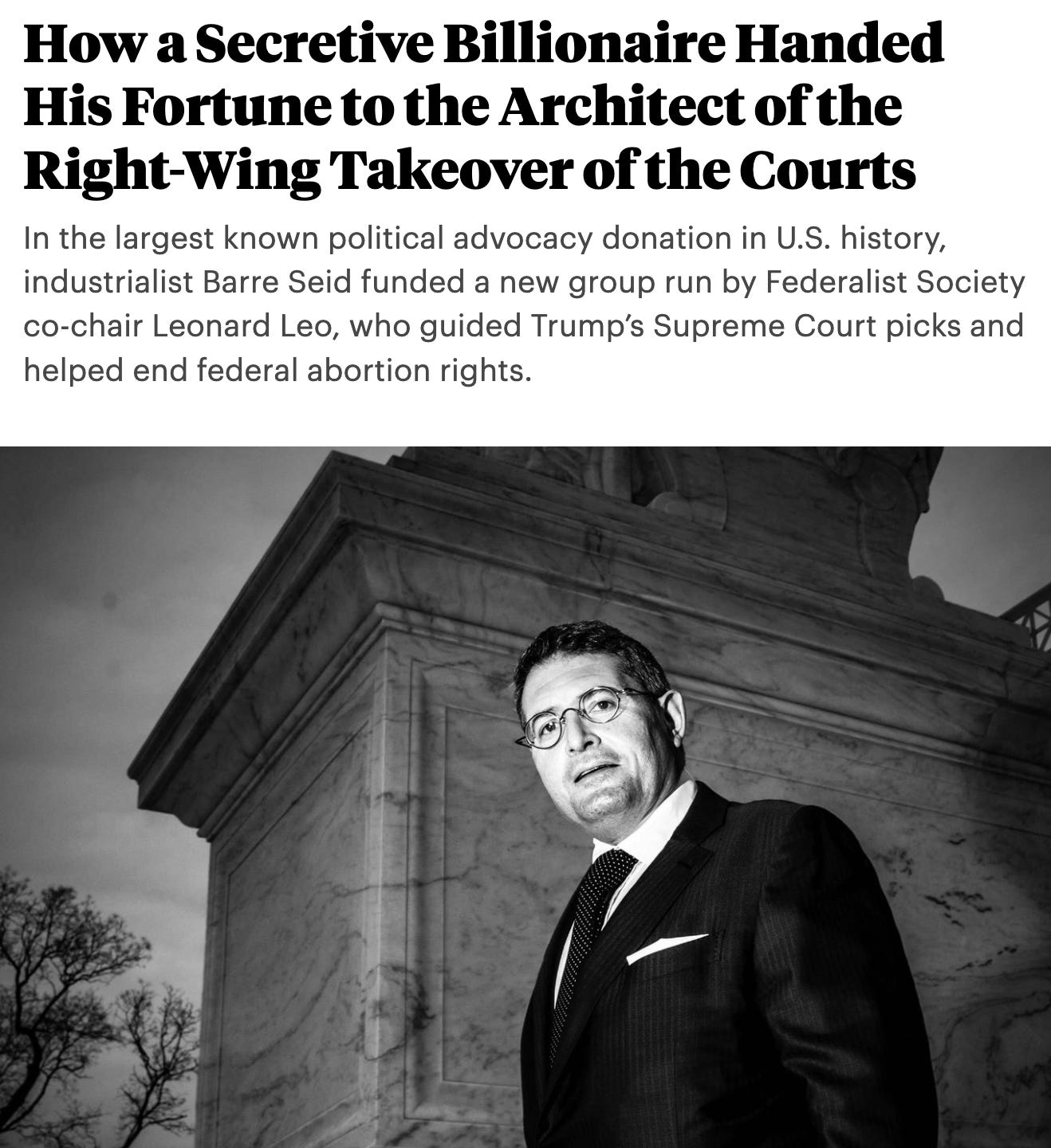
She recently discovered that Dark Money was deeply invested in the privatization of education. She posted this link on Twitter and wrote the following commentary on her blog.

Leonard Leo, the former VP of the Federalist Society and current member of the Council for National Policy, was recently outed for his funneling of dark money to a conservative parents group fighting the “woke-ification” of the US school system. While such groups need their “concerned parents” to voice their messages, groups like this do not hold the political power they think they do. They are granted the illusion of grassroots power that actually comes from the astroturfing campaigns of the shadowy, far-right Council for National Policy. These parents are lower level marks recruited into a GOP multi-level marketing scheme that benefits from counting Trump’s Secretary of Education Betsy DeVos’s parents of Amway wealth as CNP members.

Like his CNP colleague Charles Koch, Leo has been active in covertly controlling our government for some time. He was instrumental in the halting of Obama’s appointment of Merrick Garland to the Supreme Court where his old friend Clarence Thomas serves as an extremely controversial justice on a rogue court. The organizing efforts of the CNP and Federalist Society since the late 70s/early 80s were successful in overturning Roe v. Wade, despite the majority of the nation supporting abortion.

MisinformationKills’s Newsletter

Roe overturned in win for Council for National Policy

The Supreme Court of the United States voted today to overturn Roe v. Wade. This was a long time coming thanks to “most pro-life president ever” Donald J. Trump’s digital strategist Steve Bannon’s political efforts and influence. Source: Slate Bannon is a former member of the Council for National Policy, part of a shady network of Christian extremist pol…

The CNP brought us the fall of Roe as well as the rise of America’s Frontline Doctors. Ginni Thomas, Clarence’s QAnon wife, served as CNP Action Committee Chair when the pro-Trump, pro-hydroxychloroquine group was created in concert with the Tea Party Patriots for Dr. Simone Gold. The future insurrectionist’s organization appears to have been staffed by the existing far-right American Association of Physicians & Surgeons. Gold, now being sued for embezzling AFLDS’s dirty money, has shown herself to be completely corrupted by proximity to this powerful network. Without her MD or her JD, Gold’s quest for self-importance could have easily led her to Moms for Liberty. She’s now a member of the CNP, naturally.

Gold’s anti-vax movement ties into a larger GOP anti-science movement that includes anti-abortion (for the Christians) and anti-climate science (for the Kochs). Beyond that it is part of a larger anti-truth, anti-regulation movement for an attempted Christo-fascism takeover of the country by the GOP overlords at the CNP. To keep a propaganda machine like this going, they must continue to recruit talent and make sure younger generations don’t wise up to what they are doing. While New Jersey starts implementing media literacy in their curriculums, less progressive states like Florida are banning books and waging war on the culture of the American classroom. Trump’s 2024 CNP heir apparent Ron DeSantis has an AFLDS member as his Florida Surgeon General and has recruited more talent from the existing Koch Network for his own public health “accountability” committee. This is not coincidence.

The CNP has made power grabs for control of the courts, public health, media, and now the classroom. They won’t stop until they have complete control over the American people and our way of life. This is not small government, but rather silent large government. Unfortunately for the CNP ideologue oligarchs, younger generations – including those in medicine – are paying attention and forming real grassroots opposition. Fighting this network requires understanding of the inter-connectedness of their various efforts to take down the many pillars that uphold this decades old house of cards. It requires educating the public about the CNP’s forty year reign and the risk in allowing it to continue. Somewhere in those banned history books are the stories of empires that have fallen before them.

It is time to wake up from our postmodern nightmare of never-ending information warfare, epistemological conflicts/divides, incoherent narratives, and existential despair. We must embrace the hard realities of our complicated and complex world to stop falling prey to the comfort and convenience of simplicity. First and foremost, we need to dispel the myth that an individual can survive independently without responsibilities to others or in a world devoid of trust. It is simple to believe that a person’s success is theirs and theirs alone or even simpler to blame their failures on the distrusted others.

Unlike their attempted coup on January 6th, 2021, this revolution does not require violence – just education, some of that Trump sunlight on the issues, active citizenship, and a great deal of spine from our many American institutions under attack.

Lisa Graves and Alyssa Bowen recently reviewed the tax returns of some well-known “parent” groups and discovered what we suspected to be true. They are funded by Dark Money, specifically by billionaire Charles Koch, who longs to eliminate public education.

They write in Truthout:

Right-wing operatives are increasing their attacks on U.S. public education with an expanding number of legal complaints to censor books and target teachers on an array of issues —preventing them from teaching U.S. history accurately, treating LGBTQ+ students with the respect they deserve, and forming support groups for kids and teachers of color. These attacks will likely continue to escalate through 2024 as wedge issues intended to feed the right-wing voting base and lay the groundwork for redirecting funds from public schools to private recipients.

One of the main players in these attacks is Parents Defending Education (PDE), a dark money nonprofit group launched in 2021 in the midst of the Virginia state election cycle. Over the past two years, PDE has become a central actor in the right-wing assault on public schools across the nation. The group has trained local agitators to grab media attention, sued school districts for supposed anti-white discrimination, and railed against the teaching of social emotional learning, accurate U.S. history, and even ethnic studiesin schools.

Lawyers affiliated with PDE filed at least four complaints in January with the U.S. Department of Education claiming affinity groups for kids or teachers are illegal. These are just a few of the many complaints the group has filed over the past two years.

As dark money in education expert Maurice Cunningham has written, PDE’s “real goal” in filing lawsuits and complaints appears to be to “create media attention and promote chaos and disruption.” Then groups like PDE can claim the solution to the chaos is increased right-wing “parental supervision” over school boards. That supervision appears to involve a minority of vocal, politically motivated parents dictating what other people’s kids are taught or what they can read, based on whether such lessons or books are consistent with their right-wing religious beliefs and political opinions.

Illustration of Leonard Leo and a rain of judge's gavels

Groups Connected With Leonard Leo Have Funneled $31 Million to State Court Races

PDE’s speakers are often portrayed in the media as simply “concerned parents,” despite the group’s ties to the network of oil billionaire Charles Koch, far right politicians and school privatization efforts. Due to the timetables for the filing of nonprofit IRS forms, the amount PDE had raised to mount these attacks was unknown — until now.

PDE’s 2021 990 nonprofit IRS form shows that the group raised more than $3.1 million in its first year, even though many genuinely local grassroots efforts take years to raise that much money. That form does not reveal how much money PDE raised in 2022, during the congressional midterm elections; the amount it received to fuel its operations last year is likely even higher than 2021. The $3.1 million disclosed for 2021 also does not include any money raised that year by PDE Action, its (c)(4) advocacy arm.

Please open the link and keep reading this deep dive into astroturf parent groups funded by the far right billionaires.

David DeMatthews of the University of Texas and David S. Knight of the University of Washington wrote this article, which appeared in The Hill, a D.C. site. It’s by now well-established that students who take vouchers suffer academically; that vouchers will sudsidize the students already enrolled in private and religious schools; and that states will pay huge sums to underwrite affluent families. The Texas Observer, for example, estimated that if the 309,000 students currently in private schools get vouchers, the state’s public schools will lose $3 billion in the first year alone. What is more, voucher schools are free to discriminate on any basis, and they are exempt from any accountability.

They write:

School vouchers are a taxpayer swindle that fails to raise achievement while eroding public schools and the principle of equal protection under the law outlined in the U.S. Constitution. If more states adopt school voucher systems, most parents will find their top choice — a neighborhood public school — largely defunded and unable to recruit and retain high-quality teachers due to a transfer of funds into unregulated private schools.

Americans from all backgrounds have fought to gain access to public schools, including freed slaves, immigrants and people with disabilities. These struggles have led to a free universal public education system that propels each child into our democracy, communities and economy. Public schools also serve as community hubs where neighborhoods gather to vote, watch sports, participate in townhalls, among many other public events.

Vouchers jeopardize all of this because they transfer money from public schools to individual parents through grants, savings accounts or scholarships to pay private school tuition. It is a system where self-interest replaces the common good, culminating in separate education systems for children living on the same street in the same community.

Voucher supporters say parents know what is best for their children, but that is not necessarily the case. As education researchers, we know that voucher systems have led to significant declines in student achievement for voucher users in Louisiana, Indiana, New York City and Washington, D.C., especially for low-income students. In a study on the effects of the Louisiana Scholarship Program — a large voucher program established in 2008 and expanded in 2012 — researchers found that students participating in the voucher program were significantly behind their peers in reading and mathematics after four years.

There should also be concern that despite these well-documented failures, billionaires such as Betsy DeVos of Michigan and Charles Koch of Kansas use their fortunes to reportedly subvert state elections from thousands of miles away. This is not about parent choice or student achievement. It is political. null

Sadly, some state policymakers adopt equally hypocritical policy positions as they support vouchers. For example, Texas Gov. Greg Abbott (R) has become a vocal voucher supporter, yet he’s also a supporter of high-stakes accountability. Texas battled in court for years to take control of the Houston Independent School District due to low performance. So, on one hand, the state is supporting accountability for public school performance, and on the other hand, there is support for vouchers — a policy where taxpayer dollars are transferred to private schools that do not follow state accountability standards and where the state has virtually no oversight.

Florida Gov. Ron DeSantis (R) is also a voucher supporter. In 2022, DeSantis signed legislation dubbed the “Don’t Say Gay” bill that banned classroom instruction on sexual orientation and gender identity — yet, his state’s voucher program has no oversight over private school curricula. This means a private school receiving taxpayer dollars can teach about sexual orientation and gender identity without any legal recourse from the state.

In Arizona, former Gov. Doug Ducey (R) supported voucher legislation based on his belief that it would “offer all families the option to choose the school setting that works best for them.” Nevertheless, Arizona’s voucher system has been overwhelmingly used by wealthy families that were already sending their children to private schools before voucher legislation. Few low-income families could afford private school tuition and transportation with the voucher — a predictable policy shortcoming.

To make matters worse, current and pending voucher legislation could even reportedly fund racist curricula. Recently, a Nazi homeschooling group in Ohio stated they were creating “Nazi-approved homeschool material.” Under Ohio state law and many current and proposed voucher laws, states would be left powerless to intervene if a private school adopted such a curriculum.

Vouchers just do not make sense, and we should recognize that vouchers offer a false choice. What parent wants the choice to defund public education while transferring taxpayer money to unaccountable private schools that do not improve student achievement but can deny admission, discriminate against children and develop ineffective or harmful curriculum without any recourse?

David DeMatthews is an associate professor in the Department of Educational Leadership and Policy at The University of Texas at Austin.

David S. Knight is an associate professor of education finance and policy at the University of Washington.

Oklahoma Governor Kevin Stitt wants voters to believe that his push for vouchers comes from the “grassroots.” Not true. The last time vouchers came to a vote in the legislature, they were defeated by Republicans, especially rural Republicans who understand the importance of their public school.

Ben Felder of The Oklahoman got copies of internal correspondence and learned that the voucher campaign is funded by the Walton Family Foundation and organizations created by Charles Koch.

Is Governor Stitt believes that the people of Iklahoma want vouchers, why doesn’t he put it to a vote? Why let out-of-state billionaires defund the already underfunded public schools of Oklahoma. Take it to the people! Let them decide!

Libby Stanford of Education Week reports on the sudden explosion of voucher legislation in Republican-controlled states. She quotes a spokesman for the Heritage Foundation, who says that school choice is expanding because of parent dissatisfaction with public schools.

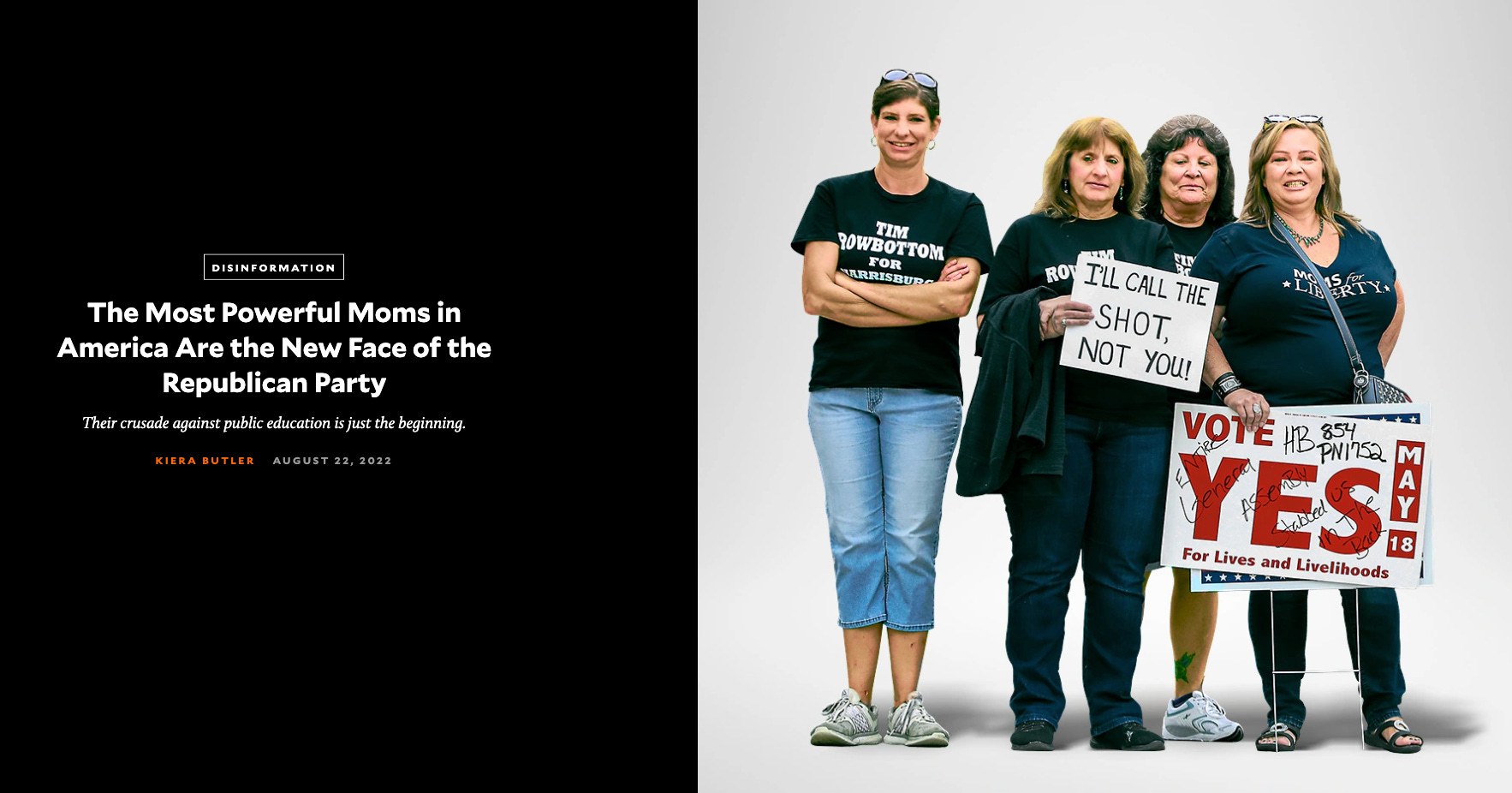
But this acceleration is not a consequence of parental dissatisfaction, as the spokesman claims. It is the result of a well-organized, well-orchestrated, lavishly-funded campaign to defame public schools, led by the religious right and such organizations as the Koch network, the Heritage Foundation, The American Legislative Exchange Council, Betsy DeVos’ American Federation for Children, and the front groups they fund, such as Moms for Liberty and Parents Defending Freedom. ALEC undoubtedly prepared model legislation and handed it out to their far-right allies in state legislatures.

None of these funders or their puppet groups are mentioned in the article. It is no accident that multiple red states are debating bills to enact vouchers for private and religious groups or that 75-80% of the voucher funding in every state will end up in the bank accounts of families whose children never attended public schools. The legislation should be characterized as a handout to families whose children never attended public school.

It doesn’t take much digging to understand that the crusade against “critical race theory” (which is taught in graduate classes in law and education, not in K-12), against any mention of homosexuality, against “dangerous” books in school libraries, against fictional children who need litter boxes in the classroom because they think they are cats or dogs—is absurd propaganda designed to discredit public schools and pave the way for public funding of religious schools, which freely discriminate against students and families and openly indoctrinate their students into their dogma.

Instead of identifying the Heritage Foundation as a major player in the war to destroy public education, Stanford quotes its spokesman, who spouts the line that school choice is the result of parent dissatisfaction. What she does not mention is that voucher supporters maneuver to avoid public referenda because they know the public is opposed to vouchers. Right wingers go to great lengths to avoid the word “vouchers” and to quash referenda, because they are afraid of the voters.

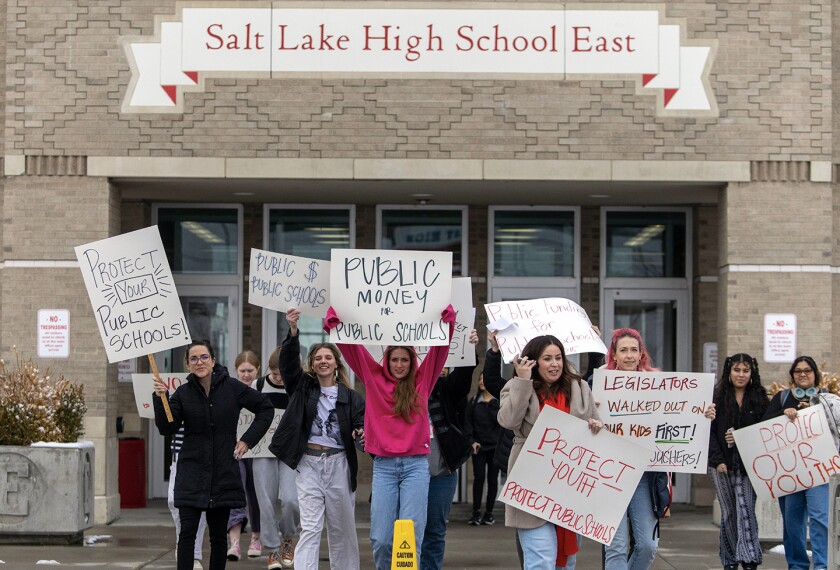
Students and teachers from East High School in Salt Lake City walk out of school to protest the HB15 voucher bill, on Wednesday, Jan. 25, 2023. Several years of pandemic restrictions and curriculum battles have emboldened longtime advocates of funneling public funds to private and religious schools in statehouses throughout the country.

Students and teachers from East High School in Salt Lake City walk out of school on Jan. 25, 2023, to protest legislation that would create private-school vouchers in the state. Several years of pandemic restrictions and curriculum battles have emboldened longtime advocates of funneling public funds to private and religious schools in statehouses throughout the country.

Rick Egan/The Salt Lake Tribune via AP

Stanford begins:

Emboldened by frustrations with pandemic-era policies and battles over what schools are teaching, conservative parents and politicians have accelerated a push for school choice policies that would funnel public funds into private schools.

Though school choice has been debated for decades, the movement is in a unique moment as advocates use parent concerns over COVID-era mask requirements; curriculum addressing race, gender, and sexuality; and library book content to bolster their argument that families should have more options outside of traditional public schools. And the school choice proposals states are considering—and, in some cases, have already passed—are more sweeping than previous iterations.

Already this year, lawmakers in at least 11 states—Idaho, Iowa, Kansas, Missouri, Nebraska, North Dakota, Oklahoma, South Carolina, Texas, Utah, and Virginia—have introduced and, in some cases, passed school choice bills. Although they vary in scope, many of the bills would establish or expand private school voucher and education savings account programs that give families public funds to pay for tuition at private schools, cover the costs of homeschooling, or pay for other schooling expenses.

The resurgence of school choice action shouldn’t come as a surprise. During the 2022 midterm election cycle, 19 Republican gubernatorial candidates advocated for school choice, mostly in the form of vouchers and education savings accounts, on campaign websites. This year, seven governors so far have talked about school choice policies in their state of the state addresses, according to the Education Commission of the States.

The policies are a result of parents’ declining satisfaction with schools following the pandemic, said Jonathan Butcher, an education policy analyst for the Heritage Foundation, a conservative think tank that advocates for school choice policies.