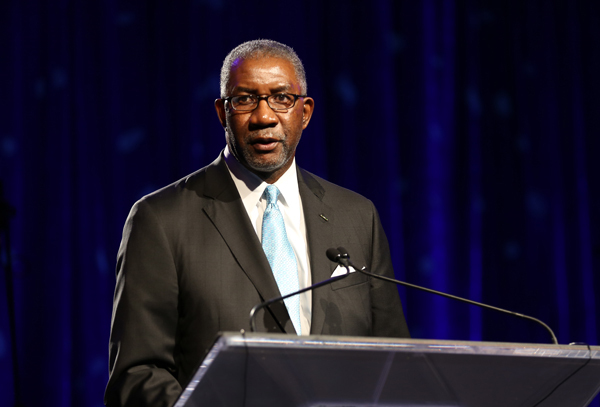
Civil rights attorneys out the state of Florida on notice that it was prepared to sue if the state bans the new AP course in African American studies.
Florida’s Black leaders delivered a warning to Gov. Ron DeSantis on Wednesday that if he doesn’t stop attempts “to exterminate Black history” in Florida classrooms, they would sue him for violating the constitutional rights of students.
“We are here to give notice to Gov. DeSantis,’’ said Ben Crump, a Tallahassee civil rights attorney, to a cheering crowd of supporters in the Capitol Rotunda, as three high school students stood at his side.
They were protesting the announcement last week by the Florida Department of Education that it had rejected a new Advanced Placement elective course on African-American studies, developed by the College Board for high school students.
“If he does not negotiate with the College Board to allow AP African-American Studies to be taught in the classrooms across the state of Florida, these three young people will be the lead plaintiffs,’’ said Crump, who has represented families in several high-profile civil rights cases.
The College Board is expected to release its updated version of the AP course on Feb. 1, the first day of Black History Month. As a pilot program taught in 60 select classrooms around the country, the board has been soliciting feedback from teachers for modifications to the curriculum. It is unknown how many schools in Florida are involved in the pilot program.
Historian Heather Cox Richardson reflects on the anniversary of Dr. Martin Luther King’s birthday. We now look on him as a hero, but during his lifetime, he was treated shamefully by many whites, and militant African-Americans scorned him as well, preferring the angry approach of Stokely Carmichael and Malcolm X. Dr. King was principled and fearless. He faced death daily, and he never back down. It is usually forgotten that he was assassinated in Memphis while there to support striking sanitation workers, who were trying to organize a union. He knew that unions offered the best protection for working people. White conservatives who fraudulently praise him now, claiming that racism is a thing of the past and should not be taught or discussed (so that everyone can be judged by “the content of their character, not the color of their skin”), oppose everything he fought and died for.
You hear sometimes that, now that we know the sordid details of the lives of some of our leading figures, America has no heroes left.
When I was writing a book about the Wounded Knee Massacre, where heroism was pretty thin on the ground, I gave that a lot of thought. And I came to believe that heroism is neither being perfect, nor doing something spectacular. In fact, it’s just the opposite: it’s regular, flawed human beings, choosing to put others before themselves, even at great cost, even if no one will ever know, even as they realize the walls might be closing in around them.
It means sitting down the night before D-Day and writing a letter praising the troops and taking all the blame for the next day’s failure upon yourself, in case things went wrong, as General Dwight D. Eisenhower did.
It means writing in your diary that you “still believe that people are really good at heart,” even while you are hiding in an attic from the men who are soon going to kill you, as Anne Frank did.
It means signing your name to the bottom of the Declaration of Independence in bold print, even though you know you are signing your own death warrant should the British capture you, as John Hancock did.
It means defending your people’s right to practice a religion you don’t share, even though you know you are becoming a dangerously visible target, as Sitting Bull did.
Sometimes it just means sitting down, even when you are told to stand up, as Rosa Parks did.
None of those people woke up one morning and said to themselves that they were about to do something heroic. It’s just that, when they had to, they did what was right.
On April 3, 1968, the night before the Reverend Doctor Martin Luther King Jr. was assassinated by a white supremacist, he gave a speech in support of sanitation workers in Memphis, Tennessee. Since 1966, King had tried to broaden the Civil Rights Movement for racial equality into a larger movement for economic justice. He joined the sanitation workers in Memphis, who were on strike after years of bad pay and such dangerous conditions that two men had been crushed to death in garbage compactors.
After his friend Ralph Abernathy introduced him to the crowd, King had something to say about heroes: “As I listened to Ralph Abernathy and his eloquent and generous introduction and then thought about myself, I wondered who he was talking about.”
Dr. King told the audience that, if God had let him choose any era in which to live, he would have chosen the one in which he had landed. “Now, that’s a strange statement to make,” King went on, “because the world is all messed up. The nation is sick. Trouble is in the land; confusion all around…. But I know, somehow, that only when it is dark enough, can you see the stars.” Dr. King said that he felt blessed to live in an era when people had finally woken up and were working together for freedom and economic justice.
He knew he was in danger as he worked for a racially and economically just America. “I don’t know what will happen now. We’ve got some difficult days ahead. But it doesn’t matter…because I’ve been to the mountaintop…. Like anybody, I would like to live a long life…. But I’m not concerned about that now. I just want to do God’s will. And He’s allowed me to go up to the mountain. And I’ve looked over. And I’ve seen the promised land. I may not get there with you. But I want you to know tonight, that we, as a people, will get to the promised land!”
People are wrong to say that we have no heroes left.
Just as they have always been, they are all around us, choosing to do the right thing, no matter what.
Wishing you all a day of peace for Martin Luther King Jr. Day, 2023.
Donna Ladd, editor and CEO of the Mississippi Free Press, writes here about the sustained rightwing effort to co-opt Dr. Martin Luther King’s legacy of militant resistance to racism and his dedication to telling the truth about our tarnished history. This is an important essay. It’s about a concerted attempt to hijack the words of Dr. King by those who hate his message. It’s about conservative white people like Chris Rufo and Ron DeSantis trying to use his words to prevent honest teaching about the history of racism. I have left the fund-raising appeals in the article because I hope you will send some money to this brave publication.
Yes, Dr. King gave his life in the search for more love and less hate, but he was not only spreading a message of love, as so many white thieves of his legacy try to say today. His message was pure fire. And he was out to hold a mirror up to our nation about white Americans—not only Mississippians and southerners—using terror to maintain power over everyone else and to enjoy the fruits of that terrorism.
Throughout his life, Dr. King toiled and ultimately sacrificed his life in the fight to change power structures and systems established and enforced to keep white people on the top and Black people on the bottom. He wanted America to understand that enslaved people built this nation—after many of their enslavers figured out how to steal the land from Indigenous Americans and forcefully remove them from the land they coveted.
None of this history is pretty or honorable, and Dr. King never tried to say it was or to cover up any of it. He wanted it taught to every person in this country and certainly wanted children to grow up having learned the lessons of the past. He knew that the “arc of the moral universe is long, but it bends toward justice.” And he was blunt that he was not likely to live long enough to see that happen.
When a white man shot him at the Lorraine Hotel in Memphis, Dr. King was more focused than ever on systemic racism and its links with poverty, and he was a harsh critic of capitalism and the Vietnam War. He was putting together the Poor People’s Campaign intending to occupy Washington, D.C., to bring more attention to the racism-poverty connection.
Of course, I didn’t know all that until I was well into adulthood. I knew most white folks in Mississippi hated him, and he was a martyred hero against racism. Like many Americans, I was fed the whitewashed version of Dr. King, which has worsened over the decades. I was nearly 40 when I studied with Dr.Manning Marable at Columbia University and learned the larger and more accurate history of Dr. King, Malcolm X, Marcus Garvey, and many Black freedom fighters. I’ve also read his speeches; I know fully what Dr. King was about and what he supported.
Now, 54 years after Dr. King went to Memphis to support a labor strike by sanitary workers, we see so many arrogant efforts by white Americans to remake him into their preferred hero—you know, the one who would tell us all now to forget all that sticky history and get along despite the systemic inequities our history embedded into our nation’s DNA.
It would be funny if it weren’t so sick and offensive. Right here in Jackson, a public-policy institute led by a former Brexiteer from the U.K. used a photo of Dr. King and his words out of context in a report a year ago to push legislation against so-called “critical race theory” in schools. Their report argued the precise opposite of what the Black freedom hero said or wanted. They even twisted his call for “being judged by the content of their character” out of context to make absurd statements about Dr. King, like this one: “Instead of celebrating the enormous achievements made since the Civil Rights Movement, critical race theory specifically rejects King’s color blind ideal and seeks to racialize every aspect of culture, sport, and public discourse.”
“Color-blind ideal”? That’s what this institute—and its board of prominent white Mississippians—think Dr. King meant by the need for white Americans to stop judging people by the color of their skin? Seriously? That’s some shoddy thinking. Or propaganda, as it were. Such cynicism can explain why this institute claiming Dr. King’s moral ground as its own has nine white men and two white women on its board.
As we consider Dr. King’s legacy this weekend, we must study the whole legacy. No serious person can argue that he would want this nation to block the teaching of our full race history from colleges, schools and homes. No serious person would say that he would want us to simply be proud of how far we’ve come and not examine how far we’ve got to go—until that arc bends toward actual justice and inequity is no longer baked into our systems. No serious person thinks Dr. King would not want us to interrogate how and why inequity became baked into our systems and how to fix them so they don’t keep replicating themselves.
And no serious person would argue that Dr. King would not want the systemic history of slavery, massacres and lynchings that helped end Reconstruction and install Jim Crow, the story of little Ruby Bridges or our Medgar Evers or Lamar Smith down in Brookhaven, the story of ongoing attacks on public education since integration—or the full story of his real dreams taught to every American on this road to eradicating the baked-in legacies of racial suppression and white supremacy.
I get it. Complaining that teaching real race history is somehow “Marxism”—which no serious person would do, either—is bringing back the stunts and propaganda the rich and powerful white people used successfully to scare white folks back in the 1950s and 1960s and even inspire violence against Dr. King and Mr. Evers. The rewriting of history is sick politics. But it is a stunt that all serious people of any party who are, indeed, working not to judge people by their skin color must reject loudly and definitively.
Dr. Martin Luther King Jr. gave his life to speak truth to power. We owe it to him to continue doing just that.
Donna Ladd, Editor and CEO
[I am not inserting a link because I can’t find one. Google Mississippi Free Press. If you find a link, please send it.]
I am sending my third contribution this year to MFP.
This is one of the most heartening statements I have seen in a long time.
Statement of Support for Art Professor Fired from Hamline University
January 9, 2023MPAC
It is with great concern that the Muslim Public Affairs Council (MPAC) views the firing of an art professor, Erika López Prater, from Hamline University on the grounds of showing a fourteenth-century painting depicting the Prophet Muḥammad. We issue this statement of support for the professor and urge the university to reverse its decision and to take compensatory action to ameliorate the situation.
News sources report that the matter reached the university administration after a Muslim student complained to them about the professor showing the image in class. Subsequently, undergraduate students at the university received an email from the administration declaring the incident to be “undeniably inconsiderate, disrespectful and Islamophobic.” Because the professor was hired as an adjunct, her contract was not renewed and she was effectively fired.
As a Muslim organization, we recognize the validity and ubiquity of an Islamic viewpoint that discourages or forbids any depictions of the Prophet, especially if done in a distasteful or disrespectful manner. However, we also recognize the historical reality that other viewpoints have existed and that there have been some Muslims, including and especially Shīʿī Muslims, who have felt no qualms in pictorially representing the Prophet (although often veiling his face out of respect). All this is a testament to the great internal diversity within the Islamic tradition, which should be celebrated.
This, it seems, was the exact point that Dr. Prater was trying to convey to her students. She empathetically prepared them in advance for the image, which was part of an optional exercise and prefaced with a content warning. “I am showing you this image for a reason,” stressed the professor:
There is this common thinking that Islam completely forbids, outright, any figurative depictions or any depictions of holy personages. While many Islamic cultures do strongly frown on this practice, I would like to remind you there is no one, monothetic Islamic culture.
The painting was not Islamophobic. In fact, it was commissioned by a fourteenth-century Muslim king in order to honor the Prophet, depicting the first Quranic revelation from the angel Gabriel.
Even if it is the case that many Muslims feel uncomfortable with such depictions, Dr. Prater was trying to emphasize a key principle of religious literacy: religions are not monolithic in nature, but rather, internally diverse. This principle should be appreciated in order to combat Islamophobia, which is often premised on flattening out Islam and viewing the Islamic tradition in an essentialist and reductionist manner. The professor should be thanked for her role in educating students, Muslim and non-Muslim alike, and for doing so in a critically empathetic manner.
In a time of rampant Islamophobia, highly offensive and racialized images of the Prophet Muḥammad abound on the internet and on social media. We consider these images to be inappropriate and not dissimilar to “black face” or Anti-Semitic cartoons; even if such images and their makers are protected by law, social opprobrium is due to them by all those who are reasonable and decent. As Muslims, of course, we must respond in a calm and graceful manner as befits our religion:
The servants of the Compassionate are those who walk humbly upon the earth, and when the ignorant address them [with insulting words], they respond, ‘peace.’ (Q 25:63)
Given the ubiquity of Islamophobic depictions of the Prophet Muḥammad, it hardly makes sense to target an art professor trying to combat narrow understandings of Islam. There is an unmistakable irony in the situation, which should be appreciated. Additionally, misusing the label “Islamophobia” has the negative effect of watering down the term and rendering it less effective in calling out actual acts of bigotry.
Finally, we stress the importance of education in the Islamic tradition. On the basis of our shared Islamic and universal values, we affirm the need to instill a spirit of free inquiry, critical thinking, and viewpoint diversity in the university setting.
Heather Long is a member of the Washington Post editorial board. She pinpoints the reasons for the national teacher shortage: low pay, but also pandemic stresses, and the ongoing political attacks on the teaching profession by extremists who want to prevent any teaching about racism or sexuality.
Message: pay teachers as professionals and let them teach as professionals, without censorship or interference by busybodies.
Long writes:
The U.S. economy hit a milestone this year: All 22 million jobs lost during the coronavirus pandemic were fully recovered. But that doesn’t mean workers went back to the same jobs. One of the sectors struggling the most to rebound is K-12 public education, which is still down more than 270,000 employees.
There is an educator shortage in the United States, but it is crucial to understand the details. First, this is about more than teachers. That 270,000 figure includes a lot fewer bus drivers, custodians and other support staff. Second, education isn’t simply about getting enough warm bodies into classrooms; it’s about having effective and qualified teachers and staff. The best analysis of the situation this fall, from the Annenberg Institute at Brown University, indicates a teacher shortage of nearly 2 percent, but more than 5 percent of positions are currently held by under-qualified teachers. Third, the shortage isn’t nationwide. It’s much worse in some schools and in some subjects.
In October, nearly half of public schools were still struggling to fill at least one teacher vacancy, according to a recently released Education Department survey. But schools in high-poverty neighborhoods were significantly more likely to have unfilled positions. Similarly, school districts report having an especially hard time finding special education, computer science and foreign language teachers, and bus drivers and custodial staff.
This isn’t a new phenomenon, but many signs indicate it worsened during the pandemic. Teachers experienced extreme levels of burnout from Zoom classes and safety concerns during the early days of the pandemic. Then came the culture wars that put teachers and staff under constant scrutiny over any conversations involving history, racism and sexuality. Throw in the Great Resignation, a tight labor market and rapidly rising pay in other professions, and the net result has been some teachers and staff retiring early. Others have quit and gone to work in different professions. And some recent graduates have decided not to enter education at all.
Jan Resseger, as always wise and compassionate, reviews the impact of the billionaire-funded culture wars on children and families. The particular focus on erasing the histories of children of color and demonizing LGBT families is harmful to them.
She writes:
Conversations about public schooling have been utterly sidetracked this year by fights about Critical Race Theory, “Don’t say gay!” laws, and whether somebody is “grooming” children at school? Where did these culture wars come from?
A NY Times analysis earlier this week tracks book banning in public schools as part of an epidemic of culture war disruption: “Traditionally, debates over what books are appropriate for school libraries have taken place between a concerned parent and a librarian or administrator, and resulted in a single title or a few books being re-evaluated, and either removed or returned to shelves. But recently, the issue has been supercharged by a rapidly growing and increasingly influential constellation of conservative groups. The organizations frequently describe themselves as defending parental rights. Some are new, and others are longstanding, but with a recent focus on books. Some work at the district and state level, others have national reach. And over the past two years or so, they have grown vastly more organized, interconnected, well funded — and effective. The groups have pursued their goals by becoming heavily involved in local and state politics, where Republican efforts have largely outmatched liberal organizations in many states for years.”
The reporters track research from PEN America: “(T)here are at least 50 groups across the country working to remove books they object to from libraries. Some have seen explosive growth recently: Of the 300 chapters that PEN tracked, 73 percent were formed after 2020. The growth comes, in part, from the rise of ‘parental rights’ organizations during the pandemic. Formed to fight COVID restrictions in schools, some groups adopted a broader conservative agenda focused on opposing instruction on race, gender and sexuality, and on removing books they regard as inappropriate.”
How is the culture war uproar affecting public schools? In a recent newsletter, the National Education Policy Center (NEPC) trackedresearch concluding: “Preparing students to participate in civil and respectful ways in our diverse democracy has long been a core mission of public schools.” Today, “U.S. high schools are struggling to fulfill this mission as they increasingly encounter hyper-partisan efforts. Those efforts have sought to spread misinformation, to encourage harassment of LGBTQ+ students, and to limit opportunities for productively discussing controversial topics. Such challenges are particularly pervasive in politically diverse areas where one party does not dominate.” The researchers surveyed 682 public high school principals and subsequently followed up by interviewing 32 of those principals. NEPC reports:
“Public schools increasingly are targets of political conflict. Nearly half of principals (45 percent) reported that the amount of conflict in their community was higher during the 2021-2022 school year than it was pre-pandemic… Teaching about race and racism was the area where principals were most likely to report challenges from community members, followed closely by LGBTQ+ content.”
“Political conflict undermines the practice of respectful dialogue. A majority of high school principals report that students have made demeaning or hateful remarks toward classmates for expressing either liberal or conservative views and that strong differences of political opinion among students have created more contentious classroom environments.”
“Conflict makes it harder to address misinformation. Misinformation—much of it tied to partisan organizations and causes—makes it more challenging to encourage productive and civil dialogue. After all, it is difficult to develop a shared sense of how to move forward when different people are working from different sets of ‘facts.’ Nearly two thirds of principals (64 percent) say parents or community members have challenged information used by teachers at their schools. The share of principals saying parents or community members challenged teachers’ use of information three or more times nearly doubled between 2018 and 2022.”
“Conflict leads to declines in support for teaching about race, racism, and racial and ethnic diversity. High schools increasingly struggle to teach students about the full spectrum of American experiences and histories, especially when it comes to issues related to racism and race… ‘My superintendent told me in no uncertain terms that I could not address issues of race and bias etc. with students or staff this year,’ said a principal in a red community in Minnesota. ‘We could not address the deeper learning.'”
“Principals report sizable growth in harassment of LGBTQ+ youth. The survey results also suggest that schools are increasingly facing challenges related to teaching students to treat one another with dignity and respect… Fewer than half of principals said school board members or district leaders made statements or acted to promote policies and practices that protected LGBTQ+ student rights.”
“Parents’ rights” are the rallying cry for many of today’s culture warriors who want to protect the dominant culture and shield their children from uncomfortable controversy. But in a recent and very personal Washington Post column, “When Children Ask About Race and Sex, We Have No Choice But to Answer,” Danielle Allen, a political theorist and the Director of the Edmond and Lily Safra Center for Ethics at Harvard University, and an African American mother, explains the point of view of many other parents and children. Allen examines why it is so urgently important for teachers to be able to respond to children’s own observations and questions when the students themselves initiate conversation about the same fraught subjects the NEPC researchers describe organized parents trying to ban from the schools.
Allen describes a conversation her own two-year-old daughter launched about race, while the child sat in seat of the grocery store cart as they were in the midst of shopping. The child declared, “Mommy, I think it’s not good to be Black.”
Allen reflects upon what her toddler had already observed about race in America: “My daughter’s statement was a question. Its subtext went like this: ‘I’ve noticed something, Mommy. It seems like it’s not good to be Black. But can that be right? You’re Black. I love you. How can these things fit together? And what does this mean for me?'”
Allen continues: “What I can assure you of is that even before any of our kids, of any racial or ethnic background, get to school, every Black family in the United States is having to teach its children about race and the history of enslavement and stories of overcoming that have played out generation after generation. The same must be true for kids raised in LGBTQ families, with regard to the history and contemporary experience of gender and sexuality… This means that the only way you can keep knowledge and questions about these histories, experiences and perspectives out of the school curriculum in early grades is to keep Black people or members of LGBTQ families out of school.”
Or, according to NEPC’s research, many school districts are enrolling Black and Brown children and children from LGBTQ families while the school districts may be imposing policies to silence such children, to make their realities invisible to other students, and to refuse to help them answer their own hard questions.
Public schools are required by law to serve all the children whatever their race, ethnicity, religion, or sexual orientation. It is not the business of school board members, school superintendents, school principals, or teachers to cater to any one group of parents’ rights advocates, no matter how well organized or well funded is their lobby.
Here, writing for The Progressive, is retired high school teacher, Peter Greene, who understands educators’ obligation to protect the interests of all the students who fill our nation’s public school classrooms: “Schools must balance the needs and concerns of all of their many stakeholders. Parents absolutely have rights when it comes to public schools, but so do non-parents, taxpayers and other community stakeholders. It’s up to the school district to balance all of these concerns, while also depending on the professional judgment of its trained personnel. It is a tricky balance to maintain, requiring nuance and sensitivity. It is correct to argue that ‘schoolchildren are not mere creatures of the state.’ But framing the issue as parents versus school has served some folks with a very specific agenda.”
Politico reports that there was no sweep for partisans of the culture war issues. We can expect to see more attacks on teachers, students, and school boards in the next election, based on hyped-up falsehoods about race and gender. Support from rightwing conservative foundations—the usual suspects—will keep alive the battles and the fake organizations leading them. (Expect a special report soon from the Network for Public Education on these front groups attacking school boards, written by an authority on Dark Money).
Juan Perez Jr. of Politico writes:
THE DIVIDED CLASSROOM — In case you missed it amid the advertising noise and campaign spending avalanche of November’s midterms, 2022 proved to be an incredibly busy — and contentious — year for education elections.
Fifteen states and the District of Columbia held state school board or education superintendent races this year. Roughly 1,800 local board seats across some 560 districts in 26 states were also up for grabs on Nov. 8, according to the nonpartisan nonprofit Ballotpedia.
Who came out on top? Nobody. Neither Democrats nor Republicans managed a clean sweep.
This means the state of education in the United States remains divided sharply along partisan lines — and the education wars are likely to continue unabated in 2023 and beyond.
The bitter differences between the two sides and lack of consensus between the poles of both parties — over everything from teaching about slavery and gender identity to childhood vaccinations – offer little incentive for either side to back down.
“We are stopping Critical Race Theory from being taught, stopping access to obscene pornography in our schools, and ending the tenure of radicalism and indoctrination of our kids because the left is waging a civil war in our classrooms,” newly-elected Oklahoma State Superintendent Ryan Walters recently wrote in the Daily Caller.
Candidates who supported having race and sex-related curricula or Covid-19 safety requirements in schools won about 40 percent of the roughly 1,800 local board elections tallied by Ballotpedia this year, and tended to win in counties President Joe Biden carried in the 2020 election. Candidates with opposing views won about 30 percent of their elections, often doing so in counties held by former President Donald Trump.
Nearly one-third of incumbent school board members also lost to their challengers on Nov. 8.
“People didn’t feel listened to. Parents felt they lost agency and power over their kids’ education,” Randi Weingarten, president of the American Federation of Teachers labor union, recently told Nightly. “My concern is that we can’t have two countries. This is one United States of America, and we have an obligation to help kids — regardless of whether they’re in South Carolina, Tennessee, New York or California — to learn how to critically think.”
As they turn toward 2023, Democrats take solace in battleground state victories for governor, successful education-related ballot measures and local school board races where moderate incumbents defeated far-right challengers in Louisville, Ky., the suburbs of Austin, Texas, and other places.
Sure, conservatives lost plenty of races. But they won more than enough to show their brand of culture-based education politics thrives in areas controlled by the party faithful. Trump seems to have this on his mind, too. The former president promised schools would lose their federal funding if they don’t get rid of critical race theory, and what he described as “radical civics and gender insanity,” when he announced his reelection bid.
No state school boards with elections this year flipped partisan control, according to the National Association of State Boards of Education. But majority parties did expand their influence on boards in Colorado, Kansas and Utah while conservative incumbents often lost primary challenges.
Candidates endorsed by two upstart GOP-aligned political committees also won roughly half of their midterm elections.
Candidates backed by Moms for Liberty, a group formed by a former Florida school board member to fight school Covid-19 mask requirements and controversial library books, won about half of their 2022 elections, according to the organization. The 1776 Project PAC, a group opposed to the critical race theory academic framework that examines how race and racism have become ingrained in American institutions, saw a similar win-loss ratio.
David Berliner and Carl Hermanns edited a book about the value and importance of public schools in a democratic society. Its title is Public Education: Defending a Cornerstone of American Democracy, and it was published by Teachers College Press. I was one of the contributors, along with other well-known figures in the field.
The book would be a terrific Christmas gift for an educator.
Public Education is a 346-page book containing 29 chapters penned by some of America’s most eminent scholars, including Diane Ravitch, Jennie Oakes, Sonia Nieto, H. Richard Milner, Deborah Meier, Ken Zeichner, Gloria Ladson-Billings, Michael Apple, William Ayers, and of course, co-editor David Berliner. The late Mike Rose has a chapter in the book as does Edward Fiske, the longtime New York Times education reporter and author of the ubiquitous Fiske Guide to Colleges.
While the themes of the book are quite varied, all the contributors to the book seem to agree that a child’s prospects in life, the quality of America’s public schools, and the country’s future as a democracy are all intimately intertwined. The importance of high-quality public education has been covered by Berliner previously in co-authored books such as The Manufactured Crisis (with Bruce Biddle, 1996) and 50 Myths and Lies that Threaten America’s Public Schools (with Gene Glass, 2014), and in well over a hundred articles.
However, in comparison with Berliner’s earlier works, this book has a stronger sense of urgency and a more dispiriting sense of disappointment in the ways in which federal and state governments have undermined, underfunded, and underappreciated the singular accomplishments of public education. In Berliner’s chapter on charter and voucher schools, for example, he uses the word scandalous over thirty times.
The very first sentence of the book’s introduction states, “The belief in the vital importance and central role of public education in the development of our country and the sustenance of our democracy runs deep.” When discussing the history and future of American public education, the specter of Horace Mann is always difficult to ignore. Indeed, more than half of the contributors explicitly discuss Mann’s ideas concerning the importance of a free education, sometimes in great detail. Even when he goes unnamed, Mann runs like a powerful current throughout these pages. To offer a sense of the content and variety of the chapters, citations from four contributors follow.
Mark Weber “Reform has become the core of the resistance to meaningful and sustained investment in schools. Education reformers are providing cover for those who fear that the United States might take its obligation to fund schools more seriously—starting with raising taxes on the wealthiest of its citizens.” (p. 205) “A 2017 meta-analysis of merit pay experiments found ‘a modest, statistically significant, positive effect on student test scores (.053 standard deviations).’ This is the equivalent of moving a student at the 50th percentile in test scores to the 52nd percentile.” (p. 207)
Gloria Ladson-Billings “Currently most major cities do not have enough white students attending their schools to adequately desegregate them.” (p. 227) “The number of the most intensively segregated schools—with more than 90% of low-income students and students of color—more than doubled [from 2001 to 2014].” (p. 229) “Beyond the crudeness of the per pupil expenditure measure is also the way ‘average daily attendance’ is derived. In Wisconsin, ADA is calculated on ONE day per year–September 15.” (p. 230)
Diane Ravitch
“After the Civil War, no state was admitted to the Union without an education clause in its constitution.” (p. 21)
“For many years, the term ‘school choice’ was stigmatized because of its association with advocacy for school segregation.” (p. 23)
Carol Burris
“The term public school is generally not viewed as a pejorative, which is why those who oppose public schools are so anxious to either exclude the term from the discourse, blur the definition, or hijack it for privatized systems.” (p. 236)
“We need to mind our words, being cognizant of how language has been used to shift the perception of privatized choice. Terms like privately-run charter schools and neighborhood public schools should replace public charter and traditional.” (p. 240)
As with any edited book, one chapter may seem nondescript while another may seem absolutely indispensable. For example, James Harvey’s chapter, “Education is our only political safety,” (pp. 214–225), a clearly written, tour-de-force about how education in the U.S. is funded, would be a perfect fit for an undergraduate foundations of education course.
Some of the book’s chapters are quite short and informal; others are fully realized, in-depth academic papers, replete with conclusions and recommendations. Most authors use APA bibliographic style, but a few use Chicago, and some chapters include no list of references at all. The chapters are divided into six “interrelated” parts that are so interrelated as to be indistinguishable from one another. Sections are identified not by titles but by Roman numerals, I–VI.
The divider pages indicating a transition to a “new part” often feature historical photos and text. For example, on p. 233, the divider page for Part V shows a picture of 16 very young child- employees of an oyster plant in a small town in Mississippi located on the Gulf of Mexico. The children depicted in the photo look to be between the ages of 5 and 8, and one of the 8-year-olds is struggling to hold another child-worker who appears to be around 2. The caption reads:
Before America had child labor laws and school attendance requirements….all [these children] worked from before daybreak until 5 p.m. for extremely low wages.”
Child Labor laws in the United States were ratified less than a century ago, in 1938. When children were liberated from the chains of illiteracy and the drudgery of working long hours for near-starvation pay, public schools emerged as welcoming, empowering institutions that offered the possibility of a better life. Rather than submit to a permanent sentence of indentured servitude, an American child—every American child—was suddenly given the opportunity to be treated as an equal among peers, regardless of race, religion, wealth, or family connections.
One can argue about the extent to which America has fallen short of its promises. But, powerful forces at work in the United States today are working to obliterate public schools and debunk the idea that every child deserves a fair chance. As noted repeatedly by the contributors to Public Education, if our public schools go down, our democracy seems likely to follow.
Author Biography LAWRENCE BAINES, Ph.D., writes on educational policy and multisensory learning. He is the author of 13 books, including What’s a Parent to Do? How to Give your Child the Best Education (2022, Rowman & Littlefield). His homepage is http://www.lawrencebaines.com.
How do we make sense of the last six years, and how do we figure out what we do next?
I’m wrestling with the dilemmas intertwined with the wisdom of Michelle Obama: When they go low, We go high.
To go high, we must wrestle with the irrational and anti-Semitic statements of Kanye West. We must confront the MAGA right wing propaganda while also responding to his words, “Hurt people hurt people – and I was hurt.”
I was born in the middle of the luckiest generation in history. My first memory is a metaphor for the opportunities that were bestowed on Baby Boomers, that have been in decline. I was “twaddling” across the living room to the “win-dome” when adults were watching television, and they exploded with joy. The news, I was told later, was that the polio vaccine had been released!
Our parents’ generation survived the Great Depression and World War II, they were committed to our generation having far greater opportunities. Time after time, when I walked somewhere, worked with neighbors, and played with their children, I found one mentor after another. I was repeatedly told, “Pay close attention, I’ll only show you once;” reminded that my job at school wasn’t high grades but “Learning how to learn;” and “Your job is to be ‘inner-directed’ not ‘outer-directed’” like those who were “like the Red River, ‘a mile wide and a foot deep.’”
Of course, we felt the uneasiness of neighbors watching the Sputnik satellite cross the night sky, of “duck and cover” drills at school, and the Cuban Missile crisis (which only affected me by the news alerts interrupting the World Series.)
And I was clueless about Jim Crow until we went to a restaurant during the Sit-In movement. The owner directed us to the fancy room where, that evening, prices were not higher than the big serving area, because we shouldn’t have to eat with N—–rs. We shouted to our parents, “You’re not supposed to say that word! Why did he say that word?” My dad tried to remain calm but he exploded, “there’s not a god-damned reason” and tore into the racist owner. It took the full police line to pull my dad off him.
Of course, Oklahoma was incredibly corrupt and my dad would jokingly point out concrete examples such as “the road to Nowhere” (which led to our top oligarch’s property,) the Turner Turnpike, and the photo at church of a Supreme Court Justice who was convicted of bribery in conjunction to with the turnpike and other cases. But, as I began to lobby and/or interview members of the “Greatest Generation,” I realized that that criminal behavior was far more common back then, but their handshakes had to be good. In the last few decades, I asked powerful people if corruption had declined significantly, and whether norms have also dropped. They agreed but, a decade ago, a State Auditor added a disclaimer; so many behaviors by elites that used to be felonies were now legal.
And that gets us to the intertwined forces of the last fifty years that laid the foundation for Trumpism. In the 1970s, rightwing think tanks sold the theory that corporations were only beholden to the share owners, not the stakeholders, the community, and the United States of America. Then, the Reagan administration’s Supply Side Economics quickly wiped out good-paying industrial jobs, which undermined communities, especially in places like rural Oklahoma which became Trumpland.
As the economic pie became more unequal, more hurt people hurt people. The willingness to share declined. And, eventually, hope declined, and life expectancy dropped for whites who hadn’t attended college, especially in places like eastern Oklahoma.
Rightwing spin masters convinced rural Oklahomans that Reagan “brought America back,” and immigrants and people of color “cut in line” in front of whites. I plead guilty to being slow to admit the importance of racism in fueling Trumpism. My wife and I have had an Obama bumper sticker on our car since 2008. I don’t recall any rudeness by Oklahomans in response to it. As soon as we crossed into Texas, and many other states, we’d be shouted at and given the finger.
Since my family came from “Little Dixie,” I was embarrassingly slow in admitting why counties in Southeast Oklahoma instantly turned Republican between 2006 and the 2008 presidential race. Similarly, Oklahoma passed one of the nation’s most punitive immigration laws, and I’d seen large numbers of attacks on Hispanics in our high school. But in my experience, Oklahomans also respected the work ethic and family values of immigrants. I saw our welcoming side until, surprise!, the nonstop anti-immigrant, anti-Hispanic, and anti-Muslim propaganda sunk in.
While acknowledging my excessive optimism, I believe we can build on our strengths – the values that gave so much hope to this young Baby Boomer. Given my experience as an inner-city teacher, I will draw on my students’ moral cores. But I see those experiences as metaphors for how we can “go high” when reversing a full range of interconnected economic, social, political, and civility challenges.
Starting with economics, the worship of Free Markets began with Joseph Schumpeter’s “creative destruction.” Corporate school reformers (like other true believers in the Market) adopted the same mindset, which they called “creative disruption” as the lever for transforming schools and rebuilding them through “venture philanthropy.” They became very skilled at “kicking down the barn,” and attacking teachers, hoping to quickly fire enough teachers (especially Baby Boomers) while training young teachers to obey top-down, teach-to-the-test mandates.
But, both sides of the “Teacher Wars” were bipartisan. Up until three or four years ago, I was very successful working with conservative Republicans who also didn’t trust the “Billionaires Boys Club” which dominated the Bush and Obama education policies. And many or most were angry at other big corporations.
If we could admit that neither Democrats or Republicans stood up to our neoliberal and their conservative funders, we could restart conversations about schools as a public good, not just a Free Market experiment. Then, maybe we could discuss the privatization of health care, the social safety net, and the other institutions on Gov. Stitt’s and other MAGA’s hit list.
Hopefully, Democrats and Republicans could join together in community building; the first step could be full-service community schools, which could also serve as community hubs. We could admit that both sides bought into the simplistic, false meme that teachers, alone, could drive transformative change of our highest-challenge schools.
Of course, teachers deserve more respect. But so do cafeteria ladies, bus drivers, counselors, tutors, parent liaisons, mentors, apprentices, and volunteers. And, sharing the respect and the credit with education teams will also create good will that would assist the dialogue we need.
As the MAGA Republicans ramp up the campaigns for vouchers, we will have new opportunities for bridging differences with rural areas. And, students can lead the way in explaining that accusations of spreading Critical Race Theory and Socialist propaganda are false.
In the late 1990s, during a community discussion about public health, my students asked white participants about the more humane way that Meth, as opposed to crack, was being handled. Perhaps because the students were so polite, the adults didn’t understand that the teenagers were contrasting the cruelty of the War on Drugs during the crack epidemic with the more empathetic public health response to the new, predominantly white epidemic. Afterwards, they told me that the white participants didn’t understand what they were saying, but they had hope for future conversations and, at least, the more humane response to Meth was a first step.
A decade later, Big Pharma profited by promoting Opioid addiction in the MAGA areas, significantly lowering life expectancy for under-educated whites. Rather than condemning “deplorables,” we should have recognized that “Hurt people hurt People.” Now, it won’t be easy, but perhaps we could unite, regulate, and control the corporate dominance that is spreading destruction across the world.
Finally, we must move on from the failed experiment of Creative Disruption. We should build on both, social and cognitive science, as well as what has worked for centuries. After all, teaching is an act of love. Neighborliness can be the driving force for community schools. Defending our children’s schools, as well as privatization battles ranging from public health to global warming, will require cross-generational, cross-cultural discussions. When they go low, we should go high by bringing the full diversity of our communities into schools, and bringing students out into the full diversity of our community.
Educators, parents, and civil rights groups in Virginia are outraged because Governor Glen Youngkin has directed the rewriting of the state’s history standards. The Youngkin standards eliminate anything that extremists and rightwingers find objectionable. The Youngkin team initially deleted all mention of Dr. Martin Luther King Jr. from the elementary curriculum. Presumably any discussion of Dr. King’s life and legacy might be interpreted as “critical race theory” by the Governor’s allies.
At the same time, Youngkin’s cultural warriors expanded coverage of Ancient Greece and Rome, expecting children in the early elementary years to learn about major figures in those civilizations for whom they have no context or understanding.
And as you will notice, the Youngkin draft refers to Native Americans and indigenous peoples as “the first immigrants.” What?
The Youngkin rewrite shows zero knowledge of what content is age-appropriate. As you will read below, first-graders are expected to learn about the Code of Hammurabi. Are first-graders really ready to learn about ancient Babylon? The educators who wrote the statement below warn that the Code includes references to adultery and sex, possibly violating recent legislation that bans sexual content in the early grades.
Many years ago, I was deeply involved in the revision of the California History-Social Science standards and curriculum framework. The process must involve teachers, historians, and experts from different disciplines (such as geography, sociology, and other social sciences). Our committee reflected the state’s ethnic diversity and included teachers from different grade levels. The draft was circulated to teachers who would teach it to get their comments. It was then presented at public hearings where parents and the public expressed their views. It was a long and arduous process, but the state ended up with a fair and accurate account of state, national, and world history, along with an appreciation of different perspectives about history.
History is not “a story.” It is told differently depending on who is writing it, and it changes as historians learn more.
That kind of deliberation was started in Virginia but it was short-circuited by Governor Youngkin, who wanted to fulfill his campaign promises about “parental rights” and “critical race theory.” The result is that the process was politicized, and the standards were warped by political interference.
The meeting to discuss the standards was held last night. I will let you know what happens. I will keep watch on the effort to whitewash Virginia’s standards of learning and to make them explicitly Eurocentric.
Press Release by Concerned Educators of the Commonwealth
RELEASE DATE: For Immediate Release
CONTACT: Concerned Educators of the Commonwealth
WHAT: The Rewrite of Virginia’s Proposed History and Social Science Standards
WHEN: Thursday, November 17th Board of Education Meeting, James Monroe Building, Richmond
The History and Social Science Standards of Learning have always been written as a non-partisan document that values input from all sides of the aisle in a transparent process. During the October 20, 2022 meeting of the Virginia Board of Education, a number of Board Members pushed to have the proposed History and Social Science Standards along with supporting Curriculum Framework documents presented for “first review” at the next meeting. The State Superintendent of Instruction resisted this in favor of further delay. Instead of honoring her promise for only a brief delay to allow new board members appointed by Governor Youngkin time to review the proposed Standards, the links below reveal that the proposed Standards have been completely rewritten at the last moment and replaced. This rewrite was led by Superintendent Balow, the Superintendent’s selected consultant, Ms. Shelia Byrd Carmicheal and staff from the Governor’s office. It is NOT the original draft of proposed standards created in partnership with countless educators, historians, professors, museums, organizations, parents, teachers, and VDOE staff in the process laid out in Virginia Code. As indicated by Item I Memo, Shelia Byrd Carmichael will present the ¨Final Redraft of VA HSS Standards for K – 12. 11.10.22¨ There is no mention of the VDOE History and Social Science staff members who have led this work for the past two years.
In addition to this flawed and undemocratic process, there are several aspects of the rewritten standards that we find to be unacceptable, and we urge the Virginia Board of Education to reject these rewritten standards and not consider them for first review at their upcoming meeting on November 17th, 2022:
The inital rewrite of the proposed Standards which were made public on November 11, 2022 entirely removed Martin Luther King, Jr. from the elementary curriculum. This selective erasure of one of the most prominent Black men in American history calls into question this entire revision of the proposed Standards. This was partially addressed on November 16th, 2022 with the sudden addition of the “Martin Luther King, Jr. Day” to SOL K.7b. However, the public needs to be aware that this last minute half-measure still removes Martin Luther King, Jr. from the 1st grade and 2nd grade SOLs that have been in place for years. This significant reduction is still unacceptable, and it not only shows how much this process was rushed in isolation with a outside consultant, but it now seems to be a paternalistic attempt to placate and mollify.
The rewrite of the proposed Standards removes most of the 2020 technical edits that were made by the recent Commission on African American History Education (click here in order to see what has been removed).
The rewrite of the proposed Standards refers to Native Americans and Indigenous Peoples as America’s “first immigrants” in SOL K.2a and b – this strips a historically marginalized group of 10,000 years of human history and their heritage as native and indigenous people who numbered in the tens of millions prior to European contact.
The rewrite of the proposed Standards completely removes the African civilization of Mali from the Third Grade standards while Ancient Greece and Rome have been greatly expanded. All of these civilizations should be explored for students to fully understand the world – not just the Western World. This represents another example of erasing people of color from the previous version of the standards while elevating a Eurocentric view of the world.
In addition to political bias, the rewrite of the proposed Standards contains several examples of age-inappropriate content that is far too complex for adolescent children. For example,
The “Code of Hammurabi” is now listed as required content for First Grade (SOL 1.1c). The Code of Hammurabi not only requires considerable historical context for students to understand Ancient Babylon, but many of the codes are inappropriate as they address topics such as adultery, sex, and capital punishment. The time period, as well as the graphic nature of the content, is highly inappropriate for 1st graders. The inclusion of the Code of Hammurabi may come into conflict with the recently passed legislation that forbids the inclusion of sexually explicit content in curriculum.
The Fertile Crescent, Mesopotamia, and the Tigris and Euphrates Rivers are now required content in SOL 1.1 for First Grade. Students in primary grades have limited context of their own communities and the world around them. Therefore, they need to focus on basic map skills and geographic features such as continents and oceans – not on specific locations that require in-depth knowledge about ancient civilizations. it should be noted that the previous revision version of the Standards placed this content appropriately in secondary courses such as World History I and World Geography that is typically taught in 8th or 9th grade. Asking our youngest learners to learn about “civilization” before they have any context of their own “communities” shows a clear lack of understanding about what is developmentally appropriate in grades K-1.
The Third Grade Standards require students to learn about several historic figures that are far too complex for this grade-level such as “Socrates, Plato, Aristotle, Hippocrates, Alexander the Great, Crassus, Julius Caesar, Mark Antony, Trajan, Hadrian, Marcus Aurelius, Constantine, Odysseus, and Aeneas.” While certainly historically significant, these figures are much more appropriate for secondary courses such as World History I which is typically taught in 8th or 9th grade. Such misunderstanding of elementary education calls into question if the person or persons who drafted these revised standards have any understanding of what is developmentally appropriate for younger learners and if they have any experience in elementary education.
The rewrite of the proposed Standards is full of grammatical, spelling, and formatting errors. For example, in SOL 2.2c, the famous closing statement of the Declaration of Independence is misspelled where the signers pledged their “lives, fortunes, and scared [sic.] honor” rather than sacred honor. Another simple mistake appears in SOL USI.7c, where the revised Standard states, “students will describe challenges faced by the new nation by….explaining what the Constitutional Conventions was.”
The rewrite of the proposed Standards is also full of historical errors and inaccuracies. For example, SOL VS.5f requires students to “explain the reasons for the relocation of Virginia’s capital from Jamestown to Williamsburg” as part of the overall standard about the Revolutionary War. However, this makes absolutely no sense given that Virginia’s capital was moved from Williamsburg to Richmond during the Revolutionary War in order to provide greater protection against British attack. A discussion of the move from Jamestown to Williamsburg seems to be a glaring historical error given that Jamestown burned in 1698 and the capital of Virginia was moved to Williamsburg 77 years before the outbreak of the Revolutionary War. The previous version of the proposed Standards did not contain egregious historical errors such as this because they were developed by a team of educators, division leaders, and historians. Another example of historical error appears in SOL VS.6 where Zachary Taylor is incorrectly identified as the most recent President from Virginia. Taylor was Virginia’s 7th President elected in 1848. Woodrow Wilson was Virginia’s 8th President elected in 1912.
The rewrite of the proposed Standards emphasizes the memorization of content knowledge at the expense of skills and deeper understanding. The level of content knowledge is so extensive that it leaves very little time for critical thinking, inquiry, and project-based learning. For example, SOL CE.1n requires students to learn the “charters of the Virginia Company of London April 10, 1606, May 23, 1609, and March 12, 1612.” Such specific content knowledge in this regard promotes rote memorization and detracts from the larger goal of deeper understanding, skill development, and learning the knowledge and facts by anchoring that content to larger conceptual understandings
Contributions from the Sikh and the Asian American Pacific Islander (AAPI) community have been greatly limited in this redraft.
The rewrite of the proposed Standards completely alters the course sequence and will cause major disruptions as divisions struggle to redesign learning materials and resources for courses in grades K-9. If adopted, this mandate would move middle school courses to elementary and high school courses to middle school. This also has the potential to create major staffing issues as teachers will have to change teaching assignments, grade levels, and even schools. The altered sequence of courses negatively impacts students who are already in the middle of a particular course sequence. Publishing companies and education departments have created grade-appropriate materials to accompany the current SOL sequence. Making these drastic changes without allowing time for the creation of high-quality, enriching, age-appropriate supporting documents is disruptive of student learning and compromises Social Studies education.
Note: I can’t guarantee that the links will open, as this is a copy of a copy of a copy.