Archives for category: History

The editorial boards of the Orlando Sentinel and the South Florida Sun Sentinel published this commentary on Governor DeSantis’ campaign to demonize being “woke.” What does it mean to be woke? It means being aware of systemic injustice. Did systemic injustices occur in the past? Yes. Do they occur now? Yes. Should we banish teaching or learning about systemic injustices, as DeSantis demands? No. That would mean teaching lies. Can we blame teachers or schools for the drop in scores on NAEP (the National Assessment of Educational Progress) when politicians like DeSantis require teachers to teach their students lies?

The editorial says it’s good to be woke:

Have you noticed? Gov. Ron DeSantis doesn’t smile enough. His brand is anger, especially at anything he can ridicule as “woke.”

Disney is “woke.” Diversity is “woke.” His obsession to cleanse Florida classrooms of discussions of racism was the “Stop W.O.K.E. Act.”

He took over New College of Florida because it was “woke.” He suspended Tampa State Attorney Andrew Warren because his policies were “woke.”
Florida “is where woke goes to die,” he says. This four-letter word has lost much of its punch, purely from overuse.

But it really doesn’t matter whether people have any idea of what “woke” means — just that it sounds bad.

But what does it mean, really?

‘Systemic injustices’

As good an answer as any came from DeSantis’ general counsel, under questioning from Warren’s attorney in federal court.

“The belief there are systemic injustices in American society and the need to address them,” lawyer Ryan Newman replied, adding that DeSantis doesn’t share that belief.

He doesn’t? No society is without injustices. To pretend that ours is is ludicrous.

The term “woke” originated in Black culture almost a century ago. According to the Legal Defense Fund, it became an “in-group signal urging Black people to be aware of the systems that harm and otherwise put us at a disadvantage.”

Those are precisely the systems that DeSantis pretends don’t exist, and that he doesn’t want Florida schoolchildren and college students to learn anything about. His hijacking of the word “woke” is ironic, to say the least.

Obnoxious objectives

His objectives, like that of copycat Republican politicians, are threefold. One is to cater to bigoted and resentful white voters. Donald J. Trump taught them the effectiveness of that. No. 2: Breed a generation of future voters who will have learned nothing about racism’s history or continuing consequences.

The third objective, not quite so transparent but equally pernicious, is to desensitize the nation’s courts to systemic economic and political injustices, many of which afflict poor white people just as much as Black people. The Florida Supreme Court bought into this when it purged diversity guidelines from the Florida Bar’s continuing education criteria.

There hasn’t been such a cynical disinformation campaign since the Daughters of the Confederacy set out more than a century ago to reinvent the Civil War and Reconstruction. In that distorted looking glass, slavery had nothing to do with the war; it was the South fighting for freedom and the North fighting against it. That’s how children were to be taught.

Writing in The New York Times, Harvard Professor Henry Louis Gates Jr. described how the Daughters suppressed textbooks to the extent of rejecting any that described slaveholders as cruel. Slavery, wrote the Daughters’ historian, “was an education that taught the negro self-control, obedience and perseverance.”

“Undertaken by apologists for the former Confederacy with an energy and alacrity that was astonishing in its vehemence and reach, in an era defined by print culture, politicians and amateur historians joined forces to police the historical profession,” Gates wrote. “The so-called Lost Cause movement was, in effect, a take-no-prisoners social media war.”

The racism didn’t go away when the South lost the war and slaves were freed. It fostered sharecropping — slavery by another means. It rationalized Jim Crow laws, lynchings, inferior schools and a denial of the right to vote that persisted until 1965. It led to federal housing policies that confined Black people to urban ghettos. It was evident when Social Security initially excluded domestic and farm workers on the fiction that it would be too difficult to collect the taxes.

It remains glaring today in the statistic that Black Americans, who account for 13% of the population, are 27% of the people shot and killed by police. It was evident when the Tennessee House of Representatives expelled two Black members over a gun violence protest in their chamber, but not the Caucasian legislator who protested with them. It is apparent in the increasing re-segregation of public schools; profound racial disparities in income, health and mortality; and the persistence of fair housing and fair employment violations.

Exposure is essential

The remedy for injustice begins with exposure. It is essential. To conceal it is to be complicit in the injustice.

To teach American history through rose-colored glasses, as DeSantis intends, is to ignore the heroism and sacrifices that every generation has made toward fulfilling the belief that “all men are created equal.” That so many Americans have risen so often to that challenge speaks well of our nation, not poorly.

A federal judge has temporarily blocked one of DeSantis’ schemes — the law allowing educators and private businesses to be sued for making students and employees feel guilty about racism — but the destruction of the schools and universities goes on.

It’s up to the voters whether that continues. It’s better to be “woke” than silent any day.


The Orlando Sentinel Editorial Board includes Editor-in-Chief Julie , Opinion Editor Krys Fluker and Viewpoints Editor Jay Reddick. The Sun Sentinel Editorial Board consists of Editorial Page Editor Steve Bousquet, Deputy Editorial Page Editor Dan Sweeney, and Anderson. Send letters to insight@orlandosentinel.com.


© 2023 Orlando Sentinel

In May 2019, Attorney General Bill Barr asked John Durham, the U.S. Attorney for Connecticut to investigate the origins of the FBI inquiry into Trump’s ties to Russia in 2016. In December 2020, Barr elevated Durham to Special Counsel so he could continue his inquiry into what Trump called a witch-hunt, the crime of the century. After four years, the Durham report was issued a few days ago.

Thom Hartmann reviewed the Durham report:

Imagine you’re in the FBI overseeing national security and a candidate for President for the United States hired to run his campaign a man who’d:

taken $66 million from Russian intelligence services via Putin-friendly oligarchs,
— helped Russia install their own puppet government in Ukraine in 2010,
— was paid $1 million a year to help the corrupt dictator Mobutu Sese Seko of Zaire (now Democratic Republic of the Congo) fight against democracy and maintain power,
— forced his party to remove references in their platform to defending Ukrainian democracy,
— gave a Russian intelligence agent top-secret insider campaign information about voters in 6 swing states so they could run an ultimately successful micro-targeted Facebook campaign to help the candidate,
— offered to run the campaign for free because he’d been well-compensated by Russian intelligence services,
— and then repeatedly lied to the FBI about his connections to Putin and Russia, leading to his being charged, convicted, and imprisoned until that candidate pardoned him.

Imagine that candidate had visited Moscow with his Soviet-citizen wife — whose father was a Soviet agent — and been groomed all the way back in 1987 by Russian intelligence (then Soviet intelligence, the KGB) to run for president.

— That he came back home from that 1987 trip to Moscow and spent $100,000 to run full-page ads in three major US newspapers urging America to abandon and leave defenseless its allies in Europe and Asia.
— That he then went to New Hampshire a month later and did a campaign rally to see if there was enough support for him to run for president.
— That US intelligence officers reported that the 1987 ad and campaign for president led toa champagne-laced celebration in Moscow, with Russian intelligence calling it one of their most successful infiltration/influence campaigns in decades.

Imagine if during his campaign for the White House that president — when only a candidate — had inked a secret deal with Russia to earn hundreds of millions of dollars by putting a hotel with his name on it in Moscow, and kept it concealed from the American public throughout the campaign.

Imagine that he made extensive use of his opponent’s emails that had been hacked by Russian intelligence services, who then ran a Facebook operation hyping that same information that reached 26 million targeted Americans in 6 swing states, helping him win the Electoral College vote.

Imagine that during the 2016 campaign an insider with Russian connections learned that Russia had successfully hacked this candidate’s opponent’s emails on behalf of the candidate before the hack was revealed on Wikileaks during the Democratic National Convention where his opponent was nominated for president…and that information came to you via an informant.

Imagine that candidate became president 29 years after his first Moscow trip and in his first weeks in office, presumably as thanks for their help, invited the Russian ambassador and the Russian foreign minister to a covert meeting in the Oval Office and gave them top-secret information on a spy about whom Russia had been concerned; that spy was then “burned.”

Imagine that this was nothing new for that president’s party: that two presidents before him had gained the White House by treasonous collaboration with openly hostile foreign powers (North Vietnam in 1968 and Iran in 1980). That congressional members of his own party would then go on to vote against compiling information about war crimes committed in Ukraine by Russia. That a senator from that party by the name of Rand Paul made a private trip to Russia to hand-deliver possibly stolen sealed “documents” to Putin’s intelligence service given him in confidence by that president.

Imagine that president had a series of nearly 20 secret telephone conversations with Putin (for which the records of what was said no longer exist) and then unilaterally — in defiance of both Congress and the law — blocked military aid to Ukraine while Russia was massing troops on its borders. And then followed those up with a years-long campaign to destroy NATO, which was Russia’s top military concern. And openly praised and deferred to Putin while trash-talking American intelligence services.

Imagine that the FBI worked with a special prosecutor named Mueller to determine the extent of Russian involvement in the 2016 election and:

— Found that Russian interference in the 2016 election was “sweeping and systemic.”
— Brought indictments against 37 individuals including six Trump advisers and 26 Russian nationals, secured seven guilty pleas or convictions, and found “compelling evidence” that the president himself had stonewalled or lied to investigators and “obstructed justice on multiple occasions.”
— Referred 14 criminal matters to the Justice Department, where the president’s hand-picked Attorney General — who’d helped President George HW Bush cover up the Iran/Contra Treason Scandal — ignored them and let them lapse.
— Uncovered five specific examples of the president criminally obstructing justice in ways that could easily have been prosecuted.

Imagine that when that president ran for re-election Russia again came to his aid by hacking his 2020 opponent’s family members, both looking for and trying to plant damaging information suggesting his opponent’s family was corrupt. That Russia then spread rumors across social media to that effect on the candidate’s behalf in the months before the election.

Imagine that when he nevertheless lost, Russian intelligence officers used social mediato amplify his claims the election was stolen, leading to an attempted coup conspiracy involving the assassination of the Vice President and Speaker of the House.

Imagine that the FBI — in part, during that president’s time in office — compiled material for a report concluding that:

“Throughout the [2020] election, Russia’s online influence actors sought to amplify mistrust in the electoral process by denigrating mail-in ballots, highlighting alleged irregularities, and accusing the Democratic Party of voter fraud.”

So, if you were in the FBI and knew all that, how do you imagine you’d react?

Would you want to dig deeper, to determine if an agent of a hostile foreign power was trying to co-opt or even destroy America from within, a la The Manchurian Candidate?

Yesterday we learned that Trump-humper John Durham, a former federal prosecutor who should know better, can’t imagine any of this.

He issued a 306-page report on his well-paid four-year investigation in a futile effort to salvage his reputation (or burnish it with Trump) claiming that the FBI really had “no basis” to investigate the possibility that the 2016 Trump campaign might have been infiltrated or corrupted by Russian intelligence.

Durham wrote there was “a complete lack of information from the Intelligence Community that corroborated the hypothesis upon which the [2016] Crossfire Hurricane investigation [of Trump’s connections to Russia and Putin] was predicated.” (I have to admit, I almost spit out my coffee when reading that line.)

During the course of his $6.6 million “investigation,” Durham pressed chargesagainst two people, costing each a fortune in legal fees and damaging their reputations, and in both cases the individuals were exonerated by a jury of their peers.

Durham later claimed he was “misunderstood” by the media, and that he brought the charges not because he thought he could easily win the cases but because he was interested in defining “the narrative,” apparently in a way that would be favorable to Trump:

“[D]efense counsel has presumed the Government’s [Durham’s] bad faith and asserts that the Special Counsel’s [Durham’s] Office intentionally sought to politicize this case, inflame media coverage, and taint the jury pool,” Durham wrote last year. “That is simply not true. If third parties or members of the media have overstated, understated, or otherwise misinterpreted facts contained in the Government’s Motion, that does not in any way undermine the valid reasons for the Government’s inclusion of this information.”

When Bill Barr and John Durham took multiple taxpayer-funded luxury trips to Italy to interrogate that country’s government about possible FBI wrongdoing in the Hurricane Crossfire investigation of Trump and Russia, they instead discovered evidence of specific “financial crimes” committed by Trump himself that were so serious they aborted the trip and Barr authorized himself to dig deeper.

The details of those Trump crimes aren’t mentioned in yesterday’s Durham report, and there’s no explanation for their absence. Barr’s “digging” was, perhaps, simply another cover-up like he did with Iran-Contra back in the day.

Apparently Durham’s imagination couldn’t extend to the possibility that Trump has been a Russian asset for at least 30 years and continues to be one to this day. After all, there’s obviously no connection between him and Russia, right?

Thank you for reading The Hartmann Report. This post is public so feel free to share it.

The Brown Decision was released by the U.S. Supreme Court on May 17, 1954, precisely sixty-nine years ago. It was a historic decision in many ways. It was the beginning of the end of de jure segregation in every aspect of American society. Of course, de facto segregation persists in schools, housing, and in many aspects of life. It would have been impossible to imagine in 1954 that the nation would elect a Black man as President in 2008 and again in 2012.

The decision was unanimous. America could not claim to be a nation of freedom, liberty, democracy, and equality when people of color were excluded from full participation in every aspect of public life and walled off from the mainstream of American society in their private lives. Segregation and discrimination were hallmarks of the American way. Black people were not only restricted in the right to vote, were not only underrepresented in legislatures and other decision-making bodies, but were excluded from restaurants, hotels, movie theaters, public transport, public beaches, and from all other places of public accommodation, as well as private commerce. Segregation was imposed by law in the South and some border states, and by custom in northern, western, and midwestern states.

The Brown Decision struck a blow against this cruel reign of prejudice and bigotry in American life. We are far, very far, from fulfilling the promise of the Brown Decision. To make progress, we must be willing to look deeply into the roots of systemic racism and dismantle the structures that condemn disproportionate numbers of Black families to live in poverty and in segregated neighborhoods. A number of Republican-led states have made such inquiries illegal.

The present movement for vouchers, which is strongest in Republican-dominated states, will not move us closer to the egalitarian goals of the Brown Decision. Vouchers are inherently a divisive concept. They encourage people to congregate with people just like themselves. Heightened segregation along lines of race, religion, social class, and ethnicity are a predictable result of vouchers.

The voucher movement began as a hostile response to the Brown decision, led by racist governors, members of Congress, legislatures, White Citizens Councils, parents who did not want their children to attend schools with Black children, and white supremacists who wanted to protect their “way of life.” They refused to comply with the Supreme Court decision. They called Earl Warren a Communist. They engaged in “massive resistance.” They quickly figured out that they could fund private academies for whites only, and some Southern states did. And they figured out that they could offer “vouchers” or “scholarships” to white students to attend white private and religious schools.

I recommend three books about the history of the ties between segregationists, the religious right, and vouchers. I reviewed all three in an article called “The Dark History of School Choice” in The New York Review of Books. Although it is behind a paywall, you can read one article for free or subscribe for a modest fee.

The Power Worshippers: Inside the Dangerous Rise of Religious Nationalism, by Katherine Stewart

Overturning Brown: The Segregationist Legacy of the Modern School Choice Movement, by Steve Suitts

Schoolhouse Burning: Public Education and the Assault on American Democracy, by Derek W. Black

In addition, I recommend Nancy MacLean’s superb Democracy in Chains: The Deep History of the Radical Right’s Stealth Plan for America. It links the voucher moment to the Koch brothers and other libertarians, including Milton Friedman. I reviewed it in the same journal. MacLean is the William H. Chafe Professor of History and Public Policy at Duke University.

Nancy MacLean wrote the following article for The Washington Post nearly two years ago. In the past two years, the voucher movement has gained even more ground in Republican-dominated states. If it is behind a paywall, you can read it here.

She wrote:

The year 2021 has proved a landmark for the “school choice” cause — a movement committed to the idea of providing public money for parents to use to pay for private schooling.

Republican control of a majority of state legislatures, combined with pandemic learning disruptions, set the stage for multiple victories. Seven states have created new school choice programs, and 11 others have expanded current programs through laws that offer taxpayer-funded vouchers for private schooling and authorize tax credits and educational savings accounts that incentivize parents moving their children out of public schools.

On its face, this new legislation may sound like a win for families seeking more school options. But the roots of the school choice movement are more sinister.

White Southerners first fought for “freedom of choice” in the mid-1950s as a means of defying the U.S. Supreme Court’s 1954 Brown v. Board of Education decision, which mandated the desegregation of public schools. Their goal was to create pathways for White families to remove their children from classrooms facing integration.

Prominent libertarians then took advantage of this idea, seeing it not only as a means of providing private options, but also as a tool in their crusade to dismantle public schools altogether. This history reveals that rather than giving families more school options, school choice became a tool intended to give most families far fewer in the end.

School choice had its roots in a crucial detail of the Brown decision: The ruling only applied to public schools. White Southerners viewed this as a loophole for evading desegregated schools.

In 1955 and 1956, conservative White leaders in Virginia devised a regionwide strategy of “massive resistance” to the high court’s desegregation mandate that hinged on state-funded school vouchers. The State Board of Education provided vouchers, then called tuition grants, of $250 ($2,514 in 2021 dollars) to parents who wanted to keep their children from attending integrated schools. The resistance leaders understood that most Southern White families could not afford private school tuition — and many who could afford it lacked the ideological commitment to segregation to justify the cost. The vouchers, combined with private donations to the new schools in counties facing desegregation mandates, would enable all but a handful of the poorest Whites to evade compliance.

Other Southern states soon adopted voucher programs like the one in Virginia to facilitate the creation of private schools called “segregation academies,” despite opposition from Black families and civil rights leaders. Oliver Hill, an NAACP attorney key to the Virginia case against “separate but equal” education that was folded into Brown, explained their position this way: “No one in a democratic society has a right to have his private prejudices financed at public expense.”

Despite such objections, key conservative and libertarian thinkers and foundations, including economists Milton Friedman and Friedrich Hayek, Human Events editor Felix Morley and publisher Henry Regnery, backed the White Southern cause. They recognized that White Southerners’ push for “freedom of choice” presented an opportunity to advance their goal of privatizing government services and resources, starting with primary and secondary education. They barely, if ever, addressed racism and segregation; instead, they spoke of freedom (implicitly, White freedom).

Friedman began promoting “educational freedom” in 1955, just as Southern states prepared to resist Brown. And he praised the Virginia voucher plan in his 1962 book, “Capitalism and Freedom,” holding it up as a model for school choice everywhere. “Whether the school is integrated or not,” he wrote, should have no bearing on eligibility for the vouchers. In other words, he knew the program was designed to fund segregation academies and saw it as no barrier to receiving state financing.

Friedman was far from alone. His fellow libertarians, including those on the staff of the William Volker Fund, a leading funder on the right, saw no problem with state governments providing tax subsidies to White families who chose segregation academies, even as these states disenfranchised Black voters, blocking them from having a say in these policies.

Libertarians understood that while abolishing the social safety net and other policies constructed during the Progressive era and the New Deal was wildly unpopular, even among White Southerners, school choice could win converts.

These conservative and libertarian thinkers offered up ostensibly race-neutral arguments in favor of the tax subsidies for private schooling sought by white supremacists. In doing so, they taught defenders of segregation a crucial new tactic — abandon overtly racist rationales and instead tout liberty, competition and market choice while embracing an anti-government stance. These race-neutral rationales for private school subsidies gave segregationists a justification that could survive court review — and did, for more than a decade before the Supreme Court ruled them unconstitutional.

When challenged, Friedman and his allies denied that they were motivated by racial bigotry. Yet, they had enough in common ideologically with the segregationists for the partnership to work. Both groups placed a premium on the liberty of those who had long profited from white-supremacist policies and sought to shield their freedom of action from the courts, liberal government policies and civil rights activists.

Crucially, freedom wasn’t the ultimate goal for either group of voucher supporters. White Southerners wielded colorblind language about freedom of choice to help preserve racial segregation and to keep Black children from schools with more resources.

Friedman, too, was interested in far more than school choice. He and his libertarian allies saw vouchers as a temporary first step on the path to school privatization. He didn’t intend for governments to subsidize private education forever. Rather, once the public schools were gone, Friedman envisioned parents eventually shouldering the full cost of private schooling without support from taxpayers. Only in some “charity” cases might governments still provide funding for tuition.

Friedman first articulated this outlook in his 1955 manifesto, but he clung to it for half a century, explaining in 2004, “In my ideal world, government would not be responsible for providing education any more than it is for providing food and clothing.” Four months before his death in 2006, when he spoke to a meeting of the conservative American Legislative Exchange Council (ALEC), he was especially frank. Addressing how to give parents control of their children’s education, Friedman said, “The ideal way would be to abolish the public school system and eliminate all the taxes that pay for it.”

Today, the ultrawealthy backers of school choice are cagey about this long-term goal, knowing that care is required to win the support of parents who want the best for their children. Indeed, in a sad irony, decades after helping to impede Brown’s implementation, school choice advocates on the right targeted families of color for what one libertarian legal strategist called “forging nontraditional alliances.” They won over some parents of color, who came to see vouchers and charter schools as a way to escape the racial and class inequalities that stemmed from White flight out of urban centers and the Supreme Court’s willingness to allow White Americans to avoid integrating schools.

But the history behind vouchers reveals that the rhetoric of “choice” and “freedom” stands in stark contrast to the real goals sought by conservative and libertarian advocates. The system they dream of would produce staggering inequalities, far more severe than the disparities that already exist today. Wealthy and upper-middle-class families would have their pick of schools, while those with far fewer resources — disproportionately families of color — might struggle to pay to educate their children, leaving them with far fewer options or dependent on private charity. Instead of offering an improvement over underfunded schools, school choice might lead to something far worse.

As Maya Angelou wisely counseled in another context, “When people show you who they are, believe them the first time.” If we fail to recognize the right’s true end game for public education, it could soon be too late to reverse course.

Update: According to Future-Ed, citing pro-voucher EdChoice (which used to be the Milton and Rose Friedman Foundation), “Currently, 32 states provide an estimated $4 billion in subsidies to some 690,000 students through tuition vouchers, education savings accounts, and tax-credit scholarships.” Several Republican-led states are considering or have already universal vouchers, which would subsidize the tuition of all students in private schools, including the children of wealthy families. Currently, most students who use vouchers were already enrolled in private and religious schools. In one state alone, Florida, the added cost of vouchers might be as much as $4 billion a year, just for the children already in private schools.
Like many other states, New Hampshire passed a law forbidding the teaching of “divisive concepts” or anything that might make students “uncomfortable.” Such laws ban teaching truthfully and direct teachers to engage in self-censorship. Teachers who dare to violate these ridiculous laws risk being fired and losing their teaching license. Such laws are, in fact, shameful and an insult to freedom of inquiry, the freedom to teach and the freedom to learn. Petty tyrants suppress knowledge.

This article was written by Gary Rayno, InDepthNH.org’s State House Bureau Chief.

History is a funny thing.

For example, two communities claim to be the birthplace of the Republican Party, Exeter, New Hampshire and Ripon, Wisconsin.

Around here Exeter is thought to be the holy place, but almost everywhere else in the country — including Wikipedia — believe it was Wisconsin.

No one disagrees its founding was in opposition to slavery, but where it started, well even Jackson, Michigan was thought to be the birthplace for a long time. So, it is anyone’s guess just where the Grand Old Party first emerged.

And the founding place for Aerosmith, which is about to begin its final tour, is also contested.

The Boston Globe and all things Boston, claim the band was formed in the city’s Allston neighborhood.

But a case can be made that the band really formed at the Barn in Georges Mills, a section of Sunapee, and not in Boston.

Two bands played the Barn in the summers of 1968 and 69 and various other places around the Lake Sunapee region, the Jam Band and Just in Time.

Tom Hamilton and Joe Perry were in the Jam Band and Steve Tyler, Joey Kramer and Ray Tabano were in the other band.

They all moved to Boston in 1970 with the idea of making it big with Tabano being replaced by Brad Whitcomb.

But they all played together here and there in Sunapee before moving to Boston.

While the origins may be contested, people in Exeter, Ripon, Sunapee or Boston still feel pride about their place in history.

But some people may not feel pride, they may be embarrassed by the notoriety.

Aerosmith may be one of the greatest American bands selling millions of records and selling out stadiums around the world.

But their lifestyle may not be what you would want your child to experience as some of the members spent considerable time in rehab.

The same could be said about the Republican Party today as it is not the party of 50 years ago and has changed considerably since its founding as an anti-slavery organization.

Several state agencies work together to put up historical markers touting some bit of the state’s history or recognizing state residents who went on to do great things.

I don’t believe there are any historical markers for Aerosmith, but there is a historical marker in Exeter in front of what once was the tavern thought to be the birthplace of the Grand Old Party.

On Route 3A in Bow is a historical marker noting the birthplace of Mary Baker Eddy, an author and religious leader who founded the Church of Christ, Science in 1879, and the Christian Science Monitor and several other publications.

While Christian Science is a well-known religion, some find its teachings controversial.

But the marker remains near the home of her birth.

In Boscawen there is a historical marker and a monument to Hannah Dustin, a woman who was captured by Native Americans in Haverhill, Massachusetts and taken north to an island in the Merrimack River. At night she killed 10 Native Americans and scalped them and freed two others who were captive.

While there were few questions asked years ago about the monument, now it is considered controversial.

There are numerous other monuments to Native Americans and settlers’ interactions, often not for the best, around the state.

In Canaan there is a historical marker for Noyes Academy, the first co-ed academy for black students.

But it was not long before the outraged local citizens forced the black students to leave and dragged the academy building down Canaan Street to the middle of town.

However, a number of the students went on to be black leaders including Henry Highland Garnet, who was the first African American to preach in Congress.

A new historical marker installed in Concord will be removed because of concerns raised by two Executive Councilors, Joe Kenney of Wakefield and David Wheeler of Milford, and backed by Gov. Chris Sununu.

The marker honors Elizabeth Gurley Flynn, “The Rebel Girl,” who was born in Concord in 1890, and went on to be a noted union organizer, women’s rights activist and a founder of the American Civil Liberties Union.

What could be the problem with any of those three accomplishments?

Well, the issue that had councilors upset was she was a member of the Communist Party.

“Wonderful, we are recognizing and honoring someone who joined the Communist Party and died a Soviet,” Kenney wrote in an email to the council. “The same Soviets I fought against during the Cold War with patriotic Americans. This is Crap!”

At the council meeting last week, he called her “Unamerican” and a “Communist.”

During her heyday, many unionists were members of the Communist Party as the polar opposite of capitalism. Many artists and musicians were also members, but as folk singer Dave Van Ronk used to say “communist with a little ‘c.’”

Flynn was convicted in 1951 under the Smith Act which made it illegal to be a member of the Communist Party and jailed for 28 months.

Flynn went to the Soviet Union where she died and is buried.

“One thing I am doing right now is review who does have the final say, the authority when it comes to state markers on state lands and all of that. So we will review that whole process,” Sununu told reporters after the Executive Council meeting. “I don’t know whether it is the council that should have the final say or view or anything like that. It is something we can definitely talk about. But we are going to look at the process internally.”

So now deciding on which historical markers will be a political decision?

Flynn was a controversial figure but so was Mary Baker Eddy and the Noyes Academy certainly is not New Hampshire’s best foot forward.

History is not always comfortable, and really shouldn’t be.

Scalping Native Americans is not a comfortable notion, neither is intimidating young black students, nor is the work Flynn spent her life doing to uplift, particularly textile workers in the mills of New England and around the country.

History should reflect what happened, not what we wished happened or what we want to hide from our children.

That is what is so troubling about the divisive concepts law passed two years ago and the rush to ban books someone doesn’t agree with for whatever reason.

If we cannot be honest about our history and what was and was not done, we cannot learn from it, and we will keep repeating it and repeating it.

History should not be Groundhog’s Day.

Garry Rayno may be reached at garry.rayno@yahoo.com.

Distant Dome by veteran journalist Garry Rayno explores a broader perspective on the State House and state happenings for InDepthNH.org. Over his three-decade career, Rayno covered the NH State House for the New Hampshire Union Leader and Foster’s Daily Democrat. During his career, his coverage spanned the news spectrum, from local planning, school and select boards, to national issues such as electric industry deregulation and Presidential primaries. Rayno lives with his wife Carolyn in New London.

Dr. Leslie Fenwick gave the Diane Silvers Ravitch Lecture at Wellesley College a few weeks ago. It was just posted online. Dr. Fenwick is the Dean Emeritus at Howard University. She began her career as a teacher. Among her current affiliations: the U.S. Military Academy at West Point, the National Museum of African American History at the Smithsonian, the American Association of Colleges of Teacher Education.

Dr. Fenwick spoke about the after-effects of the Brown decision on Black professionals. When Southern states were compelled to integrate, tens of thousands of Black teachers and principals were fired and replaced by white teachers and principals with lesser qualifications. She documents these events in her new book Jim Crow’s Pink Slip: The Untold Story of Black Principal and Teacher Leadership. It is really the “untold story of the disappearance of Black principals and teachers.”

Dr. Fenwick was the runner-up to Miguel Cardona in the Biden administration’s selection of Secretary of Education. She is a strong supporter of experienced teachers, experienced principals, and well-resourced public schools. She is critical of corporate reform. After watching this lecture, you should watch her dissect corporate reform in this one, “Looking Behind the Veil of School Reform.” It is the country’s loss not having her at the helm now, speaking out eloquently and forcefully against ignorance, bigotry and greed.

In a week or so, this lecture will be posted on the archive of online lectures at the college, including this lecture series, which has included internationally renowned scholars such as Pasi Sahlberg and Yong Zhao.

Tim Slekar, Director of the Educator Preparation Program at Muskingum University in Ohio comments here on the recent report that NAEP scores in history and civics dropped during the pandemic. The decline should surprise no one since neither subject has mattered for the past two decades. Far more worrisome, he says, is the erosion of democracy. How do you prepare students to participate in a society where voter suppression and gerrymandering are widespread and are approved by the courts? Where members of the Supreme Court see no harm in accepting valuable gifts from billionaires? Where one of the two national political parties insists the last presidential election was stolen without any evidence? Where nominees for the highest Court testify under oath that they believe in stare decisis, then promptly overturn Roe v. Wade? Where killers stalk schools and public places because of the power of the gun lobby? Where honest teaching about political events and history is considered divisive and may be criminalized?

Slekar writes:

“In the 1930s, George Counts dared the schools to “build a new social order” comprised of an active, critical citizenry, challenging industrial society’s inequities through boldly democratic education.  In 2016, a supposedly educated population of United States citizens elected Donald Trump as its next president, ushering in what surely will be a new social order.  For decades preceding that election, social studies educators, researchers, and leaders have rejected powerful and critical social studies learning efforts in favor of superficial standards-setting and accountability talk….My guess is that Counts would not be very happy with Trump’s construct of a new social order, and my point is that standards—particularly in social studies—have been useless as instruments intended to affect how the social order Counts envisioned might be built through public education.”


I wrote the above in 2018. 40 years of devotion towards the erosion of the civic mission of history and the social studies had resulted in the election of a narcissistic reality tv show host to the presidency of the United States. There were no headlines about the dismal state of teaching and learning American history and civics in 2018. The most obscene—in-your-face evidence of civic failure was ignored.

And now America is faced with a “crisis” because of an insignificant drop in 8th graders’ test scores in US History and American Civics NAEP tests. Really? This is our national concern? Really?

What about the fact that the 8th graders tested spent significantly less time in History class than 8th graders 10 – years ago?

What about the fact that 8th graders 10 years ago spent significantly less time in History class than 8th graders 20 years ago?

Thank you Race to the Top (Obama) and No Child Left Behind (Bush).

What about the current reality of state legislatures taking the insignificant time devoted to the teaching of History and whitewashing the content that can be taught through the mandated erasure of painful truths that make some “uncomfortable?”

What about legislating penalties on teachers that involve students in that horrible civic responsibility of engaging with their elected officials?

The evidence is clear. We have a crisis of democracy. We have a morality crisis that has been legislated since 1983. The mission of public schools was purposely killed and now we have a society of grievance snowflakes that openly believe intolerance, bullying, and racism are constitutional rights.

Test score drop? Fake news!

Last Sunday’s New York Times Magazine, the same publication that bravely published The 1619 Project, had a cover story about Randi Weingarten. It raised (and implied) the question of whether she is “the most dangerous person in the world.” The cover illustration had several placards, the most prominent saying “Stop Randi Weingarten.” My immediate thought, before reading the story, was that Randi’s life might be in danger, because the illustration and the title made her a target. This is no joke.

Randi has been a friend of mine for many years, and we don’t always agree. I have never persuaded her, and she has never persuaded me. We have had some strong arguments, but she’s still my friend. I believe passionately in the importance of unions, especially in a society with such deep economic inequality as ours. I wrote a letter to the editor about my objections to the article. I hope it gets published.

One important inaccuracy in the article: the author says that “only” 40% of American 8th graders are “proficient” in math, and only 32% are “proficient” in reading. This is a common error among journalists, critics, and pundits who misunderstand the achievement levels of the National Assessment of Educational Progress (NAEP). “Proficient” on NAEP is not grade level. “Proficient” on NAEP represents A level work, at worst an A-. Would you be upset to learn that “only” 40% of 8th graders are at A level in math and “only” 1/3 scored an A in reading?

Jan Resseger, in one of her most brilliant articles, wrote today:

Why Randi Weingarten Is Not a Symbol of What’s Dangerous in American Politics

I felt myself getting angry as I began skimming Jonathan Mahler’s New York Times Magazine article featuring Randi Weingarten. But as I read more carefully, I realized I had to give Mahler credit for recognizing Weingarten’s strong leadership on behalf of public schools and the school teachers she leads as president of the American Federation of Teachers—even in an article framing public school policy according to the standard Republican attack against the teachers unions:

“By now, Pompeo, Tim Scott, Marco Rubio, Ron DeSantis, Donald Trump and the rest of the Republican Party were busy elevating education to a central plank in its 2024 platform…. But Weingarten was building her own case. Public education was now itself a hyperpartisan issue, and she addressed it in hyperpartisan terms in a fiery speech at the National Press Club. Calling out by name some of the people who had demonized her since the pandemic, including Betsy DeVos, she described the ongoing effort to defund public schools as nothing less than a threat to ‘cornerstones of community, of our democracy, our economy and our nation.’ She pointed to studies that have shown that vouchers don’t improve student achievement, characterizing them as a back door into private and parochial schools that are not subject to the same federal civil rights laws as public institutions and can therefore promote discrimination. ‘Our public schools shouldn’t be pawns for politicians’ ambitions… They shouldn’t be destroyed by ideologues.'”

I have myself been delighted to see Randi Weingarten out there fighting for the educational rights of our children during the pandemic, pushing against the widespread blaming of teachers, and opposing the wave of culture war attacks on teachers and on honest and accurate curricula. She has been a far better defender of public schooling than Secretary of Education Miguel Cardona.

But there is a bias in Mahler’s piece that kept me extremely uncomfortable. While Mahler gives Weingarten some credit for defending her side of the debate, he presents his analysis primarily from the point of view of of Mike Pompeo, Tim Scott, Marco Rubio, Ron DeSantis, and Donald Trump.

We learn about “pandemic learning loss” as measured in National Assessment of Educational Progress (NAEP) scores, but we don’t learn that the drop in scores is likely temporary—a one time drop due to Covid disruption. We learn about teachers unions fighting for better protection during Covid—fighting for mask and vaccination mandates. It is implied that teachers unions were partly to blame for school closures, but we read nothing about the struggles of teachers to provide for students’ needs during remote learning, including some pretty difficult periods when many teachers were teaching kids remotely in the same classrooms where they were simultaneously working in-person with groups of kids whose families sent them to school.

Mahler implies that teachers unions are a monolith. He does not tell readers that teachers join their union locals, which operate independently from the national American Federation of Teachers and the National Education Association—the two large teachers unions.

The culture wars comprise a substantial part of Mahler’s profile. He explains that Tina Descovich in Brevard County, Florida and Tiffany Justice, of Indian River County spontaneously decided to join up and create their own parents’ rights group, Moms for Liberty, but he neglects some important background: Moms for Liberty, Parents Defending Education, and No Left Turn in Education are, in fact, Astroturf fronts for a national culture war campaign being mounted by groups like the Manhattan Institute and the Heritage Foundation, with funding from DonorsTrust dark money and Charles Koch. Additionally Mahler reports that the American Federation of Teachers supported Terry McAuliffe against Glenn Youngkin, who ran a culture war campaign against honest teaching about race in American history in the campaign for Governor of Virginia. It should not be a bit surprising that, as a labor union, the American Federation of Teachers can legally endorse and support candidates, and that the AFT endorsed the candidate who stood with the American Historical Association, the American Association of University Professors, and PEN America on the issue of the school curriculum.

Mahler devotes a significant part of his report to what he describes as the “AFT’s left-wing local, the Chicago Teachers Union (CTU).” He adds that “like-minded left-wing slates have since taken control of AFT locals in several other cities, too, including Los Angeles and Baltimore.” Many supporters of public education would embrace the cause of these big-city teachers without identifying themselves as left-wing. Here is how Mahler describes CTU’s agenda: “They see public schools’ ongoing struggles to educate their students as inseparable from the larger societal and economic issues facing their working-class members and the poor communities whose children dominate their classrooms.” Mahler quotes the Chicago Teachers’ Union’s recent past president, Jesse Sharkey: “We are trying to promote a brand of unionism that goes all out in its fight for educational justice and is brave about taking on conflicts.”

The problem with Mahler’s analysis is that today’s debates about public education policy are far more complex and nuanced than a fight between Randi Weingarten as a symbol of teacher unionism and Ron DeSantis and Glenn Youngkin. Those of us who have followed the history of education policy battles through the past two decades of No Child Left Behind and Race to the Top are now watching the far right and dark money campaigns driving culture war chaos across the state legislatures as a path to the expansion of school vouchers. Without any direct connection to teacher unions, many of us share the enlightened assessment that has been articulated by the Chicago Teachers Union.

Mahler mistakes the significance of the recent election of Brandon Johnson, who is a former teacher and more recently an organizer for the Chicago Teachers Union, as Chicago’s new mayor. Mahler sees Johnson’s victory as a symbol of the power of teachers unions: “When Johnson narrowly won, it was a stunning upset…. the teachers’ unions had effectively elected the mayor of America’s third-largest city, who was himself an avowedly progressive union organizer promising to raise taxes on the rich, reform the police and increase funding for the city’s schools…. It was those who had underestimated the political power of the unions who were mistaken.” In reality the meaning of Chicago’s mayoral election was more likely a rejection of nearly a quarter of a century of mayoral governance of Chicago’s public schools, of test-and-punish school accountability, of the explosive growth of charter schools in Chicago, and of Rahm Emanuel’s 2013 closure of 49 elementary schools in Chicago’s Black and Hispanic neighborhoods.

In our alarmingly unequal society, where too frequently our children reside far apart in pockets of concentrated poverty or in pockets of wealth, we will not be able to close children’s opportunity gaps merely by improving the public schools alone. In a new book, The Education Myth, Jon Shelton, a professor at the University of Wisconsin-Green Bay, identifies the No Child Left Behind Act as the embodiment of a deeply flawed plan to equalize school achievement: “At root, the very premise of the bill—that punishing schools for the scores of their students would improve the schools’ performance—was simply flawed, particularly when school districts did not have the ability to raise students out of poverty or alleviate the trauma of racism…. NCLB ignored the broader economic structures that might lead a student to succeed or fail in school as well as the relationship between where a student got an education and what job would actually be available to them.” (The Education Myth, p. 173)

I am grateful that, in the cities where their members teach, some teachers union locals are working actively to support efforts to ameliorate child poverty. That is not a left-wing cause; it is instead a goal for us all to embrace. As we publicly debate the needs of our children and our public schools, it is wrong to define the conversation as a mere battle between right-wing Republicans and the teachers unions


A reader who identifies as “Retired Teacher” sees the school choice juggernaut as a deliberate plan to destroy our common good: public schools. Thomas Jefferson proposed the first public schools. The Northwest Ordinances, written by the founding fathers, set aside a plot of land in every town for a public school.

The origin of the school choice movement was the backlash to the Brown Decision of 1954. Segregationists created publicly-funded academies (charters) for white flight and publicly-funded vouchers to escape desegregation.

What replaces public schools will not be better for students, and it will be far worse for our society.

So much reckless “choice” will make the public schools the schools of last resort for those that have nowhere else to go. Choice is a means to defund what should be our common good. How are the schools supposed to fund the neediest, most vulnerable and most expensive students when so much funding is transferred to private interests? How will public schools be able to pay to maintain the buildings, hire qualified teachers and pay for all the fixed costs like insurance, transportation and utilities?

The billionaires and religious groups behind so-called choice would like to see public schools collapse. Choice benefits the ultra-wealthy and segregationists. Choice empowers the schools that do the choosing, not the families trying to find a school for their child. If public schools become the bottom tier of choice, they will become like the insane asylums of the 19th century where the unfortunate were warehoused, ignored and abused. This dystopian outcome would be the opposite of what the founding fathers envisioned. Their vision was one of inclusion where all are welcome, a place serves the interests of the nation, communities and individuals with civil, social and individual benefits. A tiered system of schools is neither ‘thorough or efficient.’ It is a nightmare, and nothing any proponents of democracy should be supporting.

I am thrilled to announce that Dr. Leslie T. Fenwick will speak at Wellesley College in the annual lecture series that I endowed. Admission to the lecture is free and open to the public. If you live within driving distance, be there.

The lecture will be held in the auditorium of Jewett Arts Center. Be there!

For a real treat, watch Dr. Fenwick’s lecture “Looking Behind the Veil of Education Reform.”

The Diane Silvers Ravitch ’60 Lecture

Living with Histories That We Do Not Know with Leslie Fenwick

Tuesday, April 11, 4 p.m. ET
Dr. Fenwick will draw on her sustained contribution to education policy research and groundbreaking findings from her recently published award-winning and bestselling book, Jim Crow’s Pink Slip. Dr. Fenwick’s research upends what we know and understand about Brown vs. Board of Education and details why the newly excavated history she shares is important to the nation’s racial justice and educational equity goals.

Livestreamed at www.wellesley.edu/live.

Dr. Leslie T. Fenwick, PhD, is a nationally-known education policy and leadership studies scholar who served as Dean of the Howard University School of Education for nearly a decade. A former Visiting Scholar and Visiting Fellow at Harvard University, Fenwick holds an invited appointment as a MCLC Senior Fellow at the U.S. Military Academy at West Point where she occasionally lectures about character leadership and ethics. Additionally, Fenwick served as an appointed member of the National Academy of Sciences committee that produced the first study about mayoral control of Washington DC Public Schools. Fenwick (who is a former urban school teacher and adminstrator) is regularly called upon to testify about educational equity and college access to the U.S. Senate, National Conference of State Legislatures (NCSL), U.S. Conference of Mayors, National Urban League, Congressional Black Caucus (CBC), American Federation of Teachers (AFT), Education Writers Association (EWA), National Education Association (NEA), National Association for Equal Opportunity in Higher Education (NAFEO), Hispanic Association of Colleges and Universities (HACU), and the National Alliance of Black School Educators (NABSE). Additionally, she has been an invited speaker at the National Press Club, the Washington Lawyers’ Committee on Civil Rights and Urban Affairs and the Washington Policy Seminar.

Fred Klonsky is a retired teacher who blogs regularly about Chicago, Illinois, the nation, politics, and culture. In this post, he draws an interesting comparison between the recent expulsion of two Black legislators in Tennessee and events concurrent with the end of the Reconstruction era and the reign of Jim Crow. There is this difference: The two ousted members are very likely to be restored to their seats in the legislature by their local elected officials. The Tennessee Three are now national figures revealing the fascist hand in the iron glove of the Republican Party when it has the majority.

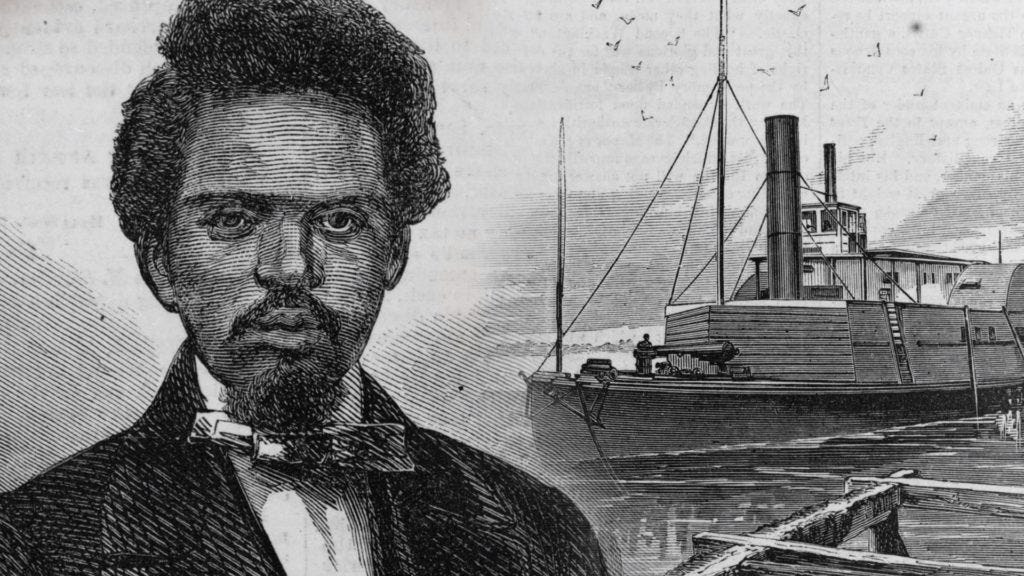
Robert Smalls, Congressman during Reconstruction.

The expulsion of Rep. Justin Jones and Rep. Justin Pearson from the Tennessee legislature has a direct historical link to the overthrow of real democracy and Reconstruction following the Civil War.

On May 13, 1862 an enslaved man named Robert Smalls, who labored on a Confederate steamer in South Carolina’s Charleston harbor, set into motion a daring plan.

As his great-great-grandson Michael Boulware Moore explained, “He saw that the Confederate crew had left, and he knew that oftentimes they left for the evening, not to come back until the next day.”

For Smalls and six other enslaved people and their families, the stakes couldn’t have been higher. “They knew that if they got caught, that they would be, not just killed, but probably tortured in a particularly egregious and public manner,” said Moore.

Disguising himself in the straw hat and long overcoat of the ship’s white captain, Smalls piloted the ship past Fort Sumter towards the Union blockade, and freedom.

After serving on a Union Naval vessel during the Civil War, Smalls returned home to Beaufort, S.C., and was elected to the U.S. House of Representatives – one of more than a dozen African Americans to serve in Congress during the period known as Reconstruction, when the formerly-rebel states were reabsorbed into the Union, and four million newly-freed African Americans were made citizens.

South Carolina, and throughout the former Confederacy, the era of Reconstruction saw the rise of Black political power and representation in both the U.S. Congress and Southern state legislatures.

During the 1870s, more than a dozen African American men, many of whom had been born into slavery, were elected to the U.S. Congress. 

It was a great democratic movement that ended all too quickly.

Former Southern insurrectionists, aided by the rise of the Ku Klux Klan, violently organized an anti-democratic counterrevolution.

Born in South Carolina, Aaron A. Bradley was a shoemaker in Augusta Georgia. Sometime around 1834 he ran away to the North, where he became a lawyer. 

In 1865 he returned to Georgia. He was the most outspoken member of the Black delegation to the constitutional convention. 

In 1868 he was elected state senator from the First District. Bradley rallied plantation workers around Savanah with his insistence that the formerly enslaved people be given land.

But Black political power and Reconstruction was short lived.

One quarter of the Black legislators in Georgia were killed, threatened, beaten, or jailed. In the December 1870 elections the Democrats won an overwhelming victory in overthrowing democracy and Reconstruction.

In 1906 W. H. Rogers from McIntosh County was the last Black legislator to be elected before Black voters were legally disenfranchised in 1908.

The actions by white Republican members of the Tennessee legislature to expel two elected Black members has all the stench of the overthrow of Reconstruction and the establishment of Jim Crow.