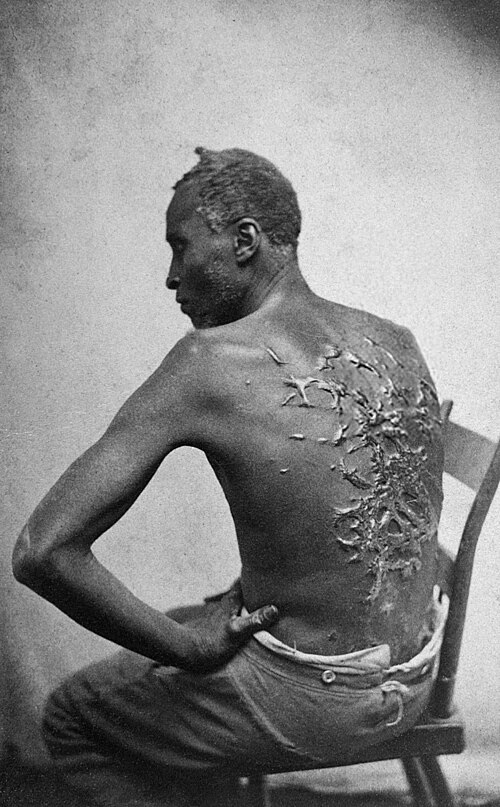
Trump warned that he was prepared to take an active role in reviewing exhibits in the Smithsonian museums, especially the African-American Museum. Too many show bad portrayals of their nation, he complained. Think about it: is it possible to show slavery in a positive light?
Trump’s insistence on purging the Smithsonian of the accurate portrayal of Black history is yet another example of his efforts to minimize and sanitize that history.
The New York Times wrote that Trump is hostile to an honest confrontation with the past:
Since taking office, Mr. Trump has led an effort to purge diversity, equity and inclusion policies from the federal government and threatened to investigate companies and schools that adopt such policies. He has tried to reframe the country’s past involving racism and discrimination by de-emphasizing that history, preferring to instead spotlight a sanitized, rosy depiction of America.
The administration has worked to scrub or minimize government references to the contributions of Black heroes, from the Tuskegee Airmen, who fought in World War II, to Harriet Tubman, who guided enslaved people along the Underground Railroad. Mr. Trump commemorated Juneteenth, the celebration of the end of slavery in the United States that became a federal holiday in 2021, by complaining that there were too many non-working holidays in America. He has called for the return of Confederate insignia and statues honoring those who fought to preserve slavery.
And he has previously attacked the exhibits on race at the Smithsonian, which has traditionally operated as an independent institution that regards itself as outside the purview of the executive branch, as “divisive, race-centered ideology.”
CNN described Trump’s determination to compel museums to remove exhibitions of events that show shameful behavior by whites and the government:
President Donald Trump escalated his campaign to purge cultural institutions of materials that conflict with his political directives on Tuesday, alleging museums were too focused on highlighting negative aspects of American history, including “how bad slavery was.”
In a Truth Social post, Trump directed his attorneys to conduct a review of museums, comparing the effort to his crackdown on universities across the country.
“The Smithsonian is OUT OF CONTROL, where everything discussed is how horrible our Country is, how bad Slavery was, and how unaccomplished the downtrodden have been — Nothing about Success, nothing about Brightness, nothing about the Future,” Trump wrote.
Trump’s comments come days after the White House announced an unprecedented, sweeping review of the Smithsonian Institution, which runs the nation’s major public museums. The initiative, a trio of top Trump aides wrote in a letter to Smithsonian Institution secretary Lonnie Bunch III last week, “aims to ensure alignment with the President’s directive to celebrate American exceptionalism, remove divisive or partisan narratives, and restore confidence in our shared cultural institutions.”
The letter said the review would focus on public-facing content, the curatorial process to understand how work is selected for exhibits, current and future exhibition planning, the use of existing materials and collections and guidelines for narrative standards.
Bunch — who has served as Secretary of the Smithsonian Institution since 2019 and is the first African American to hold the position — has made multiple comments about the importance of educating people about slavery through the National Museum of African American History and Culture specifically. He told Smithsonian Magazine that part of the purpose of that museum “was to help a nation understand itself — an impossible task without the full recognition of the horrors of slavery.”
Exhibits at the Smithsonian take years of planning and are heavily evaluated by teams of scholars and curatorial experts before they make their debut. Janet Marstine, a museum ethics expert, said that the demands laid out by the Trump administration “set the Smithsonian up for failure.”
“Nobody could provide those kinds of materials in such a comprehensive way, in that short amount of time, and so it’s just an impossible task,” she said. The White House has asked the Smithsonian to provide a wide array of materials, from internal emails and memos to digital copies of all placards and gallery labels currently on display.
The Smithsonian declined to comment on Trump’s latest remarks. A White House official, asked about the attorney review process Trump described, said the president “will explore all options and avenues to get the Woke out of the Smithsonian and hold them accountable.”
Still, Trump’s efforts to target colleges and universities — which he is now comparing to his focus on Smithsonian museums — has been even more aggressive. His administration has moved to strip federal funding from higher education institutions for a variety of reasons, including allegations of antisemitism and failure to comply with certain policy changes. Columbia University recently settled with the Trump administration for more than $220 million dollars and Trump has also been in a protracted battle with Harvard University after his administration froze $2 billion in federal funding.
The Trump administration’s push to align federal support with his cultural agenda has extended beyond the nation’s capital. The Institute of Museum and Library Services and the National Endowments for the Arts and the Humanities canceled tens of millions of dollars in federal grants earlier this year, affecting small museums, library initiatives, arts programs and academic research projects across the country.
Trump has previously praised the Smithsonian museums, including the National Museum of African American History and Culture, which he toured during his first term as president.
“I’m deeply proud that we now have a museum that honors the millions of African American men and women who built our national heritage, especially when it comes to faith, culture and the unbreakable American spirit,” Trump said during remarks at the museum in February 2017. Later that month, Trump said the museum “tells of the great struggle for freedom and equality that prevailed against the sins of slavery and the injustice of discrimination.”
Earlier this year, Trump signed an executive order that put Vice President JD Vance, who serves on the Smithsonian’s Board of Regents, in charge of stopping government spending on exhibits that don’t align with the administration’s agenda. He also tasked a former member of his legal team, attorney Lindsey Halligan, with helping to root out “improper ideology” at the Smithsonian.
“Museums in our Nation’s capital should be places where individuals go to learn — not to be subjected to divisive narratives,” the executive order said.
The Smithsonian began a review of its own in June, and has repeatedly stressed its commitment to being nonpartisan. The institution told CNN in July that it was committed to an “unbiased presentation of facts and history” and that it would “make any necessary changes to ensure our content meets our standards.”
The Smithsonian was established in the 1840s by the US with funds from the estate of James Smithson, a British scientist. As a unique trust instrumentality that is supported by federal funds, it is not an executive branch agency, which makes it a complex question whether the Trump administration has the ability to control its exhibits. It is governed by a 17-member Board of Regents led by Chief Justice John Roberts.
The fact that the Smithsonian is not an “executive branch agency” won’t deter Trump. He has ignored laws and the Constitution when they don’t support his agenda. Neither the Library of Congress nor the National Portrait Gallery is an executive agency. Yet Congress sat silently as Trump forced out their leaders.
Trump is rapidly assuming control of every federal agency that was designed to be independent.
No other President has attempted to do that.



 Diane Ravitch's blog