Archives for category: Extremism

Timothy Snyder is an expert on European history. He taught for many years at Yale University and held a prestigious chair in European history. In 2025, he accepted a chair at the University of Toronto. His Substack blog is titled “Thinking About…” This important essay appeared in May 9. Nothing Snyder says here has changed.

He wrote:

The United States has just spent billions of dollars to lose a war that enriches its oligarchs, impoverishes the citizenry, sabotages its alliances, and strengthens its enemies. As justification for the self-destructive mindlessness, the White House gestures towards Jesus and genocide.

On April 20th I was asked to speak in New York about ethics and power. My thinking, which I expressed in a conversation at the Council on Foreign Relations, on this little video, and in the media, was that our utterly unethical war was also utterly self-destructive. The war, a catastrophe in itself, suggests the guiding principle of Trump foreign policy: superpower suicide. The term was since come into more general use, and readers have been asking me to spell it out.

Empires have risen and failed before, but to my knowledge no state has ever chosen to kill its own power, and succeeded with such rapidity.

It is hard to see this clearly. Even as we oppose individual Trump adventures, we hope that in some way they are based on some understanding of the national interest. They are not. To get the perspective we need to see the nature of this anti-strategic self-slaughter, it will help to consider thirteen traditional bases of state power.

1. Statehood. A superpower must, at a minimum, be a modern state. This means that it must be an arrangement that includes, via law and other institutions, a larger body of citizens within a common endeavor. There is no sign that the Trump administration regards the United States of America as a state. It treats the existence of the United States as a commercial opportunity for a select few people, American and otherwise.

2. National interest. Another minimal requirement of superpower would be a sense of why that power must be used. The Trump administration exhibits no interest in the good of the people. Theorists of international relations have differed as to how leaders understand national interests; we are intellectually unprepared, however, for a situation in which the leader simply does not care about either the state or the nation.

3. Succession. Again, for a state to maintain itself as a superpower, it must maintain itself over time. The basic requirement of such continuity is a succession principle, a means by which authority is transferred from some people to other people while institutions continue to function. In the United States, democracy enables succession. Historically, there are means of succession, for example by dynasty (or dynastic adoption, as in second-century Rome) or by the decision of a politburo, as in China or the USSR (in the US this would be a capitalist politburo, the sort of oligarchical coven that got us JD Vance). Getting from democracy to such different arrangements would end the American republic. Trump aspires to stay in power indefinitely, and says so. By putting the vote in question, he puts America in question, and thus American power.

4. Elites. For states to thrive and to accumulate and maintain power, the right people have to be in charge. There is no perfect means to achieve this, and there is the inevitable tension, as the Roman Stoics and others have noted, between the skills needed to rise to the top and those suited to serving some general interest. And those who rise to a position of authority will try to pass it on to their children; the Roman Catholic Church went to the extreme of insisting on priestly celibacy to block this tendency. Historically, powerful states seek ways to enable qualified people to serve in positions of authority, regardless of birth. Ancient China had an examination system. Napoleon established the principle of merit in both civilian and military life. The United States had a civil service that was the envy of the world as well as a military that was its most meritocratic institution. The Trump administration has chosen to disable the civil service and to purge the military command of people of quality. This process has been carried out by people who are themselves wildly unqualified to hold any sort of office, let along cabinet positions. To see where we are, we must understand that people such as Tulsi Gabbard, Kash Patel, and Pete Hegseth, about whom one might raise other objections, had no business accepting their nominations, since they lack any qualifications. The fact that such people could be considered, let alone appointed, is a marker of superpower suicide.

5. Education. In a deeper sense, a superpower must have a mechanism to refresh its society, and thus its politics and administration, by preparing its population to understand the challenges of the world. This administration has done the contrary. University students are forbidden to gather and to speak their minds; university administrations are threatened with retaliation if they allow their faculty to teach freely; libraries around the country, including in military academies, are purged of useful books; public education generally is replaced with scams whereby tax money is transferred from the poorer to the richer while schools themselves are starved; an unregulated internet is allowed and indeed encouraged to transform the public sphere into a realm of emotions and recriminations.

6. Science. The rise of great powers often involves an alliance between politics and science. The ancient Mesopotamians were astronomers whose systems of describing the heavens still mark our ways of thought; so were the Mayans. The Romans managed to operationalize Greek science to build, defend, and cure. The Renaissance was, by no coincidence, also the age of exploration. Modern imperial powers built state institutions to fund science and attract scientists; the United States from the 1940s was the outstanding example of this trend, and science (often as practiced by immigrants) was the most important basis of American superpower. Current American policy is to fund science on the basis of primitive ideological taboos, and to discourage young scientists from immigrating to the United States. Senior scientists are also leaving; a colleague in a central position in US science just told me that he is leaving the country in part because the overall environment is better in other places. It is also US policy to cast doubt on basic scientific observations, such as that of human-caused climate change.

7. Energy. Human groups that pioneer new forms of energy technology rise; those that do not fall. This might be the most profound truth of our history; a magnificent forthcoming bookdemonstrates the significance of energy transitions at the most profound level, that of the history of life on earth itself. Humans who mastered fire could consume more energy themselves. Humans who domesticated dogs could use their energy to hunt mammoths. Humans who domesticated plants could turn solar energy to their own purposes. Humans who understood weather and climate could turn wind energy to the purpose of exploration and conquest, as did the Vikings. The United States was established on the cusp of a transition to hydrocarbon energy: coal, oil, natural gas. These forms of energy are now becoming obsolete, not only in ecological but also in economic terms. And yet this administration has chosen to cancel America’s energy transition and subsidize technologies that have no future. This is superpower suicide in perhaps the most basic form. And nothing could benefit America’s chief rival, China, more than this choice.

8. Technology. It requires little effort to associate technology with the rise of great powers. Military achievement is associated intimately with innovation; from the spur to the machine gun, the causal relationship is not really contestable. While the United States spends gigantic amounts of money on weaponry, the Trump administration has chosen to focus on weapons from the past rather than of the future. Trump’s idea is battleships named after himself based on what he remembers of a movie. The plans for “Trump-class” battleships are a mixture of the fictional and the vulnerable, which does reflect the man. The notion is to invest untold amounts of money into a kind of weapon has been understood to be obsolete since 1943, and which if somehow built would be highly vulnerable to weapons other countries now have. This strategic atavism draws the United States away from national security in its most basic sense. The shape of modern warfare is revealed by the high-tech war between Russia and Ukraine, especially in Ukraine’s successful self-defense. The Trump administration chose to ignore the lessons of that war and to demean and defund America’s Ukrainian ally, to the detriment of American interests and American warfighting.

9. Diplomacy. This art, celebrated by great powers, has been trashed by the United States. It cannot be practiced without understanding other countries, as the most focused American diplomats have stressed (for example, Henry Kissinger, who can hardly be excused of softheartedness). It has rested, in the American and other cases, on the deliberate construction of a diplomatic corps where people train in languages and trade in knowledge. Under the Trump administration, the foreign service has been trashed. The principle of diplomacy, such as it is, is that other countries will do what we want because we are big and bad. This has not worked. The bizarre notion that the president can himself “make deals” is the sign of a religious cult; like most cults, its activity is the generation of ever more creative excuses for the lack of performance. There is no evidence that Trump knows how to negotiate, and abundant evidence that he does not: for example, defeat in trade wars with China; personal vulnerability to the preferences of Russian leaders, and the disaster of Iranian nuclear enrichment, of which Trump himself is the chief sponsor. In practice, critical negotiations, with Iran and elsewhere, have been put in the hands of two people, Steve Witkoff and Jared Kushner, with close personal relationships with the president and obvious economic stakes in the relevant conflicts. The diplomacy of the Huns was far more sophisticated than this. It is hard to overstate how primitive the current American approach is, and how much joy it brings to America’s enemies.

10. Alliances. Great powers have allies. To be sure, they might change these alliances rapidly for reasons of interest, as the East Roman (Byzantine) Empire famously did. The whole history of the Roman Empire, for that matter, was one of active diplomacy with neighboring barbarians (as the Romans saw matters); archaeology bears witness to the arrangements that were made. The history of modern European empires was also one considered alliances, as the architects of American superpower understood. Under the Trump administration, useful allies are mocked and marginalized for no reason other than personal whimsy and a sense of grievance. Because there is no sense of state or national interest, there can be no understanding that alliances are of service. Trump feels annoyed because he is losing a war and removes US troops from Germany; those troops are there to enable the United States to win wars. I personally cannot think of any other example in which the leaders of a great power behaved in this way, presumably because these kinds of choices are inconsistent with the maintenance of power. The United States now seems to be treating as “allies” middle eastern countries that have nothing to offer except their own interests in the use of American armed forces in their own region, permanent engagement in the disastrous politics of oil, and financial opportunities for people personally close to Trump.

11. The international system. Postwar America did something far more impressive than build a system of alliances; it essentially created a set of laws, rules, and norms that allowed American power to maintain itself and to expand. The European Union and NATO, so abused by the Trump people today, were indirect and direct results of American policies intelligently designed to maximize American trade and security interests. But the achievement was far broader than that, and indeed historically unprecedented: the construction of laws and conventions that kept one country in the center of the world. Today, the Trump people make themselves at the World Economic Forum, the Munich Security Conference and similar gatherings and complaining that the rules are against them — the exact opposite was the case, because America made the rules. In deliberately destroying its own international system, this American government is improving the position of its rivals China and Russia, who have been calling for exactly this to happen, but who lacked the ability to make it happen.

12. The idea of victory. A superpower wins in confrontations, at least some of the time. This administration loses again and again, and is seen to lose by others. Trump announced that his main weapon of influence would be tariffs, but then lost his trade war with China, leaving Beijing more powerful and more emboldened. The Russo-Ukrainian war is a curious case. It would serve the interests of the United States in prosperity and stability for Ukraine to win; but under Trump the United States has switched its policy to one of support for Ukraine to support for Russia. So it has lost in that way. But since the United States has made that pivot, Ukraine has performed ever better in the war, and Russia has performed worse. And so the United States, amazingly, has managed to be the loser in the same war a double sense: by failing to see its own interests, and then by failing to fail. The Iranian war is an obvious strategic defeat in every traditional sense; insofar as there were any American objectives, they were not achieved. Trump’s policies have left Iran with more enriched uranium in the hands of a more radical regime which holds new sources of economic power in the world. In the current situation, in which military options have been self-humiliatingly exhausted, the useful instruments would be those that involved communicating with the Iranian people or influencing Iranian society. Those institutions existed until very recently; they were willfully demolished, to great fanfare, in early 2026.

The United States is now governed by people who celebrate defeat in symbolic terms characteristic of states in disastrous decline. Consider Defense Secretary Hegseth’s description of the rescue of a US pilot as the resurrection of Jesus. The screaming blasphemy of this might distract us from its strategic helplessness. Christological images of this sort are used as propaganda to transform defeat in the real world into victory in some imaginary one. The US lost the war in Iran. Among other things it was not able to sustain an air campaign. The downing of a US fighter meant than an individual mission failed. It is happy news, of course, that the pilot survived. But the notion that this was a “literal miracle,” as Hegseth claimed, brings the United States, sadly, into the tradition of losers who use Jesus to claim to be winners. An historical example of this was Polish Romanticism, with its idea that the collapse of a republic (chiefly due to wealth inequality) made of Poland the “Christ of Nations.” Donald Trump’s own self-deification has to be seen in similar terms: a president who could assert power in this world would not have to claim that his real authority comes from another one. His fantasies of the total destruction of Iranian civilization are part of an apocalyptic panorama that is inconsistent with decent politics.

13. Finances. Though not the most interesting historical subject, budget disaster stands behind many of the most notable collapses of state power, ancient and modern. Under Trump our national debt now approaches $40 trillion. National debt is higher than GDP of the country for the first time since the end of the Second World War. That is a notable point of comparison: it is normal to run big deficits when facing the challenge of the scale of a world war. We are running huge deficits for an entirely different reason: because we decline to tax wealthy individuals and corporations. That is not an approach that is consistent with fighting and winning wars, nor with maintaining the social services that allow a modern society to function. More profoundly: it reflects an approach to politics — government as customer service to the very wealthy — that leads us from power to ethics.

The war can lead us to a diagnosis of superpower suicide. Wars cannot be won by people who have no idea what they are doing, because they have no frame of reference (such as the nation or the state) beyond their own feelings. They cannot be fought well when the wrong people are making the daily decisions and the wrong weapons are being deployed. They cannot be reasonably brought to an end when there is no practice of diplomacy and no notion of the value of alliances and no concern about corruption.

But even a strict focus on power will lead us back to justice. But just as the war is only a symptom of superpower suicide, so superpower suicide is only a symptom of a still deeper condition, the one that must be addressed.

Even if all we cared about were American power, we would have to ask ourselves how to undo the distortions of democracy and the drastic inequalities of that enabled world-historical levels of strategic buffoonery. After a year of Trump, we face a situation where reform and repair are not the relevant categories. And, in a certain sense, this is useful. The fact that we reached this point, the fact that just a year of Trump could bring superpower suicide, shows us that the prior status quo was unsustainable.

The systems that made the United States a superpower cannot be rebuilt as they were, nor should they be: they involved structural injustices that made the present attempt at self-annihilation possible. From where we stand now there are two ways forward: one is the self-induced downfall of the American republic; the other is to reconsider American ideals and to restructure American politics so as to bring the people greater power over a more just future.

*****

PS. If you would like to help Ukrainians defend themselves from Russia’s criminal war of aggression, please consider contributing to the Sky Defense campaign. For worse but also for better, as the Ukrainians have shown us, this is a time when civil society campaigns can contribute to general security.
J. Michael Luttig is a respected conservative legal scholar who was appointed to be a federal appeals court judge by President George H.W. Bush. He served for 15 years on the U.S. Court of Appeals for the Fourth Circuit from 1981 to 2006. In 2020, he advised Vice-President Mike Pence that he had no constitutional authority to overturn the presidential election. He is an outspoken critic of Trump. In 2024, he voted for Kamala Harris.

In this post, Judge Luttig critiques a speech that Justice Clarence Thomas delivered in late April to the Civitas Institute at the University of Texas. It was supposed to be a speech about the 250th anniversary of the Declaration of Independence.

Justice Thomas expressed the bizarre idea that progressivism is at odds with the ideals of the Declation of Independence. He described progressivism as the demonic ideology that is responsible for the great evils of the past century. Justice Thomas connected progressivism to Stalin, Hitler, Mao, and Mussolini.

Here is a video. Here is a transcript.

Law school dean Erwin Chemerinsky analyzed his speech here.

Ruth Marcus, former editorial writer for The Washington Post, critiqued his upside/down version of history in The New Yorker.

Judge J. Michael Luttig joined many who were critical of Justice Thomas’s understanding of history and of progressivism.

He wrote:

The speech exe that Justice Clarence Thomas gave last week at the University of Texas could prove to be the single most important speech of political and constitutional philosophy that never should have been given.

As a conservative my entire life, I certainly wish Justice Thomas had not written and given the insidious speech.

Though his unmistakable targets were Progressives and progressivism, his speech is far more injurious to Republicans, conservatives, and conservatism than it is for progressivism because it is demonstrably and inarguably wrong as to Progressives, but it is a siren song to today’s Republicans and conservatives. Webster’s Dictionary defines “siren song” as “: an alluring utterance or appeal, especially one that is seductive or deceptive.”

Justice Thomas intended his speech as a Republican and conservative manifesto for our times — and for all times. But the political and constitutional philosophies he described and embraced are neither doctrinal conservatism nor Republican nor political conservatism, and they are manifestly not constitutional conservatism.

No one should mistake for true conservatism, or even Republicanism, much less constitutional conservatism, the political and constitutional philosophies that Justice Thomas has embraced his entire life and spoke about last week. His philosophies represent anything but true conservatism.

Rather, together, they constitute a bastard strand of conservatism that lingered and languished in the faculty lounges of the conservative academy from around the mid-1960s until it was summoned forth from the academy by acolytes of Clairmont McKenna College’s natural law philosopher Harry V. Jaffa to fuel Donald Trump’s rise to power in 2016.

Those acolytes included Justice Thomas and his, and my, former law clerk John Eastman.
Thus, the overarching significance of Justice Thomas’ speech last week is that it represents the intellectual political and constitutional philosophies for Donald Trump’s two presidencies and his entire MAGA movement.

It was these political and constitutional philosophies that underlaid and justified Donald Trump’s failed plan to cling to power on January 6, 2021, the architect of which was John Eastman.

The political and constitutional philosophies that Justice Thomas embraces are as certainly wrong for America, whose preeminent law is the Constitution of the United States, not the Declaration of Independence’s admittedly majestic and inspirational Preamble,” as Justice Thomas believes they are certainly right for America under that Constitution. His twin philosophies are, simply and demonstrably, wrong as a matter of historical fact, political fact, and both constitutional fact and law.

Together, they are a shockingly and reprehensibly ahistorical characterization of liberals and progressives and progressivism, as well as an ahistorical characterization of Republicans, Republicanism, and conservativism.

These philosophies are a radical understanding of American and world history over the past century and a quarter, a radical way of thinking about American political history, and a decidedly radical way of thinking about the relationship between the Declaration of Independence and the Constitution.


This is emphatically not what the Founders of this nation and the Framers of the Constitution of the United States contemplated, envisioned, or ever intended.


The historical flaws in Justice Thomas’ speech are many and every one of them has already been identified and authoritatively denounced by experts and scholars across the political, philosophical, and ideological spectrum.

Justice Thomas purports to trace progressivism in America back to Democrat President Woodrow Wilson, when in fact progressivism for the past century and a half is actually traceable directly back to Republican President Theodore Roosevelt. Astonishingly, Thomas then blames all progressives of the twentieth and twenty-first centuries – including progressives in the United States over this period – and charges them with responsibility for the profound failures of societies worldwide during those one hundred and twenty-five years, including Stalinism, Maoism, Mussolini’s fascism, Naziism, and worse.

Oblivious to the actual history, but supremely confident in his ahistorical understanding of that history, Justice Thomas intoned as if reading from the Gospel that “Progressivism has made many inroads in our system of government and our way of life. It has coexisted uneasily with the principles of the Declaration. Because it is opposed to those principles, it is not possible for the two to coexist forever…. Stalin, Hitler, Mussolini, and Mao all were intertwined with the rise of progressivism, and all were opposed to the natural rights on which our Declaration was based. Many progressives expressed admiration for each of them shortly before their governments killed tens of millions of people.”

Justice Thomas’ invidious accusation that progressives in America for the past century and a half up to this very day have been pursuing the same anti-democratic and anti-constitutional regimes as Stalinism, Maoism, Mussolini’s fascism, Naziism, and the like, is frightening, risible, and reprehensible.

While it can fairly be said that Woodrow Wilson was critical of the Declaration’s Preamble, virtually no other Progressive or Democrat since Woodrow Wilson has so much as criticized the Preamble, much less rejected it. The Reverend Martin Luther King, Jr., famously regarded the Declaration of Independence and the Constitution as the “promissory notes” to which all Americans were heir and he called upon the nation to fulfill the pledges of these two Founding documents.

Jeffrey Rosen, one of the greatest constitutional scholars and historians of our times and indisputably the foremost constitutional scholar of America’s Founding, writes in his recent book The Pursuit of Liberty: How Hamilton vs. Jefferson Ignited the Lasting Battle Over Power in America that Thomas Jefferson was, after all, the founder of the progressive Democratic Party and most Democrats in 19th and 20th centuries revered Jefferson.

Mr. Rosen goes on to explain that when he was President Wilson’s closest advisor, progressive Supreme Court Justice Louis Brandeis handed out biographies of Thomas Jefferson to Kentucky schoolchildren, quoted Jefferson in the greatest free speech opinion Brandeis ever wrote on the Supreme Court, and took his famous criticism of the “curse of bigness” from Thomas Jefferson.

Supreme Court Justice Hugo Black, a liberal originalist, worshiped and frequently quoted Thomas Jefferson. President Franklin Delano Roosevelt built the Jefferson Memorial on the Mall in Washington D.C. and had Jefferson’s portrait permanently engraved on the obverse of the nickel and his Virginia home, Monticello, engraved on the reverse. Mr. Rosen writes that President Roosevelt died the day before Thomas Jefferson’s birthday with an undelivered speech in hand, in which he called Thomas Jefferson the prophet of the post-war order.

And of course, President William Jefferson Clinton began his inauguration with a pilgrimage to his namesake’s Monticello home in Charlottesville, Virginia, symbolically traveling from Thomas Jefferson’s mountaintop home to the Nation’s Capital, to be sworn in as the 42nd President of the United States.

As a matter of historical fact, every single progressive president since Theodore Roosevelt, with the arguable exception of Woodrow Wilson has unhesitatingly embraced the Declaration’s Preamble, the Declaration itself, and indeed, Thomas Jefferson, the author of the Declaration of Independence.

For 250 years, it has never been the case that either of America’s two political parties has been anti-Preamble, anti-Declaration of Independence, or anti-Constitution . . . until, that is, the past 10 years, when the Republican Party led by Donald Trump has acted as if it were all three.

As a matter of historical, political, and constitutional fact, it is the 47th President and today’s Republicans and conservatives who, every day of the week, act in denial of the Declaration of Independence and the Constitution of the United States, all the while professing to revere these two Founding and foundational documents of the United States of America.

Heather Cox Richardson sums up the quagmire in which Trump is stuck, unable to bully Iran, and, according to him, “bored” by the stalemate in negotiations. His response, as she shows, is to unleash a flurry of unhinged tweets about his grandeur, his historical significance, and his self-regard. One can only imagine the reaction of the media and the public if any other president posted similar images and words. At minimum, there would be widespread concern about his deepening megalomania.

She wrote:

As we enter the summer months, we’re hitting the ground running. There is so much news today, I’m going to have to let some of it splash over into tomorrow to do it justice. For today, Iran and its role in the president’s deteriorating mental condition are going to take center stage.

Over the weekend, there were what I’m going to have to call the usual reports of an imminent agreement between the U.S. and Iran to end hostilities, with the usual outcome.

Last week the U.S. and Iran appeared to be making headway on a 60-day memorandum of understanding to continue the ceasefire and to establish a framework for further talks about Iran’s nuclear program. But President Donald J. Trump is caught between a rock and a hard place in these negotiations.

His base demands that he look strong and accomplish what, after the initial strikes failed, he claimed to have started the war for: to make sure Iran doesn’t have the capacity to produce a nuclear weapon. He also needs to reopen the Strait of Hormuz—which was open before he began the strikes—and get oil flowing again from that region of the Middle East. Prices in the U.S. are rising, and the looming threat of oil reserves running out adds even more pressure to consumer prices.

And Congress returns to work tomorrow, raising the possibility that lawmakers will pass a war powers resolution requiring Trump to withdraw American forces from the region. House speaker Mike Johnson (R-LA) sent House members home a day early before the Memorial Day holiday out of concern such a measure would pass.

But Iran is in no hurry to throw Trump a lifeline. Their negotiators now maintain they have a right to control the Strait of Hormuz. They are demanding reparations for the damage inflicted in the country during the war, and they say they won’t negotiate over the nuclear program until there is a ceasefire.

But these conditions are all problematic for Trump’s negotiators. Permitting Iran to control the strait is not just about oil; it’s about the principle of freedom of the seas set out after World War II. Global trade depends on that concept. The exchange of money is also a problem for Trump. He has spent much of his political life attacking the Joint Comprehensive Plan of Action that China, France, Germany, Russia, the U.K., the U.S., and the European Union negotiated with Iran during the Obama administration, claiming that former president Obama “gave” Iran $1.7 billion. In fact, the JCPOA simply permitted the release of Iranian assets frozen overseas by sanctions, but much of Trump’s base believes that Obama showed weakness by buying an agreement.

And then there is the nuclear issue.

So what has tended to happen in negotiations is that the teams come up with a framework, details leak to the media, and Trump’s base hears that Trump has weakened on some of his maximalist demands. They complain, Trump then posts something false about the talks or incendiary about Iran, and the negotiations fall apart.

And the cost of the war, in both lives and treasure, and the pressure on U.S. consumers and the economy continue to mount.

Last Friday, Trump and his advisors spent two hours discussing the latest round of negotiations in the Situation Room. According to Erika Solomon and Farnaz Fassihi of the New York Times, that agreement included the release of about $24 billion in frozen Iranian assets and a postwar “investment fund” to rebuild Iran, with one diplomat telling the journalists the number on the table was $300 billion. Talks about Iran’s nuclear program would be deferred.

On Friday morning, Trump posted, once again, that the strait would be opened and that Iran must never have a nuclear weapon. But then he emerged from the Situation Room without the “final determination” on the agreement he had promised. On Saturday, Mohsen Rezaie, one of the advisors to Iran’s supreme leader, posted: “As predicted, the President of the United States is betraying diplomacy for the third time.”

Over the weekend, Trump’s social media account posted repeated attacks on Democrats and on the judges who have been deciding against him in legal cases. He posted long defenses of his alterations to monuments in Washington, D.C., and AI images of capital landmarks covered in trash and graffiti juxtaposed with ones gleaming and fresh, with captions that blame Democrats for the former and praise Trump for the latter.

His posts seemed designed primarily to reassure himself. By Saturday, so many of the musical acts his team had lined up to play at his Freedom 250 “Great American State Fair” from late June through the beginning of July had bailed that Trump posted that he was “thinking about bringing the Number One Attraction anywhere in the World, the man who gets much larger audiences than Elvis in his prime, and he does so without a guitar, the man who loves our Country more than anyone else, and the man who some say is the Greatest President in History (THE GOAT!), DONALD J. TRUMP, to take the place of these highly paid, Third Rate “Artists,” and give a major speech, rallying the Country forward like I have done ever since being President!” He continued: “Two years ago, the United States was DEAD. Now we have the “HOTTEST” Country anywhere in the World. I don’t want so-called “Artists” that get paid far too much money, who aren’t happy. I only want to be surrounded by Happy People, Smart People, Successful People, and People that know how to WIN. So, by copy of this TRUTH, I am ordering my Representatives to look at the feasibility of doing an AMERICA IS BACK Rally on Wednesday, Washington, D.C., same time, same location. Only Great Patriots invited—It will be a Wild and Beautiful Celebration of America! President DONALD J. TRUMP”

It was an odd echo of his December 19, 2020, tweet calling his base to Washington, D.C., in which he wrote: “Big protest in D.C. on January 6th. Be there, will be wild!”

Odder still was what followed: image after image of Trump as a great leader. There were images of Trump alongside first president George Washington, one of them showing the two presidents riding horses together in colonial garb beside a racecar with TRUMP across the hood, the White House in the background, and the Space Shuttle overhead. In an AI image, Trump is dunking a basketball over an exhausted New York governor Kathy Hochul, a Democrat; in another image, he and Patriots football player Tom Brady stand talking, backlit, under a caption that reads “GOAT.”

There were pictures of Trump kissing the American flag; Mount Rushmore with Trump’s sculpture in line with those of George Washington, Thomas Jefferson, Theodore Roosevelt, and Abraham Lincoln (who looks somewhat alarmed); Trump apparently as a superhero admiral with armor on his chest that bears an American eagle; Trump standing near King Charles; Trump with China’s president Xi Jinping.

A series of AI images in the style of the 1950s Dick and Jane readers show a town parade festooned with flags and patriotic bunting, little girls laughing together at an old-fashioned town fair, and little boys in a suburb playing ball. All of the images read: “AMERICA IS BACK!” And in them, all of the people are white.

He posted an image of a white family from that era standing beside a Cadillac Coupe DeVille parked on a suburban street, with the caption: “BILLIONS WERE SPENT TO CONVINCE YOU THIS IS EVIL.”

Then Trump’s account posted a series of images contrasting his vision of Biden’s America versus his own. In his images, Biden’s world was one of theft, illegal squatting, violence, and illegal immigration. The images of Trump’s “solutions” to these problems showed people imprisoned, arrested, and deported.

At 1:02 this morning, Trump posted: “Iran really wants to make a deal, and it will be a good one for the U.S.A. and those that are with us. But don’t the Dumocrats, and various seemingly unpatriotic Republicans, understand that it is MUCH tougher for me to properly do my job and negotiate, when political hacks keep negatively ‘chirping,’ at levels never seen before, over and over again, that I should move faster, or move slower, or go to war, or not go to war, or whatever. Just sit back and relax, it will all work out well in the end—It always does! President DJT”

A minute later, his account posted: “Has anyone ever seen a happy Dumocrat???”

Then, later this morning, Iranian officials said they were suspending negotiations with the U.S. until Israel, which entered the war alongside the U.S., stops its strikes on Lebanon, strikes they say violate the ceasefire agreement. They warned they would close the Strait of Hormuz entirely—a few ships have been making the transit—and move against the Bab al-Mandab strait at the outlet of the Red Sea, as well. On CNBC, Trump told Eamon Javers that he doesn’t care if peace negotiations with Iran end. “I couldn’t care less,” he said. Negotiations were starting “to get very boring.”

But oil prices jumped sharply with the announcement of the suspension and the threat to the Bab al-Mandab, and at 1:43 in the afternoon, Trump posted: “Talks are continuing, at a rapid pace, with the Islamic Republic of Iran.” At 5:47, he posted on social media that he had spoken with Prime Minister Benjamin Netanyahu of Israel and indirectly with Hezbollah, and that they both agreed to stop striking each other.

The Pentagon has been trying to control information coming out about its actions for months now, but that effort is now ramping up. This afternoon, Scott Nover of the Washington Post reported that the Pentagon has designated its press office as a classified space—a Sensitive Compartmented Information Facility, or SCIF—and even those journalists who have not had their press badges rescinded will require an appointment to talk to the press secretary. 

—

Notes:

X:

ir_rezaee/status/2060634659646484743

scottbudman/status/1604915748693909504

HamidRezaAz/status/2061439791132996026

Trump’s Truth:

statuses/38975

statuses/38874

statuses/38883

statuses/38884

statuses/38888

statuses/38887

statuses/38902

statuses/38903

statuses/38907

statuses/38905

statuses/38919

statuses/38918

statuses/38917

statuses/38915

statuses/38920

statuses/38921

statuses/38922

statuses/38923

statuses/38931

statuses/38929

statuses/38938

statuses/38937

statuses/38974

statuses/38977

statuses/38979

statuses/38872

Secretary of Defense Pete Hegseth doesn’t like people who are not white males, straight white males to be exact. when a board of Navy admirals presented their candidates to be one-star admirals, Hegseth struck the names of four woman and two Black persons on the list. He also struck the names of four white men. When he was first appointed by Trump to his post, he began the purge of high-ranking women and Blacks. Hegseth is a bigot.

The New York Times reported:

In a move that disproportionately targets women and minority officers, Defense Secretary Pete Hegseth recently blocked the promotions of nine Navy officers who had been selected by a board of senior Navy admirals.

The net result of Mr. Hegseth’s intervention is a slate of 22 nominees to be one-star admirals that bears little resemblance to the broader force these officers will help lead.

Three of the officers removed by Mr. Hegseth from the promotion list are women and two are Black men. An additional four are white men.

Mr. Hegseth’s actions, which appear to violate the rules governing a promotion system that is supposed to be apolitical and merit-based, were described by five current and former defense officials who spoke on the condition of anonymity to discuss sensitive personnel matters.

No female officers were included on the new one-star list, which was released publicly in late May, despite the fact that women make up about 21 percent of the active-duty Navy. The list appears to include only two nonwhite officers, even though sailors who identify as racial minorities make up about 38 percent of the active-duty Navy.

Mr. Hegseth’s removal of the officers from the one-star list is highly unusual, said the current and former defense officials. According to Pentagon rules, the defense secretary is only supposed to pull officers from the list for moral, mental, physical or professional failings that raise questions about the officers’ fitness to lead.

Mr. Hegseth’s actions are the latest in a series of firings and personnel interventions that seem to be driven by his anti-diversity politics rather than the officers’ performance. Taken together, they could reshape the military’s top ranks for years to come.

Sean Parnell, the Pentagon’s chief spokesman, declined to say why Mr. Hegseth pulled the officers off the Navy one-star list. “Military promotions are given to those who have earned them,” Mr. Parnell said. “The department will never consider the color of a service member’s skin or their gender as a factor in promotions.” The Navy declined to comment.

Since taking office, Mr. Hegseth has fired or sidelined nearly three dozen senior military officers as part of a broader campaign designed to purge the Pentagon of leaders he has disparaged as “foolish,” “reckless” and “woke.” He has consistently refused to explain why he has chosen to fire officers or pull them from promotion lists.

His scrutiny has fallen heavily on female and minority officers, who have borne the brunt of the dismissals. Nearly 60 percent of the senior officers Mr. Hegseth has fired are female or Black, Senator Jack Reed of Rhode Island, the top Democrat on the Armed Services Committee, said in recent Senate testimony. Women and minorities currently account for fewer than 20 percent of all generals and admirals.

“You are hollowing out the military’s bench of experience and highest-performing senior officers, while making young officers wonder if they should continue to serve,” Mr. Reed told Mr. Hegseth at another recent hearing.

Among those dismissed were Gen. Charles Q. Brown Jr., the second African American to serve as chairman of the Joint Chiefs of Staff, and Adm. Lisa Franchetti, the first woman to lead the Navy.

Earlier this year, Mr. Hegseth also removed four colonels — two Black men and two women — from the Army’s list of nominees for one-star general over the objections of Army Secretary Daniel P. Driscoll. Mr. Driscoll insisted that the officers had a long history of exemplary service and had done nothing wrong.

Officers selected for one-star rank are picked by a board of admirals or generals who review hundreds of personnel files over the course of meetings that can span two weeks. Only about 5 percent of those eligible for promotion to one-star are chosen, making it the most competitive board in the U.S. military.

The lists are then reviewed by the service secretaries and the defense secretary, who under Pentagon rules may strike names in limited circumstances, like the emergence of new information that raises questions about the officers’ qualifications for service.

Despite the rigorous and competitive selection process, Hegseth is certain that women and Blacks are chosen only to satisfy diversity goals.

Trump has spent a lot of time rescuing, pardoning and trying to reward the people who joined him in attempting to overturn his election loss in 2020. He is a giant baby. He is a sore loser. He lost decisively, and he refuses to accept it. More than 60 federal and state courts, including the U.S. Supreme Court, rejected his appeals because there was no evidence of election fraud.

Someday, with time, we will look back on Trump’s refusal to accept his defeat as a low point in our history. Of course, we will look at his two terms in office as the absolute nadir of our history, as a time he spent rolling back civil rights, environmental protections, international alliances, access to healthcare, defunding medical and scientific research, bullying universities, and censoring the mass media.

Trump bullied Governor Jard Polis of Colorado to free Tina Peters, and Polis succumbed:

Tina Peters, the former clerk convicted of participating in a scheme to chase election conspiracy theories promulgated by President Donald Trump, was released from prison Monday after the president successfully pressured Colorado’s Democratic governor into commuting her sentence.

Peters’ release was confirmed by the Colorado Department of Corrections. The state agency said it would have no more information about the 70-year-old inmate. Her sentence was shortened by Gov. Jared Polis last month after Trump waged a lengthy pressure campaign against the governor and his state.

Peters served less than a quarter of her nine-year sentence.

Peters was the first local election official to be charged with breaching security after the 2020 election. She snuck in an outside computer expert affiliated with My Pillow Chief Executive Mike Lindell — who himself denied that Trump lost the White House in 2020 — and the person copied the county’s Dominion Voting Systems computer server as it was updated in 2021.

Peters then joined Lindell onstage at a “cybersymposium” that promised to reveal proof that the election was rigged. Video and photos of the computer system upgrade, including passwords, were posted online. The move stoked false claims that voting machines were manipulated to steal the election from Trump.

Peters was convicted in 2024 of attempting to influence a public servant, conspiracy to commit criminal impersonation, violation of duty and other crimes by jurors in Mesa County, a Republican stronghold that supported Trump. An appeals court upheld her conviction in April, but ordered Peters to be resentenced because it said the judge who sent her to prison wrongly punished her for speaking out about election fraud.

Trump had championed Peters’ case, but because she was convicted under state law, he did not have the power to pardon her. Instead, the president pressured Polis to do so, lambasting him on social media and disinviting him to a White House meeting with other governors. The Trump administration also announced plans to dismantle the National Center for Atmospheric Research in Colorado and relocated the U.S. Space Command to Alabama.

Polis commuted Peters’ sentence on May 15. In a letter, he wrote that although Peters was convicted of serious crimes and deserved to spend time in prison, the sentence was “extremely unusual and lengthy” for a first-time non-violent offender.

Colorado Secretary of State Jena Griswold, a Democrat, called the move a “dark day for democracy” and said it amounted to “selling out our state’s justice system for Trump.”

Certain words have been censored from government documents, most especially those that refer to diversity, equity, and inclusion, meaning race, ethnicity, gender, and LGBT status.

The New York Times has kept a running list of “forbidden” words. The list does not include the exhibits that have been removed at public museums, public libraries, National parks, and other public institutions.

As President Trump seeks to purge the federal government of “woke” initiatives, agencies have flagged hundreds of words to limit or avoid, according to a compilation of government documents.

  • accessible
  • activism
  • activists
  • advocacy
  • advocate
  • advocates
  • affirming care
  • all-inclusive
  • allyship
  • anti-racism
  • antiracist
  • assigned at birth
  • assigned female at birth
  • assigned male at birth
  • at risk
  • barrier
  • barriers
  • belong
  • bias
  • biased
  • biased toward
  • biases
  • biases towards
  • biologically female
  • biologically male
  • BIPOC
  • Black
  • breastfeed + people
  • breastfeed + person
  • chestfeed + people
  • chestfeed + person
  • clean energy
  • climate crisis
  • climate science
  • commercial sex worker
  • community diversity
  • community equity
  • confirmation bias
  • cultural competence
  • cultural differences
  • cultural heritage
  • cultural sensitivity
  • culturally appropriate
  • culturally responsive
  • DEI
  • DEIA
  • DEIAB
  • DEIJ
  • disabilities
  • disability
  • discriminated
  • discrimination
  • discriminatory
  • disparity
  • diverse
  • diverse backgrounds
  • diverse communities
  • diverse community
  • diverse group
  • diverse groups
  • diversified
  • diversify
  • diversifying
  • diversity
  • enhance the diversity
  • enhancing diversity
  • environmental quality
  • equal opportunity
  • equality
  • equitable
  • equitableness
  • equity
  • ethnicity
  • excluded
  • exclusion
  • expression
  • female
  • females
  • feminism
  • fostering inclusivity
  • GBV
  • gender
  • gender based
  • gender based violence
  • gender diversity
  • gender identity
  • gender ideology
  • gender-affirming care
  • genders
  • Gulf of Mexico
  • hate speech
  • health disparity
  • health equity
  • hispanic minority
  • historically
  • identity
  • immigrants
  • implicit bias
  • implicit biases
  • inclusion
  • inclusive
  • inclusive leadership
  • inclusiveness
  • inclusivity
  • increase diversity
  • increase the diversity
  • indigenous community
  • inequalities
  • inequality
  • inequitable
  • inequities
  • inequity
  • injustice
  • institutional
  • intersectional
  • intersectionality
  • key groups
  • key people
  • key populations
  • Latinx
  • LGBT
  • LGBTQ
  • marginalize
  • marginalized
  • men who have sex with men
  • mental health
  • minorities
  • minority
  • most risk
  • MSM
  • multicultural
  • Mx
  • Native American
  • non-binary
  • nonbinary
  • oppression
  • oppressive
  • orientation
  • people + uterus
  • people-centered care
  • person-centered
  • person-centered care
  • polarization
  • political
  • pollution
  • pregnant people
  • pregnant person
  • pregnant persons
  • prejudice
  • privilege
  • privileges
  • promote diversity
  • promoting diversity
  • pronoun
  • pronouns
  • prostitute
  • race
  • race and ethnicity
  • racial
  • racial diversity
  • racial identity
  • racial inequality
  • racial justice
  • racially
  • racism
  • segregation
  • sense of belonging
  • sex
  • sexual preferences
  • sexuality
  • social justice
  • sociocultural
  • socioeconomic
  • status
  • stereotype
  • stereotypes
  • systemic
  • systemically
  • they/them
  • trans
  • transgender
  • transsexual
  • trauma
  • traumatic
  • tribal
  • unconscious bias
  • underappreciated
  • underprivileged
  • underrepresentation
  • underrepresented
  • underserved
  • undervalued
  • victim
  • victims
  • vulnerable populations
  • women
  • women and underrepresented

Notes: Some terms listed with a plus sign represent combinations of words that, when used together, acknowledge transgender people, which is not in keeping with the current federal government’s position that there are only two, immutable sexes. Any term collected above was included on at least one agency’s list, which does not necessarily imply that other agencies are also discouraged from using it.

The above terms appeared in government memos, in official and unofficial agency guidance and in other documents viewed by The New York Times. Some ordered the removal of these words from public-facing websites, or ordered the elimination of other materials (including school curricula) in which they might be included.

In other cases, federal agency managers advised caution in the terms’ usage without instituting an outright ban. Additionally, the presence of some terms was used to automatically flag for review some grant proposals and contracts that could conflict with Mr. Trump’s executive orders.

Some of the Trump regime’s efforts to censor history have been reversed. For example, it lost its fight to remove the Gay Pride flag from the Stonewall bar in Greenwich Village in New York City.

The New York Times reported:

The Trump administration has agreed to officially restore the Pride flag that was removed from the Stonewall National Monument in New York’s Greenwich Village. 

The move marks a reversal by the Trump administration, which had the flag removed back in February. It comes on the heels of a lawsuit brought by several nonprofit groups against Department of Interior Secretary Doug Burgum, the National Park Service and others. The agreement to restore the flag settles the lawsuit. 

The National Park Service said it removed the flag under guidance from the Department of Interior, which had said non-agency flags could not be officially displayed on flagpoles managed by the National Park Service. 

The court agreement says it will no longer be subject to the political whims of whoever is in power.   

“The whole reason why the flag belongs at Stonewall is because it is such a big part of the history of the LGBTQ community and the struggle for equality. Stonewall itself is obviously such a part of that history and all along what we asserted was that the flag itself was a representation of that history,” attorney Alexander Kristofcak said.

Advocates say the ruling could have a national impact at other places where the Trump administration has sought to combat diversity initiatives. For example, the Trump administration removed an exhibit on George Washington’s ownership of slaves from Independence National Historical Park in Philadelphia. 

But in February 2026, a federal judge ordered the restoration of the Philadelphia exhibit.

Politico reported that Judge Cynthia Rufe wrote a “withering opinion” in which she compared the Trump administration’s stance to George Orwell’s 1984. It was an effort, she said, to eliminate the truth by an administration that did so because it could. No, you can’t, she ordered.

Florida, under the thumb of its rightwing extremist Governor Ron DeSantis, has had a hard time hiring a new president for its state university.

Last year, the search committee selected Santo Ono, the president of the University of Michigan, as its candidate. However, the university’s Board of Governors voted against the nomination of Ono because of his work to diversify the University of Michigan, which was contrary to the anti-DEI policies that DeSantis championed.

Now the search committee has selected Stuart Bell, the president of the University of Alabama, to be the president of the University of Florida.

The Chronicle of Higher Education reported that rightwingers are outraged by the choice of Bell. They contend that Bell is a proponent of DEI.

Under Bell’s decade-long tenure at the University of Alabama, Black and Latino enrollment doubled after he launched an aggressive diversity campaign in response to a series of racist incidents…

Opposition to Stuart Bell’s nomination to be president of the University of Florida grew this week with several prominent conservative activists, a Trump appointee, and a U.S. senator weighing in.

Activists from the Manhattan Institute argued that Bell is an ideologue who during his tenure as president of the University of Alabama discriminated against white people in his efforts to diversify the student body and faculty.

Even the Secretary of Education Linda McMahon suggested that the University of Florida should pick a different president, not Bell, tainted by DEI.

The U.S. Supreme Court was designed to be a separate branch of government, the one that monitored the adherence to the Constitution by the other two branches. The Court disappoints sometimes, but it has never been as nakedly partisan as it is under Chief Justice John Roberts. The far-right wing of the Republican Party has a reliable friend at the Court.

It’s hard to say which of their decisions is the worst.

Some might say it was their recent decision to overturn the Voting Rights Act, which will sharply reduce the number of Black members of Congress.

Some might say it was their decision to overturn Roe v. Wade, despite promises by most of them not to do so.

Some would say it is their decisions that tear down the wall of separation between church and state.

I say it was their decision in Trump v. United States, in which the majority decided that the president was above the law and could not be charged for anything he did while in office as part of his official duties. We can be certain that the same court would claim that whatever he did was part of his official duties, including tearing down the East Wing of the White House without seeking anyone’s approval.

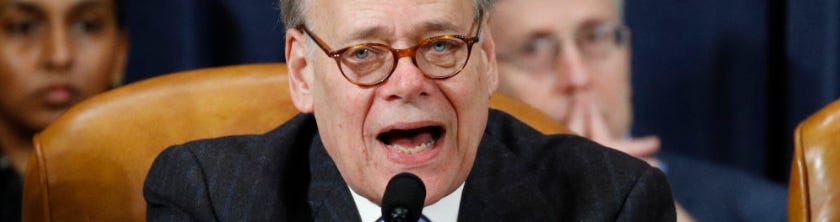
Representative Steve Cohen of Tennessee has had enough. He introduced six articles of impeachment of Chief Justice John Roberts. Good for him!

Scott Dworkin reported on his blog:

Rep. Steve Cohen

Rep. Steve Cohen has represented Memphis, Tennessee, for 19 years. Republicans cut his district into pieces, and he decided to retire—but not without a fight.

Cohen told The Dworkin Report in 2019: “[Trump’s] life has been one crime after another. One misdeed after another. One lie after another.” Now he’s applied that same standard to the man who put Trump above the law.

On May 21, Cohen introduced six articles of impeachment against Chief Justice John Roberts. Charges include allowing the Court to become a partisan weapon, placing the president above the law, endorsing a corrupt campaign finance system, and failing to recuse himself while his wife collected millions recruiting attorneys for law firms with cases before the Court.

Cohen was direct: “Under Chief Justice Roberts’ stewardship, [The Supreme Court] is now understood as biased: with decisions designed to benefit Republicans at the expense of representative government.”

They gerrymandered Cohen’s district to silence him. John Roberts now has six articles of impeachment to his name—an award no other Chief Justice has ever received in US history.

A group of activists in Colorado speaks out against standardized tests. Angela Engels’ article was printed in the Colorado Times Recorder.


A Message from Judy Solano, Chair, A4PEP (Advocates for Public Education Policy).

“It takes courage to speak out about the injustices in the world, especially when policy-makers funded by wealthy education reform organizations hold the power.  May we all be warriors in the battle for truth.”

COLORADO TIMES RECORDER

Test-Based Accountability Is Failing Colorado’s Children

by Angela Engel                                                       May 15, 2026

As the Colorado General Assembly wraps up the 2026 session, lawmakers once again failed to confront one of the most costly and disruptive features of public education: high-stakes standardized testing.

Key legislative proposals that would have addressed the burden of high-stakes testing were defeated again. SB26-068would have reduced CMAS standardized tests to the minimum extent possible, and HB26-1291 would have reduced teacher evaluations for non-probationary teachers from annually to every three years. Both had bipartisan sponsorship and were supported by teachers, parents, and community members, but opposed by billionaire-backed education reform lobbyists.

A memorial backed by the Advocates for Public Education Policy (A4PEP), urging Congress to return authority to locally elected school boards, as provided in the eww hearing.

These decisions deserve more than a procedural explanation.

The issue of high-stakes testing is neither marginal nor new. Since the passage of No Child Left Behind in 2002, policymakers have imposed lengthy and expensive criterion-referenced standardized tests on students, then incorrectly used that data to make high-stakes decisions about teacher pay and school closures. Because test scores are most closely correlated with income, policymakers have tolerated the practice of closing schools in low-income neighborhoods at the expense of our most vulnerable students.

A 2014 study showed that Colorado’s testing requirements cost up to $78 million annually in combined state and district expenditures. Adjusting for inflation, that would equal more than $100 million today. Approximately 450,000 students spend an average of 20 hours of classroom instruction each year on these assessments — more than 9 million hours diverted away from teaching and learning.

Meanwhile, the number of students identified as at-risk has increased by 118%, more than doubling since 2000. After more than two decades, the results of this approach are clear. Achievement gaps have not closed. Teacher attrition continues to rise. Families increasingly question a system that prioritizes testing over learning, with many choosing to opt out altogether.

This is not a policy in need of minor adjustment. It is an accountability structure that has failed to deliver on its core promises — and it deserves fundamental sreplacement. And yet, it remains firmly in place. Not because the evidence is unclear, but because the accountability system itself is protected.

Standardized testing is no longer just an educational tool. It is embedded in a network of contracts, compliance requirements, testing vendors, consulting firms, and political interests backed by well-funded lobbying efforts. There are real financial and political incentives to preserve it, regardless of outcomes.

Spending more than $100 million annually on a system that continues to produce the same disparities while costing students millions of hours of learning time reinforces a governance model that rewards compliance and discourages challenge.

This climate — where profits and political interests are prioritized before children — did not emerge on its own. It has been shaped over time by a campaign finance system that rewards candidates who support policies centered on test-based school accountability.

When you see something wrong, something inhumane, don’t just say something. Do something. It’s time policymakers stop protecting harmful practices and confront the consequences of policies that continue to waste taxpayer dollars, diminish learning opportunities, and drive many of our most talented and experienced teachers from the profession. After twenty-five years, the ramifications of inaction are impossible to ignore.

Public education should not revolve around protecting systems, contracts, corporate profits, or political interests. It should revolve around children. Colorado students deserve a well-rounded education that values critical thinking, creativity, and civic engagement over excessive testing and data collection. For too long, corporate education groups and privatizers have robbed students of a meaningful education and carefree childhood. This accountability model offers the illusion of control while costing Colorado a future of empowered, well-educated leaders.  

To view the planned Senate memorial, click here.  

Angela Engel is a mother, educator, and facilitator. Learn more on her website, www.angelaengel.com. Don Perl, Judy Solano, Mike DeGuire, and Manuel Solano contributed to this article.  https://coloradotimesrecorder.com/2026/05/test-based-accountability-is-failing-colorados-children/79032/

Judge Colleen McMahon of the Southern Districy of New York issued a ruling restoring $100 million in grants from the National Endowment for the Humanities that were canceled by Elon Musk’s DOGE team. The judge said the cancellations violated the First Amendment and the Fifth Amendment, and furthermore that DOGE lacked the statutory authority to act. Judge McMahon ordered the reinstatement of every grant to writers, scholars, and researchers. The DOGE censors did not actually review the grants but used ChatGPT to identify words that the Trump administration had banned, especially those associated with DEI (diversity, equity, and inclusion).

Perhaps the most gratifying aspect of the decision was the judge’s ruling that DOGE had no authority to cancel these grants. In fact, DOGE had no authority to fire thousands of civil servants or to terminate entire agencies, like USAID.

She wrote:

On the central ultra vires question, Judge McMahon was unequivocal: “It is not that DOGE misconstrued a statutory provision conferring authority on it; it is that Congress conferred no authority on DOGE at all with respect to the awarding, continuation, or termination of NEH grants.”  

The Authors Guild, one of the plaintiffs, reported on the decision;

May 7, 2026—A New York federal court in a 143-page decision today held for the Authors Guild plaintiffs on every count in its case on behalf of individual writers and scholars against DOGE and the NEH for DOGE’s April 2025 mass cancellation at the National Endowment for the Humanities. It ordered the reinstatement of every grant terminated, delivering a complete victory to the Authors Guild and more than 1,400 writers, scholars, and researchers whose awards were abruptly eliminated.  

Judge Colleen McMahon of the Southern District of New York granted summary judgment to the plaintiffs on all three of their claims, finding the terminations violated the First Amendment and the equal protection component of the Fifth Amendment and were carried out by DOGE without any statutory authority to act.  

The court issued a permanent injunction enjoining the administration from giving effect to the mass terminations and requiring the government to rescind every termination notice and restore all affected grants and certified the Authors Guild’s lawsuit as a class action covering all approximately 1,400 affected grantees. 

“Today’s ruling makes clear that no administration—regardless of its priorities—is free to defy the statutory purposes of federal agencies and that or to cancel grants based on viewpoint discrimination,” said Mary Rasenberger, CEO of the Authors Guild. “Not only did DOGE have no authority to cancel the grants, it used an AI chatbot to invent pretextual reasons to do it anyway. Writers and scholars had structured their lives around these awards—taking leaves of absence, giving up other income, making commitments—because the government had entered into a legally binding obligation. That obligation must be honored. We are gratified that justice was done, grateful to our amazing legal team at Fairmark Partners, and we will be watching closely to make sure every one of these grants is restored.”  

Background 

In early April 2025, DOGE officials terminated more than 1,400 NEH grants awarded to scholars, writers, research institutions, and other humanities organizations totaling over $100 million in congressionally appropriated funds—the largest mass cancellation of previously awarded grants in the agency’s nearly 60-year history—with no individualized review, no notice, and no opportunity to appeal.  

Discovery revealed that a DOGE official had used ChatGPT to generate “DEI rationales” for termination, submitting thousands of grant descriptions to the AI tool with a single standardized prompt, without defining the term or understanding how the tool interpreted it. They didn’t take any steps to ensure that the system wouldn’t discriminate on the basis of race, sex, or other protected categories. DOGE also searched for grants containing keywords like “gay,” “BIPOC” (Black, Indigenous, People of Color), “indigenous,” “tribal,” “melting pot,” “equality,” and similar terms. It did not search for analogous terms like “white,” “heterosexual,” or “Caucasian.” 

The results were, in the court’s account, irrational: Studies of ancient Jewish texts, the persecution of Uyghurs in China, the plastics industry, and American women in Paris in the early 1900s were all flagged as DEI. The NEH’s own acting chair told DOGE many of the rationales “mischaracterized” the grants but was overruled. His own email to DOGE acknowledged: “Either way, as you’ve made clear, it’s your decision on whether to discontinue funding any of the projects.”

Two Consolidated Cases

The result of this landmark ruling was actually two separate lawsuits that were quickly consolidated into one. On May 1, 2025, the Modern Language Association, the American Council of Learned Societies, and the American Historical Association filed the initial suit, ACLS v. McDonald, challenging DOGE’s mass terminations. Eleven days later, the Authors Guild filed its own suit, The Authors Guild v. NEH, in the Southern District of New York — structured as a class action on behalf of all approximately 1,400 affected grantees. On May 14, Judge Colleen McMahon consolidated the two cases, noting they were “substantially identical,” and the litigation proceeded jointly from there.

Because the Authors Guild’s suit was structured as a class action, Judge McMahon’s order applies not just to named plaintiffs but to all 1,400-plus writers, scholars, and researchers whose awards were canceled, making yesterday’s ruling a victory for everyone DOGE targeted. 

Ruling 

On the central ultra vires question, Judge McMahon was unequivocal: “It is not that DOGE misconstrued a statutory provision conferring authority on it; it is that Congress conferred no authority on DOGE at all with respect to the awarding, continuation, or termination of NEH grants.”  

On the ChatGPT-driven process, she wrote that it “would hardly be surprising if ChatGPT inferred, from DOGE’s repeated requests, that Fox and Cavanaugh were looking for reasons why grants could be characterized as DEI—and therefore terminable—and supplied ‘rationales’ simply in order to satisfy the user’s perceived demand. The utter lack of reasoning behind so many of its ‘rationales’ certainly suggests as much.” 

“We are extremely pleased with Judge McMahon’s ruling reinstating the more than $100 million in NEH grants that were cancelled by DOGE last April.,” said Jamie Crooks, Managing Partner of Fairmark Partners, LLP  “While we are still evaluating her detailed, 143-page opinion, the bottom line is clear: Judge McMahon agreed with the Authors Guild and the other plaintiffs that these ‘DEI’-based cancellations violated the First Amendment and Equal Protection, and that DOGE did not have the authority to order these grants terminated.  The Court’s order that the grants be reinstated will allow our clients and the hundreds of other scholars and institutions in the class to continue performing their important scholarly work, and it’s also a vindication for the rule of law and basic principles of constitutional law.”  

NEH award recipient Bill Goldstein said, “I am—and all of the plaintiffs will be— forever grateful for your brilliant, tireless, and effective work on our behalf. And on behalf of the First Amendment and what remains and must endure of the rule of law. The stakes are that high, and you made our rights and that right clear. Congratulations on your victory, and thank you for ours.” 

Given that the administration has ignored other judicial orders, including the preliminary injunction in this case, we cannot say whether NEH will in fact reinstate the grants and pay out the money owed under those grants. The court emphasized that its decision addresses only “the legality of the Government’s decision to terminate” the grants and that it is requiring the government to “rescind the termination notices,” but clarified that it does not “require[] the immediate payment of grant funds” or “adjudicate[] any contractual entitlement to money.” The reason for that it that claims seeking payment of money owed by the federal government must be brought in a separate court—the Court of Federal Claims. Here, Judge McMahon noted that securing payment of the grant funds “might well require a separate suit in the Court of Federal Claims”—though she did not outline a specific process. For now, we are reviewing the decision with our attorneys to determine next steps, including any possible action in the Court of Federal Claims. As always, our goal is to ensure that grantees receive the payments they are owed as promptly as possible.