Archives for category: Extremism

Thomas Ultican, retired teacher of advanced mathematics and physics in California, has been keeping track of the privatization movement. In this post, he criticizes the Republican Party for its war on public schools. There was a time when Republicans supported their community schools. They provided strong support for bond issues and were active on local school boards. Today, however, Republicans as a party have led privatization efforts, knowing that it is intended to defund their public schools. None of the promises of privatization have panned out. Surely they know that they are destroying not only their own community’s public schools but a foundation stone in our democracy.

Privatization promotes segregation. Public schools bring people from different backgrounds together. As our society grows more polarized, we need public schools to unite us and build community.

Ultican writes:

This year, state legislators have proposed in excess of 110 laws pertaining to public education. Of those laws 85 were centered on privatizing K-12 schools. Republican lawmakers sponsored 83 of the pro-privatization laws. Which begs the question, has the Grand Old Party become the Grifting Oligarchs Party? When did they become radicals out to upend the foundation of American greatness?

The conservative party has a long history of being anti-labor and have always been a hard sell when it came to social spending. However, they historically have supported public education and especially their local schools. It seems the conservative and careful GOP is gone and been replaced by a wild bunch. It is stupefying to see them propose radical ideas like using public money to fund education savings accounts (ESA) with little oversight. Parents are allowed to use ESA funds for private schools (including religious schools), for homeschool expenses or educational experiences like horseback riding lessons.

A review of all the 2025 state education legal proposals was used to create the following table.

In this table, ESA indicates tax credit funded voucher programs. There have been 40 bills introduced to create ESA programs plus another 20 bills designed to expand existing ESA programs. Most of 2025’s proposed laws are in progress but the governors of Texas, Tennessee, Idaho and Wyoming have signed and ratified new ESA style laws. In addition, governors in Indiana, South Carolina and New Hampshire signed laws expanding ESA vouchers in their states.

None of the 16 proposals to protect public education or 3 laws to repeal an existing ESA program were signed by a governor or passed by a legislature.

Fighting in the Courts

June 13th, the Wyoming Education Association (WEA) and nine parents filed a lawsuit challenging the Steamboat Legacy Scholarship Act, Wyoming’s new voucher program. The suit charged:

“… the program violates the Wyoming Constitution in two key ways. One for directing public dollars to private enterprises, which the lawsuit says is clearly prohibited. The second for violating the constitution’s mandate that Wyoming provide ‘a complete and uniform system of education.”’

On July 15, District Court Judge Peter Froelicher granted a preliminary injunctionagainst the state’s universal voucher program. He wrote, “The Court finds and concludes Plaintiffs are, therefore, likely to succeed on the merits of their claims that the Act fails when strict scrutiny is applied.” The injunction will remain in effect until the “Plaintiffs’ claims have been fully litigated and decided by this Court.”

Laramie County Court House

Last year, The Utah Education Association sued the state, arguing that the Utah Fits All Scholarship Program violated the constitution. April 21st, District Court Judge Laura Scott ruled that Utah’s $100-million dollar voucher program is unconstitutional. At the end of June, the Utah Supreme Court agreed to hear an appeal of Scott’s ruling. However, the decision seems well founded.

The Montana Legislature, in 2023, established a statewide Education Savings Account (ESA) voucher program. It allows families of students with disabilities to use public funds deposited into personal bank accounts for private educational expenses. In April this year, Montana Quality Education Coalition and Disability Rights Montana brought suit to overturn this program. In July, the Montana Federation of Public Employees and the organization Public Funds Public Schools joined the plaintiffs in the suit. The legal action awaits its day in court.

At the end of June, the Missouri State Teachers Association sued to end the enhanced MOScholars program which began in 2021 funded by a tax credit scheme. This year in order to expand the program; the states legislature added $51-million in tax payer dollars to the scheme. The teachers’ suit claims this is unconstitutional and calls for the $51-million to be eliminated.

Milton Friedman’s EdChoice Legal Advocates joined the state in defending the MOScholars program. Their July 30thmessage said, “On behalf of Missouri families, EdChoice Legal Advocates filed a motion to intervene as defendants in the lawsuit brought by the Missouri National Education Association (MNEA) challenging the state’s expanded Empowerment Scholarship Accounts Program, known as MOScholars.” It is unlikely EdChoice Legal Advocates are representing the wishes of most Missouri families.

In South Carolina, the state Supreme Court ruled in 2024 that its Education Trust Fund Scholarship Program was unconstitutional. The lawsuit was instituted by the state teachers union, parents and the NAACP. The program resumed this year after lawmakers revised it to funnel money from the lottery system instead of the general fund. 

The South Carolina effort has been twice ruled unconstitutional for violating prohibitions against using public funds for the direct benefit of private education. Legislators are proposing funneling the money through a fund that then goes to a trustee and then to parents, who then use it for private schools. 

 Sherry East, president of the South Carolina Education Association stated:

“We just don’t agree, and we think it’s unconstitutional.”

“We’ve already been to court twice. The Supreme Court has ruled twice that it is unconstitutional. So, we don’t understand how they’re trying to do a loophole or a workaround. You know, they’re trying to work around the Constitution, and it’s just a problem.” 

The South Carolina fight seems destined to return to the courts but they have vouchers for now.

Last year in Anchorage, Alaska, Superior Court Judge Adolf Zeman concluded that there was no workable way to construe the state statues in a way that does not violate constitutional spending rules. Therefore, the relevant laws “must be stuck down in their entirety.” This was the result of a January 23, 2023 law suit alleging that correspondence program allotments were “being used to reimburse parents for thousands of dollars in private educational institution services using public funds thereby indirectly funding private education in violation … of the Alaska Constitution.” Alaska has many homeschool students in the correspondence program.

Plaintiff’s attorney Scott Kendall believes the changes will not disrupt correspondence programs. He claims:

“What is prevented here is this purchasing from outside vendors that have essentially contorted the correspondence school program into a shadow school voucher program. So that shadow school voucher program that was in violation of the Constitution, as of today, with the stroke of a pen, is dead.”

The Big Problem

GOP legislators are facing a difficult problem with state constitutions prohibiting sending public dollars to private schools. The straight forward solution would be to ask the public to ratify a constitutional amendment. However, voucher programs have never won a popular vote so getting a constitutional change to make vouchers easier to institute is not likely.

Their solutions are Rube Goldberg type laws that create 100% tax credits for contributing to a scholarship fund. A corporation or individual can contribute to these funds and reduce their tax burden by an equal amount. Legislators must pretend that since the state never got the tax dollars it is constitutional. Lawyers who practice bending the law might agree but common sense tells us this is nonsense.

The big problem for the anti-public school Republicans is voucher schools are not popular. They have never once won a public referendum.
This is baffling. The Boston Globe reported yesterday that the Trump administration was in the process of “debarment” of Harvard University, meaning that the nation’s greatest university would be cut off from all future federal funding. The Trump team accuses Harvard of anti-Semitism. The president of Harvard University is an observant Jew. The findings of anti-Semitism are based on a report that Harvard officials conducted.

This is nuts. With federal funding, Harvard scientists have produced major breakthroughs in medicine, engineering, and science. To break Harvard, as the administration wants to do, would cripple American innovation.

The Boston Globe reported:

The Department of Health and Human Services’ Office of Civil Rights on Monday formally recommended barring Harvard University from receiving federal funding, three months after it accused the university of violating civil rights laws by failing to protect Jewish and Israeli students on campus.

In a news release, the office said it would refer Harvard to the office that is responsible for “suspension and debarment decisions” and that it notified Harvard of its right to an administrative hearing. The university has 20 days to notify the office of its decision.

The 57-page notice relied heavily upon Harvard’s own report on antisemitism and anti-Israeli bias that it released earlier this year, which followed high-profile protests at Harvard and other campuses against the war in Gaza in 2023 and 2024.

Yesterday afternoon, The New York Times reported the animosity between Harvard and the Trump administration:

The Trump administration’s move this week to choke off Harvard University’s access to future federal funding came after a scathing letter from the college accusing the administration of distorting evidence to show that the school violated civil rights laws by allowing antisemitism to persist on campus.

The brewing feud represents an escalation of tensions between Harvard and the administration, which just weeks ago seemed on the verge of agreeing on a deal to keep federal funds flowing to the university.

In a strongly worded, 163-page letter with attachments on Sept. 19, which has not been previously reported, Harvard assailed the government’s findings. The university accused investigators at the Health and Human Services Department of relying on “inaccurate and incomplete facts,” failing to meet a single legal requirement to prove discrimination and drawing sweeping conclusions from a survey of one-half of 1 percent of the student body.

Harvard painted a picture of a chaotic Trump administration rushing to leverage federal power against the university. For instance, it noted that the health department had chided the college for failing to produce certain records. But Harvard’s documents showed that the records in question had been provided in response to a request from the Education Department. Harvard said the health department never asked for those records.

Harvard said the health department’s decision to refer its findings to the Justice Department was “based on a fabricated and distorted interpretation of the record.”

The stark language was a departure from months of mostly measured tones from Harvard as the university has resisted the administration’s pressure campaign to impose President Trump’s political agenda on the nation’s elite colleges.

Mr. Trump and his administration have sought to exert control over who universities can hire, which students they should admit and what subjects should be taught by leveraging huge sums of federal research money. Those moves, which Harvard has maintained violate the college’s First Amendment rights and infringe on the nation’s long-held ideals of academic freedom, are aimed at shifting the ideological tilt of the higher education system, which the administration sees as hostile to conservatives and intent on perpetuating liberalism.

The administration’s reply to Harvard’s letter came on Monday, when the health department initiated a process to cut off Harvard from future federal research funding, which has increasingly become the lifeblood for the nation’s largest private and public colleges. In 2022, the health department accounted for nearly 81 percentof $41.6 billion in federal funding for research into agricultural science, environmental science, public health and other life sciences, according to government records.

Then, last night The New York Times reported that Trump said he was close to striking a deal with Harvard. The deal would extort $500 million from the university and an agreement to offer programs in the trades.

President Trump said Tuesday that his administration was close to reaching a multimillion-dollar agreement with Harvard University, which would end a monthslong standoff that had come to symbolize the resistance to the White House’s efforts to reshape higher education.

Harvard, which would become the latest university to strike a deal with the Trump administration, has been seeking an end to a thicket of investigations that the government opened as part of its wide-ranging efforts to bring the university in line with Mr. Trump’s agenda.

“We are in the process of getting very close,” President Trump said in an appearance from the Oval Office. He added that the details were being finalized and said, “They would be paying about $500 million.”

Mr. Trump said that the education secretary, Linda McMahon, was “finishing up the final details.” He added that the plan was for Harvard to operate trade schools.

“They are going be teaching people to do A.I. and a lot of other things — engines, lots of things,” he said. “We need people in trade schools.”

Pete Hegseth, the Secretary of Defense, summoned hundreds of generals and admirals to an in-person meeting to lecture them. Hegseth spoke to them condescendingly to remind them that he is Secretary of War, not Secretary of Defense (which is not true because only Congress can rename a Department). He spoke about raising standards for height and weight and said he didn’t want “fat generals” in command (does that crack about weight apply to the Commander-in-Chief?). He wants regular tests of physical strength for all members of the service set to male standards and if women can’t meet them, tough.

Hegseth ignored the reality that wars today are not won by brute strength but by intelligence, wisdom, experience, and training. Warriors are flying incredibly complex airplanes that require technological skills and mental sharpness. Battles are fought by soldiers operating computers, shooting down drones and missiles, and guiding weapons with precision to their target. The hand-to-hand combat that Hegseth imagines is obsolete.

The generals and admirals must have been seething to be talked down to by Hegseth, whose highest rank in the Army National Guard was major.

He lavished praise on the Trump policy of banning diversity, inclusion, and equity, ignoring the fact that the military is a prime exemplar of the success of DEI. Just recently, he abolished a program that has recruited women into the military with great success for decades.

When he finished his speech, he waited for applause but the audience didn’t put their hands together.

Trump gave a frightening speech, saying that the greatest threat was “the enemy within.” Shades of Joe McCarthy! Trump, of course, never wore his nation’s uniform, nor have his sons. He managed to get five draft deferments based on a letter from a podiatrist who rented space in one of his father’s shopping malls. In other words, he is a draft dodger.

The military is supposed to protect our nation from hostile foreign enemies but Trump believes that the worst enemies today, the worst threats to the nation, are what he calls “radical left lunatics.” He told the military brass that America’s military should use its big cities as “training grounds” for the troops.

That sounds like martial law to me.

No other President has gone before the leaders of the military to ridicule his predecessor, to rail against his political foes, and to praise himself lavishly.

What’s frightening is that Trump seems eager to use the troops to put down domestic protests. If he can manufacture domestic violence, he has telegraphed that he will not hesitate to send in the military with orders to use “full force,” that is, to gun down civilians. Shoot to kill.

Many viewers must have thought of the brave farewell speech of General Mark Milley, who served as chairman of the Joint Chiefs of Staff in Trump’s first term. A week before he gave this speech, Trump said he should be put to death.

Milley said:

“We don’t take an oath to a king, or a queen, or to a tyrant or dictator, and we don’t take an oath to a wannabe dictator. We don’t take an oath to an individual. We take an oath to the Constitution, and we take an oath to the idea that is America, and we’re willing to die to protect it.”

“Every soldier, sailor, airman, Marine, guardian and Coast Guardsman, each of us commits our very life to protect and defend that document, regardless of personal price. And we are not easily intimidated.”

A warning to people in big cities. Protest peacefully. Wave signs. Sing songs. Chant. Don’t bring weapons to protests. Do not disrespect the troops. Do not provoke them into using their weapons.

Trump wants you to fight with the troops. Don’t take the bait. He wants you to throw rocks and draw fire from them. He wants a Reichstag fire to use as a pretext to suspend elections.

Don’t play into his small hands.

There is no end to the Trump administration’s assault on academic freedom. Particularly poisonous is its withdrawal of billions of dollars for scientific research to punish universities that defy his policies. Trump is determined to obliterate any sign of “diversity, equity, and inclusion” or any tolerance of anti-Semitism.

Speaking for myself, I wholeheartedly support diversity, equity, and inclusion. Speaking as a Jew, I resent Trump’s hypocritical, duplicitous use of anti-Semitism, an issue he has never cared about and that he cynically exploits.

Until now, research grants were awarded based on scientific merit and peer review. In the proposed changes, the universities that adhere to Trump policies and values would have a competitive advantage.

The Trump cabal is prepared to withhold funding from the nation’s top researchers if they are suspected of including nonwhite, non-male researchers in order to increase D or E or I. They assume that “merit” is found only in white males.

They are willing to deny research grants to Harvard and UCLA and give them to No-Name State Agricultural University, just to make a point.

They are willing to sacrifice research into pediatric cancer, heart disease, Alzheimer’s and other afflictions just because they include researchers who are not white men.

What a disgrace this administration is.

Laura Meckler and Susan Svrluga of The Washington Post wrote:

The White House is developing a plan that could change how universities are awarded research grants, giving a competitive advantage to schools that pledge to adhere to the values and policies of the Trump administration on admissions, hiring and other matters.

The new system, described by two White House officials, would represent a shift away from the unprecedented wave of investigations and punishments being delivered to individual schools and toward an effort to bring large swaths of colleges into compliance with Trump priorities all at once.

Universities could be asked to affirm that admissions and hiring decisions are based on merit rather than racial or ethnic background or other factors, that specific factors are taken into account when considering foreign student applications, and that college costs are not out of line with the value students receive.

“Now it’s time to effect change nationwide, not on a one-off basis,” said a senior White House official, who like the other official described the plan on the condition of anonymity because it is still being developed.

Under the current system, the federal government’s vast research funding operation awards billions of dollars’ worth of grants based on peer reviews and scientific merit.

The administration says it is working to enforce civil rights laws, which it contends many universities have violated by embracing diversity, equity and inclusion programs or failing to adequately protect Jewish students or staff from antisemitism. But the effort is almost certain to add to criticism from outside experts who say the administration is already overstepping its authority to try to impose its values on higher education.

Ted Mitchell, president of the American Council on Education, said the outlines of the proposal amounted to an “assault … on institutional autonomy, on ideological diversity, on freedom of expression and academic freedom.”

“Suddenly, to get a grant, you need to not demonstrate merit, but ideological fealty to a particular set of political viewpoints. That’s not merit,” he said. “I can’t imagine a university in America that would be supportive of this…”

Since President Donald Trump returned to office in January, his administration has launched investigations of and pulled research funding from universities including Columbia, Harvard and UCLA, and then worked to extract concessions in exchange for restoring the money. Officials say the punishments are an effort to enforce federal laws that bar funding for schools that discriminate on the basis of sex, race or national origin.

The White House has faced setbacks in court — including a big loss this month in its high-profile fight with Harvard and another setback this week in California — and has not reached as many settlement agreements as Trump officials had hoped for.
The senior White House official described the new system as an opportunity for schools to show they are in compliance, as interpreted by the administration. Those that do so, the official said, would be rewarded with a “competitive advantage” in applying for federal grants…

Erwin Chemerinsky, dean of the University of California at Berkeley’s law school, said “no one will object” if the White House simply requires universities to pledge compliance with existing law.
But Chemerinsky, one of the attorneys representing UC researchers in a lawsuit challenging terminated federal research funding, also said the administration’s view of what the law requires could be at odds with other interpretations: “It all depends on what the conditions are, and whether those conditions are constitutional.”
Chemerinsky said it would be a First Amendment violation to put schools at a disadvantage in competing for funding if they profess a belief in diversity, for example, because government is not allowed to discriminate based on viewpoint. He said it “would be very troubling” if the White House proposal deviates from the standards that have been used in awarding grants based on the quality and importance of the science, peer review and merit, and uses ideology as the judgment standard instead.

A reader who uses the name Quickwrit parses the Constitutionnand finds that Trump is doing today exactly what King George did to the colonists.

Quickwrit writes:

WHAT TRUMP IS DOING TODAY is the very same thing that our Declaration of Independence lists as the violations of liberty that triggered our Declaration of Independence. Take a look:

The King used armed forces to control American cities and towns, without first asking permission from the legislatures; quoting the Declaration, it says: “He has kept among us, in times of peace, Standing Armies without the Consent of our legislatures.” Just like King Trump sending armed National Guard units into our cities today.

The King replaced local police with his armed forces. The Declaration says: “He has affected to render the Military independent of and superior to the Civil Power.

The King’s armed forces were protected from killing civilians: “For protecting them, by a mock Trial from punishment for any Murders which they should commit on the Inhabitants of these States.” People die today in ICE custody, and nothing happens.

The King ignores civil courts: “He has obstructed the Administration of Justice by refusing his Assent to Laws for establishing Judiciary Powers.”

“He has made Judges dependent on his Will alone for the tenure of their offices.”

“He has erected a multitude of New Offices, and sent hither swarms of Officers to harass our people.”

“He has forbidden his Governors to pass Laws of immediate and pressing importance, unless suspended in their operation till his Assent should be obtained.” Today, not only do governors of Red States do nothing without Trump’s approval, neither does Congress.

The Declaration also says that we also declare our independence from the King for his:

“cutting off our Trade with all parts of the world’ (just like Trump’s tariffs);

“depriving us in many cases of the benefit of Trial by Jury” and “transporting us beyond Seas to be tried for pretended offences” (just like Trump deporting people without trial to be imprisoned in foreign nations).

The Declaration says Americans are breaking away because the King has opposed immigration that is vital to America’s economic growth, by “obstructing the Laws for Naturalization of Foreigners; refusing to pass others to encourage their migrations hither.” Already in 1740, laws had been passed to grant “natural born” citizenship status to immigrants who lived there for seven consecutive years.

The King has also been “redistricting” Americans out of their right to representation: “He has refused to pass Laws for the accommodation of large districts of people, unless those people would relinquish the right of Representation in the Legislature, a right inestimable to them and formidable to tyrants only.” Just like the redistricting going on today.

Americans today truly need to read the history of our Revolution and what went into and is actually in our Declaration of Independence and our Constitution. Read the ACTUAL WRITINGS of our Founding Fathers, not just listen to or read the “analyses” of political talking heads on today’s TV and social media.

That kind of reading takes time, and too few Americans today are willing to spend the time.

Trump announced on Saturday that he intends to send the military to Portland to restore safety and to protect ICE agents.

The Mayor of Portland says the city is safe. He doesn’t want troops. The Governor of Oregon agrees. But Trump has a fixation with that city. He hates Portland because there was a protest and riot there against him a few days after Trump won the election of 2016. The riot went on for days; stores were vandalized, windows smashed. Over 100 people were arrested. Almost nine years later, Trump still wants to punish Portland, and no one can stop him.

The Washington Post made clear that Trump has not yet decided whether to mobilize the Oregon National Guard or to send in active-duty military personnel.

President Donald Trump said Saturday that he will send troops to Portland, Oregon, and to immigration detention facilities around the country, authorizing “Full Force, if necessary” and escalating a campaign to use the U.S. military against Americans that has little modern precedent.

Trump said in a social media post that he was directing Defense Secretary Pete Hegseth to provide troops to what he dubbed “War ravaged Portland” as well as “any of our ICE Facilities under siege from attack by Antifa, and other domestic terrorists.”

Saturday’s announcement appeared likely to set up a first test for a White House effort targeting left-wing protest groups. It came just days after Trump signed an executive order directing the nation’s full counterterrorism apparatus against domestic political opponents despite long precedent restricting such a move.

Right-wing politicians have long criticized Portland for the way it has handled racial-justice protests as well as its homeless population, tolerating encampments in the central part of the city. But Trump will again encounter the dynamic he faced when he deployed the National Guard in Los Angeles — a military activation in a state run by a Democratic governor who objects to the decision and could have grounds to fight it in court.

Trump’s announcement, which was posted on Truth Social while the president was at his private golf club in Northern Virginia, appeared to have come as a surprise to the Pentagon, with several officials saying they know little more than what the president included in his post.


One official familiar with the discussion Saturday said defense officials were seeking clarity on what Trump desires. The official, like others in this article, spoke on the condition of anonymity to speak frankly about private planning.
The Pentagon released a statement a few hours later, saying defense officials “stand ready to mobilize U.S. military personnel in support of DHS operations in Portland at the President’s direction.”

The statement, by spokesman Sean Parnell, said the “Department will provide information and updates as they become available.”

Another person familiar with ongoing discussions said midday Saturday that some Pentagon officials had discussed troops being sent to Portland at some point but were scrambling to make sense of what’s next.

“You know what I know,” that person said, alluding to the president’s announcement on social media.

Among the uncertainties, it was not immediately clear whether Trump plans to deploy active-duty troops or National Guard members, or both, to Portland. As is the case in similar discussions with other cities, there are legal limits to how he can do so.

There was also no clarity about the timing of any potential deployment.

Asked for more details about the potential deployment, the White House did not answer questions but responded with a list of incidents that had recently taken place outside Portland’s ICE field office, including federal charges of arson, assaulting a police officer and resisting arrest.

“Despite the crime and neighborhood pushback caused by the months-long protest, Oregon Democrats still refuse to do anything about it,” the White House said in a statement.

Protesters have been demonstrating for weeks at an ICE processing center in the city in objection to Trump’s immigration enforcement efforts. The Department of Homeland Security on Friday said that “rioters in Portland, Oregon have repeatedly attacked and laid siege” to the facility.

Protests outside the facility reignited this June, with the Portland Police Bureau declaring a riot after demonstrators blocked the driveway and threw objects like rocks and bricks at the facility and federal agents, according to local news media accounts and social media videos. Portland police arrested more than 20 people connected to the protests after multiple federal officers were injured.

But on Saturday, the streets outside the Portland ICE facility remained largely empty in the hours after Trump made his announcement. Two homeless men slept on the sidewalk. A handful of passersby took photographs of the building, and a few talked to each other about how their experiences felt nothing like the “war-ravaged” city described….

Oregon Gov. Tina Kotek (D) was one of 19 Democratic governors who signed a letter to Trump last month opposing his deployment of the National Guard over governors’ objections.
At a Saturday afternoon news conference, Kotek said she learned of Trump’s plan to deploy troops from social media and spoke to the president afterward.

“Portland’s doing just fine, and I made that very clear to the president this morning,” Kotek said. “Our city is a far cry from the war-ravaged community that he has posted about on social media, and I conveyed that directly to him.”
Kotek said she doesn’t believe Trump has the authority to deploy federal troops on state soil: “I’m coordinating with Attorney General Dan Rayfield to see if any response is necessary, and we will be prepared to respond if we have to.”

Both local and state-elected Oregon officials rejected Trump’s plan.

“The number of necessary troops is zero, in Portland and any other American city. Our nation has a long memory for acts of oppression, and the president will not find lawlessness or violence here unless he plans to perpetrate it,” Portland Mayor Keith Wilson (D) said in a statement. Wilson was elected last year on a platform of moving homeless Portland residents into a temporary shelter.

Wilson said at a news conference Friday evening that the city had seen a “sudden influx” of federal agents in recent hours, including armored vehicles, which Wilson called a “big show.” Wilson was flanked by other city and state officials, who said it wasn’t clear which agency the federal authorities were from but urged the public stay calm and refuse to “take the bait.”

U.S. Sen. Jeff Merkley (D-Oregon), who has criticized Trump’s domestic military deployments, said Saturday on X that the president “wants to stoke fear and chaos and trigger violent interactions and riots to justify expanded authoritarian control. Let’s not take the bait! Portland is peaceful and strong and we will take care of each other.”

After raising a national profile by taking MAGA ideas to absurd extremes, Ryan Walters resigned yesterday, going out in a blaze of ignominious display.

John Thompson explains:

For months, I’ve been hearing predictions that State Superintenent Ryan Walters would not serve out his term. Originally, the rumors had to do with the questionable legality of his actions. Recently they have focussed on the Republicans, who once supporteded him,  but who are now fed up with his antics.

Since I submitted this piece, yesterday, Walters said “he is ‘excited’ to step down and accept his new position. He said his goal is to ‘destroy the teachers unions.’”

Walters announced he will become the CEO of the Teacher Freedom Alliance (which says it has 2,748 teachers enrolled.) He proclaimed:
“For decades, union bosses have poisoned our schools with politics and propaganda while abandoning parents, students, and good teachers. That ends today. We’re going to expose them, fight them, and take back our classrooms,” said Walters in a press release. “At the Teacher Freedom Alliance, we’re giving educators real freedom, freedom from the liberal, woke agenda that has corrupted public education. We will arm teachers with the tools, support, and freedom they need, without forcing them to give up their values. This is a battle for the future of our kids, and we will not lose.”

Below is background information on how Walters got to this point.

Introducing her first podcast on Oklahoma State Superintendent Ryan Walters, the Atlantic’s Hannah Rosin notes the long history of public schools being attacked for cultural and political reasons. Then, she recalls:

What’s been happening to American public schools lately is different: more coordinated, more creative, and blanketing the nation. Pressure on what kids learn and read is coming from national parents’ movements, the White House, the Supreme Court.

Rosin further explains that Ryan Walters “has pushed the line further than most.” 

Walters recently announced an ideology test for new teachers moving to Oklahoma from “places like California and New York.” And, although the Oklahoma Supreme Court has issued a temporary stay on Walters’ standards, he’s “tried to overhaul the curriculum, adding dozens of references to Christianity and the Bible and making students ‘identify discrepancies in 2020 elections results.’”

The first of two podcasts review how Walters has “already succeeded in helping create a new template for what public schools can be.” Part two will go even deeper into how “Walters and a larger conservative movement seem to be trying to redefine public schools as only for an approved type.” As he said, “If you’re going to come into our state … don’t come in with these blue-state values.”

Rosin starts with Walters’ “Office of Religious Liberty and Patriotism,” and his claim, “For too long in this country, we’ve seen the radical left attack individuals’ religious liberty in our schools. We will not tolerate that in Oklahoma.” He said this in a video sent to school administrators who were supposed to play it for every student and every parent.

This mandate, however, is the opposite of his approach when he was an award-winning “woke” middle school teacher. Rosin interviewed two of Walters students, Shane and Starla, about his “parodies,” that were called, “little roasts.”

Shane, a male conservative, compared Walters’ “little roasts,” such as “Teardrops on My Scantron,” to those of Jimmy Kimmel.  

Starla, a lesbian. said of her teacher, “He was woke! (Laughs.) He was a woke teacher.” And she praised his teaching about the civil rights movement.

Rosin reported that today’s Ryan Walters is “unrecognizable” in comparison to the teacher they knew.  And, “Shane compared it to how you’d feel about your dad if he remarried a woman you didn’t like.”

In 2022 , when running for State Superintendent, pornography was Walters’ issue. He strongly supported HB 1775, which was a de facto ban on Critical Race Theory. It forbid teaching things like, “an individual, by virtue of his or her race or sex, is inherently racist, sexist or oppressive, whether consciously or unconsciously.” 

Walters’ top target was a high school teacher, Summer Boismier,  who, in response, covered her bookshelves with butcher paper. But she also posted a QR code for a Brooklyn library, which had books that Walters said were pornography.  Boismier resigned, but Walters successfully asked the Oklahoma State Board of Education to revoke her teaching certificate. He said, “There is no place for a teacher with a liberal political agenda in the classroom. Ms. Boismier’s providing access to banned and pornographic material to students is unacceptable and we must ensure she doesn’t go to another district and do the same thing.”

After being labeled a pedophile, Boismier started to get serious threats. Then the Libs of TikTok started a campaign against alleged gay teachers who were supposedly “groomers,” prompting bomb threats.

Then, as Rosin explained, “state Democrats called for an impeachment probe, and Walters leaned in harder.” For instance, Walters ramped up his campaign against teachers unions who he called a “terrorist organization.”

Walters also claimed that a “civil war” was being fought in our schools.

Rosin reported on how Walters gained a lot of attention “when he said teachers could cover the 1921 Tulsa Race Massacre, where white Tulsans slaughtered hundreds of Black people, but they should not, quote, ‘say that the skin color determined it.”” 

Then, “Walters accused the media of twisting his words. He said that “kids should never be made to feel bad or told they are inferior based on the color of their skin.”

Trump responded on Truth Social, “Great job by Oklahoma State Superintendent Ryan Walters on FoxNews [sic] last night. Strong, decisive, and knows his ‘stuff.’” And, “I LOVE OKLAHOMA!”

There was pushback when it was learned that “one of the few Bibles that met Walters’ criteria is the “God Bless the USA Bible.” It was “endorsed by Lee Greenwood and President Trump. It sells for $59.99.”

As the first part of the podcast came to an end, it reviewed Walters’ recent setbacks. 

The U.S. Supreme Court  stopped Oklahoma’s plan for  the nation’s first publicly funded religious charter school. The Oklahoma Supreme Court has paused the Bible plan. And the special test by Prager U. for teachers from California, New York, and other “woke” states, faces legal challenges.

And Walters was lambasted after sexually explicit images of naked women were seen on a screen inside his office.

Part two will give Walters a chance to tell his side of the story. Rosin previews his response by quoting him: “Yeah, they’re outrageous liars.”

John Merrow was the education correspondent for the PBS Newshour for many years. He writes here about the insane insults hurled at our nation’s teachers by MAGA.

Merrow writes:

The US has nearly 3.6 million K-12 teachers, and another 1.5 million college teachers. One-third of 5.1 million is 1.7 million. Who knew that we have 1,700,000 terrorists in our classrooms!

I certainly had no idea things were that bad, and I’m kicking myself for not knowing. After all, I spent more than 67 years in American classrooms, as a student, a teacher, a parent, and a reporter. I must have interviewed and maybe even socialized with thousands of these terrorists, and I didn’t have a clue.

My 4th grade teacher yelled a lot and banged desks (and some ears too), so I supposed she “terrorized” us, but I don’t think that’s what the accuser had in mind.

I can think of one other possible example of ‘terrorism’ in the classroom: My 10th grade English teacher, Mr. McKinley, would deliberately make mistakes when he wrote stuff on the blackboard and then erupt in (faux) fury if we failed to catch his flubs. Somehow, I don’t think that’s what the accuser had in mind.

Are you questioning the accuracy of the accusation? OK, it came from President Donald Trump’s buddy Steve Bannon, who opened his mouth while in Arizona to pay tribute to Charlie Kirk, the assassinated leader of Turning Point. The podcast host was saying to Bannon that Kirk’s ideas about marrying early and having lots of children were actually not popular with young people, which prompted Bannon to blame teachers for brain-washing their students. Here’s what he said:

“…..those kids — look, from kindergarten all the way up, they are essentially, you know, a third of the teachers are terrorists that are trying to form them.”

Predictably, the right-wing podcaster didn’t challenge Bannon’s wild accusation or even ask him what he meant by ‘terrorist,’ so I’m going to go out on a limb and suggest that Bannon meant that teachers were teaching values that Bannon disapproves of, like tolerance and cooperation. I have seen lots of teachers work hard to inculcate such values, and, if that’s ‘terrorism,’ I approve.

Mocking Bannon is a woefully insufficient response, however, because his blatant teacher-bashing is part of the right wing’s persistent, harsh, and (unfortunately) often successful campaign to bring down public education.

And Bannon’s not even a field general in this war. He’s clearly outranked by Oklahoma’s State Superintendent of Education Ryan Walters, who in January reacted to violence at the Mardi Gras in New Orleans. You may recall that, early on New Year’s Day an army veteran carrying an ISIS flag drove his pickup truck down Bourbon Street and killed 14 people and injured dozens more before the police killed him. It was labeled a possible terrorist incident, prompting Mr. Walters to go off: “We also have to take a look at how are these terrorists coming from people that live in America. …. You have schools that are teaching kids to hate their country, that this country is evil. You have the teachers’ unions pushing this on our kid (sic).”

Mocking the hyperbole of school critics like Walters and Bannon is ineffective, because culture warriors are immune to humor. Instead, they are seriously opposed to just about everything that some of us believe is in the public interest, such as public education, public transportation, public libraries, public parks, public health, and so on. They recognize that public education is a cornerstone of our democracy, and they are going after it, with sledgehammers and other implements of destruction, including lies and absurd accusations from the likes of Bannon and Walters.

(They are anti-public-everything, acronym APE. Don’t be an APE!)

Early in September, the New York Times reporter Dana Goldstein did a deep dive into the impact of vouchers, education savings accounts, tax credit scholarships, and other programs that divert funds from public schools to non-public schools. The entire article is well worth your time.

The number of students whose parents are using these programs has doubled since 2019, nearly all in Republican-led states. Five years ago, only about 20,000 students had education savings accounts (ESA), which allow deducting any ‘educational’ expense from one’s taxes; today, more than 500,000 families have ESA’s.

In the past, eligibility for most of these programs was means-tested because the stated goal was to help low income families. That’s changed, and in the new programs, any family can take advantage, regardless of income.

This ain’t cheap. Indiana’s program, for example, is costing more than $600 million dollars a year, dollars that might have gone to public education.

Joining the 14 states with voucher-type programs is your federal government, because the “Big Beautiful Bill” passed by Congress earlier this year includes a $5,000 voucher.

Do these voucher programs work? The evidence is mixed, at best.

Are they popular with voters? Here the answer is crystal clear: NO! In the 17 opportunities that voters have had to weigh in on vouchers since 1970, they’ve said NO, including three votes in Republican-led states in 2024.

For a critical view of what’s going on, read David Osborne’s analysis here.

If you support public education, begin by thanking teachers. Take a minute to picture the teachers who had changed your lives for the better…and then to ask yourselves if you ever said ‘Thank you’ to those women and men. If it’s too late to connect directly with them, you might write something about them and share it with others.

That’s only the first step. Consider attending school board meetings, perhaps even running for election to your local school board. You might join the parent-teacher organization, or volunteer as a tutor. You might contribute supplies, or help with school fund-raising efforts. Let your elected officials at all levels know that you support public education. If you’re a public school parent, move beyond ‘involvement’ to ‘engagement,’ by getting to know your children’s teachers.

(I’ve written about this in more detail in “Addicted to Reform: A 12-Step Program to Rescue Public Education,” which is available at most public libraries, some bookstores, and Amazon. It’s reviewed positively here and negatively here.)

It’s not pie-in-the-sky idealism to believe that a strong public education system is the road to equality and citizenship, or that the real safeguard of democracy is education. Those insights came from FDR and Martin Luther King, Jr., among others.

Please make certain that you are registered to vote, and that your friends and neighbors are as well. This attack on public education is serious, folks. Don’t take our democracy for granted.

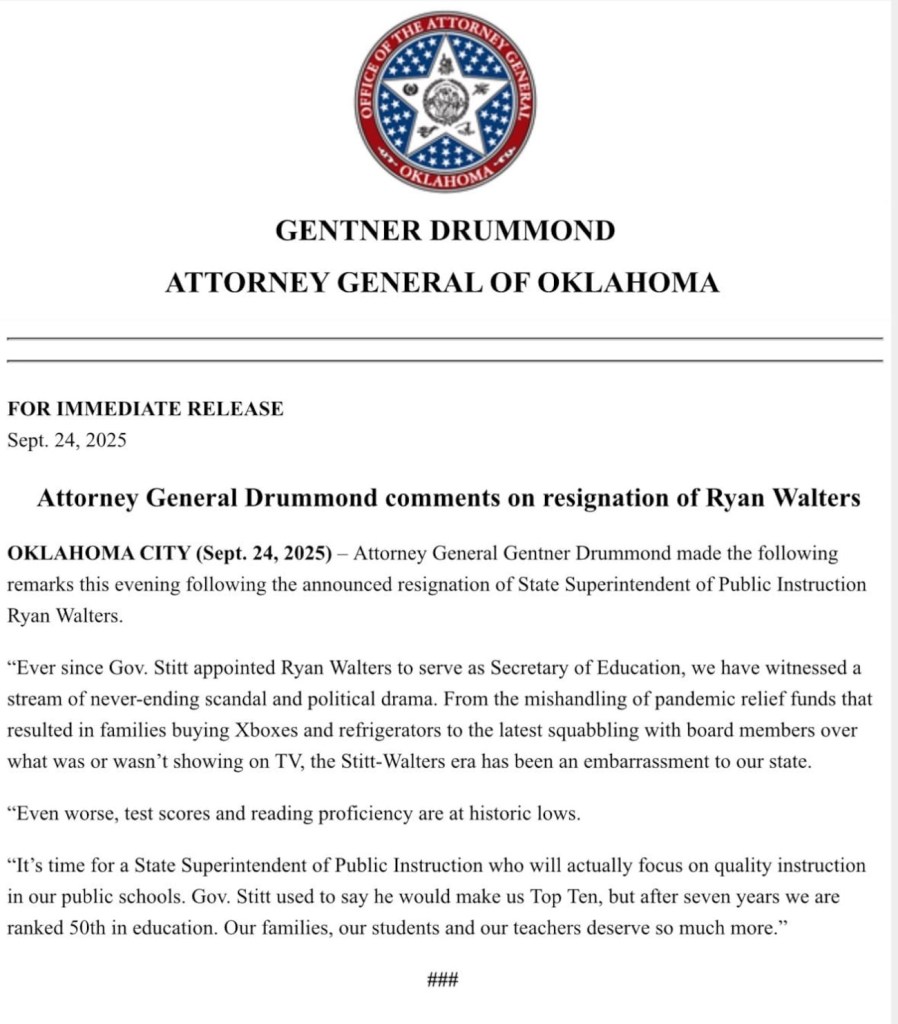
Ryan Walters announced that he was resigning his elected post as Superintendent of Schools in Oklahoma announced he is resigning. He plans to dedicate himself to fighting teachers’ unions.

Only two days ago, Walters told the local NPR station that he wanted every high school in the state to open a Turning Points USA chapter in its school.

The State Attorney General lambasted Walters.

Walters spent most of his energy promoting evangelical Christianity in the public schools. He wanted Bible-based lessons, the Ten Commandments in every classroom, and prayer in the schools. He was an outspoken MAGA guy and tried to insert doubts about the 2020 election in the social studies curriculum.

The final straw may have been the time recently when Walters conducted a meeting with members of the State Board of Education in his office and two attendees saw pornography on his television screen. Walters meanwhile had been ranting about pornography in school libraries.

Good riddance!

Mike DeGuire is a veteran educator in Denver. He says it’s time to take stock and assess the damage that “reform” has inflicted on students and public schools in Denver.

He writes in the Colorado Times Recorder:

Is public education a public or a private good? This issue is at the heart of the school choice debate sweeping the country.  

Advocates for school choice are advancing policies that move us toward the privatization of our schools, treating our children’s futures as commodities rather than community investments. This well-funded bi-partisan coalition promotes privatization through charter school expansion, vouchers, tax credits, and education savings accounts. Republicans use the words “parental rights, freedom and competition,” while neoliberal Democrats brand it as “innovation and expanding opportunity.” 

Public education is one of the last shared institutions that binds us together across race, class, and geography; when we weaken it, we weaken democracy itself.

The result is the same for communities when privatization becomes a reality in red states with vouchers or in blue cities where most charter schools are located. Vouchers segregate schools by class and race, diminish the importance of community, and severely limit funding for public schools.

Charter schools operate like private schools, create competition for students, often have unelected boards. Additionally, the charter schools, not the community, get to determine who enrolls, who stays, and what kind of learning takes place. As marketplace ideology takes over, public dollars and democratic control move from local neighborhood schools to private boards and political operatives.

Denver Public Schools (DPS) shows how this movement works in a blue city, and why it matters now in Trump’s vision of America’s education system.

Different slogans, same destination

On the right, and in most Republican-led states, legislatures enacted policies to privatize education with vouchers and education savings accounts (ESAs) designed to route public funds to private and/or religious schools. Often, these tactics originate with model bills written and promoted by the American Legislative Council (ALEC) and their allies. The goal is to let public dollars “follow the child,” which means diverting them away from democratically governed school districts.

On the neoliberal Democratic side, the mechanism is the charter-centric “portfolio model.” Local school boards often elected with large amounts of pro-reform money approve policies to close or “restart” neighborhood schools. Then they open new charters, bring in “operators” deemed to be “effective,” and the district “manages” the schools and their networks like an investment portfolio. 

This storyline was supercharged under the Obama administration’s Race to the Top, which rewarded states for removing barriers to charter growth and for aggressively initiating school “turnarounds.”

The overlap with Republicans and Democrats is structural. Both sides define schooling as a marketplace and shift authority from elected school boards to private actors, like charter boards, appointed authorities, and national nonprofits. In their book, “Wolf At the Schoolhouse Door,” Jack Schneider and Jennifer Berkshire describe “how Republicans and Democrats joined to support failed policies whose ultimate goal was to eliminate public education and replace it with a free-market approach to schooling.”

Charles Siler, who worked as a lobbyist for the libertarian Goldwater Institute, told the Washington Post that “Charter schools are part of the incremental march towards full privatization. In many ways, charter schools are the gateway to total public-school dismantling.” Since vouchers are unpopular with the public and some lawmakers, Siler continued, “privatizers have to engage in incrementalism, and they use different names to create a sort of moving target.” 

Privatization by Nick Youngs

Selling school closures with a false narrative

Both camps sell the public on privatization by claiming that “failing test scores” prove neighborhood schools, especially those serving Black and Brown students, are broken beyond repair. They argue the racial achievement gap is proof that these schools must be shut down and replaced with charters through “school choice.”

This narrative is deeply misleading. First, decades of research show that standardized test scores mostly measure socioeconomic status and neighborhood inequality, not the quality of individual schools. Poverty, housing insecurity, and systemic racism drive disparities, not the mere fact of attending a district school.

Second, the research demonstrates that replacing schools with charters has not closed achievement gaps. Denver Public Schools illustrates the point: after years of churn, closures, and huge charter expansion, racial disparities in achievement persist. Black and Latino students continue to score lower on state tests than white peers — not because they are “trapped in failing schools,” but because privatization has siphoned resources from their neighborhoods, destabilized communities, and ignored root causes.

Bipartisan funding for similar goals

The funding networks and foundations knitting these free-market agendas together are deep-pocketed and bipartisan. For instance, the conservative Walton Family Foundation underwrites charter startups and charter facilities nationwide, spending well over $1 billion on this effort. The majority of their political spending goes to Republican causes, with over 2/3 of their PAC money going to Americans for Prosperity, founded by the Koch brothers. 

In his book, “Kochland: The Secret History of Koch Industries and Corporate Power in America,” journalist Christopher Leonard describes how the American Legislative Exchange Council (ALEC), a Koch-funded right-wing group, creates model legislation which can be introduced in state legislatures. Many of these bills aim towards privatizing schools by implementing voucher programs.

City Fund raised millions, largely from Netflix founder Reed Hastings and hedge fund manager John Arnold, to spread charter schools in over 40 cities through portfolio management systems and by bankrolling local political action groups. While Hastings supports Democratic causes, he is opposed to teacher unions and believes that local school boards should be abolished. Arnold, also a Democrat, gifted the KIPPcharter network millions, and like many billionaires today, is seen as cozying up to the Trumpadministration for influence.

The Bradley Foundation and ALEC financed the policy and political infrastructure for vouchers and ESAs for decades. The Bradley Foundation, the Colorado-based Coors family, and the Koch foundation were three of the six billionaire families that funded Project 2025, which has been the playbook for Trump since he took office in January. 

Many of these same philanthropic and political dollars fund both a Republican voucher push and a Democratic-branded charter expansion — two lanes of the same privatizing highway.

Denver: a “portfolio” laboratory

Denver is often cited by education reformers as a national model as it implemented unified enrollment, systematic school closures, and rapid charter school growth. But the backstory behind who paid for these policies is less sanguine. A Network for Public Education report details how Denver Public Schools became a neoliberal “experiment,” using a web of nonprofits and political groups to expand charters and restructure the school district.

Both Republicans and Democrats contributed large amounts of money in Denver school board elections to promote corporate reforms, such as teacher pay for performance, school choice systems, and enrollment zones. In the 2017 DPS school board election, billionaires gave huge sums to the Denver candidates favoring charter school expansion. According to a report from the Network for Public Education Action, these included “Colorado billionaires Phillip Anschutzand Kenneth Tuchman, and out-of-state billionaires John Arnold of Texas and the Alice, Jim and Stuart Waltons of Arkansas.”

Both sides define schooling as a marketplace and shift authority from elected school boards to private actors, like charter boards, appointed authorities, and national nonprofits. 

Meanwhile, years of churn and school closures left communities reeling. Even reform-friendly analyses concede that the “portfolio model” era meant opening lots of charters and closing or “replacing” dozens of neighborhood schools. Researchers studying this model have cited significant concerns with the efficacy of the model, including equity issues, narrow reliance on test scores, instability and churn, tensions among schools, and loss of democratic control and community voice.

In a 2016 article, progressive education advocate David Osborne documented that “Since 2005 [Denver] has closed or replaced 48 schools and opened more than 70, the majority of them charters.” 

The billionaires’ money helped maintain a pro-charter majority school board until 2019 when teacher union-backed candidates were elected because of organized community backlash to the reforms and unrest after a teacher-led strike that year. That shift caused alarm bells among the billionaire backers of the pro-charter movement. They moved quickly to expand their funding to two political action groups in Denver.  

RootED and Denver Families for Public Schoolsreceived over $38 million from Reed Hastings’ City Fund organization, which they used to promote their pro-charter agenda through grants to charter schools, local think tanks, and other community groups. Their efforts paid off in the 2023 school board election, when three of their endorsed candidates won their elections after Denver Families Action spent nearly $1 million to promote their campaign.

Outside spending has transformed Denver board elections into major dark money funding events, with the 2023 election hitting $2.2 million, just shy of the 2019 record of $2.3 million. 

In an op-ed for Charter Folks, Clarence Burton and Pat Donovan, leaders for Denver Families for Public Schools, described their plans to repeat the 2023 wins in the upcoming November 2025 school board election. They may spend some of their vast resourcesfrom City Fund to sway voters.

In the next four years, DPS faces continued enrollment declines, and district leaders seem inclined to approve more closures to rebalance finances. That is the portfolio playbook’s endgame: when money is scarce, close neighborhood schools and expand privately run options. If successful in electing their endorsed candidates, Denver Families Action is poised to help that happen.

Do charters drain district resources? What the evidence says

District leaders and parents feel the fiscal squeeze when enrollment flows to charters. Fixed costs don’t disappear just because 5% or 10% of students leave. Research consistently warns that losses to enrollment can trigger costs that are not fully “variable” — you can’t cut 1/20th of a teacher or 1/10th of a bus route. Studies from New York and other locales estimate significant per-pupil losses in host districts as charter school share rises. 

policy brief from the National Education Policy Center summarizes the structural mechanisms that occur with fixed costs, diseconomies of scale, and shifting student composition. The brief describes how “a network of philanthropists and wealthy donors have reshaped the political economy of school finance, advocating for school voucher policies, charters, and privatization in the face of declining public-school enrollments.”

Pro-charter think tanks argue the picture is “mixed,” especially longer-term if districts close schools and cut staffing, the very things communities have fought against. But even those reviews concede there are short-term inefficiencies and significant harms. In practice, these policies mean closures, layoffs, and program cuts in neighborhood schools. 

This bipartisan push undermines neighborhood schools, deepens inequality, and places corporate interests above the common good.

Trump-world raises the stakes

Under President Trump’s second term, privatization is not just encouraged; it’s federal policy. A January 29, 2025, White House directive ordered the Education Department to steer states toward using federal formula funds to support K-12 “choice” initiatives, which was a direct push for vouchers and related schemes.  

Trump’s “Agenda47” likewise spotlights universal school choice as a signature plank, tied to dismantlingprior civil-rights guidance and reshaping federal oversight. Plans to weaken or abolish the Education Department are framed as clearing the path for parental choice

Trump’s Education Secretary Linda McMahon increased the federal department budget for charter schools by $60 million to a historic record of $500 million. At the closing session of the National Democratic Governors Association meeting, McMahonstressed to the governors they should open charterand micro-schools to promote more competition. This is the Republican Lane, wide open.

The Heritage Foundation’s Project 2025 promoted federal tax credits for vouchers, which are now approved federal legislation. The CEO of Democrats for Education Reform is pushing Democratic governors to use these new federal vouchers to expand learning opportunities for economically disadvantaged students or lose “free federal money.” 

The policy highway already built by the neoliberal Democrats (charter growth, closures, portfolio management) has made it easier for a voucher-first administration to push public taxpayer dollars out of democratically governed systems. That’s the interlock: Democrats normalized the market; Trump-world aims to privatize the whole store.

The bottom line

Denver is not an outlier — it’s a warning. A bipartisan coalition normalized the idea that public education should be run like an investment portfolio, where schools are opened, closed, and “reconstituted” based on technocratic dashboards and political spending. The Trump administration’s voucher agenda, promoted for decades by the Koch brothers and other conservatives accelerates the same logic, now directs federal policy to help states route public dollars out of public governance altogether. 

If we believe education is a public good — funded equitably, governed democratically, and accountable locally — the public must see charter expansion and vouchers as two halves of the same privatization project. When education is treated as a public good, it is essential for democracy, civic participation, economic stability, and social cohesion. 

Every child deserves an equal chance in life. Therefore, education must remain a public good — not a marketplace where opportunity is limited to the school’s choice of selecting students. The question isn’t whether our schools should be run like private businesses. It’s whether we are willing to fight for education as a right, not a privilege.

And, if the public cares about our children’s future,they need to vote, organize, and promote legislation accordingly.


Mike DeGuire, Ph.D., is the vice chair of Advocates for Public Education Policy. He has been a teacher, district level reading coordinator, executive coach, and a principal in the Denver metro area for most of his education career. He also worked as a leadership consultant for several national education organizations, and as an educator effectiveness specialist with the Colorado Department of Education. His writing is also featured on a4pep.org.