Archives for category: Extremism

Writing in The Daily Yonder, which covers the rural South, Skylar Baker-Jordan writes about Governor Andy Beshear’s selection of Silas House as the state’s poet laureate and about his own painful childhood in Kentucky.

Kentucky is usually a red state, but Governor Beshear is a popular Democrat. While the Republican-dominated legislature has passed bills that are anti-gay, Governor Beshear boldly selected House, an openly gay man, for the prestigious honor. Republicans are furious because House, a highly regarded author, insulted them with a tweet.

Baker-Jordan writes:

After Kentucky Governor Andy Beshear announced Silas House as the new poet laureate of Kentucky, there has been a significant backlash against his appointment from Republicans who claim that House “hates” Kentucky.

The Republican Governors Association called him a “radical” who thinks most Kentuckians are “bigots.” Meanwhile, a gay Republican activist wrote in the Louisville Courier-Journal that he has “no respect for Mr. House, nor should Republican Kentuckians,” arguing that it was Mr. House (as opposed to his own party, which recently passed a slate of anti-LGBTQ laws) which is standing in the way of LGBTQ rights. That’s because House once dared to tell Trump voters to “kiss [his] gay country ass” in a tweet.

I can understand Silas House’s sentiment. Sometimes, to paraphrase my friend and fellow Appalachian Neema Avashia, it is very hard to love a place that does not always love you back. Just like me, Silas House is from Leslie County, Kentucky. He loves his home state, but his home state does not always love him back.

On the one hand, Kentucky truly is the “land of milk and honey” early white settlers described: Verdant forests atop rugged mountains giving way to rolling hills of the richest soil that in turn become the most beautiful wetlands as the muddy waters of the Ohio meander ever closer to the Mississippi. There is hardly an inch of that commonwealth, a name which doubles as a promise, I haven’t tread upon.

Kentucky’s hollows raised me. Its rivers saved me. Its backroads take me home, for better or for worse.

For there is another side to Kentucky. As the only openly gay student in my high school at the dawn of the 21st century, I suffered what I have often described as “a daily crucible of homophobia.” Slurs were hurled, threats were made, and hellfire was preached – all before the morning bell had tolled.

You might be tempted to tell someone to kiss your gay country ass, too. Indeed, if that is the worst thing you say to them, no less than Job would be impressed.

As you drive into Leslie County, you see signs bragging about the accomplished individuals who have called that hidden corner of southeastern Kentucky home: Tim Couch, who played in the NFL; the Osborne Brothers, legendary bluegrass performers; a Miss Basketball from the last century; and, of course, Mary Breckinridge, who revolutionized nurse-midwifery. I often joke that they will never put up a sign claiming me as one of their own. It’s just that – a joke – but it is tinged with a painful truth: no matter how much I accomplish, Leslie County will never claim me.

I know this because they do not claim Silas House. There is no sign proudly proclaiming the county as home of the acclaimed award-winning novelist, even though he has based at least one of his books in a fictionalized version of the county. House is one of the most accomplished sons of Leslie County, but because he does not fit the narrow definition of acceptability, he goes unacknowledged. His name is verboten. Other names, though, are immortalized on a green highway sign.

Perhaps this will change now that he is the commonwealth’s poet laureate. I hope so. House reminds me of the best of Kentucky, of all the reasons why despite the pain it has caused me, I long to move back. He reminds me of Johnny Cummings, who as the first openly gay mayor of Vicco, Kentucky, ushered through a fairness ordinance to protect LGBTQ people from discrimination. He reminds me of Georgia Davis Powers, who defied racism and misogyny to become the first Black woman in the state senate. He reminds me of Loretta Lynn, who clawed her way from poverty to the top of the music charts. He reminds me of all of the countless kindhearted and decent people I have met in every corner of the commonwealth who do believe that I belong, who understand that “y’all” means all, and who work every single day to make sure the rest of the commonwealth understands that too.

Please open the link and read the rest of the article.

Then go to Amazon and look for books by Silas House. You might be tempted to buy one.
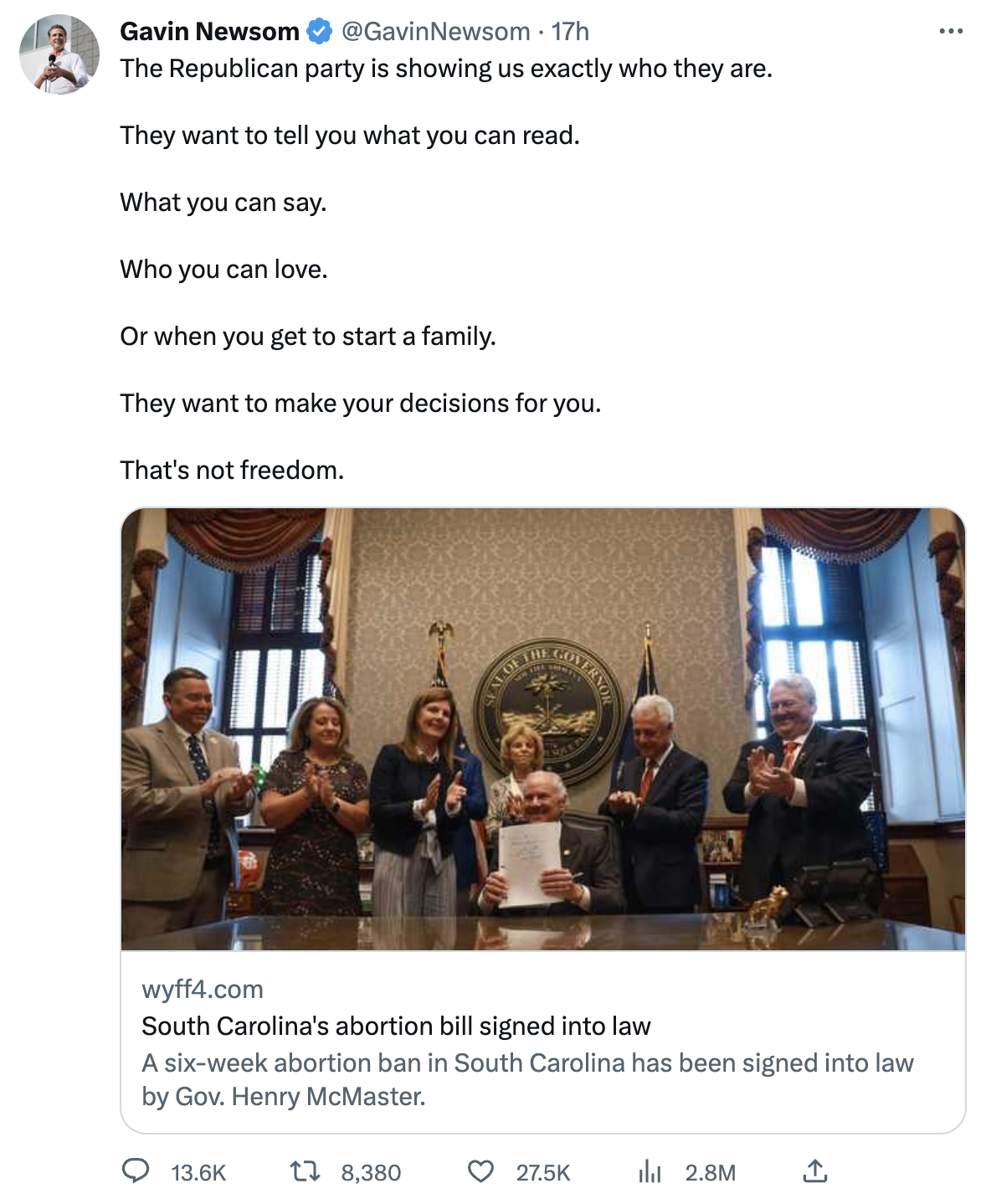
Gavin Newsom, Governor of California, regularly sends out emails pointing out the errors and hypocrisies of Republicans in other states. I enjoy them.

South Carolina, Diane…

Where the Republican governor just signed a six-week abortion ban, which he says will “begin saving lives.” All while that very same governor refuses to do anything about the fact South Carolina has one of the highest homicide rates in the country — more than 2x the rate of California.

Tweet from Gavin Newsom: 'The Republican party is showing us exactly who they are. They want to tell you what you can read. What you can say. Who you can love. Or when you get to start a family. They want to make your decisions for you. That's not freedom.'

You can’t make this up.

Today’s Republican party refuses to regulate assault weapons while gun violence is the leading cause of death of kids in America, but will champion the regulation of women’s bodies and take away reproductive freedom.

This is what Republicans want to do nationally.

And worse.

Be outraged.

– Gavin

Ron DeSantis wants to make America just like Florida, where the maximum leader (Ron DeSantis) has a docile legislature that lets him decide what everyone else is allowed to do and punishes those bold enough to ignore his orders.

That’s why he is running for President. He thinks the whole nation needs and wants a maximum leader with a reactionary view of behavior and morality.

Florida is where you are free to do whatever Ron DeSantis tells you to do and free to think what he believes. If you disagree, you are no longer free.

The Miami Herald editorial board says DeSantis has turned Florida into a mean state. No, you don’t want to make America Florida.

Florida, under Gov. Ron DeSantis and Republican Legislature, is increasingly hard to recognize. It’s an intolerant and repressive place that bears scant resemblance to the Sunshine State of just a few years ago.

The 2023 legislative session cemented those appalling setbacks. Florida is now a state where government intrusion into the personal lives of Floridians is commonplace. What will it take for citizens to push back on this unprecedented encroachment on their rights? And, more broadly, what if Desantis supporters get what they want, which is to “make America Florida”?

The latest round of laws makes Florida sound more and more dystopian — something voters in the rest of the nation should note if they are considering what a DeSantis presidency could look like. The state has new rules for who can use which bathroom, what pronouns can be used in schools, which books can be taught and when women can get an abortion (almost never.) There are measures to strip union protections from public employees, keep transgender children and their parents from choosing to seek medical treatment, prevent universities from discussing diversity or inclusion and ban talk of gender identity or sexuality in schools all the way through 12th grade.

The Washington Post tells the story of Baby Milo. His mother learned midway through her pregnancy that the fetus had a rare fatal condition. It would die within hours or days of its birth. She wanted to get an abortion but Florida abortion law made it impossible. The unborn baby had a heartbeat. No doctor would break the law by performing an abortion despite the fatal diagnosis. She had to carry the baby for three months. Baby Milo was born, then died in 99 hours. That must have made legislators happy to know the baby was born, despite the toll on its mother and father.

Milo Evan Dorbert drew his first and last breath on the evening of March 3. The unusual complications in his mother’s pregnancy tested the interpretation of Florida’s new abortion law.

Deborah Dorbert discovered she was pregnant in August. Her early appointments suggested the baby was thriving, and she looked forward to welcoming a fourth member to the family. It didn’t occur to her that fallout from the U.S. Supreme Court’s decision to overturn a half-century constitutional right to abortion would affect them.

A routine ultrasound halfway through her pregnancy changed all that.

Deborah and her husband, Lee, learned in late November that their baby had Potter syndrome, a rare and lethal condition that plunged them into an unsettled legal landscape.

The state’s ban on abortion after 15 weeks of gestation has an exception for fatal fetal abnormalities. But as long as their baby’s heart kept beating, the Dorberts say, doctors would not honor their request to terminate the pregnancy. The doctors would not say how they reached their decision, but the new law carries severe penalties, including prison time, for medical practitioners who run afoul of it. The hospital system declined to discuss the case.

Instead, the Dorberts would have to wait for labor to be induced at 37 weeks.

For the next three months, the Dorberts did their best to prepare for their second son’s short life. They consulted with palliative care experts and decided against trying to prolong his life with high-tech interventions.

“The most important thing for us was to let him know he was loved,” Deborah said.

The day before Milo was born, the Dorberts sat down with their son Kaiden to explain that the baby’s body had stopped working and that he would not come home. Instead, someday, they told Kaiden, they would all meet as angels. The 4-year-old burst into tears, telling them that he did not want to be an angel….

Without functioning kidneys, a fetus with Potter syndrome cannot produce the amniotic fluid that allows the lungs to expand and that cushions the growing body. The babies who survive until birth typically have contracted limbs, club feet and flattened features from being compressed against the uterus wall.

But after Deborah’s 12-hour labor, Milo turned out to be 4 pounds and 12 ounces of perfection, with tiny, flawlessly formed hands and feet and a head of brown hair.

“I thought I had my miracle,” said Peter Rogell, the baby’s grandfather, who attended the delivery. He allowed himself a moment of hope until the obstetrician cut the umbilical cord that for 37 weeks had performed the functions Milo’s underdeveloped lungs and missing kidneys would now take over.

He never cried or tried to nurse or even opened his eyes, investing every ounce of energy in intermittent gasps for air.

“That was the beginning of the end,” Rogell said, recalling the persistent gulps that he thought at first were hiccups but turned out to be his grandson’s labored efforts to inhale.

Lee read a book to his dying son — “I’ll Love You Forever,” a family favorite that the Dorberts had given Kaiden for Valentine’s Day — and sang Bob Marley’s “Three Little Birds.”

For 99 minutes that lasted a lifetime, they cuddled and comforted their newborn.

Ron DeSantis recently changed the Florida abortion law to make it more restrictive: abortions not permitted after six weeks. The Governor and legislature have essentially banned abortion in the state since few women know they are pregnant within six weeks. They may think their period is delayed, and they won’t have time to get the required doctor’s approval.

The six-week ban won’t go into effect until after the state’s Supreme Court has decided a challenge to the 15-week ban. Since DeSantis appointed four of seven justices, the court’s approval is expected.

Expect more heart-breaking stories, more grief, more sadness.

Nancy Goldstein writes in the Texas Observer about her pleasure in watching the state’s Republican-controlled House of Representatives impeach Ken Paxton, the state’s Attorney General. Paxton, a stalwart MAGA-man, has been under indictment for corruption for eight years. Eight years! Paxton is the Trump ally who filed a lawsuit after the 2020 elections, joined by other Republican attorneys general, to throw out the votes of states that Biden narrowly won. The Supreme Court rejected his suit, saying that Texas had no standing to sue.

For another account of Ken Paxton’s pickle, read this story in The Texas Tribune.

Was yesterday’s performance by the Texas House of Representatives intended to restore public faith in the body’s commitment to the rule of law? Separate the good cops in the GOP from the bad cops? Or prove that a legislature that spent a year cravenly ignoring the pleas of Uvalde victims’ relatives for common-sense gun safety laws before rejecting them outright while rushing through an attempt to put the Ten Commandments in every classroom isn’t really the 10th circle of hell? If so, the hearing leading up to a 121-23 vote to impeach Attorney General Ken Paxton for corruption was an epic fail.

What the public saw—regardless of the lawmakers’ intentions—were the open of fissures that have more to do with pride and power than justice. It was a cross between the state’s largest intra-party catfight and its most public self-inflicted gunshot wound, as the bad blood between Paxton and Texas House Speaker Dade Phelan, who serve as proxies for Trump and Republicans trying to distance themselves from Trump in advance of next year’s elections, finally spilled out into the open.

The lineup featured, on the one hand, GOP representatives who suddenly had a lot of worries about “due process,” “precedent,” and “evidence” that had not been evident while banning abortionand stripping transgender youth and their families of access to healthcare. Opposing them were those GOP colleagues who solemnly intoned about what appears to be their newly discovered “obligation to protect the citizens of Texas from elected officials who abuse their office and their powers for personal gain.”

Various media outlets, and a few of Paxton’s defenders, have made much of the lightning speed of this past week. But while it may have been mere days between the Republican-led House General Investigating Committee’s announcement of their investigation and their unanimous vote to introduce 20 articles of impeachment to the full House for Saturday’s hearing and impeachment vote, Paxton has been under felony indictment for securities fraud since he became attorney general in 2015. The FBI had been investigating Paxton on allegations that he used his office to benefit a wealthy donor, Nate Paul, since late 2020. Only in February of this year did the Department of Justice take over that probe, breathing new life into it.

Paxton’s overreach the next month, in March of this year, appears to have been the second-to-last straw. According to the committee’s own memo, released the day before the full House hearing: “But for Paxton’s own request for a taxpayer-funded settlement over his wrongful conduct, Paxton would not be facing impeachment.” Not, please note, the wrongful conduct—that is, Paxton’s firing of four whistleblowing members of his own senior staff after they accused him of using his office to help out Paul. Nor Paxton’s decision this past spring to pay $3.3 million to settle out of court. Or even the $600,000 the House spent defending Paxton. But Paxton’s request that taxpayers pay that $3.3 million—and that his fellow GOP colleagues go on record approving that request.

The final straw? Paxton, likely knowing that Phelan was going to try to gloss this most recent disgusting legislative term by ending it on a high note, called on him to resign last week over alleged drunkenness—via a tweet. Making it look super-extra-duper political when the House General Investigating Committee revealed that afternoon that it had been investigating Paxton in secret since March. The committee then heard a three-hour presentation from its investigators detailing allegations of corruption against the attorney general and voted to forward 20 articles of impeachment to the full House.

Believe me when I say that I, like many people who have been burned by the Texas GOP’s seemingly endless appetite for cruelty, ignorance, and hypocrisy, felt a certain satisfaction as I watched yesterday’s coverage of it setting itself on fire. Top moment? When the first group to appear outside the Capitol in Austin in response to Paxton’s call for supporters to turn out was around 100 people preparing for the “Trot for Trans Lives,” a 5K run held in support of transgender Americans affected by the waves of anti-trans rights legislation passed in recent years, including by Texas lawmakers.

Small pleasures aside, none of this is as satisfying as it sounds, nor do I think it will end well. First of all, because of all the bureaucracy that lies ahead. Governor Greg Abbott, who has remained curiously silent this past week while he sticks his finger into the political wind, has 10 days to tell the Senate to start a trial. A trial that would be presided over by Paxton buddy arch-conservative Lieutenant Governor Dan Patrick, and that’s likely to be kicked down the road infinitely and/or end with an acquittal.

But ultimately because the bottom line is that while Paxton burns—or simmers or escapes entirely—and intra-party fighting and dirty laundry airing be damned, the members of the USA’s largest, richest, and most powerful wing of the GOP have screwed Texas on such a large, systemic level that they’ll still prevail. In the state, through control of both chambers and the governor’s seat, held in place by voter suppression and gerrymandering. Nationally, with courts packed with ideologues, including a Supreme Court that has already demonstrated its willingness to let Texas gut constitutional rights, overturn precedent, and play an enthusiastic role in the new national sport: playing on whatever field offers your agenda the best advantage. That means valorizing states’ rights when it’s convenient, or passing the ball to the Supreme Court if a federal ban looks more likely or appealing.

Call this, with apologies to Taylor Swift, the “Errors Tour” or, in a nod to the Ziegfeld Follies, “Hypocrisy on Parade.” Or let’s go “Paris is Burning” and give the representatives a Realness Award for their impersonation of legislators who seriously care about integrity, democracy, and the will of voters.

But whatever you do, don’t hold your breath waiting for justice.

The state legislature in Texas passed a bill that will place an expensive burden on the state’s 300 or so small small bookstores. The mandate is not only costly but almost impossible to comply with. The state wants every bookstore to rate every book they sell by its “sexual content” and to refuse to sell books with sexually explicit content to teachers, librarians, and school libraries. In addition, the bookstores are supposed to report whether they have ever in the past sold books with such content to teachers or schools.

Independent bookstores around Texas warn that a bill designed to rid school libraries of sexual content could have unintended consequences that devastate their businesses.

The bill, which received final passage in the Legislature this week and is awaiting Gov. Greg Abbott’s signature, requires booksellers to rate every book they sell to a school, librarian or teacher for use in their classroom. Books can be without a rating, “sexually relevant” or “sexually explicit,” and those with the explicit rating will be banned from schools entirely.

And by April of next year, every bookseller in the state is tasked with submitting to the Texas Education Agency a list of every book they’ve ever sold to a teacher, librarian or school that qualifies for a sexual rating and is in active use. The stores also are required to issue recalls for any sexually explicit books.

Many have expressed concerns that the bill is an effort to restrict books with LGBTQ themes or by Black authors. In addition, throughout the legislative process, independent bookstores repeatedly have warned that the bill misunderstands how book sales to schools work, is unworkable in its current form and could be harmful to small businesses.

“The First Amendment person in me says, ‘Why do we have to mark the books at all? ’ The business person in me says, ‘that’s going to be very hard to administer for the middle vendor,’ which we are,” said Valerie Koehler, owner of Blue Willow Book Shop in Houston.

Owners and employees of bookstores around the state have said they don’t have the staff or expertise to read and rate every single book they are selling to an educator, and they have no records to retroactively rate every book they’ve ever sold to a school. If the TEA finds that bookstores have been incorrectly rating books, they can be banned from doing business with charter schools or school districts, which might make up between 10 percent and a third of their business.

The bill was sponsored by Rep. Jared Patterson, R-Frisco. He dubbed it the Restricting Explicit and Adult-Designated Educational Resources act, or READER Act. The measure was born out of conservative fears in the last few years of sexual content in public schools. Many of the books that were subsequently identified as inappropriate were written for LGBTQ children and teenagers.

Patterson has said the bill was inspired by “Gender Queer,” a coming-of-age graphic novel that explores the author’s gender identity and personal sexuality.

“We’re not talking about a certain type of sexual activity. We’re talking about sexually explicit of any sort. It doesn’t belong in front of the eyes and in the minds of kids,” Sen. Angela Paxton, R-McKinney, said during a Senate debate Tuesday night. Paxton shepherded the measure through that chamber. [Senator Paxton is the wife of State Attorney General Ken Paxton, who was just impeached for multiple financial crimes by the Texas House.]

Paxton said the bill will mostly affect large vendors, as just 50 companies sell most books purchased by Texas public schools, and three giants are responsible for the bulk of titles in campus libraries.

“If vendors want to sell books in Texas, they certainly have a vested interest in making sure it’s done properly,” she added.

But while those large vendors may be able to more easily bear the extra costs associated with this bill if it becomes law, it will be more difficult for the roughly 300 independent bookstores in Texas that have much smaller profit margins overall than the giants.

It’s common for stores to offer discounts for teachers, librarians and schools, which means the margins on those sales are lower.

For example, a librarian might give the store a list of 150 books they want to buy, at an average of 200 pages each. If this bill becomes law, the store will need to pay someone to read and rate each of those books, and run the risk of being punished by the Texas Education Agency if they get it wrong.

This could either make it more expensive for schools to buy books or make such sales infeasible for small bookstores, said Elizabeth Jordan, general manager of Nowhere Bookshop in San Antonio. Her store had a goal of increasing its share of sales to schools to about 15 percent of its total business, she said, but that will no longer be possible.

“If I am selling a book to a school, I will have to have read the whole book to determine if it’s sexually relevant or sexually explicit. And both of those things, I think, are pretty subjective, and I might rate them differently than others might,” she said. “I don’t see why I would put myself at risk to do that. If all the onus is on me, all the liability is on me, and it’s not a job I’m trained to do or my employees are trained to do….

In addition, the bill requires stores to retroactively rate every book they’ve ever sold that is still “in active use by (a) district or school.”

“The way the bill is written right now is that not only can we get in trouble for what we sell to a school, we can get in trouble for something we sold 10 years ago to a school,” Koehler said.

The Associated Press published this article about how DeSantis has unleashed a nation-wide zeal for censorship. It appeared in newspapers across the nation.

TALLAHASSEE — As he vies for the Republican presidential nomination, laws pushed by Gov. Ron DeSantis have led to an upswing in banned or restricted books not only in Florida schools but also in an increasing number of other conservative states.

Florida last year became the first in a wave of red states to enact laws making it easier for parents to challenge books in school libraries they deem to be pornographic, deal improperly with racial issues or are in other ways inappropriate for students.

Books ensnared in the Florida regulations include explicit graphic novels about growing up LGBTQ+, a children’s book based on a true story of two male penguins raising a chick in a zoo and “The Bluest Eye,” a novel by Nobel laureate Toni Morrison that includes descriptions of child sexual abuse. Certain books covering racial themes also have been pulled from library shelves, sometimes temporarily, as school administrators try to assess what material is allowed under the new rules.

While efforts to ban books or censor education material have come up sporadically over the years, critics and supporters credit DeSantis with inspiring a new wave of legislation in other conservative states to regulate the books available in schools — and sometimes even in public libraries.

The number of attempts to ban or restrict books across the U.S. last year was the highest in the 20 years the American Library Association has been tracking such efforts.

EveryLibrary, a national political action committee, said it’s tracking at least 121 proposals introduced in state legislatures this year targeting libraries, librarians, educators and access to materials. The group said 39 of those proposals would allow for criminal prosecution.

“He really is blazing a trail,” said Tiffany Justice, the Florida-based co-founder of the conservative group Moms for Liberty, whose members have filed challenges to books in libraries in several states. “What Ron DeSantis does that I think is effective is he uses all the levers of power to make long-term change happen.”

“Other governors,” Justice said, “are paying attention and following suit.

In Arkansas, Republican Gov. Sarah Huckabee Sanders signed a law, set to take effect this summer, that could impose criminal penalties on librarians who knowingly provide “harmful” materials to minors. The law also would establish a process for the public to challenge materials and ask they be relocated to a section minors can’t access.

“It’s a perverse world when we’re talking about trying to criminalize librarians,” said Nate Coulter, executive director of the Central Arkansas Library System in Little Rock, which is expected to sue over Arkansas’ law.

In Indiana, school libraries will be required by July 1 to publicly post a list of books they offer and provide a complaint process for community members under a law Republican Gov. Eric Holcomb signed this month. In Texas, a bill creating new standards for banning books from schools that the government considers too explicit has been sent to Republican Gov. Greg Abbott’s desk.

In Oklahoma, the state school board has approved new rules that prohibit “pornographic materials and sexualized content” in school libraries and allow parents to submit formal complaints. The rules still must be approved by Republican Gov. Kevin Stitt.

DeSantis insists books aren’t being banned, preferring to call the forced removal of some books “curation choices that are consistent with state standards.”

“There has not been a single book banned in the state of Florida,” DeSantis said Wednesday. He later said, “our mantra in Florida is education, not indoctrination.”

Librarians, free speech advocates and some parents and educators say the push is driven by a small, conservative minority that happens to have outsized clout in Republican primaries like the one DeSantis is now competing in.

“This is all part of his plan to run for president, and he believes his vilification of books and what’s happening in public schools is his path to the presidency,” said Andrew Spar, president of the Florida Education Association, the state’s main teachers union.

Kasey Meehan, who directs the Freedom to Read program at the writers’ organization PEN America, said that, when books are targeted in Florida, they later become the subject of complaints filed by parents in other states.

“It’s something that continues to cause alarm for individuals who are advocating for the freedom to read or for a diversity of knowledge, ideas and books to be available to students across the country,” Meehan said.

There have been challenges to books in schools for decades — “The Bluest Eye” has been targeted in various states for years, long before DeSantis became governor.

But the restrictions accelerated in Florida after DeSantis signed bills last year barring discussion of sexual orientation and gender identity in kindergarten through third-grade classrooms, a ban that has since expanded through 12th grade. He also created a mechanism for parents to challenge books in school libraries and has targeted how race is taught in Florida schools.

Many teachers and districts complain that the laws’ standards are so vague they don’t know what books might place them in legal jeopardy.

Michael Woods, a special education teacher in Palm Beach, said new rules compelling him to catalog books in his classroom led him to empty a small library he set up where students could choose to read something that interested them. Now those volumes are stored in a box he’s stashed in his closet for fear of getting in trouble.

“That kind of positive connection to reading is no longer there,” he said.

The individual challenges to books might be coming from a fairly narrow segment of the population, according to PEN and the American Library Association, which track requests to pull books. The library association said 40% of all requests challenged 100 or more books at a time.

Raegan Miller of Florida Freedom to Read, a group fighting the book restrictions, said she has talked about education issues with fellow parents of all political persuasions for years, and no one has ever complained about inappropriate material in their children’s schools. She contends the issue has been ginned up by a small group of conservative activists.

“Do you really think we are all just happily dropping our kids off at Marxist indoctrination and pornography?” Miller said. “You only hear this stuff at school board meetings.”

Moms for Liberty, which boasts 285 chapters, has a strong presence at school board meetings in the state and nationwide. It also has successfully backed several candidates for school board.

When Ron DeSantis launched his candidacy on Twitter, he scoffed at the notion that schools were banning books in Florida. That alone should disqualify him, based on what we have seen, heard and read about the state’s encouragement of banning books that refer to gays or racism. A complaint by a single parent is sufficient to get a book removed from the school library. Most recently, a parent at an elementary school complained about Amanda Gorman’s poem “The Hill We Climb,” which she read at President Biden’s inauguration. The poem is now available to middle school children, but not to those in the elementary school.

The Miami Herald published this editorial about the phenomenon that DeSantis says is non-existent, a hoax.

Perhaps it’s because of how Amanda Gorman alluded to the Jan. 6 attack in her famous poem, finished the night after rioters stormed the U.S. Capitol: “We’ve seen a force that would shatter our nation rather than share it.”

Or maybe she wrote too bluntly about race and the legacy of slavery:

“We, the successors of a country and a time where a skinny Black girl descended from slaves and raised by a single mother can dream of becoming president, only to find herself reciting for one.”

Gorman, the youngest inaugural poet in U.S. history, read “The Hill We Climb” at President Joe Biden’s inauguration, watched by about 40 million people. She wrote the poem so “that all young people could see themselves in a historical moment,” she posted on Twitter Tuesday.

But Gorman’s poem is now deemed not age appropriate, one of four library titles Bob Graham Education Center banned, following a parent’s complaint, for elementary school students, the Herald reported. The books are now available only for middle-schoolers at the public school in Miami Lakes, even though some of them were written for younger children.

The school committee that reviewed the material didn’t offer an explanation for its decision. We’re left to wonder: What in the children’s illustrated book “The ABCs of Black History,” written for children ages 5 and up, made it so inappropriate?

Perhaps it was the mention of iconic author James Baldwin’s sexual orientation: “And he was a gay man who believed that when it comes to love, you should ‘go the way your blood beats.” Or the mention of the Little Rock Nine, the “first Black children in all-white schools,” or the Black Panther movement. Or were the colorful drawings of Black female icons like Michelle Obama and Toni Morrison — described as “ queens”— too much?

One thing is clear: Books by Black authors — and about the Black American experience — make up three of the four titles deemed inappropriate for young children at Bob Graham Education Center. The other one, “Cuban Kids,” uses photos to describe the lives of children in Cuba in the early 2000s and how different or similar they are to Americans, according to the author’s homepage. Learning about the lives of their counterparts in a socialist country — including how they got around paper shortages — is sure to turn our kids into communists.

We knew that the movement to “sanitize” school libraries that Gov. Ron DeSantis and the Legislature unleashed would eventually catch up with Miami-Dade. Our melting pot, after all, might not be so different from Escambia County in the Panhandle, whose school board has been sued for removing books about race and LGBTQ topics.

Florida’s laws have emboldened parents and activists like Moms for Liberty to challenge materials dealing with these topics. Most recently, DeSantis signed a bill that empowers one person to file a complaint and ban a book, at least temporarily, while a district reviews it. Parents not satisfied with how a district ruled on the challenge can appeal to the state. That is bound to make schools acquiesce to offended parents.

The result, as Gorman wrote on Twitter after her poem was restricted, is that “most of the forbidden works are by authors who have struggled for generations to get on bookshelves.”

Elementary students were not required to read Gorman’s work or any of the challenged titles. These were options at Bob Graham Education Center’s library. Those options also should be available for the children of all parents, not only those offended by certain content or groups skimming books to find any remote reference to race or LGBTQ issues.

“Love to Langston” was written at a second-grade reading level but no longer is accessible to second-graders at Bob Graham. The illustrated biography of Harlem Renaissancewriter Langston Hughes describes his own elementary school experience, tainted by racism, in the early 1900s:

“In Topeka, Kansas the teacher makes me sit in the corner; in the last row; far away; from the other kids.”

The parent who filed the complaint said “Love to Langston” contained critical race theory, “indirect hate messages,” gender ideology and indoctrination, the Herald reported. It’s unclear how.

It is curious, however, that “indoctrination” and “hate messages” seem to be flagged mostly when when Black authors write about being Black, or when LGBTQ authors write about being queer. The adults must ask themselves why that’s the case before making them inaccessible to children.

Michael Hiltzik of the Los Angeles Times explains how Republicans agreed to the increase in the debt ceiling: by cutting aid to the neediest. He wrote: The cruelty is the point.

No one should be surprised that the resolution of our most moronic fiscal policy, the federal debt ceiling, involved our stupidest social policy, work requirements for assistance programs.

But that appears to be the case. In negotiations between the Biden White House and House Speaker Kevin McCarthy’s Republican caucus, one of the last sticking points was whether, and by how much, to tighten work requirements for food stamps and welfare.

In coming days, as Congress moves toward votes on the deal, political commentators will thoroughly masticate the question of whether Biden or McCarthy (R-Bakersfield) prevailed in this dealmaking and which of them will be hurt or harmed politically by the outcome.

Democrats right now are willing to default on the debt so they can continue making welfare payments for people that are refusing to work.

— Rep. Garret Graves (R-La.) tells a giant lie about the debt ceiling negotiations

That’s not a very interesting parlor game. (Personally, I’d go with the judgment of Timothy Noah of the New Republic, who thinks Biden emerges as the political victor and McCarthy’s days as speaker are numbered, thanks to the choler of his far right wing.)

More important is what the deal says about the principles of both camps. The granular details of the agreement were still murky Sunday, and it could still collapse because of objections from congressional Republicans or Democrats.

The deal, as reported, freezes discretionary federal spending — that is, most of the programs for which Americans depend on the federal government — at current levels for the next two years, with increases lower than inflation. That means an effective budget cut, relative to inflation. In return, the debt ceiling is suspended for two years.

But Biden managed to preserve the accomplishments of his presidency thus far from the GOP’s knives. He fended off their efforts to torpedo the support for renewable energy in last year’s Inflation Reduction Act, their harshest proposed budget cuts, the rollback of student debt relief, and repeal of his budget increase for the Internal Revenue Service.

(Reports say that $10 billion will be shaved off the $80-billion 10-year IRS budget increase, but the money can be redirected to other programs.)

Biden rejected Republican demands to impose work requirements on Medicaid, but allowed some tightening of the rules for food stamps — the Supplemental Nutrition Assistance Program, or SNAP, and Temporary Assistance for Needy Families, or TANF, which is what’s left of traditional welfare.

Make no mistake: No rich American will be harmed even a bit by this deal. Some may even be advantaged, if the carve-out from the IRS budget comes from the agency’s enforcement efforts; that would help the rich, who are the nation’s worst tax cheats.

The most vulnerable Americans, however, will bear the brunt of the deal points. Let’s take a look.

Start with work requirements. As I’ve reported ad infinitum over the years, work requirements on safety net programs accomplish nothing in terms of pushing their beneficiaries into the job market.

They are, however, very effective at throwing people off those programs; that’s what happened in Arkansas , where 17,000 people lost Medicaid benefits in 2019 after only six months of a limited rollout of work rules. A federal judge then blocked the changes.

The debt ceiling deal will tighten work requirements for SNAP by requiring able-bodied, childless low-income adults younger than 55 to work 20 hours a week or be engaged in job training or job searches. If they don’t meet that standard, their SNAP benefits end after three months. Current law applies to those adults only up to the age of 49. The change will expire in 2030.

This rule will do virtually nothing to reduce federal spending, which Republicans say has been the whole point of holding the debt ceiling hostage. The Congressional Budget Office estimated in April that the change would reduce federal spending by $11 billion over 10 years, or $1.1 billion a year.

By my calculation, that comes to 17 thousandths of a percent of the federal budget, which this year is $6.4 trillion.

If it’s scarcely a rounding error in federal accounts, however, it’s critically important to the recipients of food aid. The CBO estimated that about 275,000 people would lose benefits each month because they failed to meet the requirement.

Biden’s negotiators did get the Republicans to waive SNAP rules for veterans and the homeless, which will probably lower that figure and limit the reduction of federal spending.

Work requirements for safety net programs have been a Republican hobby horse for decades. It’s based on the Republican image of low-income Americans as layabouts and grifters — the “undeserving poor.”

Sure enough, Rep. Garret Graves (R-La.), one of McCarthy’s debt-ceiling negotiators, couldn’t resist slandering this vulnerable population during the talks. “Democrats right now are willing to default on the debt so they can continue making welfare payments for people that are refusing to work,” he said during a break.

Of course, it was Republicans who showed willingness to default on the federal debt. Nor is there a smidgen of evidence that any sizable percentage of this target population is “refusing to work.”

The vast majority of SNAP recipients already work, but they’re in low-paying jobs that are so unstable that they often drift in and out of employment. According to the Census Bureau, 79% of all SNAP families include at least one worker, as do nearly 84% of married couples on SNAP.

In other words, the GOP insistence on work requirements is nothing but the party’s typical performative malevolence toward the poor. If they really cared about getting SNAP recipients into the job market, they’d fund job training programs and infrastructure projects. They never do.

In any case, the only cohort of beneficiaries that tends to move into the job market at all are younger recipients — not those in their 50s. All that work requirements accomplish is to erect bureaucratic barriers to enrollment in the safety net. But that’s the point, isn’t it?

The work rules for TANF are managed somewhat differently — they’re directed at the states administering the program, which have been required to ensure that a certain percentage of beneficiaries are working or looking for work. How the debt ceiling deal applies to that program is unclear.

In the next week or so, before June 5 — the putative date at which the Treasury Department says the government runs out of money to pay its bills without a debt ceiling increase and thus flirts with an unprecedented default — Biden and McCarthy will hit the hustings to claim victory.

But there’s really only one way to think about the exercise we’ve just gone through. It was a supreme waste of time.

Republicans showed they were willing to crash the U.S. economy to make some bog-standard complaints about the federal deficit, most of which they created themselves through the 2017 tax cuts they enacted for the wealthy. Their initial negotiating stance was so extreme that they must have known it could never gain Democratic votes in the House or pass the Democratic Senate.

The Democrats held reasonably firm. They agreed to some modest budget constraints for two years, moved the next debt ceiling cabaret off to beyond the next election, and saved millions of Americans from serious economic pain.

As I’ve written before, if Republicans were really serious about restraining federal spending, they wouldn’t have voted for the tax cuts and budget increases that that contribute to the deficit.

Instead, they said the only way to control spending is to refuse to pay the bills they ran up, by refusing to increase the debt ceiling. They lied, and every thinking American knows they lied. So tell me, why did we go through this again?

Jim Hightower is a gadfly who keeps stinging the Texas GOP in the backside. He was elected State Agriculture Commissioner from 1983-1991. I recently subscribed to his blog to get a deeper insight into the clowns who now control my native state. You might consider doing the same.

He writes here about the latest embarrassment to the state by its leading yahoos.

Cartoon via FFRF.org

Once again, the Texas Legislature leads by example! Erroneous and wrongheaded example, but, Bless Their Little Hearts, they’re just not real good at thinking complicated things through.

The present lawmaking adventure of the GOP-controlled Lege is an attempt to impose a militant brand of Christian Nationalism as the official public religion of Texas. Throughout history, such right-wing attempts to subvert a pluralistic society’s sense of the Common Good with the narrowest mindset of one particular pietistic group has led to both great harm and unintended hilarity. Indeed, the Lone Star State has a long and daffy history of getting the Bible jumbled up in public policy. In the 1920s, for example, Governor Miriam A “Ma” Ferguson rejected a proposal for bilingual education in our schools: “If English was good enough for Jesus Christ,” she explained, “it ought to be good enough for the children of Texas.”

Likewise, today’s trio of Republican numbskulls running our state government – the governor, lt. guv, and attorney general – are acting as Bible-thumping Pentecostals. Lt. Governor Dan Patrick recently rose up on his hind legs to proclaim that ours is “a Christian nation,” that “there is no separation of church and state,” and that God Almighty himself “wrote the Constitution.” To enshrine this religious absolutism into law, these sanctimonious Texas politicos are now enacting a dictate that all public schools must conspicuously display The Ten Commandments “in every classroom,” and the nitpicking autocrats even specify that the displays “must be at least 16-by-20 inches.” It’s rule by rulers.

TIDBIT: The sanctity of the Ten Commandments derives from its devotees contention that the instructions were literally handed down by God. So, every word is sacrosanct. Except “ass.” The 10thCommandment directs: “Thou shalt not covet thy neighbor’s house… wife… manservant… maidservant… ox… ass….” But the sponsor of the Texas bill, a self-righteous pissant of a senator named Phil King, took the ungodly liberty of removing ass from the holy version of the Lord’s Word. Thus, the children will be instructed by law to obey a religious code co-authored by Yahweh and Phil King. And, thanks to Phil’s red-ink editing pen, they will be morally free to covet their neighbor’s ass.

As proof that these Christian edicts are the holy foundation of US law, pushers of the public indoctrination of children point out that a frieze along the east Wall of the US Supreme Court is emblazoned with the numbers I through X. This shows, they assert, that our nation’s laws are derived from the higher authority of Christian commandments.

But – Holy Ma Ferguson! – they’re flaunting their ignorance. Those numbers refer not to the Bible, but to the Constitution, specifically the 10 Amendments that itemized our people’s original Bill of Rights. And remember that the very first one of those secular amendments prohibits government from enacting any law for the “establishment of religion.”

Note, too, that none of America’s founding documents (Declaration of Independence, Constitution, Federalist Papers) even mentions the Christian commandments. Finally, the various writers of the Bible itself don’t agree on the proper wording of the so-called commandments, how many there are, and what they mean.

DO SOMETHING!

To get the lowdown on the Ten Commandments (or is it 13? Or more?) The Freedom From Religion Foundation providesfactual insights and historical context for each one. FFRF is the leading source for tracking theocratic assaults on religious freedom and for providing how-to action items for battling right-wing efforts to turn our local, state, and national government into autocratic theocracies. Connect at ffrf.org.