Archives for category: Ethics

During President Biden’s State of the Union address, he said that Republicans want to cut Social Security and Medicare, and the Republican side of the chamber erupted in jeers and shouts of “liar!” Two of those loudly jeering—Senators Rick Scott of Florida and Mike Lee of Utah—had explicitly made those proposals. Biden then masterfully got the Republican caucuses in both Houses to declare their support for both big entitlement programs.

Michael Hiltzik, business columnist for the Los Angeles, sets the record straight about the Republican stance on Social Security.
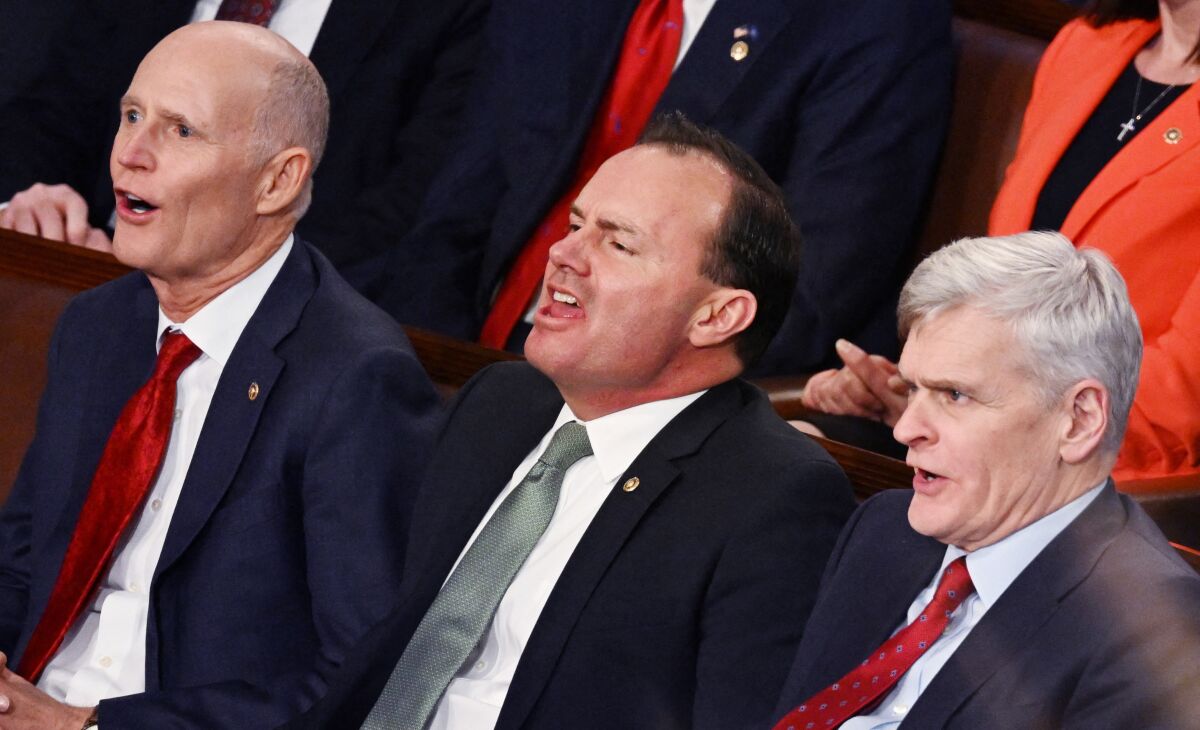
From left, U.S. Sens. Rick Scott and Mike Lee jeer.

From left, GOP Sens. Rick Scott of Florida and Mike Lee of Utah jeer during the State of the Union address when President Biden accused Republicans of wanting to cut Social Security. Both senators have proposed exactly that.

(Andrew Caballero-Reynolds / AFP/Getty Images)

Hiltzik writes:

President Biden has congressional Republicans all asquirm as he conducts a post-State of the Union speech national tour.

Why? Because Biden has doubled down — or as Fox News has it, “tripled down” — on his assertion during the speech that the GOP has been planning to cut Social Security.

Not so, they say. Never happened. Sens. Mike Lee (R-Utah) and Rick Scott (R-Fla.) were even caught on camera during the speech wearing “Who, me?” expressions of injured innocence.

It will be my objective to phase out Social Security, to pull it out by the roots.

— Sen. Mike Lee (R-Utah), during his 2010 campaign for the Senate

Unfortunately for them, we have the evidence, as does Biden. Cutting Social Security along with Medicare has been part of the Republican platform for decades.

As I’ve reported before, they often hide their intentions behind a scrim of impenetrable jargon, plainly hoping that Americans won’t do the necessary math to penetrate their subterfuge.

Let’s take a jaunt through the GOP approach to Social Security and Medicare.

Start with their description of these programs as “entitlements,” which they’ve tried to turn into a dirty word. The truth is that they are entitlements, in the sense that most Americans have been paying into these programs for all their working lives, mostly through the payroll tax. So, yes, they’re “entitled” to receive benefits in return.

Republicans, including former Senate Majority Leader Mitch McConnell (R-Ky.), have consistently blamed the federal debt on “entitlements” — never mind that their 2017 tax cut for the wealthy has blown a multitrillion-dollar hole in the budget.

They know they’re on thin ice with the public when they talk about benefit cuts, which is why Sen. Joni Ernst (R-Iowa) once recommended discussing their ideas only “behind closed doors.”

Now we can turn to the specifics of Lee’s and Scott’s plans. In widely circulated videos from Lee’s first successful Senate campaign in 2010 he can be seen and heard stating as follows: “It will be my objective to phase out Social Security, to pull it out by the roots.” He said that was why he was running for the Senate, and added, “Medicare and Medicaid are of the same sort. They need to be pulled up.”

As for Scott, his 12-point “Rescue America” plan, issued last year, included a proposal to sunset all federal legislation after five years. “If a law is worth keeping, Congress can pass it again.” The implications for Social Security and Medicare, which were created by federal legislation, were unmistakable — so much so that the proposal made Republican officeholders’ skin crawl.
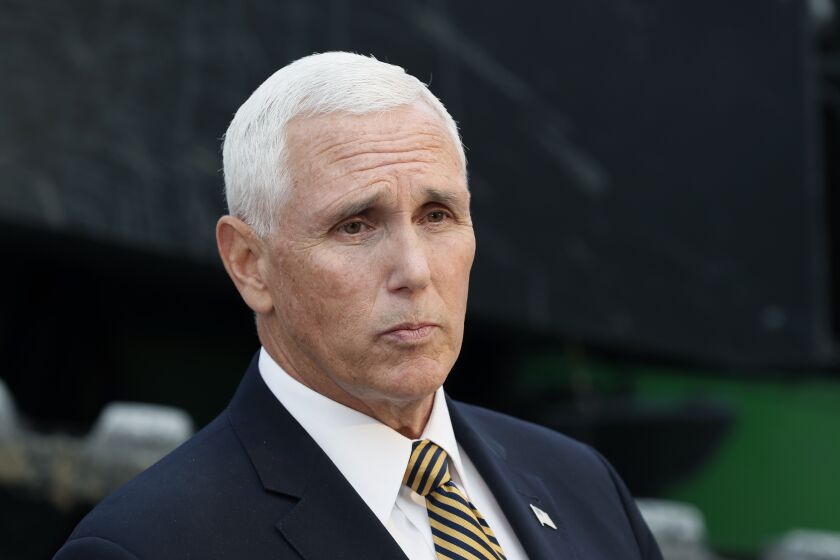
Vice President Mike Pence speaks to reporters during a visit to the Manning Farms, Wednesday, Oct. 9, 2019, in Waukee, Iowa. (AP Photo/Charlie Neibergall)

Column: Mike Pence, would-be president, has a plan to kill Social Security. It will cost you

McConnell disavowed the proposal on the spot and has continued to do so, telling a home-state radio host after the Biden speech that the sunset provision is “not a Republican plan.That was the Rick Scott plan.”

That said, it’s a priceless foil for Biden. When Republicans brayed during his speech that he was lying about it, he offered to make Scott’s manifesto available to anyone who called his office for it. At one of his subsequent appearances, a copy of Scott’s plan was placed on every seat.

The GOP can’t easily wriggle away from its intentions. Let’s examine the fiscal 2023 budget proposal issued by the Republican Study Committee, a key policy body, last June under the title “Blueprint to Save America.”

This plan would increase the Social Security full retirement age, which today is 66 or 67 (depending on one’s year of birth), to 70 by 2040. According to Kathleen Romig, the Social Security expert at the Center on Budget and Policy Priorities, this would translate into a 20% cut in lifetime benefits compared with current law.

As I’ve reported before, raising the full retirement age is a Trojan horse that would affect all retirees across the board, but harm Black workers, lower-income workers and those in physically demanding jobs the most.

It would create particular hardships for those choosing to retire early and collect their benefits prior to their full retirement age.

Doing so exacts a lifetime reduction in monthly benefits, based on a formula aimed at equalizing the lifetime benefit among those who retire early, those who wait until their full retirement age, and those who defer collecting until that age (they receive a bump-up in benefits for every year they delay, topping out at age 70).

Raising the full retirement age to 70, Romig calculates, would mean that retirees who start collecting at the minimum age of 62 would receive only 57% of their full benefit….

The Republican Study Committee also would make it harder for disabled workers to qualify for benefits, and would lengthen the period before those who are disabled and younger than 65 qualify for Medicare to five years from two. This falls into the category of balancing the budget on the backs of the most vulnerable members of society.


As for Medicare, the Republican Study Committee proposes raising the eligibility age, currently 65, so it matches the Social Security retirement age. It also would transfer many more Medicare accounts to private insurance. The committee claims this would save money.

The rest of his incisive analysis is behind a paywall, unfortunately. He demonstrates beyond doubt that Republicans have wanted for years to put these big programs on the chopping block, which are lifelines for senior citizens. They have no objections, however, to cutting the taxes of the wealthiest. That was Trump’s biggest accomplishment: tax cuts for those with the most.

Stephen Owens is an evangelical Christian who has thought deeply about the importance of public schools in our society. He has a Ph.D. In education policy from the University of Georgia and is Director of Education at the Georgia Budget and Policy Institute. His blog is called “Common Grace, Common Schools.”

Let’s begin my argument for public schooling by making the familiar strange. There are aspects of public schooling that you do not see in any other facet of American life that need to be evaluated to better understand the institution’s value. Our familiarity with them takes away their novelty, but they are unique nonetheless. I think of us like a child who has Kelly Clarkson as an aunt. Just because she thinks of the singer as “Aunt Kelly” doesn’t mean we all have aunts who can sing like an angel.

Not only are parts of American public schooling unique, but reflect central tenets of the Christian faith. I want to explore three of them in the next few posts: inclusion, equity and accountability.

To put it concisely: I believe in the American cultural and political environment the public school is best situated to offer the highest quality service for all and, most specifically, the poor. I believe this is known, in my faith tradition, as common grace.

Now when I say the “poor” I’m not just talking about those who have more needs than resources, but a more generalized group of people that, for one reason or another, have structural obstacles to academic success. Students with disabilities and children who speak a language other than English at home are two perfect examples. Further, I don’t mean to imply that the state of a family’s bank account should be conflated with a child’s worth. Being “poor” in this sense cannot mean a person has less intrinsic value. The poor in this blog instead denotes a looser title for those children for which a neutral bystander might say, “good for them!” if the child were to perform a task common to the ruling class such as graduating from college.

I believe public schools are most valuable as a tool to lessen human suffering on the poor–one of the primary, and possibly only, ends of good governance—but that is not to say that its benefits end with this group. In fact, with few exceptions, I’m convinced that public schools are a service that have shown to support allpeople groups in our country. Foundational to this belief is the fact that public schools are required to provide services to every single child that arrives.

Inclusion. Public schools (in their current state) are for everyone. The road to the schools I attended in the 90s is paved with hard-fought legal protections for children that the majority culture would rather not teach. Throughout American history school leaders had to be forced to educate women, immigrants, Black people, students with disabilities and undocumented students via government compulsion. Each of these groups had to wait for laws to be changed to gain the advantages that white, rich, Protestant males shared since before our country was founded. This is not ancient history. My mom was a junior in high school when disabled kids got the right to a public education (1975). Undocumented children were guaranteed the same right two years before I was born (1982).

Inclusion, at least by this definition, has required blood, sweat and tears. It would be foolish to assume that inclusion is natural. In fact, inclusion is so unnatural to the way we consider schooling that its inverse remains a feature of excellence in the public mind. Consider elite schools’ relationship to exclusion: the ability to reject applicants based on test scores or income signals quality in a way that other schools could never replicate with performance alone. Post-secondary education is our best example here. Rejection rates for the Ivy Leagues not only “prove” their superiority but create it. For how could Harvard do poorly as a school if they’re allowed to choose to only educate the top seven percent of all those that apply?

It is only the common, or public, school which is left to teach all who enter her doors and, once inside, compelled to provide basic opportunities to each by threat of legal action. Inclusion, since it has been won, can be demanded.

Here I need to be explicit: inclusion is a good thing. Too often advocates for public schools treat inclusion as a burden to bear—“we can’t turn away students like private schools…”—instead of their greatest strength. Inclusion at some level acknowledges dignity in every person; Christians ought to be familiar with the concept via imago dei (the image of God). Early in Genesis the reader learns that God created humans in His image, bearing His likeness. Theologians have explained this concept differentiates humans from any other created thing by our spiritual/moral/missional similarity to the Creator. There is nothing that can remove this distinction, so every person you and I have ever met “looks” like God in some form. I’m convinced that this concept should be celebrated as the starting place for who is allowed where.

Now consider: where else is this the case? Think about your daily life, what physical spaces are compelled to not only accept everyone, but to give them foundational services? The other day a family came into a coffee shop where I was working and just sat. I will admit to being surprised. They didn’t buy anything, just sat on a couch near me while the kids looked at their iPads. I’m so used to private spaces that I did not think those people belonged until they bought something. This belief did not come out of thin air, many of the places that we imagine as public are only available if we have money, genius, status or some other item to trade. Outside of government programs (public parks, public transit, etc.) it’s hard to imagine a comparable institution to public schools besides hospitals. While I believe there are several similarities between schools and hospitals (nurses and teachers have long seen commonalities between how they are treated, for example), two major differences are apparent: 1) hospitals don’t exist in many rural communities and 2) no one has gone into debt because of the services provided by public schools.


I am, as I hope I’ve made clear up to this point, big on inclusion. But what are the public schools forced to include all children to? What occurs in the inner circle that has for generations been open only to the few? The generally-accepted answer to this question, and more broadly the question of “what is the purpose of education” usually falls into two categories–socialization and skill acquisition. When I describe the need for public schools to include all people it is with the latter purpose in mind. Poor children have been historically kept from learning the skills that are needed to earn living wages. A strong school system can help ensure higher wages, better health outcomes and decreased likelihood of entering the criminal justice system. On the path to living wages (and therefore less human suffering) there are few hurdles higher than failing to graduate high school and college.

The need for public education, and the majority-culture’s attempt to restrict it to the few, has a long history in our country. Tunis Campbell, the father of public education in Georgia, recognized a strong education as necessary to support formerly-enslaved people in post-Civil War Georgia. Without the ability to read, Campbell knew that freed men would continue to be subject to, among other racist practices, predatory labor contracts. Rev. Campbell spent the years following Sherman’s march setting up schools for freed people and is as responsible as any person for the state constitution’s inclusion of a right to public education for all children. He believed education sat alongside land ownership, a just court system and community service as necessary keys to a good life for Black Georgians.

Bringing it back to the present, I will put socialization to the side for now and will describe how the very nature of common schools supports poor families more than their richer neighbors. There are many facets of public schooling which we take for granted but that are frankly unbelievable. Every morning a transit system crawls cities, towns and rural counties to pick up any child that arrives to the stop on time and take them to their school. This service is provided at no additional cost to the child’s family whether they live one mile from the building or 30. In a country that tends to require the ownership and maintenance of a personal-transport vessel as the price for admission to society, the school bus itself is a marvel. It’s far from the only one. Health care, multiple meals and career guidance are all things that richer families can pay for but are often out of reach for the poor. In the public school each (via school health clinics, free food and school counseling) are provided part and parcel to poor public school children. If any one of these services were not already a part of schooling in America, it is impossible to imagine them being created and, more importantly, paid for with public funds. It is services like these that do not neatly fit into a definition of schooling but have become a pivotal safety net for struggling families in our nation. To ignore the role of public schools as welfare is convenient but unhelpful.

To ignore the role of public schools as welfare is convenient but unhelpful.

I’d go as far as to say that the true measure of a school is their support for the poor. The brutal truth of schooling in the U.S. is that parental income is strongly predictive of educational outcomes. While we like to imagine a true meritocracy, the real difference is whether your parents have enough money to provide 1) security (food and housing), 2) accountability, 3) targeted support and 4) social capital. So, any time I come across the “conventional wisdom” of the superiority of private schools it sounds like someone bragging that Georgia beat Vanderbilt in football. Duh: Kirby and…whomever is coaching Vandy… are dealing with two qualitatively different pools of players. If we’re really going to provide the measure of a school, look to the services provided to those that the Bible refers to as “the least of these.”

When you compare the test performance of wealthy Americans to other nations it’s clear we are on par with, or outperforming, every other country in the world. What makes our system “mediocre” is our treatment of poor children. Generations of white supremacist policies have ensured that wealth is concentrated in white families. So, the limitations of our public school system cannot be separated from our nation’s original sin. The good news is that income does not have to equal destiny. Research has shown that investment in public schools can and does level the playing field, but the investments have to go to the schools and/or children that need them the most. Another word for this is equity. I will write about equity in the next post.

–Stephen

Writing in the Tampa Bay Times, journalist Jeff Solochek reports that the College Board released a letter last night denouncing the Florida State Department of Education. The College Board says it was naive in trusting the latter agency, which wanted to score political points.

Taken aback by Florida’s attacks against its new AP African American studies course, the College Board late Saturday denounced the state Department of Education, saying it used the course to advance a politically motivated agenda.

The organization’s letter, published at 8 p.m. Saturday, came just two days after it released another statement that did not take such a harsh tone as it pushed back against the department’s claims that portions of the course are “historically fictional.”

“There continue to be conversations and misinformation, and we felt the urgency to set the record straight and not wait another day to do so,” a College Board spokesperson said. The College Board publishes AP courses and exams.

In its latest unsigned statement, the College Board said it is proud of its “historic” course, which has been crafted by renowned scholars. It acknowledged it made mistakes during the rollout and accused Florida of exploiting the situation.

Gov. Ron DeSantis has criticized the course and said Florida would not accept it without revisions. DeSantis has been using attacks against the way race is taught in schools, calling it “woke,” in many speeches amid wide speculation that he will use the issue as part of a presidential campaign.

Neither the governor’s office nor the Department of Education could be reached for comments late Saturday on the College Board’s statement.

Related: Florida claims about AP African American studies are false, College Board says

The College Board stated in its latest letter that it regrets not having denounced the Florida Department of Education’s “slander” that the course “lacks educational value.” The failure to speak up “betrayed Black scholars everywhere,” College Board wrote.

It said it also should have made more clear that the course outline did not include all the scholarly articles, lectures and other materials that will be part of the course. That led to the idea that some important thinkers were eliminated, it said — something Florida officials claimed credit for.

“The vitriol aimed at these scholars is repulsive and must stop,” the group wrote.

College Board made other defenses of the materials and the course preparation. Then it turned its sights on Florida’s interaction with the course.

It called the Department of Education’s claims that it had been in frequent dialogue with College Board over the course content “a false and politically motivated charge.”

Florida officials have claimed credit for changes made to the course outline.

“We had no negotiations about the content of this course with Florida or any other state, nor did we receive any requests, suggestions or feedback,” College Board wrote.

It said the organization was “naive” not to publicize Florida’s course rejection when it first came in September. It said the letter misspelled the word “African” and contained no explanation of the rejection.

The article continues with more detail. What it does not explain is why every objection raised by Florida was met by either a deletion of the name or topic, or a shift from “included” to optional.

Did the College Board cave to Florida or reject Florida’s demands? You decide.

Time and again, Florida Governor Ron DeSantis has exceeded his authority by one-man stunts, created to win national publicity and demonstrate that he’s more fascist than Trump.

Now, his puppet legislature is meeting in special session to clean up the mess DeSantis left behind.

The Miami Herald editorial board excoriates his authoritarian control of weak-kneed legislators.

With Gov. DeSantis’ iron-fisted control of the legislative process in Florida, it’s not elected officials who must conform to the limits of the law; it’s the law that gets modified according to the whims of elected officials.

If you pass a half-baked bill in vengeful haste, someone will clean up your mess. When you get sued for allegedly violating your own migrant-relocation program, no worries, your friends in the Legislature will expand that program and give you ample power — and cash — to make it “right.” When you tout illegal voting arrests of people who the state allowed to vote, and it turns out you might have chosen the wrong prosecutors to bring those charges, you simply change the law.

That’s the story of the special legislative session that began this week in the Florida Capitol. The urgent matter the Republican-controlled Legislature must address is cleaning up the governor’s most controversial policies. Lawmakers couldn’t even wait another month until their regular two-month session that starts in March.

To be fair, there are other valid issues being discussed: providing relief for Hurricane Ian victims and expanding a law that allows college athletes to sign endorsement deals. But this is no ordinary special session. The bulk of it is about giving DeSantis more — and unchecked — power.

Take the law that tried to dissolve the Reedy Creek Improvement District in Central Florida last year. Created in the 1960s, the special taxing district is controlled by Disney and serves as the governing body for the Walt Disney World Resort. Was it time to revisit this unusual arrangement that ceded so much power to a private company (the district can even build its own nuclear power plant)? Maybe, but good governance wasn’t really top of mind. The Legislature, egged on by DeSantis, was retaliating against Disney for opposing the parental-rights law critics nicknamed “Don’t say gay.”

When lawmakers passed a bill to dissolve Reedy Creek last year, they didn’t hash out what to do with Disney’s $1 billion debt that, without the company’s ability to tax itself, would fall on the residents of Orange and Osceola counties.

There’s no mea culpa on the part of Republicans, though they did give themselves until June 1 to make changes to the law. They now want to maintain the district under a different name, take away Disney’s power to control it and give it to our almighty governor, who would nominate the five people who make up the district’s board. We suppose there’s one silver lining: The board would lose the authority to build a nuclear plant.

House Bill 5B and Senate Bill 6B are another gift to the governor from lawmakers. The state is defending a lawsuit filed by a Democratic state senator challenging the taxpayer-funded flights of mostly Venezuelan migrants from Texas to Martha’s Vineyard. Those migrants were duped into believing they would find jobs and resources on the island.

The lawsuit centers on a key component of the relocation program lawmakers funded last year at DeSantis’ urging: that it relocate migrants from Florida, not other states.

Republicans want to get rid of that fine print and give DeSantis the unchecked authority to relocate migrants from anywhere in the country as long as they have been released by the federal government pending the resolution of their case. He also would get $10 million and the possibility to access $500 million in emergency funds because he signed an executive order declaring an immigration emergency in January, the Herald reported.

This gives DeSantis the ability to tap into millions of dollars to target any voter-rich Republican primary state in his expected presidential run, courtesy of taxpayers. The premise of the program is that the border crisis presents a threat to Floridians, but whether or not those migrants would ever make it to the Sunshine State is inconsequential at this point.

The other legislative clean-up relates to the state’s new election-crimes office, created by the Legislature after Donald Trump’s lies about widespread voter fraud in the 2020 election became a major plank in the Republican Party platform. Last year, DeSantis proudly boasted the office had arrested 20 felons who voted illegally.

Those voters told the Herald and other news outlets they were given voter registration cards by their local election offices. DeSantis’ own administration didn’t flag them as ineligible. Some cases were dismissed by judges who found that the statewide prosecutors who filed the charges didn’t have the jurisdiction to do so.

The Legislature’s first order should be to prevent more ineligible voters from slipping through the cracks. Instead, its solution is to make it easier to prosecute them after they have already cast ballots. Legislation would clarify that the Office of Statewide Prosecution can investigate voting-related crimes. The office reports to a Republican, Attorney General Ashley Moody, and is a safer way for DeSantis to score wins than going through Florida’s 20 states attorney, prosecutors who are elected locally.

One-party control of Florida’s government is nothing new. What’s new is that the Legislature has become just another arm of the governor’s office. Its role isn’t to serve as a check on the executive power anymore, but to rubber stamp and inflate the man whose ambition and thirst for the spotlight have turned governing into a power-grabbing spectacle.

Dave Dewitt, editor-in-chief of the Ohio Capital Journal, wrote a blistering critique of the state’s political leadership, who place the interests of the private sector above the common good of the public.

Many Ohioans pay taxes for schools but don’t have school-age children. Their taxes are meant to fund quality public schools because having educated citizens is a public good. Sending their money to unaccountable for-profit, private, and religious schools is a terrible abuse.

Compelling taxpayers to support private interests at the expense of public ones is not only unethical, but unconstitutional when those private interests intertwine with religion. American taxpayers should never be forced to fund the efforts of religious institutions of any kind. Not one red cent.

The very first clause in the First Amendment of our Bill of Rights is couched firmly in that defining principle. The entire basis for making “no law respecting an establishment of religion” the first clause was “Father of the Constitution” James Madison’s takedown of anti-Constitution Patrick Henry’s proposal to send taxpayer money to support religious institutions.

Nevertheless, Ohio Gov. Mike DeWine has put forward a budget proposal to expand school voucher subsidies that would send money to private, for-profit, and religious ventures. Prominent Ohio Republican Statehouse leaders appear to be on board.

From Cleveland.com’s Laura Hancock:

“Families are eligible for EdChoice scholarships by either living in the boundaries of a low-performing school or by household income. Currently, a family of four can qualify for state money if the household income is at or below $69,375, or 250% of the Federal Poverty Guidelines. The limit would increase to 400% of the Federal Poverty Guidelines, which would be $111,000 for a family of four, under DeWine’s proposal. …”

EdChoice vouchers are distributed as checks given to private schools to help cover a student’s tuition. The scholarship amount is currently $5,500 for students in grades k-8 and $7,500 for grades 9-12. Republicans who control the legislature expanded vouchers in 2012, 2020, and 2021.

So vouchers are already available to low-income households and in low-performing districts, which means the only reason to increase the voucher threshold to 400% is for a massive sweetheart giveaway to private interests.

DeWine’s budget also would increase per-student building funding for all charter schools from $500 to $1,000 per student — a 100% bump — and provide an extra $3,000 for each economically disadvantaged student, or a student who qualifies for free or reduced lunch — up from $1,750 currently.

DeWine, Hancock notes, did not propose any extra per-student money for traditional public education.

Sadly, American public education was marked as a $500 billion a year opportunity for private profiteering some time ago, and Ohio has been leading the way.

 Getty Images.

Over the past several decades, Ohio’s seen one boondoggle after another.

Ohio taxpayers were ripped off by hundreds of millions of dollars, and nearly 12,000 Ohio schoolchildren and their families left in the lurch, when the ECOT scheme — dreamed up on a Waffle House napkin — crashed and burned in 2018.

Another for-profit charter school operator called White Hat Management drained $67 million a year away from Ohio public schools before low test scores and soaring high school dropout rates led to a lawsuit from school boards and its eventual demise.

Dayton Daily News’ Josh Sweigart has uncovered a smattering of cases the past decade, including nepotistic hiring, undocumented purchasing, and charter school board members overpaying themselves.

Meanwhile, Ohio Capital Journal’s Zurie Pope revealed in reporting this past summer that the proposed “Backpack Bill” legislation last General Assembly to send public education money to private schools by the head was written with help from religious lobbying group the Center for Christian Virtue (CCV) and a think tank that promotes charter schools.

Promotion for the so-called “Backpack Bill” law featured CCV President Aaron Baer speaking at a press conference for it, and documents obtained by OCJ also revealed behind-the-scenes advice and promotion by outside groups like Heritage Action and the American Legislative Exchange Council (ALEC).

ALEC even held a luncheon for lawmakers at the Statehouse promoted as a “Backpack Bill Briefing.”

All of this has come amid a decades-long right-wing assault on public education itself, only becoming more venomous and destructive in recent years.

But by wide margins, parents express satisfaction with their kids’ schools, and educational outcomes over the past 50 years in America have only steadily improved. From Education Next:

Contrary to what you may have heard, average student achievement has been increasing for half a century. Across 7 million tests taken by U.S. students born between 1954 and 2007, math scores have grown by 95 percent of a standard deviation, or nearly four years’ worth of learning. Reading scores have grown by 20 percent of a standard deviation during that time, nearly one year’s worth of learning.

The narrative of “failing public schools” has been manufactured by corrupt private school bloodsuckers looking to wet their beaks in the public school money pot.

Aside from its false pretenses, it undercuts funding and saps the ability of public schools to address real problems.

The biggest achievement gap in American education is directly tied to poverty. Exacerbating this situation is the fact that Ohio has had unconstitutional property tax-based school funding for 25 years. Wealthy districts do great, while low-income districts suffer mightily.

We have ample empirical evidence to prove that the way to address the poverty achievement gap is by robustly funding public schools to institute best practices: early childhood education; a well-rounded school experience including culture, sports, and the arts; extra-curricular activities that give students a sense of purpose; community-minded and community-building schools; cooperative learning.

But initiatives like these are the very things money-strapped districts are forced to cut first, alongside practical necessities like busing or the teachers themselves.

DeWine’s proposed budget does include money for things such as early childhood education, and he has already awarded significant grants for it, which is commendable.

But he seems to want to balance this politically with a massive giveaway of public dollars to private school interests and the religious zealots aligned with CCV, which is unacceptable.

Many Ohio taxpayers — even those who don’t have children or whose children are no longer school-age — are happy to help fund public schools.

We understand that quality public schools increase property values and make our communities attractive places to live, which helps them thrive.

We want our communities and our public schools to thrive.

What most Ohio taxpayers do not want is our public schools to continue to suffer as money and resources are siphoned away from them to prop up private, for-profit, and religious interests.

But when it comes to funding those interests, or fully and fairly funding Ohio’s public schools, Republican Statehouse leaders have continually legislated for the private interests.

The vultures have poll-tested their messaging, so they love to talk about “school choice,” “parents’ rights,” and “funding the students, not the system.”

This is a smooth evasion that attempts to elide the fact that the question isn’t about whether parents have a choice where to send their kids for schooling; everybody already does.

What these interests are asking for are endless direct state subsidies to their private enterprises and religious institutions.

And that’s what DeWine and these lawmakers stand prepared to keep giving them, on our dime and at the expense of our public schools.

Every Ohio public school faces a yearly audit, but no such requirement exists for private schools receiving public vouchers. Why not? If public money is continually funneled into these schools, why are they not subjected to the same auditing standards as public schools to make sure that money is actually going toward appropriate education of students?In an analysis of one proposed bill, the nonpartisan Legislative Services Commission found that two-thirds of kids getting vouchers in Ohio’s expansion program have never been in public schools.

So that means that these kids aren’t being “rescued” from public schools; they were never going to public schools in the first place. This is pure state subsidy of private school tuition. As the LSC puts it, these are “existing nonpublic school students that represent a new state responsibility.”

Do the private schools lead to greater academic success?

A Cincinnati Enquirer analysis of nearly 2.5 million test scores from schools in more than 150 Ohio cities during the 2017-18 and 2018-19 school years found that in 88% of the cities, the public district achieved better state testing results than the private schools.

Given all this, what assurances are Ohioans being given that our money will not be misused as it has been in the past? If this money is coming out of public school funding, what guarantees do we have that our public schools will be fully funded under the new Fair Funding plan?

 COLUMBUS, OH — JANUARY 31: Ohio Senate President Matt Huffman (R-Lima) takes questions from the press following State of the State Address, Jan. 31, 2023, in the Warren G. Harding Briefing Room at the Statehouse in Columbus, Ohio. (Photo by Graham Stokes for Ohio Capital Journal. Republish photo only with original story.)

Ohio Senate Republicans led by President Matt Huffman have made clear they want the full “Backpack Bill” pushed by the CCV. That would be the biggest win possible for the private interests. As this DeWine proposal is brought and negotiated between the House and Senate, it looks likely to become, essentially, “Backpack Bill Light.”

I’m not holding my breath for full, fair public school funding. Legislators repeatedly steamroll DeWine and there’s no reason to think they won’t on this. There’s only one pot. It’s meant for high-quality public schools. But they always turn their backs on our public schools in favor of the private interests.

I come from a family of educators: My mom, a longtime teacher and junior high school principal; my sister, a primary school special education teacher; my grandmother, a high school teacher; my other grandmother, a school librarian; my grandfather, a school teacher and later the dean of a Kent State University branch.

I grew up surrounded by public educators, both at school and at home. I grew up generally believing that we as a society agreed about the importance and value of public education.

It came as a great shock to me when I entered adulthood that there are incredibly well-funded private interests working every day to undermine and rob our public schools.

Then I started seeing one for-profit school scam after another in Ohio, and realized that our state government was actively stoking the grift.

When I ask the public educators I know for their thoughts, many tell me there’s a definite role for traditional charters and private schools for the maybe 10% of students best off at them, but it’s unconscionable to rob the other 90% of public school students and prioritize the 10%.

That seems reasonable.

Traditional charter and private schools have a place, but they must face just as much scrutiny and accountability and auditing as our public schools if they are to receive our money.

And propping up private schools should never, ever come at the expense of our already woefully unsupported public schools.

We need to dedicate ourselves to a positive vision of the wonderful beacons our public schools can be when we invest in them, when we support them, when we encourage them to be creative, and when we give them the resources and opportunity to thrive.

Public education is not failing. Ohio politicians are failing to prioritize and invest in public education.

Robert Hubbell writes a thoughtful, informative blog. I’m posting this as part of my personal project to understand the new face of white supremacy. White supremacy has always been there, simmering below the surface. Trump invited them to show their faces and step into the daylight. They did, and DeSantis is sending them signals that he wants to be their champion.

Florida Governor Ron DeSantis has set his anti-education sites on Florida’s state colleges. Through a series of political and legal maneuvers, he has ceded control over Florida’s state colleges to ultra-conservative culture warriors like Christopher Rufo. In short order, DeSantis has announced that he will rid Florida state colleges and universities of curricula not “rooted in Western tradition” or that “compels belief in critical race theory or related concepts such as intersectionality.”

Amid the torrent of reporting on Ron DeSantis’s attack on critical race theory and intersectionality, the quiet part is often left unsaid. So let me say it: DeSantis’s educational agenda is code for racism and white supremacy. (Other parts of his agenda seek to erase the dignity and humanity of LGBTQ people.) DeSantis’s invocation of “Western tradition” is meant to suppress knowledge regarding the people (and contributions) of Asia, Africa, South America, Oceania, and the Indigenous Peoples of the Americas. See Talking Points Memo, DeSantis Makes 2024 Ambitions Clear As He Pours Gasoline On His ‘Woke’ Education Fire.

Given DeSantis’s generalized ignorance, his call to focus on “Western tradition” is a slippery slope that will inevitably lead to the discussion of unpleasant truths about America. For example, the enslavement of Black people was a “tradition” in North America for 246 years—and the abolition of that evil practice is relatively recent (155 years ago). So, a college course that honestly addresses the Western “traditions” of North America should include an examination that the role of slavery played in the economic, social, and political development of America.

But DeSantis isn’t stopping at converting Florida’s colleges and universities into re-education camps in the worst traditions of the USSR. He is seeking to up-end centuries of “Western tradition” embodied in the Constitution and the English common law: the requirement of a unanimous jury to impose capital punishment. DeSantis has floated the idea that a less-than-unanimous jury verdict can impose a sentence of death—an unconstitutional proposal designed to inflict the death penalty on more Black and Latino Americans. See Vox, Ron DeSantis wants to make it much easier for the state to kill people.

DeSantis is willing to do all this because he wants to capture Trump’s loyal base—which is the only hope that DeSantis has of becoming a credible candidate. As Trump becomes mired in criminal prosecutions, DeSantis will become emboldened and radicalized beyond his already extremist views. Doing so ignores the lessons of the 2022 midterms: persuadable Americans are done with Trump and his MAGA extremism. Like all military generals, Ron DeSantis is fighting the last war (the presidential election of 2020) and has failed to heed the tectonic shift that occurred in the midterms.

This is one of Peter Greene’s finest posts. He explains the real reason that Republicans have fallen in love with vouchers. They want to eliminate public schools and in time shift the financial burden of schools to parents, not taxpayers. One of the loudest voucher advocates, who got his doctorate from the University of Walton….the University of Arkansas’s so-called Department of Educational Reform, where they teach the doctrine of school choice, posted a photograph of himself and a woman whom I assume was his wife at a funeral, celebrating the death of public schools. When we go high, they go low.

Greene writes:

The new wave of voucher bills being rammed through red state legislatures all demonstrate a truth about school voucher policies– vouchers are not about choice. They’re about peeling people away from the public school system in order to defund and dismantle that system.

What makes me think so? Here it is. Sometimes it’s not about what people say, but about what they don’t say.

If the concern were really and truly choice for every student, then voucher fans would be addressing some of the real obstacles to school choice.This door doesn’t lead where they told you it would.

For one, they would be addressing discriminatory and exclusionary policies. Yet when have we ever heard a voucher supporter say, “These discriminatory policies have to stop. LGBTQ+ students deserve just as much school choice as any other students.”

The closest thing we ever get is “Well, then they can start an LGBTQ-friendly school of their own.” Yet when that happens, pro-voucher politicians target that school with terms like “perversion.” And of course in some states, such a school can never happen because talking about LGBTQ students or Black history has been outlawed. And voucher laws are written to hold the private school right to discriminate as it wishes inviolable.

If someone were serious about voucher based choice, they would also address cost. Vouchers are typically far too small to pay for tuition to top schools in the state. If voucher supporters were really interested in making sure that, as Jeb Bush says, “each and every…student can access the education of their choice,” there would be a robust discussion about how to bridge the gap between meager vouchers and expensive schools.

Yet we never hear voucher advocates saying, “We need to find the way to fully fund vouchers so that they provide a real choice to students.” Choice advocates like to point at the inequity of the public system–parent choice is limited by their ability to buy an expensive house in a wealthy neighborhood. But the current crop of voucher programs doesn’t change that a bit–a voucher offers little to change the fact that how much “freedom” you get depends on how wealthy you are.

It has been done. But when Croydon, NH set up a school choice program, a voucher-like system that bore the full cost of sending a student to the school of their choice, local libertarians tried to shut it down because they wanted lower taxes.

Voucher fans love the idea of school choice; they just don’t want to actually pay for it.

If these folks were serious about school choice via vouchers, we would have calls for oversight and accountability. It would make a choice system that much more attractive for parents to know that all the available options have been vetted and screened and will be held to some standards, just like shopping in a grocery store where you can rest easy in near-certainty that whatever you pick, it’s not going to actually poison your family.

And yet not only do voucher fans not call for oversight and accountability, but they actively block it with language that hammers home that nobody can tell vendors what to do or how to do it.

Voucherphiles like to call their system child-centered, but in fact it is vendor-centered, with “protections” for the service providers written into the law, and protections for the students non-existent. Parents are left to navigate an unregulated system of asymmetrical information that favors the businesses– not the families.

Please open the link and finish the post. And while you are at it, subscribe to Peter’s wonderful blog.

Yesterday was the tenth anniversary of Mercedes Schneider’s wonderful blog!

I learned about it last night, too late to mark the actual blog birthday.

Mercedes is one of the sharpest, smartest voices of the Resistance to privatization. She is a hero of the Resistance thanks to her incisive, brilliant exposés of “reform” hoaxes.

She is a high school English teacher in Louisiana. She has a Ph.D. in statistics and research methodology. She could have been a professor but she wanted to teach high school students.

I started my blog in April 2012; she started hers in January 2013. We exchanged emails, and we met when I came to speak in Louisiana. We became fast friends. Mercedes has been a regular at annual conferences of the Network for Public Education, where she most recently gave lessons on how to obtain tax forms and other public data about “reform” groups, which sprout like weeds, with new names, lots of money, and the same set of actors.

Mercedes is relentless. While teaching and blogging, she wrote four books over the past decade.

In 2014, her first book was A Chronicle of Echoes: Who’s Who in the Implosion of Public Education, a vivid portrayal of the cast of characters who pursued privatization and teacher-bashing while calling themselves “reformers.” Might as well have called themselves “destroyers,” because that’s what they are.

In 2015, she published Common Core Dilemma: Who Owns Our Schools?, with a foreword by Carol Burris, executive director of the Network for Public Education.

In 2016, she published School Choice: The End of Public Education?, with a foreword by Karen Lewis, the late and much-loved President of the Chicago Teachers Union.

In 2020, she gathered her advice about research and published A Practical Guide to Digital Research: Getting the Facts and Rejecting the Lies.

In her blogday post, she reflected on some positive developments in the past decade

Of course, the fight continues, but allow me to celebrate a few realities:

  • Bobby Jindal is no longer governor of Louisiana, and his 2016 presidential ambitions were a flop.
  • John White is no longer Louisiana state superintendent. In fact, he is not a superintendent anywhere at all.
  • Michelle Rhee is no longer DC school chancellor. She, too, is chancellor of nowhere at all.
  • Hanna Skandera is no longer NM school chief. She, too, is school chief of nowhere at all.
  • Joel Klein holds no sway over NYC schools. Chief of nowhere.
  • Teach for America (TFA) is losing its luster. Though it tries to reinvent itself, the bottom line is that the org depends upon class after class of willing recruits– a well that appears to be hitting bottom.

Yes, the fight continues. But today– today I take a moment to celebrate just a wee bit.

Happy Blogday to me.

I celebrate Mercedes too and happily name her to the honor roll of this blog.

Love you, Mercedes! May you keep on making a difference.

Billy Townsend writes in the Tampa Bay Times about how Florida politicians game the NAEP (National Assessment of Educational Progress) scores to boast about unearned “success.” The gaming consists of bragging about fourth grade scores (which are high) while ignoring eighth grade scores (which are unimpressive).

The big Florida trick is third grade retention—holding back the children in third grade who have low reading scores. This artificially boosts fourth grade scores. But then comes the eighth grade scores, and Florida falls behind. They can’t hide the low-scoring students forever.

He writes:

A close look at ‘the Nation’s Report Card’ shows how Florida fails its students as they move up through the grades.

A few years ago, just before COVID hit, a Stanford University study of state-level standardized tests showed that Florida’s “learning rate” was the worst in the country — by a wide margin.

Florida has the worst learning rate, according to a Stanford study.
Florida has the worst learning rate, according to a Stanford study. [ Provided ]

Florida students learned 12 percent less each year from third to eighth grade than the national average from 2009 to 2018. The next worst state was Alabama, according to The Educational Opportunity Project at Stanford University. Florida’s political and education leaders completely ignored that finding.

Contrast that deafening silence with the hype and misinterpretation that comes with the release of the National Assessment of Educational Progress (NAEP), “the Nation’s Report Card.” When those results came out last fall, Gov. Ron DeSantis crowed on Twitter that, “We kept schools open in 2020, and today’s NAEP results once again prove that we made the right decision. In Florida, adjusted for demographics, fourth grade students are #1 in both reading and math.”

Tellingly, DeSantis ignored the eighth grade results, which came out far worse than fourth grade — just as they have in every NAEP cycle since 2003.

The “Nation’s Report Card” is a snapshot of group proficiency taken by different cohorts of kids every two years in reading and math in fourth grade and eighth grade. It produces state-by-state results and proficiency rankings. It does not track individual kids year over year. But it does tell you how Florida’s fourth and eighth graders compare with students in other states. I crunched the data, and here’s the bottom line: Florida’s students perform worse as they move up through the grades. There is consistent, massive systemic regression with age. And the gap is widening.

This is a state failure, not a local one attributable to individual districts. Yet, in every NAEP cycle, Florida politicians and education leaders brag about fourth-grade NAEP results in press releases.

But ignoring the eighth grade results or the “learning rate” study does not change these facts:

· Florida kids regress dramatically as they age in the system. Since 2003, Florida’s eighth grade rank as a state has never come close to its fourth grade rank on any NAEP test in any subject.

· The size of Florida’s regression is dramatic and growing, especially in math.Florida’s overall average NAEP state rank regression between fourth and eighth grade since 2003 is 17 spots (math) and 18 spots (reading). But since 2015, the averages are 27 spots (math) and 19 spots (reading).

· No other state comes close to Florida’s level of consistent fourth to eighth grade performance collapse. In the last three NAEP cycles — 2017, 2019 and COVID-delayed 2022 — Florida ranked sixth, fourth and third among states in fourth grade math. In those same years, Florida ranked 33th, 34th and tied for 31st in eighth grade.

· For comparison, Massachusetts typically ranks at or near #1 among states on both the fourth grade and eighth grade NAEP for math and reading. Its eighth grade rank has never been more than one spot lower than fourth.

· Florida has never matched the U.S. average scaled score on eighth grade math NAEP.

· In COVID-marred 2022, Florida’s eighth grade scale scores in reading and math both lost 8 points relative to the national average, compared to fourth grade. That’s larger or equal to the overall collapse of NAEP scores nationwide attributed to COVID.

To restate, what happens every NAEP cycle between fourth and eighth grade in Florida matches and mostly exceeds the negative impact of COVID. Overall, recent NAEP cycles show Florida collapsing from elite test scores in fourth grade reading and math to abysmal in eighth grade math and average in eighth grade reading, even after its much-hyped approach to COVID in 2022.

And, worse, there is no reason at all to believe Florida’s test performance regression with age stops at eighth grade. The only two years the NAEP tested 12th graders — 2009 and 2013 — the Florida collapse worsened significantly with further age, but against a smaller pool of states.

Willful ignorance, useless testing

So what to make of this?

You can rest assured that your top education officials know all about Florida’s eighth grade NAEP and learning rate failures, which is why they never discuss them. I suspect these test data realities helped drive Florida to drop its big state growth test — the Florida Standards Assessment — and move toward a “progress monitoring” regime this year that may or may not create functionally different data reporting models.

The discourse around Florida’s NAEP performance — and the catastrophic learning rate that we ignore on our state tests — makes me deeply skeptical of standardized tests and their use in our education systems and society. I see them as punitive political and social sorting tools, rather than “assessments” designed to help individual children reach their potential.

Forget whether test results are valid or biased. We can’t even accurately describe what the test results say — on their face — about the success of our state school system. So what use are they?

Florida’s politicians, education leaders, policy community and journalists should look at these results and ask this basic question: The data tells us your child will regress dramatically every year he or she stays in the Florida system. What’s going on?

If we can’t do that, then why do we force standardized tests on kids at all?

What we should be studying

I’ve been attempting to draw attention to this dramatic Florida regression dynamic for years. So I was pleased to the see the Tampa Bay Times Editorial Board and Hillsborough County Schools Superintendent Addison Davis notice and publicly address the massive drop in test performance between fourth and eighth grade in Florida on the 2022 NAEP. But I was puzzled by suggestions that it was something new, caused by COVID. It isn’t; and it wasn’t.

Indeed, if we took standardized tests seriously as diagnostic and development tools, we would have long ago started asking: What causes this? What changes need to be made beyond rebuilding and supporting a developmentally focused teacher corps? What are the system quirks of Florida that cause this dynamic?

Here are some good questions to ask and study:

· Why doesn’t “learn to read, read to learn” work in Florida?

One of our treasured education cliches is “learn to read” so you can “read to learn.” It’s essentially the policy justification for imposing mass retention on third graders, as Florida does. And yet, although Florida routinely ranks high fourth grade NAEP reading, our readers immediately lose massive ground relative to other states. The data shows that Florida’s often punitive emphasis on “learn to read” by third or fourth grade creates no benefit in “reading to learn” in later grades — in math or reading. Why not?

· What is the role of mass third grade retention in Florida’s fourth grade peak and subsequent collapse?

Florida pioneered mass third grade retention based on reading standardized test scores in 2003. This prevents the lowest scoring third grade readers from taking the NAEP with their age cohort in fourth grade. And when that low scoring third grader finally takes the fourth grade NAEP, retention has made it as if he or she is a fifth grader taking the fourth grade NAEP.

Florida law theoretically subjects more than 40 percent of Florida’s roughly 200,000 public school third graders to retention because of low scores. A smaller — but still significant — number is actually retained. Florida does not appear to publish that actual total number of third graders retained.

· What is the cost to the individual children and overall system performance?

Essentially all data shows that ripping kids away from their age cohort because of testing leads to significant human harm and increased drop out rates over time.

Is that affecting Florida’s learning rate for older kids and the eighth grade NAEP collapse? A 2017 study of a cohort of southwest Florida students showed that seven years after retention, 94% of the retained group remained below reading proficiency. It also showed that third and sixth graders find retention as stressful as losing a parent.

· How many voucher third grade testing refugees are there? What effect do they have on the fourth grade NAEP?

Third grade retention is not Florida’s only way to get low scoring fourth graders off the books for the NAEP. It’s been well-established that Florida over-testing and third grade retention is a primary sales tool for vouchers.TheOrlando Sentinel’sPulitzer-worthy “Schools without Rules”report in 2017 about voucher schools reported: “Escaping high-stakes testing is such a scholarship selling point that one private school administrator refers to students as ‘testing refugees’.”

How many testing refugees are there? And how does Florida’s massive voucher program — America’s largest and least studied — affect performance on the NAEP by allowing low scoring kids to duck it?

· What effect do voucher school dropouts have on scoring when they return in massive numbers to public schools?

At the same time, 61 percent of voucher kids abandon the voucher within two years (75 percent within three years),according to the Urban Institute, in the closest thing to a study ever done on Florida vouchers.

Enormous numbers of “low-scoring” kids duck third and fourth grade tests and then come back into the public system to be counted in the eighth grade NAEP and other yearly tests. That’s likely a recipe for score collapse. But there is no hard data to analyze. Florida is long overdue for such a study, and voucher advocates know it will be a data bloodbath.

Perhaps that’s because independent studies of smaller state voucher programs — with much greater oversight — shows attending a voucher school will “meet or exceed what the pandemic did to test scores,” according to Michigan State researcher and former voucher advocate-turned-critic Josh Cowen.

· Does chasing test scores kill test scores over time?

Test-driven instruction isn’t engaging. Kids come to understand how useless these tests are to their lives; and they behave accordingly. Teachers come to hate the test-obsessed model and leave the profession. How has that affected test scores?

A longstanding waste of human potential

For me, the eighth grade NAEP and “learning rate” failures are evidence that we’ve wasted a generation of human potential and severely damaged Florida’s teaching profession. Will anyone “follow the data” where it leads? Will anyone ask: Should our kids peak at age 9 and decline inexorably from there?

I believe Florida has long had one of America’s worst test-performing state school systems because of its governance model and intellectual corruption and pursuit of useless measures and fake accountability.

I

Billy Townsend was an award-winning investigative reporter for The Lakeland Ledger and Tampa Tribune. He oversaw education reporting as an editor for The Ledger. He has been an independent writer and journalist since 2008, focused on Florida history, education and civic systems. He was an elected Polk County School Board member from 2016-2020. Today he writes the Florida-focused email newsletter “Public Enemy Number 1.” He can be reached at townsendsubstackpe1@gmail.com.

Donna Ladd, editor and CEO of the Mississippi Free Press, writes here about the sustained rightwing effort to co-opt Dr. Martin Luther King’s legacy of militant resistance to racism and his dedication to telling the truth about our tarnished history. This is an important essay. It’s about a concerted attempt to hijack the words of Dr. King by those who hate his message. It’s about conservative white people like Chris Rufo and Ron DeSantis trying to use his words to prevent honest teaching about the history of racism. I have left the fund-raising appeals in the article because I hope you will send some money to this brave publication.

She writes, powerfully:

I grew up hearing people around me badmouthing Dr. Martin Luther King, Jr. To hear white folk in east central Mississippi in the 1960s and 1970s tell it, he was the very root of all evil, and everything wrong in their lives was his damn fault. He had marched in my hometown of Philadelphia, Miss., in 1966 amid violent chaos when I was a kid—he spoke near the murderers of James Chaney, Andrew Goodman and Michael Schwerner by law-enforcement officials.

Yes, Dr. King gave his life in the search for more love and less hate, but he was not only spreading a message of love, as so many white thieves of his legacy try to say today. His message was pure fire. And he was out to hold a mirror up to our nation about white Americans—not only Mississippians and southerners—using terror to maintain power over everyone else and to enjoy the fruits of that terrorism.

Throughout his life, Dr. King toiled and ultimately sacrificed his life in the fight to change power structures and systems established and enforced to keep white people on the top and Black people on the bottom. He wanted America to understand that enslaved people built this nation—after many of their enslavers figured out how to steal the land from Indigenous Americans and forcefully remove them from the land they coveted.

None of this history is pretty or honorable, and Dr. King never tried to say it was or to cover up any of it. He wanted it taught to every person in this country and certainly wanted children to grow up having learned the lessons of the past. He knew that the “arc of the moral universe is long, but it bends toward justice.” And he was blunt that he was not likely to live long enough to see that happen.

Support our work—and our fabulous team—by donating today.

When a white man shot him at the Lorraine Hotel in Memphis, Dr. King was more focused than ever on systemic racism and its links with poverty, and he was a harsh critic of capitalism and the Vietnam War. He was putting together the Poor People’s Campaign intending to occupy Washington, D.C., to bring more attention to the racism-poverty connection.

Of course, I didn’t know all that until I was well into adulthood. I knew most white folks in Mississippi hated him, and he was a martyred hero against racism. Like many Americans, I was fed the whitewashed version of Dr. King, which has worsened over the decades. I was nearly 40 when I studied with Dr.Manning Marable at Columbia University and learned the larger and more accurate history of Dr. King, Malcolm X, Marcus Garvey, and many Black freedom fighters. I’ve also read his speeches; I know fully what Dr. King was about and what he supported.

Just read his “I’ve Been to the Mountaintop Speech” in Memphis.

Now, 54 years after Dr. King went to Memphis to support a labor strike by sanitary workers, we see so many arrogant efforts by white Americans to remake him into their preferred hero—you know, the one who would tell us all now to forget all that sticky history and get along despite the systemic inequities our history embedded into our nation’s DNA.

It would be funny if it weren’t so sick and offensive. Right here in Jackson, a public-policy institute led by a former Brexiteer from the U.K. used a photo of Dr. King and his words out of context in a report a year ago to push legislation against so-called “critical race theory” in schools. Their report argued the precise opposite of what the Black freedom hero said or wanted. They even twisted his call for “being judged by the content of their character” out of context to make absurd statements about Dr. King, like this one: “Instead of celebrating the enormous achievements made since the Civil Rights Movement, critical race theory specifically rejects King’s color blind ideal and seeks to racialize every aspect of culture, sport, and public discourse.”

“Color-blind ideal”? That’s what this institute—and its board of prominent white Mississippians—think Dr. King meant by the need for white Americans to stop judging people by the color of their skin? Seriously? That’s some shoddy thinking. Or propaganda, as it were. Such cynicism can explain why this institute claiming Dr. King’s moral ground as its own has nine white men and two white women on its board.

January is Member Month! Join now to support our work and take advantage of special programming for MFP VIP members.

As we consider Dr. King’s legacy this weekend, we must study the whole legacy. No serious person can argue that he would want this nation to block the teaching of our full race history from colleges, schools and homes. No serious person would say that he would want us to simply be proud of how far we’ve come and not examine how far we’ve got to go—until that arc bends toward actual justice and inequity is no longer baked into our systems. No serious person thinks Dr. King would not want us to interrogate how and why inequity became baked into our systems and how to fix them so they don’t keep replicating themselves.

And no serious person would argue that Dr. King would not want the systemic history of slavery, massacres and lynchings that helped end Reconstruction and install Jim Crow, the story of little Ruby Bridges or our Medgar Evers or Lamar Smith down in Brookhaven, the story of ongoing attacks on public education since integration—or the full story of his real dreams taught to every American on this road to eradicating the baked-in legacies of racial suppression and white supremacy.

I get it. Complaining that teaching real race history is somehow “Marxism”—which no serious person would do, either—is bringing back the stunts and propaganda the rich and powerful white people used successfully to scare white folks back in the 1950s and 1960s and even inspire violence against Dr. King and Mr. Evers. The rewriting of history is sick politics. But it is a stunt that all serious people of any party who are, indeed, working not to judge people by their skin color must reject loudly and definitively.

Dr. Martin Luther King Jr. gave his life to speak truth to power. We owe it to him to continue doing just that.

Donna Ladd, Editor and CEO

[I am not inserting a link because I can’t find one. Google Mississippi Free Press. If you find a link, please send it.]

I am sending my third contribution this year to MFP.