Archives for category: Environment

It occasionally happens that I forget to add a link. I forgot to add the link for this great segment by Chris Hayes. I was embroiled in a computer glitch all day (my computer and printer are not communicating). Please watch the segment to learn what horrors Trump has in store for us.

Chris Hayes has a regular evening news program on MSNBC.

In this short video, he explains Project 2025, which spells out plans for major changes in the government and in our freedoms.

It’s a short video. Please watch.

It’s one of the great ironies of our time that Trump—a completely irreligious man—is serving the interests of the most evangelical Christians. Ban abortion? Done. End LGBT rights? Certainly. Ban contraception? Soon. Crush unions? Soon. Eliminate any climate regulations? On the way. Defund public schools? Yes. Send public money to religious schools with no accountability? Yes.

Robert Reich describes Project 2025 and demonstrates that—no matter how much he pretends otherwise—it is Trump’s blueprint for the long-sought goals of far-right extremists.

Reich writes:

“Project 2025” is nothing short of a 900-page blueprint for guiding Donald Trump’s second term of office if he’s re-elected.

After the Heritage Foundation unveiled Project 2025 in April last year, when Trump was seeking the Republican nomination, he had no problem with it.

But now that the nation is turning its attention to the general election, Trump doesn’t want Project 2025 to draw attention. Its extremism is likely to turn off independents and moderates.

So Trump is now claiming he has “no idea who is behind” Project 2025.

This is another in a long line of Trump lies…

Trump has said he’d seek vengeance against those who have prosecuted him for his illegal acts. Project 2025 calls for the prosecution of district attorneys Trump doesn’t like, and the takeover of law enforcement in blue cities and states.

Project 2025 is, in short, the plan to implement what Donald Trump has said he wants to do if he’s re-elected.

Trump may want to distance himself from Project 2025 in order to come off less bonkers to independents and moderates, but he can’t escape it. The document embodies everything he stands for.

John Thompson, retired teacher in Oklahoma, writes here about the environmental crisis in his state, propelled by greed.

He writes:

Oklahoma City is again in the national news. On one hand, it was ranked 16th in the nation in the U.S. News & World Report’s “Best Places to Live” in 2024-2025. On the other hand, The International Classification of Functioning, Disability and Health’s, (ICF) Climate Center just projected how Oklahoma City’s “temperature will change by mid-century under a moderate warming scenario.” 

From 1981 to 2010, the average annual days in Oklahoma City where heat put a strain on electric transformers was 10. This was due to “blistering daytime highs along with sultry nighttime lows, depriving electrical equipment of a chance to cool down.” By the midcentury (2036 to 2065) it is projected to reach 45 days. Also, Tulsa is expected to reach 44 days and Altus 65 days of heat waves. 

It also estimated that Phoenix, which is in the news for its current heat wave, “will endure an estimated 126 days each year with heat that reduces transformers’ performance, the analysis found. A power outage during a heat wave would kill thousands of people in the city, according to a peer-reviewed study published last year.”

Of course, the stress that heat waves dump on transformers is just an indicator of the predicted effects of a 350% increase in heat waves in Oklahoma City, and worse increases across the world. The distress imposed on infrastructure should be seen as a symptom of the devastation that humans, and other living beings will face.

The national press has also reported on possible ways that Oklahoma (and other places) could respond to global warming. In an editorial in the Tulsa WorldPhilip-Michael Weiner explained, “If we want to have a more stable climate in the future, we need to remove a lot of the carbon already in the air.” He adds, “Our elected representatives must not miss the chance to help Oklahoma become a global leader in carbon removal.”

Weiner explains that Oklahoma is “well-situated to become a global leader in carbon removal and reap meaningful economic benefits for our state.” He cites “Oklahoma’s geo-workers, technology, and resources, [and] vast geologic capacity, subsurface geology, needed for carbon storage.” And Weiner adds that, “Exxon Mobil Corp. estimates there will be a $4 trillion market by 2050 for capturing carbon dioxide and storing it underground.”

But that leads to another concern. Yes, given our failure to adequately tackle the proven threat of climate change, we must invest heavily in a range of efforts to decarbonize our atmosphere. And that will require major commitments from corporations, especially oil and gas companies, as well as government programs. But, we wouldn’t be facing such an existential threat if oil and gas companies, especially Exxon, had not hid their research which confirmed the findings of scientists who nearly convinced the H.W. Bush administration that carbon dioxide emissions needed to be quickly and massively cut. As the Guardian noted, their study:

Made clear that Exxon’s scientists were uncannily accurate in their projections from the 1970s onwards, predicting an upward curve of global temperatures and carbon dioxide emissions that is close to matching what actually occurred as the world heated up at a pace not seen in millions of years.

But they borrowed the tactics of the tobacco industry, which knowingly lied about the deadly dangers of their product. And then Exxon “continued its disinformation campaign for another half century.”

Yes, there has been reporting on Oklahomans seeking to apply technologies developed for fracking in order to cut greenhouses gases. But the bigger stories have focused on Oklahoma oil billionaire Harold Hamm, who pledges, “We’re going to be on oil and gas for the next hundred years,” It was Hamm who organized the “energy round table” at former President Trump’s private club where he promised “to eliminate Mr. Biden’s new climate rules intended to accelerate the nation’s transition to electric vehicles, and to push a ‘drill, baby, drill’ agenda aimed at opening up more public lands to oil and gas exploration.”

The New York Times reported that sources:

Asked not to be identified in order to discuss the private event.  Attendees included executives from ExxonMobil, EQT Corporation and the American Petroleum Institute, which lobbies for the oil industry.

One would think that the new predictions regarding global warming in Oklahoma City, and elsewhere, would convince the Chamber of Commerce and political leaders to immediately make de-carbonization a #1 priority. And it should be clear that the Hamm/Trump agenda – pushed by oil industry lobbyists – would devastate our planet. Somehow, we have to come together and hope businessmen will value stakeholders as well a shareholders, and place mankind over short-term corporate profits for a very few.  

By the way, as I was about to complete this post, United Nation’s World Meteorological Organization (WMO) said:

There is now an 80% chance that at least one of the next five years will mark the first calendar year with an average temperature that temporarily exceeds 1.5C above pre-industrial levels – up from a 66% chance last year.

As Reuters reports, “scientists warn of more extreme and irreversible impacts” if the 1.5C threshold is passed. So, “U.N. Secretary-General António Guterres called for urgent action to avert ‘climate hell.”” And I would add, Oklahomans and other Americans must double down on our abilities to fight global warming. But it is too late to make a difference in saving our planet if we don’t resist Exxon, Harold Hamm, Donald Trump, and others who are promoting the economics of destruction.

The school board of the Cypress-Fairbanks district (Cy-Fair) in Texas voted to delete chapters they didn’t like from textbooks in science. Science teachers in the district were taken aback.

Cy-Fair is located in the Houston suburbs and is one of the largest districts in the state.

Elizabeth Sander of The Houston Chronicle wrote:

The former science coordinator at Cypress-Fairbanks ISD was “appalled” as she watched the conservative stronghold on the school board vote to remove 13 chapters from science, health and education textbooks last month, scrapping in just minutes countless hours of work done by both state and local textbook review committees.

“Chapters are not independent entities. They’re put in an order purposefully, and they build off of prior knowledge, and they reference information in prior areas,” said Debra Hill, who has 40 years of experience in science education. “It’s like saying, ‘I’m going to take off the chapter on adding and subtracting, and we’ll just skip ahead to multiplication.’”

The material that was deleted will be covered by state tests.

One Cy Falls High School teacher, who served on the review committee for the earth systems course materials, has filed a grievance with the board that will be discussed at Thursday’s board workshop, according to information shared on social media by Trustee Julie Hinaman, the lone opposing vote on removing the chapters. Critics question whether students will get all the information the state intends — and will test for — in a last-minute effort to replace the materials. 

The earth science textbook had three entire chapters removed, titled, “Earth Systems and Cycles,” “Mineral and Energy Resources” and “Climate and Climate Change.”

Other content removed from the textbooks included chapters on cultural diversity, vaccines, COVID-19 and climate change. Courses impacted include education, health science, biology and environmental science.

Cy-Fair ISD’s Chief Academic Officer Linda Macias assured board members when they made the vote in May that it would be possible for their curriculum staff to make these changes, even as the staff has been slashed in budget cuts for the 2024-2025 school year. 

But Hill isn’t so sure it will actually be possible for Cy-Fair teachers to teach the required Texas Essential Knowledge and Skills next year, she said. 

Creating a new curriculum is hard enough, and the district must also provide students with materials that pertain to every single science TEK, she said. Cy-Fair’s curriculum staff and other educators may be responsible for creating their own textbook pages to replace the ones that were deleted, a process that could take countless hours outside of instruction that could drive teachers from the profession altogether, she said.

Plus, Hill hasn’t seen any clarity on who would approve the new instructional materials. The board could theoretically reject new chapters created by the district if it included too much of the type of climate change material that the deleted textbook chapters covered, Hill worried.

“If you want to drive teachers out of education, this is what you should do to them,” she said. “I am just very afraid that students are not going to get access to accurate, TEKS-aligned content.”

Last month, the school board voted to eliminate discussions of vaccines and other topics, while cutting the budget and eliminating 600 positions.

More than a dozen chapters including content on vaccines, cultural diversity, climate change, depopulation and other topics deemed controversial by conservative Cypress-Fairbanks ISD trustees will be removed from textbooks in the state’s third largest school system for the 2024-2025 school year.

Trustees voted 6-1 late Monday to omit the material, after an hourslong discussion about a $138 million budget deficit that is forcing the district to eliminate 600 positions, including 42 curriculum coaches, dozens of librarians and 278 teaching positions.

What were the school board members thinking? Did they think if you don’t teach about climate change, it doesn’t exist?

Who will remove the chapters? Will the publisher? Will teachers cut them out of the textbooks? Will they paste the pages together?

A big thank-you to Trustee Julie Hinaman, who believes in education, not censorship or indoctrination.

Michelle Davis writes a blog called Lone Star Left, where she opines on the struggle to reverse the hold of fascists on the state of Texas. She previously reported on the state convention of the Texas GOP, which cherishes the “right to life” for fetuses but wants to impose the death penalty on women who seek or obtain an abortion. Women who want an abortion apparently have NO right to life.

In this post, Davis reports on the Texas Democratic Party platform, which is the polar opposite of the GOP. She loves it!

She writes:

Okay, we’re finally to it. The Texas Democratic Party Platform and the proposed changes went through the Platform Committee. The Texas Democratic Party (TDP) platform is a critical document that outlines the party’s values, principles, and policy goals. It serves as a roadmap for Democratic candidates and elected officials, providing a clear vision for the future of Texas. The platform reflects the collective voice of party members and sets the agenda for the party’s legislative priorities.

The platform also plays a significant role in mobilizing voters. It provides a comprehensive guide to what the Democratic Party stands for, making it easier for voters to understand its positions on critical issues. (Or at least that’s how it’s supposed to work.)

If you missed the previous articles about the TDP’s updated rules and resolutions: 

Personally, I love the Texas Democratic Party Platform and have kept up with its evolution over the years. The previous platform is online, which you can see here: 

Loving a party platform? That’s weird. 

Earlier this week, I was mindlessly scrolling on TikTok, and I came across some dipshit from Los Angeles who has several hundred thousand followers; her video was all about how “both parties are the same,” and she was discouraging people from voting. The privileged position of living in a blue state, right?

People like this piss me off because NO Democrats and Republicans are not the same. 

While the Republican Party of Texas debated giving women who have abortions the death penalty, this week, the Texas Democratic Party added a platform plank that says, “Restore the right of all Texans to make personal and responsible decisions about reproductive health.”

Republicans want unfettered end-stage capitalism with no healthcare, no public education, no Social Security, no Medicaid, and vast wealth inequality. Democrats want universal healthcare, well-funded public education, robust social safety nets, and economic equality.

The Texas Democratic Party platform is a testament to our commitment to creating a fairer, more just society for all Texans. Seeing such misinformation spread online is frustrating, especially when it can lead to voter apathy. However, our platform represents a clear and progressive vision for the future.

It’s a comprehensive document outlining our priorities for a better Texas. We must continue to show these differences between the blue and the red to counteract the cynicism and misinformation that is prevalent today.

What are some of the positive highlights? 

Education:

The platform changes maintained the emphasis on protecting and improving Texas public education. They also retained strong language prohibiting school choice scams, such as using vouchers, including special education vouchers, and opposed these programs. The platform kept the requirement that every class have a teacher certified to teach that subject. It clarified that teachers should not be expected to provide financial support through classroom supplies and other essentials at their own expense.

Some of the planks I thought were good: 

  • Oppose discriminatory policies affecting special education funding. (It’s an ongoing problem in the Republican-led legislature.)
  • Offer dual credit and early college programs that draw at-risk students into vocational, technical, and collegiate careers.
  • Ensure all public school children are provided free school meals.

Higher education:

The TDP platform includes several favorable planks in higher education to make college more accessible and affordable. These include advocating for student loan debt relief, providing free college tuition for low-income qualified students, and offering paid internships and debt-free apprenticeship programs. Additionally, the platform supports eliminating standardized testing requirements like the SAT and ACT for college admissions.

Voting and elections:

The platform supports electronic voting systems that utilize paper backups and an auditable paper trail, ensuring election integrity. This particular plank led to some debate. While some supported it for ensuring election integrity, others were wary of potential vulnerabilities and preferred more traditional voting methods. Ultimately, it passed. 

Another fundamental plank supported the establishment of a limit on campaign donations in Texas elections to ensure fairness and transparency. We badly need campaign finance reform in Texas. Democrats see this need and are taking it seriously. 

They also supported establishing a code of judicial ethics for the Supreme Court of the United States and efforts to recalibrate the court by tying the number of justices to the number of federal circuit courts (13).

The Case For Expanding The Supreme Court

The Case For Expanding The Supreme Court

MICHELLE H. DAVIS

·FEB 14 Read full story

Healthcare:

If you missed my previous article, the Texas Democratic Party Resolution supports universal healthcare. This has also been part of their platform for several years. Unfortunately, we’re still fighting for basic healthcare access in Texas, so it’s a part of the Texas Democratic Party platform that doesn’t get enough attention. 

Here are some (not all) other interesting planks added this year: 

  • Protect doctors and hospitals from politically motivated attacks that hinder them from providing the best care possible.
  • Legalize and expand access to harm reduction supports such as fentanyl testing strips, Narcan, and safe syringe programs.
  • Support policies that reduce pollution and protect clean air and water.
  • Ensure that veterans have access to high-quality mental health services and support for substance use disorders.

Reproductive healthcare:

We all know what the GOP is doing. Besides restoring the right of Texans to make personal and responsible decisions about reproductive health, other new TDP platform planks include: 

  • Protect the right to access in vitro fertilization (IVF) treatment.
  • Uphold the right to travel to another state for legal medical services.
  • Offer comprehensive, age-appropriate sex education.
  • Hold medical providers accountable for withholding information about a pregnancy based on their presumption that the pregnancy would be terminated.
  • Safeguard reproductive health and gender-based care patient privacy, including protection from law enforcement.

The environment and climate. 

Sometimes, I wonder if we spend enough time talking about this issue. It’s terrible right now, and the next several months could bring devastating weather.

Issues regarding the environment and climate change are life-threatening, and with Texas being the number one producer of greenhouse emissions in America, it’s an issue that Texans should take very seriously. 

The new planks, which add to the TDP’s previous commitments to clean energy, address many of these concerns. Including supporting policies that develop clean energy resources, promoting alternative fuel vehicles, promoting more energy-efficient buildings and appliances, streamlining the permitting process for building new electric transmission lines, and adding charging stations for electric cars at all state highway rest stops.

Dawn Buckingham, the Texas Land Commissioner, and oil and gas shill has promised to fight the federal administration from connecting offshore windmills to Texas. However, the TDP platform supports federal legislation to share offshore wind lease and production revenues with Texas and other states, incentivizing state and local governments to facilitate successful siting processes and funding coastal infrastructure and flood resiliency projects.

They also emphasized creating and enforcing stringent state and federal regulations on oil and gas operations, including methane release monitoring and enforcement without exceptions.

All of these planks are fantastic, and maybe by the time the 2026 Convention rolls around, we’ll be ready to add support for legislation that holds fossil fuel companies responsible for climate change

Criminal justice reform.

The TDP platform includes significant changes in the criminal justice reform plank, stressing a more humane approach to law enforcement. The platform proposes raising the minimum age of criminal responsibility from 10 to 13 years, ending the prosecution of juveniles in adult courts, and closing the remaining youth prison facilities while investing in community infrastructure to support children. Additionally, it aims to enforce the constitutional mandate against imprisoning individuals for debt, promote alternatives to incarceration for non-threatening offenses, and eliminate mandatory minimum sentences to allow for judicial discretion—notably, the platform advocates for abolishing the death penalty and instituting a moratorium on executions.

There is more. Open the link to finish her post.

What happens in Texas doesn’t stay in Texas. It spreads to other GOP extremists. Stay informed.

The filmmaker and historian Ken Burns has produced some of the best documentaries ever shown on American television. He has brought history to life with gripping stories of people and momentous events. He is the master of the voice of ordinary people, many of whom are extraordinary.

He recently gave the Commencement speech at Brandeis University. It’s one of the best I have ever read or heard. Here is the link. Read it or listen to it. It’s magnificent.

A memorable paragraph about the current moment:

There is no real choice this November. There is only the perpetuation, however flawed and feeble you might perceive it, of our fragile 249-year-old experiment or the entropy that will engulf and destroy us if we take the other route. When, as Mercy Otis Warren would say, “The checks of conscience are thrown aside and a deformed picture of the soul is revealed.” The presumptive Republican nominee is the opioid of all opioids, an easy cure for what some believe is the solution to our myriad pains and problems. When in fact with him, you end up re-enslaved with an even bigger problem, a worse affliction and addiction, “a bigger delusion”, James Baldwin would say, the author and finisher of our national existence, our national suicide as Mr. Lincoln prophesies. Do not be seduced by easy equalization. There is nothing equal about this equation. We are at an existential crossroads in our political and civic lives. This is a choice that could not be clearer.

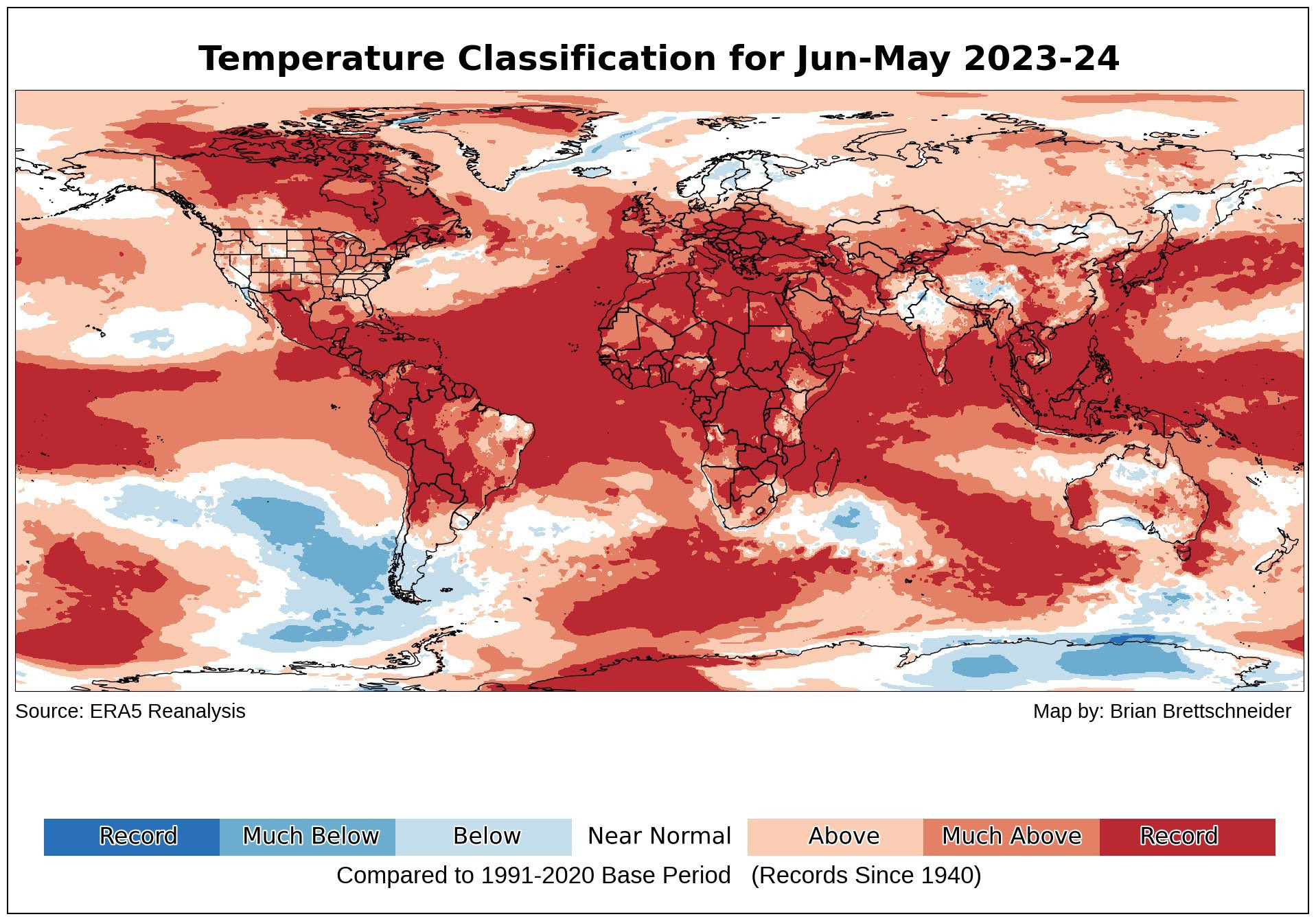
Florida is one of the states affected most by climate change. Hurricanes, flooding, and intense heat are damaging the ocean, the lakes, and the beaches, as well as the sea life and coral, while raising insurance rates and imperiling some beachfront communities. May 2024 was the hottest May on record.

Yet Governor DeSantis signed legislation downgrading the significance of “climate change,” pandering to the ignorant in his party’s base.

Some Floridians who care about science are upset.

Dan Stillman of The Washington Post reported:

Television meteorologists are usually reluctant to weigh into policy matters, instead adhering to their role as science communicators. But after Florida Gov. Ron DeSantis (R) signed a bill removing most references to climate change in state law, Steve MacLaughlin, a meteorologist for the NBC affiliate in Miami, could not restrain himself.


MacLaughlin publicly unleashed a scathing critique of the measure Saturday, earning praise from peers and perhaps paving the way for more meteorologists to speak out about the urgency of climate change action.


“As Florida is on fire, underwater and unaffordable, our state government is rolling back climate change legislation and language,” MacLaughlin wrote on X — the prelude to a passionate minute-long video explaining why he felt the measure was unwise.


“The world is looking to Florida to lead in climate change, and our government is saying that climate change is no longer the priority it once was,” MacLaughlin said in his video, which was also posted on his station’s website.

As MacLaughlin spoke, statistics appeared next to him highlighting April as the planet’s “11th straight hottest month” on record, and Wednesday’s 115-degree heat index in Key West as the city’s “hottest-feeling day on record.”


“Please keep in mind the most powerful climate change solution is the one you already have in the palm of your hands — the right to vote,” MacLaughlin continued. “And we will never tell you who to vote for, but we will tell you this: We implore you to please do your research and know that there are candidates that believe in climate change and that there are solutions, and that there are candidates that don’t.”


The legislation and MacLaughlin’s response came as numerous heat records are being set across South Florida. In Miami, the past 10 days have seen four calendar-day records for high temperature and five for heat index, according to University of Miami meteorologist Brian McNoldy.


The Florida heat wave recently reached a level 5 on Climate Central’s Climate Shift Index — the highest level — indicating “that human-caused climate change made this excessive heat at least five times more likely.”

The Washington Post reported on a meeting at Mar-a-Lago where Trump made an extraordinary offer to leaders of the oil and gas industry: you put up $1 billion for my campaign and I will roll back all Biden’s regulations that restrict drilling.

He promised to reverse all Biden’s efforts to promote clean energy and fight climate change. He said he would open the Gulf of Mexico and the Arctic to drilling. Whatever Biden has done to preserve the environment, Trump promised to void.

Trump’s response stunned several of the executives in the room overlooking the ocean: You all are wealthy enough, he said, that you should raise $1 billion to return me to the White House. At the dinner, he vowed to immediately reverse dozens of President Biden’s environmental rules and policies and stop new ones from being enacted, according to people with knowledge of the meeting, who spoke on the condition of anonymity to describe a private conversation.


Giving $1 billion would be a “deal,” Trump said, because of the taxation and regulation they would avoid thanks to him, according to the people.


Trump’s remarkably blunt and transactional pitch reveals how the former president is targeting the oil industry to finance his reelection bid. At the same time, he has turned to the industry to help shape his environmental agenda for a second term, including rollbacks of some of Biden’s signature achievements on clean energy and electric vehicles…

Texas is represented by some loathsome public officials (looking at you, Governor Abbott, Lt. Gov. Patrick, and Senator Ted Cruz). They have denounced President Biden in every imaginable way. Yet the Biden administration is sending $16 billion to Texas for clean energy and infrastructure. Texas Republicans voted against the legislation but they will gladly take the dollars and the new jobs. (All the red states are getting funds from Biden’s bills that they opposed, while taking credit for them.) And they will continue to insist that climate change is a hoax.

Chris Tomlinson writes in The Houston Chronicle:

Delivering reliable, affordable and sustainable electricity wouldn’t be difficult if officials in Austin and Washington worked together. The challenges are not technological or economic; they are about setting priorities.

Pablo Vegas, chief executive of the Electric Reliability Council of Texas, promised a new approach to grid planning on Tuesday, promising to better track the growing demand for power from industry.

“We need to accelerate aspects of our planning processes and be able to look further into the future, anticipate what’s coming, because it still takes three to six years to build transmission,” Vegas said.

The Legislature ordered ERCOT to start considering long-term proposals to add load to the grid rather than relying only on finalized plans. The new approach makes demand forecasts look much, much larger but also less reliable because not all proposed projects come to fruition.

President Joe Biden, meanwhile, is offering Texans billions of dollars to fortify the electric grid, reduce electricity bills and cut greenhouse gas emissions. On Thursday, the administration promised to upgrade 100,000 miles of transmission lines.

The Environmental Protection Agency also gave $249.7 million to the Texas Solar For All Coalition and  $156.1 million to the Clean Energy Fund of Texas this week to provide solar energy equipment to low-income communities.

The EPA has also granted $104 million in federal funds to 19 Texas school districts to purchase 288 electric school buses. The EPA grants are part of the $16 billion the federal government has committed to clean energy projects in Texas that have created 23,000 jobs.

The money comes from the Inflation Reduction Act, which Texas Republicans vehemently opposed. The massive investment in energy and manufacturing is intended to grow the economy while fighting climate change.

Past investments led Waaree Energies to invest $1 billion in a solar panel manufacturing facility near Houston, creating 1,500 jobs. San Antonio has committed $30 million to build, with federal help, the largest municipal onsite solar project in Texas. Diligence Offshore Services announced in August it would invest $1.23 billion to open an offshore wind support and manufacturing facility off the coast of Port Arthur.

Climate change, though, is still missing from Vegas’ and ERCOT’s lexicon. He’s happy to talk about the growing electricity demand from artificial intelligence and fossil fuel facilities but never mentions the residential demand during climate change-driven extreme weather. That’s what causes record-setting peaks that can trigger outages.

Nationwide, weather caused 80% of the power outages since 2000, and the frequency of blackouts has doubled in the past decade, according to data collated by research nonprofit Climate Central. Texas experienced the most weather-related outages, and the pace is accelerating.

Improving the grid to meet growing industrial electricity demand is quite different from building a system that can withstand a changing climate. Adding more power generation and transmission lines is not enough when facing stronger hurricanes, larger wildfires, colder winter storms and hotter summers.

ERCOT’s planning will remain flawed until officials start preparing for more polar vortexes like 2021’s Winter Storm Uri, rain events like Hurricane Harvey and heat waves like last summer’s.

Transitioning to clean energy and building resilient generation plants and transmission lines offer huge economic opportunities. BlackRock, the world’s largest financial manager, says the world spent $1.8 trillion on the energy transition in 2023 but will need to spend $4 trillion annually by the mid-2030s.

Vegas never mentions climate change because the Republican elected officials who oversee him call it a hoax. Texas will never chart a strong economic course until we have a governor, lieutenant governor and speaker who recognize the greatest threat yet to human prosperity….

Julian Vasquez Heilig, Provost of Eastern Michigan University, writes a blog called Cloaking Inequity. Today he proposed a new concept for a charter school that takes advantage of Michigan’s lakes to explore its environmental challenges.

He writes:

In the heart of Michigan, nestled within the vast, freshwater seas that are the Great Lakes, I’m excited that my revolutionary idea for a new charter school is taking shape. Aquatica: The Great Lakes Underwater School, is a new charter school set to launch in the fall of 2024. The school is not just a new chapter in my life and an educational innovation; it’s a bold reimagination of what a deeper learning environment can be. By submerging students in the literal depths of Lake Michigan, Aquatica aims to foster a profound connection with the natural world, leveraging the immersive power of water to enhance learning and cultivate a generation of environmental stewards.

The Vision Behind Aquatica

The vision for Aquatica was born from my desire to transcend traditional classroom boundaries, creating a space where education and the environment intersect in the most direct manner possible. In a world where ecological concerns are increasingly pressing, Aquatica stands as a beacon of innovative thought, merging the necessity of environmental education with the transformative potential of experiential learning. The school’s location in the Great Lakes near South Haven, a critical freshwater resource, underscores the urgency of its mission: to educate students not just about the world, but on how to care for it.

A Curriculum That Goes Beneath the Surface

Aquatica’s curriculum will be crafted to take full advantage of its unique underwater setting. The school will offer a holistic STEAM (Science, Technology, Engineering, Arts, and Mathematics) curriculum, enriched with a strong emphasis on environmental science and sustainability. This multidisciplinary approach ensures students receive a well-rounded education, while the unique context of learning under water provides unparalleled opportunities for deep, really deep, experiential learning.

Aquatic Sciences classes: Students have the unparalleled opportunity to study aquatic life and ecosystems up close, turning Lake Michigan into a living classroom where lessons in biology, chemistry, and environmental science come alive.

Sustainable Engineering classes: Tasked with designing solutions to real-world challenges, students apply the principles of engineering within the context of sustainability, learning the importance of creating systems that protect and preserve natural resources.

Underwater Robotics classes: By integrating technology and environmental exploration, this class empowers students to engage with the underwater world in innovative ways, fostering skills in robotics, coding, and environmental conservation.

Technological Integration for Deeper Learning

Technology plays a pivotal role in bringing my vision of Aquatica to life. Advanced technological tools, including augmented reality (AR) and virtual reality (VR), will allow students to interact with their surroundings in ways previously unimaginable. AR applications will enable learners to identify species, understand ecosystems, and conduct virtual experiments, all without leaving the underwater classroom. VR, on the other hand, will transport students to distant environments, from coral reefs across the world to the polar ice caps, expanding their understanding of global environmental issues.

Environmental Stewardship at Aquatica’s Core

At its core, Aquatica is more than just an educational institution; it’s a statement about the importance of environmental stewardship. The charter school’s design and operation are models of sustainability, utilizing renewable energy sources and minimizing its ecological footprint. More importantly, the curriculum will be designed to instill a sense of responsibility towards the environment, encouraging students to think critically about their impact on the world and empowering them to take action towards its preservation.

To learn more, open the link.