Archives for category: Elections

Michelle H. Davis of “Lone Star Left” closes out her coverage of the Texas Republican convention. Her incisive reporting demonstrates the lunacy and cruelty that now dominate Texas Republicans. Well, at least they didn’t adopt a resolution to give the death penalty to any woman who dared to have an abortion. That’s something.

She writes:

The Republican Party of Texas is a party of hate and a party of cruelty. They were built in smoky back offices and pulpits in the early 1970s on the Moral Majority and the New Right. Then, they conquered Texas through the shady legal maneuverings of Tom DeLay and Karl Rove. The men at the top built an empire of corruption and theft. Theft of our water, theft of our clean air, theft of our labor. 

Texas Republicans have long had everything they’ve wanted. For decades, the rich have gotten richer, and the poor have gotten poorer. But it’s not enough. They have to keep people voting for them somehow. Dumb down education. Appeal to the most extreme elements. That’s all they have left. 

In 1964, the John Birch Society found its moment at the Republican National Convention. Barry Goldwater didn’t fully embrace them. But he didn’t reject them either. When Nelson Rockefeller stood at that podium and named the John Birch Society alongside the Ku Klux Klan as examples of extremism that the party should refuse, the crowd booed him off the stage. Goldwater then declared, “extremism in defense of liberty is no vice.”

Goldwater was a total shit.

The Birchers never went away. And over the next sixty years, what was once considered the lunatic fringe became the Republican mainstream. The “deep state.” The “new world order.” Conspiracies about globalists, infiltrators, and enemies within. It’s the same playbook.

Which brings us to the 2026 Republican Party of Texas Convention.

The “Abolish Abortion” plank failed the final vote in the platform. That’s the one that would have handed the death penalty to any woman who received abortion care. Any woman. A minor. A rape survivor. Doesn’t matter. But don’t mistake that for a victory, because the men who stood on that convention floor and pushed for it are still on the ballot. Including: 

  • Rep. Bret Money (R-HD02). You can donate to his Democratic opponent, Fatima Muse, HERE
  • Rep. David Lowe (R-HD91). You can donate to his Democratic opponent, Yisak Worku, HERE

But what did pass on the platform? 

Banning IVF. Banning Sharia Law. 

In 2026, the Birchers write the Republican Party platform. 

Why IVF? Well, because they say this is a person:

But, actually, that ⬆️ is a mouse embryo I found on Google. But if women who are struggling with fertility are not allowed to have IVF in Texas anymore. 1- It will eventually spread to other states, and 2- what kind of repercussions will come from this? 

America already has a history of this. 

  • The Indian Adoption Project, beginning in the early 1950s, adopted Native children out primarily to non-Indian families to reduce reservation populations. By the time Congress finally acted, approximately one-third of all American Indian children had been removed from their homes. The Indian Child Welfare Act of 1978 was the legislative response, and the right has been trying to gut it ever since.
  • Between 1998 and 2008, nearly 30,000 Guatemalan-born children were adopted by US parents. The US Embassy in Guatemala knew as far back as 1995 that birth mothers’ lives were threatened if they tried to reclaim their children. Guatemala shut it down in 2008.

The Evangelical Christian adoption movement has a documented history of manufacturing an “orphan crisis” to justify removing children from living parents in developing countries. Even Erika Kirk had an orphanage in Romania, which she was later accused of sex trafficking children out of

Banning Sharia Law? 

First of all, they already tried this in the 2015 Legislative session during the last time Muslim panic swept the state of Texas. During that time, Beth Van Duyne, the then-mayor of Irving, was directly responsible for the statewide outrage and upset. This was simialar to the Muslim panic after 9/11. Maybe, not that bad. But the Republicans go back and forth between which marginalized group they hate most each year. This year, it happens to be Muslims. 

When you Google “What is Sharia Law,” you get a lot of different answers, so hear it directly from Rep. Salman Bhojani (D-HD92): 

From the Republicans’ perspective, it really boils down to ignorance and bigotry. Just like the “Show Me Your Papers” bill. Just like the DEI bans. Same rhyme, different verse. 

All the Texas transplants, pretending to be Texans

Now, don’t get me wrong, we love our transplants. They add to the vibrant culture that makes our state so unique. But nothing chaps my hide more than a bunch of dudes that moved here in their 40s rambling on about how THEY represent Texas values more than ME. Like, sirs, I have a grandfather and a great-uncle in the square the day JFK got shot, and they were both born in Dallas.

And all of these Republicans, the wealthy ones, who came here to get into politics or nepo-baby their way into their daddy’s corporation that came to Texas for the low taxes, they think the Texas spirit is all about taking as much as you can for yourself, while screwing everyone else at the bottom, and hurting anyone different from you. 

Senate Majority Leader Tan Parker, born and raised in Pittsburgh, Pennsylvania, stood at that podium and invoked the Alamo. He talked about faith, family, liberty, and the God-given right of free people to govern themselves. He said Texas is proof that freedom works. 

Parker has been rated as one of the most dangerous anti-choice legislators in Texas. He’s endorsed by both Texas Right to Life and Texas Alliance for Life. His legislative priorities in 2025 centered on capital markets packages and making Texas a hub for financial services, because when women are dying from abortion ban complications, and Texas has a maternal mortality rate that rivals that of developing nations, but Parker’s focus is on helping rich people move their money here faster. 

The man flew in from Pennsylvania, wrapped himself in the Texas flag, invoked the memory of the men who died at the Alamo, and has spent nearly two decades making life harder for the working Texans he claims to represent.

Same thing with Dannie Goober yesterday

The rest of the planks we covered mostly passed. 

The full platform will be posted on the Republican Party of Texas website in the coming weeks. Read it. Share it. Make sure every voter in your life knows exactly what these people are planning.

Because we already know what’s coming in the 90th Legislative Session. They’ve written it down for us. Frozen embryos have more rights than the mothers who made them. Muslims are the designated enemy of the cycle. A Texas that looks less like the state we love and more like the fever dream of a John Birch Society pamphlet from 1962.

They are telling us exactly who they are.

The question is whether we’re going to let them keep doing it.

We can stop them by flipping the Texas House. Democrats need a net gain of just 14 seats to break Republican control, and the candidates to do it are on the ballot right now. 

The line in the sand is at the ballot box.

The greatest mystery in Texas is why people who aren’t rich continue to elect Republicans, who do nothing for them other than to whip up culture war issues.

Michelle H. Davis reports on the latest state convention of the Texas Republican Party. You should read this to understand their thinking, or lack thereof. One candidate promises to investigate George Soros. Another asks the audience how they feel about Texas becoming a Muslim state. The big event was that hard-right Governor Greg Abbott brought an elephant to parade around, and the elephant pissed before he left the convention. Davis thought the act was symbolic of what Republicans do to ordinary Texans.

She is very witty writer. You will enjoy reading her account of the very unserious swindlers who run the state.

She writes:

Undoubtedly, by now, you’ve seen the biggest news of the Republicans’ Convention. Governor Abbott closed his speech by bringing out an elephant, which promptly peed all over the floor. It was performance art. A perfect representation of what the Republican government in Texas has been doing to the people for years. 

It’s rumored that some of the people in the front rows could hear Abbott cackle, “Ha! It’s raining,” as the incident occurred. 

Attendance for the Republican Party of Texas’ (RPT) Convention was way down. Notably, at one point yesterday, only 38 people were watching the live stream. (And one of them was me, lol.)

Then, if you follow the Texas Democratic Party on social media, you may have seen this meme they shared of Senator Bettencourt’s quote on the polling environment. 

The Convention has thus far been a disaster. Today is the final day. I’ll have the report on that tomorrow, which means we’ll be pushing out our Meet the Candidate article this week to Monday (stay tuned). Yesterday, they elected the new Chair of the Republican Party of Texas. 

D’Rinda Randall, new Republican Party of Texas Chair. 

So, this is really interesting. And it’s also a lot to unpack. First, you have to understand that the RPT elects a new Chair every two years. And by the time their cycle is up, they always have some faction against them, and they get pushed out. Abraham George is out. Before him, it was Allen West. Before him, it was James Dickey. And so on. Typically, Republicans break their own bylaws to elect their favored chair. I’m not sure if that happened this time. My emails are open. 

Randall was the Vice Chair under Abraham George. Like with the Democratic Party, the Chair and Vice Chair must be of opposite genders. Randall is the first Republican woman to chair in Texas since 2003. Stick a pin in that, we’ll circle back around. 

The Vice Chair who was elected to serve under Randall is David Covey. You may remember that Covey ran a multi-million dollar campaign against Dade Phelan (R-HD21) in 2024, had Trump’s endorsement, and still lost. He was a loser. 

Now, it’s important to understand where the Republican Party is with women’s rights in 2026. Not just women’s rights, but with women being seen as people. 

Check out this report from CBC News earlier this week at the Erika Kirk Christian National Convention in San Antonio, where a bunch of women said they were willing to give up their right to vote:

Dumb-dumbs. Who even puts that garbage in their head in the first place? The same people who add to the Legislative priorities:

  • To impose the death penalty on any woman who receives abortion care, even minors and rape survivors.
  • To ban IVF.
  • To ban all egg and sperm donation clinics.

It’s all connected. 

Don’t you find it strange that at the same time, Republican women are talking about freely giving up their right to vote, the willingness to sacrifice their lives for an ectopic pregnancy, and that all of a sudden, the Republican Party of Texas would elect its first woman in over 20 years? 

Of course, the Republican rumor mill is going wild with conspiracies. Before we jump on that bandwagon, we’ll have to see how they can cannibalize each other in the coming months. 

The keynote speakers woke up, showed up, and said nothing.

One of yesterday’s keynote speakers was Ken Paxton, and he looked awful. He might have been hungover. He shuffled out on stage, slouching, looking like he just woke up, no excitement, no energy, just, “I’m here.”

The speech itself was a masterclass in saying nothing for eight and a half minutes. Trans panic. Biden. Chuck Schumer. Open borders. The radical left. You’ve heard it. You’ve heard it a thousand times. He called James Telerico “Low T-arico,” “Sixgender Jimmy,” and “Talifreako.” He was like a middle schooler who thinks he’s the funniest kid on the bus.

He didn’t talk about the cost of living. He didn’t talk about gas prices. He didn’t talk about the rising unemployment rate. Or the increasingly difficult access to healthcare. 

Paxton, who hails from North Dakota, said the words “Texas values,” then he talked about culture war garbage. It’s hard to believe that anyone takes this man seriously. 

Or Dan Patrick, who, besides, said on stage, Talarico was going to hell, came out wearing a black pleather jacket and matching boots. 

Of course, it will never beat this jacket ⬇️, but it was a close second.

Black pleather turtleneck and matching boots, in June, in Houston, and explained, unprompted, that it was his “time travel suit.”

Sir, it is 95 degrees outside, and you look like a community theater villain.

He ran two campaign ads on the convention floor. The first one was Paul Revere warning colonists that the British were coming, except the British were James Talarico, an 8th-generation Texan, unlike Danny, who is from Maryland. The second one was the Alamo. Because nothing says “I’m in touch with modern Texas voters” like reaching back to 1836.

Then he recited the Alamo, the lyrics to a Johnny Cash song from 1960. He just said them, without rhythm, not singing them. He stood on that stage in his time-travel turtleneck, performed a Johnny Cash song, and presented it to the delegates of the Republican Party of Texas as a history lesson. It was really weird. 

He called Democrats “socialist, leftist, communist, and idiots,” in that order. He declared that the entire transgender rights movement is just a plot to make Republicans argue with each other. 

This is the Lieutenant Governor of Texas. This is a man who is one heartbeat from the governorship. This is who shows up in a pleather turtleneck and recites Johnny Cash and condemns his political opponents to eternal damnation in front of a live audience.

Texas values, from the mouth of a Marylander.

But peel back the costume and the lyrics, and you find a frightened man. He spent a big chunk of that speech begging Republicans not to stay home and doing the math out loud. Talarico starts at 45%. He only needs six more points. If Republicans aren’t unified, if rural turnout softens, if the sore losers stay home. Dan Patrick knows exactly what happens.

The man in the time travel suit is scared.

Good.

And speaking of weird. 

Mayes Middleton, for those keeping score at home, is a billionaire from Galveston who has purchased every office he has ever held. State rep. State senator. And now, Republican nominee for Attorney General of Texas, because when you have that kind of money, the next rung on the ladder is just another check to write.

You may remember Mayes from my piece on where that money actually came from.

At the Convention, Middleton took the stage and delivered what can only be described as a greatest hits collection of things that are not real problems in Texas. I don’t know what else to expect from nepobaby billionaires who have only ever harmed their own lives. He announced he will investigate George Soros on day one. He announced he will “attack Sharia law” as organized crime.

He compared Nathan Johnson and James Talarico to Santa Anna. Somehow, the Democrats are to the left of Santa Anna. He said that. Out loud. Into a microphone.

And then, because he apparently needed you to know he is a relatable family man, he told a story about his four-year-old daughter calling him “MAGA Mayes” after watching too much TV. He thought that was charming. 

His opponent, Nathan Johnson, is a Dallas state senator with a long legislative record. Middleton’s record is a checkbook. But in the Republican Party of Texas in 2026, that’s apparently enough.

The only nepo-baby more out of touch than Mayes Middleton is Bo French. Yes, also a nepo-baby. Republicans love electing men with soft hands. 

Bo French is the Republican nominee for Texas Railroad Commissioner, which, if you don’t know, regulates the oil and gas industry. It does not regulate Muslims. It does not regulate DEI. It does not regulate the Green New Deal. It regulates oil and gas.

Bo French does not appear to know this.

He asked the crowd (and this is a direct quote), “Do you want Texas to become a Muslim state?” At a Railroad Commissioner speech. He just needed you to know that was on the table. That was a concern he had about the Railroad Commission.

He cited Genesis. He cited Proverbs 14:34. He explained that God’s command to exercise dominion over the earth is actually a mandate for responsible oil and gas extraction. The Bible, Bo French has determined, is pro-drilling.

The bar was on the floor, right next to the elephant puddle.

Low attendance. A new party chair elected amid swirling conspiracies. A hungover Senate candidate workshopping middle school nicknames. A Lieutenant Governor in a pleather time travel suit who performed Johnny Cash and sent a man to hell. A billionaire who has never earned anything listing things that aren’t real problems. A Railroad Commissioner candidate who is very concerned about the Muslim takeover of oil and gas regulation. And an elephant that peed on the floor while the Governor of Texas watched.

This is a party that is performing. And the performance is getting sloppier, louder, and more desperate by the year, because underneath all of it, Dan Patrick’s math is right. They know how close this is. They know what’s coming. And they have nothing to offer the people of Texas except fear, nicknames, and Johnny Cash lyrics they didn’t write.

Meanwhile, Texans are losing farms and losing access to healthcare. Paying more for everything. And the people responsible for that spent three days in Houston talking about George Soros and Sharia law and what gender God is.

Ladies and gentlemen, I give you the 2026 Republican Party of Texas.

They’ve been pissing on you for years and calling it rain. The elephant just finally did it in front of everyone.

Scott Maxwell is a columnist for the Orlando Sentinel. In this column, he argues that voucher schools in Florida should not be allowed to dodge accountability. And, he explains, they are completely unaccountable. The state Constitution requires that the state provide high-quality education, which voucher schools do not. He neglects to notice that the state Constitution states that no public money should go to religious schools. Not a penny, but most vouchers go to religious schools.

What is more, the voters of Florida rejected an effort to strip that language from the state Vonstitution in 2012.

Scott Maxwell wrote:

Teachers and parents have filed a landmark lawsuit challenging the legality of Florida’s billion-dollar school voucher system

The argument at the heart of their suit is that Florida’s constitution requires tax dollars be spent on “high-quality” education. Yet Florida’s voucher system is a black-hole of accountability, sometimes paying for kids to go to “schools” that are total disasters — where teachers lack degrees, inflate grades and use curriculum that is rubbish.

I’m not convinced the teachers and parents will win this lawsuit. In fact, I doubt they will. Similar challenges have been unsuccessful. And Gov. Ron DeSantis has done a pretty thorough job of stacking the courts with political allies, especially at the appellate level.

But I know for a fact the teachers and parents have a point. In fact, It’s inarguable. This newspaper has spent nearly a decade documenting voucher schools that failed children.

Often, the parents themselves were shocked and outraged to learn that schools were failing their kids and that there was little to no accountability.

The Sentinel’s multi-year “Schools Without Rules” investigation into voucher (or “scholarship”) schools found some schools employed teachers that lacked any teaching credentials or college degrees.

Some were such financial disasters, they shut down in the middle of the year, stranding families. (One in Orlando was evicted from a commercial complex where a neighboring tenant was “Drug Tests R Us.”)

Some refused to serve children with disabilities, whether it was autism or reliance on a wheelchair. Even more refused to teach children who are gay or had gay parents. These were schools eager for the public money but unwilling to serve all the public. None of this was discreet. Some had written policies saying that they wouldn’t serve children with Down’s syndrome or who uttered the sentence: “I am gay.”

Some schools taught junk science and bogus history, suggesting that dinosaurs and humans roamed the earth together and downplaying slavery and segregation.

And at some schools, parents were so appalled at what they found that they reported to the state things like “Cleaning lady substituting for teacher” and “I don’t see any evidence of academics.”

If you think any of that represents “high quality” education, you might also believe the mini tacos at 7-Eleven are five-star dining.

Many private schools that accept vouchers do stellar jobs and fill niche needs that public schools have historically struggled to meet. But too many taxpayer-funded schools are total trainwrecks. And the reason is that Florida has very few standards for voucher schools.

That is, in fact, the crux of the lawsuit, which lists about 20 different things that public schools are required to do by state law, but which all voucher schools are not.

Like providing certain levels of school safety staffing and having threat-management plans in place. Offering vetted curriculum and providing transportation. Hiring qualified teachers. And publicly posting test scores from state assessments that show whether students are actually learning anything. Public schools must do all of that.

The argument from choice-without-standards supporters is that parents should be able to choose any education they want for their kids without exception.

There are two problems with that argument.
One is that no other government-funded voucher program works that way — and for good reason. We don’t let recipients of food vouchers use them on Twinkies and Mountain Dew. This is public money meant to provide nutritional sustenance. So there are guidelines. The same way there is for Medicaid and Medicare. You don’t get to spent public money that’s meant to fulfill a public purpose on anything you like just because you invoke cries of “freedom” or “choice.”

The other problem is that using this money to provide “high quality” education isn’t optional. It’s part of the Florida Constitution — a point the lawsuit addresses when it says: “… choice does not change the Constitution. When public funds are used to educate a child, that child is entitled to the same level of educational opportunities, the same quality standards, and the same basic protections.”

You can certainly make the argument that some public schools have failed some students. Do you know how we know that? Because these schools were required by law to disclose their test scores, standards, hiring practices and curriculum.
In fact, newspapers in Florida were often the ones that exposed problems at public schools.

And most anytime we did, public officials would spring to action and agree reform was needed.
Yet most every time we’ve exposed problems in taxpayer-funded voucher schools, state lawmakers leaders looked the other way.
The most pathetic part of all this is that it’s easily fixable.

Florida could still offer “choice,” but also demand that any schools that receive public money meet basic standards. Hire qualified teachers. Post the results of nationally-normed standardized test scores and graduation rates. And ban discrimination.

“To me, this is just common sense,” said Stephanie Vanos, an Orange County School Board member who also happens to be an Orlando mom and joined the lawsuit as a plaintiff in that capacity. “I’m not saying they need the thousands of pages of rules that apply to us, but we need a common-sense set of rules that should apply to everybody.”

She is, of course, right. Schools that do good jobs shouldn’t be afraid of accountability and transparency. Most aren’t.

In fact, ask yourself these basic questions:
Why shouldn’t parents and students be guaranteed qualified teachers?

Why shouldn’t taxpayers be able to see what kind of test scores are being produced at all the schools they’re funding?

And why shouldn’t taxpayers be assured that the money they’re spending is actually providing “quality” education, as the Constitution requires?
Better yet, ask those who defend the status quo.

Sonja Shaw, a right-wing school board president, came in first in the race for State Superintendent of Public Instruction in the recent election in California. She received 25% of the vote and is heading for a run-off against Richard Berrara, also a school board president, who received about 19% of the vote.

Shaw was supported by the far-right group Moms for Liberty. She was been outspoken in opposing transgender athletes who compete against females.

Howard Blume wrote in The Los Angeles Times:

Sonja Shaw — a Trump-aligned Republican whose public profile rose as she became identified with culture-war causes, including banning transgender athletes from girls’ sports — has emerged as the leading vote-getter in the June primary for California’s superintendent of public instruction.

With all precincts at least partially reporting Wednesday, Shaw, with 24.9% of the tallied votes, was well ahead of Democrat Richard Barrera, who had 18.9% of the votes. Even with vote-counting ongoing, that lead would be difficult to surmount.

Both Shaw, 43, and Barrera, 59, are school board presidents.

Shaw heads the elected Board of Education for Chino Valley Unified in San Bernardino County, a diverse but substantially conservative inland portion of Southern California…

Among its high-profile actions, the Chino Valley board majority put forward a policy that would require parents to be notified if their child expressed gender-identity issues at school. Shaw and her allies also approved a policy that allows parents to challenge the content of library books.

In the primary, Shaw was greatly helped by a candidate field that included seven Democrats, including veteran legislators and local school district officials…

Barrera heads the school board of San Diego Unified, the state’s second-largest school district, serving an area with liberal leanings, but that is also politically diverse.

An obvious difference for Barrera was a $5-million independent campaign on his behalf from the California Teachers Assn., which he acknowledged Wednesday morning.

“The CTA campaign made all the difference and it’s based on a long track record and partnership that I’ve had with educators in San Diego,” Barrera said.

Barrera sees the teachers union support as emblematic of a positive vision he has for education that will unite most voters around his campaign in November…

Positioned in a runoff against one Democrat — in a state where Democrats dominate — makes for a challenging campaign for Shaw.
“Tonight is not the finish line,” Shaw said. “It’s the beginning of the final stretch.”

Mike DeGuire, retired Denver educator, warned Coloradans that the usual billionaires are lining up behind Mike Bennett for the Democratic nomination for Governor. Bennett is currently a Senator but previously was Superintendent of Schools in Denver, where he promoted the NCLB agenda of test-and-punish, charters schools, and corporate reform. He never was an educator so he swallowed corporate reform hook, line, and sinker.

DeGuire wrote:

Colorado’s Democratic primary for governor between Attorney General Phil Weiser and U.S. Sen. Michael Bennet is heating up. TV ads are everywhere, and social media is abuzz with supporters extolling their favorite candidate’s strengths or the opponent’s weaknesses. Colorado has elected only one Republican governor in 50 years, so many pundits believe whoever wins the Democratic primary will likely win the November election. 

Money is becoming a big factor in this campaign. Bennet has a distinct advantage thus far, primarily due to one group of funders: billionaires. More than half of Bennet’s super PAC donations are from billionaires, individuals and groups affiliated with organizations run by billionaires, and from a “dark money” group. Research shows that billionaires “are swaying elections all across America.”

As of the May 18 filing deadline, Bennet had over $11.5 million in total donations compared to Weiser’s $7 million. Over $7 million of Bennet’s money is from his super PAC, Rocky Mountain Way, which includes over $1 million from an independent expenditure dark money organization called Brighter Future for Colorado. Weiser has $1.1 million from his super PAC, Fighting for Colorado, and just over $6 million from individual donations.

Michael Bloomberg is the 18th richest man in the world with a net worth of over $109 billion, and he is the largest individual donor to Bennet’s super PAC, giving $2.5 million thus far. But he is not the only billionaire donor in Bennet’s camp. These billionaires also contributed to Bennet’s super PAC: Steve Mandel and his wife ($175,000,); Tench Coxe and his wife ($100,000); Edythe Broad ($3,000); Marc Heising ($75,000); Eric Mindich ($25,000); Deborah Simon ($25,000); and Robert Fanch ($25,938).

In addition to the billionaires’ money, over a dozen hedge fund managers and venture capitalists contributed between $10,000 and $100,000 each to Bennet’s super PAC. The ultra-wealthy use their donations to gain loyalty from candidates who will enact policies that align with their values and protect their wealth through tax breaks, financial incentives and limited regulations on their corporations. They also use nonprofit foundations to fund organizations they support philosophically. 

Tax filings published by ProPublica for the years 2022-24 show that billionaires Reed Hastings and John Arnold used their nonprofit, City Fund, to give money to Denver Families for Public Schools, which contributed $45,000 to Bennet. The former CEO of City Fund, Neerav Kingsland, donated $2,000. The Bloomberg Family Foundation donated millions to the Charter School Growth Fund. That nonprofit also funds the Colorado League of Charter Schools which, along with 50Can and Stand for Children, gave $470,000 to Bennet’s super PAC. Bloomberg’s dark money group, the American Opportunity Action, gave $45,000. The total investment from Bloomberg and other billionaire-funded nonprofits surpasses $3 million. 

Bloomberg’s support for Bennet’s candidacy reflects a relationship and shared philosophy on education reform that stretches back nearly two decades. Before Bennet entered the U.S. Senate, he served as Denver’ school superintendent from 2005 to 2009, the same time that Bloomberg was serving as New York mayor, where he had control of the city’s schools. Like Bennet, Bloomberg promoted corporate education reforms, oversaw the expansion of charter schools, test-based accountability systems, and market-oriented policies. 

Both Bennet and Bloomberg ran for president in 2020. Bloomberg spent over $37 million of his own money on his unsuccessful campaign. Bennet received money for his candidacy from over 32 billionaires who were hedging their bets on who would eventually win the party’s nomination. Several billionaires supporting Bennet for president included some of the richest people in Colorado: the Ergen family, Pat Stryker and Ken Tuchman.

While Bloomberg often wins when he donates money to candidates, there are exceptions. Last year, Bloomberg joined with 26 other billionaires to support former Gov. Andrew Cuomo in the New York mayoral race, donating $13 million to his campaign. New Yorkers resoundingly said no to the billionaire money and elected Zohran Mamdani. 

The money involved so far in this year’s gubernatorial Democratic primary pales in comparison to the $34 million spent in the last contested Colorado Democratic primary, in 2018.Many observers believe that Gov. Jared Polis basically bought the governor’s seat by contributingmore than $22 million of his own money to defeat three other candidates. Bloomberg was also involved in the 2018 gubernatorial race, donating $2 million to Mike Johnston who came in third to Polis. Five years later, Bloomberg helped Johnston win his 2023 race for Denver mayor when he and another billionaire, Reid Hoffman, donated nearly $2 million to Johnston’s election. 

Ballots drop June 8 for the June 30 Democratic primary. Will the independent and Democratic voters buck the trend of billionaires swaying elections and elect Weiser, or will this billionaire investment pay off for Bennet? 

Timothy Snyder is an expert on European history. He taught for many years at Yale University and held a prestigious chair in European history. In 2025, he accepted a chair at the University of Toronto. His Substack blog is titled “Thinking About…” This important essay appeared in May 9. Nothing Snyder says here has changed.

He wrote:

The United States has just spent billions of dollars to lose a war that enriches its oligarchs, impoverishes the citizenry, sabotages its alliances, and strengthens its enemies. As justification for the self-destructive mindlessness, the White House gestures towards Jesus and genocide.

On April 20th I was asked to speak in New York about ethics and power. My thinking, which I expressed in a conversation at the Council on Foreign Relations, on this little video, and in the media, was that our utterly unethical war was also utterly self-destructive. The war, a catastrophe in itself, suggests the guiding principle of Trump foreign policy: superpower suicide. The term was since come into more general use, and readers have been asking me to spell it out.

Empires have risen and failed before, but to my knowledge no state has ever chosen to kill its own power, and succeeded with such rapidity.

It is hard to see this clearly. Even as we oppose individual Trump adventures, we hope that in some way they are based on some understanding of the national interest. They are not. To get the perspective we need to see the nature of this anti-strategic self-slaughter, it will help to consider thirteen traditional bases of state power.

1. Statehood. A superpower must, at a minimum, be a modern state. This means that it must be an arrangement that includes, via law and other institutions, a larger body of citizens within a common endeavor. There is no sign that the Trump administration regards the United States of America as a state. It treats the existence of the United States as a commercial opportunity for a select few people, American and otherwise.

2. National interest. Another minimal requirement of superpower would be a sense of why that power must be used. The Trump administration exhibits no interest in the good of the people. Theorists of international relations have differed as to how leaders understand national interests; we are intellectually unprepared, however, for a situation in which the leader simply does not care about either the state or the nation.

3. Succession. Again, for a state to maintain itself as a superpower, it must maintain itself over time. The basic requirement of such continuity is a succession principle, a means by which authority is transferred from some people to other people while institutions continue to function. In the United States, democracy enables succession. Historically, there are means of succession, for example by dynasty (or dynastic adoption, as in second-century Rome) or by the decision of a politburo, as in China or the USSR (in the US this would be a capitalist politburo, the sort of oligarchical coven that got us JD Vance). Getting from democracy to such different arrangements would end the American republic. Trump aspires to stay in power indefinitely, and says so. By putting the vote in question, he puts America in question, and thus American power.

4. Elites. For states to thrive and to accumulate and maintain power, the right people have to be in charge. There is no perfect means to achieve this, and there is the inevitable tension, as the Roman Stoics and others have noted, between the skills needed to rise to the top and those suited to serving some general interest. And those who rise to a position of authority will try to pass it on to their children; the Roman Catholic Church went to the extreme of insisting on priestly celibacy to block this tendency. Historically, powerful states seek ways to enable qualified people to serve in positions of authority, regardless of birth. Ancient China had an examination system. Napoleon established the principle of merit in both civilian and military life. The United States had a civil service that was the envy of the world as well as a military that was its most meritocratic institution. The Trump administration has chosen to disable the civil service and to purge the military command of people of quality. This process has been carried out by people who are themselves wildly unqualified to hold any sort of office, let along cabinet positions. To see where we are, we must understand that people such as Tulsi Gabbard, Kash Patel, and Pete Hegseth, about whom one might raise other objections, had no business accepting their nominations, since they lack any qualifications. The fact that such people could be considered, let alone appointed, is a marker of superpower suicide.

5. Education. In a deeper sense, a superpower must have a mechanism to refresh its society, and thus its politics and administration, by preparing its population to understand the challenges of the world. This administration has done the contrary. University students are forbidden to gather and to speak their minds; university administrations are threatened with retaliation if they allow their faculty to teach freely; libraries around the country, including in military academies, are purged of useful books; public education generally is replaced with scams whereby tax money is transferred from the poorer to the richer while schools themselves are starved; an unregulated internet is allowed and indeed encouraged to transform the public sphere into a realm of emotions and recriminations.

6. Science. The rise of great powers often involves an alliance between politics and science. The ancient Mesopotamians were astronomers whose systems of describing the heavens still mark our ways of thought; so were the Mayans. The Romans managed to operationalize Greek science to build, defend, and cure. The Renaissance was, by no coincidence, also the age of exploration. Modern imperial powers built state institutions to fund science and attract scientists; the United States from the 1940s was the outstanding example of this trend, and science (often as practiced by immigrants) was the most important basis of American superpower. Current American policy is to fund science on the basis of primitive ideological taboos, and to discourage young scientists from immigrating to the United States. Senior scientists are also leaving; a colleague in a central position in US science just told me that he is leaving the country in part because the overall environment is better in other places. It is also US policy to cast doubt on basic scientific observations, such as that of human-caused climate change.

7. Energy. Human groups that pioneer new forms of energy technology rise; those that do not fall. This might be the most profound truth of our history; a magnificent forthcoming bookdemonstrates the significance of energy transitions at the most profound level, that of the history of life on earth itself. Humans who mastered fire could consume more energy themselves. Humans who domesticated dogs could use their energy to hunt mammoths. Humans who domesticated plants could turn solar energy to their own purposes. Humans who understood weather and climate could turn wind energy to the purpose of exploration and conquest, as did the Vikings. The United States was established on the cusp of a transition to hydrocarbon energy: coal, oil, natural gas. These forms of energy are now becoming obsolete, not only in ecological but also in economic terms. And yet this administration has chosen to cancel America’s energy transition and subsidize technologies that have no future. This is superpower suicide in perhaps the most basic form. And nothing could benefit America’s chief rival, China, more than this choice.

8. Technology. It requires little effort to associate technology with the rise of great powers. Military achievement is associated intimately with innovation; from the spur to the machine gun, the causal relationship is not really contestable. While the United States spends gigantic amounts of money on weaponry, the Trump administration has chosen to focus on weapons from the past rather than of the future. Trump’s idea is battleships named after himself based on what he remembers of a movie. The plans for “Trump-class” battleships are a mixture of the fictional and the vulnerable, which does reflect the man. The notion is to invest untold amounts of money into a kind of weapon has been understood to be obsolete since 1943, and which if somehow built would be highly vulnerable to weapons other countries now have. This strategic atavism draws the United States away from national security in its most basic sense. The shape of modern warfare is revealed by the high-tech war between Russia and Ukraine, especially in Ukraine’s successful self-defense. The Trump administration chose to ignore the lessons of that war and to demean and defund America’s Ukrainian ally, to the detriment of American interests and American warfighting.

9. Diplomacy. This art, celebrated by great powers, has been trashed by the United States. It cannot be practiced without understanding other countries, as the most focused American diplomats have stressed (for example, Henry Kissinger, who can hardly be excused of softheartedness). It has rested, in the American and other cases, on the deliberate construction of a diplomatic corps where people train in languages and trade in knowledge. Under the Trump administration, the foreign service has been trashed. The principle of diplomacy, such as it is, is that other countries will do what we want because we are big and bad. This has not worked. The bizarre notion that the president can himself “make deals” is the sign of a religious cult; like most cults, its activity is the generation of ever more creative excuses for the lack of performance. There is no evidence that Trump knows how to negotiate, and abundant evidence that he does not: for example, defeat in trade wars with China; personal vulnerability to the preferences of Russian leaders, and the disaster of Iranian nuclear enrichment, of which Trump himself is the chief sponsor. In practice, critical negotiations, with Iran and elsewhere, have been put in the hands of two people, Steve Witkoff and Jared Kushner, with close personal relationships with the president and obvious economic stakes in the relevant conflicts. The diplomacy of the Huns was far more sophisticated than this. It is hard to overstate how primitive the current American approach is, and how much joy it brings to America’s enemies.

10. Alliances. Great powers have allies. To be sure, they might change these alliances rapidly for reasons of interest, as the East Roman (Byzantine) Empire famously did. The whole history of the Roman Empire, for that matter, was one of active diplomacy with neighboring barbarians (as the Romans saw matters); archaeology bears witness to the arrangements that were made. The history of modern European empires was also one considered alliances, as the architects of American superpower understood. Under the Trump administration, useful allies are mocked and marginalized for no reason other than personal whimsy and a sense of grievance. Because there is no sense of state or national interest, there can be no understanding that alliances are of service. Trump feels annoyed because he is losing a war and removes US troops from Germany; those troops are there to enable the United States to win wars. I personally cannot think of any other example in which the leaders of a great power behaved in this way, presumably because these kinds of choices are inconsistent with the maintenance of power. The United States now seems to be treating as “allies” middle eastern countries that have nothing to offer except their own interests in the use of American armed forces in their own region, permanent engagement in the disastrous politics of oil, and financial opportunities for people personally close to Trump.

11. The international system. Postwar America did something far more impressive than build a system of alliances; it essentially created a set of laws, rules, and norms that allowed American power to maintain itself and to expand. The European Union and NATO, so abused by the Trump people today, were indirect and direct results of American policies intelligently designed to maximize American trade and security interests. But the achievement was far broader than that, and indeed historically unprecedented: the construction of laws and conventions that kept one country in the center of the world. Today, the Trump people make themselves at the World Economic Forum, the Munich Security Conference and similar gatherings and complaining that the rules are against them — the exact opposite was the case, because America made the rules. In deliberately destroying its own international system, this American government is improving the position of its rivals China and Russia, who have been calling for exactly this to happen, but who lacked the ability to make it happen.

12. The idea of victory. A superpower wins in confrontations, at least some of the time. This administration loses again and again, and is seen to lose by others. Trump announced that his main weapon of influence would be tariffs, but then lost his trade war with China, leaving Beijing more powerful and more emboldened. The Russo-Ukrainian war is a curious case. It would serve the interests of the United States in prosperity and stability for Ukraine to win; but under Trump the United States has switched its policy to one of support for Ukraine to support for Russia. So it has lost in that way. But since the United States has made that pivot, Ukraine has performed ever better in the war, and Russia has performed worse. And so the United States, amazingly, has managed to be the loser in the same war a double sense: by failing to see its own interests, and then by failing to fail. The Iranian war is an obvious strategic defeat in every traditional sense; insofar as there were any American objectives, they were not achieved. Trump’s policies have left Iran with more enriched uranium in the hands of a more radical regime which holds new sources of economic power in the world. In the current situation, in which military options have been self-humiliatingly exhausted, the useful instruments would be those that involved communicating with the Iranian people or influencing Iranian society. Those institutions existed until very recently; they were willfully demolished, to great fanfare, in early 2026.

The United States is now governed by people who celebrate defeat in symbolic terms characteristic of states in disastrous decline. Consider Defense Secretary Hegseth’s description of the rescue of a US pilot as the resurrection of Jesus. The screaming blasphemy of this might distract us from its strategic helplessness. Christological images of this sort are used as propaganda to transform defeat in the real world into victory in some imaginary one. The US lost the war in Iran. Among other things it was not able to sustain an air campaign. The downing of a US fighter meant than an individual mission failed. It is happy news, of course, that the pilot survived. But the notion that this was a “literal miracle,” as Hegseth claimed, brings the United States, sadly, into the tradition of losers who use Jesus to claim to be winners. An historical example of this was Polish Romanticism, with its idea that the collapse of a republic (chiefly due to wealth inequality) made of Poland the “Christ of Nations.” Donald Trump’s own self-deification has to be seen in similar terms: a president who could assert power in this world would not have to claim that his real authority comes from another one. His fantasies of the total destruction of Iranian civilization are part of an apocalyptic panorama that is inconsistent with decent politics.

13. Finances. Though not the most interesting historical subject, budget disaster stands behind many of the most notable collapses of state power, ancient and modern. Under Trump our national debt now approaches $40 trillion. National debt is higher than GDP of the country for the first time since the end of the Second World War. That is a notable point of comparison: it is normal to run big deficits when facing the challenge of the scale of a world war. We are running huge deficits for an entirely different reason: because we decline to tax wealthy individuals and corporations. That is not an approach that is consistent with fighting and winning wars, nor with maintaining the social services that allow a modern society to function. More profoundly: it reflects an approach to politics — government as customer service to the very wealthy — that leads us from power to ethics.

The war can lead us to a diagnosis of superpower suicide. Wars cannot be won by people who have no idea what they are doing, because they have no frame of reference (such as the nation or the state) beyond their own feelings. They cannot be fought well when the wrong people are making the daily decisions and the wrong weapons are being deployed. They cannot be reasonably brought to an end when there is no practice of diplomacy and no notion of the value of alliances and no concern about corruption.

But even a strict focus on power will lead us back to justice. But just as the war is only a symptom of superpower suicide, so superpower suicide is only a symptom of a still deeper condition, the one that must be addressed.

Even if all we cared about were American power, we would have to ask ourselves how to undo the distortions of democracy and the drastic inequalities of that enabled world-historical levels of strategic buffoonery. After a year of Trump, we face a situation where reform and repair are not the relevant categories. And, in a certain sense, this is useful. The fact that we reached this point, the fact that just a year of Trump could bring superpower suicide, shows us that the prior status quo was unsustainable.

The systems that made the United States a superpower cannot be rebuilt as they were, nor should they be: they involved structural injustices that made the present attempt at self-annihilation possible. From where we stand now there are two ways forward: one is the self-induced downfall of the American republic; the other is to reconsider American ideals and to restructure American politics so as to bring the people greater power over a more just future.

*****

PS. If you would like to help Ukrainians defend themselves from Russia’s criminal war of aggression, please consider contributing to the Sky Defense campaign. For worse but also for better, as the Ukrainians have shown us, this is a time when civil society campaigns can contribute to general security.

Trump has spent a lot of time rescuing, pardoning and trying to reward the people who joined him in attempting to overturn his election loss in 2020. He is a giant baby. He is a sore loser. He lost decisively, and he refuses to accept it. More than 60 federal and state courts, including the U.S. Supreme Court, rejected his appeals because there was no evidence of election fraud.

Someday, with time, we will look back on Trump’s refusal to accept his defeat as a low point in our history. Of course, we will look at his two terms in office as the absolute nadir of our history, as a time he spent rolling back civil rights, environmental protections, international alliances, access to healthcare, defunding medical and scientific research, bullying universities, and censoring the mass media.

Trump bullied Governor Jard Polis of Colorado to free Tina Peters, and Polis succumbed:

Tina Peters, the former clerk convicted of participating in a scheme to chase election conspiracy theories promulgated by President Donald Trump, was released from prison Monday after the president successfully pressured Colorado’s Democratic governor into commuting her sentence.

Peters’ release was confirmed by the Colorado Department of Corrections. The state agency said it would have no more information about the 70-year-old inmate. Her sentence was shortened by Gov. Jared Polis last month after Trump waged a lengthy pressure campaign against the governor and his state.

Peters served less than a quarter of her nine-year sentence.

Peters was the first local election official to be charged with breaching security after the 2020 election. She snuck in an outside computer expert affiliated with My Pillow Chief Executive Mike Lindell — who himself denied that Trump lost the White House in 2020 — and the person copied the county’s Dominion Voting Systems computer server as it was updated in 2021.

Peters then joined Lindell onstage at a “cybersymposium” that promised to reveal proof that the election was rigged. Video and photos of the computer system upgrade, including passwords, were posted online. The move stoked false claims that voting machines were manipulated to steal the election from Trump.

Peters was convicted in 2024 of attempting to influence a public servant, conspiracy to commit criminal impersonation, violation of duty and other crimes by jurors in Mesa County, a Republican stronghold that supported Trump. An appeals court upheld her conviction in April, but ordered Peters to be resentenced because it said the judge who sent her to prison wrongly punished her for speaking out about election fraud.

Trump had championed Peters’ case, but because she was convicted under state law, he did not have the power to pardon her. Instead, the president pressured Polis to do so, lambasting him on social media and disinviting him to a White House meeting with other governors. The Trump administration also announced plans to dismantle the National Center for Atmospheric Research in Colorado and relocated the U.S. Space Command to Alabama.

Polis commuted Peters’ sentence on May 15. In a letter, he wrote that although Peters was convicted of serious crimes and deserved to spend time in prison, the sentence was “extremely unusual and lengthy” for a first-time non-violent offender.

Colorado Secretary of State Jena Griswold, a Democrat, called the move a “dark day for democracy” and said it amounted to “selling out our state’s justice system for Trump.”

The editorial board of The Dallas Morning News is conservative. But it is not MAGA. It does not traffic in lies and conspiracy theories. It adheres to a basic standard of civility, the kind that enabled members of different parties to compromise and occasionally agree on bipartisan legislation. Not now, but not so many years ago.

This is the editorial board’s view of the primaries on Tuesday.

Well, that was telling.  

Given a choice between John Cornyn, a man who spent his career governing as an honest, deeply conservative representative, or Ken Paxton, a man whose personal and professional dishonesty is so manifest that the mother of his own children can’t endorse him, Texas Republicans said, “we’ll take the second guy.” 

It somehow gets worse. Given the choice between Jim Wright, an experienced railroad commissioner who openly favored the oil and gas industry, or Bo French, a conspiracy-mongering bigot, Texas Republicans said, “give us the bigot.” 

We would set up the same comparison for the Texas attorney general runoff between “MAGA” Mayes Middleton and Chip Roy, except we wouldn’t know who to compare as the better of the two. Both debased themselves as lickspittles of the president while doing all they can to drive division against immigrants, Muslims and any other group they could demonize to stir fear and hatred as a path to power. 

What happened Tuesday night in Texas tells us so much about what the deep base of the Texas Republican Party has become. It should shock every person of good conscience and be an awakening for conservatives who still believe this party and its current leadership can serve the traditions of independence and liberty that Texas was founded upon. 

Because it’s Ken Paxton’s Texas GOP now. It’s Trump’s Texas. Remember that Paxton is the man Lt. Gov. Dan Patrick saved from what looked like certain conviction in an impeachment trial right after a $1 million donation and $2 million loan from West Texas Christian conservatives flowed Patrick’s way. This is the man whose top deputies, people who devoted their lives to movement conservatism, decided he was so corrupt they abandoned their careers to alert law enforcement. This is a man who pretends to be the moral authority of this state even after his wife filed for divorce on “biblical grounds.” Read that as infidelity. That’s your Texas Republican Party now. 

Regular readers of this page hopefully know a few things about us by now.  

We seek to support a thoughtful conservatism grounded in limited government, the expansion of free enterprise, the power of capital to lift people into wealth, the fundamental importance of faith and family to living a good life, a belief in an ordered society where laws are respected and enforced from the border to Main Street, and a strong suspicion of movements that would upend the traditions that have defined our country and our common humanity for generations. 

We hope for a democracy where good, if imperfect, people with different points of view are elected, take office and find ways to work out their differences through compromise that respects both the majority’s will and the minority’s rights. 

We believe the founders of our nation and our state would have wanted nothing less. That was the sort of natural freedom they sought to enshrine, a freedom rooted in the protection of individual rights and the promotion of shared responsibility for democratic norms and a basic decency toward one another. 

The people who are being elected to represent Republicans in this state cannot represent that sort of conservatism. They cannot represent the values that a majority of Texans believe in. 

Don’t take our word for it. Take theirs. Paxton and Middleton have told us repeatedly where their loyalty lies. It is not to the people of the state they seek to represent. It is to a man who governs not on the basis of conservative principles but on his daily whims. This is the fundamental promise these candidates have made to Texas voters. We will do whatever President Donald Trump tells us to do. 

John Cornyn tried to play this game. We can’t help but believe he will spend a lot of days in regret for what the end of his political career looks like. He did all he could to appease the president’s ego, and it wasn’t enough. So many good conservatives have had to learn the hard way that it is never enough. He will take and take until there is nothing left.  

We try to imagine one of the men who founded this state, one of those who rode into Texas when it was still a wild and dangerous land where people had the thought that, if they could survive, they could prosper. We try to imagine the sacrifices along the way, the hard winters and blistering summers. The decision to fight for independence from Mexico. The stubborn streak of self-reliance and persistent belief that Texas is still, somehow, its own place. 

None of that squares with who these men are. The men who won the GOP’s nomination Tuesday night are not their own men. They are, by their own admission, wholly servile. It is their entire political identity. The tough talk veneer goes only as far as Trump will let them go. There is nothing in them that is independent, that is their own, that is Texan. 

We know that most of the people who cast their ballots for Paxton, Middleton and French don’t give a fig what this page says. So many of them long ago tuned out people who still insist on asking questions, who see places for compromise, who believe our neighbors who might be a little different from us are still our neighbors, deserving of our respect and love. 

There is a word for what happened in this state Tuesday, and that is shameful. 

Texas deserves better than people who truck in lies and bigotry. But that’s what we got. 

Where we go from here is hard to say.  

My observations:

If there are enough old/fashioned, principled Republicans and independents, Texas has a good chance of turning blue. At the top of the Democratic ticket are two excellent candidates: James Talarico for the U.S. Senate and Gina Hinojosa for Governor.

Texans need fresh leadership. It needs leaders who have not been bought by oil money and White Christian nationalists. It needs leaders who want to solve problems, not engage in bigotry and culture wars.

Talarico would bring a fresh air of honesty and candor to D.C. and a deep commitment to improving the lives of working people and those in need. Hinojosa has the same commitment to helping those who need help and a passionate commitment to public schools. Her own children are public school students. Like many states, Texas has underfunded its public schools and its teachers. Hinojosa understands that Texas needs to educate all its children well. That’s at the top of her agenda.

Talarico and Hinojosa have a chance to change Texas. They represent youth and the future.

Jonathan V. Last of The Bulwark explained why Trump’s $1.776 billion slush is such a powerful tool for a crafty mob/boss.

Last wrote:

We’ve been thinking too narrowly about the $1.776 billion pot of taxpayer money that Donald Trump will soon control.

Most people assumed Trump would use it to pay off meathead insurrectionists, sort of a . . . treason stimulus.

Absolute gold.

Others believed that while Dummkopf MAGA might get a couple bucks here and there, the real money would be funneled to Trump family members and organizations.

But the Slush Fund from Hell—or whatever we’re calling it—is much more useful than any of that. It’s a multitool for corruption and maintaining MAGA discipline. Let me explain.


You have to respect Trump as an innovator. He saw that private lawsuits could be used as a way to legalize bribery and extortion—that’s what his defamation suits against CBS and ABC were.¹

Trump understood that while it might be illegal to go to CBS and ABC and demand that they pay him protection money, he could use a civil lawsuit as justification for creating a private legal contract that amounted to the same thing.

He further understood that if he filed a civil suit against the U.S. government and then became president, he could direct the government to settle with him on whatever terms he desired.

These are ideas which seem to have occurred to no one in American history prior to Trump. When it comes to corruption, the man knows how to think laterally.

So what sort of lateral uses could he make of a $1.776 billion fund which he controls completely? There are two big ones.


The obvious one is bribery. As we discussed last week, Trump can turn the fund into fee-for-service. You give him a thing he wants—a vote, a certification, a report—and then you get compensated at a later date.

But the subtle one is something else altogether. It’s about holding people on side.


One of the striking design details about the fund is that it disappears just before Trump leaves office. It is sunset so that it can never be directed by anyone other than Trump.

Think about how this is likely to work in practice.

If you were Trump, would you pay out money before your last days in office? 

Because I would not.

The optimum strategy is for Trump to pay a couple people early, just to validate the fund’s existence. After that he should encourage anyone and everyone to apply for compensation. And then he should wait.

Because open applications give him leverage over people.

As a for-instance: Two days ago Mike Flynn almost criticized Trump about making a deal with Iran. Do you think people will be willing to do even that much if they have compensation applications pending that could be worth millions of dollars?


Another reason Trump should wait to disburse funds is that he can implicitly promise to pay more than $1.776 billion. Think about it: $1.776 billion is a lot of money, but it’s only 1,700 million-dollar portions. If Trump starts paying people right away, the fund gets drawn down and people start to realize that maybe they won’t get anything from it.

But if the nut is largely intact, everyone in MAGA world can dream. Trump can pass out tens of billions of dollars worth of promises—Don’t worry, we’ll take care of you; you just have to wait a little bit longer—with everyone thinking that, since he’s going to pay up at the very end, there’s enough cash for them to get theirs.


Second-term presidents become politically weak when members of their party realize that their incentives are diverging from the POTUS.

Maybe the POTUS is becoming unpopular, so candidates need to distance themselves from him. Maybe party elites are thinking about the future and how to take over once the old man is gone.

The slush fund is a tool to fix that problem. It’s the promise of a tangible reward for Republicans to stay on his side. Be nice to him. Do what he asks. Don’t freelance. And maybe there’s a pot of gold for you at the end of the rainbow.


The slush fund won’t work on everyone. Some Republicans will be secure enough that they don’t need Trump’s money. Some will be ambitious enough that they’re willing to forgo the uncertain promise of a payout for a shot at the title.

But it’ll work for some of them. It will encourage them to modulate what they say. And within the rest of the Republican ecosystem, having more people on-side than there otherwise would be will have a force-multiplier effect. Seeing people stick with Trump will cause more people to stick with Trump.

Watch what happens in the coming days with the Iran deal. See how many defections there are. And then ask yourself: How many of those people who suddenly get with the program are hoping to apply for some compensation from their president?

The U.S. Supreme Court was designed to be a separate branch of government, the one that monitored the adherence to the Constitution by the other two branches. The Court disappoints sometimes, but it has never been as nakedly partisan as it is under Chief Justice John Roberts. The far-right wing of the Republican Party has a reliable friend at the Court.

It’s hard to say which of their decisions is the worst.

Some might say it was their recent decision to overturn the Voting Rights Act, which will sharply reduce the number of Black members of Congress.

Some might say it was their decision to overturn Roe v. Wade, despite promises by most of them not to do so.

Some would say it is their decisions that tear down the wall of separation between church and state.

I say it was their decision in Trump v. United States, in which the majority decided that the president was above the law and could not be charged for anything he did while in office as part of his official duties. We can be certain that the same court would claim that whatever he did was part of his official duties, including tearing down the East Wing of the White House without seeking anyone’s approval.

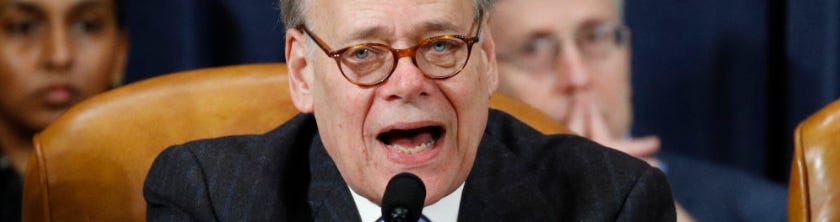
Representative Steve Cohen of Tennessee has had enough. He introduced six articles of impeachment of Chief Justice John Roberts. Good for him!

Scott Dworkin reported on his blog:

Rep. Steve Cohen

Rep. Steve Cohen has represented Memphis, Tennessee, for 19 years. Republicans cut his district into pieces, and he decided to retire—but not without a fight.

Cohen told The Dworkin Report in 2019: “[Trump’s] life has been one crime after another. One misdeed after another. One lie after another.” Now he’s applied that same standard to the man who put Trump above the law.

On May 21, Cohen introduced six articles of impeachment against Chief Justice John Roberts. Charges include allowing the Court to become a partisan weapon, placing the president above the law, endorsing a corrupt campaign finance system, and failing to recuse himself while his wife collected millions recruiting attorneys for law firms with cases before the Court.

Cohen was direct: “Under Chief Justice Roberts’ stewardship, [The Supreme Court] is now understood as biased: with decisions designed to benefit Republicans at the expense of representative government.”

They gerrymandered Cohen’s district to silence him. John Roberts now has six articles of impeachment to his name—an award no other Chief Justice has ever received in US history.