Archives for category: Elections

John Merrow was the education correspondent for PBS for many years. Now, in retirement, he continues to write and help us think through the existential moments in which we live.

He writes:

More than five million demonstrators in about 2000 communities stepped forward to declare their opposition to Donald Trump, on June 14th. “No Kings Day” was also Trump’s 79th birthday, Flag Day, and the anniversary of the creation of the American army.

So now we know what many of us are against, but the central question remains unanswered: What do we stand FOR? What do we believe in?

Just as FDR called for Four Freedoms, the Democratic party needs to articulate its First Principles.  I suggest three: “The Public Good,” “Individual Rights,” and “Rebuilding America after Trump.” 

 THE PUBLIC GOOD: Democrats must take our nation’s motto, E pluribus unum, seriously, and they must vigorously support the common good.  That means supporting public libraries, public parks, public schools, public transportation, public health, public safety, public broadcasting, and public spaces–almost anything that has the word ‘public’ in it.

INDIVIDUAL RIGHTS: Because the fundamental rights that are guaranteed in our Constitution are often subject to interpretation, debate, and even violent disagreement, Democrats must be clear.  Free speech, freedom of worship, habeas corpus, and other fundamental rights are not up for debate, and nor is a woman’s right to control her own body.  

Health care is a right, and Democrats must make that a reality.  

Conflict is inevitable–think vaccination requirements–and Democrats should come down on the side of the public good.  

Because Americans have a right to safety, Democrats should endorse strong gun control measures that ban assault weapons that have only one purpose–mass killing. 

REBUILDING AMERICA AFTER TRUMP:  The Trump regime was and continues to be a disaster for a majority of Americans and for our standing across the world, but it’s not enough to condemn his greed and narcissism, even if he goes to prison.  Let’s first acknowledge that Trump tapped into serious resentment among millions of Americans, which further divided our already divided country.  

The challenge is to work to bring us together, to make ‘one out of many’ in the always elusive ‘more perfect union.’  The essential first step is to abandon the ‘identity politics’ that Democrats have practiced for too long.  Instead, Democrats must adopt policies that bring us together, beginning with mandatory National Service: 

National Service: Bring back the draft for young men and women to require two years of (paid) National Service, followed by two years of tuition or training credits at an accredited institution.  One may serve in the military, Americorps, the Peace Corps, or other helping organizations.  One may teach or work in distressed communities, or rebuild our national parks, or serve in other approved capacities.  JFK famously said “Ask not what your country can do for you. Ask what you can do for your country.”  Let’s ask BOTH questions.  

Additionally: 1) Urge states to beef up civic education in public schools, teaching real history, asking tough questions.  At the same time, federal education policies should encourage Community schools, because research proves that schools that welcome families are more successful across many measures.

2) Rebuild Our Aging Infrastructure: This is urgent, and it will also create jobs.

3) Adopt fiscal and monetary policies to address our burgeoning national debt. This should include higher taxes on the wealthy, emulating Dwight Eisenhower. 

4) Adopt sensible and realistic immigration policies that welcome newcomers who arrive legally but close our borders to illegal immigration.

5) Rebuilding America also means rebuilding our alliances around the world.  Democrats should support NATO and Ukraine, and rejoin efforts to combat climate change. 

I have always thought there was something fishy about Trump’s win last November. When Elon Musk broke up with Trump, he said boldly that Trump would have not won the election without his help, and the Democrats would now control the House. What kind of help did he refer to? I wondered if this was an unintended admission. Of course, he can’t say more because it’s illegal to interfere to change the outcome of an election.

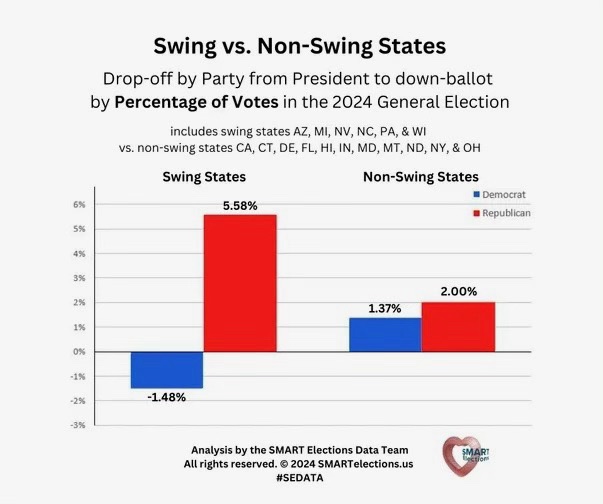
But then I read this analysis on Substack, and it opened up the issue. There’s a lawsuit right now in Rockland County, New York, based on claims by voters that their votes were not counted. How do we know? In some districts, hundreds of votes were counted for Democratic Senator Kirsten Gillibrand, but zero votes for Kamala Harris. To call this a statistical anomaly is an understatement.

Snopes reviewed the case and came down on the side of more evidence is needed. Maybe there were districts where no one voted for Harris, because they were orthodox Jewish districts and everyone followed their rabbi’s endorsement. Maybe not, because there were districts that were not Hasidic where she got zero votes.

Please open the link to read additional stories tied to this one. Also, look up the meaning of the term “Dark Enlightenment.” It refers to the reactionary ideology of Curtis Yarvin, whose admirers include billionaire Peter Thiel and his protege JD Vance.

The Dark Enlightenment Coup

The missing votes uncovered in Smart Elections’ legal case in Rockland County, New York, are just the tip of the iceberg—an iceberg that extends across the swing states and into Texas.

On Monday, an investigator’s story finally hit the news cycle: Pro V&V, one of only two federally accredited testing labs, approved sweeping last-minute updates to ES&S voting machines in the months leading up to the 2024 election—without independent testing, public disclosure, or full certification review.

These changes were labeled “de minimis”—a term meant for trivial tweaks. But they touched ballot scanners, altered reporting software, and modified audit files—yet were all rubber-stamped with no oversight.

That revelation is a shock to the public.
But for those who’ve been digging into the bizarre election data since November, this isn’t the headline—it’s the final piece to the puzzle. While Pro V&V was quietly updating equipment in plain sight, a parallel operation was unfolding behind the curtain—between tech giants and Donald Trump.

And it started with a long forgotten sale.

A Power Cord Becomes a Backdoor

In March 2021, Leonard Leo—the judicial kingmaker behind the modern conservative legal machine—sold a quiet Chicago company by the name of Tripp Lite for $1.65 billion. The buyer: Eaton Corporation, a global power infrastructure conglomerate that just happened to have a partnership with Peter Thiel’s Palantir.

To most, Tripp Lite was just a hardware brand—battery backups, surge protectors, power strips. But in America’s elections, Tripp Lite devices were something else entirely.

They are physically connected to ES&S central tabulators and Electionware servers, and Dominion tabulators and central servers across the country. And they aren’t dumb devices. They are smart UPS units—programmable, updatable, and capable of communicating directly with the election system via USB, serial port, or Ethernet.

ES&S systems, including central tabulators and Electionware servers, rely on Tripp Lite UPS devices. ES&S’s Electionware suite runs on Windows OS, which automatically trusts connected UPS hardware.

If Eaton pushed an update to those UPS units, it could have gained root-level access to the host tabulation environment—without ever modifying certified election software.

In Dominion’s Democracy Suite 5.17, the drivers for these UPS units are listed as “optional”—meaning they can be updated remotely without triggering certification requirements or oversight. Optional means unregulated. Unregulated means invisible. And invisible means perfect for infiltration.

A New Purpose for the Partnership

After the Tripp Lite acquisition, Eaton stayed under the radar. But in May 2024, it resurfaced with an announcement that escaped most headlines: Eaton was deepening its partnership with Palantir Technologies.

Let’s be clear, Palantir wasn’t brought in for customer service. It was brought in to do what it does best: manage, shape, and secure vast streams of data—quietly. According to Eaton’s own release, Palantir’s role would include:

  • AI-driven oversight of connected infrastructure
  • Automated analysis of large datasets
  • And—most critically—“secure erasure of digital footprints”

The Digital Janitor: also known as forensic sanitization, it was now being embedded into Eaton-managed hardware connected directly to voting systems. Palantir didn’t change the votes. It helped ensure you’d never prove it if someone else did.

BallotProof: The Front-End for Scrubbing Democracy

Enter the ballot scrubbing platform BallotProof. Co-created by Ethan Shaotran, a longtime employee of Elon Musk and current DOGE employee, BallotProof was pitched as a transparency solution—an app to “verify” scanned ballot images and support election integrity.

With Palantir’s AI controlling the backend, and BallotProof cleaning the front, only one thing was missing: the signal to go live.

September 2024: Eaton and Musk Make It Official

Then came the final public breadcrumb:
In September 2024, Eaton formally partnered with Elon Musk.

The stated purpose? A vague, forward-looking collaboration focused on “grid resilience” and “next-generation communications.”

But buried in the partnership documents was this line:

“Exploring integration with Starlink’s emerging low-orbit DTC infrastructure for secure operational continuity.”

The Activation: Starlink Goes Direct-to-Cell

That signal came on October 30, 2024—just days before the election, Musk activated 265 brand new low Earth orbit (LEO) V2 Mini satellites, each equipped with Direct-to-Cell (DTC) technology capable of processing, routing, and manipulating real-time data, including voting data, through his satellite network.

DTC doesn’t require routers, towers, or a traditional SIM. It connects directly from satellite to any compatible device—including embedded modems in “air-gapped” voting systems, smart UPS units, or unsecured auxiliary hardware.

From that moment on:

  • Commands could be sent from orbit
  • Patch delivery became invisible to domestic monitors
  • Compromised devices could be triggered remotely
  • This groundbreaking project that should have taken two-plus years to build, was completed in just under ten months.
    Elon Musk boasts endlessly about everything he’s launching, building, buying—or even just thinking about—whether it’s real or not. But he pulls off one of the largest and fastest technological feats in modern day history… and says nothing? One might think that was kind of… “weird.”

Lasers From Space

According to New York Times reporting, on October 5—just before Starlink’s DTC activation—Musk texted a confidant:

“I’m feeling more optimistic after tonight. Tomorrow we unleash the anomaly in the matrix.”
Then, an hour later:

“This isn’t something on the chessboard, so they’ll be quite surprised. ‘Lasers’ from space.”

It read like a riddle. In hindsight, it was a blueprint.

Let’s review what was in place:

This wasn’t a theory. It was a full-scale operation. A systemic digital occupation—clean, credentialed, and remote-controlled.

The Outcome

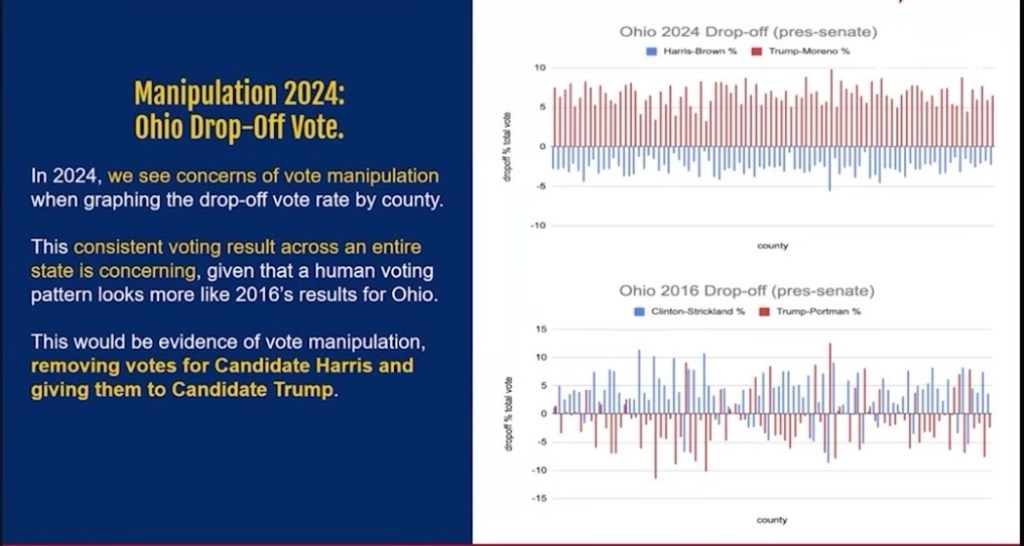
Data that makes no statistical sense. A clean sweep in all seven swing states.

The fall of the Blue Wall. Eighty-eight counties flipped red—not one flipped blue.

Every victory landed just under the threshold that would trigger an automatic recount. Donald Trump outperformed expectations in down-ballot races with margins never before seen—while Kamala Harris simultaneously underperformed in those exact same areas.

If one were to accept these results at face value—Donald Trump, a 34-count convicted felon, supposedly outperformed Ronald Reagan. According to the co-founder of the Election Truth Alliance:

“These anomalies didn’t happen nationwide. They didn’t even happen across all voting methods—this just doesn’t reflect human voting behavior.”

They were concentrated.

Targeted.

Specific to swing states and Texas—and specific to Election Day voting.

And the supposed explanation? “Her policies were unpopular.”

Let’s think this through logically. We’re supposed to believe that in all the battleground states, Democratic voters were so disillusioned by Vice President Harris’s platform that they voted blue down ballot—but flipped to Trump at the top of the ticket?

Not in early voting.

Not by mail.

With exception to Nevada, only on Election Day.

And only after a certain threshold of ballots had been cast—where VP Harris’s numbers begin to diverge from her own party, and Trump’s suddenly begin to surge. As President Biden would say, “C’mon, man.”

In the world of election data analysis, there’s a term for that: vote-flipping algorithm.

Billionaires and Tech Giants Pulled Off the Crime of the Century

Why? There wasn’t just one reason—there were many.

Elon Musk himself hinted at the stakes: he faced the real possibility of a prison sentence if Trump lost. He launched his bid for Twitter—at $20 billion over market value—just 49 days after Putin invaded Ukraine. That alone should have raised every red flag. But when the ROI is $15 trillion in mineral rights tied to Ukraine losing the war and geopolitical deals Trump could green light, it wasn’t a loss—it was leverage.

It’s no secret Musk was in communication with Putin for over two years. He even granted Starlink access to Russian forces. That’s not just profiteering. That’s treason.

Then there’s Peter Thiel and the so-called “broligarchs”—tech billionaires who worship at the altar of shower-avoidant blogger Curtis Yarvin. They casually joke about “humane genocide for non-producers” and have long viewed democracy as a nuisance—an obstacle to their vision of hypercapitalism and themselves as the permanent ruling elite.

Well, what is the elimination of Medicaid if not “humane genocide”—and does anyone really wonder why his 40-year-old protégé and political rookie, JD Vance, is Vice President? With this technology in place, if the third-term legislation were to pass, it would hand Vance a minimum of twelve years at the helm of Thiel’s regime.

And of course, Donald Trump himself:
He spent a year telling his followers he didn’t need their votes—at one point stating,

“…in four years, you don’t have to vote again. We’ll have it fixed so good, you’re not gonna have to vote.”

Trump was facing eighty-eight felony indictments—he was desperate to avoid conviction and locked in a decades-long alliance with Vladimir Putin. An alliance that’s now impossible to ignore—look no further than his policy trail.

He froze aid to Ukraine and has threatened to place sanctions on them, while planning to lift sanctions off Russia. He openly campaigned for anti-EU candidates, and sided with Russia in multiple key United Nations votes related to the Ukraine conflict.

Let’s be clear:

Donald Trump pledges allegiance to a red, white, and blue flag—
It’s just not the American one.

What Happens Now?

We don’t need permission to enforce the Constitution. We need courage. While state attorneys general begin their investigations, it only takes one U.S. senator to initiate the disqualification proceedings against the unelected and unfit occupant of the Oval Office.
State Attorneys General and Investigators:

  • Conduct independent audits of UPS firmware on Dominion and ES&S machines
  • Subpoena communications between Eaton, Palantir, Starlink employees, and Pro V&V
  • Audit Starlink satellite logs for the week of the election
  • Freeze uncertified infrastructure updates
  • Recount physical ballots—by hand
    Now they’re rolling out the same technological toolkit abroad—forcing countries into Starlink contracts in exchange for tariff relief.
    The U.S. election wasn’t their endgame. It was their litmus test.

Want the truth they’re not telling you? For fearless reporting and expert-backed research, read The Common Coalition Report. And if you believe in funding real, independent work—support our all volunteer team here.

DOGE (or DOGS, as I prefer to call them) just won the authority to see your most important personal data, thanks to the rightwing bloc of six on the SupremeCourt.,

It’s really unbelievable. There is legislation protecting our personal data. But the Court split 6-3 to allow these mostly very young, very inexperienced kids to review and gather our personal data. The Court also shielded members of the DOGE group from public scrutiny.

The six Republicans on the Court claim to be conservatives. They are not. Some of the six claim to be “originalists,” ruling in accord with the wishes of the Founding Fathers. Nonsense.

Who are these people that Elon Musk left behind? No one knows for sure. Were they confirmed by the U.S. Senate? No. What are their credentials? No one knows for certain. What right do these shadowy people have to know our personal data? They are not a government agency. They are friends of Elon.

This decision gives open access to our records by shadowy figures whose purposes are hidden.

Are they building a data base for the next election? Will the data be used to blackmail people?

These are frightening decisions.

This is a website that will keep you informed about the ongoing struggle to preserve our democracy.

It’s called Democracy Docket, and it is led by lawyer Marc Elias. Marc is a fearless defender of the rights of all citizens. He reports on threats to democracy and victories for democracy.

Open the link to sign up.

Here is the latest:

Trump administration proposes more drastic election security cuts

  • The Trump administration introduced a new budget proposal calling for a near $500 million cut to the Cybersecurity and Infrastructure Security Agency, the nation’s top federal entity responsible for protecting elections from hacking. 

Trump ‘looking at’ suspending Habeas Corpus, Stephen Miller says 

  • The Trump administration is looking into suspending people’s right to challenge their incarceration in court, to carry out President Donald Trump’s mass deportation efforts, White House aide Stephen Miller said today.
  • Though Miller described it as a “privilege,” the writ of habeas corpus is a fundamental right guaranteed by the Constitutionand can only be suspended “when in Cases of Rebellion or Invasion the public Safety may require it.”

New challenge to Wisconsin congressional map

  • A second lawsuit was filed in the Wisconsin Supreme Court challenging the state’s congressional map. Voters, represented by the Campaign Legal Center, argue the map unevenly distributes the population, violating the state constitution.

Iowa voting materials won’t be translated

  • The Iowa Supreme Court reversed a lower court decision that allowed voting materials to be translated into other languages, despite a state law requiring documents to be distributed in English only. The case was dismissed due to lack of standing.

Wyoming’s citizenship requirement challenged

  • A pro-voting group is challenging Wyoming’s House Bill 156, which mandates documentary proof of citizenship to register to vote. The lawsuit alleges the measure violates the First, Fifth, and 14th Amendments by creating barriers for eligible voters. 
  • The group argues the law disproportionately affects women, Hispanic, young, and low-income residents. This comes amid already low civic participation in Wyoming, where only 65% of eligible voters registered and 60% voted in 2024.

We have more power than Trump wants us to believe

  • Trump wants us to believe he is all-powerful. He wants us to believe that opposing him is futile or worse. He wants you to accept that there’s nothing you can do to limit his ability to harm our country and our democracy. But that simply isn’t true.
  • Marc shares 10 things you can do to stand up to Trump and protect our democracy.

Elon Musk plans to expand his rocket business, in hopes of eventually reaching Mars. He moved his rocket business to Texas, far from the environmentalists who get in his way. So he bought a massive plot of land in Texas and started building the new town of Starbase. The residents of Starbase, almost all employed by Musk, held an election and voted to create a new town. Surprise! It was a landslide, reports Berenice Garcia of The Texas Tribune. He calls Srarbase a city, but with a likely population of 500 residents, it’s a small town.

Just down the road from the SpaceX launch site is Boca Chica Beach. A public strip sandwiched between South Padre Island and the Rio Grande, the beach is popular with locals who fish, drive and camp on its windy dunes.

At the beach on Saturday, the protesters said local politicians have not properly protected the land. Environmentalists, indigenous leaders and local fishermen said the beach needs to remain out of SpaceX’s control.

Thom Hartmann sums up what Trump is: a malignant narcissist intent on destroying every shred of our democracy and our ideals. we knew from his first term that he was a liar and a fraud. Yet here he is, acting with even more rage, vengeance, and destruction than before.

Let us not forget that Trump is enabled by the Republican Party. By their slim majorities in Congress. They have meekly watched as he terminated departments and agencies authorized by Congress. They have quietly given the power of the purse to Trump and Musk. They have watched as he turned himself into an emperor and made them useless. They could stop him. But they haven and they won’t.

He writes:

The Trump administration just gutted Meals on Wheels.

Seriously. Meals on Wheels!

Donald Trump didn’t just “disrupt” America; he detonated it. Like a political Chernobyl, he poisoned the very soil of our democratic republic, leaving behind a toxic cloud of cruelty, corruption, and chaos that will radiate through generations if we don’t contain it now.

He didn’t merely bring darkness; he cultivated it. He made it fashionable. He turned cruelty into currency and made ignorance a political virtue.

This man, a grotesque cocktail of malignant narcissism and petty vengeance, ripped the mask off American decency and showed the world our ugliest face. He caged children. Caged. Children. He laughed off their cries while his ghoulish acolytes used “Where are the children?” as a punchline for their next QAnon rally.

He welcomed white supremacists with winks and dog whistles, calling them “very fine people,” while spitting venom at Black athletes who dared kneel in peaceful protest.

He invited fascism to dinner and served it on gold-plated Trump steaks. He made lying the lingua franca of the right, burning truth to the ground like a carnival barker selling snake oil from a flaming soapbox.

And let’s not forget the blood on his hands: 1,193,165 dead from COVID by the time he left office, 400,000 of them unnecessarily, dismissed as nothing more than “a flu,” while he admitted — on tape — that he knew it was airborne and knew it was lethal. His apathy was homicidal, his incompetence catastrophic.

He tried to overthrow a fair election. He summoned a violent mob. He watched them beat cops with American flags and screamed “Fight like hell!” while cowering in the White House, delighting in the destruction like Nero fiddling as Rome burned.

And now, like some grotesque twist on historical fascism, Trump’s regime is quietly disappearing even legal U.S. residents — snatched off the streets by ICE and dumped into El Salvador’s CECOT mega-prison, a dystopian nightmare of concrete and cruelty.

One such man, Kilmar Ábrego García, had legal status and a home in Maryland. But Trump’s agents defied a federal court order and deported him anyway, vanishing him into a foreign hellhole so brutal it defies comprehension.

This isn’t policy: it’s a purge. A test run for authoritarian exile. And if Trump’s not stopped by Congress, the courts, or We The People in the streets, it won’t end there.

But somehow, he’s still here, waddling across the political stage like the Stay Puft Marshmallow Man of authoritarianism, bloated with power, empty of soul, and reeking of spray tan and sulfur.

Donald Trump didn’t just bring darkness: he’s a goddamn black hole, a gravity-well of cruelty sucking the light out of everything he touches.
This is a man who desecrates everything good.
Empathy? He mocks it. Truth? He slanders it. Democracy? He’d bulldoze it for a golf course.
And if we let him continue, he won’t just end democracy — he’ll make damn sure it never rises again.

So the question is: are we awake yet?

Or will we let this orange-faced death-cult leader finish the job he started, grinning over the corpse of the America we once believed in?

Now is not the time to kneel: it’s the time to rise. Stay loud, stay vigilant, and show up. Every protest, every march, every call to DC, every raised voice chips away at the darkness.

Democracy isn’t a spectator sport: it’s a fight, and we damn well better show up for it.

The Atlantic published a fascinating story about Donald Trump’s surprising return from what seemed to be the disastrous end of his political career in 2021 to regain the presidency in 2024.

In 2021, he left the White House in disgrace: twice impeached, leader of a failed and violent effort to overturn the election, so bitter that he skipped Joe Biden’s inauguration. For four years, with the exception of an occasional slip of the tongue, he nourished the fantasy that he was the rightful winner in 2020.

Surely there were Republicans who thought he was finished, as did all Democrats. I remember how thrilled I was to think that I would never again have to see his face or hear his voice.

His redemption began when Congressman Kevin McCarthy flew to Mar-a-Lago to pay homage to Trump. Trump spent most of the last four years plotting and planning for his return.

The article was written by Atlantic staffers Ashley Parker and Michael Scherer.

It begins with the story of how they won an interview with Trump. They filled out forms describing the reason for the interview and thought their request might be approved. But Trump personally rejected them, denouncing the reporters and the magazine as part of the leftist effort to embarrass him. Trump called Ashley Parker a “radical left lunatic.”

The reporters had spent many hours preparing for the interview, and they were determined to land it.

Soon after they were turned away, they decided to try another route. They obtained Trump’s private cell number, and they called him. He answered his phone, and they had a long conversation. During the conversation, he said matter-of-factly, “I run the country and I run the world.”

Humility was never his strong suit.

Trump eventually agreed to sit with them for an interview in the Oval Office with them and the magazine’s editor-in-chief Jeffrey Goldberg, who had been accidentally invited to be part of Defense Secretary’s Signal conversation about bonbing Yemen.

This is a must-read.

Thom Hartmann sees the pattern on the rug. Trump and Musk are stifling democratic institutions and rushing headlong towards the tyranny they both admire. Trump thinks that he can make himself dictator for life, Like his buddies in Russia and North Korea. Will the public defend the Constitution?

He wrote:

When Harvard, one of America’s oldest and most revered institutions of higher learning, stands defiant as the federal government freezes billions in funding simply because it refuses to knuckle under to authoritarian demands — like gutting DEI programs and turning faculty into immigration informants — we’re no longer playing the usual game of politics.


This is the open throttling of academic freedom, part of a larger, deliberate campaign to silence dissent, centralize power, and erase democratic norms.


We’ve seen this playbook before in other countries — but now it’s being run right here, in the land that once proudly called itself the world’s beacon of liberty.


Democracy doesn’t die in darkness, as the saying goes; it suffocates in broad daylight.


Americans are witnessing an unprecedented assault on the very foundations of our democratic experiment, orchestrated with a precision that would make authoritarian strongmen worldwide nod in approval.


Senator Chris Murphy has raised alarm bells about what he describes as a methodical attack on American institutions that are supposed to keep government accountable to its citizens. By his account, the strategy isn’t dramatic coups or burning parliaments; that’s not how modern democracies perish. Instead, they’re slowly dismantled through the calculated erosion of accountability mechanisms.


History provides a disturbing playbook, and we’re watching it unfold right now here in America. Putin, Orbán, and Erdoğan didn’t need tanks in the streets. They understood that the process is multi-part but straightforward:


— Legitimize political violence,
— Capture the media,
— Intimidate lawyers,
— Install corrupt leaders within regulatory and police agencies,
— Disappear first minorities and later opposition leaders,
— Silence universities, and
— Starve opposition movements by denying their nonprofit status and funding.


Consider what we’re seeing unfold. The recent January 6 pardons sent an unmistakable message about the acceptability of political violence. When legislators openly express fears of “retaliation” — as Senator Lisa Murkowski just did — we’re already several steps down a dangerous path.


Meanwhile, the concentration of media power in the hands of billionaires who increasingly bend to political pressure isn’t accidental. Whether through ownership, lawsuits, or regulatory threats, the ability to speak truth to power is being systematically constrained.


Universities, traditionally bastions of free thought and youth activism, face unprecedented pressure to conform or lose federal support.

Legal professionals, our front-line defenders of constitutional rights, are being asked to choose between principles and practice.


The economic dimension of this strategy can’t be ignored. Targeted tariffs and funding cuts effectively create a corporate compliance regime where business survival depends on political loyalty. When small-dollar online giving platforms become targets, it’s clear this is about drying up resources for political opposition.


Senator Murphy’s warning carries particular weight: “I still believe we can stop it,” he says. His prescription includes institutional solidarity, mass mobilization, and political courage. These steps aren’t just wishful thinking: history shows they work when deployed with determination.


The challenges are clear, but so is the path forward. Democrats and defenders of democracy must recognize this isn’t politics as usual. The systematic undermining of accountability mechanisms isn’t merely partisan: it’s anti-democratic in the most fundamental sense.


It’s the first stages of outright tyranny, the first American dictatorship.


If conventional resistance proves insufficient, Murphy suggests civil disobedience may become necessary. That’s not a suggestion to be taken lightly, especially from a sitting US senator.

The coming months will test America’s democratic resolve. The institutions being targeted aren’t merely political; they’re the scaffolding of self-governance itself. As Murphy warns, “We still have the power, but we probably have less time than most think.”


For those wondering where the line exists between alarmism and appropriate warning, consider this: When elected officials speak openly about fear of retaliation, when media owners preemptively capitulate, when universities face unprecedented political pressure, and when legal professionals must toe ideological lines, we’re no longer discussing hypotheticals.


The American experiment has faced threats before, but, outside of the Confederacy, rarely have they been so comprehensively designed or so methodically executed.


Recognition of this reality isn’t partisan, it’s patriotic. The future of American democracy depends on understanding what’s at stake and acting accordingly.


The assault on Harvard is just one chapter in a larger story — one where the villains aren’t hiding in shadows, but are operating in full view with chilling precision.


The question isn’t whether this is happening. It’s whether enough Americans will recognize the danger in time to stop it.

Joyce Vance was the U.S. Attorney for the Northern District of Alabama. She writes a smart blog called Civil Discourse, in which she writes about court cases and the law, in language accessible to non-lawyers. In this post, she explains how massive protests can change the course of history.

She writes:

This coming Tuesday marks Donald Trump’s 100th day in office, a tenure that has led to a steady decline in the economy. If we use that measure, which many voters said led them to vote for Trump, these first 100 days have been a failure. Even as Trump has successfully seized power from Congress and some organizations have bent the knee to his every request, lawyers are winning in court, and some law firms, businesses, universities, and individuals are standing up to the president who would rather be a king. Trump may not have lost the first 100 days, but he hasn’t exactly won them either. Our democracy has been weakened, but it can still be saved.

Thursday is May Day, May 1st. There will be renewed protest marches across the country, many of them focused on Americans’ increasing awareness that the fundamentals of democracy, which we’ve taken for granted for so long, are in danger. It’s not just due process concerns, although that is an enormous part of it, as the deportations continue. Last week we learned that included some involved American citizen children and children with cancer, with Secretary Rubio offering a sorry rejoinder on Meet the Press this morning, blaming the mothers who took young children back to their countries of origin with them, rather than being forced to abandon them. There are plenty of reasons to march.

This will not be the first time Americans have engaged in mass protests on May Day. In 1971, tens of thousands of people took to the streets in Washington, D.C., to protest the Vietnam War. They began on May 3 and continued for two more days. By the time the protest ended, more than 12,000 protestors had been arrested. The protesters’ goal was to cause a traffic jam that would keep government employees from getting to work; their slogan was “If the government won’t stop the war, we’ll stop the government.”

Mass protests that are large and sustained have an impact on even an entrenched presidency. They did with Nixon. The White House Historical Association’s official version of events concludes that “the enormity of the protest pushed Nixon to accelerate the nation’s exit from Vietnam.” 

Even though it’s a different era, protests are bound to get to the thin-skinned president whose staffers, during his first term in office, had to prepare folders of positive stories about Trump for him to review twice each day. Imagine having thousands of people protesting within earshot of the White House. It must be even more galling because these protests are nonviolent and aim to support democracy through a legitimate exercise of First Amendment rights. They make a powerful statement, in contrast to a president who has abandoned the rule of law. 

In 1970, two-thirds of Americans had come to believe U.S. involvement in the Vietnam War was a mistake. We are not quite there yet when it comes to people’s view of the Trump administration. The most recent NBC News Stay Tuned Poll shows only 45% of Americans approve of the job Trump is doing. But, when asked about how strongly they hold their beliefs about the president, “the vehemence of the opposition outweighs the intensity of support from the president’s MAGA base.” Twenty-three percent of Americans said they were “furious” about what Trump is doing.

Thursday is also Law Day, an annual celebration of the rule of law. Although it has been in effect since 1958, it doesn’t usually receive much attention. This year, lawyers across the country have big plans for the day—make sure you look to see what’s going on in your area. President Dwight Eisenhower established Law Day as a day of national dedication to the principles of government under law. State Bar Associations hold essay competitions for school children, and there are state and national dinners most years. In 2025, Law Day takes on special significance as Americans’ concerns about due process come to the forefront. How fitting that the May Day protests sync with the Law Day commemoration. 

I’ve been doing a lot of research and writing about the origins of Law Day for my book (Giving Up Is Unforgivable, due out October 21), so I’ll leave that for another time, but I want to make sure everyone knows about Law Day. This year, many lawyers across the country will retake their oath to show their support for the rule of law. There is no reason the rest of the country can’t participate too!

The president issues a proclamation every year for Law Day. Trump did during his first term in office, too. In 2019, the proclamation began, “On Law Day, we renew our commitment to the rule of law and our Constitution. The rule of law requires that no one be above the obligations of the law or beneath its protections, and it stands as a bulwark against the arbitrary use of government power.” Unfortunately, he never lived up to those sentiments. On Thursday, we can look for the proclamation and point out the inconsistencies between what we expect from our presidents and how this one is behaving. The hypocrisy is always full force, and we shouldn’t shy away from pointing it out.

Due process is the sleeper issue of the second Trump presidency. No one really expected democracy issues, let alone concepts like the rule of law and due process to animate a country’s protests. But it’s increasingly clear that Americans are smart, and when we are well-informed, we have no difficulty assessing what matters and what is true. We see more and more of that as Americans carry signs that say “No Kings” and “Due Process” at local rallies. All of us can be advocates for democracy, not just the lawyers among us.

Here at Civil Discourse, we all understand the importance of this. We need to make sure the rest of the country does too. Until the Trump administration is over, it has to be Law Day every day. 

In 2024, the Law Day theme was “Voices of Democracy,” recognizing that the people are the rulers in a democracy. Americans express their views without fear of retribution because of the First Amendment and vote in elections to select their leaders. It’s up to us to make sure it stays that way.

This week will bring more briefings in the Abrego-Garcia case and others. There will be outrages, like the fact that Trump has a website hawking merchandise, literally selling the presidency. It’s not just the $50 price tag on the hat; there’s also the slogan, “Trump 2028,” a reference to Trump’s not-so-subtle hints that he’d like to serve a Constitution-busting third term in office. It’s not a joke. It never is with him.

So, make sure you take some time this week to celebrate Law Day. Invite people over. Go for a walk with friends or neighbors and share your views. Talk with your kids. Democracy is not automatic; it’s a participatory sport we must all play in together, one with critically important outcomes. Democracy is important. Let’s make sure we play for keeps.

We’re in this together,

Joyce

Jamelle Bouie, one of the most insightful columnists for The New York Times, observes that Trump has no interest in governing. He is interested in ruling. He thinks he has a mandate, even though he did not win 50% of the popular vote. He thinks his will is as powerful as law. He does not share power with Congress, and he’s testing how far he can go to diminish the courts.

Bouie reflects on Trump’s indifference to the other branches of Govenment in this newsletter:

I think it’s obvious that neither President Trump nor his coterie of agents and apparatchiks has any practical interest in governing the nation. It’s one reason (among many) they are so eager to destroy the federal bureaucracy; in their minds, you don’t have to worry about something, like monitoring the nation’s dairy supply for disease and infection, if the capacity for doing so no longer exists.

But there is another, less obvious way in which this observation is true. American governance is a collaborative venture. At minimum, to successfully govern the United States, a president must work with Congress, heed the courts and respect the authority of the states, whose Constitutions are also imbued with the sovereignty of the people. And in this arrangement, the president can’t claim rank. He’s not the boss of Congress or the courts or the states; he’s an equal.

The president is also not the boss of the American people. He cannot order them to embrace his priorities, nor is he supposed to punish them for disagreement with him. His powers are largely rhetorical, and even the most skilled presidents cannot shape an unwilling public.

Trump rejects all of this. He rejects the equal status of Congress and the courts. He rejects the authority of the states. He does not see himself as a representative working with others to lead the nation; he sees himself as a boss, whose will ought to be law. And in turn, he sees the American people as employees, each of us obligated to obey his commands.

Trump is not interested in governing a republic of equal citizens. To the extent that he’s even dimly aware of the traditions of American democracy, he holds them in contempt. What Trump wants is to lord over a country whose people have no choice but to show fealty and pledge allegiance not to the nation but to him.

What was it Trump said about Kim Jong-un, the North Korean dictator, during his first term in office? “Hey, he’s the head of a country. And I mean he is the strong head. Don’t let anyone think anything different,” Trump said in 2018. “He speaks, and his people sit up at attention. I want my people to do the same.”

He wants his people to do the same.

Ad