Archives for category: Early Childhood Education

After nearly a year of bargaining, the Chicago Teachers Union reached a landmark agreement with the City of Chicago and the school board. Karen Lewis, the late President of the Chicago Teachers, was a champion for the city’s children, their teachers, and the public schools. She must be smiling in heaven to see what the CTU has accomplished.

The CTU announced:

Chicago Teachers Union

NEWS ADVISORY: 
For Immediate Release

April 2, 2025

CONTACT:312-329-9100
Communications@ctulocal1.org

CTU to Hold Press Conference to Announce Results of Special House of Delegates Meeting

Union to announce results of next step to transform Chicago Public Schools after the 60+ rank and file members of the Big Bargaining Team sent tentative agreement to the House of Delegate members for approval.

What: Press conference announcing results of House of Delegates vote

Where: Chicago Teachers Union, 1901 W Carroll Ave; enter through the East entrance off Wolcott; parking will be available for camera trucks in the South lot (on Fulton)

When: Immediately following House of Delegates meeting (Meeting starts at 4:45pm and we will alert press once the media is adjourned)

Who: CTU officers, big bargaining team members, and elected delegates

In the next step toward ratifying a contract that represents a major leap forward in the process of transforming Chicago Public Schools started by CTU in 2012, the union will hold a special House of Delegates meeting on Wednesday, April 2nd. At the meeting, the elected delegates of the union will vote on whether or not the tentative agreement landed by the 60 rank and file members of the Big Bargaining Team shall be sent to the full membership for a vote as early as next week.

The union will hold a press conference immediately following the meeting to announce whether the tentative agreement that creates smaller class sizes, a historic investment in sports, grants recess students were being denied, and enshrines protections for Black history and academic freedom – among more than 150 other items – is going to a full membership vote or back to the bargaining table for improvements.

BACKGROUND

After more than eleven months of bargaining, working without a contract throughout the entire school year, and for the first time in more than 15 years of doing so without a strike or strike vote, the Chicago Teachers Union announced their big bargaining team made up of rank and file members approved a tentative agreement with Chicago Public Schools.

The tentative agreement will go to CTU’s House of Delegates Wednesday which will decide whether or not to advance it to CTU’s 30,000 members for a ratification vote. If accepted, it will represent a major leap forward in the transformation of a district that is still recovering from the gutting and financial irresponsibility carried out by Trump’s Project 2025 style efforts under Rahm Emanuel, Arne Duncan, Paul Vallas, and other privatization forces that closed over 200 public schools between 2002 and 2018.

Despite the efforts of right wing actors like Paul Vallas, The Liberty Justice Center, and Illinois Policy Institute, and the MAGA forces that seek to deny the investments Chicago’s students deserve, this proposed contract builds upon the past several contracts won by CTU in 2012, 2016, and 2019. It charts a new direction of investment, expansion of sustainable community and dual language schools, increased staffing, and a focus on reparatory equity to provide the educational experience Chicago students deserve no matter what neighborhood they live in.

The 2012 strike won the air conditioning that kept CPS open during the back-to-school heatwave at the beginning of the school year. 2016 established the model of 20 sustainable community schools, a program that helped to stabilize and resource schools like Dyett High School whose boy’s basketball team won the state championship this year. 2019 won social workers and nurses in every school and established the sanctuary status that protected CPS students from Trump’s federal agents earlier this year.

In 2025, some highlights of the Chicago Teachers Union contract include:

  • Doubles the number of libraries and librarians for our schools
  • Enforceable and smaller class sizes for all grade levels
  • Ensuring social workers and nurses serve students in every school, every instructional day
  • Doubles the bilingual education staffing supports for students 
  • Additional staffing, curricular and enrollment supports for Early Childhood education students and programs. 
  • Creates 215 more case manager positions district-wide to support students with disabilities. 
  • A cost of living adjustment of 17-20% compounded (tied to inflation) over the four years of the contract
  • Provide new steps that compensate veteran educators for their experience
  • Increases in prep time for clinicians, elementary and special education teachers so students arrive to classrooms ready for them
  • Expanded benefits for dental, vision, infertility and abortion care, gender-affirming care, hearing aids, speech therapy, physical therapy, occupational therapy, chiropractic services
  • A more than tripling of the number of Sustainable Community Schools, from 20 to 70, over the course of the agreement. 
  • Provides CTU, CPS, City and sister agency coordination for the first time to provide housing support, section 8 vouchers, rental assistance and affordable units to CPS families in need. 
  • Enshrines 12 weeks paid parental leave, equal parental, personal illness, and supplemental leave rights for PSRPs to teachers
  • A Green Schools initiation of additional resources and collaboration to remediate lead, asbestos and mold in aging school buildings while upgrading to green energy with environmentally sustainable technology, materials and practices. 
  • Protections for academic freedom, Black history, and culturally relevant curriculum for the first time in the contract. 
  • An additional $10 million annual investment in sports programming
  • Protections for academic freedom that enshrine educators’ ability to teach Black, indigenous, and other history
  • Continuation of Sanctuary School procedures
  • A new article that creates LGBTQIA+ safe schools

See the full list of tentative agreements at https://www.ctulocal1.org/movement/contract-2024.

“Our union is bargaining for what every parent wants for their child in our school communities. It shouldn’t be a fight for children to get access to arts, sports, wrap around supports, and libraries. It’s what should already exist,” explains CTU Local 1 President Stacy Davis Gates. “We’re proud to have landed a transformative contract that turns away from decades of disinvesting in Black children and turns toward creating the world-class education system for every single student in CPS no matter their zip code. If the contract is ratified by our members, we will be one major leap forward toward the educational experience Chicago’s children and the mainly women workers who serve them in our schools deserve.”

Additional Information:

###

The Chicago Teachers Union represents nearly 30,000 teachers and educational support personnel working in schools funded by City of Chicago School District 299, and by extension, more than 300,000 students and families they serve. The CTU is an affiliate of the American Federation of Teachers and the Illinois Federation of Teachers and is the third-largest teachers local in the United States. For more information, please visit the CTU website at www.ctulocal1.org.

A group of scholars at the Brookings Institution analyzed Project 2025’s proposals for education and their implications.

What struck me as most bizarre about Project 2025 was not its efforts to block-grant all federal funding of schools, nor its emphasis on privatization of K-12 schools. (Block-granting means assigning federal funding to states as a lump sum, no strings attached, no federal oversight).

No, what amazed me most was the split screen between the report’s desire to hand all power over education to states and communities, and the report’s insistence on preserving enough power to punish LGBT students, especially trans students and to impose other far-right mandates, like stamping out critical race theory. You know, either you let the states decide or you don’t. The report wants it both ways.

It’s also astonishing to realize that the insidious goal of the report is eventually abandon federal funding of education. That’s a huge step backward, taking us to 1965, before Congress passed the Elementary and Secondary Education Act, whose purpose was to raise spending in impoverished communities. I essence, P2025 says that decades of pursuing equitable funding “didn’t work,” so let’s abandon the goal and the spending.

Here is the Brookings analysis:

Project 2025 outlines a radical policy agenda that would dramatically reshape the federal government. The report was spearheaded by the right-wing Heritage Foundation and represents the policy aims of a large coalition of conservative activists. While former President Trump has attempted to distance himself from Project 2025, many of the report’s authors worked in the previous Trump administration and could return for a second round. Trump, himself, said in 2022, “This is a great group, and they’re going to lay the groundwork and detail plans for exactly what our movement will do.”

In other words, Project 2025 warrants a close look, even if the Trump campaign would like Americans to avert their gaze.

Project 2025’s education agenda proposes a drastic overhaul of federal education policy, from early childhood through higher education. Here’s just a sample of the Project 2025 education-related recommendations:

  • Dismantle the U.S. Department of Education (ED)
  • Eliminate the Head Start program for young children in poverty
  • Discontinue the Title I program that provides federal funding to schools serving low-income children
  • Rescind federal civil rights protections for LGBTQ+ students
  • Undercut federal capacity to enforce civil rights law
  • Reduce federal funding for students with disabilities and remove guardrails designed to ensure these children are adequately served by schools
  • Promote universal private school choice
  • Privatize the federal student loan portfolio

It’s an outrageous list, and that’s just the start of it.

We’ve reviewed the Project 2025 chapter on education (Chapter 11), along with other chapters with implications for students. We’ve come away with four main observations:

1. Most of the major policy proposals in Project 2025 would require an unlikely amount of congressional cooperation

Project 2025 is presented as a to-do list for an incoming Trump administration. However, most of its big-ticket education items would require a great deal of cooperation from Congress.

Proposals to create controversial, new laws or programs would require majority support in the House and, very likely, a filibuster-proof, 60-vote majority in the Senate. Ideas like a Parents’ Bill of Rights, the Department of Education Reorganization Act, and a federal tax-credit scholarship program fall into this category. Even if Republicans outperform expectations in this fall’s Senate races, they’d have to attract several Democratic votes to get to 60. That’s not happening for these types of proposals.  

The same goes for major changes to existing legislation. This includes, for example, a proposal to convert funding associated with the Individuals with Disabilities Education Act (IDEA) to no-strings-attached block grants and education savings accounts (with, presumably, much less accountability for spending those funds appropriately). It also includes a proposal to end the “negotiated rulemaking” (“neg-reg”) process that ED follows when developing regulations related to programs authorized under Title IV of the Higher Education Act (HEA). The neg-reg requirement is written into HEA itself, which means that unwinding neg-reg would require Congress to amend the HEA. That’s unlikely given that HEA reauthorization is already more than a decade overdue—and that’s without the political baggage of Project 2025 weighing down the process.

The prospect of changing funding levels for existing programs is a little more complicated. Programs like Title I are permanently authorized. Eliminating Title I or changing the formulas it usesto allocate funds to local educational agencies would require new and unlikely legislation. Year-to-year funding levels can and do change, but the vast majority of ED’s budget consists of discretionary funding that’s provided through the regular, annual appropriations process and subject to a filibuster. This limits the ability of one party to make major, unilateral changes. (ED’s mandatoryfunding is more vulnerable.)

In sum, one limiting factor on what an incoming Trump administration could realistically enact from Project 2025 is that many of these proposals are too unpopular with Democrats to overcome their legislative hurdles.

2. Some Project 2025 proposals would disproportionately harm conservative, rural areas and likely encounter Republican opposition

Another limiting factor is that some of Project 2025’s most substantive proposals probably wouldn’t be all that popular with Republicans either.

Let’s take, for example, the proposed sunsetting of the Title I program. Project 2025 proposes to phase out federal spending on Title I over a 10-year period, with states left to decide whether and how to continue that funding. It justifies this with misleading suggestions that persistent test score gaps between wealthy and poor students indicate that investments like Title I funding aren’t paying off. (In fact, evidence from school finance reforms suggests real benefits from education spending, especially for students from low-income families.)

The phrase “Title I schools” might conjure up images of under-resourced schools in urban areas that predominantly serve students of color, and it’s true that these schools are major beneficiaries of Title I. However, many types of schools, across many types of communities, receive critical support through Title I. In fact, schools in Republican-leaning areas could be hit the hardest by major cuts or changes to Title I. In the map below, we show the share of total per-pupil funding coming from Title I by state. Note that many of the states that rely the most on Title I funds (darkest blue) are politically conservative.

[Open the link to see the map.]

Of course, the impact of shifting from federal to state control of Title I would depend on how states choose to handle their newfound decision-making power. Given that several red states are among the lowest spenders on education—and have skimped on programs like Summer EBT and Medicaid expansion—it’s hard to believe that low-income students in red states would benefit from a shift to state control.

What does that mean for the type of support that Project 2025 proposals might get from red-state Republicans in Congress? It’s hard to know. It’s worth keeping in mind, though, that the GOP’s push for universal private school voucher programs has encountered some of its fiercest resistance from rural Republicans across several states.

3. Project 2025 also has significant proposals that a second Trump administration could enact unilaterally

While a second Trump administration couldn’t enact everything outlined in Project 2025 even if it wanted to, several consequential proposals wouldn’t require cooperation from Congress. This includes some actions that ED took during the first Trump administration and certainly could take again.

Here are a few of the Project 2025 proposals that the Trump administration could enact with the authority of the executive branch alone:

  • Roll back civil rights protections for LGBTQ+ students
  • Roll back Title IX protections against sex-based discrimination
  • Dismantle the federal civil rights enforcement apparatus
  • Eliminate current income-driven repayment plans and require higher monthly payments for low-income borrowers
  • Remove protections from predatory colleges that leave students with excessive debt

Federal education policy has suffered from regulatory whiplash over the last decade, with presidential administrations launching counter-regulations to undo the executive actions of the prior administration. Take, for example, “gainful employment” regulations that Democratic administrations have used to limit eligibility for federal financial aid for colleges that leave students with excessive loan debt. A second Trump administration would likely seek to reverse the Biden administration’s “gainful employment” regulations like the first Trump administration did to the Obama administration’s rules. (Then again, with the Supreme Court striking down Chevron, which provided deference to agency expertise in setting regulations, the Trump administration might not even need to formally undo regulations.)

Other Project 2025 proposals, not explicitly about education, also could wreak havoc. This includes a major overhaul of the federal civil service. Specifically, Project 2025 seeks to reinstate Schedule F, an executive order that Trump signed during his final weeks in office. Schedule F would reclassify thousands of civil service positions in the federal government to policy roles—a shift that would empower the president to fire civil servants and fill their positions with political appointees. Much has been written about the consequences of decimating the civil service, and the U.S. Department of Education, along with other federal agencies that serve students, would feel its effects.

4. Project 2025 reflects a white Christian nationalist agenda as much as it reflects a traditional conservative education policy agenda

If one were to read Project 2025’s appeals to principles such as local control and parental choice, they might think this is a standard conservative agenda for education policy. Republicans, after all, have been calling for the dismantling of ED since the Reagan administration, and every administration since has supported some types of school choice reforms.

But in many ways, Project 2025’s proposals really don’t look conservative at all. For example, a large-scale, tax-credit scholarship program would substantially increase the federal government’s role in K-12 education. A Parents’ Bill of Rights would require the construction of a massive federal oversight and enforcement function that does not currently exist. And a proposal that “states should require schools to post classroom materials online to provide maximum transparency to parents” would impose an enormous compliance burden on schools, districts, and teachers.

Much of Project 2025 is more easily interpretable through the lens of white Christian nationalism than traditional political conservatism. Scholars Philip Gorski and Samuel Perry describe white Christian nationalism as being “about ethno-traditionalism and protecting the freedoms of a very narrowly defined ‘us’.” The Project 2025 chapter on education is loaded with proposals fitting this description. That includes a stunning number of proposals focused on gender identity, with transgender students as a frequent target. Project 2025 seeks to secure rights for certain people (e.g., parents who support a particular vision of parental rights) while removing protections for many others (e.g., LGBTQ+ and racially minoritized children). Case in point, its proposal for “Safeguarding civil rights” says only, “Enforcement of civil rights should be based on a proper understanding of those laws, rejecting gender ideology and critical race theory.”

These types of proposals don’t come from the traditional conservative playbook for education policy reform. They come from a white Christian nationalist playbook that has gained prominence in far-right politics in recent years.

At this point, it’s clear that the Trump campaign sees Project 2025 as a political liability that requires distance through the election season. Let’s not confuse that with what might happen during a second Trump administration.

Former President Trump recently discovered that members of his administration had produced a set of plans for his next term. They did this under the guidance of the Heritage Foundation, the Republican Party’s ideological center. If you believed that Trump knew nothing about this 900-page guidebook, I know of a bridge in Brooklyn to sell you.

Project 2025 is a handbook of extremism. It represents the far-right Republicans’ desire to eliminate many federal programs and, as right winger Grover Norquist one memorably said, “Shrink it so it can be drowned in a bathtub.”

North Carolina public school advocates Patty Williams and David Zonderman are public school graduates and parents. They wrote the following about Project 2025:

In the Spring of 2023, the Heritage Foundation released Mandate for Leadership: The Conservative Promise, aka Project 2025. Now, more than a year later, it is finally getting the serious attention that it demands. In its early pages, the Foundation claims to “have gone back to the future—and then some.” We are warned that, “The federal government is a behemoth, weaponized against American citizens and conservative values, with freedom and liberty under siege as never before.” To fight this supposed incubus sucking the life out of the republic, a growing number of conservative organizations have joined the Heritage Foundation in supporting this project and intend to assemble an army to march on Washington to “deconstruct the Administrative State.”


Project 2025 is both breathtaking and scary in its scope. It envisions a far-right rewriting of government missions, policies, and procedures, ranging from the White House, through all Cabinet-level departments, to the Federal Reserve and other independent regulatory agencies.  Tens of thousands of federal employees could be fired or subject to politically-inspired loyalty tests, gutting almost 150 years of civil service reform, and erasing institutional memory, knowledge, and expertise. Whole federal departments—including the Department of Education—and the funding that goes with them could be left on the cutting room floor, with disastrous consequences for the least among us.


This far-right “Playbook” is a frontal assault on honest and competent government, and the underpinnings of our 248-year-old democracy. Project 2025 flips the script on our nation’s foundation of liberty, prosperity, and the rule of law by inverting and perverting fact and data about how government actually functions to protect the environment, ensure safe workplaces, and provide some safety net for those in poverty. 


Project 2025 may appear to come from the right-wing fever swamp, which conjures up something out of science fiction. Indeed, it does remind us of a legendary Rod Serling Twilight Zone episode, first televised in March of 1962. In “To Serve Man,” earth is visited by the Kanamits. Enormously tall aliens, they appear frightening at first, but are eventually welcomed by humans. The Kanamits help end famine, eliminate war, and provide unlimited energy supplies for the betterment of the planet. 


Seemingly altruistic in their efforts, the Kanamits leave a book behind at the United Nations, which a decoding expert, Hero Chambers and his able assistant, Pat, begin to translate. Meanwhile, the Kanamits invite enthusiastic Earthlings to visit their planet, and flight reservations fill up quickly. Only when Pat races up to a space ship about to lift off does she reveal to Chambers that the title of the book—To Serve Man—is a cookbook. A recipe for disaster.


Project 2025 also proclaims to serve man, perhaps not literally on a silver platter like the Kanamits; but it may also cannibalize our government, our nation, and our democracy. Unlike the hapless denizens of earth in the Twilight Zone, we don’t need a decoding expert to see through the myths and deceptions that seek to dismantle our enduring republic and its Constitutional rights.


Let’s not wait until it’s too late and our collective goose is cooked. It’s time to stir the pot. Encourage your friends and family to vote as though their democracy depends on it—because it does.


Michigan is in track to make record investments in the quality of life for children and schools.

My friend Mitchell Robinson, a member of the State board of education, shared the following good news:

The State of Michigan passed a third consecutive historic education budget last night—and did so with bipartisan support, meaning the changes included in this budget can go into effect immediately.

It’s amazing to see what a state education budget can look like when you have pro-education legislators in charge–and teachers chairing the House and Senate Education Committees and the Senate Appropriations Subcommittee on PreK-12.

The budget includes:

•universal school meals

•foundation allowance increase of 5% — the largest in state history

•fully funded special education programs

•expanded Pre-K programs

•student teacher stipends for K-12

The budget also appropriates $11 million to a K-5 Music Education Pilot Program that provides funding to school districts that currently do not have elementary music instruction to hire certified music teachers.

Budgets are about more than dollars—they are moral documents; and in Michigan we are showing that we value our children, our families, and our future by directing funding to programs and initiatives that strengthen our schools and communities.

edbudget2023.jpeg

Nicholas Kristof is a columnist who is terrific on many issues but consistently wrong when he writes about education. As far back as 2009, I criticized Kristoff for a column in which he called American education “our greatest national shame,” citing Eric Hanushek’s since-discredited work on teachers (the best get students to produce high test scores, bad teachers don’t). Peter Greene took Kristoff to task in 2015 for being an educational tourist, making quick visits and issuing pronouncements that are wrong. I also chastised him in 2017 for endorsing for-profit schools in Africa.

Now, he has outdone all of his previous gaffes. He has discovered the amazing, miraculous, astonishing transformation of Mississippi.

Based on the impressive rise of 4th grade reading scores on NAEP, Kristof proclaims that Mississippi has lessons for the nation.

With an all-out effort over the past decade to get all children to read by the end of third grade and by extensive reliance on research and metrics, Mississippi has shown that it is possible to raise standards even in a state ranked dead last in the country in child poverty and hunger and second highest in teen births.

In the National Assessment of Educational Progress, a series of nationwide tests better known as NAEP, Mississippi has moved from near the bottom to the middle for most of the exams — and near the top when adjusted for demographics. Among just children in poverty, Mississippi fourth graders now are tied for best performers in the nation in NAEP reading tests and rank second in math.

Its success wasn’t because of smaller classes. That would cost money.

It wasn’t because of increased funding.

It wasn’t because Mississippi reduced child poverty.

It wasn’t because of desegregation.

It was because Mississippi embraced the “science of reading,” strict discipline, relentlessly focusing on test scores, and using behavioral methods that sound akin to a “no excuses” charter school.

In 2000, Mississippi received a gift of $100 million from a Mississippi-born tech entrepreneur to launch a statewide reading initiative. In 2013, the legislature invested in full-day pre-K, where children got a start on letters, numbers, and sounds.

The 2013 legislation also enacted third-grade retention. Any child who didn’t pass the third-grade reading test was retained. Most researchers think retention is a terrible, humiliating policy. But Kristof assures readers that failing students get a second chance to pass. 9% of students in third grade flunked. He considers this policy to be a great success, inspiring third graders to try harder, citing a study funded by Jeb Bush’s foundation (Florida also practices third grade retention, which lifts its fourth grade reading scores on NAEP).

Kristof writes:

“Mississippi is a huge success story and very exciting,” David Deming, a Harvard economist and education expert, told me. What’s so significant, he said, is that while Mississippi hasn’t overcome poverty or racism, it still manages to get kids to read and excel.

“You cannot use poverty as an excuse. That’s the most important lesson,” Deming added. “It’s so important, I want to shout it from the mountaintop.” What Mississippi teaches, he said, is that “we shouldn’t be giving up on children.”

The lessons: it’s okay to forget about poverty; forget about segregation; forget about funding. Rely on “the science of reading” and third-grade retention. It’s cheap to follow Mississippi’s lead, which Kristof considers an advantage.

But!

Kristof minimizes Mississippi’s eighth-grade scores on NAEP. He writes: “One challenge is that while Mississippi has made enormous gains in early grades, the improvement has been more modest in eighth-grade NAEP scores.

That’s an understatement.

Eighth grade reading scores in Mississippi have gone up over the past two decades, but scores went up everywhere. In the latest national assessment (NAEP), 37 states had scores higher than those of Mississippi on the NAEP eighth grade reading test. Only one state (New Mexico) was lower. The other 13 were tied. In Mississippi, 25% of the state’s students in 2019 (pre-pandemic) were at or above proficient, compared to 20% in 2003. Nationally, in 2019, 29% of students were at or above proficient*.

In 2019, 42 states and jurisdictions outperformed Mississippi in percentage of students at or above proficient in eighth grade math, eight were tied, and only two scored below Mississippi. 24% were at or above proficient in 2019, a big increase over 2009 when it was 15%. But Mississippi still lags the national average, because scores were rising in other states.

Has Mississippi made progress in the past decade? Yes. Is it a model for the nation? No. When impressive fourth grade scores are followed by not-so-impressive scores in eighth grade, it suggests that the fourth grade scores were anti Oakley boosted by holding back the 9% who were the least successful readers. A neat trick but not an upfront way to measure progress.

It seems fairly obvious that the big gains in NAEP in fourth grade were fueled by the policy of holding back third graders. Jeb Bush boasted of the “Florida Miracle,” which was based on the same strategy: juice up fourth grade scores by holding back the lowest performing third graders.

In 2019, fourth graders in Florida scored 7th in reading and 5th in math on NAEP, by scale scores. However, Florida’s eighth grade scores, like those of Mississippi, are middling, compared to other states. Florida eighth graders ranked #35 in eighth grade math. In eighth grade reading, 21 states and jurisdictions ranked higher than Florida, 21 are not significantly different, and 10 were below Florida.

Florida’s eighth grade reading scores have been flat since 2009; so have its its eighth grade math scores. Florida is a state that has gamed the system. Mississippi is following its lead.

Mississippi has made progress, to be sure. But it is not a national model. Not yet.

What’s worrisome about this article is that Kristof asserts that poverty doesn’t matter (it does); funding doesn’t matter (it does); class size doesn’t matter (it does). In his account, states that want to improve test scores can do it without raising teachers’ salaries, without upgrading buildings, without spending a nickel to improve the conditions of the schools or the well-being of children. Children who are hungry, lack medical care, and are homeless or ill-housed are not likely to learn as well as those who have advantages.

Does this explain why so many rightwingers love “the science of reading”? Publishers are rolling out new programs. Education can be reformed in the cheap. Can’t expect taxpayers to foot the bill, can you?

Kristof’s fundamental error is his determination to find miracles, silver bullets, solutions that fix everything. He did it again.

The U.S. Department of Education appends this disclaimer to every NAEP publication.

*NAEP achievement levels are performance standards that describe what students should know and be able to do. Results are reported as percentages of students performing at or above three achievement levels (NAEP Basic, NAEP Proficient, andNAEP Advanced). Students performing at or above the NAEP Proficient level on NAEP assessments demonstrate solid academic performance and competency over challenging subject matter. It should be noted that the NAEP Proficient achievement level does not represent grade level proficiency as determined by other assessment standards (e.g., state or district assessments). NAEP achievement levels are to be used on a trial basis and should be interpreted and used with caution. Find out more about the NAEP reading achievement levels.

Retired Texas educator David R. Taylor reminds his readers that to be anti-abortion is not the same thing as being pro-life.

Those who are actually pro-life treasure each child after they are born by making sure they have good nutrition, good healthcare, good public schools, and a secure home.

In Texas, the anti-abortion forces lose interest in children as soon as they are born.

The Governor, Greg Abbott, the Lt. Gov. Dan Patrick and the two senators demonstrated after the Uvalde massacre of School children that they were sorry as could be, offered lots of thoughts and prayers to bereaved families, but would do nothing whatever to restrict the sale or possession of military-grade weapons to civilians. The 18-year-old killer in Uvalde bought two AR15s on his 18th birthday. The AR15 is not for hunting. It’s for killing. Anyone who enables killers to have easy access to military-style weapons is not pro-life. They are pro-death.

This article by Ed Montini in the Arizona Republic explains the childish behavior of Republican leaders, who engage in taunts instead of reasoned discourse about their agenda. They don’t want to expand Medicare. They don’t want universal pre-K. They don’t support efforts to combat climate change. They oppose paid family leave for families in need after surgery or childhood. They are against a federal guarantee of two years tuition-free community college. They oppose higher taxes on billionaires. They don’t care about voting rights. They don’t want to expand opportunity. They don’t want to reduce inequality. They don’t invest in the future.

What are they for? Tax breaks for the rich.

Since they have no agenda, their goal is to make sure Biden can’t succeed. After blocking everything he proposes (with the help of Senator Manchin of West Virginia and Senator Krysten Sinema), they have nothing to offer other than the schoolyard chant.

Ed Mancini was walking his dog early one morning, and he saw two other dog owners engage in conversation, a man and a woman. As they part ways, the man says to the woman, “Let’s go, Brandon!” then turning away.

The woman is puzzled and asks Montini if he knows what that phrase means.

So, first thing in the morning I am called upon to explain this recent cultural phenomenon to one of the few American grown-ups who has managed to remain a fully functioning adult, while most of the rest of us have been transformed by social media into crude, smart-alecky 8-year-olds.

There’s that Southwest Airlines pilot

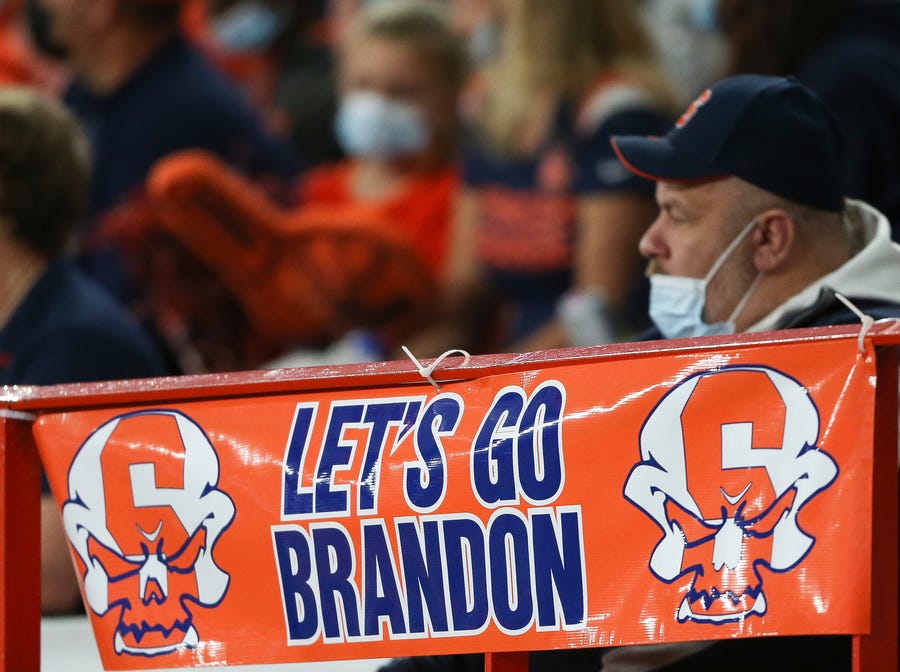
This particular sign was a the Boston College-Syracuse football game Oct. 30. A fan’s juvenile jab at President Joe Biden.Joshua Bessex

For instance, the woman had not heard about the Southwest Airlines pilot who recently signed off on a flight, telling passengers, “Let’s go, Brandon.”

Or about how the whole thing began when a race car driver named Brandon Brown won a NASCAR race and, while being interviewed on TV, the crowd started chanting, “F–k Joe Biden.” The flummoxed interviewer suggested they might be saying, “Let’s go, Brandon.”

After that, the phrase became a way for grown-up 8-year-olds to say the f-word about Biden without actually using it.

Really.

Elected Republican politicians in Washington, D.C., started using the phrase.

Donald Trump began selling “Let’s go Brandon” T-shirts through his Save America PAC for $45, and grown-up 8-year-olds in America actually purchased them.

$45.

There are adults who channel their 8-year-old selves by bringing signs saying, “Let’s go, Brandon” to public events, as well as some who scribble the message in paint on the rear window of their automobiles….

How to answer someone who says such a thing

Of course, we all learned as children that infantile behavior tends to draw some type of backlash….

After I explain the whole “Let’s go, Brandon” thing to the woman who’d been walking her dog she says, “That seems incredibly childish. How are you supposed to answer someone who says such a thing?”

I tell her that, as a grown-up, she would be best served simply ignoring it.

As for the rest of us, suffering as we do from social-media-induced age regression, I’d respond, “I’m rubber and you’re glue …”

Reach Montini at ed.montini@arizonarepublic.com.

Problem viewing email? View in browser

After months of negotiations among Democrats over the fate of President Biden’s historic $3.5 trillion proposal, a compromise seems to have been reached (although nothing is certain). At the insistence of Democratic Senators Manchin and Sinema, the size of the ambitious plan has been cut in half. Many of its parts were cut away, including two years of free community college and 12 weeks of paid family leave for medical reasons (the U.S. is the only major nation that doesn’t provide it). Three Democratic members of the House killed the provision to lower prescription drugs. And of course the Republicans opposed everything.

This is how Harold Meyerson of The American Prospect described it.

World’s Biggest Half-Full, Half-Empty Glass

Biden’s bill is historically great and bitterly disappointing.


Well—had we not anticipated, had it never seemed, that the Democrats, having won control of Congress and the White House, would proceed to enact paid family leave, expansions of Medicare, a permanent Child Tax Credit, disincentives to fossil fuel use, the ability to negotiate down drug prices, and such—had we not counted on that, then today would be a day of unmitigated celebration. Instead, celebration of the groundbreaking social provisions that actually are in the bill President Biden outlined today—universal pre-K, child care subsidies, incentives for clean energy, commonsense tax reforms that will compel corporations to pay some taxes, and the like—has to be mitigated by the fate of the even more commonsense provisions that now lie on the cutting-room floor.

For me, the most absurd relegation to that floor has been killing the proposal to give Medicare the ability to bring down drug prices. Seldom is a serious change to social and economic policy backed by more than three-fourths of the public, but this one surely was. Reportedly, President Biden has persuaded Kyrsten Sinema to accept a deal so preposterously weak—one that enables Medicare to negotiate down the price of drugs whose patents have expired (that is, after the big drug companies have wrung out the lion’s share of profits on those drugs, and which simply incentivizes those companies to extend their patents)—that few Democrats on the Hill seem inclined to vote for it. (Its merits are so nonexistent that the provision was omitted from Biden’s bill.)

By opposing giving Medicare the capacity to stop Big Pharma from charging Americans vastly more for their medications than they charge the citizens of any other nation, Sinema and three House Democrats effectively killed the one provision of the proposed $3.5 trillion package that would have most reduced the cost of living, significantly slowed the pace of inflation, and quite possibly moved more swing votes into the Democrats’ column than any other.

Leading the resistance to this measure in the House was Scott Peters, the California Democrat whose North San Diego County district includes many of the biotech companies that reap fortunes from high drug prices. While Sinema and the two other House Democrats who joined with Peters can likely be successfully primaried, the economy of Peters’s district is so dependent on high drug prices that he might well survive such a challenge…

One provision of the PRO Act—which, taken as a whole, would have been a new Magna Carta for American workers—has made it into Biden’s bill. The provision requires employers to pay fines ranging from $50,000 to $100,000 when they commit unfair labor practices, such as firing employees for their pro-union activities. Under current law, there are effectively no penalties assessed on employers when they’re found guilty of such practices. By excluding the more fundamental provisions of the PRO Act from Biden’s bill, chiefly because they don’t fit under rules of reconciliation, the employer-employee playing field remains steeply tilted toward employers, but if these fines pass muster with the Senate parliamentarian (an open question), they do reduce that tilt by a decidedly modest margin.

As befits a half-empty, if also half-full, glass.


~ HAROLD MEYERSON

Tracee Miller, a member of the St. Louis Board of Education, writes that she was shocked and dismayed to discover that a proposal to raise taxes for early childhood education was actually a disguised effort to divert more public money to charter schools. The truth leaked out:

Emails exposed via public records requests revealed that not only did the proposal lack specificity around fund distribution, but also that the funds could be redirected to economic projects unrelated to ECE. These articles also named local individuals and organizations affiliated with the deceit, illustrating the depth and breadth of political corruption connected with one ballot measure. Only it isn’t just one ballot measure.

The individuals peddling their agenda under the guise of education equity will continue to steer public dollars toward private programs and gain political capital unless we decide that public education is too important to jeopardize for the sake of private gain. We will all be complicit in the perpetuation of inequity if we choose to let this continue when we know the reality. I feel compelled to ensure, to the extent that I am capable, that the public is as aware of the even broader reach of these local actors. In reading about my experiences, I hope that St. Louis citizens will gain further awareness of the corruption at play in our education system and choose to eradicate that corruption once and for all. The same shadow groups who publicly say one thing yet do another behind-the-scenes, as they did with the ECE proposal, are working to restructure our city’s entire public education system without input from the larger community. It is incumbent upon residents of the St. Louis region to fully unearth the far-reaching influence of these groups, to assess the impact of their operating with impunity for so long, and to ensure that the community leads the way in making decisions that will impact the city’s children and its future.

Because of intense personal pressure, both public and behind-the-scenes, I spent countless hours trying to better understand the connections between groups and the strategies they were using. What I learned will strike fear into the heart of any public education advocate. Since 2018, The Opportunity Trust has funded new charter founders, has steered these founders to specific charter sponsors, and has paid for start-up and strategic planning costs to launch new charter schools or expand existing networks in St. Louis City. They do this even as St. Louis Public Schools (SLPS) struggles with under-enrollment and the possibility of school closures. This work has been executed through tactics similar to those used in their attempt to push through the tax increase allegedly for ECE, and for similar self-serving purposes.

In addition to their work in the charter sector, The Opportunity Trust has launched numerous local non-profits and supported three cohorts of fellows, including many individuals connected with the SLPS district and Board of Education (BOE), to study other school systems that have implemented similar reforms. The Opportunity Trust is not a home-grown Missouri organization, and it and its associated organizations are not here to solve Missouri problems. The Opportunity Trust is the local arm of a national organization, The City Fund, whose model seeks to expand the number of charter schools, increase charter enrollment, fund the election of school choice advocates to elected school boards, divide public school districts into factions by treating schools as independent entities that function without the oversight of an elected board, and fund the election of school choice advocates to elected school boards, including at least one current member of the SLPS BOE. The City Fund does not make it clear when it is investing in a city, actively maneuvering funding through non-profits and PACs so that the money and their motives are harder to track.

Who might these “shadow groups” and individuals be? As Miller says, “The Opportunity Trust” is the St. Louis branch of the national group called “The City Fund.” The City Fund started life with $200 million from billionaires John Arnold (Texas) and Reed Hastings (California). It took a few minutes of scouring its web pages to find its list of “investors,” which include familiar names: The Walton Family Foundation; the NewSchools Venture Fund; the Silicon Valley Community Foundation; and other less familiar names, such as the California-based Intrepid Philanthropy Foundation, which supports innovative approaches to teaching, such as Teach for America; also George Roberts, San Francisco-based billionaire and founder of the powerhouse investment fund KKR.

Their agenda is to demand more charter schools, more scrutiny of public schools, and less scrutiny of charter schools. They are there to destroy public schools, not to help them.

Miller writes:

These organizations have made a practice of using distorted data to fundraise and garner support from individuals and organizations who champion the school choice movement. A salient example of this unethical use of data is the past year’s presentation hosted by ednextstl in collaboration with WEPOWER, EdHub STL, Equity Bridge, Forward Through Ferguson, and The Opportunity Trust. The data presented at this community event, where the audience was primarily composed of charter school employees, philanthropists, and self-named equity advocates, was so slanted that a third-party representative subsequently presented on that bias during a meeting of the SLPS BOE.

It is also critical to consider the motives of WEPOWER’s education advocacy campaigns. While budget transparency and community engagement should be pillars of any public education system, these tenets are not specific to traditional public school districts, though WEPOWER treats them as such. As recipients of public tax dollars, charter schools also have a responsibility to the community they serve, yet the group has not included any charter school in the demands they have issued; to-date, SLPS has been the sole target of WEPOWER’s demands. If what they seek to achieve is truly high-quality education for all students, this same level of scrutiny must be extended to charter schools as well. Instead, they have worked harder to push their agenda than they have to truly advance the quality of education in St. Louis, as was made evident in the ECE tax proposal.

Really, it is quite disgusting to see these elites circling the neglected and abused public schools of St. Louis with their discredited solutions that have such an empty track record. Their propaganda is powerful; their track record is abysmal. Will they trick another urban district into abandoning its public schools?

Tom Ultican writes here about the charter vultures descending on St. Louis to pick over the bones of their once glorious public schools. He notes that student enrollment in the district has fallen precipitously since the mid-1960s, when it was 115,543. The drop accelerated since then and it is now under 20,000. Ultican tells the sad story of the reformers who wasted money and opened charters to further enfeeble the district.

 From 2000 to 2020, the student population in St. Louis has again fallen by more than half from 44,264 to 19,222. Some of that decline can be attributed to the continuation of migration to the suburbs which now includes Black families. However, a large portion of the drop is due to the growth of charter schools. The charter school enrollment for 2020 was at least 11,215 students which represents 37% of the district’s publicly supported students. 

Like the national trend, the privatized schools chartered by the state, educate a lower percentage of the more expensive special education students; charters 11.4% versus SLPS 15.1%.

The “reformers” have had their “fun” with the St. Louis public schools. The one thing that they have not done is to improve them. They are raiders of the public schools.

Because of declining enrollment, 11 additional public schools are on the chopping block, candidates for closure. In a recent article in Medium, St. Louis parent Emily Hubbard called on politicians and civic groups to take some pro-active steps to save these 11 schools and what remains of public education. In case they didn’t know how to help the struggling public schools, she offered some ideas:

Here are some suggestions:
* Demand commitments from all your big donors to create an endowment that will fund north city schools for years to come
* Use your strength and connections to demand that county entities pay a white flight/greenlining/educational reparations tax (perhaps that can fund the endowment?)
* Demand a charter school moratorium; refuse to sponsor or delight in these entities that play such a big part in SLPS’s struggles
* Get right to the root cause of another of SLPS’s struggles and provide universal basic income for district families
* Before giving us coats and backpacks, make sure all the parents in the district are being paid fair wages at a job that doesn’t take hours to get to
* Create more non-slummy housing for families that need three bedrooms
* Demand whoever is in charge of it to create a more equitable funding situation than property tax 
*refuse to let charter schools get access to tax breaks and capital that SLPS is unable to access because they are just a plain ol’ public school district
* do what it takes to re-do the de-seg order so that the majority of Black children are able to benefit
* Put your children in St. Louis Public neighborhood schools (and not just the majority/plurality white ones) in a demonstration of solidarity with the families you claim to speak for.
* work out a deal with the city to do something about the unused buildings, free the district from the millstones
* If you want to dismantle the public school system, please just go ahead and say so instead of being all devious 
* if you think your family is too good for SLPS, please just go ahead and say so, instead of dancing around the issue
* repent publicly for not doing the things that you should’ve to care for the children in SLPS’s care, and for doing things that harm the children in SLPS’s care

Is anyone listening? Does anyone care? Will the leaders of the city allow the Wall Street bankers, the hedge funders, and billionaires from California and elsewhere to buy the public school system and close it down?

Leonie Haimson has a weekly radio show called “Talk Out of School” on WBAI in New York City. She invited Denisha Jones and me to discuss the election results and their implications for education, on the day after the election.

Denisha is a lawyer, an early childhood education advocate, and a professor. She is also a member of the board of Network for Public Education.

Here is our discussion.