Archives for category: Disruption

New Hampshire reporter Garry Rayno says that the state legislature has its priorities upside down. Writing at IndepthNH.org, Rayno describes a Republican state government led by “moderate” Governor Chris Sununu that’s determined to destroy public schools while expanding vouchers eventually to cover all students’ private school tuition, including the children of the richest residents. Sununu appointed a homeschooling parent, Frank Edelblut, as the State Commissioner of Education. Edelblut is hostile to public schools and eager to divert funding from them.

The Republican legislature refused to renew a program to feed hungry children. As Rayno notes, they are “pro-life,” but don’t care much about living children.

Rayno writes:

From the new proposed rules for education minimum standards to alternative education opportunities, the state legislature and the executive branch appear to have their priorities upside down.

Call it culture wars, call it the war on public education or whatever you want, but much more attention is being paid to about 3 or 4 percent of the state’s school-age students — mostly in private and religious schools or home-schooled — while about 24 percent of public school students with food insecurity do not receive the same attention.

While there is ample evidence a hungry student is not a student fully focused on his or her studies, and is less likely to succeed academically than those who aren’t hungry when they come to school, the House last week by the slimmest of margins, said the food insecure kids could go hungry in this, one of the wealthiest per-capita states in the country.

House Bill 1212 supporters were willing to trim the cost by reducing the income cap from 350 percent of the federal poverty level to 250 percent or about $17 million annually from the Education Trust Fund instead of $50 million.

But that failed to induce enough Republican support to take the bill off the table where a near party line vote had put it, effectively killing it for this year.

The Republican majority also did not want to spend $150,000 of federal pandemic money to hire a coordinator to help about 1,500 homeless students who do not qualify for state homeless services because they do not live with their parents.

Many of the 1,500 students are in the LGBTQIA+ community.

Many of the same people who did not want to spend state or federal money to feed the hungry and help the homeless children and youths favor greater restrictions on abortions or are “pro-life.”

What they are saying with their votes, is we want you to have babies whether you want them or not or whether you can afford them or not, but once they are born, you’re responsible for taking care of them with no help from us.

Pro-life may not be the best term for anti-abortion proponents who voted not to feed the hungry children nor help find them a place to live…

Yet this week two public hearings will be held on bills to expand the eligibility for the Education Freedom Account program now in its third year, and every year well over its budgeted appropriation.

The bill would increase the income cap for the program from 350 percent of the federal poverty level to 500 percent which is $156,000 for a family of four and $102,000 for a parent and child household based on federal 2024 figures.

The current rate would limit family income to $109,200 for a family of four and $71,540 for a family of two.

The cost of the program since its inception has steadily increased from $8.1 million the first year, to $15 million the second and $25 million for the current school year.

The bill barely passed the House and the House Finance Committee chair waived fiscal review of the increase although many more students would be eligible — well above 50 percent of the families in New Hampshire and greatly increasing the cost, but bill proponents did not want to give Democrats another shot at killing the bill.

The money for the program comes from the Education Trust Fund which also provides the adequacy grants to public schools and the larger grants to charter schools, along with special education, building aid and other educational activities…

The bill will increase the income threshold from 350 percent to 400 percent with the threshold for a family of two $81,760 and a family of four at $124,800.

Reaching Higher Education estimates this increase will bring the cost for next school year to $53.4 million.

That is about a quarter of the current surplus in the Education Trust Fund.

The ultimate goal for supporters of the EFA program is universal eligibility or having no income cap so every family in the state would be eligible which would cost $90 million to $100 million if all the students in private or religious schools and homeschool programs sought and received some grants.

About 10 states have universal or near universal voucher programs, but the two states that have attracted the most attention because of their impact on state budgets have been Arizona and Ohio and both have gone well over estimated costs as they have here in New Hampshire.

The program is bankrupting Arizona and the Democratic governor is trying to limit its reach, but the Republican-controlled legislature has refused to go along.

Ohio faces a lawsuit over its program claiming it is hurting public schools while the vast majority of the new participants are students already in private or religious schools or homeschooling programs.  

Sound familiar.

As one Texas state senator said when Gov. Greg Abbott was pushing for school vouchers, “it is nothing but a subsidy for the wealthy.”

And there are the new rules for the state’s minimum standards for public schools.

Two public hearings were held in the past two weeks and the proposed rules were universally trashed by almost everyone testifying causing state Board of Education chair Drew Cline to chastise those focusing on the rules presented to the board in February while a newer, updated version will come before the board soon, although that updated proposal is not available to the public.

The rules are aimed at clarifying and adding details to the state’s competency-based education model, but they also have been criticized for lowering the existing minimum standards, removing limits on class size, making many standards optional and not mandatory, and no longer requiring certified teachers and professionals.

Other concerns were the proposal would do away with local control, a hallmark for public education in the state, and move toward privatizing education and away from what one person called the great equalizer “public education.”

Education Commissioner Frank Edelblut proposed bills in the last few sessions that would have eliminated many current standards to focus only on the core areas of English, math and science, but without much success with the legislature.

Many saw the plan as a way to lower the state’s share of the cost of education and to make public school alternatives more attractive to students and parents.

Say what you will about Edelblut and his opinions about public education, he is tenacious.

The state is at a crossroads that will determine what public education will be for the next decade and on whether or not the state is willing to take care of its most vulnerable so they can fully participate in that education.

The end of the 2024 session and ultimately the next election should provide a vision of the future for New Hampshire and its children.

Garry Rayno may be reached at garry.rayno@yahoo.com.

All are welcome to a very important lecture at Wellesley College in Wellesley, Massachusetts. Admission is free. Join me!

The speaker is a pioneer of critical race theory.

Professor Soo Hong, chair of the Education Department at Wellesley, released the following announcement.

We are thrilled to announce that our 2024 Ravitch Lecture in Education will be presented by Professor Patricia Williams ’72, University Distinguished Professor of Law and Humanities at Northeastern University. Professor Williams’s talk is titled, “Burying the Bodies: Book-Banning and the Legacy of Anti-Literacy Laws in Constructing Erasures of History.

This is a topic that feels relevant now more than ever. 

The lecture will be held on Thursday, April 18, 4:30 PM in Jewett Auditorium. Please share the details of this event widely!

************************************************************

Description of “Burying the Bodies: Book-Banning and the Legacy of Anti-Literacy Laws in Constructing Erasures of History” 
We live in an oddly contradictory moment: politicians who position themselves as supporters of “absolute” freedom of speech simultaneously enact laws that restrict access to books about race, gender, or critical theory, and seek to constrain conversations about diversity, equity, and inclusion. There have always been “culture wars” in America—it is not surprising that conversations about traumatic histories and contested historical perspectives might be fractious. In a civil society, we commit to arguing our way to consensus, however noisily or uncomfortably, and even if it takes generations. But it is the mark of an uncivil—or authoritarian—society when we find ourselves without the right to speak, hear, write, publish, dissent, or share common space even in our disagreement. The First Amendment rightly allows us to curtail speech that poses an “imminent threat of physical harm.” But recent “anti-woke” laws banish from public spaces books and ideas that merely might inspire “shame,” “guilt,” or “discomfort.” This lecture will ponder the conceptual chasm between those two notions of constraint upon speech. What power imbalance, what uses of force are rationalized in erasing whole histories from collective contemplation? What civic dispossession is enacted when certain lives or lived narratives are discounted as intolerable, unknowable–whose mere recounting is silenced as illegal?

Wellesley Logo

Soo Hong

The lecture will be taped and available online at a later time.

Jan Resseger reports on dramatic changes in Chicago, which has been a Petri dish for corporate school reform for at least two decades. The last mayoral election pitted Paul Vallas, an Uber reformer against Brandon Johnson, a teacher and member of the Chicago Teachers Union. Johnson is now beginning to unravel the damage done by Arne Duncan, Rahm Emanuel, and the business leadership.

Resseger writes:

Right now we are watching in real time as Chicago tries to figure out how to undo the consequences of a catastrophic, two-decades long experiment in marketplace school reform.

Chicago’s Board of Education has voted to implement an important first step in Mayor Brandon Johnson’s proposed school district overhaul: the elimination of student based budgeting.

Mayor Johnson seeks to restore equal opportunity across a school district that has become marked by magnet schools, charter schools, elite and selective public schools, struggling neighborhood schools, and neighborhoods without a a public high school or even a traditional public elementary school.

Johnson has prioritized major changes in the Chicago Public Schools, whose problems became especially obvious in June of 2013, when Mayor Rahm Emanuel closed 50 neighborhood public schools because, as he claimed, they were under-enrolled. Eve Ewing, a University of Chicago sociologist explains that, “80 percent of the students who would be affected were African American… and 87 percent of the schools to be closed were majority black.” (Ghosts in the Schoolyard, p. 54)

Chicago was an early experimenter with school reform. Brandon Johnson, the city’s elected mayor, leads Chicago’s schools as part of the 1994 mayoral governance plan imposed on the public schools by Mayor Richard M. Daley and the Illinois legislature. The Chicago Public Schools adopted universal, districtwide school choice, and the launch in 2004 of Renaissance 2010 (led by Arne Duncan) that involved the authorization of a mass of new charter schools and the subsequent closure of so-called failing neighborhood public chools. Chicago adopted a strategy called “portfolio school reform,” described in a National Education Policy Center brief: “The operational theory behind portfolio districts is based on a stock market metaphor—the stock portfolio under the control of a portfolio manager. If a stock is low-performing, the manager sells it.  As a practical matter, this means either closing the school or turning it over to an charter school….”

Then in 2014, Mayor Emanuel added a districtwide funding plan called student based budgeting. In a 2019 report, Roosevelt University professor Stephanie Farmer explained: “Student Based Budgeting fundamentally remade the approach to funding public schools. Student Based Budgeting is akin to a business model of financing public schools because funds are based on student-consumer demand and travel with the student-consumer to the school of their choice.  (The plan contrasts with)… the old public good approach to financing public schools that ensured a baseline of education professionals in each school.”

Because it is known that aggregate school test scores correlate primarily with poverty and wealth, it was predicable that student based budgeting would put schools in Chicago’s poorest neighborhoods on a race to the bottom, leading to schools with tragically limited programming for the city’s most vulnerable students and more school closures.  Farmer concludes: “Our findings show that Chicago Public Schools’ putatively color-blind Student Based Budgeting reproduces racial inequality by concentrating low budget public schools almost exclusively in Chicago’s Black neighborhoods. The clustering of low budget schools in low-income Black neighborhoods adds another layer of hardship in neighborhoods experiencing distress from depopulation, low incomes, and unaffordable housing.”

In late March of this year, WBEZ’s Sarah Karp reported that the Board of Education voted to launch a new plan to determine how much each school has to spend on teachers and programming: “Chicago Public Schools is officially moving away from a school funding formula that pitted schools against each other as they competed for students… District officials… announced (on March 21, 2024) they are implementing a formula that targets resources for individual schools based on the needs of students, such as socioeconomic status and health. They will abandon student based budgeting—a formula unveiled a decade ago under former Mayor Rahm Emanuel that provided a foundational amount of money based on how many students were enrolled…. Under the needs-based formula, every school will get at least four foundation positions, including an assistant principal, plus core and ‘holistic teachers.’… Schools will then get additional funding based on the opportunity index, which looks at barriers to opportunity including race, socioeconomic status, education, health and community factors.”

While undoing a market-based scheme for school funding and operations is clearly a moral imperative, the challenges appear daunting.  Karp continues: “This change was expected as Mayor Brandon Johnson and others have sharply criticized student based budgeting. However, it was unclear how it would play out, especially as the district faces a $391 million deficit for the next school year.  The shortfall is the result of federal COVID relief funds running out… District officials offered no information at a Board of Education meeting… on how the district will fill the budget hole.”

In addition to the threat of a serious financial shortfall, another challenge is the outcry from parents who have over the past two decades become a constituency for charter schools, magnet schools and selective high schools.  Mayor Johnson has tried to reassure parents: “(L)et me assure people that—whether its a selective enrollment school or magnet school—we will continue to invest in those goals… (A)ll I’m simply saying is that where education is working in particular at our selective enrollment schools and our magnet schools, my position is like any other parents in Chicago: that type of programming should work in all of our schools. And that has not been the case. Neighborhood schools have been attacked, they have been demonized, and they’ve been disinvested in, and Black and brown parents overwhelmingly send their children to those schools. So it’s not just demonizing and disinvesting in Black and brown schools, it’s demonizing and disinvesting in Black and brown people—and not under my administration.”

Although school choice plans like Chicago’s were originally premised on the idea of providing more choices for those who have few, in her profound book, Ghosts in the Schoolyard, Eve Ewing explains that families in Chicago do not have equal access in today’s school system based on school choice: “While choosing the best option from a menu of possibilities is appealing in theory, researchers have documented that in practice the ‘choice’ model often leaves black families at a disadvantage. Black parents’ ability to truly choose may be hindered by limited access to transportation, information, and time, leaving them on the losing end of a supposedly fair marketplace.” (Ghosts in the Schoolyard, p. 23) Families dealing with poverty and its challenges are more likely to select a neighborhood school within walking distance of their home.

Mayor Johnson and his school board are facing a fraught political battle in the midst of severe budget challenges. Chicago school reform has exacerbated inequality. The families whose children remain in traditional neighborhood schools that have been undermined by school choice and student based budgeting have watched their their schools lose staff and programs their children need. At the same time, families who have benefited from charter schools, magnet schools and selective-enrollment high schools have now become strong supporters of the programs they have come to take for granted.

Mayor Johnson has been very clear, however, about what the past two decades of portfolio school reform, school choice and student based budgeting have meant for Chicago: “What has happened in the city of Chicago is selective enrollment schools go after students who perform academically on paper.  It’s a very narrow view of education. Let’s also ensure that other areas of need are also highlighted and lifted up.  That’s arts, our humanities, technology, trades…  It’s not like we’re asking for anything radical. We’re talking about social workers, counselors, class sizes that are manageable. We’re talking about full wraparound services for treatment for families who are experiencing the degree of trauma that exists in this city.”

Federal Judge Royce Lamberth in D.C. has sentenced those convicted of committing crimes during the January 6 insurrection, most of them for violently assaulting police officers. He objects to those (like Trump) who insist on calling them “hostages” and “patriots.” Almost as shocking is the fact that Republican members of Congress who ran for their lives on January 6 sit silently as Trump praises their attackers. Trump has treated them as heroes and promised to pardon all of them.

Jennifer Rubin of The Washington Post wrote:

D.C. District Judge Royce C. Lamberth delivered a tongue-lashing last week during the sentencing of a participant in the Jan. 6, 2021, riot convicted of multiple crimes. He railed against downplaying the insurrection and specifically condemned the effort to elevate convicted criminals to the status of “hostages.”

It was not the first time Lamberth tried switching off MAGA’s national gaslighting exercise. In a January sentencing memo for another Jan. 6 participant convicted of serious felonies, he declared:

“I have been shocked to watch some public figures try to rewrite history, claiming rioters behaved “in an orderly fashion” like ordinary tourists, or martyrizing convicted January 6 defendants as “political prisoners” or even, incredibly, “hostages.” …

“Protestors” would have simply shared their views on the election — as did thousands that day who did not approach the Capitol. But those who breached and occupied the Capitol building and grounds halted the counting of the electoral college votes required by the Twelfth Amendment.

He continued, “This was not a protest that got out of hand. It was a riot; in many respects a coordinated riot, as is clear from cases before me. … Although the rioters failed in their ultimate goal, their actions nonetheless resulted in the deaths of multiple people, injury to over 140 members of law enforcement, and lasting trauma for our entire nation.” He concluded, “This was not patriotism; it was the antithesis of patriotism.”

Rubin points out that

Trump has not only reimagined Jan. 6 as a glorious event but promised to pardon those involved. Just Security compiled a list of the criminals who would be let out of jail if he spared convicts and those incarcerated awaiting trial. Tom Joscelyn, Fred Wertheimer and Norman L. Eisen calculated that, as of March 23 (the day after Trump reportedly vowed to set “these guys free”), there were 29 inmates in custody related to Jan. 6, “including defendants who are either awaiting trial or post-conviction.”

These include 27 “charged with assaulting law enforcement officers in the U.S. Capitol or on its grounds,” of which 20 have either been convicted or pleaded guilty. The violence involved should shock Americans:

One convicted felon helped lead the assault on police guarding the Capitol’s external security perimeter, an “attack [that] paved the way for thousands of rioters to storm the Capitol grounds.” Another inmate allegedly threw “an explosive device that detonated upon at least 25 officers,” causing some of the officers to temporarily lose their hearing. “For many other officers that were interviewed,” an FBI Special Agent’s statement of facts reads, “it was the most memorable event that day.”

Other January 6th inmates held in D.C.: “viciously ripped off” an Metropolitan Police Department (MPD) officer’s mask; assaulted officers “with an electro-shock device;” allegedly sprayed multiple police officers with a pepper spray; “struck an MPD officer with a long wooden pole multiple times;” and allegedly used a “crutch and a metal pole” as “bludgeoning weapons or projectiles against” a “line of law enforcement officers.”

At its most basic level, Trump’s support of Jan. 6 criminals should demolish the notion that Trump and MAGA followers “stand with the blue” or represent the “law and order” party. Trump called these people to the Capitol, fired them up and urged them on to the Capitol. Facing trial himself for the events of Jan. 6, he wants to let out of jail the foot soldiers he enlisted to attack democracy.

Trump admires criminals who attacked officers of the law. They are not hostages. They are criminals.

Dave Wells, research director of the Grand Canyon Institute, a nonpartisan research center in Arizona, released the following statement:

Phoenix —The Grand Canyon Institute expresses deep distress over the implications for women’s health and rights in response to the Arizona Supreme Court’s decision to uphold a territorial-era law from 1864 that bans nearly all abortions. This ruling poses a significant threat to reproductive freedom and will have profound economic consequences for individuals and families across the state.

While the immediate harm will be experienced by women denied access to healthcare, today’s decision will have negative repercussions for all Arizonans. An analysis published in January 2024 by the Institute for Women’s Policy Research (IWPR) sheds light on the ongoing impact of abortion restrictions, highlighting the negative impacts of such policies on economic prosperity in addition to women’s health. Women constitute a considerable segment of the workforce; restrictions on healthcare access harm not only women and their families but also have adverse effects on local economies. 

This research emphasizes, in the two years before Roe was overturned, the economic toll of abortion restrictions (e.g., required ultrasound), estimating an average annual cost of $173 billion to the United States economy due to reduced labor force participation, earnings levels, and increased turnover among women. This figure understates the substantial economic repercussions of post-Roe abortion bans. Arizona already was facing an average annual economic loss of $4.5 billion, equivalent to 1% of the state’s GDP due to its restrictive measures.

If reproductive health restrictions were removed, almost 597,000 additional women would join the nation’s labor force each year. The national GDP would experience an increase of nearly 0.7%, and employed women aged 15 to 44 would collectively earn an extra $4.3 billion annually.

“By allowing a 160-year-old law to take precedence over the 15-week law passed two years ago, the Arizona Supreme Court has condemned pregnant people to healthcare restrictions reminiscent of an era when slavery remained Constitutionally endorsed” states Dave Wells, research director of the Grand Canyon Institute. “The Court’s decision will also have significant economic consequences for the state.  Our previous restrictive abortion laws already result in an economic cost of $4.5 billion annually, this cost will certainly increase going forward and will be felt by all Arizonans.”

The Grand Canyon Institute emphasizes the importance of safeguarding reproductive rights. As an organization deeply committed to advancing evidence-based policymaking, we are actively engaging in research to further understand the detrimental effects of abortion restrictions on the Arizona economy. This is an area of research we are currently prioritizing, recognizing the profound economic implications of restrictive reproductive health policies.

For more information, contact:

Dave Wells, Ph.D., Research Director

602.595.1025, Ext. 2, dwells@azgci.org

The Grand Canyon Institute, a 501(c) 3 nonprofit organization, is a centrist think tank led by a bipartisan group of former state lawmakers, economists, community leaders and academicians. The Grand Canyon Institute serves as an independent voice reflecting a pragmatic approach to addressing economic, fiscal, budgetary and taxation issues confronting Arizona.

Forgive me for posting two reviews of my last book, which was published on January 20, 2020.

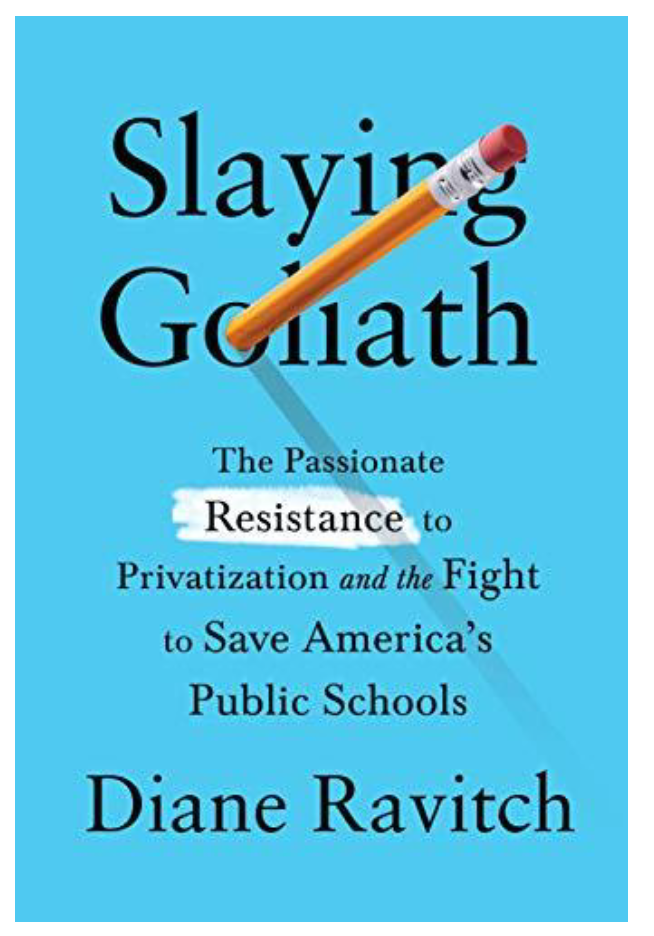
As I explained in the previous post, I did not see either of these reviews until long after they appeared in print. Slaying Goliath appeared just as COVID was beginning to make its mark, only a few weeks before it was recognized as a global pandemic. In writing the book, I wanted to celebrate the individuals and groups that demonstrated bravery in standing up to the powerful, richly endowed forces that were determined to privatize their public schools through charters or vouchers.

America’s public schools had educated generations of young people who created the most powerful, most culturally creative, most dynamic nation on earth. Yet there arose a cabal of billionaires and their functionaries who were determined to destroy public schools and turn them into privately-managed schools and to turn their funding over to private and religious schools.

Having worked for many years inside the conservative movement, I knew what was happening. I saw where the money was coming from, and I knew that politicians had been won over (bought) by campaign contributions.

Publishing a book at the same time as a global pandemic terrifies the world and endangers millions of people is bad timing, for sure.

But the most hurtful blow to me and the book was a mean-spirited review in The New York Times Book Review. The NYTBR is unquestionably the most important review that a book is likely to get. Its readership is huge. A bad review is a death knell. That’s the review I got. The reviewer, not an educator or education journalist, hated the book. Hated it. I found her review hard to read because she seemed to reviewing a different book.

I was completely unaware that Bob Shepherd reviewed the review. I didn’t see it until two or three years after it appeared. He wrote what I felt, but I, as the author, knew that it was very bad form to complain, and I did not.

So I happily post Bob Shepherd’s review of the review here.

I am almost four years late in discovering this review by two scholars for whom I have the greatest respect: David C. Berliner and Gene V. Glass.

I was happy to read this review because Slaying Goliath had a checkered fate. It was published in mid-January 2020. I went on a book tour, starting in Seattle. By mid-February, I made my last stop in West Virginia, where I met with teachers and celebrated the two-year anniversary of their strike, which shut down every school in the state.

As I traveled, news emerged of a dangerous “flu” that was rapidly spreading. It was COVID; by mid-March, the country was shutting down. No one wanted to read about the fight to save public schools or about its heroes. The news shifted, as it should have, to the panicked response to COVID, to the deaths of good people, to the overwhelmed hospitals and their overworked staff.

To make matters worse, the New York Times Book Review published a very negative review by someone who admired the “education reform” movement that I criticized. I thought of writing a letter to the editor but quickly dropped the idea. I wrote and rewrote my response to the review in my head, but not on paper.

Then, again by happenstance, I discovered that Bob Shepherd had reviewed the review of my book in The New York Times. He said everything that I wish I could have said but didn’t. His review was balm for my soul. Shepherd lacerated the tone and substance of the review, calling it an “uniformed, vituperative, shallow, amateurish ‘review.’” Which it was. His review of the review was so powerful that I will post it next.

Then, a few weeks ago, I found this review by Berliner and Glass.

The review begins:

Reviewed by Gene V Glass and David C. Berliner Arizona State University, United States

They wrote:

In a Post-Truth era, one must consider the source. 

In this case, the source is Diane Rose Silvers, the third of eight children of Walter Silverstein, a high school drop-out, and Ann Katz, a high school graduate. The Silvers were a middle-class Houston family, proprietors of a liquor store, and loyal supporters of FDR.

After graduation from San Jacinto High School, she enrolled in Wellesley College in September, 1956. Working as a “copy boy”for the Washington Post, Diane met Richard Ravitch, a lawyer working in the federal government and son of a prominent New York City family. They married on June 26,1960, in Houston, two weeks after Diane’s graduation from Wellesley. The couple settled in New York City, where Richard took employment in the family construction business. He eventually served as head of the Metropolitan Transit Authority and Lieutenant Governor in the 2000s, having been appointed by Democratic Governor David Paterson.

 Diane bore three sons, two of whom survived to adulthood. Diane and Richard ended their 26-year marriage in 1986. She had not been idle. For a period starting in 1961, Diane was employed by The New Leader, a liberal, anti-communist journal. She later earned a PhD in history of education from Columbia in 1975 under the mentorship of Lawrence Cremin.

Diane was appointed to the office of Assistant Secretary of Education, in the Department of Education by George H. W. Bush and later by Bill Clinton. In 1997, Clinton appointed her to the National Assessment Governing Board (NAGB), on which she served until 2004. 

Ravitch worked “… for many years in some of the nation’s leading conservative think tanks.

Read the full pdf here.

The Texas Education Agency, under Republican control, took over the entire Houston Independent School district last year because one high school—with disproportionate numbers of at-risk students—had low test scores for several years in a row. Even though that school, Wheatley High School, was showing marked signs of progress, State Commissioner Mike Morath, fired the elected school board and hired Mike Miles as superintendent with expansive powers and selected a hand-picked “board of managers.”

Morath, a software executive, was appointed by Governor Gregg Abbott, who surely enjoys punishing a mostly Black and Hispanic district that did not vote for him. Of course, Morath must know that state takeovers seldom lead to improvement. This is especially the case in a hostile takeover, like this one.

Houston Democrats are waking up and taking action. At last. How can they allow Gregg Abbott to do a hostile takeover of HISD and install a man with a grandiose sense of his own importance, a man who previously failed in Dallas? Given the Republican super-majority in the state and Abbott’s vengeful nature, there’s probably not much that can change his stranglehold over Houston’s public school students and teachers. But it’s always good to protest and make noise.

Several Houston-area Democratic legislators are calling for a formal hearing to address “potential violations of state law” in Houston ISD in the aftermath of the Texas Education Agency stripping elected leaders from the school district.

The lawmakers asked in a letter sent Friday that the House Committee on Public Education host a hearing to address reports of “unqualified, non-degree holding teachers” working in classrooms and a lack of accommodations for students with disabilities. They also requested independent research proving the benefits of state-appointed Superintendent Mike Miles’ New Education System

The request comes after the state takeover of HISD in March 2023 and the Texas Education Agency’s appointment of the Superintendent and nine members of the Board of Managers. Due to the takeover, the nine lawmakers who signed the letter said it is “imperative that the state assume full responsibility for HISD students and hold the board of managers accountable”

“As their duly elected State Representatives, we must hold a hearing to learn more about these concerning reports and efforts to subvert state laws and requirements,” the letter states.

Reps. Christina Morales, Ann Johnson, Jarvis Johnson, Penny Morales Shaw, Mary Ann Perez, Jon Rosentahl, Shawn Thierry, Hubert Vo and Gene Wu all signed the letter, which was addressed to Speaker of the Texas House Dade Phelan and the House education committee. Phelan and TEA did not immediately respond to a request for comment on the letter. 

“Teacher reports and parent concerns are uncovering troubling developments at our schools,” Morales wrote in a statement. “The community can no longer vote on who represents us on the school board, so we as the state representatives must hold the appointed board accountable.”

In a response to the letter, HISD said it was going to stay focused on “the critical work of serving students and families,” and it had already seen positive impacts for kids after implementing reforms.

“HISD has invited dozens of elected and community leaders into our schools to see the work happening first-hand,” the district wrote. “We are pleased to share our progress with any other leaders who want to better understand what’s happening in the schools.”

Miles has implemented the New Education System program, a controversial model that includes standardized curriculum, the conversion of libraries to Team Centers and courses focused on critical thinking and the “Science of Reading,” at 85 schools this year. The campuses also have longer hours, timed lessons, higher pay for educators and additional staff who support teachers.

“Teachers have expressed that some of our most at-risk students are not receiving the services and support that they legally have the right to receive,” lawmakers wrote. “They have also shared with us that their students feel discouraged and constantly berated by the continuous assessments and instructional method prescribed in the New Education System.”

According to the letter, the district has circumvented the law requiring teachers to obtain a bachelor’s degree, a certification and other requirements to work in a classroom by assigning certified teachers as the teacher of record for more than one classroom.

“These efforts are not only detrimental to the continued learning and development of our students, but also a violation of state law,” lawmakers said.

The Democratic lawmakers also said the district has shared plans with teachers and administrators to address a teacher shortage by hiring community college students as teacher apprentices and learning coaches. 

Under the NES model, teacher apprentices work with teachers to plan and implement lesson plans, provide instruction and support classroom management, and they can serve as the teacher when the primary instructor is absent. Learning coaches provide support to teachers by supervising students, making copies, grading papers and completing paperwork.

Frank G. Splitt is a regular reader of the blog and a retired engineer of great distinction. He sent me his Amazon review of Liz Cheney’s best-selling book about the Congressional hearings conducted by the January 6 Select Committee. I have been meaning to review the book myself but put it off and am glad to print Frank’s review, as I agree with him.

I found the book to be absorbing, revealing what Congressional leaders said to one another on the day of the insurrection, as well as the inner workings of the January 6 Committee. Cheney doesn’t pull her punches. She was appalled by Trump’s disrespect for the Constitution and his egregious lying. She is contemptuous of Congressionals leaders like Kevin McCarthy who first condemned the violent attack, then turned on a dime to bend his knee to Trump.

Liz Cheney gave up her leadership role because of strong principles. Chief among these was her oath to the Constitution. She refused to betray it, and by doing so, she gave up the likelihood that she would one day be Speaker of the House. Very few Republicans were willing to follow her lead. I have immense respect for her.

Frank G. Splitt writes:

Liz Cheney wrote the book with purpose in mind: to assure that the January 6 Select Committee’s work that revealed the culpability of former president Donald Trump in the January 6.2021, attack on the U.S. Capital would not only be thoroughly documented for posterity, but would also illuminate in detail his criminal behavior backed by solid evidence via trustworthy testimony, mostly from members of his own administration.


The book is fact-based and well organized—providing the author’s first-hand beginning-to-end account of the January 6th, 2021, insurrection from outside and inside the halls of the Capital. She tells in consummate detail how, in the aftermath of the 2020 presidential election, Donald Trump ignored the rulings of dozens of courts, plotted to overturn a lawful election, and provoked a violently egregious attack on our Capitol. Cheney goes on to tell how Trump and his congressional enablers broke their oaths of office— betraying the American people and the Constitution in their attempt to prevent the counting of electoral votes and so keep Trump in office.


Liz Cheney helped organize and lead the Congressional Select Committee investigation into how it happened. In her book she tells the story of this perilous moment in our history—exposing those who helped Trump spread his stolen-election lie while forsaking her promising political career in the process.


In the end, I am disappointed not only with the gullibility of so many American citizens who buy into Trump‘s lies, but even more so with craven politicians who keep silent for fear of losing their positions in Congress. No doubt, Cheney would have been near the top of the list of courageous U. S, Senators in John Kennedy’s 1956 book Profiles in Courage.


I am also somewhat disappointed that Trump did not respond to the Select Committee’s subpoena to testify before the committee. By not appearing, Cheney was denied the opportunity to emulate Senate lawyer Joseph Welch’s admonition of lying Wisconsin Senator Joseph McCarthy at the 1953 Army-McCarthy hearing by saying: Mr. Former President, you’ve done enough. Have you no sense of decency, sir, at long last? Have you left no sense of decency?


This should be a must-read book for every American voter as Cheney’s warning concerning the likely consequences of Trump’s return to office is indeed chilling.

Back in 2010, Secretary of Education Arne Duncan rolled out his Race to the Top program to reform American education. The U.S. Department of Education offered a total of $5 billion to states. To be eligible to compete for a part of the huge prize money, states had to agree to authorize charter schools, to adopt the Common Core (not yet finished), and to evaluate teachers based on the test scores of their students.

The requirement to change teacher evaluation was heated. Duncan scoffed at critics, saying they were trying to protect bad teachers and didn’t want to know the truth.

Debate over this methodology was heated.

I was part of a group of education scholars who denounced this method of evaluating teachers in 2010.

In 2012, three noted scholars claimed that teachers who raised test scores raised students’ lifetime incomes; President Obama cited this study, led by Harvard economist Raj Chetty, in his State of the Union address. It seemed to be settled wisdom that teachers who raised test scores were great, and teachers who did not should be ousted.

In 2014, the American Statistical Association warned about the danger of evaluating teachers by the test scores of their students. The ASA statement said that most studies of this method find that teachers account for 1-14% of the variation in test scores. The greatest opportunity for improvement, they said, was to be found in system-level changes.

The Gates Foundation poured hundreds of millions of dollars into districts willing to test value-added methodology, and eventually gave up. Teachers were demoralized, teachers avoided teaching in low-income districts. Overall improvements were hard to find.

Arne Duncan was a true believer, as was his successor, John King, and they never were willing to admit failure.

Teachers never liked VAM. They knew that it encouraged teaching to the test. They knew that teachers in affluent districts would get higher scores than those in less fortunate districts. Sometimes they sued and won. But in most states, teachers continued to be evaluated in part by their students’ scores.

But in New York state, the era of VAM is finished. Dr. Betty Rosa, the chancellor of the New York State Board of Regents, reached an agreement with Melinda Person, president of New York State United Teachers, to draft a new way of evaluating teachers that moves away from students’ standardized test scores.

New York state education leaders and the teachers’ union have announced an agreement to change how New York school teachers and principals are evaluated, and move away from the mandated reliance on standardized test scores.

State Education Department Commissioner Betty Rosa and New York State United Teachers President Melinda Person hand-delivered their drafted legislation Wednesday to lawmakers to create a new system that doesn’t use students’ test performance to penalize educators. The state teacher evaluation system, known as the Annual Professional Performance Review, or APPR, was modified in the 2015 budget to place a greater importance on scores.

“It’s connecting research to practice and developing strategies to ensure that teachers have the best tools and principals to make sure our young people are getting the best quality education,” Rosa told reporters Wednesday in the Legislative Office Building.

When NYSUT elected president Person last year, she said her first task was to change the teacher evaluation system, and state lawmakers said with confidence Wednesday it will happen this session.

The proposed law, which has not officially been introduced in the Legislature, would remove the requirement to base evaluations on high-stakes tests. School districts would have eight years to transition, but could make the changes faster than the required deadline.

Person argued it will support new teachers who are often burdened by the required paperwork under the current model.

“This would be a fair and a just system that would support them in becoming better educators, which is ultimately what they want to do anyway,” Person said.

The proposal was negotiated in agreement with state superintendents, principals, school boards, the PTA, Conference of Big 5 School Districts and other stakeholders. The issue has been contentious for union and education leaders for years, and both state Education Committee chairs in the Legislature said they’re thrilled with the agreement. 

“That’s such a nice thing in Albany,” said Senate Education chair Shelley Mayer, a Democrat from Yonkers. “Who can do that? Who gets agreement? It’s very hard around here.

“It takes a woman to do it,” Assembly Education chair Michael Benedetto replied with a smile.

Benedetto, a Bronx Democrat, was a classroom teacher for decades and recalled how feedback helps educators develop when done in the proper way.

“It’s like anything else — we want stability in our lives, we want to know where we’re going, how we’re going to be rated and what we’re going to be rated on, as a teacher, as a professional,” the assemblyman said.

Lawmakers will review the proposal and draft legislation in the coming weeks.

Remembering how strident were the supporters of VAM, it’s kind of wonderful to hear the collective sigh of relief in Albany as it fades away.