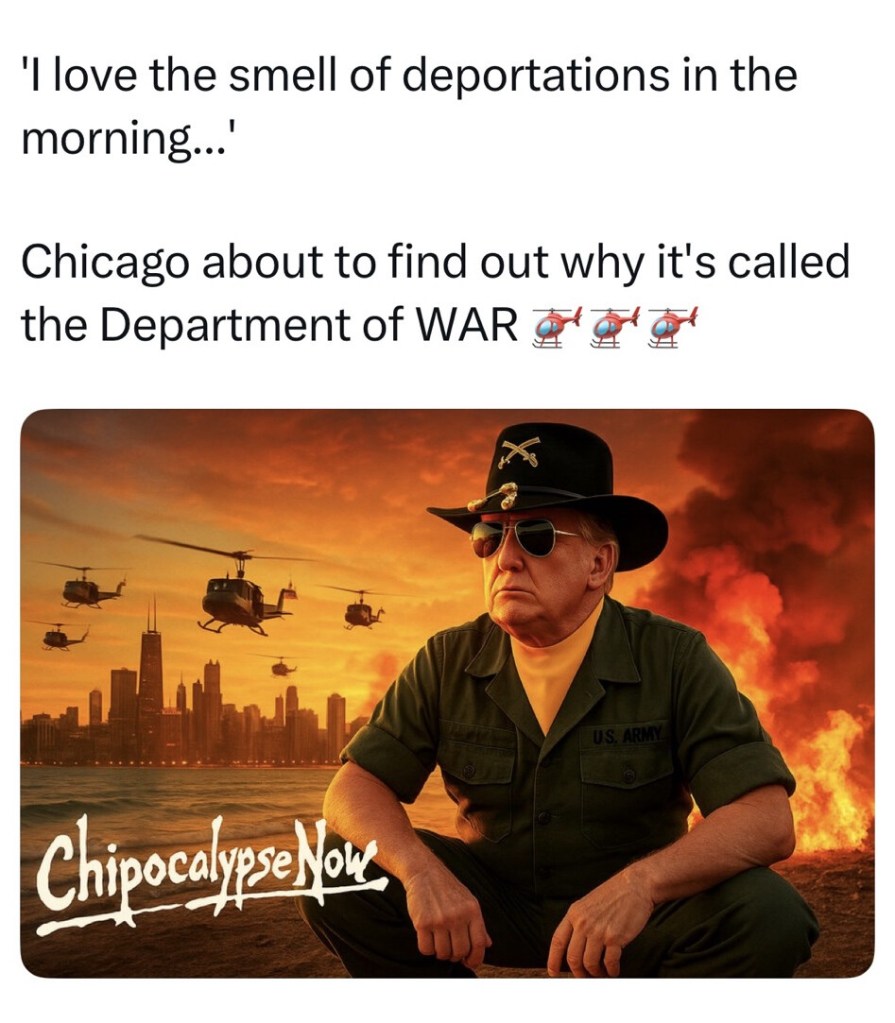
Trump posted this meme on his Internet site, “Truth Social.” He intended to invade Chicago but changed his plans after massive pushback from the people of Chicago and the Governor of Illinois, JB Pritzker.
His next target is Memphis, where federal intervention has been welcomed by Republican Governor Bill Lee, but not the mayor of Memphis.
Remember when Republicans used to believe in local control and small government? I do.
The meme stirred outrage and controversy, as he intended. Senator Tammy Duckworth of Illinois said in a tweet that he should not wear a military cap since he dodged the draft five times. Stolen valor, she said. Duckworth was a helicopter pilot in Iraq who lost both legs when her copter was shot down.
From the web:
She lost her right leg near the hip and her left leg below the knee from injuries sustained on November 12, 2004, when the UH-60 Black Hawk helicopter she was co-piloting was hit by a rocket-propelled grenade fired by Iraqi insurgents. She was the first American female double amputee from the Iraq War.
Trump, the war-lover, posted this meme:
So far as I know, no one asks what the point of this action is. Will the Guard stay for 30 days, then leave? What happens when the National Guard is withdrawn? Will crime return to previous levels? Will the President station the Guard in every big city indefinitely? Is this all a diversion from the Epstein files, inflation, other bad economic indicators?
Have you heard of Horst Wessel? He was a 22-year-old member of the Nazi paramilitary who was assassinated in 1930 by two Comminists. After his death, his name became a propaganda prop for the Nazi party. Lyrics that Wessel had written were turned into the Nazi anthem and called “The Horst Wessel Song.”
I thought of Wessel when I saw how the Trump administration is turning Charlie Kirk into a symbol of leftwing, liberal perfidy that must and will be punished.
Charlie had extremist views about race, immigration, and gender, but he was no Nazi.
I discovered that I was not the only person who was struck by the parallel between Wessel and Kirk, not in what they did, but in how their legacy was used by powerful men. Benjamin Cohen and Hannah Feuer wrote in the Forward, an independent Jewish journal, about the comparison. They interviewed Daniel Siemens, a historian who wrote a book about Wessel. Siemens insisted that the two men should not be compared because Wessel engaged in violence and Kirk did not.
Cohen and Feuer conclude:
The rush to invoke Horst Wessel’s name reflects two realities. On the right, there’s a dangerous willingness among some extremists to valorize Nazi symbols. On the left, a fear that Kirk’s death will be used to erode civil liberties.
It is time to worry about the erosion of civil liberties.
Today, JD Vance became host of “The Charlie Kirk Show.” Among his guests was Stephen Miller, Trump’s Deputy Chief of Staff and Chief ideologue. Miller is known for his hatred of immigrants.
The New York Times just reported that they discussed their plans to crack down on liberal groups, whom they hold responsible for the murder of Charlie Kirk. They believe this even though no evidence has emerged tying the alleged assassin Tyler Robinson to any group, right or left. No one can say whether Tyler moved to the left or to the right of Kirk. The Utah governor said Tyler had a “leftist ideology,” but Kirk had lately been feuding with far-right white nationalist Nick Fuentes, who accused Charlie of being too moderate, a sell-out.
Without any evidence, Vance and his colleagues are forging ahead on the assumption that liberal groups indoctrinated and funded Tyler Robinson.
Trump administration officials on Monday responded to the activist Charlie Kirk’s assassination by threatening to bring the weight of the federal government down on what they alleged was a left-wing network that funds and incites violence, seizing on the killing to make broad and unsubstantiated claims about their political opponents.
Investigators were still working to identify a motive in Mr. Kirk’s killing, but the Republican governor of Utah, Spencer Cox, has said that the suspect had a “leftist ideology” and that he acted alone.
The White House and President Trump’s allies suggested that he was part of a coordinated movement that was fomenting violence against conservatives — without presenting evidence that such a network existed. America has seen a wave of violence across the political spectrum, targeting Democrats and Republicans.
On Monday, two senior administration officials, who spoke anonymously to describe the internal planning, said that cabinet secretaries and federal department heads were working to identify organizations that funded or supported violence against conservatives. The goal, they said, was to categorize left-wing activity that led to violence as domestic terrorism, an escalation that critics said could lay the groundwork for crushing anti-conservative dissent more broadly.
Open the link to finish reading.
I wonder which groups will be targeted. The ACLU? Marc Elias’s “Democracy Docket”? Bloggers like those at The Contrarian, The Bulwark, Rick Wilson, Paul Krugman, Joyce Vance, Heather Cox Richardson, Mary Trump, Norman Eisen of Citizens for Responsibility and Ethics in Washington (CREW), and dozens of others. Will they try again to shut down Act Blue, which many Democrats use as their primary fundraising platform?
Hang on to your hat. Our political system is in for some difficult, challenging times.
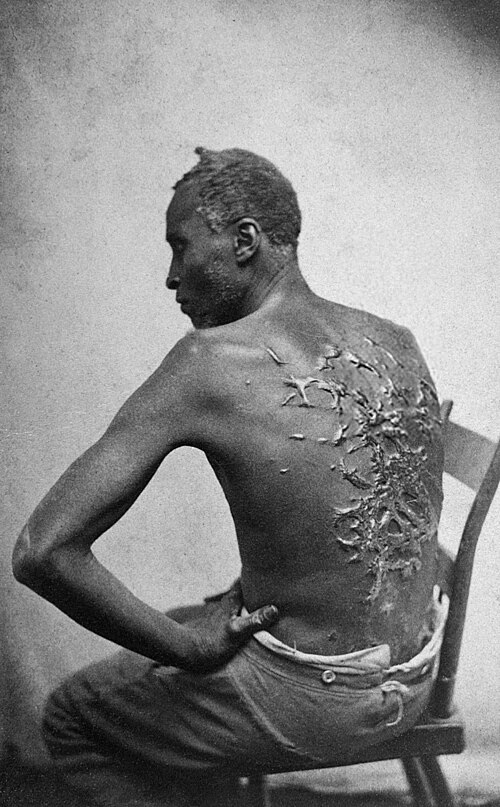
The Trump administration is well on its way to re-enacting George Orwell’s novel 1984, where unwanted facts and history disappeared down a memory hole. The Washington Post reported that officials have ordered the removal of all signage, exhibits, and photographs that depict slavery. Trump intends to eliminate history that he does not like.
Most notably, museums and parks have been told to remove an iconic photograph from 1863 of a slave showing deep scars on his back.
Jake Spring and Hannah Natanson wrote:
The Trump administration has ordered the removal of signs and exhibits related to slavery at multiple national parks, according to four people familiar with the matter, including a historic photograph of a formerly enslaved man showing scars on his back. The photo is called “The Scourged Back.” It is reproduced in many high school American history textbooks. Will they be revised too to cancel unpleasant parts of history?
The individuals, who spoke on the condition of anonymity because they were not authorized to speak with the media, said the removals were in line with President Donald Trump’s March executive order directing the Interior Department to eliminate information that reflects a “corrosive ideology” that disparages historic Americans. National Park Service officials are broadly interpreting that directive to apply to information on racism, sexism, slavery, gay rights or persecution of Indigenous people.
Following Trump’s order, Interior Department officials issued policies ordering agency employees to report any information, including signage and gift shop items, that might be out of compliance. Trump officials also launched an effort asking park visitors to report offending material, but they mostly received criticisms of the administration and praise for the parks.
The latest orders include removing information at Harpers Ferry National Historic Park in West Virginia, two people familiar with the matter said, where the abolitionist John Brown led a raid seeking to arm slaves for a revolt. Staff have also been told that information at the President’s House Site in Philadelphia, where George Washington kept slaves, does not comply with the policy, according to a third individual.
Jamelle Bouie is one of the best, most interesting opinion writers for The New York Times. As a subscriber to that newspaper, I signed up for Bouie’s newsletter, which is where these thoughts of his appeared.
Jamelle Bouie writes:
Virtually every person of note in American politics has, rightfully, condemned the horrific killing of Charlie Kirk and expressed their deep concerns about the growing incidence of political violence in the United States. Wherever we stand politically, we all agree that he should still be alive.
There has been less agreement about Kirk’s life and work. Death tends to soften our tendency to judge. And sudden, violent death — especially one as gruesome and shocking as this one — can push us toward hagiography, especially in the immediate wake of the killing.
So it goes for Kirk.
“Charlie inspired millions,” President Trump said in an Oval Office speech on Wednesday. “He championed his ideas with courage, logic, humor and grace.”
“The best way to honor Charlie’s memory,” Gov. Gavin Newsom of California declared, “is to continue his work: engage with each other, across ideology, through spirited discourse.”
Kirk’s approach, wrote the editors of Politico’s Playbook, “was to persuade, to use charm and charisma and provocation and the power of argument to convince people of the righteousness of his cause.”
There is no doubt that Kirk was influential, no doubt that he had millions of devoted fans. But it is difficult to square this idealized portrait of Kirk as model citizen with the man as he was.
Kirk’s eulogists have praised him for his commitment to discourse, dialogue and good-faith discussion. Few if any of them have seen fit to mention the fact that Kirk’s first act on the national stage was to create a McCarthyite watchlist of college and university professors, lecturers and academics. Kirk urged visitors to the website to report those who “discriminate against conservative students and advance leftist propaganda in the classroom.”
The list, which still exists, is a catalog of speech acts in and outside the classroom. The surest way to find yourself on the watchlist as an academic is to disagree, publicly, with conservative ideology, or even acknowledge ideas and concepts that are verboten among the far right. And the obvious intent of the list is made clear at the end of each entry, where Kirk and his allies urge readers to contact the schools and institutions in question. Targets of the watchlist attest to harassment and threats of violence.
The Professor Watchlist is a straightforward intimidation campaign, and you can draw a line directly from Kirk’s work attacking academics to the Trump administration’s all-out war on American higher education, an assault on the right to speak freely and dissent.
To speak of Kirk as a champion of reasoned discussion is also to ignore his frequent calls for the state suppression of his political opponents.
“‘Investigate first, define the crimes later’ should be the order of the day,” Kirk declared in an editorial demanding the legal intimidation of anyone associated with the political left. “And for even the most minor of offenses, the rule should be: no charity, no goodwill, no mercy.”
Speaking last year in support of Trump’s plan for mass deportation, Kirk warned that the incoming president would not tolerate dissent or resistance. “Playtime is over. And if a Democrat gets in our way, well, then Matt Gaetz very well might go arrest you,” he said.
It is also important to mention that Kirk was a powerful voice in support of Trump’s effort to “stop the steal” after the 2020 presidential election. His organization, Turning Point USA, went as far as to bus participants to Washington for the rally that devolved into the Jan. 6 riot attack on the Capitol.
And then there is Kirk’s vision for America, which wasn’t one of peace and pluralism but white nationalism and the denigration of Americans deemed unworthy of and unfit for equal citizenship.
On his podcast, Kirk called on authorities to create a “citizen force” on the border to protect “white demographics” from “the invasion of the country.” He embraced the rhetoric of white pride and warned of “a great replacement” of rural white Americans.
“The great replacement strategy, which is well underway every single day in our southern border, is a strategy to replace white rural America with something different,” he said last year. “You believe in God, country, family, faith, and freedom, and they won’t stop until you and your children and your children’s children are eliminated.”
Kirk also targeted Black Americans for contempt. “Prowling Blacks go around for fun to go target white people — that’s a fact,” he said in 2023. Kirk was preoccupied with the idea of “Black crime,” and on the last episode of his show before he was killed, he devoted a segment to “the ever-increasing amount of Black crime,” telling his audience, falsely, that “one in 22 Black men will be a murderer in their lifetime” and that “by age of 23, half of all Black males have been arrested and not enough of them have been arrested.”
Kirk told his listeners that Justice Ketanji Brown Jackson of the Supreme Court “is what your country looks like on critical race theory,” that former Vice President Kamala Harris was “the jive speaking spokesperson of equity,” and that the Rev. Dr. Martin Luther King Jr. “was awful.”
“I have a very, very radical view on this, but I can defend it, and I’ve thought about it,” Kirk said at a 2023 event. “We made a huge mistake when we passed the Civil Rights Act in the 1960s.”
This is just a snippet of Kirk’s rhetoric and his advocacy. He also believed that there was no place for transgender people in American society — “We must ban trans-affirming care — the entire country,” he said in 2024 — and has denounced L.G.B.T. identities as a “social contagion.”
It is sometimes considered gauche, in the world of American political commentary, to give words the weight of their meaning. As this thinking goes, there might be real belief, somewhere, in the provocations of our pundits, but much of it is just performance, and it doesn’t seem fair to condemn someone for the skill of putting on a good show.
But Kirk was not just putting on a show. He was a dedicated proponent of a specific political program. He was a champion for an authoritarian politics that backed the repression of opponents and made light of violence against them. And you can see Kirk’s influence everywhere in the Trump administration, from its efforts to strip legal recognition from transgender Americans to its anti-diversity purge of the federal government.
We can mourn Kirk. We can send prayers to his friends and family. We can take stock of the gravity of this event. We can — and should — do all of this and more without pretending he was something, as a public figure, that he was not.
Michelle H. Davis writes a blog called “Lone Star Left,” where she chronicles the usually corrupt politics of Texas. In this post, she eviscerates Governor Abbott, who loves to brag about the economic success of his state. She calls him out for ignoring the people who are nott part of the state’s prosperity.
She writes:
Today, our feckless leader gave a State-of-the-State Address at the Baylor Club in Waco. Now, if you didn’t know, the Baylor Club is a prestigious private social club nestled within McLane Stadium, offering floor-to-ceiling panoramic views of the stadium, downtown Waco, and the Brazos River.
While many Texans are choosing between groceries and insulin, Abbott delivers big promises from an elite club perched over McLane Stadium. That should tell you all you need to know.
It was about an hour long, so I watched it for you. Below, I’ve broken down everything he said and what he conveniently left out.
He began the speech by bragging about having dinner with Governor Glenn Youngkin and then told him that Texas’ budget for building roads was $146 billion. He claimed Youngkin dropped his spoon, saying it was bigger than Virginia’s entire budget. He went on to say that Texas had the “largest road building fund in America.”
It’s only partly true. According to TXDOT’s 10-year plan, we have allocated about $101.6 billion for projects and $45 billion for maintenance. But this road-building bonanza feels stupid without high-speed trains. Seriously, what are we doing?
Trains would alleviate traffic, carbon emissions, congestion, and get us from Dallas to Houston in just 90 minutes. It’s faster and greener than driving, but we’re investing all our money in roads?
Modern marvel, or not, no one likes this shit:
But Republicans do it all for the fossil fuel industry.
And that’s the optics, right there. While Abbott spoke from his panoramic perch, over half of Waco’s Black children struggle to make ends meet. This is the story of what Texas has become under Republican control.
It wouldn’t be a boastful Abbott speech if he didn’t brag about Texas’ economy.
They wine and dine behind glass walls and chandeliers, as Abbott brags to the wealthy. The Baylor Club is a fortress of privilege where the powerful toast each other on gold plates, high above the city streets.
Down below, children go to bed hungry, their bellies gnawing at them while Abbott gloats about GDP. Senior citizens, the same ones who built this state with their hands and backs, are being taxed out of their homes, cast onto the streets, the newest members of the unsheltered community.
How could you hear that and not burn with anger?…
Then, Abbott told the biggest, most monstrous lie of them all.
I had to clip this 30-second video for you to see it. Otherwise, you might not believe a whopper this big.
Abbott claimed that since the 2021 storm (Uri), they have bolstered the Texas electric grid, and it has remained perfect. He went on to say that since 2021, no Texan has lost power due to a deficiency in the grid.
This is flat-out false. This is such a fucking stupid lie, do I even need to fact-check it?
Ask the 2.3 million CenterPoint customers in Houston who lost power for over a week after Hurricane Beryl in July 2024. Or the nearly 1 million Texans left in the dark by the Houston derecho just two months earlier in May 2024. Families sweltered in the heat, elderly neighbors died waiting for oxygen refills, and Abbott wants to call that a “perfect” grid?
What he’s really doing is splitting hairs. ERCOT didn’t order rolling blackouts in those disasters. The distribution system collapsed. In other words, the wires and poles failed instead of the generators. But tell that to the family sitting in the dark with spoiled food and no air conditioning. To everyday Texans, it doesn’t matter whether it’s ERCOT or CenterPoint. The lights are off, the fridge is warm, and the Governor is lying.
This isn’t a story of resilience. It’s a story of deregulation, neglect, and profit over people.
Abbott claimed the Legislature made a “generational investment” in water.
Voters will decide in November whether or not we make that investment, which will not be nearly enough money to cover the extent of Texas’ water problems, but it’s a start.
Abbott claimed that they prioritized small businesses with the new “DOGE law.” A spin if there ever was one. It’s a new bureaucratic agency added to the Governor’s office, which will look for “ways to make regulations more effective, streamline the regulatory process, reduce department costs, and increase public access to regulatory information.”
If you followed along with Lone Star Left during the weeks where we watched the Texas budget hearings, you may remember that every Texas agency is running on outdated computer systems (if they aren’t still using paper), they are all understaffed, they are in buildings that are falling apart, and most government employees aren’t even making a livable wage.
Republicans have already run every inch of this state into the ground, and the idea that they are going to use a new government agency to run it into the ground even further is ludicrous.
Running our state agencies in such an inefficient, broken-down way doesn’t save money. It raises costs. Outdated systems, paper records, and skeleton crews result in Texans waiting longer for services, errors piling up, and agencies paying more in overtime and contract work to keep the lights on.
Republicans are really bad at governing.
The human toll is brutal. Employment turnover in some state agencies runs as high as 50%. Think about that, half the workforce gone, year after year. When you’re constantly training new people instead of keeping experienced staff, services collapse. And nowhere is this clearer than in our Health and Human Services agencies.
These are the people who process Medicaid applications, SNAP benefits, and health services for children and seniors. Understaffed offices and burned-out employees mean months-long backlogs. Families in crisis are told to wait for food assistance. Elderly Texans often lack home health care due to a shortage of caseworkers. Disabled children get lost in the system while Abbott’s donors laugh from the Baylor Club balcony.
This is intentional sabotage. Republicans have hollowed out the very agencies that keep Texans alive. Then they use the dysfunction as an excuse to privatize more, deregulate more, and funnel more contracts to their cronies. The suffering of everyday Texans is the plan.
Governor Abbott said the Texas Legislature fully funded public schools.
But when your audience is a bunch of wealthy CEOs who paid $2,000 a plate to get in to hear you speak, lies like that don’t matter. Surely all of those CEOs are sending their kids to private school, on the taxpayer’s dime, with the shiny new vouchers Mr. Let-Them-Eat-Cake got for all his wealthy donors.
I don’t know about you, but I’m ready to vote this motherfucker out.
Every year he lies a little bigger, every year he sells us out a little deeper, and every year the gap between those sipping cocktails at the Baylor Club and those wondering how to feed their kids grows wider.
The truth is, the wealth inequality in Texas right now is more drastic than the wealth inequality in France shortly before their revolution. You know what happened then.
And I’ll leave you with this, from Jean-Jacques Rousseau:
“When the people shall have nothing more to eat, they will eat the rich.”
So let’s be ready. Let’s be angry. And let’s be organized. Because November 2026 is coming, and it’s time to flip this state.
Writing in the Washington Post, Fareed Zakaria explains how Trump has driven pivotal countries–like India, Brazil, and South Africa–into the embrace of our enemies: Russia, China, and North Korea. For his own bizarre and inexplicable reasons, Trump has tried to cozy up to the leaders of those countries, which have a common interest in opposing democratic countries. He has boasted about his close friendship with Putin, Xi, and Kim Jong Un, but they are laughing at him. Trump’s insane tariffs have been harsh towards our allies, which makes no sense at all.
Zakaria wrote:
Look at the pictures that dominated this week’s world news. They are vivid illustrations of the failures of President Donald Trump’s foreign policy.
The photographs that captured most attention were of China’s massive military parade and of Xi Jinping, Vladimir Putin and Kim Jong Un striding together. Those visuals were to be expected — a reminder that the West faces a determined set of adversaries who see it as their mission to destroy the Western-led international order.
What was surprising were the images from the days before, when the Shanghai Cooperation Organization hosted leaders from India, Turkey, Vietnam and Egypt, among others. All these regional powers were generally considered closer to Washington than Beijing. But a toxic combination of tariffs, hostile rhetoric and ideological demands is moving many of the world’s pivotal states away from the United States and toward China. It might be the greatest own goal in modern foreign policy.
Consider the BRICS, a grouping of countries originally meant to represent the big emerging markets of the future — Brazil, Russia, India, China and South Africa — along with several other members now, too. At meetings, three of the core countries, Brazil, India and South Africa, would generally resist the Russian and Chinese effort to turn the organization into an anti-American grouping. For decades, Washington has been building ties with these three countries, each a leader in its region, to ensure that as they grew in size and stature, they would be favorably inclined toward the United States.
But Trump has treated those pivotal states to some of his most vicious rhetoric and aggressive policies. He unleashed the highest tariff rate in the world against India. He punished Brazil with equally high tariffs and levied sanctions and visa bans against Brazilian officials. South Africa faces 30 percent tariffs, a total cutoff of foreign aid and potential sanctions against government officials.
The governments and people in these countries are outraged at their treatment. India used to be overwhelmingly pro-American. Now it is rapidly shifting toward a deep suspicion of Washington. In Brazil, President Luiz Inácio Lula da Silva’s sagging poll numbers have risen as he stands up to Trump’s bullying. In South Africa, President Cyril Ramaphosa gained stature when he politely responded to Trump’s Oval Office hectoring. It is worth remembering that other countries have nationalist sentiment, too!
There is no strategic rationale for these policy reversals. Trump is punishing Brazil because that country’s independent courts are holding accountable Trump’s ideological soulmate, Jair Bolsonaro, for his efforts to reject the results of free and fair elections. South Africa faces Trump’s ire because of a land reform law that is an attempt to address some of the vast disparities in landholding and wealth caused by decades of apartheid. These reasons have nothing to do with restoring America’s manufacturing base or reducing trade deficits. The U.S. actually runs a trade surplus with Brazil.
While Washington has been alienating these countries, China has been courting them. It has outlined a plan with Brazil for a transformative railway network connecting its Atlantic coast to Peru’s Pacific one. Xi managed to get Indian Prime Minister Narendra Modi to visit China for the first time in seven years. China has courted South Africa with trade and aid, and public sentiment in that country has moved to be quite favorably inclined toward Beijing.
We are often told that Trump likes to talk tough to get the best deal. But his policies are producing real pain and misery on the ground — people losing their jobs and many being pushed back into poverty. That’s why even if these deals are renegotiated and things settle on less brutal terms, the memories will linger. Countries will always know that Washington could treat them as it has and they will want to hedge their bets and keep strong ties with China and Russia, just in case.
American foreign policy these days is a collection of the random slights, insults and ideological obsessions of one man. In general, Trump likes smaller countries he can bully or ideological soulmates who cozy up to him. He doesn’t enjoy dealing with large, messy democracies with their own internal dynamics, pride and nationalism.
Thus, America under Trump has befriended a strange collection of strongmen, in El Salvador, Hungary, Pakistan and the Gulf monarchies. It is at odds with the democracies of India, Brazil, South Africa, Mexico, Canada and most of Europe. Does this make any sense?
The Supreme Court on Monday backed President Donald Trump’s push to allow immigration enforcement officials to continue what critics describe as “roving patrols” in Southern California that lower courts said likely violated the Fourth Amendment.
The court did not offer an explanation for its decision, which came over a sharp dissent from the three liberal justices.
At issue were a series of incidents in which masked and heavily armed Immigration and Customs Enforcement agents pulled aside people who identify as Latino – including some US citizens – around Los Angeles to interrogate them about their immigration status. Lower courts found that ICE likely had not established the “reasonable suspicion” required to justify those stops.
The decision deals with seven counties in Southern California, but it has landed during a broader crackdown on immigration by the Trump administration – and officials are likely to read it as a tacit approval of similar practices elsewhere.
A US District Court in July ordered the Department of Homeland Security to discontinue the practice if the stops were based largely on a person’s apparent ethnicity, language or their presence at a particular location, such as a farm or bus stop. The 9th US Circuit Court of Appeals largely upheld that decision, which applied only to seven California counties.
But the Supreme Court disagreed with that approach.
The majority claim to be “originalists” who adhere to the letter of the Constitution and its original meaning.
But they are originalists only when it suits their political goals.
The Fourth Amendment protects people from unreasonable search and seizure. It reads:
The right of the people to be secure in their persons, houses, papers, and effects, against unreasonable searches and seizures, shall not be violated, and no Warrants shall issue, but upon probable cause, supported by Oath or affirmation, and particularly describing the place to be searched, and the persons or things to be seized.
To stop and search and seize people because they look Hispanic or they are not white is the very definition of “unreasonable search and seizure.”
Shame on the six members of the U.S. Supreme Court who joined this egregiously bad opinion.
Jess Piper lives in rural Missouri. She taught high school English for 16 years, then quit to run unsuccessfully for the legislature in Missouri. She is executive director of Blue Missouri and runs a weekly podcast called “Dirt Road Democrats.” She is relentless.
She wrote this post while listening to a biography of Mark Twain:
I am currently listening to Ron Chernow’s Mark Twain biography. The audio version is over 44 hours…Chernow is known for the very long biographies and I love to listen to him while driving across the heartland to speak to rural Democrats.
I spoke to about 130 people in Quincy, IL last Thursday. I drove through Hannibal (Twain’s hometown) on my way to the event, and I had been listening to Chernow’s book for about four hours when I finally arrived at the Machinists Lodge for the Adams County summer cookout.
This was my second time at the Adams County event, and when I arrived, I couldn’t help thinking there’s no way it had been a year since my last visit.
Time marches on, but I didn’t know it would be at such a quick pace.
When I last drove to Quincy, we hadn’t elected the current regime. I was still hopeful that Trump was in the past and we were moving forward. I was sure the country was going to vote for our first woman President because I was constantly in rooms with hundreds of rural Democrats across the country — they were motivated and excited and on the ground doing the work.
We all know how that went.
Adams County Democratic Party Picnic. Quincy, IL. 7/31/25.
When I arrived at the event, there were already several people there, so I decided to change in the back of my car instead of walking in with my bags and hangers and hairspray and makeup. My car has tinted windows, and if I push the front seats all the way up, I have enough room to hide behind the seats and do a quick change.
Superman’s phone booth has nothing on my Mazda.
Before speaking, I sat down to fresh tomatoes and a grilled pork chop and a salad and a piece of chocolate cake. No Diet Coke available, so I was forced to give my body the water I usually avoid.
After the event, a man came up, introduced himself, and said he was at the same event last year as well. He told me something I have been thinking about ever since: he said, “I saw you last year and your message has changed. You were light-hearted last year. You are pointed this year.”
True enough.
Last year, I had hope that we would make progress. This year I hope we won’t devolve into an autocratic police state. I hope I heave healthcare in January after the subsidies dry up. I hope my kids can afford to buy groceries and pay their rent. I hope my grandkids’ schools are funded. I hope my neighbor isn’t deported. I hope concentration camps don’t become a normal experience.
I have hope. I am also paying attention.
I have spoken so often that I almost have an autopilot switch. I rearrange the order at most events so I don’t get stale, and I usually throw in a new story or talking point at each event. I can speak unscripted for about 45 minutes, however, I would never. I am an old teacher, so I watch the audience for cues. I watch to see if I should hit a point even harder or if I should wrap up.
There is nothing as awful as a speaker who has gone on too long. I’d rather be booed than be boring.
Since March or so, I have spoken on the cruelty of ICE and the instances of kidnappings on American streets. I talk about the folks who are disappearing before our eyes. I speak on the ICE “agents” without badges or warrants or marked cars. Thugs covering their faces. Thugs who seem to have unlimited power from a regime who wants to turn the US into a police state.
I speak on my privilege and what people who look like me should do if they encounter their neighbors being kidnapped or harassed…get in the way.
Film the encounter. Ask for badges and warrants. Warn your neighbors if you see ICE. Remind them to not open the door for agents. Narrate your video, focusing on the agents not the detained.
Throw sand in the gears as best you can.
I reflected on my talking points on the drive home the next morning. My sweet host was up with me by 5:45 to let her dogs out and say goodbye and I started the journey home via Highway 36, the Twain bio roaring through my speakers.
A quick stop in Hannibal for a McDonald’s Diet Coke and back to the drive home.
And back to my audiobook. The narrator reminded me of Mark Twain’s newspaper writing in the West. How Twain had used racist rhetoric in both his notebooks and his writings since the beginning, but his attitude was slowly changing after leaving Missouri, a slave state.
Twain is a deeply complex man whose views changed and evolved throughout his life. He was vain and always seeking wealth, but he also fought for the oppressed through humor and satire.
The narrator coming through my speakers told of how offended Twain became at the treatment of Chinese immigrants in California and the constant berating and beating at the hands of both the police and politicians and random men on the streets.
As a reporter in San Francisco, Mark Twain witnessed police standing by while white men attacked a Chinese man for no reason. The narrator told me of Twain’s frustration with police complicity in racial violence perpetrated against Chinese immigrants.
No Californian gentleman or lady ever abuses or opposes a [Chinese person], under any circumstances, an explanation that seems to be much needed in the East. Only the scum of the population do it – they and their children; they, and, naturally and consistently the policeman and politicians likewise, for these are the dust-licking pimps and slaves of the scum…
I like that phrase. I usually call the folks fighting on behalf of the fascists “bootlickers”, but I think Twain’s description may predate the word bootlicker.
Dust-licking pimps and slaves of the scum…it seems very appropriate for the ICE agents I have seen and read about in the news.
ICE is getting closer and closer to my home. I just read of a raid in Lenexa, Kansas at a Mexican restaurant. I watched a video of the incident, and I am proud to say that Lenexa community members did in fact get in the way. They stood with their neighbors and tried to protect people in their community.
Rabbi Moti Rieber is the executive director of Kansas Interfaith Action, and says the raids happen without rhyme or reason.
“Because anyone who is perceived as Latino or African, wherever they are at a Home Depot, at a court hearing, out gardening, picking up their kids or at a restaurant in suburban Johnson County can be set upon by armed thugs, armed gunmen in masks, dragged into a van and disappeared. My friends, fascism in the form of uncontrolled executive power, lawlessness, political persecutions and racist law enforcement is not coming. It is here.”
The Rabbi is right. It’s not coming. It’s here. And we have to be ready to fight back on behalf of the people who are being persecuted by the police state.
The kidnappings are brazen to induce fear, but we have to act in solidarity and without hesitation. We can’t let this stand.
Twain was right in his summation of the dust-licking scum detaining and harming people for the color of their skin in the 1800s. Rabbi Rieber is correct in his description of ICE agents in the present.
As I travel around the center of the country helping to organize rural Democrats, I need you to know they exist. Rural people are also progressive people. There are people in every space in every state standing up for their neighbors and against thugs and fascism and authoritarianism. Against the racism and the disappearings.
Vermont Senator Bernie Sanders wrote an article for The New York Times calling for Health and Human Services Secretary Robert F. Kennedy Jr. to resign. Since Sanders was chairman of the Senate Committee overseeing HHS, he argues with facts, not just indignation.
He writes:
Robert F. Kennedy Jr., the secretary of health and human services, is endangering the health of the American people now and into the future. He must resign.
Mr. Kennedy and the rest of the Trump administration tell us, over and over, that they want to Make America Healthy Again. That’s a great slogan. I agree with it. The problem is that since coming into office President Trump and Mr. Kennedy have done exactly the opposite.
This week, Mr. Kennedy pushed out the director of the Centers for Disease Control and Prevention after less than one month on the job because she refused to act as a rubber stamp for his dangerous policies. Four leading officials at C.D.C. resigned the same week. One of those officials said Mr. Kennedy’s team asked him to “change studies that have been settled in the past” apparently to fit Mr. Kennedy’s anti-vaccine views. This is not Making America Healthy Again.
Despite the overwhelming opposition of the medical community, Secretary Kennedy has continued his longstanding crusade against vaccines and his advocacy of conspiracy theories that have been rejected repeatedly by scientific experts.
It is absurd to have to say this in 2025, but vaccines are safe and effective. That, of course, is not just my view. Far more important, it is the overwhelming consensus of the medical and scientific communities.
The American Academy of Pediatrics, the country’s largest professional association of pediatricians, representing over 67,000 doctors who treat our children every day, calls immunizations “one of the greatest public health achievements,” which prevents tens of thousands of deaths and millions of cases of disease.
The American Medical Association, the largest professional association of physicians and medical students, representing over 270,000 doctors along with 79 leading medical societies, recently said that vaccines for flu, R.S.V. and Covid-19 are “the best tools to protect the public against these illnesses and their potentially serious complications.”
The World Health Organization, an agency with some of the most prominent medical experts around the globe, recently noted that over the past 50 years, vaccines have saved at least 154 million lives and reduced the infant deaths by 40 percent.
Against the overwhelming body of evidence within medicine and science, what are Secretary Kennedy’s views? He has claimed that autism is caused by vaccines, despite more than a dozen rigorous scientific studies involving hundreds of thousands of children that have found no connection between vaccines and autism.
He has called the Covid-19 vaccines the “deadliest” ever made despite findings cited by the W.H.O. that Covid shots saved over 14 million lives throughout the world in 2021 alone.
He has ridiculously questioned whether the polio vaccine has killed more people than polio itself did even though scientists have found that the vaccine has saved 1.5 million lives and prevented around 20 million people from becoming paralyzed since 1988.
He has absurdly claimed that “there’s no vaccine that is safe and effective.”
Who supports Secretary Kennedy’s views? Not credible scientists and doctors. One of his leading “experts” that he cites to back up his bogus claims on autism and vaccines had his medical license revoked and his study retracted from the medical journal that published it.
Many of his supporters are from Children’s Health Defense — the anti-vaccine group he founded and profited from — and a small circle of loyalists that have spread misinformation and dangerous conspiracy theories on vaccines for years.
The reality is that Secretary Kennedy has profited from and built a career on sowing mistrust in vaccines. Now, as head of H.H.S., he is using his authority to launch a full-blown war on science, on public health and on truth itself.
What will this mean for the health and well-being of the American people?
Short term, it will be harder for Americans to get lifesaving vaccines. Already, the Trump administration has effectively taken away Covid vaccines from many healthy younger adults and kids, unless they fight their way through our broken health care system. This means more doctor’s visits, more bureaucracy and more people paying higher out-of-pocket costs — if they can manage to get a vaccine at all.
Covid is just the beginning. Mr. Kennedy’s next target may be the childhood immunization schedule, the list of recommended vaccines that children receive to protect them from diseases like measles, chickenpox and polio. The danger here is that diseases that have been virtually wiped out because of safe and effective vaccines will resurface and cause enormous harm.
Two years ago, when I was the chairman of the Senate Health, Education, Labor and Pensions Committee, I held a hearing with the major government officials responsible for protecting us from a new pandemic, including the head of the C.D.C. Without exception, every one of these agency heads said that, while they could not predict the exact date, there will be a future pandemic and we must be much better prepared for it than we are today.
Unfortunately, Secretary Kennedy’s actions are making a worrisome situation even worse by defunding the research that could help us prepare for the next pandemic. This month, he canceled nearly $500 million in research for the kinds of vaccines that helped us stop the Covid pandemic. At the same time, Mr. Kennedy is cutting funding to states to prepare and respond to future outbreaks of infectious diseases. This is unacceptable.
America’s health care system is already dysfunctional and wildly expensive, and yet the Trump administration will be throwing an estimated 15 million people off their health insurance through a cut of over $1 trillion to Medicaid and the Affordable Care Act. This cut is also expected to result in the closing of or the decline in services at hundreds of nursing homes, hospitals and community health centers. As a result of cuts to the Affordable Care Act, health insurance costs will soar for millions of Americans. That is not Making America Healthy Again.
Secretary Kennedy is putting Americans’ lives in danger, and he must resign. In his place, President Trump must listen to doctors and scientists and nominate a health secretary and a C.D.C. director who will protect the health and well-being of the American people, not carry out dangerous policies based on conspiracy theories.
Fifteen years ago, I wrote a book about the the danger that school choice and testing posed to public schools. Its title: The Death and Life of the Great American School System: How Testing and Choice Are Undermining Education. I named a few of the billionaires funding the attacks on public schools, teachers, and unions–Bill Gates, Eli Broad, and the Walton family–calling them “The Billionaire Boys Club.” Little did I know that they were the tip of the billionaire iceberg.
My hope in 2010 was that public school supporters would block the privatization of their schools. Public schools are as American as apple pie. I wanted the public to wake up, rally around their public schools, and repel the hedge fund managers and billionaires who were funding the privatization movement.
I was too optimistic.
The attacks escalated, fueled by the political power that money buys. The major media bought the corporate reform narrative hook, line, and sinker.
Neoliberal corporate reform brought us high-stakes standardized testing, A-F ratings for schools, charter schools, school closings, and rating teachers by the test scores of their students. And cheating scandals. All to get higher test scores, which never happened.
Now, Jennifer Berkshire asks on her blog The Education Wars whether it’s all over for public schools. Jennifer appreciates the importance of public schools as community builders and civic institutions that serve the common good.
I won’t lie. If you’re a member of Team Public Education, as I am, it has been a tough summer. And if you, like me, have been sounding the alarm about the dangers of school privatization, it’s impossible to ignore the sense that the future we’ve been warning about has arrived. Five years ago, education historian Jack Schneider and I wrote a book called A Wolf at the Schoolhouse Door: the Dismantling of Public Education and the Future of School that culminated in a sort of “Black Mirror” chapter called “education a la carte.” In it, we described how the ultimate vision of school privatization advocates wasn’t simply to shift the nation’s youngsters into private schools, but to ‘unbundle’ education into a vast array of products for consumers to purchase on Amazon-like exchanges. Lest you think we were exaggerating, turn your attention to Florida, where, as Sue Woltanski documents, project unbundle has arrived with a vengence.
Florida, as usual, is slightly ahead of the curve. But the accelerating collapse of public schools in the state, chronicled in this recent New York Times story, pushed along by the now universal school voucher program, will soon be coming to a state near you. The NYT piece, by the way, was just one of many ‘are public schools over?’ stories to drop in recent weeks. The Washington Postversion headed to peer in the window of the GOP vision for education. Spoiler: it entails replacing public schools with “a marketplace of school options.” Then, of course, there was the annual PDK survey of attitudes towards public education, which found both sinking approval of the nation’s schools (with the usual exception for local schools) and rising warmth towards the idea of private school vouchers. As legal scholar Derek Black put it, “The deep well of faith in public education has a disastrous leak.”
To understand what’s happening, I’m going to pause here to spend some time with yet another of the ‘are public schools through?’ stories, Chandler Fritz’s eye-opening new feature for Harper’s, “The Homemade Scholar.” Fritz, a teacher and writer who pens the “Arizona Room” newsletter, took a job at a private religious microschool in order to get a close up view of Arizona’s education marketplace, what he describes as “a new frontier in American education.” I recommend paying attention to this piece because 1) Fritz is a terrific writer and 2) he provides real insights into the appeal of vouchers, or as they’re billed in AZ, education savings accounts—something my own writing rarely reckons with.
Fritz finds a grab bag of reasons that students and parents are drawn to this particular microschool, most of which will be familiar to you: a hunger for ‘customization,’ the desire for religious instruction, the appeal of a small setting, conservative backlash against public education. But there’s another reason we don’t hear as much about—the opposition to the standardized testing that shapes every aspect of what’s left of our public schools. Fritz’s piece is long (the audio version clocks in at nearly an hour), and infuriating in parts, but his observations regarding the attitudes of these ‘education consumers’ towards standardized tests get straight to the point: they hate them.
Bad math
A similar theme pops up in Dana Goldstein’s recent portrayal of the impact of vouchers on schools in Florida’s Orange County. While three quarters of the schools in the district earned an ‘A’ or a ‘B’ on the state’s school accountability report card, parents are eager to free their kids from the burden of taking the state tests, something Florida education watchdog Billy Townsend has been tartly observing for years. Now, I mention opposition to standardized testing here because, even in our deeply divided times, it is a cause that unites parents across virtually any line of division. If you don’t believe me, head down to Texas, where, in addition to re-gerrymandering the state’s electoral maps, legislators have also been pretending to address the popular revolt against the STAAR Test.
But there’s another reason to revisit the antipathy to testing. While you’ve been distracted by the relentless tide of bad and worse news, what’s left of the education reform movement has been busy reemerging, zombie style, seemingly without having learned a single thing about why it flopped in the first place. There are overt signs of the zombie’s return—like Democrats for Education Reform trying to rally the party around a vision of education ‘abundance,’ or Andrew Cuomo, flailing in the NYC mayoral race, now rebranding himself as the education reform candidate with a pledge to shut down failing schools and replace them with new ‘schools of promise.’ Then there’s the pundit-level narrative taking shape in which education reform was working just great until the teachers unions ruined everything and/or Democrats lost their nerve.
This version of events, encapsulated in this recent David Brooks column, goes like this:
School reform was an attempt to disrupt the caste system, to widen opportunity for the less privileged. Presidents Bill Clinton and Barack Obama angered core Democratic constituencies like teachers unions in order to expand opportunity down the income scale. But now Democrats have basically given up. Joe Biden didn’t devote much energy to education reform. Kamala Harris ran for president without anything like a robust education reform agenda.
Brooks goes on to cite Michael Petrilli on the ‘Southern surge,’ the rise in test scores in Mississippi, Alabama, Louisiana and Tennessee (but not Florida) that has education reformers so excited. Kelsey Piper, authoress at the brand new outlet the Argument, is excited too. In her back-and-forth with leftist policy analyst Matt Bruenig over the question of whether giving parents cash benefits poor children, Piper comes down squarely on the side of fixing the schools.
I think school reform after school reform has served every conceivable interest group except students (who do not vote) and so have failed to meaningfully increase literacy and numeracy, even though we now have a road map for how to genuinely let every child thrive.
If you guessed that the ‘road map’ referred to here is Mississippi, you would be correct. Mississippi, by the way, is a national leader in child poverty levels, an honor that the state, which just eliminated its income tax, seems determined to hold on to.
Proxy war
Such ‘if only the band would get back together’ takes somehow miss what a flop much of our recent version of education reform turned out to be. Here’s a partial list. The backlash to Common Core on the right didn’t just help to usher in Donald Trump but played a role in transforming the GOP from the party of big business (which was all in on pushing the Common Core standards) to one dominated by aggrieved populists. And the over selling of college tapped into a well of resentment so deep that the entire system of higher education is now threatened. Then there is the relentless push to narrow the purpose of school down to standardized testing and workforce prep, a bipartisan cause that, as I argue in a forthcoming essay in the Baffler, has now been abandoned by the right in favor of education that prizes ‘virtue’ over vocation, even as many Democrats continue to beat the ‘career readiness’ drum.
I’m not the only one to point this out, by the way. Teacher-turned-writer Nora De La Cour makes a compelling case that the appeal of so-called classical charter schools is due in part to the damage done to public education by neoliberal education reform. Students at these rapidly spreading classical schools encounter the ‘great books.’ Their public school peers get “decontextualized excerpts in corporate-produced test prep materials,” writes De La Cour.
Which brings me to the main point of this piece. (Finally!) Part of what’s so frustrating about our current moment is that by leaning into a deeply unpopular vision for public schools—test them, close them, make them compete—a certain brand of Democrat is essentially incentivizing parents to seek out test-free alternatives. Consider too that we’re in the midst of a fierce intraparty debate over what Democrats need to do to win. For the education reform wing of party, the answer to the question is to go hard at teachers unions and double down on school accountability, while also embracing school vouchers.
While this vision is inherently contradictory, it’s also a loser with voters. There may be no single less appealing sales pitch than ‘we’re going to close your school.’ Just ask former Chicago mayor Rahm Emmanuel, who was so unpopular in the city’s minority neighborhoods after shuttering 50 schools that he couldn’t run for reelection. As voucher programs expand rapidly, we’re about to enter a new era of school closures. If you don’t believe me, just check out this statement from a CATO Institute spox in response to that WaPo story on Arizona:
It’s tough for some families when their school—public or private—closes. Kids miss their friends, teachers worry about their jobs, parents have to adjust their transportation plans. But stories bemoaning public schools losing enrollment due to school choice policies are missing the point. Should parents who want a different option for their children be forced to stay in their assigned school in order to prop it up? Of course not. Public schools had a virtual monopoly on enrollment for decades, but no school can serve the unique needs of all the children who happen to live near it. As we continue down the path of more educational freedom, some schools will rise to the challenge and others will close. We shouldn’t sacrifice children’s futures in an effort to save schools that aren’t meeting their needs.
Close readers will note the moving goal posts—that we’ve moved from school choice as a means of escaping ‘failing schools’ to escaping any kind of school. But the bottom line is that we’re just supposed to accept that ‘education freedom’ means that lots of schools will be closing. Or take the ‘back to the future’ sales pitch for microschools, in which parents “form pods in church basements, barns, and any space they can find. Teachers are launching microschools in their garages.” This vision of what proponents like to call ‘permissionless education’ is one many parents, indeed entire communities, will find difficult to make sense of. It also seems like a gimme for Democrats who are trying to differentiate themselves from the right’s hostility to public schools.
I want to end on a hopeful note, because I’ve depressed us all enough by now, but also because there are some hopeful signs out there. While the education reform zombie may be reemerging, well funded as ever, a growing number of Democrats are showing us what it sounds like to run as an unabashed advocate for public schools. There’s Graham Platner, the challenger to Susan Collins in Maine, who calls out the endless attacks on public schools and teachers as “the tip of the assault on all things public.” Or how about Nathan Sage in Iowa, who puts the defense of public education at the center of his populist platform:
Public schools are the heart of our Democracy, and Republicans are tearing them down brick by brick, while treating our heroic public school teachers like dirt. They are underfunding our public schools and are diverting billions of taxpayer dollars to private schools and into the pockets of billionaires behind them.
To this list I could add Josh Cowen and Abdul El-Sayed in Michigan, or Catelin Drey in Iowa, who, if she pulls off a win in today’s special election to fill a state senate seat in a district that Trump carried by 11 points, will end the GOP’s supermajority in that chamber. Drey, by the way, is running as a pro-public-education-candidate and an outspoken opponent of Iowa’s controversial universal school voucher program. Plenty of influential Democrats will insist that that message is a loser. That the way for Democrats to win is to run against public schools—to talk about what failures they are, why we need to get tougher on them, and how maybe we don’t actually need them after all. I think they’re wrong, and that voters agree.
Drey did win in Iowa, decisively, proving that a pro-public education stand is a winning message. Drey won 55% of the vote in a district that Trump carried. Her victory broke the Republican supermajority in the state senate.