Voice of America is known worldwide for its straightforward, unbiased presentation of world news. Trump placed MAGA enthusiast Keri Lake in charge. At his behest, she just laid off most of the VOA staff. Remember when America was great? We thought we had a message for the world and that the truth would set us free.
But Trump doesn’t want to “Make America great Again.” He wants to make America a land of bitter divisions, where the rich get richer, and the poor get poorer and sicker, unable to get health insurance, medical care, good schools, or any opportunity to rise into the middle class. For that, you need unions and good jobs.
The Trump administration sent layoff notices on Friday to more than 600 employees at Voice of America, a federally funded news organization that provides independent reporting to countries with limited press freedom.
The layoffs, known as reductions in force, will shrink the staff count at the news organization to less than 200, around one-seventh of its head count at the beginning of 2025. They put Voice of America journalists and support staff on paid leave until they are let go on Sept. 1.
The termination notices are the latest round of the Trump administration’s attack on federally funded news networks, including Voice of America.
In March, President Trump accused the news group of spreading “anti-American” and partisan “propaganda,” calling it “the voice of radical America.” He then signed an executive order that effectively called for dismantling of the news agency and put nearly all Voice of America reporters on paid leave, ceasing its news operations for the first time since its founding in 1942.
Kari Lake, a fierce Trump ally and a senior adviser at the news organization’s oversight agency, U.S. Agency for Global Media, notified Congress earlier this month that her agency intended to eliminate most positions at Voice of America. Her letter identified fewer than 20 employees who must remain at the media organization, according to laws passed by Congress to establish and fund it. Friday’s termination notices leave around 200 employees.
Ms. Lake’s decision “spells the death of 83 years of independent journalism that upholds U.S. ideals of democracy and freedom around the world,” Patsy Widakuswara, a former Voice of America White House bureau chief who was placed on leave and is leading a lawsuit against Ms. Lake and the U.S. Agency for Global Media, said in a statement.
She encouraged Congress to intervene and to signal support for Voice of America, which was founded to combat Nazi propaganda and reported in countries that suppress independent reporting and free speech.
“Moscow, Beijing, Tehran and extremist groups are flooding the global information space with anti-America propaganda,” Ms. Widakuswara said. “Do not cede this ground by silencing America’s voice.”
Yesterday at the meeting of the leaders of the Group of Seven (G7), a forum of democracies with advanced economies, President Donald Trump told reporters: “The UK is very well protected. You know why? Because I like them, that’s why. That’s the ultimate protection.”
Commenters often note that Trump talks like a mob boss, but rarely has his organized-crime style of governance been clearer than in yesterday’s statement.
Also yesterday, Ana Swanson and Lauren Hirsch of the New York Times reported that Trump has taken unprecedented control over U.S. Steel. Japan’s Nippon Steel has been trying to take over U.S. Steel since 2023, but the Biden administration blocked the deal for security reasons. In order to move it forward, Commerce Secretary Howard Lutnick demanded an agreement that gives to the president and his successors, or a person the president designates, a single share of preferred stock, known as class G, or “gold.” The deal gives the president permanent veto power over nearly a dozen actions the company might want to take, as well as power over its board of directors.
Swanson and Hirsch note that the U.S. government historically takes a stake in companies only when they are in financial trouble or when they play a significant role in the economy. “We have a golden share, which I control, or the president controls,” Mr. Trump told reporters on Thursday. “Now I’m a little concerned whoever the president might be, but that gives you total control.”
This kind of deal echoes those of the authoritarians Trump appears to admire. His ongoing support for Russian president Vladimir Putin was on display at the G7, when he echoed Russian talking points that blamed European countries and the United States for Putin’s war against Ukraine, rather than acknowledging that it was Russia that attacked Ukraine after giving assurances that it would respect Ukrainian sovereignty in exchange for Ukraine’s giving up the Soviet nuclear weapons stored there.
Also yesterday, Rene Marsh and Ella Nilsen of CNN reported that officials from the Environmental Protection Agency under Trump have been telling staff in the Midwest—which the authors note has a legacy of industrial pollution—to “stop enforcing violations against fossil fuel companies.” At the same time, the Department of Justice has cut its environmental division significantly, leaving “no one to do the work.”
Trump vowed that if he were reelected he would slash the oil and gas regulations he claims are “burdensome.” Now, one EPA enforcement staffer told Marsh and Nilsen, “The companies are scoffing at the cops. EPA enforcement doesn’t have the leverage they once had.”
Also yesterday, outdoor journalist Wes Siler reported in Wes Siler’s Newsletter that while language inserted in the Republicans’ budget reconciliation bill requires the sale of up to 3.3 million acres of publicly owned land, an amendment authorizes the sale of 258 million acres more over the next five years. The amendment comes from the Senate Energy and Natural Resources Committee and was written by Senators Mike Lee (R-UT) and Steve Daines (R-MT).
It includes Bureau of Land Management and U.S. Forest Service lands in 11 states: Alaska, Arizona, California, Colorado, Idaho, New Mexico, Nevada, Oregon, Utah, Washington, and Wyoming. As Siler notes, while the measure does not currently include national monument lands, the Department of Justice under Trump is arguing that the president can revoke national monument protections. If it did so, that would make another 13.5 million acres available for purchase.
Siler notes the process for selling those lands calls for an enormous rush on sales, “all without hearings, debate, or public input opportunities.”
Today, Eliot Brown of the Wall Street Journal reported that Mukesh Ambani, the richest man in India, is now one of the many wealthy foreign real estate developers “pouring money” into the Trump Organization. Brown noted that the Trump family is aggressively developing its businesses while Trump is in the White House, reaching past real estate into cryptocurrency and other sectors.
The growing power of international oligarchs to use the resources of the government for their own benefit recalls a speech Robert Mueller, then director of the Federal Bureau of Investigation, gave in New York City in 2011. In it, he explained that globalization and modern technology had changed the nature of organized crime. No longer regional networks with a clear structure, he said, organized crime had become international, fluid, and sophisticated, with multibillion-dollar stakes. Its operators were cross-pollinating across countries, religions, and political affiliations, sharing only their greed. They did not care about ideology; they cared about money. They would do anything for a price.
These criminals “may be former members of nation-state governments, security services, or the military,” he said. “They are capitalists and entrepreneurs. But they are also master criminals who move easily between the licit and illicit worlds. And in some cases, these organizations are as forward-leaning as Fortune 500 companies.”
These criminal enterprises, he noted, were working to corner the market on oil, gas, and precious metals. And to do so, Mueller explained, they “may infiltrate our businesses. They may provide logistical support to hostile foreign powers. They may try to manipulate those at the highest levels of government. Indeed, these so-called ‘iron triangles’ of organized criminals, corrupt government officials, and business leaders pose a significant national security threat.”
The FBI’s increasing focus on organized crime and national security is what prompted its interest in the connections between the Trump campaign and Russia in 2016.
The willingness of Republicans to enable Trump’s behavior is especially striking today, since June 17 is the anniversary of the 1972 Watergate break-in. On that day, operatives associated with President Richard M. Nixon’s team tried to tap the headquarters of the Democratic National Committee in Washington’s Watergate complex. Early in the morning of June 17, 1972, Frank Wills, a 24-year-old security guard, noticed that a door lock had been taped open. He ripped off the tape and closed the door, but on his next round, he found the door taped open again. He called the police, who found five burglars in the Democratic National Committee headquarters located in the building.
The story played out over the next two years with Nixon insisting he was not involved in the affair, but in early August 1974 a tape recorded just days after the break-in revealed Nixon and an aide plotting to invoke national security to protect the president. Republican senators who had not wanted to convict their president of the charges of impeachment being considered in the House knew the game was over. A delegation of them went to the White House to tell Nixon they would vote to convict him.
On August 9, 1974, Nixon became the first president in U.S. history to resign.
Chris Geidner of LawDork notes that despite the lawmakers in our own era who are unwilling to stop Trump, “the pushback…is very real.” Geidner notes not just the No Kings Day protests of the weekend, but also a lawsuit by the American Bar Association (ABA) suing Trump for his attacks on law firms and lawyers, calling Trump’s actions “unprecedented and uniquely dangerous to the rule of law.”
Geidner also notes that lower court judges are upholding the Constitution, and he points especially to U.S. District Judge William Young, an appointee of Republican president Ronald Reagan. In a hearing yesterday, Young insisted on holding the government accountable “for both Trump’s actions and the follow-up actions from those Trump has empowered to act.”
Young called cuts to funding for National Institutes of Health research grants “illegal” and “void” and ordered the NIH to restore the funds immediately. “I am hesitant to draw this conclusion—but I have an unflinching obligation to draw it—that this represents racial discrimination and discrimination against America’s LGBTQ community. That’s what this is. I would be blind not to call it out. My duty is to call it out.”
“I’ve never seen a record where racial discrimination was so palpable,” Young said during the hearing. “I’ve sat on this bench now for 40 years. I’ve never seen government racial discrimination like this.” He added: “You are bearing down on people of color because of their color. The Constitution will not permit that.… Have we fallen so low? Have we no shame?”
I have always thought there was something fishy about Trump’s win last November. When Elon Musk broke up with Trump, he said boldly that Trump would have not won the election without his help, and the Democrats would now control the House. What kind of help did he refer to? I wondered if this was an unintended admission. Of course, he can’t say more because it’s illegal to interfere to change the outcome of an election.
Snopes reviewed the case and came down on the side of more evidence is needed. Maybe there were districts where no one voted for Harris, because they were orthodox Jewish districts and everyone followed their rabbi’s endorsement. Maybe not, because there were districts that were not Hasidic where she got zero votes.
Please open the link to read additional stories tied to this one. Also, look up the meaning of the term “Dark Enlightenment.” It refers to the reactionary ideology of Curtis Yarvin, whose admirers include billionaire Peter Thiel and his protege JD Vance.
The Dark Enlightenment Coup
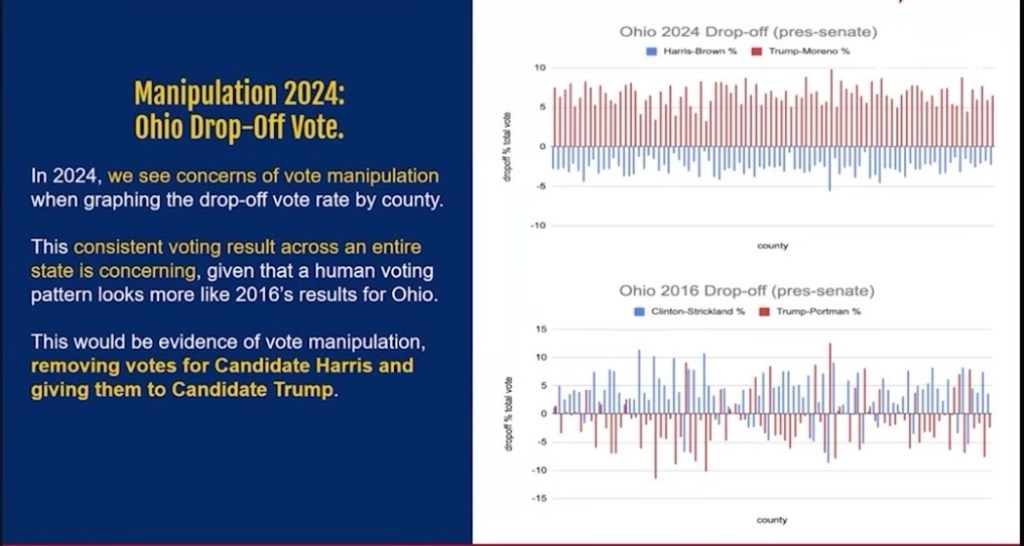
The missing votes uncovered in Smart Elections’ legal case in Rockland County, New York, are just the tip of the iceberg—an iceberg that extends across the swing states and into Texas.
On Monday, an investigator’s story finally hit the news cycle: Pro V&V, one of only two federally accredited testing labs, approved sweeping last-minute updates to ES&S voting machines in the months leading up to the 2024 election—without independent testing, public disclosure, or full certification review.
These changes were labeled “de minimis”—a term meant for trivial tweaks. But they touched ballot scanners, altered reporting software, and modified audit files—yet were all rubber-stamped with no oversight.
That revelation is a shock to the public. But for those who’ve been digging into the bizarre election data since November, this isn’t the headline—it’s the final piece to the puzzle. While Pro V&V was quietly updating equipment in plain sight, a parallel operation was unfolding behind the curtain—between tech giants and Donald Trump.
And it started with a long forgotten sale.
A Power Cord Becomes a Backdoor
In March 2021, Leonard Leo—the judicial kingmaker behind the modern conservative legal machine—sold a quiet Chicago company by the name of Tripp Lite for $1.65 billion. The buyer: Eaton Corporation, a global power infrastructure conglomerate that just happened to have a partnership with Peter Thiel’s Palantir.
To most, Tripp Lite was just a hardware brand—battery backups, surge protectors, power strips. But in America’s elections, Tripp Lite devices were something else entirely.
They are physically connected to ES&S central tabulators and Electionware servers, and Dominion tabulators and central servers across the country. And they aren’t dumb devices. They are smart UPS units—programmable, updatable, and capable of communicating directly with the election system via USB, serial port, or Ethernet.
ES&S systems, including central tabulators and Electionware servers, rely on Tripp Lite UPS devices. ES&S’s Electionware suite runs on Windows OS, which automatically trusts connected UPS hardware.
If Eaton pushed an update to those UPS units, it could have gained root-level access to the host tabulation environment—without ever modifying certified election software.
In Dominion’s Democracy Suite 5.17, the drivers for these UPS units are listed as “optional”—meaning they can be updated remotely without triggering certification requirements or oversight. Optional means unregulated. Unregulated means invisible. And invisible means perfect for infiltration.
A New Purpose for the Partnership
After the Tripp Lite acquisition, Eaton stayed under the radar. But in May 2024, it resurfaced with an announcement that escaped most headlines: Eaton was deepening its partnership with Palantir Technologies.
Let’s be clear, Palantir wasn’t brought in for customer service. It was brought in to do what it does best: manage, shape, and secure vast streams of data—quietly. According to Eaton’s own release, Palantir’s role would include:
AI-driven oversight of connected infrastructure
Automated analysis of large datasets
And—most critically—“secure erasure of digital footprints”
The Digital Janitor: also known as forensic sanitization, it was now being embedded into Eaton-managed hardware connected directly to voting systems. Palantir didn’t change the votes. It helped ensure you’d never prove it if someone else did.
BallotProof: The Front-End for Scrubbing Democracy
Enter the ballot scrubbing platform BallotProof. Co-created by Ethan Shaotran, a longtime employee of Elon Musk and current DOGE employee, BallotProof was pitched as a transparency solution—an app to “verify” scanned ballot images and support election integrity.
With Palantir’s AI controlling the backend, and BallotProof cleaning the front, only one thing was missing: the signal to go live.
September 2024: Eaton and Musk Make It Official
Then came the final public breadcrumb: In September 2024, Eaton formally partnered with Elon Musk.
The stated purpose? A vague, forward-looking collaboration focused on “grid resilience” and “next-generation communications.”
But buried in the partnership documents was this line:
“Exploring integration with Starlink’s emerging low-orbit DTC infrastructure for secure operational continuity.”
The Activation: Starlink Goes Direct-to-Cell
That signal came on October 30, 2024—just days before the election, Musk activated 265 brand new low Earth orbit (LEO) V2 Mini satellites, each equipped with Direct-to-Cell (DTC) technology capable of processing, routing, and manipulating real-time data, including voting data, through his satellite network.
DTC doesn’t require routers, towers, or a traditional SIM. It connects directly from satellite to any compatible device—including embedded modems in “air-gapped” voting systems, smart UPS units, or unsecured auxiliary hardware.
From that moment on:
Commands could be sent from orbit
Patch delivery became invisible to domestic monitors
Compromised devices could be triggered remotely
This groundbreaking project that should have taken two-plus years to build, was completed in just under ten months. Elon Musk boasts endlessly about everything he’s launching, building, buying—or even just thinking about—whether it’s real or not. But he pulls off one of the largest and fastest technological feats in modern day history… and says nothing? One might think that was kind of… “weird.”
Lasers From Space
According to New York Times reporting, on October 5—just before Starlink’s DTC activation—Musk texted a confidant:
“I’m feeling more optimistic after tonight. Tomorrow we unleash the anomaly in the matrix.” Then, an hour later:
“This isn’t something on the chessboard, so they’ll be quite surprised. ‘Lasers’ from space.”
It read like a riddle. In hindsight, it was a blueprint.
Let’s review what was in place:
This wasn’t a theory. It was a full-scale operation. A systemic digital occupation—clean, credentialed, and remote-controlled.
The Outcome
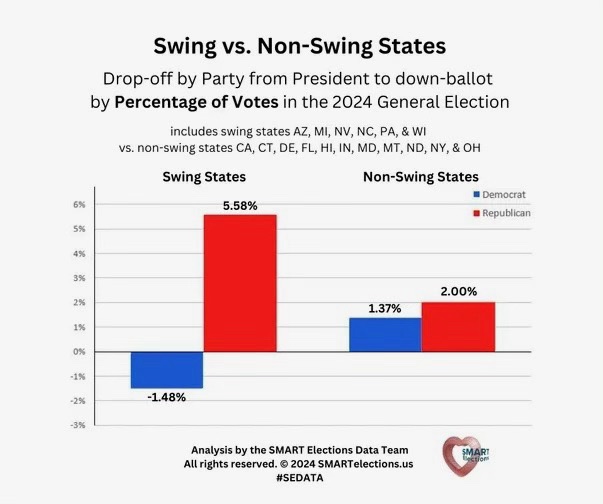
Data that makes no statistical sense. A clean sweep in all seven swing states.
The fall of the Blue Wall. Eighty-eight counties flipped red—not one flipped blue.
Every victory landed just under the threshold that would trigger an automatic recount. Donald Trump outperformed expectations in down-ballot races with margins never before seen—while Kamala Harris simultaneously underperformed in those exact same areas.
If one were to accept these results at face value—Donald Trump, a 34-count convicted felon, supposedly outperformed Ronald Reagan. According to the co-founder of the Election Truth Alliance:
“These anomalies didn’t happen nationwide. They didn’t even happen across all voting methods—this just doesn’t reflect human voting behavior.”
They were concentrated.
Targeted.
Specific to swing states and Texas—and specific to Election Day voting.
And the supposed explanation? “Her policies were unpopular.”
Let’s think this through logically. We’re supposed to believe that in all the battleground states, Democratic voters were so disillusioned by Vice President Harris’s platform that they voted blue down ballot—but flipped to Trump at the top of the ticket?
Not in early voting.
Not by mail.
With exception to Nevada, only on Election Day.
And only after a certain threshold of ballots had been cast—where VP Harris’s numbers begin to diverge from her own party, and Trump’s suddenly begin to surge. As President Biden would say, “C’mon, man.”
In the world of election data analysis, there’s a term for that: vote-flipping algorithm.
Billionaires and Tech Giants Pulled Off the Crime of the Century
Why? There wasn’t just one reason—there were many.
Elon Musk himself hinted at the stakes: he faced the real possibility of a prison sentence if Trump lost. He launched his bid for Twitter—at $20 billion over market value—just 49 days after Putin invaded Ukraine. That alone should have raised every red flag. But when the ROI is $15 trillion in mineral rights tied to Ukraine losing the war and geopolitical deals Trump could green light, it wasn’t a loss—it was leverage.
It’s no secret Musk was in communication with Putin for over two years. He even granted Starlink access to Russian forces. That’s not just profiteering. That’s treason.
Then there’s Peter Thiel and the so-called “broligarchs”—tech billionaires who worship at the altar of shower-avoidant blogger Curtis Yarvin. They casually joke about “humane genocide for non-producers” and have long viewed democracy as a nuisance—an obstacle to their vision of hypercapitalism and themselves as the permanent ruling elite.
Well, what is the elimination of Medicaid if not “humane genocide”—and does anyone really wonder why his 40-year-old protégé and political rookie, JD Vance, is Vice President? With this technology in place, if the third-term legislation were to pass, it would hand Vance a minimum of twelve years at the helm of Thiel’s regime.
And of course, Donald Trump himself: He spent a year telling his followers he didn’t need their votes—at one point stating,
“…in four years, you don’t have to vote again. We’ll have it fixed so good, you’re not gonna have to vote.”
Trump was facing eighty-eight felony indictments—he was desperate to avoid conviction and locked in a decades-long alliance with Vladimir Putin. An alliance that’s now impossible to ignore—look no further than his policy trail.
He froze aid to Ukraine and has threatened to place sanctions on them, while planning to lift sanctions off Russia. He openly campaigned for anti-EU candidates, and sided with Russia in multiple key United Nations votes related to the Ukraine conflict.
Let’s be clear:
Donald Trump pledges allegiance to a red, white, and blue flag— It’s just not the American one.
What Happens Now?
We don’t need permission to enforce the Constitution. We need courage. While state attorneys general begin their investigations, it only takes one U.S. senator to initiate the disqualification proceedings against the unelected and unfit occupant of the Oval Office. State Attorneys General and Investigators:
Conduct independent audits of UPS firmware on Dominion and ES&S machines
Subpoena communications between Eaton, Palantir, Starlink employees, and Pro V&V
Audit Starlink satellite logs for the week of the election
Freeze uncertified infrastructure updates
Recount physical ballots—by hand Now they’re rolling out the same technological toolkit abroad—forcing countries into Starlink contracts in exchange for tariff relief. The U.S. election wasn’t their endgame. It was their litmus test.
Want the truth they’re not telling you? For fearless reporting and expert-backed research, read The Common Coalition Report. And if you believe in funding real, independent work—support our all volunteer team here.
The crowds were larger and more animated at the No Kings rallies than on Constitution Avenue, where Trump summoned up a parade in honor of his 79th birthday.
Yesterday evening, I saw tweets comparing the demeanor of the American service members to their parade counterparts in Russia, North Korea, and China. The soldiers in other countries marched in perfect symmetry, with not an eye or a boot out of place. The Americans seemed to be strolling. The tweets were meant to mock us. Some were posted by someone in another country. I responded, “Those Russian troops in perfect formation have not been able to beat Ukraine in three years. If they engaged American troops, our army would kick them all the way back to Moscow.”
The country that invented jazz was never going to be good at putting on a military parade. It was never going to be us.
In the wake of Donald Trump’s flaccid, chaotic, lightly attended, and generally awkward military parade, a meme began doing the rounds. Its basic format was the juxtaposition of images of the kinds of parades Trump presumably wanted with the parade he actually got.
Over here, thousands of Chinese soldiers marching in perfectly synchronized lockstep; over there, a lone U.S. soldier holding up a drone. Over here, North Korean legs kicking up and coming back down with astounding precision; over there, a dozen U.S. soldiers walking somewhat purposelessly through Washington.
Trump’s biggest mistake was wanting a military parade in the first place. The United States military is not a birthday party rental company. Any therapist will tell you that no number of green tanks on the street is enough to heal the deep void left by a father’s withheld love.
But, setting aside the wisdom of wanting a military parade, there is the issue of execution. Even if you’re going to do the wrong thing, do it well. Do it with flair. With the most powerful military in history at his disposal, Trump couldn’t even pull off a decent parade.
But I’m here to say it’s not his fault alone. It’s hard to wring a military parade of the kind he dreamed of from a people free in their bones.
You see, it is a good thing not to be good at some things. The great beauty of his terrible parade is the reminder that Trump is waging a war against the American spirit, and this fight he is struggling to win.
No matter how much money and effort you throw at the parade, you cannot escape the fact that America is not the country of North Korean unity. We’re the country of Korean tacos.
The Korean-American comedian Margaret Cho once described those tacos, as made famous by the chef Roy Choi, of similar heritage, thus: “There were so many things happening: The familiarity of the iconic L.A. taco, the Korean tradition of wrapping food, the falling-apart short rib that almost tastes like barbacoa, the complementing sweetness of the corn tortilla.” Korea running into Mexico, running into North Carolina, and beyond. Today on the website of the Kogi food empire that Choi built, these are some of the recipes: a Korean barbecue pizza, a Korean Philly cheesesteak, a kimchi fried chicken sandwich, a Korean gyro, and Korean pulled pork nachos. I may be wrong, but here is my hypothesis: the kinds of places good at putting on parades like North Korea’s will never come up with food like this; and the kinds of places good at making food like this will never rival the give-me-synchronicity-or-give-me-death parades of places like North Korea.
America is not the country of perfectly synced swinging arms. It’s the country of “It Don’t Mean a Thing (If It Ain’t Got That Swing).” That song, by the legendary Duke Ellington, belongs to a genre of music that could only have been invented in America — jazz. As the documentarian Ken Burns explained, jazz was born in New Orleans when and because people from so many heritages were jammed together — the sounds of Africa and the sounds of Appalachia and the sounds of Germany and the sounds of indigenous people colliding to make something new. It was never scripted, always improvisational. Ellington himself made the connection to democracy:
Put it this way: Jazz is a good barometer of freedom…In its beginnings, the United States of America spawned certain ideals of freedom and independence through which, eventually, jazz was evolved, and the music is so free that many people say it is the only unhampered, unhindered expression of complete freedom yet produced in this country.
I may be wrong, but it seems to me societies that have the thing Trump wanted in his parade don’t got that swing, and societies that got that swing don’t have the thing he craved.
America is not a country of uniformity, even in its uniforms. It’s a big multicolored mess.
What is striking in the images of Chinese and North Korean and Iranian parades is the uniformity, right down to the uniforms themselves. The soldiers are often seen wearing the same thing. It gives the kind of picture Trump likes. But the images this weekend were not like that at all. In America, different units wear different uniforms. Images from the parade this weekend showed one uniform after another. The military is not a monolith. It is made up of units with their own histories and traditions and identities and loyalties. There are rivalries and competing slogans.
I may be wrong, but I would wager that societies that have first-rate matchy-matchy uniform aesthetics may look good but fight wars mediocrely, and societies that allow for variety and diversity may give less pleasant aerial shots during parades but fight wars better.
Today is ten years to the day since Trump came down the escalator and changed the course of the country and, in so many ways, changed us. It is a moment to think back and think of how much coarser, uglier, crueler the nation has become in the hands of an unwell man. The daily drumbeat of abductions and cuts and eviscerations and illegal actions and sadistic policy ideas slowly corrodes the heart. We are being remade in Trump’s sickness.
And yet. And yet what the parade reminded me is that Trump, in one regard, at least, faces steep odds. His project depends on turning Americans into something we are deeply not: uniform, cohesive, disciplined, in lockstep.
But we are more hotsteppers than locksteppers. We are more improvised solo than phalanx. We are more unruly than rule-following. Trump has a lot working in his favor as he seeks to build a dictatorship for his self-enrichment. But what will always push against him is this deep inner nature that has stood through time: the chaotic, colorful spontaneity of the American soul. We don’t march shoulder to shoulder. We shimmy.
Grace Hopper directed a team that developed early COBOL applications. Photo credit: Smithsonian Institution/Wikimedia Commons
There’s probably no programming language in history that’s quite as all pervasive as COBOL. For over 60 years, COBOL has been quietly powering 43% of the banking systems worldwide, handling a mind-blowing $3 trillion in daily transactions. And 95% of ATMs and 80% of banks still rely on it.
Wait. Look at that picture! It screams late 1950’s, early 1960’s. The team was lead by a woman! (The fact that she earned a Ph.D. in both mathematics and mathematical physics from Yale University and was a professor of mathematics at Vassar College is irrelevant.) On the team are a black guy. A guy who looks to be from the Indian subcontinent and a sole white guy!
This should never have happened … at least according to Donald J. Trump, otherwise known as The Martyr of Mar-a-Lago, the senior partner of Elon and Felon, The Mango Menace, “TACO” (Trump Always Chickens Out) Trump, POTUS (Piece of Totally Useless Shit), Darth Hideous, $hitler, the Titanic Toddler, and President of the United States Donald J. Trump. Such combinations of the sexes and races are abominations and should not happen again.
Why, oh why, does anyone pay any attention to the ravings of this … person? Why do people obey his orders when he is clearly unhinged?
I’m sick at heart about the targeted assassinations in Minnesota. As everyone surely knows by now, a gunman dressed as a police officer entered the home of Melissa Hortman, a top Democratic legislator, and murdered her and her husband Mark. The same gunman attempted to kill State Senator John Hoffman and his wife Yvette, who are hospitalized.
Both legislators were leaders of their party, the Democratic-Farmer-Labor Party, which functions as the Democratic Party. Both houses of the legislature are almost evenly split between Democrats and Republicans. Both legislators championed humane, liberal policies.
Governor Tim Walz asked the people of the state not to attend “No Kings” demonstrations for fear that the gunman might attack them.
This is not normal. Sure, we have a history that includes lots of political violence, including the assassination of Presidents and Presidential candidates and outspoken activists like Dr. Martin Luther King, Jr., Medger Evers, and Malcolm X.
Every time something like this happens, we say “never again,” but then it happens again.
Our politics are hyper partisan, polarized, and inflamed. Almost all gun limits have been stricken down by the zealots on the Supreme Court. We have a President who encourages violence, who failed to call out the national Guard on January 6, 2021, who called the perpetrators of violence against law officers that day “patriots,” and who pardoned all of them, including those who brutally assaulted law officers. Trump has also speculated about pardoning the militia members in Michigan who planned to kidnap and murder Governor Whitmer.
This is one of those days when I fear for the future of our democratic experiment. I can’t think of a silver lining.
Please read and take action to oppose Trump’s tyranny:
Earlier this week Donald Trump called for a second civil war at a US military base. This scenario can be resisted and prevented, if we have the courage to listen, interpret, and act. And this Saturday we will have the occasion to act.
The listening is important. The speech was given at the base now known again as Ft. Bragg. The fort was named for a confederate general. It was renamed Ft. Liberty. Under this administration, it was renamed Fort Bragg, now ostensibly to honor another American serviceman, not the confederate general. It is a dishonest pretense that dishonors everyone. The fort is now named again after a confederate general, as Trump made clear. The tradition that is now in fact being honored, that of oathbreakers and traitors.
In Trump’s speech, the existence of the United States is placed in doubt. We are not a country but a divided society in which some of us deserve punishment by others. He made no mention of the world today, nor of any common American interest that might necessitate national defense. There was no concern about threats from China or Russia. Middle Eastern dictatorships, the only countries that Trump singled out, garnered great praise because their leaders gave Trump money. There was no mention of any wars that are actually underway, such as the Russian invasion of Ukraine.
Trump invoked battlefields across the decades to create a sense of individual heroism, in which of course the history the the US Army is very rich. But that individual heroism is usually cited by commanders in chief as evidence of a nation that is worthy of defense. No such America figured in Trump’s speech. America did not exist Trump’s speech, except as a cult to him personally.
In the actual history of the United States, one war is central: the Civil War. Trump, who has never seen the point of the Union Army defending the republic, now seems now to have moved on to the position that the Confederacy should have won. He promised to rename Fort Gregg-Adams, the first base named for African-Americans, to Fort Robert E. Lee. The base in question hasn’t been known by the full name of the confederate commander since 1950. Lee was a traitor, an oathbreaker, a defender of slavery and the commander of a force whose mission was to break up the United States of America.
In his speech, Trump claimed that seizing undocumented migrants in 2025 shows the same courage as fighting in the Revolutionary War, or the First World War, or the Second World War, or Korea or Vietnam. It would have been news to the soldiers at the time that charging a trench or jumping from a plane is no different than ganging up on a graduate student or bullying a middle-aged seamstress.
But here we see the magic of Trump’s rhetoric: he seeks to transform the courage of the past into the cowardice of the future. He is preparing American soldiers to see themselves as heroes when they undertake operations inside the United States against unarmed people, including their fellow citizens.
All of this, of course, trivializes actual US military achievements. The actual battles of our history just become a “show,” to use one of Trump’s keywords. They are deeds performed for the pleasure of a Leader who then invokes them to justify his own permanent power. Denuded of all context, military glory becomes a spectacle into which any meaning can be injected. And he who injects the meaning is he who rules. That is the fascist principle that Trump understands. There is no politics except struggle, and he who can define the enemy in the struggle can stay in power. But whereas historical fascists had an enemy without and an enemy within, Trump only has an enemy within. The world is too much for him. The army is just for dominating Americans.
In his speech, Trump was trying to transform a legacy of battlefield victory around the world into a future willingness to take illegal orders regarding his own policy on the territory of the United States. The defiance of the law was clear. Trump cannot, for example, legally just rename those bases. The forts were named by an act of Congress. And he cannot legally deploy the Marines to Los Angeles. He has no authority to do so. The president is expressly forbidden by law from using the armed forces to implement domestic policies.
Trump defined himself not as a president but as a permanent Leader. In repeatedly mocking his predecessor, he was summoning soldiers to defy the fundamental idea that their service is to the Constitution and not to a given person. “You think this crowd would have showed up for Biden?” Whether or not it is unprecedented, as I believe it is, such mockery certainly dangerous. It suggests that something besides an election, something like individual charisma, some personal right to rule, is what matters. That soldiers should follow Trump because he is Trump, and not for any other reason.
In general, we imagine that the US Army is here to defend us, not to attack us. But summoning soldiers to heckle their fellow Americans is a sign of something quite different. Trump seized the occasion to summon soldiers to join him in mocking the press. Reporters, of course, as the Founders understood, are a critical check on tyranny. They, like protestors, are protected by the First Amendment of the Constitution. Trump was teaching soldiers that society does not matter, and that law does not matter. He “loves” soldiers. He is personally responsible for the pay raises: “I gave you so much money for four years it was crazy.” “We’re giving you an across-the-board raise” This is the way a dictator speaks to a palace guard, or a fascist to a paramilitary.
Trump is putting himself above the army and the army above the country: “we only have a country because we first had an army, the army was first.” That ridiculous: the Continental Army was formed in 1775 from the people, for the very specific and time-limited purpose of ending colonial oppression. Trump wants the armed force to be the end in itself, and freedom to be its enemy. Generally, presidents who speak to soldiers of military glory have had in mind the defense of American freedoms, such as the freedom of expression, including the freedom of the press and the freedom to assemble. Trump said nothing about freedom, except as a “flame” or a “shield.” He said nothing about rights. There was not a word about democracy.
We are witnessing an attempt at regime change, rife in perversities. It has a historical component: we are to celebrate the oathbreakers and the traitors. It has a fascist component: we are to embrace the present moment as an exception, in which all things are permitted to the Leader. And of course it has an institutional component: soldiers are meant to be the avant-garde of the end of democracy. Instead of treating the army as defenders or freedom, Trump presented soldiers as his personal armed servants, whose job it was to oppress his chosen enemies — inside the United States. Trump was trying to instruct soldiers that their mission was to crush fellow Americans who dared to exercise their rights, such as the right to protest.
Referring to migration as an “invasion,” as Trump did during the speech, is meant to blur the distinction between his immigration policy and a foreign war. But it is also meant to transform the mission of the US Army. The meaningful border here is that between reality and fantasy. If soldiers and others are willing to accept that migration is an “invasion,” then they enter into an alternative reality. Inside that alternative reality, they will see those who do not accept the invasion fantasy as enemies. And this is exactly what Trump called for when he portrayed elected officials in California as collaborators in “an occupation of the city by criminal invaders.”
The US Army, like other American institutions, includes people of various backgrounds. It depends heavily on African-Americans and non-citizens. One can try to transform the army into a cult of the Confederacy and a tool to persecute migrants, but this will cause, at a minimum, great friction. Beyond this, using the Army to enforce domestic policy risks ruining its reputation. Deploying the armed forces in cities risks US soldiers killing US civilians. It also risks that provocateurs, including foreign ones, including allies of Trump, will try to kill an American soldier to provoke a disaster. (Trump’s birthday parade seems practically designed for such an incident, by the way.)
Trump will welcome and exploit such situations, of course. He doesn’t have the courage to say things clearly or start conflict directly, but instead sets up others for situations in which they suffer and he profits. The question is whether civil war is the future Army officers and soldiers want. When Trump promises to celebrate Robert E. Lee, he is telling the Army that oath-breakers and traitors will be celebrated in the future. This is not in his gift. Officers who bring the US armed forces to battle American civilians will be remembered by the heirs of a broken republic and as the people who started a second American civil war.
It is clear what Trump is trying to do. He wants to turn everything around. He wants an army that is not a legal institution but a personal paramilitary. He wants it not to defend Americans but to oppress them. He wishes the shame of our national history to become our pride. He wants to transform a republic into a fascist regime by transforming a history of courage into a future of cowardice.
This can only succeed if it goes unchallenged. All of us can think about his words and their implications. Officers and soldiers can remember that not all orders are legal orders. Those in the media can interpret Trump’s speeches clearly rather than just repeating them or seeing them as one side in a partisan dispute. Our courts can name the limits of his authority. And even a Republican Congress can recognize when its powers are being usurped in a way that risks the end of our country.
Though he did not mention the Civil War, Trump did refer to “the sacred soil of Gettysburg.” It is worth recalling Lincoln’s very different sense of the sacrifice of American soldiers in his Gettysburg Address:
The brave men, living and dead, who struggled here, have consecrated it, far above our poor power to add or detract. The world will little note, nor long remember what we say here, but it can never forget what they did here. It is for us the living, rather, to be dedicated here to the unfinished work which they who fought here have thus far so nobly advanced. It is rather for us to be here dedicated to the great task remaining before us — that from these honored dead we take increased devotion to that cause for which they gave the last full measure of devotion — that we here highly resolve that these dead shall not have died in vain — that this nation, under God, shall have a new birth of freedom — and that government of the people, by the people, for the people, shall not perish from the earth.
In the end, and in the beginning, and at all moments of strife, a government of the people, by the people, for the people depends upon the awareness and the actions of all of us. A democracy only exists if a people exist, and a people only exists in individuals’ awareness of one another of itself and of their need to act together. This weekend Trump plans a celebration of American military power as a celebration of himself on his birthday — military dictatorship nonsense. This is a further step towards a different kind of regime. It can be called out, and it can be overwhelmed.
Thousands of Americans across the land, many veterans among them, have worked hard to organize protests this Saturday — against tyranny, for freedom, for government of the people, by the people, for the people. Join them if you can. No Kings Day is June 14th.
The 9th U.S. Circuit Court of Appeals on Thursday temporarily blocked a federal judge’s order that directed President Donald Trump to return control of National Guard troops to California after he deployed them there following protests in Los Angeles over immigration raids.
The court said it would hold a hearing on the matter on June 17. The ruling came only hours after a federal judge’s order was to take effect at noon Friday.
Earlier Thursday, U.S. District Judge Charles Breyer ruled the Guard deployment was illegal and both violated the Tenth Amendment and exceeded Trump’s statutory authority. The order applied only to the National Guard troops and not Marines who were also deployed to the LA protests. The judge said he would not rule on the Marines because they were not out on the streets yet.
California Gov. Gavin Newsom, who had asked the judge for an emergency stop to troops helping carry out immigration raids, had praised the earlier ruling.
“Today was really about a test of democracy, and today we passed the test,” Newsom said in a news conference before the appeals court decision.
The White House had called Breyer’s order “unprecedented” and said it “puts our brave federal officials in danger.”
Jan Resseger is a social justice warrior who fights for the underdog. She describes here how Trump’s budget enacts the fever dreams of evangelicals and billionaires. He would change federal aid from its historic purpose–equitable funding–and turn it into school choice, diverting funds from the poorest children to those with ample resources. Since 1965–for 70 years–federal education funding for public schools has enjoyed bipartisan support. Trump ends it.
She writes:
Earlier this week, Education Week‘s Mark Lieberman released a concise and readable analysis of the likely impact for public education of two pieces of federal funding legislation: the “Big, Beautiful” tax and reconciliation bill currently being debated in the U.S. Senate to shape public school funding beginning right now in FY 2025, and also President Trump’s proposed FY 2026 federal budget for public schooling in the fiscal year that begins October 1st.
Trump’s FY 2026 budget proposal saves Head Start.
Lieberman shares one important piece of positive news about Trump’s treatment of Head Start in next year’s federal budget: “Some programs survived the cut—including Head Start.” In early May, the Associated Press‘s Moriah Balingit reported: “The Trump administration apparently has backed away from a proposal to eliminate funding for Head Start… Backers of the six-decade-old program, which educates more than half a million children from low-income and homeless families, had been fretting after a leaked Trump administration proposal suggested defunding it… But the budget summary… did not mention Head Start. On a call with reporters, an administration official said there would be ‘no changes’ to it.”
Federal funding for U.S. public schools looks bleak.
Lieberman’s assessment of federal public education funding is not so encouraging. Overall, “The administration is aiming to eliminate roughly $7 billion in funding for K-12 schools in its budget for fiscal 2026, which starts Oct. 1. Several key programs will be maintained at today’s funding level, without an increase: “Flat funding amounts to a de-facto cut given inflation. The administration is proposing to maintain current funding levels for key programs like Title I-A for low-income students ($18.4 billion), the Individuals with Disabilities Education Act, Part B for special education ($14.2 billion) and Perkins grants for K-12 and postsecondary career and technical education ($1.4 billion).”
What has been historically a key purpose of federal public education funding—to compensate for vast inequity in the states’ capacity and the states’ willingness to fund public education—is being compromised. Lieberman explains that much of federal funding, “is currently geared toward supporting special student populations including English learners, migrants, students experiencing homelessness, Native students, and students in rural schools. Longstanding federal programs that support training for the educator workforce; preparing students for postsecondary education; reinforcing key instructional areas like literacy, civics, and the arts… would disappear. A new K-12 grant program would offer a smaller pool of funds to states and let them decide whether and how to invest in those areas. And for the first time, all federal funding for special education would flow to states through a single funding stream…. Experts view Trump’s budget as part of an effort to roll back a half-century of effort by the federal government to help make educational opportunities more consistent and equitable from state to state and district to district.”
The “Educational Choice for Children Act,” an alarming federal school voucher bill, is hidden inside the “Big Beautiful” bill.
Lieberman worries about the enormous tuition tax credit voucher plan embedded deep in the weeds of the “Big, Beautiful” tax and reconciliation bill now being considered in the U. S. Senate: “Separate from the federal budget process, Congress is currently advancing a massive package of tax changes, including a proposal for a new tax-credit scholarship program that fuels up to $10 billion a year in federal subsidies for private K-12 education. Annual spending on that program could approach the amount the Trump administration is proposing to cut from elsewhere in the education budget.” The voucher proposal is called the Educational Choice for Children Act (ECCA).
In a separate analysis of the “Big, Beautiful” bill as the House passed it in late May, Lieberman describes this proposed ECCA tuition-tax-credit voucher program: “House lawmakers narrowly approved a sweeping legislative package with $5 billion in annual tax credits that fuel scholarships and related expenses at K-12 private schools. The federal subsidies would come in the form of dollar-for-dollar tax credits for individuals and corporations that donate to largely unregulated state-level organizations that give out scholarship funds for parents to spend on private educational options of their choosing. Any student—even in states that have resisted expanding private school choice—from a family earning less than 300 percent of the area median gross income would be eligible to benefit from a scholarship paid for with a federally refunded donation.”
Lieberman adds: “No other federal tax credit is as generous. The Internal Revenue Service doesn’t currently supply tax credits worth the full donation amount for any cause, as the private school choice scholarship credit would do. The federal government currently offers tax credits on donations for disaster relief, houses of worship, veterans’ assistance groups, and children’s hospitals at roughly 37 percent of the donated amount. A $10,000 donation to those causes would yield a tax credit of $3,700. By contrast, under the proposed legislation, if a taxpayer donates $10,000 to a scholarship (voucher)-granting organization, the IRS would give them a tax credit of $10,000.”
The Institute for Taxation and Economic Policy’s Carl Davis explains that because these federal school vouchers are primarily a tax shelter, they might appeal to wealthy people who are not even supporters of school privatization: “The tax plan… includes a provision granting extraordinarily generous treatment to nonprofits that give out vouchers for free or reduced tuition at private K-12 schools. While the bill significantly cuts charitable giving incentives overall, nonprofits that commit to focusing solely on supporting private K-12 schools would be spared from those cuts and see their donors’ tax incentive almost triple relative to what they receive today. On top of that, the bill goes out of its way to provide school voucher donors who contribute corporate stock with an extra layer of tax subsidy that works as a lucrative tax shelter. Essentially, the bill allows wealthy individuals to avoid paying capital gains tax as a reward for funneling public funds to private schools.” “We estimate the bill would reduce federal tax revenue by $23.2 billion over the next 10 years as currently drafted, or by $67 billion over the next ten years if it is extended beyond its four-year expiration date… As currently drafted, the bill would facilitate $2.2 billion in federal and state capital gains tax avoidance over the next 10 years.”
The Brookings Brown Center on Education Policy’s Jon Valant warns that the vouchers are so deeply buried in the “Big, Beautiful” bill that lots of people would not be aware of the plan’s existence until after it is passed: “The Educational Choice for Children Act (ECCA) continues to move, quietly, towards becoming one of America’s costliest, most significant federal education programs. Now part of the One Big Beautiful Bill, ECCA would create a federal tax-credit scholarship program that’s unprecedented in scope and scale. It has flown under the radar, though, and remains confusing to many observers… ECCA’s stealthiness is partly due to the confusing nature of tax-credit scholarship programs. These programs move money in circuitous ways to avoid the legal and political hurdles that confront vouchers.”
Valant explains how tax-credit vouchers work: “Tax-credit scholarship programs like ECCA aren’t quite private school voucher programs, but they’re first cousins. In a voucher program, a government gives money (a voucher) to a family, which the family can use to pay for private school tuition or other approved expenses. With a tax-credit scholarship, it’s not that simple. Governments offer tax credits to individual scholarship granting organizations (SGOs). These SGOs then distribute funds… to families.”
Valant creates a scenario that shows how this tax credit program could help the wealthy and leave out poorer families. A rich donor, Billy, donates $2 million in stock to an SGO: “Billy’s acquaintance, Fred, lives in the same town as Billy, which is one of the wealthiest areas in the United States. In fact, Fred set up the SGO, looking to capture ECCA funds within their shared community… Like Billy, Fred doesn’t particularly care about K-12 public education… It might seem that Fred’s SGO couldn’t distribute funds to families in their ultra-wealthy area, since ECCA has income restrictions for scholarship recipients. That’s not the case. ECCA restricts eligibility to households with an income not greater than 300% their area’s median income. In Fred and Billy’s town, with its soaring household incomes, even multimillionaire families with $500,000 in annual income are eligible… So, Fred is looking to give scholarship money to some wealthy families in his hometown.”
Valant summarizes the result if the “Big, Beautiful” bill is enacted: “This bill would introduce the most significant and costliest new federal education program in decades. It has virtually no quality-control measures, transparency provisions, protections against discrimination, or evidence to suggest that it is likely to improve educational outcomes. It’s very likely to redirect funds from poor (and rural) areas to wealthy areas.”
Governor Gavin Newsom spoke to the situation in Los Angeles, which Trump is using as a target in his campaign to distract the public from his incompetence. In his hateful way, Trump always refers to Governor Newsom as “Newscum.”
Governor Newsom said, as transcribed by The New York Times:
Gov. Gavin Newsom of California delivered a speech on Tuesday, titled “Democracy at a Crossroads.” The following is a transcript of his remarks as broadcast online and on television channels:
I want to say a few words about the events of the last few days.
This past weekend, federal agents conducted large-scale workplace raids in and around Los Angeles. Those raids continue as I speak.
California is no stranger to immigration enforcement. But instead of focusing on undocumented immigrants with serious criminal records and people with final deportation orders, a strategy both parties have long supported, this administration is pushing mass deportations, indiscriminately targeting hardworking immigrant families, regardless of their roots or risk.
What’s happening right now is very different than anything we’ve seen before. On Saturday morning, when federal agents jumped out of an unmarked van near a Home Depot parking lot, they began grabbing people. A deliberate targeting of a heavily Latino suburb. A similar scene also played out when a clothing company was raided downtown.
In other actions, a U.S. citizen, nine months pregnant, was arrested; a 4-year-old girl, taken; families separated; friends, quite literally, disappearing.
In response, everyday Angelinos came out to exercise their Constitutional right to free speech and assembly, to protest their government’s actions. In turn, the State of California and the City and County of Los Angeles sent our police officers to help keep the peace and, with some exceptions, they were successful.
Like many states, California is no stranger to this sort of unrest. We manage it regularly, and with our own law enforcement. But this, again, was different.
What then ensued was the use of tear gas, flash-bang grenades, rubber bullets, federal agents detaining people and undermining their due process rights.
Donald Trump, without consulting California law enforcement leaders, commandeered 2,000 of our state’s National Guard members to deploy on our streets, illegally and for no reason.
This brazen abuse of power by a sitting president inflamed a combustible situation, putting our people, our officers and even our National Guard at risk.
That’s when the downward spiral began. He doubled down on his dangerous National Guard deployment by fanning the flames even harder. And the president, he did it on purpose. As the news spread throughout L.A., anxiety for family and friends ramped up. Protests started again.
By night, several dozen lawbreakers became violent and destructive. They vandalized property. They tried to assault police officers. Many of you have seen video clips of cars burning on cable news.
If you incite violence — I want to be clear about this — if you incite violence or destroy our communities, you are going to be held to account. That kind of criminal behavior will not be tolerated. Full stop.
Already, more than 220 people have been arrested. And we’re reviewing tapes to build additional cases and people will be prosecuted to the fullest extent of the law.
Again, thanks to our law enforcement officers and the majority of Angelenos who protested peacefully, this situation was winding down and was concentrated in just a few square blocks downtown.
But that, that’s not what Donald Trump wanted. He again chose escalation, he chose more force. He chose theatrics over public safety. He federalized another 2,000 Guard members.
He deployed more than 700 active U.S. Marines. These are men and women trained in foreign combat, not domestic law enforcement. We honor their service. We honor their bravery. But we do not want our streets militarized by our own armed forces. Not in L.A. Not in California. Not anywhere.
We’re seeing unmarked cars, unmarked cars in school parking lots. Kids afraid of attending their own graduation. Trump is pulling a military dragnet all across Los Angeles, well beyond his stated intent to just go after violent and serious criminals. His agents are arresting dishwashers, gardeners, day laborers and seamstresses.
That’s just weakness, weakness masquerading as strength. Donald Trump’s government isn’t protecting our communities. They are traumatizing our communities. And that seems to be the entire point.
California will keep fighting. We’ll keep fighting on behalf of our people, all of our people, including in the courts.
Yesterday, we filed a legal challenge to President Trump’s reckless deployment of American troops to a major American city. Today, we sought an emergency court order to stop the use of the American military to engage in law enforcement activities across Los Angeles.
If some of us can be snatched off the streets without a warrant, based only on suspicion or skin color, then none of us are safe. Authoritarian regimes begin by targeting people who are least able to defend themselves. But they do not stop there.
Trump and his loyalists, they thrive on division because it allows them to take more power and exert even more control.
And by the way, Trump, he’s not opposed to lawlessness and violence as long as it serves him. What more evidence do we need than January 6th.
I ask everyone: Take time, reflect on this perilous moment. A president who wants to be bound by no law or constitution, perpetuating a unified assault on American traditions.
This is a president who, in just over 140 days, has fired government watchdogs that could hold him accountable, accountable for corruption and fraud. He’s declared a war, a war on culture, on history, on science, on knowledge itself. Databases quite literally are vanishing.
He’s delegitimizing news organizations and he’s assaulting the First Amendment. And the threat of defunding them. At threat, he’s dictating what universities themselves can teach. He’s targeting law firms and the judicial branch that are the foundations of an orderly and civil society. He’s calling for a sitting governor to be arrested for no other reason than to, in his own words, “for getting elected.”
And we all know, this Saturday, he’s ordering our American heroes, the United States military, and forcing them to put on a vulgar display to celebrate his birthday, just as other failed dictators have done in the past.
Look, this isn’t just about protests here in Los Angeles. When Donald Trump sought blanket authority to commandeer the National Guard. he made that order apply to every state in this nation.
This is about all of us. This is about you. California may be first, but it clearly will not end here. Other states are next.
Democracy is next.
Democracy is under assault right before our eyes, this moment we have feared has arrived. He’s taking a wrecking ball, a wrecking ball to our founding fathers’ historic project: three coequal branches of independent government.
There are no longer any checks and balances. Congress is nowhere to be found. Speaker Johnson has completely abdicated that responsibility.
The rule of law has increasingly been given way to the rule of Don.
The founding fathers didn’t live and die to see this kind of moment. It’s time for all of us to stand up. Justice Brandeis, he said it best. In a democracy, the most important office — with all due respect, Mr. President — is not the presidency, and it’s certainly not governor. The most important office is office of citizen.
At this moment, at this moment, we all need to stand up and be held to account, a higher level of accountability. If you exercise your First Amendment rights, please, please do it peacefully.
I know many of you are feeling deep anxiety, stress, and fear. But I want you to know that you are the antidote to that fear and that anxiety. What Donald Trump wants most is your fealty, your silence, to be complicit in this moment.






 Diane Ravitch's blog