I just read Dr. Martin Luther King’s last speech out loud.
It was an enthralling experience. Uplifting, inspiring, and a bit depresssing to realize what has not happened, the persistence of racism and poverty and inequality, the scoundrels who distort his message and try to prevent the honest teaching of our history. The racist legislators who say that teaching honest history is a “divisive concept” that will make white children uncomfortable. That assumes they will identify with the oppressors. That assumes that the truth will make them woke. I assume they willl identify with the oppressed and join with those who want change.
Historian Heather Cox Richardson reflects on the anniversary of Dr. Martin Luther King’s birthday. We now look on him as a hero, but during his lifetime, he was treated shamefully by many whites, and militant African-Americans scorned him as well, preferring the angry approach of Stokely Carmichael and Malcolm X. Dr. King was principled and fearless. He faced death daily, and he never back down. It is usually forgotten that he was assassinated in Memphis while there to support striking sanitation workers, who were trying to organize a union. He knew that unions offered the best protection for working people. White conservatives who fraudulently praise him now, claiming that racism is a thing of the past and should not be taught or discussed (so that everyone can be judged by “the content of their character, not the color of their skin”), oppose everything he fought and died for.
You hear sometimes that, now that we know the sordid details of the lives of some of our leading figures, America has no heroes left.
When I was writing a book about the Wounded Knee Massacre, where heroism was pretty thin on the ground, I gave that a lot of thought. And I came to believe that heroism is neither being perfect, nor doing something spectacular. In fact, it’s just the opposite: it’s regular, flawed human beings, choosing to put others before themselves, even at great cost, even if no one will ever know, even as they realize the walls might be closing in around them.
It means sitting down the night before D-Day and writing a letter praising the troops and taking all the blame for the next day’s failure upon yourself, in case things went wrong, as General Dwight D. Eisenhower did.
It means writing in your diary that you “still believe that people are really good at heart,” even while you are hiding in an attic from the men who are soon going to kill you, as Anne Frank did.
It means signing your name to the bottom of the Declaration of Independence in bold print, even though you know you are signing your own death warrant should the British capture you, as John Hancock did.
It means defending your people’s right to practice a religion you don’t share, even though you know you are becoming a dangerously visible target, as Sitting Bull did.
Sometimes it just means sitting down, even when you are told to stand up, as Rosa Parks did.
None of those people woke up one morning and said to themselves that they were about to do something heroic. It’s just that, when they had to, they did what was right.
On April 3, 1968, the night before the Reverend Doctor Martin Luther King Jr. was assassinated by a white supremacist, he gave a speech in support of sanitation workers in Memphis, Tennessee. Since 1966, King had tried to broaden the Civil Rights Movement for racial equality into a larger movement for economic justice. He joined the sanitation workers in Memphis, who were on strike after years of bad pay and such dangerous conditions that two men had been crushed to death in garbage compactors.
After his friend Ralph Abernathy introduced him to the crowd, King had something to say about heroes: “As I listened to Ralph Abernathy and his eloquent and generous introduction and then thought about myself, I wondered who he was talking about.”
Dr. King told the audience that, if God had let him choose any era in which to live, he would have chosen the one in which he had landed. “Now, that’s a strange statement to make,” King went on, “because the world is all messed up. The nation is sick. Trouble is in the land; confusion all around…. But I know, somehow, that only when it is dark enough, can you see the stars.” Dr. King said that he felt blessed to live in an era when people had finally woken up and were working together for freedom and economic justice.
He knew he was in danger as he worked for a racially and economically just America. “I don’t know what will happen now. We’ve got some difficult days ahead. But it doesn’t matter…because I’ve been to the mountaintop…. Like anybody, I would like to live a long life…. But I’m not concerned about that now. I just want to do God’s will. And He’s allowed me to go up to the mountain. And I’ve looked over. And I’ve seen the promised land. I may not get there with you. But I want you to know tonight, that we, as a people, will get to the promised land!”
People are wrong to say that we have no heroes left.
Just as they have always been, they are all around us, choosing to do the right thing, no matter what.
Wishing you all a day of peace for Martin Luther King Jr. Day, 2023.
Donna Ladd, editor and CEO of the Mississippi Free Press, writes here about the sustained rightwing effort to co-opt Dr. Martin Luther King’s legacy of militant resistance to racism and his dedication to telling the truth about our tarnished history. This is an important essay. It’s about a concerted attempt to hijack the words of Dr. King by those who hate his message. It’s about conservative white people like Chris Rufo and Ron DeSantis trying to use his words to prevent honest teaching about the history of racism. I have left the fund-raising appeals in the article because I hope you will send some money to this brave publication.
Yes, Dr. King gave his life in the search for more love and less hate, but he was not only spreading a message of love, as so many white thieves of his legacy try to say today. His message was pure fire. And he was out to hold a mirror up to our nation about white Americans—not only Mississippians and southerners—using terror to maintain power over everyone else and to enjoy the fruits of that terrorism.
Throughout his life, Dr. King toiled and ultimately sacrificed his life in the fight to change power structures and systems established and enforced to keep white people on the top and Black people on the bottom. He wanted America to understand that enslaved people built this nation—after many of their enslavers figured out how to steal the land from Indigenous Americans and forcefully remove them from the land they coveted.
None of this history is pretty or honorable, and Dr. King never tried to say it was or to cover up any of it. He wanted it taught to every person in this country and certainly wanted children to grow up having learned the lessons of the past. He knew that the “arc of the moral universe is long, but it bends toward justice.” And he was blunt that he was not likely to live long enough to see that happen.
When a white man shot him at the Lorraine Hotel in Memphis, Dr. King was more focused than ever on systemic racism and its links with poverty, and he was a harsh critic of capitalism and the Vietnam War. He was putting together the Poor People’s Campaign intending to occupy Washington, D.C., to bring more attention to the racism-poverty connection.
Of course, I didn’t know all that until I was well into adulthood. I knew most white folks in Mississippi hated him, and he was a martyred hero against racism. Like many Americans, I was fed the whitewashed version of Dr. King, which has worsened over the decades. I was nearly 40 when I studied with Dr.Manning Marable at Columbia University and learned the larger and more accurate history of Dr. King, Malcolm X, Marcus Garvey, and many Black freedom fighters. I’ve also read his speeches; I know fully what Dr. King was about and what he supported.
Now, 54 years after Dr. King went to Memphis to support a labor strike by sanitary workers, we see so many arrogant efforts by white Americans to remake him into their preferred hero—you know, the one who would tell us all now to forget all that sticky history and get along despite the systemic inequities our history embedded into our nation’s DNA.
It would be funny if it weren’t so sick and offensive. Right here in Jackson, a public-policy institute led by a former Brexiteer from the U.K. used a photo of Dr. King and his words out of context in a report a year ago to push legislation against so-called “critical race theory” in schools. Their report argued the precise opposite of what the Black freedom hero said or wanted. They even twisted his call for “being judged by the content of their character” out of context to make absurd statements about Dr. King, like this one: “Instead of celebrating the enormous achievements made since the Civil Rights Movement, critical race theory specifically rejects King’s color blind ideal and seeks to racialize every aspect of culture, sport, and public discourse.”
“Color-blind ideal”? That’s what this institute—and its board of prominent white Mississippians—think Dr. King meant by the need for white Americans to stop judging people by the color of their skin? Seriously? That’s some shoddy thinking. Or propaganda, as it were. Such cynicism can explain why this institute claiming Dr. King’s moral ground as its own has nine white men and two white women on its board.
As we consider Dr. King’s legacy this weekend, we must study the whole legacy. No serious person can argue that he would want this nation to block the teaching of our full race history from colleges, schools and homes. No serious person would say that he would want us to simply be proud of how far we’ve come and not examine how far we’ve got to go—until that arc bends toward actual justice and inequity is no longer baked into our systems. No serious person thinks Dr. King would not want us to interrogate how and why inequity became baked into our systems and how to fix them so they don’t keep replicating themselves.
And no serious person would argue that Dr. King would not want the systemic history of slavery, massacres and lynchings that helped end Reconstruction and install Jim Crow, the story of little Ruby Bridges or our Medgar Evers or Lamar Smith down in Brookhaven, the story of ongoing attacks on public education since integration—or the full story of his real dreams taught to every American on this road to eradicating the baked-in legacies of racial suppression and white supremacy.
I get it. Complaining that teaching real race history is somehow “Marxism”—which no serious person would do, either—is bringing back the stunts and propaganda the rich and powerful white people used successfully to scare white folks back in the 1950s and 1960s and even inspire violence against Dr. King and Mr. Evers. The rewriting of history is sick politics. But it is a stunt that all serious people of any party who are, indeed, working not to judge people by their skin color must reject loudly and definitively.
Dr. Martin Luther King Jr. gave his life to speak truth to power. We owe it to him to continue doing just that.
Donna Ladd, Editor and CEO
[I am not inserting a link because I can’t find one. Google Mississippi Free Press. If you find a link, please send it.]
I am sending my third contribution this year to MFP.
Betsy DeVos poured millions into the voucher campaign, in hopes of getting it passed by a Republican legislature and avoiding a referendum. In a previous referendum, Michigan voters overwhelmingly rejected vouchers for private and religious schools.
Democrats won control of both houses of the legislature in 2022, so that idea is dead, for now.
Beth LeBlanc of The Detroit News reported:
Conservative groups last month abandoned their efforts to pass voter-initiated laws seeking to create stricter voter identification rules and a tax-incentivized scholarship fund in Michigan that could be used for private school education.
The demise of the Let MI Kids Learn ballot initiative serves as a blow to the West Michigan family of former U.S. Education Secretary Betsy DeVos, the Republican mega-donor who helped to launch the effort to create a tax incentive that would finance private school scholarships for students whose parents could not afford the tuition.
Members of the DeVos family contributed roughly $7.9 million toward the Let MI Kids Learn ballot initiative in 2021 and 2022, making up the lion’s share of the financing for the effort, according to state campaign finance records….
The end of the Let MI Kids Learn ballot initiative marks a “major victory for public school students, parents and educators,” said Casandra Ulbrich, a spokesperson for an opposition group called For MI Kids, for MI Schools.
The Secure MI Vote initiative, which also was pulled on Dec. 28, had largely been rendered irrelevant by the November passage of Proposal 2, which cemented in the Michigan Constitution voting rules that Secure MI Vote sought to change in statute, said Jamie Roe, spokesman for the Secure MI Vote effort and a Republican political consultant.
The AFT commissioned a highly reputable polling form to find out how voters think about the big education issues. The poll was conducted after the election last November. Bottom line: Voters want better, well/resourced public schools; few are interested in the Republican agenda of fighting “wokeness,” censoring books, and choice.
New Polling Reveals GOP/McCarthy Schools Agenda Is Unpopular and at Odds with Parents’ Priorities
Latest Data Show Parents, Voters Reject Culture War Agenda, Support Academic Focus and Safe Schools Instead
WASHINGTON—The American Federation of Teachers today released new national polling that shows voters overwhelmingly reject House Speaker Kevin McCarthy’s anti-school, culture war agenda. Instead, voters want to see political leaders prioritize what kids need to succeed in school: strong fundamental academic skills and safe and welcoming school environments.
“The latest education poll tells us loud and clear: Voters, including parents, oppose McCarthy’s agenda to prioritize political fights in schools and instead support real solutions, like getting our kids and teachers what they need to recover and thrive,” said AFT President Randi Weingarten.
“Rather than reacting to MAGA-driven culture wars, voters overwhelmingly say they want lawmakers to get back to basics: to invest in public schools and get educators the resources they need to create safe and welcoming environments, boost academic skills and pave pathways to career, college and beyond.”
According to Geoff Garin, president of Hart Research Associates: “One key weakness of the culture war agenda is that voters and parents reject the idea that teachers today are pushing a ‘woke’ political agenda in the schools. Most have high confidence in teachers. Voters see the ‘culture war’ as a distraction from what’s important and believe that politicians who are pushing these issues are doing so for their own political benefit.”
Polling conducted by Hart Research Associates from Dec. 12-17, 2022, among 1,502 registered voters nationwide, including 558 public school parents, shows that support for and trust in public schools and teachers remains incredibly strong:
93 percent of respondents said improving public education is an important priority for government officials.
66 percent said the government spends too little on education; 69 percent want to see more spending.
By 29 points, voters said their schools teach appropriate content, with an even greater trust in teachers.
Voters who prioritized education supported Democrats by 8 points.
Top education priorities for voters include providing:
students with strong fundamental academic skills;
opportunities for all children to succeed, including through career and technical education and greater mental health supports, as examples; and
a safe and welcoming environment for kids to learn.
According to voters, the most serious problems facing schools include:
teacher shortages;
inadequate funding;
unsafe schools; and
pandemic learning loss. (And, critically, voters and parents are looking forward to find solutions: by 85 percent to 15 percent, they want Congress to focus on improving schools through greater support, rather than through McCarthy’s investigation agenda.)
“COVID was terrible for everyone,” added Weingarten. “Educators and parents took on the challenges of teaching, learning and reconnecting and are now asking elected officials to focus on the building blocks of student success. Instead, legislators in 45 states have proposed hundreds of laws making that harder—laws seeking to ban books from school libraries; restrict what teachers can say about race, racism, LGBTQIA+ issues and American history; and limit the school activities in which transgender students can participate. Voters are saying that not only are these laws bad policy—they’re also bad politics.”
In state after state in the November midterms, voters elected pro-public education governors and school board candidates and rejected far-right attacks on teachers and vulnerable LGBTQIA+ students.
The survey’s confidence interval is ±3.0 percentage points.
Click here for toplines, here for the poll memo and here for the poll slides.
Far-right extremists concocted a cascading series of so-called culture wars that have no basis in fact or reality. Their purpose is to undermine public trust in teachers and public schools, paving the way for divisive “school choice,” which defunds public schools.
Teachers are intimidated, fearful that they might violate the law by teaching factual history about race and racism. Students are deprived of honesty in their history and social studies classes. Schools are slandered by extremists. Needless divisions are created by the lies propagated by zealots whose goal is to privatize public funding for schools.
First came the furor over “critical race theory,” which is not taught in K-12 schools. CRT is a law school course of study that examines systemic racism. The claim that it permeates K-12 schools was created as a menace threatening the children of America by rightwing ideologue Chris Rufo, who shamelessly smeared the teachers of America as purveyors of race hatred that humiliated white children. Rufo made clear in a speech at Hillsdale College that the only path forward was school choice. The entire point of Rufo’s gambit was the destruction of public trust in public schools.
Then came a manufactured brouhaha over transgender students who wanted to use a bathroom aligned with their sexual identity. The number of transgender students is minuscule, probably 1%. And yet again there was a furor that could have easily been resolved with a gender-neutral bathroom. Ron DeSantis made a campaign ad with a female swimmer who complained that she competed against a trans woman. What she didn’t mention was that the trans woman was beaten, as was she, by three other female swimmers.
And then came the nutty claim that teachers were “grooming” students to be gay. Another smear. No evidence whatever. Reading books about gay characters would turn students gay, said the critics; but would reading about elephants make students want to be elephants?
Simultaneously, extremists raised loud alarms about books that introduced students to dangerous ideas about sexuality and racism. If they read books with gay characters, students would turn gay. If they read about racism, they would “hate America.” So school libraries had to be purged; even public libraries had to be purged. One almost expected public book burnings. So much power attributed to books, as if the Internet doesn’t exist, as if kids can’t watch porn of all kinds, as if public television does not regularly run shows about American’s shameful history of racism.
As citizens and parents, we must stand up for truth and sanity. We must defend our schools and teachers against libelous claims. We must oppose those who would ban books.
Of course, parents should meet with their children’s teachers. They should partner with them to help their children. They should ask questions about the curriculum. They should share their concerns. Learning benefits when parents, teachers, students, and communities work together.
Jess Piper lives in rural Missouri. She and her husband are farmers with five children. She taught American literature in the local public school. She describes herself as a “woke” progressive. When she added the history of slavery and African American literature to her classes, she said, none of her students (all white) felt embarrassed or uncomfortable. They identified with the abolitionists, not the slaveholders.
She ran for office when she realized that there were no Democrats, and she lost. But she wasn’t discouraged.
Ellie Honig and friends have a podcast called Cafe Insider. It offers insights into current politics. In this free edition, the question is why Attorney General Merrick Garland is moving so slowly to prosecute the planners of the 1/6 insurrection, one of the biggest federal crimes in U.S. history.
Note From Elie: DOJ and The Cost of Getting There Second
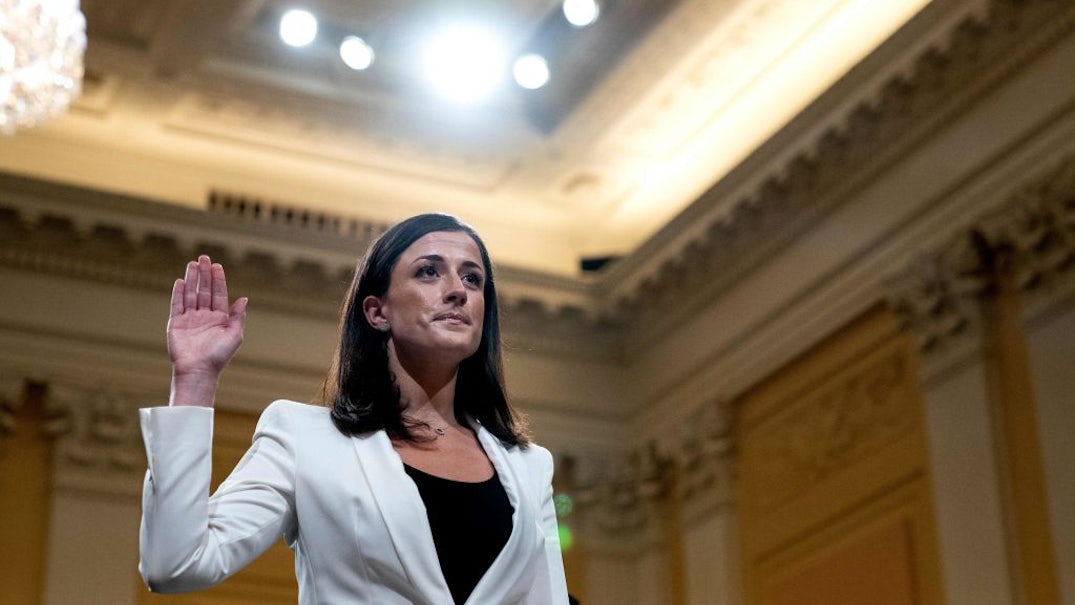
Cassidy Hutchinson is sworn in by the House Select Committee to Investigate the January 6th Attack on the US Capitol on June 28, 2022. (Photo by Stefani Reynolds / AFP)
Sign up free to receive the CAFE Brief in your inbox every Friday: cafe.com/brief
Cassidy Hutchinson is the perfect witness for a potential prosecution of Donald Trump. She had insider access as an aide to former White House Chief of Staff Mark Meadows; she was inside the West Wing during the frantic days leading up to January 6, and then as the Capitol attack went down that fateful afternoon, two years ago today. Her testimony is damning to Trump and others, and is corroborated in key respects by independent evidence. She is a compelling figure, at once likable, sympathetic, and believable. She is a prosecutor’s dream.
Also: Cassidy Hutchinson lied to federal investigators, under penalty of perjury.
This is not a matter of opinion or debate. It is a fact, openly admitted now by Hutchinson herself. And it’s not even Hutchinson’s fault, not entirely. I place much of the blame on Justice Department prosecutors who twiddled their thumbs for far too long and let themselves get beaten to the punch by the January 6 Committee. This is the cost of DOJ’s dilatory, meandering, hand-wringing approach to its investigation of the real power sources behind the coup attempt. This is the cost of getting there second.
During the first year-and-a-half or so after January 6, the Justice Department focused its prosecutorial efforts on the people who physically stormed the Capitol. Attorney General Merrick Garland vowed at his February 2021 confirmation hearing to “begin with the people on the ground and we work our way up.”
Of course, DOJ had to prosecute those who breached the Capitol and, for the most part, the feds have done an admirable job on these 900-plus cases.
The problem, however, was with Garland’s bureaucratic, bottom-up approach. Yes, prosecutors sometimes do start at ground level and work up the chain of command – but aggressive prosecutors know you don’t have to do it that way. In fact, circumstances sometimes give prosecutors a direct shot at the upper echelons of power, and there’s no reason to refrain from going after the bosses until after you’re done with the riff-raff. To put it in concrete terms: DOJ absolutely could have identified and talked to Hutchinson, Pat Cipollone, Marc Short, and other key White House insiders back in, say, mid-2021. The Justice Department has now spoken with all these folks, and other well-situated witnesses, but it didn’t get around to them until mid- to late-2022.
In the meantime, while DOJ was focused exclusively on the guys in face paint and rhino horns, the January 6 Committee – armed with less powerful investigative tools and resources– got to Hutchinson first. In February 2022 – before she gave her blockbuster, nationally broadcast testimony in June 2022 – she testified behind closed doors. The Committee asked Hutchinson whether she knew anything about a dispute on January 6 between Trump and Secret Service agents, who refused his command to take him to the Capitol. Hutchinson testified that she had heard of no such thing. At this point, Hutchinson was represented by a lawyer named Stefan Passantino, a former Trump White House ethics lawyer (yes: ethics) who was being paid by Trump’s “Save America” political action committee. (Put a pin in this; we’ll get back to Passantino in a bit).
This testimony by Hutchinson, given under penalty of perjury, was false. Months later, in June 2022, she testified publicly that she had heard that Trump had lashed out physically and verbally at Secret Service agents, at one point physically lunging for the steering wheel of the presidential SUV. In a subsequent deposition in September 2022, Hutchinson admitted that she had lied to the Committee the first time around. After her original false testimony, Hutchinson was racked with worry; she said to Passantino, “Stefan, I’m f****d. I just lied… I lied. I lied, I lied, I lied.” (That’s four “I lieds,” for those keeping count.)
There are perfectly understandable and defensible reasons why Hutchinson lied in her first deposition. As she later explained to the Committee, she was under enormous personal and financial pressure to hew to the party line and avoid testifying in any way that might harm Trump. According to Hutchinson, Passantino reinforced that perception, telling her that, “We just want to focus on protecting the President.” Worse, Hutchinson testified that when she told Passantino during prep sessions about the incident between Trump and the Secret Service, Passantino told her, “No, no, no, no, no… We don’t want to go there. We don’t want to talk about that.” (That’s five “nos,” for those keeping count.) Passantino said she could simply claim she did not recall, and there’s no way the Committee could know what she did or did not remember. Passantino contests Hutchinson’s account and starkly denies any wrongdoing.
While this was all going down, Garland was asleep at the wheel. When Hutchinson testified publicly in June 2022, federal prosecutors reportedly were “astonished” as they sat on their couches, watching on television along with the rest of us in the general public.
So here’s the problem now for DOJ (and the Fulton County DA). Hutchinson, as vital a witness as she is, is also damaged goods. She’s probably not fatally undermined but, make no mistake, defense lawyers will have a field day cross-examining her:
You lied to the Committee, didn’t you? (Yes)
You knew you were testifying to the United States House of Representatives, right? (I knew that)
And you knew you were testifying under penalty of perjury, right? (That’s right)
Just like you’re under penalty of perjury now at this trial? (Yes).
But you lied. (Correct)
You knew you could get prosecuted and go to federal prison if you lied, didn’t you? (I did)
Yet you lied, anyway. (Yes)
“I lied, I lied, I lied, I lied.” Those were your words. (Right)
By the way: you haven’t been prosecuted for perjury, have you? Even though you lied? (No, I haven’t)
These prosecutors did you a favor. They could have thrown you in prison, but they gave you a free pass, didn’t they? (Well, I guess I haven’t been charged with anything)
But you did commit perjury. (I suppose so)
Again: I find Hutchinson, on the whole, to be remarkably credible. I believe the substance of her testimony, and I believe that she lied only because of pressure applied by Passantino and others in Trumpworld. But there’s no denying it: this line of cross-examination will hurt.
Yes, Hutchinson has a plausible explanation why she originally lied to the Committee. I’ve seen plenty of witnesses in her situation, and it’s common and understandable for a person who feels financial or political or personal pressure to shade the truth. Prosecutors will surely make this argument if they ever call Hutchinson as a witness and need to rehabilitate her. But it’s an unforced error by DOJ. The Justice Department got beat to the punch, and now they needlessly have to fight a battle over Hutchinson’s credibility. By their inaction, Justice Department prosecutors have handed defense lawyers a gift.
Garland boosters sometimes argue: oh, but he is the humble tortoise, the slow but steady technician who lacks flash but wins the race in the end. Sounds reassuring, but this is apologist pablum. Speed absolutely matters. There’s a reason why prosecutors fight like mad to get to key witnesses first, and then protect them against having to testify in other settings: to prevent a Hutchinson-like scenario where, through no real fault of the witness herself, she winds up giving testimony that undermines her credibility down the line.
As I’ve noted many times in this space, prosecutors may still indict Trump, someday. But Garland’s own delay will make the ultimate job – securing a conviction – even more difficult than it needed to be.
Jan Resseger keeps close tabs on education in Ohio, which is constantly under attack in the legislature. In this post, she reviews what happened in the past year. The “good” consists of bad things that didn’t happen. The Republican-dominated legislature is intent on constant privatization of public funds. Ohio is rife with failing charters and ineffective vouchers. The legislature wants more failure. The chair of the House Education Committee, Andrew Brenner, calls public schools “socialism.” The Ohio legislature deserves a spot on this blog’s Wall of Shame.
Jan Resseger wrote:
In the midst of the big 2022 Christmas week storm, a frozen sprinkler-system pipe burst at the Ohio Statehouse and flooded the state senate chamber. This year in Ohio’s gerrymandered, supermajority Republican legislature, democracy itself has been so severely threatened that many of us wondered if the event was an expression of cosmic justice.
As Ohio Supreme Court Chief Justice Maureen O’Connor retired due to the state’s mandated age limit,O’Connor—herself a Republican—condemned legislators who created one gerrymandered legislative and Congressional district map after another, O’Connor told the Associated Press: “My advice to them was, please review the Constitution and maybe go back to, what is it, fourth or fifth grade and learn about our institutions… And maybe, just maybe, review what it was like in Germany when Hitler intimidated the judiciary and passed those laws that allowed for the treatment of the Jewish population… This country cannot stand if the judiciary is intimidated.” The AP reports that, “In retirement, she has pledged to champion a constitutional amendment that fixes Ohio’s redistricting process…”
BAD THINGS THAT DID NOT HAPPEN IN 2022
The 134th Ohio General Assembly did not pass Ohio Senate Bill 178 to hollow out the Ohio State Board of Education and shift its primary responsibilities (including overseeing the Department of Education itself) to a new cabinet Department of Education and the Workforce under the Governor. Politics have already to some degree invaded the Ohio State Board of Education, because the governor already appoints 8 of its 19 members. And during the past two years there have been several legislative/gubernatorial interventions to gerrymander the districts of elected members to favor Republicans, and to fire unruly members and appoint new members who would be more faithful to Ohio Republicans’ priorities.
In 2022, the Ohio Senate passed SB 178 to move the important functions of the State Board of Education under the governor’s control, to insulate the state board from the will of the people, and to remove many of the State Board’s responsibilities. In December, during the last week of the legislative session, SB 178 was heard by the House Education Committee, but the bill never came up for committee vote and never was acted on by the Ohio House. At 2:30 AM, before the the 134th General Assembly permanently adjourned at 6:30 AM, Senate President Matt Huffman inserted the entire 2,144 page SB 178 into HB 151 to ban transgender girls from sports, inserted another amendment to ban school vaccine mandates, and sent the entire package back to the Ohio House, where it failed by 6 votes. Although this problematic bill failed in the 134th General Assembly, Senate President Matt Huffman has pledged another attempt during 2023 to politicize the State Board of Education in the 135th Ohio General Assembly.
HB 322, HB 327, and HB 616 to ban teaching and materials about divisive concepts including racism and sexual orientation.
HB 529 to demand that school curricula be posted online.
HB 454 to ban gender affirming care for minors.
HB 704 to affirm that gender identity is identifiable at birth according to DNA.
HB 722 to ban discussion of any ‘sexually explicit’ content and establish a ‘parents bill of rights.’
SB 361 to enable former military troops to become teachers with relaxed credentialing.
SB 365 to include curriculum about free market capitalism in educational standards.
HB 290, the “Backpack” universal education savings account voucher programnever came up for a vote in the 134th General Assembly. Most people expect, however, that a similar bill will be introduced in the 135th General Assembly, perhaps as part of the FY 2024-2025 biennial budget bill. For more information see here.
GOOD THINGS THAT DID NOT HAPPEN IN 2022
The Ohio Legislature did not pass HB 497 to eliminate the Third Grade Reading Guarantee. After HB 497 passed the Ohio House by a margin of 82-10 and after the bill was unanimously endorsed by the Ohio State Board of Education, HB 497 was never considered by the Ohio Senate Primary and Secondary Education Committee and never forwarded for a vote by the full Ohio Senate. The bill died with the end of the 134th Ohio General Assembly. The bill would have eliminated mandatory retention in third grade of any student who does not reach a proficient score on the state’s third grade achievement test. Research demonstrates that holding kids back in grade damages self esteem and makes it more likely that students will drop out of school before graduating from high school. For background see here.
BAD THINGS THAT HAPPENED IN 2022…
Keep reading to learn about the “Bad Things That Happened in 2022” and the One Good Thing That Happened.
Jan concluded her post:
There is no reason to believe that in 2023 the legislative majority of Ohio’s 135th General Assembly will be supportive of Ohio’s public schools. Persistence will be required as advocates press for the full six year phase-in of adequate school funding under the Cupp-Patterson Fair School Funding Plan. And, as Ohio Public Education Partners declares, we must demand that the Legislature “rejects the school privatization agenda, which includes school voucher schemes (and) charter schools….”
Nancy MacLean, professor of history at Duke University, and Lisa Graves, board president of the Center for Media and Democracy, warn readers not to be fooled by billionaire Charles Koch’s efforts to rebrand himself as a nice guy who has mellowed, who no longer wants to fund divisive, hateful organizations. A nice guy.
The media fell for it. The new, nice Charles Koch.
Koch, the single most influential billionaire shaping American political life, never changed course. And the head fake he pulled off in 2020 succeeded in securing for his vast donor network—and the hundreds of organizations they underwrite—the freedom to operate, virtually without scrutiny, over the two years since. In that time, far from ceasing their efforts to divide the country, they have ramped them up. Like a snake shedding its skin as it grows, Koch was merely rebranding—yet again after exposure—and grouping his numerous operations under a sunny new name: Stand Together.
In August, the Center for Media and Democracy (CMD) reported that Koch-funded organizations spent over $1.1 billion in the 2020 election cycle. At the same time his book claiming to have changed course was in press, Koch spent almost 50 percent more than the record amount the Koch network had raised in the 2016 cycle: $750 million. Koch did not endorse Trump, though his spending buoyed the top of the ticket and helped maintain a GOP Senate majority to secure Koch-backed policies and judicial nominees embraced by Trump.
One of these organizations, Koch’s Americans for Prosperity (AFP), a 501(c)(4) tax-exempt organization, claimed it was involved in more than 270 races in the 2020 election, reaching almost 60 million voters with door-knocking, phone calls, postcards, digital ads, and more. AFP also played heavily in the battle for U.S. Senate seats in Georgia, in January 2021—even as Koch was still getting favorable coverage for his supposed withdrawal from divisive electoral politics. AFP Action, the super PAC arm, alone raised and spent $60 million nationwide in that election cycle.
Meanwhile, other key organizing enterprises, think tanks, litigation outfits, campus centers, and more that were previously backed by the Koch network continue operating today, sometimes under new names, and with expanded funding. These include endeavors we consider unethical, only some of which we have the space to highlight here.
Take, for example, Koch’s longest running quest: enchaining democracy by rigging the rules of governance to free corporations from customary oversight and to prevent the will of the vast majority of Americans from securing federal, state, and local policies to improve their lives. With the connivance of Trump, the generalship of Federalist Society leader Leonard Leo, and the well-funded campaigning of Leo’s Judicial Crisis Network, the arch-right billionaire succeeded in capturing a supermajority in the U.S. Supreme Court. Koch had told his allied billionaire backers that this was one of his top priorities for the Trump Administration—along with the dramatic tax cuts for corporations and the wealthy that he also secured.
Senator Sheldon Whitehouse, Democrat from Rhode Island, a climate hero and senior member of the Senate Judiciary Committee, exposes how they did it in a recently published book, The Scheme: How the Right Wing Used Dark Money to Capture the Supreme Court. The long effort to reshape the judicial system, going back to the notorious Lewis Powell Memo of 1971, culminated in the Trump Administration’s appointment of more than 230 “business-friendly” federal judges, including three Supreme Court Justices, in a project overseen by longtime Koch allies Leo and Donald McGahn, who served as Trump’s legal counsel until 2018. The 6-3 stacked court is already delivering bombshell decisions for the coalition that put it in power, from undermining our options for mitigating devastating climate change and limiting the power of agencies to regulate corporations, to revoking people’s Constitutional freedom to decide whether and when to bear children. The current court term with the Koch-backed faction in control is expected to soon overthrow affirmative action and other hard-won reforms.
The Koch-funded American Legislative Exchange Council (ALEC) also continues its long campaign to shackle democracy on behalf of its corporate backers. Passing voter ID restrictions that make it harder for Americans to exercise their right to vote became a top ALEC priority after the United States elected its first Black President, Barack Obama. That measure was first voted on at an ALEC task force meeting co-chaired by the National Rifle Association in 2009.
ALEC is one of the nation’s leading promoters of charter schools, vouchers, and anti-union legislation. You can learn more about ALEC by reading Gordon Lafer’s The One Percent Solution.
Please open the link and read the article. Learn about the “new” Charles Koch, same as the old one.
If you are looking for a good read, read Nancy MacLean’s Democracy in Chains, which provides the context for understanding the links between the Koch brothers, Milton Friedman, and free-market economics. Suffice it to say that one of their goals was to privatize Social Security. Still working on that.

 Diane Ravitch's blog