Archives for category: Curriculum

Peter Greene weighs in on Mike Petrilli’s article in the New York Times.

He writes:

Mike Petrilli, head honcho of the right-tilted Fordham Institute thinky tank, made it into the New York Times today to do some chicken littling about Learning Loss and suggest a bold solution. Don’t have a NYT subscription? That’s okay– let me walk you through the highlights of this festival of Things We Can Stop Saying About Education Right Now, Please.

Let’s start by invoking general Learning Loss panic. Petrilli points out that students “lost significant ground” during covid, and now NWEA says that students continue “backsliding” and “falling further behind.” People, in Petrilli’s view, are not panicking enough about “America’s massive learning loss.”

First, let’s use some more precise language, please. In all discussions of learning loss, we are actually talking about scores on a Big Standardized Test of reading and math going down. We will never, ever know how much of the slippage in tests scores is the result of students going a year or two without practicing for the BS Test. But in the meantime, it would be great if we stopped talking about test scores as if they were infallible equivalents of learning and achievement.

Second, “learning loss” is a misnomer. I’m willing to bet that verrrrrrry tiny number of students in this country actually lost learning. I’m equally certain that the vast majority of students did not learn as much as they would have in a non-pandemic year, but that’s not the same. 

Think of it this way. It’s budget time, and the Mugwumps’ proposed budget increases spending on widgets from $500 to $600. The Wombats say, “Let’s only increase widget spending to $550.” That gets us to the part where the Mugwump talking point is “The Wombats want to cut spending on widgets.” When in fact everybody wants widget spending to go up.

That’s where we are. During the pandemic, learning occurred–just not as much as might have been expected in a normal-ish year. And this looks most like a crisis if you think of test scores like stock prices and focus on data rather than individual human students. (Petrilli does not invoke the baloney about impact on future earnings, so we’ll not go there right now.)

And, it should also be pointed out, it is where we were for a decade before covid even hit.

Having sounded the alarm, Petrilli bemoans the surfeit of leaders willing to make alarmy noises.The country is in desperate need of leaders who will speak the truth about what’s happening in our K-12 schools, and are willing to make the hard choices to fix it. Simply put, we need to bring some tough love back to American education.

Tough love? Back? Petrilli doesn’t really explain how the pandemic led to a loss of tough love in education. But that’s the dog we’re going to try to hunt with.

He cites Michael Bloomberg, who is ceaselessly alarmed about anything going on in public schools. Bloomberg wants a plan from Washington, a joint session of Congress, a Presidential address. 

Ah, says Petrilli–you know when politicians were on the same page about education, presumably flinging tough love around with wild abandon.

We’re talking, of course, about the golden days of No Child Left Behind. 

Petrilli remembers it fondly, citing how we saw “significant progress” which of course means “test scores went up,” which they did, at first, for a few years. Anyone who was in a classroom, especially a math or reading classroom, can tell you why. Within a couple of years, schools figured out what test prep would be most effective. Then they targeted students who were teetering on the line between High Enough Scores and Not High Enough Scores, especially the ones in special subgroups, and test prepped the hell out of those kids. At which point scores started stagnating because schools had done all they could do. 

The Average Yearly Progress requirements were set up as a bomb that would go off during the next administration. Again, if you were working in a school at the time, you remember that chart, showing a gentle upward glide for a bit before jutting upward to 2014, the magical year in which 100% of students were to score above average on the BS Test. Oh, Congress will fix that before it happens, we were told. They did not. By the early 20-teens, there were two types of school districts–those that were failing, and those that were cheating. 

Petrilli claims maybe success probably, saying NCLB “likely contributed” to graduation rates (no, schools just learned how to game those), college attainment rates (eh, maybe, but correlation is not causation) and “possibly” future real-life outcomes (absolutely not a shred of evidence–even reformster Jay Greene said as much).”It’s true that No Child Left Behind was imperfect,” says Petrilli. No. It stunk. But Petrilli has quite the tale here.There were fierce debates over “teaching to the test” and “drill and kill” instruction; about closing low-performing schools versus trying to fix them; and about the link between student achievement and family poverty. But once the law’s shortcomings became apparent, policymakers responded by adopting common standards and improving standardized tests, so as to encourage higher-level teaching. They poured billions into school turnarounds, invested in stronger instructional materials and started grading schools on how much progress their kids made from year to year, rather than focusing on one snapshot in time — an approach that is markedly fairer to high-poverty campuses. Still, the bipartisan effort that was No Child Left Behind ultimately fell apart as our politics fractured.

That’s quite the load. There was no debate about teaching to the test or drill and kill, because nobody was in favor of it except shrugging administrators who were staring at 2014. Petrilli also forgets that “teach to the test” ended up meaning “cut out any other classes–or recess–that does not appear on the test.” Arts slashed. History and science cut (at least for those teetering students). Closing low-performing schools was, in fact, the quickest way for a district to free itself of the low scores; who knows how many districts were restructured to put predictably low 8th grade scores under the same roof as better scores from lower or higher grades. And yes, poverty affects scores, despite all the No Excusing in the world.

What came next did not address any of these issues, The Common Core was an amateur hour fiasco. Were standardized tests improved? Not really (as witnessed by the fact that states dumped the SBA and PARCC as quickly as they could)–but it made a lucrative contract for some test manufacturers. Including progress in scores is great–unless you’re teaching kids who are already scoring at the top. School turnarounds have consistently failed (e.g. Tennessee’s failed Achievement School District). 

But he’s right that Trump’s election and appointment of Betsy DeVos hurt the reformster alliance (despite the fact that DeVos had long been part of the club). But then, so was the increasing split between the social justice wing of reform and the free marketeer AEI-Fordham wing. 

But look– NCLB and the sequel, Race to the Top, were just bad. They started from bad premises: 1) US education is failing because 2) teachers either don’t care or don’t know what they’re doing. They rest on a foundation of using a mediocre BS Test as an unquestioned proxy for student learning and teacher effectiveness, creating a perfect stage on which to conduct a national field test of Campbell’s Law (when you make a measure a proxy for the real thing, you encourage people to mess with the measure instead of the real thing, and it gets worse if the measure isn’t very good). And none of the “policymakers” who championed this mess ever came up with a single solitary idea of how to Fix Things that actually worked on either a local or macro scale.

The pandemic did not help anything in education. But it did lead to some flaming prose, like Petrilli’s assertion that “here we are, with decades of academic progress washed away and achievement trends still moving in the wrong direction.” This kind of overheated rhetoric is nothing new from the folks who gave us The Pandemic Erased Two Decades of Progress in Math and Reading as a headline. But what does it even mean? Washed away to where? Did knowledge dribble out of students’ heads? Did the learning of the past several years retroactively vanish with former students waking up across America feeling a little bit dumber somehow? Did teachers forget everything they knew about how to teach students, so they have to start over? Or do we just mean “test scores are down”?

Petrilli breaks this down to some other issues. His first point starts out fine– there’s an attendance problem right now. But he tries to set that beside an alleged nationwide move to lower standards. I’m not sure what basis there is for that assertion. He points to the “no zeros” rule used in some schools, but that rule existed in many places (like my old district) for ages. Maybe it’s letting slackers slide through in other places, but my own experience with no zeros policy is that it merely kept students working who would otherwise have given up–kind of the opposite of encouraging slacking. 

But then he’s slicing NCLB-style baloney again:Virtually all schools and districts have enjoyed a vacation from accountability. Almost nobody is worried about state officials shutting their campuses because of low performance, or forcing district schools to replace their principals or teachers.

You say that like it’s a bad thing, Mike. 

Embedded here are many of the same bad assumptions that have driven ed reform for decades. Teachers and schools have no motivation to do their jobs unless they have some kind of threat of punishment hanging over their heads. This isn’t just bad education policy–it’s bad management. As management which W. Edwards Deming pointed out often, fear should be driven out of the workplace. But NCLB and RttT were always all stick, no carrot, always starting out with the worst possible assumptions about the people who had chosen education as their life’s work (assumptions made largely by people who had never actually worked in a school). 

And even if you don’t dig Deming, there’s another thing to consider–none of the stuff Petrilli misses actually worked (which was Deming’s point). He points out that the kind of thing being done in Houston right now has become rare, to which I say “Good,” because Houston is a nightmare and it will end just like all the other similar attempts–no actual success, but lots of disruption and dismay and upheaval of children’s education.

Petrilli will now argue for NCLB 3.0. We need “action at scale,” but we can’t ignore “the support and assistance schools require.” Holding schools accountable wasn’t enough because– wait for it– if NCLB failed it was because schools lacked the expertise and know-how to do it right. And now Petrilli almost–but not quite–gets it.“Teaching to the test” and other problems with No Child Left Behind stemmed from schools resorting to misguided practices to meet requirements. Under pressure to boost scores, but without the training to know what to do, some educators engaged in endless practice testing, and stopped instruction in any subject that was unlikely to be on the state assessment. In a few places, educators even resorted to outright cheating. They likely felt they had no choice, because they hadn’t been given the tools to succeed.

Nope. Close but no cigar. No, the reason all those things happened was because, as NCLB 1.0 and 2.0 were designed, those things were the tools to “succeed.” Because “success” was defined as “get maximum number of kids to score well on a poorly-designed multiple-choice math and reading test.” Granted, when most of us think about “success” in education, we have a whole list of other things in mind–but none of those things were valued by NCLB or RttT.

But we’re rolling up to the finish now. But after a decade of building capacity, offering helping hands and adding funds, it’s time once again to couple skill-building with will-building.

That is a great line. But what capacity-building? More seats in unregulated charters and voucher-accepting schools? Which helping hands? And exactly whose will needs to be built? Parents? Children? Teachers? Policymakers? I’m seriously asking, because I think a hell of a lot of will was involved in slogging through the last couple of years. 

Petrilli calls on schools to spend their “federal largesse” to “catch their kids up”–and I think the call to accelerate education is one of the most infuriating calls of the last few years. Sure– because all along teachers have known how to educate children faster but they just haven’t bothered to do it, but hey, now that we have certified lower test scores, teachers will all bust the super-secret Faster Learning plans out of their file cabinets. 

Petrillii says we don’t actually need to bring back NCLB, though he seems to have been talking about nothing else– just let’s get out those big sticks and get back to (threats of) “tough interventions for persistent underperformance,” because that has totally worked in the past. No, wait. It hasn’t actually worked ever. 
Kids, too, should know that it’s time to hit the books again. We need to rethink our lax grading policies, make clear to parents that their children need to be at school and bring back high school graduation exams and the like to ensure that students buckle down.

Also, get those kids off our lawns. And while you’re making sure parents know their kids should be in school, maybe talk to all the reform crowd that has been working hard to build distrust of public schools and deepen disrespect of educators.

And the big finish:Education matters. Achievement matters. We need leaders who are willing to say so, and educators who are willing to act like these simple propositions are true.

This seems straightforward enough, though if you replace “achievement matters” with “standardized test scores matter,” which is what he really means, it doesn’t sound quite as compelling. And it’s insulting as hell to suggest that the ranks of educators are filled with people who are unwilling to act as if education matters. 

Well, the piece is completely on brand for the New York Times, and it certainly echoes the refrain of that certain brand of reformster whose response to their own policy failures has been, “Well, get in there and fail harder.” No Child Left Behind failed, and it not only failed but left some of its worst policy ideas embedded in the new status quo, continuing to do damage to public education right through today. 

The pandemic did many things, and one thing it did was panic the testing industry, which faced an existential threat that everyone might realize that school without the BS Test, or NWEA’s lovely test-prep tests, might actually be okay. It’s no wonder that they feel a special nostalgia for the days when the entire weight of the government reinforced their importance. So here we are, painting low reading and math tests scores as an educational crisis whose only solution is to get more fear, more threats, and especially more testing back into schools. 

I’m sorry if this assessment of some reformsters, their policies, and their motives seems harsh, but, you know– tough love.
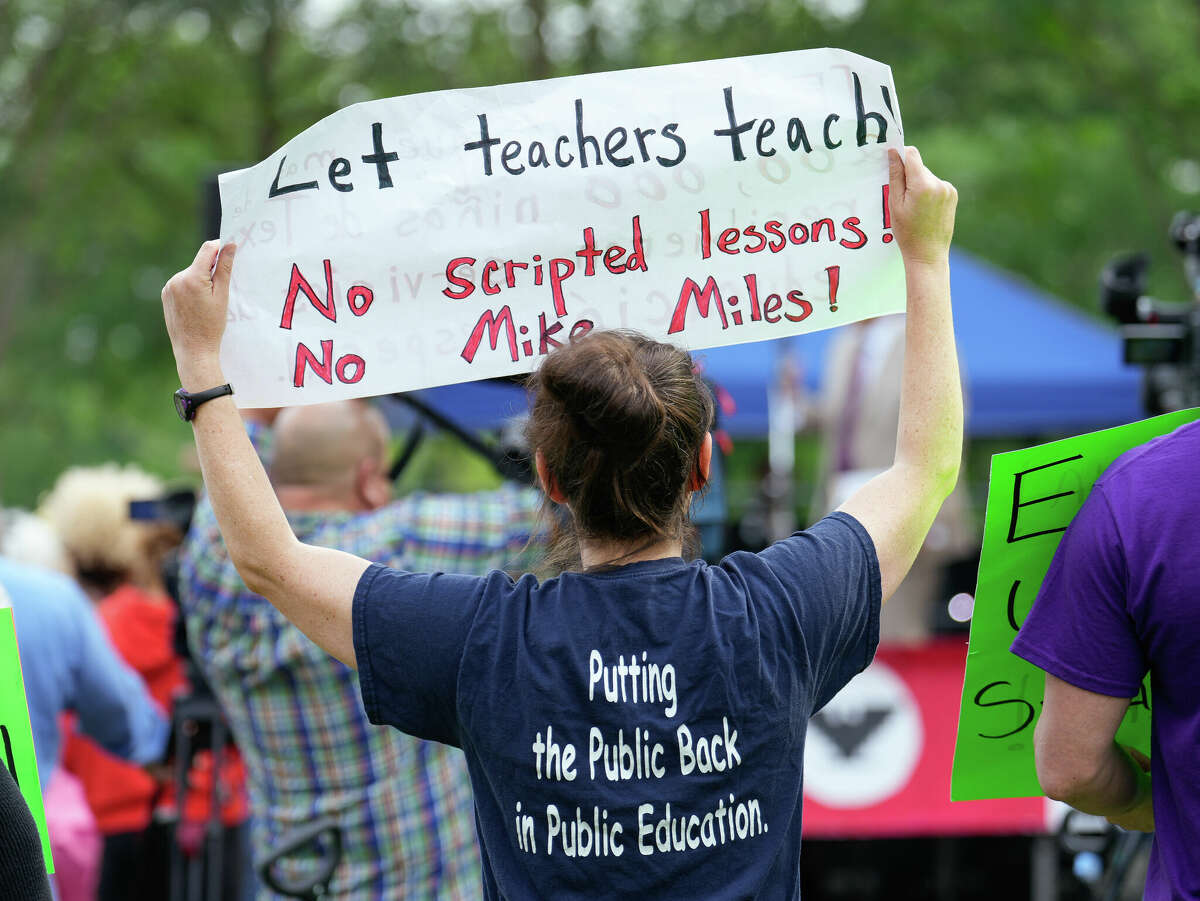
School started in the Houston Independent School District, and many teachers were stunned by the extent to which their actions were constrained by a script. The new superintendent Mike Miles has be never been a teacher but he thinks he knows everything about teaching. He laid down strict rules, and teachers must comply without hesitation. Miles is the kind of leader who, if put in charge of a hospital, would tell surgeons how to conduct surgeries. This story appeared in the Houston Chronicle and was written by staff writer Anna Bauman.

As she prepared for the start of a new school year in Houston ISD, a fifth-grade reading teacher stripped much of the colorful personality from her classroom, including motivational posters, student art projects, several bins of books and a social-emotional learning nook with comfy furniture.

She wiped away tears and, earlier this week, started teaching at a school under the New Education System, a wholesale reform model introduced by Superintendent Mike Miles, who was appointed in June by the Texas Education Agency to run the largest school system in Texas.

HISD teacher Sarah Rivlin participates in a rally hosted by The Greater Houston Justice Coalition and other community groups to speak against the state takeover of HISD Friday, March 31, 2023, at Cesar Chavez High School in Houston.

While parents and students may have noticed few of the changes, educators from a wide swath of schools in HISD say they feel micromanaged and stressed in their first week under new district leaders, who are reportedly enforcing strict guidelines and conducting frequent classroom observations that have sparked frustration, fear and low morale among teachers at both NES and non-NES schools.

“I feel like they are not allowing me to do what’s in the best interest of the children,” said the reading teacher. “Every day I go to work, I’m crying. Every day I leave from work, I’m crying.”

The superintendent, meanwhile, said he has been pleased with what he has seen while collecting a “baseline” at NES schools in the first week.

“I was very impressed with their progress, even in one day, but also their preparation for the beginning of the school year,” Miles said. “Teachers were teaching well, they were following the instructional model, and it was pretty good. It shows that the schools and the teachers have been preparing hard for the first day, second day of school.”

The district is laying the groundwork for a pay-for-performance evaluation system geared toward measuring the quality of a teacher’s instruction, although a Harris County judge has temporarily blocked HISD from implementing the system.

“The high-quality instruction, there’s a clear rubric for that, there’s a clear spot observation form, because we have to train teachers,” Miles said. “We can’t just do what we’ve always done, which is go into a classroom every three weeks or three months and think we’re going to see something that is effective teaching, and just rely on, ‘Oh, I’ll know it when I see it.’”

This year, all principals will be evaluated under a new system that requires them to give instructional feedback and spend significant time coaching teachers in classrooms. Principals will be graded in part based on the quality of instruction at their school. Meanwhile, teachers will also be measured with a new evaluation system this year, although those who do not work in the schools targeted for reform may ask for a waiver.

District leaders trained teachers in recent weeks on the evaluation system and new classroom expectations. For example, one slideshow presented during teacher training listed some “common practices that we want to generally avoid,” including stream of consciousness writing, rooms with dim lighting and worksheets that are not purposeful. The training materials also discouraged teachers from showing entire films, letting kids “earn” free time and allowing “poor readers” to read aloud during class.

The slideshow instructed teachers to post a “lesson objective” on the board before the start of each class, avoid wasting time on transitions between activities, teach “bell to bell,” teach grade-level content to “every student every day” and use a timer to guide pacing of the lesson. Teachers should use a “multiple response strategy,” an activity that engages and checks the understanding of all students, every four minutes, according to a sample spot observation form.

On the first day, teachers said they were expected to skip introductions and get-to-know-you games, instead jumping right away into instructional material.

“I don’t even know who my kids are because we haven’t been able to get to know them,” said the fifth-grade reading teacher. “They still call me ‘teacher’ because they can’t remember my name.”

She has struggled to stay on pace with the timed lessons and was scolded for bringing in additional materials to help students, many of whom are Spanish speakers who cannot read on grade level. When she raised concerns about the fast pace, a district official told a campus administrator that the teacher was “moving too slow.”

“We’re not allowed to give them work on a level they understand. Most of the time, they sit there confused,” the teacher said. “I’ve had students crying since day two, saying they’re overwhelmed.”

Meanwhile, Jessica Waligorski, a special education support teacher at Isaacs Elementary School, said she appreciates the rigor, high expectations and organization of the NES model. Administrators are supportive and easily accessible at her NES campus, she said. Teachers lift each other up when doubts creep in and students have taken to the new model “like sponges,” she said.

“Everyone is holding each other to a standard and we’re not wavering,” she said. “We have set the tone, we have set expectations, we have set goals … and our kids have been engaged, learning. They don’t have a minute to misbehave because there’s so many things they’re learning.”

Miles has said there is no directive from the district mandating that teachers at non-NES schools teach with a specific curriculum or follow a certain instructional model. In reality, however, many of the new rules and expectations seem forced on campuses across the district, including high-performing schools that do not fall under NES.

Some of the rules seem to have been taken to an extreme. One teacher said she asked for an accommodation to use lamps instead of florescent lights in her classroom due to a serious medical condition. District officials denied her request and suggested another option: Wear sunglasses.

The teacher has already started getting headaches from the bright lights.

“I have all my lights on,” she said. “I’m trying to get through the day.”

In addition to turning on lights, the teacher, who works at a non-NES middle school, has made several other changes this year, including removing bean bag chairs from her classroom, keeping the classroom door open and following the new instructional techniques outlined on the evaluation rubric.

District staff have been observing classrooms almost every day this week, she said. The teacher said she was nervous to sit down while taking attendance or interrupt a lesson to tell a funny story during class.

“We all feel afraid to step out of line,” she said.

One teacher at a non-NES campus said she was observed by appraisers three times on Monday, creating a climate of fear and nerves even at a top-ranked campus. She loves having visitors in her classroom — “I’m a really good teacher and I’m proud of what I do” — but it feels different when “someone’s sitting there, ticking boxes,” especially on the first day of class.

“People are having trouble sleeping because they’re on edge,” she said. “It’s the constant anxiety that we’re going to be caught and that we’re going to be dinged. … I think you’re going to see a mass exodus of teachers at the end of this year, if this continues.”

One teacher at a different non-NES campus said he and other educators were chastised for spending the first day on introductions, logistics and relationship building with students rather than teaching content.

The teacher stayed three hours late that night to adjust his lesson plans for the second day, and his principal checked in first thing the next morning to make sure that he was prepared to teach a full-blown lesson, as expected by the appraiser in his classroom.

The new expectations and frequent classroom observations from district administrators this week has created a sense of frustration and anxiety on campus, according to the teacher, who said he was ready to quit even though he feels “called” to the profession.

“There’s no grace, there’s no empathy, there’s no treating people as people,” he said. “We are not encouraged to move forward — we’re pushed off the cliff and told to fly. And if you don’t fly, you fail.”

Many of the teachers at his top-rated campus have decades of experience, he said.

“I work at a really special school. … We should not be the target,” he said. “We were hoping that we’d be so far under the radar that we’d be left alone, but that’s not the case.”

Nancy Bailey, retired teacher, has been blogging for ten years. She reflects on the continuing efforts to destroy public education, based on a false narrative, hubris, and in some cases, the profit motive.

Nancy and I co-authored a book that serves as a glossary about fads and “reforms.”

She begins her new article:

School reform continues to privatize and destroy public schools. August marks ten years since I began blogging. Within that time I have written two books and co-authored a third with Diane Ravitch. I’m proud of all this writing but Losing America’s Schools: The Fight to Reclaim Public Education is the book title that especially stands out today.

Many Americans still don’t understand or value their ownership of public schools, and how they’re losing one of the country’s great democraticinstitutions. Instead of working together to build up local schools, to iron out difficulties, they’re willing to end them.

Thank you for reading my blog, commenting, and for those of you who have written posts. I am amazed at the wonderful educators, parents, students, and policymakers I have met. I have appreciated debate.

Here are some of the main education issues still of concern.

The Arts

School arts programs help children thrive. Those with mental health challenges benefit. Students might find art jobs. Sadly, many poor public schools ditched the arts. Some schools might get Arts Partnerships or entrepreneurships (Hansen, 2019). These programs aren’t always consistent. Public schools must offer well-rounded and fully resourced K-12 arts programs.

Assessment

Assessment is important for teachers to understand students. But high-stakes standardized tests push a narrow, one-size-fits-all agenda used to drive parents to private schools which, on the other extreme, have little accountability. Tests have been harmful to students.

Class Size

Children deserve manageable class sizes, especially for K-3rd grade (STAR Study), and for inclusion andschool safety.

Common Core State Standards

Controversy originally surrounded Common Core State Standards, promoted by the Bill and Melinda Gates Foundation in 2010, but Common Core continues to drive profiteering, especially in online programs.

Stan Karp of Rethinking Schoolssaid CCSS are:

A massively well-financed campaign of billionaires and politically powerful advocacy organizations that seeks to replace our current system of public education which, for all its many flaws, is probably the most democratic institution we have and one that has done far more to address inequality, offers hope, and provide opportunity than the country’s financial, economic, political, and media institutions with a market-based, non-unionized, privately managed system.

Corporations and Politicians

Corporations and politicians continue to work to end public schools and drive teachers out, transferring tax dollars to nonprofit and for-profit entities.

Nancy covers many more topics that have been harmful to public education.

Open the link and read her article in its entirety.

Michael Hiltzik, columnist for the Los Angeles Times, finds a pattern in the Republican attacks on the schools and universities. Their hostility to teaching Black history, their encouragement of book banning, their strategic defunding of higher education, their treatment of teaching about race, gender, and climate change as “indoctrination”—together point to a goal: the dumbing down of American young people.

Republicans say they want to get rid of “indoctrination” but they are busily erasing free inquiry and critical thinking. What do they actually want? Indoctrination.

He reminds us of the immortal words of former President Donald J. Trump: “I love the uneducated.” Republicans do not want students to think critically about racism or the past. They do not want them to reflect on anything that makes them “uncomfortable.” They want to shield them from “divisive concerns.” They want them to imbibe a candy-coated version of the past, not wrestle with hard truths.

He writes:

For reasons that may not be too hard to understand, Republicans and conservatives seem to be intent on turning their K-12 schools, colleges and universities into plantations for raising a crop of ignorant and unthinking students.

Donald Trump set forth the principle during his 2016 primary campaign, when he declared, “I love the poorly educated.”

In recent months, the right-wing attack on public education has intensified. The epicenter of the movement is Florida under Republican Gov. Ron DeSantis, where the faculty and course offerings of one of America’s leading liberal arts colleges, New College, have been eviscerated purportedly to wipe out what DeSantis calls “ideological indoctrination.”

The state’s K-12 schools have been authorized to supplement their curricula with animated cartoons developed by the far-right Prager University Foundation that flagrantly distort climate science and America’s racial history, the better to promote fossil fuels, undermine the use of renewable energy and paint a lily-white picture of America’s past.

Then there’s West Virginia, which is proposing to shut down nearly 10% of its academic offerings, including all its foreign language programs. The supposed reason is a huge budget deficit, the harvest of a systematic cutback in state funding.

In Texas, the State Library and Archives Commission is quitting the American Library Assn., after a complaint by a Republican state legislator accusing the association of pushing “socialism and Marxist ideology.”

In Arkansas, state education officials told schools that they may not award credit for the Advanced Placement course in African American history. (Several school districts said they’d offer students the course anyway.) This is the course that Florida forced the College Board to water down earlier this year by alleging, falsely, that it promoted “critical race theory.”

I must interject here that I’m of two minds about this effort. On the one hand, an ignorant young electorate can’t be good for the republic; on the other, filling the workforce with graduates incapable of critical thinking and weighed down by a distorted conception of the real world will reduce competition for my kids and grandkids for jobs that require knowledge and brains.

Let’s examine some of these cases in greater depth.

Prager University, or PragerU, isn’t an accredited institution of higher learning. It’s a dispenser of right-wing charlatanism founded by Dennis Prager, a right-wing radio host. The material approved for use in the schools includes a series of five- to 10-minute animated videos featuring the fictional Leo and Layla, school-age siblings who travel back in time to meet historical figures.

One encounter is with Frederick Douglass, the Black abolitionist. The goal of the video is to depict “Black lives matter” demonstrations as unrestrained and violent — “Why are they burning a car?” Leo asks while viewing a televised news report. The animated Douglass speaks up for change achieved through “patience and compromise.”

This depiction of Douglass leaves experts in his life and times aghast. Douglass consistently railed against such counsel. Of the Compromise of 1850, which brought California into the union but strengthened the Fugitive Slave Act — arguably the most detested federal law in American history — he stated that it illustrated how “slavery has shot its leprous distillment through the life blood of the nation.” In 1861, he thundered that “all compromises now are but as new wine to old bottles, new cloth to old garments. To attempt them as a means of peace between freedom and slavery, is as to attempt to reverse irreversible law.”

Patience? The video depicts Douglass quoting from an 1852 speech to a Rochester anti-slavery society in which he said “great streams are not easily turned from channels, worn deep in the course of ages.”

But it doesn’t include lines from later in the speech, reproaching his audience for prematurely celebrating the progress of abolition: “Your celebration is a sham; your boasted liberty, an unholy license; your national greatness, swelling vanity; … all your religious parade and solemnity, … mere bombast, fraud, deception, impiety, and hypocrisy — a thin veil to cover up crimes which would disgrace a nation of savages.”

Another video in the series parrots the fossil fuel industry’s talking points against wind and solar power: Standing over the corpse of a bird supposedly slain by flying into a wind turbine, the schoolkids’ interlocutor states, “Like many people … you’ve been misled about renewable energy, and their impact on the environment…. Windmills kill so many birds, it’s hard to track how many…. Wind farms and solar farms disrupt huge amounts of natural habitat.”

Acid rain, pollution, global warming — those consequences of fossil fuel energy aren’t mentioned. The video ends with a pitch for nuclear power, never mind the unsolved question of what to do with its radioactive waste products.

PragerU’s sedulous attack on renewables perhaps shouldn’t be much a surprise: Among its big donors is the Wilks family, which derives its fortune from fracking and which approved “future payment” of $6.25 million to PragerU in 2013.

As for New College, its travails under the DeSantis regime have been documented by my colleague Jenny Jarvie, among many others.

In a nutshell, the Sarasota institution possessed a well-deserved reputation as one of the nation’s outstanding havens for talented, independent-minded students. Then came DeSantis. He summarily replaced its board of trustees with a clutch of right-wing stooges including Christopher Rufo, known for having concocted the panic over critical race theory out of thin air and then marketed it as a useful culture war weapon to unscrupulous conservative politicians, including DeSantis.

Rufo and his fellows fired the university president and installed a sub-replacement-level GOP timeserver, Richard Corcoran, in her place. Faculty and students have fled. Students who stayed behind and were in the process of assembling their course schedules for the coming year are discovering at the last minute that the courses are no longer offered because their teachers have been fired or quit.

Instead of ambitious scholars committed to open inquiry, Corcoran has recruited athletes to fill out the student body, even though the college has no athletic fields for many of them to play on. According to USA Today, New College now has 70 baseball players, nearly twice as many as the University of Florida’s Division I NCAA team.

More to the point, the average SAT and ACT scores and high-school grade point averages have fallen from the pre-Corcoran level, while most of the school’s merit-based scholarships have gone to athletes. New College, in other words, has transitioned from a top liberal arts institution into a school that places muscle-bound underachievers on a pedestal. DeSantis calls this “succeeding in its mission to eliminate indoctrination and re-focus higher education on its classical mission.”

Finally, West Virginia University. Under its president, Gordon Gee — who previously worked his dubious magic at Brown Universityand Ohio State University, among other places — the school built lavish facilities despite declining enrollments. The construction program at the land grant university contributed to a $45-million deficit for the coming year, with expectations that it would rise to $75 million by 2028.

But the main problem was one shared by many other public universities — the erosion of public funding. As the West Virginia Center on Budget and Policy points out, “if West Virginia lawmakers had simply kept higher education funding at the same levels as a decade ago, West Virginia University would have an estimated additional $37.6 million in state funding for [fiscal year] 2024, closing the majority of this year’s budget gap.”

The decision on which programs to shutter at WVU points to a shift in how public university trustees see the purpose of their schools, trying to align them more with economic goals set by local industries rather than the goal of providing a well-rounded education to a state’s students. Trustees in some states, including North Carolina and Texas, have injected themselves into academic decisions traditionally left to administrators, often for partisan political reasons.

When it comes to interference in educational policies by conservatives, such as what’s happened in Florida, Texas and Arkansas, there’s no justification for taking these measures at face value — that is, as efforts to remove “indoctrination” from the schools. The truth is that the right-wing effort serves the purposes of white supremacists and advocates of anti-LGBTQ+ discrimination — they’re moving to inject indoctrination that conforms more to their own ideologies.

Take the attack on critical race theory, or at least the version retailed by Rufo and his ilk. “The right has reduced CRT to an incendiary dog whistle,” the Black scholar Robin D.G. Kelley of UCLA has observed, by caricaturing a four-decade-long scholarly effort to analyze “why antidiscrimination law not only fails to remedy structural racism but further entrenches racial inequality” into “a racist plot to teach white children to hate themselves, their country, and their ‘race.’”

(The inclusion of Kelley’s work in the AP African American Studies course was cited as a “concern” by Florida officials in their rationale for rejecting the course; Kelley’s work was suppressed by the College Board in its effort to make the course more acceptable to the state Department of Education.)

These attacks are couched in the vocabulary of “parents’ rights” and student freedom, but they don’t serve the students at all, nor do they advance the rights of parents interested in a good, comprehensive education for their children, as opposed to one dictated by the most narrow-minded ideologues in their state.

Where will it end? Florida’s ham-fisted educational policies won’t produce graduates with the intellectual equipment to succeed in legitimate universities, much less in the world at large. The only university many will be qualified to attend will be Prager U, and that won’t be good for anyone.

Dan Rather and Elliot Kirschner wrote in their blog Steady about the importance of saving public education from the forces trying to destroy and privatize it. They remind us and the general public that public schools unite us; privatization is inherently divisive. It is ironic that the red states are implementing voucher plans as the evidence about the failure of vouchers and the null effects of charter schools grows stronger. (The boldfacing of passages in their essay was added by me).

It is back to school. Students of all ages flock to campuses and classrooms. Fleeting memories of summer are quickly replaced by tests and textbooks.


Getting into the swing of a new semester has always included an adjustment period, but this is a particularly difficult time for many of our nation’s students and their parents, guardians, teachers, and others entrusted with the education of young minds.


The pandemic wreaked havoc with the emotional, intellectual, and social development of America’s youth. Dismal test scores provide depressing data of yawning learning deficits. Talk to anyone in or around schools and you hear stories of setbacks and struggle — heaps of qualitative data suggesting a staggering scale of generational loss.
As usual, those who were already the most marginalized have paid the heaviest price. The pandemic exacerbated existing disruptions and placed greater strain on finances and time, particularly in large urban districts and small rural ones tasked with educating children from families struggling economically.


We like to tell ourselves that the United States is a great meritocracy, but wealth and levels of family education continue to play outsized roles in dictating a child’s likelihood of academic success long before she learns her ABCs. The simple truth is that kids come to school from widely different circumstances, and these influence their ability to thrive, independent of whatever innate intelligence or drive they may possess. The pandemic made these differences more acute.


The United States does possess a system (or more accurately, a collection of thousands of systems) that, if nurtured and respected, could foster greater equality of opportunity. And it is exactly the institution that is now struggling the most: public education. America’s public schools were once the envy of the world as engines of opportunity and upward mobility. If the nation had the will, they could return to that status once again.


Our public schools certainly weren’t perfect in the past, especially during legal racial segregation, when the lie of “separate but equal” (separate is never equal) helped enshrine white supremacy. The segregated schools of the Jim Crow Deep South were a shameful injustice and a stain on our national identity. They were inconsistent with our founding documents, which spoke eloquently about equality among people. Of course there was (and remains, to some extent) de facto segregation throughout America based on who lives in what neighborhoods. Well-financed suburban schools were often part of the draw of “white flight” from urban districts.


The very ethos of public education should be one of inclusion for America’s diverse population. It should be a place where children of different backgrounds come together to learn both from teachers and from each other. Our schools should be places that allow students to wrestle with what it means to be part of this great country, including understanding America’s uneven and often bloody road to greater equality.


Sadly, in recent years, we have seen a grave regression from these noble goals. Our schools and school districts have become fiercely contested frontlines in an era of stepped-up culture wars. As reactionary political forces target what we teach our children, it is no accident that truth, empathy, and our democratic values have become casualties.

A chief concern is how and what we teach about our history, particularly the Black experience, and race and ethnicity more generally. We have written here before about the shameful whitewashing of racial violence and injustice, including slavery, by Florida Governor Ron DeSantis. But this effort is not limited to him or that state. There is a national movement to not tell the full — and unfortunately tragic — reality of race in American history and how it continues to shape the nation.


Another serious concern is the othering of LGBTQ+ students and teachers. After years of progress, we see a wave of intolerance spread across America, including in our schools.


Few institutions in American life are as essential to the continuation of our democracy as the public schools. In a time of ascendent autocracy, attacks on our schools — how they are run, what they teach, what books they have in their libraries — are among the most pernicious, pathetic, and painful assaults on the health of our nation.

Several months back, Texas Monthly ran a striking piece of journalism with the headline, “The Campaign to Sabotage Texas’s Public Schools.” It tells a story that extends beyond the raucous school board meetings and book banning campaigns that have gotten the most attention. There is a movement afoot, and not just in Texas, to destroy public schools more generally, to privatize education through vouchers and other means.


In this context, the various culture fights become battles in a larger war over the very future and viability of public education:

Taken individually, any of these incidents may seem like a grassroots skirmish. But they are, more often than not, part of a well-organized and well-funded campaign executed by out-of-town political operatives and funded by billionaires in Texas and elsewhere. “In various parts of Texas right now, there are meetings taking place in small and large communities led by individuals who are literally providing tutorials—here’s what you say, here’s what you do,” said H. D. Chambers, the recently retired superintendent of Alief ISD, in southwest Harris County. “This divisiveness has been created that is basically telling parents they can’t trust public schools. It’s a systematic erosion of the confidence that people have in their schools.

The ideal of quality, integrated public schools for all children in the United States epitomizes the promise of our country’s founding as a place of equality and opportunity for all. It thus makes sense that would-be autocrats and protectors of privilege would seek to undermine our public schools by whatever means necessary. We must see this as what it is: as much a threat to the nation as was the violent storming of our Capitol.

The future of the United States depends on an educated and empathetic citizenry. It requires us to share a sense of common purpose and recognize our common humanity. It requires an environment that allows every child to thrive and see themselves included in the American story. It requires quality public education. Full stop.

A historic battle to save this institution and the very idea of good public schools has been underway for some time. It is now intensifying. Attention must be paid.

New Hampshire’s State Board of Education deliberated whether to adopt the infamous PragerU videos for a required financial literacy course. PragerU creates curriculum materials that are intended to indoctrinate children to rightwing views.

Gary Rayno of inDepthNH wrote:

CONCORD — The State Board of Education Thursday tabled an application by PragerU Kids to offer an on-line course on financial literacy until additional information is provided.

Board Chair Drew Cline said he was not comfortable approving the application until he could see the “whole package” including a company proposal to establish a stand-alone website for the course for New Hampshire students.

One of the many criticisms raised at the board’s meeting about the controversial, conservative non-profit organization is students taking the financial literacy course would have easy access to other Prager videos that some organizations classify as misleading on climate change, slavery and racism, immigration, history of fascism and its anti-LGBTQ bent.

The organization’s opponents told the board approving the financial literacy contract pushed by Education Commissioner Frank Edelblut would open the door to other material that did not belong in New Hampshire schools.

The non-profit organization is not an academic institution, does not confer degrees and is not accredited, and has had some of its videos removed from YouTube and Google because of their “hateful content.”

On its website, PragerU Kids says it teaches “American Values” while “Woke agendas are infiltrating classrooms, culture and social media.”
Several speakers at Thursday’s meeting said the organization’s website could lead students taking financial literacy to other videos with messages that would not be appropriate.

Emmett Soldati of Somersworth, said he is proud of the state’s tradition of local government, and shares the belief that PragerU is not right for New Hampshire.

While approving the application would appear to be tacit approval of PragerU, he said, it is more than that because throughout the financial literacy videos and its other videos is its brand and logo.

He said that branding would have to be removed from the financial literacy videos if the board did not want to have the association of other concerns with the organization.

Brandon Ewing of PragerU said the company is planning a stand-alone website for the state’s financial literacy course so students would not have access to other material on its website, which he acknowledged would be hard to navigate for students looking for the literacy course.

That would allow students with their parents to work through the 15 videos and worksheets to the final assessment without having to use the Prager website or with a log in to gather student information, he said.

“We’re a media company and we love the Learn Everywhere Program, and the state’s school choice program,” Ewing said….

But some speakers believed the program was not up to the state standards for graduation requirements.

Kearsarge Regional School District Assistant Superintendent Michael Bessette said using PragerU instead of a locally developed curriculum, is like going to McDonalds and claiming you are going to a four-star restaurant.

He had concerns particularly around competencies as did several members of the board saying five-minute videos with 36 multiple choice questions do not replace a full semester of hands-on teaching.

This is a quick hit replacing quality, Bessette said. “It may be convenient, but you are replacing something of high quality with something of low quality. You are doing a disservice to my children and all children.”
Bessette and other speakers took issue with a report on the application that said department officials had reached out to educators and the extended learning opportunity network to review the videos but did not have anyone respond.

Bessette said he was not aware of any outreach and others said the request went out on July 3 with a July 7 deadline, during a vacation week when many teachers were with their families.

Deb Howes, president of the American Federation of Teachers, called the statement an insult, noting teachers work hard all school year and during vacation time they do like to spend time with their families.

The non-profit PragerU Kids program would help fulfill a state requirement students learn financial literacy to graduate and would be available under the Department of Education’s Learn Everywhere Program.

The program was founded by conservative talk radio host Dennis Prager and uses conservative pundits and activists along with Republican National Committee members to tout its conservative philosophy in its videos it offers free to schools. So far Prager is working with Florida, Texas and Montana on programs, Ewing said.

Several board members pressed some of those opposing the application if the financial literacy videos were biased or contained good content.

Mark Maclean, director of the School Administrators Association said he did watch the videos and they were well produced and the content was good but questioned if it would be enough as a stand alone course to satisfy the minimum standards for financial literacy.

He said you have to understand what a competency-based approach is. There has to be more than one way to determine what a student knows and answering 40 multiple choice questions is not that.

Maclean said some instructional support needs to go along with the video and more robust learning experiences for the students.

He said he watched the video without considering the propaganda the brand uses, but as a piece of information.

“It is engaging, and I like the five-minute (concept), but my concern is the platform this is coming from.”

Louise Spencer of Concord, said she is concerned about the financial literacy video as it had face after face of young people looking with horror when the issue of taxes is raised.

“Oh no terrible you have to pay taxes,” she quoted from the video saying “they figure out taxes are inherently bad and that is indoctrination,” said Spencer. She said she believes taxes are what you contribute to live in a community.

“PragerU is a media company,” Spencer said. “They understand the media is the message.”

A conversation with different viewpoints is best for education, she said, noting the students need a wider range of opportunities.

Rep. David Luneau, D-Hopkinton, accused the board of trying to slip the controversial application through with little notice, when people are not paying attention and with little to no transparency.

Cline asked Luneau if he had concerns about the literacy program and Luneau said he had concerns about Prager.

The producer of this material has a well known reputation for producing extremist propaganda, Luneau said.

“People received a four-day notice to approve material submitted by an organization considered by many people to be a racist propaganda mill,” Luneau said.

The decision about adopting the PragerU videos will be made at the state board’s meeting on a September 14.

Journalist Gary Rayno expects that the state board, packed with school choice partisans, will vote to import PragerU videos, but he explains why this outfit is wrong for New Hampshire. It peddles right-wing propaganda.

The Miami Herald published an editorial describing the climate of fear that’s descended on the classrooms of Florida. That’s exactly what Republicans want, says the editorial board. Once people start self-censoring, the battle for censorship is won.

The editorial board wrote:

The fear is the point.

Schools in Florida have been canceling — and then, in some cases, reinstating — Advanced Placement psychology courses for high school students because they’ve been told by the College Board, or simply believe, the classes would violate the state’s ban on lessons involving sexual orientation and gender identity.

The worry is understandable — and a bonus for a state intent on waging culture wars in schools and crushing any dissent. If you can get people to self-censor, you’ve pretty much won the battle.

School districts in Miami-Dade and Broward counties announced Wednesday that they would be among those offering the course, although in Broward it will be require parents to “opt-in.” The districts’ decisions came after Education Commissioner Manny Diaz Jr., who is from Miami and once taught in the public schools here, said the class could be taught.

But the fact that school districts have to publicly announce their intent to teach a class that has been around since 1993 is indicative of the problem. Under Florida Gov. Ron DeSantis and his lockstep Legislature, fear has seeped into schools. Teachers and school districts are rightfully worried about violating the Parental Rights in Education Act, the “Don’t say gay” law that outlawed sexual orientation and gender identity teachings. The penalties for a violation are potential career-enders, teaching licenses suspended or revoked..

This all happened after the College Board, the New York City-based nonprofit that manages AP courses in the United States, said last week that it wouldn’t recognize Florida’s AP psychology course and — critically — wouldn’t give students college credit for it because the state wanted any mention of sexual orientation and gender identity stripped out. Any course that censors required content cannot be labeled “AP” or “Advanced Placement,” the board said. Students applying for college rely on AP credits as a plus on their applications.

And school is about to start — next week in Miami-Dade and the following week in Broward.

So now the state says it’s OK to teach the course, but the education world is jittery, with good reason. Can the state be trusted?

In Leon County, where Tallahassee is located, Superintendent Rocky Hanna said the district would offer the class, but he is clearly wary. On Twitter, he wrote: “Our teachers have some concerns but we are going to take the commissioner of education’s word when he says that Advanced Placement Psychology may be taught in its entirety,” Hanna said.

He added that he has told the staff to “respect the law and follow the law but not to fear the law.”

This is where we are in Florida: Instead of supporting our public school teachers, we are instilling fear and worry. Instead of celebrating their hard work, we are threatening them with license suspensions if they dare to cross the power of the mighty state.

Teaching has always required courage. In Florida, it now requires a whole new brand of bravery.

Bethany Erickson wrote in D Magazine about the revolution in Dallas. The superintendent, Stephanie Elidzalde, declared that test prep is dead. She is determined to make school joyful. Imagine that! I have been waiting a long time for a superintendent with the brains and guts to do what she’s doing. The teacher shortage in Dallas has shrunk dramatically. Not surprising. What wonderful news.

Erickson writes:

School started at Dallas ISD today, and parents of students attending school at any of the 230 campuses may notice something different this year.

During her state of the district address last May, superintendent Stephanie Elizalde said the district would soon eschew the numerous tests designed to find out whether students were ready for the STAAR in favor of, as she put it, more “joy” in the classroom.

In last year’s address, she declared teaching to the test was “officially dead,” and added that some schools were testing as frequently as every few weeks in preparation for the STAAR test, and doing classwork in between those assessments that also practiced STAAR strategy.

“How about we put them all together and we have a huge bonfire?” she said.

That doesn’t mean that there won’t be occasional checks to make sure a student is understanding concepts learned in the classroom. But it does mean that Elizalde recognizes something many parents have been saying for years—the frequent testing only amps up anxiety about the test.

“Do kids need to know what the tests look like? Yes,” Elizalde said in May. “But do we need to be doing that once every six weeks, once every nine weeks? No we don’t. … Because we worry so much about the test, we have added pressure in a way that actually is hindering the success of how students do.”

And while there wasn’t an actual bonfire, Elizalde reiterated that stance last week in a note to students and parents.

 “As I said in my State of the District speech, test scores will take care of themselves if joy – and on-grade-level materials – are in the classroom,” she said. “We do not need to drill and kill to prepare for the state assessment.”

Elizalde said the amount of testing and preparation for testing had “gotten completely out of control.” The district tallied up all the time teachers were spending preparing for tests and testing, which equated to roughly 18 school days. 

The district is providing a full curriculum to teachers with lesson plans that will allow them more time to teach, Elizalde says. The aim at uniformity will also help a district where students often switch schools during the school year.

During her state of the district address, Elizalde said the goal was to provide a consistent framework, not to have teachers reciting lessons by rote.

ADVERTISEMENT

null

Anecdotally it appears that mileage varies on teacher experiences with the lesson plans. Some teachers have said they didn’t have all the materials their lesson plans required. But others said they felt they had a great deal of freedom to teach beyond the lesson plan, so long as they met their specific goals and taught the required skills. 

The other lynchpin in Elizalde’s joy ride is making sure every student has a teacher in their classroom on the first day of school. Earlier this month, she told teachers at the Dallas ISD’s New Teacher Academy held at the Winspear Opera House that the district had fewer than 140 open positions out of its 10,000 total teaching jobs. (Last year, that number was 220.)

She also reiterated to those new hires that they would not be teaching to the test. “This whole movement is going to allow teachers to truly feel both the science and the art that is teaching,” she said.

It will be interesting to see which provides the district with a path to success. As a parent of a student, I’m rooting for the joy plan, especially if we can also figure out a way to pay teachers what they’re worth, and the state legislature can come out of the next special session robustly funding public education.

The editors of Rethinking Schools wrote the following commentary on the media frenzy about the post-pandemic “learning loss.”

This school year, as teachers carefully construct unit plans, build community with students, and navigate ongoing staff shortages, they also have to contend with a barrage of media coverage catastrophizing about so-called “learning loss.” Headlines suggest the losses are “historic,” “devastating,” and that students are “critically behind.” This fearmongering comes not only from the political right; there is a dangerous liberal-conservative consensus. President Biden’s Secretary of Education, Miguel Cardona, said: “I want to be very clear: The results in today’s Nation’s Report Card [delivered by the National Assessment of Educational Progress] are appalling and unacceptable.”

The learning loss narrative shrouds itself in moment-in-time data from standardized tests, but it is not really about this moment. Rather, it is a weapon wielded against the past, to shift blame for pandemic school closures, and against the future, to narrowly frame the policy choices ahead.

The last few years have negatively impacted — sometimes terribly — young people’s lives. In what is likely an undercount, more than a million people in the United States have died of COVID-19. And the pandemic is not over; people in our students’ families continue to become debilitated or die. Each lost life is a thread in the tapestry of relationships that knit together families, communities, neighborhoods, and schools. The very groups that make up the bulk of public school families — people of color and poor folks — also disproportionately bear the burden of the pandemic, suffering the highest rates of infection, severe illness, hospitalization, and death.

Was the shuttering of schools and move to remote learning necessary? Yes. Did it exacerbate the emergency for families and young people? Of course. Schools matter. Schools are hubs of community and care, and without them we are all worse off. In a country that offers no public childcare to families, schools make it possible for parents and caregivers to work. In a country in which roughly 10 percent of the population struggles with hunger — again, disproportionately represented in public schools —schools make it possible for children to eat. And yes, schools are places where children learn: to read, multiply, and sing; to be a good friend and community member; to ask questions and seek answers — how photosynthesis works, what activists mean when they call themselves “water protectors,” and so much more.

Given the importance of schools, and the magnitude of the pandemic’s devastation, what is puzzling is not that students’ academic skills were impacted, but that anyone would imagine otherwise. We are almost three years into an ongoing health crisis that has shaved years off the average life expectancy in the United States. Of course it has left marks on us.

But the learning loss narrative does not invite reflection on the whole range of collective losses we’ve suffered, nor does it encourage asking why our government — and our political and economic system — failed so spectacularly in anticipating, planning for, and coping with the coronavirus.

Shifting blame away from the for-profit healthcare system and the government’s response to the coronavirus is part of what makes the learning loss narrative so valuable to politicians who have no interest in challenging existing patterns of wealth and power. It is a narrative meant to distract the public and discipline teachers. Here’s the recipe: 1. Establish that closing schools hurt students using a narrow measure like test scores; 2. Blame closure of schools on teacher unions rather than a deadly pandemic; 3. Demand schools and teachers help students “regain academic ground lost during the pandemic” — and fast; 4. Use post-return-to-normal test scores to argue that teachers and schools are “failing”; 5. Implement “teacher-proof” (top-down, standardized, even scripted) curriculum or, more insidiously, argue for policies that will mean an end to public schools altogether.

The path ahead looks eerily like what Naomi Klein has called the “shock doctrine,” where powerful actors, like politicians, corporate tycoons, and pundits, use people’s disorientation following a collective shock — whether a devastating earthquake or a deadly pandemic — to push pro-business, neoliberal policies. The Washington Post quoted a statement from former Secretary of Education Betsy DeVos that the pandemic test scores proved children were “hostages” in a “one-size-fits-none system that isn’t meeting their needs.” Her solution, of course, is what she has long pushed: more “school choice” and privatization.

The Biden administration has offered some respite from billionaire free market fanatics like DeVos, but its policies are woefully inadequate. (See “Activists Mobilize for Waivers and Opt Outs as Biden Mandates Tests” in the Spring 2021 issue.) The latest iteration of the Elementary and Secondary School Emergency Relief Fund allocated a relatively generous $122 billion to “help safely reopen and sustain the safe operation of schools and address the impact of the coronavirus pandemic on the nation’s students.” But the law prioritizes speed — schools must spend all of the money by 2024 or forfeit it — over investments in teachers, counselors, school librarians, and nurses. Many school districts cannot quickly fill positions or, knowing that the federal windfall is only short-term, choose not to. According to Marianna McMurdock, a staff reporter at The 74, a recent survey of 291 district leaders found that districts are expanding hiring of substitutes, paraprofessionals, and tutors while shying away from hiring full-time teachers and lowering class sizes — reforms that would have more impact on student learning and better inoculate schools from the overcrowded classrooms that made shuttering schools necessary.

We know what comes next — a round of dismal math and reading scores and the right’s favorite chestnut: “See? Just throwing money at schools doesn’t work.” Schools are racing to spend short-term government funds before they run out. But the point is that adequate funding for schools should never run out. Tripling Title I funding, a Biden campaign promise popularized by Bernie Sanders, would only cost one-fiftieth of the $1.5 trillion in wealth U.S. billionaires have added to their fortunes during the pandemic. Truly confronting the many losses students in the United States have shouldered requires connecting the dots to the gains of the wealthy.

The learning loss drumbeat reveals the mainstream media to have more contempt than curiosity about what might actually improve schools’ long-term health. Keeanga-Yamahtta Taylor, writing in The New Yorker, is an exception. Noting the recent teacher strikes in Columbus and Seattle, Taylor wrote:

A real plan for recovery from the devastation of the pandemic in public education can be found in the strikes initiated by teachers and their unions. Their demands — for smaller class sizes, better conditions within school buildings, more resources to attend to students’ mental health, and higher pay for teachers and teacher assistants — have created a map for how to boost learning achievement.

This pandemic has brought real losses, and like our friends in Seattle and Columbus, we know what schools need to help students heal from the traumas of the last several years: more teachers, counselors, and nurses; smaller class sizes; planning time for educators to develop curriculum and pedagogical strategies centering students’ lives and realities; beautiful spaces to learn, make art, garden, and play.

Let’s not fall for the learning loss trick that shifts blame from the catastrophic results of decades of disinvestment in public goods to the victims of that catastrophe and those organizing to recover from it. It is not students and teachers who are failing the test of this pandemic, but a political and economic system that puts profit over people.

Alec MacGillis of ProPublica wrote recently in Raw Story about the feeding frenzy that accompanied Big Tech’s sales pitch: the tech industry claims that its hardware and software can cure learning loss. The salesmen dazzle teachers and administrators with promises and swag. The irony, as the story points out, is that “learning loss” was associated with remote learning, lack of personal interaction with their teachers. Why not more of the same that exacerbated the problem?

For the nation’s schoolchildren, the data on pandemic learning loss is relentlessly bleak, with education researchers and economists warning that, unless dramatic action is taken, students will suffer a lifelong drop in income as a result of lagging achievement. “This cohort of students is going to be punished throughout their lifetime,” noted Eric Hanushek, the Stanford economist who did the income study, in ProPublica’s recent examination of the struggle to make up for what students missed out on during the era of remote learning.

For the burgeoning education technology sector, however, the crisis has proven a glimmering business opportunity, as a visit to the industry’s annual convention revealed. The federal government has committed $190 billion in pandemic recovery funds to school districts since 2020, and education technology sales people have been eagerly making the case that their products are just what students and teachers need to make up lost ground.

“We’re huge in learning loss,” said Dan DiDesiderio, a Pittsburgh-area account manager for Renaissance Learning, a top seller of educational software and assessments. He was talking up his company’s offerings in the giant exposition hall of the Philadelphia Convention Center, where dozens of other vendors and thousands of educators gathered for three days late last month at the confab of the International Society for Technology in Education. For DiDesiderio, who was a school administrator before joining Renaissance, this meant explaining how schools have been relying on Renaissance products to help students get back on track. “During COVID, we did see an increase across the board,” he said.

Renaissance is far from the only player in the ed tech industry that is benefiting from the surge in federal funding, and the industry enjoyed a huge wave of private funding as the federal tap opened: The annual total of venture capital investments in ed tech companies rose from $5.4 billion to $16.8 billion between 2019 and 2021 before tailing off.

The largest chunk of the federal largess, $122 billion that was included in the American Rescue Plan signed by President Joe Biden in March 2021, requires that schools put at least 20% toward battling learning loss, and companies are making the case that schools should spend the money on their products, in addition to intensive tutoring, extended-day programs and other remedies. “The pandemic has created a once-in-a-lifetime economic opportunity for early stage companies to reach an eager customer base,” declared Anne Lee Skates, a partner at venture capital firm Andreessen Horowitz, in a recent article. (Her firm has invested in ed tech companies.) The federal funds “are the largest one-time infusion of funds in education from the federal government with almost no strings attached.”

Five days before the convention, the National Center for Education Statistics had released the latest devastating numbers: The decline in math scores for 13-year-olds between the 2019-20 and 2022-23 school years was the largest on record, and for the lowest-performing students, reading scores were lower than they were the first time data was collected in 1971.

But the mood was festive in Philadelphia. The educators in attendance, whose conference costs are generally covered by their district’s professional development funds, were excited to try out the new wave of nifty gadgets made possible by the advances in artificial intelligence and virtual reality. “For a lot of us, it’s like coming to Disneyland,” said one teacher from Alabama.

One could also detect the slightly urgent giddiness of a big bash in its final stages. Schools need to spend most of their recovery funds by 2024, and many have already allocated much of that money, meaning that this golden opportunity would soon close. And summer is the main buying season, with the fiscal year starting July 1 and with educators wanting their new tools delivered in time for school to start in the fall.

Hanging over the proceedings was an undeniable irony: The extent of learning loss was closely correlated to the amount of time that students had spent doing remote learning, on a screen, rather than receiving direct instruction, and here companies were offering more screen-based instruction as the remedy. Few of the companies on hand were proposing to replace the classroom experience entirely with virtual instruction, but to the degree that their offerings recalled the year-plus of Zoom school, it could be a bit awkward. “A lot of people don’t like us, because we can do remote-school stuff,” said Michael Linacre, a salesperson for StarBoard Solution, before demonstrating one of the cool things a StarBoard whiteboard could do: He jotted 1+2= with his finger and up popped 3. “There’s a mixed feeling about that now.”

Most of the vendors were not about to let that awkwardness get in their way, though, as they cajoled teachers to listen to their pitch, often with the lure of free swag.