Archives for category: Cruelty

Peter Greene looks into the Koch-funded voucher lobby in West Virginia and finds a fairly accurate portrayal of the dystopian future that lies ahead.

First, he details the background of the leaders of the voucher lobby. All have long-time connections to rightwing causes. Most were hired to push West Virginia’s expansive voucher plan, which passed in 2021.

If ever there was a state that needs a strong public school system, it’s West Virginia. But with big Koch money, the Koch puppets will make that impossible.

Instead of good public schools, West Virginians will have the “freedom” to find a good education on their own!

After identifying the staff and board, Greene writes:

So we’ve got the picture now– Cardinal Institute for West Virginia Policy (which belongs to the State Policy Network) is a Koch organization.

Cardinal Institute is all for the usual Koch version of liberty. They are pushing a West Virginia Miracle, and the four pillars are “Economic Freedom, Labor Freedom, Education Freedom, and Montani Semper Liberi – a culture of freedom.” They would like to promote “limited government, economic freedom, and personal responsibility.” They’ve got a podcast– “Forgotten America.” And they promise a “new paradigm”–

An “island” of poverty in the wealthiest country the world, West Virginia’s brighter future depends on a new paradigm – a new way of looking at the world with new ideas and a philosophy built on innovation, human flourishing, and a recognition that freedom is the greatest alleviator of poverty the world has ever seen. Ours is a philosophy built on the entrepreneur, the tinkerer in the garage, and the idea that small government means more room for people to create and build their own futures.

It’s a curious pitch in a state that is not exactly known for government overreach. West Virginia is a state with a history of labor struggles and a history of state government that exerts its power mostly to aid guys like Charles Koch. Regular people have always had plenty of room in this state that is renowned for its poverty— worst healthworst education levelsworst employment, and geography that makes it hard for basic infrastructure like roads and water and electricity and internet to reach some citizens. (And at least one community gutted by the departure of its WVU college campus–but hey, they’re free now.) It’s hard to imagine that any of these problems would be solved by less government, but libertarians gotta libertarian.

So what does Ballangee say about Mount Everest?

In his Education Next piece, Ballangee comes close to honesty about the larger goals of his particular arm of the school voucher movement. 

There is a common misconception among education reform advocates that passing universal choice legislation is akin to summiting Mount Everest. Upon universal choice’s enactment into law, it is done. Time to exhale and pop the champagne, for the mountain has been scaled.

In other words, voucher laws are not the end game. Simply making a voucher program available is not enough.

Next, the program has to be pushed and promoted. There will be a urge, then a steady growth “as families become aware of the program and hear from neighbors, fellow church attendees, and other connections about their new options” (just in case you had doubts about voucher ties to religion). Nut awareness must be built and PR must be provided to popularize the program.

Failure for an education choice program does not often come in the form of mistakes, fraud, or incompetence. More frequently, the problems are apathy and ignorance.

I don’t know. There’s an awful lot of fraud and incompetence in the school choice world. Nor am I sure how the lack of interest in a choice program is not the same thing as a lack of market demand. But of course modern marketing means creating a demand for your product. So, Ballangee asserts, somebody will need to work on that.

Someone will also need to build/attract a supply of educational “providers.” “Help private schools sign up,” he says, skipping over the question of why a successful private school would want to sign up. Somebody has to reach out to edupreneurs and get them signed up, too. Basically, be an education broker.

Now that choicers need to spend less time lobbying legislators, “the nexus of a successful program [he means a privatizing program, not an educational program] will shift somewhat from legislative considerations, lobbying, and bill design towards family outreach and relationship cultivation, specific government agency relationships, and broad marketing campaigns.”

Also, you’ll have to prepare for those “legions of entities” looking to “besmirch” the program (public education establishment, unions, union-friendly media). 

And this–

You have to figure out how – not if – to help the families about to embark on this journey for the first time…

You must figure out how to manage each “case” not only for the sake of the family and child but also for the overall health of the program.

There will be grandparents who have never used a computer now asked to upload a birth certificate on their grandchild’s behalf. There will be parents with limited education who know only one thing when it comes to navigating this fresh bureaucratic concoction: “my child needs something different.” Be sympathetic, but, more importantly, develop competence.

Learn the law and accompanying statutes backwards and forwards or find someone who does. You must have a path or contact for families to use. “I don’t know the answer, but I know someone who might” will become one of the most useful phrases in your reform handbook.

In short, Ballengee is outlining all the new business opportunities available on the mountaintop voucher peak. The only one he left out was the booming business in K-12 education loans for all those parents for whom state’s voucher won’t cover the cost of their education provider. Not only will government stop providing public education, but there are many opportunities to make a buck or ten in the newly free and unregulated marketplace of education stuff.

The Koch mountaintop

Because here’s what “freedom” means on Koch mountain– you are free to try to get to the top if you can, and I am free to ignore any of your problems (unless you pay me to help you), because the dream remains a world in which I have no responsibility to my fellow travelers on the earth (and certainly don’t have to pay taxes to provide services for Those People). 

Ballangee isn’t going to have any discussion of how well vouchers work as far as education goes (hint: not very well). But that’s okay, because, as he says, “education choice is good and a moral necessity.” I’m of the opinion that guaranteeing each child a decent education is the moral necessity, and, as always, I question the assumption that “education choice” must somehow involve the free market, one of the great unexamined assumptions of the modern choicer movement. Are choice and freedom important values in life? Damn right they are–which is why we as a society bear a responsibility for getting every child an education that will help them freely access more choices.

In the end, Ballengee’s mountain is one that Ayn Rand would probably approve of.

Though the last few steps up the mountain are the steepest and most difficult, they are also closest to what we are looking for when we embark on our journey: helping children find their own path to their own personal summit.

In other words, I’ve got my summit, Jack. Go find your own. 

“Helping” I suppose could mean choice advocates just helping out of the goodness of their hearts (though their hearts, bless them, don’t know much about actual education). But I suspect that help will be provided, for a price (or a cut of your voucher), to those who can find it and access it while navigating a sprawling unregulated complicated marketplace. It’s funny, because another thing we could do is collect all the experts in delivering education under one roof, where they’d be easy to find. And we could pay them with public tax dollars, and recruit and hire them with the understanding that they are there to help students climb their own personal mountain. But then some of us would have to pay taxes to fund it, and they might not be willing to make it all about christianist ideas. 

So instead, Koch-trained folks imagine a mountain, an Everest. By the way, do you know what Everest looks like these days? It’s a crowded mess of wealthy, resource-rich tourists who are hiring someone else to guide them. Well, that’s Everest.

The peak of the school voucher mountain looks a lot like wealthy, well-resourced folks looking down at the folks struggling on the slopes of other mountains and saying, “Well, don’t they look free. I wonder if they’ll make it.”
I wrote at the end of April about an effort by the NYC Department of Education to force a high school for overage students in Manhattan to trade places with a billionaire-funded high school on the other side of town. The school for the high-needs students had better facilities, including a gym. I suggested at that time that the Tisch family, which funds the Young Women’s Leadership Academy, could well afford to buy or build a better facility rather than force out the last-chance students in West Side High School. A few days later, the New York City Board of Education, controlled by Mayor Eric Adams, voted to oust the students from the West Side High School and give their home to the Young Women’s Leadership Academy.

It’s not over. A pro bono law firm, Advocates for Justice, has filed a lawsuit to block the swap. The lawsuit includes another school for overage students that opposes the co-location of another school in its building.

For immediate release: Thursday, June 22, 2023

More information: Laura Barbieri, lbarbieri@advocatesny.com, 914-819-3387

Sarah Frank, sarfrank@gmail.com, 617-838-2032

Lawsuit filed to block the re-location of West Side High School and the co-location of Brownsville Academy -both transfer schools with vulnerable overage and undercredited students

Today, Thursday, June 22, 2023, a lawsuit was filed in the New York State Supreme Court on behalf of parents, students, and teachers to prevent the NYC Department of Education from forcing the Edward A. Reynolds West Side High School from moving across town to a smaller building and to block Brownsville Academy from having to share its building with another school,  Aspirations Diploma Plus High School.  

Both of these schools are transfer schools, designed to ensure that vulnerable, over-aged and under-credited students have the support they need to remain in school through graduation. Many of these students have already dropped out of school once or are at increased risk of dropping out in the future, so any negative change in their learning environment jeopardizes their life chances.

The lawsuit, filed by the pro bono law firm Advocates for Justice, focuses on the inadequacy of the Educational Impact Statements [EIS’s] that the NYC Department of Education is required to prepare in advance of the votes by the Panel for Education Policy to approve these changes in school utilization that occurred on April 19, 2023, and May 1, 2023.

Instead, both EIS’s for these proposed changes in school utilization explicitly assumed that current class sizes at both schools would continue indefinitely, even though half of the classes at Brownsville Academy and more than half of the classes at Edwards A. Reynolds West Side High School are larger than the cap of 25 students per class required by the new state class size law, to be phased in over five years.

In addition, students with disabilities in both schools will likely lose their dedicated rooms for mandated services in these new, far more limited spaces. Both schools have very high percentages of such students: 43% at Edward A. Reynolds West Side High school and 26% of the students at Brownsville Academy have disabilities.

 The failure of the EIS’s to analyze the profound educational impacts of these changes is a clear violation of state education law, and in an innovative legal strategy, the lawsuit also argues that the deprivation of critical space from students with disabilities would cause a disparate impact on these vulnerable students, in violation of the New York City Human Rights Law.

Most egregiously, perhaps, is how the students at Edward A. Reynolds West Side High School will be deprived of their on-site GED program, their full-size gym, the Ryan health care center, and the LYFE day-care center, designed to take care of the young children of these overaged students while they are attending school. Yet the DOE fails to assess the likely negative educational impacts of these profound losses, or even acknowledge them in the EIS .

Also highly questionable is the way in which the DOE and certain members of the Panel for Educational Policy ignored their obligations under the Open Meetings Law (OML). Specifically, the law requires that all voting by members of public bodies must be publicly performed. However, many of the Mayor-appointed PEP members failed to turn on their cameras during the meetings that approved these changes in school utilization, which should nullify their votes. In addition, the DOE failed to record the first several hours of the PEP meeting on May 1, which is also an OML violation. Together, these violations call into question whether these PEP proceedings or their votes were legally valid.

State Assemblywoman Latrice Walker said: ““I have long been concerned about the plan to re-site Aspirations Diploma Plus and co-locate it with Brownsville Academy High School. Though well-intentioned, the proposal would harm two communities. Aspirations is the only transfer school in Crown Heights, and I fear they will lose scholars who are not willing to travel to Brownsville. I also share the concerns of the staff at Brownsville Academy, who are worried about the potentially drastic reduction in the number of rooms. The co-location process would deprive the Brownsville Academy of the space currently being used for counseling, an internship program, and their very successful mentoring services. Brownsville Academy has served the community and its students well, consistently ranking in the top 10 in graduation rates, attendance, and career readiness for transfer schools in the city. The potential impact on the student-to-teacher ratio and the reduction of services would have an adverse impact on some of Brooklyn’s most vulnerable students.”

“I strongly support West Side High School staying where it is and appreciate the effort by Advocates for Justice to halt the move,” said Council Member Gale A. Brewer. “It is inequitable to take away from the student population the LYFE Center, the wellness and health center, the large gym and field, and the kitchen. If the TYWLS building is not adequate to meet the needs of its current student population, then it cannot be adequate for the students now at West Side High School.”

“The relocation of West Side High School and the co-location of Brownsville Academy presents a number of challenges to the families, students, and teachers in both schools.” Said New York City Council Deputy Speaker Diana Ayala. “Students within these schools have either dropped out once before or require special accommodations to ensure they receive a quality education. The Department’s relocation plan does not take those factors into consideration and their decision further jeopardizes the educational prospects of the students within these schools. I urge the Department to reconsider this decision and to work with both schools to find a compromise that focuses on the students rather than the ideal location.”

Added Ashley Norman, a plaintiff, a parent of a current student at West Side High School and herself a graduate of the school: “West Side has paved the way for so many students in its time. Myself and everyone I know felt as if dropping out would be the best option, until we went to this school. They do their best to meet you where you are and push you for greatness. This school is so important for young parents. You can receive your education, have your child cared for, and receive not only mental health care but your physical healthcare as well in the Ryan Center -things that being a young parent are hard to juggle. I decided to participate in this lawsuit because I also worry about the potential for gang violence on the East side that our kids might be exposed to. I believe this school NEEDS to stay here for the benefit and more importantly the safety of our community.”

Lucie Gaba, a plaintiff and parent at Brownsville Academy commented: “Before attending Brownsville, my son attended another high school where he struggled with attendance issues and with being on time. Since switching schools, his attendance has improved and the wonderful staff have inspired him to become an active member of the school community. Brownsville Academy has helped my son improve his academics greatly. I am worried that the co-location will make it harder for him and his friends to get the dedicated help they have come to count on. English is his second language and he receives extra services for this reason. I am very concerned that if the co-location happens, the increased crowding will cause him to lose these services.”

Grisslet Rodriguez, plaintiff and parent of a current West Side High School student, said: “I’m participating in this lawsuit because it is the right thing to do for all of the students in West Side High School. I want to be a voice for my son and all the West Side students since their voices are not being heard. My concern is that if our students are moved to another location, the outcome is going to be devastating. It will have a negative impact on a minority group that already struggles. Students might drop out, have emotional damage, and more mental health challenges. My top concern is the lack of safety in the neighborhood that is on the East side and is dangerous. The new location across town will require many students, including my son, to take a bus and a train, which is a longer commute. Health-wise, there is no gym and no clinic, which is so important for the health, well-being, and growth of the students. The daycare center is crucial to keep the young mothers in school. I hope students can remain in West Side High School, where they feel safe. These students have been through a lot, and we are so proud of them and happy that they found a place where they feel they belong.”

Sarah Frank, teacher at West Side High School and a plaintiff, said: “We have been pushing back on this relocation from the moment it was announced because as a transfer school, we know our vulnerable students need access to smaller classes and additional services and support. Our current building was specifically designed for West Side High School in the 1990s to have an on-site daycare and health clinic. Our Public School Athletic League teams play in our beautiful gym and the field adjacent to the school. The building we are being relocated to on the East Side has none of these resources, and traveling to other locations for daycare, healthcare, and athletics is a huge barrier for our students. While we have had enrollment struggles, our enrollment has grown tremendously in the last few months. The new space will not allow us to meaningfully lower class size and will not afford the space for small groups and other social-emotional supports we have always offered our students, particularly the nearly 50% of our special needs population with IEPs. Our students do not gain anything from this move, they only lose.”

Marissa Moore, a plaintiff, and parent at Brownsville Academy HS pointed out: “Brownsville Academy has provided my son with a rigorous academic experience along with rich social emotional support which is so needed coming out of the pandemic. Under the co-location proposal, I am concerned that BAHS will become overcrowded and offer fewer services just like the larger schools which failed to serve him previously.”

Concluded Hon. Carmen Quinones, President of the Frederick Douglass Houses Association where many of the students who attend West Side High School live, “This is not what Justice looks like: putting a target on our children’s back and making them choose to drop out of school or die trying!”

Here are notes:

Memo of Law ; Verified Petition, and affidavits from Lucie Idiamey-Gaba, Sarah Frank, Anneris Fernandez , Chance Santiago, Marissa-Moore, Grisslet Rodriguez, Ashley Norman, and Leonie Haimson.


###

Iowa recently enacted legislation that rolls back the clock on child labor laws. The Economic Policy Institute reports on the Republican-led effort to put young children to work in hazardous industries, which conflicts with federal law.

What a disgrace these laws are! Are the red states lowering the age of employment because they don’t have enough immigrants to take these jobs? Are they ready to sacrifice the well-being of their children to keep immigrants out? All of the jobs opening for children under 18 appear to be the kind that are usually filled by minimum-wage adult workers.

EPI writes:

Last Friday, this concerted attack on child labor safeguards further expanded. Iowa Governor Kim Reynolds signed an expansive bill enacting numerous changes to the state’s child labor laws, including:

  • allowing employers to hire teens as young as 14 for previously prohibited hazardous jobs in industrial laundries or as young as 15 in light assembly work;
  • allowing state agencies to waive restrictions on hazardous work for 16–17-year-olds in a long list of dangerous occupations, including demolition, roofing, excavation, and power-driven machine operation;
  • extending hours to allow teens as young as 14 to work six-hour nightly shifts during the school year;
  • allowing restaurants to have teens as young as 16 serve alcohol; and
  • limiting state agencies’ ability to impose penalties for future employer violations.

Multiple provisions in the new state law conflict with federal Fair Labor Standards Act (FLSA) prohibitions on “oppressive child labor”involving hazardous conditions or excessive hours that interfere with teens’ schooling or health and well-being.

In Arkansas, Governor Sarah Sanders signed a law in March that eliminated youth work permits. Under the law, 14- and 15-year-olds will no longer need an employment certificate from the state Division of Labor verifying proof of their age and parental consent to work.

At a moment when exploitative child labor is on the rise, such changes are dangerous, removing an important paper trail intended to provide “proof that the companies that hire children at least acknowledge—in writing—that they’re following the law.”

In intervening weeks, the U.S. Department of Labor has cited employers for hundreds more serious child labor violations, while additional state legislatures have advanced proposals to weaken child labor standards…

Iowa’s extreme new child labor law violates federal prohibitions on hazardous occupations and excessive work hours

Iowa labor unions and their allies organized significant opposition to weakening the state’s child labor laws, compelling lawmakers to remove some of the original bill’s most egregious proposals—including language allowing teens to work in some areas of meatpacking plants and granting employers blanket immunity from liability for deaths or injuries caused by negligence while employing teens in “work-based learning programs.”

Yet even after several amendments, the final bill(passed with only Republican support) remains one of the most dangerous rollbacks of child labor protections in decades.

Many aspects of the newly enacted Iowa law contradict federal child labor law. In a May 10 letter to Iowa lawmakers, U.S. Department of Labor (DOL) Solicitor of Labor Seema Nanda and Wage and Hour Division Principal Deputy Administrator Jessica Looman clarify that “the FLSA establishes federal standards with respect to child labor, and states cannot nullify federal requirements by enacting less protective standards.”

Because most employment situations are covered by the FLSA, employers who follow weaker new state rules in Iowa will be violating federal child labor law. Enforcing federal standards that the state no longer maintains will, however, now be solely up to the federal government.

In their letter, Nanda and Looman report that “the Department currently has over 600 child labor investigations underway nationwide, including in Iowa” and detail the ways in which Iowa’s proposed bill (most of which has now been enacted) contradicts prohibitions on hazardous work or excessive work hours considered “oppressive” forms of child labor under federal law.

Federal law generally prohibits the employment of children in hazardous occupations. The new Iowa law allows several forms of hazardous child labor that are expressly prohibited under DOL regulations on work permitted for 14–15-year-olds or are banned for all youth under 18 under “Hazardous Occupations Orders” (HOs). These are specific types of work the DOL prohibits based on National Institute for Occupational Safety and Health findings that certain jobs have proven particularly dangerous for teens.

The article lists the details of the Iowa law, showing the age at which children as young as 14 are allowed to work in previously forbidden jobs.

A federal judge in Arkansas tossed out a state law prohibiting gender-affirming care for transgender youth. The judge ruled that medical decisions should be made not by politicians but by patients, their parents, and their physicians. I don’t know anyone who is transgender, but I’m happy for those who are because personal medical decisions should not be controlled by politicians.

A federal judge in Arkansas on Tuesday struck down the state’s law forbidding medical treatments for children and teenagers seeking gender transitions, blocking what had been the first in a wave of such measures championed by conservative lawmakers across the country.

The case had been closely watched as an important test of whether bans on transition care for minors, which have since been enacted by more than a dozen states, could withstand legal challenges being brought by activists and civil liberties groups.

In his 80-page ruling, Judge James M. Moody Jr. of Federal District Court in Little Rock said the law both discriminated against transgender people and violated constitutional rights for doctors. He also said that the state of Arkansas had failed to substantially prove a number of its claims, including that the care was experimental or carelessly prescribed to teenagers.

“Rather than protecting children or safeguarding medical ethics, the evidence showed that the prohibited medical care improves the mental health and well-being of patients and that by prohibiting it, the state undermined the interests it claims to be advancing,” Judge Moody wrote.

“Further,” he wrote, “the various claims underlying the state’s arguments that the act protects children and safeguards medical ethics do not explain why only gender-affirming medical care — and all gender-affirming medical care — is singled out for prohibition.”

The challenge to the law, which was brought by the American Civil Liberties Union of Arkansas and named several transgender children and a doctor as plaintiffs, argued that the ban violated transgender people’s constitutional right to equal protection, parents’ rights to make appropriate medical decisions for their children and doctors’ right to refer patients for medical treatments.

Transgender people have been around for many years, as has medical treatment for them. Why now the Republican hysteria about allowing trans people to live as they choose? It’s a diversion from the fact that Republicans have no policies to improve the lives of ordinary people. So, they whip up culture war issues like trans youth, gay marriage, critical race theory, drag queens. Why now indeed.

Vladimir Kara-Murza is a Russian journalist, author, and dissident who was sentenced to 25 years in jail for speaking out against the war on Ukraine. This article appeared in the Washington Post.

Vladimir Kara-Murza has prepared the following remarks for an upcoming appearance before a Moscow appeals court. In April, he was sentenced to 25 years in prison on treason charges — an accusation based entirely on his public statements about Russia’s full-scale invasion of Ukraine.

“Throughout this process — first in the Moscow City Court, now here in the Court of Appeal — a very strange feeling has never left me. Judicial procedures, by their nature, must be somehow connected with the law. But everything that has happened to me has nothing to do with the law; if anything, what I have witnessed is precisely the opposite.

“The law — both Russian and international — prohibits the waging of aggressive war. But for more than 15 months, the man who calls himself the president of my country has been waging a brutal, unprovoked, aggressive war against a neighboring country: killing its citizens, bombing its cities, seizing its territories.

“The law — both Russian and international — prohibits attacks on civilians and civilian targets. But during the 15 months of Putin’s aggression in Ukraine, tens of thousands of civilians have been killed and wounded, and thousands of hospitals, schools and houses have been destroyed.
The law — both Russian and international — prohibits propaganda for war. But war propaganda is all I hear from morning to night on the television that plays in my prison cell.


“Today in our country, it is not those who are waging this criminal war but those who oppose it who face judgment: Journalists who tell the truth. Artists who put up antiwar stickers. Priests who invoke the commandment “Thou shalt not kill.” Teachers who call a spade a spade. Parents whose children draw antiwar pictures. Lawmakers who allow themselves to doubt the appropriateness of children’s competitions when children are being killed in a neighboring country.

“Or, as in my case, politicians who openly speak out against this war and against this regime. I received a sentence of 25 years for five public appearances. As the head of my guards in Moscow City Court sarcastically joked: “Impressive work.”

“All this has happened before in our country. In 1968, participants in a demonstration on Red Square against the invasion of Czechoslovakia were sentenced to camps and internal exile, and in 1980, [Andrei] Sakharov was exiled to the closed city of Gorky for speaking out against the war in Afghanistan.

“But it was only a few years later that a Russian president [Boris Yeltsin], on a visit to Prague, condemned that occupation and laid flowers at the memorial to its victims, and the highest legislative body of our country declared that the war in Afghanistan deserved moral and political condemnation. The same will happen with the current war in Ukraine, and it will happen much sooner than it may seem to those who unleashed it. That is because, in addition to legal laws, there are laws of history, and no one has yet been able to cancel them.

“And then the real criminals will be judged — including those whose arrest warrants have already been issued by the International Criminal Court. As you know, war crimes have no statute of limitations. I have some advice for all of those who organized my and other show trials against opponents of the war by trying to present opponents of the authorities as “traitors to the Motherland,” for all of those who are so nostalgic for the Soviet system: Remember how it ended. All systems based on lies and violence end the same way.”

Nora de la Cour writes in Jacobin about the damage done to children by our politicians’ obsession with high-stakes standardized testing. They do not test what was taught; they encourage teaching to the tests; the results come back too late to be helpful; they distort teaching and learning.

Nora de la Cour writes:

When I taught at an alternative public school for kids with exceptional social-emotional, behavioral, and learning needs, one of my students — I’ll call him Dante — got As in every class he took. School staff would frequently elevate Dante’s extraordinary focus and commitment as an example for his peers.

In the spring of Dante’s senior year, his counselor informed him he’d earned the status of valedictorian. His beaming smile of pride after hearing the news affirmed everything I love about public education. When his mother found out, she burst into tears of joy.

Then, abruptly, we were informed that there had been a mistake. Because Dante’s exceptional learning needs made it impossible for him to pass the Massachusetts Comprehensive Assessment System (MCAS) — the standardized tests that Massachusetts requires high school students to pass prior to graduation — he would not receive a diploma. Without a diploma, he couldn’t be valedictorian — even though, according to his grades and the unanimous judgment of his teachers, he clearly deserved the honor. A wave of incredulity rippled through the staff as we tried to resign ourselves to this obviously cruel, unfair reality. For Dante, the news was devastating.

Even before the “giant federal wrecking ball” (to borrow leading education policy analyst Diane Ravitch’s phrasing) known as education reform, evidence from diverse fields had demonstrated a scientific concept known as Campbell’s Law: the more we base social decision-making on a specific quantitative measure, the more likely it is that that measure will become distorted, ultimately corrupting the processes it’s intended to monitor.

Just so, in the two decades since Congress reauthorized the 1965 Elementary and Secondary Education Act (ESEA) as George W. Bush’s No Child Left Behind Act (NCLB), researchers have collected a mountain of data showing that in the long run, attaching high-stakes, or punishments, to student standardized test scores does not improve educational outcomes. Instead, it results in a host ofperverse consequences, with poor, minority, and disabled kids like Dante experiencing the greatest harms. This last point makes a lot of sense when you consider that standardized testing was first developed by eugenicists looking to organize people into racist taxonomies based on perceived ability.

But despite these serious problems — and the persistent, bipartisan unpopularity of the high-stakes testing regime inaugurated by NCLB — our current, Obama-era iteration of the ESEA (the Every Student Succeeds Act or ESSA) still requires states to impose inappropriate test-based accountability on students and school communities.

When we sort children into “proficient” and “failing” categories based on test scores, we’re not solving the opportunity gaps that show up in public education; we’re creating new ones. No one is helped, and many people are hurt, when we give students, teachers, and schools an impossible assignment and then sanction them for failing to complete it. Looking forward to the ESEA’s now overdue reauthorization, it’s high time we built accountability systems that nurture the humanity and potential of all kids — rather than placing artificial roadblocks in their way.

Please open the link and read the article in full. FYI, in addition to referring to NCLB as a “giant wrecking ball,” I have also called it the “Death Star of American education.” If left without modifications, it would have caused the closure of almost every school in the nation. No national legisislature ever passed such a dumb law.

Historian Heather Cox Richardson brilliantly contrasts the views of Republicans and Democrats on the role of government. Republicans want it to be as minimal as possible. Democrats want it to use its powers and resources to improve people’s lives. Understanding this difference helps illuminate why Republicans want to get rid of public schools and why billionaires like Charles Koch and Betsy DeVos support vouchers and libertarianism in a society where everyone is on their own.

Yesterday, the Republican Study Committee, a 175-member group of far-right House members, released their 2024 “Blueprint to Save America” budget plan. It calls for slashing the federal budget by raising the age at which retirees can start claiming Social Security benefits from 67 to 69, privatizing Medicare, and enacting dramatic tax cuts that will starve the federal government.

I’m actually not going to rehash the 122-page plan. Let’s take a look at the larger picture.

This budget dismisses the plans of “President Joe Biden and the left” as a “march toward socialism.” It says that “[t]he left’s calls to increase taxes to close the deficit would be…catastrophic for our nation.” Asserting that “the path to prosperity does not come from the Democrats’ approach of expanding government,” it claims that “[o]ver the past year and a half, the American people have seen that experiment fail firsthand.”

Instead, it says, “the key to growth, innovation, and flourishing communities” is “[i]ndividuals, free from the burdens of a burdensome government.” 

It is?

Our history actually tells us how these two contrasting visions of the government play out.

Grover Norquist, one of the key architects of the Republican argument that the solution to societal ills is tax cuts, in 2010 described to Rebecca Elliott of the Harvard Crimson how he sees the role of government. “Government should enforce [the] rule of law,” he said. “It should enforce contracts, it should protect people bodily from being attacked by criminals. And when the government does those things, it is facilitating liberty. When it goes beyond those things, it becomes destructive to both human happiness and human liberty.”

Norquist vehemently opposed taxation, saying that “it’s not any of the government’s business who earns what, as long as they earn it legitimately,” and proposed cutting government spending down to 8% of gross national product, or GDP, the value of the final goods and services produced in the United States. 

The last time the level of government spending was at that 8% of GDP was 1933, before the New Deal. In that year, after years of extraordinary corporate profits, the banking system had collapsed, the unemployment rate was nearly 25%, prices and productivity were plummeting, wages were cratering, factories had shut down, farmers were losing their land to foreclosure. Children worked in the fields and factories, elderly and disabled people ate from garbage cans, unregulated banks gambled away people’s money, business owners treated their workers as they wished. Within a year the Great Plains would be blowing away as extensive deep plowing had damaged the land, making it vulnerable to drought. Republican leaders insisted the primary solution to the crisis was individual enterprise and private charity. 

When he accepted the Democratic nomination for president in July 1932, New York governor Franklin Delano Roosevelt vowed to steer between the radical extremes of fascism and communism to deliver a “New Deal” to the American people. 

The so-called alphabet soup of the New Deal gave us the regulation of banks and businesses, protections for workers, an end to child labor in factories, repair of the damage to the Great Plains, new municipal buildings and roads and airports, rural electrification, investment in painters and writers, and Social Security for workers who were injured or unemployed. Government outlays as a percentage of GDP began to rise. World War II shot them off the charts, to more than 40% of GDP, as the United States helped the world fight fascism. 

That number dropped again after the war, and in 1975, federal expenditures settled in at about 20% of GDP. Except for short-term spikes after financial crises (spending shot up to 24% after the 2008 crash, for example, and to 31% during the 2020 pandemic, a high from which it is still coming down), the spending-to-GDP ratio has remained at about that set point.

So why is there a growing debt?

Because tax revenues have plummeted. Tax cuts under the George W. Bush and Trump administrations are responsible for 57% of the increase in the ratio of the debt to the economy, 90% if you exclude the emergency expenditures of the pandemic. The United States is nowhere close to the average tax burden of the 38 other nations in the Organization of Economic Cooperation and Development (OECD), all of which are market-oriented democracies. And those cuts have gone primarily to the wealthy and corporations. 

Republicans who backed those tax cuts now insist that the only way to deal with the growing debt is to get rid of the government that regulated business, provided a basic social safety net, promoted infrastructure, and eventually promoted civil rights, all elements that stabilized the nation after the older system gave us the Depression. Indeed, the Republican Study Committee calls for making the Trump tax cuts, scheduled to expire in 2025, permanent. 

“There are two ways of viewing the government’s duty in matters affecting economic and social life,” FDR said in his acceptance speech. “The first sees to it that a favored few are helped and hopes that some of their prosperity will leak through, sift through, to labor, to the farmer, to the small businessman.” The other “is based upon the simple moral principle: the welfare and the soundness of a nation depend first upon what the great mass of the people wish and need; and second, whether or not they are getting it.”

When the Republican Study Committee calls Biden’s policies—which have led to record employment, a booming economy, and a narrowing gap between rich and poor— “leftist,” they have lost the thread of our history. The system that restored the nation after 1933 and held the nation stable until 1981 is not socialism or radicalism; it is one of the strongest parts of our American tradition.

Notes:

One of our readers in Indiana noted the paradox that Illinois has banned the banning of books while Indiana Republicans are welcoming any parent or ne’er-do-well to complain about a book and get it removed from school libraries.

Indiana’s Republican-controlled General Assembly decreed this year in House Enrolled Act 1447 that every public school board and charter school governing body must establish a procedure for the parent of any student, or any person residing in the school district, to request the removal of library materials deemed “obscene” or “harmful to minors.”

The procedure may provide for an intermediate response by school personnel to a request to remove a library book, but it must include the school board reviewing, and possibly implementing, each removal request at its next public meeting.

The new law followed claims by Hoosier Republicans that Indiana school libraries are secretly loaded with books containing pornography and other content inappropriate for children.

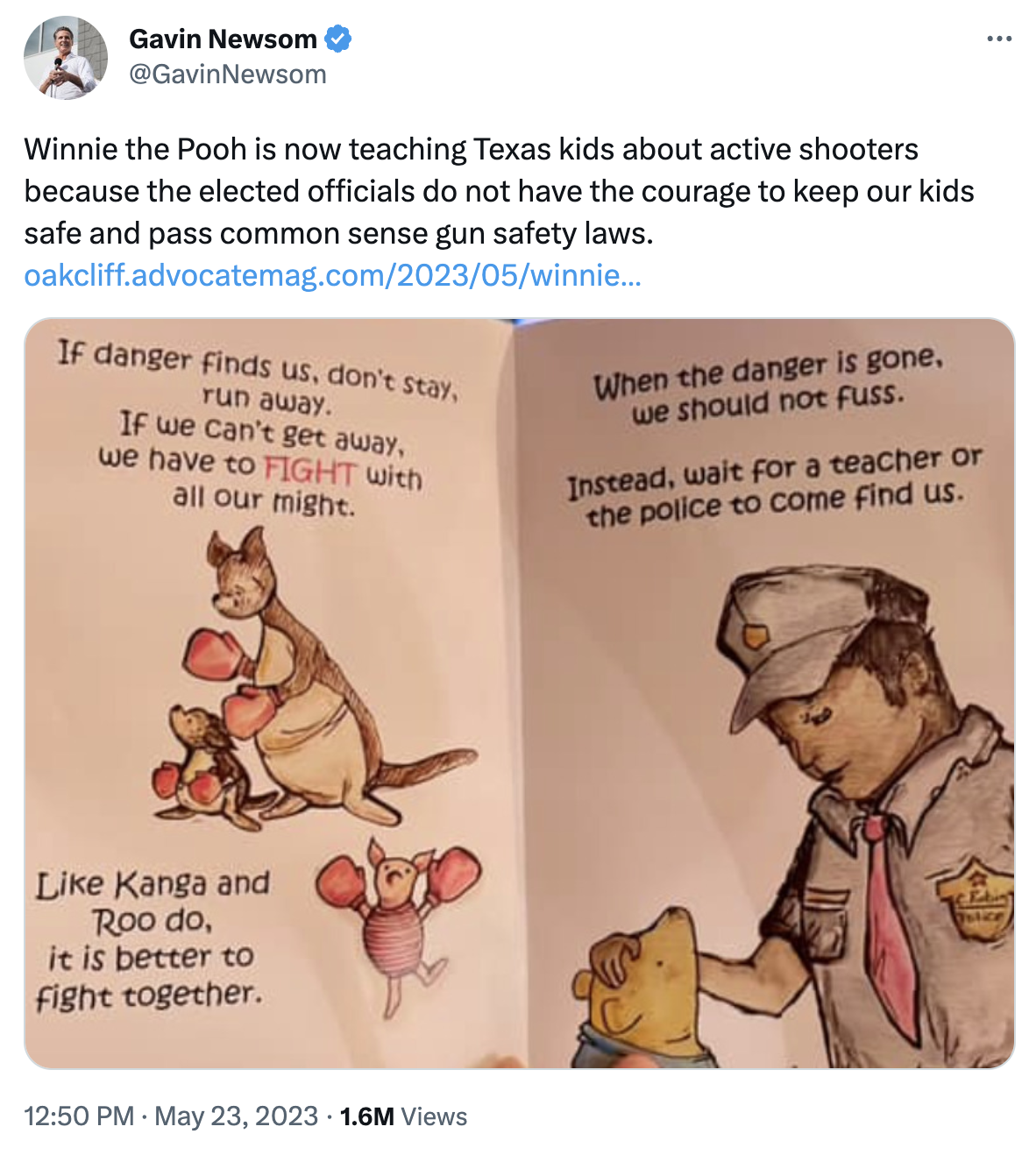
California Governor Gavin Newsom has been blasting away at knuckle-headed Republican governors like Ron DeSantis and Greg Abbott for their cruel indifference to other people. He’s already suggested he may sue DeSantis for kidnapping, after Florida sent two private planes with Venezuelan immigrants to Sacramento. Now, he’s going after Abbott for his refusal to take action against gun violence.

He wrote:

Texas… where elected officials are relying on Winnie the Pooh to teach their kids about active shooters because they don’t have the courage to keep our kids safe.

Tweet from Gavin Newsom: 'Winnie the Pooh is now teaching Texas kids about active shooters because the elected officials do not have the courage to keep our kids safe and pass common sense gun safety laws.'

Texas… where Greg Abbott signed a law to send DNA kits to parents of school children so their bodies can be identified after a shooting.

Tweet from Gavin Newsom: 'Greg Abbott’s solution to gun violence? Send DNA kits to schools so parents can identify their kids’ bodies AFTER they’ve been shot and killed.'

Guns are the leading cause of death for kids in America. Kids!

We’re not talking about accidents, or cancer or something unpreventable. We know the steps to take to save our kids lives. But leaders like Greg Abbott lack the courage to act.

Until then… It’s Winnie the Pooh for Texas families.

Gavin Newsom

J.B. Pritzker, Governor of Illinois, gave a terrific commencement address at Northwestern University, with a fabulous explanation about how to spot an idiot. He says that idiots are not necessarily stupid. They may be your boss. They may even be elected President.

If you want to see the 20+ minute speech, it’s here.

If you want to see the part where Pritzker explains idiots, state at about 7:50 into the speech.

If you are on Twitter, see it here:

Summary:

“Whenever I’m about to do something, I think ‘Would an idiot do that?’ and if they would, I do not do that thing.” – Dwight Schrute

And what is the best way to spot an idiot? Look for the person who is cruel.