Archives for category: Courage

Timothy Snyder is a professor of history at Yale University, who has written many books about European history. His book “On Tyranny” was a bestseller. He writes a blog at Substack called “Thinking About…”

Snyder writes:

Americans have a certain idea of freedom. We are fine just the way we are and the only problem are the barriers in the outside world. In this mental world, Musk’s hollowing out of the government can seem justified. Trump’s betrayal of friends and destruction of alliances can seem convenient. We will be great again by being all alone, with no one to trouble us.

This fantasy leads right to tragedy. It sets the stage for the weak strongman.

Trump is a strongman in the sense that he makes others weak. He is strong in a relative sense; as Musk destroys institutions, what remains is Trump’s presence. But other sorts of power meaning vanish, as Musk takes apart the departments of the American government that deal with money, weapons, and intelligence. And then the United States has no actual tools to deal with the rest of the world.

The strongman is weak because no one beyond the United States has anything to want (or fear) from the self-immolation. And weak because Trump submits to foreign aggression, putting waning American power behind Russia.

The weak strongman undermines the rules, but cannot replace them with anything else. He creates the image of power by his rhetorical imperialism: America will control Greenland, Panama, Mexico, Canada, Gaza, etc. From there, it is hard to say that others are wrong when they invade other countries. The weak strongman is left endorsing other people’s invasions, as with Russia and Ukraine. He lacks the power to resist them. And he lacks the power to coerce them. And, ironically, he lacks the power to carry out wars himself. He lacks the patience, and he lacks the instruments.

Many Americans fear Trump, and so imagine that others must. No one beyond America fears Trump as such. He can generate fear only in his capacity as neighborhood arsonist, as someone who destroys what others have created.

America’s friends are afraid not of him but of what we all have to lose. America’s enemies are not frightened when Trump kicks over the lantern and sets things on fire. Quite the contrary: he is doing exactly what they want.

Trump plays a strongman on television, and he is a talented performer. But the strength consists solely of the submissiveness of his audience. His performance arouses a dream of passivity: Trump will fix it, Trump will get rid of our problems, and then we will be free. And of course that kind of Nosferatu charisma is a kind of strength, but not one that can be brought to bear to solve any problems, and not one that matters in the world at large. Or rather: it matters only negatively. As soon as Trump meets someone with a better dictator act, like Putin, he submits. But he can only enable Putin. He can’t really even imitate him.

Trump’s supporters might think that we don’t need friendships because the United States can, if necessary, intimidate its enemies without help.

This has already been proven wrong. Trump can make things worse for Canada and Mexico, in the sense that a sobbing boy taking his ball home makes things worse. But he cannot make them back down. Trump has not intimidated Russia. He has been intimidated by Russia.

The cruelty that makes Trump a strongman at home arose from the destruction of norms of civil behavior and democratic practice. Unlike any other American politician before him, Trump has scorned the law and used hate speech to deter political opponents here. For years he has used his tweets to inspire stochastic violence. This intimidates some Americans. It has, for example, led to a kind of self-purge of the Republican Party, opening the way for Trump, or in fact for Musk, to rule with the help of tamed and therefore predictable cadres. The effect of this is that people who have submitted to Trump see him as a strongman. But what they are experiencing is in fact their own weakness. And their own weakness cannot magically become strength in the wider world. Quite the contrary.

Stochastic violence cannot be applied to foreign leaders. Trump has said that he can stop the war in Ukraine. He wrote a tweet directed at Vladimir Putin; but the capital letters and exclamation points did not change the emotional state of the Russian leader, let alone Russian policy. And no one in Irkutsk is going to threaten or hurt Putin because Donald Trump wrote something on the internet. Something that works in the United States is not relevant abroad. In fact, the tweet was a sign of weakness, since it was not followed by any policy. Putin quite rightly saw it as such.

Trump and his cabinet now repeat Putin’s talking points about the Russian invasion of Ukraine.
One could generously interpret Trump’s tweet to Putin threatening sanctions and such as an act of policy. I saw conservatives do that, and I would have been delighted had they been right. But I fear that this was just the characteristic American mistake of imagining that, because Americans react submissively to Trump’s words, others must as well. For words to matter, there has to be policy, or at least the possibility that one might be formulated. And for there to be policy, there have to be institutions staffed with competent people. And Trump’s main action so far, or really Musk’s action so far, has been to fire exactly the people who would be competent to design and implement policy. Many of the people who knew anything about Ukraine and Russia are gone from the federal government.

And now Trump is trying to make concessions to Russia regarding issues directly related to Ukrainian sovereignty on his own, without Ukraine, and indeed without any allies. He is showing weakness on a level unprecedented in modern US history. His position is so weak that it is unlikely to convince anyone. Trump is a sheep in wolf’s clothing. The wolves can tell the difference. Russians will naturally think that they can get still more.

Ukrainians, for that matter, have little incentive to give up their country. Trump can threaten them with cutting US arms, because stopping things is the only power he has. But Ukrainians must now expect that he would do that anyway, given his general subservience to Putin. If the US does stop support for Ukraine, it no longer has influence in how Ukraine conducts the war. I have the feeling that no one in the Trump administration has thought of that.

It is quite clear how American power could be used to bring the war to an end: make Russia weaker, and Ukraine stronger. Putin will end the war when it seems that the future is threatening rather than welcoming. And Ukraine has no choice but to fight so long as Russia invades. This is all incredibly simple. But it looks like Trump is acting precisely as is necessary to prolong the war and make it worse.

Thus far he and Hegseth have simply gone public with their agreement with elements of Russia’s position. Since this is their opening gambit, Russia has every incentive to keep fighting and to see if they can get more. The way things are going, Trump will be responsible for the continuing and escalation of the bloodshed, quite possibly into a European or open global conflict. He won’t get any prizes for creating the conditions for a third world war.

It’s an obvious point, but it has to be made clearly: no one in Moscow thinks that Trump is strong. He is doing exactly what Russia would want: he is repeating Russian talking points, he is acting essentially as a Russian diplomat, and he is destroying the instruments of American power, from institutions through reputation. No American president can shift an international power position without policy instruments. And these depend on functioning institutions and competent civil servants. In theory, the United States could indeed change the power position by decisively helping Ukraine and decisively weakening Russia. But that theory only becomes practice through policy. And it is not hard to see that Musk-Trump cannot make policy.

Even should he wish to, Trump can not credibly threaten Russia and other rivals while Musk disassembles the federal government. Intimidation in foreign affairs depends upon the realistic prospect of a policy, and policy depends, precisely, on a functioning state.

Let us take one policy instrument that Trump mentioned in his tweet about Putin: sanctions. Under Biden, we had too few people in the Department of the Treasury working on sanctions. That is one reason they have not worked as well against Russia as one might have hoped. To make sanctions work, we would need more people on the job, not fewer. And of course we would also need foreign powers to believe that Treasury was not just an American billionaire’s plaything. And that will be hard, because their intelligence agencies read the newspapers.

The United States cannot deal with adversaries without qualified civil servants in the departments of government that deal with money, weapons, and intelligence. All of these are being gutted and/or run by people who lack anything vaguely resembling competence.

Americans can choose to ignore this, or to interpret it only in our own domestic political terms. But it is obvious to anyone with any distance on the situation that the destruction of the institutions of power means weakness. And it creates a very simple incentive structure. The Russians were hoping that Trump would return to power precisely because they believe that he weakens the United States. Now, as they watch him (or Musk) disassemble the CIA and FBI, and appoint Tulsi Gabbard and Kash Patel, they can only think that time is on their side.

The Russians might or might not, as it pleases them, entertain Trump’s idea of ceasefire between Ukraine and Russia. Even if they accept the ceasefire it will be to prepare for the next invasion, in the full confidence that a United States neutered by Musk-Trump will not be able to react, that the Europeans will be distracted, and that the Ukrainians will find it harder to mobilize a second time.

Trump is not only destroying things, he is being used as an instrument to destroy things: in this case, used by Russia to destroy a successful wartime coalition that contained the Russian invasion and prevented a larger war.

What is true for Russia also holds for China. The weak strongman helps Beijing. Time was not really on China’s side, not before Trump. There was no reason to think that China would surpass the United States economically, and therefore politically and militarily. That had been the great fear for decades, but by the time of the Biden administration the trend lines were no longer so clear, or indeed had reversed. But now that Trump (or rather Musk) has set a course for the self-destruction of American state power, Beijing can simply take what it would once have had to struggle to gain, or would have had to resign from taking.

A weak strongman brings only losses without gains. And so the descent begins. Destroying norms and institutions at home only makes Trump (or rather Musk) strong in the sense of making everyone else weak. In our growing weakness, we might be all tempted by the idea that our strong man at least makes us a titan among nations.

But the opposite is true. The world cannot be dismissed by the weak strongman. As a strongman, he destroys the norms, laws, and alliances that held back war. As a weakling, he invites it.
It’s Black History Month. Ignore the fact that this annual tribute to the achievements and culture of African-Americans has been stripped of recognition by the federal government since the inauguration of the worst President in our history. Trump thinks that the nation was greatest when it was ruled by straight white men, and everyone else was submissive. I don’t work for him, so here is a tribute to two pioneering Black women. It was posted by CBS News, which is also not covered by Trump’s racist war on diversity, equity, and inclusion.

NEW YORK –  A peaceful playground in Williamsburg bears the name of Sarah J. S. Tompkins Garnet. Two miles away in DUMBO is a park named after Susan Smith McKinney Steward. These are not the only places that bear their names — a school in Fort Greene and another in Prospect Heights are also named after them. 

Dr. McKinney Steward specialized in childhood disease, co-founded a hospital and, later in life, ventured out West with her second husband, Theophilus Gould Steward, a U.S. Army Buffalo Soldier of the first all-Black Army regiment. 

Her great-granddaughter is the late actress Ellen Holly, America’s first Black soap opera star who died in 2023. 

“Its very special when someone recognizes your work,” Holly said in a 2004 interview recognizing her contribution to the history of TV.

Both sisters were also involved in the Women’s Suffrage movement and helped create the Equal Suffrage League, which worked to abolish race and gender discrimination in the late 1880s.

“Once abolition was achieved, a lot of those allies kind of went away. And you had women standing there asking, ‘well, what about us? ‘So women like Sarah and Susan took it upon themselves to take up the mantle for Women’s Suffrage,” Robbins explains.

Among the idyllic hills of Brooklyn’s historic Green-wood Cemetery are two graves, steps away from each other — the resting places of both sisters who desired to educate and heal their community. 

Yes, Virginia, there are men and women of integrity who defend the rule of law. Yesterday, it was Danielle Sassoon, the acting U.S. Attorney for the Southern district of New York. She resigned rather than drop the case against NYC Mayor Eric Adams. Her devotion to the rule of law was greater than her allegiance to Trump, who appointed her only a month ago. Her resignation was followed by several resignations in the Public Integrity Division of the U.S. Department of Justice.

The New York Daily News today reported another principled resignation by a federal prosecutor.

One of the lead prosecutors handling the sweeping public corruption case against Mayor Adams resigned on Friday — in a searing letter to President Trump’s Department of Justice saying he wouldn’t be the “fool” who files a motion to dismiss the case based on support for the administration’s immigration objectives and not the law.

Assistant U.S. Attorney Hagan Scotten, a highly regarded prosecutor in the Southern District of New York and decorated U.S. Army veteran who served in Iraq, in his resignation letter to Trump’s acting No. 2 at the DOJ Emil Bove, said he was “entirely in agreement” with the former acting U.S. Attorney Danielle Sassoon, who resigned Thursday.

Sassoon said she could not sign off on the request to drop the charges against Adams that stemmed from what’s effectively a “quid pro quo” between the mayor and the president that included the DOJ dropping the charges in exchange for Adams getting in line with the president’s immigration policies in the nation’s largest sanctuary city.

In the letter, which was first reported by The New York Times, Scotten — who has clerked for Supreme Court Justice John Roberts and Justice Brett Kavanaugh — said some may view Bove’s “mistake” in light of their negative views of the Trump administration, which he said he did not share.

“I can even understand how a Chief Executive whose background is in business and politics might see the contemplated dismissal-with-leverage as a good, if distasteful, deal. But any assistant U.S. attorney would know that our laws and traditions do not allow using the prosecutorial power to influence other citizens, much less elected officials, in this way,” Scotten wrote.

“If no lawyer within earshot of the President is willing to give him that advice, then I expect you will eventually find someone who is enough of a fool, or enough of a coward, to file your motion. But it was never going to be me…

Scotten’s blistering resignation letter came the morning after what many have already dubbed the “Thursday night massacre” at the DOJ, echoing President Nixon’s infamous 1973 DOJ purge

He marks the seventh DOJ staffer to resign after Trump’s former criminal defense lawyer, managing the daily functioning of the federal government’s law enforcement arm in an interim capacity, ordered the dismissal of the bombshell case against Adams set to go on trial in April.

Following the mass resignations, Reuters reported Friday that Bove had threatened to fire every member of the DOJ’s public integrity section — where the case was transferred following Sassoon’s resignation — unless someone volunteered to file the dismissal motion in Manhattan federal court, where Judge Dale Ho must approve it. According to the report, Bove gave them an hour to decide, and one ultimately stepped up.

The FBI is supposed to be a nonpolitical agency, although every FBI director chosen by every president was a Republican.

Over the past four years, the FBI was assigned the job of identifying and arresting those who planned and participated in the January 6, 2021, invasion of the U.S. Capitol. The mob was incited by Trump; its goal was to stop the certification of the 2020 election. The insurrection was an attempt to overthrow the Constitution and give Trump a position he lost in the 2020 elections.

The investigation of the January 6 insurrection was the largest in the history of the FBI.

Now Trump’s minions are asking FBI agents whether they were part on the investigation of January 6 or part of the investigation of Trump’s theft of classified documents.

Those who were will be fired because they can’t be trusted to faithfully execute Trump’s agenda.

Understand that the FBI agents who worked in these investigations were carrying out their duties. Understand that in no sane world is it right to send an angry mob to ransack the U.S. Capitol and to disrupt Congress in performing its prescribed duties.

Trump wants to rewrite history. He wants to make it official that the prosecution of the January 6 mob should never have happened. It was, he says, “a day of love.” The mob that beat up and bludgeoned police officers defending the Capitol and members of Congress were “patriots.”

Historians will ignore his lies. The criminal actions of Trump’s mob are well documented.

How can the FBI save itself from a mass purge?

Simple. Every single member of the FBI should sign a statement saying that they were part of the January 6 investigation. Every. Single. Member.

This is a true statement because who investigated the largest single attack in the Capitol were chosen at random. They were not there as volunteers or Trump-haters. They were there because FBI agents take their assignments seriously and execute them with fidelity.

To defend the FBI, sign your name. They can’t fire everyone. That might even offend the sombolent Republicans in Congress. Most were there on January 6. No matter what they say now, they know that their lives were in danger then. Will they sit by silently and let Trump eliminate the entire FBI? Not likely.

Their Trump obeisance must have limits.

Stand together. Sign your name.

CNN doesn’t want to make Trump angry.

Trump doesn’t like Jim Acosta.

CNN moved him to a late-night slot, where fewer viewers would see him.

Jim Acosta resigned. He is now on Substack.

This was his final message on CNN:

I just wanted to end today’s show by thanking all of the wonderful people who work behind the scenes at this network.
You may have seen some reports about me and the show, and after giving all of this some careful consideration and weighing in alternative timeslots CNN offered me, I’ve decided to move on. I am grateful to CNN for the nearly 18 years I’ve spent here doing the news.
People often ask me if the highlight of my career at CNN was at the White House covering Donald Trump.
Actually, no. That moment came here when I covered former President Barack Obama’s trip to Cuba in 2016 and had the chance to question the dictator there, Raul Castro, about the island’s political prisoners.
As the son of a Cuban refugee, I took home this lesson: It is never a good time to bow down to a tyrant.
I have always believed it’s the job of the press to hold power to account. I’ve always tried to do that here at CNN, and I plan on doing all of that in the future.
One final message. Don’t give in to the lies. Don’t give in to the fear. Hold on to the truth and to hope.
Even if you have to get out your phone, record that message. I will not give in to the lies. “I will not give in to the fear!”
Post it on your social media so people can hear from you, too.
I’ll have more to say about my plans in the coming days. But until then, I want to thank all of you for tuning in. It has been an honor to be welcomed into your home for all these years.
That’s the news. Reporting from Washington. I’m Jim Acosta.

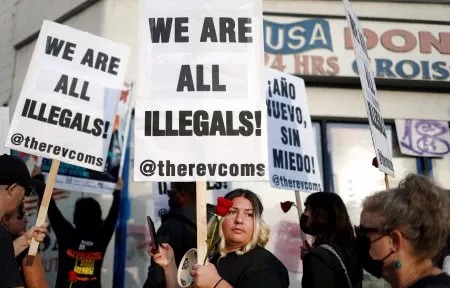
Newsweek reports that school officials and students in Bridgeport are planning to stand up for their fellow students who are immigrants. Meanwhile, the students are protesting in the best way possible, holding posters that say: “WE ARE ALL ILLEGALS.” The kids are alright.

A school district in Connecticut is defying President Donald Trump‘s order to allow Immigration and Customs Enforcement (ICE) agents to go to sensitive locations.

Bridgeport Public Schools announced on Tuesday guidelines designed to protect students in the event of an attempted raid by ICE agents at any of its schools.

Newsweek has contacted the White House via email for comment outside of normal office hours.

Why It Matters

Trump has begun implementing sweeping immigration reforms and is preparing to target millions of undocumented immigrants. The school district’s stance signals the emergence of grassroots opposition to the administration’s plans to initiate the largest mass deportation operation in U.S. history.

What To Know

Bridgeport Public Schools’ announcement came after the acting director of the Department of Homeland Security (DHS) issued a directive on January 21 ending the policy that ICE agents would not conduct actions in or near “sensitive” areas, such as churches, hospitals or schools.

Interim school superintendent Dr. Royce Avery reaffirmed that the school district’s immigration enforcement guidelines remain in place. Avery said that ICE agents and other government officials are prohibited from entering school buildings, boarding buses or attending school events without prior written approval from the superintendent.

“Every student in Bridgeport, regardless of their immigration status, has the right to feel secure and supported in our schools,” he said.

Avery did not say if any ICE raids were planned in Bridgeport. He added that Bridgeport Public Schools does not collect or store information about students’ immigration status, ensuring their privacy is protected….

What People Are Saying

Interim school superintendent Dr. Royce Avery said in a press release: “I became an educator to advocate for all students, and I will ensure their rights and privacy are upheld. Our schools will remain a safe space where all students can learn, grow, and succeed without fear or discrimination.”

Acting Secretary of Homeland Security Benjamine Huffman said in a statement: “This action empowers the brave men and women in CBP [Customs and Border Protection] and ICE to enforce our immigration laws and catch criminal aliens—including murders and rapists—who have illegally come into our country. Criminals will no longer be able to hide in America’s schools and churches to avoid arrest. The Trump Administration will not tie the hands of our brave law enforcement and instead trusts them to use common sense.”

Janet Murguía, president and CEO of Latino civil rights and advocacy organization UnidosUS, told Newsweek: “Many of the president’s proposed executive orders, however, are strictly punitive measures such as changing enforcement targets to include schools, churches and hospitals, and are designed to inflict pain on the most vulnerable—families, children and even the sick and injured.”

Imagine this: The Episcopal Bishop of Washington, D.C. spoke directly to Trump and his family at the National Prayer Service and called on him to be more like Jesus. Trump found this admonition very insulting and called on her to apologize. Maybe he will sign an executive order commanding her apology.

He will have to find a different church, one where hatred, vengeance, and cruelty are celebrated.

This is a corker of a post. It was written by Evan Hurst at Wonkette.

Donald Trump had a bad, failed day yesterday, which is too bad for him because you never get back the second day of your second term in office. Poof, gone. Only 1459 to go! Will they be failures too? Probably.

There was a prayer service at the National Cathedral on Tuesday, and Trump and Melania attended (this time not dressed as the Babadook), along with JD and Usha Vance and members of the Trump crime family and all kinds of others. And one of America’s greatest heroes, Mariann Edgar Budde, the Episcopalian bishop for Washington DC, decided to speak truth to power, softly and carrying a big stick, and that stick was J-E-S-U-S. 

(That’s right, go with it, Jesus was a stick. “Go find the Lord!” you could say if you threw it for your dog. “Where did he go? Go get him!”)

Silliness aside, what Budde did was use her homily to ask this man, this vile, foul man, this Stupid Hitler of a man, this 34-times-convicted felon of a man, this pathetic grievance monkey child of a man, this amoral clown, to have mercy on the vulnerable. 

You know, like Jesus would.

Here is some video:


Mediaite provides this long block quote:

Let me make one final plea. Mr. President. Millions have put their trust in you and as you told the nation yesterday, you have felt the providential hand of a loving God. In the name of our God, I ask you to have mercy upon the people in our country who are scared now. There are gay, lesbian and transgender children in Democratic, Republican and independent families, some who fear for their lives. And the people, the people who pick our crops and clean our office buildings, who labor in poultry farms and meatpacking plants, who wash the dishes after we eat in restaurants and work the night shifts in hospitals. They, they may not be citizens or have the proper documentation, but the vast majority of immigrants are not criminals. They pay taxes and are good neighbors. They are faithful members of our churches and mosques, synagogue, wadara and temples. I ask you to have mercy, Mr. President, on those in our communities whose children fear that their parents will be taken away and that you help those who are fleeing war zones and persecution in their own lands to find compassion and welcome here. Our god teaches us that we are to be merciful to the stranger. For we were all once strangers in this land. May God grant us the strength and courage to honor the dignity of every human being, to speak the truth to one another in love and walk humbly with each other and our God, for the good of all people, good of all people in this nation and the world. Amen.

Oh man, she really stepped in it, didn’t she? She showed Jesus to those Nazis and asked them to have mercy on people who are scared. 

Nazis hate it when you show them Jesus. 

Trump is DEMANDING an apology. Can you believe the nerve of that insolent woke bitch bishop exhorting him to love his neighbor? 

The so-called Bishop who spoke at the National Prayer Service on Tuesday morning was a Radical Left hard line Trump hater. She brought her church into the World of politics in a very ungracious way. She was nasty in tone, and not compelling or smart. She failed to mention the large number of illegal migrants that came into our Country and killed people. Many were deposited from jails and mental institutions. It is a giant crime wave that is taking place in the USA. Apart from her inappropriate statements, the service was a very boring and uninspiring one. She is not very good at her job! She and her church owe the public an apology! t

“Nasty in tone, and not compelling or smart.” “A very boring and uninspiring” service! Yeah, we bet there were some tiny-handed little tyrants in first-century Nazareth who sounded like that too. Wonder what they were convicted of 34 times….

In response, Sean Hannity had this little tantrum about it last night:

“Despite a landslide victory in the fall for Donald Trump, the left is still vowing to resist the president with the same level of drama, hysteria that we’ve all come to expect. This morning, a so-called bishop politicizing an inaugural prayer service. Instead of offering a benediction for our country, for our president, she goes on the far-left, woke tirade in front of Donald Trump and JD Vance, their families, their young children. She made the service about her very own deranged political beliefs with a disgraceful prayer full of fearmongering and division.”

Oh no, won’t somebody think of JD Vance’s children, hearing stories about Jesus, and probably being like “Wow, that sure doesn’t sound like my dad!” 

Also bless Hannity’s heart, jerking himself and his president off by calling it a “landslide.” We all know the truth. (Almost nobody watched the inauguration by the way, 27 percent fewer than Joe Biden’s.)

You can hear the sermon here.

I am always grateful to read Heather Cox Richardon’s voice of reason, putting events into perspective, tying together past and present.

In this post, she reflects on the heroes among us.

You hear sometimes, now that we know the sordid details of the lives of some of our leading figures, that America has no heroes left.

When I was writing a book about the Wounded Knee Massacre, where heroism was pretty thin on the ground, I gave that a lot of thought. And I came to believe that heroism is neither being perfect, nor doing something spectacular. In fact, it’s just the opposite: it’s regular, flawed human beings choosing to put others before themselves, even at great cost, even if no one will ever know, even as they realize the walls might be closing in around them.

It means sitting down the night before D-Day and writing a letter praising the troops and taking all the blame for the next day’s failure upon yourself in case things went wrong, as General Dwight D. Eisenhower did.

It means writing in your diary that you “still believe that people are really good at heart,” even while you are hiding in an attic from the men who are soon going to kill you, as Anne Frank did.

It means signing your name to the bottom of the Declaration of Independence in bold print, even though you know you are signing your own death warrant should the British capture you, as John Hancock did.

It means defending your people’s right to practice a religion you don’t share, even though you know you are becoming a dangerously visible target, as Sitting Bull did.

Sometimes it just means sitting down, even when you are told to stand up, as Rosa Parks did.

None of those people woke up one morning and said to themselves that they were about to do something heroic. It’s just that when they had to, they did what was right.

On April 3, 1968, the night before the Reverend Doctor Martin Luther King Jr. was assassinated by a white supremacist, he gave a speech in support of sanitation workers in Memphis, Tennessee. Since 1966, King had tried to broaden the Civil Rights Movement for racial equality into a larger movement for economic justice. He joined the sanitation workers in Memphis, who were on strike after years of bad pay and such dangerous conditions that two men had been crushed to death in garbage compactors.

After his friend Ralph Abernathy introduced him to the crowd, King had something to say about heroes: “As I listened to Ralph Abernathy and his eloquent and generous introduction and then thought about myself, I wondered who he was talking about.”

Dr. King told the audience that if God had let him choose any era in which to live, he would have chosen the one in which he had landed. “Now, that’s a strange statement to make,” King went on, “because the world is all messed up. The nation is sick. Trouble is in the land; confusion all around…. But I know, somehow, that only when it is dark enough, can you see the stars.” Dr. King said that he felt blessed to live in an era when people had finally woken up and were working together for freedom and economic justice.

He knew he was in danger as he worked for a racially and economically just America. “I don’t know what will happen now. We’ve got some difficult days ahead. But it doesn’t matter…because I’ve been to the mountaintop…. Like anybody, I would like to live a long life…. But I’m not concerned about that now. I just want to do God’s will. And He’s allowed me to go up to the mountain. And I’ve looked over. And I’ve seen the promised land. I may not get there with you. But I want you to know tonight, that we, as a people, will get to the promised land!”

People are wrong to say that we have no heroes left.

Just as they have always been, they are all around us, choosing to do the right thing, no matter what.

Wishing you all a day of peace for Martin Luther King Jr. Day 2025.

Greg Olear is simply amazing. Read the post here and perhaps you will agree. He is wise, smart, learned, insightful, and inspiring. I know of no other writer who weaves together politics, literature, and history as seamlessly as Olear. He writes at Substack and charges no fee.

Dear Reader,

The great British historian Eric Hobsbawm wrote an indispensable series of books in which he divides the 20 decades after the French Revolution into historical “ages.” The period from the 1789 storming of the Bastille to the uprisings sweeping across Europe in 1848 he termed the Age of Revolution. Eighteen forty-eight until the end of the Great Boom circa 1875 is the Age of Capital. The Age of Empire spanned from the mid-1870s until the start of the Great War in 1914. And the “short twentieth century,” a term he coined, was dubbed the Age of Extremes, and ran from the assassination of the archduke until 1991.

Ever since I discovered his books in 2012, the year of his death, I’ve often wondered what Hobsbawm would have called the fifth historical “age”—the one that began in 1991. That was the year of the first Gulf War, and the banishment from Saudi Arabia of Osama bin Laden that kickstarted his Al Qaeda movement; the mysterious death of Robert Maxwell—friend to the British royal family, mentor to Jeffrey Epstein, business partner of the Russian mobster Semion Mogilevich, and Israeli spy—who fell off his yacht off the coast of the Canary Islands; the repeal of the apartheid laws in South Africa, where Errol Musk made his fortune; the rollout of the WorldWideWeb; and the breakup of the Soviet Union—on Christmas, no less, capitalism’s holiest of holy days.

Today, a mere 24 hours and change before we hand the federal government off to a hateful confederacy of Nazis, mobsters, Opus Dei weirdos, white Christian nationalists, and billionaire dorks, I think I know not only the name of the period after the Age of Extremes, but also its termination date. As I type this, we are living in the last few hours of the Age of Unreality. It ends tomorrow at noon.

Something else happened in 1991, you see—something that likely eluded Eric Hobsbawm. Producers at MTV were developing a TV show that would begin filming in February of 1992. It was called The Real World: New York. It was the first reality TV show—or, at least, the seminal reality TV show of the subsequent reality TV explosion. Riding the reality TV wave was a British producer named Mark Burnett, who would give us Survivor in 2000, and, four years later, what wound up being the most historically significant reality TV show of all time, The Apprentice.

Although I confess to having enjoyed a few seasons of The Surreal Life, back when our eldest son was a baby—Flavor Flav does not disappoint!—I have never liked reality TV shows, encouraging, as they often do, the very worst of human behavior. I don’t like meanness. I don’t like ruthlessness. I don’t like watching anyone being voted off the island. I don’t like when people are fired. I don’t like talentless humans. I don’t like Kardashians. Most of all, I don’t like the unscripted-but-very-much-scripted fluff that has replaced actual shows written by actual writers. By encouraging us to believe in a heavily-retouched fictional universe presented as the real world—or, I suppose, The Real World—reality TV has left us more susceptible to Russian disinformation, to deep fakes, to conspiracy theories, to manufactured media narratives, to tech-bro charlatans, to pseudo-scientific arguments against vaccines, and to mendacious politicians who have supercharged lying to a form of warfare.

I have often grumbled, half in jest, that reality TV would bring about the end of Western civilization. I did not think it would also bring about the end of Western democracy. To paraphrase Don DeLillo: Reality TV has given us Joe Rogan; that alone warrants its doom.

(Is this the real life? Is this just fantasy? Freddie Mercury died in—when else?—1991.)


One of the most significant, world-altering events in this Age of Unreality was, of course, 9/11. In response to the WTC attacks, the FBI shifted its focus from transnational organized crime, which was already operating in the United States and growing more powerful by the day—a genuine threat to our society—to Islamic extremist terrorism, which involved not very many crazy people mostly living in caves far, far away from New York. In response to 9/11, we have to subject ourselves to TSA search before boarding an airplane. In response to 9/11, Bush and Cheney launched a long and expensive war on Saddam Hussein, who had nothing whatsoever to do with the attacks, while simultaneously cutting taxes for their wealthy benefactors—two actions that, in tandem, starved the U.S. treasury and put the country so far into the red that it may never recover. In Britain, meanwhile, Tony Blair’s blind loyalty to Bush—a foreshadowing, perhaps, of Joe Biden’s blind loyalty to Bibi Netanyahu—paved the way for BREXIT and the series of hapless prime ministers that followed the disastrous decision to LEAVE.

Five days after 9/11, Anthony Lane, the New Yorker’s savagely witty film critic, published what remains one of the finest pieces of writing on the attacks, a short essay called “This Is Not a Movie.” I go back and revisit it every once in a while, when the mood strikes me. Reading it now, I see that Lane perfectly articulates the paradox of the Age of Unreality, the uneasy blur between fact and fiction, when he comments on “the degree to which people saw—literally saw, and are continuing to see, as it airs in unforgiving repeats—that day”—that is, September 11, 2001—“as a movie.” He notes that the elapsed time between the initial hijackings and the collapse of the north tower was “a little over two hours;” the length of a summer blockbuster disaster film.

Lane writes:

We are talking…of the indulgence that will always be extended to an epoch blessed with prosperity—one that has the leisure, and the cash, to indulge its fancies, not least the cheap thrill of pretending that the blessing could be wiped out. What happened on the morning of September 11th was that imaginations that had been schooled in the comedy of apocalypse were forced to reconsider the same evidence as tragic. It was hard to make the switch; the fireball of impact was so precisely as it should be, and the breaking waves of dust that barrelled down the avenues were so absurdly recognizable—we have tasted them so frequently in other forms, such as water, flame, and Godzilla’s foot—that only those close enough to breathe the foulness into their lungs could truly measure the darkening day for what it was.

There are echoes of this in the fires that have ravaged Los Angeles. Looking at those horrific images, it is impossible not to describe the fiery scenes as something from a movie—or, rather, a limited series, because, unlike with 9/11, the L.A. fires did not confine themselves to a movie-length running time. They began last Tuesday, almost two full weeks ago, and are still ongoing. If 9/11 was, as Lane suggests, a disaster film come to life, the fires are a combination of disaster film and horror movie: not just the fires themselves but the hundred-mile-an-hour winds and the dread of the fires spreading. Only those close enough to breathe the foulness into their lungs could truly measure the darkening days for what they are. My heart breaks for everyone in L.A., even as I know I can never fully understand their ordeal.

The fires are not a movie, just like 9/11 was not a movie. The fires are all too real.

As a country, we have not even begun to comprehend the extent of the damage, or its impact on all those hundreds of thousands if not millions of people in the Pacific Palisades and Altadena and beyond, much less the effect the fires will have nationally, culturally, societally—not least because the recovery will ultimately be overseen by an incoming administration not much known for its compassion, its competence, or its love for Hollywood.


The last paragraph of Lane’s essay is achingly, hauntingly beautiful. Many, many people wrote about 9/11 in the days that followed it, and it always struck me as both unlikely and somehow appropriate that a film critic would offer the purest take:

To be forced to disdain the ideal in favor of the actual is never a pleasant process. Even at its worst, however, it can deliver a bitter redemption. We gazed upward, or at our TV screens, and we couldn’t believe our eyes; but maybe our eyes had been lied to for long enough. Thousands died on September 11th, and they died for real; but thousands died together, and therefore something lived. The most important, if distressing, images to emerge from those hours are not of the raging towers, or of the vacuum where they once stood; it is the shots of people falling from the ledges, and, in particular, of two people jumping in tandem. It is impossible to tell, from the blur, what age or sex these two are, nor does that matter. What matters is the one thing we can see for sure: they are falling hand in hand. Think of Philip Larkin’s poem about the stone figures carved on an English tomb, and the “sharp tender shock” of noticing that they are holding hands. The final line of the poem has become a celebrated condolence, and last Tuesday—in uncounted ways, in final phone calls, in the joined hands of that couple, in circumstances that Hollywood should no longer try to match—it was proved true all over again, and, in so doing, it calmly conquered the loathing and rage in which the crime was conceived. “What will survive of us is love.”

Larkin, the poet who wrote that line—and who is, like Lane, British—was not at all a sentimental sort. His stuff is gloomy, sourpuss, almost defeatist. Throughout his poems we see a struggle between, on the one hand, recognizing the futility of life, and on the other, being paralyzed by the fear of death. It is his poem “This Be The Verse,” about how our parents “fuck us up,” that the pub owner quotes, somewhat incongruously, in Ted Lasso:

Man hands on misery to man.
It deepens like a coastal shelf.
Get out as early as you can,
And don’t have any kids yourself.

Sunny stuff, right? Larkin’s entire worldview is neatly encapsulated in this line from “Aubade,” a title that indicates this is a poem about the dawn:

And so it stays just on the edge of vision,
A small unfocused blur, a standing chill
That slows each impulse down to indecision.
Most things may never happen: this one will,
And realisation of it rages out
In furnace-fear when we are caught without
People or drink. Courage is no good:
It means not scaring others. Being brave
Lets no one off the grave.
Death is no different whined at than withstood.

The antecedent of the “it” in the first line is “death.” But we may just as well substitute “Trump,” and the lines work just as well: the standing chill, the furnace-fear and the rage, the necessity of other people and a good stiff drink, the futility of courage.

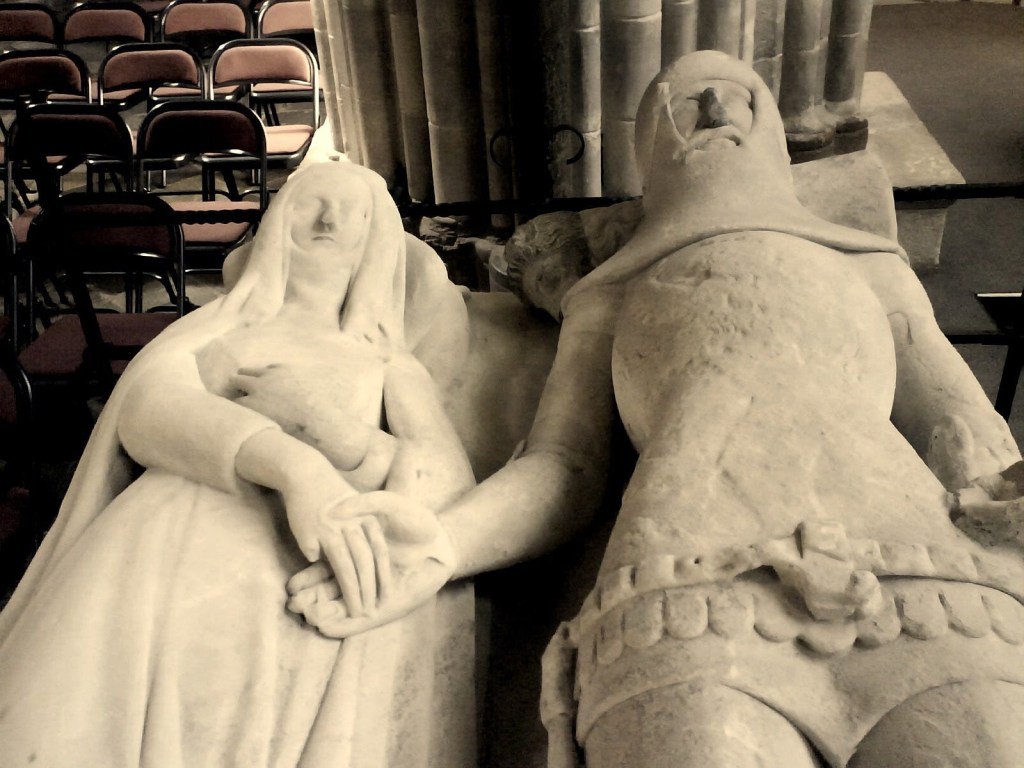
The poem that Lane quotes is called “An Arundel Tomb.” At Arundel, a medieval British town, is the tomb of Richard FitzAlan, the tenth Earl of Arundel, who died in 1371, and that of his second wife, Eleanor of Lancaster, who predeceased him by a few years. The tomb is capped by stone statues of the couple, who are, surprisingly, holding hands:

Side by side, their faces blurred,
The earl and countess lie in stone,

Larkin, a dour librarian and bemoaner of the decline of civilization who seems not to have believed in love (even as he juggled three women for most of his adult life), calls bullshit on this romantic display:

They would not think to lie so long.
Such faithfulness in effigy
Was just a detail friends would see:
A sculptor’s sweet commissioned grace

In other words, while the holding of stony hands has stood the test of time, the love it represents was probably a figment of the artist’s rosy imagination. (Note the double meaning of “lie.”)

How soon succeeding eyes begin
To look, not read. Rigidly they

Persisted, linked, through lengths and breadths
Of time. . .

Until,

Now, helpless in the hollow of
An unarmorial age. . .
Only an attitude remains:

Time has transfigured them into
Untruth. The stone fidelity
They hardly meant has come to be
Their final blazon, and to prove
Our almost-instinct almost true:
What will survive of us is love.

Larkin is saying that what the statues represent isn’t real—that our “almost-instinct” is to believe in the much-ballyhooed power of love, and that the “stone fidelity” of the earl and his wife is so compelling as to make said love-power “almost true.” Almost true is not true; almost true is AI true—a lie we want badly to believe in. The entire poem is him expressing his deep, nasty cynicism. The oft-quoted last line is intended to be ironic—a fitting epitaph for our Age of Unreality.

Even so, what survives of Larkin is “What will survive of us is love.” And I like to think, as Lane does, that, whatever the poet’s intention, the Arundel sentiment is real.


The Age of Unreality began in 1991, when all the ingredients of the historical cocktail were thrown into the shaker: the fall of the Soviet Union, the rise of the Russian mafia, the ascendance of Jeffrey Epstein, the dawn of reality TV, the end of apartheid, and the last time that a coalition of Western democracies repulsed an attempt by a despot to invade a sovereign nation—thus upholding the tenets of the Westphalian order. Out of that cocktail shaker, cold as ice, was poured Jeffrey Epstein and Semion Mogilevich, Elon Musk and Peter Thiel, Vladimir Putin and Donald Trump.

Tomorrow, that mindfuck age draws to a close, and a new one begins. What it has in store for us is anyone’s guess. Will the last barriers between fantasy and reality be worn away, or, as Lane poetically puts it, have our eyes been lied to for long enough? Will democracy really die, as the fascism scholars have been warning us for years, or will the Trump power-grab finally wake up the American people and restore our love of liberty? Will generative AI destroy all art, or will a new analog artistry emerge? What will happen to our beloved Hollywood, to which Trump has named meathead Sylvester Stallone, rightwing wacko Jon Voigt, and radical Catholic weirdo Mel Gibson his MAGA “ambassadors?”

I take some small solace in knowing that we’ve been here before. As Hobsbawm notes in The Age of Capital, the United States in the late nineteenth century—the America Trump wants us to return to—was marked by

the total absence of any kind of control over business dealings, however ruthless and crooked, and the really spectacular possibilities of corruption both national and local—especially in the post-Civil War years. There was indeed little that could be called government by European standards in the United States, and the scope for the powerful and unscrupulous rich was virtually unlimited. In fact, the phrase ‘robber baron’ should carry its accent on the second rather than the first word, for, as in a weak medieval kingdom, men could not look to the law but only to their own strength—and who were stronger in a capitalist society than the rich? The United States, alone among the bourgeois world, was a country of private justice and armed forces….

Our current crop of robber barons is orders of magnitude worse than its forebears—but maybe the abject awfulness of these despicable people will make their reigns shorter, their fall more humiliating, and their historical impact less profound.

Even so, for all my optimistic tendencies, I fear tomorrow as surely as Larkin feared death, which he describes as

The sure extinction that we travel to
And shall be lost in always. Not to be here,
Not to be anywhere,
And soon; nothing more terrible, nothing more true.

Death is permanent and absolute, but dictatorships are neither; moreover, Donald isn’t a dictator yet, and may well never be. Even as I have witnessed the poltroonish capitulation of our political leaders, our robber barons, our media figureheads, even our Snoop Doggs, I have faith that we will somehow find a better way, that we will repulse this ugly MAGA incursion, that the moral arc of the universe will bend towards justice, that the better angels of our nature will prevail. My faith will be tested, surely. But it will remain.

Nothing more true than this: What will survive of us is hope.

Share

Sherrilyn Ifill is a law professor who holds an endowed chair at Howard University. She is a former president and director-counsel of the NAACP Legal Defense Fund.

In this post, she offers sage advice about how to recharge your batteries and re-engage in the struggle for a better society. She wrote this piece soon after the 2024 election. It’s good advice.

….But ours is a subtle strength
Potent with centuries of yearning,

Of being kegged and shut away
In dark forgotten places.
We shall endure
To steal your senses
In that lonely twilight
Of your winter’s grief.


-Pauli Murray, To the Oppressors (1939)            

The truth is that things are going to get very bad. America has gone over the cliff’s edge. How hard we land in the ravine below remains to be seen. But we are one week in, and things are already quite dire. Trump’s first round of cabinet nominees, and his insistence that his picks be installed without a vote of Congress is a defining moment. It demonstrates that there will be no bottom with this Administration.

Donald Trump and his coterie of supporters are firmly in control of the most powerful and wealthy country in the world. And because they are in charge of this country – which perhaps undeservedly,  has stood as an example throughout much of the world as a symbol of freedom, equality, ethics, the rule of law and democracy – other countries will fall in our wake.

I am saying this now because I have always tried to be honest in my writings and analysis about this country. I say all of this because I have been able over the years to encourage my clients, my colleagues, my staff, my family and community to believe that we can fight and win. I have infected other people with my unshakeable optimism about what we can accomplish to transform this country.

I am going to keep fighting. It’s what I do. But I do not want to lead you astray. Because I do think that many of us – especially those of us in communities likely to be targeted by this Administration – need to see this moment as one in which we are focused on surviving this difficult time. I have faced the fact that we will not be able to move much forward in the next few years. In fact, I expect things to become so dire over the next two years, that we will scarcely recognize the country we live in. I expect that fear and cruelty will become part of our daily diet. We will hear the frightening sound of silence, as those who speak out most boldly against the excesses of the incoming administration, against its policies, against Musk and against Russia, find themselves at cross-purposes with a vindictive and cruel administration with almost unimaginable power to control communications, law, and the sense of reality itself.

Perhaps it won’t be that bad. But we are here in some measure, because far too many failed to imagine that the worst could happen. I have written already about “the nadir,” and I believe we must face it.

And so, our goal now must be first and foremost to survive this dark period with as much of our values, dignity, integrity, work, financial stability and physical and mental health intact as possible. We must also work to protect our families and communities, and to hold in place our most trusted and needed institutions, a modicum of the rule of law, our constitutional commitment to equality and to free expression.
As I have said in earlier pieces, this is “planting time.” Planting is work. That work must be aimed at building ideas, theories, paradigms, institutions, skills, practices, and alliances that we can seed now for a future harvest – a fulsome and lush democracy that will reflect the very best of us.

We are not “watching the Trump show” this time. We’ve seen it already. We can dip in every now and then, but we must not become paralyzed watching the train wreck. We will, of course, push back against injustice, and defend our rights and citizenship when necessary in the courts. We will demand that congressional representatives, our Governors and our Mayors, act to protect our democratic rights. Even when we know they will not stand up for what is right, we must not be silent. We must not make it easy for them to be cowards or to take our rights. We must still call, write and email our representatives and show up at town halls and meetings. Remember that those who have fought for us over these past years are tired too. Let them see us in these spaces and hear from us.

But our primary work must be first and foremost to work in our communities – both physical and ideological. To build them up and to share time and ideas with those committed to democracy and justice. We each need a curriculum of local service.

We also need a personal curriculum that will allow us to contribute to the building of the future we dream of for ourselves and our families. That means that our core work must be to commit during this time to do less watching, and more learning and more growing. We need to become better citizens for the democracy we want. That means we must dedicate time to expanding our thinking and our knowledge, and to building up our democratic imagination. That means our work is to imagine, to ally, to experiment, restore, befriend, study, read, write, serve, and create. Every one of us. Even as chaos swirls around us.

I encourage you to show your children and grandchildren real things – nature, animals, how things are built, how to cook from scratch. Teach them cursive writing, so that they have a signature all their own. Take them to live concerts and theater. Go on field trips. Infuse their lives with memories of things that are true and concrete.

If you teach, use primary documents in your teaching, take your students to historic sites, listen to audio of oral arguments and speeches so that they will feel confident in their understanding of history, and know that history was made by human beings not machines.

If you litigate, do it with the expectation that you will win. And act like it. Show out. Be excellent and remain confident. Those who can still feel shame – whether those at your opponents table or those on the bench – will feel it when you hold the standard high. And your clients will never forget it.

If you organize, never stop. Plant those seeds deep in our communities.

If you hold office. Hold it. Do not give up your power. Use your voice. Master every rule. Make a record. I repeat. Make a record–so that the truth might be known.

To protect ourselves and our loved ones, there are also pragmatic things we must do. I’ve thought of a few:

  • Save some cash. And keep enough in the house for gas and food for a week.
  • Let yourself imagine what you would do if you lost your job in terms of finding new employment, paying rent/mortgage for several months, and start building what you need to be able to meet that moment if it comes.
  • Get needed vaccinations in case new HHS policies result in changes or delays in their development or availability. Stock up on COVID tests, and get the most recent COVID booster. Purchase Plan B if it’s available in your area.
  • Think about tightening security on your electronic devices. Be more thoughtful about social media, and even return to making phone calls and writing letters in some instances. I know it’s old school, but actually memorize the phone numbers of at least two loved ones.
  • Gird yourself spiritually, through your faith or other meditative practices, as we are all likely to hear or confront many disturbing and ugly interactions. Experience art, go on walks, dance, play Spades, Dominoes, Scrabble. We need resilience.
  • Walk away when you need to walk away. Challenge when you need to. Try to always have back up.
  • Take the bystander training offered by groups https://righttobe.org/ so that when you see outrages committed against members of your community or against strangers, you will have practice in how you might intervene or respond.
  • Get an online subscription to a news service from another country so that you have a reliable sense of what’s going on in the world, and how this country is being perceived.  
  • Are your taxes paid, or more importantly, filed?
  • Is your passport up-to-date?
  • If you have money to give – then give to your local library, the food pantry, homelessness services. But also give to cultural institutions. Get a library card and a membership to a museum. Give to organizations working to hold back the worst that this administration may dish out – the NAACP Legal Defense Fund, the ACLU, the National Women’s Law Center, and so many others.
  • I am going to write more in this space. I hope you’ll subscribe and even pay a nominal fee to sustain the writing. I’m right here, going through this with all of you. And for me there is beauty in our shared walk. Let’s do this together.