Archives for category: Courage

Steve Schmidt is a veteran political strategist who worked for Republicans, most recently for John McCain in 2008. When Trump was elected, Schmidt was a co-founder of the anti-Trump Lincoln Project. In 2020, he registered as a Democrat. He currently writes a blog at Substack.

This one is brilliant. Pete Hegseth is the embodiment of the moral and spiritual and intellectual rot at the core of the Republican Party today.

Schmidt writes:

There is no “Secretary of War” or “War Department” in the United States of America under US law.

Each time a news organization uses Pete Hegseth’s concocted title, and submits to his “War Department” fantasy, it is an act of corruption.

It is a direct and specific choice that immolates journalistic ethics by embracing fantasy at the demand of power.

Journalism confronts power.

Journalism doesn’t obey it, heed it, submit to it, appease it, or accept the premise that make-believe is real if the leader believes it so, regardless of reality.

This was posted by a man in the chain of command for the release of nuclear weapons after the commission of a war crime on his orders, which was followed by evasions, deflections of responsibility, and an attempt to stab a US Navy admiral in the back:

[Diane’s note: This is juvenile and not funny.]

When General of the Army George Marshall, Chief of Staff of the US Army Secretary of State and Defense died, President Harry Truman said the following in remembrance of his titanic life. He made an unfortunate reference to the traitorous Robert E. Lee, who was exceeded in every way by Ulysses Grant, a man who bested him, yet was smeared into oblivion over 100 years time by the the same type of white nationalists and Christian Taliban who slither around Mar-a-Lago. That is, until one day, the truth escaped its dungeon and a foremost savior of the Union was seen clearly again.

[Truman said:]

General Marshall was an honorable man, a truthful man, a man of ability.

Honor has no modifying adjectives — a man has it, or he hasn’t. General Marshall had it.

Truth has no qualifying words to be attached to it. A man either tells the truth, or he doesn’t. General Marshall was the exemplification of the man of truth.

Ability can be qualified. Some of us have little of it, some may have moderate ability, and some men have it to the extreme.

General Marshall was a man of the greatest ability.

He was the greatest general since Robert E. Lee.

He was the greatest administrator since Thomas Jefferson.

He was the man of honor, the man of truth, the man of greatest ability.

He was the greatest of the great in our time.

I sincerely hope that when it comes my time to cross the great river that General Marshall will place me on his staff, so that I may try to do for him what he did for me.

*******************

Perhaps one reason that Pete Hegseth fetishizes the “War Department” is that, when it existed, it commanded a segregated force. The Defense Department has always commanded a desegregated force.

Before the US Army was desegregated a young Army Lieutenant named Jackie Robinson faced trumped up charges at a kangaroo court martial.
Here is Jackie Robinson’s legacy perfectly preserved for all time in the magnificent eulogy he received from Reverend Jesse Jackson, to whom I hope we can all send good wishes and prayers this holiday season, as he struggles through the ravages of the burdens handed him with dignity and grace: 

[Jackie Robinson’s eulogy by Reverend Jesse Jackson.]

Powerful men have a long tradition of sending powerless young men to die in unworthy causes in far away lands.

There should be an extremely low tolerance for such men in 2025 America, but they are not only tolerated, but indulged.  

The hypocrisy of the US Congress on the matter of Pete “Kill them all!” Hegseth is bottomless and dangerous. Their faithlessness to the American soldier, sailor, airmen and marine is obscene.

The man who jumped up on a table screaming, “Kill all Muslims!” was exactly who the Congress was warned about. Yet, the warnings were unheeded because the Congress cared more about pleasing Trump than the institutions of the US Army, Navy, and Marine Corps that predate the independence of the United States. They cared more about sating a stirred-up Fox News mob than a 19-year-old private.

Shameful doesn’t begin to describe it.

It is a dereliction of duty, and the most profound type of moral betrayal.

The 119th MAGA Congress is an abomination, led by a religious nutter and weakling who is neither bright, decent, funny, nor wise.

In other words, he is a perfect MAGA puppet who thinks he is a ventriloquist. In truth, the hand inserted into his most sacred space, the one he hides his bespectacled head within, is smeared with orange hand paint.

Faithless, treacherous and disloyal are the Hegseth ethos. They are a perfect mirror of the only reflection of equal rottenness in America: the crazed MAGA Congress, filled from bottom to top with corrupt loons, belligerent liars, sexual deviants, conspiracists, fraudsters, women beaters, and insider traders, who worship Trump together.

Pete Hegseth is the leader of a military that is unready and unprepared to fight a necessary war. He is a performance artist, a late-stage mid-tier Fox News star who is a herald of disaster to a population filled with indifference. It is about to find out the hard way how much damage a small group of evil men and women can do to a nation.

Yesterday, December 7, was the 84th anniversary of Pearl Harbor Day. President Franklin D. Roosevelt said it was a day that will live in infamy. After the passage of so much time, Heather Cox Richardson sees that Pearl Harbor shines a light on our current political morass.

She writes:

On the sunny Sunday morning of December 7, 1941, Messman Doris Miller had served breakfast aboard the USS West Virginia, stationed in Pearl Harbor, Hawaii, and was collecting laundry when the first of nine Japanese torpedoes hit the ship.

In the deadly confusion, Miller reported to an officer, who told him to help move the ship’s mortally wounded captain off the bridge. Unable to move him far, Miller pulled the captain to shelter. Then another officer ordered Miller to pass ammunition to him as he started up one of the two abandoned anti-aircraft guns in front of the conning tower.

Miller had not been trained to use the weapons because, as a Black man in the U.S. Navy, he was assigned to serve the white officers. But while the officer was distracted, Miller began to fire one of the guns. He fired it until he ran out of ammunition. Then he helped to move injured sailors to safety before he and the other survivors abandoned the West Virginia, which sank to the bottom of Pearl Harbor.

The next day, the United States declared war on Japan. Japan declared war on America, and on December 11, 1941, both Italy and Germany declared war on America. “The powers of the steel pact, Fascist Italy and National Socialist Germany, ever closely linked, participate from today on the side of heroic Japan against the United States of America,” Italian leader Benito Mussolini said. “We shall win.” Of course they would. Mussolini and Germany’s leader, Adolf Hitler, believed the Americans had been corrupted by Jews and Black Americans and could never conquer their own organized military machine.

The steel pact, as Mussolini called it, was the vanguard of his new political ideology. That ideology was called fascism, and he and Hitler thought it would destroy democracy once and for all.

Mussolini had been a socialist as a young man and had grown terribly frustrated at how hard it was to organize people. No matter how hard socialists tried, they seemed unable to convince ordinary people that they must rise up and take over the country’s means of production.

The efficiency of World War I inspired Mussolini. He gave up on socialism and developed a new political theory that rejected the equality that defined democracy. He came to believe that a few leaders must take a nation toward progress by directing the actions of the rest. These men must organize the people as they had been organized during wartime, ruthlessly suppressing all opposition and directing the economy so that businessmen and politicians worked together. And, logically, that select group of leaders would elevate a single man, who would become an all-powerful dictator. To weld their followers into an efficient machine, they demonized opponents into an “other” that their followers could hate.

Italy adopted fascism, and Mussolini inspired others, notably Germany’s Hitler. Those leaders came to believe that their system was the ideology of the future, and they set out to destroy the messy, inefficient democracy that stood in their way.

America fought World War II to defend democracy from fascism. And while fascism preserved hierarchies in society, democracy called on all men as equals. Of the more than 16 million Americans who served in the war, more than 1.2 million were Black American men and women, 500,000 were Latinos, and more than 550,000 Jews were part of the military. Among the many ethnic groups who fought, Indigenous Americans served at a higher percentage than any other ethnic group—more than a third of able-bodied Indigenous men between the ages of 18 and 50 joined the service—and among those 25,000 soldiers were the men who developed the famous “Code Talk,” based in tribal languages, that codebreakers never cracked.

The American president at the time, Democrat Franklin Delano Roosevelt, hammered home that the war was about the survival of democracy. Fascists insisted that they were moving their country forward fast and efficiently—claiming the trains ran on time, for example, although in reality they didn’t—but FDR constantly noted that the people in Italy and Germany were begging for food and shelter from the soldiers of democratic countries.

Ultimately, the struggle between fascism and democracy was the question of equality. Were all men really created equal as the Declaration of Independence said, or were some born to lead the rest, whom they held subservient to their will?

Democracy, FDR reminded Americans again and again, was the best possible government. Thanks to armies made up of men and women from all races and ethnicities, the Allies won the war against fascism, and it seemed that democracy would dominate the world forever.

But as the impulse of WWII pushed Americans toward a more just and inclusive society after it, those determined not to share power warned their supporters that including people of color and women as equals in society would threaten their own liberty. Those reactionary leaders rode that fear into control of our government, and gradually they chipped away the laws that protected equality. Now, once again, democracy is under attack by those who believe some people are better than others.

President Donald J. Trump and his cronies have abandoned the principles of democracy and openly embraced the hierarchical society the U.S. fought against in World War II. They have fired women, Black Americans, people of color, and LGBTQ+ Americans from positions in the government and the military and erased them from official histories. They have seized, incarcerated and deported immigrants— or rendered them to third countries to be tortured— and have sent federal agents and federal troops into Democratic-led cities to terrorize the people living there.

They have traded the rule of law for the rule of Trump, weaponizing the Department of Justice against those they perceive as enemies, pardoning loyalists convicted of crimes, and now, executing those they declare are members of drug cartels without evidence, charges, or trials. They have openly rejected the world based on shared values of equality and democracy for which Americans fought in World War II. In its place, they are building a world dominated by a small group of elites close to Trump, who are raking in vast amounts of money from their machinations.

Will we permit the destruction of American democracy on our watch?

When America came under attack before, people like Doris Miller refused to let that happen. For all that American democracy still discriminated against him, it gave him room to stand up for the concept of human equality—and he laid down his life for it. Promoted to cook after the Navy sent him on a publicity tour, Miller was assigned to a new ship, the USS Liscome Bay, which was struck by a Japanese torpedo on November 24, 1943. It sank within minutes, taking two thirds of the crew, including Miller, with it.

We hear a lot these days about how American democracy is doomed and the radical right will win. Maybe. But the beauty of our system is that it gives us people like Doris Miller.

Even better, it makes us people like Doris Miller.

I discovered Lisa Gonzalez’s blog on Substack recently. It is called “Eleanor’s Squad.” I read this post, which originally appeared on November 11, Memorial Day, as a tribute to members of her family and other people of Hispanic origin who served our country with their heart and soul.

The big surprise in reading her post was learning that about 20% of our population is Hispanic. Most have citizenship, some don’t. ICE is arresting people because they have brown skin. Many are citizens and must suffer days of detention before they are released. Very likely, some are unjustly deported. No way that Stephen Miller and Kristi Noem will deport 20%. Not to mention the many other Americans who do not have white skins,

Gonzalez writes:

“For those that will fight for it… freedom has a flavor the protected shall never know.”
— Tim Craft, U.S. Marine Corps

I was born on the Fourth of July — fireworks overhead, and a tornado tearing through the edges of town. Maybe that’s why I carry the American spirit of both celebration and storm. And although I was born on the day this nation celebrates its freedom, my uncles and my cousin taught me what the word freedom really costs.

Four men—two Army soldiers, two Marines—each the sons or grandsons of a Puerto Rican foundry worker who came home every night with grease on his hands and pride in his posture. My grandfather never finished high school, but he was proud of his country and raised sons who served—earning medals, scars, and degrees without anyone handing them a thing. They served in Vietnam, in Germany, in Bosnia, in Iraq. They carried radios, rifles, and the weight of a flag that didn’t always claim them back.

One of them was shot up in the jungles of Vietnam and learned he had a newborn niece—me—from a telegram delivered as he was being flown to a hospital. He still carries the shrapnel, and the leukemia that came later from Agent Orange. The medals came too, but no medal will ever heal what he saw. They are proof that he bled when his country asked him to.

And yet, every one of them could be stopped for being brown or speaking Spanish and asked to prove their citizenship. That’s what it means to be a veteran of both war and bigotry: to have risked your life for a nation that still questions whether you belong in it.

And while their loyalty has never been in question on the battlefield, it’s still doubted in the streets and at the ballot box. That’s not only insulting—it’s mathematically absurd.

For the first time in American history, one in five people living in the United States identify as Latino. According to a 2024 study by the University of California, Los Angeles and California Lutheran University, our population has passed 68 million—two million more than just a year before. Latino labor now includes more than thirty-five million workers, growing more than seven times faster than the non-Latino labor force.

Together, our labor produces a $4.1 trillion GDP—large enough to rank as the world’s fifth-largest economy, larger than India’s. And yet, men like my uncles—who bled for this country—can still be told to “show their papers.”

What kind of nation demands proof from the very people who sustain it? What kind of nation questions the citizenship of those who keep it alive? What kind of patriotism forgets the hands that built the bridges fought its wars, and believed in its promise long after it stopped believing in them?

Economist Matthew Fienup, executive director of the Center for Economic Research and Forecasting at California Lutheran University, put it plainly: “Time and time again, we find that hard work, self-sufficiency, optimism, and perseverance are the characteristics that underlie the strength and resilience of U.S. Latinos.”

Because resilience is in our DNA.

What we have can’t be taught.

My family didn’t inherit America; they helped make it. And now the numbers finally tell the stories they always knew—and Stephen Miller wants you to forget: that Latino service, labor, and love of country are not exceptions—they are the backbone of the republic.

For at least three decades, the U.S. Census published the most popular surnames in America. The last list, released in 2010, showed us the truth they’re trying to bury:
Garcia. Rodriguez. Martinez. Hernandez. Lopez. Gonzalez.

Thirty percent of the nation’s top twenty surnames trace back to families who crossed oceans, borders, and language lines to build this country. And that’s just from 2010—because, for some reason, they decided not to publish the most popular surnames from 2020. That’s how truth gets contained so the lies are easier to spread (see author’s note).

And that last surname—Gonzalez—is ours.
It’s the name sewn onto uniforms and stitched into birth certificates; the name called out on roll calls and whispered in hospital rooms. It’s the name that’s been saluted, misspelled, profiled, and still carried with pride.

They’ve never needed to prove their loyalty. They’ve already lived the truth of a Marine’s words I once saw hanging on my uncle’s wall: “For those that will fight for it…freedom has a flavor the protected shall never know.”

That’s what my family understands—what so many Latino families understand—that freedom isn’t a speech; it’s a promise you keep even when the country doesn’t keep it for you.

They’ve paid for that promise in ways the record books don’t list. As boys, they learned what doors were for—sometimes to open, sometimes to close. White families smiled until the invitations reached their daughters; then the air shifted, polite and poisonous. They learned early that courtesy was armor, and excellence the stealthy weapon that left those who tried to thwart their progress in the dust.

Decades later, after wars and degrees and decorations, they have worked twice as hard to be called qualified. Men who have led troops into fire get reduced to talking points while those who cosplay as soldiers that never saw battle call themselves patriots and wrap themselves in excuses instead of service. They call veterans like my uncles DEI hires, as if discipline, intellect, and courage were diversity quotas. Their ignorance speaks volumes about who’s truly afraid of real merit.

And yet my family will keep showing up, still believing in a country that too often forgets them. Their endurance is not compliance; it’s faith in the possibility that the nation will one day live up to the flag they salute.

The uncle who came home from Vietnam carrying shrapnel and a telegram that said he had a niece was eventually blessed with a beautiful granddaughter—two firecrackers born decades apart who share the same birthday—they all share granddaughters joined by the same Spanish name, carrying the same pride and promise of what this country was meant to be.

They are proof that our story doesn’t end with propaganda, lies, or hatred. The promise lives on in the next generation—in children who instinctively understand that freedom and fairness mean the same thing. Now they carry our family name into classrooms and playgrounds where they will learn what it means to be both proud and careful. They may not know the weight of the history yet, but they feel its rhythm—the music of stubborn belonging that refuses to be silenced.

On Veterans Day, we hang flags and post photos, but the real observance happens in the quiet—in the lives still shaped by service and by the contradictions it exposes. It lives in the way my uncles still stand a little straighter when they hear the anthem, even as the country they defended still asks them to prove they belong. It lives in the children and grandchildren who bear their names and inherit both the pride and the vigilance that freedom demands.

Freedom isn’t fireworks; it’s endurance—the decision to keep showing up, to keep believing, to keep building the country that was promised. So on this Veterans Day, I honor them all: the men and women who valiantly served and fought the wars abroad, the children and grandchildren who carry their names forward, and the families who love this nation enough to tell the truth.
Freedom’s flavor runs in our blood now—salt, sweat, and faith—and with every July Fourth candle we blow out, we’re still making good on the promise they fought to defend.

Author’s Note

On November 11, 2025, while finalizing this piece, I personally watched two official U.S. Census Bureau pages vanish in real time—the main genealogy index for the 2010 “Frequently Occurring Surnames” report and its linked sub-page, as well as those for 2000, and 1990. One moment they were live; but after refreshing, they both returned a 404 error. As of this writing, the surname dataset no longer appears in the Census archive, and the 2020 update has never been released.

Before the links went dark, I saved the files and screenshots that show what those pages contained: the 2010 table listing Garcia, Rodriguez, Martinez, Hernandez, Lopez, and Gonzalez among America’s twenty most common surnames—each more than 90 percent Hispanic in origin.

Below is my downloaded copy of that list, saved before the disappearance. Here is the link that used to list them:

Original URL (now 404): https://www.census.gov/topics/population/genealogy/data/2010_surnames.html

Some truths deserve a backup—and screenshots.

Jan Resseger is a determined and purposeful writer.

On Tuesday, Part 1 of this post explored the Trump Administration’s seizure of the Congressional “power of the purse” as part of a strategy to accomplish the President’s goal of shutting down the U.S. Department of Education by firing hundreds of the Department’s staff who administer and oversee enormous grant programs like Title I and special education programs funded by the 1975 Individuals with Disabilities Education Act, along with many other essential programs that protect students’ rights and fulfill the Department’s mission of ensuring that children across all the states can equitably have a quality public school education. Part 1 also examined how the U.S. Supreme Court has shunted many of the legal challenges filed against Trump administration onto a “shadow docket” of temporary decisions with a long wait for a hearing on their merits and a final ruling by the Supreme Court on their legality.

Today, Part 2 will examine three primary examples of what appear to be the Trump administration’s shameless violation of the core Constitutional principles we have long valued for protecting the rights of children and their teachers in our nation’s system of K-12 public schools.

The First Amendment Protection of Freedom of Speech — Beginning in February and continuing through the year, the Trump administration has been pressuring colleges and universities and K-12 public schools to adopt its own interpretation of the Civil Rights Act of 1964 and the administration’s idiosyncratic interpretation of a 2023 Supreme Court decision in Students for Fair Admissions v. Harvard. While most experts believe that Students for Fair Admissions was a narrowly tailored decision to eliminate affirmative in college admissions, the Trump administration has alleged it also bans all “diversity, equity, and inclusion” programming and policy in K-12 public schools and in higher education.

In August, the NY Times Dana Goldstein ideology the Trump administration has been trying to impose on educational institutions and teachers: “While there is no single definition of D.E.I., the Trump administration has indicated that it considers many common K-12 racial equity efforts to fall under the category and to be illegal. Those include directing tutoring toward struggling students of specific races, such as Black boys; teaching lessons on concepts such as white privilege; and trying to recruit a more racially diverse set of teachers. The administration has also warned colleges that they may not establish scholarship programs or prizes that are intended for students of specific races, or require students to participate in ‘racially charged’ orientation programs… The administration has also argued that because the Supreme Court overturned affirmative action in college admissions in 2023, all racially conscious education programs are illegal.”

Can the Trump administration impose its ideology on educational institutions and get teachers punished or fired if they cover unpleasant parts of our nation’s history? Many experts call this a violation of the First Amendment’s protection of free speech. To define how the First Amendment protects the freedom of speech in educational institutions, Yale Law School professor Justin Driver quotes the words of Supreme Court Justice Robert Jackson in the 1943 Supreme Court decision in West Virginia State Board of Education v. Barnette: “If there is any fixed star in our constitutional constellation, it is that no official, high or petty, can prescribe what shall be orthodox in politics, nationalism, religion, or any other matters of opinion or force citizens to confess by word or act their faith therein.” (Justin Driver, The Schoolhouse Gate, pp. 65-66)

The Vagueness Doctrine — In addition to the violation of the right to freedom of speech, there is another serious legal problem in the Trump administration’s efforts to scrub “diversity, equity, and inclusion” from K-12 public schools and from the policies of the nation’s universities.  Writing for the NY TimesMatthew Purdy explored how the Trump administration’s vague rules, mandates and executive orders are designed to frighten people into complying:

“Federal District Court judges across the country and across the political spectrum…  (have faulted) the administration for using broadly cast executive orders and policies to justify ‘arbitrary and capricious’ actions. Many of these judges have explicitly invoked something called the vagueness doctrine, a concept that for centuries has been foundational to American law. The notion is simple: Unless laws are clearly stated, citizens cannot know precisely what is and is not permitted, handing authorities the power to arbitrarily decide who is in violation of a law or rule. Vagueness has long been seen as a clear divide between democracies run by laws and autocracies run by strongmen….”

The Cornell Law School Legal Information Institute explains how the vagueness doctrine protects due process of law: “Vagueness doctrine rests on the due process clauses of the Fifth and Fourteenth Amendments of the U.S. Constitution. The Supreme Court stated in Winters v New York, that U.S. citizens should not have to speculate the meaning of a law due to its vagueness, the law should be clear on its face.”

Purdy adds that many of Trump’s educational executive orders and the rules being imposed by Linda McMahon’s Department of Education ought to be declared void for vagueness. Without being sure  precisely what steps are required, universities have settled with the administration by making financial deals to protect their research funding; public school administrators have changed bathroom policies for trans students; and teachers have felt afraid to teach honestly about our nation’s history.  Purdy describes “Valerie Wolfson, the 2024 New Hampshire history teacher of the year… whose post-Civil War curriculum includes Reconstruction, the rise of the K.K.K. and the Jim Crow era. ‘I do not know how I could discuss them without creating a risk of being accused of presenting a narrative of the United States as racist,’ she says… None of Donald Trump’s edicts have deployed vagueness as effectively as his attack on D.E.I. …   The line between what is and isn’t allowed may be vague, but the penalty for crossing it is certain. The version cooked up by the Department of Education’s Office for Civil Rights is a textbook case…  The message—and the threat—from the Department of Education was received loud and clear across the country.” (This blog covered Purdy’s article in more detail.)

Birthright Citizenship — One of President Trump’s executive orders stands out in its utter contradiction of the language of the Fourteenth Amendment. In an executive order last January, the President ended birthright citizenship. Birthright citizenship does not, thank goodness, deny any child’s right to public education because a 1982 Supreme Court decision in Plyler v. Doe does protect the right for every child residing in the United States to a free public education.  However without the protection of birthright citizenship, children in this country are denied the protection of virtually all other rights.

In February a Federal District Court judge temporarily stayed Trump’s executive order banning birthright citizenship; the case was appealed; and later on June 27, the U.S. Supreme Court released a final decision. However the Supreme Court Justices twisted the meaning of the case without addressing the core issue of birthright citizenship itself. Instead the justices turned the decision into a ruling on procedure—declaring that local Federal District Courts cannot block the imposition of federal policy nationwide.

For Scotus Blog, Amy Howe explains how today’s Supreme Court abrogated its responsibility by ignoring the core issue in the birthright citizenship case: “(O)n July 23, a divided panel of the U.S. Court of Appeals for the 9th Circuit (had) ruled that the executive order ‘is invalid because it contradicts the plain language of the Fourteenth Amendment’s grant of citizenship to ‘all persons born in the United States and subject to the jurisdiction thereof ‘.”

Responding to the decision of the appeals court, U.S. Solicitor General D. John Sauer failed to ask the justices to fast-track its petition, urging the Supreme Court to review the ruling. Howe adds: “Although Sauer had the option to ask the court to fast-track its petition, he chose not to.  Accordingly, if the justices decide to take the case… it will likely schedule oral arguments for sometime in 2026 and reach a decision at the end of the… term—most likely in late June or early July.”

All three of these serious Constitutional principles remain at issue today in Trump’s attempt to deny the rights of educators and undermine the protection of students’ rights.

Disciplining ourselves to name and and understand what appear to be troubling legal violations by the Trump  administration is an important step toward building the political will for reform.

Josh Cowen is a prominent scholar of education policy. He spent 20 years as a voucher researcher and eventually concluded that vouchers are a failure. In every state that adopted and expanded vouchers, he found, the overwhelming majority of vouchers were claimed by parents whose children were already enrolled in private and religious schools or home-schooled. The small proportion of students who transferred from public schools to nonpublic schools experienced academic decline.

In his new Substack newsletter, Josh interviewed Gina Hinojosa, who is running for Governor of Texas in the Democratic primary. She has broad support in the party. Whoever wins will face Greg Abbott, who is running for an unprecedented fourth term. Abbott is a Trump man whose only goal is to cut taxes and enrich his billionaire pals, while ignoring the general welfare of the state’s people.

Here is the interview.

Today we’re launching a special feature of this newsletter—a series of spotlight interviews with political candidates, authors, and other public figures across the country. These interviews are going to be in a short, 5-Question format that I hope lets you get to know each person in a way that makes you want to know more. 

First up: Gina Hinojosa. Rep. Hinojosa is a five-term state legislator in Texas, and the frontrunner for the Democratic nomination to take on Governor Greg Abbott. 

I’m doing this interview just after Abigail Spanberger and Mikie Sherrill won huge margins in their race for the governorships in Virginia and New Jersey, respectively. Both—and especially Spanberger—made renewing and reinvesting in public schools a central piece of their campaigns, to go alongside affordability and health care as major issues in their states.

A recent poll by the Texas Politics Project at UT-Austin, shows Gina Hinojosa poised to join them: Governor Abbott’s approval ratings are at a dismal 32%, with 36% of Texas saying the state is headed in the wrong direction. 

Rep. Hinojosa took the national stage this spring, first in the school voucher fight against Abbott, who took in tens of millions in out-of-state funding from billionaires—including $12 million alone from Pennsylvania’s Jeff Yass. Then, she helped lead the fight against Abbott’s redistricting scheme, which at one point meant leaving the state to deny Abbott a legislative quorum.

Over the weekend, Gina appeared with California Governor Gavin Newsom at a Houston rally to celebrate the passage of Proposition 50 in Newsom’s state—a direct response to Abbott’s redistricting scheme in Texas.

Rep. Hinojosa has been endorsed by a vast array of Democrats and other community leaders across Texas, including both her colleague Rep. James Talarico and former Congressman Colin Allred, who are competing against each other for the Democratic nomination for the U.S. Senate. 

Here’s why Gina Hinojosa is running to reverse three decades of GOP control in Texas, and why 2026 is the year for her to do it.

State Rep. Gina Hinojosa (D) is running for governor in Texas (photo: Rep. GinaHinojosa).

1.) Hi Rep. Hinojosa. Thanks for taking a few minutes here. You’re running for governor of Texas. Obviously you’re running to serve Texans, but what do think people everywhere ought to know about who you are and why you’re running?

I never wanted to run for office. In fact, I made my husband promise to never run for office before we got married. But when my son was in kindergarten, his school was threatened for closure. I got angry. Several other inner-city schools were also on the chopping block. As part of a movement to save our schools, I ran for my local school board and won. We saved our schools for the moment. On the school board, I realized that schools would be under constant threat of closure so long as the state kept withholding funding from our neighborhood schools. So I ran for the Texas House, and I won. Once there, I was able to lead on negotiations to win a substantial increase in school funding–but that happened only because Governor Abbott was forced to focus on the real needs of Texans after a 2018 wave election for Democrats. After the 2020 election when Democrats underperformed, the priorities shifted back to the monied interests and schools came under increased pressure, culminating with the passage of a $1 billion school voucher bill this year. It’s no coincidence that Governor Abbott received a $6 million campaign contribution from an out-of-state billionaire who supports privatization. I realized that we would never have the Texas we deserve so long as we have a governor who can be bought. Texas needs a Governor who is for the people, not the billionaire class.

2.) You and I met when I came to Texas during the voucher fight—Governor Abbott took a bunch of money from out-of-state billionaires to ram school vouchers into your state. You were a leader in the fight to stop him, and although they were able to finally force voucher onto Texas families, I think there’s a lot for political candidates to learn from the success you did have standing up to Abbott and those billionaires for so long. What lessons did you take away from that fight?

We beat back Governor Abbott’s voucher scam in 2023 and that fight taught me that we can have powerful cross-party alliances when we focus on what is most important, our kids. I was proud to work with Texans from all parts of the state, both Democrats and Republicans, to beat back Governor Abbott’s voucher scam. We formed strong alliances that persist to this day. One night in a meeting that went late, I was talking to a Republican woman who had travelled to Washington on January 6th in support of President Trump. We came to the realization that we were being divided by culture wars and social issues that were a distraction from the real issue: the taking of our taxpayer dollars to line the pockets of the well-connected, rich elite. Once you see this, you can’t unsee it.

3.) Folks across Texas and all over the country also know your name from the redistricting fight—which Abbott started almost as soon as he was done pushing vouchers through. You and your colleagues had to leave the state at one point to try to stop him. Was there ever a point you wanted to just give up, go home, leave the fight to someone else?

I will admit feeling a certain frustration and exhaustion after 5 terms in the Texas House and in the trenches on every big, state fight that has mattered in the last 10 years. But rather than give up, I have shifted my focus and my fight to this run for governor. For me it’s not about giving up, but about finding my place. In this moment in history, many of us are trying to find our highest, best use. Once you find it, I believe the work gives energy rather than depletes.

4.) Like we do in my home state of Michigan, Texas has a big governor’s race and key campaigns like a tough Senate contest. I worry that there’s kind of an information overload right now for ordinary folks. How do you want voters—and frankly, donors—to think about which campaigns they should be paying attention to, and why the Texas governor’s race is one of them?

Great question. Here’s why our race for governor in Texas in 2026 should be the priority for every American. By the end of this decade, in a little more than 4 years, the Brennan Center predicts that Texas will gain 4-5 new congressional seats because of population growth that is expected to be reflected in the 2030 Census. Texas will be taking those congressional seats from Democratic-majority states like California. What this means is if Texas doesn’t flip blue by the end of the decade, there will not be Democratic control of Congress for a generation. And because congressional seats equate to electoral votes, the same is true for the presidency. If Texas does not flip blue before the end of the decade, there will not be a Democratic United States President for a generation. That’s just math. A Democratic governor of Texas can insist on fair maps and veto any maps aimed to silence the will of the voters. Recent history tells us that this midterm after Trump’s re-election is our best chance to make gains for Democrats. The 2018 midterm after Trump was elected the first time, Democrats swept in Texas. Democrats won 12 seats in the Texas House and made additional gains across the state without national “battleground” funding. This time we must be ready. The fate of the Union depends on it.

5.) What didn’t I ask about you, or your campaign, that you’d like folks in Texas and across the country to know heading into 2026?

We are in a moment in history. Not of our choosing, but it chose us. This moment doesn’t care that we are tired or scared. What happens in our country at this moment will determine whether or not our children inherit a country where they will live free and be able to pursue their dreams and happiness. The stakes couldn’t be higher and there is no escaping from that reality. What we can do is find and join collective efforts dedicated to meeting the moment. We can find support and camaraderie in these efforts. We are very fortunate that there are so many dedicated to doing what is good and right. In fact, I still believe that most Americans are committed to the greater good. (Ignore social media!) Get out there! Meet each other. There is power when we come together and there is peace of mind in asserting that power.

Bonus question: I don’t know any candidates with time to watch TV these days, but give this a shot: which show have you seen or streamed lately that you’re excited about—or can’t wait to check out one day ?

I love The Diplomat on Netflix! My favorite character is Hal.

For the record: I also love The Diplomat, though my favorite character is Todd. 

You can chip in to Rep. Gina Hinojosa’s campaign right here.

Over the weekend, Hinojosa joined CA Governor Gavin Newsom at a Houston rally.

I love and admire Rabbi Sharon Kleinbaum. She recently retired as the leader of the nation’s largest LGBT synagogue. She looks 16, but she’s not. She is one of the wisest people I know. She is a fighter for justice and kindness. She is fearless.

You will enjoy this interview. And you will learn by listening.

On election night, Zohran Mamdani gave the following speech, celebrating his victory and also the multicultural coalition that made his victory possible. He is now the Mayor-elect of New York City. He is 34 years old, the youngest Mayor in more than a century. He was born in Uganda to Indian parents. His father is a professor of African Studies at Columbia Unicersity, his mother is a noted film-maker. He is a graduate of the Bronx High School of Sciebce–a selective public high school–and Bowdoin College. He was elected to the State Assembly in 2032, representing the Astoria district of Queens

This transcript was published by The Guardian..

The sun may have set over our city this evening, but as Eugene Debs once said: “I can see the dawn of a better day for humanity.”

For as long as we can remember, the working people of New York have been told by the wealthy and the well-connected that power does not belong in their hands.

Fingers bruised from lifting boxes on the warehouse floor, palms calloused from delivery bike handlebars, knuckles scarred with kitchen burns: these are not hands that have been allowed to hold power. And yet, over the last 12 months, you have dared to reach for something greater.

Tonight, against all odds, we have grasped it. The future is in our hands. My friends, we have toppled a political dynasty.

I wish Andrew Cuomo only the best in private life. But let tonight be the final time I utter his name, as we turn the page on a politics that abandons the many and answers only to the few. New York, tonight you have delivered. A mandate for change. A mandate for a new kind of politics. A mandate for a city we can afford. And a mandate for a government that delivers exactly that.

On 1 January, I will be sworn in as the mayor of New York City. And that is because of you. So before I say anything else, I must say this: thank you. Thank you to the next generation of New Yorkers who refuse to accept that the promise of a better future was a relic of the past.

You showed that when politics speaks to you without condescension, we can usher in a new era of leadership. We will fight for you, because we are you.

Or, as we say on Steinway, ana minkum wa alaikum.

Thank you to those so often forgotten by the politics of our city, who made this movement their own. I speak of Yemeni bodega owners and Mexican abuelas. Senegalese taxi drivers and Uzbek nurses. Trinidadian line cooks and Ethiopian aunties. Yes, aunties.

To every New Yorker in Kensington and Midwood and Hunts Point, know this: this city is your city, and this democracy is yours too. This campaign is about people like Wesley, an 1199 organizer I met outside of Elmhurst hospital on Thursday night. A New Yorker who lives elsewhere, who commutes two hours each way from Pennsylvania because rent is too expensive in this city.

It’s about people like the woman I met on the Bx33 years ago who said to me: “I used to love New York, but now it’s just where I live.” And it’s about people like Richard, the taxi driver I went on a 15-day hunger strike with outside of City Hall, who still has to drive his cab seven days a week. My brother, we are in City Hall now.

This victory is for all of them. And it’s for all of you, the more than 100,000 volunteers who built this campaign into an unstoppable force. Because of you, we will make this city one that working people can love and live in again. With every door knocked, every petition signature earned, and every hard-earned conversation, you eroded the cynicism that has come to define our politics.

Now, I know that I have asked for much from you over this last year. Time and again, you have answered my calls – but I have one final request. New York City, breathe this moment in. We have held our breath for longer than we know.

We have held it in anticipation of defeat, held it because the air has been knocked out of our lungs too many times to count, held it because we cannot afford to exhale. Thanks to all of those who sacrificed so much. We are breathing in the air of a city that has been reborn.

To my campaign team, who believed when no one else did and who took an electoral project and turned it into so much more: I will never be able to express the depth of my gratitude. You can sleep now.

To my parents, mama and baba: You have made me into the man I am today. I am so proud to be your son. And to my incredible wife, Rama, hayati: There is no one I would rather have by my side in this moment, and in every moment.

To every New Yorker – whether you voted for me, for one of my opponents or felt too disappointed by politics to vote at all – thank you for the opportunity to prove myself worthy of your trust. I will wake each morning with a singular purpose: to make this city better for you than it was the day before.

There are many who thought this day would never come, who feared that we would be condemned only to a future of less, with every election consigning us simply to more of the same.

And there are others who see politics today as too cruel for the flame of hope to still burn. New York, we have answered those fears.

Tonight we have spoken in a clear voice. Hope is alive. Hope is a decision that tens of thousands of New Yorkers made day after day, volunteer shift after volunteer shift, despite attack ad after attack ad. More than a million of us stood in our churches, in gymnasiums, in community centers, as we filled in the ledger of democracy.

And while we cast our ballots alone, we chose hope together. Hope over tyranny. Hope over big money and small ideas. Hope over despair. We won because New Yorkers allowed themselves to hope that the impossible could be made possible. And we won because we insisted that no longer would politics be something that is done to us. Now, it is something that we do.

Standing before you, I think of the words of Jawaharlal Nehru: “A moment comes, but rarely in history, when we step out from the old to the new, when an age ends, and when the soul of a nation, long suppressed, finds utterance.”

Tonight we have stepped out from the old into the new. So let us speak now, with clarity and conviction that cannot be misunderstood, about what this new age will deliver, and for whom.

This will be an age where New Yorkers expect from their leaders a bold vision of what we will achieve, rather than a list of excuses for what we are too timid to attempt. Central to that vision will be the most ambitious agenda to tackle the cost-of-living crisis that this city has seen since the days of Fiorello La Guardia: an agenda that will freeze the rents for more than 2 million rent-stabilized tenants, make buses fast and free, and deliver universal childcare across our city.

Years from now, may our only regret be that this day took so long to come. This new age will be one of relentless improvement. We will hire thousands more teachers. We will cut waste from a bloated bureaucracy. We will work tirelessly to make lights shine again in the hallways of NYCHA developments where they have long flickered.

Safety and justice will go hand in hand as we work with police officers to reduce crime and create a department of community safety that tackles the mental health crisis and homelessness crises head on. Excellence will become the expectation across government, not the exception. In this new age we make for ourselves, we will refuse to allow those who traffic in division and hate to pit us against one another.

In this moment of political darkness, New York will be the light. Here, we believe in standing up for those we love, whether you are an immigrant, a member of the trans community, one of the many Black women that Donald Trump has fired from a federal job, a single mom still waiting for the cost of groceries to go down, or anyone else with their back against the wall. Your struggle is ours, too.

And we will build a City Hall that stands steadfast alongside Jewish New Yorkers and does not waver in the fight against the scourge of antisemitism. Where the more than 1 million Muslims know that they belong – not just in the five boroughs of this city, but in the halls of power.

No more will New York be a city where you can traffic in Islamophobia and win an election. This new age will be defined by a competence and a compassion that have too long been placed at odds with one another. We will prove that there is no problem too large for government to solve, and no concern too small for it to care about.

For years, those in City Hall have only helped those who can help them. But on 1 January, we will usher in a city government that helps everyone.

Now, I know that many have heard our message only through the prism of misinformation. Tens of millions of dollars have been spent to redefine reality and to convince our neighbors that this new age is something that should frighten them. As has so often occurred, the billionaire class has sought to convince those making $30 an hour that their enemies are those earning $20 an hour.

They want the people to fight amongst ourselves so that we remain distracted from the work of remaking a long-broken system. We refuse to let them dictate the rules of the game any more. They can play by the same rules as the rest of us.

Together, we will usher in a generation of change. And if we embrace this brave new course, rather than fleeing from it, we can respond to oligarchy and authoritarianism with the strength it fears, not the appeasement it craves.

After all, if anyone can show a nation betrayed by Donald Trump how to defeat him, it is the city that gave rise to him. And if there is any way to terrify a despot, it is by dismantling the very conditions that allowed him to accumulate power.

This is not only how we stop Trump; it’s how we stop the next one. So, Donald Trump, since I know you’re watching, I have four words for you: Turn the volume up.

We will hold bad landlords to account because the Donald Trumps of our city have grown far too comfortable taking advantage of their tenants. We will put an end to the culture of corruption that has allowed billionaires like Trump to evade taxation and exploit tax breaks. We will stand alongside unions and expand labor protections because we know, just as Donald Trump does, that when working people have ironclad rights, the bosses who seek to extort them become very small indeed.

New York will remain a city of immigrants: a city built by immigrants, powered by immigrants and, as of tonight, led by an immigrant.

So hear me, President Trump, when I say this: to get to any of us, you will have to get through all of us. When we enter City Hall in 58 days, expectations will be high. We will meet them. A great New Yorker once said that while you campaign in poetry, you govern in prose.

If that must be true, let the prose we write still rhyme, and let us build a shining city for all. And we must chart a new path, as bold as the one we have already traveled. After all, the conventional wisdom would tell you that I am far from the perfect candidate.

I am young, despite my best efforts to grow older. I am Muslim. I am a democratic socialist. And most damning of all, I refuse to apologize for any of this.

And yet, if tonight teaches us anything, it is that convention has held us back. We have bowed at the altar of caution, and we have paid a mighty price. Too many working people cannot recognize themselves in our party, and too many among us have turned to the right for answers to why they’ve been left behind.

We will leave mediocrity in our past. No longer will we have to open a history book for proof that Democrats can dare to be great.

Our greatness will be anything but abstract. It will be felt by every rent-stabilized tenant who wakes up on the first of every month knowing the amount they’re going to pay hasn’t soared since the month before. It will be felt by each grandparent who can afford to stay in the home they have worked for, and whose grandchildren live nearby because the cost of childcare didn’t send them to Long Island.

It will be felt by the single mother who is safe on her commute and whose bus runs fast enough that she doesn’t have to rush school drop-off to make it to work on time. And it will be felt when New Yorkers open their newspapers in the morning and read headlines of success, not scandal.

Most of all, it will be felt by each New Yorker when the city they love finally loves them back.

Together, New York, we’re going to freeze the rent together, New York, we’re going to make buses fast and free together, New York, we’re going to deliver universal childcare.

Let the words we’ve spoken together, the dreams we’ve dreamt together, become the agenda we deliver together. New York, this power, it’s yours. This city belongs to you.

The celebrated author Azar Nafisi will speak at Wellesley College on October 29 at 4 p.m. as part of the annual Diane Silvers Ravitch 1960 lecture series. She will speak in Alumnae Hall. Dr. Nafisi will answer questions after the lecture.

Her topic: READ DANGEROUSLY: THE SUBVERSIVE POWER OF LITERATURE IN TROUBLED TIMES.

Drawing from her life between Iran and the U.S., Nafisi will explore how literature defies repression—whether under the Islamic Republic or the rise of Trump. In times of crackdown on women, culture, minorities, and rights, literature opens spaces of freedom where authoritarianism seeks to closethem. Today, imaginative knowledge is more vital than everin the fight for democracy.

The lecture will be live-streamed.

Azar Nafisi wrote one of the best books I have ever read: Reading Lolita in Tehran.

The book was a sensation. It was on the New York Times bestseller list for over two years.

Dr. Nafisi was born in Tehran. She received her Ph.D. at the University of Oklahoma. She returned to Iran in 1979, after the Iranian Revolution, and taught English literature at the University of Tehran. In 1981, she was expelled from the university for refusing to wear the mandatory Islamic veil.

She returned to the U.S. in 1997 and acquired American citizenship in 2008.

She has written many books about literature and how it can change our lives.

The public is welcome and admission is free.

I hope to see you there!

Despite Trump’s relentless demand to win the Nobel Peace Prize, he did not. He says he ended 6 or 8 wars in his few months in office. Just days ago, he brokered a ceasefire in Gaza.

But consider the criteria:

  1. He united the opposition; check.
  2. He resisted the militarization of his society. Fail.
  3. He has promoted democracy. Fail.

They say there’s always next year. But if you fail to meet the criteria, no way.

Bloomberg News reported:

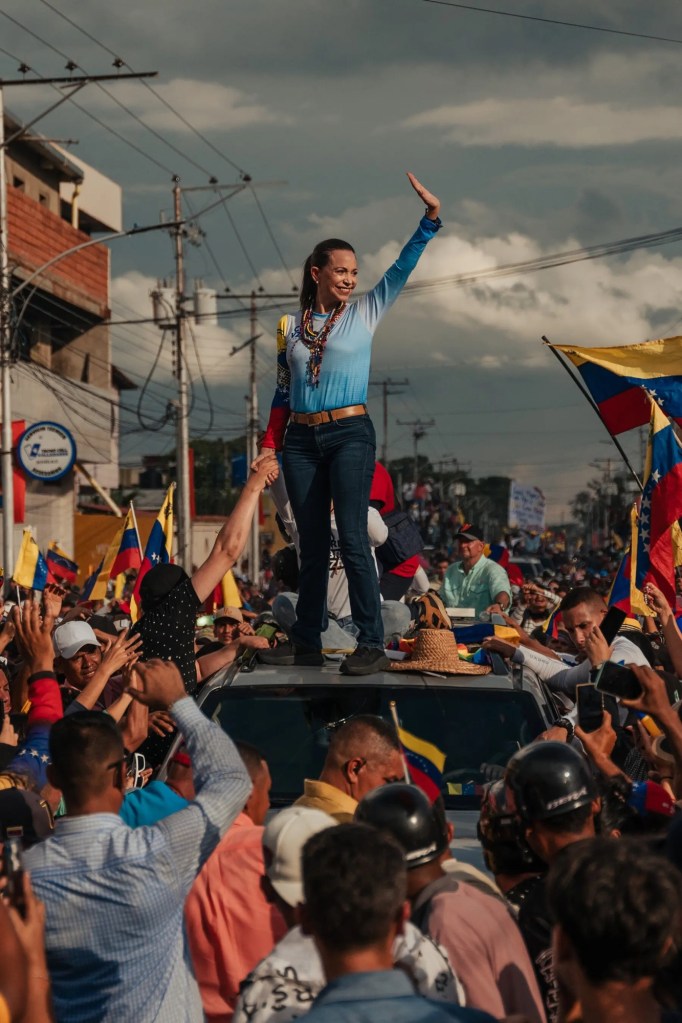
Venezuelan opposition leader Maria Corina Machado was awarded the Nobel Peace Prize for 2025 for her efforts to promote democracy at a time when an increasing number of countries slide into authoritarianism.

She receives the prize worth 11 million Swedish kronor ($1.2 million) “for her tireless work promoting democratic rights for the people of Venezuela and for her struggle to achieve a just and peaceful transition from dictatorship to democracy,” the Oslo-based Norwegian Nobel Committee said in a statement Friday. 

Machado, 58, “has led the struggle for democracy in the face of ever-expanding authoritarianism in Venezuela,” the Committee said. She leads the Vente Venezuela opposition party and has worked to unite pro-democracy forces in the country.

In her life before politics, she studied engineering and finance and had a short career in business before establishing a foundation that helps street children in Caracas. 

Machado “meets all three criteria stated in Alfred Nobel’s will for the selection of a Peace Prize laureate,” the Committee said. “She has brought her country’s opposition together. She has never wavered in resisting the militarization of Venezuelan society. She has been steadfast in her support for a peaceful transition to democracy.”

María Corina Machado at a rally in Guanare, Venezuela, in 2024.Credit…Adriana Loureiro Fernandez for The New York Times

No contest!

Olivia Troye describes the inspiration we all should draw from the life of Jane Goodall. Olivia worked in former Vice President Pence’s office as the Homeland Security and Counterterrorism advisor and also was Vice President Pence’s lead staffer on the White House Coronavirus Task Force. She resigned in August 2020 and became an outspoken critic of Trump.

She posted today:

We are under stress right now in the middle of a government shutdown. I have friends and loved ones being impacted by it, and I know how hard it is to live with that uncertainty. At first, I thought about writing to you about the shutdown, in a sea of what will be countless takes on how people view it and their opinions. But today, I want to sit in the moment and think about Jane. My hope is that, regardless of your politics, as you read this, something in her story inspires you.

The summer after my freshman year at the University of Pennsylvania, I went back home to El Paso. I enrolled in a course at the University of Texas at El Paso (UTEP). It was an anthropology class, and that’s where I was first introduced to Jane Goodall. I saw in her a path: a woman who looked beyond boundaries, who gave us permission to ask better questions about who we are. Her story lit a spark in me, showing me that science could be about curiosity, compassion, and courage.

When she arrived at Gombe Stream National Park in 1960, she had no formal scientific training. That, in fact, was part of her gift: she observed without the rigid assumptions of academia. She named the chimpanzees she studied—David Greybeard, Flo, and Fifi—at a time when science insisted on using numbers, not names. She insisted that they were individuals, not objects of study. Her findings were revolutionary: chimpanzees were observed making and using tools, a behavior once thought to be uniquely human. She uncovered their hidden lives, hunting, eating meat, forging bonds, grieving, fighting, and reconciling. They had culture, learned traditions passed from one generation to the next. Those discoveries didn’t just change primatology. They changed how we think about ourselves. The line we had drawn between “human” and “animal” blurred.

From Scientist to Advocate

Jane could have stayed in Gombe forever, her pen and notebooks filling with discoveries. But she chose a more challenging path, the path of turning science into action.

In 1977, she founded the Jane Goodall Institute, now a global leader in wildlife protection, community-led conservation, and education. In 1991, she launched Roots & Shoots, a youth-led program that today spans more than 60 countries.

Her vision was holistic: you can’t protect chimpanzees without protecting forests, and you can’t protect forests without working with the people who live there. Through initiatives like the Lake Tanganyika Catchment Reforestation and Education (TACARE) program, she connected reforestation, sustainable agriculture, girls’ education, and microcredit for women.

Looking back, Jane Goodall’s legacy is less about any single discovery and more about the principles that animated her work:

These were not abstract ideals. They were lessons for a fractured world, lessons that matter urgently now. We need Jane Goodall’s example to guide us.

Today, politicians play shutdown games that harm federal workers and erode agencies while boasting about fiscal responsibility. Science, institutions, and truth have become bargaining chips in the hands of those insulated from the consequences. Even Jane Goodall’s Institute felt this: earlier this year, its Hope Through Action project faced funding cuts from the U.S. government under Donald Trump, despite a $29.5 million pledge over five years.

Goodall’s life reminds us that science isn’t abstract. It is human. It is moral. It is about survival. When we gut research budgets, when we dismiss climate science, when we silence federal experts, we are not saving money; we are burning the future.

She also teaches us about dialogue across divisions:

“Change happens by listening, then starting a dialogue with the people doing something you don’t believe is right.”

And she forces us to confront a deeper question: Is an animal more our best friend than our neighbor?

In Gombe, she saw chimps grieve, nurture, and protect. They were not “other.” They were kin. In a society that struggles even to see our human neighbors with compassion, her work unsettles us. What does it mean if we can empathize with animals but not with each other? Or perhaps the reverse: if we learn to extend compassion across species, might we relearn it across human divides as well?

When Jane Goodall died at 91 this week, tributes poured in from around the globe. They called her a scientist, a conservationist, a visionary. But her most important title was witness.

She bore witness to the lives of chimpanzees, the destruction of forests, the resilience of communities, and the hope of young people.

Her words echo for me now: 

What you do makes a difference, and you have to decide what kind of difference you want to make.

So yes, I do worry about government shutdowns. I worry about the erosion of science and the hollowing out of public goods. I worry about the traps laid by political operatives who thrive on chaos. The farther I step from the government, the more clearly I see this reality.

But in dark times, we can choose to be witnesses. We can choose action, compassion, and resistance. And if we do, we honor Jane Goodall’s greatest gift: the reminder that what we do matters. That choice, that courage, is her gift and her legacy to all of us.

More soon,

Olivia