Archives for category: Corruption

Trump has spent a lot of time rescuing, pardoning and trying to reward the people who joined him in attempting to overturn his election loss in 2020. He is a giant baby. He is a sore loser. He lost decisively, and he refuses to accept it. More than 60 federal and state courts, including the U.S. Supreme Court, rejected his appeals because there was no evidence of election fraud.

Someday, with time, we will look back on Trump’s refusal to accept his defeat as a low point in our history. Of course, we will look at his two terms in office as the absolute nadir of our history, as a time he spent rolling back civil rights, environmental protections, international alliances, access to healthcare, defunding medical and scientific research, bullying universities, and censoring the mass media.

Trump bullied Governor Jard Polis of Colorado to free Tina Peters, and Polis succumbed:

Tina Peters, the former clerk convicted of participating in a scheme to chase election conspiracy theories promulgated by President Donald Trump, was released from prison Monday after the president successfully pressured Colorado’s Democratic governor into commuting her sentence.

Peters’ release was confirmed by the Colorado Department of Corrections. The state agency said it would have no more information about the 70-year-old inmate. Her sentence was shortened by Gov. Jared Polis last month after Trump waged a lengthy pressure campaign against the governor and his state.

Peters served less than a quarter of her nine-year sentence.

Peters was the first local election official to be charged with breaching security after the 2020 election. She snuck in an outside computer expert affiliated with My Pillow Chief Executive Mike Lindell — who himself denied that Trump lost the White House in 2020 — and the person copied the county’s Dominion Voting Systems computer server as it was updated in 2021.

Peters then joined Lindell onstage at a “cybersymposium” that promised to reveal proof that the election was rigged. Video and photos of the computer system upgrade, including passwords, were posted online. The move stoked false claims that voting machines were manipulated to steal the election from Trump.

Peters was convicted in 2024 of attempting to influence a public servant, conspiracy to commit criminal impersonation, violation of duty and other crimes by jurors in Mesa County, a Republican stronghold that supported Trump. An appeals court upheld her conviction in April, but ordered Peters to be resentenced because it said the judge who sent her to prison wrongly punished her for speaking out about election fraud.

Trump had championed Peters’ case, but because she was convicted under state law, he did not have the power to pardon her. Instead, the president pressured Polis to do so, lambasting him on social media and disinviting him to a White House meeting with other governors. The Trump administration also announced plans to dismantle the National Center for Atmospheric Research in Colorado and relocated the U.S. Space Command to Alabama.

Polis commuted Peters’ sentence on May 15. In a letter, he wrote that although Peters was convicted of serious crimes and deserved to spend time in prison, the sentence was “extremely unusual and lengthy” for a first-time non-violent offender.

Colorado Secretary of State Jena Griswold, a Democrat, called the move a “dark day for democracy” and said it amounted to “selling out our state’s justice system for Trump.”

Today, I read Robert Reich’s commentary on a remarkable event: A bipartisan group of 35 former federal judges asked Federal Judge Kathleen J. Williams to reopen the case that culminated in a deal between President Trump and Acting Attorney General Todd Blanche, who had been Trump’s personal lawyer before the 2024 election.

The “settlement” between Trump and Blanche handed over $1.776 billion to a commission controlled by Trump, and in another part of the “settlement,” Blanche agreed that neither Trump nor his family members would be audited by the Internal Revenue Service.

The retired judges said that Trump and Blanche may have deceived the court and perpetrated a fraud.

Judge Williams agreed to investigate and gave Trump and Blanche until June 12 to respond.

Reich wrote:

I can’t overstate the importance of Judge Kathleen Williams’s decision on Friday to reopen Trump’s $10 billion case against the I.R.S. 

She said she wants to investigate “grievous allegations” that the hasty deal to resolve it was “premised on deception,” and she ordered Trump’s lawyers to tell her by June 12 whether the lawsuit should be formally reopened because “the court was the victim of a fraud.”

The “deception” and “fraud” Judge Williams refers to were allegedly carried out by Trump and his Justice Department.

This is a big deal. 

Judge Williams’s decision came in response to court papers filed on Wednesday by a bipartisan group of 35 former federal judges who urged her to revive the case and dig into the details of the agreement to settle it. 

The judges’ brief is also a big deal. They call it a motion for relief from judgement or order or, alternatively, “leave to appear as amici curiae by thirty-five former federal judges.” 

I don’t recall a similar instance of 35 former federal judges filing such a motion or amicus (friend of the court) brief. 

In it, the judges argue that the parties’ — Trump and the Justice Department’s — so-called “settlement” agreement was made to circumvent the court ‘s possible finding that the case presented no actual controversy, since Trump is on both sides of it. 

This, they conclude, constituted a fraud on the Court.

I wanted to read the brief by the 35 judges. I did. You should read it too. It is linked in the next paragraph from Reich’s post.

Judge Williams’s decision came in response to court papers filed on Wednesday by a bipartisan group of 35 former federal judges who urged her to revive the case and dig into the details of the agreement to settle it.

Read it yourself. The judge had previously raised the question of whether Trump’s $10 billion lawsuit was genuine, since he seemed to be suing himself. Had the case gone to trial, she might have tossed it, since there were not two genuine adversaries.

The parties decided to withdraw their lawsuit and quickly reached an agreement that was highly beneficial to Trump (the slush fund and freedom from audits).

The former judges smelled a rat and took the unprecedented step of joining together to petition Judge Williams.

Alan Feuer and Andrew Duehren wrote in The New York Times today:

A federal judge in Miami reopened President Trump’s $10 billion case against the I.R.S. in a striking turnabout, saying that she wanted to investigate “grievous allegations” that the hasty deal to resolve it was “premised on deception.”

The ruling by the judge, Kathleen M. Williams, on Friday to revive the case shortly after closing it was a significant blow both to Mr. Trump, who had voluntarily dismissed the suit last week, and to the Justice Department. After the president withdrew the suit, senior department officials released a pair of extraordinary agreements that settled the case by establishing a $1.8 billion fund to compensate people who claimed they were victims of government “weaponization” by Democrats.

The deal also conferred lucrative tax benefits on Mr. Trump, his family and his businesses.

Judge Williams’s decision came in response to court papers filed on Wednesday by a bipartisan group of 35 former federal judges who urged her to bring the case back to life and dig into the details of the agreement to settle it.

The former judges said that Mr. Trump’s settlement agreement raised serious questions about his “candor toward the court and manipulation of the judicial system.”

Before she closed the case, Judge Williams, an Obama appointee, had in fact questioned whether the lawsuit presented an actual conflict that she could adjudicate, given that Mr. Trump was on both sides of the suit, bringing claims against a federal agency that he controlled. When she closed it, she noted there was no “settlement of record,” but shortly after, the Justice Department released its agreement foreclosing the action.

In her brief but stern order on Friday, Judge Williams said that she wanted to investigate the circumstances surrounding Mr. Trump’s efforts to settle the lawsuit in a way that benefited him and his allies. If she succeeds in moving forward with her inquiry, it could ultimately result in questions being asked of the Justice Department leaders who signed the agreements to settle the suit — chief among them, Todd Blanche, the acting attorney general, and Stanley Woodward Jr., the No. 3 official in the department.

In her order, Judge Williams asserted that she was “empowered to investigate serious misconduct” in any case before her, and ordered Mr. Trump’s lawyers to tell her by June 12 whether the lawsuit should be formally reopened because “the court was the victim of a fraud.”

She also wanted Mr. Trump’s lawyers to respond to the question of whether he had colluded with his own government to settle the case “to avoid judicial scrutiny.”

The White House did not immediately respond to a message seeking comment.

Judge Williams pointed to reporting by The New York Times that described how the I.R.S. had prepared a 25-page memorandumoutlining defenses against the suit that the Justice Department did not take up in court.

Lawyers for the former judges hailed Judge Williams’s decision.

“The judges and their counsel greatly appreciate the seriousness with which the court is addressing these grievous allegations,” said Norman Eisen, who represented the former judges for the nonprofit group, Democracy Defenders Fund. “We stand ready to work with the court as it investigates this matter.”

Mr. Eisen was joined by the law firms Platkin and Susman Godfrey.

In their filing this week, the former judges claimed that Mr. Trump had improperly used his suit against the I.R.S. as a way to obtain “unlawful private benefits” for himself and his family, and to create a fund that would dole out taxpayer money “without constitutional or congressional authority.”

They also argued that the president had tried to shield the deal from judicial oversight by rushing a settlement and “short-circuiting” Judge Williams’s ability to examine its terms.

The $1.8 billion fund has faced separate legal headwinds. A federal judge in the Eastern District of Virginia temporarily blocked the Trump administration from taking any further steps to set it up or disburse money from it. Lawmakers on Capitol Hill, including many Republicans, have also been critical of the fund, which upended G.O.P. plans to pass a party-line bill funding immigration enforcement efforts last week.

Mr. Trump, along with two of his sons and the Trump family business, first sued the I.R.S. in January, claiming they were owed at least $10 billion because a former contractor at the agency had leaked their tax returns (and hundreds of others) during the president’s first term in the White House. The Trumps claimed that the I.R.S. should have done more to prevent the contractor, Charles Littlejohn, from disclosing tax information to The New York Times and ProPublica.

Mr. Trump’s suit, as I.R.S. officials laid out in their memo and other lawyers have noted, had clear legal flaws. Potential defenses against it include that it was filed after the statute of limitations, and that it incorrectly faulted the I.R.S. for the actions of Mr. Littlejohn, previously a contractor employed by Booz Allen Hamilton. But the Justice Department never made an attempt to contest Mr. Trump’s suit. No government lawyer entered an appearance in the case.

That has fueled criticism that the deal the Justice Department struck with Mr. Trump was not a genuine attempt to avoid a loss on the merits to the president in court, but instead a scheme to provide him and his political allies with public benefits.

In a footnote, Judge Williams questioned the provision granting Mr. Trump, his family and their businesses immunity from I.R.S. scrutiny of tax returns they had already filed. She wrote that the audit protection may run afoul of Justice Department rules requiring legal settlements to directly relate to the issues in the suit.

She also noted that only Mr. Blanche signed the audit provision. The separate, nine-page agreement laying out the $1.8 billion fund was signed by Mr. Woodward and Frank Bisignano, who is serving as the chief executive officer of the I.R.S., a newly created role that is not subject to Senate confirmation.

Here is NPR’s summary.

Jonathan V. Last of The Bulwark explained why Trump’s $1.776 billion slush is such a powerful tool for a crafty mob/boss.

Last wrote:

We’ve been thinking too narrowly about the $1.776 billion pot of taxpayer money that Donald Trump will soon control.

Most people assumed Trump would use it to pay off meathead insurrectionists, sort of a . . . treason stimulus.

Absolute gold.

Others believed that while Dummkopf MAGA might get a couple bucks here and there, the real money would be funneled to Trump family members and organizations.

But the Slush Fund from Hell—or whatever we’re calling it—is much more useful than any of that. It’s a multitool for corruption and maintaining MAGA discipline. Let me explain.


You have to respect Trump as an innovator. He saw that private lawsuits could be used as a way to legalize bribery and extortion—that’s what his defamation suits against CBS and ABC were.¹

Trump understood that while it might be illegal to go to CBS and ABC and demand that they pay him protection money, he could use a civil lawsuit as justification for creating a private legal contract that amounted to the same thing.

He further understood that if he filed a civil suit against the U.S. government and then became president, he could direct the government to settle with him on whatever terms he desired.

These are ideas which seem to have occurred to no one in American history prior to Trump. When it comes to corruption, the man knows how to think laterally.

So what sort of lateral uses could he make of a $1.776 billion fund which he controls completely? There are two big ones.


The obvious one is bribery. As we discussed last week, Trump can turn the fund into fee-for-service. You give him a thing he wants—a vote, a certification, a report—and then you get compensated at a later date.

But the subtle one is something else altogether. It’s about holding people on side.


One of the striking design details about the fund is that it disappears just before Trump leaves office. It is sunset so that it can never be directed by anyone other than Trump.

Think about how this is likely to work in practice.

If you were Trump, would you pay out money before your last days in office? 

Because I would not.

The optimum strategy is for Trump to pay a couple people early, just to validate the fund’s existence. After that he should encourage anyone and everyone to apply for compensation. And then he should wait.

Because open applications give him leverage over people.

As a for-instance: Two days ago Mike Flynn almost criticized Trump about making a deal with Iran. Do you think people will be willing to do even that much if they have compensation applications pending that could be worth millions of dollars?


Another reason Trump should wait to disburse funds is that he can implicitly promise to pay more than $1.776 billion. Think about it: $1.776 billion is a lot of money, but it’s only 1,700 million-dollar portions. If Trump starts paying people right away, the fund gets drawn down and people start to realize that maybe they won’t get anything from it.

But if the nut is largely intact, everyone in MAGA world can dream. Trump can pass out tens of billions of dollars worth of promises—Don’t worry, we’ll take care of you; you just have to wait a little bit longer—with everyone thinking that, since he’s going to pay up at the very end, there’s enough cash for them to get theirs.


Second-term presidents become politically weak when members of their party realize that their incentives are diverging from the POTUS.

Maybe the POTUS is becoming unpopular, so candidates need to distance themselves from him. Maybe party elites are thinking about the future and how to take over once the old man is gone.

The slush fund is a tool to fix that problem. It’s the promise of a tangible reward for Republicans to stay on his side. Be nice to him. Do what he asks. Don’t freelance. And maybe there’s a pot of gold for you at the end of the rainbow.


The slush fund won’t work on everyone. Some Republicans will be secure enough that they don’t need Trump’s money. Some will be ambitious enough that they’re willing to forgo the uncertain promise of a payout for a shot at the title.

But it’ll work for some of them. It will encourage them to modulate what they say. And within the rest of the Republican ecosystem, having more people on-side than there otherwise would be will have a force-multiplier effect. Seeing people stick with Trump will cause more people to stick with Trump.

Watch what happens in the coming days with the Iran deal. See how many defections there are. And then ask yourself: How many of those people who suddenly get with the program are hoping to apply for some compensation from their president?

The U.S. Supreme Court was designed to be a separate branch of government, the one that monitored the adherence to the Constitution by the other two branches. The Court disappoints sometimes, but it has never been as nakedly partisan as it is under Chief Justice John Roberts. The far-right wing of the Republican Party has a reliable friend at the Court.

It’s hard to say which of their decisions is the worst.

Some might say it was their recent decision to overturn the Voting Rights Act, which will sharply reduce the number of Black members of Congress.

Some might say it was their decision to overturn Roe v. Wade, despite promises by most of them not to do so.

Some would say it is their decisions that tear down the wall of separation between church and state.

I say it was their decision in Trump v. United States, in which the majority decided that the president was above the law and could not be charged for anything he did while in office as part of his official duties. We can be certain that the same court would claim that whatever he did was part of his official duties, including tearing down the East Wing of the White House without seeking anyone’s approval.

Representative Steve Cohen of Tennessee has had enough. He introduced six articles of impeachment of Chief Justice John Roberts. Good for him!

Scott Dworkin reported on his blog:

Rep. Steve Cohen

Rep. Steve Cohen has represented Memphis, Tennessee, for 19 years. Republicans cut his district into pieces, and he decided to retire—but not without a fight.

Cohen told The Dworkin Report in 2019: “[Trump’s] life has been one crime after another. One misdeed after another. One lie after another.” Now he’s applied that same standard to the man who put Trump above the law.

On May 21, Cohen introduced six articles of impeachment against Chief Justice John Roberts. Charges include allowing the Court to become a partisan weapon, placing the president above the law, endorsing a corrupt campaign finance system, and failing to recuse himself while his wife collected millions recruiting attorneys for law firms with cases before the Court.

Cohen was direct: “Under Chief Justice Roberts’ stewardship, [The Supreme Court] is now understood as biased: with decisions designed to benefit Republicans at the expense of representative government.”

They gerrymandered Cohen’s district to silence him. John Roberts now has six articles of impeachment to his name—an award no other Chief Justice has ever received in US history.

How much corruption will Republicans in Congress tolerate? All of them were hiding under their desks or running for their lives on January 6, 2021. How do they feel about the rioters of that infamous day getting a reward for their efforts to overturn the Constitution? How do they feel about handing out money to the people chanting “Hang Mike Pence!” And rewards for those who beat the Capitol Police officers? I watched the events from start to finish. It was a shameful day in our history.

The New York Times editorial board published the following editorial yesterday. The headline: “There Has Never Been an Example of Presidential Corruption Like This.“

Has there ever been an episode of presidential corruption so blatant and threatening to constitutional order? Certainly not in modern times. President Trump’s Justice Department is using taxpayer money to create a $1.8 billion political slush fund. Ostensibly set up to compensate those who the department claims have “suffered weaponization and lawfare,” it will in fact reward loyalists willing to defy the law and commit violence on behalf of the president.

The fund manages to combine three of Mr. Trump’s most alarming behaviors. One, it is an obvious form of corruption, coming from a president who has used his office to enrich himself, his family and his allies. Two, the fund continues his pattern of using the Justice Department as an enforcer to punish his perceived opponents and protect his friends and allies. Three, the fund is his latest attempt to rewrite history about the 2020 election and the Jan. 6, 2021, attack on Congress.

It is worth pausing to put the fund into the larger context of Mr. Trump’s political project: He is destroying pillars of American democracy to empower himself. He claims elections are legitimate only if he wins. He uses federal law enforcement to investigate and prosecute his perceived enemies. He purges his party of officials who defy him. He describes members of the other party and civil society as traitors and enemies. He incentivizes his supporters to break the law on his behalf and rewards them when they do. He directs his allies to change election rules to keep his party in power.

Mr. Trump’s project has not yet succeeded, at least not fully. Many Americans — in the judicial system, in Congress, in state governments and elsewhere — continue to stand up for democracy and oppose his autocratic ambitions. By now, though, nobody should have illusions about what he is attempting to do.

The fund’s existence is a story of political self-dealing. It is nominally the product of a flimsy personal lawsuit that Mr. Trump filed this year against the Internal Revenue Service, which he oversees, over the leaking of his tax returns during his first term. That lawsuit led to an absurd negotiation, in which the lawyers on one side worked for Mr. Trump the citizen and those on the other side worked for Mr. Trump the president.

Adding to absurdity, the government lawyers reported to Todd Blanche, the acting attorney general, who previously worked as Mr. Trump’s personal lawyer. A federal judge in Miami helping to oversee the case, Kathleen Williams, pointed out that the two sides were not adversaries, which called into question the process. Even Mr. Trump acknowledged the situation shortly after filing the suit by saying, “I am supposed to work out a settlement with myself.”

Yet the talks proceeded because Mr. Trump’s Justice Department was in charge. Unsurprisingly, they led to a deal that was extremely favorable to him.

In exchange for the president’s dropping the suit against the I.R.S., both he and his supporters will receive government handouts. For Mr. Trump, the handout comes in the form of permission to have cheated on his taxes. The government has granted himand his family immunity from ongoing audits of his tax payments. He has a long history of using questionable accounting maneuvers, and the audits could have cost him more than $100 million, experts have said. Now they will cost him nothing.

For his supporters, the handouts will come from the slush fund. The Justice Department will tap a permanent stream of revenue that Congress created in 1956, known as the Judgment Fund, to settle lawsuits against the federal government. As Paul Figley, a former Justice Department official, noted, the new fund appears to be both legal and at odds with Congress’s intent. “It’s horrible policy,” Mr. Figley told The Times.

The department has allocated $1.8 billion for what it calls, in an Orwellian flourish, an Anti-Weaponization Fund and invited applications from people who have been targeted for “political, personal or ideological reasons.” Mr. Blanche — who holds his position as acting attorney general largely because of his willingness to use federal power in service of Mr. Trump’s personal whims — will appoint a five-member board, with congressional leaders given input on one of the five. Mr. Trump can fire any of the members at any time.

To understand who is likely to receive payments, look at who has previously received settlements from the Justice Department. Michael Flynn, who was briefly Mr. Trump’s national security adviser in 2017, received $1.25 million, even though he pleaded guilty to lying to F.B.I. agents. The family of Ashli Babbitt, who participated in the Jan. 6 riot, and whom federal agents shot as she and others approached the House floor, received nearly $5 million, even though investigators cleared the shooters of wrongdoing. The Trump administration is paying off people who committed violence and crimes, as long as they are Trump allies.

The fund’s timeline is the giveaway of how Mr. Trump plans to use it. The Justice Department said the fund would stop processing claims on Dec. 15, 2028, weeks before the president is to leave office, ensuring the money is distributed while he still holds the power to fire anyone who objects. The window is precisely the window of Mr. Trump’s authority.

Even some of Mr. Trump’s usual defenders are unhappy. Senator John Thune, Republican of South Dakota and the majority leader, meekly said that he was “not a big fan” of the fund. Brian Morrissey, the Treasury Department’s general counsel, resigned within hours of the announcement, seven months after the Senate had confirmed him.

Providing payoffs is only part of the point. Another, according to Mr. Blanche, is “ensuring this never happens again.” What, exactly, is “this”? The evenhanded enforcement of the law.

The Trump administration has already fired federal agents who did their duties by investigating the president’s attempts to overturn the 2020 election. Mr. Trump has issued blanket clemency to more than 1,500 Jan. 6 rioters, some of whom may soon receive payments. His Justice Department secured an indictment of James Comey, the former F.B.I. director, on dubious charges as retribution for his role in the investigation of the 2016 Trump campaign’s Russia ties. The fund continues the effort to turn law enforcement into a tool of raw political power.

The fund also encourages future lawlessness on Mr. Trump’s behalf. It sends the message that he will use his power not only to shield people who break the law from accountability but also to shower benefits on them. Just as punishment is a deterrent, rewards are an incentive.

After President Richard Nixon’s abuses in the Watergate scandal, Congress and the executive branch built rules and traditions to ensure that federal agencies, especially the Justice Department, operated in the public interest, rather than that of the president. Mr. Trump has tried to break this system. Once he is gone, it will need to be rebuilt, and better than before. He has exposed and exploited its flaws and gaps. Unless they are filled, Mr. Trump’s corruption and perversion of justice risk becoming the norm.

In the meantime, Americans should be cleareyed about what the president is doing. He is taking their money and showering it on criminals.

Trump is apparently willing to drop his demand for $10 billion from the IRS, which wouldn’t pass the smell test in a court of law (unless the judge was Aileen Cannon), if the Treasury sets up a $1.7 Billion fund to compensate anyone who was “wrongfully” prosecuted during Biden’s term.

That means that all of the MAGA crowd that attacked and defaced the U.S. Capitol on January 6, 2021, will get not only a pardon but a payoff for their efforts to overthrow the Constitution. Also, the friends and allies of Trump who collaborated to nullify the 2020 election will be rewarded.

ABC reports:

President Donald Trump is expected to drop his $10 billion lawsuit against the Internal Revenue Service in exchange for the creation of a $1.7 billion fund to compensate allies who claim they were wrongfully targeted by the Biden administration, sources familiar with the matter told ABC News.  

The commission overseeing the compensation fund would have the total authority to hand out approximately $1.7 billion in taxpayer funds to settle claims brought by anyone who alleges they were harmed by the Biden administration’s “weaponization” of the legal system, including the nearly 1,600 individuals charged in connection with the Jan. 6 Capitol attack as well as potentially entities associated with President Trump himself. 

While the settlement is expected to be agreed upon in the coming days, sources caution that the final terms will not be set until they are officially announced. Judge orders Trump, DOJ to justify why president’s $10B IRS lawsuit should proceed

In addition to a public apology from the IRS, the compensation fund is believed to be the main condition for Trump to drop a series of legal actions he filed against the federal government, including the $10 billion lawsuit related to the 2019 leak of his tax returns as well as $230 million in legal claims related to the 2022 search of his Mar-a-Lago estate and the Russia collusion investigation he faced during his first term in office, sources familiar with the ongoing deliberations said. 

The settlement terms are expected to prohibit Trump from directly receiving payments related to those three legal claims; however, entities associated with Trump are not explicitly barred from filing additional claims, sources said. 

In response to a request for comment, a spokesperson for President Trump’s legal team told ABC News, “The IRS wrongly allowed a rogue, politically-motivated employee to leak private and confidential information about President Trump, his family, and the Trump Organization to the New York Times, ProPublica and other left-wing news outlets, which was then illegally released to millions of people. President Trump continues to hold those who wrong America and Americans accountable.”

A spokesperson for the Justice Department declined to comment when contacted by ABC News. Representatives for the IRS and the Treasury Department did not immediately respond to requests for comment

This a great article that will uplift your spirits!

Jennifer Rubin is a journalist and lawyer who was hired by The Washington Post to be its conservative columnist. But Trump radicalized her, and she became a leading voice for liberal policies. After Jeff Bezos decided to placate and woo Trump, she resigned her job and started a new and wildly popular blog called “The Contrarian,” where she and other brilliant writers gathered to critique the madness of MAGA.

She recently posted an optimistic analysis of American politics. Despite the gerrymandering, despite horrible court decisions, Democrats are in a great position to wash the MAGA stain out of the nation’s government.

It’s the most optimistic piece I’ve read in a long while, and I think you will enjoy it too.

Rubin writes:

In a span of less than two weeks, the U.S. Supreme Court (contravening the text and intent of the post-Civil War amendments and decades of court precedent) and the Virginia State Supreme Court (overturning the will of Virginia voters and inventing a new definition of “election”) have bulldozed through the electoral landscape to slant the 2026 midterm playing field in Republicans’ favor.

In Louisiana v. Callais, the U.S. Supreme Court demolished 60 years of progress in voting rights, robbed Black and Hispanic communities of the power to elect representatives of their own choosing, and aimed to decimate the ranks of non-white U.S. House members, state legislators, and local officials. This is nothing short of an attempt to reimpose white supremacy.

(MicroStockHub/iStock)

Voting rights legal guru Rick Hasen wrote:

This decision will bleach the halls of Congress, state legislatures, and local bodies like city councils, by ending the protections of Section 2 of the act, which had provided a pathway to assure that voters of color would have some rudimentary fair representation. It’s the culmination of the life’s work of Chief Justice John Roberts and Samuel Alito, who have shown persistent resistance to the idea of the United States as a multiracial democracy, and a brazen willingness to reject Congress’ judgment that fair representation for minority voters sometimes requires race-conscious legislation…. It protects Alito’s core constituency: aggrieved white Republican voters.

As infuriating, partisan, and legally unsound as these rulings are, they are not the final word on either the midterms or the future of our multi-racial democracy.

The Midterms

Even with the loss in Virginia, Democrats’ five-seat pick up in California should more than counteract the original Texas re-redistricting (where two of the five seats Republicans sought to steal may well go to Democrats). And despite the Virginia decision, Democrats may still pick up one to two more seats under Virginia’s old map. The net pickup for Republicans currently is less than ten before Democrats pursue their own redistricting in New York, Illinois, Colorado, and Maryland.

However, even with the advantage of, say, a dozen rigged seats, Republicans are unlikely to keep the House majority. Since 2024, Democrats have swung the electorate substantially in their direction, over-performing in comparison to Kamala Harris in 193 of 226 state legislative races, by 20 points in some cases. On average, Democrats are doing more than 10 points better than they did in 2024. (Brookings’ William A. Galston wrote: “In the six special elections for the House conducted in 2025-2026, the swing toward Democratic candidates averaged about 15 points, while the swing toward Democratic gubernatorial candidates in New Jersey and Virginia averaged 14 points.”)

More than 20 Republican House seats were won by less than 10 points in 2024; 43 Republicans won by less than 15%. Given the electoral shift, Democrats’ list of targeted seats expands each week.

The New York Times reported that gerrymandering “tells only part of the story” about the midterms. While “Democrats could end up losing at least half a dozen safe seats, and possibly more,” depending on new maps drawn in Southern states, Republicans face gale-force “headwinds” thanks to Donald Trump’s atrocious approval numbers, his reviled Iran war, soaring gas and other consumer prices, snatching away healthcare coverage from millions, disaffection of Hispanic voters, and rampant corruption.

In short, gerrymandering, however outrageous, will not be enough to save Republicans if Democrats generate huge turnout, especially among those voters enraged that they have been stripped of voting power. (As Hungary demonstrated, a determined opposition can overcome a raft of unfair impediments imposed by a corrupt, unpopular regime.)

Democrats, independents, and disaffected Republicans know that the MAGA cult has no message — which is why MAGA lawmakers and courts must rig the election to cement white supremacy. That’s all they’ve got.

Democrats have their targets

The enormity of reversing 60 years of progress on voting rights necessitates a new era of intense organizing and public education — a new civil right movement to counter MAGA’s court-imposed Jim Crow. That effort kicks off with a grassroots National Day of Action on Saturday, May 16, in Alabama. Organizers declared, “The dismantling of the Voting Rights Act is a reminder that we have unfinished business. The fight is ours and we are going to finish it.” Scores of democracy groups, faith-based organizations, and civil rights organizations will rally to oppose Jim Crow redistricting and to support multi-racial democracy.

The goal: Democrats must win, and win big, in 2026 and 2028. Senate seats, governorships, and other statewide offices cannot be gerrymandered. A massive registration and turnout-the-vote operation must expand deep into Republican areas, appealing to disgruntled independents and Republicans while firing up the base. Democrats will need a broad, inclusive electoral coalition to pursue bold reform. As former attorney general Eric Holder likes to say, progressives “need to be comfortable with acquiring power and using power.”

What then? If Democrats come out of the 2028 election with House and Senate majorities, and the presidency, they will have all the motivation and tools required to reverse the slide into Jim Crow, beginning with substantial reform of the discredited Supreme Court. The MAGA justices’ willful misreading of the Voting Rights Act and the Constitution to concoct a “color blind” interpretation of voting rights (coupled with their monstrous expansion of executive power and abuse of the emergency docket) should unify democracy defenders on the urgency of Supreme Court reform through court expansion, term limits, revised appellate jurisdiction, and ethics reform.

Election law guru Rick Hasen argued:

The Supreme Court itself has shown itself to be the enemy of democracy. If and when Democrats retake control of the political branches, it will be incumbent on them not only to write new voting legislation protecting minority voters and all voters in the ability to participate fairly in elections that reflect the will of all the people. They will also have to consider reform of the Supreme Court itself.

With the election of aggressive Senate Democrats running in 2026 and 2028, Democrats should have little trouble carving out a filibuster exception, especially if they win by large margins that affirm voters’ rejection of MAGA assault on pluralistic democracy.

In addition to reforming the MAGA Supreme Court, a myriad of solid proposals for undoing the damage wrought by Callais include: state voting rights’ protections, a federal statute that requires nonpartisan redistricting, proportional representation, and a constitutional amendmentguaranteeing the right to vote. Democrats should pursue an “all of the above” approach, not merely to regain but to expand diverse voters’ participation and power.

Though the tools to sustain multi-racial democracy may be different from those employed in the 1960s, Madeleine Greenberg of the Campaign Legal Center reminded us: “Every generation has faced attempts to restrict access to the ballot box, and every generation has pushed back.” If Democrats win elections decisively and fully exercise the power they obtain, they can fix what MAGA white supremacists have broken. Only then can we fulfill the promise of pluralistic democracy.

The midterm elections of 2026 are approaching. Start working now to reclaim our democracy! Our time is now.

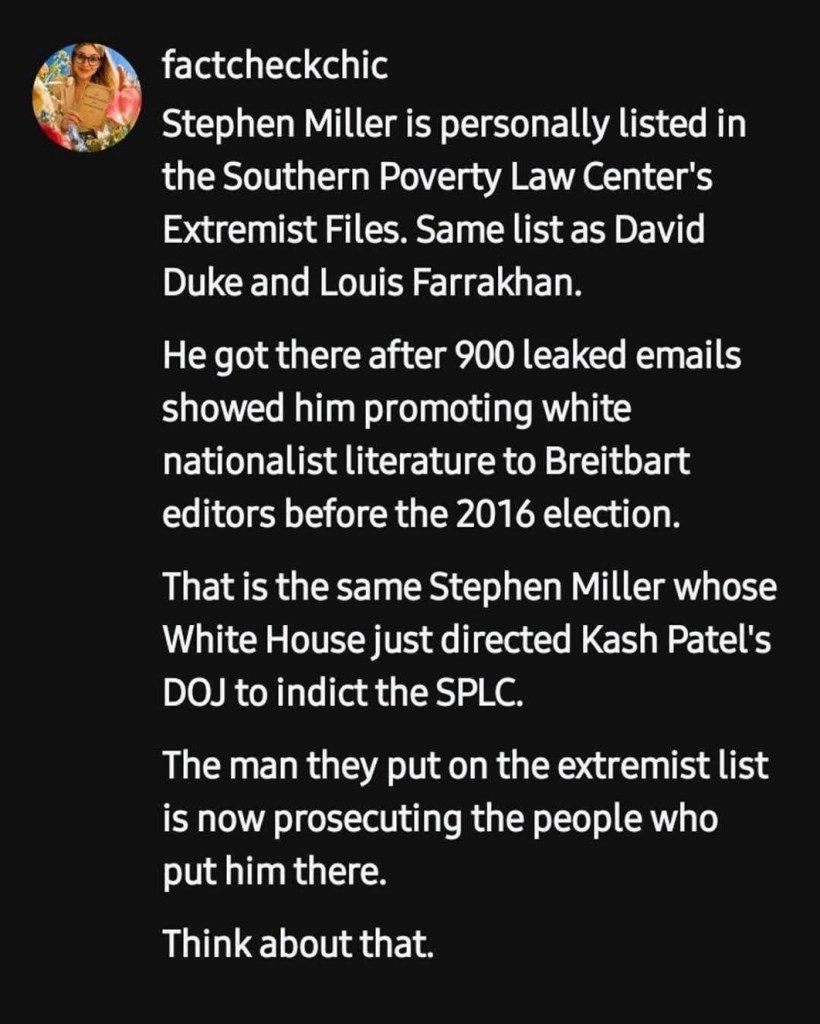
The Department of Justice indicted the Southern Poverty Law Center by paying informants to infiltrate extremist groups.

CNN wrote:

The Justice Department alleges in the criminal case brought last month that the Southern Poverty Law Center — which has drawn the ire of President Donald Trump and other Republicans for labeling right-wing organizations as hate groups — defrauded donors by not informing them of secret payments to hate group members to act as informants.

The Justice Department alleges that SPLC has funneled $3 million to hate groups like the KKK, Unite the Right, and the Aryan Nations. SPLC also listed Moms for Liberty as a hate group, and M4L said that SPLC should be shut down.

One of the specialties of SPLC is compiling a list of hate groups and individuals who spread hate.

As an organization that was created to oppose racial injustice in the South, SPLC became a natural target for the GOP vengeance campaign.

The odd thing about the suit is that SPLC paid infiltrators, not the groups themselves.

This is a brazen assault on a significant civil rights group that has tangled with hate-groups for more than 50 years.

It is also a demonstration of the Trump administration’s weaponization of the Justice Department, turning it into a partisan cudgel.

Some large corporations have paused their charitable gifts to SPLC, including a division of Schwab that manages charitable gifts, Fidelity, and vanguard.

It was noted on Twitter that Stephen Miller, Trump’s policy advisor, is in the SPLC list of extremists.

Dan Rather, the esteemed journalist, wrote on his blog Steady about the dreadful consequences of Trump’s defunding of science, medicine, and public health.

But on Friday night, when we weren’t looking for a controversial announcement, Trump fired every single member of the 24-person National Science Board. Why? The simplest answer is that the members of the board were not his sycophants. They allegiance is to science, not to the person of Donald J. Trump. He couldn’t control them. They had to go.

Dan Rather wrote:

We toss around terms like “American exceptionalism” far too easily. But there is little debate that, in areas of science and medicine, this country has long been the world leader. We have more top scientists, elite doctors, and preeminent researchers than anywhere else. Their work has meant people live longer, healthier lives.

It is also a cornerstone of American influence around the world.

Scientific and medical research requires significant funding. It has thrived because our elected officials have had the political will to provide a financial pipeline to the public and private sectors.

President Donald Trump is severing that lifeline.

As the mainstream media was renting tuxedos and getting manicures ahead of the White House Correspondents’ Dinner, Trump was busy pounding nails into the coffin of the American scientific research community.

Tucked away on Friday evening, in a terse, two-line email, the White House personnel office fired the entire National Science Board. “On behalf of President Donald J. Trump, I’m writing to inform you that your position as a member of the National Science Board is terminated, effective immediately,” the email read.

No reason was given in the email, and the White House has had no additional comment on the firings.

The independent, 24-person board is made up of top scientists and engineers who serve staggered, six-year terms, to ensure overlap between presidential administrations. They are chosen “solely on the basis of established records of distinguished service.”

The board advises the National Science Foundation (NSF), which supports a wide range of research, from Antarctic exploration to quantum computing. NSF-funded research helped develop the MRI machine, LASIK eye surgery, and Wi-Fi, among many other innovations. It distributes $9 billion in research grants annually.

“[I]t is not enough simply to keep abreast of the rest of the world in scientific matters. We must maintain our leadership,” President Harry Truman said in 1950, when he established the board.

Keivan Stassun, a physicist and astronomer at Vanderbilt University who was appointed to the board in 2022, called the Trump purge “a wholesale evisceration of American leadership in science and technology globally,” to the Los Angeles Times.

Although the president is often reluctant to explain why he does imprudent and detrimental things, if one looks hard enough, a reason can usually be found. In this case, there may be two.

Reason one: to save face. The board was set to meet in early May to work on the release of a new report. The report outlines how the U.S., once the world leader in scientific research, is losing ground to China. If there is no board, the report can’t be released.

Reason two: money. In its 2026 budget, the Trump administration recommended a 55% cut to the NSF. After lobbying by the National Science Board, Congress rejected the White House’s proposal and funded the NSF at 2025 levels.

To avoid the same fate for this year’s budget, which again recommends slashing the foundation’s funding, Trump did away with the board before its members could convince members of Congress.

Friday’s firings are just the latest in Trump’s long list of objectionable actions to cast doubt on scientific findings and thwart research.

The United States has been on the cutting edge of scientific and medical research since the end of World War II. The National Institutes of Health (NIH) has been the world leader in funding biomedical research. A 2020 study found that NIH-funded research was associated with every new drug approved between 2010 and 2019.

But all of that is now changing. And Trump is to blame.

Science is “explicitly designed to counter human self-deception,” psychologist Steven Pinker told Chris Mooney in his book “The Republican War on Science.”

When deception is your modus operandi, you will naturally try to squash, discount, and demonize the truth. Being anti-science helps protect established special interests. Think climate change denialism and fossil fuel companies.

Trump called the climate crisis “the greatest con job ever perpetrated on the world” at last year’s United Nations General Assembly. He said this even as the globe is in the midst of the warmest 10-year span on record, according to the National Oceanic and Atmospheric Administration.

The NSF’s board is not the first the Trump administration has hamstrung. In June of last year Robert F. Kennedy Jr., the Secretary of Health and Human Services, fired the 17-person vaccine advisory board and replaced many with vaccine skeptics. Trump himself replaced leading scientists with tech billionaires on the President’s Council of Advisors on Science and Technology.

The administration significantly cut funding to the National Cancer Institute, once the gold standard for rigorous, evidence-based research. It no longer funds mRNA research, a revolutionary technology that has the potential to radically improve cancer care.

It canceled 22 separate mRNA contracts, including one working on a vaccine for brain cancer in children. Kennedy is an mRNA skeptic, claiming the vaccines aren’t safe while providing no evidence.

Pancreatic cancer is an incurable disease with a dismal survival rate. Fortunately for pancreatic cancer patients, research into an mRNA vaccine was far enough along that the cuts didn’t affect the very promising treatment.

BioNTech, a German biomedical research company, partnered with Moderna, an American company, to develop pancreatic cancer vaccines using mRNA technology.

The technology, already in development when the pandemic hit, was used to create the Covid vaccine. The Lancet estimated that mRNA vaccines prevented 14.4 to 19.8 million deaths just in the first year of use.

MRNA vaccine technology was in the pipeline thanks to billions of dollars in federal grants over decades. This allowed researchers to get Covid vaccines to market incredibly quickly. This technology is now helping people with pancreatic cancer live years longer than ever before.

Moderna is also using mRNA therapy in combination with other drugs to cut melanoma death rates by 49%. Applications for a variety of cancers are in the works.

Paul Darren Bieniasz, a British-American virologist, wrote in The Guardian, “If we continue the destructive course plotted by this administration, medicines that would otherwise have saved lives in future generations, will not be invented. Technologies that would have ensured future employment and prosperity in the U.S. will not be devised. Solutions that allow the generation of power while causing less damage to the environment, will never be developed. Clearly, if we decline to nurture science, the lives of future Americans will be shorter, sicker and poorer.”

While Donald Trump won’t be around to see that, millions of Americans will. Trump doesn’t like inconvenient truths. Science is a kaleidoscope of inconvenient truths. Rather than deal with them like the world leader he should be, he gaslights, he rages, he denies all.

And as with so much else in this administration, we the people pay the price.
A blog called Home of the Brave has been running a series about “Profiles in Corruption.”

The most recent was about Jared Kushner, husband of Trump’s daughter Ivanka.

If the Democrats win control of the House of Representatives in November, the public can expect a steady stream of investigations about how friends and relatives of Trump cashed in.

Home of the Brave writes:

This article is Part Three in a series called ‘Profiles in Corruption,’ in which we shine a light on the personal financial interests of people close to the president. Previously, we profiled Don Jr. and JD Vance.

Before Jared Kushner became a billionaire, he was the wealthy son of a New York real estate magnate and paid next to nothing in federal income taxes for several years running. The New York Times reported that between 2009 and 2016, Jared Kushner utilized real estate depreciation rules to avoid cutting checks to Uncle Sam. Kushner’s wealth quintupled from around $64 million in 2008 to $324 million in 2018.

The wealth he has accumulated since 2018 is even more staggering. Leveraging the rolodex he accrued as an advisor in the West Wing, Kushner launched a private equity firm in 2021 called Affinity Partners and quickly secured lucrative investments from abroad. In four years, he turned Affinity Partners into a $4.8 billionenterprise.

When you add up Kushner’s 100 percent ownership stake in Affinity, his 20 percent stakein Kushner Companies (his family’s real estate business), his $105 million dollar home in Florida, and his collection of artwork, cash, and other personal investments, Kushner’s total net worth now exceeds the three comma benchmark. He officially became a billionaire in September 2025.

Before we unpack how Kushner amassed his fortune, let’s ask: Why does this matter?

It’s not illegal for the president’s son-in-law to become rich; we are not alleging that Kushner has committed any crime. But since Kushner became a senior advisor in Trump’s first administration and an unofficial negotiator in the second, his business activity warrants close scrutiny. And his sprawling web of business deals with Middle Eastern governments raises concerns about whether Kushner can negotiate in good faith on behalf of the United States government.

Kushner’s story is part of a pattern: people in Trump’s inner circle are monetizing their proximity to the president and obtaining financial gains that wouldn’t exist without that access. The American people are left wondering whose interest is driving the administration’s policy decisions: the public’s interest, or the personal financial interests of the president’s friends and family.

Before he was part of the Trump family, Kushner was a scion of a different New York City real estate empire. Jared Kushner’s father, Charles Kushner, started a real estate development firm in New York in 1985. But in 2005, Charles Kushner was found guilty of federal tax violations and an attempted plan to blackmail his brother-in-law by hiring a prostitute to seduce him, secretly film the encounter, and send the video tape to Kushner’s own sister, the man’s wife. The elder Kushner was sentenced to 24 months in federal prison. (As an aside, Donald Trump pardoned Charles Kushner in 2020. Today, Charles Kushner serves as the United States Ambassador to France and Monaco.)

While Charles Kushner was serving his time in jail, Jared was called up to run the family’s real estate business. At the time, he was a joint law-M.B.A. student at NYU, and he was dating Ivanka Trump. He and Ivanka got married in October 2009

Fast forward to 2017. His personal wealth had grown substantially, in part due to his savvy navigation of federal income tax rules as discussed above. His father-in-law became the President of the United States, and Kushner served as a senior White House advisor and Middle East envoy. This role was unprecedented for someone with no government experience, no Senate confirmation, and no apparent expertise in foreign policy. He was the architect of the Abraham Accords, the 2020 agreements that normalized diplomatic relations between Israel and the United Arab Emirates, Bahrain, Sudan, and Morocco. In the process, he built close personal relationships with the leaders of several Gulf states including Saudi Crown Prince Mohammed bin Salman, known popularly as MBS.

When Washington Post journalist Jamal Khashoggi was murdered in the Saudi consulate in Istanbul in 2018, US intelligence agencies concluded MBS ordered the killing. Kushner was, according to the New York Times, a key defenderof MBS inside the White House—helping ensure the relationship between Kushner’s country and MBS’s survived. (Kushner also reportedly communicated with MBS through WhatsApp to conduct official business—a breach of protocol that presaged  Signalgate.)

The $2 Billion Question

Six months after leaving the White House in January 2021, Kushner secured a $2 billion investment from Saudi Arabia’s Public Investment Fund, the country’s sovereign wealth fund, for Affinity Partners, his newly formed private equity firm.

Here’s what makes that remarkable: Saudi Arabia’s own investment board didn’t want to do it. According to the New York Times, a review panel that screens investment for the main Saudi sovereign wealth fund flagged Affinity Partners for inexperienced management, unsatisfactory due diligence, excessive management fees, and, in their words, “public relations risks” tied to Kushner’s White House role. Despite these concerns, Crown Prince MBS overruled the panel and approved the deal.

Also, interestingly, Kushner was not the only former Trump administration official soliciting investments from the Saudi sovereign wealth fund at the time. Steve Mnuchin, the Treasury Secretary during Trump’s first term, was also starting a new fund. Mnuchin, a man with decades of finance experience, received a $1 billion investment from the Saudi Public Investment Fund, setting off alarm bells in Congress. Despite acknowledging the risks and concerns in investing in Kushner’s firm, the Saudis wound up investing twice as much money in Kushner’s firm as they did Mnuchin’s.

The Gulf money kept coming for Jared. Qatar’s sovereign wealth fund and the Abu-Dhabi based firm Lunate combined to invest $1.5 billion into Affinity Partners in 2024. Today, Affinity manages roughly $4.8 billion in assets—the majority of it from the same Gulf countries whose leadership Kushner courted while serving as a US official.

Congress noticed. In 2024, Rep. Jamie Raskin (D-Md.) and Sen. Ron Wyden (D-Or.) called on then-Attorney General Merrick Garland to appoint a special counsel to investigate Kushner and Affinity Partners for potential violations of the Foreign Agents Registration Act. They alleged that Kushner was simultaneously acting as a “political consultant” to Trump and as what they called a “shadow diplomat” for Saudi, Emirati, and Qatari interests—while collecting tens of millions in management fees from those same governments.

After the 2024 election, when Republicans took control of Congress and the White House, the investigation into Kushner fizzled out.

The Bottom Line

Today, Jared Kushner is traveling the world—as an unelected, not-officially-appointed official—actively shaping US government policy. At the same time, he is soliciting funds for his own private equity business. In the Middle East especially, the countries with whom Kushner’s firm, Affinity Partners, is negotiating are greatly impacted by American foreign policy. Kushner’s participation in nuclear negotiations with Iran is well-documented. At least three separate reports suggest that Kushner told his father-in-law that Iran was using the negotiations to “buy time,” which encouraged Trump to order airstrikes targeting Iran’s senior leadership.

Given his financial interests in the region and his close relationships with senior government officials in Gulf countries, Kushner cannot be trusted to negotiate on the United States’s behalf in good faith. He cannot be relied upon to offer judicious, unbiased advice to his commander-in-chief. And given his proximity to the president, we cannot trust that other countries view their investments in Kushner’s private equity firm purely through a financial lens.

With Kushner, geopolitics, personal financial interests, national security and U.S. foreign policy are inextricably linked. Right now, he is purporting to represent the interests of all Americans as a de-facto diplomat, while so much of his personal wealth is linked to related government policy decisions. That’s a conflict of interest in plain sight. The least he could do is abide by public financial disclosure rules, as executive branch officials and presidential appointees have done for decades. He could attempt to dispel the public’s doubt about potential conflicts of interest. Instead, Kushner insists he’s just a “volunteer” helping out the government; as a result he is exempt from the usual financial disclosure laws.

Still, Kushner continues to hold a murky, unofficial role in Trump’s administration. This allows Kushner to legally negotiate with foreign countries on the president’s behalf while seeking investments from foreign countries’ sovereign wealth funds for his private business. We have to wonder what is guiding Kushner’s actions: his private financial interests or the public interests of the United States? We have to wonder if our government’s foreign policy is being exchanged for private investment into the president’s son-in-law’s private equity firm.

Yesterday, Rep. Jamie Raskin, ranking member of the House Judiciary Committee, wrote the following to Kushner: “You are now reportedly participating as ‘Special Envoy for Peace’ in negotiations on behalf of the United States government to address the roiling conflicts in the Middle East. At the same time, you are soliciting billions of dollars from Gulf Monarchies for your private business ventures while already managing billions of dollars of their money in your international investment firm … To whom do your professional obligations and fiduciary duties belong?”

It’s a good question. If what’s best for Kushner’s bottom line is at odds with what’s best for the American people, can Kushner be trusted to faithfully defend the interests of the United States and suffer the personal financial hit?

Kushner is trying to have his cake and eat it, too. He is jet-setting around the globe, collecting $5 billion from foreign governments. Meanwhile, Americans are staring into a future where $5 per gallon gas prices are in the realm of possibility. We deserve better.

Home of the Brave exists to show Americans the real-world consequences of this administration’s policies, and to highlight what bravery looks like in defense of American democracy.