Archives for category: Corruption

Scott Dworkin runs a Democratic activist’s blog, raising money for candidates and exposing Trump scandals and grifts. I subscribe and encourage you to do the same.

He writes:

A NEW TRUMP BUSINESS: THE PENTAGON

A paper trail of federal money keeps showing up right behind the Trump name. Don Jr. joined drone maker Unusual Machines’ advisory board in November 2024—and within a year, one of the company’s largest orders ever was placed by the US Army.

Last August, Don Jr.’s firm, 1789 Capital, bought into a startup called Vulcan Elements; three months later it landed a $620 million loan, the biggest in the Pentagon’s lending office history. ProPublica found the loan was initiated by senior White House official Peter Navarro—a friend of Don Jr.’s—and pushed through in a matter of weeks, sending Vulcan’s value skyrocketing from $200 million toward $2 billion.

The sons swear their names have nothing to do with it, but the record says otherwise: roughly $3.7 billion in federal money went to at least ten companies tied to the brothers since the regime took power. That’s your April taxes, meant to defend the country, rerouted to whoever hired the right last name.

Rep. Robert Garcia, the top Democrat on the House Oversight Committee, is now demanding the Pentagon’s inspector general investigate: “his sons are cashing in on defense contracts funded by hardworking taxpayers.”

They built this in the dark to work in secret, betting nobody would ever turn on the lights. The investigation just started, the receipts are already public, and every dollar gets traced. This fight is only beginning.

DOGE IS DEAD. THE DAMAGE ISN’T.

DOGE’s mandate expired July 4, the end date written into Trump’s own executive order. Elon Musk swore he’d cut $2 trillion. DOGE’s website claims $215 billion—a number they haven’t updated since January and that budget experts don’t buy. Even taking their figure at face value, that’s a dime in cuts for every dollar promised.

Molly Hardy was the National Endowment for the Humanities’ 2024 employee of the year. DOGE laid her off anyway. Then in March, the agency came crawling back, emailing to ask if she’d return. She turned them down—not bitter, just clear-eyed: “It didn’t feel good. It just felt really sad.”

She’s not alone, and that’s the part they didn’t see coming. All over the government, the wreckage is being reversed: HHS fired 10,000 workers and is now scrambling to hire 12,000. Agencies that bragged about the chainsaw are begging people to come back. Asked if shrinking the workforce was even still the goal, OPM chief Scott Kupor admitted: “I’m not hearing that.”

And when Congress asked what DOGE actually accomplished, budget director Russell Vought had nothing to show: “We have no plans to do kind of a closing DOGE report.”

The people who took a chainsaw to our government don’t get to slink off without a full accounting. We’ll see to that.

Carol Burris, executive director of the Network for Public Education, was the author of the recent report Public Schooling in America: Our 2026 Report Card on the States. The subtitle: THE BEST AND THE WORST STATEHOUSES FOR SUPPORTING PUBLIC SCHOOLS AND THEIR STUDENTS.

She wrote recently to explain why Ohio received a low grade:

Ohio lost more points on privatization in the NPE Report Card than any other state — more than Florida, more than Arizona. Its charter and voucher policies are among the most expansive and least accountable in the nation. The only reason Ohio does not rank at the very bottom is that it continues to fund its public schools at a relatively adequate level. That margin is shrinking.

The charter sector tells a particularly troubling story. Half of all charter schools in Ohio are operated by for-profit companies — an unusually high share even by national standards. Yet nearly half of all charter schools that have ever opened with enrollment in the state have since closed, a closure rate of 49 percent. These are not isolated failures. They reflect a system designed with too few guardrails and too little accountability.

A significant portion of these for-profit schools are credit recovery operations and online schools — low-cost, maximum-profit models held to lower academic standards than traditional public schools. Nearly one in three charter students in Ohio — 30 percent — attends a virtual school or an institution where instruction is delivered primarily online.

What explains so much low-quality supply? Ohio’s authorizing structure is a central culprit. The state permits multiple authorizers, including nonprofits that collect millions in authorizing fees and have a financial incentive to approve and retain schools regardless of performance.

Ohio also has more voucher programs than any other state in the country — eight in total — further diverting public dollars away from the students and communities that depend on public schools.

If Ohio continues on its current trajectory, the consequences are predictable: further erosion of public school funding, further decline in the rankings, and fewer educational options as the neighborhood public school choice disappears. 

We have read all about the scandals of Graham Platner. We know about the women he dated, the women he texted, and his tattoo. The media has written about all of them in detail.

What we don’t know is about the financial scandals of his opponent, Senator Susan Collins. Her husband is a lobbyist, and she has lovingly taken care of his business.

David Dayen, editor of The American Prospect, wrote about the media’s double standard here.

The Founding Fathers had a finely honed sense of the corroding power of corruption. They wrote prohibitions on self-enrichment and the pull of bribery directly into the Constitution on three separate occasions, banning foreign and domestic gifts, changes to presidential compensation during one’s period in office, and appointments for members of Congress that could be remunerative. They believed that someone treated well by a foreign potentate or stateside special interest would be naturally inclined to benefit them, if even unconsciously, and that a wall needed to be constructed to guard against this.

That the Supreme Court has directly or indirectly nullified these one by one is a tragedy. But the court of public opinion, at least as mediated by gatekeepers of information, has also separated what counts as corruption from what counts as a political scandal. Donald Trump personally earning $1.4 billion from a family cryptocurrency business that benefits from his administration’s lenient crypto policies (much of those crypto purchases coming directly from a foreign government) is less well known to the public than whatever wild thing he said on his personal social media site the night before.

By the same token, Marjorie Taylor Greene is a household name, and Darializa Avila Chevalier will soon be, because of what they say, or once said. Thomas Daffron is not a household name.

Daffron is Susan Collins’s husband. He was also a registered lobbyist and eventually became chief operating officer of a K Street consulting firm named Jefferson Consulting, prior to and after marrying Collins. This firm received $76 million in government contracts for acquisition and improvement consulting during Daffron’s tenure from 2006 to 2016. Much of it came after he became COO, and especially after Collins wrote a contracting reform bill in 2007, parts of which boosted Jefferson Consulting.

Some of the connections appeared rather clear. To use one example, the Collins bill required a strategic plan for acquisition at the Federal Acquisition Institute, and Jefferson billed the Federal Acquisition Institute for its strategic plan. This pattern repeated; the bill put in rules mandating precisely the services Jefferson Consulting provided.

This is not a new revelation. It was released on the eve of Collins’s last re-election campaign six years ago. Collins’s response was that Daffron, the man she has been married to since 2012 and has known since the 1970s, never officially lobbied her. Collins won re-election and that was that, until her Democratic opponent for Senate this year, Graham Platner, brought it up as part of an anti-corruption agenda he released a week ago. He proposed the “Collins Rule”: Any senator whose spouse or the firm where they work receives government contracts should have to recuse themselves from voting or oversight work on that contract.

Collins was apoplectic. She tweeted that the claim was “outrageous and false,” and that she was defamed as a criminal. (Platner replied that he didn’t say it was criminal, but that it should be.) She sent her campaign manager to stand outside Platner’s press event and rebut the charges. The campaign manager said that money is delivered to contractors through the executive branch and not the Senate, eliding the fact that the bill Collins wrote benefited the firm her good friend and future spouse worked at.

For six years, this has been a nonstory, because we don’t have a political culture that imprints this kind of financial machination and leveraging of political power as a scandal. It’s either too complicated or just politics, and people move on.

Scandals are reserved for old internet comments and personal failings. Of these, Platner has plenty. When I talked to him last week, I mentioned that he’s become like a figure in Homer’s epics who is always preceded with an epithet: the “scandal-plagued” Graham Platner.

He’s talked about these scandals countless times, and I don’t need to rehash them here. But you can believe both that personal character is important in assessing elected officials and make room within that definition of character to cover how their actions in office affect their personal bank accounts.

“We’ve been working within a political system that for so long now, this form of self-dealing and self-enrichment has become intrinsic to the system itself,” Platner told me. “A lot of people who cover this stuff have created this framework in which that kind of thing is not even worthy of discussion … We write off actual scandal, legalized corruption, because we’ve been so immunized to it.”

This may seem solely like a media critique, and yes: It’s partially that. Headlines like “Platner Tests Democrats’ Tolerance for Scandal” are rarely matched by ones like “Collins Tests Republicans’ Tolerance for Self-Dealing.” But that takes everyone but the media off the hook.

Platner and Collins are locked in a virtually tied race, according to recent polling. Other statewide Maine races show the Democrat comfortably in front. Part of Collins’s still being in the game is due to her experience and durability, but part of it is the way in which this definition of political scandal is massaged and shaped.

In her career, Susan Collins hasn’t faced a drumbeat of questions about her consistent violations of the congressional stock trading disclosure laws that she co-authored. She hasn’t had to answer many queries about a net worth that has more than doubled since 2012, after her marriage to Daffron. She doesn’t respond to reporters about her family stock holdings in Amazon and UnitedHealth and Visa, and the votes she makes affecting those businesses.

She isn’t forced to explain why she switched her vote to allow a tax break for private equity managers to stand, and how now private equity managers are supporting her re-election with millions of dollars. She hasn’t said much about the 100 billionaires who are funding a super PAC on her behalf (run by a lobbyist whom Daffron recently consulted for) that has spent $9 million in attack ads just through the end of last month. There’s been little about how one of the billionaires is a private equity mogul who destroyed paper mills in Maine and put residents out of work.

We all know chapter and verse about Platner’s Totenkopf tattoo, his texts to women other than his wife early in his marriage, and allegations of misconduct from former girlfriends (that one he vociferously denies). These are the kinds of revelations that are grist for gossip. We don’t have a mentality that puts financial scandal and personal scandal on the same plane. Old tweets are easy to cover, but they’re also easy to understand and to render judgments in ways not applied to things that take more consideration.

The people who decide what does and doesn’t matter in politics also don’t speak the language of no-bid contracts, pay-to-play deals, and family benefits from contractswith the same zeal reserved for putting an old tweet on a screen. Maybe that’s because corruption hits both ways and can blow back on one’s own party, and maybe that’s because personal peccadilloes are a shortcut and time-saver.

Either way, this dearth of consideration has saddled us with this myopic definition of scandal that contributes to a disaffection with politics. If graft is seen as normal, the ability for reform and even progress feels remote.

Please open the link to finish reading this examination of the media’s double standards.

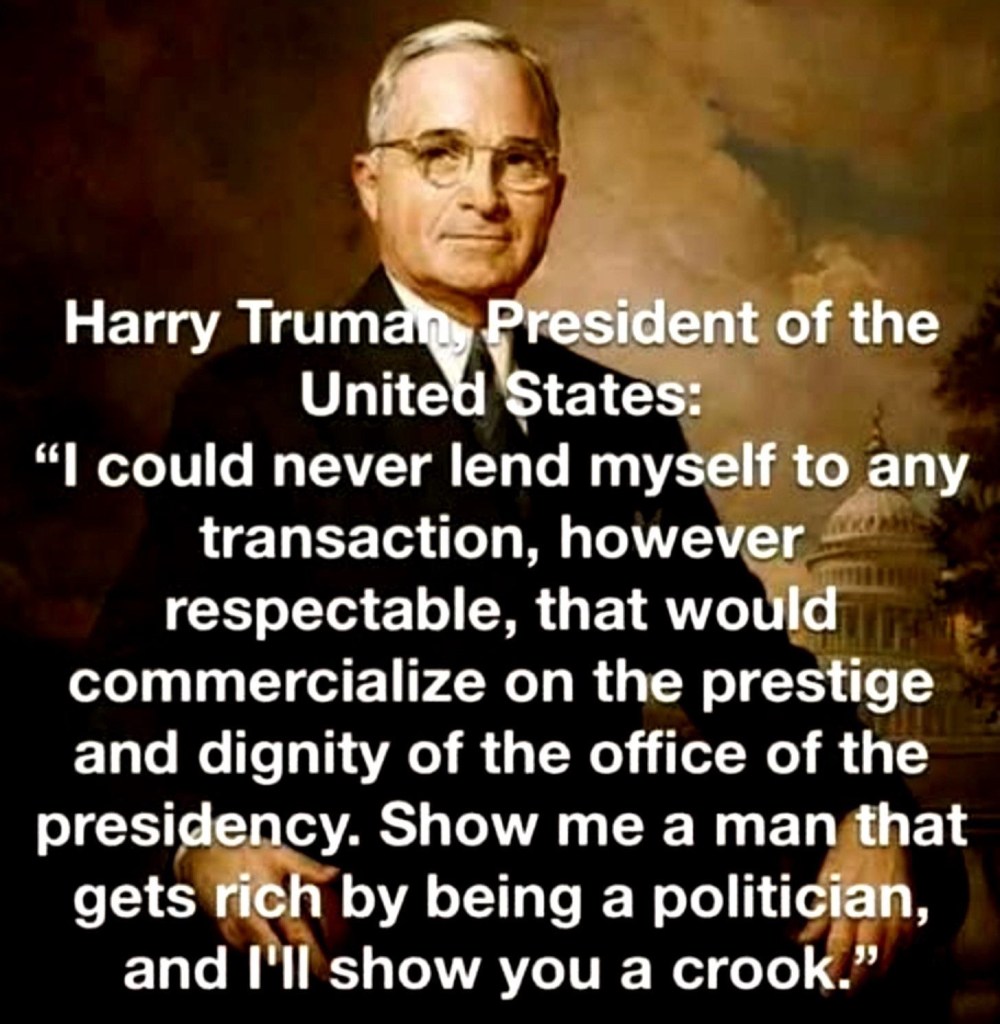
Truman didnt say anything about the President’s children!

Mary Trump wrote about how Eric and Donald Jr. are cashing in on their father’s Presidency.

Are there no laws against conflict of interest? Nepotism?

And to think that Republicans were outraged by Hunter Biden! Whatever he did (a seat on the Burisma board; name-dropping his father in business meetings?) is chump change compared to the money-grubbing Trump boys.

Where is the outrage?

Mary Trump writes:

Donald has always insisted that his children run their businesses independently. We have been told repeatedly that there is a bright line separating the presidency from the Trump family’s financial interests. We have also been told to ignore the remarkable coincidence that, every time Donald returns to power, his family somehow discovers lucrative new industries that depend almost entirely on decisions made by the federal government.

Those coincidences are becoming increasingly difficult to believe.

Since Donald returned to the White House, his two oldest and arguably most useless sons have dramatically expanded their investments into industries that rely almost entirely on Pentagon spending and federal policy. These are not businesses they spent years building. They are not industries in which either Don Jr. or Eric has any meaningful experience. They simply happen to be some of the fastest growing sectors benefiting from the Trump regime’s priorities.

Coincidentally, of course.

Don Jr.’s venture capital firm acquired a stake in Vulcan Elements shortly before the company received a $620 million Pentagon loan. According to reporting by ProPublica, that loan was accelerated after intervention from the White House.

Eric, meanwhile, serves as Chief Strategy Advisor for a robotics company despite possessing no discernible qualifications for such a role. That same company later received a $24 million Pentagon contract.

Neither Don Jr. nor Eric serves in government.

Neither is required to comply with federal ethics rules.

Neither files public financial disclosures.

Yet both continue to profit from industries whose fortunes increasingly depend on decisions being made by the administration run by their father.

Late in 2025, the Pentagon established the Defense Autonomous Warfare Group, appropriately abbreviated DAWG, to rapidly expand the military’s use of drones, robotics, and artificial intelligence. Initially funded at roughly $226 million for fiscal year 2026, the Pentagon is now requesting an astonishing $54.6 billion for fiscal year 2027.

That represents an increase of more than 24,000 percent.

It is also larger than the entire proposed budget for the United States Marine Corps.

Think about that for a moment.

The Pentagon is proposing to spend more money on autonomous warfare than on the Marine Corps itself.

And it just so happens that Donald’s two oldest sons have recently become enthusiastic investors in autonomous defense technologies.

This is what MSNBC reported:

This is a major business move and another in a series of examples of the president’s family’s dealings seeming to intersect with his administration. In this case, the Pentagon, as the war with Iran rages on. Just yesterday, drone maker PowerUS announced it will merge with a golf course holding company backed by Trump’s sons Eric and Don Jr., with plans to create a new publicly traded company. That new company calls the Trumps notable investors and says it aims to support American drone industry dominance. The company is expected to compete for lucrative military contracts, trying to fill a void created after the Trump administration banned new foreign made drones on national security grounds. An investment firm joined by Donald Trump Jr. shortly after his father’s reelection has also taken a significant stake in another defense contractor supplying AI powered military technology to the Pentagon. The Trumps maintain their father is not involved in their business dealings, and the White House says President Trump acts only in the best interests of the American people.

The phrase “notable investor” deserves closer examination.

It does not mean Don Jr. or Eric possess unique knowledge about robotics, drones, artificial intelligence, or national defense.

It certainly does not suggest either of them suddenly became experts in autonomous weapons systems. It means they are the sons of the President of the United States. That relationship is their greatest asset. It is the reason companies want them associated with their businesses. It is the reason investors pay attention. And it is almost certainly the reason government contracts suddenly become easier to obtain.

No private citizen should be allowed to leverage proximity to presidential power in this way.

Yet that appears to be exactly what is happening.

Members of Congress are beginning to ask difficult questions.

Following ProPublica’s investigation into Vulcan Elements, Democratic lawmakers demanded explanations after learning that the company’s $620 million Pentagon loan was reportedly handled very differently from virtually every other application under consideration.

According to the report, Don Jr.’s investment firm, 1789 Capital, purchased a stake in Vulcan during 2025. Only months later, the Pentagon approved the largest loan ever issued through its Office of Strategic Capital.

Internal documents reportedly revealed that Vulcan’s application moved through the approval process with unusual speed after direct involvement from senior White House adviser Peter Navarro.

One anonymous Pentagon official summarized the situation bluntly.

The call came from the White House. We have to get this done.

The Pentagon insists political considerations played no role in the decision. Don Jr. likewise denies participating in securing the loan. Those denials become increasingly difficult to accept when viewed alongside the broader pattern.

One contract might be coincidence.

One investment might be luck.

One White House intervention might be explainable.

But eventually coincidences stop looking like coincidences.

They begin looking like a business model.

The deeper problem is that none of this violates the disclosure rules that govern executive branch officials because Don Jr. and Eric are not executive branch officials.

That loophole allows enormous sums of money to flow toward businesses connected to the First Family while shielding the public from understanding the true extent of their financial interests.

Transparency disappears. Accountability disappears. And public trust disappears right alongside them.

Unfortunately, this pattern does not stop with rare earth minerals or autonomous weapons.

It extends into robotics as well. 

Apparently, Eric Trump has now become an expert on robotics too, a development that would be more amusing if it were not attached to Pentagon spending, military applications, and the rapidly expanding market for autonomous weapons systems.

This is what Eric Trump said in a FOX state TV Interview:

We have to win robotics in the United States of America. You had a great segment two days ago, Maria, about the robot in Beijing that was literally running marathons and beating the fastest marathoners by seven, eight minutes for a full marathon. These are in the very early days. We better be winning this race in the United States of America. We are the greatest economy in the world, and that is exactly what this company is doing. I am telling you, he is doing a phenomenal job. When you go up and interact with these robots and they fist bump you, they high five you, they follow your commands. You bring in the AI economy. It is going to change industry, it is going to change military application, it is going to change hospitality. The uses are unlimited and I think it is a very beautiful thing, but we must win this race.

What race, exactly?

The marathon the robot is running?

In what universe does the world become a better place because we have fast-running robots that can fist bump people? Although, to be fair, I would be more than happy to have robots replace Eric and Donnie.

Eric is listed as Chief Strategy Advisor, which, after listening to him speak, makes perfect sense if the strategy is to say a lot of words without demonstrating any understanding of the subject matter. In April 2026, the Pentagon awarded Foundation Future Industries a $24 million contract to test its Phantom robotic systems for military applications. That contract immediately drew attention from lawmakers concerned about potential conflicts of interest.

This is what Senator Elizabeth Warren said:

Is the Pentagon just a cash machine for Trump’s kids now? This looks like corruption in plain sight.

Yes. It does.

The Pentagon has defended the contracting process and has not alleged wrongdoing by Eric or the company. Of course it has not. This is Pete Hegseth’s Pentagon. Expecting it to objectively assess whether Donald Trump’s son is benefiting from conflicts of interest is like asking Donald to fact-check his own net worth.

We need a slightly more objective entity to decide whether there is wrongdoing here.

In May 2026, Ranking Member Robert Garcia wrote a letter to the Department of Defense laying out the concerns with unusual clarity.

Eric and Donnie’s purchases, consultancies, and advisory roles create unprecedented intertwining of Donald’s personal financial interests with U.S. policy and national security. Each new venture opens new opportunities to direct DOD funds to the first family’s pockets, and the Trump administration appears to be taking advantage of those opportunities. Such actions raise concerns that DOD is rewarding companies with contracts for recruiting a Trump family member into their ownership group or directly onto their payroll. Such companies have amassed over $725 million in loans, grants, and awards since Donald took office.

No kidding.

The coincidences are mind-boggling.

The Pentagon maintains that its decisions are based on merit, which is a difficult claim to take seriously when Pete Hegseth is the Secretary of Defense. His appointment alone is evidence that merit is not exactly the organizing principle of this administration.

Because neither Eric nor Donnie is subject to federal disclosure requirements, the public has very limited visibility into the scale of their financial exposure. That is precisely how this kind of corruption is allowed to happen. The President’s children can invest in, advise, or promote companies that stand to benefit from federal contracts, while the American people are left guessing how much money they are making and how directly their father’s administration may be helping them make it.

This is the Trump family business model in its purest form. Find an industry dependent on government action. Attach the Trump name to a company operating in that space. Let the machinery of government create the opening. Then insist there is nothing to see when the money begins flowing.

The problem is not merely that Eric and Donnie are unqualified. That has always been the least surprising part of the story. The problem is that their lack of qualifications does not matter. In fact, it may be part of the point. Companies do not need them for their expertise. They need them for their access.

This is the same pattern that has defined Donald’s entire life. He has never understood the difference between public power and private profit because nobody ever forced him to learn it. Fred Trump built the empire. Donald inherited it, hollowed it out, sold off pieces of it, and survived only because other people kept rescuing him. Now his sons are applying the same principle to national security.

The stakes, however, are much higher this time.

We are not talking about failed casinos, licensing deals, branded steaks, or golf course scams. We are talking about drones, rare earth minerals, autonomous warfare, artificial intelligence, robotics, and Pentagon contracts. We are talking about the future of American military policy and billions of dollars in public money being routed through a system in which the president’s family appears to have direct financial interests.

There needs to be an investigation.

Someday, when we finally get through this mess, Eric and Donnie need to be held accountable, stripped of their ill-gotten gains, and, if warranted by the evidence, prosecuted. The American people should not be treated as a revenue stream for the Trump family. The Pentagon should not function as another Trump family ATM. National security should not be turned into a business opportunity for two men whose only qualification is their last name.

Senator Chris Murphy of Connecticut gave a stunning speech about the normalcy of corruption in the Trump White House. Senator Murphy spoke about “500 Days of Corruption,” in which he detailed numerous deals that enriched the Trump sons, Don Jr. and Eric. Typically, they invested in a company and with days or weeks, that company received a government contract.

Set aside 30 minutes and watch this speech. It is startling, infuriating, outrageous.

Just yesterday (June 29), the media reported that President Trump made $2.2 billion in 2025. $2.2 billion!

The New York Times reported:

President Trump reaped a stunning windfall in his first year back in the White House, including about $1.4 billion from his family’s cryptocurrency businesses, a new filing shows.

All told, the president pulled in at least $2.2 billion, a figure that includes other parts of his vast holdings, such as his real estate assets. That compares to a minimum of $622 million his enterprises pulled in for all of 2024, before he returned to the presidency.

One of his biggest hauls in 2025 came when an investment firm tied to the United Arab Emirates bought nearly half of the Trump family’s main crypto company, World Liberty Financial, a transaction that blurred the line between foreign policy and private enterprise.

Mr. Trump also collected hundreds of millions of dollars from sales of his $TRUMP memecoin and World Liberty’s sale of its own digital tokens.

Remember how the Republicans in Congress excoriated Hunter Biden because he was paid to serve as a board member for a company called Burisma in Ukraine? How many times did Trump and his allies speak with derision about “the Biden crime family”?

Penny-ante when compared to the shameless profiteering of the Trump family.

The President should have no problem paying his $5 million debt to E. Jean Carroll, which the U.S. Supreme Court refused to overturn or even the $83 million judgment that Carroll won in state court but Trump is litigating to avoid paying.

In response to a lawsuit filed by independent journalist Katie Phang, a federal judge has ordered the Department of Justice to “unredact” specific portions of the Epstein files or explain why it could not comply. A redaction is a black mark used to hide names or other material.

CBS reporters Joe Walsh and Daniel Ruetenik write:

A judge on Thursday ordered the Justice Department to either release unredacted versions of several files on the late sex offender Jeffrey Epstein or explain why it can’t do so, following a lawsuit accusing Acting Attorney General Todd Blanche of improperly redacting documents.

U.S. District Judge Emmet Sullivan gave the government until Thursday, July 2, to comply.

The documents in question include eight emails with either the sender or recipient blacked out, a draft indictment of Epstein with the names of potential co-conspirators obscured and a 2019 email that mentions several co-conspirators whose names were redacted. Sullivan also ordered the Justice Department to either release the interview notes behind several FBI documents summarizing unverified allegations against President Trump, or explain why it couldn’t release them.

The court order follows months of controversy over the Justice Department’s handling of the files, which were released in response to a federal law. Millions of records have been made public since December, including photos, emails and law enforcement documents from the federal investigations into the disgraced financier and his 2019 death in pretrial custody.

Lawmakers and Epstein survivors have raised questions about missing or heavily redacted records. The Justice Department has said only about half of the 6 million pages of documents it collected on Epstein would be released, and many of the released files are partially blacked out. The department has said the unreleased documents were either duplicates, unrelated to Epstein or protected by legal privilege.

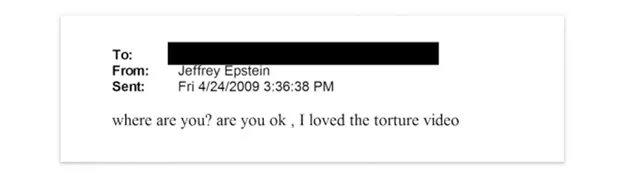
One of the emails covered by Thursday’s order — in which Epstein refers to a “torture video” — drew scrutiny earlier this year after Democratic Rep. Ro Khanna of California and GOP Rep. Thomas Massie of Kentucky questioned why the recipient was blacked out. Blanche later suggested on social media the recipient was Sultan Ahmed bin Sulayem, former CEO of the Dubai-based logistics firm DP World. CBS News has previously reached out to Sulayem for comment.

The Justice Department redacted the name of the recipient of this email released in the Epstein files. U.S. Department of Justice 

The department has defended its efforts, arguing the redactions are necessary to protect personal information or victims’ identities.

Thursday’s court ruling was spurred by a lawsuit filed in April by independent journalist and legal commentator Katie Phang over the redactions, which she argues are a “brazen, shocking, and ongoing violation” of the federal law mandating the release of the Epstein files. She asked a judge to order the release of several unredacted files.

The Justice Department responded earlier this month by arguing Phang cannot sue to force the documents’ release because the proper recourse is for her to file a Freedom Of Information Act request. Phang’s lawyers on Wednesday pointed to denials of Epstein-related FOIA requests. The judge then directed the Justice Department to respond by 1 p.m. on Thursday, and after the department missed that deadline, he ordered it to release the documents Phang had requested.

Marc Elias and his Democracy Docket are leading figures in the legal battle to stop Trump’s assault on our election system. Trump is trying to gain access to state voter rolls, and Elias has repeatedly defeated him in court.

To our national shame, Trump tells the world that American elections are “rigged.” Our free and fair elections are one of the major elements of our democracy. But the proof that they are rigged is that Trump got re-elected despite a disastrous first term, despite multiple convictions, and despite his allegiance to his fellow billionaires. The question is: how did he rig it? Was it Elon Musk’s Starlink satellites, 10,000 of them circling the earth? Someday we will know.

Elias writes:

Donald Trump desperately wants to build a national database of voters. His plan is to have his administration control who stays on the list and who gets removed. He has issued unconstitutional executive orders to accomplish this goal, and the U.S. Postal Service has proposed a new rule to do his bidding.

The problem for Trump is that his Department of Justice keeps losing cases that it needs to access this critical data. This humiliating string of defeats threatens to derail Trump’s signature plan to subvert the 2026 midterm elections.

This morning, a federal judge in Maryland handed the DOJ its ninth defeat in a series of 31 cases the department has filed to gain access to state voter files. The DOJ has yet to win a single one. The court wrote that it “joins every court to have addressed this issue in concluding that [a state voter file] is not a record or paper that a state must produce to the United States.”

Importantly, of the nine cases the DOJ has lost, five were decided by judges nominated by Trump. This is nothing short of a debacle for Attorney General Todd Blanche, Assistant Attorney General Harmeet Dhillon, and the rest of the department’s leadership.

From nearly the start of Trump’s second term, the DOJ began seeking access to these voter records. Initially, many assumed this was simply an effort to bolster false claims of widespread voter fraud.

Proponents of that theory contended that the administration would highlight a handful of names on the list as supposedly fraudulent — ginning up his supporters and providing talking points for Republican candidates.

From the start, I have argued that this plan was not simply about spreading lies and disinformation. It was not only aimed at creating an environment to undermine free and fair elections — it was the lynchpin to achieving that outcome.

The distinction is critical.

There remains a faction in the pro-democracy camp that believes Trump’s anti-voting rhetoric and actions are largely performative. They view the fights over the SAVE Act, mail-in voting and access to voter files as mostly a messaging effort.

Underpinning their view is the belief that our election systems are strong and that voter suppression laws are ineffective. Historically, they have treated legal fights over these laws as less important than the messages they send to voters.

By contrast, I take Trump’s attacks on voting rights both literally and seriously.

I believe voter suppression laws can alter the outcomes of elections, and I have watched our election system become weakened by years of sustained attacks. Most importantly, when Trump says he wants to take over voting and vote-counting, I believe him — and I plan accordingly.

That is why, when the DOJ started suing states to obtain access to their voter lists, I did not simply call it out — my law firm joined the legal fight. And we did not just pick a case or two. Instead, we made a substantial investment to defend the rights of voters in all 31 cases brought by the DOJ.

So far, that approach has paid off. Today’s victory brings us one step closer to the goal of protecting the 2026 midterm elections. However, Election Day is still months away, and many fights remain — both in court and in public.

In the days, weeks, and months to come, the midterms will come into sharper focus. As Republican electoral prospects wane, Trump will grow more desperate, and that desperation will lead to even more extreme actions by the administration. It will also require much more litigation.

On behalf of the Democratic Party, we have already sued to block Trump’s anti-voting executive orders. If the USPS adopts an anti-voting rule, we will bring litigation to stop it.

In the next few weeks, the Supreme Court is set to decide a critical mail-in voting case brought by the Republican National Committee. At issue is whether ballots mailed and postmarked by Election Day may be counted even if they arrive in the days afterwards.

The outcome could disenfranchise tens of thousands of lawful voters. My firm and I are defending against that lawsuit as well.

And, of course, the fight in the 31 voter file cases continues. Twenty-one trial courts have yet to rule, and the DOJ is appealing its defeats in nearly every case. In each one, we are battling back.

The road ahead for democracy is narrow and filled with obstacles — but we have already shown that we can clear them. I will continue to do everything I can in court to ensure safe passage for voters, and today’s victory is proof that when we fight, we can win.

During the 2024 campaign, Trump met with leaders of the oil and gas industry and asked them to raise $1 billion for his campaign. He promised to be their champion.

I don’t know whether the industry delivered for Trump, but he has certainly delivered for them. He has opposed alternative sources of energy, treats climate change as a hoax, and canceled federal contracts for wind and solar projects that were well underway. He loves fossil fuels and plans to revive the coal industry. Trump is a champion of “clean coal,” whatever that is.

While Europe, China, and Japan forge ahead with the expansion of alternative sources of energy, the U.S. is investing in the energy sources of the past.

Redeeming his promise to the coal industry, Trump recently launched planning for a coal-fired power plant in West Virginia. The contract for the design and feasibility was awarded to a Trump crony with no experience in the field.

A man the Trump administration picked to be a key player at the fore of a U.S. coal renaissance is likely more familiar to QAnon circles than energy ones.

TerraSpark’s project carries big promises. The proposed 1.6 gigawatt facility — touted by the Trump administration last week — would be the first new coal-fired power plant built in the U.S since 2013. It vows to infuse up to 1,000 jobs into West Virginia, a state rich in coal-mining history that’s seen its industry wither over the past two decades.

But few if any Trump administration energy allies have heard of TerraSpark or Alex Phillips, who is running the company with two other people also lacking coal backgrounds. Even the Republican lawmaker whose district would host the massive coal plant and carbon capture project learned of it just two months before the Energy Department this month agreed to give it $18.5 million of taxpayer dollars to pay for a feasibility and design study.

While Phillips has no energy industry experience, he has hovered around Washington politics during the Trump era. The owner of a rural Virginia internet business served on telecommunications advisory boards. He was past president of a wireless internet company trade association that also had a political action committee. And he operated his own PAC, the Great American Patriot Project, that backed candidates who “adhere to the United States Constitution and America First principles.”

He made more of a name for himself within the MAGA movement through his American Priority Conference, known as AMPfest. It drew QAnon promoters and personalities like Roger Stone — President Donald Trump is a longtime friend and former client — former National Security Adviser Mike Flynn and other MAGA influencers with a history of touting conspiracy theories, particularly the lie that widespread voter fraud cost Trump the 2020 election.

AMPfest and Phillips’ American Priority organization have since closed shop, with the last AMPfest held in October 2021 at Trump National Doral in Miami. Before then, however, he became integral enough to MAGA world to secure a speaking spot alongside far-right provocateurs like Alex Jones, Scott Pressler and Jack Posobiec at a rally on the eve of Trump’s Jan. 6, 2021 “Save America” event.

While Phillips did not end up speaking at that event — according to Mother Jones, which did not report why — he embraced election denier theories from the scene. He also encouraged then-Vice President Mike Pence to refuse to certify the 2020 election, saying he “needs to step up.”

“I think that there’s been overwhelming evidence provided in so many different formats, ways, that any congressman or senator that doesn’t think that there was some kind of irregularity that needs to be looked at in these seven states is just not paying attention or is corrupt,” he told Citizen Media News outside of the Capitol on Jan. 6.

Phillips referred questions to a public relations firm, which made another TerraSpark partner, Bill Tolpegin, available for comment. Tolpegin said in a statement that Phillips had no contact with the White House or Energy Department about the grant. Tolpegin said that the company “had no special, unique or otherwise different levels of access, communication with or attention from administration officials.”

But Phillips’ latest career act is nonetheless illustrative of Washington politics during Trump’s White House sequel, where allies have often won contracts or jobs.

“This is not normal,” Mike McKenna, an energy lobbyist who worked in the first Trump White House, said of DOE approving federal grants for a company with no track record in the industry.

McKenna said he is aware of two companies “with decades of experience in generating electricity” that have struggled to navigate DOE processes.

“These companies are no doubt going to ask if companies and people with no experience can do this, why can’t we?” he said. “I don’t want to be that guy, but this is obviously political. And the more political it is, the less likely it is to happen,” he said of building new coal plants.

White House spokesperson Taylor Rogers said in a statement that Trump’s coal grants are part of his commitments to buoy the nation’s coal industry, such as directives to run coal plants beyond scheduled retirement dates that DOE has credited for preventing electricity blackouts.

“The media’s continued attempts to fabricate conflicts of interest are irresponsible and reinforce the public’s distrust in what they read,” she wrote in response to questions about Phillips and TerraSpark.

Rogers referred POLITICO to DOE for questions about the grant process. DOE spokesperson Ben Dietderich said the department selected TerraSpark through a “competitive merit review process” that included evaluation of “technical merit, programmatic relevance, and the applicant’s ability to successfully execute the proposed work.” He did not address questions about Phillips.

“The economics of the project will speak for itself, and are highly competitive,” Tolpegin said.

Coal and carbon capture

What TerraSpark envisions is complex and expensive. A power plant the size it foresees would likely cost more than $1 billion — and that’s before accounting for technology to capture carbon dioxide emissions as proposed.

In addition to Phillips and Tolpegin, who calls himself a “serial entrepreneur,” the company has a third partner, Cory Cipra, a Kansas City-based technology consultant whom Tolpegin said has “a deep background working with utilities.” The company applied for the DOE grant in December and said it will not receive the funding until it comes up with the remaining $21.5 million needed to fund its study.

In an interview with POLITICO, Tolpegin said he founded the company with Phillips to bring online more energy generation “in a way that’s as clean as possible” that could eventually be “carbon negative.”

He called the company’s lack of experience in coal a “good thing.” Prior carbon capture attempts have been limited by “conventional” carbon capture technologies, he said.

“We’re not building your grandparents’ coal plant,” Tolpegin said. “We’re going to be building something new that I hope can flip the script on coal.”

The project was not on DOE’s radar a year ago, said Steve Winberg, who ran DOE’s fossil energy office in Trump’s first term and was undersecretary of infrastructure at DOE until May 2025. He said he knew some of the people involved in TerraSpark — he would not say who — but not Phillips.

The pool of potential grant winners was much larger earlier this winter. DOE’s National Energy Technology Laboratory, which handles power generation and coal research, briefed the agency front office in early March on at least seven viable selections for the federal money, according to three people familiar with the process, who were granted anonymity to discuss internal government deliberations.

DOE ultimately picked two proposals for new coal plants, including a project in Alaska — which was awarded an $89 million grant — and the TerraSpark plan to build in West Virginia. Another two projects for existing plants also received awards. 

“Some of these companies are probably three connected guys who threw an application together,” said one DOE official granted anonymity because they were not authorized to speak with reporters. They said the TerraSpark proposal deserves scrutiny. “And the DOE review that occurred would likely not surface that and/or was specifically disinterested in figuring that out.”

TerraSpark does not have much of an online presence, registering its website in July 2025, according to a domain registry. Its website did not name any company officials until a press release for the DOE grant appeared late June 4.…

Kevin Hagerty, a commissioner of Grant County, where the project is slated to be located, said there had been rumors of a project but that he didn’t learn of specifics until DOE announced the grant. Nonetheless, he said people in the Trump-backing county were excited about the support for the state’s shrinking coal industry.

The project is in early stages. While TerraSpark said the project will be located in Mount Storm, it has not yet selected a location, and does not own land in the county.

The partners are also still exploring what specific end users, such as a data center, will be attached to the project.

On June 4, the day DOE announced its grant, TerraSpark’s website said the coal plant would be accompanied by a 1-gigawatt AI data center. By the next day, the website instead said the plan would be paired with a “multi-industry campus.”

Tolpegin said some details on the website were updated to correct “stale” information and that the “first phase” of the project would be building the coal plant in the next few years, with tenants to be determined later. The company has also said it eventually plans to connect the plant to the grid.

Uphill battle for new coal

Energy companies and utilities have been reluctant to build new coal-fired power plants in the U.S. for myriad reasons. Environmental regulations raised the cost of burning coal. A gusher of natural gas made that fuel more economically competitive. Plummeting solar and wind costs pushed more capital-intensive coal facilities out of the mix.

Yet tech companies have proven willing to explore costly energy projects like geothermal and nuclear to feed energy-hungry data centers. Trump, meanwhile, has pledged to revive “clean, beautiful coal.” Some coal backers are quietly optimistic that those trends will benefit them.

“You think about the speed to which you need to get a data center going, people assume it’s going to be natural gas, but then you’ve got that turbine problem — long lead time on those,” Winberg said. “A lot of people assume it’s going to be nuclear, but you’ve got a long, long lead time on the nuclear. So coal is starting to fit into the mix again.”

But analysts in the energy sector have been skeptical of the TerraSpark project’s viability.

Seth Feaster, an energy data analyst at the Institute for Energy Economics and Financial Analysis, a think tank that supports a shift to cleaner resources, said that while many large energy infrastructure projects are built by experienced energy utilities, DOE in its June grant announcement turned to companies that don’t appear to have deep pockets or relevant experience.

“Who’s financing them, who’s going to invest in them?” he said. The government grants will “help a little bit, but you’ve got to convince the markets of the credibility of your project.”

“I find that pretty thin at the moment here,” he said.

Ryan Sweezey, director of North American power and renewables at the consulting firm Wood Mackenzie, said that if the developers plan to have a data center or other industrial customers that directly tie in to the plant, coal boilers likely won’t be able to ramp up and down quickly enough without batteries.

Sweezey said the executives’ lack of experience in energy or coal plant development was a “major red flag.”

Hooking up AI data centers directly to power sources — an increasingly popular model for the electricity-devouring sector — is “very complicated” and requires “serious expertise,” said Sweezey.

Adding a carbon capture and storage system to the mix further complicates that picture, and would catapult the overall cost, which could be over $10 billion, he predicted. Tolpegin said the entire cost of the energy campus and coal plant could be “in the billions.”

TerraSpark has partnered with Mantel, a carbon capture startup founded by MIT alumni in 2022, and Sargent & Lundy, an energy engineering firm. The Chicago-based firm has built more than 100 projects related to carbon capture in the last five years, according to its website, and completed work on the Petra Nova project in Texas, the only U.S. power plant currently operating carbon capture at commercial scale.

In a statement, a Mantel spokesperson said TerraSpark is one of many customers and that it is “committed to delivering efficient, scalable carbon capture solutions wherever they can have the greatest impact.”

The energy technology service provider Babcock & Wilcox is also part of the project, along with carbon capture consultants Advanced Resources International.

In a statement, Babcock’s communications director, Sharyn Brooks, said the company has decades of experience with boiler technologies, which positions the company “to support advanced coal generation projects with proven, high-efficiency technologies.”

“Our role is focused on providing engineering and technical support,” Brooks said.

Representatives of Sargent & Lundy and Advanced Resources International did not respond to requests for comment.

Terraspark’s ambitious plans also call for building a new campus for West Virginia University to focus on extracting rare earth minerals from coal waste, and could eventually acquire coal ash from other locations to process for rare earths.

That would be a massive undertaking for any developer, said Rudra Kapila, a director of carbon management and hydrogen at think tank Third Way, who evaluated carbon capture grant proposals for DOE during the Biden administration.

“I mean, who is this Johnny?” she said.

Ben Lefebvre contributed to this report.

Timothy Snyder is an expert on European history. He taught for many years at Yale University and held a prestigious chair in European history. In 2025, he accepted a chair at the University of Toronto. His Substack blog is titled “Thinking About…” This important essay appeared in May 9. Nothing Snyder says here has changed.

He wrote:

The United States has just spent billions of dollars to lose a war that enriches its oligarchs, impoverishes the citizenry, sabotages its alliances, and strengthens its enemies. As justification for the self-destructive mindlessness, the White House gestures towards Jesus and genocide.

On April 20th I was asked to speak in New York about ethics and power. My thinking, which I expressed in a conversation at the Council on Foreign Relations, on this little video, and in the media, was that our utterly unethical war was also utterly self-destructive. The war, a catastrophe in itself, suggests the guiding principle of Trump foreign policy: superpower suicide. The term was since come into more general use, and readers have been asking me to spell it out.

Empires have risen and failed before, but to my knowledge no state has ever chosen to kill its own power, and succeeded with such rapidity.

It is hard to see this clearly. Even as we oppose individual Trump adventures, we hope that in some way they are based on some understanding of the national interest. They are not. To get the perspective we need to see the nature of this anti-strategic self-slaughter, it will help to consider thirteen traditional bases of state power.

1. Statehood. A superpower must, at a minimum, be a modern state. This means that it must be an arrangement that includes, via law and other institutions, a larger body of citizens within a common endeavor. There is no sign that the Trump administration regards the United States of America as a state. It treats the existence of the United States as a commercial opportunity for a select few people, American and otherwise.

2. National interest. Another minimal requirement of superpower would be a sense of why that power must be used. The Trump administration exhibits no interest in the good of the people. Theorists of international relations have differed as to how leaders understand national interests; we are intellectually unprepared, however, for a situation in which the leader simply does not care about either the state or the nation.

3. Succession. Again, for a state to maintain itself as a superpower, it must maintain itself over time. The basic requirement of such continuity is a succession principle, a means by which authority is transferred from some people to other people while institutions continue to function. In the United States, democracy enables succession. Historically, there are means of succession, for example by dynasty (or dynastic adoption, as in second-century Rome) or by the decision of a politburo, as in China or the USSR (in the US this would be a capitalist politburo, the sort of oligarchical coven that got us JD Vance). Getting from democracy to such different arrangements would end the American republic. Trump aspires to stay in power indefinitely, and says so. By putting the vote in question, he puts America in question, and thus American power.

4. Elites. For states to thrive and to accumulate and maintain power, the right people have to be in charge. There is no perfect means to achieve this, and there is the inevitable tension, as the Roman Stoics and others have noted, between the skills needed to rise to the top and those suited to serving some general interest. And those who rise to a position of authority will try to pass it on to their children; the Roman Catholic Church went to the extreme of insisting on priestly celibacy to block this tendency. Historically, powerful states seek ways to enable qualified people to serve in positions of authority, regardless of birth. Ancient China had an examination system. Napoleon established the principle of merit in both civilian and military life. The United States had a civil service that was the envy of the world as well as a military that was its most meritocratic institution. The Trump administration has chosen to disable the civil service and to purge the military command of people of quality. This process has been carried out by people who are themselves wildly unqualified to hold any sort of office, let along cabinet positions. To see where we are, we must understand that people such as Tulsi Gabbard, Kash Patel, and Pete Hegseth, about whom one might raise other objections, had no business accepting their nominations, since they lack any qualifications. The fact that such people could be considered, let alone appointed, is a marker of superpower suicide.

5. Education. In a deeper sense, a superpower must have a mechanism to refresh its society, and thus its politics and administration, by preparing its population to understand the challenges of the world. This administration has done the contrary. University students are forbidden to gather and to speak their minds; university administrations are threatened with retaliation if they allow their faculty to teach freely; libraries around the country, including in military academies, are purged of useful books; public education generally is replaced with scams whereby tax money is transferred from the poorer to the richer while schools themselves are starved; an unregulated internet is allowed and indeed encouraged to transform the public sphere into a realm of emotions and recriminations.

6. Science. The rise of great powers often involves an alliance between politics and science. The ancient Mesopotamians were astronomers whose systems of describing the heavens still mark our ways of thought; so were the Mayans. The Romans managed to operationalize Greek science to build, defend, and cure. The Renaissance was, by no coincidence, also the age of exploration. Modern imperial powers built state institutions to fund science and attract scientists; the United States from the 1940s was the outstanding example of this trend, and science (often as practiced by immigrants) was the most important basis of American superpower. Current American policy is to fund science on the basis of primitive ideological taboos, and to discourage young scientists from immigrating to the United States. Senior scientists are also leaving; a colleague in a central position in US science just told me that he is leaving the country in part because the overall environment is better in other places. It is also US policy to cast doubt on basic scientific observations, such as that of human-caused climate change.

7. Energy. Human groups that pioneer new forms of energy technology rise; those that do not fall. This might be the most profound truth of our history; a magnificent forthcoming bookdemonstrates the significance of energy transitions at the most profound level, that of the history of life on earth itself. Humans who mastered fire could consume more energy themselves. Humans who domesticated dogs could use their energy to hunt mammoths. Humans who domesticated plants could turn solar energy to their own purposes. Humans who understood weather and climate could turn wind energy to the purpose of exploration and conquest, as did the Vikings. The United States was established on the cusp of a transition to hydrocarbon energy: coal, oil, natural gas. These forms of energy are now becoming obsolete, not only in ecological but also in economic terms. And yet this administration has chosen to cancel America’s energy transition and subsidize technologies that have no future. This is superpower suicide in perhaps the most basic form. And nothing could benefit America’s chief rival, China, more than this choice.

8. Technology. It requires little effort to associate technology with the rise of great powers. Military achievement is associated intimately with innovation; from the spur to the machine gun, the causal relationship is not really contestable. While the United States spends gigantic amounts of money on weaponry, the Trump administration has chosen to focus on weapons from the past rather than of the future. Trump’s idea is battleships named after himself based on what he remembers of a movie. The plans for “Trump-class” battleships are a mixture of the fictional and the vulnerable, which does reflect the man. The notion is to invest untold amounts of money into a kind of weapon has been understood to be obsolete since 1943, and which if somehow built would be highly vulnerable to weapons other countries now have. This strategic atavism draws the United States away from national security in its most basic sense. The shape of modern warfare is revealed by the high-tech war between Russia and Ukraine, especially in Ukraine’s successful self-defense. The Trump administration chose to ignore the lessons of that war and to demean and defund America’s Ukrainian ally, to the detriment of American interests and American warfighting.

9. Diplomacy. This art, celebrated by great powers, has been trashed by the United States. It cannot be practiced without understanding other countries, as the most focused American diplomats have stressed (for example, Henry Kissinger, who can hardly be excused of softheartedness). It has rested, in the American and other cases, on the deliberate construction of a diplomatic corps where people train in languages and trade in knowledge. Under the Trump administration, the foreign service has been trashed. The principle of diplomacy, such as it is, is that other countries will do what we want because we are big and bad. This has not worked. The bizarre notion that the president can himself “make deals” is the sign of a religious cult; like most cults, its activity is the generation of ever more creative excuses for the lack of performance. There is no evidence that Trump knows how to negotiate, and abundant evidence that he does not: for example, defeat in trade wars with China; personal vulnerability to the preferences of Russian leaders, and the disaster of Iranian nuclear enrichment, of which Trump himself is the chief sponsor. In practice, critical negotiations, with Iran and elsewhere, have been put in the hands of two people, Steve Witkoff and Jared Kushner, with close personal relationships with the president and obvious economic stakes in the relevant conflicts. The diplomacy of the Huns was far more sophisticated than this. It is hard to overstate how primitive the current American approach is, and how much joy it brings to America’s enemies.

10. Alliances. Great powers have allies. To be sure, they might change these alliances rapidly for reasons of interest, as the East Roman (Byzantine) Empire famously did. The whole history of the Roman Empire, for that matter, was one of active diplomacy with neighboring barbarians (as the Romans saw matters); archaeology bears witness to the arrangements that were made. The history of modern European empires was also one considered alliances, as the architects of American superpower understood. Under the Trump administration, useful allies are mocked and marginalized for no reason other than personal whimsy and a sense of grievance. Because there is no sense of state or national interest, there can be no understanding that alliances are of service. Trump feels annoyed because he is losing a war and removes US troops from Germany; those troops are there to enable the United States to win wars. I personally cannot think of any other example in which the leaders of a great power behaved in this way, presumably because these kinds of choices are inconsistent with the maintenance of power. The United States now seems to be treating as “allies” middle eastern countries that have nothing to offer except their own interests in the use of American armed forces in their own region, permanent engagement in the disastrous politics of oil, and financial opportunities for people personally close to Trump.

11. The international system. Postwar America did something far more impressive than build a system of alliances; it essentially created a set of laws, rules, and norms that allowed American power to maintain itself and to expand. The European Union and NATO, so abused by the Trump people today, were indirect and direct results of American policies intelligently designed to maximize American trade and security interests. But the achievement was far broader than that, and indeed historically unprecedented: the construction of laws and conventions that kept one country in the center of the world. Today, the Trump people make themselves at the World Economic Forum, the Munich Security Conference and similar gatherings and complaining that the rules are against them — the exact opposite was the case, because America made the rules. In deliberately destroying its own international system, this American government is improving the position of its rivals China and Russia, who have been calling for exactly this to happen, but who lacked the ability to make it happen.

12. The idea of victory. A superpower wins in confrontations, at least some of the time. This administration loses again and again, and is seen to lose by others. Trump announced that his main weapon of influence would be tariffs, but then lost his trade war with China, leaving Beijing more powerful and more emboldened. The Russo-Ukrainian war is a curious case. It would serve the interests of the United States in prosperity and stability for Ukraine to win; but under Trump the United States has switched its policy to one of support for Ukraine to support for Russia. So it has lost in that way. But since the United States has made that pivot, Ukraine has performed ever better in the war, and Russia has performed worse. And so the United States, amazingly, has managed to be the loser in the same war a double sense: by failing to see its own interests, and then by failing to fail. The Iranian war is an obvious strategic defeat in every traditional sense; insofar as there were any American objectives, they were not achieved. Trump’s policies have left Iran with more enriched uranium in the hands of a more radical regime which holds new sources of economic power in the world. In the current situation, in which military options have been self-humiliatingly exhausted, the useful instruments would be those that involved communicating with the Iranian people or influencing Iranian society. Those institutions existed until very recently; they were willfully demolished, to great fanfare, in early 2026.

The United States is now governed by people who celebrate defeat in symbolic terms characteristic of states in disastrous decline. Consider Defense Secretary Hegseth’s description of the rescue of a US pilot as the resurrection of Jesus. The screaming blasphemy of this might distract us from its strategic helplessness. Christological images of this sort are used as propaganda to transform defeat in the real world into victory in some imaginary one. The US lost the war in Iran. Among other things it was not able to sustain an air campaign. The downing of a US fighter meant than an individual mission failed. It is happy news, of course, that the pilot survived. But the notion that this was a “literal miracle,” as Hegseth claimed, brings the United States, sadly, into the tradition of losers who use Jesus to claim to be winners. An historical example of this was Polish Romanticism, with its idea that the collapse of a republic (chiefly due to wealth inequality) made of Poland the “Christ of Nations.” Donald Trump’s own self-deification has to be seen in similar terms: a president who could assert power in this world would not have to claim that his real authority comes from another one. His fantasies of the total destruction of Iranian civilization are part of an apocalyptic panorama that is inconsistent with decent politics.

13. Finances. Though not the most interesting historical subject, budget disaster stands behind many of the most notable collapses of state power, ancient and modern. Under Trump our national debt now approaches $40 trillion. National debt is higher than GDP of the country for the first time since the end of the Second World War. That is a notable point of comparison: it is normal to run big deficits when facing the challenge of the scale of a world war. We are running huge deficits for an entirely different reason: because we decline to tax wealthy individuals and corporations. That is not an approach that is consistent with fighting and winning wars, nor with maintaining the social services that allow a modern society to function. More profoundly: it reflects an approach to politics — government as customer service to the very wealthy — that leads us from power to ethics.

The war can lead us to a diagnosis of superpower suicide. Wars cannot be won by people who have no idea what they are doing, because they have no frame of reference (such as the nation or the state) beyond their own feelings. They cannot be fought well when the wrong people are making the daily decisions and the wrong weapons are being deployed. They cannot be reasonably brought to an end when there is no practice of diplomacy and no notion of the value of alliances and no concern about corruption.

But even a strict focus on power will lead us back to justice. But just as the war is only a symptom of superpower suicide, so superpower suicide is only a symptom of a still deeper condition, the one that must be addressed.

Even if all we cared about were American power, we would have to ask ourselves how to undo the distortions of democracy and the drastic inequalities of that enabled world-historical levels of strategic buffoonery. After a year of Trump, we face a situation where reform and repair are not the relevant categories. And, in a certain sense, this is useful. The fact that we reached this point, the fact that just a year of Trump could bring superpower suicide, shows us that the prior status quo was unsustainable.

The systems that made the United States a superpower cannot be rebuilt as they were, nor should they be: they involved structural injustices that made the present attempt at self-annihilation possible. From where we stand now there are two ways forward: one is the self-induced downfall of the American republic; the other is to reconsider American ideals and to restructure American politics so as to bring the people greater power over a more just future.

*****

PS. If you would like to help Ukrainians defend themselves from Russia’s criminal war of aggression, please consider contributing to the Sky Defense campaign. For worse but also for better, as the Ukrainians have shown us, this is a time when civil society campaigns can contribute to general security.

Trump has spent a lot of time rescuing, pardoning and trying to reward the people who joined him in attempting to overturn his election loss in 2020. He is a giant baby. He is a sore loser. He lost decisively, and he refuses to accept it. More than 60 federal and state courts, including the U.S. Supreme Court, rejected his appeals because there was no evidence of election fraud.

Someday, with time, we will look back on Trump’s refusal to accept his defeat as a low point in our history. Of course, we will look at his two terms in office as the absolute nadir of our history, as a time he spent rolling back civil rights, environmental protections, international alliances, access to healthcare, defunding medical and scientific research, bullying universities, and censoring the mass media.

Trump bullied Governor Jard Polis of Colorado to free Tina Peters, and Polis succumbed:

Tina Peters, the former clerk convicted of participating in a scheme to chase election conspiracy theories promulgated by President Donald Trump, was released from prison Monday after the president successfully pressured Colorado’s Democratic governor into commuting her sentence.

Peters’ release was confirmed by the Colorado Department of Corrections. The state agency said it would have no more information about the 70-year-old inmate. Her sentence was shortened by Gov. Jared Polis last month after Trump waged a lengthy pressure campaign against the governor and his state.

Peters served less than a quarter of her nine-year sentence.

Peters was the first local election official to be charged with breaching security after the 2020 election. She snuck in an outside computer expert affiliated with My Pillow Chief Executive Mike Lindell — who himself denied that Trump lost the White House in 2020 — and the person copied the county’s Dominion Voting Systems computer server as it was updated in 2021.

Peters then joined Lindell onstage at a “cybersymposium” that promised to reveal proof that the election was rigged. Video and photos of the computer system upgrade, including passwords, were posted online. The move stoked false claims that voting machines were manipulated to steal the election from Trump.

Peters was convicted in 2024 of attempting to influence a public servant, conspiracy to commit criminal impersonation, violation of duty and other crimes by jurors in Mesa County, a Republican stronghold that supported Trump. An appeals court upheld her conviction in April, but ordered Peters to be resentenced because it said the judge who sent her to prison wrongly punished her for speaking out about election fraud.

Trump had championed Peters’ case, but because she was convicted under state law, he did not have the power to pardon her. Instead, the president pressured Polis to do so, lambasting him on social media and disinviting him to a White House meeting with other governors. The Trump administration also announced plans to dismantle the National Center for Atmospheric Research in Colorado and relocated the U.S. Space Command to Alabama.

Polis commuted Peters’ sentence on May 15. In a letter, he wrote that although Peters was convicted of serious crimes and deserved to spend time in prison, the sentence was “extremely unusual and lengthy” for a first-time non-violent offender.

Colorado Secretary of State Jena Griswold, a Democrat, called the move a “dark day for democracy” and said it amounted to “selling out our state’s justice system for Trump.”