Archives for category: Civil Rights

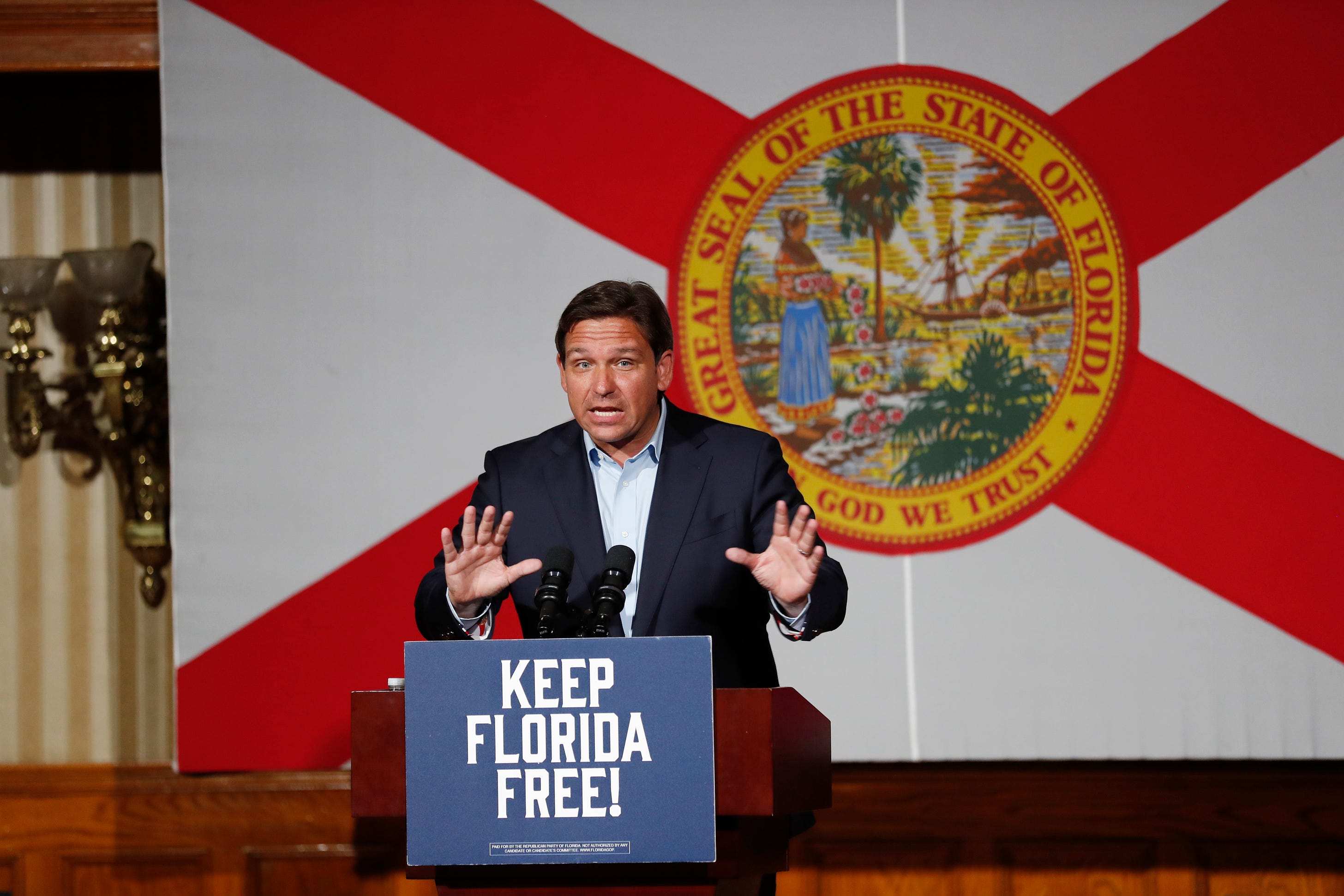
Florida has become a Petri dish for potential fascism. DeSantis has made war on African Americans, on gays, on transgender people, on drag queens, on public schools, on higher education, even on private corporations (Disney). He likes to stand behind signs that declare Florida is “free,” but no one is free to disagree with him. That’s not freedom.

Now DeSantis has proposed to create a military force that answers only to him. To call out the National Guard, he must get federal permission. That’s not good enough for him. He wants a Florida state guard. Some other states have them, but they are not in the hands of a would-be dictator whose vanity knows no limits.

CNN reports:

St, Petersburg, Florida (CNN) — Florida Gov. Ron DeSantis wants to reestablish a World War II-era civilian military force that he, not the Pentagon, would control.

DeSantis pitched the idea Thursday as a way to further support the Florida National Guard during emergencies, like hurricanes. The Florida National Guard has also played a vital role during the pandemic in administering Covid-19 tests and distributing vaccines.

But in a nod to the growing tension between Republican states and the Biden administration over the National Guard, DeSantis also said this unit, called the Florida State Guard, would be “not encumbered by the federal government.” He said this force would give him “the flexibility and the ability needed to respond to events in our state in the most effective way possible.” DeSantis is proposing bringing it back with a volunteer force of 200 civilians, and he is seeking $3.5 million from the state legislature in startup costs to train and equip them.

States have the power to create defense forces separate from the national guard, though not all of them use it. If Florida moves ahead with DeSantis’ plan to reestablish the civilian force, it would become the 23rd active state guard in the country, DeSantis’ office said in a press release, joining California, Texas and New York. These guards are little-known auxiliary forces with origins dating back to the advent of state militias in the 18th century. While states and the Department of Defense share control of the National Guard, state guards are solely in the power of a governor.

Will DeSantis use his state guard to break up peaceful demonstrations? Will he send it to drag shows to close them down? Will he it to harass teachers accused of being woke? The possibilities are frightening.

Dan Rather and Elliott Kirschner write a blog called Steady. Their voice is always thoughtful, reasonable, informed, and…steady. I think that they, like me, are old enough to remember when we believed that overt racism was ebbing and that white supremacy was dead. Our hopes have been shattered since 2016. It takes the use of critical race theory to understand why we were so naive. Here is their take on the big Education story of the day:

Photo credit: Octavio Jones

Editor’s note: this is an ironic banner in front of DeSantis. Florida is not free for those who don’t share his ideology. If you think racism exists today in Florida, you are not free to discuss it in school or college. You are free to agree with him.

Rather and Kirschner write:

Much of American history is entangled with racism and white supremacy. That is the reality of our beloved nation, no matter how much we wish it were not.

As we sit here nearly a quarter of the way through the 21st century, it is obvious that we need to have the maturity to look back to our past as well as ahead to the future. Can we do this with our eyes wide open? Will we study and learn from the lessons of history?

You can’t grapple with the truth if you hide it from view. Yes, our national narrative is an inspiring one — of freedom, rights, and new opportunities. But it is also a narrative of pain — of the bondage, rape, and murder of enslaved people. It is a story of mass death, broken treaties, and land stolen from Native people. And it is a story of persecution of the “other,” time and again.

The chasm between the noble promises of our founding documents and our historical realities continues to obstruct our national journey toward a more perfect union.

Yes, ours is a country that has facilitated exploration, innovation, and growth, but it is also one built upon families torn apart at the auction block, bodies whipped, and police dogs and fire hoses set against children.

Cities were redlined. Public schools were segregated. And despite our carefully cultivated national image as a meritocracy, throughout our history we have seen talent overlooked and our common humanity diminished on account of people’s race, religion, and sexual orientation.

The ripples of injustice continue to destabilize our society.

It shouldn’t be controversial to say any of this. But acknowledging these truths today is a political act, because it threatens the privileged narratives of those who seek to sugarcoat our past. These are men and women who serve their own ambitions by fortifying their cynical holds on power, delighting in division, feeding off fear, and applauding anger.

And that brings us to Florida’s Governor Ron DeSantis.

Listing all of his efforts to leverage the power of his office to attack equity, empathy, and justice would stretch this post immeasurably. But doing so would also jeopardize the central point: DeSantis is an opportunist. He is not weighing the merits of any one campaign. Rather, he wants headlines as a culture warrior standing up to “wokeness,” a term he has eagerly redefined to suit his own purposes. It allows him to sneer at and dismiss any attempt to reckon with American injustice.

DeSantis has focused his assaults on two of our society’s most traditionally marginalized groups: Black Americans and the LGBTQ community. While these populations have thus far felt the brunt of his targeting, we need to see clearly that his rhetoric is a threat to all who care about a democratic, peaceful, empathetic, and just America. Those of us with the greatest privilege should bear a special burden in rejecting this hate.

DeSantis’s pugilism has enabled him to consolidate power in Florida. Any opposition to his toxic initiatives must contend with the uncomfortable truth that voters validated his message and style via his landslide win in November. Now DeSantis thinks he can take his show on the road with a presidential bid. That remains to be seen. Florida has been trending Republican in recent years, and success there might not translate to the current battleground states, many of which saw big Democratic wins in the midterms.

All that being said, there is a great danger to framing this struggle primarily through the lens of electoral politics. This normalizes a discourse that should be rejected by society’s mainstream. Just as the outright bigotry of the past became socially unacceptable, so too should these latest attempts at divisiveness.

It should not surprise us that DeSantis is making schools — both K-12 and college — a central target. He wants to teach a distorted view of America. He wants to make dissenting speech not only suspect but even criminal. He wants to silence the voices of his critics and of critical thinking more generally. This is a playbook that has been followed by demagogues before to very dangerous ends.

It is essential that DeSantis not be covered by the press through a false equivalence paradigm. We can debate what we should teach and how to teach it. But we can’t replace the truth, as unsavory as it may be, with sanitized narratives that suit those already in power. This is a battle for the minds of the voters of the future. This is about what kind of nation we will become.

But DeSantis primarily cares about what kind of country we are now. He wants to appeal to fear because he thinks he can mine that fear for votes. That is his game plan. And he’s not hiding it. There can be no appeasement. DeSantis has already shown that he isn’t interested in deliberations or good faith compromise. Those would disrupt his approach of means to an end.

History illustrates that hatred can be taught, but so can empathy and justice. We are on a winding journey as a nation. And we have much farther to go. But we have made progress in the face of bigots and autocrats because people had the courage to forge the inequities of our past into a more equitable future.

This history, this truth, is what scares people like DeSantis the most. But it is one that can give us hope if we are determined not to look away.

Robert Hubbell writes a thoughtful, informative blog. I’m posting this as part of my personal project to understand the new face of white supremacy. White supremacy has always been there, simmering below the surface. Trump invited them to show their faces and step into the daylight. They did, and DeSantis is sending them signals that he wants to be their champion.

Florida Governor Ron DeSantis has set his anti-education sites on Florida’s state colleges. Through a series of political and legal maneuvers, he has ceded control over Florida’s state colleges to ultra-conservative culture warriors like Christopher Rufo. In short order, DeSantis has announced that he will rid Florida state colleges and universities of curricula not “rooted in Western tradition” or that “compels belief in critical race theory or related concepts such as intersectionality.”

Amid the torrent of reporting on Ron DeSantis’s attack on critical race theory and intersectionality, the quiet part is often left unsaid. So let me say it: DeSantis’s educational agenda is code for racism and white supremacy. (Other parts of his agenda seek to erase the dignity and humanity of LGBTQ people.) DeSantis’s invocation of “Western tradition” is meant to suppress knowledge regarding the people (and contributions) of Asia, Africa, South America, Oceania, and the Indigenous Peoples of the Americas. See Talking Points Memo, DeSantis Makes 2024 Ambitions Clear As He Pours Gasoline On His ‘Woke’ Education Fire.

Given DeSantis’s generalized ignorance, his call to focus on “Western tradition” is a slippery slope that will inevitably lead to the discussion of unpleasant truths about America. For example, the enslavement of Black people was a “tradition” in North America for 246 years—and the abolition of that evil practice is relatively recent (155 years ago). So, a college course that honestly addresses the Western “traditions” of North America should include an examination that the role of slavery played in the economic, social, and political development of America.

But DeSantis isn’t stopping at converting Florida’s colleges and universities into re-education camps in the worst traditions of the USSR. He is seeking to up-end centuries of “Western tradition” embodied in the Constitution and the English common law: the requirement of a unanimous jury to impose capital punishment. DeSantis has floated the idea that a less-than-unanimous jury verdict can impose a sentence of death—an unconstitutional proposal designed to inflict the death penalty on more Black and Latino Americans. See Vox, Ron DeSantis wants to make it much easier for the state to kill people.

DeSantis is willing to do all this because he wants to capture Trump’s loyal base—which is the only hope that DeSantis has of becoming a credible candidate. As Trump becomes mired in criminal prosecutions, DeSantis will become emboldened and radicalized beyond his already extremist views. Doing so ignores the lessons of the 2022 midterms: persuadable Americans are done with Trump and his MAGA extremism. Like all military generals, Ron DeSantis is fighting the last war (the presidential election of 2020) and has failed to heed the tectonic shift that occurred in the midterms.

The Miami Herald reported today on Governor DeSantis’ plans to cleanse higher education in the state. Conservatives are creating “civics” institutes as a vehicle for patriotic indoctrination, not as a means to think critically about how to improve democracy. Censorship, which DeSantis practices, would be condemned in any genuine civics class.

Gov. Ron DeSantis on Tuesday announced a package of major reforms to Florida’s higher education system, including tighter controls on faculty tenure, the establishment of “civics institutes” at three universities and prohibitions on diversity, equity and inclusion programs.

Speaking at a news conference in Bradenton, the governor unveiled a plan that would allow university boards of trustees and presidents to conduct reviews of tenured faculty members “at any time,” in addition to the periodic reviews that now take place. Regarding university presidents in particular, he proposes “reestablishing their authority over the hiring process.”

Currently, according to a flier distributed by the governor’s staff, “faculty committees can tie the hands of university presidents and bind them to only consider a small pool of recommended candidates.”

And under a heading in the flier that reads “Education not indoctrination,” he proposes changes in standards and course content “to ensure higher education is rooted in the values of liberty and western tradition.” His plan would require schools to “prioritize graduating students with degrees that lead to high-wage jobs, not degrees designed to further a political agenda.”

The proposal also would prohibit state schools from “supporting campus activities or programs that promote divisive concepts like DEI and CRT.” The letters refer to diversity, equity and inclusion programs and critical race theory.

In addition, he proposes establishing “world-class civics institutes” at the University of Florida, Florida International University and Florida State University. The institutes, according to the flier, would develop courses and curricula “that can be used to educate the next generation on the values of liberty and constitutionalism.”

The flier included information on the governor’s higher education budget proposals as well. He proposes $100 million for “recruitment and retention of highly qualified faculty at state universities” and $15 million for faculty and student recruitment at New College of Florida, where he recently appointed six conservative members to the board of trustees.

The New College board meets Tuesday for the first time since the appointments.

Read more at: https://www.miamiherald.com/article271870522.html#storylink=cpy

The College Board has not released the syllabus for the AP African-American Studies course that the state of Florida wants to ban because, they say, it has “no educational value” and violates state law by invoking “critical race theory.”

But the syllabus was released by NBC News and is easily found on the internet.

And here is the syllabus.

I suggest that you read it for yourself.

Stanley Kurtz, a conservative academic, wrote a scathing critique in National Review, where he blasted the AP course as “Neo-Marxist” and intent on propagating a socialist-Marxist-Communist mindset. Google and you will find follow-up articles by Kurtz.

I taught the history of American education, and I wrote books that specifically included the history of the education of Black Americans. To write about the history, I read many of the authors cited in the AP course. None of those authors, like Frederick Douglass or Carter Woodson or W.E.B. DuBois or Booker T. Washington, should be excluded from a course like this.

I will say without hesitation that the course is not, as Florida officials claim, “leftwing indoctrination.” Very few Americans know anything about African history, so my guess is that 99% of that history will be new to every reader. I am not sure why DeSantis is upset by “intersectionality.” A reporter should ask him to define it. I saw no problem in the mention of the Black Lives Matter movement or the reparations movement, because they are part of history; they exist. Why ban them? The DeSantis team wants the AP course of study to be upbeat; to show the celebratory rightwing view of American history; to exclude authentic African American thinkers, like Kimberlé Crenshaw and Michelle Alexander.

True there is a topic on “Black Queer Studies” that must drive Ron DeSantis and his allies crazy. I doubt that any students will be turned gay by learning about the topic. But this topic alone will be sufficient to get the course banned in DeSantis’ state and probably other red states. It might get axed by the College Board, which is alert to its bottom line. If the pushback hurts revenue, the College Board is likely to beat a hasty retreat.

Kurtz is right on one count. He wrote that “A stunningly large portion of the APAAS curriculum is devoted to the history of black studies.” This is true. Students will learn a lot about the leading scholars of the field and their contributions. Much of the scholarship is about the scholarship. And much, rightly, is about the brutal exploitation and degradation of African peoples.

In discussions with students about their expectations for the course, students said there should be an “unflinching look at history and culture.” Of course. They don’t want a sanitized history. They also said “Emphasis should be placed on joy and accomplishments rather than trauma.” They felt that they had learned about slavery every year, and “students feel they have been inundated with trauma.” In this course, it’s hard to find the “joy and accomplishments” that students are hoping to learn about. It is unlikely that they will learn much about barrier-breaking individuals like Dr. Charles Drew; LBJ’s Housing Secretary Robert Weaver; Guy Bluford (the first Black astronaut) or Mae Jamison (the first Black female astronaut); Ralph Bunche (the first African American to win a Nobel Prize for his diplomacy); Leontyne Price, the great international opera star, born in Laurel, Mississippi, or the newest international opera star Michelle Bradley, born in Versailles, Kentucky; or even the first Black President, Barack Obama. Of the hundreds and thousands of African Americans who have achieved their dreams, not much is said. The students say they know a lot about Dr. King, Malcolm X, and Rosa Parks; they want more. And they should have the pleasure of learning the inspiring stories of African-Americans who shattered stereotypes and made history.

The College Board says this is a preliminary version of the ultimate AP exam. It’s a good start. Let’s see if it can survive the political maelstrom.

Civil rights attorneys out the state of Florida on notice that it was prepared to sue if the state bans the new AP course in African American studies.

Florida’s Black leaders delivered a warning to Gov. Ron DeSantis on Wednesday that if he doesn’t stop attempts “to exterminate Black history” in Florida classrooms, they would sue him for violating the constitutional rights of students.

“We are here to give notice to Gov. DeSantis,’’ said Ben Crump, a Tallahassee civil rights attorney, to a cheering crowd of supporters in the Capitol Rotunda, as three high school students stood at his side.

They were protesting the announcement last week by the Florida Department of Education that it had rejected a new Advanced Placement elective course on African-American studies, developed by the College Board for high school students.

“If he does not negotiate with the College Board to allow AP African-American Studies to be taught in the classrooms across the state of Florida, these three young people will be the lead plaintiffs,’’ said Crump, who has represented families in several high-profile civil rights cases.

The College Board is expected to release its updated version of the AP course on Feb. 1, the first day of Black History Month. As a pilot program taught in 60 select classrooms around the country, the board has been soliciting feedback from teachers for modifications to the curriculum. It is unknown how many schools in Florida are involved in the pilot program.

Read more at: https://www.miamiherald.com/news/local/education/article271651587.html#storylink=cpy

Arnie Alpert is an activist in New Hampshire. In this post, he calls out the state GOP for attributing its racist “divisive concepts” law to Dr. Martin Luther King Jr. Its real author is Donald Trump, or more likely, Trump’s sidekick Stephen Miller. At the end of his article is a tape of Dr. king’s famous “I Have a Dream” speech of 1963. It has nothing in common with the GOP’s efforts to whitewash the curriculum of America’s schools. The GOP betrays Dr. King’s ideals.

When New Hampshire House Republican leaders quoted Martin Luther King, Jr. in their defense of the state’s “Divisive Concepts” or “Non-Discrimination” law last week, it wasn’t the first time King’s words were used to imply something quite different from what he intended.

All the law does, according to a statement from GOP Majority Leader Jason Osborne, R-Auburn, and Deputy Leader Jim Kofalt, R-Wilton, is prohibit “teaching children that some of them are inherently racist based on their skin color, sex, race, creed, etc. Is that not what Dr. Martin Luther King, Jr. called for when he said, ‘I have a dream that my four little children will one day live in a nation where they will not be judged by the color of their skin but by the content of their character?’”

To that I say, no, that’s not what he called for, not if one takes the time to review the entirety of the speech now known as “I Have a Dream.”

Since all sides to this controversy say they want history portrayed accurately, a review is in order, starting with the New Hampshire law in question.  The statute began its life in 2021 as HB 544, sponsored by Rep. Keith Ammon, R-New Boston, and co-sponsored by Rep. Osborne, aiming to bar teachers, other public officials, and state contractors from the “the dissemination of certain divisive concepts related to sex and race in state contracts, grants, and training programs.”

The proposal was not of local origin.  According to The First Amendment Encyclopedia, “’Divisive concepts’ legislation emerged in multiple states beginning in 2021, largely fueled by conservative legislatures seeking to limit topics that can be explored in public school classrooms. The laws have been driven in large part by opposition to critical race theory, an academic theory that says racism in America has largely been perpetuated by the nation’s institutions.”  Those proposals followed an Executive Order on “Combating Race and Sex Stereotyping” issued by President Donald Trump the previous year, which blocked federal agencies from providing diversity, equity, and inclusion training “rooted in the pernicious and false belief that America is an irredeemably racist and sexist country; that some people, simply on account of their race or sex, are oppressors.”

In its statement of purpose, the order cited the same brief extract from Dr. King’s 1963 speech, talked about the “significant progress” made in the intervening 57 years, and went on to criticize diversity training conducted in a variety of federal agencies.  It listed nine “divisive concepts” which would be prohibited, among them were that “the United States is fundamentally racist or sexist,” and that anyone “should feel discomfort, guilt, anguish, or any other form of psychological distress on account of his or her race or sex.” 

Trump’s order was deemed unconstitutional by a federal judge and later rescinded by President Joseph Biden, but it’s intent and language were picked up by legislators in several states, including New Hampshire. 

The Trump order’s list of “divisive concepts” was repeated almost word-for-word in Rep. Ammon’s bill, which received considerable attention from supporters, several of whom tried to recruit Dr. King among their ranks.  For example, a letter-to-the-editor published both in the NH Union Leader and Concord Monitor, stated, “HB 544 eliminates the use of Critical Race Theory (CRT) in the discussion of issues of race and the other ‘isms’ we are addressing today.”  It went on, “America has been moving in that direction of Dr. King’s idea for the last 50 years. We want to teach our children and share with our employees that we want to act in the way Dr. King has prescribed, not the CRT idea of systemic racism.”  Speakers made similar comments at a State House rally that spring, where one participant reportedly carried a sign reading, “Teach MLK, Not CRT.” 

But after a public hearing and extensive work in committee, HB 544 was tabled on the House floor.

The proposal was not dead, however.  Instead, it sprang back to life as a provision in the House version of the state budget.  Now titled, “Right to Freedom from Discrimination in Public Workplaces and Education” and with a somewhat reduced menu of concepts to be prohibited in schools and other public workplaces, the Finance Committee inserted it into HB 2, the budget trailer bill.  Under this version, “any person” who believed they had been aggrieved by violation of the law could pursue legal remedies. 

When Senate GOP leaders heard that Governor Sununu was not happy about the “Freedom from Discrimination” language, Senator Jeb Bradley re-re-wrote it, turning it into what is now the non-discrimination statute.  Once again the proposal’s scope was reduced, for example limiting it only to conduct of teachers.  But it did contain a provision that “any person claiming to be aggrieved by a violation of this section, including the attorney general, may initiate a civil action against a school or school district in superior court for legal or equitable relief, or with the New Hampshire commission for human rights.” 

It’s worth noting that other than in the original public hearing on HB 544, at no time did the House or Senate provide a meaningful opportunity for public comment on the proposal, whose final details were worked out in the rapid deliberations of a House-Senate conference committee.  

Following adoption of the budget, with the Bradley version intact, the NH Department of Education added a link to its website encouraging parents to report teachers they believe are disseminating ideas banned under the “Non-Discrimination” law.  A right-wing group promised $500 to the first family that files a successful complaint.

Given what we might call the “original intent” of its sponsors, it’s no surprise that some teachers are fearful that “any member” of the public might put their jobs at risk if they teach about the ways in which African Americans and other people of color have faced systematic discrimination. 

It was the clamor for laws that would end systematic discrimination that brought a few hundred thousand people to Washington DC on Aug. 23, 1963, for the March for Jobs and Freedom.  Inspired by A. Phillip Randolph, president of the Brotherhood of Sleeping Car Porters, the rally marked the 100th anniversary of the Emancipation Proclamation which ended slavery in the states of the Confederacy.  It took place shortly after demonstrations in Birmingham, Alabama brought inescapable attention to the brutality needed to maintain racial segregation.  By emphasizing jobs and freedom, the march sought to advance an agenda for job training and an end to workplace discrimination as well as voting rights and a civil rights bill that would end segregation in schools and public accommodations.  Dr. King was one of several major speakers.  

A century after emancipation, Dr. King said, “the Negro still is not free; one hundred years later, the life of the Negro is still sadly crippled by the manacles of segregation and the chains of discrimination.”  Referring to the Declaration of Independence, Dr. King said, the founders of the nation had issued “a promissory note to which every American was to fall heir.” 

“It is obvious today that America has defaulted on this promissory note insofar as her citizens of color are concerned,” he charged, saying that instead of following through on a promise, America had issued a bad check.  “We’ve come to cash this check, a check that will give us upon demand the riches of freedom and the security of justice,” Dr. King said. 

Seeking to rescue the nation from “the quicksands of racial injustice,” including “the unspeakable horrors of police brutality,” Dr. King said, “There will be neither rest nor tranquility in America until the Negro is granted his citizenship rights.  The whirlwinds of revolt will continue to shake the foundations of our nation until the bright day of justice emerges.” 

Looking back, there is no doubt Dr. King was addressing the collective and systematic discrimination experienced by African Americans, a view fully consistent with what HB 544 backers decried as critical race theory. 

Yes, progress has been made since 1963. But the realities of police brutality, extreme inequality, and denial of voting rights which Dr. King condemned are still with us. Dr. King can still help us find the way forward if we take the time to study what he actually meant.
Dr. Charles Foster Johnson, founder of Pastors for Texas Children, is a dear and beloved friend. I can’t give him enough praise for the work he does every day to protect the public schools of Texas and the five million children enrolled in them. He shared the following message today.

Dr. King and the Work for Justice

Dear PTC Pastor and Friend,


It is good to set aside a day as a nation to remember the world-changing life, ministry, and legacy of the Rev. Martin Luther King, Jr. The prophetic vision he cast for our nation is far from realized.


As a 65-year-old white man from Alabama, I remember very well how Dr. King was vilified by the white power structure of this nation. What the Hebrew prophet Isaiah said about the suffering servant was true for Dr. King: he was “despised and rejected.” He was assassinated not because he was popular but because he was hated. Indeed, God has used his death and martyrdom as means to bring our nation into a “more perfect union.”


In 2008, I was privileged to be inducted into the Martin Luther King, Jr. Board of Preachers at Morehouse College. I knelt with other ministers before the full congregation in the King Chapel that day, vowing before God that I too would dedicate my life and ministry to the justice of Christ. It was one of the most moving moments of worship Jana and I have ever experienced.


The Rev. Dr. Billy Kyles, Pastor of the Monumental Baptist Church of Memphis, was the day’s keynote speaker.

Rev. Kyles was on the balcony when Dr. King was murdered. They were on the way to the Kyles’ home for supper. He retold the story that day, moment by moment, building to the awful instant when the shot rang out.


Rev. Kyles began musing to himself in his sermon why God placed him on that Lorraine Motel balcony that day, at that historic moment, standing beside Dr. King. Then he paused, with the perfect timing of a great preacher, and said, “Now I know. I know why the Lord had me right there. Because every crucifixion has to have a witness.”


We dishonor Rev. Martin Luther King’s life and legacy with easy platitudes or historical whitewashing. We honor him– and our Lord who led him– only with the painful, painstaking work of justice-making.


That is why we stand strong for quality public education for all children. We have a long way to go in delivering this promise of justice. But, no private model of education will ever ensure this provision of God. Only the public trust can and will do this.


Thank you for bearing witness so faithfully to this call!


Rev. Charles Foster Johnson, Executive Director

DONATE TO PTC


PO Box 471155, Fort Worth, Texas, 76147

Check out our website  


I just read Dr. Martin Luther King’s last speech out loud.

It was an enthralling experience. Uplifting, inspiring, and a bit depresssing to realize what has not happened, the persistence of racism and poverty and inequality, the scoundrels who distort his message and try to prevent the honest teaching of our history. The racist legislators who say that teaching honest history is a “divisive concept” that will make white children uncomfortable. That assumes they will identify with the oppressors. That assumes that the truth will make them woke. I assume they willl identify with the oppressed and join with those who want change.

Read it. Out loud.

https://abcnews.go.com/Politics/martin-luther-kings-final-speech-ive-mountaintop-full/story?id=18872817

Historian Heather Cox Richardson reflects on the anniversary of Dr. Martin Luther King’s birthday. We now look on him as a hero, but during his lifetime, he was treated shamefully by many whites, and militant African-Americans scorned him as well, preferring the angry approach of Stokely Carmichael and Malcolm X. Dr. King was principled and fearless. He faced death daily, and he never back down. It is usually forgotten that he was assassinated in Memphis while there to support striking sanitation workers, who were trying to organize a union. He knew that unions offered the best protection for working people. White conservatives who fraudulently praise him now, claiming that racism is a thing of the past and should not be taught or discussed (so that everyone can be judged by “the content of their character, not the color of their skin”), oppose everything he fought and died for.

You hear sometimes that, now that we know the sordid details of the lives of some of our leading figures, America has no heroes left.

When I was writing a book about the Wounded Knee Massacre, where heroism was pretty thin on the ground, I gave that a lot of thought. And I came to believe that heroism is neither being perfect, nor doing something spectacular. In fact, it’s just the opposite: it’s regular, flawed human beings, choosing to put others before themselves, even at great cost, even if no one will ever know, even as they realize the walls might be closing in around them.

It means sitting down the night before D-Day and writing a letter praising the troops and taking all the blame for the next day’s failure upon yourself, in case things went wrong, as General Dwight D. Eisenhower did.

It means writing in your diary that you “still believe that people are really good at heart,” even while you are hiding in an attic from the men who are soon going to kill you, as Anne Frank did.

It means signing your name to the bottom of the Declaration of Independence in bold print, even though you know you are signing your own death warrant should the British capture you, as John Hancock did.

It means defending your people’s right to practice a religion you don’t share, even though you know you are becoming a dangerously visible target, as Sitting Bull did.

Sometimes it just means sitting down, even when you are told to stand up, as Rosa Parks did.

None of those people woke up one morning and said to themselves that they were about to do something heroic. It’s just that, when they had to, they did what was right.

On April 3, 1968, the night before the Reverend Doctor Martin Luther King Jr. was assassinated by a white supremacist, he gave a speech in support of sanitation workers in Memphis, Tennessee. Since 1966, King had tried to broaden the Civil Rights Movement for racial equality into a larger movement for economic justice. He joined the sanitation workers in Memphis, who were on strike after years of bad pay and such dangerous conditions that two men had been crushed to death in garbage compactors.

After his friend Ralph Abernathy introduced him to the crowd, King had something to say about heroes: “As I listened to Ralph Abernathy and his eloquent and generous introduction and then thought about myself, I wondered who he was talking about.”

Dr. King told the audience that, if God had let him choose any era in which to live, he would have chosen the one in which he had landed. “Now, that’s a strange statement to make,” King went on, “because the world is all messed up. The nation is sick. Trouble is in the land; confusion all around…. But I know, somehow, that only when it is dark enough, can you see the stars.” Dr. King said that he felt blessed to live in an era when people had finally woken up and were working together for freedom and economic justice.

He knew he was in danger as he worked for a racially and economically just America. “I don’t know what will happen now. We’ve got some difficult days ahead. But it doesn’t matter…because I’ve been to the mountaintop…. Like anybody, I would like to live a long life…. But I’m not concerned about that now. I just want to do God’s will. And He’s allowed me to go up to the mountain. And I’ve looked over. And I’ve seen the promised land. I may not get there with you. But I want you to know tonight, that we, as a people, will get to the promised land!”

People are wrong to say that we have no heroes left.

Just as they have always been, they are all around us, choosing to do the right thing, no matter what.

Wishing you all a day of peace for Martin Luther King Jr. Day, 2023.

—

Notes:

Dr. King’s final speech:

https://abcnews.go.com/Politics/martin-luther-kings-final-speech-ive-mountaintop-full/story?id=18872817