Archives for category: Charter Schools

An obscure board appointed by Oklahoma Governor Kevin Stitt voted 3-2 to approve funding a virtual charter school operated by the Archdiocese of Oklahoma City abd the Diocese of Tulsa. This violates the state constitution, as well as the First Amendment to the Constitution. Randi Weingarten, who is a lawyer, decried this action. The state will end up spending many more millions in legal fees, as it battles for its decision in the courts. If the decision is upheld, Oklahoma and other states can expect to fund yeshivas, madrassas, fundamentalist schools, even Satanic schools. We don’t need schools that indoctrinate; we need public schools that educate children to think for themselves and to respect others.

AFT’s Weingarten on Oklahoma Religious Charter School Approval
 

WASHINGTON—American Federation of Teachers President Randi Weingarten issued the following statement after Oklahoma approved a taxpayer-funded religious charter school:

“This decision not only threatens to siphon millions of dollars in public money into private hands, it strikes at the heart of our nation’s very foundations. The framers never intended to require public funding of religious institutions or religious schools.

“The combination of the Constitution’s free exercise clause and the concept of separation of church and state is what ensures religious freedom in the United States. This decision turns that idea on its head.

“It also turns on its head the concept that charter schools were supposed to be public schools run in a different way. And it vitiates the distinction between public and nonpublic religious schools in the eyes of Oklahoma.

“It is telling that a bipartisan coalition was opposed to the approval, and that only an obscure, hand-picked board of the governor’s own choosing was able to force it through.

“This ruling will no doubt end up at the Supreme Court. It is a clear and present danger, not only to ensuring public schools are open and accessible to all, but to religious liberty and freedom in our democracy writ large.”

Indiana blogger Steve Hinnefeld reveals a new charter scam: remote renewal of controversial charter schools. in this case, the charter is affiliated with the Christian rightwing Hillsdale College. Please open the link to finish the post.

Seven Oaks Classical School in Ellettsville received a 5-year extension to its operating charter recently. Well, not that recently. It happened in December 2022. Ellettsville and Monroe County residents may have missed it, though, because the extension was approved nearly 200 miles away.

It was approved by the three-member board of Grace Charters LLC, a nonprofit formed by Grace College and Theological Seminary to authorize charter schools, which are publicly funded and privately operated. The board met on the Grace College campus in Winona Lake, Indiana.

To meet legal requirements for public meetings, a notice was published in the local newspaper: the Warsaw Times-Union, which probably no one in Monroe County reads. One member of the public attended, according to minutes of the meeting: Seven Oaks headmaster Stephen Shipp.

The situation highlights the tension between public and private in Indiana charter schools. The Seven Oaks website says charter schools are “tuition-free, open-enrollment public schools.” But the school’s authorizer, which sets the terms of its operation and is supposed to hold it accountable, is a private, Christian college with no connection to the community where the school operates.

Seven Oaks is part of a network of charter schools aligned with Hillsdale College, a conservative and politically active private college in Michigan. The Hillsdale charter initiative once cast itself as part of a “war” to reclaim America from “100 years of progressivism” in education. Its president, Larry Arnn, led Donald Trump’s 1776 Commission and its promotion of “patriotic history.”

Grace College has also granted a charter to Valor Classical Academy, a Hillsdale-affiliated school that has stalled in its attempts to open in Hamilton or Marion County.

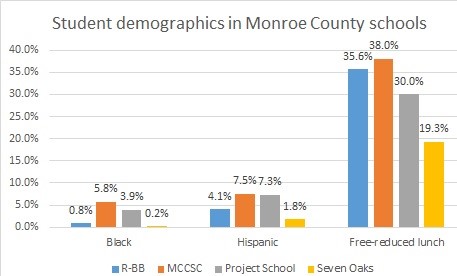
Along with the Hillsdale affiliation, there are other factors that distinguish Seven Oaks from public schools: for example, its demographic profile. Out of more than 500 students, one is Black and nine are Hispanic, according to state data. Fewer than 20% of students would qualify for free or reduced-price meals if they were provided. (The school doesn’t provide transportation or school lunches).

Bar chart showing percentage of Black, Hispanic and free-reduced lunch students in Monroe County schools.

This chart shows the percentage of students who are Black, Hispanic and eligible for free or reduced-price meals in Monroe County public school districts (Monroe County and Richland-Bean Blossom community school corporations) and charter schools (Bloomington Project School and Seven Oaks Classical School).

Nine of its 38 teachers are Hillsdale College alumni, according to profiles on the school’s website. In 2021-22, the most recent year for which a state teacher statistics report is posted, nearly 40% of its teachers had emergency licenses, compared with 4.6% in local public school districts.

The 24-page Seven Oaks charter extension reads like a standard agreement, with boilerplate language from state law and recommended practices for authorizing. It spells out the duties of each party, the expectations for the school, and the legal remedies if something goes wrong. An attached accountability plan includes out-of-date references to state assessments and, I’m told, is being revised.

The agreement says Grace College gets to keep 2.5% of the school’s state funding as an authorizer fee. That’s less than the 3% maximum that Indiana allows. In 2023-24, the college will net about $93,000.

Grace initially approved a charter for Seven Oaks in 2016 in one of Indiana’s first examples of what’s called authorizer shopping. The school’s founders applied to the Indiana Charter School Board, but it rejected their application. They reapplied but withdrew after a negative recommendation from the board’s staff. Then they took their plan to Grace College, which said yes to a 7-year charter.

At that time, private colleges could authorize charter schools in closed-door meetings with no public notice. Since 2017, they’ve had to use nonprofit authorizing agencies, such as Grace College’s Grace Charters LLC, that are subject to open-meetings and public-records laws. Even so, it can be hard to keep up. I started asking by email about the Seven Oaks charter extension in March; it took until late May to get copies of the December 2022 board minutes and the school’s extended charter agreement.

Transparency is one issue of having distant authorizers for charter schools, but there are others. The National Association Charter School Authorizers cautions against throwing the door wide open for higher education institutions, or HEIs, to authorize schools, as Indiana has done since 2011.

Edward B. Fiske was the education editor of the New York Times and editor of the Fiske Guide to Colleges. Helen F. Ladd is a nationally prominent economist of education and professor emeritus at Duke University. They are married, a power couple of American education. This article appeared on the website of WRAL in North Carolina.

Forty years ago this spring a national commission charged with evaluating the quality of American education issued a blistering report entitled “A Nation at Risk.” It cited a “rising tide of mediocrity” in the country’s schools and declared that the country’s failure to provide high quality education “threatens our very future as a Nation and a people.”

North Carolina leaders took this warning to heart. They began investing heavily in public education and even became a model for other states in areas such as early childhood education. Significantly, the state was making progress toward fulfilling its obligation under the North Carolina Constitution to provide a sound, basic education for all students.

The situation started to change, however, in 2012 when Republicans came to power and began an assault on public education that continues to this day.

When it comes to public education, North Carolina is now “A State at Risk.”

The Republican assault has taken multiple forms, starting with inadequate funding. North Carolina now ranks 50th in the country in school funding effort and 48th in overall funding. Despite widespread teacher shortages, the Republicans have kept teacher salaries low — $12,000 below the national average – and they have failed to provide adequate funding for the additional support staff that schools need.

In addition, they have permitted significant growth in the number of charter schools. Such schools divert much-needed funds from traditional public schools and make it difficult for local boards of education to operate coherent education systems.

The Republican-controlled Legislature is currently working hard to weaken public education by politicizing the process. Pending legislation would regulate how history and racism are taught, give a commission appointed mainly by lawmakers the job of recommending standards in K-12 subjects, and transfer authority to create new charter schools from the State Board of Education to a board appointed by the General Assembly.

The problem is about to get even worse. The Legislature is now poised to expand the earlier Opportunity Scholarship program, which had provided public funds for low income children to attend private schools, into a much larger universal voucher program that would make all children eligible regardless of family income – at an estimated cost of more than $2 billion over the next 10 years.

Given that private schools are operated by private entities typically with no public oversight and no obligation to serve all children, why in the world would it ever make sense to use taxpayer dollars to support private schools?

A common argument has been that voucher systems raise achievement levels of the children who used them. While some early studies of small scale means-tested voucher programs in places like Milwaukee showed small achievement gains in some cases, recent studies of larger voucher programs in places such as Ohio, Louisiana and Indiana consistently show large declines in average achievement — often because of the low quality of the private schools that accept vouchers.

Supporters also argue that vouchers provide more schooling options for children and that having more choices is a good thing. But in the context of education policy that need not be the case. Americans support public education – and make schooling mandatory – not only for the benefits it generates for individual children but also for collective benefits such as the creation of capable workers and informed citizens. What matters is the quality of education for all the state’s children.

An expanded voucher program would lead to a substantial outflow of funds from traditional public schools to privately operated schools, with the potential for a significant loss in the quality of our public schools, and subsequent vitality in the state’s economy.

A strong public education system – from elementary and secondary schools to the nation’s first public university, the University of North Carolina – has long been pivotal to our state’s cultural, political and economic success. We must stop the current assaults on public education and reaffirm our commitment to one of North Carolina’s great strengths.

Back in 1983 when the education system of the nation was “at risk,” President Ronald Reagan – who had earlier been lukewarm in his support of public education — took the warning seriously and began touring the country to talk about the problem. His successors from both parties then took up the cause and continued to make the case that a strong public education system is essential for a vibrant economy, and importantly, to make the policy changes needed to strengthen it.

Let’s hope that our current Republican leaders in this state can muster the wisdom and courage to follow the example of President Reagan and other leaders from both parties in pushing for strong public education. In the absence of such wisdom, we will indeed continue to be “A State at Risk.”

A reader who signs in as CarolMalaysia described the latest education-related laws passed in Indiana:

She writes:

These are some of the new Indiana laws that will take effect on Saturday. [Indiana is run by the GOP and they have NO respect for public schools or teachers.] Gary is a poverty area and they cannot vote for their school board members. 87% of Hoosier children attend public schools and they are continuously underfunded.

Book bans — Every public school board and charter school governing body is required to establish a procedure for the parent of any student, or any person residing in the school district, to request the removal of library materials deemed “obscene” or “harmful to minors.” School districts must also post a list of the complete holdings of its school libraries on each school’s website and provide a printed copy of the library catalogue to any individual upon request. (HEA 1447)

Charter schools — The proceeds of each new voter-approved school funding referendum in Lake County must be shared with local charter schools in proportion to the number of children living in the school district who attend charter schools. Beginning July 1, 2024, all incremental property tax revenue growth at Lake County school districts must be shared on a proportional basis with local charter schools. (SEA 391, HEA 1001)

Gary schools — A five-member, appointed school board is reestablished for the Gary Community School Corp. to eventually replace the Indiana Distressed Unit Appeals Board as the governing body for the formerly cash-strapped school district. Gary’s mayor and the Gary Common Council appoint one member each, and the three others are chosen by the Indiana secretary of education, including at least one Gary resident, one resident of Gary or Lake County, and a final member from anywhere. (SEA 327)

Pro Publica investigated the case of a child at Success Academy who was disruptive and learned that at a charter school, the chain is free to write its own disciplinary rules. The public schools are governed by regulations, but Success Academy is exempt from those regulations.

ProPublica told the story of Ian, whose mother left work repeatedly to find out why Success Academy had called the police about the child. It seems clear that the school was trying to persuade her to withdraw Ian. But she kept showing up. It also seems clear that Ian’s behavior got worse because of the school’s rigid discipline.

In a panic, if she floors it, Marilyn Blanco can drive from her job at the Rikers Island jail complex to her son Ian’s school in Harlem in less than 18 minutes.

Nine times since December, Blanco has made the drive because Ian’s school — Success Academy Harlem 2 — called 911 on her 8-year-old.

Ian has been diagnosed with ADHD. When he gets frustrated, he sometimes has explosive tantrums, throwing things, running out of class and hitting and kicking anyone who comes near him. Blanco contends that, since Ian started first grade last year, Success Academy officials have been trying to push him out of the school because of his disability — an accusation similar to those made by other Success Academy parents in news stories, multiple lawsuits that resulted in settlements and a federal complaint.

When giving him detentions and suspensions didn’t stop Ian’s tantrums, Blanco said, the school started calling 911. If Blanco can’t get to Ian fast enough to intervene, a precinct officer or school safety agent from the New York Police Department will hold him until an ambulance arrives to take him to a hospital for a psychiatric evaluation — incidents the NYPD calls “child in crisis” interventions.

The experience has been devastating for Ian, Blanco said. Since the 911 calls started late last year, he’s been scared to leave his house because he thinks someone will take him away. At one ER visit, a doctor wrote in Ian’s medical file that he’d sustained emotional trauma from the calls.

Citywide, staff at the Success Academy Charter School network — which operates 49 schools, most of them serving kids under 10 years old — called 911 to respond to students in emotional distress at least 87 times between July 2016 and December 2022, according to an analysis of NYPD data by THE CITY and ProPublica.

If Success Academy were run by the city Department of Education, it would be subject to rules that explicitly limit the circumstances under which schools may call 911 on students in distress: Under a 2015 regulation, city-run schools may never send kids to hospitals as a punishment for misbehavior, and they may only involve police as a last resort, after taking mandatory steps to de-escalate a crisis first. (As THE CITY and ProPublica reported this month, the rules don’t always get followed, and city schools call 911 to respond to children in crisis thousands of times a year.)

But the regulation doesn’t apply to Success Academy, which is publicly funded but privately run and — like all of the city’s charter school networks — free to set its own discipline policies.

The consequence, according to education advocates and attorneys, is that families have nowhere to turn if school staff are using 911 calls in a way that’s so frightening or traumatic that kids have little choice but to leave.

“Sure, you can file a complaint with the Success Academy board of trustees. But it isn’t going anywhere,” said Nelson Mar, an education attorney at Legal Services NYC who represented parents in a 2013 lawsuit that led to the restrictions on city-run schools.

Success Academy did not respond to questions about the circumstances under which school staff generally call 911 or the criteria they use to determine whether to initiate child-in-crisis incidents.

Regarding Ian, Success Academy spokesperson Ann Powell wrote that school staff called EMS because Ian “has repeatedly engaged in very dangerous behavior including flipping over desks, breaking a window, biting teachers (one of whom was prescribed antibiotics to prevent infection since the bite drew blood), threatening to harm both himself and a school safety agent with scissors, hitting himself in the face, punching a pregnant paraprofessional in the stomach (stating ‘I don’t care’ when the paraprofessional reminded him that ‘there’s a baby in my belly’), punching a police officer and attempting to take his taser, and screaming ‘I wish you would die early.’”

Powell also provided documentation that included contemporaneous accounts of Ian’s behavior written by Success Academy staff, photographs of bite marks and a fractured window, an assessment by a school social worker concluding that Ian was at risk for self-harm, and a medical record from an urgent care facility corroborating the school’s account that a teacher had been prescribed antibiotics.

Blanco said that Success Academy administrators have regularly exaggerated Ian’s behaviors. When he was 6, for example, Ian pulled an assistant principal’s tie during a tantrum, and school staff described it as a choking attempt, according to an account Blanco gave to an evaluator close to the time of the incident. Each time Success Academy has sent Ian to an emergency room, doctors have sent him home, finding that he didn’t pose a safety threat to himself or others, medical records show. (Success Academy did not respond to questions about the assertion that staffers have exaggerated Ian’s behaviors.)

Blanco knows that Ian is struggling. No one is more concerned about his well-being than she is, she said. But villainizing her 8-year-old only makes the situation worse.

“It’s like they want to tarnish him,” Blanco said. “He’s just a child, a child who needs help and support.”

Blanco chose Success Academy because she wanted Ian to have better education that what’s available in his neighborhood public school.

Success Academy, which has avid support from many parents and is led by former New York City Councilmember Eva Moskowitz, promotes itself as an antidote to educational inequality, offering rigorous charter school options to kids who might not have other good choices. On its website, the network advertises its students’ standardized test scores (pass rates for Black and Latino students are “double and even triple” those at city-run schools) and its educational outcomes: 100% of high school graduates are accepted to college, the network says.

Success Academy administrators say that strict and consistent discipline policies are essential to kids’ learning. Students are required to follow a precise dress code and to sit still and quietly, with hands folded in their laps or on their desks. When students break the rules, the school issues a progressive series of consequences, including letters home, detentions and suspensions.

Once students are accepted through the Success Academy lottery, the network is required to serve them until they graduate or turn 21, unless they withdraw or are formally expelled…

In Harlem, Ian started struggling at Success Academy just a few weeks into first grade. He’d never been aggressive before he started school, Blanco said. Because of the COVID-19 pandemic, he’d attended kindergarten online. When schools went back to in-person instruction, he was a high-energy 6-year-old who couldn’t follow Success Academy’s strict rules requiring him to sit still and stay quiet. By the end of first grade, he’d been suspended nearly 20 times.

The more Ian got in trouble, the worse he felt about himself and the worse his behavior became, Blanco said. He started falling behind because he missed so much class time during his suspensions, according to his education records. At home and at school, he said that teachers disciplined him because he was a “bad kid.”

At first, Blanco worked hard to cooperate with the school, she said. She was worried by the change in Ian’s behavior, and she thought that school staff had his best interests at heart. But then an assistant principal called her into an office and told her that Success Academy wasn’t a “good fit” for Ian, Blanco said to THE CITY and ProPublica, as well as in a written complaint she sent to Success Academy at around that time. (Success Academy’s board of trustees investigated the complaint and did not find evidence of discrimination against Ian, according to a September 2022 letter to Blanco from a board member.)

“That didn’t sit right,” said Blanco, who is an investigator at Rikers Island and is accustomed to gathering paper trails. She asked the assistant principal to put the statement in writing, but he told her she had misunderstood, she said. (Success Academy did not respond to questions about this incident.)

Several times, when the school called Blanco to pick Ian up early, staff told her to take him to a psychiatric emergency room for an evaluation. But the visits didn’t help, Blanco said. “You could be sitting there for six, seven, eight hours,” waiting to talk to a psychologist. Because Ian never presented as an immediate threat to himself or others, hospital staff couldn’t do much but refer him to outpatient care and send him home, according to hospital discharge records.

Eventually, Blanco found an outpatient clinic that would accept her insurance to evaluate Ian for neurological and behavioral disorders. She said she begged school staff to stop disciplining Ian while she worked to get him treatment, but the suspensions were relentless. Once, he missed 15 straight days of school.

At the beginning of Ian’s second grade year, Blanco reached out to Legal Services NYC, where Mar, the education attorney, took her on as a client.

The school twice reported Blanco to child welfare services as a negligent mother. An investigator came to her home to interview her and Ian. She said she was humiliated.

One month after the child welfare visit, things got even worse. Blanco was in Queens, heading to work to pick up some overtime, when the school called to say that Ian had had another tantrum. This time, she was too late to bring Ian home herself. He was in an ambulance, on his way to Harlem Hospital….

Two weeks ago, Success Academy sent Blanco an email informing her that they requested a hearing to have Ian removed from school for up to 45 school days because he “is substantially likely to cause injury to himself and others while in the Success Academy community.”

Ian would be barred from Success Academy immediately, the email said, even though it could take up to 20 days to schedule the hearing, which will be held at the special education division of the city’s Office of Administrative Trials and Hearings. If the hearing officer agrees with Success Academy, Ian will miss the rest of the school year..

To Blanco, the hearing seems like just another way for the school to get rid of her son. She thinks about pulling Ian out of Success Academy all the time, she said, but it feels like there’s no good alternative. She doesn’t want to give up on the idea of him getting a better shot than the one she got at a failing neighborhood school.

“I want him to get free of this cycle of disadvantage,” Blanco said. “I want to fight for my son’s rights and let them know that you’re not going to treat my child this way. I’ve made it my mission. You don’t get to pick and choose who you give an education to.”

.

In several cities, charters get space by moving into a public school building and “co-locating” with the existing public school. The existing public school never likes giving up classrooms, but they are not allowed to say no. The deal is done by the school board or the mayor or some other authority.

The two schools in the same building are typically separate. The students do not have shared activities. The new charter gets spruced-up classrooms and the best of everything. The students in the public school lose space and get no improvements. The two schools are separate and unequal.

Recently, a teacher wrote to describe what happened to her/his school in Harlem after the richly-funded Success Academy co-located into the building:

in 2012 Success Academy was allowed to co-locate in a landmark Harlem building amidst protests from NAACP and several political figures. Over ten years later, the same public school has lost an entire floor of classrooms including a radio broadcasting space, cafeteria space, and auditorium usage. While the traditional public school (that serves every student who enrolls) continues to struggle with attendance, credit matriculation, and graduation rates etc. the charter is allowed to “thrive” by cherry-picking students and choosing to not backfill seats in the younger grades. Charter/public co-locations are separate and unequal treatment of students and are extremely detrimental to our traditional public school community that has originally occupied the building for over 100 years.

Carol Burris is the Executive Director of the Network for Public Education. She watched Secretary Cardona testify before various committees and was chagrined to see how ill-informed he was. She called to tell me what he said, and I was appalled by how poorly informed he was.

Why does he know so little about the defects of vouchers? Why has no one in the Department told him that most students who take vouchers are already enrolled in private and religious schools? Why has no one told him about the dismal academic performance of students who leave public schools to use a voucher? I suggest that his chief of staff invite Joshua Cowen of Michigan State University to brief the Secretary; clearly, no one in the Department has.

Why is he so ill-informed about the meaning of NAEP scores? How can he not know that “proficient” on NAEP is not grade level? Why does he not know that NAEP proficient represents solid academic performance? Why has no one told him that he is using fake data?

Why is he not speaking out loud and clear against vouchers, armed with facts and data? Why is he not speaking out against privatization of public schools? Why is he not speaking out against censorship? Why is he not speaking out against the Dark Money-funded astroturf groups like “Moms for Liberty,” whose main goal is smearing public schools? Why is the Federal Charter Schools Program still funding charter chains that are subsidized by billionaires?

He is a mild-mannered man, to be sure, but now is not the time to play nice when the enemies of public schools are using scorched earth tactics and lies. Now is the time for a well-informed, fearless voice to speak up for students, teachers, principals, and public schools. Now is the time to defend the nation’s public schools against the nefarious conspiracy to defame and defund them. Not with timidity, but with facts, accuracy, bold words, and actions.

Carol Burris writes:

Secretary of Education Cardona is a sincere and good man who cares about children and public education. However, his appearances before Congress to defend the Biden education budget have been serious disappointments. The Republican Party is now clearly on a mission to destroy public education. He must recognize the threat and lead with courage and facts. Unfortunately, he seems more interested in deflecting arguments and placating voucher proponents than facing the assault on public education head-on. 

During the April 18 budget hearing, the Republicans, who now control the committee, had four objectives: to slash education funding, to score political points at the expense of transgender students, to support vouchers, and to complain that student loan forgiveness was unfair. 

Although the Secretary pushed back on all four, his arguments were at times disappointingly uninformed. Whenever asked about proposed policies regarding including transgender students in sports, his responses were evasive and robotic. He objected to vouchers because they reduced funding for public schools but never mentioned that vouchers result in publicly funded discrimination. Overall, he missed valuable opportunities to seize the opportunity to lead with moral courage in defense of children, democracy, and public education.

Shortly into the discussion, the Secretary argued the case against budget cuts by disparaging the performance of our public schools and their students. He called NAEP reading levels “appalling” and “unacceptable,” falsely claiming that only 33% of students are reading at “grade level.”

As Diane explained in her blog on April 19, Secretary Cardona is flat-out wrong. As described on the website of the National Center for Education Statistics:

“It should be noted that the NAEP Proficient achievement level does not represent grade level proficiency as determined by other assessment standards (e.g., state or district assessments).”

He could have made far better (and more honest) arguments for why the budget should not be cut. A wealth of research shows the connection between funding and student performance. He could have explained how Title I funds help close the gap between resource-rich and resource-poor districts. He could have argued how important a well-educated citizenry is in preserving our democracy. Instead, he kept repeating that a “tsunami of jobs” was coming as though the only purpose of schooling was job training. 

Later on, Secretary Cardona defended the budget by citing the teacher shortage. However, he pivoted and argued that we did not have a teacher shortage problem but rather a “teacher respect problem,” with no explanation regarding how his budget would address that. 

I cringed when he said, “Research shows that the most influential factor in a child’s success is the teacher in front of the classroom.” No, Mr. Secretary, that is not what research shows. Research consistently shows that out-of-school factors like poverty far more influence variations in children’s academic outcomes than in-school factors. This is not to say that teacher quality does not matter—it is the most important in-school factor, but outside factors are more influential.

Sadly, Secretary Cardona’s incorrect assertion harkens back to Race to the Top thinking, resulting in ineffective and unpopular policies such as evaluating teachers by student test scores.  Much like his inaccurate remarks about NAEP scores, he used an argument from the Republican playbook–public schools and teachers are failing America’s students.

When he was recently grilled by the Education and Workforce committee on whether he favors vouchers, he still would not confront the issue head-on, repeating that he used school choice to go to a vocational high school. When pressed, he responded, “What I’m not in favor of, sir, is using dollars intended to elevate or raise the bar, as we call it, public school programming, so that the money goes to private school vouchers. What happens is, we’re already having a teacher shortage; if you start taking dollars away from the local public school, those schools are going to be worse.”

Vouchers indeed drain funding from public schools, but there are far more compelling reasons to oppose them, beginning with their ability to discriminate in admissions. A 2010 study published by his own department showed that 22% of students who got a SOAR voucher never used it. The top reasons included: no room in the private school, the school could not accommodate the child’s special needs, and the child did not pass the admissions test or did not want to be “left back.” Schools choose—an aspect of school choice that voucher proponents ignore. 

And he allowed Aaron Bean of Florida to cite 2011 SOAR graduation statistics from the American Heritage Foundation about the DC voucher program without challenging him with the findings of a 2019 Department of Education study of SOAR that showed voucher student declines in math scores and no improvement in reading when they move to a private school. The overwhelming majority of voucher students use them in the early years, making graduation rate comparisons a less meaningful statistic. Interestingly, the 2010 study found that students often left the SOAR system because there was no room for them in high schools. More than half of all voucher students who take a voucher do not continue in the SOAR voucher system. 

Was the Secretary poorly briefed? Or did he believe he would win over Republican committee members by using their arguments when defending the President’s budget?

Either way, one can only hope that when he meets with the Senate, he is better prepared and dares to say that public money belongs in public schools that educate every child.  We need a Secretary of Education that is willing to stand up, push back and use facts to dispute the Republican narrative that American education is broken, not a Secretary who reinforces it.

Nebraska was one of the few states that managed to resist privatization. But it is a well-known fact that the privatization industry cannot tolerate any state that devotes its resources to public schools open to all students. Nebraska had no charter schools, no vouchers, no Common Core, and no grounds for dissatisfaction: its scores on NAEP are strong.

But Nebraska is a red state, and the billionaires could not leave it be.The legislature passed a voucher bill, and Nebraska’s Stand for Children will fight to get it on a state referendum, as they are confident that Nebraskans will reject vouchers. That’s a good bet, as vouchers have never won a state referendum.

Image

We have some very bad news to share with you, and there’s no way to sugarcoat it: Our legislature has passed Nebraska’s first school privatization bill.

Just a while ago, 33 senators voted to pass LB 753. But we aren’t deterred; we’re determined. Over 300,000 students attend a public school in Nebraska. And there are hundreds of thousands of Nebraskans who, like us, support public schools and will stand up for what’s right.

If you’re one of those Nebraskans (and we think you are), please support our work today for Give To Lincoln Day. A gift of $20 or more will send the school privatizers a strong message: NOT IN NEBRASKA.

Give Now

Right now, somewhere not in Nebraska, DeVos and other billionaires who backed this bill are undoubtedly celebrating. Our state was one of the last to fall for their privatization schemes.

And fall we will, if Governor Pillen signs LB 753 into law. The conventional notion that public dollars should be invested in the common good and in common schools will, at that point, only be true in North Dakota, where the governor recently vetoed an eerily similar piece of legislation.

While the mega-donors like DeVos break open their champagne, our team at Stand For Schools is still hard at work – fighting to advance public education in Nebraska for ALL and getting fired up for the Support Our Schools Nebraska effort.

Please support our work today with a gift of $20 or more for Give To Lincoln Day. We can honestly say we’ve never needed your help more than we do today. Our team is ready to win this fight – whether it’s in a courtroom or at the ballot box – but we can’t do it without you.

Help Us Fight Back

PS: You can read our organization’s full statement about the the Nebraska Legislature passing LB 753 here.

Copyright © 2023 Stand For Schools, All Rights Reserved

Mailing Address:
P.O. Box 95166
Lincoln, NE 68509

Here is Stand for Schools statement, released today:

Today’s passage of LB 753 marks a dark new era for schooling in Nebraska.

The Legislature’s Education Committee considered proposals this year to make school lunches free, broadly prohibit discrimination, include student voices in curriculum decisions, and increase the poverty allowance in TEEOSA. But instead of improving the schools that serve 9 out of 10 children in our state, instead of addressing the needs of over300,000 students attending Nebraska public schools, 33 senators chose todayto prioritize giving tax breaks to the wealthy and corporations by sending tax dollars to unaccountable private schools.

They did so despite overwhelming and constantly mounting evidence that the implementation of tax-credit voucher schemes does not improve access to private schools or academic outcomes but rather marks the beginning of a devastating dismantling and defunding of public education, as it has in dozens of other states.

Policymakers who voted to pass LB 753 made the wrong choice. Statewide polling consistently shows a strong majority of Nebraskans firmly oppose school privatization measures. From Omaha to Ogallala, and Spencer to Sidney, Nebraskans take pride in our public schools because we know they are the head and heart of our urban and rural communities.

Like our fellow Nebraskans, Stand For Schools remains committed to a vision of public education that is welcoming to all students regardless of their race, religion, gender, or ability. Realizing that vision is neither easy nor politically expedient. It is, for instance, far easier to lean on out-of-state bill mills and think tanks than it is to grow our own nonpartisan solutions to nonpartisan Nebraska problems. It is far easier to demonize the education professionals who work hard in our public schools every day than it is to address crisis-level staff shortages by recruiting and retaining the qualified teachers and school psychologists our students need. It is far easier to restrict the ability of school districts to raise revenue than to finally, fully fund our K-12 public education system. And it is far easier to offload the duties of educating the next generation of Nebraskans to unaccountable private schools than to do the hard work of providing a free, fair, equitable, and excellent public school system that works for all.

Today, 33 senators chose what was easy over what was right. The consequences of their decision will be far-reaching and long-lasting. The hours the Legislature spent debating LB 735 will not compare to the years it will take to undo the damage done to public schools and the harm caused to students, their families, and their communities.

Thankfully, there are hundreds of thousands of Nebraskans who aren’t afraid of hard work, who are undeterred by today’s decision and determined to make it right. Stand For Schools is proud to join them. Together with the Support Our Schools Nebraska coalition, we will work to put LB 753 on the 2024 ballot and ensure voters’ voices are heard: Not in Nebraska.

Indiana blogger Steve Hinnefeld reports on the gains of the billionaire-funded school choice industry in the last session of the Indiana legislature. The Republican dominated state is all in for enriching both charters and vouchers, without any proof of success.

Hinnefeld writes:

Indiana’s private school voucher system was the big winner in the 2023 legislative session, but charter schools came in a close second. They secured sizeable increases in state funding to pay for facilities and transportation, along with – for the first time – a share of local property taxes.

As Amelia Pak-Harvey of Chalkbeat Indiana explains, the success followed an all-out lobbying and PR effort in which charter supporters teamed with voucher proponents. Advocates insist charter schools are public schools, and private schools certainly aren’t. But the joint effort was effective.

The Republican supermajority in the General Assembly rewarded charter schools with:

  • An increase to $1,400 from $1,250 per pupil in “charter and innovation network school grants,” intended to make up for the fact that charter schools haven’t been able to levy property taxes.
  • A new law that says school districts in four counties, Lake, Marion, St. Joseph and Vanderburgh, must share increases in their local property-tax revenue with charter schools.
  • A requirement that districts in the same four counties share with charter schools if their voters pass a referendum to raise property taxes to pay for operating expenses.
  • $25 million in fiscal year 2024 for facilities grants for charter schools. That’s in addition to the “charter and innovation school network grants” listed above.

All told, the budget and student funding formula will provide about $671 million in state funds over the next two years for brick-and-mortar charter schools and another $112 million for virtual charter schools. That doesn’t include the local property tax funding that charter schools in four counties will receive.

House Speaker Todd Huston, R-Fishers, said at the start of the session that expanding school choice would be a priority. Growing the voucher program was on the table from the start, but it wasn’t until the last day of the session that charter school funding bills took their final shape.

As Chalkbeat reported, a $500,000 campaign by charter supporters, including catchy TV and Facebook ads attributed to the Indiana Student Funding Alliance, certainly helped. The Institute for Quality Education, an Indianapolis organization that promotes vouchers and charter schools, helped pay for the ads. Its political action committee, Hoosiers for Quality Education, gave over $1.3 million to Republican campaigns in 2020-22. Another pro-charter group, Hoosiers for Great Public Schools, gave over $1 million. Arguably no other special interest did more to keep the Statehouse in solid GOP control.

Both PACs are largely funded by out-of-state billionaires: the Walton family of Arkansas for Hoosiers for Quality Education and Netflix CEO Reed Hastings for Hoosiers for Great Public Schools.

The Student Funding Alliance campaign initially focused on getting a share of a planned property-tax operating referendum for Indianapolis Public Schools. IPS dropped plans for the referendum, and the call for “parity” in school funding shifted to the legislature, where it had a ready audience.

Charter schools get about the same per-pupil state funding as district schools. They get more federal money. But they haven’t been able to raise money with property taxes. That will now change for charter schools in the four designated counties, and that’s two-thirds of the charters in the state. By my count, 56 of Indiana’s nearly 100 brick-and-mortar charter schools are in Indianapolis (Marion County) and nine are in Lake County.

In almost every other instance, government entities that levy property taxes – school districts, cities, counties, townships, etc. – can be held accountable via elections. If you don’t like how the school district is spending your tax dollars, you can vote out the school board. That won’t be the case with charter schools, which are privately operated nonprofits with appointed boards.

Expanding school choice was a key part of GOP legislators’ education program, but it wasn’t the only part. The supermajority also passed what the ACLU referred to as a “slate of hate”: laws to ban gender-affirming care for trans youth, set the stage for banning books and prosecuting school librarians, ban teaching about sex in early grades, and force schools to out trans kids to their parents.

Governor Greg Gianforte of Montana—a hard-right Republican best known for punching out a journalist during his campaign—signed two charter school laws. Public education groups, including representatives of rural schools, are furious.

Retired teacher and librarian Dana Carmichael, who lives in Whitefish, Montana, explains “the real agenda” behind the charter legislation:

Critics of Montana public schools, are recycling student achievement boogeymen and offering charter schools as the solution. In cities where charter school enrollment is the highest, based on percentage of total school populations, there is no significant change in reading or math scores. In fact, Montana scores statewide are higher than these charters in New York, Los Angeles, New Orleans, San Antonio, Detroit, and D.C. If these charters are the benchmark, our public education exceeds it.

The largest communities in Montana already have alternative high schools and private schools. Public schools of all sizes also have access to Montana Digital Academy and other online course offerings. Scholarships are more prevalent than ever with legislative rules changes for private and corporate tax incentives for donations up to two million dollars….

Another article by “Rural Ed Voices” thinks charter schools can positively impact rural areas, and holds up Idaho charter schools as examples. They highlight a school created to teach native language as a shining star for the Shosone-Bannock tribe. But Montana tribes already have native language programs in public school classrooms. A STEM school is believed to be successful because they cut transportation and food service costs by attending four days per week. Sound familiar?

Many of our rural schools currently have four-day weeks. So why the big push for charter schools? The real agenda is to undermine the tenure protections and teachers’ retirement system, as charter schools would not participate in either of these systems. Our private schools already eschew these protections, which is why salaries lag behind their public employee counterparts.

Fewer rules and regulations might be what charter proponents want you to buy, but HB-562 wants to create a new government entity called the Community Choice School Commission, (p. 1, line 24). All seats would be appointed one for one by the governor, house majority and minority speakers, senate majority and minority speakers, and the state superintendent of schools. Notice how the majority of these appointees would be beholden to officials elected by individual voting districts?

And what of the existing Office of Public Instruction and the Board of Public Education? If state tax dollars are being used for charter schools capable of contracting with for-profit “entrepreneurial education” shouldn’t these schools be responsible to the current oversight structure of our public schools? Even our registered homeschools report to county superintendents.

If this rule is adopted by the Senate, I believe charter schools will become exclusive entities within our communities. But exclusivity does not mean better, as the charter experiment bears out in 44 other states. We know how to improve schools. Our local school boards have the power to create smaller class sizes at all grade levels and help raise standards of excellence for students and teachers. Private citizens can run for these boards or volunteer with early grades to help close gaps in reading and math skills. Let’s strengthen our communities to strengthen our schools.

Looking for a silver bullet to “fix” schools ignores the interconnectedness of communities. Schools mirror where they exist. The real solutions are to help families with jobs/wages that root them to the community and combat the poverty cycle too often to blame for trouble in the schools.

Investing in education is a good thing. Creating country club schools is not.

Despite her good advice and common sense, the legislature passed the two bills into law and the governor signed them.