Archives for category: Censorship

Another editorial cartoonist, Darrin Bell, weighed in to compare the difference between the fearless media of the 1970s and the careful media today. And just as important, he compares how social media has changed the expectations of readers.

Bell writes:

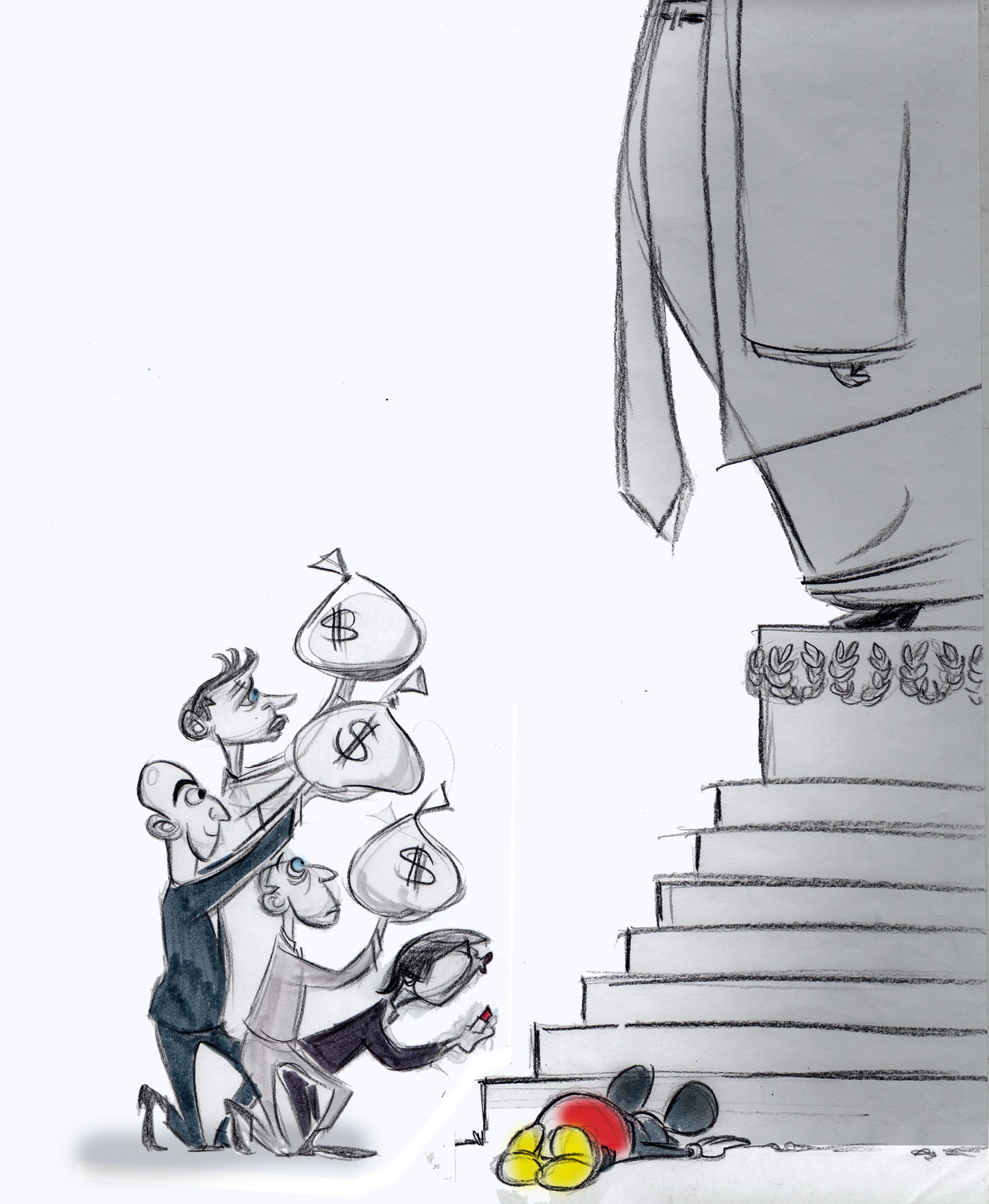
Ann Telnaes is a brilliant, Pulitzer Prize-winning editorial cartoonist for the Washington Post, and I’m proud to know her. Yesterday, she posted to her Substack that after The Post rejected this rough sketch, she resigned in protest:

I’ve spoken on a couple panels about editorial cartooning alongside Ann Telnaes. The first one was at a 2017 (or was it 2016?) convention in Columbus Ohio. The second was years later at the University of Virginia. 

In 2017, I told that audience how I broke into the industry through perseverance, by making myself stand out, and by proving myself to opinion page editors and to the newspaper syndicates. I felt such pride in recounting that story. But in 2023, it hit differently. As I opened my mouth to speak to students who don’t remember a time before social media, suddenly I felt that this generation was more likely to interpret my “inspirational” tale as one of how I groveled for years before gatekeepers. 

The obsolete origin story

Instead, I told the UVA students that my origin story was now obsolete. It’s not a road map they should follow anymore. I advised them to avoid newspapers altogether and reach readers directly through services such as Substack. I surprised myself. I wasn’t sure why I said that.

So I kept talking, and discovered why as I spoke. I’d been harboring frustration that, until then, I’d managed to suppress. 

Before I was born, the Washington Post’s reporters (and their cartoonist, Herblock) led the coverage that brought down Richard Nixon. That’s when the right wing began playing a long game, with the goal of neutering the Media. By 2023, they’d convinced most Americans that pretty much any media not owned by right wing ideologues were just cogs in a liberal conspiracy machine. 

The press is the only industry the Constitution specifically protects. But when I spoke to those UVA students, I could not tell them that newspapers were fulfilling the function the Founders had intended them to fulfill. The Founders had a lot of lousy ideas, but enshrining the press as the main line of defense against creeping authoritarianism wasn’t one of them.

I’d won a Pulitzer a few years earlier for work attacking police brutality, Trump’s malevolence, and systemic racism. But by 2023, those themes had become a tough sell – even to newspapers that had kept a running tally of Donald Trump’s lies throughout his wretched presidency. Papers seemed to want something less strident. Something less opinionated, on the Opinionpages.

I didn’t know whether to consider that a function of fear, or to chalk it up to editors simply being tired of all the existential dread, who just wanted to lighten things up. I’m not sure the distinction matters, to me. All the President’s Men was my first inkling of what journalism was supposed to be. Paul Conrad’s LA Times editorial cartoons were brutal and brilliant, especially to a kid like me in the 1980s. 

David Shipley’s response

David Shipley, the Post’s editorial pages editor, disagreed with Ann’s interpretation of events. He told the New York Times “Not every editorial judgment is a reflection of a malign force…” and “My decision was guided by the fact that we had just published a column on the same topic as the cartoon and had already scheduled another column — this one a satire — for publication. The only bias was against repetition.”

I’ve seen my work run alongside columns that dealt with the same issues before. It’s common. And a satirical column is not a replacement for an editorial cartoon. I don’t believe David Shipley considered something I’ve always found to be the case: different readers read different things.Some stick to earnest columns. Some dive straight into satirical columns. But others – especially young people like I was in the 1980s – only open the opinion page for the editorial cartoons. Editorial cartoons are an introduction to journalism, for young people and for those whose eyes gloss over when they see paragraph after paragraph of prose. Covering the same matter with three different types of journalism is not redundant, it’s reach-out.

Open the link to finish reading this provocative essay.

Ann Tolnaes is a brilliant cartoonist who resigned from The Washington Post when her latest cartoon was cancelled. It depicted the media and tech oligarchs bowing and scraping to Trump, including the owner of The Washington Post, Jeff Bezos.

The editor of the opinion section said he killed the cartoon because the paper had run a story on the same topic, and the cartoon was repetitious. I found that hard to believe because cartoons typically comment on stories in the news; they don’t break news.

He also said she had been invited to return. We will see what happens. The whole episode was widely publicized and is a stain on the newspaper’s reputation, especially since Jeff Bezos intervened and canceled the paper’s endorsement of Kamala Harris in the closing days of the campaign.

For another telling of this important story, read the article by Mike Peterson in The Daily Cartoonist about the controversy and about Ann Tolnaes’s importance. He reprints several of her cartoons, explains how to order a book of her cartoons (bypassing Amazon), and suggests we show our support by subscribing to her Substack blog. I just subscribed.

Thanks to reader John Ogozalek for directing me to this insightful commentary.

Ann Telnaes, editorial cartoonist for the Washington Post since 2008, quit her job after one of her cartoons was censored by higher-ups. The cartoon at issue depicted tech and media billionaires paying obeisance and money to Donald Trump. The cartoon included portrayals of Mark Zuckerberg (META), Sam Altman (AI), Patrick Soon-Shiong (Los Angeles Times), and Jeff Bezos, owner of the Washington Post. And, of course, Disney, which settled with Trump for $15 million rather than defend George Stephanopoulos in court. Each has given Trump $1 million or more to underwrite his inauguration. If Telnaes had waited a day, she would have added Tim Cook, CEO of Apple, to her list of suck-ups and sycophants.

The motto of the Washington Post is: “Democracy dies in darkness.” Conservative (but anti-Trump) lawyer George Conway wrote on BlueSky:

I guess the new slogan for the Washington Post ought to be:

“Newspapers die in cowardice.”

Ann Telnaes’ resignation is an act of courage that should inspire all of us to stand by our principles.

Telnaes wrote about her decision to resign on her Substack blog:

I’ve worked for the Washington Post since 2008 as an editorial cartoonist. I have had editorial feedback and productive conversations—and some differences—about cartoons I have submitted for publication, but in all that time I’ve never had a cartoon killed because of who or what I chose to aim my pen at. Until now.

The cartoon that was killed criticizes the billionaire tech and media chief executives who have been doing their best to curry favor with incoming President-elect Trump. There have been multiple articles recently about these men with lucrative government contracts and an interest in eliminating regulations making their way to Mar-a-lago. The group in the cartoon included Mark Zuckerberg/Facebook & Meta founder and CEO, Sam Altman/AI CEO, Patrick Soon-Shiong/LA Times publisher, the Walt Disney Company/ABC News, and Jeff Bezos/Washington Post owner. 

While it isn’t uncommon for editorial page editors to object to visual metaphors within a cartoon if it strikes that editor as unclear or isn’t correctly conveying the message intended by the cartoonist, such editorial criticism was not the case regarding this cartoon. To be clear, there have been instances where sketches have been rejected or revisions requested, but never because of the point of view inherent in the cartoon’s commentary. That’s a game changer…and dangerous for a free press.

(rough of cartoon killed)

Over the years I have watched my overseas colleagues risk their livelihoods and sometimes even their lives to expose injustices and hold their countries’ leaders accountable. As a member of the Advisory board for the Geneva based Freedom Cartoonists Foundation and a former board member of Cartoonists Rights, I believe that editorial cartoonists are vital for civic debate and have an essential role in journalism. 

There will be people who say, “Hey, you work for a company and that company has the right to expect employees to adhere to what’s good for the company”. That’s true except we’re talking about news organizations that have public obligations and who are obliged to nurture a free press in a democracy. Owners of such press organizations are responsible for safeguarding that free press— and trying to get in the good graces of an autocrat-in-waiting will only result in undermining that free press.

As an editorial cartoonist, my job is to hold powerful people and institutions accountable. For the first time, my editor prevented me from doing that critical job. So I have decided to leave the Post. I doubt my decision will cause much of a stir and that it will be dismissed because I’m just a cartoonist. But I will not stop holding truth to power through my cartooning, because as they say, “Democracy dies in darkness”.

Thank you for reading this.

Heather Cox Richardson recalls the days of bipartisan consensus around the goals of liberal democracy, in which government protected the rights of individuals. By today’s MAGA standards, President Dwight D. Eisenhower would be considered a dangerous leftwinger.

She wrote on her blog, “Letters from an American”:

Cas Mudde, a political scientist who specializes in extremism and democracy, observed yesterday on Bluesky that “the fight against the far right is secondary to the fight to strengthen liberal democracy.” That’s a smart observation.

During World War II, when the United States led the defense of democracy against fascism, and after it, when the U.S. stood against communism, members of both major political parties celebrated American liberal democracy. Democratic presidents Franklin Delano Roosevelt and Harry Truman and Republican president Dwight D. Eisenhower made it a point to emphasize the importance of the rule of law and people’s right to choose their government, as well as how much more effectively democracies managed their economies and how much fairer those economies were than those in which authoritarians and their cronies pocketed most of a country’s wealth.

Those mid-twentieth-century presidents helped to construct a “liberal consensus” in which Americans rallied behind a democratic government that regulated business, provided a basic social safety net, promoted infrastructure, and protected civil rights. That government was so widely popular that political scientists in the 1960s posited that politicians should stop trying to court voters by defending its broadly accepted principles. Instead, they should put together coalitions of interest groups that could win elections.

As traditional Republicans and Democrats moved away from a defense of democracy, the power to define the U.S. government fell to a small faction of “Movement Conservatives” who were determined to undermine the liberal consensus. Big-business Republicans who hated regulations and taxes joined with racist former Democrats and patriarchal white evangelicals who wanted to reinforce traditional race and gender hierarchies to insist that the government had grown far too big and was crushing individual Americans.

In their telling, a government that prevented businessmen from abusing their workers, made sure widows and orphans didn’t have to eat from garbage cans, built the interstate highways, and enforced equal rights was destroying the individualism that made America great, and they argued that such a government was a small step from communism. They looked at government protection of equal rights for racial, ethnic, gender, and religious minorities, as well as women, and argued that those protections both cost tax dollars to pay for the bureaucrats who enforced equal rights and undermined a man’s ability to act as he wished in his place of business, in society, and in his home. The government of the liberal consensus was, they claimed, a redistribution of wealth from hardworking taxpayers—usually white and male—to undeserving marginalized Americans.

When voters elected Ronald Reagan in 1980, the Movement Conservatives’ image of the American government became more and more prevalent, although Americans never stopped liking the reality of the post–World War II government that served the needs of ordinary Americans. That image fed forty years of cuts to the post–World War II government, including sweeping cuts to regulations and to taxes on the wealthy and on corporations, always with the argument that a large government was destroying American individualism.

It was this image of government as a behemoth undermining individual Americans that Donald Trump rode to the presidency in 2016 with his promises to “drain the swamp” of Washington, D.C., and it is this image that is leading Trump voters to cheer on billionaires Elon Musk and Vivek Ramaswamy as they vow to cut services on which Americans depend in order to cut regulations and taxes once again for the very wealthy and corporations.

But that image of the American government is not the one on which the nation was founded.

Liberal democracy was the product of a moment in the 1600s in which European thinkers rethought old ideas about human society to emphasize the importance of the individual and his (it was almost always a “him” in those days) rights. Men like John Locke rejected the idea that God had appointed kings and noblemen to rule over subjects by virtue of their family lineage, and began to explore the idea that since government was a social compact to enable men to live together in peace, it should rest not on birth or wealth or religion, all of which were arbitrary, but on natural laws that men could figure out through their own experiences.

The Founders of what would become the United States rested their philosophy on an idea that came from Locke’s observations: that individuals had the right to freedom, or “liberty,” including the right to consent to the government under which they lived. “We hold these truths to be self-evident,” Thomas Jefferson wrote, “that all men are created equal, that they are endowed by their Creator with certain unalienable Rights, that among these are Life, Liberty and the pursuit of Happiness,” and that “to secure these rights, governments are instituted among men, deriving their just powers from the consent of the governed.”

In the early years of the American nation, defending the rights of individuals meant keeping the government small so that it could not crush a man through taxation or involuntary service to the government or arbitrary restrictions. The Bill of Rights—the first ten amendments to the Constitution—explicitly prohibited the government from engaging in actions that would hamper individual freedom.

But in the middle of the nineteenth century, Republican president Abraham Lincoln began the process of adjusting American liberalism to the conditions of the modern world. While the Founders had focused on protecting individual rights from an overreaching government, Lincoln realized that maintaining the rights of individuals required government action.

To protect individual opportunity, Lincoln argued, the government must work to guarantee that all men—not just rich white men—were equal before the law and had equal access to resources, including education. To keep the rich from taking over the nation, he said, the government must keep the economic playing field between rich and poor level, dramatically expand opportunity, and develop the economy.

Under Lincoln, Republicans reenvisioned liberalism. They reworked the Founders’ initial stand against a strong government, memorialized by the Framers in the Bill of Rights, into an active government designed to protect individuals by guaranteeing equal access to resources and equality before the law for white men and Black men alike. They enlisted the power of the federal government to turn the ideas of the Declaration of Independence into reality.

Under Republican president Theodore Roosevelt, progressives at the turn of the twentieth century would continue this reworking of American liberalism to address the extraordinary concentrations of wealth and power made possible by industrialization. In that era, corrupt industrialists increased their profits by abusing their workers, adulterating milk with formaldehyde and painting candies with lead paint, dumping toxic waste into neighborhoods, and paying legislators to let them do whatever they wished.

Those concerned about the survival of liberal democracy worried that individuals were not actually free when their lives were controlled by the corporations that poisoned their food and water while making it impossible for individuals to get an education or make enough money ever to become independent.

To restore the rights of individuals, progressives of both parties reversed the idea that liberalism required a small government. They insisted that individuals needed a big government to protect them from the excesses and powerful industrialists of the modern world. Under the new governmental system that Theodore Roosevelt pioneered, the government cleaned up the sewage systems and tenements in cities, protected public lands, invested in public health and education, raised taxes, and called for universal health insurance, all to protect the ability of individuals to live freely without being crushed by outside influences.

Reformers sought, as Roosevelt said, to return to “an economic system under which each man shall be guaranteed the opportunity to show the best that there is in him.”

It is that system of government’s protection of the individual in the face of the stresses of the modern world that Franklin Delano Roosevelt, Harry Truman, Dwight Eisenhower, and the presidents who followed them until 1981 embraced. The post–World War II liberal consensus was the American recognition that protecting the rights of individuals in the modern era required not a weak government but a strong one.

When Movement Conservatives convinced followers to redefine “liberal” as an epithet rather than a reflection of the nation’s quest to defend the rights of individuals—which was quite deliberate—they undermined the central principle of the United States of America. In its place, they resurrected the ideology of the world the American Founders rejected, a world in which an impoverished majority suffers under the rule of a powerful few.

Scott Maxwell is an opinion writer for The Orlando Sentinel. I consistently enjoy his writings. Here he explains what he believes. I agree with him, although I am not a Presbyterian.

He writes:

Every new year, I follow a tradition started by former Orlando Sentinel columnist Charley Reese who believed that, if a newspaper columnist is going to tell you what he thinks all year long, he should first tell you who he is and where he stands.

I am a married father with two grown kids, both of whom picked up their best attributes from their mother.

I’m not a Republican nor a Democrat. I’m a lifelong unaffiliated voter who has seen too many people defend indefensible deed-doers simply because they share a party affiliation.

That said, I lean left of center. I believe in public education, free speech, equal rights, balanced budgets and the U.S. Constitution.

I believe most of the politicians who lead this state and claim to be constitutionalists are full of it. We have the court rulings to prove it.

I believe censorship is favored by those with weak minds. If you crave government censorship, you’re an authoritarian’s dream disciple.

I think the world has two kinds of people: Those who hear an idea and immediately think: How will this affect me? And those who hear a new idea and also wonder: How will this affect society? I have a lot more respect for the latter.

One of my favorite quotes involves the definition of privilege — when something doesn’t strike you as a problem because it’s not a problem to you. I believe that explains why families with disabilities are on seven-year-waiting lists for basic services in this state.

Another one of my favorite quotes is: Fifty percent of the enjoyment you get from a vacation comes from the anticipation beforehand. My wife and I always have several vacations planned.

We love our children. I’d throw myself in front of a bus for either one. That said, now that they’re both grown, I’m glad that any buses they might take nowadays will drop them off at their own respective homes. My wife and I have fully embraced being empty-nesters.

Our daughter works with children in the arts. Our son writes and also substitute teaches. Both of our kids are good with kids. We take great pride in that.

I believe teachers are underappreciated. So are social workers, public defenders and full-time caregivers.

I believe arts and culture are an essential part of any community. So are nonprofit organizations. If cultural groups are the heart of a community, nonprofits represent the backbone.

My wife and I have two main sources of income — my salary at the newspaper and hers with the Department of Veterans Affairs. We’ve worked at both jobs for the past quarter century. Her job is a lot more stable.

We both read voraciously. She reads books — at least two a week. I read lengthy court rulings, drafted legislation and just about every piece of current-event info published about Florida.

We also diverge a bit when it comes to film. She likes Hallmark movies where a busy, big-city boss lady stumbles into a small town and discovers love on a Christmas tree farm. I like ridiculous, scary movies where the big-city boss lady stumbles into giant insects that have mutated in size thanks to toxic sludge dumped in that small town’s water reservoir.

My wife says her book and movie tastes are more normal. She’s usually right. About most things in life.

We own two houses — the one in which we live near downtown Orlando and our starter home that we still own and rent out in Seminole County.

I don’t have or accept any other streams of income. Mainly because I try to avoid financial conflicts of interest. But also because I find my one job pretty exhausting.

I start most days by 4 a.m. and work 60 to 80 hours a week, partly because our newsroom has only a fraction of the journalists and editors it used to have.

This newspaper business has changed a lot, in many ways for the worse when it comes to staffing and customer service. But I still believe in the mission and am honored to work alongside feisty, smart and curious  journalists who aren’t easily intimidated, virtually all of whom are still in local journalism because they care about this community.

I’m also honored to work for a paper with editors and publishers who have never — ever — told me what I can or can’t write.

I welcome dissenting opinions. In fact, I seek them out. When I’m writing a column, I usually spend as much time looking up arguments against my premise as I do ones that support it. I’d much rather hear the best arguments before I publish a piece.

I don’t worship any politician and am a bit puzzled by those who do. I’ve yet to meet one who was flawless. I respect elected officials who truly study the issues, question what they’re told and are willing to challenge the status quo.

I believe in checks and balances and that one-party control is a recipe for both extremism and corruption.

I’m a Presbyterian and church elder, a die-hard Tar Heel, a decent poker player, solid Worldler and much less-solid pickleball player.

I love laughter and plot twists and loathe bigotry and standing in lines.

I think Tesla Cybertrucks look ridiculous.

I feel privileged to have this job and honored to know so many of you read and share your own stories with me.

I hope you all have a happy, healthy new year.

smaxwell@orlandosentinel.com

The Thought Police lost an important case in Arkansas! Score one for librarians, booksellers, and people who read books! It’s a setback for those who don’t read books, never have, never will.

Doktor Zoom writes on the blog Wonkette:

A federal judge Monday tossed out parts of an Arkansas state law that allowed librarians and booksellers to be sent to prison for up to a year for allowing minors to access “obscene” or “harmful” materials, whatever local officials might decide is “obscene” or “harmful.” Probably gay penguins.

In his ruling, US District Judge Timothy Brooks found that the law, Act 372, violated the First Amendment and also generally sucked, was overly vague, and didn’t provide adequate guidance to libraries and booksellers to help them avoid being arbitrarily prosecuted. The law created a new process for complaints and required libraries (tell you what, just assume “and booksellers” is part of every sentence, OK?) to shelve “harmful” materials in a special adults-only section, although it didn’t mandate that such a section be behind a beaded curtain like at an old video store. A similar law in Idaho — minus the librarian-jailing — is also being challenged in federal court, as are multiple other censorship laws. 

Brooks wrote that the law “deputizes librarians and booksellers as the agents of censorship; when motivated by the fear of jail time, it is likely they will shelve only books fit for young children and segregate or discard the rest,” which was of course the point. For all the Mad Moms’ insistence that they only want to protect tiny innocent kids from “obscene” materials, the actual targets of book banning tend to be anything rightwing parents dislike, especially mentions of LGBTQ people, books about race, and sex education. 

Not surprisingly, Arkansas Attorney General Tim Griffin said that while he’ll respect the ruling, he plans to appeal, and Gov. Sarah Huckabee Sanders issued a statement calling Act 372 “just common sense” because “schools and libraries shouldn’t put obscene material in front of our kids,” so there. 

Holly Dickson, executive director of the ACLU of Arkansas, said yippee, now we can poison kids’ minds, destroy the family, and kill God, or at least that’s how wingnuts will interpret what she actually said, which was 

“This was an attempt to ‘thought police,’ and this victory over totalitarianism is a testament to the courage of librarians, booksellers, and readers who refused to bow to intimidation…”

To learn more about the court decision, open the link.

The Network for Public Education announces the winners of the non-prestigious “Coal in the Stocking” Award for 2024.

This is an award given to those who have done the most damage to our public schools.

They should feel ashamed and humiliated for gaining this recognition of their odious and undemocratic behavior.

They hurt children and communities. They hurt the future of our great nation.

Open the link to see the names of the winners.

During the campaign, Democrats continually drew attention to the radical proposals of Project 2025 as the agenda for a second Trump term. Trump distanced himself from Project 2025 and pretended to know nothing about it or anyone who wrote it. Now that he is President-elect, Project 2025 is indeed Trump’s agenda.

Someone on social media asked, “If Trump disavowed Project 2025 when campaigning, isn’t I clear that he has no “mandate” to act on it?

The LA Times reports:

Russell Vought, one of the chief architects of Project 2025 — a conservative blueprint for the next presidency — is no fan of the federal government that President-elect Donald Trump will soon lead.

He believes “woke” civil servants and “so-called expert authorities” wield illegitimate power to block conservative White House directives from deep within federal agencies, and wants Trump to “bend or break” that bureaucracy to his will, he wrote in the second chapter of the Project 2025 playbook.

Vought is a vocal proponent of a plan known as Schedule F, under which Trump would fire thousands of career civil servants with extensive experience in their fields and replace them with his own political loyalists, and of Christian nationalism, which would see American governance aligned with Christian teachings. Both are core tenets of Project 2025.

Throughout his campaign, Trump adamantly disavowed Project 2025, even though its policies overlapped with his and some of its authors worked in his first administration. He castigated anyone who suggested the blueprint, which polls showed was deeply unpopular among voters, represented his aims for the presidency.

But last week, the president-elect nominated Vought to lead the Office of Management and Budget, which oversees the White House budget and its policy agenda across the federal government.

Trump called Vought, who held the same role during his first term, an “aggressive cost cutter and deregulator” who “knows exactly how to dismantle the Deep State and end Weaponized Government.”

The nomination was one of several Trump has made since his election that have called into question his claims on the campaign trail that Project 2025 was not his playbook and held no sway over him or his plans for a second term. 

He selected Tom Homan, a Project 2025 contributor and former visiting fellow at the Heritage Foundation, the conservative organization behind the blueprint, as his “border czar.” Trump named Stephen Miller, an immigration hard-liner also linked to Project 2025, as his deputy chief of staff for policy. Both also served in the first Trump administration.

He also named Brendan Carr to serve on the Federal Communications Commission. Carr wrote a chapter of Project 2025 on the FCC, which regulates U.S. internet access and TV and radio networks, and has echoed Trump’s claimsthat news broadcasters have engaged in political bias against Trump.

Trump named John Ratcliffe as his pick for CIA director and Pete Hoekstra as ambassador to Canada. Both are Project 2025 contributors. It has also been reported that the Trump transition team is filling lower-level government spots using a Project 2025 database of conservative candidates.

During the campaign Trump said that he knew “nothing about” Project 2025 and that he found some of its ideas “absolutely ridiculous and abysmal.” In response to news in July that Project 2025’s director, Paul Dans, was leaving his post, Trump campaign managers Chris LaCivita and Susie Wiles — whom the president-elect has since named his chief of staff — issued a statement saying that “reports of Project 2025’s demise would be greatly welcomed.”

Asked about Trump’s selection of several people with Project 2025 connections to serve in his administration, Trump transition spokeswoman Karoline Leavitt responded with a statement, saying Trump “never had anything to do with Project 2025.”

“This has always been a lie pushed by the Democrats and the legacy media, but clearly the American people did not buy it because they overwhelmingly voted for President Trump to implement the promises that he made on the campaign trail,” Leavitt wrote. “All of President Trump’s cabinet nominees and appointments are whole-heartedly committed to President Trump’s agenda, not the agenda of outside groups.”

Leavitt too has ties to Project 2025, having appeared in a training video for it.

In addition to calling for much greater power in the hands of the president, Project 2025 calls for less federal intervention in certain areas — including through the elimination of the Department of Education. It calls for much stricter immigration enforcement and mass deportations — a policy priority of Trump’s as well — and rails against environmental protections, calling for the demolition of key environmental agencies such as the National Oceanic and Atmospheric Administration and the National Weather Service.

It calls for tougher restrictions on abortion and for the federal government to collect data on women who seek an abortion, and backs a slew of measures that would strip rights from LGBTQ+ people.

For Trump’s critics, his selections make it clear that his disavowal of the conservative playbook was nothing more than a campaign ploy to pacify voters who viewed the plan as too far to the right. It’s an argument many were making before the election as well.

Open the link to continue reading.

Timothy Snyder is an expert on European history and on tyranny (the title of one of his books is On Tyranny). He writes here about the creeping authoritarianism of the coming Trump regime.

Snyder writes:

We should be wary of shock, which excuses inaction. Who could have known? What could I have done? If there is a plan, shock is part of the plan. We have to get through the surprise and the shock to see the design and the risk. We don’t have much time. Nor is outrage the point.

Of course we are outraged. But our own reactions can distract is from the larger pattern.
The newspapers address the surprise and the shock by investigating each proposed appointment individually. And we need this. With detail comes leverage and power. But clarity must also come, and quickly. Each appointment is part of a larger picture. Taken together, Trump’s candidates constitute an attempt to wreck the American government.

In historical context we can see this. There is a history of the modern democratic state. There is also a history of engineered regime change and deliberate state destruction. In both histories, five key zones are health, law, administration, defense, and intelligence. These people, with power over these areas of life, can make America impossible to sustain.

The foundation of the modern democratic state is a healthy, long-lived population. We lived longer in the twentieth century because of hygiene and vaccinations, pioneered by scientists and physicians and then institutionalized by governments. We treat one another better when we know we have longer lives to lose. Health is not only the central human good; it enables the peaceful interactions we associate with the rule of law and democracy. Robert F. Kennedy, Jr., the proposed secretary of the Department of Health and Human Services, would undo all of this. On his watch, were his ideas implemented, millions of us would die. Knowing that our lives will be shorter, we become nasty and brutish.

A modern democratic state depends upon the rule of law. Before anything else is possible, we have to endorse the principle that we are all governed by law, and that our institutions are grounded in law. This enables a functional government of a specific sort, in which leaders can be regularly replaced by elections. It allows us to live as free individuals, within a set of rules that we can alter together. The rule of law depends on people who believe in the spirit of law. Matt Gaetz, Trump’s first proposed attorney general, is the opposite of such a person. It is not just that he flouts law himself, spectacularly and disgustingly. It is that he embodies lawlessness, and can be counted upon to abuse law to pursue Trump’s political opponents. The end of the rule of law is an essential component of a regime change. He has been replaced by Pam Bondi, who will evade the sex-crime allegations that seem to have brought Gaetz down. But Bondi is someone who dropped an investigation against Trump when he made an illegal donation to one of her foundations. She also led “lock her up” chants against Hillary Clinton, who had committed no crime. And she participated in a central injustice of contemporary American history, Donald Trump’s Big Lie that he won the election of 2020. She can be expected to lead prosecutions based upon alternative reality.

In a class by himself is Kash Patel, whom Trump would like to see as director of the FBI. This, of course, requires Trump to fire Christopher Wray, whom he himself appointed, and who has three years left to serve. Firing Wray for no reason would be unprecedented and would itself have been an outrage in a more sane time. Giving Patel authority over the national police force is nothing less than a promise of authoritarian rule.

Patel is a narcissitic zealot with zero qualification for such a post, as even hard-right Trump insiders such as Bill Barr have said (“over my dead body” were his words when Trump proposed Patel for a lesser position of authority in 2020). Patel got Trump’s attention for his efforts to denounce the entirely correct proposition that Trump was supported by Russia in 2016. Patel was then one of the most active and outspoken participants in Trump’s coup attempt of 2020-2021. Patel has since become a pitchman for a clothing line as well as pills that, he claims, will detox your body from the harmful effects of vaccinations. Patel said both that he would shut down the FBI and that he would use it to prosecute journalists and people who deny the untrue conspiracy theories in which he believes, and to prosecute people who say true things, such as that Russia supports Donald Trump when he runs for office. Russian trolls have been, understandably, very excited in their support of Patel.

A pattern is emerging: the federal government is to be used only as an instrument of revenge, which means that the law will be subverted as such. Laws that were passed to improve the lives of citizens, meanwhile, will simply not be implemented.

The United States of America exists not only because laws are passed, but because we can expect that these laws will be implemented by civil servants. We might find bureaucracy annoying; its absence, though, is deadly. We cannot take the pollution out of the air ourselves, or build the highways ourselves, or write our Social Security checks ourselves. Without a civil service, the law becomes mere paper, and all that works is the personal connection to the government, which the oligarchs will have, and which the rest of us will not. This is the engineered helplessness promised by Elon Musk and Vivek Ramaswamy, who are to head a black hole named after a cryptocurrency. There are already oversight instruments in government. DOGE is something entirely different: an agency of destruction, run by people who believe that government should exist for the wealthy or not at all.

The understandable jokes are that DOGE just adds unelected bureaucrats when it is supposed to replace them, and that DOGE is itself a model of inefficiency, since it has two incompetent directors. But the humor distracts from the basic truth: DOGE is there to make the government fail, and then to divide the profitable bits among regime-proximate oligarchs.

DOGE = Den of Oligarchs Gets Everything.

In a modern democratic state, the armed forces are meant to preserve a healthy, long-lived people from external threats. This principal has been much abused in American practice. But never before Donald Trump have we had a president who has presented the purpose of the armed forces as the oppression of Americans. Trump says that Russia and China are less of a threat than “internal enemies.” In American tradition, members of the armed forces swear an oath to the Constitution. Trump has indicated that he would prefer “Hitler’s generals,” which means a personal oath to himself. Pete Hegseth, Trump’s proposed secretary of defense, defends war criminals and displays tattoos associated with white nationalism and Christian nationalism. He is a fundraiser and television personality, with a complicated sexual past and zero experience running an organization. Like Trump, he has no coherent account of how foreign powers might threaten America; if anything, he praises them for sharing his misogyny. His own obsessions with gender lead him to believe that American high officers should be politically purged — a proposition that America’s actual enemies would of course welcome. Hegseth makes perfect sense as the person who would direct American armed forces against American citizens.

In a world of hostile powers, an intelligence service is indispensable. Intelligence can be abused, and certainly has been abused. Yet it is necessary to consider military threats: consider the Biden administration’s correct call the Russia was about to invade Ukraine. It is also necessary to counter the attempts by foreign intelligence agencies, which are constant, to harm American society. This often involves disinformation. Tulsi Gabbard, insofar as she is known at all, is known as a spreader of Syrian and Russian disinformation. She visited Syria, where her remarks could only be understood as an endorsement of the atrocities of Assad. She suggested to burn victims that they had not suffered because of Assad and his ally Russia, which was in fact the case. Gabbard has no relevant experience. Were she to become director of national intelligence, as Trump proposes, we would lose the trust of our allies, and lose contact with much of what is happening in the world — just for starters. We would be vulnerable to all of those who wish to cause us harm. Unsurprisingly, Gabbard is regarded in Russia as “girlfriend,” “superwoman” and a “Putin’s agent.”

In the Soviet theory of regime change, one crucial aspect was control of the power ministries: those associated with defense, the police, and intelligence. Patel, Gabbard, and Hegseth are such shocking suggestions as custodians of American power and law that it is easy to overlook Kristi Noem as Trump’s proposed director of Homeland Security. Noem is regarded positively in Trump’s circles because of a publicity stunt in which she, as governor of South Dakota, effectively privatized her states’s National Guard by accepting a big private donation to send a few of its members to the border with Mexico. The border is, of course, a serious matter, Noem’s combination of spectacle, privatization, and incompetence is more than concerning.

Imagine that you are a foreign leader who wishes to destroy the United States. How could you do so? The easiest way would be to get Americans to do the work themselves, to somehow induce Americans to undo their own health, law, administration, defense, and intelligence. From this perspective, Trump’s proposed appointments — Kennedy, Jr.; Bondi; Musk; Ramaswamy; Hegseth; Gabbard; Noem — are perfect instruments. They combine narcissism, incompetence, corruption, sexual incontinence, personal vulnerability, dangerous convictions, and foreign influence as no group before them has done. These proposed appointments look like a decapitation strike: destroying the American government from the top, leaving the body politic to rot, and the rest of us to suffer.

I do not defend the status quo. I have no doubt whatsoever that the Department of Defense and the Food and Drug Administration require reform. But such a reform, of these or other agencies, would have to be guided by people with knowledge and experience, who cared about their country, and who had a vision of improvement. That is simply not what is happening here. We are confronted instead with a group of people who, were they to hold the positions they have been assigned, could bring an end to the United States of America.

It is a mistake to think of these people as flawed. It is not they will do a bad job in their assigned posts. It is that they will do a good job using those assigned posts to destroy our country.

However and by whomever this was organized, the intention of these appointments is clear: to create American horror. Elected officials should see this for what it is. Senators, regardless of party, should understand that the United States Senate will not outlast the United States, insist on voting, and vote accordingly. The Supreme Court of the United States will likely be called upon. Although it is a faint hope, one must venture it anyway: that its justices will understand that the Constitution was not in fact written as the cover story for state destruction. The Supreme Court will also not outlast the United States.

And citizens, regardless of how they voted, need now to check their attitudes. This is no longer a post-electoral moment. It is a pre-catastrophic moment. Trump voters are caught in the notion that Trump must be doing the right thing if Harris voters are upset. But Harris voters are upset now because they love their country. And Harris voters will have to get past the idea that Trump voters should reap what they have sown. Yes, some of them did vote to burn it all down. But if it all burns down, we burn too. It is not easy to speak right now; but if some Republicans wish to, please listen

Both inside and outside Congress, there will have to be simple defiance, joined with a rhetoric of a better America. And, at moments at least, there will also have to be alliances among Americans who, though they differ on other matters, would like to see their country endure.

Chris Tomlinson is an opinion writer for The Houston Chronicle and one of the best critics of the state’s loony leadership. In this column, he warns of the perils of pushing out the free-thinkers. As Forrest Gump famously said, “Stupid is as stupid does.”

He writes:

Texas lawmakers are targeting colleges and universities in the next culture war battle, putting our most vital economic drivers at risk.

Our public universities are why Texas outperforms, whether it’s petroleum engineering at Texas A&Melectrical engineering at UT-Austin or transportation at Prairie View A&M University. Multi-disciplinary research universities produce diverse workforces and innovative entrepreneurs that benefit state and local economies.

The right-wing thought police, though, are fed up with freethinkers. Recent laws and proposed bills aim to restrict what ideas faculty and students can explore. The brightest minds will not stick around if the GOP limits intellectual freedom.

Republicans spent the 2023 legislative session protecting white supremacy by attacking programs intended to help historically under-represented students succeed. GOP lawmakers worried that fragile white students may feel uncomfortable discussing the nation’s history of slavery and oppression.

State Sen. Brandon Creighton, a Conroe Republican who leads the Senate Education Committee, passed a law banning diversity, equity and inclusion programs at public universities. In a stunning example of Orwellian doublethink, Creighton said his law would boost diversity.

However, when UT Austin complied with Senate Bill 17, a third of the 49 people laid off were Black, even though African-Americans make up only 7% of employees. Roughly three-fourths of the employees let go were women, though they make up just 55% of the total staff.

Across all campuses, the University of Texas System eliminated more than 300 jobs to comply with the law, arguing it was a cost-saving measure.

“Why is it that you must save costs on the backs of Black and brown employees and female employees?” Texas NAACP President Gary Bledsoe asked.

Not only do Republican leaders want to wipe out programs trying to reverse the lingering effects of white supremacist rule, but they also want to stop research into how racism and bigotry have harmed our society.

The Texas A&M University System Board of Regents, appointed by Gov. Greg Abbott, recently cut 52 academic programs, including global culture and society, LGBTQ studies, global health, Asian studies and a certificate in performing social activism in the College of Performance, Visualization and Fine Arts. Regent Michael J. Plank echoed UT officials, saying the board has a duty to “eliminate waste.”

Across the country, conservatives are using “cost saving” as a fig leaf for suppressing ideas they don’t like. For example, A&M had only offered the LGBTQ studies minor for three semesters before declaring it wasteful.

The University of North Texas made 78 changes to its course schedule, removing words such as race, gender, class and equity from titles and descriptions, the Dallas Morning News reported. Freedom of speech group PEN America accused university leaders of abusing SB17.

“UNT seems to be arguing that the principle of academic freedom only exists when state law allows it,” Jeremy Young, PEN’s Freedom to Learn project director, said. “This ludicrous interpretation effectively nullifies academic freedom as a protection against government censorship, setting a perilous precedent for higher education institutions across Texas and potentially beyond.”

Texas A&M and UNT may have only been obeying in advance of more restrictive laws to come.

“While DEI-related curriculum and course content does not explicitly violate the letter of the law, it indeed contradicts its spirit,” Creighton said during a Texas Senate Higher Education Subcommittee hearing. “The curriculum does not reflect the expectations of Texas taxpayers and students who fund our public universities.”

Newly elected state Rep. Carl Tepper, a Lubbock Republican, has introduced a bill requiring the Texas Higher Education Coordinating Board to calculate a ratio of student debt to annual salary for every degree or certificate offered. The board would then assign a rating: reward, monitor, sanction or sunset. The goal is to shut down programs in the latter categories.

Learning for learning’s sake would not be tolerated under House Bill 281.

Political leaders have long interfered with colleges and universities. Texas lawmakers started using professors as political scapegoats within three years of establishing UT. Institutions have long offered tenure to protect underpaid professors from political interference.

Lt. Gov. Dan Patrick has repeatedly said he wants to ban tenure and make it easier to remove professors who teach or study ideas the Legislature doesn’t like.

Unsurprisingly, two-thirds of the 950 Texas faculty surveyed by the American Association of University Professors said they would not recommend teaching in Texas to colleagues.

Texas Republicans may feel a mandate to drive free thinkers out of public universities, but Texas employers looking for an educated workforce will pay the price.