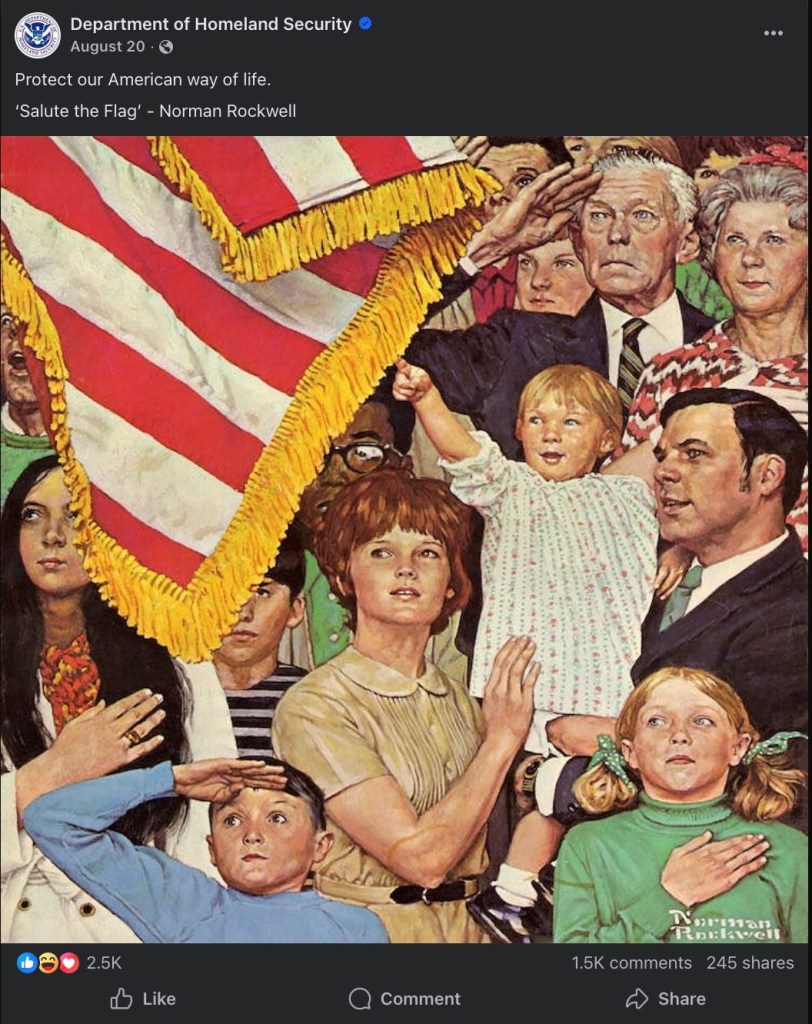
Descendants of the celebrated painter Norman Rockwell wrote an article in USA Today protesting the Trump administration’s selective use of his work to portray an all-white America. The Department of Homeland Security has issued propaganda that includes Rockwell paintings to illustrate that the U.S. has no racial diversity. Whites only.
His children, grandchildren and great-grandchildren wrote this article.
If Norman Rockwell were alive today, he would be devastated to see that his own work has been marshalled for the cause of persecution toward immigrant communities and people of color.
The Rockwell family
A group of mostly White Americans stands beneath a billowing national flag, right hands to their hearts. Construction workers crawl ant-like over a close-up of the upraised torch in the hand of the Statue of Liberty. A craggy Daniel Boone in raccoon-skin cap gazes off into the distance against a purple background, cradling his rifle.
These are three Norman Rockwell paintings that recently appeared without authorization in social media posts by the U.S. Department of Homeland Security. They bore these labels: “Protect our American way of life,” “Manifest Heroism” and a quote from Calvin Coolidge, “Those who do not want to be partakers of the American spirit ought not to settle in America.”
Norman Rockwell – our father, grandfather and great-grandfather – painted more than 4,000 works during his career, many of them depicting what are considered classic scenes from 20th century American life: Boy Scouts, doctor visits, squabbling couples, soda shops, soldiers returning from war, linemen and so much more.
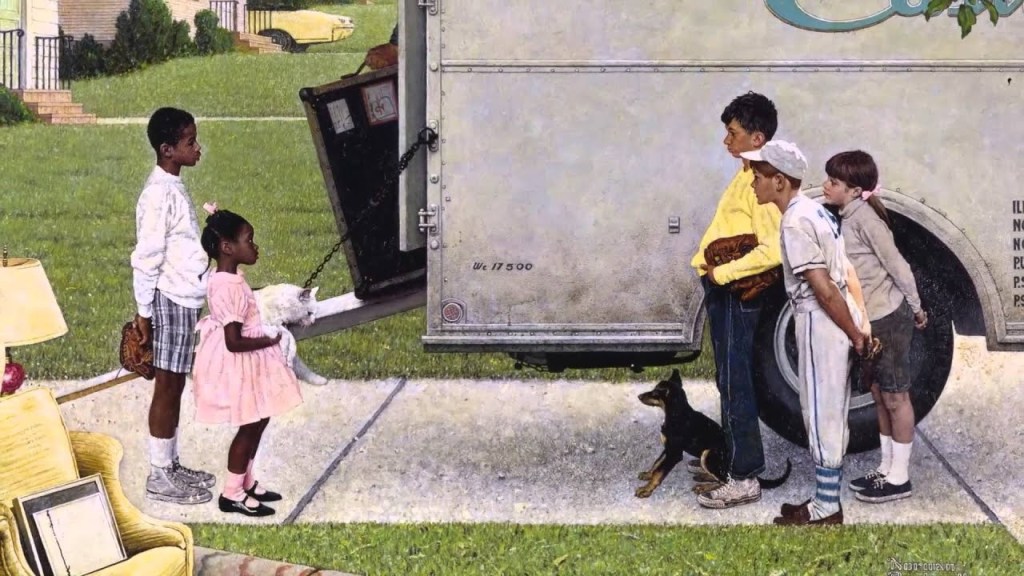
From 1916 to 1963, he regularly painted covers for the Saturday Evening Post, which by and large depicted only White people. The scarcity of people of color in Rockwell’s paintings has led those who are not familiar with his entire oeuvre to draw the conclusion that his vision was of a White America, free of immigrants and people of color. But nothing could have been further from the truth.
Norman Rockwell used art to confront racism, injustice in America
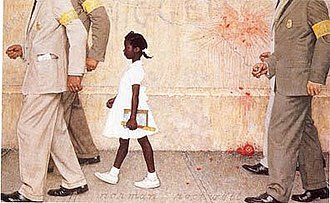
In January of 1964, just one month shy of his 70th birthday, his iconic painting “The Problem We All Live With” appeared in Look magazine. The painting was inspired by the experiences of Ruby Bridges, a 6-year-old girl who had been escorted by U.S. Marshals to desegregate her New Orleans school in 1960.
“The Problem We All Live With”–Norman Rockwell
The painting focuses on a young Black girl in a white dress walking to school surrounded by unmistakable signs of racism and violence. A horrifying epithet scrawled across a wall dotted by rotten tomatoes recently hurled and the burly bodies of the four U.S. Marshalls accompanying her all point to the horrifying historical moment depicted in the scene. But perhaps most haunting of all is that title: “The Problem We All Live With,” an eternal present tense, inviting us to engage with the ravages of racism in our society, to open our eyes to the injustice and violence.
“I was born a White Protestant with some prejudices that I am continuously trying to eradicate,” Rockwell said in an interview in 1962. “I am angry at unjust prejudices, in other people and in myself.”
If Norman Rockwell were alive today, he would be devastated to see that not only does the problem Ruby Bridges confronted 65 years ago still plague us as a society, but that his own work has been marshalled for the cause of persecution toward immigrant communities and people of color.
We ‒ as his eldest son, grandchildren and great-grandchildren ‒ believe that now is the time to follow in his footsteps and stand for the values he truly wished to share with us and all Americans: compassion, inclusiveness and justice for all.
***********************************
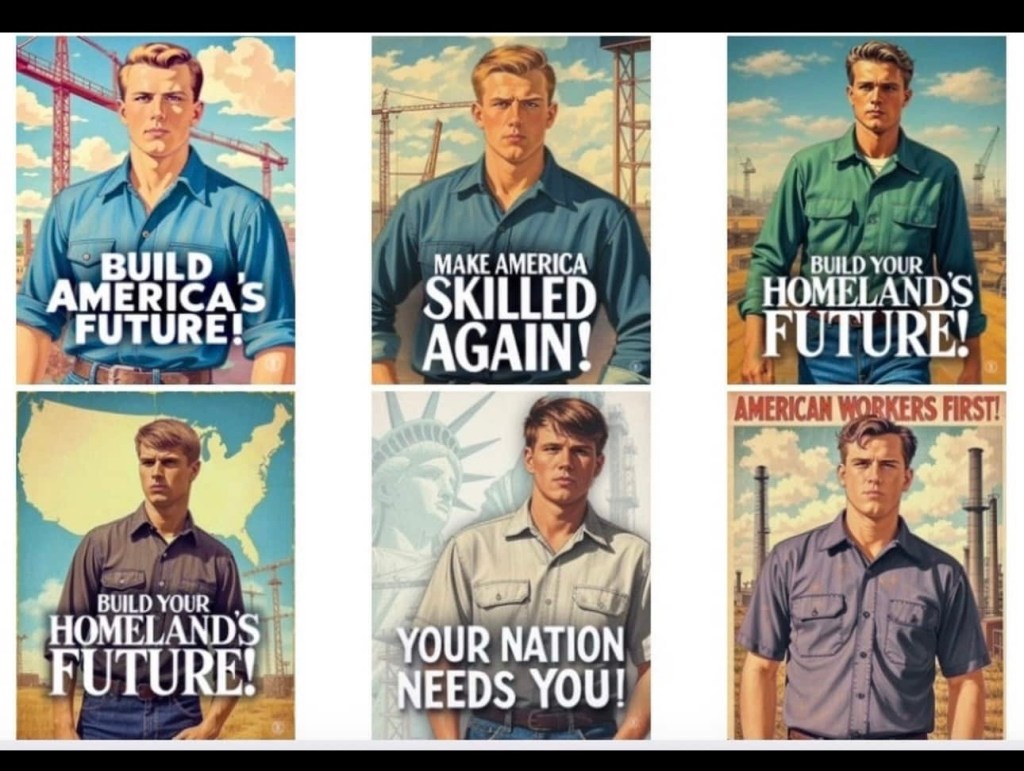
In addition to the contested use of Rockwell’s paintings, the Trump administration’s Department of Labor has used the retro images below as part of its recruitment/branding campaign (slogans like “Make America Skilled Again,” “Build America’s Future,” “American Workers First,” “Your Nation Needs You”). The DOL ran them on social media (USDOL posts on X/Twitter, Facebook and Instagram). The posters present America as an all-white nation of male workers. No diversity. Broad shoulders. Blonde hair. Open-collar. He-men. Red-blooded white American men. No Rosie the Riveter.
In Pennsylvania school board races, extremists who provoked battles over culture war issues were ousted. One winner said that parents looked forward to the days when school board meetings were “boring,” not divisive.
A slate of Democratic candidates won four seats on the Pine-Richland school board last night and unseated one incumbent with ties to a statewide movement of conservative education leaders.
The sweep capped an Election Day marked by Democratic victories in school board races statewide.
Pine-Richland electee Randy Augustine and his peers on the Together for PR slate won over voters with slogans like “excellence over extremism.”
“School board positions are theoretically supposed to be non-partisan, non-political positions,” Augustine said. “A number of the school board members were trying to push a political agenda, focusing on culture war issues, not focusing on the students.”
The Republican-led school board initiated policies that gave board members the final say over which books were included in school libraries and challenged books with LGBTQ characters. The district’s teachers union issued a vote of no confidence in the majority of school board members this spring.
“ It was becoming toxic, and the turmoil, I think, was spreading,” said fellow Together for PR winner Melissa Vecchi. “People just wanted to see it back to boring.”
Thom Hartmann explains why the shutdown continues. The Republicans in the Senate have the votes to end it.
He writes:
— The GOP’s dirty little secret exposed, courtesy of Donald Trump: Republicans in the Senate could have ended the shutdown anytime they wanted. Ever since the shutdown started, I’ve been shouting into the wilderness that Senate Majority Leader Republican John Thune (who now holds the position Mitch McConnell held for so long) could reopen the government with the GOP’s so-called “clean continuing resolution” or “clean CR” any time he wanted. All it takes to suspend or even eliminate the filibuster rule — which is neither in the Constitution nor any law, but merely a Senate rule — is 51 votes. Republicans have 53 senators and the Vice President adds a 54th, so it shouldn’t be a particularly heavy lift. I pointed it out on Ali Velshi’s program, and a few days later Congressman Ro Khanna and I discussed it on my program; he went on to point it out over on Fox “News” (the host thought he was discussing reconciliation; they don’t hire the best and the brightest over there). But virtually none of the mainstream media have bothered to point out this simple reality; instead, they go along with the story that Republicans are essentially helpless victims of evil Democrats who are holding the nation hostage. Finally, though, Trump himself let the bomb drop in a posting on his Nazi-infested social media site, writing: “WE are in power, and if we did what we should be doing, it would IMMEDIATELY end this ridiculous, Country destroying ‘SHUT DOWN’… It is now time for the Republicans to play their ‘TRUMP CARD,’ and go for what is called the Nuclear Option — Get rid of the Filibuster, and get rid of it, NOW!” I’ve argued for years that the filibuster helps the GOP and special interests far more than Democrats, and Schumer, et al, should have nuked it years ago when they had the power to do so. Hell, it was originally put into the Senate rules back in the early 19th century to protect against the passage of legislation outlawing slavery! Thune could suspend the filibuster for a single bill or blow it up altogether; either would be an improvement over the status quo. Yes, it would enable Republicans to pass more of their toxic and destructive legislation over the short term, but it would — importantly — also let Americans see the unvarnished consequences of Republican policies. And when Democrats come back into power, they could get a lot more done without the filibuster, including rolling back Citizens United and establishing an absolute right to vote. Let your Republican senators know (202-224-3121) they should take Trump’s advice and end the filibuster!
— Epstein, Rubio, or ego? What’s really behind Trump’s Venezuela madness? What the hell is going on with Trump’s provocations against Venezuela? It sure looks like he’s trying to gin up a war or regime change, neither of which are popular with the American people or consistent with Trump’s outspokenly loud anti-interventionist anti-nation-building campaign rhetoric. And he’s trying to do it the same way he tore down the East Wing of the White House: in secret until it’s such a done deal that nobody can undo it. But why? I’ve posited that — like Reagan and both Bush presidents — he thinks he needs a “little war” to distract us from his crimes, corruption, Epstein, and the weakness of the economy. But it’s also possible that this is being driven by Secretary of State “Lil” Marco Rubio and Secretary of Defense “Whiskey Pete” Hegseth. Rubio rose to political power in Florida by lying for years that his parents were Cuban refugees who fled Castro and communism (in fact, they came to the US in May, 1956, more than 2 years before the Cuban revolution), and has long harbored anti-Latin-communist sentiments. It’s entirely possible that he still nurtures presidential aspirations and thinks taking down Maduro might be his ticket to the GOP nomination in 2028 (assuming there’s an election that year). Hegseth is a dry (?) drunk apparently doped up on testosterone who gets giddy every time he can use the words “lethal” or “kill” in a sentence; it’s a safe bet that he’d be orgasmic over the chance to murder more than just a few dozen people in small boats. Yesterday, the Miami Herald reported: “The Trump Administration has made the decision to attack military installations inside Venezuela and the strikes could come at any moment, sources with knowledge of the situation told the Miami Herald…” Adding to the intrigue, the DOD gave a secret briefing to the Senate Intelligence Committee and — get this — only allowed Republicans into the room. The committee’s senior Democrat, Mark Warner, called the unprecedented decision by Republicans “bullshit” and over in the House, where Democrats were allowed in, Democrat Seth Molton said: “What I heard here today was a tactical brief. I heard no strategy, no end game, no assessment of how they are going to end the flow of drugs into the United States…” Every day it seems more and more evident that this has little to nothing to do with drugs, which raises the question: “Why?” Why take such a chance by attacking a country with mutual defense agreements with Russia and China? Why risk war in our hemisphere? Why put our soldiers, sailors, marines, and airmen at such risk? Is it Epstein? Rubio‘s ambitions? Inquiring minds — and American patriots who care about our military and our reputation around the world — want to know.
— Trump’s new refugee policy: white, wealthy, and welcome. In a major change of a refugee policy that stretches back to the 1920s, the Trump administration has announced that only 7,500 people will be allowed into the US this year, and priority won’t go to Afghans who helped our troops or brown immigrants who’ve served in America’s military. Instead, the entire front of the line will be filled by white South Africans like Elon Musk’s father (who was in Moscow this week for a party with Putin). The white supremacy credentials of the Trump administration — including widespread layoffs of Black employees — are now absolutely impeccable.
— Hispanics not welcome either, unless they worked for one of Trump’s shabby golf motels. Alejandro Juarez illegally crossed the US border 22 years ago, and soon thereafter became one of Trump’s many undocumented workers (like the Poles who built Trump Tower, for example). ICE picked him up a few weeks ago and put him on a deportation flight to Mexico before, apparently, somebody from the Trump organization noticed he was missing. DHS is now frantically trying to find the valued worker and bring him back to the US so he can apply for long-term residency and a work permit. Irony of ironies…
— “Judge Boxwine” Pirro, recently recruited from Fox “News” for a federal judgeship, apparently demanded prosecutors delete the word “mob” to describe a member of the mob that attacked the US Capitol on January 6th. George Orwell famously wrote, “Those who control the present, control the past and those who control the past control the future.” It now appears that we’re falling deeper and deeper into an Orwellian world where Trump redefines the past so he can rewrite the future, much as the remnants of the Confederacy did with their Lost Cause mythology when Reconstruction collapsed in 1877. Pirro won’t explain why the description was excised, nor why the two prosecutors who wrote it into a sentencing recommendation have been relocated, perhaps in anticipation of being fired. But anybody with half a brain can figure this one out…
— Tear gassing trick-or-treaters: Noem’s new definition of American values. Puppy killer Noem refused to pause operations in Chicago so children can trick or treat. What have we become? Brutal is probably a good word, to begin with. In another example of the Trump regime’s frantic efforts to harass, imprison, and deport brown people — and perhaps to gin up an insurrection that could justify suspending elections — Noem denied Illinois Governor Pritzker’s request to hold off on the tear gas and masked terror operations for Halloween. When ICE recently raided a Chicago apartment building, they then trashed multiple apartments, ripping up furniture, smashing windows, breaking and scattering possessions, and removing and carting away phones and laptops. No warrants signed by judges were presented and one ICE thug, when asked about the shivering zip-tied American citizen kids standing in the freezing cold, said, “Fuck the children.” Setting aside the invocation of Epstein (and Trump?) the phrase immediately brings to mind, the brutal sentiment appears to be one embraced by ICE Barbie herself…
— From firebrand to outcast: Marjorie Taylor Greene’s midlife MAGA crisis. What’s happening with MTG? The MAGA firebrand appears to be undergoing some sort of a conversion experience, most recently calling out “pathetic Republican men” who she says are essentially telling her to sit down and shut up. Prior to that, she posted on social media: “Democrats did this with Obamacare 15 yrs ago and Johnson says Republicans have a mystery plan that is yet to be revealed to fix it. But no one knows what it is and we’re told to stay home in our districts.” Either Greene is in trouble politically in her district as she looks at an upcoming primary or next year’s midterm election, or she’s finally figured out that she’s been being played for a sucker by Trump and his Republicans all these years (along with so many others) and is no longer willing to play the game. I’ve invited her on my program for a friendly discussion; we’ll see if she shows up…
Didn’t anyone in the Trump administration think about the impact of their draconian deportation policies on farming, the tourist industry, and other sectors where immigrants are employed? Apparently not.
Trump claimed he intended to deport “the worst of the worst.” The murderers, rapists, repeat offenders. But in fact, ICE is deporting hard-working people who have not committed crimes and who have contributed to our economy.
Even though Brooke Rollins, the Secretary of Agriculture, has warned Trump about the impact of deportations on farmers, nothing has changed. ICE continues to round up farm laborers, threatening the nation’s food supply.
Herrera writes:
As we broiled beneath a relentless sun in the Chihuahuan Desert, next to countless rows of improbably green cotton plants, I expected Ramon Tirres to tell me that water is his most precious resource. In the valley south of El Paso, Tirres grows cotton and pecans, and for the past 23 years, he’s farmed in the midst of historic drought. But as the wiry 71-year-old toed the dirt next to one of the canals that waters his fields, Tirres told me he’s facing a more pressing shortage: “The big issue we’re having now is finding workers,” Tirres said. “God almighty, is it hard.”
Three years ago, Tirres began working to get an H-2A employment visa for a Mexican farmhand, one of a small pool of workers who could handle the massive John Deere harvesters, the sophisticated machines that use GPS to navigate down furrows without veering an inch off course. “I need him—I was looking forward to having him,” Tirres said. “Irrigation, hauling, driving the tractor, cultivating—he could do it all.” The visa process was going well, and around January, the worker received news that it was looking likely he’d get approved. Then in March, after President Donald Trump took office, the man called Tirres and told him that working as an immigrant in the U.S. now carried intolerable risks. “He got scared,” Tirres said. “He told me, ‘I hear the talk that [immigrants] are getting shipped out to Venezuela or El Salvador—and I don’t want that to happen to me.’” He gave up on the visa process.
Labor shortages are crippling agriculture across the U.S., and they’ve got the attention of everyone from farmers in El Paso to top officials in the White House. For generations, farmers have struggled to find American-born workers, and in recent years, the number of Mexican farmworkers in the country has decreased, dangerously shrinking the labor pool. In 2022, a national survey of farmers found that close to half—46 percent—said they didn’t have enough workers and that they were struggling to hire more. “We are losing farms in America at a rapid pace and there is no question that our broken workforce system is partly to blame,” Zippy Duvall, the American Farm Bureau Federation president, said in March of that year.
Brooke Rollins, Trump’s secretary of agriculture, is well aware of the problem. At a forum in February, she talked about meeting with farmers across the country. “Almost every single conversation, every single one, labor comes up, so it’s clearly a top issue,” Rollins said. She has had to contend with an inconvenient fact: More than 42 percent of farmworkers in the U.S. are undocumented.As farmers raise the alarm about critical worker shortages, the Trump administration is actively deporting those workers—or scaring them away. In June, Immigration and Customs Enforcement agents conducted huge raids in California, Nebraska, and Texas’s Rio Grande Valley. In the Valley, ICE raids have not come for farms, but the fear of them has been disruptive. According to the most recent survey from the National Center for Farmworker Health, as many as 80 percent of farmworkers in Hidalgo County are undocumented. Farmers have reported that fears of ICE raids have led many of their workers to stop going to work. Food has been left rotting in fields and warehouses. Over the summer, South Texas farmers told reporters that they weren’t just low on workers—they had zero workers left; even those with papers were afraid to show up. “One hundred percent, one hundred percent don’t want to come out of fear of being picked up even if they are doing it the right way,” one farmer told the Valley Central News.
Several days ago, Politico wrote about the scurrilous text messages shared by Young Republican leaders. When Vice President jD Vance was asked about the chat, he said in effect, “Boys will be boys.” Other GOP bigwigs had the same reaction. But the people in the chat group were not teenagers. They were adults in their 20s and 30s. The chat included racist, anti-Semitic, misogynistic, homophobic comments. One said “I love Hitler.”
It shows the attitudes that Trump has unleashed and encouraged among the younger generation of Republicans. They knew enough to worry what would happen if their chats ever went public. They knew.
But they also demonstrated what a fraud the Trump administration’s concern about anti-Semitism is. It’s a useful ploy, nothing more. People who actually care about anti-Semitism don’t make jokes about gas chambers.
Here’s an excerpt:
NEW YORK — Leaders of Young Republican groups throughout the country worried what would happen if their Telegram chat ever got leaked, but they kept typing anyway.
They referred to Black people as monkeys and “the watermelon people” and mused about putting their political opponents in gas chambers. They talked about raping their enemies and driving them to suicide and lauded Republicans who they believed support slavery.
William Hendrix, the Kansas Young Republicans’ vice chair, used the words “n–ga” and “n–guh,” variations of a racial slur, more than a dozen times in the chat. Bobby Walker, the vice chair of the New York State Young Republicans at the time, referred to rape as “epic.” Peter Giunta, who at the time was chair of the same organization, wrote in a message sent in June that “everyone that votes no is going to the gas chamber.”
Giunta was referring to an upcoming vote on whether he should become chair of the Young Republican National Federation, the GOP’s 15,000-member political organization for Republicans between 18 and 40 years old.
“Im going to create some of the greatest physiological torture methods known to man. We only want true believers,” he continued….
“Can we fix the showers? Gas chambers don’t fit the Hitler aesthetic,” Joe Maligno, who previously identified himself as the general counsel for the New York State Young Republicans, wrote back.
“I’m ready to watch people burn now,” Annie Kaykaty, New York’s national committee member, said.
The exchange is part of a trove of Telegram chats — obtained by POLITICO and spanning more than seven months of messages among Young Republican leaders in New York, Kansas, Arizona and Vermont. The chat offers an unfiltered look at how a new generation of GOP activists talk when they think no one is listening.
“I’m ready to watch people burn now,” Annie Kaykaty, New York’s national committee member, said.
The exchange is part of a trove of Telegram chats — obtained by POLITICO and spanning more than seven months of messages among Young Republican leaders in New York, Kansas, Arizona and Vermont. The chat offers an unfiltered look at how a new generation of GOP activists talk when they think no one is listening…
Together, the messages reveal a culture where racist, antisemitic and violent rhetoric circulate freely — and where the Trump-era loosening of political norms has made such talk feel less taboo among those positioning themselves as the party’s next leaders…
Mixed into formal conversations about whipping votes, social media strategy and logistics, the members of the chat slung around an array of slurs — which POLITICO is republishing to show how they spoke. Epithets like “f—-t,” “retarded” and “n–ga” appeared more than 251 times combined.
Vice President JD Vance laughed about the exchanges. Just the jokes that “kids” say, although these “boys” were adults.
The vice president suggested the real problem is the idea that an offensive joke can ruin a young person’s life.
“The reality is that kids do stupid things, especially young boys,” Vance said on “The Charlie Kirk Show.” “They tell edgy, offensive jokes. That’s what kids do. And I really don’t want us to grow up in a country where a kid telling a stupid joke — telling a very offensive, stupid joke — is cause to ruin their lives.”
The hateful language has entered the GOP mainstream with no filters. One far-right blogger said the conversation was “tame” compared to the chatter on far-right sites. It’s no longer taboo to admire Nazis, Hitler, and gas chambers.
The Trump administration, enabled by complicit Republicans in Congress, has betrayed our Constitution repeatedly.
Such as, sending troops to peaceful cities, against the wishes of their elected officials.
Allowing masked ICE agents to snatch people from their homes, their workplaces, and the streets without a warrant.
Allowing ICE agents to use unnecessary force.
Taking “the power of the purse” away from Congress, whose Republican majority has willingly abandoned its Constitutional role.
Establishing tariffs based on Trump’s whims, not only disrupting the global economic order, but hurting American farmers and increasing inflation for all Americans.
Enriching himself and his family by making real estate deals with foreign powers, selling crypto to receive tribute of billions of dollars, selling Trump merchandise, and accepting a gift of a $400 million jet plane from a foreign power (an act forbidden as an emolument by the Constitution).
Politicizing the Justice Departnent as a personal Trump vendetta campaign against those his enemies.
Purging veteran career civil servants who won’t bend their knee to Trump.
Twisting civil rights enforcement to be the opposite of the law’s intent. Instead of protecting people of color and other minorities who have suffered from generations of discrimination, civil rights protection now applies to whites, who allegedly suffer whenever any institution tries to help minorities advance (DEI).
Firing any government lawyers who were assigned to investigate his criminal activities.
The list goes on and on.
Trump acts as if he is a king. The U.S. Supreme Court, dominated by six conservatives, have granted him “absolute immunity” from prosecution for anything he does as President. Nothing in the U.S. Constitution allows this grant of royal power.
And that is why we must show to express the wishes of the people: NO KINGS!
John Thompson, retired teacher and historian in Oklahoma, listened to a two-part podcast about Oklahoma education by Hanna Rosin of The Atlantic. He reports on what he heard, based on his in-depth knowledge of politics and education in his state.
What’s been happening to American public schools lately is different: more coordinated, more creative, and blanketing the nation. Pressure on what kids learn and read is coming from national parents’ movements, the White House, the Supreme Court.
Rosin further explains that Ryan Walters “has pushed the line further than most.”
Walters recently announced an ideology test for new teachers moving to Oklahoma from “places like California and New York.” And, although the Oklahoma Supreme Court has issued a temporary stay on Walters’ standards, he’s “tried to overhaul the curriculum, adding dozens of references to Christianity and the Bible and making students ‘identify discrepancies in 2020 elections results.’”
The first of two podcasts review how Walters has “already succeeded in helping create a new template for what public schools can be.” Part two will go even deeper into how “Walters and a larger conservative movement seem to be trying to redefine public schools as only for an approved type.” As he said, “If you’re going to come into our state … don’t come in with these blue-state values.”
Rosin starts with Walters’ “Office of Religious Liberty and Patriotism,” and his claim, “For too long in this country, we’ve seen the radical left attack individuals’ religious liberty in our schools. We will not tolerate that in Oklahoma.” He said this in a video sent to school administrators who were supposed to play it for every student and every parent.
This mandate, however, is the opposite of his approach when he was an award-winning “woke” middle school teacher. Rosin interviewed two of Walters students, Shane and Starla, about his “parodies,” that were called, “little roasts.”
Shane, a male conservative, compared Walters’ “little roasts,” such as “Teardrops on My Scantron,” to those of Jimmy Kimmel.
Starla, a lesbian. said of her teacher, “He was woke! (Laughs.) He was a woke teacher.” And she praised his teaching about the civil rights movement.
Rosin reported that today’s Ryan Walters is “unrecognizable” in comparison to the teacher they knew. And, “Shane compared it to how you’d feel about your dad if he remarried a woman you didn’t like.”
In 2022 , when running for State Superintendent, pornography was Walters’ issue. He strongly supported HB 1775, which was a de facto ban on Critical Race Theory. It forbid teaching things like, “an individual, by virtue of his or her race or sex, is inherently racist, sexist or oppressive, whether consciously or unconsciously.”
Walters’ top target was a high school teacher, Summer Boismier, who, in response, covered her bookshelves with butcher paper. But she also posted a QR code for a Brooklyn library, which had books that Walters said were pornography. Boismier resigned, but Walters successfully asked the Oklahoma State Board of Education to revoke her teaching certificate. He said, “There is no place for a teacher with a liberal political agenda in the classroom. Ms. Boismier’s providing access to banned and pornographic material to students is unacceptable and we must ensure she doesn’t go to another district and do the same thing.”
After being labeled a pedophile, Boismier started to get serious threats. Then the Libs of TikTok started a campaign against alleged gay teachers who were supposedly “groomers,” prompting bomb threats.
Then, as Rosin explained, “state Democrats called for an impeachment probe, and Walters leaned in harder.” For instance, Walters ramped up his campaign against teachers unions who he called a “terrorist organization.”
Walters also claimed that a “civil war” was being fought in our schools.
Rosin reported on how Walters gained a lot of attention “when he said teachers could cover the 1921 Tulsa Race Massacre, where white Tulsans slaughtered hundreds of Black people, but they should not, quote, ‘say that the skin color determined it.””
Then, “Walters accused the media of twisting his words. He said that “kids should never be made to feel bad or told they are inferior based on the color of their skin.”
In 2024, Rosin recalled, Walters “directed all Oklahoma public schools to teach the Bible. And in an appearance on Fox News, Walters talked about displaying the Ten Commandments.” He claimed, “What we’ve seen in America are the Democrats, the teachers’ unions have driven God out of schools, and Americans, Oklahomans, President Trump want God back in the classroom.”
Trump responded on Truth Social, “Great job by Oklahoma State Superintendent Ryan Walters on FoxNews [sic] last night. Strong, decisive, and knows his ‘stuff.’” And, “I LOVE OKLAHOMA!”
There was pushback when it was learned that “one of the few Bibles that met Walters’ criteria is the “God Bless the USA Bible.” It was “endorsed by Lee Greenwood and President Trump. It sells for $59.99.”
As the first part of the podcast came to an end, it reviewed Walters’ recent setbacks.
The U.S. Supreme Court stopped Oklahoma’s plan for the nation’s first publicly funded religious charter school. The Oklahoma Supreme Court has paused the Bible plan. And the special test by Prager U. for teachers from California, New York, and other “woke” states, faces legal challenges.
And Walters was lambasted after sexually explicit images of naked women were seen on a screen inside his office.
Part two will give Walters a chance to tell his side of the story. Rosin previews his response by quoting him: “Yeah, they’re outrageous liars.”
Greg Olear implores us not to allow Trump’s militarized violence against our fellow citizens to become normalized. Trump and Kristi Noem have organized a lawless army of thugs to terrorize us on the streets, in our workplaces, in our homes. This is not normal!
I’m excerpting his long article. Open the link and read it.
He writes:
I. #FTK, Origin Story: The ICE Gestapo Invades Chicago
I first heard about the ICE Gestapo’s military-style raid on the five-story apartment building on Chicago’s South Shore at 9:21 am on October 2, the morning after it happened. A concerned Chicago resident was kind enough to send me an email, alerting me to this disturbing development. He wrote:
ICE Agents Rappel From Black Hawk Helicopters Into Chicago for Major Raid
Trump has officially started “using” our own cities as “training grounds for the US Military.”
Federal agents rappelled from a Black Hawk helicopter onto the rooftops of Chicago residential buildings, launching a sweeping immigration enforcement operation targeting suspected Tren de Aragua gang members, according to NewsNation.
The FBI confirmed on Tuesday morning that they were helping U.S. Border Patrol, under the direction of Attorney General Pam Bondi.
It was hardly a “surprise raid”. This was for show—for intimidation—for TERROR. A large helicopter makes a LOT of noise—and many people ran. But those who stayed, because they had no reason to fear authorities, were given the criminal treatment instead.
My first instinct was to not believe it. I mean, Black Hawk helicopters? Over Chicago? In the middle of the night? Surely this must be one of those “fake news” stories designed to “trigger” the libs—a prank originating from some troll farm in Minsk. It can’tbe authentic, I assured myself. No no no.
Even after I searched the headline he’d sent, and found the story in Newsweek, I remained skeptical; that magazine is not what it used to be. But the second part of the email contained a lot more detail—way too much to invent. I verified the story, which came from ABC7, the local news affiliate in Chicago:
“My building is shaking. So, I’m like, ‘What is that?’ Then I look out the window, it’s a Blackhawk helicopter,” witness Dr. Alii Muhammad told ABC7 News.
Building resident Alicia Brooks said, “As I got to my unit to stick my key in the door, I was grabbed by an officer. And, I said, ‘What’s going on? What’s going on?’ He never actually told me. He said I was being detained.”
Neighbors like Eboni Watson say they ducked for cover as they heard several flash bangs.
“They was terrified. The kids was crying. People was screaming. They looked very distraught. I was out there crying when I seen the little girl come around the corner, because they was bringing the kids down, too, had them zip tied to each other,” Watson said. “That’s all I kept asking. What is the morality? Where’s the human? One of them literally laughed. He was standing right here. He said, ‘f*** them kids.’”
I sat at my laptop, dumbfounded, as both my blood and my coffee went cold. I knew it was real, but couldn’t quite believe it was real. So many horrific things have happened since January 20th that I’ve lost count, but nothing so far has affected me quite like this. I mean, “Fuck them kids?”
Watson said trucks and military-style vans were used to separate parents from their children. Other neighbors said agents destroyed property to get in the building.
Marlee Sanders said, “They had the Black people in one van, and the immigrants in another van.” Her boyfriend was taken in the raid. Officials have not released the number of arrests there were made, but witnesses estimate 30 to 40 people were taken.
ABC7 spoke to Pertissue Fisher, a woman who lives in the building. She said ICE agents took everyone in the building, including her, and asked questions later.
“They just treated us like we were nothing,” Fisher said.
Fisher said she came out to the hallway of her apartment complex on the corner of 75th and South Shore Drive in her nightgown around 10 p.m. Monday only to find armed ICE agents yelling “Police.”
“It was scary, because I had never had a gun in my face,” Fisher said. “They asked my name and my date of birth and asked me, did I have any warrants? And I told them, ‘No,’ I didn’t.”
Fisher said she was handcuffed before being released around 3 a.m., and she was told that if anyone had any kind of warrant out for them, even if it was unrelated to immigration, they would not be released.
Destruction was left behind inside the apartment complex, with doors blown off their hinges and holes left in the wall.
“They had a big, 15-inch chainsaw with round blade on it, cutting this fence down,” said witness Darrell Ballard. “We’re under siege. We’re being invaded by our own military.”
When I ran a Google search,1 I found that no one else seemed to have picked up the story. The big legacy-media outlets were yammering about God knows what, none of it remotely as important as this illegal operation.
Make no mistake: The ICE Gestapo raid was nothing less than an act of state-sanctioned terror—a loud-and-clear announcement that democracy, as we knew it, was officially over.
And still—still—I didn’t want to believe it.
But it really happened. Not only did it really happen, the Department of Homeland Security, which oversees ICE, didn’t even have the common decency to deny it. On the contrary, DHS produced a slick video clip bragging about it, making it seem cinematic, heroic, cool—like a video game come to life. Dog-killing fascist Kristi Noem, who tweeted out the abominable thing, was clearly proud of this. Her post was ominous:
“Chicago,” she wrote, “we’re here for you.”
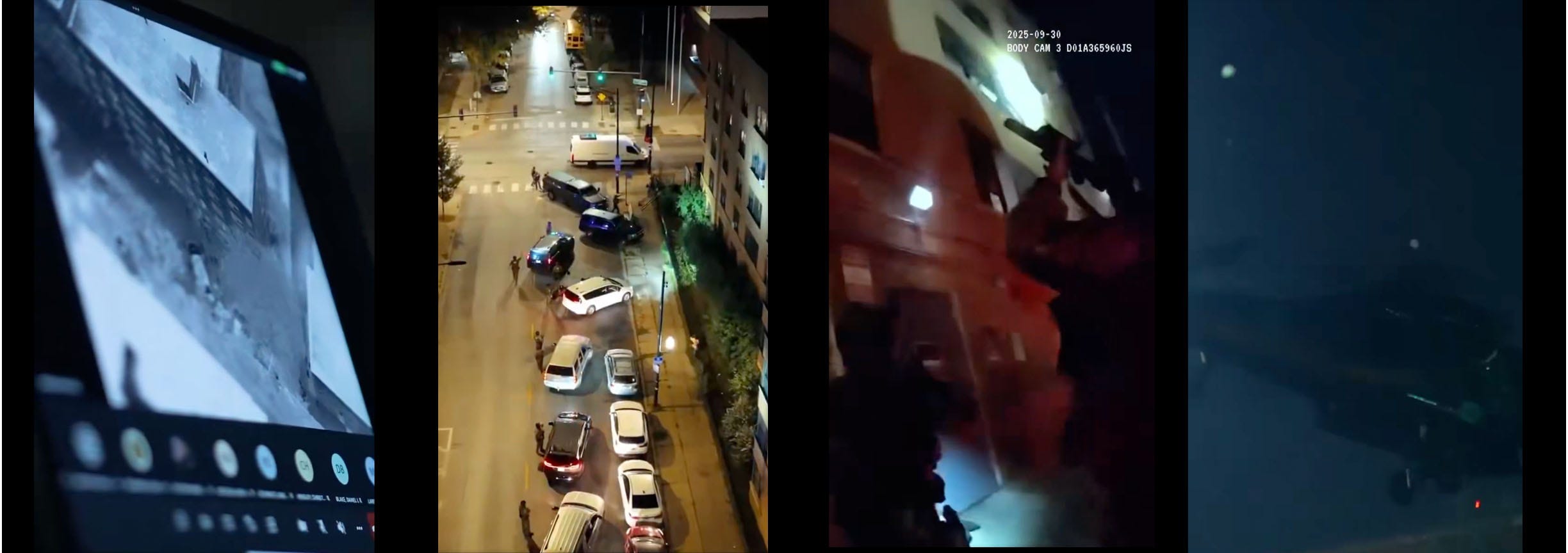
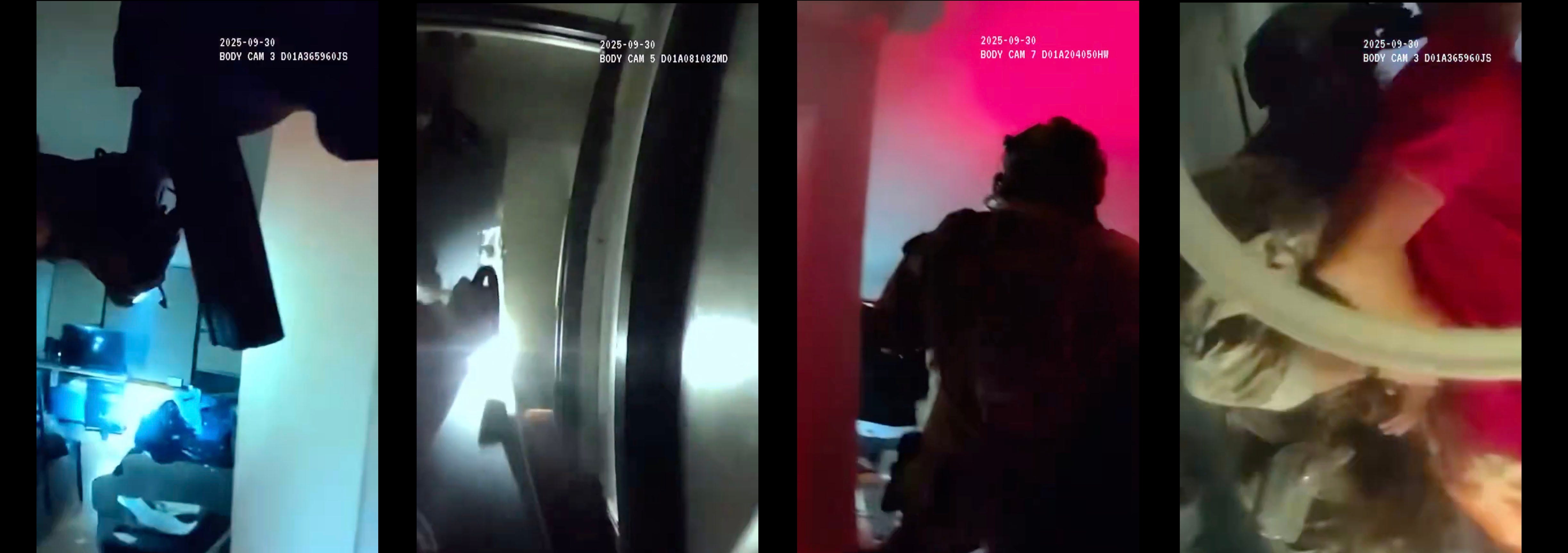
Here are some screenshots of the raid, which I encourage you to look at carefully:
It was all true: the Black Hawk helicopters, the dudes in military gear rappelling down, the mass arrests, the doors being broken down, the zip-ties, the public humiliation. In the video, DHS shows the faces of the men the ICE agents arrested, which no doubt will help their defense attorneys (assuming they are granted access to defense attorneys—no longer a safe assumption with Stephen Miller in charge).
But the damage has already been done.
I mean, little children were among those herded out of the apartments. Some of those children had theirhands zip-tied, too—by grown men decked out in enough military gear to occupy Fallujah.
And when a woman—an American citizen, not in any way affiliated with a gang, guilty of nothing more than living in Chicago, a city Trump hates because Obama’s from there—called out the ICE agents on their egregious lack of humanity, she was given the dismissive three-word response:
Fuck them kids.
The Trump regime has crossed yet another Rubicon. Now, the government can break down the front door of your house, drag you out of bed, zip-tie your hands behind your back, herd you into a van, and leave you there for hours and hours, without cause, without Miranda rights, without charge.
This is not fear-mongering. This is not speculation about what the Trump regime might do. This is happening. This has already happened. Here, in America. Nine months into the Trump Redux, and right on schedule, the fascist baby has been born.
Reading about this expression of brutal state tyranny, I was reminded of a passage in Defying Hitler, the Sebastian Haffner memoir about 1933 Germany:
The internal process was repressive terror: cold, calculated, official orders, directed by the state and carried out under the full protection of the police and the armed forces. It did not take place in the excitement following a victorious battle or danger successfully overcome — nothing of the kind had happened. Nor was it an act of revenge for atrocities committed by the other side — there had been none. What happened was a nightmarish reversal of normal circumstances: robbers and murderers acting as the police force, enjoying the full panoply of state power, their victims treated as criminals, proscribed and condemned to death in advance.
What we are seeing in Chicago the past 24 hours is a mere prelude. The official numbers of agents is nothing compared to the prisoners private contractors are releasing to kidnap, disappear and kill their fellow Americans. This suggests the covered faces are less about protecting the contractors and more about hiding from the public that prisoners are being used for this. Armed and set loose upon their fellow denizens on our streets.
This has yet to be confirmed by other news sources—but are other news sources, all of them owned by MAGA oligarchs, even interested at this point?
Plus, I mean, does it seem implausible? It’s clear ICE is staffed by poorly-trained, undisciplined, out-of-shape dipshits who barely know how to use their weapons. These losers have to come from somewhere.
But back to 1933 Germany. Haffner continues:
An example that became public knowledge because of its scale occurred some months later in the Cöpenick area of Berlin, where a Social Democratic trade unionist defended himself, with the help of his sons, against an SA patrol that broke into his home at night to “arrest” him. In obvious self-defense he shot two SA men. As a result, he and his sons were overcome by a larger troop of SA men and hanged in a shed in the yard that same night. The next day, the SA patrols appeared in Cöpenick, in disciplined order, entered the homes of every known Social Democrat, and killed them on the spot. The exact number of deaths was never made public.
Reading about masked men breaking down doors in the middle of the night and terrorizing an entire apartment complex, the Nazi-executed Social Democratic trade unionist is what sprung to mind.
Then they came for the trade unionists And I did not speak out Because I was not a trade unionist
This is the path we’re headed down—and it is paved with the skulls of the dead.
Fuck them kids.
It occurred to me that those three words perfectly sum up the priorities of Donald Trump and the soulless ghouls running his administration: RFK, Jr., Stephen Miller, Kristi Noem, Russ Vought, and so on. Indeed, FUCK THEM KIDS might as well be Trump’s 2028 campaign slogan.
Those three words will, I hope, be (figuratively) seared onto the forehead of every member of this MAGA Nazi administration, like Aldo Raine carving up swastikas in Inglorious Basterds.
Herd immunity means that enough people in a group or area have achieved immunity (protection) against a virus or other infectious agent to make it very difficult for the infection to spread. Immunity happens in multiple ways: through natural infection, vaccination or passive transfer. Vaccination is the best way.
Every person who has immunity makes it harder for the infection to spread to other people. If you’re vaccinated, it’ll be harder for the virus to use you to infect other people or to mutate into a new variant. Higher numbers of immune people are needed to stop the spread if a virus is very infectious.
To achieve herd immunity, studies show, 95 percent of a given population must be vaccinated. But since Trump’s first term, vax rates have been declining.
“During the 2024-2025 school year, vaccination coverage among kindergartners in the U.S. decreased for all reported vaccines from the year before,” reads a report by the CDC, “ranging from 92.1% for diphtheria, tetanus, and acellular pertussis vaccine (DTaP) to 92.5% for measles, mumps, and rubella vaccine (MMR) and polio vaccine.”
Ninety-two seems like a high number—but it’s not high enough for herd immunity. In many communities, especially in rural areas and in red states, where MAGA disinformation is most effective, communities are no longer protected from the scourge of long-conquered childhood diseases.
And that was before Trump put the deranged, whale-beheading gourd husk known as RFK, Jr. in charge of the country’s public health policy.
Bobby is an antivaxxer. He’s already contributed to the 2019 measles outbreak in Samoa, where 83 people, most of them young children, died (in a country with a population of 200,000 people), when he traveled there and stoked antivax hysteria, with his prestigious Kennedy name and his noxious Kremlin talking points.
In a related story, Donald and Bobby have Made Measles Great Again. Per the CDC:
As of September 30, 2025, there have been a total of 1,544 confirmed measles cases reported in the United States. Among these, 1,523 measles cases were reported by 42 jurisdictions: Alabama, Alaska, Arizona, Arkansas, California, Colorado, Florida, Georgia, Hawaii, Idaho, Illinois, Indiana, Iowa, Kansas, Kentucky, Louisiana, Maryland, Michigan, Minnesota, Missouri, Montana, Nebraska, New Jersey, New Mexico, New York City, New York State, North Dakota, Ohio, Oklahoma, Oregon, Pennsylvania, Rhode Island, South Carolina, South Dakota, Tennessee, Texas, Utah, Vermont, Virginia, Washington, Wisconsin, and Wyoming. A total of 21 measles cases were reported among international visitors to the U.S.
There have been 42 outbreaks reported in 2025, and 86% of confirmed cases (1,333 of 1,544) are outbreak-associated. For comparison, 16 outbreaks were reported during 2024 and 69% of cases (198 of 285) were outbreak-associated.
These outbreaks will only get worse, as the federal government continues to adopt antivax positions. South Carolina is only the latest state to have a measles outbreak.
This is a lot of data, I realize. A lot of statistics and numbers. But all you really need to know is this: In 2000, the World Health Organization declared that measles was eliminated in the United States—because of the success of the vaccines. Twenty-five years later, little children are once again dying of it.
The new conditions for federal funding the Trump administrationoffered to MIT put the school in a no-win situation, people on the Cambridge campus and throughout academia said Friday: Agree to the federal government’s terms and surrender some academic freedom, or refuse and risk further punishment.
The White House’s proposed “Compact for Academic Excellence in Higher Education” — sent to MIT and eight other top-tier universitiesthis week — ties access to federal moneyto a string of conditions that, if agreed to,would effectuate the most substantial changes MIT has seen to dateand fundamentally transform an economic powerhouse of Greater Boston.
The 10-point document asks the list of schools — which also includes Brown and Dartmouth — to cap international student enrollment, freeze domestic tuition rates for five years, and commit to strict definitions of gender.Some of those requests, such as reducing tuition and the number of international students, are popular with many Americans. But others, including one to limit the speech of university employees, strike at the heart of freedom and independence that universities have long prized.
While MIT declined to comment, on campus and in academia, there doesn’t appear to be much inclination to make a deal with the White House.
The offer amounts to “a loyalty oath to the federal government,” said Catherine D’Ignazio, an MIT professor of urban studies and planning.
“They’re asking us to sacrifice science. They’re asking us to sacrifice international students. They’re asking us to sacrifice our trans students. They’re asking us to sacrifice our whole idea of shared governance,” D’Ignazio said. “No amount of money is worth that great long list.”
The mandate also says that universities should transform or abolish “institutional units that purposefully punish, belittle, and even spark violence against conservative ideas.” That’s troubling, said Tyler Coward lead counsel for government affairs at the Foundation for Individual Rights and Expression, because it conflates allowing speech with condoning violence.
“This mandate basically forces these institutions to remain silent in order to secure some government benefit,” Coward said. “I think that is a problem, a First Amendment problem.”
MIT is the birthplace for countless startup companies, forms the backbone of Kendall Square, and serves as a first landing place for many students — roughly 30 percent of whom come from abroad — who stay and build careers in Massachusetts.
Federal money plays a key role in seeding all that. Last year, MIT collected $648 million in government funding for sponsored activities, including research, which federal agenciescould simply choose to award elsewhere.
The provisions in the compact, said Sandy Baum, a higher education finance expert with the think tank The Urban Institute, amount to “dramatic requests” of MIT from a dollars-and-cents perspective.
MIT is already bracing for a $300 million reduction in its central budget from the newfound 8 percent tax on its endowment and potential losses of federal science funding that powers much of its massive research arm, university administrators said in a September staff forum. (A recording of the meeting was reviewed by the Globe.)
In the spring, MIT saved roughly $100 million by freezing hiring and instituting a 5 percent cut to department budgets. It plans to close the remaining $200 million gap by terminating some real estate leases and seeking outside private funding for some academic priorities, including climate change, life sciences, and artificial intelligence, according to details shared at the staff forum. Administrators said that they may also withhold merit raises for employees next year.
“We do need to treat the $300 million amount as a permanent burden on the central budget that requires a permanent budgetary solution,” Glen Shor, MIT’s executive vice president and treasurer said at the September meeting. “Even if power at some point changes hands in Washington, we can’t count on these policies being reversed.”
Meanwhile, signing onto the compact could impact the number of international students at MIT, who make up around 10 percent of its undergraduate population — less than the limit set in the agreement. (Around 40 percent of MIT graduate students are from abroad.) Many international students pay full price to attend MIT, which can cost nearly $90,000 between tuition, housing, and other expenses. MIT would also pledge to cover the cost of attendance for all students studying hard sciences, such as physics, chemistry, and biology.
“If [MIT] had to freeze tuition and limit [the] number of international students, that would be a huge hit,” said Baum, the university finance expert.
Multiple MIT student organizations signed a letter Friday asking MIT to “firmly refuse” to sign the document, claiming that “accepting such a compact would effectively destroy the institutional culture of MIT as we know it.”
Nadia Zaragova, a material sciences PhD student and vice president of the graduate student union, said it would give the federal government “undue oversight over what we do here at the university, including our classrooms, what we study, what we research.”
And Governor Maura Healey, who has proposed $400 million in state funding to help make up for lost federal funds to Massachusetts universities, urged MIT to stand strong, describing the White House offer as “yet another attempt by President Trump to silence speech.”
MIT supporters note the university has already taken up some measures pushed by the Trump administration, including winding down its Institute Community and Equity Office and taking disciplinary actions against students — including a commencement speaker — who participate in pro-Palestinian protests.
Indeed, MIT was chosen among the schools who received the compact because they are seen as “good actors,” according to May Mailman, senior adviser for special projects at the White House.
“They have a president who is a reformer or a board that has really indicated they are committed to a higher-quality education,” she said to The Wall Street Journal.
But Ian Hutchinson, an MIT emeritus professor and co-president of its Council of Academic Freedom, said that even those in favor of those moves have sour feelings about the new offer from the administration.
“Many of us on the council think that the modern academy needs to reform and [is] beginning to do so and that the compact has the risk of alienating a large fraction of the faculty,” he said.
Others fear that some professors could leave entirely, should the school sign onto the compact.
A better approach, Hutchinson added, would be if “the government makes clear what it is interested in funding in the way of research and what it is not interested in funding.”
The compact also frames preserving “single-sex spaces” such as bathrooms and locker rooms as necessary for “women’s equality” and stipulates institutions must commit to defining gender “according to reproductive function and biological processes.”
Mila Halgren, an MIT postdoctoral associate, said including such language is an affront to what the values of American higher education should be.
“In a personal capacity, every moment MIT even considers this compact is a betrayal of every marginalized group on campus,” she said. “That MIT did not immediately reject a proposal which defines trans people out of existence is shameful.”
In the post at 9 a.m. today, two scholars of racism and equity explained that Trump’s scrubbing of museums, national parks, and other federal facilities is an attempt to capture control of the culture and erase the place of Blacks, women, and anyone else who is not a straight white male.
But, as scholar Julian Vasquez Heilig writes here, Trump and his commissariat cannot control the popular culture. In time, we can hope, his mean-spirited efforts to revise history will become a bad joke, a cruel joke, a stupid joke. He and all those who carry out his orders will become a public laughing stock.
Vasquez Heilig writes on his blog Cloaking Inequity:
The Super Bowl has always been more than football. It is a ritual, a spectacle, a national performance. It’s where America tells the world who it thinks it is, and who it wants to be. Which is why the announcement that Bad Bunny will host the halftime show is far more significant than a musical lineup change. It’s a cultural earthquake.
I remember the first time I heard Bad Bunny. It was December 6, 2019, at La Concha Hotel in San Juan. In the downstairs lounge, the beat of reggaetón was shaking the walls, and I pulled out Shazam to figure out what it was. The song was Vete. The room was electric, filled with Puerto Ricans singing every word in Spanish, unapologetically themselves. That night, it hit me: Bad Bunny was not just making music in San Juan, he was celebrating culture. He wasn’t crossing over into the mainstream by adapting; he was dragging the mainstream toward him. He refused to translate, refused to dilute, and now he is everywhere—on playlists, on charts, SNL, in crowded places from San Juan to New York to Madrid.
That’s why his Super Bowl moment matters so much. It is not just a performance, it is the culmination of a global movement that began in places like that basement lounge in Puerto Rico. What felt local then is now universal. Bad Bunny’s rise shows how culture flows upward, from the margins to the center, from overlooked communities to the biggest stage in the world. For millions of us, this is affirmation. For the right wing, it is destabilization. Because when the halftime show belongs to Bad Bunny, it proves that America is no longer just what they imagine it to be. It is bigger, louder, and more diverse than great again nostalgia can contain.
Jay-Z, Kendrick Lamar, and the New Halftime Era
The NFL’s halftime choices haven’t shifted by accident. When the league came under fire for its treatment of Colin Kaepernick and broader criticisms about racial injustice, it needed credibility. Enter Jay-Z and Roc Nation. The NFL tapped him to advise and help curate halftime shows.
The results have been undeniable. Kendrick Lamar’s halftime performance last year was a watershed moment—unapologetically Black, politically charged, and culturally defining. That performance sparked widespread discussion, and even a blog post I wrote about it entitled “TV Off”: What Kendrick Lamar Was Really Saying at the Super Bowl drew more than 100,000 readers in just a few days. Clearly, the hunger to talk about representation and ownership of the halftime stage is real.
Now with Bad Bunny taking the baton, the NFL is making another cultural statement, whether it fully realizes it or not (I think it does). The league’s biggest platform is no longer reserved for the safe, predictable acts of yesterday. It’s becoming a stage where hip hop, reggaeton, and the voices of communities once marginalized are front and center.
Bad Bunny and the Right’s Panic
For decades, the halftime show was dominated by choices that reinforced a narrow image of America: classic rock icons, country stars, or pop acts who wouldn’t ruffle feathers but had wardrobe malfunctions. Bad Bunny shatters that mold. His performance won’t be a side act, it is the show. Spanish won’t be a novelty; it will be central.
This is exactly why the right wing panics. To them, football Sundays and Super Bowls have long been “their” cultural territory. They’ve wrapped the game in patriotic rituals, military flyovers, and moments of silence for conservative heroes. When someone like Bad Bunny steps into the spotlight, it disrupts their monopoly. It forces a new definition of America—one that is multilingual, multicultural, and undeniably Latino. That’s what makes his halftime role so radical: after focusing on the Black experience with Kendrick, this year signals that Latino identity is no longer peripheral. It’s woven into the fabric of America’s biggest stage.
Why ICE Wants to Loom Over the Moment
It might sound absurd that ICE wants to connect itself to the Super Bowl halftime show, but immigration enforcement has always thrived in the shadows of visibility. When Latino joy and success are celebrated so publicly, ICE apparently feels the need to remind America of its terrorizing power.
Bad Bunny performing at the Super Bowl is a triumph of belonging. But ICE’s assaults, raids, arrests, kangaroo courts, and deportations are constant reminders that belonging is conditional on politics. While millions watch a Puerto Rican superstar, ICE agents are throwing mothers and journalists to the ground, spraying pepper liquid into the eyes of Americans who dare to ask questions, arresting elected politicians at the behest of Washington politicians after turning off their body cameras, and authorized by the Supreme Court to detain people simply for looking Latino and poor.
The contradiction is sharp: on the world’s stage, Latino identity is being widely celebrated; on America’s streets, it’s criminalized. ICE doesn’t need to show up at the stadium—it already shows up in our daily life. Its existence ensures that even at moments of cultural triumph, there’s a purposeful shadow of fear and terroristic threats.
Danica Patrick’s Tone-Deaf Criticism
And then, inevitably, a silly critic emerges from the sidelines. This time it’s Danica Patrick, who dismissed Bad Bunny’s hosting role. Her comments were more than unhelpful, they were stupid.
Patrick should know better. She carved her own career by getting along in a male-dominated sport, where every step forward was a battle for representation. She knows the symbolic weight of breaking barriers. For her to turn around and mock or diminish Bad Bunny’s presence is hypocritical at best, willfully ignorant at worst.
Bad Bunny isn’t there to tick a diversity box, he’s there because he is one of the most influential artists alive— maybe THE most. The incredible success of his shows that he did for his most recent album this past summer ONLY in Puerto Rico is proof that the center of American culture is shifting. Criticizing that isn’t just a matter of taste. It’s a refusal to accept reality.
The Lions, Charlie Kirk, and Who Gets Tribute
The battle over cultural ownership in America doesn’t stop at the Super Bowl. It plays out every Sunday on the NFL field. When conservative commentator Charlie Kirk was assassinated, the league encouraged teams to hold moments of silence in his honor. Most complied. But the Detroit Lions, along with a few other teams, did not.
That decision matters. It was a quiet but deliberate act of boundary-setting, a refusal to let every NFL broadcast become a political ritual sanctifying right-wing political ideology. By declining the tribute, the Lions reminded us that not every form of patriotism must come prepackaged with conservative allegiance. It wasn’t loud or defiant. It was subtle and deeply symbolic. Sometimes resistance isn’t what you do, it’s what you decline to perform and participate.
The Lions’ restraint connects to the same cultural realignment symbolized by Bad Bunny’s Super Bowl performance. Both moments reject the idea that American culture belongs to a single tribe. They push back against the notion that sports, music, or patriotism must orbit one political pole. They insist, instead, that culture belongs to everyone, not just the loudest or the angriest voices claiming to defend it.
The Double Standard of Protest
Of course, this tension between culture, power, and dissent has long been visible in the NFL. When Colin Kaepernick knelt during the national anthem to protest police brutality, he was branded a traitor by many of the same voices now demanding “respect” for Charlie Kirk. His silent, dignified act of conscience was recast as an attack on America itself.
The outrage was never really about the flag. It was about control. It was about who is allowed to define what counts as “patriotic.” Kaepernick’s kneeling was an act of moral courage, but it exposed how fragile America’s cultural gatekeepers truly are when confronted with truth. They could not tolerate a protest that revealed their own comfort with injustice and brutality.
Meanwhile, state violence continues daily without the same moral outrage from the right-wing. ICE officers violently throw mothers and journalists to the ground without cause. They pepper-spray citizens in their eyeballs for daring to ask questions in a conversation. They arrest and detain American citizens in raids not for crimes but for looking poor, brown, or foreign. These acts have not provoked right-wing primetime outrage or public boycotts. Their hypocrisy is staggering.
A man kneeling quietly for justice was vilified. Agents brutalizing families are ignored. The problem has never been the method of protest, it has always been their morality. Silence in the face of injustice is acceptable; silence against injustice is not. The Lions’ quiet refusal and Kaepernick’s quiet protest share something profound: both disrupted the script of cultural obedience. Both reminded us that resistance isn’t always loud. Sometimes it’s the refusal to play along.
The Supreme Court’s Enabling Role
And looming behind all of this is the judiciary. Recent Supreme Court rulings have expanded law enforcement’s power, narrowing protections under the Fourth Amendment and giving politicians more leeway to persecute immigrants using federal data. Justice Brett Kavanaugh has been the lead in the right-wing judicial majorities that have handed law enforcement broad authority to stop, question, and detain anyone with minimal cause. Its new rulings have created the legal cover that now makes racial profiling essentially legal.
Racial profiling has happen illegally before and the new legal result empowered by the Supreme Court is the same: citizens living under suspicion, families living in fear, communities targeted not for what they’ve done but for how they look. The Supreme Court has enabled ICE brutality in the same way NFL owners enabled the blackballing of dissent, by creating structures that justify exclusion and violence while insisting neutrality.
The Bigger Picture: Who Owns the Stage?
So what do Bad Bunny, Kendrick Lamar, Jay-Z, Danica Patrick, ICE, the Lions, Charlie Kirk, and Brett Kavanaugh all have in common? They are all part of the “fight, fight, fight” (see new Trump $1 coin) over who gets to define American culture.
The right wing has long claimed the NFL as its territory: its rituals, its tributes, its symbols of patriotism. But culture evolves. It cannot be contained. From Detroit to San Juan to Los Angeles, new voices are shaping the narrative. Bad Bunny’s halftime show, Kendrick’s explosive performance, and even the Lions’ silent refusal all tell the same story: football does not belong exclusively to one political ideology. Neither does America.
The real question is whether we are willing to see that America’s identity is bigger than its old rituals. Are we willing to admit that inclusion is not a threat but a fact? Because culture doesn’t wait for permission. It claims the stage. And this year, that stage will belong to Bad Bunny.
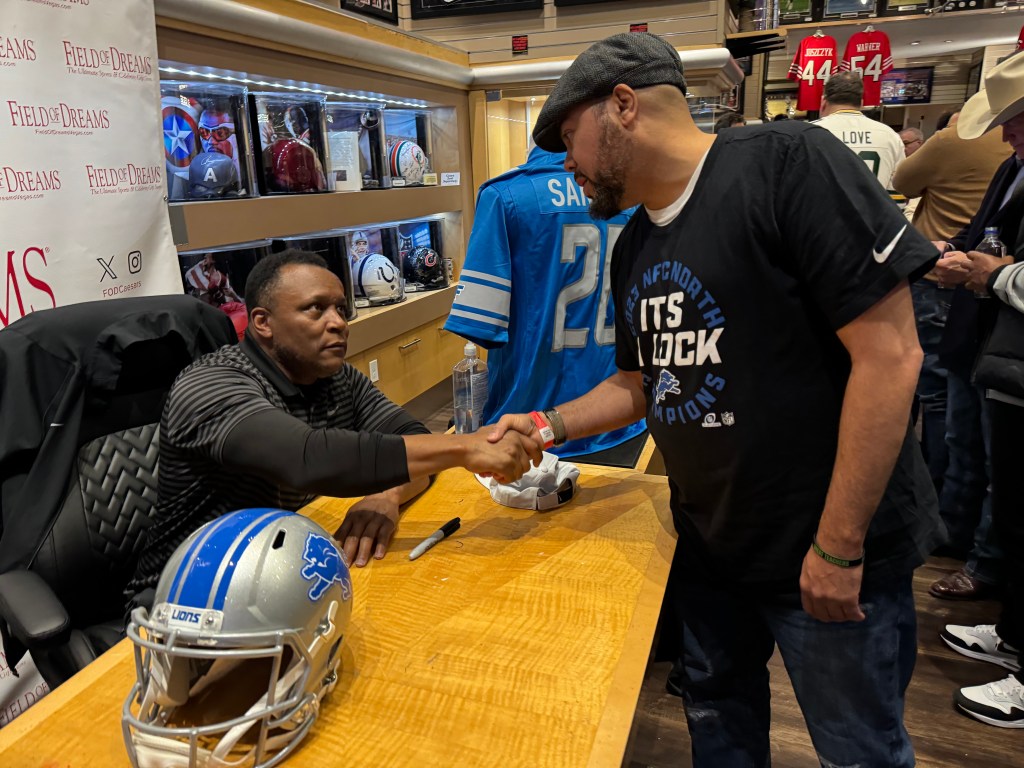
Julian Vasquez Heilig is a professor, writer, and a legit lifelong Detroit Lions fan since 1981. He attended the NFC Championship in San Jose two years ago to support his Cardiac Cats and last year’s playoff loss to the Washington Commanders at Ford Field. He was also at the official Lions partners party during the NFL Draft in Detroit, where he met Robert Porcher and Jason Hanson. Over the years he’s spotted Billy Sims in Times Square, endured the heartbreak of the Lions’ 0–16 season, and treasures his personally autographed Barry Sanders helmet. Beyond education and equity, Julian dabbles in writing about sports, culture, and society.


 Diane Ravitch's blog