Archives for category: Bigotry

CNN posted an important article about two billionaires in Texas who are spending heavily to push state politics to the extreme right fringes on social issues. Tim Dunn and Farris Wilks despise gays, love guns, and preach a version of Christianity that is suffused with hate, not love or charity or kindness. Above all, they aim to destroy public education, which they see as the root of America’s cultural decline.

If you read one article today, make it this one. It explains the drive for vouchers for religious schools. What Dunn and Wilks want is not “choice,” but indoctrination into their selfish, bumigored world view.

CNN’s investigative team writes:

Gun owners allowed to carry handguns without permits or training. Parents of transgender children facing investigation by state officials. Women forced to drive hours out-of-state to access abortion.

This is Texas now: While the Lone Star State has long been a bastion of Republican politics, new laws and policies have taken Texas further to the right in recent years than it has been in decades.

Elected officials and political observers in the state say a major factor in the transformation can be traced back to West Texas. Two billionaire oil and fracking magnates from the region, Tim Dunn and Farris Wilks, have quietly bankrolled some of Texas’ most far-right political candidates — helping reshape the state’s Republican Party in their worldview…

Critics, and even some former associates, say that Dunn and Wilks demand loyalty from the candidates they back, punishing even deeply conservative legislators who cross them by bankrolling primary challengers. Kel Seliger, a longtime Republican state senator from Amarillo who has clashed with the billionaires, said their influence has made Austin feel a little like Moscow.

“It is a Russian-style oligarchy, pure and simple,” Seliger said. “Really, really wealthy people who are willing to spend a lot of money to get policy made the way they want it — and they get it…”

Former associates of Dunn and Wilks who spoke to CNN said the billionaires are both especially focused on education issues, and their ultimate goal is to replace public education with private, Christian schooling. Wilks is a pastor at the church his father founded, and Dunn preaches at the church his family attends. In their sermons, they paint a picture of a nation under siege from liberal ideas…

Dunn and Wilks have been less successful in the 2022 primary elections than in past years: Almost all of the GOP legislative incumbents opposed by Defend Texas Liberty, a political action committee primarily funded by the duo, won their primaries this spring, and the group spent millions of dollars supporting a far-right opponent to Gov. Greg Abbott who lost by a wide margin.

But experts say the billionaires’ recent struggles are in part a symptom of their past success: Many of the candidates they’re challenging from the right, from Abbott down, have embraced more and more conservative positions, on issues from transgender rights to guns to voting.

“They dragged all the moderate candidates to the hard right in order to keep from losing,” said Bud Kennedy, a columnist for the Fort Worth Star-Telegram newspaper who’s covered 18 sessions of the Texas legislature…

People who’ve worked with Wilks and Dunn say they share an ultimate goal: replacing much of public education in Texas with private Christian schools. Now, educators and students are feeling the impact of that conservative ideology on the state’s school system.

Dorothy Burton, a former GOP activist and religious scholar, joined Farris Wilks on a 2015 Christian speaking tour organized by his brother-in-law and said she spoke at events he attended. She described the fracking magnate as “very quiet” but approachable: “You would look at him and you would never think that he was a billionaire,” she said.

But Burton said that after a year of hearing Wilks’ ideology on the speaking circuit, she became disillusioned by the single-mindedness of his conservatism.

“The goal is to tear up, tear down public education to nothing and rebuild it,” she said of Wilks. “And rebuild it the way God intended education to be.”

In sermons, Dunn and Wilks have advocated for religious influence in schooling. “When the Bible plainly teaches one thing and our culture teaches another, what do our children need to know what to do?” Wilks asks in one sermon from 2013.

Dunn, Wilks and the groups and politicians they both fund have been raising alarms about liberal ideas in the classroom, targeting teachers and school administrators they see as too progressive. The billionaires have especially focused on critical race theory, in what critics see as an attempt to use it as a scapegoat to break voters’ trust in public schooling.

In the summer of 2020, James Whitfield, the first Black principal of the mostly White Colleyville Heritage High School in the Dallas suburbs, penned a heartfelt, early-morning email in the wake of George Floyd’s murder, encouraging his school to “not grow weary in the battle against systemic racism.”

The backlash came months later. Stetson Clark, a former school board candidate whose campaign had been backed by a group that received its largest donations from Dunn and organizations he funded, accused Whitfield during a school board meeting last year of “encouraging all members of our community to become revolutionaries” and “encouraging the destruction and disruption of our district.” The board placed Whitfield on leave, and later voted not to renew his contract. He agreed to resign after coming to a settlement with the district. Clark did not respond to a request for comment.

Whitfield said he saw the rhetoric pushed by Dunn and Wilks as a major cause of his being pushed out.

“They want to disrupt and destroy public schools, because they would much rather have schools that are faith-based,” Whitfield said. “We know what has happened over the course of history in our country, and if we can’t teach that, then what do you want me to do?”

Meanwhile, the legislature has also been taking on the discussion of race in classrooms, passing a bill last year that bans schools from making teachers “discuss a widely debated and currently controversial issue of public policy or social affairs.” The legislation was designed to keep critical race theory out of the classroom, according to Abbott, who signed the bill into law.

Some of the co-authors and sponsors of the bill and previous versions of the legislation received significant funding from Dunn and Wilks.

The billionaires “want to destroy the public school system as we know it and, in its place, see more home-schooling and more private Christian schools,” said Deuell, the former senator.

By the power of their money, these two billionaires are reshaping public policy in Texas to make it as narrow-minded and bigoted as they are. Their reactionary vision will indoctrinate students and crush the freedom to teach and the freedom to learn.

If you live in Texas, vote for Beto O’Rourke for Governor, Mike Collier for Lt. Governor, and for legislators who support public schools.
Maureen Downey of the Atlanta Journal-Constitution posted a guest column by two university scholars in Georgia, warning about the dangerous legislation now under consideration.

T. Jameson Brewer is an assistant professor of social foundations of education at the University of North Georgia. Brandon Haas is an associate professor of social foundations and leadership education at the University of North Georgia.

Brewer and Haas write:

At present, several bills in the state Legislature — including House Bill 1084 and Senate Bill 377 — weaponize grievance politics in the culture wars during a Georgia election year. These bills are our state’s iteration of “anti-critical race theory” proposals across the nation.

In Florida, lawmakers are seeking to make it illegal for white students to feel discomfort. In Oklahoma, a recent proposed bill would allow parents to sue teachers for $10,000 per day if they discuss any topic that does not perfectly align with a student’s closely held religious belief.

The House and Senate bills here in Georgia do not mention critical race theory by name. But they are part of this growing ideological trendto manufacture and capitalize on outrage as it relates to what students are taught or not taught in schools — the front line, as it were, of the nation’s culture war.

While there have long been efforts from the political right to censor curriculum and ban books in U.S. schools, these efforts have reached a fever pitch over the past two years. First, parents shouted at local school boards to ignore medical science and reopen schools as well as remove mask mandates during the height of the pandemic. Then, concerns over the teaching of CRT began to spring up across the country.

The simmering perception that K-12 schools and universities are engaged in teaching students to hate the United States or themselves was captured in the Trump administration’s 1776 Report. That report, not penned by historians, is full of inaccuracies in its attempt to promote fascist-like indoctrination that the United States is without historical or contemporary issues. Among many concerns, the 1776 Report attempts to suggest that George Washington freed his slaves and, thus, the United States does not have a legacy of racial oppression. Those with an accurate understanding of history know Martha Washington freed one of approximately 123 slaves.

Recently, the Heritage Action group tweeted about “uncovering” the teaching of CRT in Gwinnett County Public Schools despite K-12 districts suggesting that they do not teach CRT. Yet, this tweet was not the “gotcha” that Heritage may think it was for a few reasons: (1) The course in question was an Advanced Placement language and research course (that is, a college-level course), (2) students learn myriad frameworks for examining and critiquing issues, and (3) this type of critical thinking is precisely what we should want education to teach our students. All of that said, Superintendent Calvin Watts, noted that the syllabus in question was never used in classes. A district spokeswoman said it was a sample syllabus submitted to the organization that provides AP curriculum.

Georgia’s proposed bills seek to establish that racial injustice is an artifact of the past that no longer exists. They state that educators cannot suggest that the United States or Georgia is fundamentally biased based on race. Yet, any examination will clearly show that racial bias was a fundamental component of our legal, social, and educational system — from slavery to Jim Crow to mass incarcerations. The question, then, is whether or not these inequalities still persist. For this, students need to develop the ability to examine, evaluate and critique myriad forms of data and generate their own fact-based conclusion.

While part of any learning process is extending beyond our comfort zones, that discomfort is not what is at stake with these bills in Georgia, Florida and a dozen other states. It is uncomfortable to admit that white schools receive so much more in funding than nonwhite schools. Admitting this reality begs action. If we claim that the U.S. affords all children with a level playing field, the receipts showing that the field is structurally uneven suggests that we either forfeit the claim of equality or seek to remedy the inequality…

The larger problem created by SB 226 is that it creates a slippery slope of giving power to those who lack training in curriculum, instruction, and library media. This trend should alarm anyone who does not fancy a Nazi Germany-style authoritarian government over a democratic republic. In fact, one of the initial steps taken in Nazi Germany was banning of books, control of school curriculum and requirements of “loyalty oaths” and coerced patriotism as we are seeing in a variety of proposed laws across the country.

The United States has a checkered past that is troubling for all citizens. This is known as difficult history and provides students with an opportunity to understand how the past shapes the present so that they can be thoughtful and effective citizens. As novelist and essayist James Baldwin said, “I love America more than any other country in the world and, exactly for this reason, I insist on the right to criticize her perpetually.”

Will Georgia codify lying to students? Will we ban or burn books? While the next political outrage may find another arena to target and destroy for political gain, there are real harmful implications of the one currently targeting schools and books in an effort to satiate the public’s broad ignorance about buzzwords such as critical race theory. These bills are not anti-CRT, whatever that may mean. They are explicitly anti-education.

Mercedes Schneider writes here about the decision by Willie Carver, Kentucky’s 2022 Teacher of the Year, to resign.

Carver testified before Congress and described the indignities he endured because he is gay. Carver is a highly qualified, highly experienced teacher. He loves teaching. But he is afraid to return to the classroom because of the state-sponsored bigotry that threatens teachers and students like him.

Carver told members of Congress (in part, open the link):

Identity is rarely discussed by direct means. No teachers come out as straight. They are married to opposite sex spouses whose pictures sit on their desks or whose names come up in stories about vacations or weekend trips to the grocery store.

LGBTQ teachers and students will not be afforded this freedom. They will be required to deny their existence and edit the most basic aspects of their stories, unlike their classmates and colleagues.
Few LGBTQ teachers will survive this current storm. Politicizing our existence has already darkened our schools.

I’m made invisible. When we lost our textbooks during lockdown, I co-wrote two free textbooks
with a university professor, made them free to anyone who wanted them, and found sponsors to print them. I wasn’t allowed to share them at my school. Other schools in Kentucky celebrate similar work by teachers, but my name is a liability.

I’m from the small town of Mt. Sterling, KY and I was invited to meet the President of the United States. It was not advertised to my students and colleagues. My school didn’t even mention it in an email or morning announcement.

This invisibility extends to all newly politicized identities. Our administrators’ new directive about books and lessons is “nothing racial.”

We all know how to interpret this.

Works by white people living lives as white people are never called racial.

Works by Black and brown people living lives as Black and brown people are always called racial.

The politicization of identity erases their identities.

Parents now demand alternative assignments when authors of texts or materials are Black or LGBTQ; we teachers are told to accommodate them, but I cannot ethically erase Black or queer voices.

We ban materials by marginalized authors, ignoring official processes. One parent complaint removes all students’ books overnight.

Endangered educators

My Gay Straight Alliance (GSA), a campus group dedicated to discussing and helping make schools safe for LGBTQ students, couldn’t share an optional campus climate survey with classmates. I was told it might make straight students uncomfortable.

Students now use anti-LGBTQ or racist slurs without consequence. Hatred is politically protected now.

When my GSA’s posters were torn from walls, my principal’s response was that people think LGBTQ advocacy is “being shoved down their throats.”

Inclusive teachers are thrown under the bus by the people driving it.

During a national teacher shortage crisis, I know gay educators with perfect records dismissed this year.

A Kentucky teacher’s whiteboard message of “You are free to be yourself with me. You matter” with pride flags resulted in wild accusations and violent threats. During this madness, his superintendent wrote to a parent, “This incident … is unacceptable and will not be tolerated.” The situation became unimaginably unsafe. He resigned.

Last month, a parent’s dangerous, false allegations that my GSA was “grooming” students were shared 65 times on Facebook. I felt my students and I were unsafe. Multiple parents and I asked the school to defend us. One father wrote simply, “Please do something!” The school refused to support us.

There are 10,000 people in my town; one fringe parent doesn’t represent most parents, who trust us.

Student suicides

School is traumatic; LGBTQ students are trying to survive it. They often don’t. Year after year, I receive suicidal goodbye texts from students at night. We’ve always saved them, but now I panic when my phone goes off after 10:00.

Meryl, a gentle trans girl from Owen County High, took her life in 2020. She always wanted a GSA. Her friends tried to establish one, but the teachers who wanted to help were afraid to sponsor it. Meryl’s mother Rachelle runs an unofficial GSA, PRISM, from the local library.

45% of LGBTQ youth seriously considered suicide this year. We chip away at their dignity and spaces to exist. The systems meant to protect them won’t even acknowledge them.

I recently attended Becky Oglesby’s TED Talk. She described surviving a tornado with first graders, how they huddled, her arms around them, as their school walls lifted into the darkness.

I sobbed uncontrollably. I realized that for fifteen years, I have huddled around students, protecting them from the winds, and now the tornado’s here. As the walls rip away, I feel I’m abandoning them.

But I’m tired. I’ve been fighting since my first day in a classroom. Fighting for kids to feel human. Fighting for kids to be safe. Fighting to stop the fear by changing hearts and minds.

I’m tired. I don’t know how much longer I can do it.

It is not safe to be gay in Kentucky or Florida or most states in the South and Midwest. Nor is it safe to be Black or Brown in the many states that have banned teaching about the history of racism.

Willie Carver has accepted a position at the University of Kentucky where he will work in student services.

Censorship and harassment does eliminate homosexuality. Nor does it turn all students white.

Lying about history doesn’t change history. It just spreads ignorance.

Veteran educator Arnold Hillman and his wife Carol retired to South Carolina. But instead of golfing, they devoted themselves to a high-poverty high school and worked directly with the students to encourage them to aspire them to go to college.

Arnold writes here about what he has learned about South Carolina:

As with the beginning of any sports season, odds makers, fans, team owners, managers and coaches and players look forward to the onset of the games. In single person sports like golf, tennis, combat sports such as real wrestling, boxing, UFC, and the martial arts, expectations are even greater.

How do successful teams, individuals and those who are in charge, manage to rise above others? Why are certain teams and individuals levels of expectations so very high? Why is it that former doormats become champions in a few short years?

There are many examples of those kind or turnarounds. How about Cassius Clay (Muhammed Ali) destroying the world champion Sonny Liston? How did the 1980 USA hockey team come from obscurity to defeat the greatest teams in the world?. For pitysake, how did the New York Mets go from nothingness to World Series Champs in 1969?

There are so many examples of these kind of things that apply to what is happening in education here in South Carolina. Let’s go back to sports for a moment. Certainly, individuals have their own expectations of how they will succeed. Whether nature or nurture, is always a question. If a group of players on a football team have their own beliefs, and they are not shared by the coach, there will be little success.

Try and explain the success of the New England Patriots and then the Tampa Bay Buccaneers. In the case of New England, players wanted to be traded there because of the level of expectations the teams always had of themselves. Tom Brady and Bill Belicheck knew how to win and how to inspire others. Mediocre players who migrated to the Pats soon became integral parts of the success of the team.

Now that Tom Brady is with the Bucs and Bruce Arians, the Coach, there is also an expectation of victories. So, they win the Super Bowl in their first year together. On the other end is the Jacksonville Jaguars, with a super quarterback and a coach who had no level of expectations.

What does this have to do with education in South Carolina? Do we ever wonder why our state is always at the bottom of any ranking list in education? The history is long and continual. Here is a site that will take you a while to read. It is, however, a clear picture of why education has not flourished in our state.

Now that you understand our history, you can see why the level of expectation for our children is so low. Pat Conroy and his “Corridor of Shame,” described the situation in many of our poor and rural school districts. He taught in one of those districts. He understood.

For some reason, it appears that those in charge of education at the state level continue to treat parts of our state in a way that encourages low expectations. Here are some historical reasons why South Carolina’s education system has floundered though the years:


“1. A strong tradition brought from England that public support for education should be limited to the poor

2. Education seen as more of the responsibility of the Church than the State

3. Attitudes of those outside the wealthy class that worked against a unified system, including low regard for learning, reluctance to accept charity through free tuition, and the need to keep children in the family labor force

4. The very high cost in the 1700s and 1800s to provide quality schools outside the citiesand coastal areas, population was sparse and transportation poor

5. Strong resistance to local taxation for schools until the late 1800s

6. Interruption of a burgeoning “common school movement” in South Carolina by the CivilWar, and the subsequent disruption of a tax base

7. Increased white resistance to the public school idea following the Reconstruction government’s attempts to open schools to all races

8. An attitude on the part of some 20th century leaders that too much education would damage the state’s cheap labor force

9. The slow growth of state supervision of the schools due to strong sentiments toward local control

10. The financial burden of operating a racially segregated system, and the social and educational impact of combining two unequal systems”


(The History of South Carolina Schools

Edited by Virginia B. Bartels

Study commissioned by the Center for Educator Recruitment, Retention, and Advancement)

(CERRA–SC)


These historical happenings still are partially responsible for our current education system. Low test scores in the poor and rural sections of the state confound state leadership. Therefore, they have come to expect these outcomes year after year.

Yet, in travels across the state, SCORS (South Carolina Organization of Rural Schools) has seen how those school districts and their children make huge efforts to improve education. We have worked with these children in one local high school and seen the lack of resources, lack of quality of instruction, and actual lack of teachers in math and sciences.

In many of the rural and poor school districts, there has been “white flight” to private schools, charter schools, religious schools and home schoolings. Once again the wealthier the school district, the higher they are in the rankings of school districts in the state.

So, what is left- a lack of expectations for those left in the public schools. Why, say the talking heads and misunderstanders, aren’t these schools doing better. The system is really stacked against those poor and rural folks. However, are the children really unable to learn or compete, on any level, with the lighthouse districts? You bet they can. I have seen it.

Let me give you some anecdotal evidence. Dr. Vernon (not her real name) was the superintendent of a rural school district in South Carolina. She was, in fact, a product of the public schools in SC. She came from humble beginings and rose to her position as superintendent with some help from people and a great desire to help youngsters like herself.

After 5 years as superintendent, her board changed dramatically. One of her board members said that the students test scores on certain state tests were not true and that she had elevated those test scores. The Department of Education was called in and found none of those charges to be true. Board members could not believe that the children could be this good. By the way the superintendent and board parted ways with much acrimony.

Certainly there was much politics in her leaving. She also sued the board for defamation of character and won. Was all this because the level of expectations for the poor, minority and rural children were unable to improve on their test scores?

Another anecdote centers about a student (and an excellent basketball player) was placed in a prep school outside of Philadelphia. He spent a year there as a post graduate. After the first four weeks of school, he retook the SATs and got 120 more points than he had at his old school. He got an athletic scholarship from a prestigious university.

So what does all that mean? We can tell you from my 61 years in education that there is a blanket on our poor and rural children that leads to a lack of expectations and a lack of will to help these children.

Lloyd Lofthouse, author, former Marine, and former teacher, explains what it means to be woke. Some Republican politicians—notably Ron DeSantis— are trying to suppress “wokeness.”

Lloyd writes:

Anyone that attacks what’s known as “woke ideology” is supporting zombie thinking and belongs to a fascist cult of ignorance.

Wokeness means someone that is highly literate, well educated, well read, is a life long learner, questions claims and uses critical thinking, problem solving and rational logic to find out if there is any truth to what these fascist zombies are shouting.

Question: Are you woke?

In Virginia, an evangelical church announced plans to open a new school. They claim that demand for private Christian education has soared due to controversies over critical race theory (i.e., teaching anything about racism, past or present) and masking during the pandemic (they refused to protect their children’s health). Will the new school indoctrinate children to be racist? To hate gays? To look down on other religions? One thing you can be sure of: it will seek government money for its tuition.

MIDDLEBURG, Virginia – Nestled in the rolling hills of northern Virginia sits a sprawling tree-lined campus. Classrooms inside this shuttered private school sit empty. Once-busy halls are eerily silent. Each room looks like a time capsule of better days. But not for long.

“After much prayer and discussion with our elders, and pastoral leadership, we will be launching Cornerstone Christian Academy,” said Senior Pastor Gary Hamrick.

Hamrick got a standing ovation after making that announcement during recent Sunday services at Cornerstone Chapel in Leesburg.

The campus is about 20 miles from Cornerstone Chapel the church that will open the school in the fall of ’23.

Initially, there will be enough space for 500 elementary and middle school students. “They have classrooms, desks, there’s a gym, cafeteria, down the hall. We’re going to repurpose it for the Lord,” said Hamrick.

On Today’s Quick Start Podcast: How Red Flag Laws Failed, Marvel Actors Sound Off on LGBT Message in Thor

There are also plans to expand to high school and online learning.

“Our goal is to provide children an education where they have a biblical worldview. So they can go out into the world and be salt and light,” he said.

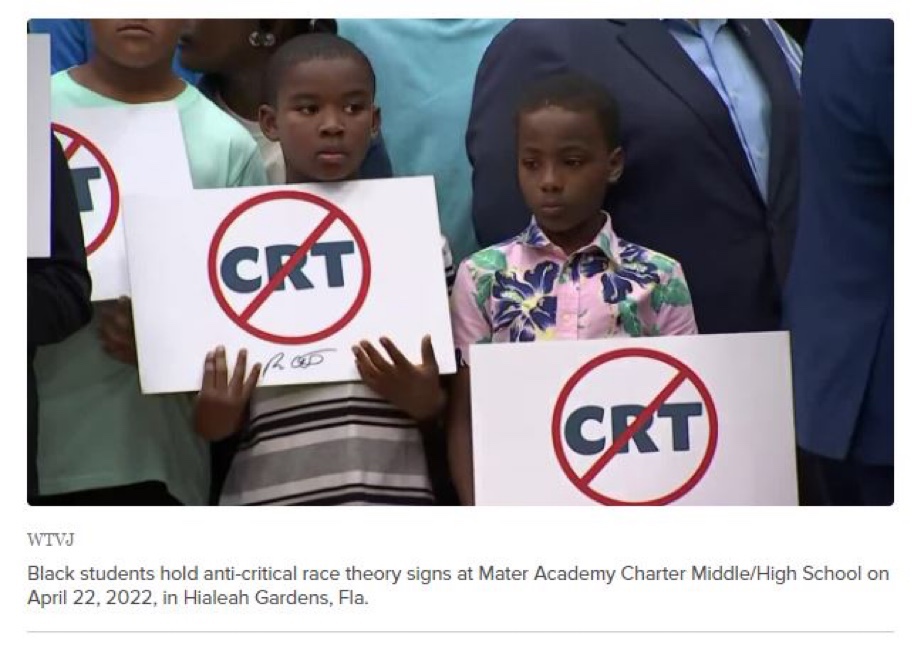
Blogger Carl Petersen posted this photo on Twitter.

Do you sincerely believe that any Black student opposes teaching about the history of racism? Isn’t it amazing to see this photograph of Black students attending the for-profit Mater Academy in Florida , holding up signs opposing critical race theory? CRT means an analysis of the roots of racism in our history, our laws, and our politics.

Governor Ron DeSantis signed the anti-CRT bill at the same charter school. He believes that teaching the truth is hateful.

Do you think these children actually oppose CRT?

Or were they indoctrinated?

Katherine Stewart is an expert on Christian Nationalism who has researched its history, attends their conferences, and writes about their determination to destroy our freedoms. Read her recent book “The Power Worshippers.”

Her latest article in The New York Times reports on their recent dramatic gains.

She writes:

The shape of the Christian nationalist movement in the post-Roe future is coming into view, and it should terrify anyone concerned for the future of constitutional democracy.

The Supreme Court’s decision to rescind the reproductive rights that American women have enjoyed over the past half-century will not lead America’s homegrown religious authoritarians to retire from the culture wars and enjoy a sweet moment of triumph. On the contrary, movement leaders are already preparing for a new and more brutal phase of their assault on individual rights and democratic self-governance. Breaking American democracy isn’t an unintended side effect of Christian nationalism. It is the point of the project.

A good place to gauge the spirit and intentions of the movement that brought us the radical majority on the Supreme Court is the annual Road to Majority Policy Conference. At this year’s event, which took place last month in Nashville, three clear trends were in evidence. First, the rhetoric of violence among movement leaders appeared to have increased significantly from the already alarming levels I had observed in previous years. Second, the theology of dominionism — that is, the belief that “right-thinking” Christians have a biblically derived mandate to take control of all aspects of government and society — is now explicitly embraced. And third, the movement’s key strategists were giddy about the legal arsenal that the Supreme Court had laid at their feet as they anticipated the overturning of Roe v. Wade.

They intend to use that arsenal — together with additional weaponry collected in cases like Carson v. Makin, which requires state funding of religious schools if private, secular schools are also being funded; and Kennedy v. Bremerton School District, which licenses religious proselytizing by public school officials — to prosecute a war on individual rights, not merely in so-called red state legislatures but throughout the nation.

Although metaphors of battle are common enough in political gatherings, this year’s rhetoric appeared more violent, more graphic and more tightly focused on fellow Americans, rather than on geopolitical foes.

“The greatest danger to America is not our enemies from the outside, as powerful as they may be,” said former President Donald Trump, who delivered the keynote address at the event. “The greatest danger to America is the destruction of our nation from the people from within. And you know the people I’m talking about.”

Speakers at the conference vied to outdo one another in their denigration of the people that Mr. Trump was evidently talking about. Democrats, they said, are “evil,” “tyrannical” and “the enemy within,” engaged in “a war against the truth.”

“The backlash is coming,” warned Senator Rick Scott of Florida. “Just mount up and ride to the sounds of the guns, and they are all over this country. It is time to take this country back.”

Citing the fight against Nazi Germany during the Battle of the Bulge, Lt. Gov. Mark Robinson of North Carolina said, “We find ourselves in a pitched battle to literally save this nation.” Referencing a passage from Ephesians that Christian nationalists often use to signal their militancy, he added, “I don’t know about you, but I got my pack on, I got my boots on, I got my helmet on, I’ve got on the whole armor.”

It is not a stretch to link this rise in verbal aggression to the disinformation campaign to indoctrinate the Christian nationalist base in the lie that the 2020 election was stolen, along with what we’re learning from the Jan. 6 hearings. The movement is preparing “patriots” for the continuation of the assault on democracy in 2022 and 2024.

The intensification of verbal warfare is connected to shifts in the Christian nationalist movement’s messaging and outreach, which were very much in evidence at the Nashville conference. Seven Mountains Dominionism — the belief that “biblical” Christians should seek to dominate the seven key “mountains” or “molders” of American society, including the government — was once considered a fringe doctrine, even among representatives of the religious right. At last year’s Road to Majority conference, however, there was a breakout session devoted to the topic. This year, there were two sessions, and the once arcane language of the Seven Mountains creed was on multiple speakers’ lips.

The hunger for dominion that appears to motivate the leadership of the movement is the essential context for making sense of its strategy and intentions in the post-Roe world. The end of abortion rights is the beginning of a new and much more personal attack on individual rights.

And indeed it is personal. Much of the rhetoric on the right invokes visions of vigilante justice. This is about “good guys with guns” — or neighbors with good eavesdropping skills — heroically taking on the pernicious behavior of their fellow citizens. Among the principal battlefields will be the fallopian tubes and uteruses of women.

At a breakout session called “Life Is on the Line: What Does the Future of the Pro-Life Movement Look Like From Here?” Chelsey Youman, the Texas state director and national legislative adviser to Human Coalition Action, a Texas-based anti-abortion organization with a national strategic focus, described the connection between vigilantes and abortion rights.

Instead of the state regulating abortion providers, she explained, “You and me as citizens of Texas or this country or wherever we can pass this bill, can instead sue the abortion provider.” Mrs. Youman, as it happens, played a role in promoting the Texas law Senate Bill 8, which passed in May 2021 and allows private citizens to sue abortion providers and anyone who “aids or abets” an abortion. She was exultant over the likely passage of similar laws across the nation. “We have legislation ready to roll out for every single state you live in to protect life regardless of the Supreme Court, regardless of your circuit court.” To be sure, Christian nationalists are also pushing for a federal ban. But the struggle for the present will center on state-level enforcement mechanisms.

Movement leaders have also made it clear that the target of their ongoing offensive is not just in-state abortion providers, but what they call “abortion trafficking” — that is, women crossing state lines to access legal abortions, along with people who provide those women with services or support, like cars and taxis. Mrs. Youman hailed the development of a new “long-arm jurisdiction” bill that offers a mechanism for targeting out-of-state abortion providers. “It creates a wrongful death cause of action,” she said, “so we’re excited about that.”

The National Right to Life Committee’s model legislation for the post-Roe era includes broad criminal enforcement as well as civil enforcement mechanisms. “The model law also reaches well beyond the actual performance of an illegal abortion,” according to text on the organization’s website. It also includes “aiding or abetting an illegal abortion,” targeting people who provide “instructions over the telephone, the internet, or any other medium of communication.”

Mrs. Youman further made clear that Christian nationalists will target the pills used for medication abortions. “Our next big bill is going to make the Heartbeat Act look tame, you guys; they’re going to freak out!” she said. “It’s designed specifically to siphon off these illegal pills.”

Americans who stand outside the movement have consistently underestimated its radicalism. But this movement has been explicitly antidemocratic and anti-American for a long time.

It is also a mistake to imagine that Christian nationalism is a social movement arising from the grassroots and aiming to satisfy the real needs of its base. It isn’t. This is a leader-driven movement. The leaders set the agenda, and their main goals are power and access to public money. They aren’t serving the interests of their base; they are exploiting their base as a means of exploiting the rest of us.

Christian nationalism isn’t a route to the future. Its purpose is to hollow out democracy until nothing is left but a thin cover for rule by a supposedly right-thinking elite, bubble-wrapped in sanctimony and insulated from any real democratic check on its power.

Samuel Abrams, Director of the National Center for the Study of Privatization, noticed a curious omission in the U.S. Supreme Court’s ruling that required Maine to fund two evangelical religious schools. There was no mention of what other nations do. Some European nations fully fund religious schools. But they regulate them! Choice zealots here want religious schools to get public funds without any public oversight. None.

He writes:

In tandem with its reversal of Roe v. Wade, the Supreme Court stands to substantially alter everyday life in America with its recent decisions of ­Carson v. Makin, amplifying its support for public funding of religious schools, and Kennedy v. Bremerton School District, allowing prayer in public schools.

The significance of Kennedy is blunt. With the Court ruling 6-3 along party lines that the dismissal of a football coach at a public high school in the state of Washington for holding post-game prayer meetings violated his First Amendment right to free exercise of religion, we can expect similar meetings as well as Bible study sessions, nativity pageants, and the like in public schools across the country. Such events will surely lead some students to feel coerced into participating for fear of disappointing peers and authority figures. In her dissent, Justice Sonia Sotomayor indeed noted that a lower court had determined that some players said they joined the coach’s prayer meetings “because they felt social pressure to follow their coach and teammates.”

The significance of Carson is more subtle but equally profound. In Carson, the same justices ruled 6-3—as forecasted on this site following oral arguments in December—that Maine’s exclusion of religious schools from partaking in its Town Tuitioning Program likewise violated the right to free exercise of religion. This program covers all or part of the cost for students in rural districts without high schools to attend either public or nonsectarian private high schools in nearby districts or beyond (if the school is public, the total cost is covered; if it is private, coverage is pegged to per-pupil statewide average spending). With this decision, we can expect religious groups in considerably rural states across the country to lobby legislators to create programs similar to Maine’s.

But there’s another dimension to Carson, which derives as much from what it did not say as from what it did. To grasp the wider implications of Carson requires understanding what is missing from the decision.

While many countries—such as Belgium, France, and the Netherlands—have for many years allowed a considerable portion of their students to attend religious schools with public funding, the Court did not cite such foreign practice. In the Netherlands, in fact, 55 percent of students attend religious schools with public funding.

Why then didn’t the Court cite foreign practice? This indifference to foreign practice holds, as well, for the majority opinions in Zelman v. Simmons-Harris in 2002, validating the provision of government-funded vouchers to cover tuition at religious schools in Cleveland, and Espinoza et al. v. Montana Department of Revenue in 2020, mandating that if a state permits students to attend private schools with scholarships funded by a tuition tax-credit program, it cannot bar religious schools from participation.

American jurisprudence does tend to stick to domestic precedent, but that custom cannot explain this disregard for education policy abroad. After all, former Justice Anthony Kennedy, who voted with the majority in Zelman, was a prominent champion of deference to foreign practice and inspired others to follow in his path. In authoring the majority opinion in Lawrence v. Texas in 2003, Kennedy famously drew on British legislation and the European Convention on Human Rights to overturn state laws criminalizing homosexual relations. Two years later, Kennedy made use of the United Nations’ Convention on the Rights of the Child in writing the majority opinion in Roper v. Simmons to nullify the constitutionality of the death penalty for juvenile offenders.

The answer to this question is crucial. To have invoked foreign practice would have been to invite trouble. Publicly funded religious schools in such countries as Belgium, France, and the Netherlands are regulated to a degree that American proponents of religious schools would find unacceptable.

In Carson, Chief Justice John Roberts conceded in this light that while Maine public schools must adhere to specific standards for instruction in a range of subjects, that is not so for nonsectarian and religious private schools. Though accredited by the New England Association of Schools and Colleges (NEASC), such schools, wrote Chief Justice Roberts, “are exempt from these requirements, and instead subject only to general ‘standards and indicators’ governing the implementation of their own chosen curriculum.”

As Justice Stephen Breyer pointed out in his dissent, one of the two schools at the heart of Carson, both of which are accredited by NEASC, considers academic and religious education “completely intertwined,” so much so that “in science class, students learn that atmospheric layers ‘are evidence of God’s good design.’”

At religious as well as nonsectarian private schools funded with public money in such countries as Belgium, France, and the Netherlands, curricula must comport with national standards (meaning, for example, no attribution to divine design for atmospheric composition). In addition, teachers must be certified and guaranteed access to union membership while members of the LGBTQ community cannot be barred from either enrollment or employment.

The parameters of NEASC and other independent school organizations across the United States do not come close to such expectations, as Justice Breyer’s point about science education indicates. Indeed, many religious schools, such as the two defining Carson, refuse to hire gay or lesbian teachers.

While Maine passed an amendment to its human rights act to bar schools from receiving public money if they discriminate based on sexual orientation or gender identity, that does not mean other states motivated by Carson to create similar programs will enact such protections; nor does it mean that Maine’s amendment will go unchallenged on the grounds that it interferes with an institution’s right to free exercise of religion.

In a guest essay in The New York Times, Aaron Tang, a professor of law at the University of California, Davis, cited this amendment as a model for deflecting the impact of decisions like Carson, but he neither acknowledged that other states implementing town tuitioning programs might not take such action nor recognized that Maine’s amendment might not last.

Setting aside whether public funding of any form of religious schooling poses a threat to democratic values by fostering societal division and conflict, as Justice Breyer claimed in his dissent, there can be no doubt that public funding of lightly regulated religious schooling poses precisely such a threat.

Policymakers abroad have understood this. And it is basic to our own tradition. The Supreme Court made this clear in 1925 in Pierce v. Society of Sisters, ruling unanimously that Oregon could not, as decided by a statewide referendum in 1922, bar private schools from operating but that it was empowered to carefully regulate them.

“No question is raised concerning the power of the State reasonably to regulate all schools,” the Court declared in Pierce, “to inspect, supervise and examine them, their teachers and pupils; to require that all children of proper age attend some school, that teachers shall be of good moral character and patriotic disposition, that certain studies plainly essential to good citizenship must be taught, and that nothing be taught which is manifestly inimical to the public welfare.”

With Carson building on Zelman and Espinoza, public funding of religious schooling appears irreversible. But that does not mean the message of Pierce and the lessons from abroad cannot be heeded. With Kennedy, the public school as neutral common ground is over.

Samuel E. Abrams
Director, NCSPE
June 30, 2022

Published Thursday, Jun 30, 2022

Peter Greene tells the story caught on tape when Larry Arnn, president of rightwing Christian Hillsdale College, tells Tennessee Governor Bill Lee that teachers are the dumbest, trained by the dumbest, and you don’t need to know anything to be a teacher.

Governor Lee listens abjectly. He invited Hillsdale to open 100 charter schools across Tennessee. Hillsdale agreed to open 50.

Greene writes about Arnn’s tirade, which was taped:

“The teachers are trained in the dumbest parts of the dumbest colleges in the country.”


“They are taught that they are going to go and do something to those kids…. Do they ever talk about anything except what they are going to do to these kids?”


“In colleges, what you hire now is administrators…. Now, because they are appointing all these diversity officers, what are their degrees in? Education. It’s easy. You don’t have to know anything.”


“The philosophic understanding at the heart of modern education is enslavement…. They’re messing with people’s children, and they feel entitled to do anything to them.”


“You will see how education destroys generations of people. It’s devastating. It’s like the plague.”

“Here’s a key thing that we’re going to try to do. We are going to try to demonstrate that you don’t have to be an expert to educate a child because basically anybody can do it.”

Someone should have told Arnn that America was built by people who attended public schools, not by graduates of Hillsdale.

Governor Lee didn’t have the guts to stand up for the teachers of Tennessee. Probably he thinks the people who voted for him are the dumbest of the dumb.

Anne Thomas-Abbott, a teacher in Knoxville, did respond to Larry Arnn, whose contempt for teachers is abhorrent and ignorant.

Greene adds:

If you are shaking your head at Tennessee, I suggest you look around your own state first, because these public education-hating faux Christian right wingers are all over the country, and when he’s selling his product in public, Arnn is rarely as blunt as he was before the Tennessee crowd. Make sure everyone gets to hear what he really thinks.