Archives for category: Accountability

Please join me and your many allies in D.C. on October 28-29 for our 10th anniversary conference. It promises to be our best ever!

Sign up now.

You will have a wonderful time!

And you will meet your favorite bloggers, hear great speakers, and meet people who are fighting against privatization across the nation.

Indiana blogger Steve Hinnefeld reveals a new charter scam: remote renewal of controversial charter schools. in this case, the charter is affiliated with the Christian rightwing Hillsdale College. Please open the link to finish the post.

Seven Oaks Classical School in Ellettsville received a 5-year extension to its operating charter recently. Well, not that recently. It happened in December 2022. Ellettsville and Monroe County residents may have missed it, though, because the extension was approved nearly 200 miles away.

It was approved by the three-member board of Grace Charters LLC, a nonprofit formed by Grace College and Theological Seminary to authorize charter schools, which are publicly funded and privately operated. The board met on the Grace College campus in Winona Lake, Indiana.

To meet legal requirements for public meetings, a notice was published in the local newspaper: the Warsaw Times-Union, which probably no one in Monroe County reads. One member of the public attended, according to minutes of the meeting: Seven Oaks headmaster Stephen Shipp.

The situation highlights the tension between public and private in Indiana charter schools. The Seven Oaks website says charter schools are “tuition-free, open-enrollment public schools.” But the school’s authorizer, which sets the terms of its operation and is supposed to hold it accountable, is a private, Christian college with no connection to the community where the school operates.

Seven Oaks is part of a network of charter schools aligned with Hillsdale College, a conservative and politically active private college in Michigan. The Hillsdale charter initiative once cast itself as part of a “war” to reclaim America from “100 years of progressivism” in education. Its president, Larry Arnn, led Donald Trump’s 1776 Commission and its promotion of “patriotic history.”

Grace College has also granted a charter to Valor Classical Academy, a Hillsdale-affiliated school that has stalled in its attempts to open in Hamilton or Marion County.

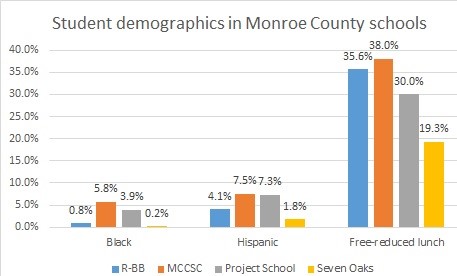
Along with the Hillsdale affiliation, there are other factors that distinguish Seven Oaks from public schools: for example, its demographic profile. Out of more than 500 students, one is Black and nine are Hispanic, according to state data. Fewer than 20% of students would qualify for free or reduced-price meals if they were provided. (The school doesn’t provide transportation or school lunches).

Bar chart showing percentage of Black, Hispanic and free-reduced lunch students in Monroe County schools.

This chart shows the percentage of students who are Black, Hispanic and eligible for free or reduced-price meals in Monroe County public school districts (Monroe County and Richland-Bean Blossom community school corporations) and charter schools (Bloomington Project School and Seven Oaks Classical School).

Nine of its 38 teachers are Hillsdale College alumni, according to profiles on the school’s website. In 2021-22, the most recent year for which a state teacher statistics report is posted, nearly 40% of its teachers had emergency licenses, compared with 4.6% in local public school districts.

The 24-page Seven Oaks charter extension reads like a standard agreement, with boilerplate language from state law and recommended practices for authorizing. It spells out the duties of each party, the expectations for the school, and the legal remedies if something goes wrong. An attached accountability plan includes out-of-date references to state assessments and, I’m told, is being revised.

The agreement says Grace College gets to keep 2.5% of the school’s state funding as an authorizer fee. That’s less than the 3% maximum that Indiana allows. In 2023-24, the college will net about $93,000.

Grace initially approved a charter for Seven Oaks in 2016 in one of Indiana’s first examples of what’s called authorizer shopping. The school’s founders applied to the Indiana Charter School Board, but it rejected their application. They reapplied but withdrew after a negative recommendation from the board’s staff. Then they took their plan to Grace College, which said yes to a 7-year charter.

At that time, private colleges could authorize charter schools in closed-door meetings with no public notice. Since 2017, they’ve had to use nonprofit authorizing agencies, such as Grace College’s Grace Charters LLC, that are subject to open-meetings and public-records laws. Even so, it can be hard to keep up. I started asking by email about the Seven Oaks charter extension in March; it took until late May to get copies of the December 2022 board minutes and the school’s extended charter agreement.

Transparency is one issue of having distant authorizers for charter schools, but there are others. The National Association Charter School Authorizers cautions against throwing the door wide open for higher education institutions, or HEIs, to authorize schools, as Indiana has done since 2011.

The respected Southern Poverty Law Center (SPLC) designated “Moms for Liberty” as an extremist group, along with a number of other astroturf anti-government organizations that popped up during the pandemic to protest masks and vaccines.

In its annual report on hate groups, SPLC named Moms for Liberty and 11 other “parent”groups as extremists who feed on racism, misogyny, homophobia, and bigotry:

Moms for Liberty joins the ranks of groups including the Oath Keepers, the Three Percenters and the United Constitutional Patriots, a self-styled militia that “patrols” the U.S.-Mexico border.

Other astroturf “parent” groups were identified as extremist by SPLC:

The 12 “parent’s rights” groups labeled by the SPLC as extremist groups: Moms for Liberty; Moms for America; Army of Parents; Courage is a Habit; Education First Alliance; Education Veritas; No Left Turn in Education; Parents Against CRT (PACT); Parents Defending Education; Parents Rights in Education; Purple for Parents Indiana and Parents Involved in Education.

Will Carless wrote in USA Today that Moms for Liberty “pitched itself as a potent grassroots movement of outraged parents, many of whom weren’t active in school politics until COVID-19 restrictions forced them to pay attention. It has sprouted local chapters in at least 40 states, claims more than 100,000 members and has the ear of the Republican establishment: Florida Gov. Ron DeSantis has championed their efforts to restrict teaching about race in schools and universities. Critics in Florida slam the group for turning schools into a political battlefield.”

Both DeSantis and Trump will address the annual conference of this two-year-old organization of hate-mongers.

Moms for Liberty and the other organizations are being designated as “anti-government extremist groups,” based on longstanding criteria, explained SPLC Intelligence Project Director Susan Corke. Corke said the grassroots conservative groups are part of a new front in the battle against inclusivity in schools, though they are drawing from ideas rooted in age-old white supremacy.

“[The movement] is primarily aimed at not wanting to include our hard history, topics of racism, and a very strong push against teaching anything having to do with LGBTQ topics in schools,” Corke said. ”We saw this as a very deliberate strategy to go to the local level…”

Despite the national profile, these organizations spread conspiracy theories and operate on the myth that educators are engaged in “Marxist indoctrination” of the nation’s children by imbuing them with dangerous ideas about equality and sexuality, the SPLC said.

While the movement may be reasonably new, it is founded on the same traditional racist, misogynist and homophobic views that brought people out to protest the desegregation of schools in the 1950s and ’60s, the SPLC argues.

Moms for Liberty does not report the names of its funders.

Lizette Alvarez, a journalist in Miami, wrote an opinion piece for The Washington Post, explaining the outrageousness of Florida’s universal voucher program.

What I find outrageous is that this story is not being covered by the Washington Post, the New York Times, or any of the other major media outlets. Nor is it reported as news by any of the network or cable stations.

Why are these stories not in the news every day?

CONSERVATIVE REPUBLICANS ARE WIPING OUT THE LONG-HONORED TRADITION OF SEPARATION OF CHURCH AND STATE!!

CONSERVATIVE REPUBLICANS IN EVERY RED STATE ARE DESTROYING THEIR PUBLIC SCHOOLS DESPITE PUBLIC OPPOSITION!!

Well, at least, the Washington Post printed an opinion piece telling of the greatest theft of the public good in our lifetimes:

Florida public schools are having an awful year. Record numbers of teachers have left their jobs, and those who remain face a minefield of ambiguous culture-war dictates about what they can say and how they teach.

And it’s about to get worse for Florida’s beleaguered public schools.

Florida Gov. Ron DeSantis (R) recently signed legislation that might radically undermine the state’s education system by making Florida’s already robust school voucher program the largest and most expensive in the country.

Beginning in July, the state will make it possible for every Florida K-12 student to receive a taxpayer-funded voucher or savings account worth $8,648. And for the first time in Florida, the vouchers will be available to children from wealthy families, even those who are home-schooled or who already attend private or religious schools. The money can go to tuition and educational expenses.

At least five other states have passed so-called universal choice programs — Arizona, Arkansas, Iowa, Utah and West Virginia — but Florida’s is, by far, the biggest. Other Republican-led states are considering similar bills.

The new policy is a revolutionary (and expensive) expansion. The original state voucher program, which began in 1999, was designed exclusively for a small number of children in F-rated, or failing, public schools and, later, special-needs students. The program grew to more than 177,000 students, from households earning up to $100,000.

About 2,300 private schools in Florida accept vouchers; 69 percent of them are unaccredited, 58 percent are religious and 30 percent are for-profit, according to the Hechinger Report.
In a state infamous as a magnet for schemers and grifters, there’s plenty of reason to worry as millions of dollars in new spending will soon pour into schools that have little accountability. When DeSantis celebrated passage of his vouchers-for-all gambit as a victory for school choice, he was no doubt being cheered on by those with no ideology other than diving into any trough freshly filled with public money.

But, as of July 1, even the child of a private-jet-flying tycoon will be eligible for a voucher. As state Rep. Marie Woodson (D) said, “This bill is an $8,000 gift card to the millionaires and billionaires who are being gifted with a state-sponsored coupon for something they can already afford.” The rich might not need it, but who passes up free money?

Estimates of the cost range from $209 million to $4 billion a year. About 2,300 private schools in Florida accept vouchers; 69 percent of them are unaccredited, 58 percent are religious and 30 percent are for-profit, according to the Hechinger Report….

In a state infamous as a magnet for schemers and grifters, there’s plenty of reason to worry as millions of dollars in new spending will soon pour into schools that have little accountability.

When DeSantis celebrated passage of his vouchers-for-all gambit as a victory for school choice, he was no doubt being cheered on by those with no ideology other than diving into any trough freshly filled with public money.

Alexandra Olson of AP wrote about a strike by journalists who work for Gannett newspapers. A vibrant free press is essential to democracy. Talking heads reading from a script on television are not a good substitute for local journalism that holds power to account. The death of community and local newspapers narrows our sources of information and strengthens the handful of barons who own the networks.

NEW YORK (AP) — Journalists at two dozen local newspapers across the U.S. walked off the job Monday to demand an end to painful cost-cutting measures and a change of leadership at Gannett, the country’s biggest newspaper chain.

The strike involves hundreds of journalists at newspapers in eight states, including the Arizona Republic, the Austin American-Statesman, the Bergen Record, the Rochester Democrat & Chronicle, and the Palm Beach Post, according to the NewsGuild, which represents workers at more than 50 Gannett newsrooms. Gannett has said there would be no disruption to its news coverage during the strike, which will last for two days at two of the newspapers and one day for the rest.

The walkouts coincided with Gannett’s annual shareholder meeting, during which the company’s board was duly elected despite the NewsGuild-CWA union urging shareholders to withhold their votes from CEO and board chairman Mike Reed as an expression of no confidence in his leadership. Reed has overseen the company since its 2019 merger with GateHouse Media, a tumultuous period that has included layoffs and the shuttering of newsrooms. Gannett shares have dropped more than 60% since the deal closed.

Susan DeCarava, president of the The NewsGuild of New York, called the shareholder meeting “a slap in the face to the hundreds of Gannett journalists who are on strike today.”

“Gannett CEO Mike Reed didn’t have a word to say to the scores of journalists whose livelihoods he’s destroyed, nor to the communities who have lost their primary news source thanks to his mismanagement,” DeCarava said in a statement.

In legal filing, the NewsGuild said Gannett’s leadership has gutted newsrooms and cut back on coverage to service a massive debt load. Cost-cutting has also included forced furloughs and suspension of 401-K contributions….

Among the contract demands are a base annual salary of $60,000. The median pay for Gannett employee in 2022 was $51,035, according to the company’s proxy filing. Reed’s total annual compensation was valued at nearly $3.4 million, down from $7.7 million in 2021.

At the shareholder meeting, NewsGuild-CWA President Jon Schleuss said the union proposed lowering Gannett’s median CEO-to-employee ratio from 66:1 to 20:1. But Schleuss said the meeting lasted just eight minutes and Reed didn’t address any questions. In a series of tweets, Schleuss called the meeting a “complete joke…”

Gannett, which owns USA Today and more than 200 other daily U.S. newspapers with print editions, announced last August that it would lay off newsroom staff to lower costs as it struggles with declining revenue amid a downturn in ad sales and customer subscriptions.

The newspaper industry has struggled for years with such challenges, as advertising shifts from print to digital, and readers abandon local newspapers for online sources of information and entertainment. Major newspapers such as The New York Times, The Wall Street Journal and The Washington Post have gained substantial digital audiences for coverage of broad topics, but regional and local papers have struggled to replicate that success in narrower markets…

According to the NewsGuild, Gannett’s workforce has shrunk 47% in the last three years due to layoffs and attrition. At some newspapers, the union said the headcount has fallen by as much as 90%.

The Arizona Republic, for example, has gone from 140 newsroom employees in 2018 to 89 this year, the NewsGuild said. The Austin American-Statesman’s newsroom shrunk during that period from 110 employees in 2018 to 41 this year.

Elahe Izadi of the Washington Post wrote this about the strike:

Gannett merged with the GateHouse chain in 2019, a deal that executives promised would lead to dramatic cost savings while critics warned of job cuts and leaner newsrooms. While the resulting company included 261 daily newspapers and 302 weeklies, those numbers had shrunk by the end of last year to 217 dailies and 175 weeklies, after some papers were shuttered or sold.

Rochester Democrat and Chronicle education reporter Justin Murphy said Monday’s protest represents a “desperation and fear that not only is our workplace and our employer going astray, but the consequences for our communities will be truly devastating.”

Gannett last summer froze hundreds of positions and laid off 400 employees — some of whom were the last remaining reporters at their newspapers — after a dismal financial quarter. Gannett has also offered voluntary buyouts and in December laid off 6 percent of its roughly 3,400-person news staff.

A year before he joined the paper in 2012, Murphy said the Rochester Democrat and Chronicle had a newsroom with 86 union members — a count that excludes editors and other managers — but that the number is now down to 23.

“Those of us who are left are kind of local journalism sickos who just can’t stop doing this,” he said. “As we’ve had cutbacks and cutbacks and they’ve asked us to do more and more, we’ve done it because we think it’s important that the work get done, and that’s just how we’re wired. But it’s one thing to do that when you have 86 people going to 80 or 73, but to 23? It doesn’t make sense anymore.”

Sportswriter Rob Aitken grew up reading the newspaper where he now works, the Record in northern New Jersey. “It was the best thing in the world to see your name in this paper,” he recalled. “It meant you were something.”

But now he says some high school sports are rarely written about, as staffers are stretched too thin. “You want to try to be everywhere and cover every great story. It makes you wonder how many great stories are not being told,” he said. “When we can tell a story about a kid and give them enough attention that maybe they get a college scholarship — you wonder how many kids aren’t getting that opportunity now.”

After the cutbacks, Gannett ended the year with a quarterly profit of $32.77 million, and $1.27 billion in outstanding debt.

The walkout also follows the departure of several top Gannett executives in recent months, as well as editors at some of the chain’s largest newspapers.

In a May earnings call, Reed said “2023 is off to a great start,” noting that the cuts and other “cost management initiatives” had boosted Gannett’s net income to $10.3 million, compared with a loss of $3 million during the first quarter of 2022. Digital subscriptions also grew by about 15 percent from the same time frame the previous year, totaling around 2 million paid subscribers.

Reed has also said he’s open to selling more Gannett newspapers.

“We would entertain bids on any of our markets, any of our products, that are at or above fair-market value,” he said in February. “We’re hopeful that we’ll have an opportunity this year to do that. But it’s not anything that’s in our plans.”
Edward B. Fiske was the education editor of the New York Times and editor of the Fiske Guide to Colleges. Helen F. Ladd is a nationally prominent economist of education and professor emeritus at Duke University. They are married, a power couple of American education. This article appeared on the website of WRAL in North Carolina.

Forty years ago this spring a national commission charged with evaluating the quality of American education issued a blistering report entitled “A Nation at Risk.” It cited a “rising tide of mediocrity” in the country’s schools and declared that the country’s failure to provide high quality education “threatens our very future as a Nation and a people.”

North Carolina leaders took this warning to heart. They began investing heavily in public education and even became a model for other states in areas such as early childhood education. Significantly, the state was making progress toward fulfilling its obligation under the North Carolina Constitution to provide a sound, basic education for all students.

The situation started to change, however, in 2012 when Republicans came to power and began an assault on public education that continues to this day.

When it comes to public education, North Carolina is now “A State at Risk.”

The Republican assault has taken multiple forms, starting with inadequate funding. North Carolina now ranks 50th in the country in school funding effort and 48th in overall funding. Despite widespread teacher shortages, the Republicans have kept teacher salaries low — $12,000 below the national average – and they have failed to provide adequate funding for the additional support staff that schools need.

In addition, they have permitted significant growth in the number of charter schools. Such schools divert much-needed funds from traditional public schools and make it difficult for local boards of education to operate coherent education systems.

The Republican-controlled Legislature is currently working hard to weaken public education by politicizing the process. Pending legislation would regulate how history and racism are taught, give a commission appointed mainly by lawmakers the job of recommending standards in K-12 subjects, and transfer authority to create new charter schools from the State Board of Education to a board appointed by the General Assembly.

The problem is about to get even worse. The Legislature is now poised to expand the earlier Opportunity Scholarship program, which had provided public funds for low income children to attend private schools, into a much larger universal voucher program that would make all children eligible regardless of family income – at an estimated cost of more than $2 billion over the next 10 years.

Given that private schools are operated by private entities typically with no public oversight and no obligation to serve all children, why in the world would it ever make sense to use taxpayer dollars to support private schools?

A common argument has been that voucher systems raise achievement levels of the children who used them. While some early studies of small scale means-tested voucher programs in places like Milwaukee showed small achievement gains in some cases, recent studies of larger voucher programs in places such as Ohio, Louisiana and Indiana consistently show large declines in average achievement — often because of the low quality of the private schools that accept vouchers.

Supporters also argue that vouchers provide more schooling options for children and that having more choices is a good thing. But in the context of education policy that need not be the case. Americans support public education – and make schooling mandatory – not only for the benefits it generates for individual children but also for collective benefits such as the creation of capable workers and informed citizens. What matters is the quality of education for all the state’s children.

An expanded voucher program would lead to a substantial outflow of funds from traditional public schools to privately operated schools, with the potential for a significant loss in the quality of our public schools, and subsequent vitality in the state’s economy.

A strong public education system – from elementary and secondary schools to the nation’s first public university, the University of North Carolina – has long been pivotal to our state’s cultural, political and economic success. We must stop the current assaults on public education and reaffirm our commitment to one of North Carolina’s great strengths.

Back in 1983 when the education system of the nation was “at risk,” President Ronald Reagan – who had earlier been lukewarm in his support of public education — took the warning seriously and began touring the country to talk about the problem. His successors from both parties then took up the cause and continued to make the case that a strong public education system is essential for a vibrant economy, and importantly, to make the policy changes needed to strengthen it.

Let’s hope that our current Republican leaders in this state can muster the wisdom and courage to follow the example of President Reagan and other leaders from both parties in pushing for strong public education. In the absence of such wisdom, we will indeed continue to be “A State at Risk.”

It’s not often that I have the opportunity to repost something written years ago. John Thompson, teacher and historian, summarized Mike Miles’s disastrous three years in Dallas. At the time I posted John’s analysis, I didn’t know how to embed links. His commentary starts in the second paragraph of the linked post.

Miles is a military veteran. He has no experience as a teacher or principal. Yet somehow he thinks he knows how to reform schools. That conceit is a hallmark of the Broad Academy.

Miles was recently selected by the Texas Commissioner of Education Mike Morath—also not an educator—to be the superintendent of schools in Houston, one of the nation’s largest school districts. The state took control of The Houston Independent School District because one school—Wheatley High School—received failing scores for several years in a row. This past year, its state score rose to a C, but the state didn’t care. These are Republicans who don’t believe in local control or democracy.

Mike Miles arrived in Dallas after a stint as superintendent of a tiny district in Colorado. He’s a know-it-all. He arrived with an attempt at a Broadway show performance in which he was the star (the video was deleted).

He quickly set numerical goals that everyone was expected to meet. He alienated teachers, who left DISD in record numbers. He had no appreciation for words like “trust,” “respect,” “collaboration,” “teamwork.” It was his way or the highway.

It was not surprising that Miles’s first action as superintendent in Houston under the state takeover was to fire every member of the staff at 29 schools and invite them to reapply for their jobs. So what if this creates instability for students? Miles doesn’t care. He also plans to evaluate teachers in part by test scores, a well-discredited method.

He is a razzle-dazzle guy who likes to take bold actions, no matter who he hurts or what chaos he creates for the students and the professionals.

One of Mike Miles’ worst actions in Dallas was the time he called the police to arrest a school board member who was visiting a school in her district. That tells you the kind of guy he is: arrogant, insensitive, tough, mean.

Soon after he arrived in Dallas, his family moved back to Colorado because Mike was such a toxic guy. Hopefully, this time they stayed in Colorado.

Education doesn’t need military leaders. It doesn’t need people who don’t give a hoot for the morale of the teachers.

Miles was booted out of Dallas after three years of failure.

The question now is why Mike Morath, who was on the Dallas school board when Miles wreaked his damage on the district, decided to install him in Houston. Was it to punish Houston? Houston public schools today are performing better than Dallas. Why didn’t Morath take control of Dallas and give Miles another chance to ruin that district?

Broadies have a very bad track record. They were taught to be top-down, decisive, arrogant, indifferent to others. This is not an approach that blends well with students, teachers, teaching and learning.

Great educational leaders have experience in the classroom. They attract dedicated teachers and protect them. They understand that every child is precious to someone, whatever their test scores. They care about education more than test scores. They listen.

Mike Miles is not that guy.

Here are a few other commentaries about Niles while he was in Dallas:

Miles arrives: https://dianeravitch.net/2012/05/20/enter-the-new-dallas-superintendent/

Teachers flee Dallas, and Miles urges other districts not to hire them: https://dianeravitch.net/2013/08/06/dallas-teachers-flee-superintendent-mike-miles-under-investigation-his-family-moves-back-to-colorado/

Miles calls police to arrest a school board member visiting a school in her district: https://dianeravitch.net/2014/10/13/breaking-news-dallas-superintendent-miles-calls-police-to-remove-school-board-member-from-school/

At the end of his stormy three years, Miles compares his time in Dallas to “Camelot”:https://dianeravitch.net/2015/06/24/mike-miles-compares-his-three-year-tenure-in-dallas-to-camelot-starring-him-as-king-arthur/

PS: I take this state invasion of HISD personally. I graduated from HISD in 1956.

Oklahoma just gave its permission for the Roman Catholic Archdiocese of Oklahoma City and the Diocese of Tulsa to open an online charter school, supported by public funds. Governor Kevin Stitt and the state’s Superintendent of Schools Ryan Walters are hard-right Republicans. This decision is sure to go to the U.S. Supreme Court. No one knows how it will rule. Even charter lobbyists are concerned about this turn of events because they like to refer to charters as “public charter schools.” A religious charter, which teaches religion, is not a public school.

Sarah Mervosh wrote the story for the New York Times:

The nation’s first religious charter school was approved in Oklahoma on Monday, handing a victory to Christian conservatives, but opening the door to a constitutional battle over whether taxpayer dollars can directly fund religious schools.

The online school, St. Isidore of Seville Catholic Virtual School, would be run by the Roman Catholic Archdiocese of Oklahoma City and the Diocese of Tulsa, with religious teachings embedded in the curriculum, including in math and reading. Yet as a charter school — a type of public school that is independently managed — it would be funded by taxpayer dollars.

After a nearly three-hour meeting, and despite concerns raised by its legal counsel, the Oklahoma Statewide Virtual Charter School Board approved the school in a 3-to-2 vote, including a “yes” vote from a new member who was appointed on Friday.

The relatively obscure board is made up of appointees by Gov. Kevin Stitt, a Republican who supports religious charter schools, and leaders of the Republican-controlled State Legislature.

The approval — which is almost certain to be challenged in court — comes amid a broader conservative push to allow taxpayer dollars to go toward religious schools, including in the form of universal school vouchers, which have been approved in five states in the last year. The movement has been bolstered by recent rulings by the U.S. Supreme Court, which has increasingly signaled its support for directing taxpayer money to religious schools.

Harold Meyerson of The American Prospect writes here about the sharp divergence between red states and blue states. Their elected officials have very different ideas about how to build their state and serve the needs of the public. There is one issue that he overlooked: vouchers. Red states are busy handing out tax dollars to families whose children are already enrolled in private and religious schools and tearing down the wall of separation between church and state.

Which side are you on?

He writes:

Two Prospect pieces on red and blue trifecta states make clear we really are two separate nations.

If there’s anyone who’s still mystified about why congressional Democrats and Republicans can’t come to an agreement on anything so basic as honoring the debts they’ve incurred, may I gently suggest they take a look at what Democrats and Republicans are doing in the particular states they each completely control.

Yesterday, we posted a piece by my colleague Ryan Cooper on how Minnesota, where Democrats now control both houses of the legislature and the governor’s office, has just enacted its own (to be sure, scaled-back) version of Scandinavian social democracy—including paid sick leave for all, paid family leave, a minimum wage for Uber and Lyft drivers, sector-wide collective bargaining in key industries, and the outlawing of “captive audience” meetings, in which management compels employees to attend anti-union rants. A new law also strengthens women’s right to an abortion. Similar laws have been enacted or are under consideration in other Democratic “trifecta” states, though none quite so pro-worker as some of Minnesota’s.

Also yesterday, we posted one of my pieces, this one on everything that Texas’s Republican legislature and governor are enacting to strip power from their large cities, almost all of which are solidly Democratic. One new bill says the state can declare elections to be invalid and compel new ones to be held under state supervision in the state’s largest county, Harris County, which is home to reliably Democratic Houston. And the state Senate has also passed a bill that would strip from cities the ability to pass any regulations on wages, workplace safety, business and financial practices, the environment, and the extent of property rights that exceed the standards set by the state. Which leaves cities with the power to do essentially nothing. No other Republican trifecta states have gone quite as far as Texas, but Tennessee’s legislature did effectively abolish Nashville’s congressional district and expel its assemblymember; Alabama’s legislature revoked Birmingham’s minimum-wage law; and Florida’s governor suspended Tampa’s elected DA because he wouldn’t prosecute women and doctors for violating the state’s new anti-abortion statutes. Beyond their war on cities, Republican trifecta states have long refused to expand Medicaid coverage, have recently also begun to re-legalize child labor and legislate prison terms for librarians whose shelves hold banned books, and in the wake of the Dobbsdecision, criminalized abortions.

Just as cosmic inflation propels the stars away from each other with ever-expanding speed, so Democratic and Republican states are also moving away from each other at an accelerating pace—the Democrats toward a more humane future; the Republicans borne back ceaselessly into a nightmare version of the past. Any dispassionate view of America today has to conclude that the differences between these two Americas are almost as large and intractable as those that split the nation in 1860 and ’61. (The South’s opposition to fairly paid and nondiscriminatory labor was the central issue then and remains a central issue now.)

That said, when confronted with the choice between those two Americas, voters in those red states have frequently backed the blue-state versions of economic rights and personal freedoms, as is clear from their many initiative and referendum votes to raise the minimum wage, expand Medicaid, and preserve the right to an abortion. Likewise, the polling on unions shows their national favorability rating now exceeds 70 percent of the public, including roughly half of self-declared Republicans. Only by their relentless demagoguery on culture-war issues and immigration, their adept gerrymandering, and the disproportionate power that the composition of the Senate vests in barely inhabited states can the Republicans enforce their biases against a rising public tide—but enforce them they do wherever they have the power.

All right, as John Dos Passos wrote in his USA Trilogy, we are two nations—and becoming more so with each passing day.


Postscript: In his Washington Post column…, Perry Bacon noted that while a number of news publications have gone under recently, a few, in his words, “are reimagining political journalism in smart ways.” He cited seven such publications, and his list was headed by—ahem—The American Prospect.

The Lever is a site created by investigative journalist David Sirota. Sirota was a speech writer for Senator Bernie Sanders and co-writer of the award-winning film “Don’t Look Up.” In this post, he reveals the Dark Money behind state-level efforts to get rid of abortion rights. Based on what happened in Kansas, anti-abortion forces will try to block referenda in the future; letting voters decide defeats their cause, just as it does with vouchers, which never win state referenda. In Kansas, their deceptive tactic was to confuse voters about whether to vote yes or no. Most women do not want to abandon a right they had for almost fifty years.

The dark money network led by conservative Supreme Court architect Leonard Leo financed the nonprofit that bankrolled a misleading text message campaign pretending a Kansas ballot measure would “give women a choice,” when it actually would have eliminated state abortion protections.

New tax documents hint at how Leo’s network has been quietly working to influence abortion policy in the states utilizing his historic $1.6 billion dark money fund, in the wake of the Supreme Court decision last year overturning Roe v. Wade and ending federal protections for abortion rights. As President Donald Trump’s judicial adviser, Leo helped select three of the six justices making up the Supreme Court’s conservative supermajority.

Leo’s network donated $1.7 million to CatholicVote Civic Action, a conservative Catholic advocacy group, between July 2021 and June 2022, according to a new tax return obtained by The Lever.

The contribution was made around the time that CatholicVote Civic Action was funding a campaign supporting a Kansas ballot measure designed to eliminate protections for abortion rights in the state constitution. The ballot measure would have affirmed “there is no Kansas constitutional right to abortion” and given state lawmakers “the right to pass laws to regulate abortion.”

Do Right PAC, a political action committee funded by CatholicVote Civic Action, sent text messages to Kansas voters a day before the election last summer giving the false impression that a “yes” vote on the ballot measure would “give women a choice” and “protect women’s health,” when its passage would have ended state protections for abortion rights.

The PAC also paid for TV ads featuring Kansas City Chiefs kicker Harrison Butker, in which he claimed that the amendment would “let Kansas decide what we do on abortion, not judges and not D.C. politicians.”

A spokesperson for Leo did not respond to questions from The Lever.

Former Rep. Tim Huelskamp (R-Kan.), a senior political advisor to CatholicVote Civic Action, led Do Right PAC. CatholicVote Civic Action donated $500,000 of the $556,000 raised by the PAC last year.

Huelskamp did not respond to a request for comment.

Despite these efforts, the Kansas initiative failed decisively, 41 to 59 percent — offering an early preview of how anti-abortion efforts would flounder in the 2022 state elections. While Kansas Republicans recently overrodeDemocratic Gov. Laura Kelly’s vetoes of some anti-abortion measures, abortion remains legal in the state up to 22 weeks.

The Leo network’s donation to CatholicVote Civic Action came via the Concord Fund, the conservative advocacy group that spent tens of millions to confirm the three Supreme Court nominees whom Leo helped select as former Trump’s judicial adviser.

Tax records show the Concord Fund raised $29 million between July 2021 and June 2022. All of that money appears to have come from Leo’s Marble Freedom Trust. As The Lever and ProPublica reported last year, this trust was the recipient of an unprecedented $1.6 billion cash infusion courtesy of Chicago surge protector magnate Barre Seid.

The new tax documents show how Leo is using the Concord Fund to imprint his conservative vision on both politics and policy.

The disclosure shows the Concord Fund donated $3 million to One Nation, the Senate GOP’s dark money arm. One Nation, which supports Republican Senate candidates, aired ads supporting Supreme Court Justice Brett Kavanaugh’s confirmation in 2018.

The Concord Fund separately donated nearly $1 million to the Susan B. Anthony List, an anti-abortion advocacy group that pressed the Supreme Court to overturn Roe v. Wade. The organization has actively backed voter suppression laws passed by Republican lawmakers around the country.

Records show the Concord Fund also donated $500,000 to Advancing American Freedom, a dark money group chaired by former Vice President Mike Pence that is serving as his “campaign-in-waiting” in advance of a potential 2024 presidential bid, according to Politico.

In 2021, Advancing American Freedom filed an amicus brief, or friend-of-the-court filing, pressing the Supreme Court to overturn Roe v. Wade — warning that “unfettered access to abortion” has led to “declining formation of families with accompanying increases in family instability and single parent households (many living in poverty).”

This year, the organization filed a brief unsuccessfully urging the high court to approve a Texas district court ruling designed to ban a commonly-used abortion pill. The Supreme Court blocked the lower court’s decision in April, allowing an appeals court to consider the case first, though it’s widely expected that the case will eventually end up back at the high court.

The Concord Fund has long been the chief financier of the Republican Attorneys General Association, which elects GOP attorneys general, and donated $6.5 million to the group last election cycle, according to data compiled by CQ Roll Call’s Political Moneyline.

Those attorneys general regularly bring cases and file briefs urging the Supreme Court to issue precedent-shattering decisions. Mississippi Attorney General Lynn Fitch, for instance, led the Dobbs v. Jackson Women’s Health Organization case at the Supreme Court, by which justices overturned federal protections for abortion rights.

The Concord Fund additionally reported donating $750,000 to the lobbying arm of the Foundation for Government Accountability, which has led the fight to institute new and expanded work requirements for a range of social safety net programs.

President Joe Biden’s recent debt ceiling deal with House Republicans includes some of those expanded work requirements, at the urging of Speaker Kevin McCarthy (R-Calif.).