Archives for category: NCLB (No Child Left Behind)

Paul Thomas taught in South Carolina public high schools for many years, then became a professor of education at Furman University. He is an articulate critic of the decades-old “crisis in education.”

If you are confused by the different fonts, please open the link to read the original article.

He wrote:

People try to put us d-down (Talkin’ ’bout my generation)
Just because we get around (Talkin’ ’bout my generation)
Things they do look awful c-c-cold (Talkin’ ’bout my generation)
I hope I die before I get old (Talkin’ ’bout my generation)
“My Generation,” The Who

Born in 1961, I am a young boomer, but a boomer none the less.

I began teaching high school English in the ominous year of 1984, my first students having been born at the end of the same decade as I had, the 1960s.

That means across my career as an educator, I have taught most living generations, including my own. My grandchildren as Generation Alpha.
It does seem valid to note that humans experience generational shifts that can be identified in fair ways, especially in ways that may help those of us who teach better serve our students.

Those characteristics, however, are not universally defining and the cut off dates we decide are more blur than fact.

Being at the end of the boomer generation makes me often quite similar to Gen X folk I meet, including the first wave of students I taught high school.

What seems less valid, is the historical and current urge older generations have to negatively characterize younger generations, often through never-ending cycles of crying “Crisis!,” especially about education (notably reading and math).

The US has been riding a high tide of crisis rhetoric about reading—both that students can’t read and the students don’t read—for about a decade now.

It seems this cycle of crisis has reached a new stage according to The New York Times:

A report on the new data describes a decade-long “learning recession.”…
Students’ test scores had been increasing since 1990 — then abruptly stopped in the mid-2010s. That coincided with two events: an easing of federal school accountability under No Child Left Behind, which was replaced in 2015, and the rise of smartphones, social media and personalized school laptops.

The decade analyze attempts to compare, even with the caveat above, learning using test data that itself has shifted several times and ways even in a relatively brief decade window.

As I have noted about reading proficiency, the US has no standard definition of “reading proficiency” or “grade-level reading,” but instead, we have NAEP achievement levels (that are confusing and misleading) drawn from random sampling about every two years along with annual (except for the Covid blip) testing at the state level, where every state establishes its own cut scores for proficiency (with most state proficiency level overlapping with NAEP “basic”).
Analyses such as these also suffer from compelling but questionable metrics such as days, months, or years of learning. What metric researchers choose and then how data is displayed significantly impacts how the conclusions are interpreted.

Unfortunately, most analyses of education are designed to create the appearance of crisis.
While this rhetorical shift to “learning recession” is yet another oversell that likely will do more harm than good, the immediate responses should prompt even greater skepticism:

Tweet by David Frum, May 13, 2026:

Seven months ago, the David Frum Show hosted former Education Secretary Margaret Spellings for a discussion of why US K-12 scores are declining. Her answer: the decline in testing and accountability since 2015.

Resurrecting former Secretary of Education Spellings deserves a reminder about her misinformation and misunderstanding concerning tests data, which she used to falsely claim success for NCLB (the testing and accountability she is sad to see gone, although that claim isn’t true either):

During President George W. Bush’s tenure, NCLB was a corner stone of his agenda, and when then-Secretary Spellings announced that test scores were proving NCLB a success, Gerald Bracey and Stephen Krashen exposed one of two possible problems with the data.

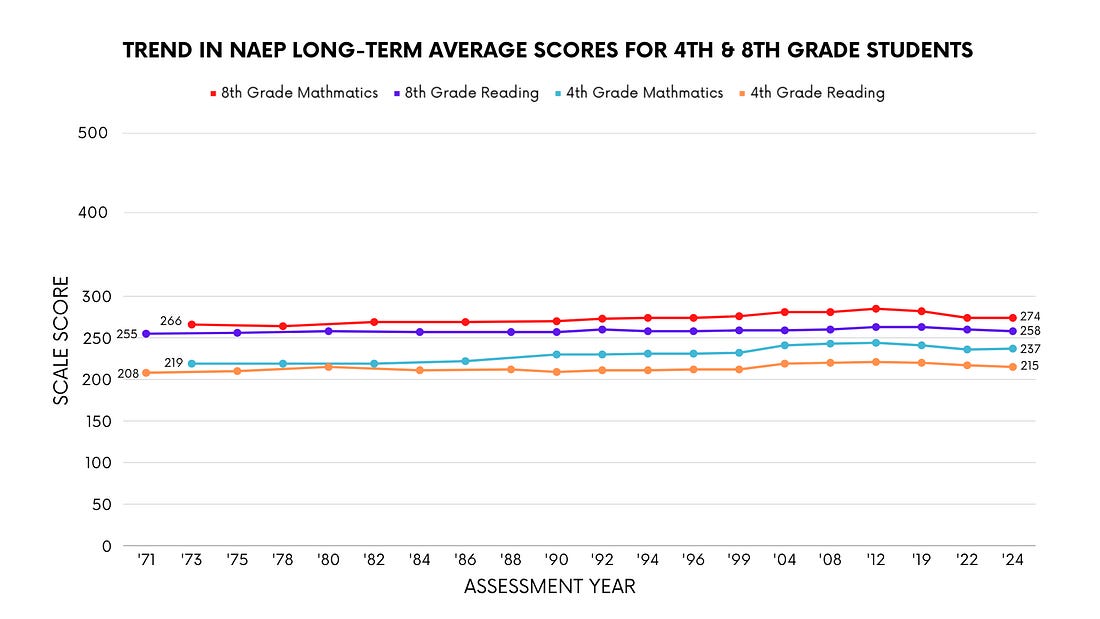
Spellings either did not understand basic statistics or was misleading for political gain. Krashen detailed the deception or ineptitude by showing that the gain Spellings noted did occur from 1999 to 2005, a change of seven points. But he also revealed that the scores rose as follows: 1999 = 212; 2000 = 213; 2002 = 219; 2003 = 218 ; 2005 = 219. The jump Spellings used to promote NCLB and Reading First occurred from 2000 to 2002, before the implementation of Reading First. Krashen notes even more problems with claiming success for NCLB and Reading First, including:

“Bracey (2006) also notes that it is very unlikely that many Reading First children were included in the NAEP assessments in 2004 (and even 2005). NAEP is given to nine year olds, but RF is directed at grade three and lower. Many RF programs did not begin until late in 2003; in fact, Bracey notes that the application package for RF was not available until April, 2002.”

This recent claim from Spellings, then, must be taken with a gigantic grain of salt because most politicians see education crisis as an opportunity to score political points, not as a way to better serve students.

That we are really about to have testing and accountability nostalgia sold to us is almost laughable—if it weren’t so insidious.

Reasonable people have noted that our testing obsession has resulted in deforming what and how students read, more passages to answer question and less whole book reading.

But research being ignored, makes the opposite and evidence-based argument from Spellings’s self-serving observation:

Almost 63% of the variance in test performance was explained by social capital family income variables that influence the development of background knowledge. Background knowledge is a known predictor of standardized test results. Family income variables are immutable by schools. Only public policies, outside the control of school personnel, can influence family income….
Policy makers and education leaders should rethink the current reliance on standardized test results as the deciding factor to make decisions about student achievement, teacher quality, school effectiveness, and school leader quality. In effect, policies that use standardized test results to evaluate, reward, and sanction students and school personnel are doing nothing more than rewarding schools that serve advantaged students and punishing schools that serve disadvantaged students.

Crisis rhetoric has never and will never serve even good intentions well in terms of seeking better ways to serve the needs of all students, regardless of the generational differences.
But let’s also resist this new push to go back (?) to the good ol’ days of testing and accountability NCLB-style.

Let’s instead recycle an old (and silly then) chestnut from the Reagan era.

When it comes to crisis rhetoric as well as testing and accountability in education reform, just say no.

See Also

The Reading Crisis Paradox: On Moral Crisis and Thought-Terminating Clichés

How to Manufacture Crisis with Line Charts: NAEP Reading Edition

Recommended: Reading educational research: How to avoid getting statistically snookered, Gerald Bracey (2006)

“Kids Today”: Perpetually Dumb and Lazy as a Box of Rocks

Reading Crisis 1961: Tomorrow’s Illiterates
1959: “yet students enter college badly lacking in these fundamental skills”

Reading Full Books in Secondary English Language Arts Classrooms


Jan Resseger, social justice warrior, strongly dissents from those who want to bring back the test-based accountability of No Child Left Behind and Race to the Top.

She writes:

Defining schools by their achievement test scores is reductive. Of course we want our children to learn to read, to enjoy and understand literature, to master math, and to study history and the sciences, but a fixation on comparing school districts’ test scores blinds us to the human relations that constitute a classroom, to the social formation of children that happens at school, and to myriad other ways of thinking about what students are accomplishing at school. The temptation then is to define schoolteachers as producers of test scores and forget about all the other ways they help our children learn and grow.

Because test scores provide a simple, universal measure, we grab onto it and give it more weight than all the other factors we can’t so easily measure. Kevin Welner, a professor of education policy at the University of Colorado and director of the National Education Policy Center identifies family income, a factor entirely outside of school, as the most significant variable affecting a school district’s aggregate test scores: “Those of us who work in or with schools never question the enormous impact that a teacher or school can have on a student. But this essential truth coexists with another truth: that differences between schools account for a relatively small portion of measured outcome differences. That is, opportunity gaps in the U.S arise primarily outside of schools. This should not be a surprise. Poverty, concentrated poverty, and racialized poverty are pervasive features of America.  School improvement efforts cannot directly help children and their families overcome decades of policies that perpetuate systemic racism and economical inequality.”

Last week, the NY Times’ Claire Cain Miller, Frencesca Paris and Sarah Mervosh reported on a major new demographic study documenting a widespread decline over the past decade in U.S. students’ standardized test scores: “Something troubling is happening in U.S. education. Almost everywhere in America, students are performing worse than their peers were 10 years ago… A report on the new data describes a decade-long ‘learning recession.’… Education experts say there is no single reason for the declines. But the timing provides some clues. Students’ test scores had been increasing since 1990—then abruptly stopped in the mid-2010s. That coincided with two events: an easing of federal school accountability under No Child Left Behind (NCLB), which was replaced in 2015, and the rise of smartphones, social media and personalized school laptops. The pandemic then accelerated learning declines, especially for the poorest students. Some pandemic effects have lingered. Student absenteeism, for example, remains higher than pre-pandemic… Test scores in low-income districts fell furthest, but affluent districts—the types of places families move to for the schools—also lost ground.”

The reporters do acknowledge a number of factors that may correlate with dropping scores, but they seem to lean toward blaming a lot of the problem on the end of No Child Left Behind. They are mistaken when they declare that the Every Student Succeeds Act (ESEA), NCLB’s replacement, ended test-based school accountability. In fact that 2015 law just made the states, not the federal government, agree to impose sanctions on the schools that had been unable significantly to raise test scores.  The reporters quote Brian A. Jacob, a professor at the University of Michigan, who believes NCLB’s fading influence has been one cause of test score decline: “It was not a cure-all, but I think it really did improve student achievement… There’s evidence that school accountability does change behaviors of teachers and administrators and probably parents and students.”

A prominent retired professor of education, Diane Ravitch pushed back immediately on what she understood as the bias of the recent NY Times article: “I reject the claim that scores have stagnated because of the easing of  No Child Left Behind-Race to the Top pressures. Sure, they increased the pressure on students, teachers, and principals, but their negative effects undermined the quality of education. Picking the right bubble on a standardized test became the goal of education.  Campbell’s Law says that when a measure becomes the goal, it loses its value as a measure. Social scientist Donald Campbell wrote that ‘the more any quantitative social indicator is used for social decision-making, the more subject it will be to corruption pressures and the more apt it will be to distort and corrupt the social processes it is intended to monitor.’ “

Ravitch names a number of experts who have evaluated the damage wrought by the No Child Left Behind Act’s strategy: to punish schools and teachers who, supposedly, weren’t working hard enough to make all students reach test-score proficiency by 2014.  The most prominent is Daniel Koretz, the Harvard University expert on standardized testing, who, in 2017, published The Testing Charade: Pretending to Make Schools Better. Koretz not only explains Campbell’s Law, but he shows how the pressure of test-based accountability corrupted what happened public schools across the country when the federal government threatened mandatory closure, or mandatory privatization or charterization of so-called “failing schools.”

Koretz reminds us that in places where test scores did rise under No Child Left Behind, it may not have reflected students’ academic growth. Test score gains were in many places artificially produced through test prep, the narrowing of the school curriculum, and even cheating: “Cheating—by teachers and administrators, not by students—is one of the simplest ways to inflate scores, and if you aren’t caught, it’s the most dependable.” (The Testing Charade, p. 73)  His book covers the tragic Atlanta cheating scandal, and other examples when teachers read the tests in advance and prepared students to answer specific questions. Koretz describes various kinds of test prep coaching and drilling that were widespread in the NCLB era.  And, “(Teachers) reported that they reduced—sometimes very substantially—the amount of time devoted to teaching science, which was not tested, in order to make additional time for prepping kids in math and reading.” (The Testing Charade, pp. 95-96)

Last week’s NY Times report on the possible causes of an overall drop in test scores over the recent decade also names two other possible causes.  First, a decade ago, as schools began to provide laptops or electronic tablets to their students for online learning, students’ widespread dependence on their smartphones also became epidemic: “Something happened globally around the same time: the proliferation of devices, at home and in school.  Nearly half of American teenagers now say they are online ‘almost constantly,’ compared with just under a quarter who said that a decade ago, according to Pew Research Center.”  Due to the proliferation of devices, our classrooms operate differently, and our children are doing less reading of books for study and enjoyment.

Second, the reporters, explain, there was massive and well documented learning loss during the COVID pandemic: “Immediately after the pandemic, there was hope that students would recover quickly.  The new data shows that scores inched upwards in reading last year, and have climbed more steadily in math since 2022. But it has been nowhere near enough to make up for lost ground…. The biggest losses have been among the lowest-achieving students.”

I have never heard anyone who has been able to trace the extent of long term damage during COVID, when students’ schools were closed and many children were left while their parents were at work to learn remotely on computers. Chronic absence has been a greater problem since COVID, and something schools have struggled to overcome.  No one has been able to assess how long COVID will keep affecting children who were preschoolers and young elementary students back in 2019.

Finally there is one other big factor that could also be related to falling test scores over time: states have been perpetually reducing funding for public schools. According to the most recent research from the Albert Shanker Institute: “There are 42 states (including the District of Columbia) that devote a smaller share of their economies to their K-12 schools than they did before the 2007-2009 recession. This seems to be a permanent disinvestment in public education.” “(U)nequal opportunity is (also) universal in the U.S. In all states, higher-poverty districts are funded less adequately than lower-poverty districts… We find that 37 percent of white students attend districts with negative adequacy gaps, compared with 75 percent of African American students and 62 percent of Hispanic students. In other words, African American students are about twice as likely as their white peers to attend school in a district with below-adequate funding, while Hispanic students are almost 70 percent more likely to do so, and Native American… students are 50 percent more likely. Similarly, African American students are over 3 times more likely than white students to attend chronically underfunded districts….” These economic factors are likely to have affected students’ learning over time.

Our society will not be able to address our economic, social, and educational injustices through No Child Left Behind-style, test-based public school accountability.

This week, a report by the Education Scorecard, led by Sean Reardon at the Stanford group; Thomas Kane at the Center for Education Policy Research at Harvard; and Douglas Staiger at Dartmouth proclaimed that we are in a decade-long “learning recession.” It found that 83% of state reading scores declined from 2015 to 2025. 

While I respect the Scorecard’s skills in compiling test score patterns, due to my time as an academic historian, an education researcher, and an inner city teacher, who witnessed the extreme harm done to students by the No Child Left Act of 2001 and the 2010 Race to the Top, I must challenge many of the conclusions that are being drawn from the test score patterns that Reardon, Kane, Staiger, and their partners present.

For instance, Thomas Kane told NPR that around 2013, “‘school districts learned that nobody was looking over their shoulders in terms of student achievement.’” When I read this statement, my response was that Kane must be living in a different world.So many districts are still looking over their shoulders prioritizing accountability metrics, not real learning.

Kane then claimed that accountability-driven mandates due to the NCLB and the RttT produced gains that “‘may be one of the most important social policy successes of the last half-century that nobody knows about.’” That statement has been refuted by numerous studies including RAND’s research which concluded that the failure of attempts to improve learning through high-stakes testing added to the proof,  “that one does not fatten a hog by weighing it.”I believe the test-driven teacher evaluations that Kane pushed were the most destructive education policy that I’ve ever heard of, and were a major factor in undermining teaching background information and reading for comprehension.Their test results patterns, I argue, actually support the opposite of the defense of NCLB and the RttT; it was the full implementation of high stakes testing, not the rejection of those failed policies, that was one of the top two causes of the sharp decline in literacy.

On the other hand, I agree that a main reason for the decline is the failure to manage social media, and that chronic absenteeism is a major factor.

But, first, I want to explain the political reasons why reading outcomes in the Tulsa Public Schools (TPS), and the Oklahoma City Public School System (OKCPS) fell so far. Secondly, I want to help defuse the “blame game,” and push back against the ramping up of unfair criticism of urban schools that is likely to get worse.  

Reardon previously led the research by the Equal Opportunity Project which found that the TPS’s 3rd through 8th grade growth rates were the 7th lowest in the nation from 2009 to 2015.

TPS students had gained only 3.8 years of learning over five years. Moreover, the OKCPS students only gained 4.4 years.

The TPS had had better schools than Oklahoma City, and we repeatedly visited Tulsa to learn from them. But, in 2010 they received a Gates Foundation grant for evaluating teachers, that Kane and Staiger helped create. Then, I frequently visited Tulsa and listened to both teachers and frustrated consultants as they complained about the damage being done to teaching and learning. Not surprisingly, it became much harder to recruit or retain teachers.

Now, the TPS, when compared with around 10,000 schools with similar demographics, “ranked higher than 1% of districts nationwide in average reading performance during the 2022-25 school years.” 

Also, data from American Enterprise Institute’s Nat Malkus showed that the TPS’s chronic absenteeism rate was 48.2%, compared to the nation’s 31.9% chronic absenteeism rate for similar schools.

Similarly, the Scorecard said, “Oklahoma City ranked higher than 0% of districts nationwide in average reading performance during the 2022-25 school years.” Its students performed 3.93 grade levels below the 2019 national average. Moreover, chronic absenteeism was 42.8% compared to the national rate of 33% for similar districts. 

But, before Oklahoma City’s educators in high-challenge schools are blamed, the extreme segregation they face must be taken into account. Oklahoma County has 14 school districts.  along with magnet, charter, and private schools. School choice resulted in neighborhood schools with intense concentrations of students from extreme, generational poverty, who have endured multiple traumas (known as ACEs), thus driving down the OKCPS’s test scores. 

Consequently, in 2015, suburban and exurban schools Edmond, Mustang, Moore, and Yukon were ranked higher than the national average by 1.6; .6; 1; and .8 years. By 2024, their scores declined by the same or by lower rates as similar national schools. So, it’s hard to make the case that the lack of teacher accountability, as opposed to segregation by choice, drove those drops in reading. 

At the risk of sounding too nerdy, the historian in me needs to recall the chronologies for test score gains and decreases. I argue that the most meaningful reading metric is the 8th grade NAEP, which had been improving incrementally from 255 in 1971, to 263 in 2012, before it fell to 260 in 2020, and to 256 in 2023. 

Both my experiences in the classroom, and the reading of the data, support the narrative that it took a while for the destructive policies of both interconnected reforms to be put in place, but when that happened, both laws drove meaningful learning down.    

On the other hand, some claim that the reversal of the most punitive parts of RttT caused that decline. But those changes didn’t occur until 2015, after 8th grade reading scores were already in decline. Even so, in Oklahoma, the conservative Oklahoma Council of Public Affairs (OCPA) blamed State Superintendent Joy Hofmeister for the drop in state reading scores because she ended the practice that made us second in the nation in retentions. 

Getting back to today’s national discussion about literacy, one data-driven scholar, Brian Jacobs, was cited for supporting NCLB despite its problematic features. He said, “It was not a cure-all, but I think it really did improve student achievement.” 

But, if you follow the link to his research, it concludes, “Our results suggest that NCLB had no impact on reading achievement for 4th or 8th graders.” And it gives virtually no evidence that it didn’t undermine learning about science, history, arts, and music.    

Reading the news coverage of the Education Scorecard brings me back to three sets of memories. During the early 1990’s, our school superintendent bragged about implementing the Reagan administration’s A Nation at Risk. So many of my students who grew up in that era would thank me for teaching in a meaningful manner, and then complain that they had previously been “robbed of an education” by its testing.

Secondly, at the turn of the century, I repeatedly talked with smart, sincere data experts about methodological problems when using their metrics for real world policies, as opposed to economic theory. I repeatedly heard the reply that their job was to show that data-driven accountability can improve teaching. If I’m right, they would say, they would run some more controls (presumably after the policies were in place). But it wasn’t their job to predict what will happen if those policies are adopted.    

Thirdly, as the RttT was implemented, my students from the poorest elementary and middle schools would repeatedly thank me for showing them respect by teaching them in a meaningful manner. And, they kept volunteering that they had been “robbed of an education.”

It is also important to remember that the majority of OKCPS students are Hispanic, and remember that the OKCPS probably would have collapsed if it had not been for immigration. Now, when ICE is terrorizing immigrants, we must come together in support of our threatened students in order to reduce its contribution to chronic absenteeism. 

And Oklahoma has long ranked near the nation’s top for Adverse Childhood Experiences (ACEs), and near the bottom for children’s wellness.

Moreover, I don’t recall talking to a parent who doesn’t see the need to help young people control, and not be controlled, by their digital devices.

And I almost never talk to a parent, a student, or an educator who doesn’t want to cut back on high-stakes testing and test prep.

So, I agree we need to take the Education Scorecard seriously, but we should use it as a diagnostic tool to help us come together for the team efforts required for bringing back the joy of reading.   

For instance, I agree with Elaine Allensworth, the executive director of the Chicago Consortium on School Research, who responded to the Scorecard saying we should not panic, but “We need to really start asking questions about what we can do to support students so they feel engaged in school.”

Retired teacher Nancy Bailey wrote on her blog about significant figures in the evolution of the history of reading. In this post, she focuses on the role of Robert Sweet, an important figure in the Department of Edication during the Reagan-Bush era.

Bailey writes:

Today’s Science of Reading (SOR) was born of a right-wing conservative phonics focus. A Nation at Risk helped advance that messaging, and one of the messengers was Robert Sweet, Jr.

As the country mandates the Science of Reading (SOR) and invests heavily in unproven programs, marketing disputes flourish over which best align with so-called evidence. These programs control teachers’ instruction through one-size-fits-all directives, delivered with manuals or online. It’s easy to see where this is going. States could spend millions more on reading programs that don’t appear to improve learning as teachers are driven out with tech.

During the Reagan administration, A Nation at Risk raised unfounded negativity towards public schools and teachers (See Biddle and Berliner, The Manufactured Crisis). Reading, already controversial, became a vehicle for attacking teachers, their teacher colleges, and public schools, furthering a school privatization agenda that continues to this day. Schools weren’t doing badly, but those who wanted to privatize them worked to make them fail.

The obituary of Robert Sweet, Jr. is glowing. I don’t doubt that, like many SOR enthusiasts, he believed he was doing the right thing. He became instrumental in the phonics movement, working later with the Science of Reading and Reading First promoter Reid Lyon to create No Child Left Behind and Reading First. Yet he’s rarely mentioned today.

Sweet wasn’t a qualified reading teacher. He taught physics, coached, and sold textbooks. He arrived in DC as a member of the US House of Representatives staff during the Reagan administration. He supported Reagan initiatives such as tuition tax credits, low-income voucher programs, student self-help reforms, education savings accounts, and other conservative school initiatives.

He met Dr. Onalee McGraw, a PhD political scientist and a Heritage Foundation representative. McGraw, unrelated to the publishing company, was a Reagan appointee to the National Council on Educational Research (See Robert Sweet interview 4.17 below).

The Heritage Foundation is behind today’s Project 2025. Lindsey Burke, who wrote the education part, works with Education Secretary Linda McMahon. Neither are educators.

McGraw wrote “Family Choice in Education: The New Imperative,” arguing that public schools were in decline, academics had been replaced by social engineering, and humanistic curricula and subjective values had taken over. She believed education was inherently religious, not value-free. She promoted vouchers, minimum competency requirements, and moral education classes.

Sweet initially didn’t see reading as a problem. He and his children learned to read. But McGraw introduced him to Michael Brunner, who convinced Sweet otherwise.

Brunner wasn’t a reading teacher either. He had a degree in library science becoming the director of Title I in Idaho. He connected with the Reading Reform Foundation, created after Rudolph Flesch’s Why Johnny Can’t Read. Brunner wrote Vowelectomy. He believed in the work of well-known reading expert Jeanne Chall, but didn’t think vowel and mixed digraph instruction took place early enough, waiting until the end of first grade.

Both Sweet and Brunner repeatedly claim that students aren’t learning to read and teachers and especially their colleges are failing to teach phonics.

But Berliner and Biddle in The Manufactured Crisis pointed to media claims as being distorted and hostile, describing reporters failing to address cited study details, indicating that research really showed that poverty was the leading cause of reading difficulties (see p. 10-11).

Sweet became the director of the National Institute of Education and later the US Department of Education, bringing Brunner to DC to work on reading. They commissioned a report, Becoming a Nation of Readers. It’s informative, covering phonics importance, but also comprehension, meaning, and environmental influences. Sweet complained it was unfocused (8.45 video below).

He commissioned another report by Marilyn Jaeger Adams Beginning to Read: Thinking and learning about Print. The book, still popular today, stresses the importance of phonics and whole language. I could not find what Sweet thought about Jaeger’s book.

Both Bruner and Sweet favored Spaulding, a reading program spun from Orton-Gillingham (OG). Sweet criticizes Reading Recovery, praising Spaulding at the end of this interview. OG remains popular in the Science of Reading, despite common knowledge that it has lacked high-quality, peer-reviewed studies of its efficacy for 50 years!

Brunner and Sweet traveled the country observing teachers, without being reading experts. They blamed colleges for failing teachers on how to teach phonics. While teacher colleges can always improve, generalizing the same criticism towards all is dangerous. I knew of excellent teacher college programs at that time. Brunner created his own reading program, Phonics Made Plain.

He authored numerous articles on reading, including a Republican policy paper “Illiteracy: An Incurable Disease or Educational Malpractice?” Sweet’s paper was supported by the U.S. Department of Education and the Center for the Study of Reading at the University of Illinois. It called for enlarging the restoration of the instructional practice of intensive, systematic phonics in every primary school in America.

Next, under President George H.W. Bush, Sweet became administrator for the Juvenile Justice Department. Brunner writes Retarding America: The Imprisonment of Potential, highlighting that juvenile crime is due to current reading methods (i.e. little phonics), while ignoring other variables. A good thing is that they establish reading programs in some detention facilities.

Sweet learns of the National Institute of Health and Human Development and met Reid Lyon. He seemed then to form the idea that reading must be based on scientific principal and one assumes he’s talking about phonics (11.58 video below).

In 1993, Sweet became co-founder and president of the now defunct National Right to Read Foundation which focuses again on phonics (12:41 video below). He still implied that teachers didn’t know about phonics.

Brunner criticizes the All Handicapped Children’s Act (PL 94-142) throughout the book listed above implying children simply lack phonics instruction.

But, public schools were working to accommodate children with reading difficulties in schools using phonics in resource classes especially after the 1975 passage of PL94-142. And phonics may have been taught later.

Sweet eventually helps pass the Reading Excellence Act in 1998 under President Clinton, although he doesn’t care for Clinton’s America Reads program where college students read to students (14.18 video below).

Under President G.W. Bush he collaborates with Reid Lyon, an advisor to the president, crafts language for the No Child Left Behind Act. Sweet becomes the primary author of the Reading First initiative which saw “scientifically based research” noted more than 100 times. Reading First turned out controversial.

Lyon immensely disliked educational schools, stating in 2002, a year after 9/11, You know, if there was any piece of legislation that I could pass, it could be to blow up colleges of education. He supports today’s Science of Reading initiative.

Around this time Reid, according to the NYTs, advised his former boss, Dr. Duane Alexander, about candidates for the National Reading Panel (Schemo, 2007). No early childhood teachers who teach reading were included on the panel. It’s controversial findings are still promoted by SOR enthusiasts, including some whom were on the panel. [I mention the lack of early childhood teachers but one teacher/principal was selected for the panel. Joanne Yatvin wrote many reports about her concerns about the panel itself. Minority View]

Robert Sweet and those described here were given much clout over teachers and how they teach. Yet after all these years, focusing heavily on phonics, and adding billions in technology often for SOR online programs, teachers, and their teacher colleges are still blamed as failing.

References

Berliner, D. C., & Biddle, B. J. (1995). The manufactured crisis : myths, fraud, and the attack on America’s public schools. Addison-Wesley.

Gursky, D. (1981, August 1). After The Reign Of Dick And Jane. Education Week, Retrieved from https://www.edweek.org/education/after-the-reign-of-dick-and-jane/1991/08

Schemo, D. J. (2007, March 9). In War Over Teaching Reading, a U.S.-Local Clash. The New York Times, Retrieved from https://www.nytimes.com/2007/03/09/education/09reading.html

This post is adapted from my panel presentation at the 2025 Network for Public Education meeting.

Jennifer Berkshire, keen-eyed commentator on the nation’s schools and their detractors, writes that the doomsayers are up in arms again. After 25 (or 40) years of nonstop “reform,” their lamentations are once again in style. Note that the lamentors never blame the failure of the “reforms” they imposed. No. It’s the students, the teachers, the public schools, anyone else but not themselves.

Berkshire writes:

The kids are dumb and getting dumber. They can’t add or read the books they are no longer assigned, rousing themselves from their stupid stupors only to demand extra time on tests or another (now meaningless) A. The schools are collapsing, thanks to weakened standards and something called “cargo cult equity.” Just how bad is it out there? Today’s kids are the equivalent of the subprime mortgage-backed securities that blew up the economy in the lead up to the Great Recession. (Yes, somebody actually made this argument).

I could keep going, but you get where this is heading. Also, we are only a few days into the new year and I am already exhausted. The point, reader, is that we find ourselves in the throes of a full-blown public education panic. But why now? And why does this one feel different? I kick off 2026 with a look at a story that is all but guaranteed to keep telling itself in the months ahead.

America’s oldest pastime

If you’re new to the great American pastime of bemoaning the state of the nation’s schools then perhaps you’re unaware that we’ve been doing this since at least the ‘70’s. By which I mean the 1870’s. If the railroad collapse that triggered the Panic of 1873 feels startlingly familiar in our own bubbly AI economy, so too will feel the ensuing laments about the schools. They were too expensive. They used to teach reading well, but no longer. They had too many administrators. And if you’ve been following the ‘women ruin everything’ discourse, this was also the time when teaching became a female-documented occupation. Related? You tell me. Over the past 250 years, complaints “that the public schools of today are inferior to those of a generation or two ago” have resurfaced as reliably as measles or whooping cough.

Too many of the wrong kids are in college

Several years ago, education historian Jack Schneider and I wrote an op-ed in which we argued that the GOP was using education culture war to appeal to vastly different constituencies, including rural voters enflamed over CRT and litter boxes and affluent moderates obsessed with getting their kids into elite institutions. Alas, our bleak prediction about the realigning power of this emerging coalition turned out to be premature, but only in the K-12 world. Today, the powerful backlash movement that is upending higher education is based on just such an unlikely coalition, united in the belief that there are too many of the wrong kids in college. As one wry observer noted on X: “Half the education posts are like ‘my kid has a 5.3 GPA and invented $5 insulin and got rejected from DeVry’ and half are ‘60% of freshmen do not know enough math to read the numbers on their classroom doors.’”

Or how about this one? “The Atlantic is Fox News but for high SES liberals worried their kids spot at a UC will be taken by some Latino kid from the Central Valley.” Touché! As Trump et al continue to expand the definition of “wrong kids” [immigrants, non-white students, protestors, poor students, women], affluent parents with an eye on the Ivies, not to mention the pundit class, are proving all too willing to play footsie with them.

Billionaires gonna billionaire

Here’s a question for you, reader: what was your favorite example of a billionaire purchasing state-level education policy in 2025? Mayhaps it was hedge funder Ken Griffin’s purchase of the state legislature in Florida. Or hedge funder Jeff Yass’ purchase of Texas governor Greg Abbott. Or maybe you prefer a more bespoke intervention, like when billionaire Lauren Overdeck rented mobile billboards to warn New Jersey parents that their kids aren’t that smart.

Nobody knows anything

“I Don’t Know What to Think About America’s Declining Test Scores and Neither Should You” was the title of a great post last year by teacher and writer Michael Pershan. Digging into the surging remedial math program at University of California San Diego that fueled roughly one billion hot takes, Pershan patiently pointed out the contradictory nature of the data regarding student achievement in California. Even as student math skills were supposedly declining, state test scores were increasing. Or take Los Angeles, one of the few bright spots in the post-pandemic recovery landscape. During the last golden age of education reform, roughly 15 minutes ago, the progress of LA’s students would have merited its own fawning press treatment. No longer. Today, the story is decline and failure, and while this is a global phenomenon that includes adults, why let a little complexity get in the way of a hot take? The emergence of our ‘hot take’ economy, by the way, in which content entrepreneurs are handsomely rewarded for their “obtuse penchant for moral and ideological incuriousity” (and pay no price for 1) being wrong or 2) contradicting themselves) is a major driver of our current round of public education panic.

Neoliberalism is gone (but not forgotten)

Every year I ban myself from using the word “neoliberalism,” and, well, you can see how that’s going. The story of education decline and collapse that’s now sweeping the land typically goes something like this. Back when we had accountability, standards and choice, things were going great, but then [insert teachers, unions, progressives, lazy kids here] did [insert bad thing here] and the result is [insert calamity here.] But if you’ve been paying attention to education politics for more than 15 minutes then you know that that story is not just partial but wildly inaccurate.

For example, did you know that grassroots opposition to the Common Core standards on the right blew up, not just the era of bipartisan accountability, but helped deliver the current occupant into the White House? The result is that we’re now in an in-between-state, in which the vision of market-minded education reform that has held sway for the last THIRTY YEARS is exhausted while no clear alternative has emerged to take its place. For a compelling explanation of how the crack up of education policy relates to our larger political disintegration, check out this essay by Matt Wilka and Kent McGuire, “A Democratic Vision for Public Schools.”

The neoliberal paradigm has cracked, but it has not crumbled. And this instability marks our current transition period, which has brought much graver threats to American democracy. The confluence of economic pain, demographic change, and new media has proved fertile ground for authoritarian leaders to champion resistance to government.

Human capitalists vs. the chainsaw

Of all of the reading I’ve done in the last month, it was this piece that stopped me in my tracks. The author, a used-to-be copy writer now being replaced by AI, asks an AI chat bot for career advice, to which he is instructed to pick up a chainsaw. I’ll stop here as I want you to read it yourself, but suffice it to say that the author uses his experience to take aim at two sacred cows of the neoliberal era: 1) that more and better education is the answer to our economic woes and 2) that the remedy for worker dislocation is retraining. (For evidence of our muddled moment, consider that the New York Times ran, in addition to the chainsaw op-ed, a Sal Kahn ripped-from-the-time machine argument for worker re-training and a good old-fashioned education-as-boot-straps editorial, all in the same month.)

What does this have to do with our current round of public education panic? For the past three decades, bipartisan education reform has been pitched as an alternative to economic redistribution. Why impose higher taxes on the wealthy when going after the teachers unions is so much more satisfying? But as downward mobility comes for a larger and larger segment of the workforce, that sales pitch has officially run out of steam. The big question now is ‘whither the Democrats?,’ who, to paraphrase the great Tom Frank, have long seen every economic problem as an education problem. Will they seize the populist economic mantle, as even James Carville is prodding them to do? Or will the centrist zombie rise again, flogging the exhausted case that “[e]ducation reform is the seed corn of economic prosperity”? My money is on the chainsaw…

Race science is back

What single silver bullet would cause US test scores to soar like a SpaceX rocket? If you answered ‘kicking out all of the immigrants,’ you would be quoting Trump advisor Stephen Miller. While the claim is measurably preposterous, it’s indicative of the roaring return of race science during Trump 2.0. But Goebbels envy isn’t the only reason for the obsessive fixation on IQ these days. For a forthcoming essay on the Democrats’ populism bind, I’ve been revisiting education historian Michael Katz’s 1987 Reconstructing American Education. In his survey of 100 years of education reform promises and disappointment, Katz identified a familiar pattern. Once the hypes and hopes of addressing an astonishing array of societal ills through the schools inevitably fall short, “hereditarian theories of intelligence reemerge” like clockwork.

Here’s Katz:

As so often in American history, education had been deployed as the primary weapon to fight poverty, crime and social disorder, and, as before, schools were unable to alleviate these great problems whose structural origins lie in the distribution of power and resources.

Katz was surveying the wreckage of the War on Poverty era, its optimism curdling into mainstream social science claims that 1) because IQ was largely inherited and racially determined 2) efforts to boost achievement through the schools were doomed to failure. Today we’re in a similar moment, the exuberant claims of the last education reform era (see above) crashing into the chasm of economic inequality. Katz argued that the only way to challenge genetic arguments, by the way, was to acknowledge “the structural origins of social problems and the inherently ineffectual nature of the reforms that have been attempted.” Sound familiar?

Too many of the wrong kids are in college

Several years ago, education historian Jack Schneider and I wrote an op-ed in which we argued that the GOP was using education culture war to appeal to vastly different constituencies, including rural voters enflamed over CRT and litter boxes and affluent moderates obsessed with getting their kids into elite institutions. Alas, our bleak prediction about the realigning power of this emerging coalition turned out to be premature, but only in the K-12 world. Today, the powerful backlash movement that is upending higher education is based on just such an unlikely coalition, united in the belief that there are too many of the wrong kids in college. As one wry observer noted on X: “Half the education posts are like ‘my kid has a 5.3 GPA and invented $5 insulin and got rejected from DeVry’ and half are ‘60% of freshmen do not know enough math to read the numbers on their classroom doors.’”

Or how about this one? “The Atlantic is Fox News but for high SES liberals worried their kids spot at a UC will be taken by some Latino kid from the Central Valley.” Touché! As Trump et al continue to expand the definition of “wrong kids” [immigrants, non-white students, protestors, poor students, women], affluent parents with an eye on the Ivies, not to mention the pundit class, are proving all too willing to play footsie with them.

Billionaires gonna billionaire

Here’s a question for you, reader: what was your favorite example of a billionaire purchasing state-level education policy in 2025? Mayhaps it was hedge funder Ken Griffin’s purchase of the state legislature in Florida. Or hedge funder Jeff Yass’ purchase of Texas governor Greg Abbott. Or maybe you prefer a more bespoke intervention, like when billionaire Lauren Overdeck rented mobile billboards to warn New Jersey parents that their kids aren’t that smart.

THERE IS MORE! OPEN THE LINK TO FINISH THE ARTICLE. And open the link to see the links to sources.

If you have been following this blog for a long time, you know that in my estimation one of the best (actually the best) education bloggers is Peter Greene. Peter taught high school students for 39 years in Pennsylvania. He knows more about teaching than all the experts at the elite universities.

Best of all, he has a keen eye for flimflammery and a great sense of humor. His is one of the few blogs that makes me laugh out loud. He pierces through BS and shysters with ease. And he’s more prolific than anyone I know. Some years back, I devoted every post on one day to Peter’s writings. I consider him to be one of my teachers.

So I was immensely grateful when I discovered that he reviewed my memoirs in both Forbes and, in a different voice, on his blog Curmudgacation.

Here is his blog review:

Over at Forbes.com, I’ve posted a piece about Diane Ravitch’s new memoir, An Education. That’s my grown-up fake journalist piece; but I have a few more blog-appropriate things to say. 

Most folks know the basic outline of the Ravitch career, that she was a recognized and successful part of the conservative ed reform establishment who then turned away from the Dark Side and joined the Resistance–hell, basically co-founded the Resistance. 

I have never heard her talk or write much about what that change cost her, and she doesn’t really talk about it in those terms in this book, but the early chapters show just how in that world she was. Connected to all the right people, welcome at all the right gatherings, in demand as a speaker, and the people–the names just keep coming. Ravitch was in the Room Where It Happens, and not just in it, but close friends with some of the folks in it with her. And she walked away from all that.

I don’t point to that to say we should feel sad for what she gave up, but as a sign of just how tough she is. She looked at the reality on the ground and concluded that she had to change some core beliefs, and having changed them, she had to act on them. If there was more of that kind of intellectual and ethical toughness in the world, the world would be a better place. It’s unusual enough that folks on the privatizer side have often assumed that someone must be paying her off, and a handful of people on the public school side were reluctant to fully trust her. 

There are other details in the book that attest to her guts and hard work. Her first book, The Great School Wars, was a history of the New York City public school system– a massive research project that Ravitch in her mid-thirties just assigned to herself, a project so thorough and well-constructed that she could use it as her PhD thesis. 

There are lots of fun details in the book– imagine the young Diane Ravitch swinging on a rope ladder outside a Wellesley dorm room where a formal dinner was in progress.

The book tells the story of how she got there, how she concluded that the policies that she had believed in were simply not so. And again– many another person would have at that point either kept going through the motions, or retreated to a quiet cave, but Diane instead became an outspoken critic of the very policies, organizations, and people who had been her professional world.

Back in the early 2010s, I was a high school English teacher in a quiet rural and small town corner of Pennsylvania. I knew things were happening in education that just felt really wrong, and I went searching for answers. What I found was Diane Ravitch’s blog, which was like a gathering place for many voices of advocacy for public school. It was where I found many writers who could help me make sense of things like Common Core and NCLB’s undermining of public education. 

There are several people who were responsible for my finding an audience (or the audience finding me) but it was Diane’s blog that got me my earliest connections to audiences. I didn’t know any of these folks, didn’t have any of the connections that hold together movements. At my first NPE conference, the most common question I got was some version of “Who the heck are you and where did you come from?” Diane’s network had made it possible for me to find my connections with a larger movement.

I’m just one example of how Diane’s extraordinary generosity in sharing her platform allowed all sorts of supporters of public education from all across the country to connect and support each other. It’s a notably different approach to leadership than, say, making a movement all about yourself in an attempt to collect personal power on the backs of followers instead of lifting everyone up to be a leader and activist in their own little corner of the world.

The book provides part of answer to where a person like Diane comes from, where that kind of intellectual and ethical courage and diligence come from. And it also provides a clear, compact explaining of where modern ed reform has gone wrong, from the toxic test-and-punish approach of NCLB to the billionaire-driven privatization push to the culture panic debates currently raging. If you want to hand someone a quick simple explainer of what has gone wrong, you can do worse than the last few chapters of this book.

At 223 pages, this is a brisk read but an illuminating one. I highly recommend it

This may be the most important article you will read today.

Richard Rothstein has had a distinguished career as a journalist who writes about social science, most notably, achievement gaps, housing segregation, and the impact of poverty on academic performance. He has long been a fellow at the Economic Policy Institute and before that was education editor of The New York Times.

Rothstein writes here about the origins of the belief that teachers are directly responsible for student academic performance. If students score poorly on tests, goes the theory, it’s because their teachers have low expectations for them. In the case of black students, teachers’ racism is likely to explain their low expectations. From this perspective, No Child Left Behind and Race to the Top made perfect sense. The teachers needed high expectations or needed to be fired.

Rothstein writes:

Social psychologist Robert Rosenthal died at the age of 90 last month. He was best known for his 1968 book, Pygmalion in the Classroom, co-authored by Lenore Jacobson, an elementary school principal in South San Francisco.

No book in the second half of the 20th century did more, unintentionally perhaps, to undermine support for public education, and thus diminish educational opportunities for so many children, especially Black and Hispanic children, to this day. The book and its aftermath put the onus solely on teacher performance when it came to student achievement, disregarding so many critically important socioeconomic factors—at the top of the list, residential segregation.
How did it do that?

The book described an experiment conducted in Ms. Jacobson’s school in 1965. The authors gave pupils an IQ test and then randomly divided the test takers into two groups. They falsely told teachers that results showed that students in one of the groups were poised to dramatically raise their performance in the following year, while the others would not likely demonstrate similar improvement.

At the end of that year, they tested students again and found that the first and second graders in the group that was predicted to improve did so on average, while those in the other group did not. The book, as well as academic articles that Dr. Rosenthal and Ms. Jacobson published, claimed that the experiment showed that teacher expectations had a powerful influence on student achievement, especially of young children. Pupils whose teachers were told were more likely to improve then apparently worked harder to meet their teachers’ faith in them.1

Some psychologists were skeptical, believing that the experimental design was not sufficiently rigorous to support such a revolutionary conclusion. Even the reported results were ambiguous. Teacher expectations had no similar impact on children in grades three through six. Similar experiments elsewhere did not confirm the results even for first and second graders.2

Nonetheless, the book was very influential.
In the decades after Pygmalion, other studies examined teacher expectations. They showed that teachers have greater expectations of higher achieving students but couldn’t determine whether the teacher attitudes helped to cause better pupil performance. Perhaps teachers only developed those expectations after seeing that students were higher achieving.3 Only an experimental study, like Pygmalion, could establish causality, but contemporary ethical standards would often prohibit such experiments, requiring, as they must, lying to teachers about their students’ data.

Minority children in the South San Francisco school where Rosenthal and Jacobson experimented were Mexican-origin, not African American. Yet ignoring how scanty the evidence was, education policymakers concluded from their research that the Black-white gap in test scores at all grade levels resulted from teachers of Black children not expecting their pupils to do well. And that, they reasoned, should be an easy problem to solve—holding teachers accountable for results would force them to abandon the racial stereotypes that were keeping children behind.

The accountability movement grew in intensity during the Bill Clinton administration, while in Texas, Governor George W. Bush implemented a mandatory standardized testing program whose publicized results, he thought, would force teachers to improve by shaming them for the lower scores of their poorer Black and Hispanic pupils.

In 2000, Bush was elected president; his campaign promised to demolish teachers’ “soft bigotry of low expectations.” During his first year in office, he led a bipartisan congressional majority to adopt the “No Child Left Behind Act” that required every state to conduct annual standardized testing in reading and math for pupils in the third through eighth grades. 

Shortly after the bill was signed, I met with the congressional staffer who had been primarily responsible for writing the legislation. She predicted that within two years, the publication of test scores would so embarrass teachers that they would work harder, with the result that racial differences in academic achievement would evaporate entirely.

Nothing of that sort has happened. Although test performance of both Black and white students has improved somewhat, the gap is not much different than it was two decades ago. But the public reputation of our teaching force has continued to deteriorate, as a conclusion spread that failure to equalize test results could be remedied by gimmicks like naming a school’s classrooms for the Ivy League colleges that teachers expected their students to attend.4 

Enthusiasm for charter schools escalated from a belief that operators could choose teachers with higher expectations, yet charter schools have not done any better (and in many cases worse) in closing the gap, once the sector’s ability to select students less likely to fail (and expel students who do) is taken into account.5

In 2008, I taught an education policy course for master’s degree candidates, many of whom had taught for two years in the Teach for America (TFA) program. It placed recent college graduates without teacher credentials in schools for lower-income Black and Hispanic students.

Funded heavily by private philanthropies, TFA embraced the low-expectations theory of below-average performance. Prior to their teaching assignments, TFA corps members were required to attend a summer institute whose curriculum featured a unit entitled “The Power of My Own Expectations” and required them to embrace the “mindset” of “I am totally responsible for the academic achievement of my students.”

None of my master’s degree students claimed that in their two years of teaching, their high expectations actually produced unusually high achievement. But most were so immunized against evidence and experience that they enrolled in a graduate program with the intention of creating new charter schools infused with high expectations. Only a few wondered what had gone wrong with their theory, besides having goals that still weren’t high enough.

Certainly, there are teachers with low expectations and harmful racial stereotypes, and it would be beneficial if those who can’t be trained to improve were removed from the profession. But I’ve visited many schools serving disadvantaged students. Most teachers I observed, white and Black, were dedicated, hard-working, engaged with their students, and frustrated about the social and economic challenges with which children daily came to school. I don’t claim that my observations were representative; I was more likely to be invited to visit schools that took great pride in their efforts, despite conditions they struggled to overcome.

No matter how high their expectations, teachers can’t do much about:

*their pupils’ higher rates of lead poisoning that impact cognitive ability;

*more frequent asthma—the result of living with more pollution, near industrial facilities, in less-well maintained buildings with more vermin in the environment—that may bring them to school drowsy from being awake at night, wheezing;

*neighborhoods without supermarkets that sell fresh and healthy food;

*stress intensified by being stopped and frisked by police without cause, and a discriminatory criminal justice system that disproportionately imprisons their fathers and brothers for trivial offenses;

*frequent moves due to rising rents, or landlords’ failure to keep units in habitable condition;

*absenteeism from a need to stay home to care for younger siblings while parents race from one low-wage job to another;

*poor health from living in neighborhoods with fewer primary care physicians or dentists;

*lower parental education levels that result in less academic support at home, combined with less adequate access to technology, a problem exacerbated since the pandemic;6

*and many other socioeconomic impediments to learning.7

Not every Black child suffers from these deprivations that affect their ability to take full advantage of the education that schools offer. But many do. Concentrating disadvantaged pupils in poorly resourced schools in poorly resourced and segregated neighborhoods overwhelms instructional and support staffs.

Such realities contributed to my conclusion that residential segregation, not low teacher expectations, was the most serious problem faced by U.S. education. It is what led to my recent books, The Color of Law, and its sequel (co-authored by my daughter, Leah Rothstein), Just Action; How to challenge segregation enacted under the Color of Law.

Robert Rosenthal’s Pygmalion theory set the stage for a national willingness to deny educational disparities’ true causes: the unconstitutional and unlawful public policies that imposed racial segregation upon our nation.

Footnotes:

1. Robert Rosenthal and Lenore Jacobson. 1968. Pygmalion in the Classroom: teacher expectation and pupils’ intellectual development. (New York: Holt, Rinehart, and Winston). For a technical summary by the authors, see. Rosenthal and Jacobson, “Pygmalion in the Classroom.” The Urban Review 3, September, 1968: 16-20.

2. See “Pygmalion in the Classroom.” The Urban Review 3, September, 1968, footnote on p. 19.

3. For example, see Thomas L. Good, Natasha Sterzinger, and Alyson Lavigne. 2018. “Expectation Effects: Pygmalion and the initial 20 years of research.” Educational Research and Evaluation 24 (3-5): 99-123.

4. See, for example, Richard Rothstein. 2010. “An overemphasis on teachers.” Commentary, Economic Policy Institute, October 18. 

5. Martin Carnoy, et al. 2005. The Charter School Dust-Up. (Washington, D.C.: The Economic Policy Institute).

6. In early 2020, I wrote that the pandemic would widen the achievement gap. The consequences turned out to be worse than I could have imagined. Teacher expectations had nothing to do with it. Richard Rothstein. 2020. “The Coronavirus Will Explode Achievement Gaps in Education.” Shelterforce.org, April 13.

7. Richard Rothstein. 2004. Class and Schools. Using social, economic, and educational reform to close the black–white achievement gap. (Washington, D.C.: The Economic Policy Institute).

The text of this post was originally published on January 30, 2024 on the Working Economics Blog of the Economic Policy Institute.

Fifteen years ago, I wrote a book about the the danger that school choice and testing posed to public schools. Its title: The Death and Life of the Great American School System: How Testing and Choice Are Undermining Education. I named a few of the billionaires funding the attacks on public schools, teachers, and unions–Bill Gates, Eli Broad, and the Walton family–calling them “The Billionaire Boys Club.” Little did I know that they were the tip of the billionaire iceberg.

My hope in 2010 was that public school supporters would block the privatization of their schools. Public schools are as American as apple pie. I wanted the public to wake up, rally around their public schools, and repel the hedge fund managers and billionaires who were funding the privatization movement.

I was too optimistic.

The attacks escalated, fueled by the political power that money buys. The major media bought the corporate reform narrative hook, line, and sinker.

Neoliberal corporate reform brought us high-stakes standardized testing, A-F ratings for schools, charter schools, school closings, and rating teachers by the test scores of their students. And cheating scandals. All to get higher test scores, which never happened.

Now, Jennifer Berkshire asks on her blog The Education Wars whether it’s all over for public schools. Jennifer appreciates the importance of public schools as community builders and civic institutions that serve the common good.

Please read her smart take on the state of public education today:

I won’t lie. If you’re a member of Team Public Education, as I am, it has been a tough summer. And if you, like me, have been sounding the alarm about the dangers of school privatization, it’s impossible to ignore the sense that the future we’ve been warning about has arrived. Five years ago, education historian Jack Schneider and I wrote a book called A Wolf at the Schoolhouse Door: the Dismantling of Public Education and the Future of School that culminated in a sort of “Black Mirror” chapter called “education a la carte.” In it, we described how the ultimate vision of school privatization advocates wasn’t simply to shift the nation’s youngsters into private schools, but to ‘unbundle’ education into a vast array of products for consumers to purchase on Amazon-like exchanges. Lest you think we were exaggerating, turn your attention to Florida, where, as Sue Woltanski documents, project unbundle has arrived with a vengence.

Florida, as usual, is slightly ahead of the curve. But the accelerating collapse of public schools in the state, chronicled in this recent New York Times story, pushed along by the now universal school voucher program, will soon be coming to a state near you. The NYT piece, by the way, was just one of many ‘are public schools over?’ stories to drop in recent weeks. The Washington Post version headed to peer in the window of the GOP vision for education. Spoiler: it entails replacing public schools with “a marketplace of school options.” Then, of course, there was the annual PDK survey of attitudes towards public education, which found both sinking approval of the nation’s schools (with the usual exception for local schools) and rising warmth towards the idea of private school vouchers. As legal scholar Derek Black put it, “The deep well of faith in public education has a disastrous leak.”

To understand what’s happening, I’m going to pause here to spend some time with yet another of the ‘are public schools through?’ stories, Chandler Fritz’s eye-opening new feature for Harper’s“The Homemade Scholar.” Fritz, a teacher and writer who pens the “Arizona Room” newsletter, took a job at a private religious microschool in order to get a close up view of Arizona’s education marketplace, what he describes as “a new frontier in American education.” I recommend paying attention to this piece because 1) Fritz is a terrific writer and 2) he provides real insights into the appeal of vouchers, or as they’re billed in AZ, education savings accounts—something my own writing rarely reckons with. 

Fritz finds a grab bag of reasons that students and parents are drawn to this particular microschool, most of which will be familiar to you: a hunger for ‘customization,’ the desire for religious instruction, the appeal of a small setting, conservative backlash against public education. But there’s another reason we don’t hear as much about—the opposition to the standardized testing that shapes every aspect of what’s left of our public schools. Fritz’s piece is long (the audio version clocks in at nearly an hour), and infuriating in parts, but his observations regarding the attitudes of these ‘education consumers’ towards standardized tests get straight to the point: they hate them.

Bad math

A similar theme pops up in Dana Goldstein’s recent portrayal of the impact of vouchers on schools in Florida’s Orange County. While three quarters of the schools in the district earned an ‘A’ or a ‘B’ on the state’s school accountability report card, parents are eager to free their kids from the burden of taking the state tests, something Florida education watchdog Billy Townsend has been tartly observing for years. Now, I mention opposition to standardized testing here because, even in our deeply divided times, it is a cause that unites parents across virtually any line of division. If you don’t believe me, head down to Texas, where, in addition to re-gerrymandering the state’s electoral maps, legislators have also been pretending to address the popular revolt against the STAAR Test.

But there’s another reason to revisit the antipathy to testing. While you’ve been distracted by the relentless tide of bad and worse news, what’s left of the education reform movement has been busy reemerging, zombie style, seemingly without having learned a single thing about why it flopped in the first place. There are overt signs of the zombie’s return—like Democrats for Education Reform trying to rally the party around a vision of education ‘abundance,’ or Andrew Cuomo, flailing in the NYC mayoral race, now rebranding himself as the education reform candidate with a pledge to shut down failing schools and replace them with new ‘schools of promise.’ Then there’s the pundit-level narrative taking shape in which education reform was working just great until the teachers unions ruined everything and/or Democrats lost their nerve.

This version of events, encapsulated in this recent David Brooks column, goes like this:

School reform was an attempt to disrupt the caste system, to widen opportunity for the less privileged. Presidents Bill Clinton and Barack Obama angered core Democratic constituencies like teachers unions in order to expand opportunity down the income scale. But now Democrats have basically given up. Joe Biden didn’t devote much energy to education reform. Kamala Harris ran for president without anything like a robust education reform agenda.

Brooks goes on to cite Michael Petrilli on the ‘Southern surge,’ the rise in test scores in Mississippi, Alabama, Louisiana and Tennessee (but not Florida) that has education reformers so excited. Kelsey Piper, authoress at the brand new outlet the Argument, is excited too. In her back-and-forth with leftist policy analyst Matt Bruenig over the question of whether giving parents cash benefits poor children, Piper comes down squarely on the side of fixing the schools.

I think school reform after school reform has served every conceivable interest group except students (who do not vote) and so have failed to meaningfully increase literacy and numeracy, even though we now have a road map for how to genuinely let every child thrive.

If you guessed that the ‘road map’ referred to here is Mississippi, you would be correct. Mississippi, by the way, is a national leader in child poverty levels, an honor that the state, which just eliminated its income tax, seems determined to hold on to.

Proxy war

Such ‘if only the band would get back together’ takes somehow miss what a flop much of our recent version of education reform turned out to be. Here’s a partial list. The backlash to Common Core on the right didn’t just help to usher in Donald Trump but played a role in transforming the GOP from the party of big business (which was all in on pushing the Common Core standards) to one dominated by aggrieved populists. And the over selling of college tapped into a well of resentment so deep that the entire system of higher education is now threatened. Then there is the relentless push to narrow the purpose of school down to standardized testing and workforce prep, a bipartisan cause that, as I argue in a forthcoming essay in the Baffler, has now been abandoned by the right in favor of education that prizes ‘virtue’ over vocation, even as many Democrats continue to beat the ‘career readiness’ drum.

I’m not the only one to point this out, by the way. Teacher-turned-writer Nora De La Cour makes a compelling case that the appeal of so-called classical charter schools is due in part to the damage done to public education by neoliberal education reform. Students at these rapidly spreading classical schools encounter the ‘great books.’ Their public school peers get “decontextualized excerpts in corporate-produced test prep materials,” writes De La Cour.

Which brings me to the main point of this piece. (Finally!) Part of what’s so frustrating about our current moment is that by leaning into a deeply unpopular vision for public schools—test them, close them, make them compete—a certain brand of Democrat is essentially incentivizing parents to seek out test-free alternatives. Consider too that we’re in the midst of a fierce intraparty debate over what Democrats need to do to win. For the education reform wing of party, the answer to the question is to go hard at teachers unions and double down on school accountability, while also embracing school vouchers. 

While this vision is inherently contradictory, it’s also a loser with voters. There may be no single less appealing sales pitch than ‘we’re going to close your school.’ Just ask former Chicago mayor Rahm Emmanuel, who was so unpopular in the city’s minority neighborhoods after shuttering 50 schools that he couldn’t run for reelection. As voucher programs expand rapidly, we’re about to enter a new era of school closures. If you don’t believe me, just check out this statement from a CATO Institute spox in response to that WaPo story on Arizona:

It’s tough for some families when their school—public or private—closes. Kids miss their friends, teachers worry about their jobs, parents have to adjust their transportation plans. But stories bemoaning public schools losing enrollment due to school choice policies are missing the point. Should parents who want a different option for their children be forced to stay in their assigned school in order to prop it up? Of course not. Public schools had a virtual monopoly on enrollment for decades, but no school can serve the unique needs of all the children who happen to live near it. As we continue down the path of more educational freedom, some schools will rise to the challenge and others will close. We shouldn’t sacrifice children’s futures in an effort to save schools that aren’t meeting their needs.

Close readers will note the moving goal posts—that we’ve moved from school choice as a means of escaping ‘failing schools’ to escaping any kind of school. But the bottom line is that we’re just supposed to accept that ‘education freedom’ means that lots of schools will be closing. Or take the ‘back to the future’ sales pitch for microschools, in which parents “form pods in church basements, barns, and any space they can find. Teachers are launching microschools in their garages.” This vision of what proponents like to call ‘permissionless education’ is one many parents, indeed entire communities, will find difficult to make sense of. It also seems like a gimme for Democrats who are trying to differentiate themselves from the right’s hostility to public schools. 

I want to end on a hopeful note, because I’ve depressed us all enough by now, but also because there are some hopeful signs out there. While the education reform zombie may be reemerging, well funded as ever, a growing number of Democrats are showing us what it sounds like to run as an unabashed advocate for public schools. There’s Graham Platner, the challenger to Susan Collins in Maine, who calls out the endless attacks on public schools and teachers as “the tip of the assault on all things public.” Or how about Nathan Sage in Iowa, who puts the defense of public education at the center of his populist platform:

Public schools are the heart of our Democracy, and Republicans are tearing them down brick by brick, while treating our heroic public school teachers like dirt. They are underfunding our public schools and are diverting billions of taxpayer dollars to private schools and into the pockets of billionaires behind them.

To this list I could add Josh Cowen and Abdul El-Sayed in Michigan, or Catelin Drey in Iowa, who, if she pulls off a win in today’s special election to fill a state senate seat in a district that Trump carried by 11 points, will end the GOP’s supermajority in that chamber. Drey, by the way, is running as a pro-public-education-candidate and an outspoken opponent of Iowa’s controversial universal school voucher program. Plenty of influential Democrats will insist that that message is a loser. That the way for Democrats to win is to run against public schools—to talk about what failures they are, why we need to get tougher on them, and how maybe we don’t actually need them after all. I think they’re wrong, and that voters agree.

Drey did win in Iowa, decisively, proving that a pro-public education stand is a winning message. Drey won 55% of the vote in a district that Trump carried. Her victory broke the Republican supermajority in the state senate.

On May 10, Dana Goldstein wrote a long article in The New York Times about how education disappeared as a national or federal issue. Why, she wondered, did the two major parties ignore education in the 2024 campaign? Kamala Harris supported public schools and welcomed the support of the two big teachers’ unions, but she did not offer a flashy new program to raise test scores. Trump campaigned on a promise to privatize public funding, promote vouchers, charter schools, religious schools, home schooling–anything but public schools, which he regularly attacked as dens of iniquity, indoctrination, and DEI.

Goldstein is the best education writer at The Times, and her reflections are worth considering.

She started:

What happened to learning as a national priority?

For decades, both Republicans and Democrats strove to be seen as champions of student achievement. Politicians believed pushing for stronger reading and math skills wasn’t just a responsibility, it was potentially a winning electoral strategy.

At the moment, though, it seems as though neither party, nor even a single major political figure, is vying to claim that mantle.

President Trump has been fixated in his second term on imposing ideological obedience on schools.

On the campaign trail, he vowed to “liberate our children from the Marxist lunatics and perverts who have infested our educational system.”Since taking office, he has pursued this goal with startling energy — assaulting higher education while adopting a strategy of neglect toward the federal government’s traditional role in primary and secondary schools. He has canceled federal exams that measure student progress, and ended efforts to share knowledge with schools about which teaching strategies lead to the best results. A spokeswoman for the administration said that low test scores justify cuts in federal spending. “What we are doing right now with education is clearly not working,” she said.

Mr. Trump has begun a bevy of investigations into how schools handle race and transgender issues, and has demanded that the curriculum be “patriotic” — a priority he does not have the power to enact, since curriculum is set by states and school districts.

Actually, federal law explicitly forbids any federal official from attempting to influence the curriculum or textbooks in schools.

Education lawyer Dan Gordon wrote about the multiple laws that prevent any federal official from trying to dictate, supervise, control or interfere with curriculum. There is no sterner prohibition in federal law than the one that keeps federal officials from trying to dictate what schools teach.

Of course, Trump never worries about the limits imposed by laws. He does what he wants and leaves the courts to decide whether he went too far.

Goldstein continued:

Democrats, for their part, often find themselves standing up for a status quo that seems to satisfy no one. Governors and congressional leaders are defending the Department of Education as Mr. Trump has threatened to abolish it. Liberal groups are suing to block funding cuts. When Kamala Harris was running for president last year, she spoke about student loan forgiveness and resisting right-wing book bans. But none of that amounts to an agenda on learning, either.

All of this is true despite the fact that reading scores are the lowest they have been in decades, after a pandemic that devastated children by shuttering their schools and sending them deeper and deeper into the realm of screens and social media. And it is no wonder Americans are increasingly cynical about higher education. Forty percent of students who start college do not graduate, often leaving with debt and few concrete skills.

“Right now, there are no education goals for the country,” said Arne Duncan, who served as President Barack Obama’s first secretary of education after running Chicago’s public school system. “There are no metrics to measure goals, there are no strategies to achieve those goals and there is no public transparency.”

I have been writing about federal education policy for almost fifty years. There are things we have learned since Congress passed the Elementary and Secondary Education Act in 1965. That law was part of President Lyndon B. Johnson’s agenda. Its purpose was to send federal funds to the schools enrolling the poorest students. Its purpose was not to raise test scores but to provide greater equity of resources.

Over time, the federal government took on an assertive role in defending the rights of students to an education: students with disabilities; students who did not speak English; and students attending illegally segregated schools.

In 1983, a commission appointed by President Reagan’s Secretary of Education Terrell Bell declared that American schools were in crisis because of low academic standards. Many states began implementing state tests and raising standards for promotion and graduation.

President George H.W. Bush convened a meeting of the nation’s governors, and they endorsed an ambitious set of “national goals” for the year 2000. E.g., the U.S. will be first in the world by the year 2000; all children will start school ready to learn by 2000. None of the goals–other than the rise of the high school graduation rate to 90%–was met.

The Clinton administration endorsed the national goals and passed legislation (“Goals 2000”) to encourages states to create their own standards and tests. President Clinton made clear, however, that he hoped for national standards and tests.

President George W. Bush came to office with a far-reaching, unprecedented plan called “No Child Left Behind” to reform education by a heavy emphasis on annual testing of reading and math. He claimed that because of his test-based policy, there had been a “Texas Miracle,” which could be replicated on a national scale. NCLB set unreachable goals, saying that every school would have 100% of their students reach proficiency by the year 2014. And if they were not on track to meet that impossible goals, the schools would face increasingly harsh punishments.

In no nation in the world have 100% of all students ever reached proficiency.

Scores rose, as did test-prep. Many untested subjects lost time in the curriculum or disappeared. Reading and math were tested every year from grades 3-8, as the law prescribed. What didn’t matter were science, history, civics, the arts, even recess.

Some schools were sanctioned or even closed for falling behind. Schools were dominated by the all-important reading and math tests. Some districts cheated. Some superintendents were jailed.

In 2001, there were scholars who warned that the “Texas Miracle” was a hoax. Congress didn’t listen. In time the nation learned that there was no Texas Miracle, never had been. But Congress clung to NCLB because they had no other ideas.

When Obama took office in 2009, educators hoped for relief from the annual testing mandates but they were soon disappointed. Obama chose Arne Duncan, who had led the Chicago schools but had never been a teacher. Duncan worked with consultants from the Gates and Broad Foundations and created a national competition for the states called Race to the Top. Duncan had a pot of $5 billion that Congress had given him for education reform.

Race to the Top offered big rewards to states that applied and won. To be eligible, states had to authorize the creation of charter schools (almost every state did); they had to agree to adopt common national standards (that meant the Common Core standards, funded wholly by the Gates Foundation and not yet completed); sign up for one of two federally funded standardized tests (PARCC or Smarter Balanced) ; and agree to evaluate their teachers by the test scores of their students. Eighteen states won huge rewards. There were other conditions but these were the most consequential.

Tennessee won $500 million. It is hard to see what, if anything, is better in Tennessee because of that audacious prize. The state put $100 million into an “Achievement School District,” which gathered the state’s lowest performing schools into a new district and turned them into charters. Chris Barbic, leader of the YES Prep charter chain in Houston was hired to run it. He pledged that within five years, the lowest-performing schools in the state would rank among the top 20% in the state. None of them did. The ASD was ultimately closed down.

Duncan had a great fondness for charter schools because they were the latest thing in Chicago; while superintendent, he had launched a program he called Renaissance 2010, in which he pledged to close 80 public schools and open 100 charter schools. Duncan viewed charters as miraculous. Ultimately Chicago’s charter sector produced numerous scandals but no miracles.

I have written a lot about Race to the Top over the years. It was layered on top of Bush’s NCLB, but it was even more punitive. It targeted teachers and blamed them if students got low scores. Its requirement that states evaluate teachers by student test scores was a dismal failure. The American Statistical Association warned against it from the outset, pointing out that students’ home life affected test scores more than their teachers.

Duncan’s Renaissance 2010 failed. It destroyed communities. Its strategy of closing neighborhood schools and dispersing students encountered growing resistance. The first schools that Duncan launched as his exemplars were eventually closed. In 2021, the Chicago Board of Education voted unanimously to end its largest “school turnaround” program, managed by a private group, and return its 31 campuses to district control. Duncan’s fervent belief in “turnaround” schools was derided as a historical relic.

Race to the Top failed. The proliferation of charter schools, aided by a hefty federal subsidy, drained students and resources from public schools. Charter schools close their doors at a rapid pace: 26% are gone in their first five years; 39% in their first ten years. In addition, due to lax accountability, charters have demonstrated egregious examples of waste, fraud, and abuse.

The Common Core was supposed to lift test scores and reduce achievement gaps, but it did neither. Conservative commentator Mike Petrilli referred to 2007-2017 as “the lost decade.” Scores stagnated and achievement gaps barely budged.

So what have we learned?

This is what I have learned: politicians are not good at telling educators how to teach. The Department of Education (which barely exists as of now) is not made up of educators. It was not in a position to lead school reform. Nor is the Secretary of Education. Nor is the President. Would you want the State legislature or Congress telling surgeons how to do their job?

The most important thing that the national government can do is to ensure that schools have the funding they need to pay their staff, reduce class sizes, and update their facilities.

The federal government should have a robust program of data collection, so we have accurate information about students, teachers, and schools.

The federal government should not replicate its past failures.

What Congress can do very effectively is to ensure that the nation’s schools have the resources they need; that children have access to nutrition and medical care; and that pregnant women get prenatal care so that their babies are born healthy.

John Thompson, historian and retired teacher in Oklahoma, wonders if the days of authentic teaching and learning will ever return. After a quarter-century of NCLB mandates, are there still teachers who remember what it was like in the pre-NCLB days. John does.

He writes:

Our public schools are facing unbelievable threats. We need to unite and fight for culturally meaningful, holistic, teaching and learning. To do so, I believe educators must remember the divisions that took off after the No Child Left Behind Act of 2001 (NCLB), which mandated test-driven, competition-driven instruction. So, I believe we need cross-generational discussions about both – the weaknesses and strengths of urban districts before the NCLB.

Corporate school reformers used top-down, accountability mandates to rapidly transform schools serving our poorest children of color, but in my experience, those were the students who were most damaged by their output-driven reforms that forced teachers to be “on the same page” when teaching the same lessons.

However, thirty-plus years ago when I started teaching in the Oklahoma City Public Schools, teachers’ autonomy was respected. Teachers in our 80% Black John Marshall High School were urged to build on students’ strengths, not just remediation. Many teachers failed to use that freedom, but we were encouraged to frontload the semester with lessons the students would love in order to turn them onto “learning how to learn.”

On the first day of school in the mid-1990s, I held up a copy of the old Oklahoma history textbook, Panorama of Oklahoma.. The book wasn’t as bad as the curriculum and the video that State Superintendent Ryan Walters is now mandating. But it pushed “inspiring” passages about our state. According to the curriculum guide, the book could be used to explore themes such as “The Spirit of Oklahoma” and “Oklahoma as the Heartland.” One suggested lesson was watching the video Oklahoma by the Department of Tourism.

When the laughter subsided, I showed my students the newly approved book we would use, The Story of Oklahoma, by the late Danney Goble and James Scales.  My job was to help the students “read the authors’ minds” and understand the most important information and concepts that they sought to communicate. I explained Goble’s sales pitch to the OKCPS where he admitted that his book was written on a higher level than other texts, but he demonstrated how students would be able to follow a lesson if it were told as a compelling story.

Goble chose the Tulsa Race Riot of 1921 (as it was called back then) as one of the pivotal moments in the book. This massacre happened during the post-World War I panic known as “the Red Scare,” when immigrants and people of color were often seen as threats to America’s way of life, and when up to 300 died as a white mob burned the section of town known as “Black Wall Street.”  The text included a photograph of the burning of Mount Zion Baptist.

The lesson concluded with Goble’s closing words on Mount Zion:

All that was left was a shattered hull, an ugly hole – and an $84,000 mortgage that would have to be repaid … In a remarkable display of courage, tenacity, and will, Mount Zion’s congregation proceeded to rebuild the church.  Not only did they rebuild the church structure but they also paid off the original mortgage. …”

Goble concluded:

“Let that serve as our point. Those anonymous black Oklahomans endured and triumphed over momentous times.  Like others – nameless roustabouts, oil millionaires, tired housewives, …, even Tulsa’s white rioters – their lives were the stuff of which history was made.”

The end-of-class bell rang. Nobody moved or made a sound. Will, a baritone in his church choir, stood solemnly and said, “Please tell your friend, Dr. Goble, that we appreciate what he is doing.” The rest of the class remained seated, watching Will clasp my hand as if I were a preacher after a Sunday sermon and, then, the entire class lined up and shook my hand as each filed out of our room.

Similarly, our curriculum director encouraged me to start classes with the 20th century to get the kids hooked on history, and then double back to the first years covered in the classes. In World History, that meant we started with a scene from Cry Freedom with Denzel Washington, playing the role of the South African hero Stephen Biko, explaining imperialism.

As required, I would put each day’s learning standards on the blackboard, in addition to the day’s “History in the News.”  That meant that students would come in early to see what  contemporary topic would be discussed, and make suggestions for other topics, as well as report on conversations they had had at lunch about yesterday’s lessons. This was doubly meaningful when seniors visited when younger students were coming to class and got sucked into these higher level conversations.

One day, the older students previewed scenes in Marc Levin’s award-winning movie, Slam. It portrayed a Black rapper who used poetry to defuse conflict in the inner city. Before the start of the first-hour class, a crowd gathered to watch a gripping scene where the rapper used free verse to extract himself from a jailhouse situation.  As older students crowded around the television, the freshmen had to squeeze in closer to see.

Mike, a tall, impressive senior, was a perfect role model. His first-hour teacher knew he would quickly catch up on whatever he might miss in class, and freed him to guest-teach a lesson on Slam.  He gave a motivational lecture on the power of satire and metaphors.  He closed, as usual, by citing a line from Dalton Trumbo’s Spartacus, “I’d rather be here, a free man among brothers, facing a long march and a hard fight, than to be the richest citizen of Rome.”

We should remember the lessons learned by listening to students, and together building a culture where they share insights about topics ranging from Keynesian economics to Ralph Ellison’s childhood in Oklahoma City’s “Deep Deuce,” to Clara Luper leading the 1969 Oklahoma City Sanitation Strike march. They saw those lessons as a sign of respect. For example, a militant Black Nationalist and I got caught up in an after-school discussion of a New York Review of Books article on the history of Black families. When we realized that more than two hours had passed, he said, “You are the coolest white man I’ve ever known. You respect my brain.”

Again, I want us to move beyond the last two decades of teach-to-the-test, which almost all of my students saw as a sign of disrespect, treating them like a test score. We all need to participate in cross-generational conversations on how we can do both  – defeat the attempts by Ryan Walters to impose rightwing ideologies on our students, and build on their strengths and moral compass in order to prepare our kids for the 21stcentury.