Archives for category: NCLB (No Child Left Behind)

On May 10, Dana Goldstein wrote a long article in The New York Times about how education disappeared as a national or federal issue. Why, she wondered, did the two major parties ignore education in the 2024 campaign? Kamala Harris supported public schools and welcomed the support of the two big teachers’ unions, but she did not offer a flashy new program to raise test scores. Trump campaigned on a promise to privatize public funding, promote vouchers, charter schools, religious schools, home schooling–anything but public schools, which he regularly attacked as dens of iniquity, indoctrination, and DEI.

Goldstein is the best education writer at The Times, and her reflections are worth considering.

She started:

What happened to learning as a national priority?

For decades, both Republicans and Democrats strove to be seen as champions of student achievement. Politicians believed pushing for stronger reading and math skills wasn’t just a responsibility, it was potentially a winning electoral strategy.

At the moment, though, it seems as though neither party, nor even a single major political figure, is vying to claim that mantle.

President Trump has been fixated in his second term on imposing ideological obedience on schools.

On the campaign trail, he vowed to “liberate our children from the Marxist lunatics and perverts who have infested our educational system.”Since taking office, he has pursued this goal with startling energy — assaulting higher education while adopting a strategy of neglect toward the federal government’s traditional role in primary and secondary schools. He has canceled federal exams that measure student progress, and ended efforts to share knowledge with schools about which teaching strategies lead to the best results. A spokeswoman for the administration said that low test scores justify cuts in federal spending. “What we are doing right now with education is clearly not working,” she said.

Mr. Trump has begun a bevy of investigations into how schools handle race and transgender issues, and has demanded that the curriculum be “patriotic” — a priority he does not have the power to enact, since curriculum is set by states and school districts.

Actually, federal law explicitly forbids any federal official from attempting to influence the curriculum or textbooks in schools.

Education lawyer Dan Gordon wrote about the multiple laws that prevent any federal official from trying to dictate, supervise, control or interfere with curriculum. There is no sterner prohibition in federal law than the one that keeps federal officials from trying to dictate what schools teach.

Of course, Trump never worries about the limits imposed by laws. He does what he wants and leaves the courts to decide whether he went too far.

Goldstein continued:

Democrats, for their part, often find themselves standing up for a status quo that seems to satisfy no one. Governors and congressional leaders are defending the Department of Education as Mr. Trump has threatened to abolish it. Liberal groups are suing to block funding cuts. When Kamala Harris was running for president last year, she spoke about student loan forgiveness and resisting right-wing book bans. But none of that amounts to an agenda on learning, either.

All of this is true despite the fact that reading scores are the lowest they have been in decades, after a pandemic that devastated children by shuttering their schools and sending them deeper and deeper into the realm of screens and social media. And it is no wonder Americans are increasingly cynical about higher education. Forty percent of students who start college do not graduate, often leaving with debt and few concrete skills.

“Right now, there are no education goals for the country,” said Arne Duncan, who served as President Barack Obama’s first secretary of education after running Chicago’s public school system. “There are no metrics to measure goals, there are no strategies to achieve those goals and there is no public transparency.”

I have been writing about federal education policy for almost fifty years. There are things we have learned since Congress passed the Elementary and Secondary Education Act in 1965. That law was part of President Lyndon B. Johnson’s agenda. Its purpose was to send federal funds to the schools enrolling the poorest students. Its purpose was not to raise test scores but to provide greater equity of resources.

Over time, the federal government took on an assertive role in defending the rights of students to an education: students with disabilities; students who did not speak English; and students attending illegally segregated schools.

In 1983, a commission appointed by President Reagan’s Secretary of Education Terrell Bell declared that American schools were in crisis because of low academic standards. Many states began implementing state tests and raising standards for promotion and graduation.

President George H.W. Bush convened a meeting of the nation’s governors, and they endorsed an ambitious set of “national goals” for the year 2000. E.g., the U.S. will be first in the world by the year 2000; all children will start school ready to learn by 2000. None of the goals–other than the rise of the high school graduation rate to 90%–was met.

The Clinton administration endorsed the national goals and passed legislation (“Goals 2000”) to encourages states to create their own standards and tests. President Clinton made clear, however, that he hoped for national standards and tests.

President George W. Bush came to office with a far-reaching, unprecedented plan called “No Child Left Behind” to reform education by a heavy emphasis on annual testing of reading and math. He claimed that because of his test-based policy, there had been a “Texas Miracle,” which could be replicated on a national scale. NCLB set unreachable goals, saying that every school would have 100% of their students reach proficiency by the year 2014. And if they were not on track to meet that impossible goals, the schools would face increasingly harsh punishments.

In no nation in the world have 100% of all students ever reached proficiency.

Scores rose, as did test-prep. Many untested subjects lost time in the curriculum or disappeared. Reading and math were tested every year from grades 3-8, as the law prescribed. What didn’t matter were science, history, civics, the arts, even recess.

Some schools were sanctioned or even closed for falling behind. Schools were dominated by the all-important reading and math tests. Some districts cheated. Some superintendents were jailed.

In 2001, there were scholars who warned that the “Texas Miracle” was a hoax. Congress didn’t listen. In time the nation learned that there was no Texas Miracle, never had been. But Congress clung to NCLB because they had no other ideas.

When Obama took office in 2009, educators hoped for relief from the annual testing mandates but they were soon disappointed. Obama chose Arne Duncan, who had led the Chicago schools but had never been a teacher. Duncan worked with consultants from the Gates and Broad Foundations and created a national competition for the states called Race to the Top. Duncan had a pot of $5 billion that Congress had given him for education reform.

Race to the Top offered big rewards to states that applied and won. To be eligible, states had to authorize the creation of charter schools (almost every state did); they had to agree to adopt common national standards (that meant the Common Core standards, funded wholly by the Gates Foundation and not yet completed); sign up for one of two federally funded standardized tests (PARCC or Smarter Balanced) ; and agree to evaluate their teachers by the test scores of their students. Eighteen states won huge rewards. There were other conditions but these were the most consequential.

Tennessee won $500 million. It is hard to see what, if anything, is better in Tennessee because of that audacious prize. The state put $100 million into an “Achievement School District,” which gathered the state’s lowest performing schools into a new district and turned them into charters. Chris Barbic, leader of the YES Prep charter chain in Houston was hired to run it. He pledged that within five years, the lowest-performing schools in the state would rank among the top 20% in the state. None of them did. The ASD was ultimately closed down.

Duncan had a great fondness for charter schools because they were the latest thing in Chicago; while superintendent, he had launched a program he called Renaissance 2010, in which he pledged to close 80 public schools and open 100 charter schools. Duncan viewed charters as miraculous. Ultimately Chicago’s charter sector produced numerous scandals but no miracles.

I have written a lot about Race to the Top over the years. It was layered on top of Bush’s NCLB, but it was even more punitive. It targeted teachers and blamed them if students got low scores. Its requirement that states evaluate teachers by student test scores was a dismal failure. The American Statistical Association warned against it from the outset, pointing out that students’ home life affected test scores more than their teachers.

Duncan’s Renaissance 2010 failed. It destroyed communities. Its strategy of closing neighborhood schools and dispersing students encountered growing resistance. The first schools that Duncan launched as his exemplars were eventually closed. In 2021, the Chicago Board of Education voted unanimously to end its largest “school turnaround” program, managed by a private group, and return its 31 campuses to district control. Duncan’s fervent belief in “turnaround” schools was derided as a historical relic.

Race to the Top failed. The proliferation of charter schools, aided by a hefty federal subsidy, drained students and resources from public schools. Charter schools close their doors at a rapid pace: 26% are gone in their first five years; 39% in their first ten years. In addition, due to lax accountability, charters have demonstrated egregious examples of waste, fraud, and abuse.

The Common Core was supposed to lift test scores and reduce achievement gaps, but it did neither. Conservative commentator Mike Petrilli referred to 2007-2017 as “the lost decade.” Scores stagnated and achievement gaps barely budged.

So what have we learned?

This is what I have learned: politicians are not good at telling educators how to teach. The Department of Education (which barely exists as of now) is not made up of educators. It was not in a position to lead school reform. Nor is the Secretary of Education. Nor is the President. Would you want the State legislature or Congress telling surgeons how to do their job?

The most important thing that the national government can do is to ensure that schools have the funding they need to pay their staff, reduce class sizes, and update their facilities.

The federal government should have a robust program of data collection, so we have accurate information about students, teachers, and schools.

The federal government should not replicate its past failures.

What Congress can do very effectively is to ensure that the nation’s schools have the resources they need; that children have access to nutrition and medical care; and that pregnant women get prenatal care so that their babies are born healthy.

John Thompson, historian and retired teacher in Oklahoma, wonders if the days of authentic teaching and learning will ever return. After a quarter-century of NCLB mandates, are there still teachers who remember what it was like in the pre-NCLB days. John does.

He writes:

Our public schools are facing unbelievable threats. We need to unite and fight for culturally meaningful, holistic, teaching and learning. To do so, I believe educators must remember the divisions that took off after the No Child Left Behind Act of 2001 (NCLB), which mandated test-driven, competition-driven instruction. So, I believe we need cross-generational discussions about both – the weaknesses and strengths of urban districts before the NCLB.

Corporate school reformers used top-down, accountability mandates to rapidly transform schools serving our poorest children of color, but in my experience, those were the students who were most damaged by their output-driven reforms that forced teachers to be “on the same page” when teaching the same lessons.

However, thirty-plus years ago when I started teaching in the Oklahoma City Public Schools, teachers’ autonomy was respected. Teachers in our 80% Black John Marshall High School were urged to build on students’ strengths, not just remediation. Many teachers failed to use that freedom, but we were encouraged to frontload the semester with lessons the students would love in order to turn them onto “learning how to learn.”

On the first day of school in the mid-1990s, I held up a copy of the old Oklahoma history textbook, Panorama of Oklahoma.. The book wasn’t as bad as the curriculum and the video that State Superintendent Ryan Walters is now mandating. But it pushed “inspiring” passages about our state. According to the curriculum guide, the book could be used to explore themes such as “The Spirit of Oklahoma” and “Oklahoma as the Heartland.” One suggested lesson was watching the video Oklahoma by the Department of Tourism.

When the laughter subsided, I showed my students the newly approved book we would use, The Story of Oklahoma, by the late Danney Goble and James Scales.  My job was to help the students “read the authors’ minds” and understand the most important information and concepts that they sought to communicate. I explained Goble’s sales pitch to the OKCPS where he admitted that his book was written on a higher level than other texts, but he demonstrated how students would be able to follow a lesson if it were told as a compelling story.

Goble chose the Tulsa Race Riot of 1921 (as it was called back then) as one of the pivotal moments in the book. This massacre happened during the post-World War I panic known as “the Red Scare,” when immigrants and people of color were often seen as threats to America’s way of life, and when up to 300 died as a white mob burned the section of town known as “Black Wall Street.”  The text included a photograph of the burning of Mount Zion Baptist.

The lesson concluded with Goble’s closing words on Mount Zion:

All that was left was a shattered hull, an ugly hole – and an $84,000 mortgage that would have to be repaid … In a remarkable display of courage, tenacity, and will, Mount Zion’s congregation proceeded to rebuild the church.  Not only did they rebuild the church structure but they also paid off the original mortgage. …”

Goble concluded:

“Let that serve as our point. Those anonymous black Oklahomans endured and triumphed over momentous times.  Like others – nameless roustabouts, oil millionaires, tired housewives, …, even Tulsa’s white rioters – their lives were the stuff of which history was made.”

The end-of-class bell rang. Nobody moved or made a sound. Will, a baritone in his church choir, stood solemnly and said, “Please tell your friend, Dr. Goble, that we appreciate what he is doing.” The rest of the class remained seated, watching Will clasp my hand as if I were a preacher after a Sunday sermon and, then, the entire class lined up and shook my hand as each filed out of our room.

Similarly, our curriculum director encouraged me to start classes with the 20th century to get the kids hooked on history, and then double back to the first years covered in the classes. In World History, that meant we started with a scene from Cry Freedom with Denzel Washington, playing the role of the South African hero Stephen Biko, explaining imperialism.

As required, I would put each day’s learning standards on the blackboard, in addition to the day’s “History in the News.”  That meant that students would come in early to see what  contemporary topic would be discussed, and make suggestions for other topics, as well as report on conversations they had had at lunch about yesterday’s lessons. This was doubly meaningful when seniors visited when younger students were coming to class and got sucked into these higher level conversations.

One day, the older students previewed scenes in Marc Levin’s award-winning movie, Slam. It portrayed a Black rapper who used poetry to defuse conflict in the inner city. Before the start of the first-hour class, a crowd gathered to watch a gripping scene where the rapper used free verse to extract himself from a jailhouse situation.  As older students crowded around the television, the freshmen had to squeeze in closer to see.

Mike, a tall, impressive senior, was a perfect role model. His first-hour teacher knew he would quickly catch up on whatever he might miss in class, and freed him to guest-teach a lesson on Slam.  He gave a motivational lecture on the power of satire and metaphors.  He closed, as usual, by citing a line from Dalton Trumbo’s Spartacus, “I’d rather be here, a free man among brothers, facing a long march and a hard fight, than to be the richest citizen of Rome.”

We should remember the lessons learned by listening to students, and together building a culture where they share insights about topics ranging from Keynesian economics to Ralph Ellison’s childhood in Oklahoma City’s “Deep Deuce,” to Clara Luper leading the 1969 Oklahoma City Sanitation Strike march. They saw those lessons as a sign of respect. For example, a militant Black Nationalist and I got caught up in an after-school discussion of a New York Review of Books article on the history of Black families. When we realized that more than two hours had passed, he said, “You are the coolest white man I’ve ever known. You respect my brain.”

Again, I want us to move beyond the last two decades of teach-to-the-test, which almost all of my students saw as a sign of disrespect, treating them like a test score. We all need to participate in cross-generational conversations on how we can do both  – defeat the attempts by Ryan Walters to impose rightwing ideologies on our students, and build on their strengths and moral compass in order to prepare our kids for the 21stcentury.    

If you are within driving distance of Salisbury, Maryland, please come to hear me talk on Tuesday at 7 pm.

I will be speaking in a lecture series endowed by veteran educator E. Pauline Riall.

John Thompson is a historian and retired teacher in Oklahoma. He remembers the time before George W. Bush’s “No Child Left Behind” took control of the schools away from educators. Data-driven accountability, he writes, polluted the culture of learning. After more than two decades of failure, educators and students need a better way forward.

He writes in Oklahoma Voice:

When I first walked into John Marshall High School in 1992, I was stunned by the exceptional quality of so many teachers.

It had never occurred to me that such great teaching and learning was being done in high schools. Yes, there were problems, but each year, our school would make incremental improvements.

Then, the Oklahoma City Public Schools system (OKCPS) would bow to pressure and implement disastrous policies that would wipe out those gains — or worse.

I remember when OKCPS was first forced into policies that were later dubbed “corporate school reform.”

The No Child Left Behind Act, which was signed into law in 2002 by former Republican President George W. Bush, increased the federal government’s influence in holding schools accountable for student performance.

During the first years after the passage, local and state leaders often had some success in minimizing the damage done by school “choice” and high stakes testing. But, as in the rest of the nation, that resistance angered market-driven reformers who then doubled-down on harsher, more punitive policies.

They ordered everyone to “be on the same page,” and even today press educators to “teach to the test.”

I quickly discovered that this one-size-fits-all philosophy was disastrous for schools, teachers and students. And decades later, it still remains so.

It doesn’t take into account the difference between situational and generational poverty. It ignores that some students are seriously emotionally disturbed and/or burdened by multiple traumatic experiences, now known as Adverse Childhood Experiences (ACEs). And, it fails to factor in that children, who may have reading or math disabilities, have the potential to become student leaders.

The tipping point for me was when school staffing became driven by a primitive statistical model that could not distinguish between low income students and children of situational poverty receiving free and reduced price lunches as opposed to children living in extreme poverty with multiple ACEs.

Because of the additional costs of providing services for the most emotionally disturbed students, teachers in “regular” classrooms were assigned up to 250 students.

I had classes with 60 students.

Data-driven accountability pollutes our learning cultures.

School segregation by choice combined with test-driven accountability creates a culture of competition, winners and losers, and simplistic policies that ignore poverty and Adverse Childhood Experiences.

It is a policy imposed mostly by non-educators who ignore educational and cognitive scientific research.

As these quick fixes failed — just like educators and social scientists predicted they would — the “blame game” took off, fueling an exodus of teachers and driving out the joy of teaching and learning. The change in culture particularly affected the poorest children of color.

In order to improve our learning environment and our children’s outcomes, we must first get back to building on our strengths rather than weaknesses.

For instance, if we agree on a culture where we use tests for diagnostic purposes, rather than determining winners and losers, we could go back to the time when our curriculum committees included teachers, assistant principals, and parents.

Those meetings frequently ended in compromises that brought out the best in all sides and made our schools a desired place to learn and work.

Peter Greene critiques the conservative idea that states should support public schools and all sorts of choice. Greene explains why this idea erodes the quality of public schools, which enroll the vast majority of the nation’s students. Conservatives blame teachers’ unions for whatever they dont like about pibkic schools, but Greene denonstrates that they are wrong. Open the link to read the full article.

He writes:

In the National Review, Michael Petrilli, Thomas Fordham Institute honcho and long-time reformster, poses the argument that folks on the right don’t need to choose “between expanding parental options and improving traditional public schools.” Instead, he asserts, they “can and should do both.”

On the one hand, it’s a welcome argument these days when the culture panic crowd has settled on a scorched earth option for public schools. As Kevin Roberts, Heritage Foundation president, put it in his now-delayed-until-after-it-can’t-hurt-Trump-election-prospects book, “We don’t merely seek an exit from the system; we are coming for the curriculums and classrooms of the remaining public schools, too.” For many on the right, the education policy goal is to obliterate public schools and/or force them to closely resemble the private christianist schools that culture panickers favor. 

Pertrilli is sympathetic to the “let’s just give parents the money and be done with it” crowd. 

We’ve inherited a “system” that is 150 years old and is saddled with layers upon layers of previous reforms, regulations, overlapping and calcified bureaucracies, and a massive power imbalance between employees and constituents, thanks to the almighty teachers unions.

Sigh. Reforms and regulations, sure, though it would be nice for Petrilli to acknowledge that for the last forty-ish years, those have mostly come from his own reformster crowd. And I am deeply tired of the old “almighty teachers unions” trope, which is some serious baloney. But his audience thinks it’s true, so let’s move on. 

Petrilli’s point is that conservatives should not be focusing on “school choice” alone, but should embrace an “all of the above” approach. Petrilli dismisses Democrats as “none of the above” because of their “fealty to the unions,” which is, again, baloney. Democrats have spent a couple of decades as willing collaborators with the GOP ; if they are “none of the above” it’s because they’ve lost both the ability and authority to pretend to be public education supporters. The nomination of Tim Walz has given them a chance to get on the public education team, but let’s wait and see–there’s no ball that the Democratic Party can’t drop.

Petrilli sits on a practical point here (one that Robert Pondiscio has made repeatedly over the years)– public schools are a) beloved by many voters, b) not going away, and c) still educate the vast, vast majority of U.S. students. Therefore, folks should care about the quality of public education.

Petrilli then floats some ideas, all while missing the major obstacle to his idea. There are, he claims, many reforms that haven’t been tried yet, “including in red states where the teachers unions don’t have veto power.” I believe the actual number of states where the union doesn’t have veto power is fifty. But I do appreciate his backhanded acknowledgement that many states have dis-empowered their teachers unions and still haven’t accomplished diddly or squat. It’s almost as if the unions are not the real obstacle to progress.

His ideas? Well, there’s ending teacher tenure, a dog that will neither hunt nor lie down and die. First of all, there is no teacher tenure. What there is is policy that requires school districts to follow a procedure to get rid of bad teachers. Behind every teacher who shouldn’t still have a job is an administrator who isn’t doing theirs. 

Tenure and LIFO (Last In First Out) interfere with the reformster model of Genius CEO school management, in which the Genius CEO should be able to fire anyone he wants to for any reason he conceives of, including having become too expensive or so experienced they start getting uppity. 

The theory behind much of education reform has been that all educational shortfalls have been caused by Bad Teachers, and so the focus has been on catching them (with value-added processing of Big Standardized Test scores), firing them, and replacing them with super-duper teachers from the magical super-duper teacher tree. Meanwhile, other teachers would find this new threatening environment inspirational, and they would suddenly unleash the secrets of student achievement that they always had tucked away in their file cabinet, but simply hadn’t implemented.

This is a bad model, a non-sensical model, a model that has had a few decades to prove itself, and has not. Nor has Petrilli’s other idea– merit pay has been tried, and there are few signs that it even sort of works, particularly since schools can’t do a true merit pay system and also it’s often meant as a cost-saving technique (Let’s lower base pay and let teachers battle each other to win “merit” bonuses that will make up the difference).

Petrilli also argues against increased pay for teacher masters degrees because those degrees “add no value in terms of quality of teaching and learning” aka they don’t make BS Test scores go up. He suggests moving that extra money to create incentives for teachers to move to the toughest schools. 

Petrilli gets well into weeds in his big finish, in which he cites the “wisdom of former Florida governor Jeb Bush” and the golden state of Florida as if it’s a model for all-of-the-above reform and not a state that has steadily degraded and undercut public schools in order to boost charter and private operations, with results that only look great if you squint hard and ignore certain parts(Look at 4th grade scores, but be sure to ignore 8th and 12th grade results). And if you believe that test results are the only true measure of educational excellence.

So, in sum, Petrilli’s notion that GOP state leaders should support public education is a good point. What is working against it?

One is that his list is lacking. Part of the reform movement’s trouble at this point is that many of its original ideas were aimed primarily at discrediting public education. The remaining core– use standardized tests to identify and remove bad teachers– is weak sauce. Even if you believe (wrongly) that the core problem of public education is bad teaching, this is no way to address that issue. 

Beyond bad teachers, the modern reform movement hasn’t had a new idea to offer for a couple of decades. 

Petrilli also overlooks a major challenge in the “all of the above approach,” a challenge that reformsters and choicers have steadfastly ignored for decades.

You cannot run multiple parallel school systems for the same cost as a single system. 

If you want to pay for public schools and charter schools and vouchers, it is going to cost more money. “School choice” is a misnomer, because school choice has always been available. Choicers are not arguing for school choice–they’re arguing for taxpayer funded school choice. That will require more taxpayer funds. 

You can’t have six school systems for the price of one. So legislators have been left with a choice. On the one hand, they can tell taxpayers “We think school choice is so important that we are going to raise your taxes to pay for it.” On the other hand, they can drain money from the public system to pay for charters and vouchers all while making noises about how the public system is totes overfunded and can spare the money easy peasy. 

I can offer a suggestion for conservatives who want to help public schools improve.

Get over your anti-union selves.

Please open the link to finish the article.

Jeff Bryant, veteran education journalist, writes here about the success of community schools in Chicago, in contrast to the failed ideas of “education reform.” The latter echoed the failed strategies of No Child Left Behind and Race to the Top: testing, competition, privatization, firing staff, closing schools, ranking and rating students, teachers, principals and schools based on test scores. So-called “education reform” created massive disruption and led to massive failure.

Bryant describes the evolution of community schools in Chicago, led by grassroots leaders like Jitu Brown, where parents are valued partners.

Bryant writes:

“Until now, we haven’t even tried to make big-city school districts work, especially for children of color,” Jhoanna Maldonado said when Our Schools asked her to describe what Chicago Mayor Brandon Johnson and his supporters have in mind for the public school system of the nation’s third-largest city.

Johnson scored a surprising win in the 2023 mayoral election against Paul Vallas, a former CEO of Chicago Public Schools (CPS), and education was a key issue in the race, according to multiplenewsoutlets. Maldonado is an organizer with the Chicago Teachers Union (CTU), which is reported to have “bankrolled” Johnson’s mayoral campaign along with other labor groups, and Johnson is a former middle school teacher and teachers union organizer. What Johnson and his supporters are doing “is transforming our education system,” Maldonado said. There’s evidence the transformation is sorely needed.

For the past two decades, Chicago’s schools experienced a cavalcade of negative stories, including recurring fiscal crisis, financial scandals and mismanagement, a long downward slide in student enrollment, persistent underfunding from the state, the “largest mass closing [of schools] in the nation’s history,” and a seemingly endless conflict between the CPS district administration and CTU.

Yet, there are signs the district may be poised for a rebound.

“The people of Chicago have had enormous patience as they’ve witnessed years of failed school improvement efforts,” Maldonado said. “And it has taken years for the community to realize that no one else—not charter school operators or so-called reformers—can do the transformation. We have to do it ourselves.”

“Doing it ourselves” seems to mean rejecting years of policy and governance ideas that have dominated the district, and is what Johnson and his transition committee call, “an era of school reform focused on accountability, high stakes testing, austere budgets, and zero tolerance policies,” in the report, “A Blueprint for Creating a More Just and Vibrant City for All.”

After experiencing more than 10 years of enrollment declines between 2012 and 2022, losing more than 81,000 students during this period, and dropping from its status as third-largest school district in the nation to fourth in 2022, CPS reported an enrollment increase for the 2023-2024 school year. Graduation rates hit an all-time high in 2022. The number of students being suspended or arrested on school grounds has also declined significantly. And student scores on reading tests, after a sharp decline during the COVID-19 pandemic, have improved faster than most school districts across the country. Math scores have also rebounded, but are more comparable to other improving districts, according to a 2024 Chalkbeat article.

Johnson and his supporters have been slowly changing the district’s basic policy and governance structures. They are attempting to redefine the daily functions of schools and their relationships with families and their surrounding communities by expanding the number of what they refer to as “sustainable community schools.” The CPS schools that have adopted the community schools idea stand at 20 campuses as of 2024, according to CTU. Johnson and his transition committee’s Blueprint report has called for growing the number of schools using the sustainable community schools approach to 50, with the long-term goal of expanding the number of schools to 200.

The call to have more CPS schools adopt the community schools approach aligns with a national trend where several school districts, including big-city districts such as Los Angeles and New York City, are embracing the idea.

Community schools look different in different places because the needs and interests of communities vary, but the basic idea is that schools should address the fundamental causes of academic problems, including student health and well-being. The approach also requires schools to involve students and their families more deeply in school policies and programs and to tap the assets and resources available in the surrounding community to enrich the school.

In Chicago—where most students are non-white, more than 70 percent are economically disadvantaged, and large percentages need support for English language learning and learning disabilities—addressing root causes for academic problems often means bringing specialized staff and programs into the school to provide more academic and non-academic student and family services, often called wraparound supports. The rationale for this is clear.

“If a student is taken care of and feels safe and heard and has caring adults, that student is much more ready to learn,” Jennifer VanderPloeg the project manager of CPS’s Sustainable Community Schools told Our Schools. “If [a student is] carrying around a load of trauma, having a lot of unmet needs, or other things [they’re] worrying about, then [they] don’t have the brain space freed up for algebra. That’s just science,” she said.

“Also important is for students to see themselves in the curriculum and have Black and brown staff members in the school,” said Autumn Berg, director of CPS’s Community Schools Initiative. “All of that matters in determining how a student perceives their surroundings.”

“Community schools are about creating a culture and climate that is healthy, safe, and loving,” said VanderPloeg. “Sure, it would be ideal if parents would be able to attend to all the unmet needs of our students, but that’s just not the system we live in. And community schools help families access these [unmet] needs too.”

Also, according to VanderPloeg, community schools give extra support to teachers by providing them with assistance in all of the things teachers don’t have time to attend to, like helping families find access to basic services and finding grants to support after-school and extracurricular programs.

But while some Chicago educators see the community schools idea as merely a mechanism to add new programs and services to a school’s agenda, others describe it with far more expansive and sweeping language.

“Community schools are an education model rooted in self-determination and equity for Black and brown people,” Jitu Brown told Our Schools. Brown is the national director of Journey for Justice Alliance, a coalition of Black and brown-led grassroots community, youth, and parent organizations in more than 30 cities.

“In the Black community, we have historically been denied the right to engage in creating what we want for our community,” Brown said.

In Chicago, according to Brown, most of the schools serving Black and brown families are struggling because they’ve been led by people who don’t understand the needs of those families. “Class plays a big role in this too,” he said. “The people in charge of our schools have generally been taught to believe they are smarter than the people in the schools they’re leading.”

But in community schools, Brown sees the opportunity to put different voices in charge of Chicago schools.

“The community schools strategy is not just about asking students, parents, and the community for their input,” he said. “It’s about asking for their guidance and leadership.”

It Started with Saving a Neighborhood

Chicago’s journey of embracing the community schools movement has been long in the making, and Brown gets a lot of credit for bringing the idea to the attention of public school advocates in the city.

He achieved much of this notoriety in 2015 by leading a hunger strike to reopen Walter H. Dyett High School in Chicago’s predominantly African American Bronzeville community. Among the demands of the strikers—Brandon Johnson was a participant in the protest when he was a CTU organizer—was for the school to be reopened as a “hub” of what they called “a sustainable community school village,” according to Democracy Now.

The strike received prominent attention in national news outlets, including the New York Times and the Washington Post.

But Brown’s engagement with the community schools approach started before the fight for Dyett, going back almost two decades when he was a resource coordinator at the South Shore High School of Entrepreneurship, a school created in 2001 when historic South Shore International College Preparatory High School was reorganized into three smaller campuses as part of an education reform effort known as small schools.

Brown was responsible for organizing educators and community members to pool resources and involve organizations in the community to strengthen the struggling school. He could see that the school was being “set up,” in his words, for either closure or takeover by charter school operators.

“School privatization in the form of charter schools was coming to our neighborhood,” he said, “and we needed a stronger offer to engage families in rallying to the school and the surrounding community.”

Brown pushed for the adoption of an approach for transforming schools that reflected a model supported by the National Education Association of full-service community schools.

That approach was based on five pillars that included a challenging and culturally relevant curriculum, wraparound services for addressing students’ health and well-being, high-quality teaching, student-centered school climate, and community and parent engagement. A sixth pillar, calling for shared leadership in school governance, was eventually added.

After engaging in “thousands” of conversations in the surrounding historic Kenwood neighborhood, where former President Barack Obama once lived, Brown said that he came to be persuaded that organizing a school around the grassroots desires of students, parents, teachers, and community members was a powerful alternative to school privatization and other top-down reform efforts that undermine teachers and disenfranchise families.

Brown and his collaborators recognized that the community schools idea was what would turn their vision of a school into a connected system of families, educators, and community working together.

Open the link to continue reading this important story.

A few days ago, I joined a discussion with Dr. Tim Slekar and Dr. Johnny Lupinacci about the current state of public education. It was aired on their show “Busted Pencils,” which is dedicated to teachers, students, and public schools.

We talked about charters, vouchers, testing, and how to get involved. Everyone can stand up for what they believe.

Tom Ultican has noticed a strange phenomenon on billionaire-funded websites, particularly The 74: Praise for the justly-reviled No Child Left Behind.

Teachers hated it because of its warped emphasis on standardized test scores. Students hated it because they were cheated of a real education, they lost civics, the arts, and recess, and the tests assumed more importance than they deserved.

But Ultican writes, Chad Aldeman of The 74 is nostalgic for the good old days of NCLB.

Neoliberals joined with libertarians to “reform”public education. Their tools were big money and propaganda distributed by media outlets like The 74, support by The Walton family (EIN 13-3441466) and Bill Gates (EIN 56-2618866). This year, regular columnist for The 74, Chad Aldeman, is trying to claim that lifting No Child Left Behind (NCLB) school accountability sanctions is responsible for the public school testing “data decline”.

In a recent article in The 74, Aldeman complained of widening achievement gaps in Indiana, but Ultican can’t find the source of Aldeman’s data.

Ultican notes that NCLB interrupted a long period of academic improvement.

From 1970 to 1992, America’s schools showed slow but steady improvement in education-testing outcomes but since the era of standards, testing and accountability, improvement basically stopped. Education, run by billionaires and politicians instead of educators, failed to improve testing outcomes.

Alderman stated in his latest article that it is not just an Indiana problem but that “49 of 50 states, the District of Columbia and 17 out of 20 of the large cities that participated in NAEP … saw a widening of their achievement gap over the last decade.” He did not share which tests showed widened achievement gaps nor which cohorts were compared. NAEP reports on reading scores for 4th and 8th grade do not show a significant change in scoring gaps between Black and White students and comparisons in other ethnic groups also were steady.

After asking what has caused this (non-existent) achievement gap increase, Alderman posited several possible reasons: Common Core state standards (CCSS), per-pupil spending, technology and social media. He said the timing for CCSS fit but did not explain why states where CCSS was never adopted had the same problem. For per-pupil spending, he claimed that more money was getting to classrooms, which defies education-spending reports, making his claim a little shady. For technology and social media, he said other countries with similar problems, did not see testing declines … a declaration made with no evidence cited.

If this decline were real, wouldn’t the privatization of public education be the most likely culprit? Charter schools came first followed by vouchers and more charter schools. Data clearly shows that vouchers harm student-testing performance. Furthermore both charter schools and voucher schools leech money from public education budgets.

He finally made his real point, “I argue that the weakening of school accountability pressures after the No Child Left Behind Act was passed is responsible for a large portion of the drop.” Those of us, who were in classrooms and witnessed the test-and-punish philosophy damage to public education, disagree. How many great public schools were labeled “failures and closed” because they existed in low income zip codes?…

Ultican concludes:

The 74 was founded in 2015 by former CNN news anchor, Campbell Brown, along with Michael Bloomberg’s education advisor, Romy Drucker. Its original funding came from the Dick and Betsy DeVos Family Foundation Walton Family FoundationDoris and Donald Fisher Fund and Bloomberg Philanthropies. Since then, it has been the vehicle for spreading the billionaire message of privatization and undermining public schools.

Some billionaires see the non-sectarian nature of public education as a threat to their dreams of a Christian theocracy. Others are libertarians that oppose free universal public education, believing everyone should pay one’s own way and not steal people’s private properties using taxation. The Neoliberals are convinced that education should be run like a business and react to market forces.

Responding to the mission of The 74, Chad Aldeman’s series of articles, like those of many of his colleagues, are pure propaganda, shaping data to support his neoliberal ideology instead of honestly reporting facts. Unfortunately this kind of fake “journalism” is flooding email boxes and web pages throughout America every day.

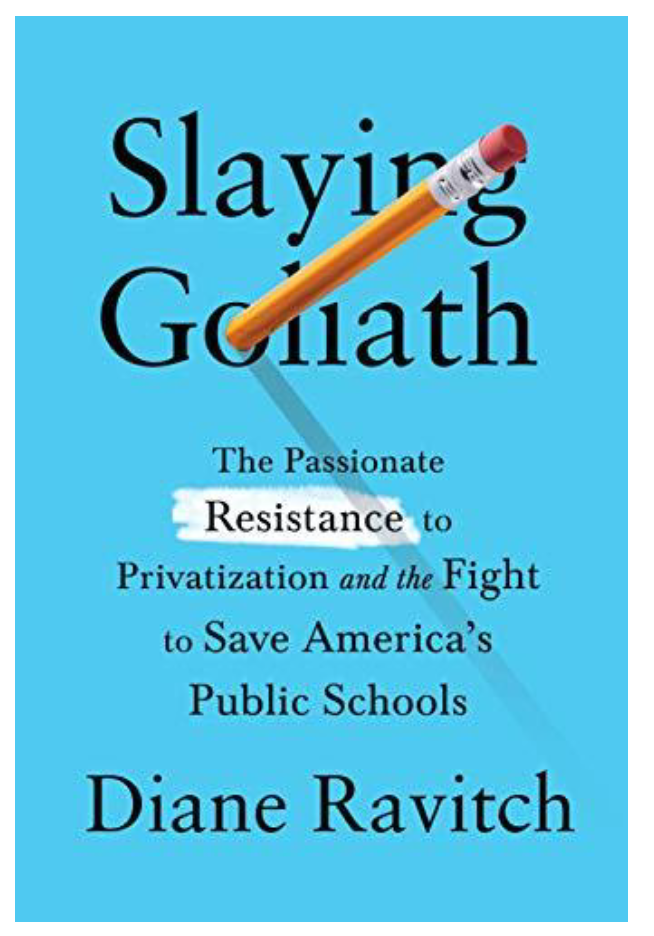
I am almost four years late in discovering this review by two scholars for whom I have the greatest respect: David C. Berliner and Gene V. Glass.

I was happy to read this review because Slaying Goliath had a checkered fate. It was published in mid-January 2020. I went on a book tour, starting in Seattle. By mid-February, I made my last stop in West Virginia, where I met with teachers and celebrated the two-year anniversary of their strike, which shut down every school in the state.

As I traveled, news emerged of a dangerous “flu” that was rapidly spreading. It was COVID; by mid-March, the country was shutting down. No one wanted to read about the fight to save public schools or about its heroes. The news shifted, as it should have, to the panicked response to COVID, to the deaths of good people, to the overwhelmed hospitals and their overworked staff.

To make matters worse, the New York Times Book Review published a very negative review by someone who admired the “education reform” movement that I criticized. I thought of writing a letter to the editor but quickly dropped the idea. I wrote and rewrote my response to the review in my head, but not on paper.

Then, again by happenstance, I discovered that Bob Shepherd had reviewed the review of my book in The New York Times. He said everything that I wish I could have said but didn’t. His review was balm for my soul. Shepherd lacerated the tone and substance of the review, calling it an “uniformed, vituperative, shallow, amateurish ‘review.’” Which it was. His review of the review was so powerful that I will post it next.

Then, a few weeks ago, I found this review by Berliner and Glass.

The review begins:

Reviewed by Gene V Glass and David C. Berliner Arizona State University, United States

They wrote:

In a Post-Truth era, one must consider the source. 

In this case, the source is Diane Rose Silvers, the third of eight children of Walter Silverstein, a high school drop-out, and Ann Katz, a high school graduate. The Silvers were a middle-class Houston family, proprietors of a liquor store, and loyal supporters of FDR.

After graduation from San Jacinto High School, she enrolled in Wellesley College in September, 1956. Working as a “copy boy”for the Washington Post, Diane met Richard Ravitch, a lawyer working in the federal government and son of a prominent New York City family. They married on June 26,1960, in Houston, two weeks after Diane’s graduation from Wellesley. The couple settled in New York City, where Richard took employment in the family construction business. He eventually served as head of the Metropolitan Transit Authority and Lieutenant Governor in the 2000s, having been appointed by Democratic Governor David Paterson.

 Diane bore three sons, two of whom survived to adulthood. Diane and Richard ended their 26-year marriage in 1986. She had not been idle. For a period starting in 1961, Diane was employed by The New Leader, a liberal, anti-communist journal. She later earned a PhD in history of education from Columbia in 1975 under the mentorship of Lawrence Cremin.

Diane was appointed to the office of Assistant Secretary of Education, in the Department of Education by George H. W. Bush and later by Bill Clinton. In 1997, Clinton appointed her to the National Assessment Governing Board (NAGB), on which she served until 2004. 

Ravitch worked “… for many years in some of the nation’s leading conservative think tanks.

Read the full pdf here.

During the past few decades, we have seen the persistence of failed policies in education. Most of them were codified by No Child Left Behind and Race to the Top: give standardized tests; punish teachers and schools where scores are low or do not rise; reward teachers and schools where scores go up. Pay bonuses to teachers if their students’ scores go up. Tie teacher pay to student scores. Close schools with low scores. Turn low-scoring schools over to private management. Give vouchers to parents to send their children wherever they want.

All of these remedies failed. They encouraged cheating and gaming the system. They encouraged educators to avoid schools that enrolled the neediest students. They demoralized teachers who were idealistic and wanted to teach the joy of learning. Test prep became far more important than intellectual curiosity.

All of these are zombie policies. No matter how consistently they fail, policymakers won’t let go of them.

Merit pay is a policy that has been tried since the 1920s. It has never accomplished anything. I summarized the research on merit pay in my last three books: The Death and Life of the great American School System; Reign of Error; and Slaying Goliath. The research is overwhelming: merit pay doesn’t improve education and doesn’t even raise test scores. Yet in true zombie style, it never dies. It should.

John Thompson writes here about the revival of the merit pay zombie in Oklahoma:

As the “mass exodus” of teachers from Oklahoma schools continues, the legislature has rejected an across-the-board pay raise for teachers. Instead, several legislators are searching for a fix for the state’s “flawed” bonus system. If that doesn’t work, maybe Walters’ use of public money to spread his attacks on “on the radical left” will bring educators back to Oklahoma …

Seriously, Walters’ push for his vision of incentive pay prompted some education advocates to ask me to research performance pay. I sure appreciated the oportunity to reread new and older research on the subject.

Twenty-five years ago, I opposed performance pay because there were better ways to improve teacher quality. But I didn’t have major concerns; although its likely benefits would be small, I thought its downsides shouldn’t be a big deal. However, starting with No Child Left Behind and taking off with Race to the Top, test scores were weaponized, and the dangers of performance pay grew dramatically. Output-driven teachers’ salaries, joined at the hip with unreliable and invalid accountability metrics, promoted educational malpractice that undermined meaningful teaching and learning, increasing in-one-ear-out-the-other, worksheet-driven instruction. Teamwork was damaged, trust was compromised, the flight of educators from classroom increased, and the joy of student learning declined significantly.

During that time, I communicated frequently with data-driven analysts working for think tanks, who almost never had experience in urban schools. Their job was to provide evidence that performance pay, and other incentives and punishments, can work. They ignored educators and social scientists who tackled the real policy question – how will those experiments work? 

Sometimes, merit pay produced modest test score gains, but there was no way of determining whether those test scores revealed an increase or a drop in meaningful learning. Neither did they address the overall learning losses due to teachers being pressured to focus on metrics, as opposed to children. In 2012, a Rand study concluded, “most studies have found no effects on student outcomes.” By 2015, the U.S. Department of Education found that large incentives, such as $15,000 per teacher, may attract talent, but:

In addition to creating an environment that lends itself to narrowed pedagogical approaches and teaching to tests (and even cheating on them), this article suggests that merit pay schemes that require teachers to compete with one another may likely undermine positive collaboration.

Around the time of the 2018 Oklahoma teacher walk-out for higher pay, Denver threatened a strike to get rid of performance pay. Chalkbeat explained the complexity of balancing for larger or smaller payments to teachers in diverse classrooms. It went into depth answering the question, “How did a pay system that once seemed to hold so much promise bring teachers to their breaking point?”  The concise conclusion was, “lack of trust.”

Education Week studied the minimal effects of performance pay in Tennessee and Texas, which implemented expensive reward-and-punish, and often short-lived programs. The negative effects of the Houston plan, which State Superintendent Ryan Walters seems to support, are especially relevant for Oklahoma. The Houston teachers’ union president explained, “Performance pay demeans students and undermines teachers, so if the focus is on pay for performance, you’re incentivizing the test-and-punishment model.” Similarly, Education Week cited comprehensive studies that concluded that the relatively more effective programs “avoided an overemphasis on test scores.” But even many or most of the more successful programs were unlikely to survive.

Finally Education Week reported how the $200 million Bill and Melinda Gates Foundation merit pay experiments “did little to boost retention of high-performing teachers,” and it “had little effect on student achievement.”

At the peak of merit pay mandates, and now, Bixby Superintendent Rob Miller explained, “Teacher merit pay is one of the more persistent and seemingly indestructible zombie ideas related to education.” Miller said, “Merit pay for teachers has been tried again and again since the 1920s.” He cited cognitive and social science that explained why performance pay experiments were doomed to fail, as well as numerous evaluations of how it failed in the 21st century.  Miller now asks, “Is it fair to place the primary responsibility on teachers and schools for outcomes strongly affected by factors outside their control?” and answers, “Doing so damages school culture and teacher morale and obstructs meaningful dialogue about school improvement.”

At a time when Ryan Walters is threatening to put the worst of the failed policies of the last twenty years on steroids, I was struck by a recent column by Thomas Dee, a fervent believer in output-driven accountability. Even though he seems to think that teachers were to blame, Dee also seems to acknowledge that performance pay had disappointing results. Now he recommends:

It may be possible to achieve durable political support for a teacher evaluation system if that system focuses narrowly on identifying master teachers and providing them with training and extra pay to coach their peers but takes a more incremental approach toward dismissing underperforming teachers.

Dee’s latest almost brings me back to 25 years ago, before NCLB, when the schools I knew were improving, and a win-win approach to performance pay didn’t seem so problematic. At the urging of the union, the Oklahoma City Public School System briefly implemented the Toledo peer review plan, which included a fair and efficient plan for removing ineffective teachers. The best evidence is that the plan was a reliable method for improving classroom instruction. But, it and so many other promising programs were undercut by corporate school reform.

Maybe I’ll once again be open to a compromise involving constructively built, non-punitive merit pay incentives, once the destructive school cultures advanced by corporate school “reform” have disappeared. But, I won’t hold my breath.