Mike Simpson, known on Twitter as “Big Education Ape,” is known for his brilliant memes and editorial cartoons. Typically, they expose the latest fads and lies that defame teachers and public schools. Every once in a while, he publishes a great post, like this one.
I’M SHOCKED, SHOCKED — HOW 30 YEARS OF BILLIONAIRE-FUNDED “REFORM” MANUFACTURED THE EDUCATION CRISIS IT PROMISED TO FIX
There’s a famous scene in Casablanca where Captain Renault declares he is “shocked, shocked” to find gambling going on — right before a croupier hands him his winnings. That’s essentially the posture of the billionaire reform industrial complex today, clutching its pearls over a Gallup poll showing public satisfaction with American schools has cratered to 32% — an 11-point nosedive in just two years — while quietly pocketing the profits of the crisis they spent three decades engineering.
Shocked. Absolutely shocked.
The Architecture of a Manufactured Crisis
Let’s be precise about the timeline, because precision matters when someone is picking your pocket.
For roughly 30 years, a well-funded constellation of think tanks, philanthropic foundations, hedge fund managers, and tech oligarchs pumped billions of dollars into a single, relentless narrative: public schools are failing. Not “underfunded.” Not “systematically neglected.” Failing — as in, inherently broken, irredeemably incompetent, populated by bad teachers protected by evil unions, and salvageable only by the heroic intervention of the private market.
The messaging was surgical. The money was real. And — surprise! — it worked.
Starve public schools of adequate funding. Declare them “failing.” Ride in on a white charter bus to “rescue” the children.
The chronic underfunding wasn’t fiscal negligence. In many states, it was a feature, not a bug. Squeeze hard enough, the theory went, and disruption would force innovation. What it actually forced was deferred maintenance, teacher shortages, and a generation of kids learning to read in buildings where the roof leaks and the textbooks predate the iPhone.
Now the poll numbers confirm the narrative took hold — and the reformers are citing those same poll numbers as proof they were right all along. The audacity is, genuinely, breathtaking.
The Numbers That Tell Two Very Different Stories
Here’s what the data actually shows — and what it doesn’t show:
Metric: The Headline. What It Actually Means Gallup Public Satisfaction 32% — record low 30 years of “failing schools” messaging worked exactly as intended.
Parent Satisfaction with Their Own School Historically ~2x the national figure People trust what they experience; they fear what they’re told
Math & Reading Scores Declining, especially bottom quartile Tracks directly with funding inequity and screen-time explosion
Top-tier U.S. Student Performance Still globally competitive. The “crisis” is concentrated where disinvestment is concentrated
The gap between how Americans rate schools in general versus their own child’s school is the smoking gun. It has always been the smoking gun. People who actually walk into a public school building — who meet the teachers, see the classrooms, watch their kids come home — consistently rate those schools dramatically higher than the national “failing” narrative suggests.
That gap is the manufactured crisis. It lives entirely in the space between lived experience and media-amplified fear.
$1.8 Billion Worth of Snake Oil, Served Fresh
And just when you thought the reform carousel might slow down, along comes the Science of Reading — the latest Next Big Thing™ in a long line of Next Big Things™ that have collectively cost American taxpayers tens of billions of dollars and produced reading scores that went, as the Big Education Ape’s withering analysis puts it, precisely nowhere.
Remember Common Core? $15.8 billion. A decade of standardized testing theater. Reading scores: unmoved.
Now we have the Science of Reading, $1.8 billion deep and climbing, with the same cast of vendors, the same philanthropic networks, and the same conspicuous absence of a money-back guarantee.
To be scrupulously fair: phonics works. Explicit decoding instruction works. The underlying research on structured literacy is legitimate. But here’s the thing about legitimate research — it doesn’t require a $1.8 billion vendor ecosystem, mandatory state legislation in 40+ states, and the systematic deskilling of teachers who are told to stop thinking and start following the script. When real science gets packaged into proprietary curricula, sold to districts under legislative mandate, and deployed without the trained human educators needed to implement it well, you don’t get science. You get very expensive phonics worksheets.
The question nobody in the reform complex wants to answer remains the same one it’s always been: Where is the money-back guarantee?
The Other Hand: How Tech Bros Broke Kids’ Brains While Selling the Cure
Here is the part of the story that deserves its own criminal investigation — or at minimum, a very uncomfortable congressional hearing.
The same Silicon Valley billionaires who spent decades pushing EdTech into classrooms as the revolutionary equalizer — screens for every student! –are the identical billionaires whose social media platforms have:
Collapsed long-form reading among adolescents at a rate researchers describe as one of the steepest drops in PISA history
Engineered algorithmic doom-scrolling that neurologically rewires 15-year-olds away from the sustained attention that math and reading comprehension require
Distracted over a quarter of students internationally during core academic instruction, by their own PISA survey data
They sold the disease and the cure. They pushed the screens that fragmented attention spans, then sold the adaptive software to remediate the fragmented attention spans, then pointed at the test scores and said: See? Public schools are failing.
None of this is inevitable. None of this is permanent. The No Kings Coalition — the sprawling, nonpartisan civic movement that flooded the streets in March — is now flooding the polls, with a Vote Early Day of Action on October 17 aimed squarely at the November 3, 2026 midterms.
The math is straightforward, even if the billionaires prefer we can’t do it:
Elect candidates who will defend public education funding, not divert it into voucher schemes that enrich private operators at public expense
Overturn the Supreme Court rulings — from Citizens United forward — that transformed American democracy into a billionaire auction
Restore the principle that public money follows public children into public schools, not into the portfolios of private equity firms with a “reform” logo.
The manufactured crisis has a manufactured solution: more billionaire intervention, more privatization, more EdTech, more testing, more disruption. The actual solution is considerably less glamorous and considerably more effective — fund schools equitably, pay teachers competitively, put phones away, and stop letting people who profit from public school failure write public school policy.
The Bottom Line
The 32% satisfaction number is not evidence that public schools have failed. It is evidence that a 30-year, billion-dollar propaganda campaign succeeded. The same people who manufactured the crisis are now selling the cure — at $1.8 billion a pop, no refunds, no guarantees, no accountability.
Meanwhile, the teachers who showed up every day through a pandemic, through chronic underfunding, through a staffing crisis, through the algorithmic dismantling of their students’ attention spans — those people are still in the classroom at 7 AM, doing the work that no EdTech platform, no voucher program, and no think tank white paper has ever actually replaced.
The casino is rigged. Captain Renault is shocked. And the November ballot is the one lever the house can’t control.
Vote like a public school depends on it. Because one does.
All links verified active as of September 9, 2026. Primary polling data sourced from Gallup/Walton Family Foundation. PISA data sourced from NCES/OECD 2025 release.
Mike Simpson posts amazing memes on Twitter and BlueSky. He calls himself “Big Education Ape.” He makes the point with his illustrations.
Here is one of his best: THE GHOST OF ELI BROAD: TWENTY-FIVE YEARS OF VULTURE PHILANTHROPY AND THE ONGOING DESTRUCTION OF AMERICAN PUBLIC EDUCATION.
I wasn’t able to copy some tables and graphics. Please open the link to read the post in full.
Eli Broad was one of the billionaires who was eager to tear apart public education and remake it. I referred to him, the Waltons, and the Gates Foundation as “the Billionaires Boys Club,” which was chapter 10 of my book The Death and Life of the Great American School System: How Testing and Choice Are Undermining Education.
Eli Broad’s distinctive contribution to the corporate reform movement was his Broad Academy, where aspiring superintendents were “trained” with his ideas. All expenses were paid, and trainees got to hobnob with others. They also had the Academy’s help in job placement; many “graduates” of the Broad Academy were placed as superintendents in big-city districts, imbued with the ideology that schooling was a business, that low-performing schools should be closed and replaced by charter schools. Eli and his wife Edythe were both graduates of the Detroit Public Schools, but they were not grateful for what they learned.
In 2009, when I was writing the book, I was not aware that the Billionaire Boys Club had many more members and that some were women. There was Alice Walton, Betsy DeVos, the Koch brothers, John Arnold, Joel Greenberg, Daniel Loeb, Jeff Yass, and many more. I posted a far longer list of the super-rich underwriting the privatization of public money in my book Slaying Goliath.
I once was invited by Eli Broad to meet at his gorgeous apartment in New York City, overlooking Central Park. He wanted to know why I was critical of his efforts. He told me that he knew nothing about teaching or curriculum, but he knew a lot about business management and organization. His belief was that public schools could improve by better management.
Mike Simpson performs a public service here by updating the legacy of Eli Broad.
He writes:
How a billionaire’s “vision” became a scandal-soaked legacy — and why it refuses to die, now dressed in Yale’s ivy
There’s a particular kind of audacity required to spend a quarter-century systematically dismantling public education, leave a trail of federal indictments, billion-dollar procurement disasters, and devastated communities in your wake — and then get your name engraved on a building at Yale University. That, in essence, is the story of Eli Broad, the Broad Academy, and its reincarnation as The Broad Center at Yale School of Management. If you were hoping the death of Eli Broad in 2021 would finally close this chapter of American education history, well — ghosts don’t follow rules. And this one has a $100 million endowment.
Part I: Venture Philanthropy — When Billionaires Play School
Let’s start with the concept that makes all of this possible: “venture philanthropy.” It sounds benign — even noble. In practice, it means a billionaire who made his fortune in housing construction (KB Home) and insurance (SunAmerica) decided he understood public education better than educators, parents, communities, or — heaven forbid — children.
Eli Broad’s core thesis, launched formally in 2002 with the Broad Superintendents Academy (BSA), was elegantly simple and catastrophically wrong: public school systems are just badly managed corporations, and what they need is corporate managers.
Not teachers. Not child psychologists. Not community leaders. Corporate managers. Preferably ones with MBAs, military command experience, or backgrounds in supply-chain logistics. Because nothing says “I understand the developmental needs of a seven-year-old” quite like a background in restructuring defense procurement contracts.
The curriculum reflected this philosophy with almost comedic precision:
10% — Actual education: pedagogy, curriculum, child development
90% — Corporate operational reform: fiscal optimization, data-driven accountability, labor relations, and what the Academy euphemistically called “reform accelerators” — which, translated from the original MBA-speak, meant privatization strategies
The program was free to participants — tuition, travel, lodging, all covered. Because when you’re deploying an ideological army, you don’t charge the soldiers.
Part II: Yale Said “Yes” — And Charged It to Prestige
In 2019, the Eli and Edythe Broad Foundation committed $100 million to Yale University to transform the independent, unaccredited Los Angeles operation into The Broad Center at Yale School of Management. The transition was completed in 2020, and the unaccredited LA entity was quietly sunsetted — like a getaway car abandoned after the heist.
The rebranding was masterful. Suddenly, the same ideological pipeline that had produced federal convicts, FBI raid subjects, and a generation of “disruptors” who disrupted primarily the educational lives of low-income children of color was now operating under the imprimatur of one of the world’s most prestigious universities.
The center today operates two flagship tracks, both tuition-free:
The 2026–27 MMS cohort is already being assembled, per the center’s own Instagram, described as “leaders committed to reimagining” public education — which, given the network’s history, should be read as a threat as much as a promise.
Beyond the programs themselves, the center has launched an aggressive data aggregation initiative — a centralized repository hosted on GitHub tracking superintendents across more than 10,000 of the nation’s 13,000 public school districts, aggregating over 180,000 data points across 23 states. The stated goal is academic research. The unstated goal, critics argue, is mapping the vacancy pipeline for the next generation of Broad placements.
Part III: The Damage Ledger — Twenty-Five Years of “Disruption”
Let’s be precise about what the word “disruption” meant in practice. A landmark 2022 longitudinal study published in Educational Evaluation and Policy Analysis tracked two full decades of Broad Academy graduates and delivered findings that would be devastating — if anyone in the venture philanthropy world were capable of embarrassment:
No statistically significant positive effects on district spending, student completion rates, or test scores
Broad-trained superintendents had 18% shorter tenures than non-Broad peers in equivalent districts
The only statistically significant footprint left behind? A sustained, measurable trend toward increased charter school enrollment and sector privatization
In other words, after 25 years and hundreds of millions of philanthropic dollars, the Broad Academy’s measurable legacy in public education was: more charter schools and shorter superintendent tenures. That’s it. That’s the product.
The Human Cost
The abstract numbers become concrete when you look at specific communities:
Oakland & Detroit saw aggressive charter expansion and centralized fiscal management that critics argued deepened structural deficits and fractured community trust for generations.
Chicago experienced the largest single wave of school closures in modern U.S. history — 50 neighborhood schools shuttered in 2013 under Broad-network-affiliated Barbara Byrd-Bennett — triggering federal civil rights complaints alleging the closures disproportionately harmed low-income students of color.
Seattle watched Broad graduate Maria Goodloe-Johnson (BSA Class of 2003) get fired in 2011 following a state audit revealing $1.8 million in public funds funneled into a contracting program that provided little to no actual services — with investigators concluding she exercised a “severe lack of oversight” despite early warnings.
Part IV: The Scandal Hall of Fame — From Procurement Fraud to Federal Prison
Here is where the story transitions from ideologically troubling to criminally spectacular.
John Deasy — The iPad That Broke LAUSD
Deasy (BSA Class of 2006) championed a $1.3 billion initiative to put Apple iPads loaded with Pearson software into the hands of every LAUSD student. The rollout failed within days — students bypassed security filters almost immediately — but the procurement scandal was far worse than the technical failure.
Internal records revealed that Deasy and his deputies had close personal and professional ties to Apple and Pearson executives prior to the bidding process, raising serious allegations of a rigged procurement cycle. The FBI seized boxes of district records. Deasy resigned in 2014. The district eventually abandoned the program and settled for millions in refunds.
His post-resignation career? He was immediately hired by the Broad Center as a Superintendent-in-Residence — coaching the next generation of urban leaders. Because in this ecosystem, failure is a credential.
Barbara Byrd-Bennett — The Federal Prison Graduate
Byrd-Bennett’s career arc is the Broad model in miniature: leave Cleveland in fiscal distress, leave Detroit in structural chaos, get hired as a “turnaround expert” in Chicago, execute the largest school closure wave in American history, then get indicted on 20 counts of federal mail and wire fraud.
Federal investigators proved she steered $23 million in no-bid contracts to SUPES Academy and Synesi Associates — the very consulting firms she had worked for immediately before taking the CPS helm. Internal emails laid bare her motive with a candor that would be almost admirable if it weren’t so brazen: she needed the money because she had “tuitions to pay and casinos to visit.”
In exchange, she was promised a 10% kickback disguised as future consulting fees funneled into trust funds for her twin grandsons. She pleaded guilty and was sentenced to four and a half years in federal prison.
Robert Runcie — The Perjury Arrest
Runcie (BSA Class of 2009) took over Broward County Public Schools — the nation’s sixth-largest district — and oversaw a culture of severe administrative bid-rigging around an $800 million capital bond program, with independent investigations revealing contracts steered to pre-selected corporate entities.
Following the 2018 Parkland school shooting, which exposed deep systemic lapses in district safety infrastructure, a statewide grand jury investigation led to Runcie’s arrest by the Florida Department of Law Enforcement on felony perjury charges in April 2021 — prosecutors proving he lied under oath about communications regarding procurement contracts.
He resigned in exchange for a $743,000 separation agreement. Paid by taxpayers.
Alberto Carvalho — The AI Echo of the iPad Disaster
If the Deasy iPad scandal was the defining Broad-era procurement catastrophe of the 2010s, Alberto Carvalho’s LAUSD tenure became its 2020s technological sequel — almost as if the universe decided one billion-dollar tech procurement disaster per decade wasn’t sufficient.
Carvalho, a celebrated figure on the corporate-reform speaking circuit who regularly headlined Broad Center leadership panels, aggressively championed a contract with “AllHere,” a tech startup contracted to build a multi-million dollar AI student-chatbot tool for LAUSD. The project collapsed into total insolvency. The startup’s founder was indicted for fraud. Federal investigators traced systemic steering of contracts that bypassed traditional public bidding protections.
In early 2026, FBI agents raided Carvalho’s personal residence and district offices. He was placed on paid administrative leave and subsequently resigned — a modern, tech-era echo of the Deasy iPad scandal, separated by exactly one decade and approximately zero lessons learned.
Part V: The Carousel — How Failed Superintendents Get Recycled
One of the most structurally revealing features of the Broad model is what happens after a superintendent fails. In a normal accountability framework, catastrophic failure — federal indictment, FBI raids, mass community protests, historic labor strikes — would end careers.
In the Broad ecosystem, it typically accelerates them.
The recycling mechanism operates in three predictable stages:
Stage 1 — The Soft Landing: Departing executives are caught by the philanthropic safety net. Foundations like Broad, Walton, or Gates place them into well-funded “fellow,” “executive coach,” or “senior advisor” roles at charter management organizations or policy think tanks. The local political dust settles. The national network maintains their status.
Stage 2 — The Headhunter Buffer: National executive search firms — operating with screening frameworks that prioritize corporate operational metrics over community approval or longevity — present the executive to a new school board in another state as a “courageous, battle-tested change agent.” The fact that the “battle” was largely against the parents and teachers of the previous district is presented as a résumé enhancement.
Stage 3 — The Next Major District: Re-hired at a higher salary, with stronger contractual protections, and a golden parachute clause ensuring that the next failure will also be financially comfortable.
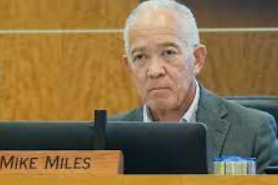
Mike Miles left Dallas ISD under multiple internal investigations and extreme executive turnover, founded a charter network, and was then directly appointed by the Texas Education Agency — which had dissolved Houston ISD’s elected school board — to run the entire Houston district with even fewer democratic constraints than before.
Jean-Claude Brizard left Rochester under a 95% teacher vote of no confidence, was immediately recruited to lead Chicago Public Schools (the nation’s third-largest system), triggered the historic 2012 Chicago Teachers Strike within 17 months, was pushed out with a $250,000 buyout, and transitioned smoothly into senior advisory roles at national education foundations.
The pattern is not a bug. It is the feature.
Part VI: Buying the Boardroom — How Venture Philanthropy Captured School Governance
The Broad playbook cannot function under genuine democratic oversight. A superintendent who closes 50 neighborhood schools, eliminates teacher tenure protections, and converts public schools into privately managed charter networks will be fired by an elected school board that answers to the community — unless that school board has been pre-selected to not do that.
The solution was elegant and corrosive: buy the school board elections.
Because local school board races historically required minimal campaign capital, the injection of billionaire wealth fundamentally altered the political landscape. The money flows not directly to candidates (which faces statutory limits) but through Independent Expenditure Committees and Super PACs — allowing unlimited spending on sophisticated polling, negative television ads, and targeted digital saturation.
In Los Angeles, Eli Broad, the Walton family, and allied donors regularly poured $5 million to $10 million per election cycle into LAUSD board races — specifically to achieve a “pro-reform majority” that would protect executives like John Deasy and later Austin Beutner (a former investment banker with no education background whatsoever) from community accountability.
In Oakland, independent groups funded by the California Charter Schools Association outspent local parent-teacher associations 10-to-1, successfully seating board members who routinely approved charter petitions and fiscal consolidation plans drafted by Broad Residency staff embedded in the central office.
When even this proved insufficient — when local civic resistance made winning democratic elections too expensive or unpredictable — the network pivoted to eliminating the elections entirely:
Chicago: Mayoral control legislation allowed Mayor Rahm Emanuel to single-handedly install Broad executives without board confirmation.
Houston: The Texas Education Agency dissolved the elected school board entirely and replaced it with a state-appointed body, allowing direct installation of Mike Miles.
Detroit: The short-lived Education Achievement Authority bypassed the traditional school board to implement a centralized, non-unionized reform experiment under Broad graduate John Covington.
The structural message is unambiguous: the corporate management model and democratic accountability are incompatible. When democracy gets in the way, the solution is to remove democracy.
Part VII: The Network Map — 1,000 Alumni and Counting
The Broad Network now comprises more than 1,000 alumni spanning major urban school districts, charter management organizations, state education agencies, and venture philanthropy foundations — with its heaviest concentrations precisely where the playbook finds the most fertile ground:
California remains the densest hub, with alumni embedded throughout LAUSD, Oakland Unified, and San Diego Unified central offices, as well as major CMOs like KIPP SoCal, Aspire Public Schools, and Green Dot.
Texas has become the fastest-growing hub, with Houston ISD under state-appointed Miles serving as the current flagship experiment, alongside significant placement within Dallas ISD, Fort Worth ISD, the Texas Education Agency, and massive charter entities like KIPP Texas and IDEA Public Schools.
New York serves as the “soft landing” capital of the network — hundreds of alumni operating within Wall Street-adjacent education foundations, charter advocacy groups, and elite national search firms headquartered in Manhattan.
Illinois and Pennsylvania — Chicago and Philadelphia specifically — remain high-density environments where teams of Broad Residents are embedded in central operations managing financial stabilization, facilities restructuring, and school assignment data systems.
Meanwhile, the network has largely migrated out of direct superintendencies — where the political friction is high and the tenure is short — and into the broader ecosystem where influence is durable and accountability is minimal: senior director roles at the Gates Foundation, the Walton Family Foundation, and the Chan Zuckerberg Initiative; high-level education consultancies like Watershed Advisors and Instruction Partners; and, of course, The Broad Center at Yale SOM itself, where the current MMS cohort is being trained to carry the philosophy forward.
Part VIII: Yale — Laundering a Legacy in Ivy
Let us be direct about what the Yale partnership accomplishes that the standalone Los Angeles operation never could: institutional legitimacy laundering.
The Broad Academy, operating independently, was unaccredited, ideologically transparent, and easy to critique. Its graduates were called “Broadies” — a term used by both allies and critics — and the pipeline was visible enough that parent groups, teachers’ unions, and education researchers could track, document, and organize against it.
The Broad Center at Yale SOM is something different. It is now embedded within one of the world’s most prestigious academic institutions, granting an Ivy League master’s degree, hosting fellows in New Haven, and publishing peer-reviewed research. The same corporate management philosophy that produced federal convictions and FBI raids now arrives in urban school districts wearing a Yale credential.
The center’s new data aggregation initiative — tracking superintendents across more than 10,000 districts, aggregating 180,000+ data points — is framed as academic research. Critics see it as something more operational: a comprehensive national vacancy map for the next generation of Broad placements, now with the algorithmic sophistication that the original Los Angeles operation could only dream of.
The 2025-26 Fellowship cohort of 17 fellows is already gathering in New Haven for weeklong modules at Yale SOM. The 2026-27 MMS cohort is being assembled. The pipeline flows.
The Synthesis: What Twenty-Five Years Actually Taught Us
Here is what a quarter-century of Broad-style education reform has empirically demonstrated:
The Promise: The Reality
Corporate management improves district outcomes/No measurable positive effect on test scores, graduation rates, or spending efficiency”
Disruptors” bring needed change/18% shorter tenures; accelerated community fracture
Charter expansion improves options/Statistically significant increase in privatization; no demonstrated academic gains
Data-driven accountability improves teaching/Curriculum narrowing; teaching to the test
Free consulting support helps districts/Permanent embedding of private ideology on public payroll
School board reform improves governance/Systematic dismantling of democratic accountability
The most damning verdict is not the federal indictments — though those are damning. It is not the FBI raids — though those are spectacular. It is not even the $23 million in no-bid kickback contracts or the billion-dollar iPad disasters.
It is this: after 25 years, hundreds of millions in philanthropic investment, and the placement of Broad-trained executives in over 160 school systems, there is no credible empirical evidence that any of it helped a single child learn to read better.
What it did produce — measurably, statistically, reproducibly — was more charter schools, shorter superintendent tenures, and a revolving door of well-compensated executives cycling between urban districts, consulting firms, and Ivy League fellowship programs while the communities they “disrupted” rebuilt themselves from the wreckage.
Epilogue: The Ghost That Won’t Be Exorcised
Eli Broad died in April 2021. His foundation subsequently announced it would spend down its assets and close. The Los Angeles operation was already gone, folded into Yale two years prior.
And yet — the ghost persists. It persists in the 2026-27 MMS cohort assembling in New Haven. It persists in the 180,000 data points tracking superintendent vacancies across 10,000 districts. It persists in the career of Mike Miles, currently running Houston ISD under state protection from democratic accountability. It persists in the aftermath of Alberto Carvalho’s FBI-raided departure from LAUSD — a scandal so structurally identical to the Deasy iPad disaster of 2014 that it reads less like history repeating and more like history plagiarizing itself.
The Broad Center at Yale SOM is not a reformed version of the Broad Academy. It is the Broad Academy with better branding, an Ivy League address, and a GitHub repository. The philosophy is identical. The network is intact. The pipeline flows.
The only thing that has genuinely changed is the zip code — from Los Angeles to New Haven — and the price tag of the credential being handed to the next generation of disruptors preparing to be deployed into the public schools of America.
Eli Broad may be gone. But his ghost has tenure.
And unlike the superintendents he trained, it shows no signs of an early exit.
Sources:
: The Broad Center institutional history, curriculum breakdowns, alumni scandal documentation, EEPA 2022 longitudinal study findings, and school board funding mechanics — as documented in comprehensive public education policy research and investigative reporting compiled in the source brief above.
: EdSource — “FBI raid of Los Angeles Superintendent Carvalho’s home, office may be linked to student AI chatbot” (2026) — edsource.org
: Los Angeles Times — “How probe into failed startup led to LAUSD superintendent investigation” (March 1, 2026) — latimes.com
: Yale School of Management — “The Broad Center Announces 2025-26 Cohort of the Fellowship for Public Education Leadership” — som.yale.edu
Master Source List: The Ghost of Eli Broad & The Broad Center at Yale
🏛️ The Broad Center at Yale SOM — Official Sources
$CITETitleSourceLinkThe Case of Broad Superintendents— Full EEPA Longitudinal Study (2022) Educational Evaluation and Policy Analysis / Tom Dee tom-dee.github.io — EEPA-Broad.pdf New Study: Broad Supes Made No Difference, Other Than Increasing Charter Schools Diane Ravitch’s Blogdianeravitch.net
🗞️ Investigative Journalism & Policy Criticism
$CITETitleSourceLink Critics Target Growing Army of Broad Leaders Education Week edweek.org The Broad Foundation’s Impact on Public Schools Facebook — Oakland Parent Sharon Higgins Analysis facebook.com — Broad Foundation Analysis
⚖️ Barbara Byrd-Bennett — Federal Conviction (Chicago)
$CITETitleSourceLink Former Chief Executive of Chicago Public Schools Sentenced to More Than Four Years in Prison U.S. Department of Justice — Official Press Release justice.govBarbara Byrd-Bennett — Full Coverage Archive WTTW Chicago Public Media news.wttw.com Barbara Byrd-Bennett — Wikipedia Overview Wikipediaen.wikipedia.org
⚖️ Robert Runcie — Broward County Perjury Arrest
$CITETitleSourceLinkFDLE Arrests Broward County Schools Superintendent Robert Runcie for Perjury Florida Department of Law Enforcement — Official Release fdle.state.fl.us Former Broward Superintendent Robert Runcie Avoids Trial — Perjury Charge Dropped CBS News Miami cbsnews.com/miami State Drops Perjury Charge Against Former Broward Schools Superintendent Miami Herald miamiherald.comPerjury Charge Dropped Against Ex-Broward Schools Superintendent NBC Miami nbcmiami.com
🤖 Alberto Carvalho — LAUSD FBI Raid & AllHere AI Scandal
$CITETitleSourceLinkFBI Raid of Los Angeles Superintendent Carvalho’s Home and Office May Be Linked to Student AI ChatbotEdSource edsource.org How Probe Into Failed Startup Led to LAUSD Superintendent Investigation Los Angeles Times latimes.com
📌 Quick Citation Reference Guide
For the article sections, citations map as follows:
Broad Center Yale programs → , , ,
EEPA 2022 empirical study → ,
General Broad criticism & history → ,
Byrd-Bennett federal conviction → , ,
Runcie perjury arrest → , , ,
Carvalho FBI raid / AllHere AI → ,
⚠️ Research Note: Several additional primary sources — including the original EEPA journal publication, the Jeffrey Hubbard California Supreme Court ruling, the Maria Goodloe-Johnson state audit, and the Jean-Claude Brizard Chicago strike documentation — are recommended for deeper verification. Additional searches can be run to surface those specific primary documents on request.
John Thompson, historians and retired teacher, keeps us informed about the news from Oklahoma. In this post, he looks at the blame game surrounding the Tulsa public schools.
He writes:
As the Tulsa World recently explained, State Auditor Cindy Byrd issued a “scathing new forensic audit of Tulsa Public Schools” which “laid the blame on the administration of former Superintendent Deborah Gist, who served as Tulsa superintendent for the audited time of 2015-2023.” Byrd “also said multiple school district administrators ‘created and fostered a culture’ of noncompliance and systemic lack of internal controls that ‘potentially placed millions of taxpayer dollars in jeopardy.’”
I’m not qualified to comment on the financial side of the audit, but I strongly agree with the World that Byrd has an impeccable record as a financial auditor.
And as I completed this post, another impeccable institution, The Frontier, discovered, “Deborah Gist and her deputies were quietly arranging an exit plan for the official behind it (Fletcher) — and using secret payments to a private consultant to manage the transition, according to internal district records obtained by The Frontier.” It further explained:
The newly obtained documents — including auditors’ notes and memos, internal district emails, and procurement records — shed new light on these gaps. They show that Gist and her deputies began planning Fletcher’s departure as early as December 2021, more than six months before the district reported his scheme to the police.
Moreover:
Gist and former assistant superintendent Paula Shannon hired a New York-based human resources consultant, Talia Shaull, to manage Fletcher’s exit, paying her $175 per hour through the Foundation for Tulsa Schools, emails and contracts show. According to the documents, the arrangement to pay her directly through the foundation was designed “to avoid Board approval, keeping the project confidential” and violated district procurement policy.
Getting back to the history I witnessed, in 2019, a comment by a Tulsa teacher was posted on the Diane Ravitch blog with the title of Tulsa: Broadie Swarm Alert. It began with the teacher’s statement, “Welcome to my Hell in Tulsa.” The introduction explained that a Broadie “is someone ‘trained’ in the top-down management philosophy of Eli Broad at the unaccredited Broad Superintendents Academy. They are known for setting high goals and meeting none of them.”
In other words, their methods foreshadowed those of today’s Elon Musk.
The Broad Center was a “venture philanthropy” committed to everyone being on the same page for test-driven accountability, mass firings of teachers, and charter schools. It had an extensive record of spreading disruption, imposing script-driven instruction, and driving teachers out of the profession, while failing to improve student outcomes.
Byrd’s audit found that during the Gist administration the TPS “received payments totaling $554,772 from the Broad Center. It “utilized at least 23 different vendors with Broad Academy connections. The majority of these vendors did not have a relationship with [the] TPS prior to the hiring of the Broad related alumni.” Moreover, the “TPS retained 33% of the employees who received the recruitment or retention bonus payments, 40% of these employees did not continue their employment for more than five years, with 25% remaining for less than two years.”
The audit and reporting on the Gist administration are consistent with my experience with Broadies, and their questionable approaches to data. During the first meeting I had with a consultant hired to implement their agenda, I showed him scatter-grams from the TPS web site that showed how difficult (or completely impossible) it would be to take into account the effect of the district’s segregation when trying to measure individual secondary school teachers’ effectiveness. He replied in a scientific manner, “Oh Sh__!” I repeatedly spoke with consultants who, like him and like me, could not get Gist or her Broadies to listen to social and cognitive science, or to teachers.
Similarly, when the OKCPS hired John Q. Porter, a Broadie from an affluent district’s finance department, he would blow off concerns expressed by my students, colleagues, and researchers. He was adamant in demanding frequent surprise visits by administrators and, then, placing a camera in every classroom so he could see if each teacher was teaching the same lessons in the same way according to the same schedule. Porter was forced to resign in less than a year due to seemingly small violations of district policy, but the Washington Post later reported that he had not properly divested from “Spectrum International, the document management company he founded in 1993.”
Finally, I’m not in a position to comment on the Tulsa World’s concern that Cindy Byrd, who is running for lieutenant governor, was being political when investigating diversity, equity and inclusion efforts, and whether its funds could be “associated with violations of House Bill 1775.” The World acknowledged that Byrd “stops short of saying any law, such as the mean-spirited House Bill 1775 or Gov. Kevin Stitt’s order to report school DEI expenses, was violated.” It properly noted that, “Classifying DEI or HB 1775 programs is subjective, but it’s already being seized upon by anti-TPS and anti-public education critics.”
And that brings me back to the real harm done to Tulsa by the ideology-driven “Billionaires Boys Club” – not DEI. Back when Deborah Gist and her funders were imposing test-and-punish on schools, I found that many or most conservative legislators who I knew were opposed to the campaign to run schools like venture capitalist institutions. I hope they will remember that the real scandals that fostered a destructive culture that the audit documented were linked to corporate school reformers, not DEI or the efforts to defend meaningful teaching and learning in public schools.
Every once in a while, I read an article that is so important and so powerful that I want to give it as much attention as possible. This is such an article. Please read it and share it. Post the link on every social media site. Send it to school board members and journalists.
The article was written by Dr. Maurice Cunningham, a retired Professor of Political Science at the University of Massachusetts. Cunningham has been studying “dark money” in education for years. It was published by “Our Schools” and “Independent Media Institute.”
If you want to understand the attacks on public schools, on teachers, and on teachers’ unions, read this article. If you want to understand how the organized groups that smear public schools got started, read this article. If you read a story about two or three “moms” sitting around their kitchen table and worrying whether the teachers at the local public school are indoctrinating their children, read this article. If those “moms” raised over $1 million in their first year, read this article.
They have fooled many journalists. Don’t let them fool you!
Cunningham warns:
“These groups are the creation of deep-pocketed conservative networks, not “grassroots” advocates.“
By Maurice Cunningham
“If your mother says she loves you, check it out” is a bromide drilled into every journalist. So it is baffling why, if an interest group includes the words “moms” or “parents,” it is just taken at its word, especially when a little digging can reveal that many of these groups are the creations of billionaires out to destroy public education.
As the author of Dark Money and the Politics of School Privatization, I have been following billionaire-backed education interest groups for more than a decade. Since big money lacks public credibility, it often masquerades as organizations claiming to represent the interests of “parents,” “moms,” “educators,” and “families.” The concocted stories about how these groups were created are often repeated by an incurious press, which misses the opportunity to tell its readers a more interesting story: how billionaires and right-wing activists pour money into upbeat-sounding organizations to further their aim of privateering our public school system.
These astroturf operations have been proliferating resulting in serious negative impacts. Consider the havoc wreaked on some school boards by Moms for Liberty (M4L). M4L even got into presidential politics in 2024, boosting Donald Trump, at the behest of the donors, who co-founder Tina Descovich termed as M4L’s “investors.”
Consider a November 2024 Washington Post story on Linda McMahon’s nomination to be secretary of education. The article contrasted remarks from National Education Association (NEA) President Becky Pringle with an alternative view from Keri Rodrigues, founding president of the National Parents Union (NPU), which the reporter Laura Meckler called “a grassroots group,” thus giving the impression that NEA and NPU are similar organizations.
They are not. NEA is a well-established teachers’ union that credibly claims 3 million members and is governed by a democratic structure. NPU appeared on the scene in 2020, surfing in on millions of dollars from the foundations of American oligarchs, including the Walton family, Mark Zuckerberg, and Charles Koch.
In 2024, Rodrigues, a fixture at education privateering groups, told the Boston Globe that NPU could get its message to “250,000 families to vote against” a ballot question sponsored by the teachers’ union and would “put that network to work.”
There is zero evidence that this extensive network exists or that it did anything on the ballot question. There is also no proof to validate Rodrigues’s claimthat the organization has 1.7 million members nationally.
A 2021 Washington Post article introducing Moms for Liberty chronicled its claimed rapid rise without raising questions about how it grew so fast. The story simply provided the M4L narrative of its creation story, centered around former Florida school board members Descovich and Tiffany Justice. It omitted M4L’s third co-founder Bridget Ziegler, though it did quote her husband, Christian Ziegler, about the group’s political potency.
Bridget Ziegler served briefly on the M4L board and was replaced by GOP campaign consultant Marie Rogerson. Christian Ziegler was then the powerful vice-chair of the Florida Republican Party and a key Trump supporter. (In 2023, the Zieglers became famous for a threesome scandal. She quickly resigned from her executive position with the Leadership Institute, an established training institution for right-wing activists. Christian was removed from his perch as chair of the Florida Republican Party.)
The Post October 2021 story featured a photo of Descovich pulling aside, Superman style, a white jacket to reveal the group’s logo t-shirt while posing next to an American flag. The questions about the group’s ties to the Republican Party and suspicious financing were laughed off by the founders of M4L. The Post followed up a month later by printing an op-ed by Descovich and Justice.
NPU, M4L, and similar groups organize as nonprofit corporations under sections 501(c)(3) and 501(c)(4) of the Internal Revenue Service Code. As nonprofits, their Form 990 tax returns are made public but only in November, following the tax year. The information is skimpy but valuable. Journalists can access the Form 990s by requesting them directly from the nonprofits or from the ProPublica Nonprofit Explorer, which helps trace donors as well.
These groups leave clues that no reporter can miss:
Don’t buy the phony origin stories: These organizations all claim to be about moms joining together to improve education. But in no time, they have access to millions of dollars in donations and have the services of elite law firms, pollsters, media consultants, and often, ties to the Republican Party.
Follow the money: It isn’t easy in the first two years of a nonprofit’s existence, but there are signs: easy access to right-wing media, hiring expensive consultants, and big-budget conferences.
Watch how these groups work: The founding leadership usually consists of veteran right-wing operatives or communications professionals with years of experience in privateering organizations.
Get the big picture: Right from the beginning, M4L had obvious ties to Republican and right-wing organizations that often went unreported.
Keep following the money: When nonprofit tax forms finally become public, they’ll reveal how much was donated and can help identify the top contractors and how much they were paid.
Let us expand on these insights to show how these secretive operations can be exposed right from the beginning by using Form 990.
Don’t Buy the Phony Origin Stories
The typical “moms” or “parents” creation story goes something like this: outraged by some aspect of their children’s public school education, two or three “moms” band together to attract other like-minded parents to cure the deficiencies of the system, which are always the fault of the teachers’ unions. In truth, the “moms” are agents of far-right billionaires often tied—like M4L and Parents Defending Education (PDE)—to the secretive Council for National Policy, which seeksto privateer K-12 for profit, expand Christian education, and promote homeschooling.
According to the billionaire-funded online publication the 74, NPU “is the brainchild of two Latina mothers,” Keri Rodrigues and Alma Marquez, who “had disappointing experiences with education, both as parents and students, and with advocacy groups.”
To its credit, the 74 was candid about the funding of NPU: the foundations of billionaires, including Bill Gates, the Walton family, the late Eli Broad, and Michael and Susan Dell, and organizations like the City Fund, which gets its money from Reed Hastings, John Arnold, and Walton family members, inheritors of the Walmart fortune.
Nonetheless, the tenor of the story was of a grassroots moms’ start-up. Other news outlets ignored the 74’s detailing of billionaire funding. An online search through the New York Times website supplemented with a library search through Gale OneFile showed 13 NYT stories or columns that mention the National Parents Union since the group’s public launch on January 1, 2021. Only one column by Michelle Goldberg noted that “The National Parents Union is funded by the pro-privatization Walton Family Foundation.” The Waltons are, however, the only funders Goldberg mentioned.
The New Yorker came closest to the truth in a June 2021 piece: “The Walton foundation set up the National Parents Union in January 2020, with Rodrigues as the founding president.” A review of Form 990s for NPU and the Walton Family Foundation from 2020 through 2023 that I reviewed shows that NPU accepted more than $11 million in contributions. The Walton Family Foundation donated around $3 million of that amount.
The media is failing to cover the single most important fact the public needs to know about “parents” and “moms” groups: who is supplying them with millions of dollars in funding.
As for M4L, although a few media outlets wrote it had three founders, most followed the practice of CNN, which in December 2021 omitted Bridget Ziegler and described “the two women behind Moms for Liberty, a group of conservatives that came together in January,” downplaying the fact that at that time, the state GOP vice-chair’s wife was also one of the co-founders. By January 9, 2021, soon after its incorporation, M4L’s online store was offering magnets, t-shirts, and hats, and a “Madison Meetup” package of right-wing materials.
While mainstream media was valorizing M4L’s origin story, right-wing outlets produced a steady stream of propaganda about the organization. Later in January 2021, Descovich appeared on the Rush Limbaugh Show (guest-hosted by Todd Herman). Media Matters for America found that, by July 2022, M4L “representatives have been regulars on right-wing media, appearing on Fox News at least 16 times and Steve Bannon’s “War Room” at least 14 times.”
Another supposedly grassroots parents’ group that has an origin story grounded in deception is PDE. In lodging a civil rights complaint against the Columbus, Ohio, public schools in May 2021, PDE President Nicole Neily told the Columbus (Ohio) Dispatch, “We just all work from home… We’re all working moms.”
Due to the barriers to tracing the funding of such groups, it can be hard to follow the money, especially in the first two years of operation. But in 2021, an article in the New Yorker described how the VELA Education Fund, a partnership of the Walton Family Foundation and the Charles Koch Institute, had given NPU $700,000 in 2020 to “help people with fewer resources,” including promoting homeschooling during COVID-19. This is despite the fact that NPU was not familiar with homeschooling.
Press outlets have also overlooked funding sources of M4L. In 2021, co-founder Descovich told CNN that M4L had raised more than $300,000 through t-shirt sales, small donors, and fundraising events. However, one such event was a gala featuring former Fox News personality Megyn Kelly in June 2021, six months into M4L’s first year. The top tickets went for $20,000. The Celebrity Speakers Bureau pegged Kelly’s speaking fee as between $50,000 and $100,000. The event raised at least $57,000.
In July 2021, Descovich appeared at a Heritage Foundation virtual town hall on “Preserving American History in Schools.” By October 29, 2021, M4L was referring members to the Leadership Institute for training and sending members to the Heritage Foundation for events and other resources. Both these organizations have been part of the right-wing political firmament since the 1970s. A bit of digging showedthat M4L was deeply embedded in far-right politics. But most press accounts ignored that evidence and the public remained largely in the dark.
In April 2021, PDE headed by Neily, brought on Elizabeth Schultz as a “senior fellow,” who had worked under Trump’s Education Secretary Betsy DeVos during his first term and was a vocal anti-LGBTQ activist.
Watch How These Groups Work
These groups can be intertwined. PDE, M4L, and another faux-grassroots group, No Left Turn in Education (NLTE), all came on the scene around the same time, with NLTE being founded in 2020. PDE’s website includes a map called “IndoctriNation” with lists of affiliates across the nation. The April 15, 2021, listings (the website appears to have gone live only in March 2021) showed that most of its allies were chapters of M4L and NLTE with few actual members, according to my research in 2021.
Media reports seemed content to accept the “moms working from home” creation story despite the obvious early support from well-resourced groups.
NPU held its organizing meeting, which it claims drew representatives from all 50 states, in New Orleans in January 2020. To promote the event, NPU employedMercury Public Affairs, an international public relations firm. To draw press attention, NPU also commissioned polling from Echelon Insights, a Republican pollster that has also worked for the Walton family.
In the same year of its founding, in 2021, PDE published detailed plans, such as “How to Create ‘Woke At’ Pages,” that instruct parents on how to use secrecy to attack “woke activists” in the education system. PDE also began initiating lawsuits against local school boards, represented by the Republican law firm of Consovoy McCarthy.
William Consovoy, who passed in 2023, was in the Federalist Society, the nationwide network of conservative lawyers that helped form Trump’s picks for the U.S. Supreme Court. Consovoy had been a law clerk to Justice Clarence Thomas and represented Donald Trump during a congressional investigation. The firm also represented Trump in 2020 as he tried to intervene before the Supreme Court to stop the vote count in Pennsylvania. When PDE’s 2021 Form 990became available, it showed PDE paid Consovoy McCarthy $800,000 in legal fees.
Get the Big Picture
The clues kept coming, only to be ignored by the press.
In 2022, M4L held its first national summit in Tampa, Florida. In its reporting of the event, NBC portrayedthe group as a political powerhouse, reporting that attendees “browsed booths set up by conservative groups, including Turning Point USA, the Leadership Institute and Heritage Action, and the evangelical Liberty University” without describing these organizations for what they are—the critical infrastructure of Christian nationalism.
Media reports on the event generally ignored who the sponsors of the summit were or the amounts of their donations. The Leadership Institute donated $50,000. The Heritage Foundation and Heritage Action for America provided $10,000 each. And PDE chipped in $10,000. Meanwhile, Descovich was still peddling the story that M4L was getting by on t-shirt sales, even though an aide to Leadership Institute’s Morton Blackwell bragged about how the institute had provided the relevant training to help the group “become a national force.”
When there were questions raised about how M4L could fund such a lavish event with t-shirt sales, M4L denied any connections to deep-pocketed right-wing groups, and most news reporters presented a simple “he said, she said” account and moved on. Reporters generally missed the bigger story that the institutional right was creating and passing off phony “moms” and “parents” operations.
Keep Following the Money
Once Form 990s were filed, the deception became obvious, but that didn’t mean it got covered by big media outlets.
The 2022 Form 990 for NPU showed that Keri Rodrigues was paid $410,000 from NPU and a sister organization. She paid her husband, the chief operating officer of both organizations, $278,529. Yet, in August 2024, CBS Morning News presented Rodrigues as a typical parent worried about back-to-school shopping.
PDE’s Form 990 for 2021 was even more revealing, as exposed by True North Research’s Lisa Graves and Alyssa Bowen for Truthout in 2023. Graves and Bowen showed that PDE is deeply tied with far-right Supreme Court fixer Leonard Leo, even paying $106,938 to his for-profit consulting firm.
PDE, a brand-new operation, raised $3,178,272 in its first year in 2021. It paid Neily, who is also on the board, a total compensation of $195,688 for her 40-hour work week.
According to Speech First’s Form 990 for 2021, Neily put in an additional 20-hour week for Speech First, earning another $86,117 and a total of $281,805 from both Koch- and Leo-funded operations combined. In 2023, PDE pushed Neily’s base salary and other compensation up to $341,400. This is quite an income for a stay-at-home working mom.
The trail from NPU leads back to the Walton family and billionaire allies who have been working to undermine teachers’ unions and siphon public money to charter schools for years.
Scratch the surface of groups like M4L and PDE, and you find the Heritage Foundation, the Leadership Institute, and Leonard Leo—the elite of far-right politics who work to replace public schools with for-profit schools, religious schools, and homeschooling. These details make for a very important story that most journalists have overlooked.
Stop Being Fooled
Reporters should not be fooled by the techniques used by these fake “mom” and “parent” groups on behalf of their extremist overseers. As Naomi Oreskes and Erik M. Conway show in Merchants of Doubt: How a Handful of Scientists Obscured the Truth on Issues from Tobacco Smoke to Global Warming, these techniques have been used by “scientific” nonprofits created by the same conservative groups, including the Heritage Foundation, to contest climate change.
Many have tracked the origin of these techniques back to the tobacco industry’s fight to protect their profits from the growing body of research linking their products to cancer and other health problems.
In 1994, tobacco giant RJ Reynolds created the industry front group Get Government Off Our Back to advance a “smokers’ rights” campaign to fight against the tsunami of scientific evidence exposing the health risks of tobacco. Reynolds kept its backing a secret while promoting it as a movement of “grassroots” smokers.
Meanwhile, in his farewell address, former President Joseph R. Biden warned about how the wealthy are a big threat to democracy:
“Today, an oligarchy is taking shape in America of extreme wealth, power, and influence that literally threatens our entire democracy, our basic rights and freedoms, and a fair shot for everyone to get ahead.”
For years, the same oligarchy that threatens basic rights has been threatening our freedom to have access to a high-quality system of public education. There is no reason they should be aided by credulous reporters from trusted news sources. If we can question our moms on whether they really love us, we can question the authenticity of these moms and parent groups.
Maurice Cunningham PhD, JD, retired in 2021 as an associate professor of political science at the College of Liberal Arts, University of Massachusetts, Boston, and is the author ofDark Money and the Politics of School Privatization.
Miles was imposed as superintendent of the Houston Independent School District after the state took control of HISD, based on the low performance of ONE school, Wheatley High School. Miles was selected by State Superintendent Mike Morath, who served on the Dallas school board when Miles was superintendent for three years and failed to meet any of his lofty goals. Neither Morath nor Miles is an educator. Morath was in the software business, and Miles was in the military before joining Eli Broad’s Superintendent Academy, which emphasized top-down management and disruption.
Ana Hernandez, a Houston legislator, wrote Mike Morath to call for an investigation of Miles. Morath is unlikely to conduct a serious probe since he chose Miles. The State Attorney General Ken Paxton is under indictment for corruption, so he’s not likely to dig deep into Morath’s choice; Morath was picked by Governor Gregg Abbott.
Miles, in a late night email to “friends, partners and board members,” wrote that the story by Spectrum News in Dallas “badly misunderstands, or worse, intentionally misrepresents the financial practices of Third Future Schools.” The story, by reporter Brett Shipp, who covered Miles during his tenure as Dallas ISD superintendent, accuses Third Future Schools of charging fees to its Texas network to subsidize one of its campuses in Colorado, and reported that Third Future Schools Texas had run a deficit due to debts to “other TFS network schools and to TFS corporate.”
The Spectrum report cites recordings of TFS corporate board and investor meetings, as well as the charter network’s financial records. The Houston Chronicle’s review of the documents confirmed that TFS Texas had sent funds to Colorado campuses, which a charter school finance expert said is generally permitted by state law.
“While I have not worked at the Third Future Schools network for more than a year, I find the piece irresponsibly inaccurate, and I cannot let this kind of misinformation go uncorrected,” Miles wrote.
Miles wrote that Third Future Schools “was always a responsible steward of every public dollar received” and that school finances were approved by local school boards and partner districts. He acknowledged that Texas schools paid “administrative fees” to the central Third Future office, which is headquartered in Colorado, to provide network-wide supports in areas, including finance and human resources, but said that such payments are common practice for charter networks.
“Spectrum News either intentionally or, through gross incompetence, mischaracterized these common place financial arrangements between charter schools and the charter management organizations that support them,” Miles wrote.
Neither Spectrum nor Shipp immediately responded to requests for comment.
Spectrum’s story immediately prompted outrage among HISD community members and some elected officials, who are demanding the superintendent’s resignation and a federal investigation over the charter network’s use of Texas taxpayer money in Colorado schools.
The Texas Education Agency said in a statement Tuesday that it was aware of Spectrum’s report and was reviewing the matter.
The “charter school finance expert” consulted by The Houston Chronicle worked for the state charter school association. It is not clear that state law allows charter schools in Texas to send Texas public funds to its offices or other charters in Colorado.
I am almost four years late in discovering this review by two scholars for whom I have the greatest respect: David C. Berliner and Gene V. Glass.
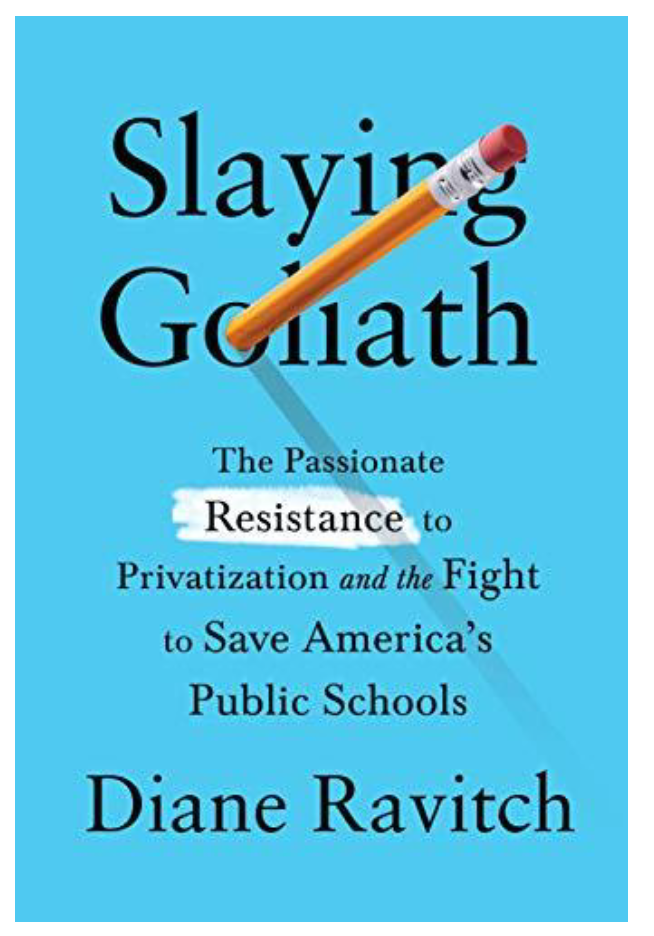
I was happy to read this review because Slaying Goliath had a checkered fate. It was published in mid-January 2020. I went on a book tour, starting in Seattle. By mid-February, I made my last stop in West Virginia, where I met with teachers and celebrated the two-year anniversary of their strike, which shut down every school in the state.
As I traveled, news emerged of a dangerous “flu” that was rapidly spreading. It was COVID; by mid-March, the country was shutting down. No one wanted to read about the fight to save public schools or about its heroes. The news shifted, as it should have, to the panicked response to COVID, to the deaths of good people, to the overwhelmed hospitals and their overworked staff.
To make matters worse, the New York Times Book Review published a very negative review by someone who admired the “education reform” movement that I criticized. I thought of writing a letter to the editor but quickly dropped the idea. I wrote and rewrote my response to the review in my head, but not on paper.
Then, again by happenstance, I discovered that Bob Shepherd had reviewed the review of my book in The New York Times. He said everything that I wish I could have said but didn’t. His review was balm for my soul. Shepherd lacerated the tone and substance of the review, calling it an “uniformed, vituperative, shallow, amateurish ‘review.’” Which it was. His review of the review was so powerful that I will post it next.
Then, a few weeks ago, I found this review by Berliner and Glass.
The review begins:
Reviewed by Gene V Glass and David C. Berliner Arizona State University, United States
They wrote:
In a Post-Truth era, one must consider the source.
In this case, the source is Diane Rose Silvers, the third of eight children of Walter Silverstein, a high school drop-out, and Ann Katz, a high school graduate. The Silvers were a middle-class Houston family, proprietors of a liquor store, and loyal supporters of FDR.
After graduation from San Jacinto High School, she enrolled in Wellesley College in September, 1956. Working as a “copy boy”for the Washington Post, Diane met Richard Ravitch, a lawyer working in the federal government and son of a prominent New York City family. They married on June 26,1960, in Houston, two weeks after Diane’s graduation from Wellesley. The couple settled in New York City, where Richard took employment in the family construction business. He eventually served as head of the Metropolitan Transit Authority and Lieutenant Governor in the 2000s, having been appointed by Democratic Governor David Paterson.
Diane bore three sons, two of whom survived to adulthood. Diane and Richard ended their 26-year marriage in 1986. She had not been idle. For a period starting in 1961, Diane was employed by The New Leader, a liberal, anti-communist journal. She later earned a PhD in history of education from Columbia in 1975 under the mentorship of Lawrence Cremin.
Diane was appointed to the office of Assistant Secretary of Education, in the Department of Education by George H. W. Bush and later by Bill Clinton. In 1997, Clinton appointed her to the National Assessment Governing Board (NAGB), on which she served until 2004.
Ravitch worked “… for many years in some of the nation’s leading conservative think tanks.
Since the state put Mike Mikes (ex-military, Broadie, briefly Superintendent of Dallas ISD) in charge of the Houston Independent School District, Miles has cemented his reputation as a leader who issues orders and doesn’t listen to critics. It’s his way or Mr get out. Many teachers and principals have left rather than comply with his scripted curriculum and mandates.
But, says the Houston Chronicle editorial board, he actually listened and put on hold his intention to fire dozens of principals, including some from Houston’s best schools. It’s worth pausing to remember that the state took control of the entire district because one high school (disproportionately enrolling students with disabilities, ELLs, and high needs) posted low test scores for several consecutive years. Rather than focus on helping that school, the state placed the entire district under the thumb of an autocrat and know-it-all.
Miles is testing out the proposition that the way to “fix” education is by standardization, mandates, data, rigid worship of test scores, and one-man control.
The editorial says:
Late this week, the state-appointed superintendent of Houston ISD did something many thought impossible: he listened.
It took several protests, community outcry and some three hours of overwhelmingly negative public comment during Thursday’s school board meeting, but Mike Miles seems to have heard the message.
The uproar began with the leaked release of a list of 117 principals the district said weren’t performing well enough yet to secure their spot for next year. Several of the principals at top-rated schools were on the list.Parents and students from those campuses showed up in force. Early Friday morning, with the meeting still plodding along, Miles announced that he and the board of managers changed course and said they wouldn’t make any adverse employment decisions this year based off of these proficiency screenings, which broadly measure student achievement with a variety of test data, quality of instruction gathered during spot observations and professionalism judged by a rubric that includes how well principals reinforce “district culture and philosophy.” But, he made clear, he would still usethe more comprehensive principal evaluation system approved last fall to make those decisions at the end of the school year.
Miles told us the next day he’d already gotten some emails from anxious community members “saying thank you” for the decision late last week.
“I’m proud of the board who worked so hard to listen,” Miles added.
We’re glad to see Miles pay attention to optics for once. No matter how good his intentions, his reforms won’t succeed long-term without community buy-in. That said, we’re struggling to see how Miles changed his overarching approach on principal evaluations.
Miles never planned to can those 117 principals — in fact, he expected the overwhelming majority of them would return — based on the proficiency screenings but the handful who were already deemed unsatisfactory don’t seem to suddenly be in a different position as best we can tell. Miles insisted those few failing principals not getting asked back didn’t just fail the proficiency screening and that the decision to let them go was based on other input.
“We were looking at all the data for them,” he told us.
And the principals who were told they need to improve, aren’t really in a different position either.
In practice, then, very little seems to have changed for the campus leaders who will still be judged on some of the same metrics, including spot reviews by the district’s so-called independent review teams. Instead, he said the decision was meant to allay some community confusion and ease some anxiety about principal turnover, something he’d been trying to combat since the leaked list was published by the Chronicle ahead of spring break on March 8.
“People have made it a bigger deal than it is,” Miles insisted when he met with the editorial board Wednesday ahead of the school board meeting. “You keep your job if you’re an effective principal,” he said, adding that he expects the majority, at least 80 percent, of the principals to return next year.
What Miles didn’t seem to grasp until he heard from a whole new set of angry parents — not the “usual suspects” who have protested the state takeover from the outset — was how nonsensical his list appeared.
Some of the schools aren’t just top-ranked in the district but in the country. Carnegie. HSPVA. T.H. Rogers. If people had doubts before about Miles’ priorities and evaluation criteria, the inclusion of these high-achieving campuses heightened them. It’s possible a high-performing school can still have a weak leader, just as it’s possible that a low-performing school can have a great one. But the list begged the question.
“You start to wonder what he is evaluating,” a parent with a student at Carnegie told us outside the State of the District event Thursday. She said the school’s principal, long-time veteran Ramon Moss, is an integral piece of the school’s success.
“He’ll be the first to tell you that the success of the school is due to the teachers and students and community even though his leadership is a big reason why the community is there,” she said.
Miles has declined to talk about specific campuses and what landed them on the list. So while this decision might relieve some momentary angst, it doesn’t address the lingering doubts aboutwhether the district’s measures of quality instruction and effectivenessare so narrow they fail to recognize the best educators, a concern that extends well beyond the star campuses.
This principal evaluation chaos is just the latest example of a breakdown of communication and trust.
We don’t disagree with the idea of evaluations or consistent standards across the district. It’s entirely possible that an overall A rating at a campus masks concerning disparities. Or that high-achieving campuses don’t show a ton of growth on standardized tests over the course of a school year.
What concerns us about the entire saga of the principal list is how, whether it’s intentional or not, Miles contributes to fear and uncertainty. He hasn’t effectively communicated his vision to the public or to the people tasked with carrying it out, despite his copious slideshows and sincere efforts to clear up the confusion over principals with follow-up press conferences, statements and even interviews with this board.
Last week,Miles and team showed greater sensitivity to the environment. It’s a good start. But they should make more effort to respond to the substance of the criticisms and not just the volume of them.
Mike Miles, the state-appointed superintendent of the Houston Independent School District, was given control of the district despite his poor track record in Dallas. Nonetheless, he intends to remake the district. He imposed a set of mandates that he called the “New Education System.” At first, he was supposed to reform 28 schools. Then another 85 schools joined his program voluntarily. 190 schools are supposed to be left alone.
Miles has ruled with a heavy hand. A few days ago, he removed a principal from a B-rated school and installed an “apprentice,” an inexperienced one as a temporary replacement.
District officials have removed another principal from a Houston ISD campus, this time pulling the top leader from Jane Long Academy and Las Americas Middle School in southwest Houston.
Myra Castle-Bell, an educator of more than two decades, will no longer serve as principal of the schools located on the same campus in Sharpstown, according to an HISD spokesperson. Castle-Bell chose to align both schools with the New Education System, a reform model created by state-appointed Superintendent Mike Miles, when given the option over the summer.
The district shared the news last week in a message sent to families and staff at the schools, informing them that Courtney Riley, a principal apprentice, will lead the campus while HISD searches for a permanent replacement.
“We know these changes can feel disruptive, but we are committed to ensuring every student at both schools gets access to excellent instruction every day,” the district said in the message. “We’ll update you as soon as we have selected a new Principal and thank you for your continued partnership.”
Riley is a member of the HISD Principal Academy, a program introduced this year by Miles geared toward preparing future principals through a year-long, paid residency model.
Long Academy is a B-rated school serving more than 800 students in middle and high school, according to the most recent state data. Las Americas is a newcomer campus that caters to recent immigrant and refugee children who typically have little or no English language proficiency or formal education.
HISD provided no explanation for the removal of Castle-Bell or any other principal, saying it cannot comment on personnel matters. Castle-Bell has been reassigned to a new position as Division Support Administrator for the West Division, according to HISD.
Miles is following the Broad Academy “reform” playbook. Disrupt as much as possible. Keep everyone on edge. Create an “academy” to train new principals, bypassing the traditional route of rising through the ranks and serving a genuine apprenticeship for 3-5 years as an assistant principal. NYC had a “Leadership Academy” doing exactly what Miles is doing now; it failed and was eventually closed down.
Mercedes Schneider summarizes the checkered career of Mike Miles, who was put in charge of the Houston Independent School District by State Commissioner Mike Morath, who was appointed by hard-right Republican Governor Greg Abbott. Abbott wants to punish Houston for not voting for him. What better punishment than to install Mike Miles as superintendent?
On June 01, 2023, the Texas Education Agency (TEA) appointed Mike Miles as the new HISD superintendent.
Miles is the golden-child product of market-based, ed-reform leadership. As reported in his LinkedIn bio, Miles holds no college degrees in teaching (engineering; slavic languages and literature; international affairs and policy). He has never been a classroom teacher, never a site-based administrator, yet he was a district superintendent in Colorado for six years (2006-11) and superintendent of Dallas ISD for three.
Though he does not mention it in his LinkedIn bio, Miles was a member of the Class of 2011 at the Broad Superintendents Academy A 2011 EdWeek article on Broad superintendents includes the criticism that they “use corporate-management techniques to consolidate power, weaken teachers’ job protections, cut parents out of decisionmaking, and introduce unproven reform measures.”
Indeed.
In 2015, Miles abruptly resigned from Dallas ISD amid being, as WFAA.com states, “at the center of controversy since he took the position nearly three years ago,” which apparently included questions about misdirecting funding intended for at-risk students and the subsequent exit of the Dallas ISD budget director. (Also calling Miles “a lightening rod for controversy,” WFAA.com offers this timeline of Miles’ unsettling tenure in Dallas.)
Following his Dallas ISD exit, in 2016, he founded a charter school chain, Third Future Schools, which has locations in Colorado, Texas, and Louisiana. For two years (2017-19), Miles was a senior associate in an education consulting firm, FourPoint Education Partners.
In true Broadie style, Houston Superintendent Mike Miles removed two elementary principals only days before the start of school. He started his job of “reforming” the Houston public schools in June, so he obviously did not observe either of them. This is disruption to the max. Teachers and parents learned about this abrupt action through an automated phone call.
Erin Trent (left), principal at Stevens Elementary School, and Linda Bellard, principal at Garcia Elementary School, were both removed from their positions Aug. 23, 2023. Houston ISD
Parents and teachers at Stevens say they were “blindsided” by the announcement, which was made via an automated phone call.
“This unexpected and impersonal communication from the district caused immediate anxiety, confusion and fear, not just for me personally but among hundreds of parents,” said Adam Chaney, the parliamentarian for Stevens’ Parent Teacher Community Organization.
“Our community deserves clarification immediately. We are two days away from ‘Meet the Teacher,’ the whole campus is going to be present, and then Monday morning is the start of school,” Chaney said. “It’s become increasingly difficult to avoid interpreting this chaotic situation through the lens of this controversial takeover.”
HISD officials declined to comment further or provide a reason for the reassignments, saying that the district cannot comment on ongoing personnel matters. The call Stevens parents received Wednesday acknowledged that “the change may feel abrupt,” but that it had “become clear that this change is necessary to ensure Stevens Elementary students start the year off well with access to high-quality instruction on day one that meets their needs and supports increased academic outcomes on the campus…”
One teacher, who asked to remain anonymous for fear of retaliation, said Trent resisted pushes from the HISD central office to become an NES-aligned school, which would have seen many of Miles’ most sweeping and controversial reforms implemented at Stevens.
Miles also disbanded the HISD team of autism specialists who served schools throughout the district.