Indiana blogger Steve Hinnefeld is puzzled, as am I. School choice has not fulfilled any of its bold promises. The charter industry is rife with waste, fraud, and abuse, and large numbers of them close every year. Vouchers were supposed to “save poor kids from failing schools,” but mostly they subsidize well-off kids who never attended public schools. Why do red states keep pumping more resources into failed programs that are neither innovative nor successful?

He writes:

Pundits have been wringing their hands over the “learning loss” caused by the COVID-19 pandemic. Scores on the 2022 National Assessment of Educational Progress showed the largest decline in decades.

But if people care about what kids are and aren’t learning, they should be every bit as alarmed by the private school voucher programs that are spreading across the country.

That’s according to Joshua Cowen, a Michigan State University education policy professor. He’s been studying vouchers and following the research for two decades, and he says the evidence is crystal clear that voucher programs don’t work when it comes to helping students learn.

In a recent episode of “Have You Heard,”an education podcast, he said thorough evaluations of large-scale voucher programs – in Indiana, Louisiana, Ohio and Washington, D.C. – found overwhelmingly negative effects on learning as measured by test scores.

“We’ve seen some of the biggest drops in test scores that we’ve ever seen in the research community for people who take vouchers and go to private schools,” he said.

The impact on math scores, in some cases, was twice as large as the test-score decline associated with the pandemic, he said. It was on the scale of what New Orleans students lost when Hurricane Katrina shut down schools and forced families from their homes.

“They suffered that badly, in terms of their test scores,” he said. “We’re talking about nine or 10 months loss of learning. It’s massive….”

Cowen said he naively thought the conclusive research findings would put a nail in the coffin for state voucher programs. In fact, the opposite has happened. There are now 29 voucher programs in 16 states enrolling over 300,000 students, according to the pro-voucher group EdChoice. Arizona recently adopted a “universal voucher” program. Some states have adopted Education Savings Accounts, private-school tax credits and other neo-voucher programs.

Indiana expanded its already large voucher program in 2021. The program grew last year to over 44,000 students at a cost to the public of nearly a quarter billion dollars. Nearly all participating private schools are religious, and some discriminate by religion, disability, sexual orientation and gender identity. A 2018 evaluation of the effects of Indiana’s program – cited by Cowen and conducted by professors at Notre Dame and the University of Kentucky – found significant test-score declines in math.

Why haven’t voucher programs disappeared if they don’t work? The title of the “Have You Heard” episode sums it up: “Moving the Goalposts.”

Parents have the right to send their children to low-performing religious schools or to homeschool them. But why should taxpayers subsidize their personal choices?

I don’t usually get enthusiastic about fictionalized portrayals of schools because they are typically sensationalized and hostile towards teachers and students. It’s easy to make a long list of such movies or TV programs, starting with “Blackboard Jungle.”

But wait!

Here’s a show you will love: “Abbott Elementary” is set in Philadelphia. The writer of the Emmy-award-winning show, Quinta Brunson, is also the star. She plays a first-year teacher in the first season. She is thrilled to be a teacher and her colleagues are helpful, funny, and the usual mix of personalities—real people. They care about the children. The children—all Black—are adorable. There’s not enough money for supplies, but everyone makes do. The spirit of the show is beautiful.

The show makes you feel like teaching is the very best job in the world. Don’t miss it!

Bob Shepherd, the brilliant polymath and man of many interests and talents, has had a long and distinguished career in educational publishing. He has developed assessments, written textbooks, and ended his career as a classroom teacher in Florida. I defer to his superior knowledge on almost every subject.

Pour yourself another cup of coffee and sit back for a long read about literacy and how it is acquired.

He wrote about the flaws in the teaching of reading in an essay that begins with these words:

An Essay Touching upon a Few of the Many Reasons Why the Current Standards-and-Testing Approach Doesn’t Work in ELA

NB: For all children, but especially for the one for whom learning to read is going to be difficult, early learning must be a safe and joyful experience. Many of our students, in this land in which nearly a third live in dire poverty, come to school not ready, physically or emotionally or linguistically, for the experience. They have spent their short lives hungry or abused. They lack proper eyeglasses. They have had caretakers who didn’t take care because they were constantly teetering on one precipice or another, often as a result of our profoundly inequitable economic system. Many have almost never had an actual conversation with an adult. They are barely articulate in the spoken language and thus not ready to comprehend written language, which is merely a means for encoding a spoken one. They haven’t been read to. They haven’t put on skits for Mom and Dad and the Grandparents. They don’t have a bookcase in their room, if they have a room, brimming with Goodnight, Moon; A Snowy Day; Red Fish, Blue Fish; Thomas the Tank Engine; The Illustrated Mother Goose; and D’Aulaires Book of Greek Myths. They haven’t learned to associate physical books with joy and closeness to people who love them. In the ambient linguistic environment in which they reached school age, they have heard millions fewer total numbers of words and tens of thousands fewer unique lexemes than have kids from more privileged homes, and they have been exposed to much less sophisticated syntax. Some, when they have been spoken to at all by adults, have been spoken to mostly in imperatives. Such children desperately need compensatory environments in which spoken interactions and reading are rich, rewarding, joyful experiences. If a child is going to learn to read with comprehension, he or she must be ready to do so, physically, emotionally, and linguistically (having become reasonably articulate in a spoken language). Learning to read will be difficult for many kids, easy for others. And often the difficulty will have nothing to do with brain wiring and everything to do with the experiences that the child has had in his or her short life. In this, as well as in brain wiring, kids differ, as invariant “standards” do not. They need one-on-one conversations with adults who care about them. They need exposure to libraries and classroom libraries filled with enticing books. Kids need to be read to. They need story time. They need jump-rope rhymes and nursery rhymes and songs and jingles. They need social interaction using spoken language. They need books that are their possessions, objects of their own. They need to memorize and enact. And so on. They need fun with language generally and with reading in particular. They need the experiences that many never got. And so, the mechanics of learning to read should be only a small part of the whole of a reading “program.” However, this essay will deal only with the mechanics part. That, itself, is a lot bigger topic than is it is generally recognized to be.

Permit me to start with an analogy. As a hobby, I make and repair guitars. This is exacting work, requiring precise measurement. If the top (or soundboard) of a guitar is half a millimeter too thin, the wood can easily crack along the grain. If the top is half a millimeter too thick, the guitar will not properly resonate.  For a classical guitar soundboard made of Engelmann spruce (the usual material), the ideal thickness is between 1.5 and 2 mm, depending on the width of the woodgrain. However, experienced luthiers typically dome their soundboards, adding thickness (about half a millimeter) around the edges, at the joins, and in the area just around the soundhole (to accommodate an inset, decorative rosette and to compensate for the weakness introduced by cutting the hole).

To measure an object this precisely, one needs good measuring equipment. To measure around the soundhole, one might use a device like this, a Starrett micrometer that sells for about $450:

It probably goes without saying that one doesn’t use an expensive, precision tool like this for a purpose for which it was not designed. You could use it to hammer in frets, but you wouldn’t want to, obviously. It wouldn’t do the job properly, and you might end up destroying both the work and the tool.

But that’s just what many Reading teachers and English teachers are now doing when they teach “strategies for reading comprehension.” They are applying astonishingly sophisticated tools—the minds of their students—in ways that they were not designed to work, and in the process, they are doing significant damage. Leaving aside for another essay the issues of physical and emotional preparedness, to understand why the default method for teaching reading comprehension now being implemented in our elementary and middle-school classrooms fails to work for many students, one has to understand how the internal mechanism for language is designed to operate.

Nancy Bailey is a veteran teacher who always has wise insights into what happens in the classroom. In this post, she questions the corporate interest in the so-called science of reading.

She begins:

Many of the same individuals who favor charter schools, private schools, and online instruction, including corporate reformers, use the so-called Science of Reading (SoR) to make public school teachers look like they’ve failed at teaching reading.

Politicians and corporations have had a past and current influence on reading instruction to privatize public schools with online programs. This has been going on for years, so why aren’t reading scores soaring? The SoR involves primarily online programs, but it’s often unclear whether they work.

The Corporate Connection to the SoR

Bill and Melinda Gates Foundation

The Bill and Melinda Gates Foundation fund numerous nonprofits to end public education. The National Council of Teacher Quality (NCTQ), backed by Gates and other corporations, an astroturf organization, promotes the SoR.

SoR promoters ignore the failure of Common Core State Standards (CCSS), embedded in most online programs, like iReady and Amplify. CCSS, influenced by the Gates Foundation, has been around for years.

Also, despite its documented failure ($335 million), the Gates Foundation Measures of Effective Teaching, a past reform initiative (See VAMboozled!), irreparably harmed the teaching profession, casting doubt on teachers’ ability.

EdReports, another Gates-funded group, promotes their favored programs, but why trust what they say about reading instruction? They’ve failed at their past education endeavors.

But the Bill and Melinda Gates Foundation continues to reinvent itself and funds many nonprofits that promote their agenda, including the SoR.

Please open the link and read on.

The U.S. Department of Education’s Office of the Inspector General conducted an in-depth audit of the federal Charter Schools Program, which was initiated in 1994 with a few million dollars by the Clinton administration. Thanks to astute lobbying by the charter industry, the modest program grew to $440 million a year with little or no accountability. Betsy DeVos pushed it aggressively to large charter chains, including for-profit chains.

You will be interested in this account of the audit, written by Valerie Strauss on her blog “The Answer Sheet” in the Washington Post, introducing an analysis by Carol Burris, executive director of the Network for Public Education.

This audit demonstrates the power and persistence of the Network for Public Education, a small but smart advocate for public schools. NPE operates with one full-time employee and a small number of part-time employees. Our work is motivated not by greed but by idealism and a passionate commitment to the common good. We believe in well-funded schools with experienced teachers for all children.

The introduction by by Strauss and the analysis by Burris has many links, but none transferred when I copied it. I copied some, but not all of them. I urge you to open the original and find the links.

Strauss begins:

The U.S. Education Department’s Office of Inspector General has released a new audit of the federal Charter School Program that found some alarming results about how charter school networks have used millions of dollars in funding. Among other things, the audit found that charter school networks and for-profit charter management organizations did not open anywhere near the number of charters they promised to open with federal funding. This piece looks at the new audit and what it tells us.


The reason this is not surprising is that investigations into the Charter School Programs by the Network for Public Education, an advocacy group that opposes the growth of charter schools, found that same problem, as well as others and reported it a few years ago. You can read my stories about their “Asleep at the Wheel” here and here. (The second report noted that the state with the most charter schools that never opened was Michigan, home to former education secretary Betsy DeVos, who has pushed to expand charter schools for decades.)


Charter schools are publicly funded but privately managed. The federal charter program, which began in 1994 with the aim of expanding high-quality charters, had bipartisan support for years, but many Democrats have pulled back from the movement, citing the fiscal impact on school districts and repeated scandals in the sector. The Biden administration is making some changes to the program in an effort to stop waste and fraud and provide more transparency to the operation of charters.


This piece was written by Carol Burris, executive director of the Network for Public Education and a former award-winning principal in New York. She has been chronicling the charter school movement and the standardized-test-based accountability movement on this blog for years. The Network for Public Education is an alliance of organizations that advocates for the improvement of public education and sees charter schools as part of a movement to privatize public education.


By Carol Burris


A new report issued by the Office of the Inspector General (OIG) entitled “The Effectiveness of Charter School Programs in Increasing the Number of Charter Schools” documents how states, charter management organizations, and charter developers often make wildly exaggerated claims regarding the number of charter schools they will open or expand to secure large grants.

The OIG, an independent watchdog of the U.S. Department of Education (the Department), found that for grants issued between 2013 and 2016, only 51 percent of the schools promised by Charter School Programs (CSP) recipients opened or expanded.


The OIG audit also exposed the sloppy record keeping and weak oversight that characterize CSP operations. Since 2006, the department has paid a private corporation, WestEd, millions of dollars to compile, check and update CSP records. WestEd’s present CSP contract exceeds $12 million. In total, WestEd has active contracts with the U.S. Department of Education worth more than $27.6 million. Yet an alarming number of grant records could not be found when requested by the OIG auditors. And while the Biden administration is attempting to clean up and reform the CSP, according to the independent OIG, more work needs to be done.


What did the Office of the Inspector General audit?
The audit had three goals. The first was to describe how the department’s Office of Elementary and Secondary Education tracked and reported the number of charter schools that opened and expanded using Charter School Program funds. A second goal was to determine whether CSP grant recipients actually delivered the number of charter schools they promised when they applied for their often multimillion dollar awards. Finally, the audit sought to determine how many schools were still open two years after CSP funding ended.


As its title stated, the audit was an attempt to measure the program’s effectiveness in fulfilling its mission. To conduct the audit, the OIG examined 2013 through 2016 CSP grant records. During that period, the department awarded 103 CSP grants to states, charter management organizations, or individual charter developers. Ninety-four were closely investigated by the OIG. The likely reason these years were chosen was that most grants are for five years. The auditors also found that the department often extends them further when grantees have not spent all of their money. Therefore, more recent grants were excluded because records were likely to be incomplete.

Incomplete and inaccurate records

The auditors noted that while the department, through WestEd, tracked spending and schools while grants were open, the tracking stopped as soon as the grant was complete. Therefore, the department had no way of knowing whether schools remained open beyond the years federal funds propped them up. This speaks to the purpose of the program — to open and expand high-quality charter schools.


When auditors asked the department to define the term high-quality, the department responded that the “CSP office does not determine whether a charter school is high-quality because state rules for determining high quality vary.”


“Additionally,” it said, “the determination of whether a charter school is a high quality is often the responsibility of charter school authorizers.” The department also told auditors that tracking a school’s existence after all money was doled out was not its job.


Even if the department wanted to do a quality check of schools as they were funding and expanding, the OIG found that there was no accurate base of information that they could rely on to determine whether they should continue what was often a multimillion-dollar grant. From the audit:


Although the CSP office created processes for tracking and reporting on charter schools that opened and expanded and charter schools that remained open through the grant performance period end date, those processes did not result in CSP grant recipients reporting precise, reliable, and timely information in their FPRs [final performance reports], APRs [annual performance reports], and data collection forms. The processes also did not result in the CSP office receiving all the necessary information to assess grant recipients’ performance or evaluate the overall effectiveness of the CSP.


Specifically, the department could not produce 13 percent of the required final reports from grantees and 43 percent of the required final data collection sheets. Auditors noted that grantees would report different numbers of schools opened or expanded among required collection forms and final reports. The accuracy of the final documents prepared by WestEd for the department was beyond the scope of the audit.

During our research for our second “Asleep at the Wheel” report, we found that the data collection sheets produced by WestEd and published in 2019 by then Education Secretary Betsy De Vos were replete with errors. Schools that had closed or never opened were reported as open or future. We also noted inaccuracies in recently submitted sheets we received from a Freedom of Information Act request, especially relating to the for-profit management status of the awardee.


But the OIG discovered a far worse problem yet. More than half of the schools that grantees committed to opening or expanding did not open or expand at all.

CSP grantees failed to meet commitments
Grant applicants asked for and received millions of dollars based on their promises to open and expand charter schools. However, when the auditors examined 94 grantee applications, they found that many grantees fell far short of their commitments.

The OIG determined that based on the commitments made in the 94 applications, state education agencies, CMOs, and developers promised to open or expand 1,570 charter schools using CSP funds.


As of July 2021, approximately 75 percent of the grant funding had been spent, yet grantees had only opened or expanded 51 percent of the charters they had promised.


This begs the question, where did millions of tax dollars go? I identified grantees by matching applications on the department website along with numbers in the data set with grant codes in the OIG report.


In its 2016 CSP application, the Florida Department of Education put forth what it called a “bold and ambitious plan to … develop a high-impact system to dramatically improve the opportunities of educationally disadvantaged students. The department said that it would use the grant to “support the creation of 200 new high-quality charter schools over the next five years.”

Florida received $70.7 million to achieve its “bold and ambitious” plan. According to the OIG report, it had only opened 33 percent — or 66 — of the schools it promised to open as of July 2021, although it had spent over 51 percent of the CSP funds.


Colorado’s 2015 application promised that it would open 72 charter schools with its over 24.2 million dollar grant. In the end, it opened fewer than half — just 33 — and expanded three schools. Nevertheless, it spent 87.5 percent of its funds.

Tennessee ambitiously promised to open 114 charter schools. It opened just 16, though it managed to spend 63 percent of its grant. These states are not outliers. The report shows a pattern.

And CMOs also failed to deliver. The KIPP charter network promised 65 schools for its jumbo $48,750,000 grant, one that well exceeded most states. It delivered 34 schools and expanded one.

Finally, there are grants to developers that the department directly provides. The Innovation Development Corporation received a $405,730 CSP grant to open The Delaware Met. It was open for just a few months before it was shut down. It also received and spent $72,000 to open DE Stem. That school was shut down before it even opened. Willow Public School, a Washington charter school, took and spent a $602,875 grant, opened, ran into trouble, changed its name, and then shut down.


The department and the National Alliance for Public Charter Schools attribute the problem to authorizer reluctance and state caps on the number of schools that can open. Really? Every state that got a grant has a state board that can override local rejections of applications. State applicants and the department are also well aware of caps. Take the case of the 2018 $78,888,888 CSP grant to the New York State Department of Education, which was outside the scope of the OIG audit.

In the New York State application review, which you can find here, raters acknowledge that New York State had not even used up its previous grant which was open beyond its terms and that charter expansion would be limited by the state cap on the number of charters. Yet they gave the application high scores, and it was approved. Where did that 2018 money go? Over $10 million went to provide staff development in technology for charter schools.

Jumbo grants

Why do states and charter management organizations ask for jumbo grants knowing they cannot deliver? Because they want the money to fund their charter school operations.


States and charter management organizations get to keep 10 percent of the cut for grant administration and technical assistance to charter schools. The bigger the grant, the bigger the cut.

Therefore, KIPP was allowed to keep nearly $5 million for its charter management organization, even though it fell way short of its commitment. The Florida Department of Education secured over $7 million for administrative services on its grant.
Second, there are no guidelines about how much an individual charter school can get. We have seen grants as low as $250,000 and grants to schools of $1.5 million. When a state realizes it cannot or will not meet its commitment, it just doles out larger amounts.


Third, until President Biden, no prior administration did anything about it over the Charter School Program’s existence. Therefore, states, CMOs, and individual schools realized pretty quickly that they could create grandiose applications, sometimes including falsehoods, and there would be no real consequences if commitments were never met.

The present department has taken a terrible beating for creating modest CSP reform regulations which are still being fought by the charter trade organizations and their proxies, including the Thomas B. Fordham Institute, a charter school authorizer. Challenges include both a lawsuit and a Republican-sponsored bill to overturn the new rules.

But as the OIG audit shows, reforms are desperately needed.

.

Here is a message to you and all my friends!

Be happy!

Be kind to people of different religions as well as those who have no religious beliefs!

Welcome the stranger!

Open your hearts!

Banish cruelty, hatred, and bigotry!

Save some time to laugh every day, even to laugh at yourself!

Happy New Year!

John Merrow offers sage advice about how to protect your child from predators. Do not put their name on their backpack, lunchbox, or clothing.

He writes:

The adult and child walking in front of me were complete strangers, people I had never seen before. The man, who looked to be in his early 30’s, was casually dressed. He was holding the hand of a young girl, probably about five years old. Perhaps the girl, Sophie, was his daughter and they were on their way home from school or a music lesson.

If you’re reading carefully, you may be thinking, “Hold on a minute! You wrote that you had never seen those two before, and yet you assert that her name was Sophie? That doesn’t compute, buddy. You’ve lost your credibility….big time.”

I did what I have done on other occasions. I called out, “Excuse me, sir,” and the man stopped and turned around. “Hi, Sophie,” I said, and the man looked at me sideways, probably wondering why an old man with white hair was striking up a conversation.

“Do I know you,” he asked, somewhat suspiciously?

“No,” I said. “We have never met, but I know your daughter’s name is Sophie. I probably shouldn’t know it, but I do–and so does everyone else who sees her backpack.”

He seemed uncertain as to how to respond to my blunt, even rude, comment, and so I continued talking.

“I reported on children’s issues for 41 years on public television and radio,” I said. “And a story I did on child predators back in the 1980’s has stayed with me. I spent a day with cops searching for a suspected pedophile, and at one point they hauled in a man who was lingering outside an elementary school. He hadn’t done anything, so they couldn’t charge him, and he denied being a predator. But he did tell them—and me, the reporter–how pedophiles are successful in persuading children to go off with them.”

The father was now paying close attention.

“The biggest gift,” this (probable) predator said, “is clothing or a backpack with the child’s name printed on it. All he has to do is call the child by name to catch them off guard. The 5-year-old won’t recognize or remember him, but children see many adults throughout their day. But the man knows her name, and so she might assume that she must have met him. Of course, her parents have taught her not to talk to strangers, but this man knows her name, and so she lets down her guard.”

I have not been able to erase from my memory his final words: “Game over.”

Unfortunately (from my point of view), personalized backpacks like the one Sophie was wearing are big business. A Google search turns up 43,100,000 hits. That’s 43 MILLION! A search for personalized lunch boxes– another gift to predators–produces 10,000,000 hits. Disney will gladly sell you all sorts of stuff with your child’s name emblazoned on it, as will hundreds of other large companies.

Open the link and read on.

A new report on Florida’s education budget found that vouchers will divert $1.3 billion from public schools this year alone. This is money that goes mainly to religious schools that meet no accountability standards and are free to discriminate and ignore state and federal laws.

The amount of public money being spent on private schools in Florida has increased substantially since 2019, according to a new report by the Florida Policy Institute and the Education Law Center.

The analysis estimates that some $1.3 billion in taxpayer funds will be diverted school vouchers this year, amounting to 10% of the overall funding the state earmarked for public school districts for the 2022-2023 school year.

“This enormous increase in the flow of public dollars to fund private education has happened so quickly that many Floridians are likely unaware of the financial impact being placed upon public school districts and the way these voucher programs are affecting the availability of their tax dollars for public education,” the report reads in part.

Private schools don’t have to comply with federal civil rights laws or state laws on standardized testing, teacher certification or certain building codes in the way that public schools do.

Leon County Schools Superintendent Rocky Hanna, who spoke at a press conference about the report’s findings, said expanding vouchers is taking away resources away from traditional public schools.

“Enough is enough,” Hanna said. “What’s happening is, we are diverting funds from students with special needs, from students who otherwise are going to lose programs that are vitally important to their academic success later in life….”

The report – titled ‘Florida’s Hidden Voucher Expansion’ – traces the growth in the state’s voucher programs to 2019, when the state legislature created the Family Empowerment Scholarship or FES.

State lawmakers expanded the program in 2021, loosening the qualifications for applying and rolling two other voucher programs into the FES – the McKay Scholarship and Gardiner Scholarship, which set aside funding for students with disabilities.

Now, families who make nearly $100,000 a year are able to qualify for the FES. Students are no longer required to have attended public schools to apply for a voucher; now, students who were homeschooled can also qualify. Families also have greater flexibility in how the funds can be spent, including on transportation, private tutoring, online learning and other costs.

The impact of the vouchers on school districts varies depending on how much they rely on state versus local money. Funding for the FES comes from the Florida Education Finance Program or FEFP – which allocates money on a per student basis and is a key source of revenue for local school districts.

The report estimates that in the Miami-Dade school district, $225 million will be diverted to private schools in the 2022-2023 school year, amounting to “8% of the district’s total FEFP budget”.

Bacardi Jackson is the Interim Deputy Legal Director for Children’s Rights at the Southern Poverty Law Center. She argues that diverting public funds into private schools is part of a long legacy of undermining students’ equal access to education – especially Black students.

Open the link and read on.

Remember how voucher advocates claim that vouchers will “save” poor kids from “failing public schools”? T’aint so.

Stephen Dyer compared the progress of Ohio students in voucher schools to those in public schools. Guess what? The longer students are enrolled in voucher schools, the farther behind they fall.

He writes:

One thing you’d expect to hear a lot from voucher proponents is that students taking private school tuition subsidies do better the longer they’re in the private schools taxpayers are paying.

I mean, assuming these “choices” are so vastly superior to “failing” public schools, right?

Yet you never hear that argument. Now I know why: according to state test data, the longer students take vouchers, the worse they do on state tests — in some cases a lotworse. Especially in high school.

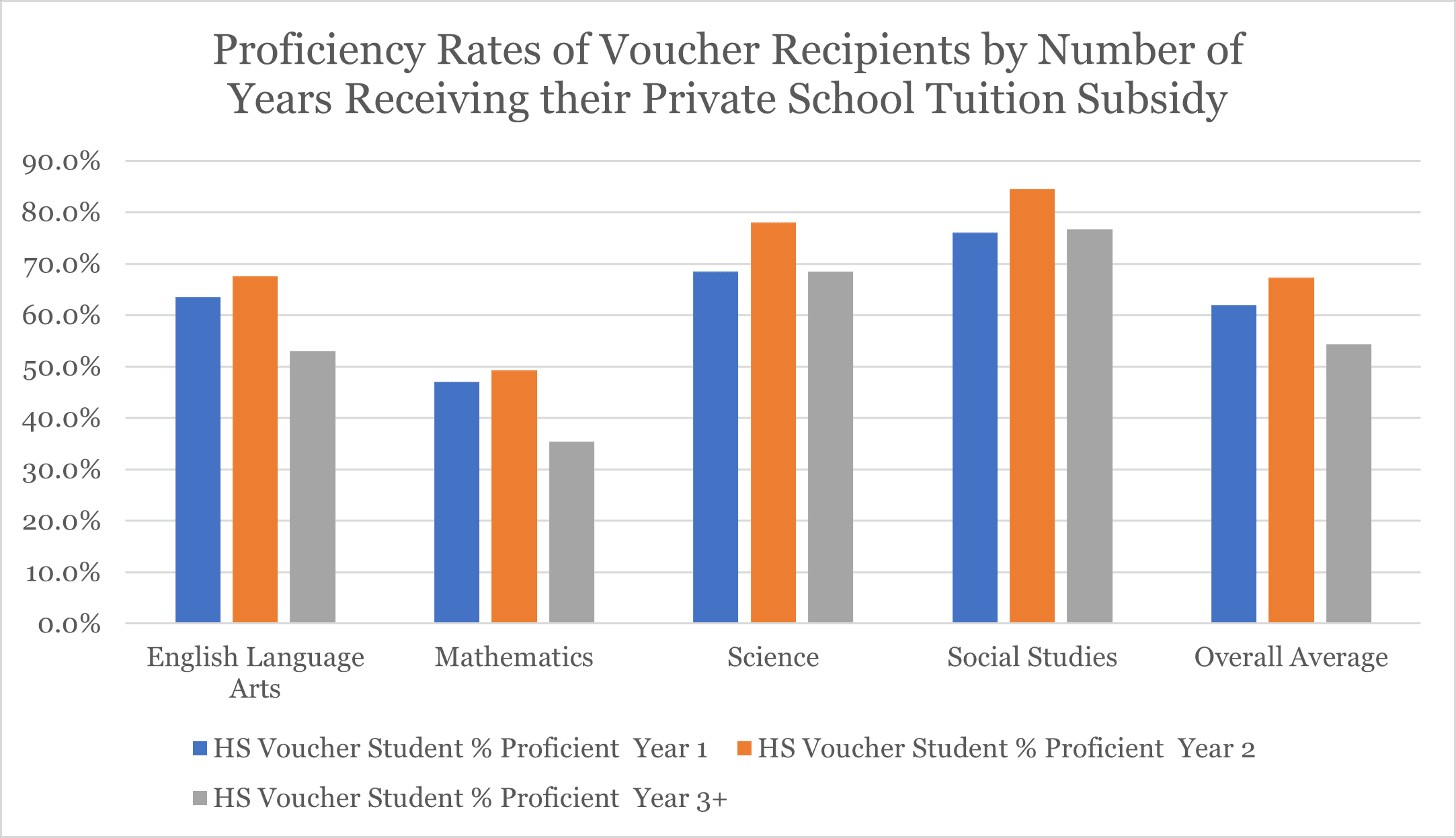
Here is how students perform on state High School proficiency rates, depending on how long they’ve been taking vouchers. You can see pretty clearly that especially in English and Math, students do markedly worse if they’ve been taking vouchers for 3 plus years than they do if they’ve only been taking it for a year.

This provides some pretty compelling evidence that students taking vouchers are better prepared by public schools, but once they enter the private system, that success wanes. Only in Social Studies is there an increase, but it’s only a 0.9% increase. Math drops by nearly 1/4. Overall, there’s, on average, a 12.1% drop in proficiency rates the longer a high school student takes a voucher….

Let me put it simply:

  • Generally, Voucher students do worse on state tests the longer they take vouchers.
  • The Black-White achievement gap is much greater among voucher students than public school students.
  • Private Schools that accept Vouchers take a Whiter population of students than the districts from whence the students come.

I just have one simple question: How is it again that Vouchers provide “better” opportunities for students of color who are being “failed” by public schools, as voucher proponents continuously claim?

Because Ohio data sure suggest that students of color are best served by their local public schools, not the private schools who are more reluctant to take them, even with significant taxpayer-funded tuition subsidies.

I was shocked when I heard that Josh Shapiro endorsed a voucher bill for Pennsylvania. His opponent is an insurrectionist who was in D.C. and a QAnon nut. Why did Josh pander to Republicans?

I wrote him this letter at contact@joshshapiro.org

Dear Josh,

I was so excited when you won the Democratic primary for Governor.

But when I learned you support vouchers, I was shocked and disappointed.

Research shows that kids who use vouchers fall behind their peers in public schools.

Vouchers will send public money to religious schools that discriminate against children with disabilities, children who are LGBT, children who don’t share the same religious faith, children with low test scores. SPrivate schools choose, not families. Public schools belong to everyone and are not allowed to exclude children.

Democrats support fair and adequate funding for public schools.

Why do you support vouchers?

Diane Ravitch, Ph.D.