J. Michael Luttig is a respected conservative legal scholar who was appointed to be a federal appeals court judge by President George H.W. Bush. He served for 15 years on the U.S. Court of Appeals for the Fourth Circuit from 1981 to 2006. In 2020, he advised Vice-President Mike Pence that he had no constitutional authority to overturn the presidential election. He is an outspoken critic of Trump. In 2024, he voted for Kamala Harris.

In this post, Judge Luttig critiques a speech that Justice Clarence Thomas delivered in late April to the Civitas Institute at the University of Texas. It was supposed to be a speech about the 250th anniversary of the Declaration of Independence.

Justice Thomas expressed the bizarre idea that progressivism is at odds with the ideals of the Declation of Independence. He described progressivism as the demonic ideology that is responsible for the great evils of the past century. Justice Thomas connected progressivism to Stalin, Hitler, Mao, and Mussolini.

Here is a video. Here is a transcript.

Law school dean Erwin Chemerinsky analyzed his speech here.

Ruth Marcus, former editorial writer for The Washington Post, critiqued his upside/down version of history in The New Yorker.

Judge J. Michael Luttig joined many who were critical of Justice Thomas’s understanding of history and of progressivism.

He wrote:

The speech exe that Justice Clarence Thomas gave last week at the University of Texas could prove to be the single most important speech of political and constitutional philosophy that never should have been given.

As a conservative my entire life, I certainly wish Justice Thomas had not written and given the insidious speech.

Though his unmistakable targets were Progressives and progressivism, his speech is far more injurious to Republicans, conservatives, and conservatism than it is for progressivism because it is demonstrably and inarguably wrong as to Progressives, but it is a siren song to today’s Republicans and conservatives. Webster’s Dictionary defines “siren song” as “: an alluring utterance or appeal, especially one that is seductive or deceptive.”

Justice Thomas intended his speech as a Republican and conservative manifesto for our times — and for all times. But the political and constitutional philosophies he described and embraced are neither doctrinal conservatism nor Republican nor political conservatism, and they are manifestly not constitutional conservatism.

No one should mistake for true conservatism, or even Republicanism, much less constitutional conservatism, the political and constitutional philosophies that Justice Thomas has embraced his entire life and spoke about last week. His philosophies represent anything but true conservatism.

Rather, together, they constitute a bastard strand of conservatism that lingered and languished in the faculty lounges of the conservative academy from around the mid-1960s until it was summoned forth from the academy by acolytes of Clairmont McKenna College’s natural law philosopher Harry V. Jaffa to fuel Donald Trump’s rise to power in 2016.

Those acolytes included Justice Thomas and his, and my, former law clerk John Eastman.
Thus, the overarching significance of Justice Thomas’ speech last week is that it represents the intellectual political and constitutional philosophies for Donald Trump’s two presidencies and his entire MAGA movement.

It was these political and constitutional philosophies that underlaid and justified Donald Trump’s failed plan to cling to power on January 6, 2021, the architect of which was John Eastman.

The political and constitutional philosophies that Justice Thomas embraces are as certainly wrong for America, whose preeminent law is the Constitution of the United States, not the Declaration of Independence’s admittedly majestic and inspirational Preamble,” as Justice Thomas believes they are certainly right for America under that Constitution. His twin philosophies are, simply and demonstrably, wrong as a matter of historical fact, political fact, and both constitutional fact and law.

Together, they are a shockingly and reprehensibly ahistorical characterization of liberals and progressives and progressivism, as well as an ahistorical characterization of Republicans, Republicanism, and conservativism.

These philosophies are a radical understanding of American and world history over the past century and a quarter, a radical way of thinking about American political history, and a decidedly radical way of thinking about the relationship between the Declaration of Independence and the Constitution.


This is emphatically not what the Founders of this nation and the Framers of the Constitution of the United States contemplated, envisioned, or ever intended.


The historical flaws in Justice Thomas’ speech are many and every one of them has already been identified and authoritatively denounced by experts and scholars across the political, philosophical, and ideological spectrum.

Justice Thomas purports to trace progressivism in America back to Democrat President Woodrow Wilson, when in fact progressivism for the past century and a half is actually traceable directly back to Republican President Theodore Roosevelt. Astonishingly, Thomas then blames all progressives of the twentieth and twenty-first centuries – including progressives in the United States over this period – and charges them with responsibility for the profound failures of societies worldwide during those one hundred and twenty-five years, including Stalinism, Maoism, Mussolini’s fascism, Naziism, and worse.

Oblivious to the actual history, but supremely confident in his ahistorical understanding of that history, Justice Thomas intoned as if reading from the Gospel that “Progressivism has made many inroads in our system of government and our way of life. It has coexisted uneasily with the principles of the Declaration. Because it is opposed to those principles, it is not possible for the two to coexist forever…. Stalin, Hitler, Mussolini, and Mao all were intertwined with the rise of progressivism, and all were opposed to the natural rights on which our Declaration was based. Many progressives expressed admiration for each of them shortly before their governments killed tens of millions of people.”

Justice Thomas’ invidious accusation that progressives in America for the past century and a half up to this very day have been pursuing the same anti-democratic and anti-constitutional regimes as Stalinism, Maoism, Mussolini’s fascism, Naziism, and the like, is frightening, risible, and reprehensible.

While it can fairly be said that Woodrow Wilson was critical of the Declaration’s Preamble, virtually no other Progressive or Democrat since Woodrow Wilson has so much as criticized the Preamble, much less rejected it. The Reverend Martin Luther King, Jr., famously regarded the Declaration of Independence and the Constitution as the “promissory notes” to which all Americans were heir and he called upon the nation to fulfill the pledges of these two Founding documents.

Jeffrey Rosen, one of the greatest constitutional scholars and historians of our times and indisputably the foremost constitutional scholar of America’s Founding, writes in his recent book The Pursuit of Liberty: How Hamilton vs. Jefferson Ignited the Lasting Battle Over Power in America that Thomas Jefferson was, after all, the founder of the progressive Democratic Party and most Democrats in 19th and 20th centuries revered Jefferson.

Mr. Rosen goes on to explain that when he was President Wilson’s closest advisor, progressive Supreme Court Justice Louis Brandeis handed out biographies of Thomas Jefferson to Kentucky schoolchildren, quoted Jefferson in the greatest free speech opinion Brandeis ever wrote on the Supreme Court, and took his famous criticism of the “curse of bigness” from Thomas Jefferson.

Supreme Court Justice Hugo Black, a liberal originalist, worshiped and frequently quoted Thomas Jefferson. President Franklin Delano Roosevelt built the Jefferson Memorial on the Mall in Washington D.C. and had Jefferson’s portrait permanently engraved on the obverse of the nickel and his Virginia home, Monticello, engraved on the reverse. Mr. Rosen writes that President Roosevelt died the day before Thomas Jefferson’s birthday with an undelivered speech in hand, in which he called Thomas Jefferson the prophet of the post-war order.

And of course, President William Jefferson Clinton began his inauguration with a pilgrimage to his namesake’s Monticello home in Charlottesville, Virginia, symbolically traveling from Thomas Jefferson’s mountaintop home to the Nation’s Capital, to be sworn in as the 42nd President of the United States.

As a matter of historical fact, every single progressive president since Theodore Roosevelt, with the arguable exception of Woodrow Wilson has unhesitatingly embraced the Declaration’s Preamble, the Declaration itself, and indeed, Thomas Jefferson, the author of the Declaration of Independence.

For 250 years, it has never been the case that either of America’s two political parties has been anti-Preamble, anti-Declaration of Independence, or anti-Constitution . . . until, that is, the past 10 years, when the Republican Party led by Donald Trump has acted as if it were all three.

As a matter of historical, political, and constitutional fact, it is the 47th President and today’s Republicans and conservatives who, every day of the week, act in denial of the Declaration of Independence and the Constitution of the United States, all the while professing to revere these two Founding and foundational documents of the United States of America.
Bruce D. Baker is one of the nation’s foremost experts on school finance. He is now a Professor of Teaching and Learning at the University of Miami.

His blog is SchoolFinance 101. He recently mused about how Dr. Seuss would explain school finance and equality of educational opportunity.

He wrote:

Alas – I’ve found a use for OpenAI – Converting my deepest theoretical musings on school finance into Seussical prose: 

Oh, the Funds You Will Flum!
(A Zany Zoodle on Equity, Adequacy, and Opportunity Gum)

In a flibber-flap land of the Schollaroo Schools,
With Sneetchy-like districts and Yoppity rules,
There lived some young learners (some tall, some quite small),
Some had lots of Zoom-Zooks… some nothing at all.

Now the Board of Big Thinkers (in hats three feet wide)
Said, “Fairness! We’ll fix it!” and puffed up with pride.
“We’ll give EVERY school just the same little stack—
Same dollars! Same books! Same chalk in each pack!”

But the Glumguzzle Kids from the Far Fizzle Vale
Said, “That sameness you’re selling is starting to fail!
For we’ve got more needs than the Zazzberry crew—
Same stuff doesn’t make us equal to you!”

“Oh fiddle-dee-FOOF!” said a Number McNerd,
Adjusting his graphs (which were wildly absurd).
“If fairness is sameness, then sameness we’ll do!”
But the data went BLORP! and the theory fell through.

Then a Wise Whiffling Wonk (with a long curly tie)
Said, “You’re asking the wrong kind of ‘what’ and of ‘why.’
Don’t stare at the STUFF—don’t just measure the pile—
Ask what kids can do at the end of the mile!”

“Set goals!” cried the Wonk. “Let outcomes be king!
A common big target for every small thing!
If all kids must reach the same Zibble-Zoo height,
Then fund them so EACH one can climb it just right!”

“But WAIT!” cried the Snargle from Budget Bay Bog,
“You’re forgetting the Blibbers! The Froons! And the Fog!
Some start way behind on the Great Learning Track—
You can’t just say ‘equal!’ and pat your own back!”

So they huddled and muddled and scribbled in ink,
With equations that wobbled and charts that would clink.
Till they stumbled—KERSPLOOSH!—on a curious rule:
“To be truly fair, you fund not by the school…

But by NEED!” they all shouted. “Yes, NEED is the key!
More Zorks for the Borks! More help for the Wee!
Unequal inputs (now isn’t that neat?)
Are how equal outcomes can finally meet!”

Then in strutted Adequacy (round as a bun),
Saying, “I’ve got a shortcut! A quick way! A fun!
Just set a low bar—call it ‘good enough done’—
And declare every system a marvelous one!”

“For school’s not a puddle—it’s more like a race,
Or a ladder, or jungle, or zig-zaggy place!
Where where you land matters (oh yes, it is true),
For jobs and for futures and who gets what who!”

“Oh NO!” cried the Wonk, with a wobble and squeak,
“That ‘good enough’ thinking is terribly weak!
If some kids zoom high on a rocket of flair,
While others just hover… that still isn’t fair!”

“So adequacy?” asked a small nervous Nerp.
“Is it useful at all, or just policy burp?”

“Why yes!” said the Wonk. “But don’t let it shrink—
When budgets go BLINK! and revenues BLINK!
That floor must stay sturdy, not sink in the goo,
Or opportunity slips right away from your view.”

Then they built a GRAND GIZMO (with levers and springs),
That balanced these tricky, conflicting things:

One lever for NEED (pull it higher for some),
One lever for GOALS (so all kids can become),
One lever for BASES (tax gaps big and wide),
So poor little districts don’t lag far behind.

The machine whirred and clanked—CLACK-CLUNKETY-CLACK!—
Spitting fairness (at last!) from the back of the stack.

And the children? The children went ZOOMITY-ZEE!
Climbing their ladders as far as could be!
Not all in the same way, not all at the same pace,
But each with a real, fighting, fair-starting place.

So remember, dear reader (with eyebrows or none),
This tale of the Funds You Will Flum when begun:

Don’t trust simple sameness—it’s often a trick.
Don’t settle for “adequate”—that’s far too quick.
Set bold common goals, but fund smartly indeed—
And tilt all the dollars in favor of NEED.

For a system that’s fair (in this wibbly world stew)
Must be stretchy and thoughtful and slightly askew—
A bit Seussian strange, but precisely on track…

Or the whole thing goes SPLOOP!
…and we’re right back to whack.

Heather Cox Richardson sums up the quagmire in which Trump is stuck, unable to bully Iran, and, according to him, “bored” by the stalemate in negotiations. His response, as she shows, is to unleash a flurry of unhinged tweets about his grandeur, his historical significance, and his self-regard. One can only imagine the reaction of the media and the public if any other president posted similar images and words. At minimum, there would be widespread concern about his deepening megalomania.

She wrote:

As we enter the summer months, we’re hitting the ground running. There is so much news today, I’m going to have to let some of it splash over into tomorrow to do it justice. For today, Iran and its role in the president’s deteriorating mental condition are going to take center stage.

Over the weekend, there were what I’m going to have to call the usual reports of an imminent agreement between the U.S. and Iran to end hostilities, with the usual outcome.

Last week the U.S. and Iran appeared to be making headway on a 60-day memorandum of understanding to continue the ceasefire and to establish a framework for further talks about Iran’s nuclear program. But President Donald J. Trump is caught between a rock and a hard place in these negotiations.

His base demands that he look strong and accomplish what, after the initial strikes failed, he claimed to have started the war for: to make sure Iran doesn’t have the capacity to produce a nuclear weapon. He also needs to reopen the Strait of Hormuz—which was open before he began the strikes—and get oil flowing again from that region of the Middle East. Prices in the U.S. are rising, and the looming threat of oil reserves running out adds even more pressure to consumer prices.

And Congress returns to work tomorrow, raising the possibility that lawmakers will pass a war powers resolution requiring Trump to withdraw American forces from the region. House speaker Mike Johnson (R-LA) sent House members home a day early before the Memorial Day holiday out of concern such a measure would pass.

But Iran is in no hurry to throw Trump a lifeline. Their negotiators now maintain they have a right to control the Strait of Hormuz. They are demanding reparations for the damage inflicted in the country during the war, and they say they won’t negotiate over the nuclear program until there is a ceasefire.

But these conditions are all problematic for Trump’s negotiators. Permitting Iran to control the strait is not just about oil; it’s about the principle of freedom of the seas set out after World War II. Global trade depends on that concept. The exchange of money is also a problem for Trump. He has spent much of his political life attacking the Joint Comprehensive Plan of Action that China, France, Germany, Russia, the U.K., the U.S., and the European Union negotiated with Iran during the Obama administration, claiming that former president Obama “gave” Iran $1.7 billion. In fact, the JCPOA simply permitted the release of Iranian assets frozen overseas by sanctions, but much of Trump’s base believes that Obama showed weakness by buying an agreement.

And then there is the nuclear issue.

So what has tended to happen in negotiations is that the teams come up with a framework, details leak to the media, and Trump’s base hears that Trump has weakened on some of his maximalist demands. They complain, Trump then posts something false about the talks or incendiary about Iran, and the negotiations fall apart.

And the cost of the war, in both lives and treasure, and the pressure on U.S. consumers and the economy continue to mount.

Last Friday, Trump and his advisors spent two hours discussing the latest round of negotiations in the Situation Room. According to Erika Solomon and Farnaz Fassihi of the New York Times, that agreement included the release of about $24 billion in frozen Iranian assets and a postwar “investment fund” to rebuild Iran, with one diplomat telling the journalists the number on the table was $300 billion. Talks about Iran’s nuclear program would be deferred.

On Friday morning, Trump posted, once again, that the strait would be opened and that Iran must never have a nuclear weapon. But then he emerged from the Situation Room without the “final determination” on the agreement he had promised. On Saturday, Mohsen Rezaie, one of the advisors to Iran’s supreme leader, posted: “As predicted, the President of the United States is betraying diplomacy for the third time.”

Over the weekend, Trump’s social media account posted repeated attacks on Democrats and on the judges who have been deciding against him in legal cases. He posted long defenses of his alterations to monuments in Washington, D.C., and AI images of capital landmarks covered in trash and graffiti juxtaposed with ones gleaming and fresh, with captions that blame Democrats for the former and praise Trump for the latter.

His posts seemed designed primarily to reassure himself. By Saturday, so many of the musical acts his team had lined up to play at his Freedom 250 “Great American State Fair” from late June through the beginning of July had bailed that Trump posted that he was “thinking about bringing the Number One Attraction anywhere in the World, the man who gets much larger audiences than Elvis in his prime, and he does so without a guitar, the man who loves our Country more than anyone else, and the man who some say is the Greatest President in History (THE GOAT!), DONALD J. TRUMP, to take the place of these highly paid, Third Rate “Artists,” and give a major speech, rallying the Country forward like I have done ever since being President!” He continued: “Two years ago, the United States was DEAD. Now we have the “HOTTEST” Country anywhere in the World. I don’t want so-called “Artists” that get paid far too much money, who aren’t happy. I only want to be surrounded by Happy People, Smart People, Successful People, and People that know how to WIN. So, by copy of this TRUTH, I am ordering my Representatives to look at the feasibility of doing an AMERICA IS BACK Rally on Wednesday, Washington, D.C., same time, same location. Only Great Patriots invited—It will be a Wild and Beautiful Celebration of America! President DONALD J. TRUMP”

It was an odd echo of his December 19, 2020, tweet calling his base to Washington, D.C., in which he wrote: “Big protest in D.C. on January 6th. Be there, will be wild!”

Odder still was what followed: image after image of Trump as a great leader. There were images of Trump alongside first president George Washington, one of them showing the two presidents riding horses together in colonial garb beside a racecar with TRUMP across the hood, the White House in the background, and the Space Shuttle overhead. In an AI image, Trump is dunking a basketball over an exhausted New York governor Kathy Hochul, a Democrat; in another image, he and Patriots football player Tom Brady stand talking, backlit, under a caption that reads “GOAT.”

There were pictures of Trump kissing the American flag; Mount Rushmore with Trump’s sculpture in line with those of George Washington, Thomas Jefferson, Theodore Roosevelt, and Abraham Lincoln (who looks somewhat alarmed); Trump apparently as a superhero admiral with armor on his chest that bears an American eagle; Trump standing near King Charles; Trump with China’s president Xi Jinping.

A series of AI images in the style of the 1950s Dick and Jane readers show a town parade festooned with flags and patriotic bunting, little girls laughing together at an old-fashioned town fair, and little boys in a suburb playing ball. All of the images read: “AMERICA IS BACK!” And in them, all of the people are white.

He posted an image of a white family from that era standing beside a Cadillac Coupe DeVille parked on a suburban street, with the caption: “BILLIONS WERE SPENT TO CONVINCE YOU THIS IS EVIL.”

Then Trump’s account posted a series of images contrasting his vision of Biden’s America versus his own. In his images, Biden’s world was one of theft, illegal squatting, violence, and illegal immigration. The images of Trump’s “solutions” to these problems showed people imprisoned, arrested, and deported.

At 1:02 this morning, Trump posted: “Iran really wants to make a deal, and it will be a good one for the U.S.A. and those that are with us. But don’t the Dumocrats, and various seemingly unpatriotic Republicans, understand that it is MUCH tougher for me to properly do my job and negotiate, when political hacks keep negatively ‘chirping,’ at levels never seen before, over and over again, that I should move faster, or move slower, or go to war, or not go to war, or whatever. Just sit back and relax, it will all work out well in the end—It always does! President DJT”

A minute later, his account posted: “Has anyone ever seen a happy Dumocrat???”

Then, later this morning, Iranian officials said they were suspending negotiations with the U.S. until Israel, which entered the war alongside the U.S., stops its strikes on Lebanon, strikes they say violate the ceasefire agreement. They warned they would close the Strait of Hormuz entirely—a few ships have been making the transit—and move against the Bab al-Mandab strait at the outlet of the Red Sea, as well. On CNBC, Trump told Eamon Javers that he doesn’t care if peace negotiations with Iran end. “I couldn’t care less,” he said. Negotiations were starting “to get very boring.”

But oil prices jumped sharply with the announcement of the suspension and the threat to the Bab al-Mandab, and at 1:43 in the afternoon, Trump posted: “Talks are continuing, at a rapid pace, with the Islamic Republic of Iran.” At 5:47, he posted on social media that he had spoken with Prime Minister Benjamin Netanyahu of Israel and indirectly with Hezbollah, and that they both agreed to stop striking each other.

The Pentagon has been trying to control information coming out about its actions for months now, but that effort is now ramping up. This afternoon, Scott Nover of the Washington Post reported that the Pentagon has designated its press office as a classified space—a Sensitive Compartmented Information Facility, or SCIF—and even those journalists who have not had their press badges rescinded will require an appointment to talk to the press secretary. 

Notes:

X:

ir_rezaee/status/2060634659646484743

scottbudman/status/1604915748693909504

HamidRezaAz/status/2061439791132996026

Trump’s Truth:

statuses/38975

statuses/38874

statuses/38883

statuses/38884

statuses/38888

statuses/38887

statuses/38902

statuses/38903

statuses/38907

statuses/38905

statuses/38919

statuses/38918

statuses/38917

statuses/38915

statuses/38920

statuses/38921

statuses/38922

statuses/38923

statuses/38931

statuses/38929

statuses/38938

statuses/38937

statuses/38974

statuses/38977

statuses/38979

statuses/38872

Secretary of Defense Pete Hegseth doesn’t like people who are not white males, straight white males to be exact. when a board of Navy admirals presented their candidates to be one-star admirals, Hegseth struck the names of four woman and two Black persons on the list. He also struck the names of four white men. When he was first appointed by Trump to his post, he began the purge of high-ranking women and Blacks. Hegseth is a bigot.

The New York Times reported:

In a move that disproportionately targets women and minority officers, Defense Secretary Pete Hegseth recently blocked the promotions of nine Navy officers who had been selected by a board of senior Navy admirals.

The net result of Mr. Hegseth’s intervention is a slate of 22 nominees to be one-star admirals that bears little resemblance to the broader force these officers will help lead.

Three of the officers removed by Mr. Hegseth from the promotion list are women and two are Black men. An additional four are white men.

Mr. Hegseth’s actions, which appear to violate the rules governing a promotion system that is supposed to be apolitical and merit-based, were described by five current and former defense officials who spoke on the condition of anonymity to discuss sensitive personnel matters.

No female officers were included on the new one-star list, which was released publicly in late May, despite the fact that women make up about 21 percent of the active-duty Navy. The list appears to include only two nonwhite officers, even though sailors who identify as racial minorities make up about 38 percent of the active-duty Navy.

Mr. Hegseth’s removal of the officers from the one-star list is highly unusual, said the current and former defense officials. According to Pentagon rules, the defense secretary is only supposed to pull officers from the list for moral, mental, physical or professional failings that raise questions about the officers’ fitness to lead.

Mr. Hegseth’s actions are the latest in a series of firings and personnel interventions that seem to be driven by his anti-diversity politics rather than the officers’ performance. Taken together, they could reshape the military’s top ranks for years to come.

Sean Parnell, the Pentagon’s chief spokesman, declined to say why Mr. Hegseth pulled the officers off the Navy one-star list. “Military promotions are given to those who have earned them,” Mr. Parnell said. “The department will never consider the color of a service member’s skin or their gender as a factor in promotions.” The Navy declined to comment.

Since taking office, Mr. Hegseth has fired or sidelined nearly three dozen senior military officers as part of a broader campaign designed to purge the Pentagon of leaders he has disparaged as “foolish,” “reckless” and “woke.” He has consistently refused to explain why he has chosen to fire officers or pull them from promotion lists.

His scrutiny has fallen heavily on female and minority officers, who have borne the brunt of the dismissals. Nearly 60 percent of the senior officers Mr. Hegseth has fired are female or Black, Senator Jack Reed of Rhode Island, the top Democrat on the Armed Services Committee, said in recent Senate testimony. Women and minorities currently account for fewer than 20 percent of all generals and admirals.

“You are hollowing out the military’s bench of experience and highest-performing senior officers, while making young officers wonder if they should continue to serve,” Mr. Reed told Mr. Hegseth at another recent hearing.

Among those dismissed were Gen. Charles Q. Brown Jr., the second African American to serve as chairman of the Joint Chiefs of Staff, and Adm. Lisa Franchetti, the first woman to lead the Navy.

Earlier this year, Mr. Hegseth also removed four colonels — two Black men and two women — from the Army’s list of nominees for one-star general over the objections of Army Secretary Daniel P. Driscoll. Mr. Driscoll insisted that the officers had a long history of exemplary service and had done nothing wrong.

Officers selected for one-star rank are picked by a board of admirals or generals who review hundreds of personnel files over the course of meetings that can span two weeks. Only about 5 percent of those eligible for promotion to one-star are chosen, making it the most competitive board in the U.S. military.

The lists are then reviewed by the service secretaries and the defense secretary, who under Pentagon rules may strike names in limited circumstances, like the emergence of new information that raises questions about the officers’ qualifications for service.

Despite the rigorous and competitive selection process, Hegseth is certain that women and Blacks are chosen only to satisfy diversity goals.

Trump has spent a lot of time rescuing, pardoning and trying to reward the people who joined him in attempting to overturn his election loss in 2020. He is a giant baby. He is a sore loser. He lost decisively, and he refuses to accept it. More than 60 federal and state courts, including the U.S. Supreme Court, rejected his appeals because there was no evidence of election fraud.

Someday, with time, we will look back on Trump’s refusal to accept his defeat as a low point in our history. Of course, we will look at his two terms in office as the absolute nadir of our history, as a time he spent rolling back civil rights, environmental protections, international alliances, access to healthcare, defunding medical and scientific research, bullying universities, and censoring the mass media.

Trump bullied Governor Jard Polis of Colorado to free Tina Peters, and Polis succumbed:

Tina Peters, the former clerk convicted of participating in a scheme to chase election conspiracy theories promulgated by President Donald Trump, was released from prison Monday after the president successfully pressured Colorado’s Democratic governor into commuting her sentence.

Peters’ release was confirmed by the Colorado Department of Corrections. The state agency said it would have no more information about the 70-year-old inmate. Her sentence was shortened by Gov. Jared Polis last month after Trump waged a lengthy pressure campaign against the governor and his state.

Peters served less than a quarter of her nine-year sentence.

Peters was the first local election official to be charged with breaching security after the 2020 election. She snuck in an outside computer expert affiliated with My Pillow Chief Executive Mike Lindell — who himself denied that Trump lost the White House in 2020 — and the person copied the county’s Dominion Voting Systems computer server as it was updated in 2021.

Peters then joined Lindell onstage at a “cybersymposium” that promised to reveal proof that the election was rigged. Video and photos of the computer system upgrade, including passwords, were posted online. The move stoked false claims that voting machines were manipulated to steal the election from Trump.

Peters was convicted in 2024 of attempting to influence a public servant, conspiracy to commit criminal impersonation, violation of duty and other crimes by jurors in Mesa County, a Republican stronghold that supported Trump. An appeals court upheld her conviction in April, but ordered Peters to be resentenced because it said the judge who sent her to prison wrongly punished her for speaking out about election fraud.

Trump had championed Peters’ case, but because she was convicted under state law, he did not have the power to pardon her. Instead, the president pressured Polis to do so, lambasting him on social media and disinviting him to a White House meeting with other governors. The Trump administration also announced plans to dismantle the National Center for Atmospheric Research in Colorado and relocated the U.S. Space Command to Alabama.

Polis commuted Peters’ sentence on May 15. In a letter, he wrote that although Peters was convicted of serious crimes and deserved to spend time in prison, the sentence was “extremely unusual and lengthy” for a first-time non-violent offender.

Colorado Secretary of State Jena Griswold, a Democrat, called the move a “dark day for democracy” and said it amounted to “selling out our state’s justice system for Trump.”

Oliver Darcy posts a very informative update on news of the media world. This is an unusual one, which appeared yesterday, based upon a recording of a meeting of the staff of “60 Minutes” with its new executive producer.

“60 Minutes” is the leading news program in the nation. It’s investigative reporting is known for being fearless.

When CBS was purchased by the billionaire Ellison family, they set about making the network more Trump/friendly. Part of the deal to sell CBS was the cancellation of Stephen Colbert’s show by the previous owner Shari Redstone.

After ownership changed, David Ellison hired Bari Weiss, editor of a center-right blog called “The Free Press” to be editor-in-chief of news. She was a print journalist with no experience in broadcast journalism.

There was an immediate uproar at “60 Minutes,” when Weiss delayed a segment on immigration because the producer Sharyn Alfonsi did not obtain a comment from the Trump administration. Eventually, the show aired and later Alfonsi was fired, along with other correspondents and staff, including the executive producer Tanya Simon.

The veteran staff of “60 Minutes” is clearly outraged by the firings and by the choice of an executive producer selected by Weiss.

Pelley’s ‘60 Minutes’ Revolt

In a stunning confrontation, Scott Pelley accused Bari Weiss of “murdering” the newsmagazine and relentlessly grilled her newly installed executive producer, Nick Bilton, over the show’s recent firings, according to audio obtained by Status. 

On Monday morning, the staff of “60 Minutes” convened for an introductory meeting with Bari Weiss‘ handpicked new executive producer of the program, Nick Bilton. Bilton, the technology journalist who lacks both broadcast news and managerial experience, opened the meeting by reading from some prepared notes. He didn’t get far. 

Scott Pelley, the iconic “60 Minutes” correspondent and longtime CBS News journalist, interjected and started grilling Bilton about what he dubbed “Black Thursday”—referencing the day last week in which Weiss carried out mass firings, terminating Tanya Simon as executive producer, ousting Sharyn Alfonsi and Cecilia Vega as correspondents, and showing the door to other senior staffers. 

In the extraordinary back and forth, an impassioned Pelley relentlessly pressed Bilton on Weiss’ intentions for the storied newsmagazine, pointed out that he has no relevant experience to helm television’s most prestigious news program, grilled Bilton on what he knew about the firings, and more. 

“Bari loves this institution,” Bilton told staffers at one point during the highly contentious meeting. “She loves ’60 Minutes.'” 

“She’s murdering ’60 Minutes,'” Pelley countered. “She does not love this place. She was brought in to kill it—and she’s doing exactly that.” 

This story is based on audio of the meeting obtained by Status. A CBS News spokesperson did not respond to a request for comment, but Pelley’s stunning series of remarks left staffers on the newsmagazine wondering if he will resign. 

In the meeting, Pelley pointed out that Weiss has “no qualifications for her job” and told Bilton “you have slender qualifications for this job.” Pelley, the former anchor of “CBS Evening News,” noted that the changes Weiss has made to that program “have been catastrophic.” 

“So why should we expect any of this is going to be any better?” Pelley asked Bilton. 

Bilton tried to move the meeting along, but Pelley pressed on, challenging the new executive producer’s references in interviews to “60 Minutes” creator Don Hewitt’s vision for the program as he outlined his plans. 

“I have another question,” the veteran journalist said. “Did you at any point work with Don Hewitt, telling everybody about what Don Hewitt thought, and what his inspiration was? I worked for Don Hewitt from 1999 to 2004 and Lesley Stahl probably worked with him for 30 years. Just wondering how you have such deep insight?” 

Bilton replied that he was simply quoting Hewitt’s own words from past interviews and asked Pelley whether he had any other questions. Pelley said that he did. 

“I have many questions,” Pelley responded. “What was wrong with Sharyn Alfonsi?” 

As Bilton started to say he would “defer,” Pelley interrupted: “This is not the crowd to dodge.” 

Bilton insisted he was not dodging. 

“Nobody talked to you about that?” Pelley continued, pressing him on the firing. “They’re taking one of your correspondents away and nobody mentioned to you what was wrong with Sharyn?” 

Bilton acknowledged that he “had conversations with people.” 

“And what came out of those conversations?” Pelley asked. “They are private conversations?” 

Bilton reiterated that he “did not fire” Alfonsi or Vega. Pelley pointed out that Bilton had nonetheless discussed the matter with others. Charles Forelle, a top Weiss deputy and managing editor of CBS News, interjected, telling Pelley that he was being “rude.” 

“This is not actually productive,” Forelle said. “This is not an interview.” 

“It’s working for me,” Pelley replied. 

“Anybody came into our house—this is ’60 Minutes,'” Pelley added. “I guess you wandered in expecting to read a statement off?” 

Pelley then asked Bilton “what was wrong with” Draggan Mihailovich, the executive editor of “60 Minutes” who was fired on Thursday. 

Bilton again said that he did not fire Mihailovich. Forelle one more told Pelley that he was being “rude.” 

Pelley did not let up, however. The veteran newsman told Bilton and Forelle that the way management handled the firings was “cruel.” Forelle—yet again—responded by calling Pelley “rude.” 

“I’m not being rude,” Pelley shot back. “I have some pretty—you know what was rude? Black Thursday. That was the absolute definition of rudeness. Telling Tanya Simon she had to be out of here at five o’clock. Sending Draggan Mihailovich to HR to get fired, because nobody could look him in the eye. Not talking about Tanya’s contract. Not talking about Sharyn Alfonsi’s contract. Not talking about Cecilia Vega’s contract. Just calling them up and telling they were fired. That’s rude. This is a conversation. That is rude, and you were part of that.” 

At that point, Bilton acknowledged that there were many questions about the moves that Weiss had made last week. He said he did “not feel comfortable” answering some of them and proposed going to Weiss—who was notably absent from the meeting—so that Pelley could raise his concerns to her directly. 

“What I would like to do right now is talk about what happens next,” Bilton added. 

As Bilton tried to move the discussion on to the show’s future, another staffer pointed out that it “takes years” to develop new correspondents for the program and noted that new correspondents would require training. 

Bilton pushed back, saying “these are not going to be new correspondents that have never done this before.” The remark drew laughter, to which Bilton said, “You have no idea what my plans are, so I will present those plans to you. I will present them when the time is right.” 

Pelley, who was applauded multiple times during the meeting by other staffers present, then refocused the conversation on the firings. 

“Here’s a question: Were you aware of how Black Friday was going to play out?” he asked. “I find it odd that you would take this job knowing that you would never be welcomed here.” 

“I have no problem taking a job in a place that I am not welcome, OK? I don’t believe that will be the case,” Bilton replied. 

“I am not intimidated by—I have been a journalist for 25 years, Scott. I have sat and talked with incredibly powerful people like you have,” Bilton continued. “None of it intimidates me, OK? So you are not going to intimidate me in front of this group of people.” 

“Does it show good judgment to take this job under those circumstances?” Pelley asked. 

“Yes, it does,” Bilton replied, saying he would end on this note: “The reason it takes good judgment is because I care so deeply about this institution, and I want to ensure that what happened to TIME magazine and all of these other institutions does not happen here.” 

“Well, we feel protected,” Pelley replied. “That’s great. Thank you.” 

Bilton then brought the acrimonious meeting to a close, thanking the staff for “graciously being so welcoming.” 

This article by Finnish educator Pasi Sahlberg tells the story of how he became an “education warrior.”

Pasi is one of the best-known education gurus in the world. He is an articulate advocate of a “whole child, child-centered” view of education. He believes in the power of teachers. He has stood strongly against standardized testing, incentives, punishments, and markets throughout his career.

He is one of my personal heroes.

Brian Brady is the grandson of Marion Brady, a progressive educator who has been critical of typical school subject-based curricula for many decades. Benjamin asks questions that his grandfather Marion has asked and puts them into the context of the 21st century, where information is easily accessible but hard to put into context as “knowledge.”

Brian has done his grandfather proud, as folks used to say.

Brian Brady writes:

The crisis is no longer information. It is orientation.

My grandfather Marion Brady is 99 years old. For most of his life he has been asking a single question that feels larger now than when he first asked it:

What is worth learning?

Not what is easiest to test.

Not what breaks neatly into standards and benchmarks.

Not what helps institutions sort children into rows, percentiles, and predictions.

What is actually worth learning?

It sounds like a school question. It is not. It is a civilizational question.

If you take it seriously, it does not just expose the limits of school. It exposes the limits of the world school was built to serve.

Modern education was designed for an industrial age. Its task was not wisdom, but coordination, standardization, and legibility. It divided knowledge into subjects, time into periods, children into age groups, achievement into grades, and called that order an education.

For the world that built it, this made sense. Industrial society needed people who could move through prearranged sequences, follow instructions, tolerate fragmentation, and mistake compliance for progress. School served that machine well.

The problem is that the structure remained after its justification expired.

And still we teach as if reality itself were divided into compartments. Math at nine. History at ten. Science after lunch. Literature here. Economics there. A little civics. A little technology. Each subject kept in its lane as though the world itself respected those borders.

It does not.

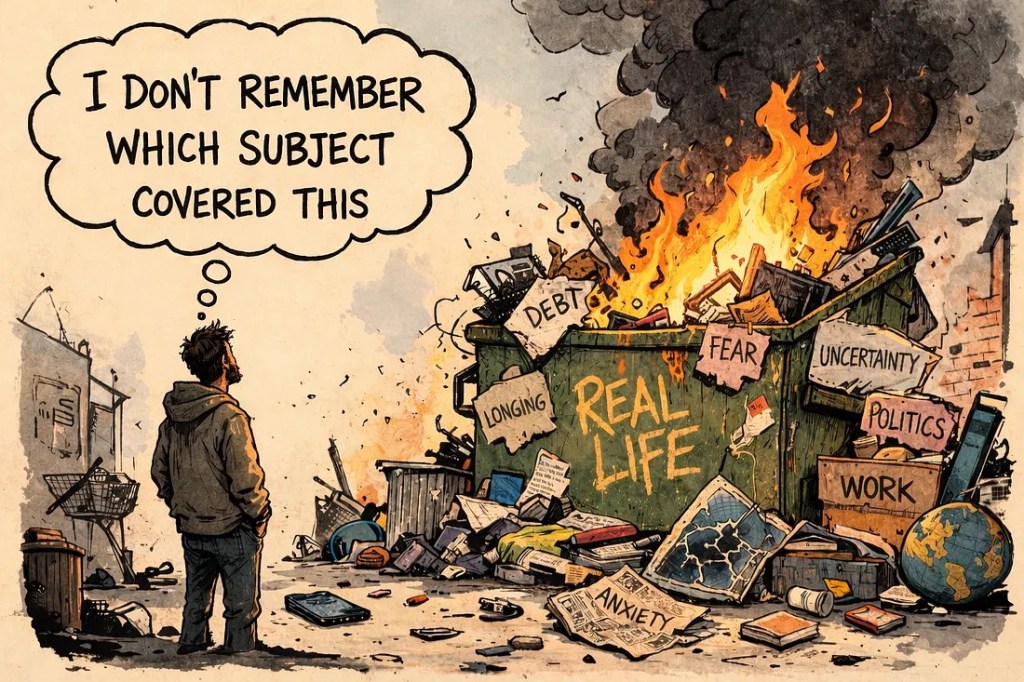
Life does not arrive in subjects.

A financial crisis is not economics. It is psychology, history, incentives, propaganda, institutional failure, and fear operating at once. Illness is not biology. It is money, labor, family, bureaucracy, grief, and mortality arriving together. Loneliness is not merely a private feeling. It is architecture, technology, work, romance, status, community, and meaning breaking down in a recognizable pattern.

Reality is not modular. It is entangled.

That is part of why so many people leave school with a disappointment they cannot quite name. They did what they were told. Learned the material. Passed the tests. Moved through the sequence. Then they entered adult life and discovered that reality does not present itself as a worksheet.

It presents itself as consequence.

That is the betrayal inside modern schooling. Not that it teaches facts, but that it too often mistakes fragmentation for understanding. Students are given pieces without pattern, procedures without orientation, answers without structure. They are trained to perform knowledge before they are taught how to organize reality.

For a long time, institutions could hide this weakness by controlling access to information. That was the old bargain. Sit still. Absorb the fragments. Repeat them back. We will certify that you know something.

That bargain is collapsing.

Information is everywhere. Explanation is instant. Summary is on demand. Generation is cheap. If education is merely the transfer of information, then large parts of the inherited model are about to be exposed by machines with humiliating ease.

This does not make my grandfather’s question obsolete. It makes it unavoidable.

What is worth learning when information is cheap?

The crisis is no longer information. It is orientation.

The central problem is no longer whether a person can retrieve facts, generate prose, summarize an argument, produce an image, or assemble code. The machine can assist with all of that. The deeper problem is whether a person can judge what is worth knowing, what is worth building, what is worth preserving, what is worth resisting, and what kind of intelligence a civilization should trust itself to become.

The machine is a tool. A powerful one. A dangerous one. Not because it thinks for us in some dramatic science-fiction sense, but because it amplifies whatever confusion already exists upstream.

The machine can generate almost anything. It cannot tell us what is worth becoming.

A culture that cannot answer questions of value will use powerful tools to accelerate its own disorientation. It will confuse fluency with understanding, output with insight, scale with wisdom, optimization with purpose. It will become more capable and less clear about why any of that capability should exist.

That is why my grandfather’s question now reaches far beyond school.

What is worth learning?

A person should learn how systems behave. How incentives bend institutions. How language hides power. How metrics deform the things they claim to measure. How technology reshapes attention, memory, and desire. How emotion alters perception. How to distinguish causes from symptoms. How to think across domains, across timescales, and across consequences. How to remain inwardly free inside environments built to colonize thought.

These are not luxuries. They are survival skills.

And they are difficult to teach inside the model we inherited because they do not belong neatly to any single subject. They live between subjects, across domains, inside relationships and consequences. They require synthesis, context, pattern recognition, and judgment.

That is the real educational question now.

Not how to cram more content into the pipeline.
Not how to optimize test performance.
Not how to produce students who can generate the approved answer in the approved format.

How do we cultivate minds that can actually perceive reality?

That was always the deeper force inside my grandfather’s work.

What is worth learning?

In an age of infinite information and machine generation, it may be the most important question we have.

Certain words have been censored from government documents, most especially those that refer to diversity, equity, and inclusion, meaning race, ethnicity, gender, and LGBT status.

The New York Times has kept a running list of “forbidden” words. The list does not include the exhibits that have been removed at public museums, public libraries, National parks, and other public institutions.

As President Trump seeks to purge the federal government of “woke” initiatives, agencies have flagged hundreds of words to limit or avoid, according to a compilation of government documents.

  • accessible
  • activism
  • activists
  • advocacy
  • advocate
  • advocates
  • affirming care
  • all-inclusive
  • allyship
  • anti-racism
  • antiracist
  • assigned at birth
  • assigned female at birth
  • assigned male at birth
  • at risk
  • barrier
  • barriers
  • belong
  • bias
  • biased
  • biased toward
  • biases
  • biases towards
  • biologically female
  • biologically male
  • BIPOC
  • Black
  • breastfeed + people
  • breastfeed + person
  • chestfeed + people
  • chestfeed + person
  • clean energy
  • climate crisis
  • climate science
  • commercial sex worker
  • community diversity
  • community equity
  • confirmation bias
  • cultural competence
  • cultural differences
  • cultural heritage
  • cultural sensitivity
  • culturally appropriate
  • culturally responsive
  • DEI
  • DEIA
  • DEIAB
  • DEIJ
  • disabilities
  • disability
  • discriminated
  • discrimination
  • discriminatory
  • disparity
  • diverse
  • diverse backgrounds
  • diverse communities
  • diverse community
  • diverse group
  • diverse groups
  • diversified
  • diversify
  • diversifying
  • diversity
  • enhance the diversity
  • enhancing diversity
  • environmental quality
  • equal opportunity
  • equality
  • equitable
  • equitableness
  • equity
  • ethnicity
  • excluded
  • exclusion
  • expression
  • female
  • females
  • feminism
  • fostering inclusivity
  • GBV
  • gender
  • gender based
  • gender based violence
  • gender diversity
  • gender identity
  • gender ideology
  • gender-affirming care
  • genders
  • Gulf of Mexico
  • hate speech
  • health disparity
  • health equity
  • hispanic minority
  • historically
  • identity
  • immigrants
  • implicit bias
  • implicit biases
  • inclusion
  • inclusive
  • inclusive leadership
  • inclusiveness
  • inclusivity
  • increase diversity
  • increase the diversity
  • indigenous community
  • inequalities
  • inequality
  • inequitable
  • inequities
  • inequity
  • injustice
  • institutional
  • intersectional
  • intersectionality
  • key groups
  • key people
  • key populations
  • Latinx
  • LGBT
  • LGBTQ
  • marginalize
  • marginalized
  • men who have sex with men
  • mental health
  • minorities
  • minority
  • most risk
  • MSM
  • multicultural
  • Mx
  • Native American
  • non-binary
  • nonbinary
  • oppression
  • oppressive
  • orientation
  • people + uterus
  • people-centered care
  • person-centered
  • person-centered care
  • polarization
  • political
  • pollution
  • pregnant people
  • pregnant person
  • pregnant persons
  • prejudice
  • privilege
  • privileges
  • promote diversity
  • promoting diversity
  • pronoun
  • pronouns
  • prostitute
  • race
  • race and ethnicity
  • racial
  • racial diversity
  • racial identity
  • racial inequality
  • racial justice
  • racially
  • racism
  • segregation
  • sense of belonging
  • sex
  • sexual preferences
  • sexuality
  • social justice
  • sociocultural
  • socioeconomic
  • status
  • stereotype
  • stereotypes
  • systemic
  • systemically
  • they/them
  • trans
  • transgender
  • transsexual
  • trauma
  • traumatic
  • tribal
  • unconscious bias
  • underappreciated
  • underprivileged
  • underrepresentation
  • underrepresented
  • underserved
  • undervalued
  • victim
  • victims
  • vulnerable populations
  • women
  • women and underrepresented

Notes: Some terms listed with a plus sign represent combinations of words that, when used together, acknowledge transgender people, which is not in keeping with the current federal government’s position that there are only two, immutable sexes. Any term collected above was included on at least one agency’s list, which does not necessarily imply that other agencies are also discouraged from using it.

The above terms appeared in government memos, in official and unofficial agency guidance and in other documents viewed by The New York Times. Some ordered the removal of these words from public-facing websites, or ordered the elimination of other materials (including school curricula) in which they might be included.

In other cases, federal agency managers advised caution in the terms’ usage without instituting an outright ban. Additionally, the presence of some terms was used to automatically flag for review some grant proposals and contracts that could conflict with Mr. Trump’s executive orders.

Some of the Trump regime’s efforts to censor history have been reversed. For example, it lost its fight to remove the Gay Pride flag from the Stonewall bar in Greenwich Village in New York City.

The New York Times reported:

The Trump administration has agreed to officially restore the Pride flag that was removed from the Stonewall National Monument in New York’s Greenwich Village. 

The move marks a reversal by the Trump administration, which had the flag removed back in February. It comes on the heels of a lawsuit brought by several nonprofit groups against Department of Interior Secretary Doug Burgum, the National Park Service and others. The agreement to restore the flag settles the lawsuit. 

The National Park Service said it removed the flag under guidance from the Department of Interior, which had said non-agency flags could not be officially displayed on flagpoles managed by the National Park Service. 

The court agreement says it will no longer be subject to the political whims of whoever is in power.   

“The whole reason why the flag belongs at Stonewall is because it is such a big part of the history of the LGBTQ community and the struggle for equality. Stonewall itself is obviously such a part of that history and all along what we asserted was that the flag itself was a representation of that history,” attorney Alexander Kristofcak said.

Advocates say the ruling could have a national impact at other places where the Trump administration has sought to combat diversity initiatives. For example, the Trump administration removed an exhibit on George Washington’s ownership of slaves from Independence National Historical Park in Philadelphia

But in February 2026, a federal judge ordered the restoration of the Philadelphia exhibit.

Politico reported that Judge Cynthia Rufe wrote a “withering opinion” in which she compared the Trump administration’s stance to George Orwell’s 1984. It was an effort, she said, to eliminate the truth by an administration that did so because it could. No, you can’t, she ordered.

Today, I read Robert Reich’s commentary on a remarkable event: A bipartisan group of 35 former federal judges asked Federal Judge Kathleen J. Williams to reopen the case that culminated in a deal between President Trump and Acting Attorney General Todd Blanche, who had been Trump’s personal lawyer before the 2024 election.

The “settlement” between Trump and Blanche handed over $1.776 billion to a commission controlled by Trump, and in another part of the “settlement,” Blanche agreed that neither Trump nor his family members would be audited by the Internal Revenue Service.

The retired judges said that Trump and Blanche may have deceived the court and perpetrated a fraud.

Judge Williams agreed to investigate and gave Trump and Blanche until June 12 to respond.

Reich wrote:

I can’t overstate the importance of Judge Kathleen Williams’s decision on Friday to reopen Trump’s $10 billion case against the I.R.S. 

She said she wants to investigate “grievous allegations” that the hasty deal to resolve it was “premised on deception,” and she ordered Trump’s lawyers to tell her by June 12 whether the lawsuit should be formally reopened because “the court was the victim of a fraud.”

The “deception” and “fraud” Judge Williams refers to were allegedly carried out by Trump and his Justice Department.

This is a big deal. 

Judge Williams’s decision came in response to court papers filed on Wednesday by a bipartisan group of 35 former federal judges who urged her to revive the case and dig into the details of the agreement to settle it. 

The judges’ brief is also a big deal. They call it a motion for relief from judgement or order or, alternatively, “leave to appear as amici curiae by thirty-five former federal judges.” 

I don’t recall a similar instance of 35 former federal judges filing such a motion or amicus (friend of the court) brief. 

In it, the judges argue that the parties’ — Trump and the Justice Department’s — so-called “settlement” agreement was made to circumvent the court ‘s possible finding that the case presented no actual controversy, since Trump is on both sides of it. 

This, they conclude, constituted a fraud on the Court.

I wanted to read the brief by the 35 judges. I did. You should read it too. It is linked in the next paragraph from Reich’s post.

Judge Williams’s decision came in response to court papers filed on Wednesday by a bipartisan group of 35 former federal judges who urged her to revive the case and dig into the details of the agreement to settle it.

Read it yourself. The judge had previously raised the question of whether Trump’s $10 billion lawsuit was genuine, since he seemed to be suing himself. Had the case gone to trial, she might have tossed it, since there were not two genuine adversaries.

The parties decided to withdraw their lawsuit and quickly reached an agreement that was highly beneficial to Trump (the slush fund and freedom from audits).

The former judges smelled a rat and took the unprecedented step of joining together to petition Judge Williams.

Alan Feuer and Andrew Duehren wrote in The New York Times today:

A federal judge in Miami reopened President Trump’s $10 billion case against the I.R.S. in a striking turnabout, saying that she wanted to investigate “grievous allegations” that the hasty deal to resolve it was “premised on deception.”

The ruling by the judge, Kathleen M. Williams, on Friday to revive the case shortly after closing it was a significant blow both to Mr. Trump, who had voluntarily dismissed the suit last week, and to the Justice Department. After the president withdrew the suit, senior department officials released a pair of extraordinary agreements that settled the case by establishing a $1.8 billion fund to compensate people who claimed they were victims of government “weaponization” by Democrats.

The deal also conferred lucrative tax benefits on Mr. Trump, his family and his businesses.

Judge Williams’s decision came in response to court papers filed on Wednesday by a bipartisan group of 35 former federal judges who urged her to bring the case back to life and dig into the details of the agreement to settle it.

The former judges said that Mr. Trump’s settlement agreement raised serious questions about his “candor toward the court and manipulation of the judicial system.”

Before she closed the case, Judge Williams, an Obama appointee, had in fact questioned whether the lawsuit presented an actual conflict that she could adjudicate, given that Mr. Trump was on both sides of the suit, bringing claims against a federal agency that he controlled. When she closed it, she noted there was no “settlement of record,” but shortly after, the Justice Department released its agreement foreclosing the action.

In her brief but stern order on Friday, Judge Williams said that she wanted to investigate the circumstances surrounding Mr. Trump’s efforts to settle the lawsuit in a way that benefited him and his allies. If she succeeds in moving forward with her inquiry, it could ultimately result in questions being asked of the Justice Department leaders who signed the agreements to settle the suit — chief among them, Todd Blanche, the acting attorney general, and Stanley Woodward Jr., the No. 3 official in the department.

In her order, Judge Williams asserted that she was “empowered to investigate serious misconduct” in any case before her, and ordered Mr. Trump’s lawyers to tell her by June 12 whether the lawsuit should be formally reopened because “the court was the victim of a fraud.”

She also wanted Mr. Trump’s lawyers to respond to the question of whether he had colluded with his own government to settle the case “to avoid judicial scrutiny.”

The White House did not immediately respond to a message seeking comment.

Judge Williams pointed to reporting by The New York Times that described how the I.R.S. had prepared a 25-page memorandumoutlining defenses against the suit that the Justice Department did not take up in court.

Lawyers for the former judges hailed Judge Williams’s decision.

“The judges and their counsel greatly appreciate the seriousness with which the court is addressing these grievous allegations,” said Norman Eisen, who represented the former judges for the nonprofit group, Democracy Defenders Fund. “We stand ready to work with the court as it investigates this matter.”

Mr. Eisen was joined by the law firms Platkin and Susman Godfrey.

In their filing this week, the former judges claimed that Mr. Trump had improperly used his suit against the I.R.S. as a way to obtain “unlawful private benefits” for himself and his family, and to create a fund that would dole out taxpayer money “without constitutional or congressional authority.”

They also argued that the president had tried to shield the deal from judicial oversight by rushing a settlement and “short-circuiting” Judge Williams’s ability to examine its terms.

The $1.8 billion fund has faced separate legal headwinds. A federal judge in the Eastern District of Virginia temporarily blocked the Trump administration from taking any further steps to set it up or disburse money from it. Lawmakers on Capitol Hill, including many Republicans, have also been critical of the fund, which upended G.O.P. plans to pass a party-line bill funding immigration enforcement efforts last week.

Mr. Trump, along with two of his sons and the Trump family business, first sued the I.R.S. in January, claiming they were owed at least $10 billion because a former contractor at the agency had leaked their tax returns (and hundreds of others) during the president’s first term in the White House. The Trumps claimed that the I.R.S. should have done more to prevent the contractor, Charles Littlejohn, from disclosing tax information to The New York Times and ProPublica.

Mr. Trump’s suit, as I.R.S. officials laid out in their memo and other lawyers have noted, had clear legal flaws. Potential defenses against it include that it was filed after the statute of limitations, and that it incorrectly faulted the I.R.S. for the actions of Mr. Littlejohn, previously a contractor employed by Booz Allen Hamilton. But the Justice Department never made an attempt to contest Mr. Trump’s suit. No government lawyer entered an appearance in the case.

That has fueled criticism that the deal the Justice Department struck with Mr. Trump was not a genuine attempt to avoid a loss on the merits to the president in court, but instead a scheme to provide him and his political allies with public benefits.

In a footnote, Judge Williams questioned the provision granting Mr. Trump, his family and their businesses immunity from I.R.S. scrutiny of tax returns they had already filed. She wrote that the audit protection may run afoul of Justice Department rules requiring legal settlements to directly relate to the issues in the suit.

She also noted that only Mr. Blanche signed the audit provision. The separate, nine-page agreement laying out the $1.8 billion fund was signed by Mr. Woodward and Frank Bisignano, who is serving as the chief executive officer of the I.R.S., a newly created role that is not subject to Senate confirmation.

Here is NPR’s summary.