Florida, under the thumb of its rightwing extremist Governor Ron DeSantis, has had a hard time hiring a new president for its state university.

Last year, the search committee selected Santo Ono, the president of the University of Michigan, as its candidate. However, the university’s Board of Governors voted against the nomination of Ono because of his work to diversify the University of Michigan, which was contrary to the anti-DEI policies that DeSantis championed.

Now the search committee has selected Stuart Bell, the president of the University of Alabama, to be the president of the University of Florida.

The Chronicle of Higher Education reported that rightwingers are outraged by the choice of Bell. They contend that Bell is a proponent of DEI.

Under Bell’s decade-long tenure at the University of Alabama, Black and Latino enrollment doubled after he launched an aggressive diversity campaign in response to a series of racist incidents…

Opposition to Stuart Bell’s nomination to be president of the University of Florida grew this week with several prominent conservative activists, a Trump appointee, and a U.S. senator weighing in.

Activists from the Manhattan Institute argued that Bell is an ideologue who during his tenure as president of the University of Alabama discriminated against white people in his efforts to diversify the student body and faculty.

Even the Secretary of Education Linda McMahon suggested that the University of Florida should pick a different president, not Bell, tainted by DEI.

The U.S. Supreme Court has been asked to approve religious charter schools. Given their disregard for the principle of separation of church and state, the majority might approve the idea. This would be yet another raid on the funding of public schools.

We hope this information is helpful to your state.

FOR IMMEDIATE RELEASE May 26, 2026

Network for Public Education Applauds New Research Brief Warning States of Religious Charter School Threat

Researchers Offer Clear Legislative Path to Ensure Charter Schools Cannot Engage in Discrimination

[New York, New York] — The Network for Public Education (NPE) today praised the release of a critical new policy brief examining the looming threat posed by anticipated U.S. Supreme Court decisions on religious charter schools. Avoiding the Supreme Court’s Religious Charter-School Trap: Governance Change for the New Legal Era, authored by Kevin G. Welner (University of Colorado Boulder), Carol Burris (NPE Executive Director), and Preston C. Green III (University of Connecticut), offers states a concrete legislative roadmap to safeguard public education before it is too late.

Forty-two states and the District of Columbia face sweeping changes to their charter school systems as the Supreme Court appears poised to deliver what the brief calls a “one-two punch.” In the coming terms, the Court is expected first to establish a free-exercise right for taxpayer-funded religious schools to engage in faith-based discrimination, and then to prohibit states from excluding religious organizations from running independent charter schools — effectively exempting religious charter schools from the anti-discrimination and accountability laws that apply to all public schools.  

The brief makes clear, however, that states are not helpless to act.  States that structure charter governance through public entities — rather than private, independent organizations — are shielded from the Court’s free-exercise reasoning. Four states, Alaska, Kansas, Maryland, and Virginia, already place all charter schools under publicly elected school boards and are therefore already protected. Nine additional states allow district-governed charters as well as independent charters, thus shielding some of their charter sector.  

“State legislators can head off the Court’s radical change by strengthening the fundamental publicness of their charter schools,” said Welner. “Legislators can protect the charter-school sectors against the imposed transformation by changing how they are governed.”

NPE President Diane Ravitch applauds this research for providing exactly the kind of actionable guidance that policymakers urgently need. “District-governed charter schools not only preserve civil rights protections and constitutional safeguards — they also provide stronger financial oversight, reduce the risk of mismanagement and fraud, and give voice through their elected school boards.”

The full brief is available at: https://nepc.colorado.edu/publication/religious-charter

###

The Network for Public Education is a nonprofit advocacy organization committed to protecting, preserving, and strengthening public schools.

Jonathan V. Last of The Bulwark explained why Trump’s $1.776 billion slush is such a powerful tool for a crafty mob/boss.

Last wrote:

We’ve been thinking too narrowly about the $1.776 billion pot of taxpayer money that Donald Trump will soon control.

Most people assumed Trump would use it to pay off meathead insurrectionists, sort of a . . . treason stimulus.

Absolute gold.

Others believed that while Dummkopf MAGA might get a couple bucks here and there, the real money would be funneled to Trump family members and organizations.

But the Slush Fund from Hell—or whatever we’re calling it—is much more useful than any of that. It’s a multitool for corruption and maintaining MAGA discipline. Let me explain.


You have to respect Trump as an innovator. He saw that private lawsuits could be used as a way to legalize bribery and extortion—that’s what his defamation suits against CBS and ABC were.¹

Trump understood that while it might be illegal to go to CBS and ABC and demand that they pay him protection money, he could use a civil lawsuit as justification for creating a private legal contract that amounted to the same thing.

He further understood that if he filed a civil suit against the U.S. government and then became president, he could direct the government to settle with him on whatever terms he desired.

These are ideas which seem to have occurred to no one in American history prior to Trump. When it comes to corruption, the man knows how to think laterally.

So what sort of lateral uses could he make of a $1.776 billion fund which he controls completely? There are two big ones.


The obvious one is bribery. As we discussed last week, Trump can turn the fund into fee-for-service. You give him a thing he wants—a vote, a certification, a report—and then you get compensated at a later date.

But the subtle one is something else altogether. It’s about holding people on side.


One of the striking design details about the fund is that it disappears just before Trump leaves office. It is sunset so that it can never be directed by anyone other than Trump.

Think about how this is likely to work in practice.

If you were Trump, would you pay out money before your last days in office? 

Because I would not.

The optimum strategy is for Trump to pay a couple people early, just to validate the fund’s existence. After that he should encourage anyone and everyone to apply for compensation. And then he should wait.

Because open applications give him leverage over people.

As a for-instance: Two days ago Mike Flynn almost criticized Trump about making a deal with Iran. Do you think people will be willing to do even that much if they have compensation applications pending that could be worth millions of dollars?


Another reason Trump should wait to disburse funds is that he can implicitly promise to pay more than $1.776 billion. Think about it: $1.776 billion is a lot of money, but it’s only 1,700 million-dollar portions. If Trump starts paying people right away, the fund gets drawn down and people start to realize that maybe they won’t get anything from it.

But if the nut is largely intact, everyone in MAGA world can dream. Trump can pass out tens of billions of dollars worth of promises—Don’t worry, we’ll take care of you; you just have to wait a little bit longer—with everyone thinking that, since he’s going to pay up at the very end, there’s enough cash for them to get theirs.


Second-term presidents become politically weak when members of their party realize that their incentives are diverging from the POTUS.

Maybe the POTUS is becoming unpopular, so candidates need to distance themselves from him. Maybe party elites are thinking about the future and how to take over once the old man is gone.

The slush fund is a tool to fix that problem. It’s the promise of a tangible reward for Republicans to stay on his side. Be nice to him. Do what he asks. Don’t freelance. And maybe there’s a pot of gold for you at the end of the rainbow.


The slush fund won’t work on everyone. Some Republicans will be secure enough that they don’t need Trump’s money. Some will be ambitious enough that they’re willing to forgo the uncertain promise of a payout for a shot at the title.

But it’ll work for some of them. It will encourage them to modulate what they say. And within the rest of the Republican ecosystem, having more people on-side than there otherwise would be will have a force-multiplier effect. Seeing people stick with Trump will cause more people to stick with Trump.

Watch what happens in the coming days with the Iran deal. See how many defections there are. And then ask yourself: How many of those people who suddenly get with the program are hoping to apply for some compensation from their president?

Paul Thomas taught in South Carolina public high schools for many years, then became a professor of education at Furman University. He is an articulate critic of the decades-old “crisis in education.”

If you are confused by the different fonts, please open the link to read the original article.

He wrote:

People try to put us d-down (Talkin’ ’bout my generation)
Just because we get around (Talkin’ ’bout my generation)
Things they do look awful c-c-cold (Talkin’ ’bout my generation)
I hope I die before I get old (Talkin’ ’bout my generation)
“My Generation,” The Who

Born in 1961, I am a young boomer, but a boomer none the less.

I began teaching high school English in the ominous year of 1984, my first students having been born at the end of the same decade as I had, the 1960s.

That means across my career as an educator, I have taught most living generations, including my own. My grandchildren as Generation Alpha.
It does seem valid to note that humans experience generational shifts that can be identified in fair ways, especially in ways that may help those of us who teach better serve our students.

Those characteristics, however, are not universally defining and the cut off dates we decide are more blur than fact.

Being at the end of the boomer generation makes me often quite similar to Gen X folk I meet, including the first wave of students I taught high school.

What seems less valid, is the historical and current urge older generations have to negatively characterize younger generations, often through never-ending cycles of crying “Crisis!,” especially about education (notably reading and math).

The US has been riding a high tide of crisis rhetoric about reading—both that students can’t read and the students don’t read—for about a decade now.

It seems this cycle of crisis has reached a new stage according to The New York Times:

A report on the new data describes a decade-long “learning recession.”…
Students’ test scores had been increasing since 1990 — then abruptly stopped in the mid-2010s. That coincided with two events: an easing of federal school accountability under No Child Left Behind, which was replaced in 2015, and the rise of smartphones, social media and personalized school laptops.

The decade analyze attempts to compare, even with the caveat above, learning using test data that itself has shifted several times and ways even in a relatively brief decade window.

As I have noted about reading proficiency, the US has no standard definition of “reading proficiency” or “grade-level reading,” but instead, we have NAEP achievement levels (that are confusing and misleading) drawn from random sampling about every two years along with annual (except for the Covid blip) testing at the state level, where every state establishes its own cut scores for proficiency (with most state proficiency level overlapping with NAEP “basic”).
Analyses such as these also suffer from compelling but questionable metrics such as days, months, or years of learning. What metric researchers choose and then how data is displayed significantly impacts how the conclusions are interpreted.

Unfortunately, most analyses of education are designed to create the appearance of crisis.
While this rhetorical shift to “learning recession” is yet another oversell that likely will do more harm than good, the immediate responses should prompt even greater skepticism:

Tweet by David Frum, May 13, 2026:

Seven months ago, the David Frum Show hosted former Education Secretary Margaret Spellings for a discussion of why US K-12 scores are declining. Her answer: the decline in testing and accountability since 2015.

Resurrecting former Secretary of Education Spellings deserves a reminder about her misinformation and misunderstanding concerning tests data, which she used to falsely claim success for NCLB (the testing and accountability she is sad to see gone, although that claim isn’t true either):

During President George W. Bush’s tenure, NCLB was a corner stone of his agenda, and when then-Secretary Spellings announced that test scores were proving NCLB a success, Gerald Bracey and Stephen Krashen exposed one of two possible problems with the data.

Spellings either did not understand basic statistics or was misleading for political gain. Krashen detailed the deception or ineptitude by showing that the gain Spellings noted did occur from 1999 to 2005, a change of seven points. But he also revealed that the scores rose as follows: 1999 = 212; 2000 = 213; 2002 = 219; 2003 = 218 ; 2005 = 219. The jump Spellings used to promote NCLB and Reading First occurred from 2000 to 2002, before the implementation of Reading First. Krashen notes even more problems with claiming success for NCLB and Reading First, including:

“Bracey (2006) also notes that it is very unlikely that many Reading First children were included in the NAEP assessments in 2004 (and even 2005). NAEP is given to nine year olds, but RF is directed at grade three and lower. Many RF programs did not begin until late in 2003; in fact, Bracey notes that the application package for RF was not available until April, 2002.”

This recent claim from Spellings, then, must be taken with a gigantic grain of salt because most politicians see education crisis as an opportunity to score political points, not as a way to better serve students.

That we are really about to have testing and accountability nostalgia sold to us is almost laughable—if it weren’t so insidious.

Reasonable people have noted that our testing obsession has resulted in deforming what and how students read, more passages to answer question and less whole book reading.

But research being ignored, makes the opposite and evidence-based argument from Spellings’s self-serving observation:

Almost 63% of the variance in test performance was explained by social capital family income variables that influence the development of background knowledge. Background knowledge is a known predictor of standardized test results. Family income variables are immutable by schools. Only public policies, outside the control of school personnel, can influence family income….
Policy makers and education leaders should rethink the current reliance on standardized test results as the deciding factor to make decisions about student achievement, teacher quality, school effectiveness, and school leader quality. In effect, policies that use standardized test results to evaluate, reward, and sanction students and school personnel are doing nothing more than rewarding schools that serve advantaged students and punishing schools that serve disadvantaged students.

Crisis rhetoric has never and will never serve even good intentions well in terms of seeking better ways to serve the needs of all students, regardless of the generational differences.
But let’s also resist this new push to go back (?) to the good ol’ days of testing and accountability NCLB-style.

Let’s instead recycle an old (and silly then) chestnut from the Reagan era.

When it comes to crisis rhetoric as well as testing and accountability in education reform, just say no.

See Also

The Reading Crisis Paradox: On Moral Crisis and Thought-Terminating Clichés

How to Manufacture Crisis with Line Charts: NAEP Reading Edition

Recommended: Reading educational research: How to avoid getting statistically snookered, Gerald Bracey (2006)

“Kids Today”: Perpetually Dumb and Lazy as a Box of Rocks

Reading Crisis 1961: Tomorrow’s Illiterates
1959: “yet students enter college badly lacking in these fundamental skills”

Reading Full Books in Secondary English Language Arts Classrooms

The U.S. Supreme Court was designed to be a separate branch of government, the one that monitored the adherence to the Constitution by the other two branches. The Court disappoints sometimes, but it has never been as nakedly partisan as it is under Chief Justice John Roberts. The far-right wing of the Republican Party has a reliable friend at the Court.

It’s hard to say which of their decisions is the worst.

Some might say it was their recent decision to overturn the Voting Rights Act, which will sharply reduce the number of Black members of Congress.

Some might say it was their decision to overturn Roe v. Wade, despite promises by most of them not to do so.

Some would say it is their decisions that tear down the wall of separation between church and state.

I say it was their decision in Trump v. United States, in which the majority decided that the president was above the law and could not be charged for anything he did while in office as part of his official duties. We can be certain that the same court would claim that whatever he did was part of his official duties, including tearing down the East Wing of the White House without seeking anyone’s approval.

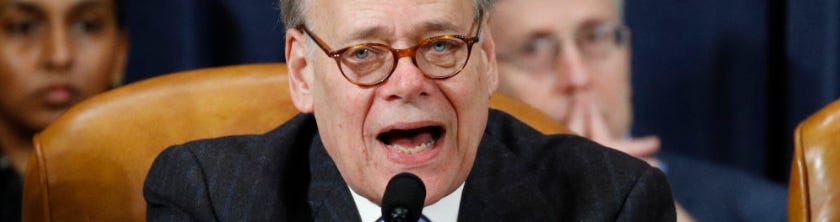
Representative Steve Cohen of Tennessee has had enough. He introduced six articles of impeachment of Chief Justice John Roberts. Good for him!

Scott Dworkin reported on his blog:

Rep. Steve Cohen

Rep. Steve Cohen has represented Memphis, Tennessee, for 19 years. Republicans cut his district into pieces, and he decided to retire—but not without a fight.

Cohen told The Dworkin Report in 2019: “[Trump’s] life has been one crime after another. One misdeed after another. One lie after another.” Now he’s applied that same standard to the man who put Trump above the law.

On May 21, Cohen introduced six articles of impeachment against Chief Justice John Roberts. Charges include allowing the Court to become a partisan weapon, placing the president above the law, endorsing a corrupt campaign finance system, and failing to recuse himself while his wife collected millions recruiting attorneys for law firms with cases before the Court.

Cohen was direct: “Under Chief Justice Roberts’ stewardship, [The Supreme Court] is now understood as biased: with decisions designed to benefit Republicans at the expense of representative government.”

They gerrymandered Cohen’s district to silence him. John Roberts now has six articles of impeachment to his name—an award no other Chief Justice has ever received in US history.

South Carolina has 7 Congressional seats. one is held by a person who is Black, Rep. Jim Clyburn. Trump urged the South Carolina legislature to redistrict and turn every seat into a Republican district.

The SC House passed a bill to redistrict. The SC Senate rejected the bill. Twelve Republicans joined 12 Democrats to say no.

Some said they wouldn’t pass the bill because early voting had started and the election was underway. Some must have felt that it was wrong to eliminate the only district with a Black Congressman.

Whenever any Republican has the spine to say NO to the Grifter-in-Chief, it’s a good day for democracy.

Adam Kinzinger, former member of Congress, reports on the Trump administration’s cruel policy of separating children from their parents–even when one or both of their parents are U.S. citizens.

He writes:

Report Reveals Trump Has Separated 100,000 Children From Their Parents — and 75% Are U.S. Citizens

In a brand new Brookings Institution report, researchers estimate around 145,000 U.S. citizen children have had a parent detained since Trump returned to office. About 22,000 have had every parent in the home taken into custody. More than a third of those children are under six years old.

And here is the part that should stop you cold. Only about five percent of these children have been touched by the child welfare system. The other 95 percent are scattered: some with relatives, some left the country with a deported parent, some simply unaccounted for in any government data.

The Department of Homeland Security responded with a sentence they have been recycling for a year: ICE “does not separate families.” That is the official line while 145,000 American kids are missing a parent.

In Trump’s first term, family separation at the border ended in 2018 because the country saw the photos and refused to live with it. This time around it is more than twenty times bigger, it is happening in our cities rather than at the border, and the official government response is to deny the separations are happening at all.

A group of activists in Colorado speaks out against standardized tests. Angela Engels’ article was printed in the Colorado Times Recorder.


A Message from Judy Solano, Chair, A4PEP (Advocates for Public Education Policy).

“It takes courage to speak out about the injustices in the world, especially when policy-makers funded by wealthy education reform organizations hold the power.  May we all be warriors in the battle for truth.”

COLORADO TIMES RECORDER

Test-Based Accountability Is Failing Colorado’s Children

by Angela Engel                                                       May 15, 2026

As the Colorado General Assembly wraps up the 2026 session, lawmakers once again failed to confront one of the most costly and disruptive features of public education: high-stakes standardized testing.

Key legislative proposals that would have addressed the burden of high-stakes testing were defeated again. SB26-068would have reduced CMAS standardized tests to the minimum extent possible, and HB26-1291 would have reduced teacher evaluations for non-probationary teachers from annually to every three years. Both had bipartisan sponsorship and were supported by teachers, parents, and community members, but opposed by billionaire-backed education reform lobbyists.

memorial backed by the Advocates for Public Education Policy (A4PEP), urging Congress to return authority to locally elected school boards, as provided in the eww hearing.

These decisions deserve more than a procedural explanation.

The issue of high-stakes testing is neither marginal nor new. Since the passage of No Child Left Behind in 2002, policymakers have imposed lengthy and expensive criterion-referenced standardized tests on students, then incorrectly used that data to make high-stakes decisions about teacher pay and school closures. Because test scores are most closely correlated with income, policymakers have tolerated the practice of closing schools in low-income neighborhoods at the expense of our most vulnerable students.

A 2014 study showed that Colorado’s testing requirements cost up to $78 million annually in combined state and district expenditures. Adjusting for inflation, that would equal more than $100 million today. Approximately 450,000 students spend an average of 20 hours of classroom instruction each year on these assessments — more than 9 million hours diverted away from teaching and learning.

Meanwhile, the number of students identified as at-risk has increased by 118%, more than doubling since 2000. After more than two decades, the results of this approach are clear. Achievement gaps have not closed. Teacher attrition continues to rise. Families increasingly question a system that prioritizes testing over learning, with many choosing to opt out altogether.

This is not a policy in need of minor adjustment. It is an accountability structure that has failed to deliver on its core promises — and it deserves fundamental sreplacement. And yet, it remains firmly in place. Not because the evidence is unclear, but because the accountability system itself is protected.

Standardized testing is no longer just an educational tool. It is embedded in a network of contracts, compliance requirements, testing vendors, consulting firms, and political interests backed by well-funded lobbying efforts. There are real financial and political incentives to preserve it, regardless of outcomes.

Spending more than $100 million annually on a system that continues to produce the same disparities while costing students millions of hours of learning time reinforces a governance model that rewards compliance and discourages challenge.

This climate — where profits and political interests are prioritized before children — did not emerge on its own. It has been shaped over time by a campaign finance system that rewards candidates who support policies centered on test-based school accountability.

When you see something wrong, something inhumane, don’t just say something. Do something. It’s time policymakers stop protecting harmful practices and confront the consequences of policies that continue to waste taxpayer dollars, diminish learning opportunities, and drive many of our most talented and experienced teachers from the profession. After twenty-five years, the ramifications of inaction are impossible to ignore.

Public education should not revolve around protecting systems, contracts, corporate profits, or political interests. It should revolve around children. Colorado students deserve a well-rounded education that values critical thinking, creativity, and civic engagement over excessive testing and data collection. For too long, corporate education groups and privatizers have robbed students of a meaningful education and carefree childhood. This accountability model offers the illusion of control while costing Colorado a future of empowered, well-educated leaders.  

To view the planned Senate memorial, click here.  

Angela Engel is a mother, educator, and facilitator. Learn more on her website, www.angelaengel.comDon Perl, Judy Solano, Mike DeGuire, and Manuel Solano contributed to this article.  https://coloradotimesrecorder.com/2026/05/test-based-accountability-is-failing-colorados-children/79032/

What’s the best antidote to the MAGA claim that America was made by white Christians for white Christians? Here is her answer.

For a while now, I’ve been hinting that my team was up to something. And tonight, at last, I have an announcement.

Last August, during one of my Politics Chat webcasts, at a time when those trying to impose white nationalism, Christian nationalism, or authoritarianism on our country insisted they were embracing American values, I urged people instead to see those who care about the preservation of democracy and who have worked to expand its values as the people who truly represent America.

That idea appealed strongly, apparently, to the two young women we had recently hired to manage my social media accounts and to produce the historical videos we’ve been putting up. As we kicked around ideas for our own celebration of the nation’s 250th anniversary, they kept coming back to the idea from that Politics Chat: that “we…are America.”

So, to honor the 250th anniversary of the Declaration of Independence, we decided to launch a series of one-minute videos that highlight the people, places, and events that have helped to move us toward a more perfect Union.

We designed the videos to emphasize the agency of Americans—mostly everyday Americans—to change the country. Each falls into a category that defines what it means to be an American, including community, democracy, innovation, mobility, civil rights, education, conservation, and creativity.

When we floated the plan, lots of wonderful people all over the country understood the idea immediately and jumped in to help, suggesting topics, writing scripts, offering images, narrating.

We’re launching the project tomorrow with the stories of the Battles of Lexington and Concord, narrated by Massachusetts Governor Maura Healey; the Women’s Armed Services Integration Act, narrated by Representative Chrissy Houlahan of Pennsylvania; the Constitutional Convention (I narrated that one); Ruben Salazar, narrated by journalist Sylvia Salazar; Yellowstone, narrated by former senator Jon Tester of Montana; the AIDS Quilt, narrated by originator Cleve Jones; the Acadians, narrated by historian Jason Herbert; the Erie Canal, narrated by former secretary of transportation Pete Buttigieg; John Peter Zenger and the First Amendment, narrated by journalist Jelani Cobb; the Charter Oak, narrated by Senator Chris Murphy of Connecticut; Thomas Paine’s Common Sense, narrated by Representative Jamie Raskin of Maryland; and the story of actress and dancer Rita Moreno, narrated by Academy Award winner Ariana DeBose.

For the next several weeks, we will be telling these stories and hundreds more. We hope that you will share them widely to flood social media with the real story of how Americans have always worked, often against seemingly insurmountable odds, to create a more perfect Union.

What has made America great has always been the American people.

Now, as for the past 250 years, “We Are America.”

Humorist Andy Borowitz praises Donald Trump for his tribute to the Unknown Podiatrist.

QUEENS, NEW YORK (The Borowitz Report)—In what has become a Memorial Day tradition for him, on Monday Donald J. Trump laid a wreath at the Tomb of the Unknown Podiatrist.  

Trump made his annual pilgrimage to pay homage to the heroic doctors who issued bogus diagnoses to ensure that their privileged patients never answered the call of duty. 

In an emotional tribute, Trump thanked the fallen foot specialists who bravely risked their medical licenses so that others facing military service could be free. 

Choking back tears, he said, “They gave everything so people like me could give nothing.”

Actually, Trump’s podiatrist is not unknown.

The New York Times published an article in 2018 stating that the daughters of the Trump podiatrist claimed that their father, Dr. Larry Braunstein, had given Trump the bone spur diagnosis to help him evade the draft. It was a favor to his landlord, Fred Trump, Donald’s father.

The podiatrist, Dr. Larry Braunstein, died in 2007. But his daughters say their father often told the story of coming to the aid of a young Mr. Trump during the Vietnam War as a favor to his father.