Archives for category: Texas

Michelle H. Davis writes a thoughtful blog on Substack called “Lone Star Left,” where she reports incisively on politics in Texas. This column explains how white supremacists keep Blacks and Hispanic unrepresented and disenfranchised: gerrymandering voting district. What’s happening in Texas is happening in other states, especially the South.

It’s hard to remember that Congress passed the Voting Rights Act in 1965.

Davis writes:

In the early 1960s, Black residents in Leflore County, Mississippi, comprised two-thirds of the population. Despite that, they had no political representation. In 1962, when voter registration of Black voters increased, the all-white Board of Supervisors (similar to a Commissioners’ Court in Texas) cut off federal surplus food aid, a lifeline for over 20,000 poor Black sharecroppers and farmworkers. This move came to be known as the Greenwood Food Blockade.

This move by the white Board of Supervisors exacerbated widespread poverty-induced hunger and malnutrition among Mississippi Delta sharecroppers. This laid the groundwork for long-term food insecurity, economic marginalization, and ongoing inequality in Mississippi that persists to this day.

This pattern is not new. Every time Black Americans have taken even a step toward political power, white supremacy has moved to snatch it back. In Greenwood, it meant starving families to stop them from voting. In Tarrant County today, it means redrawing district lines to erase Black representation, again, by a white-majority governing body.

What happened in Mississippi in 1962 wasn’t just about food. It was about control. And what happened in Tarrant County today isn’t just about maps. It’s about the same thing.

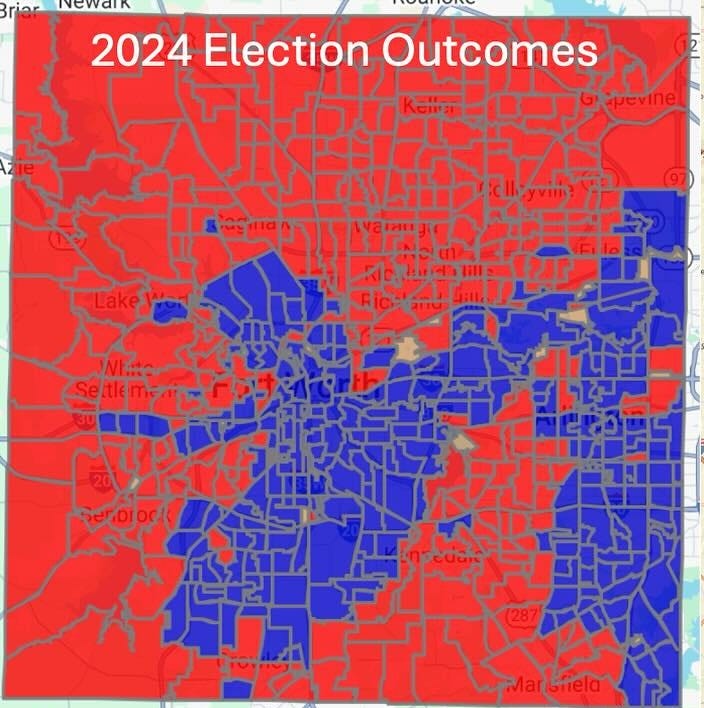
Today, the Tarrant County Commissioners Court voted to approve a redistricting map that effectively eliminates the seat of Commissioner Alisa Simmons, the only Black woman on the court.

It’s not a coincidence. It’s not neutral. It’s not “routine.” It is the calculated removal of a voice that dared to speak up for all of us.

Commissioner Simmons has stood firmly against the racist agenda pushed by Judge Tim O’Hare and the Republican Commissioners on the court. She spoke out against the rise in jail deaths under their watch. She called out the cruelty of defunding Girls Inc., a nonprofit that empowers young women of color. She opposed the elimination of free rides to the polls, which made it harder for working-class people, especially Black and brown voters, to cast a ballot.

And now, she’s being punished for it.

Commissioner Simmons wasn’t just a name on a ballot. She is my commissioner. I voted for her. I campaigned for her. And like thousands of others in Precinct 2, I saw her as a voice for the voiceless, a woman unafraid to shine a light on white supremacy, even when it came dressed in a suit and tie.

That light scared them. So they tried to snuff it out.

What we witnessed today was retaliation. It was white supremacy striking back at a Black woman who told the truth. And just like in Greenwood in 1962, they’re using the tools of power, maps, votes, and bureaucratic language, to do what they couldn’t do in public: silence her.

But we see it. We name it. And we will fight it.

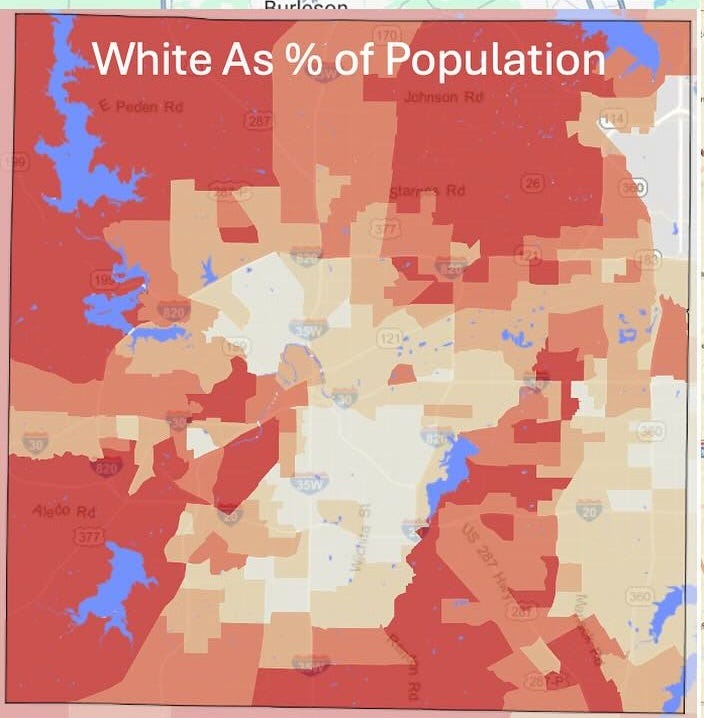
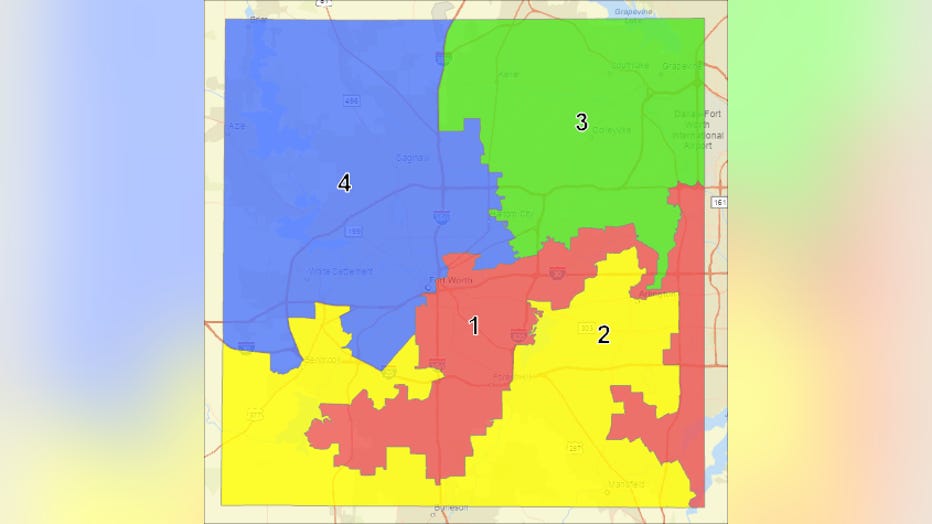
The new map that the County Commissioners voted on today.

The Republican Commissioners and their defenders kept repeating the same excuse over and over again, “This wasn’t about race. It was just about politics.”

They said the map was designed to secure a Republican majority, not to silence Black voters. As if those two things aren’t deeply intertwined.

It’s the same argument Greg Abbott’s lawyers made in Shannon Perez v. Abbott, when Texas was caught racially gerrymandering districts. Their defense?

A direct quote from Greg Abbott

“It is not our intent to discriminate against minorities. It is our intent to discriminate against Democrats. If minorities happen to vote Democrat, that is their fault, not ours.”

That’s not a denial. That’s a confession….

Let’s stop pretending this distinction between race and party means anything in Texas. In Tarrant County, in Harris County, across the South, voter suppression by “party” is voter suppression by race. When you target the communities who dare to elect Black women, working-class progressives, young organizers, and civil rights leaders, you are targeting those communities on purpose.

They can say it’s about partisanship all they want. But we know what it’s really about.

Because when Conservatives talk about “conserving” something, they mean it.

They want to conserve white supremacy.

They want to conserve inequality, corporate power, and police brutality.

They want to conserve a system where jails are full, books are banned, teachers are silenced, and women don’t have autonomy.

They want to conserve a Texas where your zip code decides your worth, and where Black and brown voices are only welcome if they stay quiet.

And when people like Alisa Simmons refuse to stay quiet, they get erased.

But erasing her seat won’t erase her power, or ours….

And just when we thought we might get a win, it vanished as quickly as it came.

Yesterday, far-right extremist Tony Tinderholt (R-HD94) announced he would not seek reelection to the Texas House. For a brief moment, there was celebration across Arlington. A man who built his career on cruelty, censorship, and conspiracy was finally stepping aside. But the celebration didn’t last.

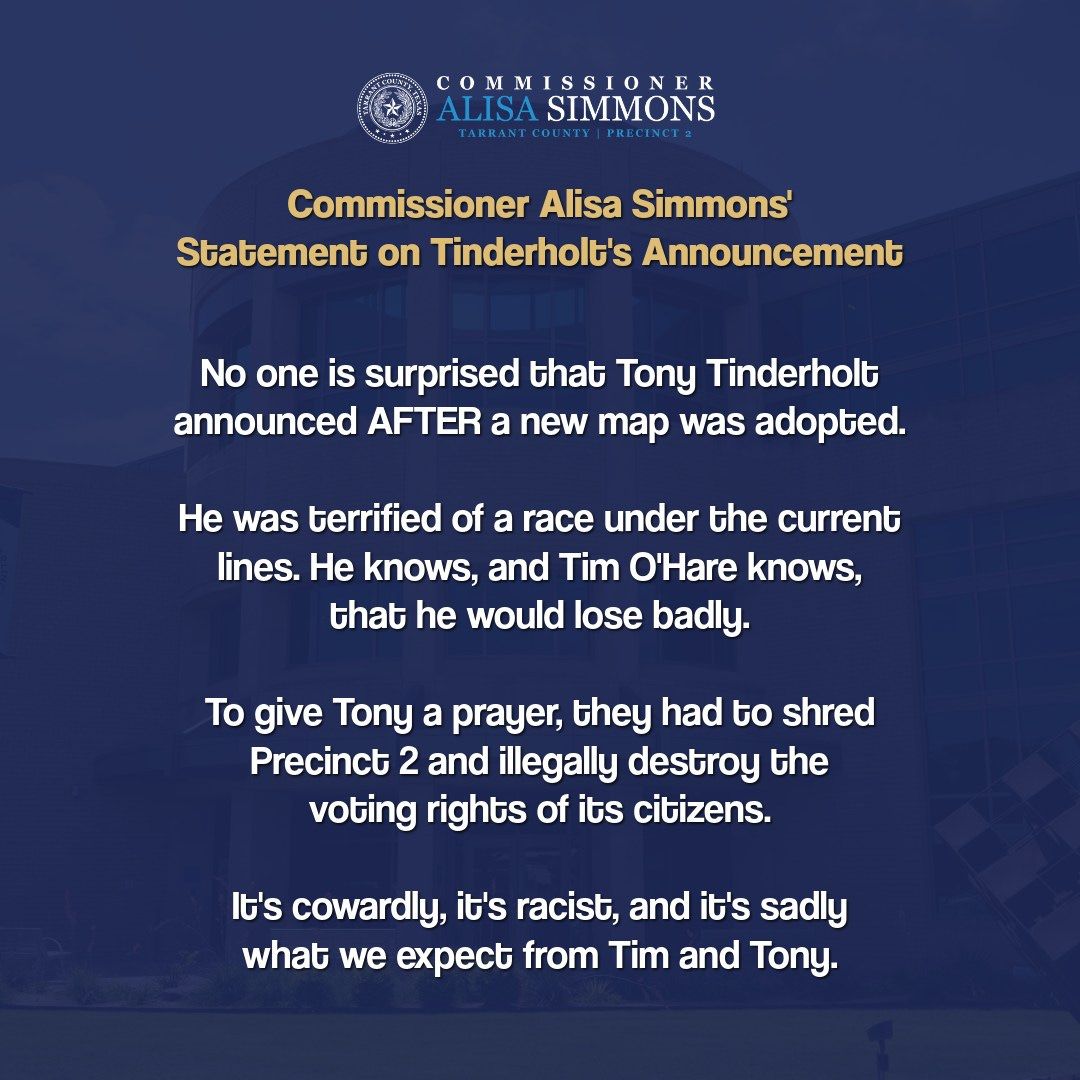
Because today, just minutes after the Tarrant County Commissioners voted to dismantle Precinct 2, Tinderholt announced he would run for that very seat, Alisa Simmons’ newly gutted district.

And he didn’t come alone.

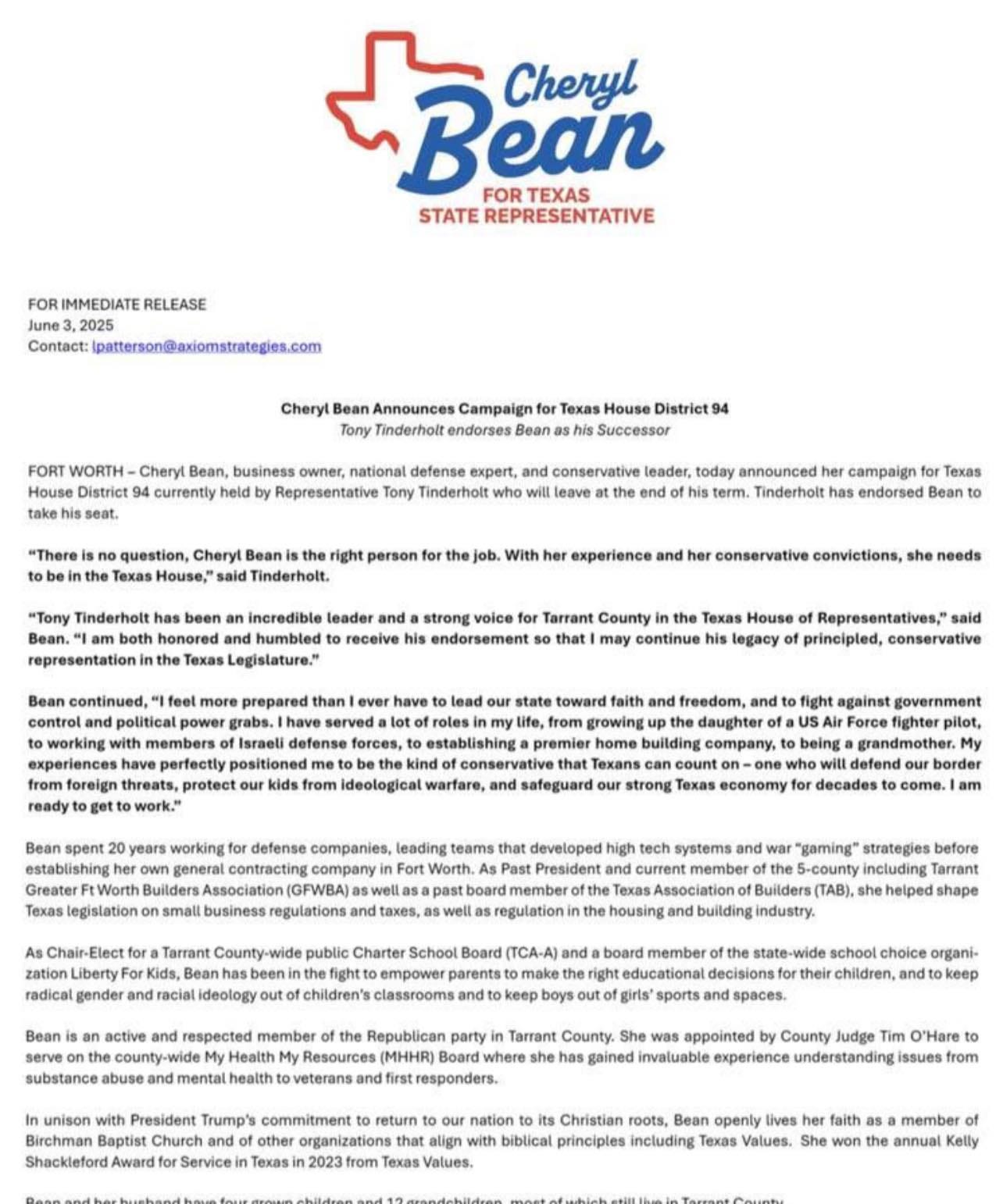
Cheryl Bean, another far-right extremist and ally of Tinderholt, announced her run for the now-open HD94 seat. A seat that was, conveniently, made safer for someone like her under the new maps.

Bean doesn’t even live in the district. She changed her voter registration to a new address inside it—an address she doesn’t own, according to the Tarrant Appraisal District. Her real home? Still outside the district lines. But facts don’t matter when the plan is to bulldoze through communities with precision and arrogance.

This wasn’t a coincidence. It was a coordinated political hit job, plain and simple.

A rigged map. A choreographed retirement. A handoff. A handpicked replacement. All timed to disempower the voices of Black and brown voters in Tarrant County. All orchestrated by Tim O’Hare and the extremist wing of the Republican Party.

They knew Simmons couldn’t be beaten fairly.

So they changed the lines.

They cleared the field.

And then they tried to rewrite the future.

But we see them.

We know the playbook.

And we’re not going to let this go unanswered.

This is part of a broader, coordinated strategy across Texas to suppress the political power of Black and brown communities under the guise of partisan politics…..

To read the post in full, open the link.

On Friday June 20, the Fifth Circuit Court of Appeals overturned Louisiana’s law requiring that schools post the Ten Commandments in every classroom.

On Saturday June 21, Governor Greg Abbot of Texas announced that he had signed a law requiring that the Ten Commandments be posted in every classroom in the state.

The goal of plastering the Ten Commandments in every schoolroom is promoted by Christian nationalists who want to see an official declaration that the U.S. is a Christian nation.

The Founding Fathers would be stunned to hear the assertion that the Constitution they wrote was influenced by the Ten Commandments. The First Amendment very clearly states the importance of freedom of religion, meaning that anyone could practice any religion or none at all. It also declares that government should not “establish” any religion, meaning that government should not sponsor or endorse or favor any religion.

CNN reported:

Texas’ law requires public schools to post in classrooms a 16-by-20-inch (41-by-51-centimeter) poster or framed copy of a specific English version of the commandments, even though translations and interpretations vary across denominations, faiths and languages and may differ in homes and houses of worship.

Supporters say the Ten Commandments are part of the foundation of the United States’ judicial and educational systems and should be displayed.

NPR reported on the decision striking down the Louisiana law.

Its supporters said that the Ten Commandments were the foundation of the American legal system. The state of Louisiana intends to appeal to the U.S. Supreme Court.

The court’s ruling stems from a lawsuit filed last year by parents of Louisiana school children from various religious backgrounds, who said the law violates First Amendment language guaranteeing religious liberty and forbidding government establishment of religion.

The ruling also backs an order issued last fall by U.S. District Judge John deGravelles, who declared the mandate unconstitutional and ordered state education officials not to enforce it and to notify all local school boards in the state of his decision.

Republican Gov. Jeff Landry signed the mandate into law last June.

Landry said in a statement Friday that he supports the attorney general’s plans to appeal.

“The Ten Commandments are the foundation of our laws — serving both an educational and historical purpose in our classrooms,” Landry said.

The Founding Fathers would laugh at Governor Abbot and Landry. And Governor Sarah Huckabee Sanders, who shepherded a similar law in Arkansas. It’s especially funny that the leader of their party has broken almost every one of the Ten Commandments. Perhaps the place to start posting them is in the Oval Office.

You know the Bad MAGA, the one that wants to drag us back a century.

There is also a good MAGA: Mothers Against Greg Abbott.

It’s led by Nancy Thompson, who spends her time trying to help others, unlike the other MAGA.

My leading nominee for silliest bill of the year is this one: “Rep. Stan Gerdes filed HB 54, a bill that aims to ban non-human behaviors in Texas public schools.” This is an adult man who took seriously the absurd claim that some children asked for litter boxes because they identify as cats. That’s a wack-a-doo rumor, not a reality. Why not legislate about the best way to respond to men in flying saucers if they should land and disembark in Texas?

This her latest report on the Republican-dominated legislature in Texas, which does nothing to help others:
 

TX LEGE BREAKDOWN

📚 Education Legislation 📚

  • On April 24th, the Texas Senate voted to redirect $1 billion in taxpayer funds to their favored private schools in passing Greg Abbott’s school voucher bill. We (and tens of thousands of folks across Texas) organized hard to stop it, but a final phone call from Donald Trump sealed the deal. This scam on the taxpayers, I mean voucher bill, has just been signed into law by Abbott.
  • While voucher programs and charter schools are getting our hard-earned pennies, the TX Lege hasn’t passed a single public education funding bill yet this session. This is BS.

🏠 Housing and Water Legislation 🏠

  • HB 32 and its Senate companion, SB 38, would escalate the Texas housing crisis by making evictions faster, easier, and far more common. These are being sold as a fix for “squatters,” but in reality, the bills are Trojan horse policies that would dismantle due process, weaken eviction warnings, and reduce opportunities for legal protections for all renters in Texas.

😵‍💫 Wtf Legislation 😵‍💫

  • The Texas legislature has considered a record number of bills this year that only serve to bully transgender people. On April 23rd, the Senate approved SB 240, the ridiculously named “Texas Women’s Privacy Act,”which requires Texans to use bathrooms and locker rooms that correspond with the gender assigned on their birth certificate — even if they’ve transitioned.
  • The Texas House passed HB 366, a bill that would make it a crime to distribute altered media, including political memes, without a government-approved disclaimer. Violators could face up to a year in jail. WTF?
  • Rep. Stan Gerdes filed HB 54, a bill that aims to ban non-human behaviors in Texas public schools.
  • The Texas Senate passed SB 1870, a bill that would prohibit cities from putting any citizen initiative on local ballots that would decriminalize marijuana.
  • The Texas House is expected to consider House Bill 2436, to exempt law enforcement officers from being charged for “deadly conduct” (killing members of the public) while in the line of duty. The Senate approved a similar bill in early April. This is a dangerous escalation of the power of state violence and a lack of accountability for the harm it causes.
  • The Texas Senate also approved SCR 42, which declares that the state only recognizes two genders. Let’s be clear: trans and intersex people have always existed. This is just more dangerous bullying toward a vulnerable minority from Texas Republicans.

HOW YOU CAN GET INVOLVED

  • Follow us on social media — we’ll be posting live updates, actions you can take to speak out on legislation, and more.

  FOLLOW ON BLUESKY    FOLLOW ON FACEBOOK  

  DONATE  
It’s important to be clear-eyed about the damage Texas Republicans — arm in arm with the Trump Administration — are inflicting on our state. When the consequences come, like underfunded classrooms, law enforcement officers shielded from legal consequences, and discrimination and violence against vulnerable people, we need to be ready to make sure Texans know who to hold accountable – Texas Republicans.

Get ready to use your voice when the time comes.

Nancy Thompson

In 2000, the contagious disease measles was officially eradicated in the United States. However, since the rise of anti-vaccine anxieties during the COVID pandemic, a growing number of parents have refused to let their children be vaccinated.

Texas is the center of a measles outbreak. 702 children have measles; 95% had not been vaccinated. Two have died, neither of them had been vaccinated. The national number is certainly larger.

The Houston Chronicle reported:

The measles outbreak that started in the South Plains region of Texas surpassed 700 cases on Tuesday, according to health officials.

The latest update from the Texas Department of State Health Services shows the state has seen 702 cases of measles since the outbreak began spreading in late January. The outbreak, which has also spread to New Mexico and Oklahoma, is the largest in the United States since measles was declared eliminated in the country in 2000.

Two children, an 8-year-old girl and a 6-year-old girl, died after contracting the virus, and 91 people have been hospitalized. Neither child who died had received the measles, mumps and rubella vaccine, and they did not have any underlying medical conditions, according to the DSHS.

Roughly two-thirds of cases in Texas have been in children and teens. More than 95% have been in individuals who are unvaccinated, or whose vaccination status is unknown.

Rob Curran writes about finance and other topics for Dow Jones, The Wall Street Journal, and other major publications. This article appeared in The Dallas Morning News.

Curran writes:

Neri Alvarado Borges was working for Latin Market Venezuelan Treats, which has locations in Far North Dallas and Lewisville, before he was deported to El Salvador’s Centro de Confinamiento Contra del Terrorismo last month.(Alvarado family / Courtesy)

****

The Trump administration has couched its aggressive ramp-up of deportations as an action to root out criminals. But signs are quickly emerging that the Immigration and Customs Enforcement Agency is scooping up hardworking North Texas migrants with little or no criminal past in its “crackdown.”

Last week, editorial columnist Robert Wilonsky chronicled the case of Neri Alvarado Borges, a young Lewisville resident with a jigsaw-ribbon tattoo associated with autism awareness he wore in honor of his autistic little brother. Did Alvarado look like a hardened criminal to you?

In February, the Venezuelan citizen was seized by ICE officers outside his apartment, and eventually taken to an El Salvadoran prison with suspected members of the Tren de Aragua gang. If he ever gets out, Alvarado’s trauma will be lifelong.

Paul Hunker is a Dallas immigration attorney and former chief counsel of the Dallas office of the U.S. Immigration and Customs Enforcement agency. Since the Trump administration took power, Hunker has been shocked by the profile of clients who come to him for help fighting deportation proceedings, he told me. These clients typically do not have criminal histories, Hunker said. They are hardworking members of the community, longtime residents. There’s a brief police encounter, a routine traffic stop, and they land in ICE custody.

“The model is detain-and-deport,” Hunker said. “The focus [in my time] was people who were a threat to their community, national-security threats and recent entrants. … Now they’re just going after everybody, even if they’ve been here for 20 years, with family ties. It doesn’t matter.”

ICE’s remit has changed drastically, and that change threatens to drag us all into something akin to a police state. ICE, and before it the Immigration and Naturalization Service’s enforcement arm, traditionally worked with the border patrol, focused on preventing undocumented migrants crossing the border. Apprehending a migrant in the act of an irregular border crossing is a vital part of rule-keeping, and something that has happened throughout U.S. history. Dragging family men out of their cars, throwing them into detention centers and kicking them out of the country is something ICE has never done. Until now.

That’s what appears to be happening to Jesus Ramos, of Lewisville. He, like me, is a green-card holder. Now, he’s facing deportation, allegedly because of nonviolent offenses in his past which have already been adjudicated. Ramos is on probation for simple assault and intent to possess drugs, according to reporting from NBC5.

He may have some substance-abuse problems, but Ramos is not a hardened criminal. Most families have members who go through similar struggles.

There are other stories. In Cedar Park in January, a young Venezuelan man with no criminal record was apprehended by ICE, according to an NPR story which withheld his name. Immigration officers told his family that the 18-year-old had appeared in an online video with guns and drugs, but they couldn’t produce the video for the family or for NPR.

ICE is still targeting serious offenders as the agency has always done since it launched in 2003, according to Hunker. But, as these cases and many of Hunker’s cases illustrate, ICE has new targets, too. And they are targets that we all know well.

ICE is targeting the people who climb on our roofs after hailstorms to fix the shingles. ICE is targeting the people who clean our houses and mind our children. What happens the next time your house-cleaner or your handyman drives home after a few too many?

That’s when the thorny moral question arises, the one your grandchildren may ask you: What did you do when dear, dear Nanny Gloria was swept up by burly officers and thrown in a cell?

What could you do? You will say. You were just one person.

“Tell your congressmen, ‘We don’t want this police state,’” said Hunker, who worked for ICE and its predecessor for more than 20 years. “‘Let ICE focus on people that are dangerous, and don’t try to deport those people who have their lives here.’”

I was reared in Ireland where memories of 1930s Central Europe were fresh. We are not there, yet or hopefully ever, but 20th-century history is no longer an abstract lesson. 

My grandmother met some of the young people brought to London in the Kindertransport operation that evacuated Jewish children from Central Europe before World War II. She inspired my mother with a compassion for displaced families, and an animus for state authorities who displaced those families because of their outsider status. 

It is all too easy, my mother taught me, to turn a blind eye to the state’s mistreatment of vulnerable outsiders. 

A couple of weeks ago, I was in Houston. I saw an ICE officer cruising around a strip mall in her patrol SUV, and felt a familiar chill. As a reporter with interest in the subject, I wanted to ask the officer why she was there, who she was looking for. But I turned my back, and moved on.

In Ireland, looking on from across the ocean, we contrasted Europe’s 20th-century dystopia with Reagan’s America, a land where hard work and enterprise counted for more than paperwork. Kids a few years ahead of us in school escaped to New York and Chicago from recession-wracked Ireland. A few won green-card lotteries. Most fudged the paperwork for a few years. Nobody shook them down. They were allowed to build skyscrapers, restaurant chains and plumbing empires, and sort the paperwork out later.

Now their children run emergency rooms, law offices and trading floors all over this nation.

That’s the story of immigration in modern America. The authorities have always sought to facilitate the inclusion of hardworking immigrants, rather than seeking to exclude and detain people for paperwork reasons.

The Trump administration continues to insist it is only targeting migrants with a criminal past. ICE’s broad interpretation of those criteria is what troubles me. Who’s to say that today’s deportation for DUI won’t be tomorrow’s deportation for a traffic violation, or for having the wrong surname?

Or writing a newspaper column critical of the regime. My green card is soon up for renewal. I sometimes fear it will be revoked by the thin-skinned Trump government.

But I must be able to look my children in the eye, and so I must speak up for Neri Alvarado and for Jesus Ramos and an unnamed Venezuelan 18-year-old.

Someone has to.

Elon Musk plans to expand his rocket business, in hopes of eventually reaching Mars. He moved his rocket business to Texas, far from the environmentalists who get in his way. So he bought a massive plot of land in Texas and started building the new town of Starbase. The residents of Starbase, almost all employed by Musk, held an election and voted to create a new town. Surprise! It was a landslide, reports Berenice Garcia of The Texas Tribune. He calls Srarbase a city, but with a likely population of 500 residents, it’s a small town.

Just down the road from the SpaceX launch site is Boca Chica Beach. A public strip sandwiched between South Padre Island and the Rio Grande, the beach is popular with locals who fish, drive and camp on its windy dunes.

At the beach on Saturday, the protesters said local politicians have not properly protected the land. Environmentalists, indigenous leaders and local fishermen said the beach needs to remain out of SpaceX’s control.

One of the most determined opponents of vouchers in Texas was the Pastors for Texas Children. While some faith leaders celebrated the opportunity to get public money for their religious schools, the PTC stood firm for separation of church and state. They believe it is the state’s responsibility to provide good public schools, and it is the duty of religious groups to support their own faith.

They know the research. They know that most of the $1 billion in vouchers will be used to subsidize students already enrolled in private schools. They know that many private schools will raise their tuition in response to the state subsidy. They know that the public schools, which serve the vast majority of students, will continue to be underfunded.

PTC sent out the following message:

The Signing of HB 3

An old preacher once said that God’s Justice was figuring out what belongs to whom and giving it to them.

Universal education for ALL children is God’s Justice. A $1 billion voucher subsidy program for children already in private schools— mostly religious schools that use Caesar to support their religion— is not.

Texans know that. They have rejected voucher programs for 30 years.

Gov. Greg Abbott had to rely on a Philadelphia billionaire to give him over $12 million dollars to defeat conservative, rural Republican state representatives who opposed vouchers on deep conviction and moral principle.

We take no pleasure in calling out our governor’s lies and bullying against these decent public servants. God is not mocked by Gov. Abbott’s corruption.

The voucher bill was signed on Saturday. Also on Saturday Texans all over the state overwhelmingly approved public school bond programs and elected pro-public ed trustees as a direct response to Abbott’s voucher scam.

We will have another opportunity to express our will on public education and against the privatization of it:

The 2026 primary and general elections.

DONATE TO PTC

PO Box 471155, Fort Worth, Texas, 76147

***************************************

What Happened After Passage of HB 3.

A statewide rejection of extremism.

In the aftermath of the passage of the voucher bill, voters in several districts responded by ousting hard-line conservative school board members. Texan Michelle H. Davis described the devastating losses of MAGA school board members across the state.

It was a tough night for MAGA-aligned candidates in Texas. In the May 3, 2025, local elections, voters across the state decisively rejected far-right candidates, particularly in school board and city council races. From Tarrant County to Collin County, and from San Antonio to Dallas, communities chose leaders who prioritize public education, inclusivity, and pragmatic governance over culture wars and partisan agendas. This widespread shift signals a growing resistance to extremist politics at the local level. 

Last night, voters across Texas sent a message loud enough to rattle the far-right out of their echo chambers: we’re done with your culture wars, your book bans, and your crusade against public schools. Voters chose community over chaos, educators over agitators, and progress over extremism.

The local elections weren’t just a series of wins but a sweep. MAGA-backed candidates got absolutely trounced across the state. This was the result of deep organizing, years of work by local Democrats, and voters who are fed up with the far-right hijacking of school boards and city councils to push their agenda.

Texas isn’t turning blue overnight, but make no mistake: the MAGA movement had a very bad night, and the momentum is shifting.

Tarrant County. 

The Republican Party poured money, endorsements, and out-of-state personalities into these Tarrant County races, and they got wiped. Every single candidate backed by Patriot Mobile, the far-right Christian nationalist group trying to take over school boards, lost. That’s losses in Mansfield ISD, Keller ISD, and Grapevine-Colleyville ISD. A clean sweep.

The Tarrant County GOP went 0-for-11 in the county’s three largest cities: Fort Worth, Arlington, and Mansfield. Let that sink in. They didn’t just lose a few races. They got shut out entirely. In Mansfield, Republican Rep. David Cook’s backyard, where Allen West himself came out to rally the troops, the GOP lost all five races they backed.

Meanwhile, Democrats made real gains on the Fort Worth City Council. One of the biggest victories was Debrah Peoples’s victory in her race. A longtime activist and former Tarrant County Democratic Party Chair, Peoples gave progressive voters a reason to celebrate in a city that’s often overlooked on the statewide map.

Huge, huge shout out to the Tarrant County Young Democrats. They didn’t just show up, they organized, knocked on doors, made calls, and fought for every single school board seat they were targeting. And guess what? They swept them all. That’s the kind of ground game that wins elections. That’s the kind of energy we need to keep building.

Open the link to continue reading about the pushback in Texas against bookbanning rightwing MAGA culture warriors.

Governor Gregg Abbott signed his big voucher bill into law yesterday, repeating promises he has made that are most certainly false. He claimed that vouchers will put Texas on a path to being the number one school system in the nation. Several other states have large voucher programs–e.g., Florida, Arizona, and Ohio–and none of them is the number one rated school system in the nation.

If anything, vouchers and charter schools break up the common school system that states pledge in their constitutions to support. Public schools are one system, regulated by the state, subject to elected local school boards. Charter schools are another, lightly regulated by the state, some for-profit, some as corporate chains, managed by private boards. Voucher schools are a third system, almost entirely deregulated, not required to accept all students, as public schools are. Voucher schools are not required to have certified teachers, as public schools are. Voucher schools are exempt from state testing. Most voucher schools are religious schools, managed by their religious leader. Private and religious schools choose their students.

Vouchers have been a big issue since the early 1990s. The first voucher program was launched in Milwaukee in 1990. The second started in Cleveland in 1996, ostensibly to save poor kids from failing public schools. Neither Cleveland nor Milwaukee is a high-performing district.

What we have learned in the past 30-35 years about vouchers is this:

  1. Most students who use vouchers were already enrolled in nonpublic schools.
  2. The students who transfer from public to private schools are likely to fall behind their peers in public schools. Many return to public schools.
  3. The public does not want their taxes to be spent on religious schools or on the children of affluent families. In nearly two dozen state referenda, voters defeated vouchers every time.
  4. The academic performance of students who leave public schools to attend nonpublic schools is either the same or much worse than students in public schools.
  5. Vouchers drain funding from public schools, where the vast majority of students are enrolled. This, the majority of students will have larger classes and fewer electives to subsidize vouchers.
  6. Vouchers are expensive. Arizona is projecting a cost of $1 billion annually. Florida currently is paying $4 billion annually.

To learn more about the research, read Joshua Cowen’s book The Privateers: How Billionaires Created a Culture War and Sold School Vouchers (Harvard Educatuon Press).

Governor Abbott surely knows these facts, but he determined that vouchers were his highest priority. Certainly they make him the champion of parents who send their children to private and religious school. All will be eligible for a subsidy from the state. And Abbott delivered for the billionaires who funded his voucher campaign.

Edward McKinley of the Houston Chronicle wrote:

Gov. Greg Abbott signed a $1 billion school voucher program into law Saturday, cementing the biggest legislative victory of his decade in office before a huge crowd including families, legislators and GOP donors.

Abbott framed the ceremony as the climax of a multiyear effort by himself and advocates around the state, and touted the state’s new program as the largest to ever launch in the nation. 

“Today is the culmination of a movement that has swept across our state and across our country,” he said, using the speech to call out parents in the crowd who had already pulled their students from “low-performing” public schools to put them into private ones. “It’s time we put our children on a pathway to have the number one-ranked education system in the United States of America.”

He put pen to paper at a wooden desk in front of the Governor’s Mansion, as a gaggle of children stood around him wearing their private school colors and logos. Someone shouted, “Thank you, governor!” before the crowd of nearly 1,400 people erupted in applause. Abbott pumped his fist in the air. 

The ceremony marked a major moment for the third-term Republican, who threw his full political weight and millions of campaign dollars into a push for private school vouchers, overcoming a legislative blockade that had lasted for decades. The bill he signed into law will give Texas students roughly $10,000 a year that they can put toward private school tuition, tutoring, textbooks and other expenses…

Texas Education Agency Commissioner Mike Morath and Pennsylvania billionaire Jeff Yass mingled in the crowd. Yass contributed more than $12 million to Abbott’s campaign last cycle, as the governor sought to unseat anti-voucher Republicans in the 2024 primary election.

Abbott was joined on stage by U.S. Sen. John Cornyn, Lt. Gov. Dan Patrick, House Speaker Dustin Burrows and the House and Senate authors of the bill. Also in attendance were private school leaders, including Joel Enge, director of Kingdom Life Academy. 

After Abbott’s address, Enge told the crowd he founded his Christian school after working in public schools in a low-income area of Tyler and watching children fall behind. His speech had the feel of a sermon.

“Children who have been beaten down by the struggles in the academic system that did not fit the system will now be empowered as they begin to find the right school setting that’s going to support them and to allow them to grow in confidence in who God created them to be,” he yelled, to raucous cheers. “Amen!…”

Hours earlier, Democratic legislators, union leaders and public educators gathered in the parking lot of the AFL-CIO building across the street from the governor’s mansion, where they had a much different message. 

Echoing lines used throughout committee hearings and legislative debates for the past few years, they warned that vouchers would hurt already struggling neighborhood public schools by stripping away their funding. About two dozen people swayed under the direct sun, waving signs that said “public dollars belong in public schools” and “students over billionaires.” 

“Today, big money won and the students of Texas lost,” said state Rep. James Talarico, an Austin Democrat. “Remember this day next time a school closes in your neighborhood. Remember this day next time a beloved teacher quits because they can’t support their family on their salary.”

Several speakers pointed out that while Republicans fast-tracked the voucher bill, they have yet to agree on a package to increase funding to public schools and raise teacher pay.

State Rep. Gina Hinojosa, an Austin Democrat, said she hoped this defeat could sow the seeds of future victories. Abbott and most legislators are up for reelection next year.

“He may have won this battle, but the war is not over,” she said. “There will be a vote on vouchers and he can’t stop it, and it will be in November 2026.”

What’s in the bill

The new law stands to remake education in Texas, granting parents access to more than $10,000 in state funds to pay for private school tuition and expenses, or $2,000 for homeschoolers. The first year of operation will begin in 2027, and in the run-up, the state will choose nonprofits to run the program, develop the application process and pick which families will have access.

All students will be eligible, although families making more than 500% of the federal poverty line, about $160,750 in income for a family of four, cannot take up more than 20% of the funds. The funds will be tied roughly to the amount of money the students would have received in public schools, meaning students with disabilities will receive extra.

School vouchers have become a signature of Abbott’s three terms in office. 

After the COVID-19 pandemic, other Republican-controlled states such as Florida, Arizona, Iowa and Indiana created or expanded their own voucher programs. But school choice advocates repeatedly fell short in Texas thanks to an alliance between Democrats and rural Republicans. Bills passed the Senate but failed to gain traction in the House. 

Then, in May 2022, Abbott announced in a speech at San Antonio’s Southside that he’d be throwing his full weight behind the policy. Even as public schools struggled to keep teachers in the classroom and balance their budgets, the governor told lawmakers he wouldn’t approve extra funds until a voucher bill made it to his desk. When it didn’t happen, even in special sessions, he took to the campaign trail, spending millions to unseat about a dozen key GOP lawmakers who stood in his way.

This session, he enlisted President Donald Trump’s help at the last minute to rally Republican House members, some of whom said they felt forced to back the policy.

Critics warn the state’s voucher program lacks safeguards to ensure it reaches the children it was designed to help and say they expect many of the slots to go to students already in private schools, which can pick and choose who they educate. The majority of private schools in Texas are religiously affiliated, and the average tuition costs upwards of $10,900, according to Private School Review.

Though $1 billion is set aside for the program in the first biennium, the nonpartisan Legislative Budget Board projects it could grow exponentially in the next decade amid huge demand from students currently in private or home schools.

It remains to be seen how many private schools will accept the vouchers, but many advocated their passage, including Catholic, Jewish and Muslim schools.

Although Abbott has said repeatedly that the program won’t pull funds from public schools, because schools are funded based on attendance, the LBB analysis showed that the program would reduce state payments to public schools by more than $1 billion by 2030. 

It was no secret that Governor Abbott was intent on passing voucher legislation by any means necessary. In 2024, he called four special sessions to demand a voucher law, offering a big increase in public school funding as a sweetener. A coalition of rural Republicans and Democrats voted them down again and again. Rural Republicans know that their schools are the most important institution in their community. They know the teachers and the principal. They and everyone else in the community support the school and its activities. In rural areas, the public school is not only the hub of community life, but the largest contributor to the economy.

With the help of out-of-state billionaires and home-grown evangelical billionaires, Abbott succeeded in defeating most of the Republicans who opposed vouchers. He blatantly lied about them, claiming they opposed his tough tactics at the border (they didn’t), he claimed they didn’t support increased funding for their local schools because they voted against his bribe. He blanketed their districts with lies.

The Houston Chronicle tells a straightforward account of how the voucher vote went down, based on Abbott’s strong arm tactics. Fear won.

Benjamin Wermund and Edward McKinley of The Houston Chronicle wrote the back story:

Pearland Republican Jeff Barry has long been skeptical of school vouchers, but on Thursday morning he voted to create what could become the largest voucher program in the nation. 

Barry, a freshman House lawmaker, said it felt like he had no choice. 

“If I voted against it I would have had every statewide and national political…figure against me – not to mention all of my bills vetoed,” Barry wrote in a post responding to one user who called his support for the measure a “betrayal.”

He added: “The consequences were dire with no upside at all.” 

Barry wasn’t the only Republican House member who felt cornered after an unprecedented, years-long pressure campaign by Gov. Greg Abbott to bend the chamber to his will. 

Only two GOP members joined Democrats in opposing the measure on Thursday, a remarkable turnaround from their widespread opposition to vouchers just a few years ago. It was a major vindication of Abbott’s governing approach of strong-arming lawmakers into submission. 

Where his predecessors, including Gov. Rick Perry, often cozied up to members of the Legislature, Abbott has looked to exploit their weaknesses. His success on what was once seen as an impossible issue marks a potentially major power shift in state leadership, where lieutenant governors have long been seen to hold as much or more power than the governor, because of their control over the Senate. 

“What Perry got by finesse, Abbott gets by force — and that definitely matters for the power structure,” said Brandon Rottinghaus, a political scientist at the University of Houston. “He, through expending a tremendous amount of political capital and money, was able to reshape the Republican party in his image. That’s something very few governors have been able to do.”

Abbott spent months on the road advocating for vouchers and poured nearly $12 million into unseating fellow Republicans who opposed the same legislation in 2023. Ahead of the vote this month, he met privately with GOP lawmakers on the fence, and on Wednesday morning he gathered the caucus for a call from President Donald Trump, who not-so-subtly reminded them of his success rate in Texas GOP primaries. 

Just four years ago, before Abbott began seriously campaigning for vouchers, four out of five House members publicly opposed the thought of using taxpayer dollars for private education. That included House Speaker Dustin Burrows and state Rep. Brad Buckley, the education committee chairman who carried the bill this year in the House. 

Just one of the remaining Republican holdouts voted the same way early Thursday morningas they did in 2021: state Rep. Gary VanDeaver of New Boston, who narrowly survived a primary runoff election last year against an Abbott-backed challenger.

State Rep. Drew Darby, R-San Angelo, also defeated one of Abbott’s primary challengers last year. He voted for vouchers this time, calling it a pragmatic move to retain at least some modicum of leverage.

“We made this decision with a clear understanding: the bill would pass with or without our support,” Darby wrote on social media shortly after the vote. “Rather than stand by, we chose to stay in the fight, negotiating critical amendments to reduce the impact on our communities.”

Those concessions included annual public audits of the voucher program and its contractors, clarified residency requirements for participants, a requirement that private schools be accredited for at least two years before participating and a permanent one-fifth cap of slots going to students from families that make more than 500% of the federal poverty line — or $160,750 for a family of four. 

One of the aims, Darby and others said, was to block unproven private schools from popping up in areas with few other options, just to access the new state dollars. And critics hoped to prevent existing private school students with wealthy families from taking up a bulk of the voucher slots, as has happened in other states.

Darby’s wife, Clarisa Darby, also posted online that not backing vouchers would have jeopardized billions of dollars in new public school funding for teacher raises and special education.

“School funding would be cut by the Senate in retribution and bills affecting our west Texas economy had a high chance of being vetoed if they voted against the bill,”  she wrote. “Bills affecting school funding, oil, gas, water, jobs, ASU, Howard College, are too important to be vetoed.”

Ahead of the vote Wednesday night, state Rep. James Talarico, an Austin Democrat, accused Abbott of intimidating Republican colleagues with the threat of a primary “bloodbath.” 

“No one including the governor should ever threaten a lawmaker,” Talarico said. “We do not serve the governor, we serve our constituents.” 

Abbott’s office denied the claim. But whether threats were real or implied, House Republicans were clearly feeling the heat after Abbott’s all-out offensive in last year’s primaries. 

“He’s working behind the scenes to make sure he’s got the vote. There’s no question about that,” state Rep. Sam Harless, a Spring Republican, said Wednesday as the voucher debate was beginning. 

Trump’s call Wednesday morning helped quash any lingering doubts among Republicans.

“Many of you I’ve endorsed, and I’ll be endorsing,” Trump told the members. “I won Texas in a landslide. Everybody who was with me got carried.” 

State Rep. Wes Virdell, who campaigned on supporting school vouchers, said earlier this week it was “no secret that the governor is pressuring a lot of people” to support the proposal. 

Steve Allison, a former Republican state lawmaker from San Antonio who lost his seat to an Abbott-backed challenger after opposing vouchers last session, said he liked the changes fought for by Darby and others but would have still voted against the bill.

“I think that members need to prioritize their districts… and I think that was interfered with here, not just in (my) district but elsewhere,” he said, adding that he’d spoken with several current lawmakers who’d been threatened by Abbott. He declined to say who. “It’s just unfortunate what the governor did,” Allison said.

The House GOP shift on vouchers stretched all the way to its top leadership. Even as he has helped block voucher legislation in the past, newly-elected Speaker Dustin Burrows was a vocal champion of the bill this year, appearing at multiple events with Abbott. 

“Speaker Burrows was the real X factor in the debate,” said John Colyandro, a former Abbott adviser who lobbied for the legislation. 

Burrows took the gavel from state Rep. Dade Phelan, one of only two Republicans to vote against the bill. 

As speaker, Phelan had not openly opposed the legislation. And heading into the speaker’s race he said he would prioritize it. 

But before the vote, he explained he was planning to vote against it because he felt voters in his Beaumont district did not support vouchers. He wanted to put it on the ballot in November, a failed proposal offered by Talarico. 

Phelan, who narrowly fended off a Trump-backed primary challenger last year, shrugged off the fear of political threats — real or implied. He brought up the Trump call in an interview ahead of the vote, saying he wasn’t in the room but heard audio of it. 

Trump noted only one of his endorsed candidates lost, apparently referencing David Covey’s failed bid to unseat Phelan, though the president did not name either candidate. 

“He said he went 42 and 0,” Phelan said. “And then he remembers he lost one.”

Governor Greg Abbott finally got the voucher legislation he wanted, after years of defeats. His goal was frustrated by a coalition of Democrats and rural Republicans. The latter were defending their hometown schools, which are staffed by friends and relatives and are the community’s hub.

In last year’s elections, Abbott ran hard-right Republicans against the rural Republicans who stood in his way and disposed of most of them. He attacked them with a campaign of lies, saying they opposed border control, never mentioning vouchers. His efforts to oust anti-voucher Republicans were funded by out- of-state billionaires, including Jeff Yass, the richest man in Pennsylvania, Betsy DeVos, and Charles Koch, as well as home-grown Texas billionaires. Even Trump intervened to encourage the passage of vouchers.

The article says that the legislators refused to permit a referendum because such votes “generally” reject vouchers. Fact-checking would have changed the word “generally” to “always.” In more than 20 state referenda over the years, the public has always voted against vouchers. The article does not mention that the vast majority of vouchers in every state that have adopted them are used by students already in private schools, mostly religious schools. Nor does it note that the academic results of vouchers are strikingly negative (see Josh Cowen’s book The Privateers). Typically the students at private schools are exempt from state testing requirements (which conservatives contend is absolutely necessary for students in public schools).

Most important, it is not the students or the parents who have choice. It is the schools that choose their students. Voucher schools are not bound by anti-discrimination laws. They may exclude students for any reason, including their race, religion, disability, gender or sexual orientation. Some religious schools accept only children of their own sect.

Gregg Abbott campaigned exclusively at private Christian schools. He attacked public schools for “indoctrinating” students, but the best schools for indoctrination are the evangelical schools that will benefit from this legislation.

The following article is a gift, meaning no pay wall.

The New York Times reported:

The Texas House of Representatives voted early Thursday morning to create one of the largest taxpayer-funded school voucher programs, a hard-fought victory for private school choice activists as they turn their attention to a nationwide voucher push.

The measure still has some legislative hurdles to clear before Gov. Greg Abbott signs it into law, but the House vote — 85 to 63 — secured a win that was decades in the making, propelled by the governor’s hardball politics last year. It was also a significant defeat for Democrats, teachers’ unions and some rural conservatives who had long worried that taxpayer-funded private-school vouchers would strain public school budgets.

The program would be capped at $1 billion in its first year, but could grow quickly, potentially reaching an estimated $4.5 billion a year by 2030. The funds can be used for private school tuition and for costs associated with home-schooling, including curriculum materials and virtual learning programs.

The bill was championed by an ascendant wing of the Republican Party, closely allied with President Trump and important conservative donors, including Betsy DeVos, Mr. Trump’s wealthy former education secretary, and Jeff Yass, a billionaire financier from Pennsylvania and a Republican megadonor.