The National Education Policy Center recently posted a study of how teachers choose their workplace. The study was conducted in San Antonio, where about one quarter of students attend charter schools. Why do some teachers choose to teach in public schools while others prefer charter schools?
School choice involves different choosers—students, their parents, and of course the schools themselves. But teachers choose too when they decide where to work. Increasingly, this process involves deciding whether to work or not to work in the charter sector.
A recently published study by Andrene J. Castro of Virginia Commonwealth University, NEPC Fellow Huriya Jabbar of the University of Southern California, and Sebastián Núñez Miranda of the University of Texas at Austin takes a closer look at this process via interviews with 23 prospective or new-to-the-profession teachers and 22 current educators about their job searches in San Antonio, Texas, where about a quarter of the students attend charters. The semi-structured interviews were conducted pre-pandemic, during the 2016-17 school year. The study was published last summer in Education Policy Analysis Archives, a peer-reviewed, open-access journal.
The goal of the research was to examine “how choice policy contexts alter teachers’ professional identities as they search for jobs,” a topic that had received only limited attention from researchers. The researchers describe how:
[T]he job search is not separate or isolated from teachers’ professional identity, rather it is a critical juncture where teachers evaluate their professional identity as they make choices about the sector—charter or TPSs [traditional public schools]—and/or school organizations that best align with their professional beliefs and values.
Teachers, the researchers write, “largely construct professional identities to match positions in the primary sector, that is, jobs in TPSs, which typically offer greater stability, higher salaries, and predictable career paths.” These qualities of TPSs appealed to most of the interviewees.
As one interviewee noted,
Even though they [charter schools] tell you that you’re going to get paid more, in all reality once you sign the contract, the pay is not what you’re told at the beginning of signing the contract. It’s a little more frustrating because I feel like you have to fight more . . . I think it’s more of a challenge now than working at the regular big public schools.
Some interviewees also indicated that charter schools were not in line with their professional identities or values. “I’m not really interested in charter schools,” one job seeker said. “I feel like the public schools, there’s a lot of areas that we need to improve. That’s where I feel like I can do the most good.”
For these and other reasons, the interviewees in this study typically turned to charters as a last resort, explaining that charters tended to pay less, offer temporary contracts, and lack transparency. But some interviewees embraced a charter school career, responding to a different professional identity.
Teach for America participants emerged as a group favoring charters over TPSs. They perceived that the values of TFA aligned with the missions of specific charter management organizations. Also, a few younger teachers who were interviewed felt more comfortable at charters because they tended to have younger staffs, with many teachers who were new to the profession.
Teachers also applied to charters because they believed that those charters provided higher levels of autonomy, better opportunities to learn a lot in a short period of time, and the chance to receive pay raises and promotions more rapidly than might be possible in the traditional public school system. One interviewee noted:
You can be stuck in the same teaching position for seven years [at a TPS] as opposed to [charter school] where if you’re really just doing a rock-solid job at what you’re doing now you can be within mid-management principal-ship within five, 10 years.
One additional finding from the study has clear policy implications for those hoping for cross-fertilization and sharing of ideas and experiences between the sectors: Prospective teachers were more open to switching sectors than were current teachers seeking to change jobs.
“To some extent, we found these segmented identities led to sector entrapment, constraining teachers’ notions, both individually and collectively, regarding what it means to be a teacher in either sector, rather than the profession at large,” the researchers conclude.
Instead of focusing exclusively on struggling campuses, Miles’ New Education System plan mainly targets elementary and middle schools that “feed” into three struggling high schools in the district. Though the plan will reconstitute 29 total schools as a part of the system, a spokesperson for HISD clarified that only 28 traditional campuses will be impacted. The 29th school will be a temporary alternative education program which will be reformed and evaluated separately.
The schools chosen to participate in Miles’ “New Education System” are three high schools and their feeder schools.
The schools are largely low-income, Black and Latino schools
According to the Houston Chronicle’s analysis, each school included in Miles’ plan is either majority Black or majority Hispanic/Latino. The vast majority of students at each campus are also from low-income families.
At the schools impacted by Miles’ plan, the average percentage of economically disadvantaged students – which is measured by the amount of students who qualify for free and reduced price lunches – is higher than the average across HISD. In the 2021-2022 school year, the average percentage of economically disadvantaged students at the campuses in Miles’ plan was 98%, while the district average was 83%, according to data from the National Center for Education Statistics.
New Education System schools demographics
Every school in Mike Miles’ New Education System plan has either a majority Black or majority Latino student population, and most students at the schools are from low-income families, according to data from the 2021-2022.
Most of the schools are 90-95% Black.
Most schools are already performing well
In terms of accountability ratings, many of the schools targeted in Miles’ overhaul have not underperformed in recent years. In 2022, the majority of schools included in the plan received “A” or “B” ratings, and only five of the schools were given a “Not Rated” label under SB 1365 – which exempted schools from ratings that would have received a “D” or “F” last year.
Though the three high schools at the heart of the Miles’ plan – Kashmere, North Forest and Wheatley – have had three of the five highest failure rates in the district, North Forest and Wheatley both received passing ratings in 2022.
Additionally, Miles’ plan includes four campuses that are unconnected to the three struggling high schools. These campuses include Highland Heights Elementary and Henry Middle, which also have some of the worst failure rates in the district, and Sugar Grove Academy and Marshall Elementary, which both received passing ratings in 2022 but have struggled in prior years.
So, at the point of takeover, the most troubled schools in HISD were on an upswing, making progress under the leadership of an experienced educator (who was quickly hired by Prince George’s County in Maryland). And now they are led by a Broadie who failed to make a difference in Dallas.
It would not be a stretch to believe that Governor Abbott, a mean and vindictive man—is punishing Houston for not voting for him.
Joe Holley, a columnist for The Houston Chronicle writes here about why rural Republicans in Texas vote against vouchers. The public schools in their home districts are in deep financial trouble. They can’t pay enough to attract teachers. They lack the funding for physical improvements. The public schools are the heart of their communities. Most rural districts don’t have any private schools. Those that do don’t want to lose their funding to pay for kids to go to private schools.
Holley writes:
MARATHON – One afternoon not long after Laura and I bought The Wee House, our home away from home in this small, unincorporated community west of the Pecos, I decided to go run the bleachers at the high school football field a block up the street. I didn’t know it at the time, but the long-abandoned field, dry grass giving way to patches of hard dirt and scraggly weeds, had been home in years past to arguably the most formidable six-man football dynasty in Texas history.
Between 1967 and 1976, the Mustangs compiled a record of 100-6, including a 42-game winning streak that stretched from October 1968 until November 1971. Fans from all over the trans-Pecos made the long drive to Marathon on Friday nights to watch the mighty Mustangs beat up on both six- and 11-man teams. The Mustangs were twice state champions.
It quickly became obvious that my ambitious exercise regimen was foolhardy. The spindly-looking bleachers were only eight rows high, the rows so far apart I almost had to climb from one to the next. I decided instead to investigate the rusted sheet-metal press box perched on the top row, so small that maybe three Howard Cosell-wannabes, no more, could squeeze in. I thought I might find an old program, a yellowed memento from the Mustangs’ glory days. Opening the squeaky door into the dark interior, I set off a clamorous tumult. Then came a whoosh. Powerful wings grazed the top of my head and almost sent me tumbling backward down the steps. I had disturbed a great horned owl.
Marathon’s Friday-night lights were extinguished in 2007, but as in every small Texas town I know, the school remains the heart of the community. The school is where town kids and ranch kids get to know each other. It’s where the well-off and the not-so-well-off mix and mingle; where Hispanic kids and Black kids and white kids work out their differences and discover their similarities; where members of the Parent Teacher Organization man the concession stand for basketball games in the venerable gym.
Money is a perennial problem. With a total K-12 enrollment of 53 in the school year that just ended, consolidation with nearby Alpine or Fort Stockton is always a possibility. If that happened, though — if the stately rust-colored brick high school and the low-slung elementary school across the street were left to the great horned owls — Marathon would not be Marathon.
That fact of small-town Texas life is something Gov. Greg Abbott, Lt. Gov. Dan Patrick and voucher-peddling legislators either don’t understand or refuse to admit. This legislative session, while they toyed like Scrooge McDuck with a mountainous pile of cash — an unprecedented $33 billion budget surplus — they left rural school districts across the state to grapple with ever-increasing operating costs, deteriorating facilities, teacher shortages, and an unfair funding system. New requirements for security upgrades are only partially funded.
HB 100, the Legislature’s primary education bill, would have raised the state’s basic allotment, but even a modest increase — not to mention the $900 needed to match inflation — was held hostage to getting vouchers passed. The governor promises that education will be the focus of another special session later this summer, but so far, rural schools have received next to nothing. Meanwhile, administrators for schools large and small are trying to craft a budget for the coming school year without knowing what the Legislature has in store.
Instead of dipping into that enormous budget surplus to ease the hardships of small-town schools, Abbott, Patrick and friends are distracted by a different mountain of money. They covet an Everest of campaign cash from a trio of West Texas oil and fracking billionaires — people who had just as soon put public schools out of business in favor of private schools funded, at least in part, by taxpayer money.
Because Texas public schools get by on a complicated system of local tax revenue and state dollars — with state money distributed on a per-student basis — private-school vouchers are a threat to already precarious districts such as Marathon’s. If local students take their vouchers and leave, those districts would lose funds. (Some voucher plans would compensate rural districts for these lost students, but only temporarily.) Despite Abbott’s and Patrick’s assurances, one way or another, state funds could be diverted to cover private and home-schooling expenses. That would leave less per-student funding for every district, large or small.
Small-town Texans, most of whom cannot even imagine voting for a Democrat, know that vouchers are a threat. That’s why their lawmakers, even the most conservative, have fought the voucher ambitions of the GOP leadership with the ferocity of yesteryear’s Marathon Mustangs. Marathon, Alpine, Fort Davis and Marfa — the little West Texas towns I know best — need every resource the state can provide, as do their counterparts across Texas. Rural lawmakers beat back Abbott and vouchers yet again during the regular session, but the governor, like a wily old boxer, keeps probing round after round for weak spots….
Alpine is 30 miles west of Marathon. Home to Sul Ross State University, the attractive little town is much larger than Marathon, but not so big that it manages to avoid lawmaker neglect. The Legislature’s inaction during the regular session was “a dereliction of duties,” Michelle Rinehart, superintendent of Alpine ISD, told the Big Bend Sentinel.
This year, Rinehart told me a few days ago, should have been our chance to boost Texas education funding — to move the state from 42nd in per-pupil spending to something like the national average. “We were expecting at least modest pay raises for teachers,” she said.
New teachers in oil-blessed Midland start at $60,500, while her new teachers start at $33,000. But instead of helping Alpine with salaries, maintenance and other basic needs, the state’s arcane and inequitable funding formulas end up taking money away. Rinehart has to finish her budget for the next school year by July 1. Unless the Legislature changes something in the special session, the deficit will grow from $300,000 to $1 million….
Rinehart has ample reason to be frustrated. Public education spending is lower now than when Abbott took office in 2015. Given a $321.3 billion budget, our lawmakers — so far, anyway — are starving one of the basic building blocks of a self-governing nation.
Abbott doesn’t listen to educators or the people in rural districts. He listens to the billionaires who fund him.
Abbott listens to the likes of oilmen Tim Dunn and the Wilks brothers, Farris and Dan, who insist that government and education should be guided by fundamentalist Christian principles.
Dunn, a lay preacher at the Midland mega-church he and his family attend, has given more than $18 million to Abbott, Patrick, all 18 GOP state senators, now-suspended Attorney General Ken Paxton, U.S. Sen. Ted Cruz and assorted ultra-conservative political action committees. He also serves on the board of the Texas Public Policy Foundation, a powerful voucher champion.
Farris Wilks, a native of Cisco, near Abilene, has given more than $11 million to GOP candidates and officeholders. He’s also a minister with the Cisco church his father founded, the Assembly of Yahweh 7th Day.
The superintendent of the Marathon public schools is Ivonne Durant. Holley interviewed her. She was upset that the state hasn’t increased teacher pay.
As superintendent of a rural school, Durant is constantly in touch with parents about their children’s well-being, in touch as only a small-school educator can be. They sit together at church, run into each other at the grocery store in Alpine. She teaches the Spanish class and tutors kids on Saturday morning. (One in particular: If that girl fails a class, the five-person junior high basketball team will have to disband.) Durant makes sure her seniors have definite plans — college, the military or a good job — before they graduate.
“I love my children,” she said. “They know, and their parents know, that everybody here cares. They know we’re going to be there for them.”
If only Greg Abbott and the Texas Legislature could say the same.
Governor Greg Abbott is having a temper tantrum. He called a special session to push for vouchers, which failed in the regular session. But now he’s feuding with his Lt. Governor Dan Patrick over what to do about property taxes.
The state is sitting on a $33 billion surplus. Abbott has vowed to veto every bill until he gets vouchers and his own property tax plan. Abbott wants all property taxes reduced, while Patrick wants the biggest breaks to go to businesses.
Gov. Greg Abbott has continued to follow through with his perceived threat to veto a large number of bills in the absence of a House-Senate compromise on property taxes. As of Saturday afternoon, the governor had vetoed 47 bills in the past five days, most of which originated in the Senate, adding fuel to his feud with Lt. Gov. Dan Patrick.
The common theme in his many of his vetoes, 21 of which were announced Friday: The bills can wait until after lawmakers figure out property taxes.
“At this time, the legislature must concentrate on delivering property tax cuts to Texans,” Abbott said in multiple veto proclamations Friday.
He vetoed more than a dozen bills Saturday, which included a new objection tied to school vouchers, another one of Abbott’s legislative priorities this year. In explaining why he rejected a bill setting new training rules for fire alarm technicians, Abbott said the legislation “can be reconsidered at a future special session only after education freedom is passed.”
During the regular legislative session, Abbott spent significant political capital traveling across the state to promote education savings accounts, a voucher-like program that allows parents to use taxpayer dollars to pay for their kids’ private schooling. The Texas Legislature failed to pass such a bill, mostly because of staunch opposition from Democrats and rural Republicans in the House, who argue that vouchers will hurt public schools’ finances. Abbott has said he’ll call a special session specifically to discuss vouchers again.
On Wednesday during a bill-signing ceremony at the Capitol, Abbott raised the possibility of vetoing a significant number of the hundreds of bills that he hasn’t yet signed. With lawmakers still deadlocked on property taxes, Abbott said he “can’t ensure that any bill that has not yet been signed is going to be signed.”
Military man Mike Miles has launched his overhaul of Houston’s public schools, and parents and teachers are alarmed. Miles previously failed in Dallas, but that has not dimmed his authoritarian style. Trained for school leadership by the Broad Academy, which admires authoritarian style, Miles was imposed on Houston as part of a state takeover.
The state education department is led by non-educator Mike Morath but controlled by Governor Greg Abbott. Abbott hates Houston, because its a Democratic city. The takeover was triggered by the “failure” of one high school, Wheatley, which enrolls higher proportions of students with disabilities than other high schools. Miles, however, has far exceeded his mandate by firing the staff at 29 schools—not just Wheatley—and telling staff to re-apply for their jobs. Miles now sees himself as an education expert and has declared his grandiose ambition to create a “New Education System” (NES), to show the nation how it’s done.
Parents, teachers, and students at the schools that Miles is disrupting are outraged.
Elmore Elementary School was never perfect, but Kourtney Revels felt prospects were improving for the northeast Houston campus. A new principal, Tanya Webb, had taken the helm in December, and while Revels didn’t approve of every move she made, she admired the newcomer’s initiative.
Revels and other parents had long been frustrated, for example, that the school bus would often arrive late in the afternoon because kids would act up on board. So the principal took matters into her own hands — she, or another staff member, began riding the bus home with students, to make sure their behavior stayed in line. Now, Revels’ third grader, Judith, arrives home faster from school.
“Going that one extra mile took a burden off of parents who were waiting an hour, two hours, three hours for their kid to come from down the street,” Revels said.
“I do see a little bit of turnaround since she came in this year but she’s only been here since December,” Revels said. “And now she has to reapply for her job.”
Radical changes
The 29 schools in the New Education System program that Miles announced on June 1 will likely look radically different when doors open to students on Aug. 28. For starters, kids might be greeted by an entirely new roster of teachers, administrators and support staff; all employees besides custodians, cafeteria workers, bus drivers and nurses have to reapply for their jobs.
Miles has already said that librarians will likely be removed from NES schools, though he promised that they, along with all other teachers, principals, assistant principals and counselors who are already under contract, will be guaranteed similar jobs with the same salary at other schools if they are not brought back. Other staff members have received no such guarantees.
Teachers who do return will make over $90,000 after factoring in various stipends offered for teaching at high-need schools, and be supported by teaching apprentices and learning coaches who will handle much of the supplementary work such as grading and classroom preparation.
The application process is already underway for principals and teachers. NES principals will be selected by June 23, and teachers by July 3.
But staffing changes are just part of the transformation coming to NES schools. Curriculum will be standardized across campuses and lesson plans prepared for teachers in advance. Classes will be recorded via webcam, and students who are pulled from class for disruptive behavior will be sent to another room to watch the streamed class. Magnet offerings such as STEM and dual language programs “will be evaluated on a case-by-case basis” and may be cut.
Emails shared with the Houston Chronicle from principals to their staff suggest school leaders will be observing teachers every day, and that schools will be open from 6:30 a.m. to 5 p.m. each day for free childcare before and after school, with teachers serving four supervisory shifts per month. Miles is also bringing the Dyad program that he had introduced at his charter school network, Third Future Schools, to the NES schools, in which community members will teach students in extra-curriculars, such as sports or arts twice a week, according to emails shared with the Chronicle.
Miles says the changes put students’ most fundamental needs at the forefront by allowing teachers to focus purely on instruction.
“We will be aligning our resources—especially our most effective teachers and principals—to better serve students in underserved communities,” Miles said. “For students who need to catch up and in schools that have failed for years, we will be offering more instructional time.”
Miles has repeatedly stated that he understands the concerns emanating from many in the HISD community, but that he hopes improvements at the schools will eventually win their trust.
“Change brings some anxiety, and there will be some anxiety most of the summer, probably, but we will keep putting information out there so that we can turn that anxiety into hope,” Miles said during his first week in office.
‘Pugh es nuestra familia’
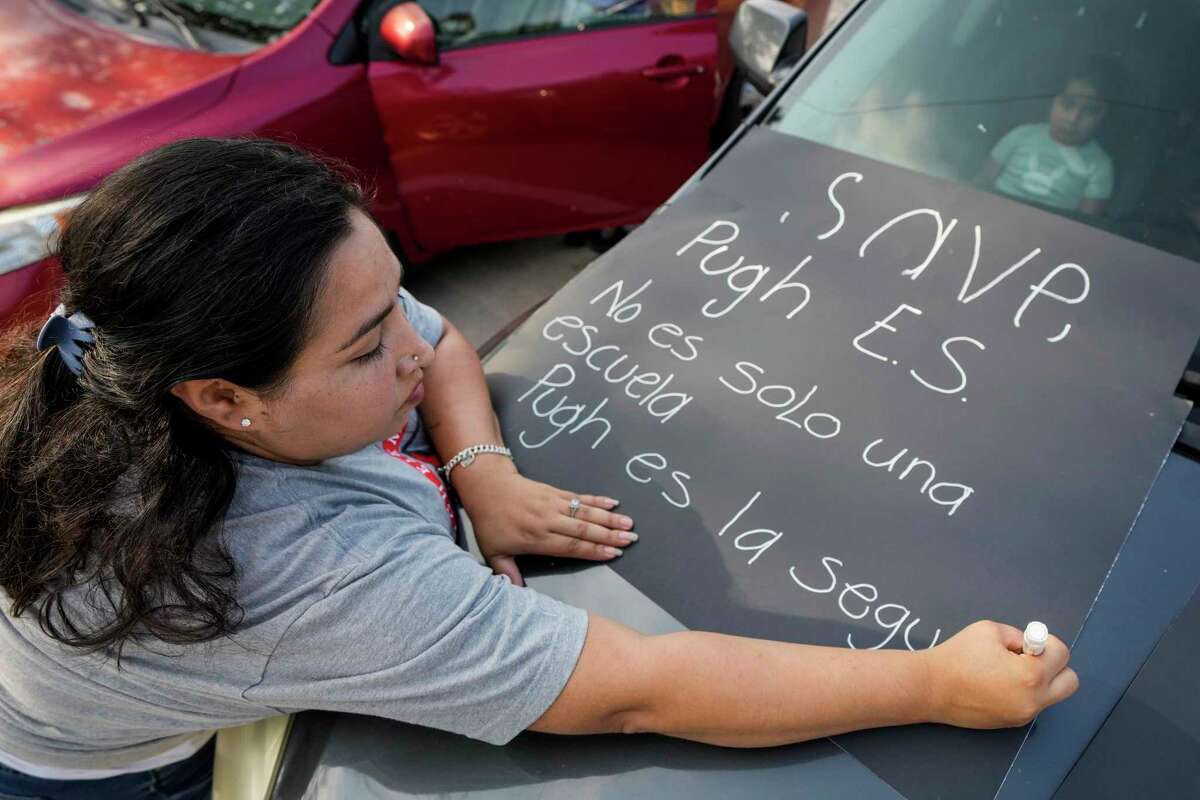
Several parents at Pugh, Martinez and other northeast Houston elementary schools gathered Thursday morning with their children at the Denver Harbor Multi-Service Center to protest the potential removal of teachers from their A-rated schools, before traveling to HISD headquarters to bring their complaints to the district. Children held signs with their teachers’ names — Ms. Rodriguez, Ms. Arguelles, Mr. Infante — and pleas to keep them in place. “Pugh es nuestra familia,” one sign read.
“Every morning, everyone from the principal to the office staff, custodians and cafeteria workers, they greet our children with a smile. I think the kids forget the problems they have at home when they go to school. We don’t want new teachers, we want the same teachers because they’ve been our second family at Pugh,” said Nancy Coronado, a parent volunteer at Pugh for 13 years, in Spanish.
Her son, Ricardo Delgado, graduated from fifth grade at Pugh this year. He discussed his favorite teacher, Ms. Lopez, and how she was a warm, familiar presence to him even before he’d ever taken her class. Now set to start at the Baylor College of Medicine Academy at Ryan Middle School in the fall, Delgado credits Ms. Lopez with teaching him the reading skills he’ll need in middle school.
“If other teachers come, it wouldn’t be the same because she’s been there since I was 6 years old,” Delgado said.
The plan to have teachers reapply for their job has left other Houston parents with mixed feelings. Karmell Johnson, a Fifth Ward mother of three students at NES schools, said there are “pros and cons” to the situation. She welcomes the opportunity to remove under-performing teachers, but worries that some effective teachers, who understand the community they’re serving in and may have formed bonds with students, may be caught up in the mix.
“It’s an emotional roller coaster. Once a bond is established and they rip that out, the kids have to get used to their teachers, the teachers have to get used to the schools, and it’s going to take some time. It’s going to be uncomfortable for everybody,” Johnson said.
Uncertain future for teachers, staff
At many NES schools, however, teacher and principal turnover has already become a fact of life. It was only 10 years ago that North Forest High School was completely reconstituted when the Texas Education Agency ordered North Forest ISD to be absorbed into Houston ISD, and after a brief upswing, it has failed 80 percent of its TEA evaluations since (it passed this year with a C). Wheatley High School replaced a significant portion of their teachers just last year.
Ainhoa Donat, a bilingual fourth grade teacher at Paige Elementary, said she worked with a different fourth-grade colleague in each of her six years at the Eastex/Jensen school.
Donat said she was told by her principal that the school would no longer offer a bilingual program, and that she was welcome to apply for a standard teaching position at the school (the district, in a statement, said that NES schools “will now have a dedicated English Language Arts block for English language development,” which “includes bilingual support for emerging English speakers based on their proficiency level”).
With 16 years of experience at HISD under her belt, the extra money being offered wasn’t enough for Donat to overcome the indignity of being blamed for the school’s low performance. She’s currently in the process of applying for a bilingual job at another HISD campus.
“I have a lot of experience and I work super hard, so when I went to that meeting and the superintendent (basically) said ‘you didn’t do your job,’ I felt really humiliated,” Donat said.
One longtime teacher at Martinez Elementary School, who asked to remain anonymous out of fear of retribution, said she worries that the financial incentives may “entice the wrong people.”
“I would give it back to stay at Martinez,” she said. “There are some teachers who are all about the money… but not at our school.”
The fear is even more acute for support staff, who aren’t guaranteed positions.
One administrative assistant, who has worked for over 20 years at an NES elementary school and also asked to remain anonymous, said she may be forced to retire early if she isn’t rehired. The assistant has spent almost her entire career with HISD and doesn’t know what else she could do.
She wonders who will manage the payroll, procure supplies for teachers, plan field trips and do all the other unseen tasks that keep a school running if support staff are eliminated.
“All I’ve ever known is HISD, getting up and going to work at these schools. We’re not here for the money, we’re here for the children,” she said. “You talk about the children but what are you doing for them? You’re taking their teachers away, and its very upsetting.”Parents, students and community activists gather near Pugh Elementary to protest the potential replacement of their children’s teachers by HISD on Thursday, June 15, 2023 in Houston.Brett Coomer/Houston Chronicle
The state takeover of the Houston Independent School Board involved firing the elected school board, replacing them with a state-picked board, and hiring a new superintendent who was never a teacher but is a military man, a Broadie, and a failure as Dallas superintendent.
The new school board held its first meeting and set up only 35 seats for the public. The room holds 310 people. Everyone else was shunted to a room where they could watch the meeting on a screen. One man who registered to speak was handcuffed when he insisted on entering the room where the board was neeting.
The board unanimously agreed that superintendent Mije Miles should be allowed to serve even though his state license had lapsed in 2018.
This meeting exemplified the state’s contempt for public schools, and its complete indifference to the public, which has a stake in public schools. The public schools belong to the public, not to Republican politicians in Austin.
Only days ago, the Network for Public Education released a report on the growth of Christian nationalist charter schools. It is titled “A Sharp Turn Right: A New Breed of Charter Schools Delivers the Conservative Agenda.” Many of these charters are affiliated with the far-right Hillsdale College, and call themselves classical academies. Their goal is to indoctrinate their students into extremist political views and to teach a rose-colored version of American history.
Last summer, the Texas State Board of Education denied for the third time an application from Heritage Classical Academy to start a charter school in Northwest Houston. Heritage will try again next week, and although very little has changed about its application, its chances of success are now much higher.
Classical charter schools, like Heritage, have been on the rise nationwide and in Texas as parents seek an alternative to “woke” lessons and themes in public schools, namely the promotion of diversity and inclusion, viewing America’s history through a more critical lens, and discussion of LGBTQ topics in classrooms. And earlier this year, the Texas Legislature advanced several bills to bring more Christianity into public schools, part of a related national movement.
Heritage Academy is pitched as a return to an old-school type of education, involving training in rhetoric and public speaking, learning Greek or Latin and reading foundational texts.
Texas Education Agency Commissioner Mike Morath has already approved Heritage, as he did the preceding three years. But before the school can open, the State Board of Education is allowed an opportunity to veto it. Next week state board members will interview officials from Heritage on Wednesday before a planned Friday vote.
Heritage is affiliated with Hillsdale College, a conservative Christian university that refuses federal assistance so that it doesn’t have to comply with Title IX or other federal regulations, through its Barney Charter School Initiative.
The program provides curricula and assistance to help launch classical charter schools around the country. Its “1776 Curriculum” teaches that America is morally exceptional to other countries and offers lessons on American history through a conservative bent, including descriptions of the New Deal as bad public policy and of affirmative action as “counter to the lofty ideals of the Founders.”
The school was voted-down initially in 2020 for including books on its curriculum for primary grades that some board members criticized as containing racist themes. Aicha Davis, a Democrat from Dallas who serves on the state board, last year described Heritage as “extreme” and “one of the most controversial applicants that we’ve had because of the curriculum and ideas they wanted to push.”
The academy’s board president and main financial backer is Stuart Saunders, a wealthy Houston lawyer and banker. Saunders has complained of Critical Race Theory and inappropriate sexual content in public schools, including at his son’s school, which he said inspired him to found Heritage. He has pledged $1 million from his foundation to the school, if approved.
After the state board denied the school for the second time, Saunders and his family donated more than $250,000 to a political action committee called Texans for Educational Freedom. That PAC then donated more than $500,000 to local school board races and other candidates who have promoted conservative themes in the schools.
The group donated in four State Board of Education races, including well over $100,000 total in successful bids to unseat state board members Sue Melton Malone and Jay Johnson, Republicans who voted with Democrats in opposition to Heritage. Board members questioned Saunders about this during a public hearing last year.
“Whereas that’s undoubtedly legal, it really appears to be unethical. It appears like you’re trying to remake this board after last summer when you were denied this charter school for the second time,” former board member Matt Robinson, R-Friendswood, said during last year’s board meeting.
Last year, Heritage’s lobbying efforts backfired and became a factor in the board’s decision to reject the charter, although Saunders told state board members he didn’t know Texans for Educational Freedom would donate to state board races.
This year the story could be different.
Robinson is now gone from the state board, as his home was drawn-out of his district by the Legislature. So are Melton Malone and Johnson. All three have been replaced by more Republicans who are thought to be more friendly to charter schools.
Texans for Educational Freedom then reported spending nearly $200,000 to support the campaign of Republican LJ Francis last year, a massive amount for a state board race.
Francis won his race by 1,665 votes, or 0.4 percent of the total, flipping his board seat from blue to red and putting yet another charter-friendly face on the board. Francis joined Gov. Greg Abbott at a speaking event at a San Antonio private school to promote the governor’s school voucher plan. Francis did not respond to a request for comment.
Heritage said in this year’s application to the Texas Education Agency, which was approved by Commissioner Mike Morath, that it expects to serve 1,056 students at capacity, primarily nonwhite students. Its goal is to bring classical education, including “instruction in moral virtues” to “the most disadvantaged students of Northwest Houston.”
A recent analysis from the Network for Public Education found classical schools nationwide are disproportionately wealthy and white, with just 17 percent of students eligible for free or reduced-price school lunch.
Board members have also questioned Heritage’s connection with Hillsdale College, which doesn’t fund or govern schools directly, but provides curriculum and consulting.
Hillsdale has a long history of cozy relationships with the political right. For instance, Ginni Thomas, the wife of Supreme Court Justice Clarence Thomas — who reportedly lobbied to overturn the 2020 presidential election — is a former vice president at the college.
With the four new state board members installed, Heritage’s plan to provide a conservative curriculum that dovetails neatly with an understanding of the United States as a fundamentally Christian nation could be a selling point, rather than a bug.
Texas operates under the theory that if students always have the Ten Commandments in their classrooms, have ample opportunity to pray during the school day, and read the Bible as often as possible, that will cure the social ills of the state: no more murders, no more suicides, no more abortions, no more adultery, no more rapes, no more crime. You get the picture. Meanwhile the state has removed all gun control. Gun buyers don’t need a permit and they can carry their weapon in public. More of that all-time religion will fix things.
If not, the people of Texas should throw these self-aggrandizing frauds out on their ears.
California Governor Gavin Newsom has been blasting away at knuckle-headed Republican governors like Ron DeSantis and Greg Abbott for their cruel indifference to other people. He’s already suggested he may sue DeSantis for kidnapping, after Florida sent two private planes with Venezuelan immigrants to Sacramento. Now, he’s going after Abbott for his refusal to take action against gun violence.
He wrote:
Texas… where elected officials are relying on Winnie the Pooh to teach their kids about active shooters because they don’t have the courage to keep our kids safe.
Texas… where Greg Abbott signed a law to send DNA kits to parents of school children so their bodies can be identified after a shooting.
Guns are the leading cause of death for kids in America. Kids!
We’re not talking about accidents, or cancer or something unpreventable. We know the steps to take to save our kids lives. But leaders like Greg Abbott lack the courage to act.
Until then… It’s Winnie the Pooh for Texas families.
If you read only one article today, read this one. It’s powerful and poignant. The article was written by Forrest Wilder and appears in the Texas Monthly, a terrific publication.
To understand why Republican legislators from rural districts helped to defeat vouchers in Texas, read this article about the schools of Fort Davis in Jeff Davis County in rural West Texas. The superintendent is a bedrock conservative who is dead set against vouchers. His schools are on the verge of bankruptcy due to the state’s Byzantine school-finance system. The state government doesn’t care. At the end, you will understand Governor Abbott’s long-term goal: to eliminate property taxes and completely privatize education.
Texas doesn’t have a mile-high city, but Fort Davis comes close at 4,892 feet. The tiny unincorporated town is nestled in the foothills of the Davis Mountains, where bears and mountain lions and elk stalk among pine-forested sky islands. Fort Davis is the seat of Jeff Davis County, whose population of 1,900 is spread among 2,265 square miles, 50 percent bigger than Rhode Island. The sparsely populated desert country of Mongolia has nearly seven times the population density of Jeff Davis County. Odessa, the nearest city to Fort Davis, is two and a half hours away. The state Capitol is six and a half.
For Graydon Hicks III, the far-flunged-ness of Fort Davis is part of its appeal. He likes the high and lonesome feel of his hometown—the “prettiest in Texas,” he says. But these days, it has never felt further from the state’s political center of gravity.
For years, Hicks, the superintendent of Fort Davis ISD, has been watching, helplessly, as a slow-motion disaster has unfolded, the result of a flawed and resource-starved public-school finance system. Over the last decade, funding for his little district, which serves just 184 K–12 students, has sagged even as costs, driven by inflation and ever-increasing state mandates, have soared. The math is stark. His austere budget has hovered around $3.1 million a year for the past six years. But the state’s notoriously complex school finance system only allows him to bring in about $2.5 million a year through property taxes.
Hicks has hacked away at all but the most essential elements of his budget. More than three-quarters of Fort Davis’s costs come in the form of payroll, and the starting salary for teachers is the state minimum, just $33,660 a year. There are no signing bonuses or stipends for additional teacher certifications. Fort Davis has no art teacher. No cafeteria. No librarian. No bus routes. The track team doesn’t have a track to train on.
But Hicks can’t cut his way out of this financial crisis. This school year, Fort Davis ISD has a $622,000 funding gap. To make up the difference, Hicks is tapping into savings. Doug Karr, a Lubbock school-finance consultant who reviewed the district’s finances, said Fort Davis ISD was “wore down to the nub and the nub’s all gone. And that pretty much describes small school districts.”
“I am squeezing every nickel and dime out of every budget item,” Hicks said. “I don’t have excess of anything.” When I joked that it sounded like he was holding things together with duct tape and baling wire, he didn’t laugh. He said: “I literally have baling wire holding some fences up, holding some doors up.”
The district’s crisis comes at a time when the state is flush with an unprecedented $33 billion budget surplus. Hicks is a self-described conservative, but he thinks the far right is trying to destroy public education. For years, the state has starved public schools of funding: Texas ranks forty-second in per-pupil spending. And yet Governor Greg Abbott is spending enormous political capital on promoting a school voucher plan, which would divert taxpayer funds to private schools. Public education, Abbott has repeatedly said, will remain “fully funded,” though public-education spending is lower now than when he took office in 2015, and the Legislature recently passed a $321.3 billion budget with no pay raise for teachers and very little new funding for schools. Unable to get his voucher plan through the regular legislative session, Abbott is threatening to call lawmakers back to Austin until he gets his way.
Lieutenant Governor Dan Patrick, long a champion of vouchers, is backing legislation that would attempt to appease rural Republican legislators—a bloc long wary of vouchers—by offering $10,000 to districts that lose students to private schools. Hicks can barely contain his anger when he hears such talk. He has been lobbying state leaders for years to fix the crippling financial shortages that plague districts like his. “Take your assurances and shove ’em up your ass,” he says, before softening a bit. “I’m so tired. I’m so frustrated. We have tried. I have fought and fought and fought.”
With each passing month, his rural district inches closer to financial ruin. If nothing changes by next summer or fall, Fort Davis will have depleted its savings. He doesn’t know the exact day that his school district will go broke, but he can see it coming.
It’s easy enough to grasp the basic problem in Fort Davis. But what’s going on beneath the surface is another story.
During my twenty years of reporting on Texas politics, I’ve often heard that only a handful of people in the state understand the school-finance system, with its complicated formulas, allotments, maximum compressed tax rates, guaranteed yields, and “golden pennies.” A former colleague of mine, who once spent months trying to make sense of the topic, warned me against writing about it. Karr, the school finance consultant, compares the process of making sense of our public education funding to encountering a fire at a roadside cotton gin on some lonely West Texas highway. “You drive off into that smoke and you might never drive out,” he said. “You might end up getting killed.”
A thorough explanation of the system is the stuff of graduate theses, but the broad strokes are straightforward enough. How a school district is funded begins with two key questions: How much money is the district eligible for? And who pays for it?
Here it’s helpful to use a venerable school finance analogy: buckets of water. The size of a school district’s bucket—how much money it’s entitled to—is largely determined by the number of students in attendance. Every district receives at least $6,160 per pupil, an amount known as the basic allotment, an arbitrary number dreamed up by the Legislature and changed according to lawmakers’ whims.
At this point in the article, Wilder goes into the intricacies of school finance in Texas. Very few people understand it. All you need to know is that some districts are lavishly funded while others, like Fort Davis, are barely scraping by and may go bankrupt.
Hicks is not alone in thinking the opaqueness is intentional. “They make it just as complicated as they can,” he said of state officials. “Because how do you explain something so complicated to the average voter?” In other words, if constituents can’t easily grasp the perplexing and unnecessarily knotty framework, it’s tougher to hold officials accountable for budget decisions.
Though the spreadsheets may be head-spinning, they tell a story. In a state where some wealthy suburban communities build $80 million high school football stadiums, Fort Davis ISD is one of many rural communities literally struggling to keep the lights on.
I first heard from Hicks in March 2021, when he emailed state officials and journalists with a dire message: “What, exactly, does the state expect us to do? What more can we do? What more do our children need to be deprived of? At what point does our community break?” Hicks has received few answers, even as his situation has grown more desperate.
When I visited him in April, we met in his office, where he keeps a book on Texas gun laws, a photo of his West Point 1986 graduating class (which included Donald Trump’s secretary of state Mike Pompeo), and a list of quotes from General George Patton (“Genius comes from the ability to pay attention to the smallest details”). Hicks, who’s stout and serious and talks in a sort of shout-twang because of partial hearing loss, wore a cross decorated in the colors of the American flag. He was eager to show me the fine line he walks between fiscal prudence and dilapidation. The first lesson came as he stood from his desk and I noticed the holstered handgun on his hip. The district, he explained, can’t afford to hire a school security officer, so he and eleven other district employees carry firearms.
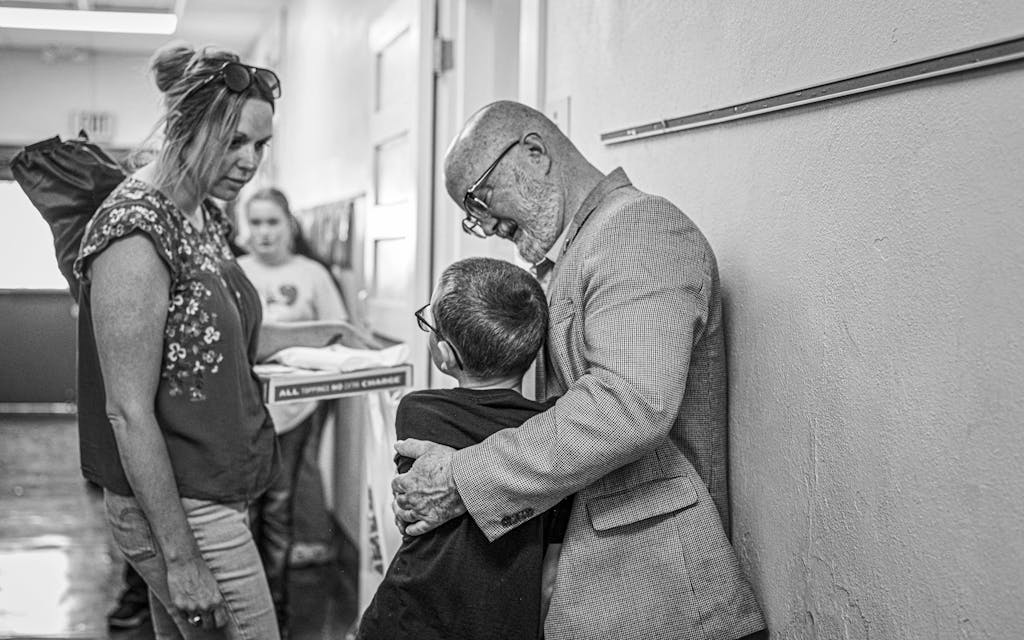
His family has been in the area since the 1870s, when federal soldiers still pursued Comanche and Apache from the town’s namesake garrison. His great uncle was one of the first superintendents of Fort Davis ISD. (At one point, Hicks showed me a copy of his great-uncle’s 1942 master’s thesis, “The Early Ranch Schools of the Fort Davis Area.”) Later, as we were walking around campus, Hicks’s ten-year-old grandson, a thin fourth-grader wearing blue-rimmed glasses and blue jeans tucked into a pair of cowboy boots, ran up to Hicks and gave him a hug.
Superintendent Hicks hugs his grandson in the hallway at Dirks-Anderson Elementary School in Fort Davis.Photograph by Maisie Crow
Both the elementary school and the high school—where Hicks graduated in 1982—were built in 1929, Hicks explained. Walking through their timeworn hallways is to step back in time. In places, the plaster is flaking off the original adobe walls. The elementary school gym floor is bubbling up because of a leak under the foundation. The wooden seats in the high school auditorium have never been replaced. The urinals in the elementary school are original too. The newest instructional facility, a science lab, was built in 1973. In the summer, Hicks mows the football field, the same one he played on five decades ago. “Every bit helps,” he said.
The funding challenges create all manner of ripple effects. Hicks has trouble recruiting and retaining teachers, and some students drift away from school without extracurriculars to hold their interest. “You lose teachers, then you start losing kids, and then your funding gets worse,” he said. “It’s a circle-the-drain kinda thing. And it’s really speeding up for Fort Davis.”
The first problem is the size of the district’s bucket. For the last decade, TEA has calculated that Fort Davis’s Tier I annual allotment is between $2 million and $2.5 million, well short of its already spartan $3.1 million budget.
And then there’s the matter of how that bucket is filled. In the 2011–2012 school year, the state covered two-thirds of Fort Davis’ entitlement, about $2.1 million. Today, it chips in about $150,000, a 93 percent decrease. How to explain that change?…
In June 2019, the Big Three figures in state government—Abbott, Patrick, and then–House Speaker Dennis Bonnen—gathered at an elementary school in Austin for an almost giddy bill-signing ceremony. As a bipartisan group of lawmakers watched, Abbott signed into law House Bill 3, an $11.6 billion package of property tax cuts and education funding that had received near-unanimous support in both the House and Senate, a rarity in the highly polarized Legislature. “This one law does more to advance education in the state of Texas than any law that I have seen in my adult lifetime,” said Abbott.
For almost a year, an appointed commission of experts had met to discuss how to overhaul the school-finance system, issuing a report in December 2018 that called on the Lege to “redesign the entirety of our state’s funding system to reflect the needs of the 21st century.” HB 3 was the by-product of that prompt. Lawmakers rejiggered many of the system’s outdated formulas, offered pay raises to teachers, fixed some of the most glaring inequities, and reduced the amount of money recaptured by the state from property-wealthy districts. Most important, HB 3 represented a much-needed infusion of cash for struggling schools. The basic allotment was raised from $5,140 to $6,120 per student.
But HB 3 also exacerbated disparities among property-wealthy and property-poor districts. Because of changes to the way Tier II enrichment funding works, some communities were able to cut tax rates and generate significant new revenues from their tax base. For others, a minority of districts, HB 3 actually created new problems. Around 10 percent of districts saw a decrease in formula funding. This year, Alpine has $220,000 less than it would have had under the old system, even as some of the richest districts in the state—tiny West Texas communities with lots of oil wealth—saw their funding explode. Rinehart contrasts Alpine, which has almost no mineral wealth, with Rankin ISD, 130 miles northeast in the Permian Basin oil patch. While Alpine’s funding went down 2 percent, Rankin’s went up 339 percent. Even though Rankin is projected to return close to $100 million in recapture payments to the state this year, the district is fabulously wealthy. “Alpine’s budget is $10 million,” Rinehart points out. “Rankin’s is $14 million. We educate a thousand kids and they educate three hundred kids. So they are a third of our size and have a budget 40 percent larger than ours.”
Rinehart doesn’t begrudge Rankin’s wealth—she recently served as assistant superintendent there—but uses the Alpine–Rankin comparison as a “wild” example of how HB 3 exacerbated inequities, making the rich richer and the poor poorer.
Hicks, too, has noticed. “Rankin just built a whole new school,” he told me. “They got a new fieldhouse, a new gym. Two new science labs. A turf practice field, a turf game field. A new track, a new stadium. And my buildings were built in 1929.” Rankin is planning to build ten new “teacherages”—district-funded housing for teachers, important to attracting and retaining talent in areas with scant or affordable residences.
Jeff Davis County, on the other hand, has no oil and gas and very little industry; any school debt would thus be borne by homeowners through bonds. Hicks’s district has never issued a bond, in part because it would be unlikely to pass; the voters wouldn’t support a tax increase. The school’s ag barn was built in 2019 with local donations. The band program, suspended for nine years as a cost-saving measure, was only revived in 2023 after a philanthropist left his estate to the school.
To be sure, Alpine and Fort Davis are outliers. Most districts saw an immediate boost to their finances from HB 3, and advocates celebrated a meaningful investment in public education after $5.4 billion in devastating cuts in 2013. But even for those districts, the sugar rush from HB 3 didn’t last long. According to Chandra Villanueva, the director of policy and advocacy at the progressive nonprofit Every Texan, the $1,000 increase in the basic allotment was “roughly enough to cover one year of inflation….”
The property tax system and the school finance system are inextricably linked, Rube Goldberg–style. Twist a dial here and a light will come on over there. Slip a gear here and spring a leak there. As state lawmakers have prioritized tax cuts over public education funding, the trade-offs have grown clearer. This year represents a potential turning point. But rather than trying to solve the problem using the $33 billion budget surplus—a generational bonanza—Abbott and Patrick have overwhelmingly focused their attention on property tax cuts and a school-voucher plan loathed by almost everyone in public education, in part because it would threaten to strip even more funding from school districts.
The just-completed regular session was a bloodbath. The 88th Legislature began in January with the governor and lieutenant governor promising to pass a transformative voucher program and a record-setting $17 billion in property-tax cuts. Funding for public education, often a banner issue, was scarcely discussed. Even the House, the friendlier chamber toward public education, only proposed raising the basic allotment by $140, from $6,160 to $6,300 per student—far less than the $1,500 increase needed to keep up with inflation since 2019, according to the Texas American Federation of Teachers. But in the end, teachers and public schools got virtually nothing.
Teachers and administrators were stunned. Zeph Capo, the president of Texas AFT, called it a “joke.” HD Chambers, the executive director of the Texas School Alliance, accused Patrick and Abbott of playing a “hostage game” with Texas’s teachers and public school students by tying education funding to vouchers. “It’s pretty simple. The governor and Senate says, ‘If you don’t give us the kind of vouchers we want, we’re not giving you any money.’” The House refused to budge, and the regular session concluded without a deal on property tax relief, vouchers, and other GOP priorities.
Now, the governor has promised to convene multiple special sessions to take up the unresolved issues. The first special session began three hours after the regular one ended, and effectively wrapped up less than 24 hours later, with the House rejecting the Senate property-tax plan, passing its own program consisting solely of property-tax compression, and then abruptly adjourning. Abbott threw his support behind the House plan. The message to the Senate was clear: take it or leave it. If the Senate yields, the House version would push some school districts down to as low as $0.60 per $100, with no new source of revenue to backfill for the reduced funding in case of a bad economy.
Abbott has said his goal is to completely eliminate the main school property tax. In such a scenario, Texas’s thousand-plus school districts would be at the mercy of the Legislature for funding—a troubling scenario, says Villanueva. She suspects vouchers would then become inevitable. “At that point, it’s like, ‘You know what, we don’t have the money to fund schools. Everyone take five thousand bucks, figure it out for yourselves.’”
That day, if it ever comes, may still be far off. But the education system is in crisis right now, and unlike previous hard times, the state is flush with cash. The pain, Chambers says, is being intentionally inflicted by Abbott and Patrick. “Because of this one pet project that the governor has”—vouchers—“they are purposely creating a financial environment where every school district in Texas is being set up to fail.”
The result is that Texas schools, already operating on “shoestring budgets,” will have a harder time attracting and retaining educators, said Josh Sanderson, the deputy executive director of the Equity Center, a nonprofit that represents six hundred Texas school districts. They will run up deficits. They may have to cut extracurriculars and athletic programs. Some, like Fort Davis, may become insolvent and be forced to consolidate with another district, an often painful process.
As we were sitting in his red pickup with the engine idling outside his office, Hicks told me that he’d given up on lobbying the Legislature. He mentioned again that Patrick and other GOP lawmakers are trying to destroy public education by using vouchers to privatize schools, and he said that most other politicians “don’t give a shit about West Texas.” But for the time being he was still fighting: writing op-eds, firing off plaintive missives, asking concerned citizens to contact their legislators.
Toward the end of our visit, I asked Hicks what’s going to happen to his schools. “I don’t know,” he said. “I’m not patient enough to spend time with assholes in Austin, and I’m not rich enough to buy any votes.” TEA has suggested consolidating with another district—most likely nearby Valentine ISD—but Hicks said this would harm both Fort Davis and the other district.
He seemed resigned to his role as a Cassandra warning of impending doom, destined to be ignored. He reminded me that his grandson goes to school here, and that the painful road ahead feels both personal and existential. “If you don’t have a school,” he said, “you don’t have a community.”
Two months later, Hicks called me with some news. He’d decided to resign this summer, joining the mass exodus of school leaders that have fled the profession in the past few years. To anyone who closely follows public education in Texas, his reasoning was tragically familiar: He said he was too tired to fight anymore.
Nancy Goldstein writes in the Texas Observer about her pleasure in watching the state’s Republican-controlled House of Representatives impeach Ken Paxton, the state’s Attorney General. Paxton, a stalwart MAGA-man, has been under indictment for corruption for eight years. Eight years! Paxton is the Trump ally who filed a lawsuit after the 2020 elections, joined by other Republican attorneys general, to throw out the votes of states that Biden narrowly won. The Supreme Court rejected his suit, saying that Texas had no standing to sue.
Was yesterday’s performance by the Texas House of Representatives intended to restore public faith in the body’s commitment to the rule of law? Separate the good cops in the GOP from the bad cops? Or prove that a legislature that spent a year cravenly ignoring the pleas of Uvalde victims’ relatives for common-sense gun safety laws before rejecting them outright while rushing through an attempt to put the Ten Commandments in every classroom isn’t really the 10th circle of hell? If so, the hearing leading up to a 121-23 vote to impeach Attorney General Ken Paxton for corruption was an epic fail.
What the public saw—regardless of the lawmakers’ intentions—were the open of fissures that have more to do with pride and power than justice. It was a cross between the state’s largest intra-party catfight and its most public self-inflicted gunshot wound, as the bad blood between Paxton and Texas House Speaker Dade Phelan, who serve as proxies for Trump and Republicans trying to distance themselves from Trump in advance of next year’s elections, finally spilled out into the open.
The lineup featured, on the one hand, GOP representatives who suddenly had a lot of worries about “due process,” “precedent,” and “evidence” that had not been evident while banning abortionand stripping transgender youth and their families of access to healthcare. Opposing them were those GOP colleagues who solemnly intoned about what appears to be their newly discovered “obligation to protect the citizens of Texas from elected officials who abuse their office and their powers for personal gain.”
Various media outlets, and a few of Paxton’s defenders, have made much of the lightning speed of this past week. But while it may have been mere days between the Republican-led House General Investigating Committee’s announcement of their investigation and their unanimous vote to introduce 20 articles of impeachment to the full House for Saturday’s hearing and impeachment vote, Paxton has been under felony indictment for securities fraud since he became attorney general in 2015. The FBI had been investigating Paxton on allegations that he used his office to benefit a wealthy donor, Nate Paul, since late 2020. Only in February of this year did the Department of Justice take over that probe, breathing new life into it.
Paxton’s overreach the next month, in March of this year, appears to have been the second-to-last straw. According to the committee’s own memo, released the day before the full House hearing: “But for Paxton’s own request for a taxpayer-funded settlement over his wrongful conduct, Paxton would not be facing impeachment.” Not, please note, the wrongful conduct—that is, Paxton’s firing of four whistleblowing members of his own senior staff after they accused him of using his office to help out Paul. Nor Paxton’s decision this past spring to pay $3.3 million to settle out of court. Or even the $600,000 the House spent defending Paxton. But Paxton’s request that taxpayers pay that $3.3 million—and that his fellow GOP colleagues go on record approving that request.
The final straw? Paxton, likely knowing that Phelan was going to try to gloss this most recent disgusting legislative term by ending it on a high note, called on him to resign last week over alleged drunkenness—via a tweet. Making it look super-extra-duper political when the House General Investigating Committee revealed that afternoon that it had been investigating Paxton in secret since March. The committee then heard a three-hour presentation from its investigators detailing allegations of corruption against the attorney general and voted to forward 20 articles of impeachment to the full House.
Believe me when I say that I, like many people who have been burned by the Texas GOP’s seemingly endless appetite for cruelty, ignorance, and hypocrisy, felt a certain satisfaction as I watched yesterday’s coverage of it setting itself on fire. Top moment? When the first group to appear outside the Capitol in Austin in response to Paxton’s call for supporters to turn out was around 100 people preparing for the “Trot for Trans Lives,” a 5K run held in support of transgender Americans affected by the waves of anti-trans rights legislation passed in recent years, including by Texas lawmakers.
Small pleasures aside, none of this is as satisfying as it sounds, nor do I think it will end well. First of all, because of all the bureaucracy that lies ahead. Governor Greg Abbott, who has remained curiously silent this past week while he sticks his finger into the political wind, has 10 days to tell the Senate to start a trial. A trial that would be presided over by Paxton buddy arch-conservative Lieutenant Governor Dan Patrick, and that’s likely to be kicked down the road infinitely and/or end with an acquittal.
But ultimately because the bottom line is that while Paxton burns—or simmers or escapes entirely—and intra-party fighting and dirty laundry airing be damned, the members of the USA’s largest, richest, and most powerful wing of the GOP have screwed Texas on such a large, systemic level that they’ll still prevail. In the state, through control of both chambers and the governor’s seat, held in place by voter suppression and gerrymandering. Nationally, with courts packed with ideologues, including a Supreme Court that has already demonstrated its willingness to let Texas gut constitutional rights, overturn precedent, and play an enthusiastic role in the new national sport: playing on whatever field offers your agenda the best advantage. That means valorizing states’ rights when it’s convenient, or passing the ball to the Supreme Court if a federal ban looks more likely or appealing.
Call this, with apologies to Taylor Swift, the “Errors Tour” or, in a nod to the Ziegfeld Follies, “Hypocrisy on Parade.” Or let’s go “Paris is Burning” and give the representatives a Realness Award for their impersonation of legislators who seriously care about integrity, democracy, and the will of voters.
But whatever you do, don’t hold your breath waiting for justice.





 Diane Ravitch's blog