Archives for category: Teachers

This delightful article appeared in the New York Times.

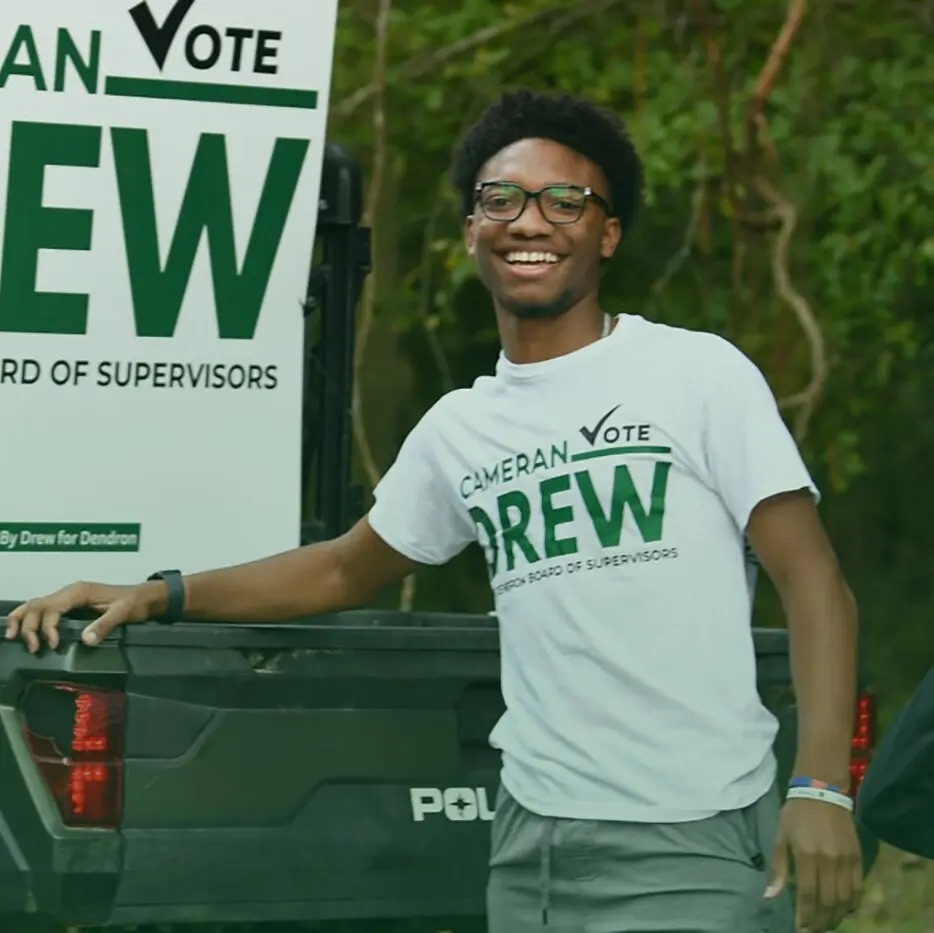
In the recent election in Virginia, 19-year-old Cameron Drew ran for a seat on the Surry County Board of Supervisors and won by a mere 10 votes. Even more interesting, the candidate he beat was his high school teacher of civics, history, and government.

Drew won 345 votes. His former teacher, Kenneth Bell, received 335.

The New York Times wrote:

The election, to represent the Dendron district, wasn’t contentious. In fact, Mr. Drew said he remained “very close” with his former teacher, fondly recalling that Mr. Bell twice took him to Richmond to shadow lawmakers. Mr. Bell, for his part, said he was “over the moon” when he found out who he would be running against.

“He’s the type of student that if teachers could have a little cloning machine in their classrooms to duplicate, he would be all over the place,” Mr. Bell said.

Surry County, with a population of about 6,500, is in a rural area of southeastern Virginia between Richmond and Norfolk. The five members of the county board serve four-year terms.

A seat opened up in July when a board member resigned, and both Mr. Bell and Mr. Drew raised their hands for an interim appointment. The board seated Mr. Bell. Mr. Drew then gathered the 125 signatures needed to get on the ballot for Tuesday’s special election.

A bald man in a pink T-shirt and glasses.
Kenneth Bell was appointed to a vacant seat on the Surry County Board of Supervisors earlier this year.Credit…Kenneth Bell

“I saw that the youth wasn’t always taken care of or just appreciated, so I was like, ‘Hey, it’s time for me to step up,’” said Mr. Drew, who is studying business administration at Virginia Peninsula Community College in Hampton, Va.

He made direct-to-camera appeals to voters on Instagram, dressed in a suit and positioning himself as someone “who’s looking to move Surry forward, while retaining our rural charm,” as he put it in one post

Mr. Bell said that, because of his affection for Mr. Drew, he didn’t campaign aggressively.

Mr. Drew reported spending $2,295 on his campaign, according to the Virginia Public Access Project, a nonpartisan group that tracks voting data. Mr. Bell spent nothing.

Mr. Bell and Mr. Drew, neither of whom ran on a party line, largely agreed on the issues and held just one joint town hall-style forum. Describing himself as a philanthropist, Mr. Drew told the audience, “It’s time to bring young minds to the table.”

The campaign centered on local issues, though some, such as affordable housing, have resonated nationally. Mr. Drew focused particularly on how to incentivize young people to stay in the area.

On election night, Mr. Drew was at a watch party for a mentor of his, Kimberly Pope Adams, who flipped a seat in the House of Delegates, helping Democrats increase their majority.

On the Virginia elections website, Mr. Drew saw that he had eked out a victory — a moment he called “surreal.” Mr. Bell called to concede. They had a pleasant five-minute conversation.

“He was like, ‘If you ever need anything from me, just let me know,’” Mr. Drew said. “He was, once again, still the supportive person he has always been.”

Mr. Bell said there was “not a sad bone in his body” that he lost.

“I have found that is not the answer people in our community want me to give,” Mr. Bell said. “I think everybody wants me to be in a depression and sad. It’s because I know Cameran and I know the quality of a person that he is. And so I can’t be sad.”

If you read only one article about what happened to the students, teachers and schools in the aftermath of Hurricane Katrina, this is the one. Ashana Bigard is a parent of students in New Orleans. Elizabeth K. Jeffers taught in the NOLA district.

Turning New Orleans into an all-charter district may have raised test scores–although New Orleans is still a low-performing district in one of the nation’s lowest performing states–but as you will learn by reading this article, the transformation was a disaster for students, their families, their communities, and their teachers.

Please read!

This article was produced by Our Schools. Ashana Bigard is the director of Amplify Justice, an educational advocate, and author of Beyond Resilience: Katrina 20. A dedicated mother of three, she serves as an education fellow for the Progressive magazine’s Public Schools Advocate project and is a director-producer of numerous video and audio productions. Follow her on Bluesky @AshanaBigard. Elizabeth K. Jeffers, PhD, is an assistant professor at the University of New Orleans who began teaching in pre-Katrina New Orleans public schools. Her scholarship focuses on school choice and community-based inquiry. Her research has been published in Educational Evaluation and Policy Analysis, Educational Policy, the International Journal of Qualitative Studies in Education, and other scholarly journals. Follow her on Bluesky @ekjeffersphd.

To mark the 20th anniversary of Hurricane Katrina’s devastation of New Orleans, numerous articles and opinion pieces have appeared in prominent media outlets touting the supposed improvement of the city’s public school system since the storm.

Katrina’s immediate aftermath saw the state of Louisiana disempower the democratically elected school board by taking over the management of 107 out of 128 schools. This led to the termination of 7,600mainly Black and womenteachers, paraprofessionals, cafeteria workers, clerical workers, principals, and other permanent employees, and the eventual conversion of all of the city’s public schools into privately managed charters.

A Washington Post column, “‘Never Seen Before:’ How Katrina Set off an Education Revolution,” by British journalist Ian Birrell, proclaimed the transformation a “miracle.” Another opinion piece in The 74, “The Inconvenient Success of New Orleans Schools” by Ravi Gupta, the founder and former CEOof a charter school network, stated that the New Orleans school system shaped by Katrina was “a model that should theoretically appeal to both sides of America’s education debates. It delivered the academic results that reformers promised while addressing the equity and community concerns that critics raised.”

As proof of their arguments, both authors pointed to a June 2025 report, “The New Orleans Post-Katrina School Reforms: 20 Years of Lessons” by Douglas N. Harris and Jamie M. Carroll of the Education Research Alliance for New Orleans. Pulling from the data presented in that study, Birrell said the case for declaring New Orleans-style education reform a “remarkable success” is “pretty definitive,” and Gupta called this supposed success an “unequivocal conclusion.” As a longtime youth advocate and community leader and an assistant professor at the University of New Orleans, who was a public school teacher in the city, we invite you to consider whether this data alone proves that New Orleans public schools and the families they serve are better off after 20 years of “reform.”

Although Gupta warns against “[falling] into the tyranny of the anecdote when reporting on fraught education debates like those over the meaning of the New Orleans reforms,” we’d like to tell you about Rio, whose last name has been withheld for privacy reasons. Rio attended 12 different schools in New Orleans, many of which were shut down suddenly, before he finally graduated from a school that is now also closed. Rio’s story is not atypical of the human costs of the New Orleans school system, where closures are a defining feature and evidence that the disaster Katrina wrought on the schools is still happening.

Forced to traverse the fragmented charter system that has replaced the public system of neighborhood schools, New Orleans students are often traumatized by multiple school closures. Decades of researchattest to the academic, emotional, and economic harms that result from severing social connections that families, faculty, and staff have had with schools and with one another.

For instance, obtaining a job reference letter from a former teacher should be simple for students to do, but that task becomes an obstacle course for many young adults from New Orleans, like Rio. Black Man Rising, a national group providing outreach and mentorship for Black youth, had to intervene to help him obtain the letter that made the difference between him being able to financially support himself and being just another addition to the statistics of Black youth who are unemployed and incarcerated.

Rio’s story illustrates a central paradox of the New Orleans system: Black families and communities continue to be severed and displaced as a result of failed leadership at the federal, local, and state levels. While the storm may be over, the disaster continues. On the other hand, white children in New Orleans rarely experience school closures.

The near obliteration of democratic public schooling

In addition to severing families from their neighborhood schools and educators, Katrina reforms have nearly obliterated democratic participation in ways that would shock most Americans.

New York University professor Domingo Morel contends in his book Takeover: Race, Education, and American Democracy that state takeovers do not generally improve test scores or graduation rates; instead, they are about removing political power, as Black school boards have historically functioned as entryways for Black political leaders.

In a similar vein, Louisiana legislators, in the immediate aftermath of Katrina, passed Act 35 in November 2005, which expanded the state-run Recovery School District’s (RSD) jurisdiction over New Orleans public schools during an emergency session when voters were dispersed across the country and many were still searching for their loved ones. The new laws removed the parent and teacher approvals required for charter conversions.

State legislation also enabled the termination of the majority Black teaching force, gutting the teachers’ collective bargaining unit, United Teachers of New Orleans (American Federation of Teachers, Local 527), and further removing obstacles for top-down reform. Research conducted by University of Wisconsin-Madison professor Kevin L. Henry and his co-author has shown how the “charter school authorization and application process” used in post-Katrina New Orleans “reproduces white dominance.” While another study published in the journal Urban Education points to how charter schools consolidate power “in ways that limit local Black political power.”

Consider the example of Kira Orange Jones, whose case perfectly illustrates how educational democracy has been dismantled. In 2011, Jones raised $478,000for her Board of Elementary and Secondary Education campaign—much of it from out-of-state donors connected to Democrats for Education Reform and charter school advocacy groups. Her opponent raised just $19,000, creating a 25-to-1 spending disadvantage. But the campaign money was just the beginning. Jones simultaneously served as executive director of Teach For America’s (TFA) Greater New Orleans chapter while sitting on the board that approved TFA’s $1 million state contract with Louisiana. When ethics complaints were filed in 2012, the Louisiana Ethics Board overruled its own staff’s recommendation that Jones choose between her TFA position and her board seat.

While NOLA Public Schools mandates charter school governance boards to include an alumnus or a parent, legal guardian, or grandparent, who is either elected or appointed, Katrina school reforms have nearly obliterated democratic participation. Parents often don’t find out when school board meetings are happening, let alone have access to board members’ email addresses or phone numbers to voice concerns. Even local reporters who tried to obtain basic contact information for charter school board members have been stonewalled. There is no state requirement that charter school boards meet at times that are convenient for working parents to attend.

The absence of neighborhood schools is an additional obstacle for parents who rely on public transportation. And although charter schools seemingly returned to an elected school board in 2018, the public has virtually no control over individual charter schools, which maintain complete autonomy over curricula, calendars, certification requirements, contracts, and daily operations.

Shadow suspensions and ‘behavior problems’

Louisiana has long been among the states with the highest rates of student suspensions and expulsions, and Black students are more than twice as likely to be suspended compared to white students and receive longer suspensions for identical infractions, according to an analysis of 2001to 2014 figures by Education Research Alliance for New Orleans. In New Orleans, suspension and expulsion rates rose sharply after the storm but then stabilized. Nevertheless, some charter schools continued to suspend and expel high percentages of students.

But that’s just the official data. More recently, several parents have reported that their children are being sent home from school without receiving official suspension papers. Elizabeth’s field notes attest to students’ reports of one charter school network sending students to “the RC room” (restorative center) where they are forced to sit in cubicles, complete detention assignments, and write apology letters in a secluded room. This shadow suspension system allows schools to push out Black students without creating the paper trail that might trigger oversight or intervention. Children lose days or weeks of education in bureaucratic limbo, with no formal process and no recourse. And large numbers of students, often labeled as “behavior problems,” remain enrolled in alternative schools, rather than mainstream degree programs, according to state data.

Community-rooted educators replaced by managers

New Orleans teachers once lived in their communities. Most were career educators who taught generations of children, creating lasting bonds that extended far beyond the classroom.

Ashana experienced this personally at a small school called New Orleans Free School. As someone who is extremely dyslexic, she felt inadequate throughout most of her educational life until she encountered teachers like Woody, Janice, Jeanette, and Jim—two of whom, Jeanette and Jim, have since passed away. Woody still leaves encouraging comments under articles she has published, telling her he is proud of her. He, along with the others, encouraged her and insisted she could be brilliant despite her spelling difficulties. They told her she could be a writer. They emphasized that we all have different skill sets that we can develop, and that none of us is perfect, but that we can practice and grow.

This encouragement didn’t end when Ashana left Free School. The advice and support continue today. That’s what it means to have authentic relationships with your teachers. That’s what it means to be rooted in your community. Unfortunately, Ashana didn’t have the opportunity to send her children to that school to be educated by those incredible educators. The school that gave her a love of learning shut down.

The structure of charter schools severs critical bonds between schools and families. For instance, in her book Beyond Resilience: Katrina 20 Ashana recounts a teacher reaching out to her for resources to help with one of her students years before the storm. The child’s mother, who worked two jobs as a housekeeper and restaurant server, struggled to care for her seven children.

Her nine-year-old son often arrived at school dirty and disheveled because their washing machine had broken, and despite the mother’s instructions, the children didn’t wash their uniforms in the tub while she worked overnight shifts. Although the mother worked tirelessly, her extremely low reading level meant she was unaware of how to apply for assistance programs that could have helped her family. Most importantly, she probably didn’t believe she qualified for help. This teacher understood the family’s circumstances and worked to connect them with resources rather than simply reporting the situation to authorities.

This kind of close relationship between educators and families has become increasingly rare in the Katrina experiment. For instance, Ashana encountered a similar situation that ended differently. A family facing tough times was reported to the Office of Children and Family Services (OCFS) multiple times for neglect. When OCFS attempted to provide services, the mother, terrified that her children would be taken and placed in foster care as she had been, and having suffered abuse in that system, fled Orleans Parish with her children. She moved them to a motel in St. Bernard Parish, leaving everything behind. The children weren’t enrolled in school for almost a year until someone tracked them down and helped them return to the city and reintegrate into the school.

Somehow, punitive measures for Black parents and children have been equated with success—which raises the question: What exactly is the reform proponents’ definition of success, and what was the goal from the outset?

The current system has replaced community-based educators with a top-heavy administrative structure. New Orleans charter schools spend significantly more money on administration, even as teacher shortages remain high. For instance, InspireNola Charter Schools, which only manages seven schools, paid three executives a total of $667,000 for the fiscal year 2023.

Meanwhile, the constant “churning” of schools and the absence of a collective bargaining agreement have led to a larger system that dehumanizes teachers. In fact, the RSD required certified teachers who chose to return to their pre-Katrina schools to complete a “basic skills test” (akin to a literacy test).

But that was only the beginning of the disaster for New Orleans educators. One Black veteran explained to Elizabeth: “The RSD was bouncing teachers around like balls.” That is, the state takeover district issued letters labeling numerous experienced teachers as “surplus” when their schools transformed into charters. Many of these schools recruited inexperienced teachers who were expendable, accepted lower salaries, and could be programmed to adhere to the ideology of reform. The absence of collective bargaining power, arbitrary closures, and charter takeovers eventually led many career teachers to “choose” between commuting several hours a day to schools in outlying parishes and changing careers. Twenty years after the district’s purging of its unionized teachers (the United Teachers of New Orleans), only five of the city’s 90 charter schools are unionized.

In another example, Ashana recounts in her book about how a teacher whom she advocated for brought a doctor’s note to her school’s chief financial officer to document a urinary tract infection and request restroom breaks. The administrators emailed her to offer reimbursement for adult diapers. This example of denying teachers basic respect and humanity illustrates what is seen as a continual disaster. If educators are treated this way, imagine the conditions students face.

The cruel reality of ‘choice’

The current “choice” system has created impossible decisions for families. Consider the mother in New Orleans East who must choose each morning which of her two children to accompany to their bus stop, because the system doesn’t allow siblings to attend the same school. She would have to explain to her young daughter, who is clutching a bright orange whistle for safety, “Today I’m going to stand with your brother, but tomorrow it’ll be your turn.” The little girl, frightened at the prospect of standing alone, pleads with her mother, but is told, “I’m sorry, you know this is just the way it is for right now.”

This mother, with tears in her eyes as her children clung to her legs, captured the cruel reality. With this new choice system, she doesn’t get to choose to have both of her children sent to the same school. She gets to choose which one she can stand with every morning. That’s no choice at all.

Propaganda masquerading as research….

I have quoted too much already. Open the link to finish this sobering and important article.
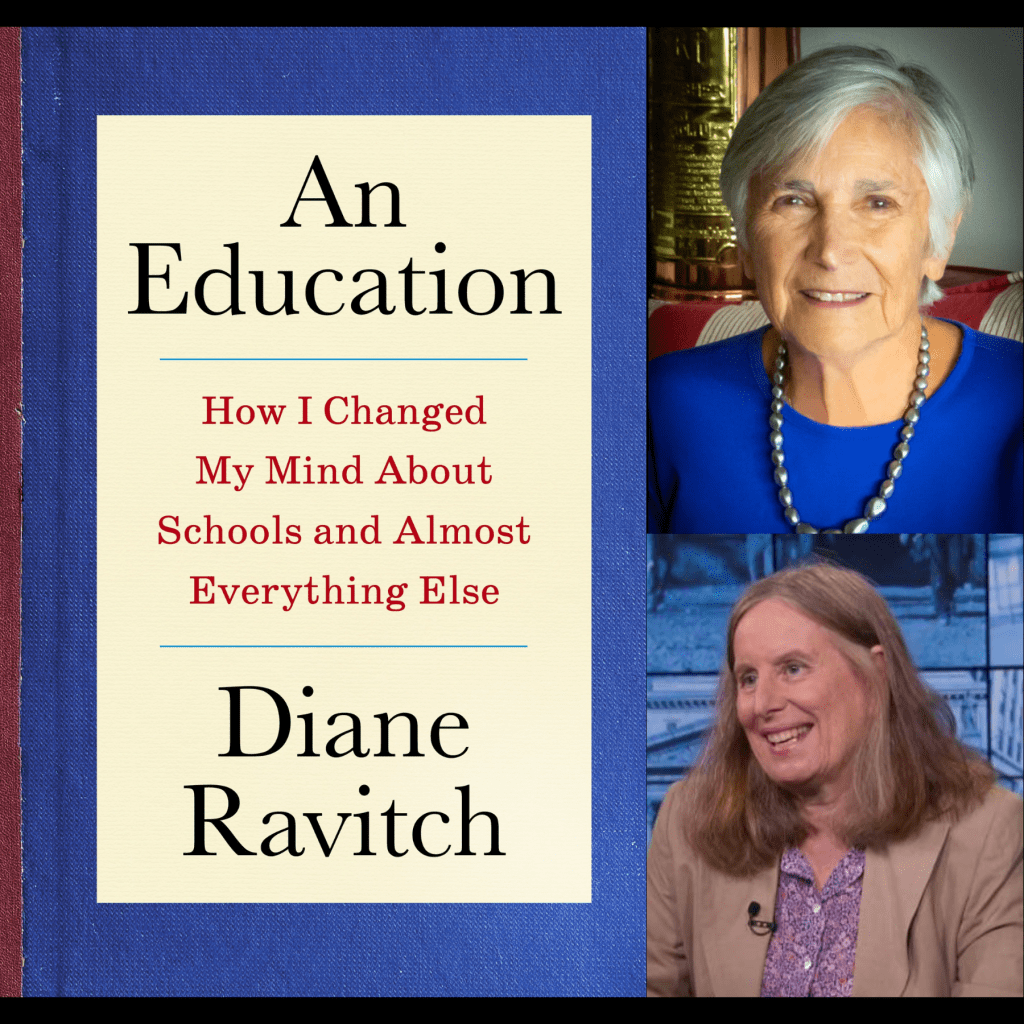
Veteran journalist Eleanor Bader published the very first review of my new book!

It’s a great review!

The official publication date is October 20, but books are now in print and available.

My first appearance to talk about the book will be in my home town: Brooklyn, New York, on October 21 at 6 pm at the Brooklyn Heights branch of the Brooklyn Public Library.

I will have a conversation with the brilliant Leonie Haimson, leader of Class Size Matters.

I’m not traveling to promote the book, but I am doing Zooms. I will be speaking to educators in North Carolina on October 22. To learn more about it, contact Yevonne Brannon of Public Schools First NC at ybrannon@gmail.com.

John Merrow was the education correspondent for the PBS Newshour for many years. He writes here about the insane insults hurled at our nation’s teachers by MAGA.

Merrow writes:

The US has nearly 3.6 million K-12 teachers, and another 1.5 million college teachers. One-third of 5.1 million is 1.7 million. Who knew that we have 1,700,000 terrorists in our classrooms!

I certainly had no idea things were that bad, and I’m kicking myself for not knowing. After all, I spent more than 67 years in American classrooms, as a student, a teacher, a parent, and a reporter. I must have interviewed and maybe even socialized with thousands of these terrorists, and I didn’t have a clue.

My 4th grade teacher yelled a lot and banged desks (and some ears too), so I supposed she “terrorized” us, but I don’t think that’s what the accuser had in mind.

I can think of one other possible example of ‘terrorism’ in the classroom: My 10th grade English teacher, Mr. McKinley, would deliberately make mistakes when he wrote stuff on the blackboard and then erupt in (faux) fury if we failed to catch his flubs. Somehow, I don’t think that’s what the accuser had in mind.

Are you questioning the accuracy of the accusation? OK, it came from President Donald Trump’s buddy Steve Bannon, who opened his mouth while in Arizona to pay tribute to Charlie Kirk, the assassinated leader of Turning Point. The podcast host was saying to Bannon that Kirk’s ideas about marrying early and having lots of children were actually not popular with young people, which prompted Bannon to blame teachers for brain-washing their students. Here’s what he said:

“…..those kids — look, from kindergarten all the way up, they are essentially, you know, a third of the teachers are terrorists that are trying to form them.”

Predictably, the right-wing podcaster didn’t challenge Bannon’s wild accusation or even ask him what he meant by ‘terrorist,’ so I’m going to go out on a limb and suggest that Bannon meant that teachers were teaching values that Bannon disapproves of, like tolerance and cooperation. I have seen lots of teachers work hard to inculcate such values, and, if that’s ‘terrorism,’ I approve.

Mocking Bannon is a woefully insufficient response, however, because his blatant teacher-bashing is part of the right wing’s persistent, harsh, and (unfortunately) often successful campaign to bring down public education.

And Bannon’s not even a field general in this war. He’s clearly outranked by Oklahoma’s State Superintendent of Education Ryan Walters, who in January reacted to violence at the Mardi Gras in New Orleans. You may recall that, early on New Year’s Day an army veteran carrying an ISIS flag drove his pickup truck down Bourbon Street and killed 14 people and injured dozens more before the police killed him. It was labeled a possible terrorist incident, prompting Mr. Walters to go off: “We also have to take a look at how are these terrorists coming from people that live in America. …. You have schools that are teaching kids to hate their country, that this country is evil. You have the teachers’ unions pushing this on our kid (sic).”

Mocking the hyperbole of school critics like Walters and Bannon is ineffective, because culture warriors are immune to humor. Instead, they are seriously opposed to just about everything that some of us believe is in the public interest, such as public education, public transportation, public libraries, public parks, public health, and so on. They recognize that public education is a cornerstone of our democracy, and they are going after it, with sledgehammers and other implements of destruction, including lies and absurd accusations from the likes of Bannon and Walters.

(They are anti-public-everything, acronym APE. Don’t be an APE!)

Early in September, the New York Times reporter Dana Goldstein did a deep dive into the impact of vouchers, education savings accounts, tax credit scholarships, and other programs that divert funds from public schools to non-public schools. The entire article is well worth your time.

The number of students whose parents are using these programs has doubled since 2019, nearly all in Republican-led states. Five years ago, only about 20,000 students had education savings accounts (ESA), which allow deducting any ‘educational’ expense from one’s taxes; today, more than 500,000 families have ESA’s.

In the past, eligibility for most of these programs was means-tested because the stated goal was to help low income families. That’s changed, and in the new programs, any family can take advantage, regardless of income.

This ain’t cheap. Indiana’s program, for example, is costing more than $600 million dollars a year, dollars that might have gone to public education.

Joining the 14 states with voucher-type programs is your federal government, because the “Big Beautiful Bill” passed by Congress earlier this year includes a $5,000 voucher.

Do these voucher programs work? The evidence is mixed, at best.

Are they popular with voters? Here the answer is crystal clear: NO! In the 17 opportunities that voters have had to weigh in on vouchers since 1970, they’ve said NO, including three votes in Republican-led states in 2024.

For a critical view of what’s going on, read David Osborne’s analysis here.

If you support public education, begin by thanking teachers. Take a minute to picture the teachers who had changed your lives for the better…and then to ask yourselves if you ever said ‘Thank you’ to those women and men. If it’s too late to connect directly with them, you might write something about them and share it with others.

That’s only the first step. Consider attending school board meetings, perhaps even running for election to your local school board. You might join the parent-teacher organization, or volunteer as a tutor. You might contribute supplies, or help with school fund-raising efforts. Let your elected officials at all levels know that you support public education. If you’re a public school parent, move beyond ‘involvement’ to ‘engagement,’ by getting to know your children’s teachers.

(I’ve written about this in more detail in “Addicted to Reform: A 12-Step Program to Rescue Public Education,” which is available at most public libraries, some bookstores, and Amazon. It’s reviewed positively here and negatively here.)

It’s not pie-in-the-sky idealism to believe that a strong public education system is the road to equality and citizenship, or that the real safeguard of democracy is education. Those insights came from FDR and Martin Luther King, Jr., among others.

Please make certain that you are registered to vote, and that your friends and neighbors are as well. This attack on public education is serious, folks. Don’t take our democracy for granted.

John Kuhn is the superintendent of schools in Abilene, Texas. He was hired by the Abilene school board in April 2024. He previously served as superintendent in three small districts in Texas. The Abilene board introduced him this way

Dr. John Kuhn brings 27 years of proven experience in public education to Abilene ISD. Prior to joining the Abilene ISD team, Dr. Kuhn most recently served as Superintendent of Schools for Mineral Wells ISD. He has also served as superintendent of Perrin-Whitt CISD and as a high school principal, assistant principal, teacher, and bus driver in the Mineral Wells and Graford Independent School Districts.

I met John Kuhn at a conference of the Network for Public Education about a dozen years ago. At that time, he was superintendent of the Perrin-Whitt Distrist, which has about 320 students, half of whom are economically disadvantaged.

John is one of the most eloquent champions of public education that I’ve ever met. I remember him saying, “Send me the kids you don’t want. Send me the kids who don’t speak English. Send me the kids who are struggling to learn. Send me the kids with disabilities. I’m in a public school and we will teach them all.” Or words to that effect. I’m hoping he will be a keynote speaker at our next conference in Houston in April 2026. He’s the leader we need!

He posted this letter on his Facebook page and it drew a massive response and national attention.

Gosh where to begin? I’m eligible to retire in January, and I don’t want to because I feel like I owe the good people who hired me and this great community at least a few years of blood sweat and tears. I work for a great school board in a city I’ve absolutely fallen in love with. But holy moly do I want to pack it in right now. The burden is heavy.

Yesterday I spent hours at an update listening to the impacts on teachers and admins at public schools of bill after bill passed by our lege. Did you know that one bill says teachers are going to be required to catalogue every book in their classrooms? Kindergarten teachers have hundreds of tiny books. With what time? When?

Did you know that another bill says nurses can’t provide any health care whatsoever and counselors can’t provide any emotional support whatsoever without a written permission slip from parents? The bill language is so poorly written that—despite what it clearly says in black and white English—the bill author sent out a clarification saying nurses can provide a band-aid to a kid who is bleeding. He wouldn’t have to send out a clarification if they wouldn’t pass dumb bills—but legislators have been convinced by political groups who hate public schools that everyone inside them are wicked, evil people.

Did you know about the other new bill that says school administrators who work on the side as refs or one-act-play judges at any school anywhere are subject to a $10k fine per offense for working those jobs if they each individually don’t present a contract to their school board.

That doesn’t apply to me, but I know tons of APs and principals who ref and judge student drama contests. In fact, there’s a huge shortage of both, so if they didn’t do it, we’d be in an even bigger bind in trying to put on games. Again, the bill author had to put out a “clarification” claiming the bill doesn’t mean what it clearly says.

Because they refused to listen to the input of our educator groups—groups, by the way, that they are trying to get defunded because they consider them “taxpayer funded lobbyists” for representing school districts and municipalities.

There is a political movement to pull the teeth of local officials at schools and on city councils and county commissioners courts so that all we have is centralized state leadership. So local yokels like yours truly have to be continually demonized and legislated into submission.

I haven’t even talked about vouchers draining our public schools of resources so those education dollars can go toward private schools that aren’t subject to the crushing bureaucracy. I haven’t event talked about the new testing bill—the one that replaces STAAR with the 3x per year Death STAAR that, like its predecessor tests is solely owned and controlled by the TEA commissioner and is not norm-referenced so Texas student results can be compared to other states, which would keep things honest and prevent the manipulation of student results for political narrative-building.

Anyway, I go to a conference all day listening to this stuff the day after Republican Charlie Kirk is murdered and months after a Democratic state senator is murdered, and I just keep thinking, is it worth it? I can retire and keep to myself until I die of old age. I can just fish every single day. I can travel. I can camp. I can sleep in.

And I get to my hotel room and find some social media commenter calling my teachers “demons” because they assigned an chapter of the amazing book Extremely Loud and Incredibly Close as a reading passage for a freshman honors English class. This is a book written in the voice of a nine-year-old boy who lost his dad on 9/11 in the terrorist attack on the twin towers. It’s an award winning book. But the passage has the word “shit” in it. And it has a vulgar term that I’m told the teacher was unfamiliar with it. And it has a crude joke about talking butts, which I was a nine-year-old boy and that’s the kind of crudeness we giggle at, so the author was pretty spot on. It also has the word “pussy” but that was what the kid called his cat, but the Facebook post highlighted it as part of making a case that this book was inappropriate.

Thing is, it’s likely valid that this book should be restricted to older kids—17 and 18 year olds. It’s worth noting that this was assigned to only the honors kids because the other passage that the class was reading—also related to 9/11–was at too easy a reading level. So these poor teachers are trying to find something for advanced kids to read, and they don’t have time, and they’re making a good faith effort to push kids to Meets and Masters because they care (and if our A-F grade is too low, there is outrage over that too). And they pick this award-winning book. They decide one “shit” is tolerable. They aren’t offended by the word “pussy” because it literally isn’t a bad word in the context. They get it approved by a colleague.

And they are called “DEMONS.” (Ironically, in the comments of the outrage post, they’re also called “assholes,” which is literally worse than “anus,” which is one of the words the parent highlighted and took offense to, but nobody scolded the commenter for that vulgarity. What’s good for the goose… Commenters also typed “wtf” and “WTH,” which mean “what the fuck” and “what the hell” but nobody accused them of “grooming” children. Selective outrage, anyone.

Who needs this? Is everybody serious? Does everyone just feel absolutely compelled to post their moral superiority online by attacking perceived enemies they’ve never met or shared a meal with.

Our country is no longer capable of living in community. We’ve been driven to our corners. It is barely possible to be a public servant anymore. I totally get why our city manager retired.

My teachers aren’t demons. They may have made a mistake in assigning this book to 15-year-olds rather than 17-year-olds, and for that there are people online saying they need to be fired. Today Incredibly Loud and Extremely Close is likely temporarily coming off our library shelves while we review our book challenge policies. Read the book. It’ll make you cry.

We can’t win in public ed anymore. This is absolutely ridiculous. If I make it to December, it’s gonna be a miracle. I don’t need your sympathy replies, either. I’ll hang it up when I have to for my family and my health, and I’ll stick it out if I feel like I want to. In the meantime, I just want you to know I’m sick of politicians playing divisive politics and leaving local public servants to clean up the mess. Public schools are apolitical entities with the job of teaching kids to think critically and become awesome humans. We aren’t perfect. We have missteps, because we are human organizations. But don’t call my teachers DEMONS while you cuss in the comments.

Mercedes Schneider reviews Kristen Buras’ new book about a Black high school that was closed against the wishes of the community it served. The book is What We Stand to Lose: Black Teachers, the Culture They Created, and the Closure of a New Orleans School (2025, Beacon Press). Buras describes a school whose teachers went beyond the call of duty to help their students. If you care about education, if you care about social justice, you should read this book. I did not post the review in full, so please open the link to finish reading.

Mercedes Schneider writes:

I was born in 1967 in Chalmette, Louisiana (St. Bernard Parish), a suburb of New Orleans so close to the city that is is the actual site of the 1815 Battle of New Orleans.

I did not know that my father moved to Chalmette in the mid-1950s as part of the “white flight” from New Orleans. 

I did not know why the St. Bernard-Orleans Parish line was so starkly white on the St. Bernard side and black on the Orleans side.

I did not know that the black teachers at my all-white elementary and middle schools were part of an effort for local officials to dodge federal mandates to racially integrate the schools (as in integrating the student body).

(I do remember seeing what I think was one black student in the special education, self-contained classroom of my elementary school– such an unusual, remarkable event that it puzzled my young mind to see him as a student assistant in the cafeteria, and the moment remains clearly in my memory to this day.)

I did not know that when I moved to a more rural section of St. Bernard Parish as I started high school that the African-American residents “down the road” knew full well of the dangers of trying to reside in certain sections of the parish (namely, Chalmette and Arabi).

I did not know that the school-superintendent uncle of one of my favorite teachers tried circa 1961 to create an “annex school” near the Arabi-New Orleans city line in order to enable white parents in the city to avoid racial integration by using school vouchers from New Orleans to enroll their children in an all-white public school just across the parish line.

I did not know that the proliferation of parochial schools in New Orleans was fueled by white flight from the New Orleans public schools.

I did not know that the reason I attended an all-girls public middle- and high school was for local officials to try to sham-integrate the St. Bernard public schools but to keep “those black boys away from our white girls.”

There’s a lot that I did not know and did not begin to learn until I was in my twenties and started asking questions.

But there were a lot of lessons that many white adults in my life tried to instill in me, lessons that indeed needed some serious questioning:

“You know property values will drop if the blacks start moving into a neighborhood.”

“It is better for a white woman to have a physically-abusive white boyfriend or husband than a black one, even if he does treat her well.”

“Interracial marriage is cause for a family disowning a child.”

“The city is a wreck because blacks are lazy and destroy everything.”

As I began reading about New Orleans officials’ cross-generational efforts to obliterate the black middle class in New Orleans (by, for example, by destroying multiple black owned businesses in order to build both the Desire housing project in 1956 and construct Interstate 10 in 1966), I felt like I had been lied to for decades– and my views as a white child and young adult repeatedly manipulated in order to purposely cement in me a sense of white superiority that no amount of personal maturity would ever shake.

Nevertheless, I am happy to say that such twisted, misplaced superiority is indeed and forever shaken in me and shown to be the mammoth lie that it is– the very lie that happens to fuel the white saviors who would impose themselves on black communities– including the center of the community:

The community school.

The community should be the final word on its schools, and when it is, those schools are successful, even in the face of racially-imposed hardship and intentional, multi-generational deprivation of basic resources, including physical space, current textbooks, and even ready supplies of toilet paper. 

Such is the story of George Washington Carver High School in New Orleans– a school created as part of a school complex and housing project and build in New Orleans, Louisiana, to intentionally be a segregated school despite its opening post-Brown vs. Board of Education.

In her book, What We Stand to Lose: Black Teachers, the Culture They Created, and the Closure of a New Orleans School (2025, Beacon Press), Dr. Kristen Buras offers to readers a detailed history and daily life of G. W. Carver High School in New Orleans, from its inception to its white-savior closure in 2005, post-Katrina, when the state of Louisiana refused to grant the returning Carver community a charter to operate their own school. Buras details what no pro-charter, education reformer discussed at any length as regards traditionally-black New Orleans public schools: the repeated, intentional, multi-generational, systematic fiscal neglect of both the schools and the black community in New Orleans.

In contrast, Buras not only discusses these issues; she brings them to life through her numerous interviews with Carver faculty and staff, a life that begins even before Carver High School opened its doors in the 1958-59 school year.

Right out of the gate, the community served by Carver High School– families residing in the Desire Housing Project– had to face the reality that the project homes were poorly constructed and were starting to fall apart due to a lack of concrete foundations on swampland, no less.

Indeed, the location of what was known as the “Carver Complex” was originally a Maroon colony for escaped African slaves in a backswamp area that 1973 Carver graduate describes as “really not made for residential living.”

Separate was not equal, but to the Carver community, it was theirs, and in the midst of profound racism, the faculty and staff at Carver High devoted themselves to their students and the students’ families, who also happened to be their neighbors.

What speaks loudly to the teacher commitment to Carver High students, as Buras notes, is their multi-decade commitment. Despite being chronically underfunded and under-maintained across its almost-fifty years pre-Katrina, Carver High School had a very low teacher turnover.

In What We Stand to Lose, readers are introduced to the precise and disciplined teachings of music teacher Yvonne Busch, who was known for offering free music lessons during summer break. Former student Leonard Smith produced a documentary about Busch, who retired in 1983 after a 32-years at Carver. We learn of the 38-year career of social studies teacher, Lenora Condoll, who wanted so much for her students to experience the larger world that she organized fundraisers to take her students on Close-Up trips to Washington, DC, and who, on a practical note, showed students that they could make a dressy wardrobe out of a few basic items, including her “black, cashmere skirt.” We meet Enos Hicks, head coach of track and football and athletic director once Carver High opened. By that time, Hicks had been teaching for twenty years already. When Hicks’ students saw “his bag of medals” for track and field, they believed that they, too, could excel and receive their own medals.

These are real teachers whose legacy is undeniable among Carver alumni. They inspired their students to hold their heads high in self-respect despite the cultural pressures and dangers to be pressed into a Whites Only mold of “forever less-than.”

Carver High School was at most 30 minutes from my own high school. I had no idea such quality against the odds was so nearby.

To continue reading the review, open the link.

Not so very long ago, when North Carolina had forward-looking governors like Terry Sanford and James Hunt, North Carolina was considered the best state in the South for its public schools and universities.

Since the Tea Party takeover in 2010, the Republican-dominated legislature has done its worst to shed that reputation. Now it strives to be a state that ignores and underfunds public schools while pouring money into substandard charter schools and segregated voucher schools.

Where once North Carolina boasted of having more National Board Certified teachers than any other state, it now treats teachers disrespectfully, underpaying them and driving out some of its best teachers.

North Carolina is in a race to the bottom, hoping to fall behind Mississippi, Alabama, even Florida, in its maltreatment of the teaching profession. The state Republicans don’t want its children to be well-educated.

Just recently, the Republican leaders in the State Senate decided to increase class sizes and to lower the percentage of licensed and certified teachers in its classroom.

The North Carolina News & Observer reported:

Legislation filed Monday by state House Republican education leaders would eliminate class-size requirements in schools and allow school districts to hire unlicensed teachers. The “Public School Operational Relief” bill would change class-size requirements in elementary schools to class-size “recommendations.” House Bill 806 also would only require 50% of the teachers in a public school to have a license — down from the 100% requirement for traditional public schools.

The bill comes at a time when schools are struggling to find enough teachers. A state report released last week showed the teacher turnover rate was 9.88%, meaning nearly one out of every 10 teachers left the profession between March 2023 and March 2024.

If adopted, the bill would have major ramifications for how North Carolina public schools educate their students. Three of the legislation’s primary sponsors are the Republican co-chairs of the House K-12 Education Committee: Rep. David Willis of Union County, Rep. Brian Biggs of Randolph County and Rep. Tricia Cotham of Mecklenburg County. The bill’s fourth primary sponsor is Rep. Heather Rhyne, a Lincoln County Republican and House Majority Freshman Leader.

Eliminating school class-size requirements Under state law, class sizes are capped in K-3 class sizes with no limits for other grade levels. Charter schools are exempt from the class-size limits. State GOP lawmakers lowered K-3 class size limits in 2017, saying it would help improve instruction.

But school districts, such as Wake County, have complained it’s led to them reassigning students and putting enrollment caps at some elementary schools.

Currently, the state funds one teacher for every 18 students in kindergarten, 16 students in first grade and 17 students in second and third grades. Individual classrooms are allowed to go three students above that number. The bill would make K-3 the same as grades 4-12, with class size limits being recommendations only.

Lowering the number of licensed teachers under current law, school districts are required to have all their teachers be licensed. This includes people who have received temporary licenses allowing them to teach while they meet their training requirements.

Nearly half of all the new teachers in North Carolina enter classrooms under alternative licensure routes, according to the state Department of Public Instruction. Charter schools are only required under state law to have 50% of their teachers be licensed. The new bill would have all public schools — charter schools and traditional public schools — use the 50% teacher licensure requirement in each school.

While the bill says school districts can hire unlicensed teachers, it says you’d need to be a college graduate to teach the core subject areas of mathematics, science, social studies, and language arts.

The legislation could run afoul of a 2022 N.C. Supreme Court ruling requiring the state to transfer funds to public schools to help provide every student with a sound, basic education and access to highly qualified teachers. But a pending ruling by the Supreme Court could throw out the 2022 ruling in the Leandro case.

Read more at: https://www.newsobserver.com/news/politics-government/article303662976.html#storylink=cpy

After nearly a year of bargaining, the Chicago Teachers Union reached a landmark agreement with the City of Chicago and the school board. Karen Lewis, the late President of the Chicago Teachers, was a champion for the city’s children, their teachers, and the public schools. She must be smiling in heaven to see what the CTU has accomplished.

The CTU announced:

Chicago Teachers Union

NEWS ADVISORY: 
For Immediate Release

April 2, 2025

CONTACT:312-329-9100
Communications@ctulocal1.org

CTU to Hold Press Conference to Announce Results of Special House of Delegates Meeting

Union to announce results of next step to transform Chicago Public Schools after the 60+ rank and file members of the Big Bargaining Team sent tentative agreement to the House of Delegate members for approval.

What: Press conference announcing results of House of Delegates vote

Where: Chicago Teachers Union, 1901 W Carroll Ave; enter through the East entrance off Wolcott; parking will be available for camera trucks in the South lot (on Fulton)

When: Immediately following House of Delegates meeting (Meeting starts at 4:45pm and we will alert press once the media is adjourned)

Who: CTU officers, big bargaining team members, and elected delegates

In the next step toward ratifying a contract that represents a major leap forward in the process of transforming Chicago Public Schools started by CTU in 2012, the union will hold a special House of Delegates meeting on Wednesday, April 2nd. At the meeting, the elected delegates of the union will vote on whether or not the tentative agreement landed by the 60 rank and file members of the Big Bargaining Team shall be sent to the full membership for a vote as early as next week.

The union will hold a press conference immediately following the meeting to announce whether the tentative agreement that creates smaller class sizes, a historic investment in sports, grants recess students were being denied, and enshrines protections for Black history and academic freedom – among more than 150 other items – is going to a full membership vote or back to the bargaining table for improvements.

BACKGROUND

After more than eleven months of bargaining, working without a contract throughout the entire school year, and for the first time in more than 15 years of doing so without a strike or strike vote, the Chicago Teachers Union announced their big bargaining team made up of rank and file members approved a tentative agreement with Chicago Public Schools.

The tentative agreement will go to CTU’s House of Delegates Wednesday which will decide whether or not to advance it to CTU’s 30,000 members for a ratification vote. If accepted, it will represent a major leap forward in the transformation of a district that is still recovering from the gutting and financial irresponsibility carried out by Trump’s Project 2025 style efforts under Rahm Emanuel, Arne Duncan, Paul Vallas, and other privatization forces that closed over 200 public schools between 2002 and 2018.

Despite the efforts of right wing actors like Paul Vallas, The Liberty Justice Center, and Illinois Policy Institute, and the MAGA forces that seek to deny the investments Chicago’s students deserve, this proposed contract builds upon the past several contracts won by CTU in 2012, 2016, and 2019. It charts a new direction of investment, expansion of sustainable community and dual language schools, increased staffing, and a focus on reparatory equity to provide the educational experience Chicago students deserve no matter what neighborhood they live in.

The 2012 strike won the air conditioning that kept CPS open during the back-to-school heatwave at the beginning of the school year. 2016 established the model of 20 sustainable community schools, a program that helped to stabilize and resource schools like Dyett High School whose boy’s basketball team won the state championship this year. 2019 won social workers and nurses in every school and established the sanctuary status that protected CPS students from Trump’s federal agents earlier this year.

In 2025, some highlights of the Chicago Teachers Union contract include:

  • Doubles the number of libraries and librarians for our schools
  • Enforceable and smaller class sizes for all grade levels
  • Ensuring social workers and nurses serve students in every school, every instructional day
  • Doubles the bilingual education staffing supports for students 
  • Additional staffing, curricular and enrollment supports for Early Childhood education students and programs. 
  • Creates 215 more case manager positions district-wide to support students with disabilities. 
  • A cost of living adjustment of 17-20% compounded (tied to inflation) over the four years of the contract
  • Provide new steps that compensate veteran educators for their experience
  • Increases in prep time for clinicians, elementary and special education teachers so students arrive to classrooms ready for them
  • Expanded benefits for dental, vision, infertility and abortion care, gender-affirming care, hearing aids, speech therapy, physical therapy, occupational therapy, chiropractic services
  • A more than tripling of the number of Sustainable Community Schools, from 20 to 70, over the course of the agreement. 
  • Provides CTU, CPS, City and sister agency coordination for the first time to provide housing support, section 8 vouchers, rental assistance and affordable units to CPS families in need. 
  • Enshrines 12 weeks paid parental leave, equal parental, personal illness, and supplemental leave rights for PSRPs to teachers
  • A Green Schools initiation of additional resources and collaboration to remediate lead, asbestos and mold in aging school buildings while upgrading to green energy with environmentally sustainable technology, materials and practices. 
  • Protections for academic freedom, Black history, and culturally relevant curriculum for the first time in the contract. 
  • An additional $10 million annual investment in sports programming
  • Protections for academic freedom that enshrine educators’ ability to teach Black, indigenous, and other history
  • Continuation of Sanctuary School procedures
  • A new article that creates LGBTQIA+ safe schools

See the full list of tentative agreements at https://www.ctulocal1.org/movement/contract-2024.

“Our union is bargaining for what every parent wants for their child in our school communities. It shouldn’t be a fight for children to get access to arts, sports, wrap around supports, and libraries. It’s what should already exist,” explains CTU Local 1 President Stacy Davis Gates. “We’re proud to have landed a transformative contract that turns away from decades of disinvesting in Black children and turns toward creating the world-class education system for every single student in CPS no matter their zip code. If the contract is ratified by our members, we will be one major leap forward toward the educational experience Chicago’s children and the mainly women workers who serve them in our schools deserve.”

Additional Information:

###

The Chicago Teachers Union represents nearly 30,000 teachers and educational support personnel working in schools funded by City of Chicago School District 299, and by extension, more than 300,000 students and families they serve. The CTU is an affiliate of the American Federation of Teachers and the Illinois Federation of Teachers and is the third-largest teachers local in the United States. For more information, please visit the CTU website at www.ctulocal1.org.

Michael R. Bloomberg is a billionaire who made his fortune in technology. He produced a computer with a double screen that is called “the Bloomberg,” with each screen focused on different topics. I don’t know enough about technology to explain why this machine was a big success but it was. Bloomberg is now the most generous of the billionaire set, with the likely exception of McKenzie Scott, who has dedicated her time to giving away the fortune she got when she divorced Jeff Bezos.

Bloomberg was mayor of New York City for 12 years. When he was first elected, I was very enthusiastic about his prospects for reforming the city’s sclerotic school system but became disenchanted when I saw him adopt the “move fast and break things” mode of the tech industry and disrupt the system.

Although I was critical of his disruptive changes, I always liked the man, with whom I had several delightful conversations.

Thus it was a great surprise and delight to encounter the following article, in which he warns about the overuse of technology in the classroom:

Over the past two decades, school districts have spent billions of taxpayer dollars equipping classrooms with laptops and other devices in hopes of preparing kids for a digital future. The result? Students have fallen further behind on the skills they most need to succeed in careers: the three R’s plus a fourth — relationships.

Today, about 90% of schools provide laptops or tablets to their students. Yet as students spend more time than ever on screens, social skills are deteriorating and test scores are near historic lows. 

Just 28% of eighth graders are proficient in math and 30% in reading. For 12th graders, the numbers are similarly dismal (24% in math and 37% in reading, according to the most recently available scores). And US students have also fallen further behind their peers in other countries.

The push for laptops in classrooms came from technologists, think tanks and government officials, who imagined that the devices would allow for curricula to be tailored around student needs, empowering them to learn at their own pace and raising achievement levels. It hasn’t worked.

The push also came from another source: computer manufacturers. However well-intentioned they may be, they have a financial interest in promoting laptops in classrooms and have profited handsomely from it. 

When Google released its inexpensive, utilitarian Chromebook in 2011, the company quickly capitalized on schools’ new emphasis on computer use. Why should children learn the quadratic equation, a Google executive asked, when they can just Google the answer? Today, the same executive might ask: Why should children learn to write an essay — or even a sentence — when they can ask a chatbot to do it for them?

The answer to both questions is that mastering the three R’s is the first step toward the true goal of education: critical thinking and problem-solving.

As someone who built a company by developing a computer at the dawn of the digital age, I never believed that computers in the classroom were the cure to what ails schools. Some of the most powerful educational interactions occur when a caring, well-trained teacher can look into a student’s eyes and help them see and understand new ideas. Machines often don’t have that power.

Think back on your own education. Most of us can remember teachers who challenged and inspired us. Now imagine that you had spent less time listening to those teachers and more time staring at a screen. Would you be better or worse off today?

While moderate use of computer devices can have academic benefits, especially when they are used at home, intensive use is often correlated with diminishing performance. 

For example: A post-pandemic survey found that more than a quarter of students spend five hours of class time daily on screens, often practicing skills on games that rarely lead to mastery. At the same time, some traditionally interactive classes — art, music, foreign languages — have moved increasingly online.

Studies have found that time-tested methods of learning — such as reading and writing on a page— are superior to screen-based approaches. One reason is simply a matter of time management. As a review of two decades of academic research concluded, children using laptops are easily distracted — and distracting to their peers. As kids might say: Well, duh.

One study found it can take students up to 20 minutes to refocus after engaging in a nonacademic activity. Put another way: Playing one video game three times a day costs an hour of learning.

Some of the online diversions that students find involve disturbing and inappropriate content that slips through schools’ filters, warping developing minds. Making matters worse: Downtime in classrooms — which might have been spent reading, drawing, imagining or playing with classmates, thereby building crucial social skills — is now frittered away on screens.

By reorienting so much class time around screens, schools have unwittingly been promoting an increasingly isolated childhood experience, which has been correlated with rising anxiety and depression — and can come with tragic and even deadly consequences. 

As some school districts finally awake to the benefits of banning smartphones during school hours, they should also reconsider their policies around in-class computers, which can be as problematic as phones. For instance: Storing laptops in locked classroom carts would enable more limited, purposeful use. Schools should also provide parents more transparency about the amount of time their children are spending on devices. 

The soaring promise of technology in the classroom has failed to deliver results while imposing great costs on children and taxpayers. Superintendents, principals and teachers ought to lead the way in adopting what has become a radical idea: having students spend more classroom time picking up books and pens than powering up laptops and tablets.

Congresswoman Rosa DeLauro of Connecticut is a stalwart ally of public schools. When Democrats controlled the House of Representatives, she was chair of the powerful House Appropriations Committee and she will be again when Democrats regain control of the House. She knows the federal budget.

Check her attachment to see how many teachers will be laid off in YOUR Congressional district. The deep cuts will affect both Republican and democratic districts.

Rep. DeLauro issued a warning about the deep cuts to education that Trump and Musk are planning:

WASHINGTON — Last week, through his unlawful executive order, President Trump took another step in his plan to eliminate the Department of Education. Next, he plans to eliminate Title I grants that help 26 million students learn. House Appropriations Committee and Labor, Health and Human Services, and Education Subcommittee Ranking Member Rosa DeLauro released a new fact sheet detailing the number of teachers in each district that stand to be kicked out of the classroom, leaving millions of students across the country without a teacher.

 “We are in the middle of a cost-of-living crisis, and Elon Musk and President Trump are making it worse. President Trump promised to fight for the working class, but instead, he put Elon Musk and billionaires in charge of the government. His plan to eliminate Title I grants that help 26 million students in schools across the country would mean that nearly 300,000 teachers across the United States stand to be kicked out of the classroom. This would leave millions of students without a teacher. President Trump and unchecked billionaire Elon Musk do not care about helping hardworking people build a better life or helping our kids learn. They care only about tax breaks for billionaires and the biggest corporations.”

 A fact sheet on the number of teachers in each district that stand to be kicked out of the classroom is here.

 Ranking Member DeLauro’s previous statements on the unlawful elimination of Education employees can be found here and here.

 Her letter to Secretary McMahon demanding answers to mass firings is here. Her February statement on Elon Musk’s and President Trump’s dismantling of the Department of Education is here.