Archives for category: Standardized Testing

Yale University, one of the nation’s most elite institutions, has dropped its policy of no-test scores for admissions. Instead, it will require students to submit one of four standardized tests when they apply. The elite universities were flooded with applicants last year, and some were able to accept only 3-5% of applicants. Last year, 57,465 students applied for admission; only 3.7% were accepted.

My guess is that the re-introduction of standardized test scores will discourage some from applying and will immediately disqualify those with very low scores.

The Yale Daily News reported:

After four years of a test-optional policy allowing applicants to decide whether to submit test scores, applicants to Yale’s class of 2029 must submit standardized test scores.

Under Yale’s text-flexible admissions policy, applicants may select one or more types of tests from a list of four options — SAT, ACT, Advanced Placement and International Baccalaureate. Those who choose to send AP or IB scores are required to include results from all subject exams that they have taken…

Among peer institutions, Yale stands out for its test-flexible admissions policy for the class of 2029. Of the other seven Ivy League institutions, HarvardBrown and Dartmouth require the SAT or ACT.  PrincetonColumbiathe University of Pennsylvania and Cornell are still test-optional for the current admissions cycle…

John Yi ’13, associate director of the Office of Undergraduate Admissions, believes the test-flexible policy helps the University communicate that “academic preparation is a core component of our admissions process, but that there is not a one-size-fits-all exam that communicates that strength.” Whichever tests applicants choose to send, they are only part of a “much broader puzzle” among other components of applications….

Yale College received 6,754 early applications to the class of 2029, a 14 percent decrease from early applications from the previous year. This group of applicants will be the first to be evaluated under Yale’s test-flexible policy. ..

Yi wrote to the News that under test-optional admissions, Yale saw a “large increase” in applications from students without test scores whose other application elements — transcript, recommendations and personal essays — also “lacked evidence” that they were prepared to succeed at Yale.

On the other hand, he emphasized that the test-required policy prompted applicants to view testing as the “single most important factor” because everyone had to submit the same tests, discouraging applicants with lower test scores who would be great Yale students. With a test-optional policy, it is “easy” for applicants to imagine that test scores are “completely extraneous” to the review, he wrote. 

“I would reassure students that the standardized testing piece is far less interesting to us than all the other components of the application,” Yi wrote. “Each student’s context is unique, and the test-flexible policy is designed to help them shine their brightest in the admissions process — not to trick or trap them.”

Alex Zimmerman of Chalkbeat reported this morning that New York State officials have decided to eliminate the Regents exams as a high school graduation requirement. Voters in Massachusetts today will decide whether to eliminate the MCAS as a graduation requirement.

New York students will no longer be required to pass Regents exams to earn a diploma beginning in the 2027-28 school year, according to a proposed timeline state officials unveiled Monday.

That means current ninth graders may not need to pass the exams to graduate — though students will continue to take them — a shift with significant implications for teaching and learning across New York.

State education officials have been rethinking what it should take to earn a high school diploma in recent years, sketching out a new “portrait of a graduate” that reflects seven areas over which students must show proficiency. Students are expected to have new ways to demonstrate command of those areas, including internships, capstone projects, and community service.

A major part of the overhaul is reducing the role of Regents exams — standardized tests in English, Math, science, and social studies — that high school students must typically pass to graduate. New York is one of a dwindling number of states that use such exams. Research suggests they do little to promote student achievement or raise their earning potential and can lead to higher dropout rates.

Many educators and advocates have cheered the state’s plans to reduce the influence of Regents exams, arguing that they do not adequately assess student’s skills or knowledge, force teachers to focus on memorization, and present unnecessary hurdles for students with disabilities and English learners.

Yet others worry making the exams optional raises the risk that some students, particularly those with greater needs, will be funneled into less rigorous pathways with lower expectations.

State Education Commissioner Betty Rosa acknowledged during Monday’s Board of Regents meeting that the shifts are likely to be contentious. 

“We’re going to have some cases where we agree to disagree respectfully,” she said. Still, “we are so excited about the fact that we are moving forward to ensure that our schools really prepare our students for the very, very best.”

Officials sketched out a timeline on Monday for overhauling graduation standards, a process they indicated will take at least five more years. Though the plans are subject to approval from the Board of Regents, here are some of the key dates that students, educators, and parents should keep in mind.

Later this school year: The ‘portrait of a graduate’ emerges

To graduate from high school under the new standards, New York students will have to demonstrate proficiency in seven key areas: critical thinking, effective communication, cultural and social-emotional competences, innovative problem solving, literacy across content areas, and status as a “global citizen.”

Officials are still in the process of defining each of those areas and translating them into explicit credit requirements students must meet. Those definitions are expected to be released sometime this school year, though full details of the new credit requirements won’t be unveiled until the 2025-26 school year.

Massachusetts has one of the highest performing school systems in the nation on the national test called NAEP (National Assesmrnt of Educational Progress). Some attribute this success to the state’s testing and accountability program. Others believe that the state test–MCAS–is overused and misused as a high school graduation requirement. Critics of the high-stakes exam as graduation requirement say that it was not designed to be an exit exam, that it has no value for diagnostic purposes, and that the small number of students who don’t pass it are disproportionately made up of students with disabilities and students who are not native-English speakers.

More than 90% of tenth graders pass the MCAS on their first try. Ultimately only hundreds out of more than 65,000 students don’t pass the test, and 85% of those who fail either have disabilities or don’t speak English.

Opponents of MCAS as a high-stakes graduation requirement have placed a referendum on the ballot called Question 2.

I urge voters in Massachusetts to vote YES on Question 2.

Belief in standardized testing as a remedy for low test scores has been misplaced for decades. Some believe that facing a test compels students to study harder, but we now know that the results of the standardized tests reflect family income and education more than student effort and ability. Those at the bottom of the scores inevitably are students with disabilities, students who don’t read English, students living in high poverty.

If high-stakes standardized were the solution to poor academic performance, the U.S. would have no failure at all. We have been administering those tests for more than 20 years. After the initial increases that are associated with test prep, improvement ground to a halt and score gaps between racial and economic groups stubbornly persisted.

Massachusetts teachers know that good things happen to students when schools have ample resources, small classes, and time to help the students with the greatest needs.

The YES vote is supported by the Massachusetts Teachers Association, many local school boards, and Senator Elizabeth Warren.

The NO vote is supported by Governor Maura Healey and the business community.

The campaign to keep the MCAS as a graduation requirement just received a donation of $2.5 million from former New York City Mayor Mike Bloomberg. Bloomberg ran the New York City schools with a firm belief that high-stakes testing, charter schools, and firing professionals would fix the schools. They didn’t, but he hasn’t learned anything from his stewardship of the schools.

The Boston Globe reported:

Former New York City mayor Michael Bloomberg gave $2.5 million to the group trying to beat back a ballot question that would eliminate the MCAS test as a graduation requirement, offering a significant infusion into the heated campaign just ahead of Election Day.

Bloomberg’s seven-figure donation is the largest contribution the “Vote No on 2″ campaign has received, and accounts for more than half of the $4.8 million it has reported raising this election cycle, state data show.

It’s not the billionaire’s first time pouring money into a Massachusetts ballot campaign. Bloomberg donated $490,000 in 2016 to a failed ballot question that would have expanded charter schools in Massachusetts.

If approved by voters, Question 2 would repeal a provision of the state’s landmark 1993 education law that makes earning a high school diploma contingent on students passing MCAS exams in English, math, and science. In its place, the ballot measure would establish a new mandate: Students would need to complete coursework certified by their districts in those subjects that meet state academic standards. The state would be able to add new subjects to that list.

Maurice Cunningham, a retired professor of political science at the University of Massachusetts, writes on his blog that the entry of Bloomberg clarifies the actors. He says it is capital vs. labor, the oligarchy vs. the teachers’ union.

Massachusetts voters will have a chance to vote on whether the state academic test–MCAS–should continue to be a high school graduation requirement.

The Boston Globe reports:

Roughly 58 percent of Massachusetts voters said they would support eliminating a requirement that students pass the MCAS examination to graduate high school, far outpacing the 37 percent who said they would vote to keep the mandate in place.

The measure, known as Question 2, is one of the most consequential on the ballot in Massachusetts, which by some measures boasts the best public school systems in the country. Despite that success, the Massachusetts Teachers Association and its leaders are leading the biggest revolt over testing in two decades, arguing the mandate puts too much focus on subjects tested by MCAS and creates too much anxiety and retesting of students.

The question speaks to the frustrations of many parents, including Felicia Torres, a 39-year-old Haverhill resident and mother of three. Her 9-year-old is smart, loves hockey, and enjoys math, but he “dreads and hates school” because he chafes at being taught “whatever they’re forced to learn,” she said.

“I honestly don’t think that a standardized test depicts how well a child will do,” said Torres, a nurse. “I just don’t think it’s accurate.”

The bid to eliminate the MCAS graduation requirement is riding huge advantages among female voters, with 64 percent saying they plan to vote “yes.” Perhaps most notably, 60 percent of independent voters also say they want to eliminate the mandate.

“That tells me it has an excellent chance of passing,” said David Paleologos, director of the Suffolk University Political Research Center.

Typically, he said, those who are undecided about a ballot question ultimately vote against it if they are confused by it or are unsure about its impact, effectively siding with the status quo. In the case of Question 2, only about 4 percent of voters said they were undecided.

The question has split Democratic leaders, with Governor Maura Healey, House Speaker Ron Mariano, and Senate President Karen E. Spilka each opposed to eliminating the requirement while some members of Congress and state lawmakers joined the Massachusetts Teachers Union. But its support isn’t universal among teachers, either.

“You need some sort of tool and measurement stick in terms of how the school is performing,” said Luke, a 37-year-old Wakefield resident and eighth-grade social studies teacher who told pollsters he is voting against the question. He spoke to the Globe on the condition his full name not be used. “If you’re going to still carry out the MCAS, how do you think students are going to take it seriously when you’re saying it doesn’t need to be a requirement?”


John Thompson is a historian and retired teacher in Oklahoma. He remembers the time before George W. Bush’s “No Child Left Behind” took control of the schools away from educators. Data-driven accountability, he writes, polluted the culture of learning. After more than two decades of failure, educators and students need a better way forward.

He writes in Oklahoma Voice:

When I first walked into John Marshall High School in 1992, I was stunned by the exceptional quality of so many teachers.

It had never occurred to me that such great teaching and learning was being done in high schools. Yes, there were problems, but each year, our school would make incremental improvements.

Then, the Oklahoma City Public Schools system (OKCPS) would bow to pressure and implement disastrous policies that would wipe out those gains — or worse.

I remember when OKCPS was first forced into policies that were later dubbed “corporate school reform.”

The No Child Left Behind Act, which was signed into law in 2002 by former Republican President George W. Bush, increased the federal government’s influence in holding schools accountable for student performance.

During the first years after the passage, local and state leaders often had some success in minimizing the damage done by school “choice” and high stakes testing. But, as in the rest of the nation, that resistance angered market-driven reformers who then doubled-down on harsher, more punitive policies.

They ordered everyone to “be on the same page,” and even today press educators to “teach to the test.”

I quickly discovered that this one-size-fits-all philosophy was disastrous for schools, teachers and students. And decades later, it still remains so.

It doesn’t take into account the difference between situational and generational poverty. It ignores that some students are seriously emotionally disturbed and/or burdened by multiple traumatic experiences, now known as Adverse Childhood Experiences (ACEs). And, it fails to factor in that children, who may have reading or math disabilities, have the potential to become student leaders.

The tipping point for me was when school staffing became driven by a primitive statistical model that could not distinguish between low income students and children of situational poverty receiving free and reduced price lunches as opposed to children living in extreme poverty with multiple ACEs.

Because of the additional costs of providing services for the most emotionally disturbed students, teachers in “regular” classrooms were assigned up to 250 students.

I had classes with 60 students.

Data-driven accountability pollutes our learning cultures.

School segregation by choice combined with test-driven accountability creates a culture of competition, winners and losers, and simplistic policies that ignore poverty and Adverse Childhood Experiences.

It is a policy imposed mostly by non-educators who ignore educational and cognitive scientific research.

As these quick fixes failed — just like educators and social scientists predicted they would — the “blame game” took off, fueling an exodus of teachers and driving out the joy of teaching and learning. The change in culture particularly affected the poorest children of color.

In order to improve our learning environment and our children’s outcomes, we must first get back to building on our strengths rather than weaknesses.

For instance, if we agree on a culture where we use tests for diagnostic purposes, rather than determining winners and losers, we could go back to the time when our curriculum committees included teachers, assistant principals, and parents.

Those meetings frequently ended in compromises that brought out the best in all sides and made our schools a desired place to learn and work.

Jeff Bryant, veteran education journalist, writes here about the success of community schools in Chicago, in contrast to the failed ideas of “education reform.” The latter echoed the failed strategies of No Child Left Behind and Race to the Top: testing, competition, privatization, firing staff, closing schools, ranking and rating students, teachers, principals and schools based on test scores. So-called “education reform” created massive disruption and led to massive failure.

Bryant describes the evolution of community schools in Chicago, led by grassroots leaders like Jitu Brown, where parents are valued partners.

Bryant writes:

“Until now, we haven’t even tried to make big-city school districts work, especially for children of color,” Jhoanna Maldonado said when Our Schools asked her to describe what Chicago Mayor Brandon Johnson and his supporters have in mind for the public school system of the nation’s third-largest city.

Johnson scored a surprising win in the 2023 mayoral election against Paul Vallas, a former CEO of Chicago Public Schools (CPS), and education was a key issue in the race, according to multiplenewsoutlets. Maldonado is an organizer with the Chicago Teachers Union (CTU), which is reported to have “bankrolled” Johnson’s mayoral campaign along with other labor groups, and Johnson is a former middle school teacher and teachers union organizer. What Johnson and his supporters are doing “is transforming our education system,” Maldonado said. There’s evidence the transformation is sorely needed.

For the past two decades, Chicago’s schools experienced a cavalcade of negative stories, including recurring fiscal crisis, financial scandals and mismanagement, a long downward slide in student enrollment, persistent underfunding from the state, the “largest mass closing [of schools] in the nation’s history,” and a seemingly endless conflict between the CPS district administration and CTU.

Yet, there are signs the district may be poised for a rebound.

“The people of Chicago have had enormous patience as they’ve witnessed years of failed school improvement efforts,” Maldonado said. “And it has taken years for the community to realize that no one else—not charter school operators or so-called reformers—can do the transformation. We have to do it ourselves.”

“Doing it ourselves” seems to mean rejecting years of policy and governance ideas that have dominated the district, and is what Johnson and his transition committee call, “an era of school reform focused on accountability, high stakes testing, austere budgets, and zero tolerance policies,” in the report, “A Blueprint for Creating a More Just and Vibrant City for All.”

After experiencing more than 10 years of enrollment declines between 2012 and 2022, losing more than 81,000 students during this period, and dropping from its status as third-largest school district in the nation to fourth in 2022, CPS reported an enrollment increase for the 2023-2024 school year. Graduation rates hit an all-time high in 2022. The number of students being suspended or arrested on school grounds has also declined significantly. And student scores on reading tests, after a sharp decline during the COVID-19 pandemic, have improved faster than most school districts across the country. Math scores have also rebounded, but are more comparable to other improving districts, according to a 2024 Chalkbeat article.

Johnson and his supporters have been slowly changing the district’s basic policy and governance structures. They are attempting to redefine the daily functions of schools and their relationships with families and their surrounding communities by expanding the number of what they refer to as “sustainable community schools.” The CPS schools that have adopted the community schools idea stand at 20 campuses as of 2024, according to CTU. Johnson and his transition committee’s Blueprint report has called for growing the number of schools using the sustainable community schools approach to 50, with the long-term goal of expanding the number of schools to 200.

The call to have more CPS schools adopt the community schools approach aligns with a national trend where several school districts, including big-city districts such as Los Angeles and New York City, are embracing the idea.

Community schools look different in different places because the needs and interests of communities vary, but the basic idea is that schools should address the fundamental causes of academic problems, including student health and well-being. The approach also requires schools to involve students and their families more deeply in school policies and programs and to tap the assets and resources available in the surrounding community to enrich the school.

In Chicago—where most students are non-white, more than 70 percent are economically disadvantaged, and large percentages need support for English language learning and learning disabilities—addressing root causes for academic problems often means bringing specialized staff and programs into the school to provide more academic and non-academic student and family services, often called wraparound supports. The rationale for this is clear.

“If a student is taken care of and feels safe and heard and has caring adults, that student is much more ready to learn,” Jennifer VanderPloeg the project manager of CPS’s Sustainable Community Schools told Our Schools. “If [a student is] carrying around a load of trauma, having a lot of unmet needs, or other things [they’re] worrying about, then [they] don’t have the brain space freed up for algebra. That’s just science,” she said.

“Also important is for students to see themselves in the curriculum and have Black and brown staff members in the school,” said Autumn Berg, director of CPS’s Community Schools Initiative. “All of that matters in determining how a student perceives their surroundings.”

“Community schools are about creating a culture and climate that is healthy, safe, and loving,” said VanderPloeg. “Sure, it would be ideal if parents would be able to attend to all the unmet needs of our students, but that’s just not the system we live in. And community schools help families access these [unmet] needs too.”

Also, according to VanderPloeg, community schools give extra support to teachers by providing them with assistance in all of the things teachers don’t have time to attend to, like helping families find access to basic services and finding grants to support after-school and extracurricular programs.

But while some Chicago educators see the community schools idea as merely a mechanism to add new programs and services to a school’s agenda, others describe it with far more expansive and sweeping language.

“Community schools are an education model rooted in self-determination and equity for Black and brown people,” Jitu Brown told Our Schools. Brown is the national director of Journey for Justice Alliance, a coalition of Black and brown-led grassroots community, youth, and parent organizations in more than 30 cities.

“In the Black community, we have historically been denied the right to engage in creating what we want for our community,” Brown said.

In Chicago, according to Brown, most of the schools serving Black and brown families are struggling because they’ve been led by people who don’t understand the needs of those families. “Class plays a big role in this too,” he said. “The people in charge of our schools have generally been taught to believe they are smarter than the people in the schools they’re leading.”

But in community schools, Brown sees the opportunity to put different voices in charge of Chicago schools.

“The community schools strategy is not just about asking students, parents, and the community for their input,” he said. “It’s about asking for their guidance and leadership.”

It Started with Saving a Neighborhood

Chicago’s journey of embracing the community schools movement has been long in the making, and Brown gets a lot of credit for bringing the idea to the attention of public school advocates in the city.

He achieved much of this notoriety in 2015 by leading a hunger strike to reopen Walter H. Dyett High School in Chicago’s predominantly African American Bronzeville community. Among the demands of the strikers—Brandon Johnson was a participant in the protest when he was a CTU organizer—was for the school to be reopened as a “hub” of what they called “a sustainable community school village,” according to Democracy Now.

The strike received prominent attention in national news outlets, including the New York Times and the Washington Post.

But Brown’s engagement with the community schools approach started before the fight for Dyett, going back almost two decades when he was a resource coordinator at the South Shore High School of Entrepreneurship, a school created in 2001 when historic South Shore International College Preparatory High School was reorganized into three smaller campuses as part of an education reform effort known as small schools.

Brown was responsible for organizing educators and community members to pool resources and involve organizations in the community to strengthen the struggling school. He could see that the school was being “set up,” in his words, for either closure or takeover by charter school operators.

“School privatization in the form of charter schools was coming to our neighborhood,” he said, “and we needed a stronger offer to engage families in rallying to the school and the surrounding community.”

Brown pushed for the adoption of an approach for transforming schools that reflected a model supported by the National Education Association of full-service community schools.

That approach was based on five pillars that included a challenging and culturally relevant curriculum, wraparound services for addressing students’ health and well-being, high-quality teaching, student-centered school climate, and community and parent engagement. A sixth pillar, calling for shared leadership in school governance, was eventually added.

After engaging in “thousands” of conversations in the surrounding historic Kenwood neighborhood, where former President Barack Obama once lived, Brown said that he came to be persuaded that organizing a school around the grassroots desires of students, parents, teachers, and community members was a powerful alternative to school privatization and other top-down reform efforts that undermine teachers and disenfranchise families.

Brown and his collaborators recognized that the community schools idea was what would turn their vision of a school into a connected system of families, educators, and community working together.

Open the link to continue reading this important story.
John Thompson, historian and retired teacher, reports on the cruelty of Oklahoma’s new crackdown on test scores.

He writes:

I wonder how most teachers responded to Nuria Martinez-Keel’s Tulsa Public Schools Ups the Intensity to Prepare for High Stakes Testing. I’m confident that few educators would be surprised by the language used by those who are implementing Oklahoma State Superintendent Ryan Walters’ teach-to-the-test program.  But, how many would believe that fellow educators really believe it will work? 

Martinez-Keel reports that “Angie Teas, a Tulsa Public Schools (TPS) instructional leadership director spoke positively about “a renewed focus on both academic standards and preparing students to take the standardized exams.” I was struck, however, by Teas’ words, “state tests are ‘part of our lives’ every year in public schools, but this testing season is ‘important for its own outside reasons.’” 

It seems likely that the “outside reasons” she cites are Superintendent Walters’ threats to takeover the TPS, as well as his order to immediately “elevate 12 of its schools off of the ‘F’ list.” In response to this seemingly impossible target, “the district provided high-dosage tutoring to 470 fourth and fifth graders, launched a campaign to combat chronic absenteeism and focused on credit-deficient seniors at struggling high schools to boost graduation rates, among other initiatives district leaders highlighted.” (A total of 1,125 elementary students will be served in a district with more than 33,000 enrollees.) 

I suspect that most educators would be supportive of efforts to assist small numbers of students if those policies were disconnected from test results, and they did not have the potential to undermine meaningful teaching and learning in the district as a whole. I find it hard to believe that teachers  who saw the harm inflicted by No Child Left Behind (NCLB) and Race to the Top (RttT) on students would not recognize why this new, stress-driven approach is also doomed to fail.

The narrative of educators in the story about upping the intensity of high-stakes testing is interesting, and it reminds me of the scripts my administrators would use as my colleagues repeatedly shouted back when ordered to do what virtually everyone saw as educational malpractice.  As Martinez-Keel reported:

Burroughs Elementary is one of the schools identified for improvement. Principal Dee Tisdale said the school has added academic rigor, focused on testing data and added extra resources, and it “all ties back” to individualized, small-group instruction between students and their teacher.

With state testing only days away, the mentality at Burroughs is “now it’s showtime.”

“I think in terms of the big championship game,” Tisdale said. “We’re just preparing, and we’re hoping that all of our practices will give us the trophy in June or July when the results come back.”

And as the TPS instructional leadership director Angie Teas said:

It’s nerve-wracking to feel the pressure of, ‘Oh my God, it feels like the world is watching,’ yeah,” … “But it’s also exciting to recognize that we’ve had an opportunity, like with OTEP (Oklahoma Teacher Empowerment Program) to be more all-parts-equal to the entire whole. We all see our part in the district that in a way I don’t think we have in a really long time.”

Martinez-Keel also cited an elementary teacher:

She felt ‘a little bit of pressure’ to make academic gains in only six small-group sessions. [Charity] Hargrave teaches fourth grade at Skelly but, through the OTEP program, was assigned 27 fifth graders at her school for extra instruction.

She said she had a ‘very short period of time’ to review benchmark test scores for each student, group them based on their performance level and plan lessons for each session.

But the experience has been positive, she said, and she hopes it will continue in the future.

Similarly, Asriel Teegarden said “Sometimes, there’s a little bit of fear about the unknown.” After a “30-minute lesson – featuring a space-themed reading comprehension exercise,” she asks her students “how did they feel about the ‘big test’ next week?” Then, “Teegarden said there’s a ‘different intensity level’ ahead of the most important testing period of her career.” But then she concluded: 

Usually, I would be nervous for these children, but I’ve gone about it like, ‘I’m excited you’re going to take this because you’re going to all do great,’… ‘Everything has got to be positive, giving them a lot of positive feedback. I think they’re going to do excellent.’

Of course, that sounds like wishful thinking to me. But I used to engage in a forced optimism in order to remain in the classroom and serve my students. Being an award-winning, veteran teacher who was successfully engaged in meaningful, challenging instruction, I was able to negotiate compromises with my principals who knew I would not participate in teach-to-the-test. I even agreed to an experiment in teaching a class in a way that would raise test scores without undermining my students’ meaningful learning. We produced the school’s highest History test results, but despite our best efforts, the stress overtook both my students and me. I swore to never again let testing influence our lessons.

Holistic instruction became more difficult over the years when my students from the poorest elementary schools volunteered that they had been “completely robbed of an education” by test prep.

Then, I came back from retirement to teach at an alternative charter school that was like my first school which served students with felony convictions. But then the top administrator ordered the principal to order me to focus solely on the few who had a chance to pass the Common Core high stakes tests. My principal asked me to briefly comply while she tried to persuade the district administration to cancel that plan. She said that they didn’t understand that this year’s end-of-instruction-exam was just a pilot, and thus wasn’t a graduation requirement. She was confident she could persuade them to withdraw the order to just assign most students worksheets, and focus solely on 3, 4, or 5 students per class.

Of course, my students were horrified by the new system, but they trusted me to not follow those rules except for a brief time.  However, when my principal apologized and said that the new system had to become permanent, she knew I’d resign, and I did.

So, I won’t criticize the 45 teachers who are each trying to help 25 or so students in the hope that they will benefit. I also appreciate journalists who are reporting on the stress being inflicted on teachers, and whether the data-driven, rushed interventions will somehow produce more good than harm. But I hope students will be their new priority as they review the research and the history of the failure of these sorts of mandates. And above all, I hope we will listen to our kids as the stress of test-prep is added to the stress of poverty, and attending high-poverty schools that are under attack by Ryan Walters.   

Tom Ultican has noticed a strange phenomenon on billionaire-funded websites, particularly The 74: Praise for the justly-reviled No Child Left Behind.

Teachers hated it because of its warped emphasis on standardized test scores. Students hated it because they were cheated of a real education, they lost civics, the arts, and recess, and the tests assumed more importance than they deserved.

But Ultican writes, Chad Aldeman of The 74 is nostalgic for the good old days of NCLB.

Neoliberals joined with libertarians to “reform”public education. Their tools were big money and propaganda distributed by media outlets like The 74, support by The Walton family (EIN 13-3441466) and Bill Gates (EIN 56-2618866). This year, regular columnist for The 74, Chad Aldeman, is trying to claim that lifting No Child Left Behind (NCLB) school accountability sanctions is responsible for the public school testing “data decline”.

In a recent article in The 74, Aldeman complained of widening achievement gaps in Indiana, but Ultican can’t find the source of Aldeman’s data.

Ultican notes that NCLB interrupted a long period of academic improvement.

From 1970 to 1992, America’s schools showed slow but steady improvement in education-testing outcomes but since the era of standards, testing and accountability, improvement basically stopped. Education, run by billionaires and politicians instead of educators, failed to improve testing outcomes.

Alderman stated in his latest article that it is not just an Indiana problem but that “49 of 50 states, the District of Columbia and 17 out of 20 of the large cities that participated in NAEP … saw a widening of their achievement gap over the last decade.” He did not share which tests showed widened achievement gaps nor which cohorts were compared. NAEP reports on reading scores for 4th and 8th grade do not show a significant change in scoring gaps between Black and White students and comparisons in other ethnic groups also were steady.

After asking what has caused this (non-existent) achievement gap increase, Alderman posited several possible reasons: Common Core state standards (CCSS), per-pupil spending, technology and social media. He said the timing for CCSS fit but did not explain why states where CCSS was never adopted had the same problem. For per-pupil spending, he claimed that more money was getting to classrooms, which defies education-spending reports, making his claim a little shady. For technology and social media, he said other countries with similar problems, did not see testing declines … a declaration made with no evidence cited.

If this decline were real, wouldn’t the privatization of public education be the most likely culprit? Charter schools came first followed by vouchers and more charter schools. Data clearly shows that vouchers harm student-testing performance. Furthermore both charter schools and voucher schools leech money from public education budgets.

He finally made his real point, “I argue that the weakening of school accountability pressures after the No Child Left Behind Act was passed is responsible for a large portion of the drop.” Those of us, who were in classrooms and witnessed the test-and-punish philosophy damage to public education, disagree. How many great public schools were labeled “failures and closed” because they existed in low income zip codes?…

Ultican concludes:

The 74 was founded in 2015 by former CNN news anchor, Campbell Brown, along with Michael Bloomberg’s education advisor, Romy Drucker. Its original funding came from the Dick and Betsy DeVos Family Foundation Walton Family FoundationDoris and Donald Fisher Fund and Bloomberg Philanthropies. Since then, it has been the vehicle for spreading the billionaire message of privatization and undermining public schools.

Some billionaires see the non-sectarian nature of public education as a threat to their dreams of a Christian theocracy. Others are libertarians that oppose free universal public education, believing everyone should pay one’s own way and not steal people’s private properties using taxation. The Neoliberals are convinced that education should be run like a business and react to market forces.

Responding to the mission of The 74, Chad Aldeman’s series of articles, like those of many of his colleagues, are pure propaganda, shaping data to support his neoliberal ideology instead of honestly reporting facts. Unfortunately this kind of fake “journalism” is flooding email boxes and web pages throughout America every day.

I am almost four years late in discovering this review by two scholars for whom I have the greatest respect: David C. Berliner and Gene V. Glass.

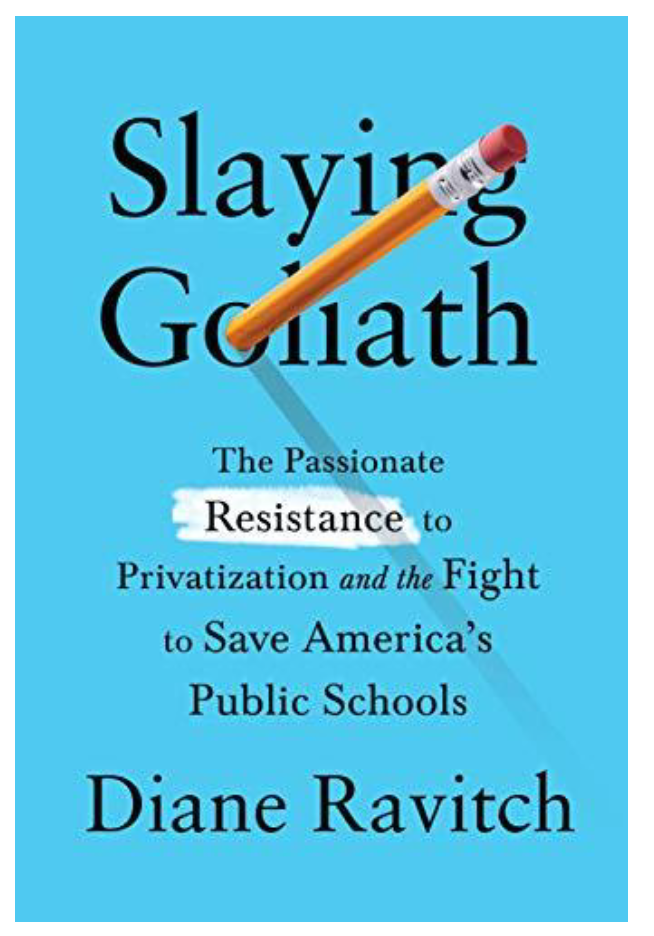
I was happy to read this review because Slaying Goliath had a checkered fate. It was published in mid-January 2020. I went on a book tour, starting in Seattle. By mid-February, I made my last stop in West Virginia, where I met with teachers and celebrated the two-year anniversary of their strike, which shut down every school in the state.

As I traveled, news emerged of a dangerous “flu” that was rapidly spreading. It was COVID; by mid-March, the country was shutting down. No one wanted to read about the fight to save public schools or about its heroes. The news shifted, as it should have, to the panicked response to COVID, to the deaths of good people, to the overwhelmed hospitals and their overworked staff.

To make matters worse, the New York Times Book Review published a very negative review by someone who admired the “education reform” movement that I criticized. I thought of writing a letter to the editor but quickly dropped the idea. I wrote and rewrote my response to the review in my head, but not on paper.

Then, again by happenstance, I discovered that Bob Shepherd had reviewed the review of my book in The New York Times. He said everything that I wish I could have said but didn’t. His review was balm for my soul. Shepherd lacerated the tone and substance of the review, calling it an “uniformed, vituperative, shallow, amateurish ‘review.’” Which it was. His review of the review was so powerful that I will post it next.

Then, a few weeks ago, I found this review by Berliner and Glass.

The review begins:

Reviewed by Gene V Glass and David C. Berliner Arizona State University, United States

They wrote:

In a Post-Truth era, one must consider the source. 

In this case, the source is Diane Rose Silvers, the third of eight children of Walter Silverstein, a high school drop-out, and Ann Katz, a high school graduate. The Silvers were a middle-class Houston family, proprietors of a liquor store, and loyal supporters of FDR.

After graduation from San Jacinto High School, she enrolled in Wellesley College in September, 1956. Working as a “copy boy”for the Washington Post, Diane met Richard Ravitch, a lawyer working in the federal government and son of a prominent New York City family. They married on June 26,1960, in Houston, two weeks after Diane’s graduation from Wellesley. The couple settled in New York City, where Richard took employment in the family construction business. He eventually served as head of the Metropolitan Transit Authority and Lieutenant Governor in the 2000s, having been appointed by Democratic Governor David Paterson.

 Diane bore three sons, two of whom survived to adulthood. Diane and Richard ended their 26-year marriage in 1986. She had not been idle. For a period starting in 1961, Diane was employed by The New Leader, a liberal, anti-communist journal. She later earned a PhD in history of education from Columbia in 1975 under the mentorship of Lawrence Cremin.

Diane was appointed to the office of Assistant Secretary of Education, in the Department of Education by George H. W. Bush and later by Bill Clinton. In 1997, Clinton appointed her to the National Assessment Governing Board (NAGB), on which she served until 2004. 

Ravitch worked “… for many years in some of the nation’s leading conservative think tanks.

Read the full pdf here.

Back in 2010, Secretary of Education Arne Duncan rolled out his Race to the Top program to reform American education. The U.S. Department of Education offered a total of $5 billion to states. To be eligible to compete for a part of the huge prize money, states had to agree to authorize charter schools, to adopt the Common Core (not yet finished), and to evaluate teachers based on the test scores of their students.

The requirement to change teacher evaluation was heated. Duncan scoffed at critics, saying they were trying to protect bad teachers and didn’t want to know the truth.

Debate over this methodology was heated.

I was part of a group of education scholars who denounced this method of evaluating teachers in 2010.

In 2012, three noted scholars claimed that teachers who raised test scores raised students’ lifetime incomes; President Obama cited this study, led by Harvard economist Raj Chetty, in his State of the Union address. It seemed to be settled wisdom that teachers who raised test scores were great, and teachers who did not should be ousted.

In 2014, the American Statistical Association warned about the danger of evaluating teachers by the test scores of their students. The ASA statement said that most studies of this method find that teachers account for 1-14% of the variation in test scores. The greatest opportunity for improvement, they said, was to be found in system-level changes.

The Gates Foundation poured hundreds of millions of dollars into districts willing to test value-added methodology, and eventually gave up. Teachers were demoralized, teachers avoided teaching in low-income districts. Overall improvements were hard to find.

Arne Duncan was a true believer, as was his successor, John King, and they never were willing to admit failure.

Teachers never liked VAM. They knew that it encouraged teaching to the test. They knew that teachers in affluent districts would get higher scores than those in less fortunate districts. Sometimes they sued and won. But in most states, teachers continued to be evaluated in part by their students’ scores.

But in New York state, the era of VAM is finished. Dr. Betty Rosa, the chancellor of the New York State Board of Regents, reached an agreement with Melinda Person, president of New York State United Teachers, to draft a new way of evaluating teachers that moves away from students’ standardized test scores.

New York state education leaders and the teachers’ union have announced an agreement to change how New York school teachers and principals are evaluated, and move away from the mandated reliance on standardized test scores.

State Education Department Commissioner Betty Rosa and New York State United Teachers President Melinda Person hand-delivered their drafted legislation Wednesday to lawmakers to create a new system that doesn’t use students’ test performance to penalize educators. The state teacher evaluation system, known as the Annual Professional Performance Review, or APPR, was modified in the 2015 budget to place a greater importance on scores.

“It’s connecting research to practice and developing strategies to ensure that teachers have the best tools and principals to make sure our young people are getting the best quality education,” Rosa told reporters Wednesday in the Legislative Office Building.

When NYSUT elected president Person last year, she said her first task was to change the teacher evaluation system, and state lawmakers said with confidence Wednesday it will happen this session.

The proposed law, which has not officially been introduced in the Legislature, would remove the requirement to base evaluations on high-stakes tests. School districts would have eight years to transition, but could make the changes faster than the required deadline.

Person argued it will support new teachers who are often burdened by the required paperwork under the current model.

“This would be a fair and a just system that would support them in becoming better educators, which is ultimately what they want to do anyway,” Person said.

The proposal was negotiated in agreement with state superintendents, principals, school boards, the PTA, Conference of Big 5 School Districts and other stakeholders. The issue has been contentious for union and education leaders for years, and both state Education Committee chairs in the Legislature said they’re thrilled with the agreement. 

“That’s such a nice thing in Albany,” said Senate Education chair Shelley Mayer, a Democrat from Yonkers. “Who can do that? Who gets agreement? It’s very hard around here.

“It takes a woman to do it,” Assembly Education chair Michael Benedetto replied with a smile.

Benedetto, a Bronx Democrat, was a classroom teacher for decades and recalled how feedback helps educators develop when done in the proper way.

“It’s like anything else — we want stability in our lives, we want to know where we’re going, how we’re going to be rated and what we’re going to be rated on, as a teacher, as a professional,” the assemblyman said.

Lawmakers will review the proposal and draft legislation in the coming weeks.

Remembering how strident were the supporters of VAM, it’s kind of wonderful to hear the collective sigh of relief in Albany as it fades away.