Archives for category: School Choice

The 74 Million—a news site funded by charter supporters and billionaires—reports that Rep. Hakeem Jeffries will downplay his support for charter schools now that he is Minority Leader of House Democrats. Charters have lost ground among Democrats, and Jeffries wants to unite the party. Importantly, he doesn’t want to alienate the teachers’ unions, which are an important part of the Democratic Party’s base.

Most Democratic members of Congress realized that charters were a step towards vouchers, and that both were deeply embedded in the Trump MAGA agenda.

For a time, during the Obama years, Obama and his Secretary of Education Arne Duncan sold charters as a “progressive” idea that would nurture innovation. After thirty years, the charter claims dimmed. Too many scandals, too little innovation. Too many charter chains making profits or paying outlandish salaries. Too many charters that opened and closed within three years. Too many charters that believed harsh discipline was “innovative.”

The charter lobby considered Hakeem Jeffries one of its best friends, but that was before Trump chose Betsy DeVos as Secretary of Education. She was an outspoken friend of School choice, including charter schools. In recent years, red states have embraced charters and vouchers in their frenzy to privatize public schools and transfer public funding to private organizations.

Now, it’s clear to most Democrats that Republicans own the issue of charters and vouchers, not Democrats.

When Biden’s Secretary of Education Miguel Cardona proposed modest rules to clean up the federal Charter Schools Program, which hands out $440 million a year to start new charter schools, the charter lobby made wild claims about how any accountability would irreparably harm new charters, but Democrats didn’t go along. The usual charter supporters in the Senate—Booker, Bennett, and Feinstein—complained about the new rules, but when the Senate voted on a motion to overturn them, not a single Democrat voted for the motion.

Today, the strongest allies of charter schools in Congress are conservative Republicans, like Virginia Foxx (NC), chair of the House Education Committee.

Peter Greene takes a hard look at the real goals of the voucher crowd: to kill public education. Not by offering better choices but by defunding it, step by step.

Doug Mastriano was not out of step with the movement; he was just a bit early.

Mastriano ran for governor of Pennsylvania with the idea that he could end real estate taxes entirely and cut state funding for public schools to $0.00. Just give everyone a tiny voucher and send them on their way. The idea was far enough out there that the campaigntried to back away from it (without entirely disowning it) and even other GOP politicians raised eyebrows and said, “No, not that.”You slice them off at the knees, right here–

The thing is, this is not a new idea. It has been the fondest dream of some choicers all along. Nancy MacLean, professor of history and public policy at Duke University, offered a succinct digest in the Washington Post of what Milton Friedman, granddaddy of the not-overtly-racist wing of the school choice movement, thought about the movement and its ultimate goals.Friedman, too, was interested in far more than school choice. He and his libertarian allies saw vouchers as a temporary first step on the path to school privatization. He didn’t intend for governments to subsidize private education forever. Rather, once the public schools were gone, Friedman envisioned parents eventually shouldering the full cost of private schooling without support from taxpayers. Only in some “charity” cases might governments still provide funding for tuition.

Friedman first articulated this outlook in his 1955 manifesto, but he clung to it for half a century, explaining in 2004, “In my ideal world, government would not be responsible for providing education any more than it is for providing food and clothing.” Four months before his death in 2006, when he spoke to a meeting of the conservative American Legislative Exchange Council (ALEC), he was especially frank. Addressing how to give parents control of their children’s education, Friedman said, “The ideal way would be to abolish the public school system and eliminate all the taxes that pay for it.

You don’t have to set the wayback machine to find folks saying this quiet part out loud. Utah is one of several red states racing to ram through a voucher bill. Here’s Allison Sorenson, executive director of Utah Fits For All, an outfit marketing the voucher plan like crazy; in this clip, she’s explaining that the folks who back Utah’s plan can’t come right out and say they’re going to defund public education entirely, that admitting the goal is to destroy public education would be too politically touchy.

Vouchers are not about choice. Just look at Florida, which has worked to disrupt, defund and dismantle public schools for years, while simultaneously shutting down and limiting what choices schools are allowed to offer. Look at every state’s voucher law; they all enshrine a private “education provider’s” right to deny and discriminate as they wish, thereby denying choice to any students they wish to deny choice to. One of the biggest limiters of school choice is not the public system, but the private system’s unwillingness to open their doors to all these students who, we hear, are just thirsting for choices.

We know what a free market education system looks like–it looks like the US post-secondary education system. Occasional attempts at free-to-all schools are beaten down by racist and classist arguments, along with charges of socialist indoctrination. You get as much choice as you can afford, the private schools only accept (and keep) the students they want, and those who aspire to certain levels of schooling have to sink themselves in debt to get it. Meanwhile, state’s slowly but surely withdraw financial support from the few “public” universities left.

Please open the link and finish his article.

John Thompson sees some hopeful signs that educators and legistors—especially Republican legislators—are willing to speak out against the attacks on public schools. Perhaps they saw the recent poll that showed that 75% of the public is opposed to vouchers. Perhaps they read in one of my books that merit pay has repeatedly failed and that it discourages collaboration and teamwork.

He writes:

Oklahoma schools have faced a long history of ideology-driven attacks that produced a “culture of compliance” where educators learned to keep their heads low, and avoid being targets. The two biggest exceptions were the1990 teacher rally at the Capitol and the passage of HB 1017’s funding increases, and the 2018 teacher walkout. But today’s MAGA-driven assaults have put previous threats on steroids, seeking to cripple or destroy public education and other public services. After this year’s reelection of Gov. Kevin Stitt and State Superintendent Ryan Walters, a worst case scenario seemed to be unfolding. It now looks like brazen falsehoods being spread by corporate powers such as the Koch brothers and ALEC, and local MAGAs have energized a diverse, bipartisan coalition of truth tellers.

Frankly, I’ve never seen so many education supporters opening up like they have this February. And as the legislature convened, more and more allies of public education have begun to say what’s on their minds.

In his latest tantrum, Ryan Walters further spurred the pushback by threating the accreditation of the Oklahoma City and Putnam City school systems for making “a pornographic book called ‘Let’s Talk About It’” available to students. Both districts deny they have the book. Walters’ source was a rightwing social media account, “Libs of TikTok.”

The Tulsa World’s Ginnie Graham challenged Walters’ attacks on diversity, equity, and inclusion (DEI), writing, “DEI is not a euphemism for race, affirmative action or critical race theory. It is not a liberal indoctrination to make white people feel shame. It is neither Marxism nor socialism.” Graham also explains that only 26% of Oklahomans have a bachelors degree, but within five years, “two-thirds of the top 100 critical professions will require a college degree.” And as Chancellor Allison Garrett explains, DEI is an essential tool for meeting that challenge.

The head of the Oklahoma City Public School Foundation, Mary Melon-Tully, editorialized in the Oklahoman, “A lot of the headlines and media attention have been focused on these divisive bills.” She then wrote in support of pro-education Republicans’ bills, like those of Sen. Adam Pugh and Rep. Rhonda Baker who have focused on “a multi-level pay raise,” paid maternity leave, creation of an Oklahoma Teacher Corps, mentoring, changes to the A-F report card, STEM preparedness, updating the funding formula, and better accountability for virtual and in-person charter schools, as well as “funding literacy instructional teams,” career-readiness, modernizing state graduation requirements, modifying the computer science curriculum, and “adding definition for English Language Learners.”

Similarly, Dr. Pam Deering wrote in the Oklahoman that it’s time to stop being “dominated by divisive culture war talking points,” [and] “focus on the true issues at hand.” Dr. Deering gave an overview of successes in schools, such as Lawton’s Life Ready Center, northwest Oklahoma’s High Plains Technology Center and Technical Applications Programs, Oklahoma City’s STEM academy, Norman’s Oklahoma Aviation Academy, and Sand Spring’s hybrid and virtual programs.”

Then the Stillwater News Press editorialized:

It would be nice to see the focus go to pumping more of that money into public schools, the ones that can’t refuse a child based on disability or who their parents are or how bad they are at basketball.

It would be good if the money wasn’t eventually going to be funneled to a for-profit lobbyist.

It would be great if the focus was on hiring and retention of dedicated teachers and staff.

As Walters pushes for pay-for-performance, the press has displayed a candor that previously would have usually been seen as too risky to articulate bluntly. For instance, the Enid News reported on the thoughts of Erika Wright, founder of the Oklahoma Rural Schools Coalition, who said, that the “politicizing a pay scale and a pay raise for teachers that are college-educated that are educating our children is ridiculous.” … “That is just an effort to add more divisiveness and inflammatory rhetoric.”

Bixby’s School Superintendent Rob Miller’s Tulsa World editorial was even blunter. He described teacher merit pay as “one of the more persistent and seemingly indestructible zombie ideas related to education.” It’s been “tried again and again since the 1920s.” And it’s only been 12 years since “the $12 billion merit pay experiment failed once more.” He also cited W. Edwards Deming, who “argued that merit pay ‘nourishes short-term performance, annihilates long-term planning, builds fear, demolishes teamwork, and nourishes rivalry and politics.’”

Our last pay-for-performance experiment, as was predicted, started by corrupting school data. Now, Miller adds, the teachers “who are supposed to reap the rewards” … “know that merit pay undermines collaboration and teamwork. They understand that it would corrupt the culture of their school.”

And it is especially encouraging that bipartisan collection of legislators, and Republicans like Sen. Dave Rader, chairman of the Senate Finance Committee and Rep. Jeff Boatman, are making such thoughtful arguments against Walters’ and Stitt’s plans. The Tulsa World reports, Sen. Rader says “the state’s tax structure is being reviewed but that he feels no great urgency to make sudden, drastic changes. The state “is in a good position,” he said, with “a nice surplus and a relatively low tax burden.”

Moreover, Rep. Boatman “said there are ways to return value to taxpayers besides just cutting taxes.” He said, “Sure, there’s going to be some tax cuts,” but “there’s going to be some things we invest in through agencies and through services we do as a state. We can give money back that way.” Then Boatman suggested using some of the reserves to fund “some pretty incredible” community projects.

Finally, the Tulsa World’s Carmen Foreman reports, “House Speaker Charles McCall, R-Atoka, recently reiterated his opposition to school vouchers.” But she also reports, “House Republicans are expected to unveil an education plan that would expand school choice options in Oklahoma without vouchers.”

And, as Oklahoma Watch’s Jennifer Palmer explains, the Statewide Virtual Charter School Board “is set to consider a Catholic charter school this week in what is viewed as a national test case for publicly-funded religious education.”

Given Oklahoma’s Republican majority, and the unconscionable number of Republicans who have remained largely silent regarding the assaults on democracy and public institutions during the Trump era, our future requires more conservatives and Republicans to embrace the wisdom and values of their colleagues and other supporters who are making a stand for our schools. The future remains uncertain, it’s looking more likely that the legislature will come together and at least stop the most destructive rightwing campaigns.

Mimi Swartz, a writer for the Texas Monthly, explored the background, the funders, and the consequences of the well-coordinated campaign to privatize public schools—by defaming them and discrediting those who run for local school board seats. She focuses on the travails of one dedicated school board member, Joanna Day in Dripping Springs, Texas, who contended with insults and threats in her life.

The following is a small part of a long article, which I encourage you to read in full:

The motivations for these attacks are myriad and sometimes opaque, but many opponents of public education share a common goal: privatizing public schools, in the same way activists have pushed, with varying results, for privatization of public utilities and the prison system. Proponents of school privatization now speak of public schools as “dropout factories” and insist that “school choice” should be available to all. They profess a deep faith in vouchers, which would allow parents to send their children not just to the public schools of their choice but to religious and other private schools, at taxpayers’ expense.

But if privatizing public education is today cloaked in talk of expanded liberty, entrepreneurial competition, and improved schools for those who need them most, its history tells a different story. In 1956, two years after the U.S. Supreme Court handed down its landmark Brown v. Board of Education decision, a group of segregationist legislators in Texas, with support from retiring governor Allan Shivers, began concocting work-arounds for parents appalled by the prospect of racial integration of public schools. One idea: state-subsidized tuition at private schools. That never came to pass, but it was Texas’s first flirtation with vouchers.

Privatization proponents have since switched up their rhetoric, pitching vouchers as an opportunity for poor urban families to save their children from underperforming neighborhood schools. That hasn’t worked out either. In various experiments across the nation, funding for vouchers hasn’t come close to covering tuition costs at high-quality private schools, and many kids, deprived of the most basic tools, haven’t been able to meet the standards for admission.

School funding in Texas is based largely on attendance—as the saying goes, the money follows the child. Considerable evidence suggests that vouchers would siphon money from underfunded public schools and subsidize well-to-do parents who can already afford private tuition. Critics frequently cite a program in Milwaukee, where four out of ten private schools created for voucher students from 1991 to 2015 failed.

“I don’t think that vouchers serve any useful purpose at all,” said Scott McClelland, a retired president of H-E-B who now chairs Good Reason Houston, an education nonprofit. Ninety-one percent of Texas students attend public schools. “There isn’t enough capacity in the private school network to make a meaningful difference in their ability to serve economically disadvantaged students in any meaningful numbers, and it will divert funding away from public schools.”

In Texas, an unusual alliance of Democratic and rural Republican leaders has for decades held firm against voucher campaigns. The latter, of course, are all too aware that private schools aren’t available for most in their communities and that public schools employ many of their constituents. But the spread of far-right politics and the disruption of public schools during the pandemic created an opening for activists to sow discontent and, worse, chaos. “If they can make the public afraid of their public school, they will be more likely to support privatizing initiatives. Then that puts us back to where we used to be with segregation of public schools,” says former Granbury school board member Chris Tackett, who, with his wife Mendi, has become an outspoken advocate for public education and a relentless investigator of the attempts to undermine it.

They have their work cut out for them. In the past, just a few right-wing legislators pushed for privatization and were routinely ignored. After all, the state constitution spelled out “the duty of the Legislature of the State to establish and make suitable provision for the support and maintenance of an efficient system of public free schools.” But as times have changed, so has the interpretation of that guarantee.

Betsy DeVos, President Donald Trump’s former Education Secretary, set up shop in Dallas with her American Federation for Children to push against “government schools” in favor of “school choice.” Political PACs such as Patriot Mobile Action, an arm of a Christian wireless provider in North Texas, continue pouring millions into school board races and book bans to promote more religious education. Patriot has joined other recently formed PACs with inspirational names such as Defend Texas Liberty and Texans for Excellent Education, all of which supposedly support better public schools but are actually part of the privatization push. But by far the most powerful opponents of public schools in the state are West Texas oil billionaires Tim Dunn and the brothers Farris and Dan Wilks. Their vast political donations have made them the de facto owners of many Republican members of the Texas Legislature through organizations such as the now dissolved Empower Texans and the more recent Defend Texas Liberty, which the trio uses to promote restrictions on reproductive rights, voter access, and same-sex marriage. Almost as influential is the Texas Public Policy Foundation, where Dunn is vice board chair.

A November 2021 TPPF fund-raising letter, sent to supporters in advance of the Eighty-eighth Legislature convening, argued that “public education is GROUND ZERO” in the fight for freedom. “The policy team and board of the Texas Public Policy Foundation (TPPF) believe it is now or never,” it read, signaling that the long-standing and robust alliance against vouchers was unusually vulnerable. “The time is ripe to set Texas children free from enforced indoctrination and Big Government cronyism in our public schools.” The letter went on to herald a $1.2 million “Set the Captives Free” campaign to lobby legislators to save Texas schoolchildren from “Marxist and sexual indoctrination” funded by “far-Left elites for decades.”

Lieutenant Governor Dan Patrick, generously backed by Dunn, the Wilks brothers, and their organizations, has long been a proponent of privatizing public education (and of starving it through reductions in property taxes). He has made vouchers a primary legislative goal of the current session. Mayes Middleton, of Wallisville, a Republican state senator and former chair of the TPPF-aligned Texas House Freedom Caucus, filed a bill to create the “Texas Parental Empowerment Program,” proposing education savings accounts that are essentially a form of vouchers. Representative Matt Shaheen, of Plano, who is a member of the Texas Freedom Caucus, has introduced a measure that would guarantee state tax credits for those who donate to school-assistance programs—such as scholarships for kids wishing to go to private schools.

Governor Greg Abbott, knowing all too well the political headwinds that vouchers have faced, has long been wary of publicly supporting them, so he has undermined public schools in other ways. While campaigning early last year, he promised to amend the Texas constitution with a “parental bill of rights,” even though most, if not all, of those rights already existed. By then, “parental rights” had become a dog whistle to animate opponents of public education. (As the Texas Tribune put it: “Gov. Greg Abbott taps into parent anger to fuel reelection campaign.”)

During the recent intensifying crisis on the border, Abbott publicly floated a challenge to the state’s constitutional obligation to give all Texas children, including undocumented ones, a publicly funded education—a step his Republican predecessor, Rick Perry, had denounced years earlier as heartless. Then last spring, Abbott made headlines with his first full-throated public endorsement of a voucher program.

So here we are, with distrust in public schools advancing as fast as the latest COVID-19 variant. The forces behind the spread of this vitriol are no mystery. Those who would destroy public schools have learned to apply three simple stratagems: destabilize, divide, and, if that doesn’t work, open the floodgates of fear

Jeff Bryant is a professional journalist who has written extensively about the failures of corporate-style school reform. This story recounts the experience of a family that accepted vouchers in Maine and learned that school choice meant that students abandon their civil rights protections when they enroll in a private school. Please open the link and read the complete article.

The harrowing story of a Maine family shows the potential perils families face when they transfer to privately run schools that are less subject to government oversight.

By Jeff Bryant

“I am the type of parent who always made sure my kids had the good teachers and always took the right classes,” said Esther Kempthorne in an interview with Our Schools. So, in 2014, when she moved with her husband and two daughters to their new home in Washington County, Maine, in a bucolic corner of the state, near the Canadian border, she made it a top priority to find a school that would be the right educational fit for their children.

“We settled in Washington County hoping to give our children the experience of attending one high school, making lasting friendships, and finally putting down some roots,” said Esther’s husband, Nathan, whose career in the military had sent the Kempthorne family traveling the world, changing schools more than 20 times in 17 years. “Both of our children were born on military bases while I was on active duty with the U.S. Navy and the U.S. Air Force,” said Nathan, whose role in military intelligence often meant that he was deployed to high-risk assignments in war zones.

“We said that when we got to Maine, we weren’t going to keep bouncing from school to school,” said Esther.

But after some firsthand experience with the education programs provided by the local public schools, the Kempthornes decided to investigate other options the state offers. One of those options was the state’s provision that allows parents who live in a district that doesn’t have a school matching their child’s grade level the choice to leave the public system and transfer their children to private schools, with the “home” public school district picking up the cost of tuition and transportation, subject to state allowance.

Because the rural district the Kempthornes lived in did not have a high school, they took advantage of that option to enroll their daughters—at taxpayer expense—in Washington Academy, an elite private school founded in 1792 that offersa college track curriculum and access to classes taught by faculty members from a nearby university.

Their decision to leave the public school system for Washington Academy seemed all the better when Esther, a naturalized U.S. citizen born in Mexico, got a full-time job teaching Spanish at the school.

Thinking back on how the Kempthorne family negotiated the school choice landscape in Maine, Nathan recalled, “I thought we were finally going to be okay.”

But the Kempthornes weren’t okay. Far from it, in 2021, the Kempthornes found themselves in the front seat of their car while they were traveling in another state, using Nathan’s iPhone to call in via Zoom and provide testimony to a Maine legislative committee on why Washington Academy, and other schools like it, pose significant threats to families like theirs and how the state needs to more heavily regulate privately operated schools that get taxpayer funding.

Fighting through tears, they spoke of “racism” and “bullying” at Washington Academy and the school administration’s unwillingness to acknowledge and address the school’s culture.

In his written testimony, Nathan wrote of “a disturbing pattern of systemic racism and institutionalized oppression, harassment, and bullying behavior based on race, ethnicity, country of origin, gender, and sexual orientation that has occurred for years at [Washington Academy].”

In her letter of resignation from the school, presented to the committee, Esther wrote of a school environment where she and her daughters, who identify as Hispanic, experienced “racist, anti-immigrant sentiments.” She wrote, “As the racist anti-immigrant rhetoric became more mainstream, we had to teach our daughters how to defend themselves without our intervention, and they did. However, such self-defense has been exhausting and stressful for my children, and it should not be their responsibility to constantly deflect harassment; rather they should be guaranteed a safe educational environment by school leaders.”

Although their daughters eventually graduated from Washington Academy and went on to college, the family became totally uprooted because of their experience at the school. Nine years after building their dream home in rural Maine, they now find themselves living in an apartment in New York City, embroiled in a years-long battle with Washington Academy and Maine officials, which has absorbed countless hours of their time and thousands of dollars of their life savings.

Esther has been unable to reenter the classroom as a full-time teacher due to the lingering effects of the traumatic experiences she had from teaching at Washington Academy, and both parents and daughters speak of long-term adverse mental health effects stemming from the years they spent at the school.

“We sold everything,” Nathan said in his spoken testimony to the committee. “We lost everything in your state and we left for our safety. Our children are completely traumatized. They lost all their friends.”

The Kempthornes’ story about the consequences of leaving the public education system for a private school is a cautionary tale about what can happen when a system designed to provide parents with taxpayer-supported private school options fails to consider the potential risks when students and parents transfer to these schools that are less subject to government oversight.

Their story is even more significant given the current trend across the country where states have increasingly been adopting charter schools, voucher programs, education savings accounts, “backpack funding,” and other so-called school choice options that use taxpayer money to fund alternatives to the public system.

These options are favored by politicians on the right and left, and, at least one state, Arizona, has a voucher program called the Empowerment Scholarship Account Program, which every student in the state is eligible to tap.

This rapid expansion of school choice options is taking place even though there is ample anecdotal evidence and a growing body of research showing that parents in a school choice marketplace often make questionable choices they sometimes come to regret.

As the Kempthornes came to learn, private education providers that are not governed within the public domain pose legal problems that parents often either don’t know about or don’t understand, and local and state government officials often either have no authority to intercede on parents’ behalf or are reluctant to assert what little authority they do have.

The Kempthorne family’s saga, which is still enduring, is a sharp counterpoint to advocates who promote school choice as a simplistic solution for families without acknowledging that transferring taxpayer-funded education services from the public to the private realm will actually complicate parents’ and students’ lives.

Bryant goes in to describe a school culture that was implicitly racist and unwilling to act in complaints of racism.

Washington Academy is one of several Maine “town academies” that benefit from what’s known as “town tuitioning,” in which private schools receive public funding from districts that “tuition out” students to the schools rather than paying to educate them in their “home” district. These Maine academies had from 80.4 to 99.3 percent of their student enrollments funded with public dollars in the fiscal year 2020-2021. Most of them also obtain additional income by operating expensive residential programs that enroll students, often from countries outside the U.S.

The practice of using town tuitioning programs as alternatives to providing public schools started in Vermont, according to Education Week, but has since spread to New Hampshire, Massachusetts, and Connecticut, as well as Maine.

Supporters of these programs call them a “model of educational choice,” according to Education Week, and although supporters of vouchers haven’t always held up town academies as their ideal, they’ve more recently been describing them as the “oldest school choice program in the nation” and calling for expanding them so that all students are eligible to attend the town academies.

But the rationale for having town academies and funding them with public money seems to no longer hold, if it ever did.

‘A Common Myth’

“A common myth is that town academies in New England exist in rural areas which have a scarcity of public schools due to the relatively low population density of families with school-aged children and a lack of funding to support district schools,” according to Bruce Baker, an education professor at the University of Miami in Florida. “But that’s not the reality.”

According to Baker, many of these schools started in the early 1800s, or earlier, as private secondary schools for their communities prior to the existence of public high schools “and in many cases,” prior to the creation of the nation’s system of public common schools. “Some, like Burr and Burton Academy in Manchester, Vermont, were originally funded by local businessmen,” he noted.

Given that origin, town academies that are in operation today are “holdovers,” according to Baker, “of what were once proxy public schools that never converted to district public schools,” although a few have, such as Bellows Free Academy in St. Albans, Vermont, which converted from private to public in 2008.

Contrary to the town academy narrative, some of the schools are in communities that have sufficient populations to educate school-aged children. For instance, New Bedford Academy in New Bedford, Massachusetts, is located in a city with a population exceeding 100,000, according to the 2021 U.S. census. Norwich Free Academy is located in Norwich, Connecticut, a community with a population of more than 40,000.

Also, the notion that town academies are needed in Maine because public schools are few and far between seems hardly the case. “The distances between publicly funded town academies and competing public high schools in Maine is often negligible,” Nathan Kempthorne wrote in an email, pointing out that the distance between Washington Academy and Machias Memorial High School in Machias is only 4.2 miles, and John Bapst Memorial High School, a town academy in Bangor, is only 2.5 miles from Bangor High School and 2.1 miles from Brewer High School.

Public schools in rural communities are quite commonplace. “More than 9.3 million—or nearly one in five students in the U.S.—attend a rural school,” according to a 2019 reportby the Rural School and Community Trust. “This means that more students in the U.S. attend rural schools than in the nation’s 85 largest school districts combined.”

Whereas rural public schools are subject to the same government oversight that all public schools are subject to, that oversight does not extend to private schools, even when they get a substantial portion of their funding from the public.

“In private schools, students end up losing basic constitutional rights and essentially don’t have due process rights,” Todd DeMitchell told Our Schools. DeMitchell is a professor emeritus at the University of New Hampshire at Manchester who studies laws governing school policies and the impact of court cases on these policies.

According to him, if the Kempthornes had their children enrolled in public schools they would have had access to certain rights protected by the U.S. Constitution, including Title 6, which addresses race, and Title 9, which addresses discrimination on the basis of sex. Washington Academy, being a private school, is exempt from these protections.

DeMitchell pointed to a 1987 decision by a federal courtthat ruled a private academy in New Hampshire had the right to fire a teacher who, contrary to school policy, grew a beard, because the school argued successfully that it was “not a state actor,” according to DeMitchell. That ruling’s logic has been extended to a potential 2023 U.S. Supreme Court case in which a North Carolina charter school is arguing that it has the right to require girl students to wear skirts at school because it also is not a state actor. (Charter schools are also privately operated schools that are funded almost exclusively with public money.)

Along with their problematic funding rationale, town academies also have issues with being truly diverse and inclusive schools. For instance, they’ve “long struggled” to serve students with disabilities, according to Baker. And the student populations of these town academies tend to be more white and affluent than their surrounding communities, with any purported claims of student diversity being largely due to their enrollments of international students in residential programs.

Please open the link to read this important article.

Jeff Bryant is a writing fellow and chief correspondent for Our Schools. He is a communications consultant, freelance writer, advocacy journalist, and director of the Education Opportunity Network, a strategy and messaging center for progressive education policy. His award-winning commentary and reporting routinely appear in prominent online news outlets, and he speaks frequently at national events about public education policy. Follow him on Twitter @jeffbcdm.
Oklahoma State Superintendent Ryan Walters seems to have absorbed all his talking points from ALEC, the rightwing bill mill or he may just be trying to duplicate whatever Florida Governor Ron DeSantis is doing. All the talking points are there about critical race theory, “diversity, equity, and inclusion,” the “science of reading,” the fear of students turning transgender or being recognized as such, the readiness to censor anything that mentions sexuality or gender, and of course, vouchers for home schoolers and religious schools.

Superintendent Walters adds another item to his “reform” agenda: pay for performance, which has been tried for a century and never worked anywhere. It is hard to find an educational program that has been more thoroughly discredited, especially in the past dozen years. Performance these days equals test scores, and the teachers in the most affluent schools always come out in top, while those who teach the most vulnerable children are always on the bottom. No need to reinvent that broken wheel. Even Republican legislators know instinctively that “performance,” defined as test scores favors those in the whitest, most advantaged schools.

John Thompson, historian and former teacher, writes:

Last week, rightwing Oklahoma Secretary of Education Ryan Walters tried to “Shove ‘Choice’ Down the Throats of Unwilling Schools and Parents,” but he received serious pushback by influential Republicans for ignoring legislative norms in budget-making. This week, Walters’ revealed more of his plans to divide and conquer public schools, while ramping up the stakes for educators who don’t comply with ambiguous and weird mandates. The response by numerous Republicans, however, seems to indicate that a bipartisan effort against Walters’ and Gov. Kevin Stitt’s extremism is growing.

Walters started the Board of Education meeting, where his budget was presented with a prayer, which included a “reference to his school choice goals.” He then condemned “a loud and vocal crowd, a minority for sure, that say that all that is needed to fix the problems in education is to toss more money and to leave everything alone.” Walters then promised:

“There will be school choice. We will ensure that indoctrination and CRT (critical race theory) are eliminated in our state. We will also make sure that our kids are safe. There will be no boys in the girls bathrooms. There will be no pornography in our schools. We will make sure all of our vendors and the schools are focused on education and not diversity, equity and inclusion.”

Then, Walters met with rural superintendents in Atoka, the home of the Republican Speaker of the House Charles McCall, who has opposed voucher expansion. Walters explained that his “incentive pay plan that would reward a select few highly rated teachers in each school with up to $10,000 on top of their salaries.”

Walters then complained that:

“Tulsa has done so poor that if you took Tulsa Public Schools out of what we’re doing, we’re in the top half nationally. If you take Tulsa and OKC out, we’re in the top 15.”

So, the Tulsa World reported that Walters said:

“He would be open to pushing for Tulsa Public Schools to be broken up into smaller schools because of academic results there he says are dismal and parents who complain they are locked in because they can’t afford private school tuition and suburban schools bursting at the seams.”

At the same time, Walters’ allies are revealing more options for punishing educators who don’t comply with confusing mandates. While Walters seems to be backing off from his suggestion that all federal education funds be rejected, Sen. David Bullard filed a bill to “develop a ten-year plan to phase out the acceptance and use of federal funds for the support of K-12 education.” Sen. Shane Jett would “add seven more prohibited topics to House Bill 1775, which bans eight race and gender concepts from K-12 schools.” Jett and Rep. Terry O’Donnell seek to ban “teaching about sexual orientation and gender identity to elementary-age children,” And Jett “would outlaw any school policies that respect or promote ‘self-asserted sex-based identity narratives,’” as well as hosting “drag queen story time.”

Moreover, Sen. Cody Rogers “would prohibit school employees from calling students by names or pronouns that differ from the students’ birth certificates, unless having received written consent from the child’s parent.” Rep. Danny Williams would completely ban sex education from public schools.

Then, it was learned, Walters fired the Oklahoma State Department of Education’s Assistant general counsel Lori Murphy. The veteran attorney was “known for her support of transgender people and objections to the state’s rulemaking on classroom race and gender discussions.”

And the Tulsa World reported, the Oklahoma State Regents for Higher Education responded to Walters’ “urgent request” to audit spending on diversity, equity and inclusion, or DEI, programs. The Regents, “scrambled hundreds of employees to compile a 10-year review of its spending history on and current materials used for … DEI programs.” They found that DEI spending was “a third of 1%” of the budget.

But, on the eve of submitting his budget to the legislature, Walters, as well as his ally Gov. Stitt, faced more bad news. As the Oklahoman reports, Attorney General Gentner Drummond, who defeated Stitt’s appointee, John O’Conner, announced an “investigation into misspent education funds” which “hung over the state Capitol on Wednesday.” As an investigation by Oklahoma Watch and The Frontier found, Connors’ lawsuit led “some critics to question whether the lawsuit was an honest attempt to recoup the funds.” Consequently, The Oklahoman reported, “some high-ranking lawmakers appeared hesitant to heed funding requests from Oklahoma’s new state superintendent because of his alleged part in the controversy.” The reason was it was “a mix of Walters’s and Gov. Kevin Stitt’s staff, not a state agency [that] was overseeing the program.”

The Republican Chair of the House Appropriations and Budget subcommittee for Education, Mark McBride, said (and Speaker Charles McCall confirmed) he had been authorized to investigate the lawsuit, and was wrong in not doing so. But now, as Nondoc reports, A.G. Drummond said he “would pursue accountability for state officials, potentially including Walters owing to his prior role as director of an organization tasked with dispersing the funds.” (for what it’s worth McCall, a likely candidate for governor, attended the budget presentation.)

The Tulsa World added that Stitt had blamed the parent company of ClassWallet for the “unflattering audit of federal pandemic relief funds under Stitt’s control.” But, the audit was critical of how the Stitt administration spent $31 million to provide pandemic relief for students’ educational needs.”

Nondoc further explained that Walters’ presentation to the committee “took the opportunity with some of the lawmakers’ questions to expound on campaign rhetoric, including addressing questions regarding his ‘liberal indoctrination’ comments and past declarations to get federal funding out of Oklahoma public education.” And, his two-point plan, funding “science of reading” and pay-for-performance, drew plenty of criticism.

Republican Rhonda Baker, chair of the Common Education Committee, told Walters, “We have, as a legislative body, voted on the science of reading.” She added, “We’ve been very supportive of that, and we have made sure that there has been funding for that, so none of that is new. What is challenging, though, … is that we are not keeping teachers.”

Moreover, Democrat Rep. Andy Fugate said Walters performance pay plan would backfire by drawing teachers away from high-challenge schools and finding schools where “it’s easiest to teach.” Similarly, McBride said:

“Merit pay, I’m OK with it if you work in the oil field or some industry, but in education I just don’t see it working. … If you’ve got a classroom of troubled youth, how do you compare that to the classroom over here where the teacher’s got all the A and B students? It’s just almost impossible to me to evaluate that.”

I’ve heard mixed appraisals as to whether Walters really believes his own words. Regardless, as his ideology-driven claims become more extreme, it seems more likely that there will be more bipartisan pushback against Walters, Stitt, and MAGA true-believers. And, who knows, maybe it will open the door to Republican Adam Pugh’s bill, based on discussions with hundreds of superintendents and education leaders and over a thousand educators, that “would spend $241 million on teacher pay raises, guarantee 12 weeks of maternity leave for teachers and offer $15 million in scholarships to future educators who pledge to work in high-poverty schools,” while bestowing respect on teachers.

Christopher Lubienski is Professor of Education Policy and director of the Center for Evaluation and Policy Analysis at Indiana University. Among his publications is The Public School Advantage: Why Public Schools Outperform Private Schools. In this article, which appeared in The Tennessean, he points out that vouchers are unpopular as well as ineffective. So unpopular are they that they are usually sold another another name, like “education scholarships.”

He writes:

Recently, a panel of judges dismissed lawsuits against Tennessee’s private school voucher program passed by the General Assembly back in 2019. A month before that decision, the West Virginia Supreme Court ruled in favor of its legislature’s efforts to implement a universal voucher program. These types of legal victories may seem like good news for parents’ rights, but they are also a reminder that the school choice movement is missing a key source of support: the voters.

School choice is continuing to expand across the United States. New Hampshire implemented a statewide voucher program in 2021, and this year Arizona legislators also adopted a universal voucher program.

But these successes often come in spite of overwhelming voter opposition to school choice programs. Arizona lawmakers had passed a similar measure in 2018, only to see the initiative soundly rejected by a 2-to-1 margin at the ballot box. This time around, policymakers successfully undercut an effort to put their initiative back before the electorate.

In Michigan, school choice advocates appeared to have ignored a deadline to place their proposal for a voucher program on the ballot. Since such measures had been overwhelmingly rejected by Michigan voters twice before, voucher proponents instead exploited a quirk in state law that allowed them to put the issue directly before the GOP-run legislature while preempting any veto from the Democratic governor. (Unfortunately for their plan, Michigan voters then flipped the legislature to Democratic control.)

This voter-avoidance strategy is clear with school choice programs across the U.S. According to the pro-voucher organization EdChoice.org, the U.S. has over 75 publicly funded private school choice programs, including vouchers and education savings accounts, as well as another 45 charter school programs. But all of these programs have been implemented by legislators, not the electorate. Following these legislative actions, judges, not voters, can get their say.

In fact, voters have been allowed to weigh in on school choice programs only nine times since 2000, and they almost always reject them, often by overwhelming margins. Only twice did school choice programs pass through the ballot box. In 2012 Georgia voters empowered their legislature with the ability to create charter schools. That same year, although they had clearly rejected it twice before, Washington voters passed a charter school referendum by the slimmest of margins following financial support from Bill Gates and associates for the measure.

This reflects an interesting conflict. Parents seem to like choice programs. Perhaps that’s not surprising, since people are often happy to receive public subsidies. But when asked, voters consistently and overwhelmingly reject these programs.

Policymakers and choice advocates have largely come down on the side of parent rights in endorsing school choice. Since this puts them in opposition to voters, they largely avoid the electorate on the issue.

But policymakers would do well to remember that this is not just a question of who controls education decision-making. After all, they are entrusted with the wise use of taxpayers’ dollars. And recent research is repeatedly showing that the voters may be on to something: that vouchers are not a good investment. Although publicly funded vouchers may be propping up some private schools that might otherwise go out of business, they are not really helping the people they purport to help. In fact, despite parent satisfaction, study after study shows that students using vouchers are falling behind where they would have been if they had remained in public schools. Thus, policymakers might think twice about defying voters on initiatives that actually cause harm to children.

It’s a curious approach for a movement that claims to be working for the grass roots.

You can view the post at this link : https://networkforpubliceducation.org/blog-content/christopher-lubienski-the-school-choice-movement-has-a-voter-problem/

Joshua Q. Nelson wrote a story for FOX News, saying that I was a hypocrite for sending my sons to private schools (more than 50 years ago) and ignoring the fact that I turned against school choice publicly in 2010. His source was Corey DeAngelis, who works for Betsy DeVos. He has attacked me so often on Twitter that I blocked him.

A little bit of research would have shown that I supported school choice from the late 1980s (when charters first emerged) until 2008 (when I started writing a book about my disavowal of conservative education ideology—charters, vouchers, standardized testing, merit pay, and high-stakes accountability).

My change of mind and heart was well covered, not only in The New York Times, but in The Wall Street Journal and other publications). And the book became a national bestseller.

Christina Pushaw, a close aide to Ron DeSantis, amplified the story in her Twitter account, as did the notorious Chris Rufo.

Since the story came out, I have received numerous death threats. Yesterday, I got another one, a long and garbled message with religious allusions, which ended by saying “Yes, we will be ‘slaying Goliath.’ You are Goliath.”

I think Joshua Q. Nelson should be aware that he was played by DeAngelis and correct his story.

Meanwhile, I am flattered that Ron DeSantis and Betsy DeVos and their minions read my tweets and perhaps my blog. I would like to recommend that they read my last three books, where I demonstrate the importance of public schools and the hoax of school choice, which originated as the battle cry of segregationists after the Brown decision.

In a diverse society like ours, public schools bring children from different backgrounds together. They are essential for our democracy. They are the best choice.

Of course, parents are free to make private choices but they should not expect taxpayers to pay for their choice to send their child to a private school that discriminates against others.

Meanwhile, here is a reading assignment for Corey DeAngelis, Christina Pushaw, Chris Rufo, Ron DeSantis, and Betsy DeVos:

https://www.nybooks.com/articles/2021/01/14/the-dark-history-of-school-choice/

And three books:

The Death and Life of the Great American School System: How Testing and Choice Are Undermining Education (2010)

Reign of Error: The Hoax of the Privatization Movement and the Danger to America’s Public Schools (2013)

Slaying Goliath: The Passionate Resistance to Privatization and the Fight to Save America’s Public Schools (2020)

On a personal note: I am 84. I do not fear your threats. I write what I choose. I will not be intimidated.

Over the past few days, I have received a number of hostile tweets, comments on my blog, and Instagram comments, accusing me of hypocrisy because I support public schools but sent my own sons (now ages 60 and 55) to private school. I am touched, even baffled, that anyone is upset by decisions that I made half a century ago.

It was easy to see who inspired these denunciations of me: Christina Pushaw, who is one of Ron DeSantis’ closest aides, and Chris Rufo, the man who led the phony crusade against critical race theory. They seem to think they unearthed a dark secret. That’s absurd. I’m guessing that Governor DeSantis doesn’t like what I write about him in my posts and tweets. I’m flattered.

The question of where my middle-aged sons went to schools is a nothing-burger. For the past decade, my blog bio has said that my two sons went to private school.

Pushaw and Rufo were outraged that I tweeted during “school choice week”:

“The best choice is your local public school. It welcomes everyone. It unifies community. It is the glue of democracy.”

They tweeted their “discovery” that my sons went to private school. The outrage of these two prominent right wingers generated two articles attacking me as a hypocrite.

One appeared on a news site called MEAA.com, titled:

“Who is Diane Ravitch? ‘Hypocrite’ NYU prof who sent her children to private school urges parents to pick public schools”

The article quotes Pushaw’s tweets, as well as tweets from others responding indignantly to my alleged hypocrisy.

The Daily Mail in the U.K. published an unintentionally hilarious article with this title:

“NYU education professor tells parents to send their kids to public school – before being forced to admit she send hers to private schools

It was never a secret that my sons went to private school. I was never “forced to admit” that fact.

Why did I send them to a private school?

After college, I married a New Yorker in 1960 whose family had a long tradition of attending private schools. My husband enrolled in the private Lincoln School in 1936! Like him, our sons went to private schools. When I started my career as a writer, I was conservative. I wrote articles in publications like The Wall Street Journal, Commentary, and The Public Interest. I opposed affirmative action, identity politics, and the Equal Rights Amendment. I believed, like Governor DeSantis, that the law should be colorblind.

However, I was never a racist. I was never contemptuous of public schools, because I had graduated from them and was grateful for the education and teachers I had, and the opportunities they opened for me.

In 1975, I earned a Ph.D. In the history of American Education from Columbia University. I was an adjunct professor at Teachers College from 1976 to 1991, when I left to work in the first Bush administration as Assistant Secretary of Education for Research and serve as Counselor to Secretary of Education Lamar Alexander.

After my stint in the Bush administration, I rejoined the board of the conservative Thomas B. Fordham Foundation and was invited to be a Senior Fellow at the Manhattan Institute (which now employs Chris Rufo) and at the Hoover Institution. All three are very conservative and support school choice, as did I. I even went to Albany on behalf of the Manhattan Institute and testified on behalf of charter legislation in 1998.

When I came back to New York City, Teachers College asked me not to return because of my conservative views. I was hired as an adjunct at New York University, where I was a faculty member from 1995 to 2020, when I retired.

In 2007, after a long and deep immersion in the conservative education world, I began to change my views. I began to realize, based on frank conversations within the conservative think tanks, that charters were no better and possibly worse than public schools unless they cherrypicked their students; that clever entrepreneurs and grifters were using some of them to make millions; that voucher schools were usually ineffective, had uncertified staff, and did not save poor kids; that standardized tests are not valid measures of learning; that the emphasis on tests was actually ruining education by narrowing the curriculum and encouraging teaching to the tests.

The more I reflected on the poor outcomes of conservative policies, the more I doubted the ideas I had long espoused. In 2008, I began writing a book in which I renounced my conservative views. I rejected high-stakes testing, school choice, merit pay, evaluating teachers by their students’ test scores, and the entire corporatist school “reform” agenda.

The book—The Death and Life of the Great American School System: How Testing and Choice Are Undermining Education (Basic Books)—was published in 2010, and it became a national bestseller. My change of mind and change of heart were widely reported in the national media.

Today, I am no longer a conservative. I support equal opportunity and equal justice for all Americans. I am sensitive, as I always have been, to the unjust and inhumane treatment that Black Americans have suffered. I endorse critical race theory, because it is a way of studying and evaluating why racism persists in our society and devising ways to eliminate it. Racism and other forms of hatred are a cancer in our society, and we must end them.

And so, Ms. Pushaw and Mr. Rufo, I hope I have answered your question. I enrolled my youngest child in a private school in 1965 and my second child in 1970 because I was a conservative. A lot happened to me in the years between 1965 and 2023, more than I can put into a tweet. I hope you understand why today I am a passionate advocate for public schools and an equally passionate opponent of public funding for private choices.

From my life experiences and many years as a scholar of education, I have concluded that the public school teaches democracy in a “who sits beside you” way; it teaches students to live and work with others who are different from them. The public school, I realized, is the foundation stone of our diverse society. It deserves public support and funding.

Libby Stanford of Education Week reports on the sudden explosion of voucher legislation in Republican-controlled states. She quotes a spokesman for the Heritage Foundation, who says that school choice is expanding because of parent dissatisfaction with public schools.

But this acceleration is not a consequence of parental dissatisfaction, as the spokesman claims. It is the result of a well-organized, well-orchestrated, lavishly-funded campaign to defame public schools, led by the religious right and such organizations as the Koch network, the Heritage Foundation, The American Legislative Exchange Council, Betsy DeVos’ American Federation for Children, and the front groups they fund, such as Moms for Liberty and Parents Defending Freedom. ALEC undoubtedly prepared model legislation and handed it out to their far-right allies in state legislatures.

None of these funders or their puppet groups are mentioned in the article. It is no accident that multiple red states are debating bills to enact vouchers for private and religious groups or that 75-80% of the voucher funding in every state will end up in the bank accounts of families whose children never attended public schools. The legislation should be characterized as a handout to families whose children never attended public school.

It doesn’t take much digging to understand that the crusade against “critical race theory” (which is taught in graduate classes in law and education, not in K-12), against any mention of homosexuality, against “dangerous” books in school libraries, against fictional children who need litter boxes in the classroom because they think they are cats or dogs—is absurd propaganda designed to discredit public schools and pave the way for public funding of religious schools, which freely discriminate against students and families and openly indoctrinate their students into their dogma.

Instead of identifying the Heritage Foundation as a major player in the war to destroy public education, Stanford quotes its spokesman, who spouts the line that school choice is the result of parent dissatisfaction. What she does not mention is that voucher supporters maneuver to avoid public referenda because they know the public is opposed to vouchers. Right wingers go to great lengths to avoid the word “vouchers” and to quash referenda, because they are afraid of the voters.

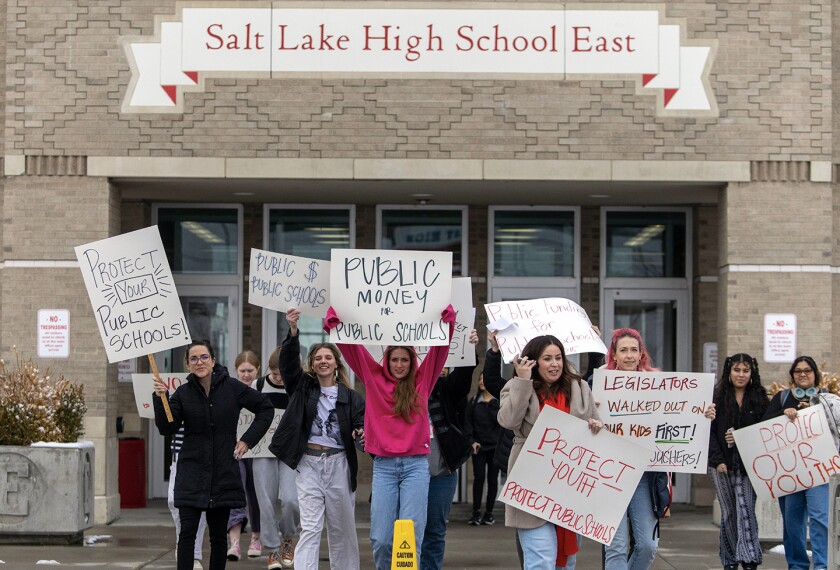
Students and teachers from East High School in Salt Lake City walk out of school to protest the HB15 voucher bill, on Wednesday, Jan. 25, 2023. Several years of pandemic restrictions and curriculum battles have emboldened longtime advocates of funneling public funds to private and religious schools in statehouses throughout the country.

Students and teachers from East High School in Salt Lake City walk out of school on Jan. 25, 2023, to protest legislation that would create private-school vouchers in the state. Several years of pandemic restrictions and curriculum battles have emboldened longtime advocates of funneling public funds to private and religious schools in statehouses throughout the country.

Rick Egan/The Salt Lake Tribune via AP

Stanford begins:

Emboldened by frustrations with pandemic-era policies and battles over what schools are teaching, conservative parents and politicians have accelerated a push for school choice policies that would funnel public funds into private schools.

Though school choice has been debated for decades, the movement is in a unique moment as advocates use parent concerns over COVID-era mask requirements; curriculum addressing race, gender, and sexuality; and library book content to bolster their argument that families should have more options outside of traditional public schools. And the school choice proposals states are considering—and, in some cases, have already passed—are more sweeping than previous iterations.

Already this year, lawmakers in at least 11 states—Idaho, Iowa, Kansas, Missouri, Nebraska, North Dakota, Oklahoma, South Carolina, Texas, Utah, and Virginia—have introduced and, in some cases, passed school choice bills. Although they vary in scope, many of the bills would establish or expand private school voucher and education savings account programs that give families public funds to pay for tuition at private schools, cover the costs of homeschooling, or pay for other schooling expenses.

The resurgence of school choice action shouldn’t come as a surprise. During the 2022 midterm election cycle, 19 Republican gubernatorial candidates advocated for school choice, mostly in the form of vouchers and education savings accounts, on campaign websites. This year, seven governors so far have talked about school choice policies in their state of the state addresses, according to the Education Commission of the States.

The policies are a result of parents’ declining satisfaction with schools following the pandemic, said Jonathan Butcher, an education policy analyst for the Heritage Foundation, a conservative think tank that advocates for school choice policies.