Archives for category: Racism

Katherine Stewart is an expert on Christian Nationalism who has researched its history, attends their conferences, and writes about their determination to destroy our freedoms. Read her recent book “The Power Worshippers.”

Her latest article in The New York Times reports on their recent dramatic gains.

She writes:

The shape of the Christian nationalist movement in the post-Roe future is coming into view, and it should terrify anyone concerned for the future of constitutional democracy.

The Supreme Court’s decision to rescind the reproductive rights that American women have enjoyed over the past half-century will not lead America’s homegrown religious authoritarians to retire from the culture wars and enjoy a sweet moment of triumph. On the contrary, movement leaders are already preparing for a new and more brutal phase of their assault on individual rights and democratic self-governance. Breaking American democracy isn’t an unintended side effect of Christian nationalism. It is the point of the project.

A good place to gauge the spirit and intentions of the movement that brought us the radical majority on the Supreme Court is the annual Road to Majority Policy Conference. At this year’s event, which took place last month in Nashville, three clear trends were in evidence. First, the rhetoric of violence among movement leaders appeared to have increased significantly from the already alarming levels I had observed in previous years. Second, the theology of dominionism — that is, the belief that “right-thinking” Christians have a biblically derived mandate to take control of all aspects of government and society — is now explicitly embraced. And third, the movement’s key strategists were giddy about the legal arsenal that the Supreme Court had laid at their feet as they anticipated the overturning of Roe v. Wade.

They intend to use that arsenal — together with additional weaponry collected in cases like Carson v. Makin, which requires state funding of religious schools if private, secular schools are also being funded; and Kennedy v. Bremerton School District, which licenses religious proselytizing by public school officials — to prosecute a war on individual rights, not merely in so-called red state legislatures but throughout the nation.

Although metaphors of battle are common enough in political gatherings, this year’s rhetoric appeared more violent, more graphic and more tightly focused on fellow Americans, rather than on geopolitical foes.

“The greatest danger to America is not our enemies from the outside, as powerful as they may be,” said former President Donald Trump, who delivered the keynote address at the event. “The greatest danger to America is the destruction of our nation from the people from within. And you know the people I’m talking about.”

Speakers at the conference vied to outdo one another in their denigration of the people that Mr. Trump was evidently talking about. Democrats, they said, are “evil,” “tyrannical” and “the enemy within,” engaged in “a war against the truth.”

“The backlash is coming,” warned Senator Rick Scott of Florida. “Just mount up and ride to the sounds of the guns, and they are all over this country. It is time to take this country back.”

Citing the fight against Nazi Germany during the Battle of the Bulge, Lt. Gov. Mark Robinson of North Carolina said, “We find ourselves in a pitched battle to literally save this nation.” Referencing a passage from Ephesians that Christian nationalists often use to signal their militancy, he added, “I don’t know about you, but I got my pack on, I got my boots on, I got my helmet on, I’ve got on the whole armor.”

It is not a stretch to link this rise in verbal aggression to the disinformation campaign to indoctrinate the Christian nationalist base in the lie that the 2020 election was stolen, along with what we’re learning from the Jan. 6 hearings. The movement is preparing “patriots” for the continuation of the assault on democracy in 2022 and 2024.

The intensification of verbal warfare is connected to shifts in the Christian nationalist movement’s messaging and outreach, which were very much in evidence at the Nashville conference. Seven Mountains Dominionism — the belief that “biblical” Christians should seek to dominate the seven key “mountains” or “molders” of American society, including the government — was once considered a fringe doctrine, even among representatives of the religious right. At last year’s Road to Majority conference, however, there was a breakout session devoted to the topic. This year, there were two sessions, and the once arcane language of the Seven Mountains creed was on multiple speakers’ lips.

The hunger for dominion that appears to motivate the leadership of the movement is the essential context for making sense of its strategy and intentions in the post-Roe world. The end of abortion rights is the beginning of a new and much more personal attack on individual rights.

And indeed it is personal. Much of the rhetoric on the right invokes visions of vigilante justice. This is about “good guys with guns” — or neighbors with good eavesdropping skills — heroically taking on the pernicious behavior of their fellow citizens. Among the principal battlefields will be the fallopian tubes and uteruses of women.

At a breakout session called “Life Is on the Line: What Does the Future of the Pro-Life Movement Look Like From Here?” Chelsey Youman, the Texas state director and national legislative adviser to Human Coalition Action, a Texas-based anti-abortion organization with a national strategic focus, described the connection between vigilantes and abortion rights.

Instead of the state regulating abortion providers, she explained, “You and me as citizens of Texas or this country or wherever we can pass this bill, can instead sue the abortion provider.” Mrs. Youman, as it happens, played a role in promoting the Texas law Senate Bill 8, which passed in May 2021 and allows private citizens to sue abortion providers and anyone who “aids or abets” an abortion. She was exultant over the likely passage of similar laws across the nation. “We have legislation ready to roll out for every single state you live in to protect life regardless of the Supreme Court, regardless of your circuit court.” To be sure, Christian nationalists are also pushing for a federal ban. But the struggle for the present will center on state-level enforcement mechanisms.

Movement leaders have also made it clear that the target of their ongoing offensive is not just in-state abortion providers, but what they call “abortion trafficking” — that is, women crossing state lines to access legal abortions, along with people who provide those women with services or support, like cars and taxis. Mrs. Youman hailed the development of a new “long-arm jurisdiction” bill that offers a mechanism for targeting out-of-state abortion providers. “It creates a wrongful death cause of action,” she said, “so we’re excited about that.”

The National Right to Life Committee’s model legislation for the post-Roe era includes broad criminal enforcement as well as civil enforcement mechanisms. “The model law also reaches well beyond the actual performance of an illegal abortion,” according to text on the organization’s website. It also includes “aiding or abetting an illegal abortion,” targeting people who provide “instructions over the telephone, the internet, or any other medium of communication.”

Mrs. Youman further made clear that Christian nationalists will target the pills used for medication abortions. “Our next big bill is going to make the Heartbeat Act look tame, you guys; they’re going to freak out!” she said. “It’s designed specifically to siphon off these illegal pills.”

Americans who stand outside the movement have consistently underestimated its radicalism. But this movement has been explicitly antidemocratic and anti-American for a long time.

It is also a mistake to imagine that Christian nationalism is a social movement arising from the grassroots and aiming to satisfy the real needs of its base. It isn’t. This is a leader-driven movement. The leaders set the agenda, and their main goals are power and access to public money. They aren’t serving the interests of their base; they are exploiting their base as a means of exploiting the rest of us.

Christian nationalism isn’t a route to the future. Its purpose is to hollow out democracy until nothing is left but a thin cover for rule by a supposedly right-thinking elite, bubble-wrapped in sanctimony and insulated from any real democratic check on its power.

This article in The Houston Chronicle is infuriating. The subtitle might well be, “If the state board turns you down, buy it.”

As I read it, I felt my blood was coming to a boil. This is a portrayal of tank corruption, corruption of education and corruption of the democratic process. The elected state board of education in Texas denied the charter application of four out of five charters. The charters struck back by dumping vast sums of money into the election for state board and electing hand-picked candidates to give them the approvals they wanted. As I have shown in previous posts, charter schools in Texas are generally low-performing and compare unfavorably to public schools,

The article begins:

The State Board of Education last month denied, for the third time, efforts to launch Heritage Classical Academy in Northwest Houston, a school designed as a conservative response to anti-racism, LGBT-inclusive sex education and other progressive themes in public schools.

But despite Heritage’s recent failure, its future — and that of other charter schools like it in Texas — looks bright.

The state’s fight over charter schools has bubbled slowly for decades since they were first authorized in the 1990s, with the state board standing as the main political roadblock to their expansion.

Now, as Republican lawmakers fight to restrict how teachers discuss social issues in the classroom and generally shift the education system more toward the right, their alliance with charter schools is stronger than ever.

A MOVEMENT: Trump-era rancor spills into Texas school board politics

So much so that three GOP members of the state board, who have sided with Democrats in voting against Heritage Classical Academy, won’t be therenext time — two were beaten in a primary after the family of Heritage’s board chairman donated $250,000 to a PAC supporting their opponents. The third was redistricted out of his seat by the Texas Senate.

Heritage, and other classical academies to come, can count on a more sympathetic board starting in January.

Matt Robinson, the Republican who lost his seat in redistricting — he says he had decided before then not to run for re-election anyway — called his ouster a testament to the power charter school advocates wield.

“There’s a whole pattern here of them really strongly exerting the influence that they have with our elected officials,” he said.

LIBRARY BACKLASH: Texas GOP’s book hunt mostly targets LGBT issues, not critical race theory

The pitch for classical education

Heritage is part of the Barney Charter School initiative, a national charter school movement to introduce a more conservative ideology in schools. The initiative was founded by Hillsdale College in Michigan.

The college doesn’t fund or govern schools directly, but provides curriculum and consulting. Dozens of schools have been started so far across the nation, including one in Gardendale, Texas. The schools serve nearly 15,000 students and 8,000 more on wait-lists.

Its “1776 Curriculum” for charter schools teaches that “America is an exceptionally good country” and includes comprehensive lessons about American history through a conservative lens, including descriptions of the New Deal as bad public policy and of affirmative action as “counter to the lofty ideals of the Founders.”

The wife of conservative Supreme Court Justice Clarence Thomas, Ginni Thomas — who reportedly lobbied to overturn the 2020 presidential election — is a former vice president at the college and ran its Washington programs.

Hillsdale is a nonsectarian Christian university with a mostly white student body that touts its role in the abolition movement of the 1800s, when Black activist Frederick Douglass spoke at the campus.

‘CRITICAL RACE THEORY’ IN SCHOOLS: Abbott signs law forbidding lessons on systemic racism

Across the country, only one Hillsdale-backed charter school serves a majority of economically disadvantaged students, and only two serve a majority of students of color, according to staff at the State Board of Education.

Heritage Classical Academy was voted down for the first time in 2020 by the board, several members said, because of the inclusion of “Brer Rabbit” books in its early grade curricula. The 19th century children’s story has been assailed by critics for promoting racist stereotypes and mimicking dialect used by African-American slaves.

The arguments for and against Heritage over the last few years have added up to more than the sum of their parts. When the board discussed it last month, conversations turned to how racism and slavery are taught, “inappropriate content in public schools,” alleged anti-Islamic Facebook posts made by a Heritage board member, the work experience of the proposed school leadership and more.

Aggressive lobbying from the Heritage board and its supporters also appears to have backfired, becoming a factor in the board’s decision this year to reject the charter.

After the board denied approval for the second time in 2021, Heritage Board Chair Stuart Saunders and his family donated more than $250,000 to a political action committee called Texans for Educational Freedom. That PAC then donate more than $500,000 to local school board races and other candidates who have promoted conservative themes in the schools.

The group donated in four State Board of Education races, including well over $100,000 total in the bids to unseat board members Sue Melton Malone and Jay Johnson, Republicans who opposed Heritage.

In their charter application filed with Texas Education Agency, Heritage reported 17 meetings with public officials ahead of the board’s decision last month, including a July 2021 meeting with TEA Commissioner Mike Morath and state Rep. Steve Toth, who penned the Legislature’s anti-critical race theory law. Signed a year ago by Gov. Greg Abbott, the law limits how public school teachers address systemic racism and the lingering impacts of slavery.

When it convenes in next year after this fall’s elections, the state board will be a more conservative body, with six new members.

“Clearly, (Saunders) was trying to use all his money to remake the SBOE, to buy it,” said Robinson, the board member from Friendswood who is losing his seat in redistricting. “When you really upset wealthy peoplethey don’t take that lightly.”

During an SBOE meeting, Robinson confronted Saunders — who is the chairman of SouthTrust Bank — saying that while Saunders’ donations were legal, they were unethical.

Saunders retorted: “Me and my family have a long history of supporting education initiatives. Part of our involvement includes a history of supporting public policy and education initiatives, and I did give some of my money to a PAC that is involved in education. Their website speaks of wanting to depoliticize the classroom, working to create strong local school boards and to root-out and eliminate sexually explicit materials that have found their way into our schools. And I support those initiatives.”

He said his son was assigned two “inappropriate” books in class, and though he confronted the school’s principal about them, only one of the books was removed from the curriculum.

Texas Ethics Commission records show that the PAC Saunders spoke of donated to SBOE races both before and after he and his family contributed money.

18,000 Texas students in classical schools

Over the last decade, the State Board of Education has generally been a chokepoint to charter school expansion. The board is given final veto power over charter applicants after they are approved by the TEA commissioner. Since 2017, TEA approved 35 schools, but the SBOE only allowed 23 to proceed.

Those who oppose charter schools typically do so because they say it weakens the structure of public education. Charter schools face less accountability than public schools, and when students flee struggling public schools for charters, the school districts lose out on the attendance-based funding they would have received from the state if the child was still a student.

“The idea of 95 percent of kids losing funding and programming and opportunities so that 5 percent can attend a private-light-school and parents aren’t paying a private school bill is just asinine to me,” said state board member Georgina Pérez, a Democrat who votes against all charter applicants.

The Republican-controlled Legislature has been pushing in the opposite direction. The last major change Republicans in Austin made to charter school law was removing the state board’s ability to approve expansions of existing charter schools, in 2013 paving the way for hundreds of new campuses. Charter enrollment has nearly doubled since, to 377,375 students (the state’s K-12 schools serve about 5 million children).

The total number of charter campuses has risen from 588 to 872.

“I always compare charter schools and how they expand to Gremlins if they eat after midnight. Tomorrow morning you’re going to wake up and you don’t know how many of them you’re going to have,” Pérez said.

There’s also an appetite particularly for “Classical” schools such as Heritage, of which there are already a number in Texas, including Aristoi Classical in Katy, the Great Hearts Texas schools, Founders Classical and Houston Classical. Their combined enrollment for the 2016-2017 school year was less than 7,500, and has more than doubled to 18,000, state data shows.

Charter school supporters and several members of the SBOE, they said they expect that another bill will be filed next year with renewed efforts to remove the state board’s authority to approve the schools, leaving the matter up to Education Commissioner Mike Morath, an appointee of Gov. Greg Abbott.

Some members of the state board added that Abbott lobbied their colleagues directly, asking them to approve Heritage’s application and other charter schools over the years.

“Historically it was, (the SBOE wasn’t) approving expansions fast enough, or enough, to keep pace with demand,” said Starlee Coleman, CEO of the Texas Charter Schools Association. “I would not be surprised one bit if a move were made to roll back the board’s authority, even farther.”

Charter school proponents point to a charter school wait-list in the state of more than 58,000 kids. They say families want more options and that public schools aren’t working for everyone. They point to data that show the large majority of charter students are children of color, and that their test scores are better than the public school averages.

“The statute is really clear about legislative intent is that there will be a robust and vibrant charter sector in Texas,” Coleman said. “if the state board can’t agree with that, then I don’t think state legislators feel very compelled to let them continue to be part of the process.”

edward.mckinley@chron.com

ProPublica wrote about a campaign to destroy the reputation of a black educator and their pursuit of her to another district. The white agitators accused her of being an advocate of “critical race theory,” but she didn’t know what it was. That didn’t deter the vigilantes.

In April of 2021, Cecelia Lewis had just returned to Maryland from a house-hunting trip in Georgia when she received the first red flag about her new job.

The trip itself had gone well. Lewis and her husband had settled on a rental home in Woodstock, a small city with a charming downtown and a regular presence on best places to live lists. It was a short drive to her soon-to-be office at the Cherokee County School District and less than a half hour to her husband’s new corporate assignment. While the north Georgia county was new to the couple, the Atlanta area was not. They’d visited several times in recent years to see their son, who attended Georgia Tech.

Lewis, a middle school principal, initially applied for a position that would bring her closer to the classroom as a coach for teachers. But district leaders were so impressed by her interview that they encouraged her to apply instead for a new opening they’d created: their first administrator focused on diversity, equity and inclusion initiatives…

At first, the scope of the role gave Lewis pause. In her current district, these responsibilities were split among several people, and she’d never held a position dedicated to anything as specific as that before. But she had served on the District Equity Leadership Team in her Maryland county and felt prepared for this new challenge. She believed the job would allow her, as she put it, to analyze the district’s “systemic and instructional practices” in order to better support “the whole child.”

“We’re so excited to add Cecelia to the CCSD family,” Superintendent Brian Hightower said in the district’s March 2021 announcement about all of its new hires. (The announcement noted that the creation of the DEI administrator role “stems from input from parents, employees and students of color who are serving on Dr. Hightower’s ad hoc committees formed this school year to focus on the topic.”) Hightower acknowledged “both her impressive credentials and enthusiasm for the role” and pointed out that, “In four days, she had a DEI action plan for us.”

But then a group of white parents decided that Lewis planned to bring “critical race theory” to their district. And they decided to hound her out of her job and out of Georgia.

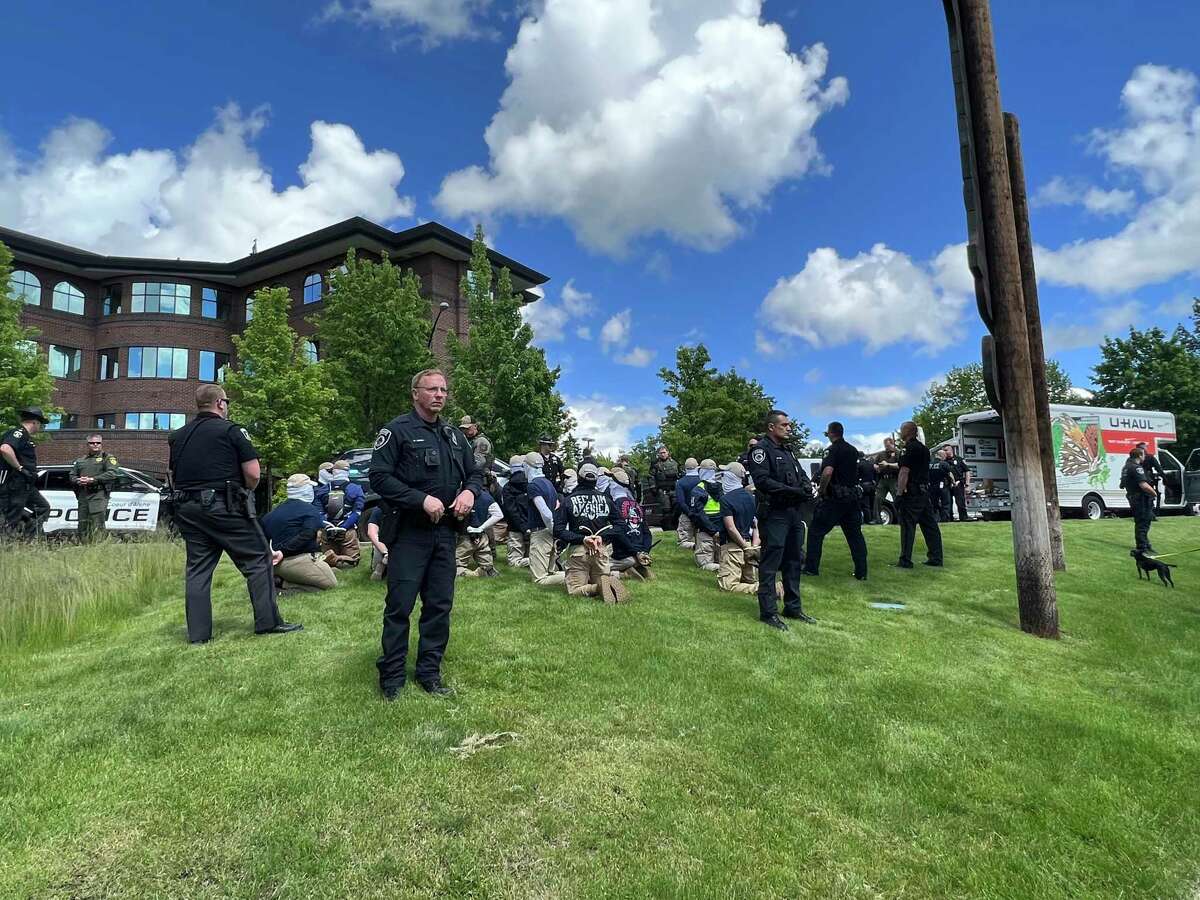
This is a strange yet unsurprising story. A truck filled with 31 individuals was stopped in Idaho. The 31 were on their way to disrupt a gay pride parade in Idaho. The men arrested came from different states. I saw the article in the Houston Chronicle but it was widely reported. When I read it before, I decided not to post it. But then I realized it has a larger significance, as it signifies the normalization of extremism, that is, extremists who wear uniforms and show their faces instead of lurking in the shadows and muttering to themselves.

Why was this group converging on gays in Idaho, not in a city in their own states? I’m guessing that they expected little resistance in a deeply conservative state. If they had rioted in a big city like Houston, Chicago, Miami, or Los Angeles, the crowd would have far outnumbered them and resisted. That’s my guess. What is truly alarming, aside from the fact that this riot was planned and might have turned violent, is that extremist groups like this are showing their faces. The emergence of QAnon, Proud Boys, Oath Keepers and other extremists as allies of one of the nation’s two dominant political parties has encouraged open violence against marginalized groups. Will we soon see open KKK marches—oh, wait, we saw that in Charlottesville in 2017, with the torches but not the hoods. Trumpism—aka, white supremacy—used to be hidden under a rock. No more. Thank God they were arrested. In Idaho.

Authorities arrest members of the white supremacist group Patriot Front near an Idaho pride event Saturday, June 11, 2022, after they were found packed into the back of a U-Haul truck with riot gear. 
Authorities arrest members of the white supremacist group Patriot Front near an Idaho pride event Saturday, June 11, 2022, after they were found packed into the back of a U-Haul truck with riot gear. Georji Brown/Associated Press

Texas residents were among 31 individuals affiliated with a white nationalist group arrested Saturday in Idaho on suspicion of conspiracy to riot after police there found them packed in a U-Haul truck apparently heading to a Pride celebration with riot gear and at least one smoke grenade, authorities said.

It was not clear by Saturday night how many of the individuals detained in Coeur d’Alene, a city in north Idaho about 33 miles east of Spokane, were from Texas or what part of the state they reside in. The others arrested, who were still being booked Saturday, were residents of Utah, Idaho, Colorado, South Dakota, Illinois, Arkansas, Wyoming, Washington, Oregon and Virginia, the city’s police Chief Lee White said.

A person called authorities around 1:38 p.m. after seeing some 20 people jump into a truck wearing masks and carrying shields, looking “like a little Army.” Police stopped the truck about 10 minutes later and arrested the 31 individuals, who appear to be affiliated with the group Patriot Front, White said, citing logos on their hats, similar outfits, insignia and at least one patch that said Patriot Front.

The Southern Poverty Law Center describes the group as a white nationalist hate group.

Colbert I. King, a columnist for the Washington Post, wrote recently about the acknowledgement by various institutions about their role in perpetuating slavery. Harvard University was the most recent example. King says that not enough attention has been paid to the sexual exploitation of slave women. As we reflect on the current Republican obsession with banning teaching about racism and accusing teachers of pedophilia, think of the following story. Who were the most dangerous pedophiles in American history?

King writes:

This soul-searching may well help the nation come to terms with its past. But an examination of racist cruelty in 18th and 19th-century America cannot stop with the failings of public and private institutions.

No probe into the corrosive effects of racial bondage can be complete without coming to grips with, besides slavery itself, the single most heinous crime against humanity committed in the annals of U.S. history: the centuries-long sexual exploitation and subjugation of Black women and girls….

How many black women and girls were sexually exploited?

The 1860 federal census provides a clue. In Southern or slaveholding states, and in Northern states respectively, 518,360 and 69,885 people were classified as “mulattoes.”

Then King refers to a relationship that was revealed almost a decade ago. I did not read about it then.

A 22-year-old White South Carolinian who impregnated a 16-year-old Black maid in his father’s house also comes to mind. He, Strom Thurmond, avowed segregationist, Dixiecrat presidential candidate and staunch opponent of civil rights legislation, went to his grave without saying a word about what he did to that teenager. As did hundreds if not thousands of White men before him.

King links to an article that tells the story of Thurmond’s never-acknowledged black daughter. It was written by journalist Mary C. Curtis and published in the Washington Post in 2013.

Essie Mae Washington-Williams lived for 87 years. But, in her own words, she was never “completely free” until she could stand before the world and say out loud that Strom Thurmond, the one-time segregationist South Carolina senator, was her father. That was in 2003, after she had spent more than 70 years being denied what we all deserve – her true name and birthright. “In a way, my life began at 78, at least my life as who I really was,” Washington-Williams wrote in her life story. She has died.

Thurmond’s oldest child — born when he was a 22-year-old man and her mother, Carrie Butler, a 16-year-old black maid in his father’s house – had kept the senator’s secret, an open one rumored about but never revealed when he was alive because, she had said, “He trusted me, and I respected him.” As in the case of Thomas Jefferson, another successful southern politician who was father to black children, stories shared among African Americans were long disbelieved until they turned out to be true….

She remained silent even as he did his best to block civil rights legislation and uphold white supremacy. She and her mother occasionally visited Thurmond’s law office. He sometimes gave her money. But he never gave her his name.

In 2003, she could finally stop holding her breath and tell her truth. The Thurmond family didn’t dispute her, and her name was added to the list of children on a monument for the senator on the grounds of the South Carolina state house, joining the Confederate flag, a monument to the contributions of African Americans and statues honoring segregationists who did their worst but could not stop Washington-Williams from achieving.

Wanda Bailey, Washington-Williams’ daughter, said in The State newspaper that her mother was an inspiration. “She was there for us,” Bailey said. “She was a very giving person. She did everything she could not only for her children, but her grandchildren and great-grandchildren.”

In that, she proved a better person than the man who spent his own life denying her. I wonder if she was smiling a few years ago when she said she would become a member of the United Daughters of the Confederacy through Thurmond’s ancestral lines.

Facing internal conflicts most could only imagine, she became a mother, wife, teacher, and a daughter that Strom Thurmond or any father could be proud of.

South Carolina journalist Marilyn Thompson was credited with breaking the story of Strom Thurmond’s biracial daughter.

The gubernatorial election is approaching in Maine, and to everyone’s surprise, former Governor Paul LePage is running again.

LePage was an enthusiastic member of the Tea Party. He called himself “Trump before Trump.” He insulted immigrants, gays, anyone other that straight white people. He took his cues on education from Jeb Bush.

He was a xenophobic disaster. Keep your eye on Maine.

Neil Meyer, a native of Uvalde who now lives in Bethesda, Maryland, says he was not surprised by the massacre there. He explained why in the Washington Post.

I was born in Uvalde, Tex., lived there recently and love its complex history and people. Like most, I’ve been struggling under the weight of grief to understand the violence that left 19 children, two teachers and a young killer dead last week. But I’m not surprised.


First, you would be challenged to find a more heavily armed place in the United States than Uvalde. It’s a town where the love of guns overwhelms any notion of common-sense regulations, and the minority White ruling class places its right-wing Republican ideology above the safety of its most vulnerable citizens — its impoverished and its children, most of whom are Hispanic.

Second, at news of the shooting, I was struck to hear the words “Robb Elementary” because I knew of its centrality to the struggle in Uvalde over the past half-century to desegregate its schools. Robb sits in the city’s southwest quadrant. So I knew the victims of the shooting would largely be Hispanic. They have been locked into that school for decades.
In Uvalde, simply put, everything north of Highway 90 is primarily White Republican, and everything south is mostly Hispanic Democrat. The city has about 15,000 residents; more than 80 percent identify as Hispanic or Latino.


Most of Uvalde’s political leadership and the heads of the largest employers are White. At the center of town on the courthouse grounds, you’ll find a monument to Jefferson Davis, the Confederate president — installed when the Ku Klux Klan dominated Uvalde politics. (Some of us tried to get the monument removed after the murder of George Floyd, but that’s a story for another day.)

I am tired of rightwing politicians distorting our language to suit their bigoted ideology.

They have the nerve, for example, to quote Dr. Martin Luther King Jr. when he spoke at the March on Washington in 1963 and said he hoped for the day when his children would be judged by the content of their character, not the color of their skin. Dr. King was projecting a vision of a world without racism, when people would see each other as friends, neighbors, and fellow human beings.

But rightwing politicians twist his words to insist that we should ignore racism right now, stop teaching about it, and pretend it does not exist. They use his words to justify prohibitions on teaching about or discussing the racism in the here and now. They use his appeal for an unrealized future to blind us to a cruel present.

I propose that we make a conscientious effort to reclaim the plain meaning of words.

One of the hot-button words that has been appropriated by rightwing politicians is “woke.” They are trying to turn it into a shameful word. I looked up the definition of WOKE. It means being aware of injustice and inequality, specifically when referring to racism. I strive to be aware of injustice and inequality and racial discrimination and to do whatever I can to change things for the better. Shouldn’t we all do that?

My acronym for WOKE is “Wide Open to Knowledge and Enlightenment.”

What would you say about someone who is not WOKE? They are “asleep,” “unconscious,” “indifferent.” They are “Mind Closed, Mouth Open.”

Yes, I am WOKE. I want Dr. King’s dream someday to be true. It is not true now.

Governor Ron DeSantis of Florida believes it is terrible to be woke. He demeans those he says are woke. He claims that the woke are politically correct and are intimidated by organized efforts to reduce racism in schools and the workplace. He thinks that being woke is so dreadful that it must be made illegal.

He urged the Florida legislature to pass “anti-woke” legislation in March. And they did. The so-called STOP WOKE” Act means “Stop the Wrongs to Our Kids and Employees Act.”

This legislation is intended specifically to silence discussions and study of racism. It bans the teaching of critical race theory in schools and colleges and bans diversity training in the workplace.

Governor DeSantis doesn’t want people to be opposed to injustice and inequality. He doesn’t want them to be opposed to racism. Such awareness makes some people feel uncomfortable, he says. We should teach nothing that makes anyone uncomfortable.

Who is uncomfortable when racism is discussed? In my experience, the people who don’t want any discussion of racism are either racist or are embarrassed by their acts of racism in the past.

To protect the tender sensibilities of white people, we must avoid any discussion that makes them or their children uncomfortable. We must not take the risk that they or their children might feel uncomfortable for terrible things that happened long ago. So don’t talk about them. Don’t read books that discuss slavery, the Ku Klux Klan, lynchings, or segregation. Don’t mention the distant past or the wrongs of the present. Don’t dare to talk about discrimination against black people, or the passage of laws that impair their right to vote, or the persistence of racially segregated schools.

Not only is it wrong to be woke, in the eyes of those who prefer to stifle all recognition of racial discrimination, it is absolutely forbidden for teachers or professors to examine the causes of racism and its persistence today in our laws and policies. Making a conscientious effort to understand the causes of racism and to seek remedies is called “critical race theory” (CRT).

The attacks on critical race theory are intended to intimidate teachers and to prevent students from learning about racism, past or present.

In states that have banned the teaching of critical race theory, the legislators can’t define CRT, so they make it illegal to teach “divisive concepts” or anything that makes some students “uncomfortable.”

When a white supremacist massacred ten Black people in Buffalo, New York, teachers in anti-CRT states were not sure if they were allowed to teach about what happened. Would they lose their jobs if they taught the truth?

The states that prohibit the teaching of critical race theory are banning the teaching of honest history, for fear that someone might be uncomfortable when they learn the facts about what was done to Black people in our history. Some states have explicitly banned Nikole Hannah-Jones’ “The 1619 Project,” because it might make some white people uncomfortable. I may be wrong, but I can’t recall a state that ever passed a law censoring a single book. This book is obviously very powerful and very frightening to those who feel the need to ban it. It cannot be refuted by the DeSantis faction so it must be banned.

The same states that want to ban honest teaching about racism are also banning books about gender identity and sexuality. The legislatures in Republican states think that the schools are filled with pedophiles. The rightwing zealots claim that teachers are “grooming” their students to become gay or transgender. They pass laws like Florida’s “Don’t Say Gay” law, which bans teaching about gender identity and sexuality in grades K-3 (where gender identity and sexuality are not taught) and tolerate only “age-appropriate” discussion of gender identity and sexuality in other grades.

Like the STOP WOKE law, the “Don’t Say Gay” law is vague, which makes teachers fearful of teaching anything related to gender or sexuality. If schools can’t teach about gender identity, then they cannot teach about married couples of any gender. If you take them literally, you should not refer to Moms and Dads, men and women. Dare we teach young children about heterosexuality? Apparently not, if you follow the letter of the law.

The groups that are behind these attacks are familiar to us. They are Moms for Liberty, Moms for America, Parents Defending Freedom, and a bevy of other groups funded by rightwing billionaires.

Not coincidentally, these are the same groups that are fighting to pass funding for charter schools and vouchers.

What is their motive? They want to destroy not only freedom of thought but public schools.

Recently, I watched the far-right provocateur Chris Rufo give a speech at Hillsdale College. He called on his audience to act in a speech titled “Laying Siege to the Institutions.” (Please watch it: https://www.youtube.com/watch?v=W8Hh0GqoJcE). Rufo claims credit for making CRT a national issue. He boasts that a few years ago, CRT had virtually no public recognition. Thanks to his lies and distortions, most people have heard of it and some think it is a radical, Marxist plot to destroy America by turning race against race. Because he says so.

This is absurd.

For the past four decades, CRT was known as a law school study of the origins of systemic racism and the extent to which it is embedded in our laws and institutions. Its founder was Derrick Bell of Harvard Law School. He was a friend of mine. He was not a Marxist or a radical. He was a great American who wanted America to live up to its promises. Unlike Rufo, he didn’t believe in gag orders and bans. He believed in study, scholarship, debate and discussion.

Chris Rufo offers one solution to all the problems he sees: school choice.

To him, the public school is the most dangerous of all institutions, because it teaches equality, justice, and critical thinking. It teaches students to respect others. It teaches them to abhor racism and other forms of bigotry. It teaches students about American history without censoring the unpleasant and horrifying parts. The laws passed to ban CRT and to gag teachers have one purpose: Teach lies, not honest history.

Here is what I suggest.

Fight censorship.

Fight privatization of our public assets.

Read without fear.

Read “The 1619 Project,” which will open your minds. Read critiques of “The 1619 Project” by reputable scholars, not by rightwing ideologues.

Think about it. Discuss and debate the issues.

Say gay.

Stand up to the craven politicians who attack your freedoms.

Vote against them when you have the chance.

Fearlessly defend the freedom to read, the freedom to teach, and the freedom to learn.

Work towards the day when we treat each other with respect.

Wake up.

Robert Hubbell is a blogger who writes consistently insightful, common sense commentaries. In this one, he makes an important point. What happened to outrage?

I recall when presidential candidate Senator Gary Hart of Colorado dropped out of the race after the press got photos of him on a boat with a woman who was not his wife. Imagine that! I remember when a president (Nixon) was forced to resign his office because he lied about his role in burgling the offices of the Democratic National Committee. At least official Washington had public standards of behavior. Republican Senator Howard Baker of Tennessee was as appalled by Nixon’s behavior as members of the other party. Yet Lamar Alexander, who claimed Baker as his role model, twice refused to vote to impeach Trump for violating his oath of office and for actions far more dangerous than anything Nixon did, even though Alexander was retiring.

Hubbell wrote this before the Uvalde school massacre. Watch the process: Americans are outraged. The media are outraged. What happens next? Our attention shifts. Uvalde fades, as Sandy Hook faded, as Parkland faded, as Buffalo will fade.

The capacity for outrage—in the political class, in the media, and in the public— seems to have vanished.

Hubbell writes:

“The apparent death of outrage is one factor driving many Americans to distraction, if not despair. Stories that would have shaken the foundations of democracy a decade ago barely reverberate for a single news cycle today. Quick! Answer this question: What was the biggest story of last Friday (as in two days ago)? It is that the wife of a sitting Supreme Court justice actively encouraged Arizona legislators to overthrow the Constitution by appointing fraudulent electors. The January 6th Committee previously discovered that Ginni Thomas forwarded emails from other election deniers to members of the Trump administration, but the most recent revelation clarifies that Ginni Thomas was a direct participant in the plot to subvert democracy. But by Sunday evening, the story has dropped from the pages of every major newspaper in America.

And, of course, Justice Clarence Thomas reviewed Mark Meadows’ request to block the disclosure of emails and texts from Ginni Thomas about the attempted coup. Before the endless stream of Trump scandals killed outrage, those facts would have prompted Justice Thomas to submit his resignation and spend the remainder of his life in solitude and shame. Instead, Thomas is on a revenge tour at the Antonin Scalia School of Law, where he is scolding women for protesting an impending decision that will grant state governments control over their reproductive choices.

Over the weekend, Senator Rick Scott couldn’t find the decency to say that leaders of the GOP should condemn white supremacy. Talking Points Memo, Scott Deflects On Whether GOPers Should Condemn White Nationalism. Scott agreed that racism was bad and that “all Americans” should condemn “any hate” and “any white supremacy,” but repeatedly dodged the question of whether Republican leaders had a responsibility to do so. Instead, he volunteered that “We have to stop asking people on government forms for their skin color” and “every Senate candidate on both sides is going to decide what is important to them”—evasions that leave room for his Republican colleagues to wink-and-nod to white supremacists on the campaign trail.

Also over the weekend, the Conservative Political Action Conference (CPAC) held its annual meeting in Hungary so that Hungarian Prime Minister Viktor Orbán could lecture aspiring American autocrats on how to subvert “illiberal democracy.” The panel of speakers included Trump, Tucker Carlson, and a Hungarian journalist infamous for writing that Jews are stinking excrement,” that Roma are “animals,” and that Black people are [unprintable]. See Times of Israel, Hungarian journalist who called Jews’ stinking excrement’ addresses CPAC conference. Do either Trump or Carlson feel any need to distance themselves from the reprehensible views of their co-presenter? Ha! It was not worth the electrons to type that rhetorical question on my laptop.

On Friday of last week, Louisiana Senator Bill Cassidy attempted to explain away the high maternal mortality rates in his state. Cassidy made the following repugnant statement:

About a third of our population is African American; African Americans have a higher incidence of maternal mortality. So, if you correct our population for race, we’re not as much of an outlier as it’d otherwise appear.

See Business Insider, Maternal death rate isn’t as bad if you don’t count Black women, GOP senator says. Cassidy’s statements were so offensive it is difficult to know where to begin. To be clear, Louisiana’s maternal death rate among Black women is worse than the maternal death rate for Black women in other states, so Cassidy’s racist statistics are wrong. But what does Cassidy mean, “if you correct our population for race?” By “correcting” for race, Cassidy clearly implies that the “correct” race in Louisiana is white. But Cassidy’s comments have been largely ignored by the mainstream media.

And then there is Dr. Oz, who went out of his way on election night thank Fox News personality Sean Hannity for helping his campaign. That would be the same Sean Hannity who was busy trashing one of Dr. Oz’s opponents in the primary (the late-surging Kathy Barnette) as Hannity acting as a a “behind the scenes advisor” to Oz. See Dan Rather and Elliot Kirschner in Steady, Crossing the Line. Rather and Kirschner write that Fox News “is a functional arm of the Party of Trump.” Does anyone care? As Rather astutely observes,

Needless to say, if a reporter at a news organization other than Fox supported a candidate with half as much complicity as Hannity did Dr. Oz, it would be grounds for immediate termination. Not surprisingly, at Fox News, Hannity’s actions don’t even earn a slap on the wrist.

And therein lies the problem: The capacity for outrage is becoming a one-way street. Hannity can break all rules of journalistic independence, and no one cares. Senator Cassidy can suggest that Blacks are not part of Louisiana’s “correct” race, and no major mainstream sources bother to report on the comments. The wife of a Supreme Court justice can encourage insurrection, and the justice goes on the attack against “liberals.” But . . . If any of those situations were reversed such that a liberal journalist, Democratic Senator, or liberal justice was involved, the outrage from the right would be unending, unforgiving, and shrill.

We must not lose our capacity for outrage. We cannot allow insurrection to be normalized. We cannot allow the sheer volume and velocity of GOP scandals to overwhelm and exhaust us. Indeed, we must recognize that conservatives try to turn outrage to their benefit by making more of it—to provoke “outrage fatigue.”

The wife of a supreme court justice participated in an attempted coup. That fact is outrageous and should matter to every American and should remain on the front pages of every newspaper in America until the justice resigns or recuses himself from all election-related cases.

More one-sided reporting in WaPo.

The Washington Post is running a story in its Monday edition, Democrats See Headwinds in Georgia, and Everywhere Else. The subheader says that Democratic candidates will “be running against President Biden’s low ratings as well as their G.O.P. rivals.” The article accurately reports on the challenges facing Democrats but does not acknowledge that Republicans are led by a twice-impeached failed coup-plotter who insists on absolute allegiance to a disproven conspiracy theory and has led the effort to deny women the right to control their reproductive choices.

About two-thirds of the way through the story, the author makes a nod to the difficulties faced by the GOP—but only by describing comments from a Republican voter:

[Democrats] need to do more to communicate clearly with voters that they are a steady hand at the wheel of getting the economy back on track for people.” Ms. Bourdeaux said. But she, too, saw a chance to draw a sharp contrast with what she described as ascendant far-right Republicans. “The other side, candidly, has lost its mind,” she said, pointing to efforts to restrict voting rights and abortion rights.

Hmm . . . if a Democratic voter had said that the Democratic Party “has lost its mind,” that would be the headline in the article. Oh, and here is the clincher: The author concedes near the end of the article that “Most polling shows a close race for [Georgia] governor and Senate, with a slight Republican advantage.”

Got that? The races for Governor and Senator in Georgia are “close,” but the story focuses on “headwinds” faced by Democrats because of the economy and Biden, with almost no mention of the challenges for the GOP created by an out-of-control Trump, reversal of Roe v. Wade, and unrestrained concealed carry of handguns by June.

More accurate headlines for the article could include, “One reporter’s attempt to trash the Democrats by rehashing the economy and Biden’s favorability ratings” or “According to one Republican voter, ‘The GOP has lost its mind.’” I will let you choose your favorite headline or suggest alternatives in the Comments section or by reply email to me.

Concluding Thoughts.

There is an old joke that goes like this: “I just flew into Las Vegas and, boy, are my arms tired.” My wife and I just spent forty-eight hours taking care of one granddaughter while simultaneously pinch-hitting with a second granddaughter for eight hours on Saturday, and boy, are my arms tired! It was tough writing the newsletter tonight because I could not get the words of the literary classic Good Dog Carl Visits the Zoo out of my mind. (Reading a book out-loud dozens of times over the course of forty-eight hours will do that to you.) A sign of my desperation is that I was delighted to take a mental break by watching The Little Mermaid after failed multiple failed attempts to get our granddaughter to take a nap. Let me say that The Little Mermaid is an underappreciated classic that deserves a place alongside The Godfather and Citizen Kane (at least that’s how I feel tonight).

In lieu of my own closing thoughts (which are often the most challenging part of the newsletter to write), I include a list of Democratic candidates to support, supplied by Ellie Kona. Many of you may know Ellie as a frequent commenter on Heather Cox Richardson’s newsletter on Substack, Letters from an American. Per Ellie, “Here is a handy-dandy list of Dems to support, along with their Twitter handles (courtesy of Nick Knudsen):

PA Gov: @JoshShapiroPA

PA Sen: @JohnFetterman

PA Lt Gov: @AustinDavisPA

NC Sen: @CheriBeasleyNC

NC-01: @DonDavisNC

NC-13: @wileynickel

OR Gov: @TinaKotek

OR-04: @ValHoyle

OR-06: @AndreaRSalinas

Provided by NickKnudsen at DemCast

For many years, I have been interested in the history of the Soviet Union. I found it fascinating to read about the origins of the Russian Revolution and the development of a totalitarian state, in which all freedoms were ruthlessly stamped out, and fascinating to read about the creation of a vast propaganda machine that fooled so many gullible people in the West. I read the works of dissidents like Andrei Sakharov and poets whose works were banned. I was always curious about the “cult of personality” that enabled one man to rule a vast territory with his whims. Stalin ruled as a cruel tyrant, yet millions of innocents idolized him. Why do people obey a Stalin or Hitler? How do they manage to get unlimited power? Why do people admire Trump, who is obviously a liar and a blowhard who cares about no one but himself?

In the 1980s, I read many books about American support for the USSR and the debates about Whittaker Chambers and Alger Hiss. I even attended a rowdy debate at Town Hall in New York City between supporters of the Rosenbergs (Julius and Ethel) and their critics. I suppose I became fascinated because of having worked at The New Leader, a small democratic socialist magazine in New York City that was founded by Mensheviks, where the debates were endless, and where I encountered not only Mensheviks, Trotskyists, Schachtmanites, Cannonites, Lovestoneites, and other schismatic groups. I also learned that Al Shanker’s secretary Yetta was married to Max Schachtman, one of the leaders of a dissident leftist group. I was only 22, and it was my first job after graduating from college. Office chatter at The New Leader introduced me to a world that I had never known existed as a kid growing up in Houston, not even in college at Wellesley in Massachusetts. At one point, I was asked to pick up an article at the apartment of Boris Nicolaevsky on the Upper West Side of Manhattan. I went to the building, then to his apartment, and when I rang the bell, the door opened slightly, behind a privacy chain. I barely caught a glimpse of his face. He quickly slipped the typewritten pages to me and closed the door. I did not know anything about him. Thanks to Wikipedia, I discovered his history. He was a historic figure, but no one told me.

This article, about the disapppearance of a black man in Russia, is one of the best I have read in recent years. It was written by Joshua Yaffa and published in The New Yorker. It is long, but well worth reading.

In the spring of 1936, Lovett Fort-Whiteman, an African American man from Dallas, Texas, vanished in Moscow. He had lived in the Soviet Union for nearly a decade, most recently with his wife, Marina, a Russian Jewish chemist, in a cramped apartment around the corner from the Central Telegraph building. By then, a half-dozen African Americans had settled in Moscow permanently. Even among them, Fort-Whiteman, who was forty-six, was a striking sight. He wore knee-high boots, a black leather cap, and a belted long shirt in the style of Bolshevik commissars. Homer Smith, a Black journalist from Minneapolis and Fort-Whiteman’s close friend in Moscow, later wrote, “He had adopted the practice of many Russian Communists of shaving his head, and with his finely chiseled nose set into a V-shaped face he resembled a Buddhist monk.”

Nearly two decades had passed since the Bolshevik Revolution established the world’s first Communist state, a society that promised equality and dignity for workers and peasants. In the Soviet Union, racial prejudice was considered the result of capitalistic exploitation, and, for the Kremlin, countering racism became a question of geopolitical P.R. Throughout the nineteen-twenties and thirties, dozens of Black activists and intellectuals passed through Moscow. Wherever they went, Russians would give up their place in line, or their seat on a train—a practice that an N.A.A.C.P. leader called an “almost embarrassing courtesy.” In 1931, after the so-called Scottsboro Boys—nine Black teen-agers falsely accused of raping two white women in Alabama—were put on trial, the American Communist Party provided pro-bono legal defense, and rallies in their support were held in dozens of cities across the Soviet Union. Two years later, Paul Robeson, the singer, actor, and activist, visited Moscow and remarked, “Here, for the first time in my life, I walk in full human dignity.”

Homer Smith eventually published a memoir, “Black Man in Red Russia,” in which he described Fort-Whiteman as one of the “early Negro pilgrims who journeyed to Moscow to worship at the ‘Kaaba’ of Communism.” Fort-Whiteman, Smith went on, was a “dyed-in-the-wool Communist dogmatist” who once said that returning to Moscow after a trip to the U.S. felt like coming home.

By the mid-thirties, however, the exuberance of Moscow’s expat community had begun to wane. In 1934, Sergei Kirov, a leading Bolshevik functionary, was shot dead in Leningrad. Joseph Stalin, who had spent the previous decade consolidating power, used the event to justify a campaign of purges targeting the Communist élite. Foreigners, once fêted, became objects of suspicion. “The broom had been sweeping steadily,” Smith, who attended the hearings for a number of high-profile defendants, wrote. “Thousands of lesser victims, I knew, simply disappeared or were liquidated without benefit of trial.”

Fort-Whiteman had become a polarizing figure. He could be pedantic and grandiose, with a penchant for name-dropping. “He did his best to proselytize and indoctrinate,” Smith wrote. Increasingly, Fort-Whiteman came to argue that the Communist Party, in order to win more support among African Americans, must acknowledge that racism, as much as social class, fuelled their plight. For Marxist ideologues, this was heresy.

One day, Smith stopped by Fort-Whiteman’s apartment. He knocked a few times, and finally Marina opened the door. “Is Gospodin Fort-Whiteman at home?” Smith asked, using the Russian honorific. Marina was clearly on edge. “No, he isn’t,” she said. “And I beg you never to come here looking for him again!” From his reporting on the purges, Smith could reasonably assume the worst. He later wrote, “I had been living in Russia long enough to understand the implications.”

Like many African Americans in the early twentieth century, Fort-Whiteman’s life was directly shaped by the atrocities of the antebellum South. His father, Moses Whiteman, was born into slavery on a plantation in South Carolina. Shortly after Reconstruction, he moved to Dallas and married a local girl named Elizabeth Fort. They had a son, Lovett, in 1889, and then a daughter, Hazel. When Fort-Whiteman was around sixteen, he enrolled at the Tuskegee Institute, the historically Black university in Alabama, then led by Booker T. Washington. Moses died a few years later, and Elizabeth and Hazel moved to Harlem. Fort-Whiteman eventually came, too, finding work as a bellhop and moonlighting as an actor in a Black theatre troupe.

In his mid-twenties, he went to Mexico, entering without a passport, and headed for the Yucatán. The Mexican Revolution was under way, with upstart anarchist and socialist movements confronting the wealthy landowning class. By the time Fort-Whiteman returned to Harlem, four years later, in 1917, he was a committed Marxist.

In Russia, it was the year of the October Revolution, in which Vladimir Lenin and the Bolsheviks, after the abdication of Tsar Nicholas II, seized power and declared a dictatorship of the proletariat. In the U.S., the appeal of Communism for many immigrants and ethnic minorities was obvious: few other political philosophies at the time held out the possibility of full equality. “It can be difficult for many who think of the Soviet Union through the lens of Stalinism or the ‘evil empire’ to recognize all it seemed to offer African Americans,” Glenda Gilmore, the author of the 2008 book “Defying Dixie,” a history of the radical roots of the civil-rights movement, told me. “They weren’t delusional but, rather, thinking quite practically.”

In the years that followed, Fort-Whiteman returned to acting and began publishing theatre criticism and short fiction in The Messenger. His stories were richly imagined and often laced with a brash disregard for the era’s racial mores. In “Wild Flowers,” Clarissa, a Northern white woman with “a slight but well-knit figure,” has an affair with Jean, a Black man from the South “of pleasing countenance, and in the early flush of manhood.”Eventually, Clarissa gets pregnant, and she tries to hide the affair by accusing her husband of harboring Black ancestry.

As soldiers returned from the First World War, increased competition for jobs and housing contributed to rising racial tensions in the United States. During the summer of 1919, some twenty-six race riots broke out across the country. In Chicago, a Black teen-age boy who drifted on a raft into a whites-only area of Lake Michigan was attacked with rocks and left to drown by a crowd of white bathers. In the violent aftermath, hundreds of Black businesses and homes on the South Side were destroyed, and nearly forty people were killed.

Fort-Whiteman set off on a speaking tour, in the hope that this nationwide spasm of racist violence, known as the Red Summer, would open up African Americans to his radical message. A labor organizer from Illinois compared him to “a man carrying a flaunting torch through dry grass.” Fort-Whiteman was detained in Youngstown, Ohio, after trying to convince Black laborers to join striking steelworkers. He drew a meagre audience in St. Louis, where the police arrested him, boasting to the local papers that they had busted the “St. Louis Soviet.”

Fort-Whiteman eventually caught the attention of the Bureau of Investigation, soon to become the F.B.I. In February of 1924, an agent named Earl Titus, one of the first African Americans to work at the Bureau, saw Fort-Whiteman speak in Chicago. As Titus wrote in his report, Fort-Whiteman told the crowd that “there is nothing here for the negro, and that until they have a revolution in this country as they have had in other countries, the negro will be the same.” Fort-Whiteman added that he “would like very much to go to Russia.”

“Let’s eat somewhere that isn’t so touristy.”

Four months later, at the age of thirty-four, he got his chance: he was selected as a delegate to the Fifth World Congress, the preëminent gathering of the Communist International, to be held that summer in Moscow.

On arrival, Fort-Whiteman and other delegates to the Comintern, as the Communist International was known, were taken to Lenin’s mausoleum, on Red Square. The father of the Revolution had died six months earlier, and his body lay in perpetual state, attracting pilgrims from all over the world. Stalin had been named the head of the Party, but he had not yet solidified power. Bolshevik politics were in a liminal phase, marked by a boisterous debate over the future of Communism. Everything seemed up for grabs, including the Comintern’s policy toward recruiting and organizing African Americans.

During a session devoted to the “national and colonial question,” Fort-Whiteman was given the floor. Stalin was in the audience, along with foreign delegates such as Palmiro Togliatti, a leader of the Italian Communist Party, and Ho Chi Minh, then a young Vietnamese socialist, who had travelled to Moscow on a fake Chinese passport. Fort-Whiteman began by explaining the Great Migration: Blacks were moving north, he said, not only in search of economic opportunity but also as an “expression of the growing revolt of the Negroes against the persecutions and discriminations practiced against them in the South.”

Fort-Whiteman suggested that issues of race and class, in varying and overlapping ways, were responsible for the oppression of African Americans. “The Negroes are not discriminated against as a class but as a race,” he said, seeming to acknowledge that this was a controversial statement. For Communists, he continued, “the Negro problem is a peculiar psychological problem.”

Much of the congress was leisurely. Delegates went boating on the Moscow River and attended a classical-music concert held along the shore. At the end of the three-week event, Fort-Whiteman decided to remain in Moscow. He was invited to enroll as the first African American student at the Communist University of the Toilers of the East (K.U.T.V.). White Americans attended the International Lenin School, Moscow’s premier academy for foreigners. But, because Soviet policy deemed African Americans a “colonized” people, they were to study at K.U.T.V., alongside students from China, India, Indonesia, and elsewhere. (Ho Chi Minh was a student there; so, too, was Deng Xiaoping, the future Chinese leader.) Students spent ninety minutes a day on Russian lessons, and the rest of their time reading Communist texts.

That summer, Fort-Whiteman embarked on a tour of the Soviet Union. Gilmore, in her book, recounts that a Cossack division in Ukraine made him an honorary member; in Soviet Turkestan, residents voted to rename their town Whitemansky. The archives of W. E. B. Du Bois contain a letter from Fort-Whiteman, written “from a village deep in the heart of Russia,” in which he describes how the many nationalities of the Soviet Union “live as one large family, look upon one another simply as human beings.” He tells Du Bois of evenings spent with his K.U.T.V. classmates, staging open-air theatrical performances in the forest: “Here life is poetry itself!”

Back in Moscow, Fort-Whiteman settled into his room at the Hotel Lux, where he wrote a number of letters to top Communist officials. I read them in the Comintern archive, held in the building that once housed the Marx-Engels-Lenin Institute—a five-story edifice in what is now a posh stretch of central Moscow, across from a Prada boutique. Fort-Whiteman asked Grigory Zinoviev, a powerful Bolshevik and the head of the Comintern, about the possibility of enlisting “the discontented elements of the Negro race in America into the revolutionary movement.” He noted that, though African Americans were the most oppressed group in the United States, American Communist organizations had done little to reach out to them. Even if most Black workers had not read Marx, they had been pushed toward radicalism by the crucible of American racism. The Party, he wrote, must “carry Communist teaching to the great mass of American black workers.”

Fort-Whiteman soon returned to Chicago, where he established the American Negro Labor Congress (A.N.L.C.), a forum for Communists to make their pitch to Black workers. Not long after he arrived, he ran into Oliver Golden, a friend from his student days at the Tuskegee Institute. Golden, who was in his late thirties, worked as a railway porter. Fort-Whiteman was walking down the street in a Russian blouse and boots. Golden later recalled, “I asked him what the hell he was wearing. Had he come off stage and forgotten to change clothes?” Fort-Whiteman said that he had just returned from Russia, and asked if Golden wanted to study in Moscow. Golden remembered, “At first I thought he was kidding, but, man, I would have done anything to get off those dining cars!” A couple of weeks later, Golden was on a boat headed across the Atlantic.

That year, Fort-Whiteman dispatched ten Black students to study at K.U.T.V. “Feel assured that the university will be satisfied with the group of young men and women I am sending,” he wrote to K.U.T.V.’s director. The New York Herald Tribune reported that Fort-Whiteman hoped for his recruits to “do some real upheaving when they come home,” and that he planned to open a K.U.T.V. branch in Harlem with courses such as “Economics of Imperialism” and “History of Communism.” The journalist, clearly alarmed, wrote, “The flame of Bolshevism, kindled by Lenin and threatening at one time to set all Europe ablaze, is being quietly concentrated upon the United States through the instrument of the American Negro.”

Harry Haywood, a child of enslaved parents, who had served in a Black regiment in the First World War, helped Fort-Whiteman organize the American Negro Labor Congress. (His older brother Otto was among the men whom Fort-Whiteman convinced to study at K.U.T.V.) Haywood, in his memoir, “Black Bolshevik,” published in 1978, wrote, of Fort-Whiteman, “There was no doubt that he was a showman. He always seemed to be acting out a part he had chosen for himself.”

On the evening of October 25, 1925, five hundred people assembled in a rented hall on Indiana Avenue, in Chicago, for the A.N.L.C.’s founding convention. The program, which Fort-Whiteman had arranged, quickly went awry. A member of a “Russian ballet” company—actually made up of white American dancers—shocked by all the Black faces in the audience, shouted a racial slur. Someone yelled back, “Throw the cracker bitches out!” The company refused to go on. A Soviet theatre troupe performed a one-act Pushkin play, in Russian. “Of itself, it was undoubtedly interesting,” Haywood noted. “But its relevance to a black workers congress was, to say the least, quite unclear.

After the convention, Fort-Whiteman mounted a barnstorming tour of industrial cities, inviting press attention wherever he went. In Baltimore, the local African American newspaper wrote, approvingly, “If this is red propaganda, then for God’s sake let all our leaders supply themselves with a pot and a brush and give 12,000,000 colored people in this country a generous coating.” The white press reacted with predictable hysteria. In 1925, an article in Time referred to Fort-Whiteman as the “Reddest of the Blacks.”

Fort-Whiteman never ventured farther south, where the vast majority of African Americans lived. The A.N.L.C.’s recruitment efforts floundered. A Communist Party directive in the Comintern archive notes the failure of Fort-Whiteman’s mission, informing Party members that “all shortcomings in tactics and organization must be frankly brought to light.” One high-ranking Black official in the Workers Party of America declared that the organization ended up “almost completely isolated from the basic masses of the Negro people.”

Fort-Whiteman was removed as head of the A.N.L.C. in 1927. It appeared that his great ambition had failed: he hadn’t convinced many African Americans that socialist revolution was a means for combatting racism, nor had he convinced his Communist brethren in Moscow that African Americans were oppressed based on their race. But Fort-Whiteman wouldn’t let the matter drop.

In an article in the Comintern’s official organ, he wrote that “race hatred on the part of the white masses extends to all classes of the negro race.” This debate about the roles of race and class in the perpetuation of inequality continues among leftist activists and thinkers today. “It was clear then, as it is now, that, in America, race classes you,” Gilmore told me. “Fort-Whiteman and others were talking about which should be fixed first.” If race is a social construct, then an egalitarian revolution could be seen as a means for achieving racial equality, too. But, Gilmore added, Fort-Whiteman had a different notion: “Even as a devoted Communist, he understood that, in America, it always came down to the fact that he was a Black man.”

In the Comintern archive, I read an “editorial note” that Fort-Whiteman’s comrades later attached to his essay, calling his position “very superficial.” Fort-Whiteman, they warned, was “shifting from the Communist to the petty bourgeois nationalist point of view.”

At the Sixth Congress of the Comintern, in the summer of 1928, there was a major debate about how best to agitate for Communist revolution among African Americans. Some people within the Party pushed for recruiting sharecroppers and rural laborers in the South. Fort-Whiteman, who had returned to Moscow as a delegate, argued that it was better to wait out the Great Migration, organizing Black workers once they became urban proletariat in the factories of the North. His position aligned with that of Nikolai Bukharin, the editor of Pravda, who saw capitalism as ascendant; worldwide revolution, Bukharin argued, would have to be deferred. Stalin, of course, disagreed.

But, even as Fort-Whiteman found himself in opposition to the Communist mainstream on the “Negro question,” as Comintern ideologues called it, he was thriving in the Soviet Union. He studied ethnology at Moscow State University and spent a summer in Murmansk, in the Arctic Circle, researching the effects of hydrogen concentration in water on fish metabolism. The Moscow Daily News, an English-language paper, hired him as a contributor. His clips reflect an omnivorous mind, on subjects ranging from early radiation therapies (“The result of this experiment was a 70 per cent cure of cancerous mice”) to the fauna of western Siberia (“The expedition reports the presence of an abundance of elk”). In an interview that Smith conducted for the Chicago Defender, a Black-owned paper, Fort-Whiteman described the Soviet Union as a place where “the Negro is untrammeled by artificial racial restrictions to make a genuine contribution to human culture.”

Along the way, he married Marina, a chemist in her late twenties, although, as Smith recalls, Fort-Whiteman’s Russian was still rudimentary, and Marina’s English wasn’t much better. Soviet authorities opened an Anglo-American school in Moscow, to educate the children of foreign workers; Fort-Whiteman took a job there, as a science teacher. Yevgeny Dolmatovsky, a celebrated poet, wrote a verse about a visit to Fort-Whiteman’s classroom: “The black teacher Whiteman / Leads the lesson. / From in my heart I draw my words / From the deepest reaches within / I see again, and again, and again / You, my Black comrade!”

Fort-Whiteman was eager to mentor the other African Americans living in Moscow. He regularly hosted lunches at his apartment, where he expounded on Marxist theory and boasted about his connections to top Bolsheviks, such as Bukharin and Karl Radek, an Austrian-born Jewish Communist and a former secretary of the Comintern. He also implored his visitors to remain acutely aware of their race. This emphasis on color consciousness, which ran counter not only to reigning Communist theory but also to the everyday experience of being Black in Moscow, was often met with resistance. One of Fort-Whiteman’s guests suggested that, if he enjoyed “going around with a black chip on his shoulder,” he should return to the American South. Smith later wrote, “His Negro guests relished the food and drinks, but the indoctrination dish did not prove as digestible.”

In 1931, a production company financed by the Comintern backed a big-budget movie, “Black and White,” about the American race problem. The film was set in Birmingham, Alabama, and featured Black stokers in steel mills and domestic workers in affluent white households. Fort-Whiteman was enlisted as a screenwriting consultant. A number of aspiring Black actors in the U.S. expressed interest in taking part. Langston Hughes joined on as a writer.

In the early-morning hours of June 14, 1932, twenty-two Black students, teachers, actors, and writers set off from New York, travelling to Germany on the ocean liner Europa, and then by train to Moscow. Fort-Whiteman met them on the platform with a welcome party that included most of the city’s small African American community. As Hughes later recalled, invoking a popular spiritual, “Certainly colored comrade Whiteman didn’t look anything like a motherless chile, a long ways from home.”

The Americans spent the next few weeks dancing at the Metropol Hotel, cavorting with nude bathers along the riverfront, and embarking on love affairs. A member of the company was soon engaged to a Russian woman; Mildred Jones, an art student at the Hampton Institute, in Virginia, was pursued by an official from the Soviet Foreign Ministry. According to Smith, one couple were so engrossed in their rendezvous on a rowboat in the Moscow River that they failed to notice the boat was sinking.

Fort-Whiteman had helped write the first draft of the “Black and White” script. I found a copy at the Russian State Archive of Literature and Art, where a typewritten note from the esteemed Soviet filmmaker Boris Barnet was attached to the first page. “This picture tries to provide a historical perspective to the narrative of the enslavement of American Negroes, which is part of the general enslavement and exploitation of the capitalist system,” Barnet wrote. “Even if individual events in this picture may seem grotesque or almost incredible, the fault lies not with the author but with the viewer himself, who deliberately closes his eyes to the cruelty of the capitalist system.”

Hughes, put in charge of revising the script, found the draft “improbable to the point of ludicrousness.” He recalled, “I was astonished at what I read. Then I laughed until I cried.” A number of the film’s scenes, including one in which the son of a rich white industrialist asks a Black servant to dance at a party, were “so interwoven with major and minor impossibilities and improbabilities that it would have seemed like a burlesque on the screen.” At one point, a well-heeled capitalist hatches a plot to keep labor unrest at bay, saying, “You see, racial hatred allows us to avoid more serious conflicts.” The workers, however, aren’t having it: “The proletariat does not see racial differences,” one of the union leaders proclaims.

“Black and White” was a dream world of Fort-Whiteman’s making. As Smith put it, “He was a negro intellectual and so steeped in party dogma that he had completely lost touch with America.” Hughes told his Soviet hosts that the script was beyond saving.

In the end, the project fell apart for reasons that had nothing to do with Hughes or Fort-Whiteman. In the autumn of 1933, after years of negotiations, the United States agreed to grant formal diplomatic recognition to the Soviet regime. The agreement, Stalin hoped, would help secure the loans and the foreign machinery needed to realize his Five-Year Plan, an ambitious race to build up industry and modern infrastructure. But in return the Kremlin was required to limit its dissemination of anti-American propaganda. “Black and White” was cancelled before a single scene had been shot.

By the mid-thirties, Stalin had squelched internal debates about the pace and the objectives of the Communist project. His secret police, the N.K.V.D., was sending previously loyal Party members to an expanding network of work camps, the Gulag, in the harshest corners of the country. Smith began to sour on the Soviet Union, wondering, “Was the racial equality worth the bare subsistence living in an atmosphere filled with fear and suspicion?”

Even Fort-Whiteman was having doubts. He confided to Smith that he feared Stalin was leading the country away from the original tenets of the Revolution. In October, 1933, he sent a letter to the Workers Party head office, in New York. “I wish to return to America,” he wrote, proposing that he work as a lecturer at the Party school on East Fourteenth Street. Soviet authorities monitored the correspondence of foreigners in Moscow, and the letter was intercepted before it left the country. I found it in Fort-Whiteman’s file at the Comintern archive. A handwritten note from a top official at the Comintern’s Anglo-American secretariat, scribbled across the page, instructed subordinates to bring Fort-Whiteman in for a talk. His request to leave was denied.

Letters documenting Fort-Whiteman’s activities began piling up in his personnel file. His informal apartment gatherings were a cause of concern: “Fort-Whiteman held the most backward view that a group of this kind should not exist as a political entity nor within existing structures.” Indoctrination was the exclusive role of the Party, and Fort-Whiteman was going off script.

During the purges, ideological disagreements and skirmishes over bureaucratic positioning often blended with petty personal grievances. In April, 1935, at the Foreign Workers’ Club, Fort-Whiteman led a discussion about “The Ways of White Folks,” a new collection of fiction by Hughes, which depicts the immutability of racism with tragicomic irony. Fort-Whiteman, perhaps still stung by his experience on “Black and White,” was not a fan of the work, dismissing it as “art, not propaganda.”

William Patterson, a prominent Black Communist and a leading civil-rights lawyer, who had travelled to Moscow from Harlem some months before, was in the audience that night. He seemed to harbor ill feelings toward Fort-Whiteman, and moved to strike against him under the pretext of defending Hughes. In a letter to the Comintern, Patterson wrote that Fort-Whiteman had used his review of the book as cover for making “a very open attack upon the Comintern position on the Negro Question,” adding that Fort-Whiteman should be “sent to work somewhere where contact with the Negro comrades is impossible.”

That summer, at the Seventh Congress of the Comintern, a few American delegates met to discuss what to do about Fort-Whiteman’s efforts to “mislead some of the Negro comrades.” It was agreed that Patterson and James Ford, a Black Communist who had run for Vice-President of the United States on the Party’s slate, would take charge of the question. During the next several months, Patterson filed a flurry of letters with the Comintern. In an elegant cursive, he alleged that Fort-Whiteman had a “rotten” attitude toward the Party and was preoccupied with “the corruption of the Negro elements.”

Once a person was identified as unreliable, the pile-on was inevitable; the only danger was to be seen as inadequately vigilant in calling out class enemies. A kindly archivist passed me a summary of the “secret” portion of Fort-Whiteman’s personnel file, still technically off limits nearly a hundred years after its compilation. According to the accounts of unnamed informants, Fort-Whiteman had been overheard saying that the work of the Comintern had amounted to “empty talk,” that Stalin was a “minor” figure in the Bolshevik Revolution, and that Communists held their “white interests dearer and closer” than those of Blacks. Fort-Whiteman, one source claimed, considered himself a natural “leader of the people” who would return to the U.S. and create a movement among African Americans outside Soviet influence.

Reading the list of Fort-Whiteman’s supposed transgressions, I pictured him strolling through Moscow in those days, projecting an air of headstrong industriousness. He was still working on manuscripts and speeches, teaching, travelling, and attending the theatre—generally enjoying the kind of spirited intellectual and social life that would have been impossible in the land of his birth. In the spring of 1936, when he was ordered to report to N.K.V.D. headquarters, on Lubyanka Square, how could he have foreseen the cruelty that his adopted country was about to inflict on him? By the time Homer Smith knocked on Fort-Whiteman’s door, a few days later, he was in exile.

After the Soviet collapse, many archives in Russia were suddenly accessible. Alan Cullison, who worked as an A.P. reporter in Moscow during the nineties, spent much of his free time researching the fates of Americans in the Soviet Union. In the Communist Party archive, he found a partial record showing that Fort-Whiteman had been banished to Semipalatinsk, a distant outpost in the eastern reaches of Soviet Kazakhstan. It was a hard, unforgiving place, but Fort-Whiteman made a life for himself. He found work as a language teacher and a boxing instructor, attracting a circle of curious locals to his sports club.

Back in Moscow, the purges had taken on a fearful momentum. Radek, the former Comintern secretary, who had mentored Fort-Whiteman, was declared a traitor and sent to a labor camp. Bukharin was executed after providing a false confession at a show trial. On November 16, 1937, a squad of N.K.V.D. agents showed up at Fort-Whiteman’s apartment in Semipalatinsk. Fort-Whiteman’s investigative file at the agency’s Kazakh bureau was unearthed by Sean Guillory, a researcher at the University of Pittsburgh who is working on an audio documentary about African Americans in the early Soviet Union. The file includes the testimony of a young man, whom Fort-Whiteman tried to recruit as a boxing pupil, reporting that Fort-Whiteman had recommended foreign literature and said, “Come join my club, we’ll earn a lot of money, travel across the Soviet Union and go abroad.”

For the next eight months, Fort-Whiteman was held in a prison cell in Semipalatinsk, while a “special council” of the N.K.V.D. was assembled to decide his fate. The Kazakh prosecutor’s office sent me a copy of his case. It showed that, in August, 1938, he was found guilty of crimes including anti-Soviet agitation, slandering the Party, and “cultivating exiles around himself while instilling a counter-revolutionary spirit.” He was sentenced to five years in a correctional labor camp.

His destination was Kolyma, a region in the Russian Far East which Aleksandr Solzhenitsyn described as a “pole of cold and cruelty.” Fort-Whiteman was assigned to a network of forced-labor sites known as Sevvostlag, where convicts mined for gold and laid new stretches of road on the frozen tundra. The prisoners were outfitted with crude boots and thinly padded jackets—little defense against temperatures that regularly dipped to fifty degrees below zero.

Within a few months, Fort-Whiteman fell behind on his work quota, and his daily food rations were withheld. Camp guards beat him brutally and often. A man of so much vitality, even glamour, was reduced to a dokhodyaga, camp slang that roughly translates as “a person nearing the end of his walk.”

None of his Moscow friends had any idea what had happened to him. Among them was Robert Robinson, an African American toolmaker from Detroit who had been recruited to work in Russia by Soviet emissaries who were visiting the Ford Motor plant. Robinson ultimately stayed in the Soviet Union for more than four decades. In a memoir, he described an encounter with a friend in Moscow who had been a prisoner in Kolyma with Fort-Whiteman. “He died of starvation, or malnutrition, a broken man whose teeth had been knocked out,” the friend said.

The final document in Fort-Whiteman’s long record is his death certificate, a faded sheet of paper held in a distant archive in Kazakhstan. Just after midnight on January 13, 1939, Fort-Whiteman’s frozen corpse was delivered to the hospital in Ust-Taezhny, a settlement carved out of fields of snow. The official cause of death was “weakening of cardiac activity.” Fort-Whiteman is the only African American recorded to have died in the Gulag, but in his final moments that distinction made little difference. He was buried in a mass grave with thousands of fellow-inmates who met the same fate. ♦


Joshua Yaffa is a contributing writer at The New Yorker and the author of “Between Two Fires: Truth, Ambition, and Compromise in Putin’s Russia.”