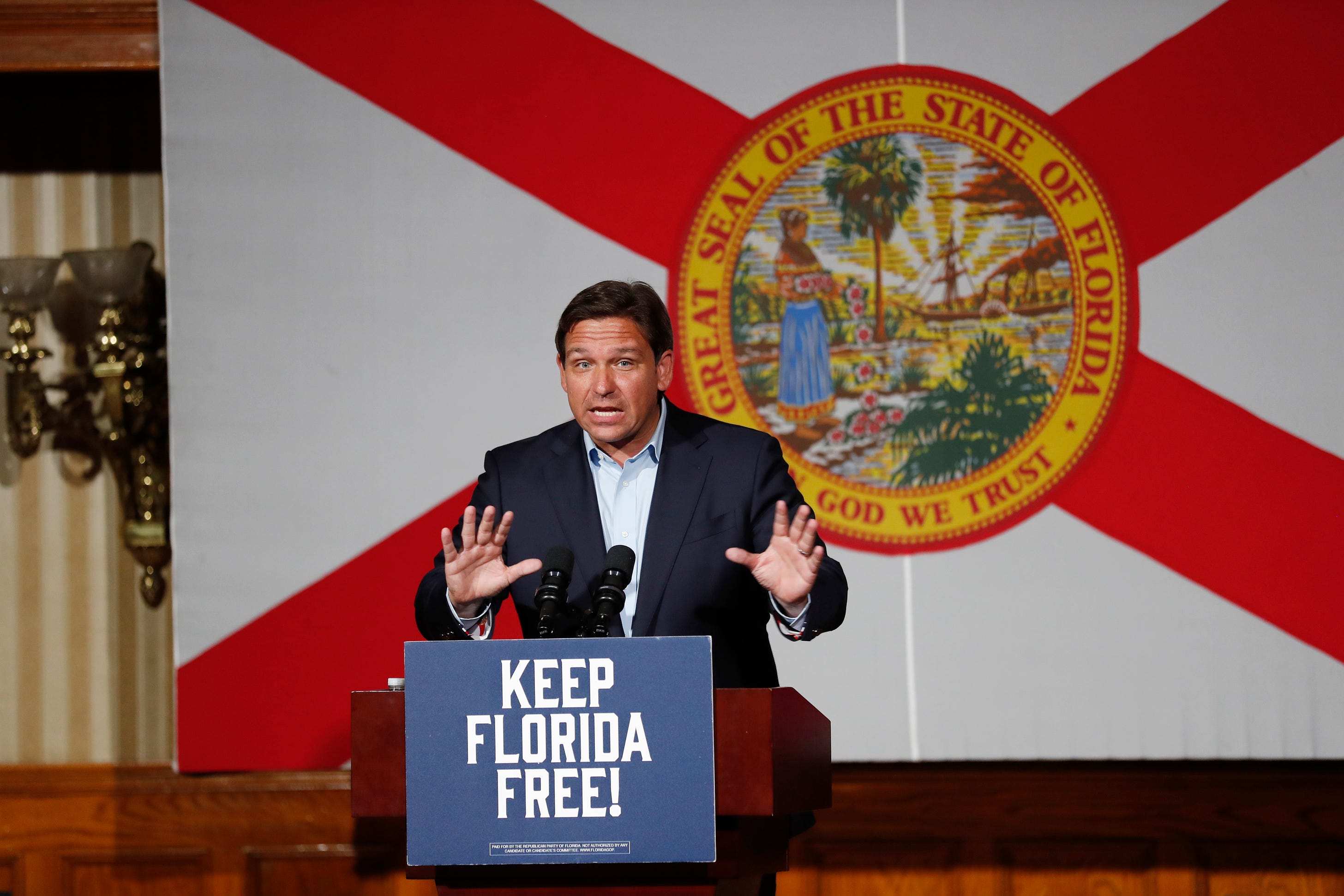
The Miami Herald reported today on Governor DeSantis’ plans to cleanse higher education in the state. Conservatives are creating “civics” institutes as a vehicle for patriotic indoctrination, not as a means to think critically about how to improve democracy. Censorship, which DeSantis practices, would be condemned in any genuine civics class.
Gov. Ron DeSantis on Tuesday announced a package of major reforms to Florida’s higher education system, including tighter controls on faculty tenure, the establishment of “civics institutes” at three universities and prohibitions on diversity, equity and inclusion programs.
Speaking at a news conference in Bradenton, the governor unveiled a plan that would allow university boards of trustees and presidents to conduct reviews of tenured faculty members “at any time,” in addition to the periodic reviews that now take place. Regarding university presidents in particular, he proposes “reestablishing their authority over the hiring process.”
Currently, according to a flier distributed by the governor’s staff, “faculty committees can tie the hands of university presidents and bind them to only consider a small pool of recommended candidates.”
And under a heading in the flier that reads “Education not indoctrination,” he proposes changes in standards and course content “to ensure higher education is rooted in the values of liberty and western tradition.” His plan would require schools to “prioritize graduating students with degrees that lead to high-wage jobs, not degrees designed to further a political agenda.”
The proposal also would prohibit state schools from “supporting campus activities or programs that promote divisive concepts like DEI and CRT.” The letters refer to diversity, equity and inclusion programs and critical race theory.
In addition, he proposes establishing “world-class civics institutes” at the University of Florida, Florida International University and Florida State University. The institutes, according to the flier, would develop courses and curricula “that can be used to educate the next generation on the values of liberty and constitutionalism.”
The flier included information on the governor’s higher education budget proposals as well. He proposes $100 million for “recruitment and retention of highly qualified faculty at state universities” and $15 million for faculty and student recruitment at New College of Florida, where he recently appointed six conservative members to the board of trustees.
The New College board meets Tuesday for the first time since the appointments.
Keith Benson is a teacher in Camden, New Jersey. He is also President of the Camden Educators Association, an author, and a member of the board of the Network for Public Education. He wrote the following article for the Newark Star-Ledger. He reminds us that when Republican governors and ideologues talk about “parental rights,” they assume that only white parents have parental rights. Black parents too have parental rights, and black and white and Latino and Asian students—all students— have the right to learn accurate, factual history.
To make sense of America’s fixation with the (non)existence of critical race theory (CRT) in schools and the ways by which CRT became a partisan flashpoint, we must consider this phenomenon as a contemporary manifestation of what Emory University professor Carol Anderson calls, “white rage.”
With corporate news media refusing to unequivocally point out that CRT, a complex legal theory, is not taught in K-12 schools but is taught in some graduate schools of education and law schools, allowed predominantly white grievants and Republican politicians to shapeshift CRT into anything American history-adjacent that offended their whitewashed sensibilities.
The decrying of CRT is part of a long American tradition of white backlash that is aided by a well-funded conservative messaging apparatus skilled in amplifying white rage for political gain based on misinformation in efforts to protect whiteness and the societal benefits it provides white Americans.
By exhaustively covering anti-CRT rallies at suburban school board meetings following President Joe Biden’s convincing defeat of Donald Trump in 2020, mass media platformed white grievance in response to an imaginary issue.
A complicit media apparatus, however, is not the only bad actor advancing CRT propaganda. As the organized effort attacking CRT is also bolstered by some of the same education reform advocates who champion school choice as the answer for, ironically, urban Black parents to receive a “better” education.
White backlash, the concept that greater equity achieved through increased political representation or economic opportunity for non-white ethnic groups results in a loss of social status among white Americans, has been ubiquitous throughout our nation’s history.
The passing of the Second Amendment, the amendment conservatives hold so dear – that they are willing to sacrifice the lives of students and school staff to preserve it in its entirety – was passed to pacify slave states by permitting them to arm militias consisting exclusively of white men, to crush efforts by enslaved Black people, if they chose to fight for their freedom as exhibited in the Stono Rebellion (1739) and Haitian Revolution (1791).
The enacting of Black Codes immediately following Emancipation and the formation of the Ku Klux Klan, the nation’s first terrorist organization, founded soon after Black Americans gained access to the franchise; the establishment of school choice resulting from the Brown (1954) decision where white parents refused to integrate southern public schools, and instead began an alternative schooling system in protest of white tax dollars going toward educating Black children are not examples of CRT, but historic examples of how white rage impacts our society today.
In its place, Republican lawmakers are calling for the teaching of white supremacist “classical” “patriotic” history and social studies curriculum that uncritically celebrates American history that lionizes the “founding fathers,” and uncritically champions capitalism.
Aside from conservatives and lawmakers’ commitment to derail students’ understanding of history, is the collection of individual groups like the Center on Educational Excellence, National Charter School Alliance, and National Parents Union who supported those Republican governors’ rise to power in advocacy, or in their silence against lawmakers’ campaign of miseducation
For decades, education reform advocates, consisting primarily of wealthy ideologues and representatives from the business community, publicly lamented the shortcomings in public education as evidenced by test scores and graduation rates.
They argued that privatizing education in the form of school vouchers, charter schooling, online education, and now homeschooling are answers to “underperforming” public schools — a message targeted principally toward Black parents.
While much could be unpacked regarding the nonsensical nature of that argument, through massive funding of “think tanks” and foundations, combined with sustained lobbying of lawmakers of both parties, the goal of shifting collective responsibility of educating all of America’s children through its public schools to that of a private endeavor where parents focus only on what impacts their child directly, has been achieved.
Significant expanses of the country see their public institutions deliberately dismantled and replaced with more voucher and corporate charter schools.
As Republican lawmakers endeavor to pass more choice legislation while simultaneously mandating the whitewashing of American history, we have to ask: Do Black parents have a choice in the type of history their child will learn, or is the concern for Black parents’ choice matter only to conservatives and reformers when weaponized to attack public education?
Keith E. Benson is the author of Education Reform and Gentrification in the Age of #CamdenRising: Public Education and Urban Redevelopment in Camden, NJ (2018) available on Peter Lang Publishing at www.peterlang.com. He is the President of the Camden Education Association, a board member of the Network for Public Education and co-founder of Working Together, LLC.
The College Board has not released the syllabus for the AP African-American Studies course that the state of Florida wants to ban because, they say, it has “no educational value” and violates state law by invoking “critical race theory.”
Stanley Kurtz, a conservative academic, wrote a scathing critique in National Review, where he blasted the AP course as “Neo-Marxist” and intent on propagating a socialist-Marxist-Communist mindset. Google and you will find follow-up articles by Kurtz.
I taught the history of American education, and I wrote books that specifically included the history of the education of Black Americans. To write about the history, I read many of the authors cited in the AP course. None of those authors, like Frederick Douglass or Carter Woodson or W.E.B. DuBois or Booker T. Washington, should be excluded from a course like this.
I will say without hesitation that the course is not, as Florida officials claim, “leftwing indoctrination.” Very few Americans know anything about African history, so my guess is that 99% of that history will be new to every reader. I am not sure why DeSantis is upset by “intersectionality.” A reporter should ask him to define it. I saw no problem in the mention of the Black Lives Matter movement or the reparations movement, because they are part of history; they exist. Why ban them? The DeSantis team wants the AP course of study to be upbeat; to show the celebratory rightwing view of American history; to exclude authentic African American thinkers, like Kimberlé Crenshaw and Michelle Alexander.
True there is a topic on “Black Queer Studies” that must drive Ron DeSantis and his allies crazy. I doubt that any students will be turned gay by learning about the topic. But this topic alone will be sufficient to get the course banned in DeSantis’ state and probably other red states. It might get axed by the College Board, which is alert to its bottom line. If the pushback hurts revenue, the College Board is likely to beat a hasty retreat.
Kurtz is right on one count. He wrote that “A stunningly large portion of the APAAS curriculum is devoted to the history of black studies.” This is true. Students will learn a lot about the leading scholars of the field and their contributions. Much of the scholarship is about the scholarship. And much, rightly, is about the brutal exploitation and degradation of African peoples.
In discussions with students about their expectations for the course, students said there should be an “unflinching look at history and culture.” Of course. They don’t want a sanitized history. They also said “Emphasis should be placed on joy and accomplishments rather than trauma.” They felt that they had learned about slavery every year, and “students feel they have been inundated with trauma.” In this course, it’s hard to find the “joy and accomplishments” that students are hoping to learn about. It is unlikely that they will learn much about barrier-breaking individuals like Dr. Charles Drew; LBJ’s Housing Secretary Robert Weaver; Guy Bluford (the first Black astronaut) or Mae Jamison (the first Black female astronaut); Ralph Bunche (the first African American to win a Nobel Prize for his diplomacy); Leontyne Price, the great international opera star, born in Laurel, Mississippi, or the newest international opera star Michelle Bradley, born in Versailles, Kentucky; or even the first Black President, Barack Obama. Of the hundreds and thousands of African Americans who have achieved their dreams, not much is said. The students say they know a lot about Dr. King, Malcolm X, and Rosa Parks; they want more. And they should have the pleasure of learning the inspiring stories of African-Americans who shattered stereotypes and made history.
The College Board says this is a preliminary version of the ultimate AP exam. It’s a good start. Let’s see if it can survive the political maelstrom.
Civil rights attorneys out the state of Florida on notice that it was prepared to sue if the state bans the new AP course in African American studies.
Florida’s Black leaders delivered a warning to Gov. Ron DeSantis on Wednesday that if he doesn’t stop attempts “to exterminate Black history” in Florida classrooms, they would sue him for violating the constitutional rights of students.
“We are here to give notice to Gov. DeSantis,’’ said Ben Crump, a Tallahassee civil rights attorney, to a cheering crowd of supporters in the Capitol Rotunda, as three high school students stood at his side.
They were protesting the announcement last week by the Florida Department of Education that it had rejected a new Advanced Placement elective course on African-American studies, developed by the College Board for high school students.
“If he does not negotiate with the College Board to allow AP African-American Studies to be taught in the classrooms across the state of Florida, these three young people will be the lead plaintiffs,’’ said Crump, who has represented families in several high-profile civil rights cases.
The College Board is expected to release its updated version of the AP course on Feb. 1, the first day of Black History Month. As a pilot program taught in 60 select classrooms around the country, the board has been soliciting feedback from teachers for modifications to the curriculum. It is unknown how many schools in Florida are involved in the pilot program.
Just in case there was any doubt about what Governor DeSantis and Florida legislature banned when they outlawed any discussion of “critical race theory,” that doubt has been resolved. They do not want schools and teachers to acknowledge race, racism, or the very existence of people of color in the United States. Sight unseen, the DOE has banned an AP course on African American studies. The Department claimed that the content of the course is historically inaccurate and violates state law, even though the Department has never seen the course syllabus.
The Miami Herald reported today:
Without a detailed explanation, Gov. Ron DeSantis’ administration has rejected a new Advanced Placement course on African American studies for high school students, broadly claiming it violates state law and that it “lacks educational value.”
When asked for specifics on the content, the Florida Department of Education did not respond, making it unclear what items the state believes are unlawful or objectionable.
“In the future, should College Board be willing to come back to the table with lawful, historically accurate content, FDOE will always be willing to reopen the discussion,” the state wrote in a letter to the College Board, the company that administers the course as well as other interdisciplinary courses and the SAT exam.
The Advanced Placement program is the first course in African American studies to be offered by the College Board. It would allow high school students to earn credits and advanced placement at many colleges across the country.
The course has been in development for more than a decade, and it focuses not just in history, but explores the “vital contributions and experiences of African Americans” in literature, the arts, political science, geography and science, according to the College Board. A syllabus is not yet publicly available.
I just read Dr. Martin Luther King’s last speech out loud.
It was an enthralling experience. Uplifting, inspiring, and a bit depresssing to realize what has not happened, the persistence of racism and poverty and inequality, the scoundrels who distort his message and try to prevent the honest teaching of our history. The racist legislators who say that teaching honest history is a “divisive concept” that will make white children uncomfortable. That assumes they will identify with the oppressors. That assumes that the truth will make them woke. I assume they willl identify with the oppressed and join with those who want change.
Historian Heather Cox Richardson reflects on the anniversary of Dr. Martin Luther King’s birthday. We now look on him as a hero, but during his lifetime, he was treated shamefully by many whites, and militant African-Americans scorned him as well, preferring the angry approach of Stokely Carmichael and Malcolm X. Dr. King was principled and fearless. He faced death daily, and he never back down. It is usually forgotten that he was assassinated in Memphis while there to support striking sanitation workers, who were trying to organize a union. He knew that unions offered the best protection for working people. White conservatives who fraudulently praise him now, claiming that racism is a thing of the past and should not be taught or discussed (so that everyone can be judged by “the content of their character, not the color of their skin”), oppose everything he fought and died for.
You hear sometimes that, now that we know the sordid details of the lives of some of our leading figures, America has no heroes left.
When I was writing a book about the Wounded Knee Massacre, where heroism was pretty thin on the ground, I gave that a lot of thought. And I came to believe that heroism is neither being perfect, nor doing something spectacular. In fact, it’s just the opposite: it’s regular, flawed human beings, choosing to put others before themselves, even at great cost, even if no one will ever know, even as they realize the walls might be closing in around them.
It means sitting down the night before D-Day and writing a letter praising the troops and taking all the blame for the next day’s failure upon yourself, in case things went wrong, as General Dwight D. Eisenhower did.
It means writing in your diary that you “still believe that people are really good at heart,” even while you are hiding in an attic from the men who are soon going to kill you, as Anne Frank did.
It means signing your name to the bottom of the Declaration of Independence in bold print, even though you know you are signing your own death warrant should the British capture you, as John Hancock did.
It means defending your people’s right to practice a religion you don’t share, even though you know you are becoming a dangerously visible target, as Sitting Bull did.
Sometimes it just means sitting down, even when you are told to stand up, as Rosa Parks did.
None of those people woke up one morning and said to themselves that they were about to do something heroic. It’s just that, when they had to, they did what was right.
On April 3, 1968, the night before the Reverend Doctor Martin Luther King Jr. was assassinated by a white supremacist, he gave a speech in support of sanitation workers in Memphis, Tennessee. Since 1966, King had tried to broaden the Civil Rights Movement for racial equality into a larger movement for economic justice. He joined the sanitation workers in Memphis, who were on strike after years of bad pay and such dangerous conditions that two men had been crushed to death in garbage compactors.
After his friend Ralph Abernathy introduced him to the crowd, King had something to say about heroes: “As I listened to Ralph Abernathy and his eloquent and generous introduction and then thought about myself, I wondered who he was talking about.”
Dr. King told the audience that, if God had let him choose any era in which to live, he would have chosen the one in which he had landed. “Now, that’s a strange statement to make,” King went on, “because the world is all messed up. The nation is sick. Trouble is in the land; confusion all around…. But I know, somehow, that only when it is dark enough, can you see the stars.” Dr. King said that he felt blessed to live in an era when people had finally woken up and were working together for freedom and economic justice.
He knew he was in danger as he worked for a racially and economically just America. “I don’t know what will happen now. We’ve got some difficult days ahead. But it doesn’t matter…because I’ve been to the mountaintop…. Like anybody, I would like to live a long life…. But I’m not concerned about that now. I just want to do God’s will. And He’s allowed me to go up to the mountain. And I’ve looked over. And I’ve seen the promised land. I may not get there with you. But I want you to know tonight, that we, as a people, will get to the promised land!”
People are wrong to say that we have no heroes left.
Just as they have always been, they are all around us, choosing to do the right thing, no matter what.
Wishing you all a day of peace for Martin Luther King Jr. Day, 2023.
Donna Ladd, editor and CEO of the Mississippi Free Press, writes here about the sustained rightwing effort to co-opt Dr. Martin Luther King’s legacy of militant resistance to racism and his dedication to telling the truth about our tarnished history. This is an important essay. It’s about a concerted attempt to hijack the words of Dr. King by those who hate his message. It’s about conservative white people like Chris Rufo and Ron DeSantis trying to use his words to prevent honest teaching about the history of racism. I have left the fund-raising appeals in the article because I hope you will send some money to this brave publication.
Yes, Dr. King gave his life in the search for more love and less hate, but he was not only spreading a message of love, as so many white thieves of his legacy try to say today. His message was pure fire. And he was out to hold a mirror up to our nation about white Americans—not only Mississippians and southerners—using terror to maintain power over everyone else and to enjoy the fruits of that terrorism.
Throughout his life, Dr. King toiled and ultimately sacrificed his life in the fight to change power structures and systems established and enforced to keep white people on the top and Black people on the bottom. He wanted America to understand that enslaved people built this nation—after many of their enslavers figured out how to steal the land from Indigenous Americans and forcefully remove them from the land they coveted.
None of this history is pretty or honorable, and Dr. King never tried to say it was or to cover up any of it. He wanted it taught to every person in this country and certainly wanted children to grow up having learned the lessons of the past. He knew that the “arc of the moral universe is long, but it bends toward justice.” And he was blunt that he was not likely to live long enough to see that happen.
When a white man shot him at the Lorraine Hotel in Memphis, Dr. King was more focused than ever on systemic racism and its links with poverty, and he was a harsh critic of capitalism and the Vietnam War. He was putting together the Poor People’s Campaign intending to occupy Washington, D.C., to bring more attention to the racism-poverty connection.
Of course, I didn’t know all that until I was well into adulthood. I knew most white folks in Mississippi hated him, and he was a martyred hero against racism. Like many Americans, I was fed the whitewashed version of Dr. King, which has worsened over the decades. I was nearly 40 when I studied with Dr.Manning Marable at Columbia University and learned the larger and more accurate history of Dr. King, Malcolm X, Marcus Garvey, and many Black freedom fighters. I’ve also read his speeches; I know fully what Dr. King was about and what he supported.
Now, 54 years after Dr. King went to Memphis to support a labor strike by sanitary workers, we see so many arrogant efforts by white Americans to remake him into their preferred hero—you know, the one who would tell us all now to forget all that sticky history and get along despite the systemic inequities our history embedded into our nation’s DNA.
It would be funny if it weren’t so sick and offensive. Right here in Jackson, a public-policy institute led by a former Brexiteer from the U.K. used a photo of Dr. King and his words out of context in a report a year ago to push legislation against so-called “critical race theory” in schools. Their report argued the precise opposite of what the Black freedom hero said or wanted. They even twisted his call for “being judged by the content of their character” out of context to make absurd statements about Dr. King, like this one: “Instead of celebrating the enormous achievements made since the Civil Rights Movement, critical race theory specifically rejects King’s color blind ideal and seeks to racialize every aspect of culture, sport, and public discourse.”
“Color-blind ideal”? That’s what this institute—and its board of prominent white Mississippians—think Dr. King meant by the need for white Americans to stop judging people by the color of their skin? Seriously? That’s some shoddy thinking. Or propaganda, as it were. Such cynicism can explain why this institute claiming Dr. King’s moral ground as its own has nine white men and two white women on its board.
As we consider Dr. King’s legacy this weekend, we must study the whole legacy. No serious person can argue that he would want this nation to block the teaching of our full race history from colleges, schools and homes. No serious person would say that he would want us to simply be proud of how far we’ve come and not examine how far we’ve got to go—until that arc bends toward actual justice and inequity is no longer baked into our systems. No serious person thinks Dr. King would not want us to interrogate how and why inequity became baked into our systems and how to fix them so they don’t keep replicating themselves.
And no serious person would argue that Dr. King would not want the systemic history of slavery, massacres and lynchings that helped end Reconstruction and install Jim Crow, the story of little Ruby Bridges or our Medgar Evers or Lamar Smith down in Brookhaven, the story of ongoing attacks on public education since integration—or the full story of his real dreams taught to every American on this road to eradicating the baked-in legacies of racial suppression and white supremacy.
I get it. Complaining that teaching real race history is somehow “Marxism”—which no serious person would do, either—is bringing back the stunts and propaganda the rich and powerful white people used successfully to scare white folks back in the 1950s and 1960s and even inspire violence against Dr. King and Mr. Evers. The rewriting of history is sick politics. But it is a stunt that all serious people of any party who are, indeed, working not to judge people by their skin color must reject loudly and definitively.
Dr. Martin Luther King Jr. gave his life to speak truth to power. We owe it to him to continue doing just that.
Donna Ladd, Editor and CEO
[I am not inserting a link because I can’t find one. Google Mississippi Free Press. If you find a link, please send it.]
I am sending my third contribution this year to MFP.
Governor DeSantis has pushed through laws that ban the teaching of “critical race theory” and gender studies. The effect of this law and his denunciation of anyone who dares to say that racism is real has been to silence academic freedom. This article in ProPublica (Read the story) shows how professors are dropping the courses they usually teach or changing their names. Untenured teachers— the majority of professors in higher education in Florida and elsewhere worry about being fired if they offend DeSantis’ thought police.
Ironically, the story includes a photograph of a truck owned by a rightwing group, festooned with the words “Freedom of Speech.” To be clear, DeSantis and his rightwing goons are silencing academic freedom and freedom of speech. They are the Thought Police, practicing “cancel culture.”
The article begins:
Jonathan Cox faced an agonizing decision. He was scheduled to teach two classes this past fall at the University of Central Florida that would explore colorblind racism, the concept that ostensibly race-neutral practices can have a discriminatory impact. The first, “Race and Social Media,” featured a unit on “racial ideology and color-blindness.” The second, “Race and Ethnicity,” included a reading on “the myth of a color-blind society.” An assistant sociology professor, Cox had taught both courses before; they typically drew 35 to 40 undergraduates apiece.
As recently as August 2021, Cox had doubted that the controversy over critical race theory — which posits, among other things, that racism is ingrained in America’s laws and power structure — would hamstring his teaching. Asked on a podcast what instructors would do if, as anticipated, Florida restricted the teaching of CRT in higher education, he said that they would need to avoid certain buzzwords. “What many of us are looking at doing is just maybe shifting some of the language that we’re using.”
But a clash with state law seemed inevitable, once Florida’s governor, Ron DeSantis, proposed what he called the strongest legislation in the nation against “the state-sanctioned racism that is critical race theory.” Last April, DeSantis signed the Individual Freedom Act, also known as the “Stop Woke Act,” into law. It bans teaching that one race or gender is morally superior to another and prohibits teachers from making students feel guilty for past discrimination by members of their race. And it specifically bars portraying racial colorblindness — which the law labels a virtue — as racist. A DeSantis spokesperson, Jeremy Redfern, told me in an email that the law “protectsthe open exchange of ideas” (italics in the original) by prohibiting teachers from “forcing discriminatory concepts on students.”
Whatever one thinks of critical race theory, the state’s interference limits the freedom of professors who are experts in their fields to decide what to teach their students. Cox worried, not without reason, that the law effectively banned him from discussing his ideas in class, and that teaching the courses could cost him his livelihood. Cox, who is the only Black professor in the sociology department, will not be considered for tenure until this fall. His salary was his family’s only income while his wife stayed home with their baby.
A month before the fall 2022 semester was set to start, he scrapped both courses. Students scrambled to register for other classes. “It didn’t seem like it was worth the risk,” said Cox, who taught a graduate course on inequality and education instead. “I’m completely unprotected.” He added, “Somebody who’s not even in the class could come after me. Somebody sees the course catalog, complains to a legislator — next thing I know, I’m out of a job.”
Cox’s decision, along with another professor’s cancellation of a graduate course because of similar apprehension, created an unusual gap in the sociology curriculum at UCF, which, with almost 69,000 students, is Florida’s largest university.
Cox’s department chair, Elizabeth Mustaine, said she went along with the professors’ wishes because “I thought: ‘I’m not going to stress anyone out about this. It’s crazy.’” Still, she added, “it’s an absolute tragedy that classes like this get canceled.” Of the 39 courses offered this past fall by a department that specializes in the study of human society, none focused primarily on race.
In just over two years, critical race theory has gone from a largely obscure academic subject to a favorite bogeyman for Republican candidates. Activists such as Christopher Rufo, a senior fellow at the conservative Manhattan Institute, conceived of targeting CRT to foment a backlash against measures enacted following George Floyd’s murder in May 2020. At that time, Rufo told me in an email, “school districts across the country suddenly started adopting ‘equity statements,’ hiring ‘diversity and inclusion’ bureaucrats, and injecting heavily partisan political content into the curriculum.” Black Lives Matter and the left were riding high, said Rufo, who denies that structural racism exists in America. In our email exchange, Rufo described “the fight against critical race theory” as “the most successful counterattack against BLM as a political movement. We shifted the terrain and fought on a vector the Left could not successfully mobilize against.”
The anti-CRT campaign quickly expanded from sloganeering to writing laws. Seven states, including Florida, have passed legislation aimed at restricting public colleges’ teaching or training related to critical race theory. Those laws face impediments. On Nov. 17, 2022, a federal judge temporarily blocked enforcement of the higher-education provisions of Florida’s Individual Freedom Act. “The First Amendment does not permit the State of Florida to muzzle its university professors, impose its own orthodoxy of viewpoints, and cast us all into the dark,” Judge Mark Walker wrote. The DeSantis administration filed a notice of appeal on Nov. 29 and is seeking to stay the injunction pending that appeal. The 11th Circuit, where most of the judges are Republican appointees, will hear the appeal, with briefs to be filed in the next few months and oral arguments potentially this coming summer.
Additionally, with DeSantis’ landslide reelection — after a campaign in which he repeatedly denounced “woke” education — and Republicans gaining a supermajority in both chambers of the state’s Legislature, they are likely to look for new ways to crack down on CRT and what they perceive as higher education’s leftist tilt. And at the federal level, conservatives are drafting a “potential suite of executive orders in 2024,” in case the next presidential election goes their way, to “disrupt the national network of left-wing ideological production and distribution,” according to Rufo.
It’s easy to dismiss the conservative crusade against critical race theory as political theater without real consequences. But most colleges and universities offer social science and humanities courses that address racial inequality and systemic racism, and the anti-CRT laws are already having repercussions for people who teach or take these classes in red states. Moreover, the push against CRT is hitting academia after decades of declines in the proportion of professors protected by tenure, meaning that most faculty members are not in positions secure enough to resist political pressure. Now, forced to consider whether they face any legal or career risk, some are canceling courses or watering down content, keeping quiet rather than sharing their expertise with students.
“When you implement a law like this, you’re asking professors to leave out things that clearly happen or have happened in the past,” Grace Castelin, a UCF undergraduate who plans to introduce a resolution in the student senate condemning the law, told me. “It’s making us more ignorant in this generation and generations to come.”
Fearful that legislators will retaliate by cutting their budgets, few top university administrators have publicly criticized the laws, which put institutions as well as individual teachers at risk. Indeed, UCF Provost Michael Johnson told faculty last July that the university would “have to take disciplinary action” against any faculty member who repeatedly violated the Individual Freedom Act because it couldn’t afford to lose a “catastrophic amount” — $32 million — in state funding linked to graduation rates and other metrics. (Johnson declined an interview request.)
Other states have left professors similarly undefended. In Tennessee, which passed a law much like Florida’s, the provost of the state university’s flagship Knoxville campus made clear to professors that the administration wouldn’t necessarily help them. If they were sued under the law, Provost John Zomchick told faculty, Tennessee’s Republican attorney general would decide whether the university would represent them in court. “People freaked out,” said Anne Langendorfer, a senior lecturer at UT Knoxville and the president of a union for campus workers at the state’s public universities.
A university spokesperson, Kerry Gardner, said that the attorney general makes the final decision in “any situation” where individuals are sued in their capacity as university employees. Administrators “wanted to be fully transparent about how the process works,” while assuring faculty that “we will take every step to defend them,” Gardner said. Zomchick, she added, “does not agree with the view of some faculty” that the law “infringes on the First Amendment or academic freedoms.”
With uncertain support from above, most full and associate professors at least enjoy the protection of tenure, which shields scholars whose insights or research are politically unpopular. Tenured professors can’t be fired without cause and a hearing by their peers. Other faculty typically work on contracts, which the university can decide not to renew without specifying a reason.
Some tenured professors in Florida have resisted anti-CRT pressure. The historian Robert Cassanello, the president of the UCF chapter of United Faculty of Florida, was comfortable becoming a plaintiff in one of the lawsuits contending that the Individual Freedom Act violates free speech. Cassanello, who keeps a life-size cutout of Karl Marx in his office window, told me that he’s less threatened by the law than his untenured colleagues are.
Robert Cassanello, a tenured professor, teaches history at the University of Central Florida and became a plaintiff in a lawsuit challenging a state law that restricts the teaching of critical race theory. (Tara Pixley, special to ProPublica and The Atlantic)
By contrast, Juan Salinas, an assistant sociology professor at the University of North Florida in Jacksonville, declined to be a plaintiff. “For me to stick my name out, I didn’t feel comfortable,” Salinas said. “If I had tenure, I would be more active.”
But even having tenure didn’t feel like “adequate protection” to Scott Carter, the other UCF sociologist who scrapped a course on race in the fall semester. “It’s very sad for students,” Carter told me. “They won’t get the experience of hearing from scholars on contemporary race relations.”
One of the regular readers of the blog alerted me to the fact that there were several comments today (January 5) that contained vulgarity and profanity that are not allowed on this blog.
These disgusting comments were written in response to a post I wrote on June 1 called “I Am Woke, You Should Be Too,” in which I asserted that I care about justice, equality, freedom, and other fundamental ideals of our society. I took issue with those who would censor the views of those who disagree with them. I specifically criticized Florida Governor Ron DeSantis for passing laws to silence those who don’t agree with his censorious views.
I wrote:
One of the hot-button words that has been appropriated by rightwing politicians is “woke.” They are trying to turn it into a shameful word. I looked up the definition of WOKE. It means being aware of injustice and inequality, specifically when referring to racism. I strive to be aware of injustice and inequality and racial discrimination and to do whatever I can to change things for the better. Shouldn’t we all do that?
My acronym for WOKE is “Wide Open to Knowledge and Enlightenment.”
What would you say about someone who is not WOKE? They are “asleep,” “unconscious,” “indifferent.” They are “Mind Closed, Mouth Open.”
Yes, I am WOKE. I want Dr. King’s dream someday to be true. It is not true now.
Apparently, this post was reprinted on a rightwing site. Consequently, I have received quite a few hostile, vicious, profane comments, especially today.
I regret that several such profane comments got past me today. I was busy and did not carefully screen every comment.
I apologize for allowing profanity on this site.
I will try to block them as soon as possible.
Yes, I am woke. I am proud to be woke. I hope someday everyone will care passionately about justice, equality, and freedom. Curse all you want. But not on this blog. I will delete them as soon as I see them. I won’t back down.