Archives for category: Literature

Most people would promptly respond to the question that is the title of this post: NO! the First Amendment was written to protect the people against government over-reach. The very question is absurd on its face. Yet Republican Attorneys General have argued that the First Amendment protects their right to ban books. No, no, no, a million times NO!

Chris Tomlinson, a columnist for The Houston Chronicle, wrote about the case:

Book banners in Llano County and Florida’s attorney general will try to convince a federal appeals court Tuesday that the First Amendment grants elected officials the unlimited right to remove books from public libraries.

Conservatives will turn freedom of speech on its head by arguing that politicians are expressing themselves when they ban books, and therefore, the Constitution protects book bans. In a perverse twist, they will make this argument during Banned Books Week, the time of year when writers defend the right to share ideas.

The Little v. Llano case will undoubtedly go to the U.S. Supreme Court. Seventeen Republican state attorneys general have joined Ken Paxton in defending the Llano County Commissioners Court’s order to remove 17 books from the public library. Not the school library, mind you, but the library system for all residents.

The banned books include the award-winning “They Called Themselves the K.K.K: The Birth of an American Terrorist Group,” by Susan Campbell Bartoletti, “Caste” by Isabel Wilkerson, and “It’s Perfectly Normal: Changing Bodies, Growing Up, Sex and Sexual Health,” by Robie Harris.

Llano is not alone. Texas has led the nation in book bans, according to PEN America, a nonprofit freedom of speech group of which I am a member.

Historically, the U.S. Supreme Court has held that the First Amendment severely limits the power of government to control speech and other forms of expression. Governments are not allowed to ban books based solely on their viewpoint; there must be a public safety issue.

Llano County residents sued in federal court last year to have the books returned. U.S. District Judge Robert Pitman found that Llano officials only banned the books because they disagreed with the content and determined the commissioners had no compelling government interest to remove them. He ordered all the books restored to library shelves.

The county appealed to the 5th U.S. Circuit Court of Appeals, which split in a preliminary decision. The full 17-judge court will hear arguments Tuesday.

The 18 Republican attorneys general who have joined the case want the judges to accept a new interpretation of the First Amendment, one first pushed in Florida. They argue government officials have free speech rights, and the court must protect them as much as a librarian’s, a writer’s or a reader’s civil liberties.

“The county’s decisions over which books to offer its patrons in its public libraries, at its own expense, are its own speech,” the states argued in a court filing last month. “The government does not violate anyone’s free speech rights merely by speaking — no matter what it chooses to say or not to say.”

If Little v. Llano makes it to the Supreme Court, and the justices agree with this argument, they will hobble the foundation of our democracy: the free exchange of ideas. The flip side of the freedom to write is the freedom to read. One is useless without the other.

Libraries play a crucial role in a free society. They are repositories not only of history and entertainment but of accumulated knowledge and new ideas. Books are expensive, and libraries make them available to the entire community.

Public libraries are, by definition, government entities financed with taxpayer dollars. In a free society, they must be nonpartisan and contain a wide range of content absent political litmus tests. A conservative victory for Llano would turn politicians into thought police.

The conservative activists who complained about the Llano library books relied on a list of 850 titles published by former state Rep. Matt Krause, a Fort Worth Republican, in 2021. Krause focused on books about racismLGBTQ issues or anything else that “might make students feel discomfort, guilt, anguish.”

Krause was among the state lawmakers who limited how teachers can discuss slavery and discrimination against African Americans because it might make descendants of slaveholders uncomfortable. Possessing “The 1619 Project” is now a firing offense at Texas public schools.

Where does it end if politicians have a free speech right to ban books? We know politicians try to outdo each other with ideological purity tests. Activists on the left and right will draft lists of authorized and prohibited books, and libraries will have to restock their shelves after every election.

As for those who argue libraries are full of pornography, I say poppycock. The American Library Association and professional librarians follow well-considered procedures in choosing what titles to carry, and one person’s taste should not determine what a library buys.

If politicians do end up determining what we can find at the library, you’ll have fellow Texans to thank.

A high school student in Idaho peaceably performed a quiet but powerful protest against censorship at her graduation ceremonies. For her courage, her commitment to freedom to read, and her sheer chutzpah, I add the name of Annabelle Jenkins to the honor roll of this blog.

An Idaho high school graduate staged an unusual form of protest at her graduation when she offered a book to the school district’s superintendent, who had banned it months earlier.

Annabelle Jenkins was one of 44 graduates to have her name called during the Idaho Fine Arts Academy graduation ceremony on May 23.

After she shook hands with administrators on the stage, Jenkins paused in front of West Ada School District Superintendent Derek Bub and pulled out “The Handmaid’s Tale” from the sleeve of her graduation gown.

Bub stood firm with his arms crossed and declined the book, leaving Jenkins to drop it at his feet as she moved across the stage.

The graphic novel version, written by Margaret Atwood and Renee Nault, was one of 10 the school district banned from its libraries earlier in the academic year over its graphic imagery, deemed unsuitable for the student body.

I hope that Annabelle read the full text version of the book, in addition to the banned graphic novel.

Good news in New Hampshire! Federal Judge Paul Barbadoro threw out the state’s “divisive concepts” law, which banned the teaching of anything that might be “divisive.” The same kind of law has been used in other states to ban the teaching of historical facts and literature about Blacks and gays. The judge declared it was too vague to be Constitutional and created confusion about what was and was not allowed in the classroom. In an ironic twist, the law that censors teaching and curriculum is titled “The Law Against Discrimination.”

Nancy West of InDepthNH.com wrote about the decision, which certainly must have upset State Commissioner Frank Edelblut and Governor Chris Sununu, as well as the state’s busybody Moms for Liberty.

West writes:

CONCORD – A federal judge on Tuesday struck down the state’s controversial ‘divisive concepts’ law, which had its roots in an executive order by former President Trump, that limited how teachers can discuss issues such as race, sexual orientation and gender identity with students.

The law, passed in a budget rider in 2021, created a chilling atmosphere in classrooms around the state with teachers unsure of what they could discuss about those issues without fear of being suspended or even banned from teaching altogether in the state.

The four banned concepts include:  That one’s age, sex, gender identity, sexual orientation, race, creed, or color is inherently superior or inferior; that an individual, by virtue of age, sex, gender identity, sexual orientation, race, creed, color…is inherently racist, sexist, or oppressive, whether consciously or unconsciously; that an individual should be discriminated against  because of his or her age, sex, gender identity, sexual orientation, race, creed, color; and that people of one age, sex, gender identity, sexual orientation, race, creed, color…cannot and should not attempt to treat others without regard to age, sex, gender identity, sexual orientation, race, creed, color…., according to the judge’s ruling.

In New Hampshire it’s called the Law Against Discrimination and makes it unlawful for a public employer to “teach, advocate, instruct, or train” the banned concepts to “any employee, student, service recipient, contractor, staff member, inmate, or any other individual or group.”

U.S. District Court Judge Paul Barbadoro ruled the law is unconstitutional under the 14th Amendment because it is too vague.

In the suit filed against Education Commissioner Frank Edelblut and the Department of Education by the National Education Association of New Hampshire and the American Federation of Teachers of New Hampshire, Barbadoro sided with the teachers and granted their motion for summary judgment.

  “The Amendments are viewpoint-based restrictions on speech that do not provide either fair warning to educators of what they prohibit or sufficient standards for law enforcement to prevent arbitrary and discriminatory enforcement. Thus, the Amendments violate the Fourteenth Amendment to the U.S. Constitution,” Barbadoro wrote…

The controversy escalated after Edelblut posted a page of the Department of Education website to file complaints against teachers for allegedly discriminating and a group called Moms for Liberty offered a $500 reward “for the person that first successfully catches a public school teacher breaking this law.”

Barbadoro wrote: “RSA § 193:40, IV provides that a “[v]iolation of this section by an educator shall be considered a violation of the educator code of conduct that justifies disciplinary sanction by the state board of education.

“An ‘educator’ is defined as ‘a professional employee of any school district whose position requires certification by the state board [of education].’ RSA § 193:40, V. Potential disciplinary sanctions include reprimand, suspension, and revocation of the educator’s certification.

“In other words, an educator who is found to have taught or advocated a banned concept may lose not only his or her job, but also the ability to teach anywhere in the state,” Barbadoro wrote…

Barbadoro was critical of Edelblut’s two op-ed pieces in the New Hampshire Union Leader.

“Despite the fact that the articles offer minimal interpretive guidance, Department of Education officials have referred educators to them as a reference point. For example, after showing two music videos to her class as part of a unit on the Harlem Renaissance, Alison O’Brien, a social studies teacher at Windham High School, was called into a meeting with her principal and informed that she was being investigated by the Department of Education in response to a parent’s complaint.

“Department of Education Investigator Richard Farrell recommended that Windham’s administrators consult Edelblut’s April 2022 opinion article to understand the context of the investigation against O’Brien, without otherwise explaining why O’Brien’s lesson warranted investigation. After witnessing her experience, O’Brien’s colleagues grew anxious about facing similar actions,” Barbadoro wrote.

What did she do wrong? She doesn’t know.

Edelblut, the state’s top education official, homeschooled his children. He was appointed by Governor Sununu. The governor likes to pretend he is a Republican moderate. Don’t be fooled.

Judge Barbadoro was appointed by President George H.W. Bush.

Open the link to finish reading the article.

.

Jan Resseger explains how young people are injured when adults censor what they read and teach them inaccurate history.

She writes:

Public schools, which serve more than 50 million of our nation’s children and adolescents are perhaps our society’s most important public institution. Unlike private schools, public schools guarantee acceptance for all children everywhere in the United States, and they protect the rights of all children by law. And unlike their private school counterparts, public schools are also required to provide services to meet each child’s educational needs, even children who are disabled or who are learning the English language.

Today’s culture war attacks on public education drive fear of “the other” and attempt to frighten parents about exposing their children to others who may come from other countries, from other cultures, from a different race or ethnicity, from a different religion, or from a gay or lesbian family.

The idea of insulating children is, however, counter to the whole philosophical tradition that is the foundation for our system of public schooling.

More than a century ago, education philosopher John Dewey declared: “What the best and wisest parent wants for his own child, that must the community want for all of its children… Only by being true to the full growth of all the individuals who make it up, can society by any chance be true to itself,” (The School and Society, p. 5)

For Dewey, however, educating all children together without insulating them was important as more than an abstract principle. Dewey believed that the experience of school was itself a way of learning to live in a broader community: “I believe that the school is primarily a social institution. Education being a social process, the school is simply that form of community life… I believe that much of present education fails because it neglects… the school as a form of community life… I believe that… the best and deepest moral training is precisely that which one gets through having to enter into proper relations with others in a unity of work and thought.” (My Pedagogic Creed, January 1897)

A hundred years later, in 1998, the political philosopher Benjamin Barber defended the idea of public schools as a microcosm of the community: “America is not a private club defined by one group’s historical hegemony. Consequently, multicultural education is not discretionary; it defines demographic and pedagogical necessity.  If we want youngsters from Los Angeles whose families speak more than 160 languages to be ‘Americans,’ we must first acknowledge their diversity and honor their distinctiveness.”( Education for Democracy,” in A Passion for Democracy: American Essays, p.231).

And in the same year, another philosopher of education, Walter Feinberg explained that in public school classrooms students should learn to tell their own stories, to listen and respect the stories of others, and through that process prepare for democratic citizenship: “That there is an ‘American story’ means not that there is one official understanding of the American experience but, rather, that those who are telling their versions of the story are doing so in order to contribute to better decision making on the part of the American nation and that they understand that they are part of those decisions. The concept is really ‘Americans’ stories.’” (Common Schools: Uncommon Identities, p. 232) (emphasis in the original)

Today, of course, the culture wars attacks on public education seek to reshape the curriculum, silence controversial discussion, and ban books.

Massachusetts political science professor Maurice Cunningham explains that well-funded advocates for reshaping school curricula—including the Heritage Foundation, the Manhattan Institute, the Council for National Policy and a number of dark money groups—are spending millions of dollars to fan the fears of parents by supporting local advocates in organizations like Moms for Liberty and Parents Defending Education. The goal is to agitate against overly “woke” public school curricula and to frighten parents by telling them that teachers are frightening children by including the nation’s sins as well as our society’s virtues as part of the American history curriculum, and by encouraging children to listen to the voices of people who have traditionally been marginalized.  There is, however, no evidence that our children have been personally or collectively frightened when they learn about slavery as the cause of the Civil War or when they learn about gender identity as part of a high school human sexuality curriculum. Accurate and inclusive curricula and open class discussion where all voices are heard and considered are essential for truly public education.

Robert Samuels’ When Your Own Book Gets Caught Up in the Culture Wars profoundly explains the damage wrought by book banning, Samuels, a Washington Post reporter and his colleague Toluse Olorunnipa, had just won the 2023 Pulitzer Prize for General Nonfiction last fall when they were invited to a Memphis high school to discuss their new book, His Name Is George Floyd: One Man’s Life and the Struggle for Racial Justice.  Samuels describes why he wanted to share his book with the Memphis high school students: “I had once been told that the answer to anything could be found in a book… One day, during my senior year, I was browsing an airport bookstore when I saw Stokely Carmichael’s autobiography, “Ready for Revolution.” A whole chapter was devoted to Bronx (High School of) Science, which he had also attended. I was riveted. It started with an officer hassling him on the street, only to be stunned when Carmichael shows him a book with the school’s logo. Although our time there was separated by four decades, we both had the same confusion upon discovering that white classmates had grown up reading an entirely different set of material….  We were both surprised by how little dancing there was at white classmates’ parties. ‘It was at first a mild culture shock, but I adapted,’ he wrote. I, too, had to learn to adapt, to not be so self-conscious about getting stereotyped because of my speech, my clothes, my interests. It was the first time I had ever truly felt seen in a book that was not made for children.”

Samuels and Olorunnipa received a call just before their Memphis visit warning them they could not read from the book and that the school could not distribute copies to students. And during their visit, it became evident that students’ questions had even been carefully edited by their teachers.  Then, in the weeks after the visit, the Memphis-Shelby County school staff and event sponsoring organization stepped all over themselves trying to apologize to Samuels and Olorunnipa.  It became evident that school staff had been frightened and intimidated by school district regulations; the penalties were severe while the rules themselves remained unclear.

Samuels describes what happened: “(T)he spokesperson for the school district e-mailed… to apologize for the miscommunication and misinformation ‘surrounding your recent visit’… (She) defended prohibiting the book itself, on the ground that it was not appropriate for people under the age of eighteen… (She) then admitted that no one involved in the decision had actually read it. The district’s academic department didn’t have time… A staff person in the office searched for it in a library database, noting that the American Library Association had classified it as adult literature.” There was one positive result of the whole fiasco:  with a donation from Viking Books, the publisher, a Memphis community development group, promised any student from Whitehaven High School a free copy of His Name is George Floyd: One Man’s Life and the Struggle for Racial Justice.

Philosophers of education, academic researchers, educational psychologists, and the students in America’s classrooms all tell us that young people are hurt when the school is forced to remove the books that tell students’ own stories.

Young people are made invisible when state laws suppress accurate teaching about all the strands of the American story including slavery, and what happened during the Civil War, Reconstruction, and the Civil Rights Movement. Children who are gay or lesbian learn that they should withdraw and hide when the words that describe them are banned. Experts also tell us that the other children in the classroom are not frightened when, for example, a classmate shares the challenges his or her family faced as immigrants trying to find a place to feel welcome.

Please open the link and finish reading this important article.

John Thompson, historian and retired teacher in Oklahoma, writes here about a book that is important in Oklahoma history and American history.

He writes:

When I first read Victor Luckerson’s Built from the Fire: The Epic Story of Tulsa’s Greenwood District, America’s Black Wall Street, I was stunned by his beautiful prose. Watching Luckerson on CSPAN Book T.V., I was reminded of his eloquence. And I was even more impressed by the timeliness of the story of the communities and families who built and rebuilt Greenwood after the 1921 Tulsa Massacre, and who then had to repeatedly fight to keep their community from being erased. 

This April 2, 2024, when hearing a lawsuit on reparations, the Oklahoma Supreme Court Justice Yvonne Kauger said to the litigants, “When I went to high school, … Greenwood was never mentioned,” so “I think regardless of what happens, you’re all to be commended for making sure that that will never happen again. It will be in the history books.”  We all must also commend Luckerson’s contribution to that essential story, and help pass it down to younger generations.

As Marcia Chatelain’s New York Times review of Built from the Fire explained, “The seemingly unfettered opportunity in the new state of Oklahoma drew unabashed capitalists, confidence men, industrious wives and loyal mothers to what had formerly been known as Indian Territory…” The story of diverse Black people who built Greenwood, the “Eden of the West” is just as complex.

Similarly, Suzette Malveaux’s Washington Post review started with the lie that prompted the Massacre by claiming:

Dick Rowland, a Black teenager, had sexually assaulted a white woman in an elevator. A show of force by Greenwood men to prevent Rowland from being lynched escalated into an all-out attack on Black Tulsans by white vigilantes, who in some cases had been handed arms by the police. As Luckerson recounts, “More than 1,200 houses were leveled, nearly every business was burned to the ground and an unknown number of people — estimates reach as high as 300 — were killed.”

As one white person recalled, white officers quickly deputized the crowd; he was told, “Get a gun and get busy, and try to get a n—–.”

But Malveaux also stresses the way that:

Luckerson shines a light on uncomfortable fissures between Oklahoma’s Black freedmen and Black migrants from the South; Native American enslavers and Black enslaved people; and the American Red Cross’s White “angels of mercy” and Tulsa’s mobsters. And he doesn’t shy away from telling the full story of Greenwood’s great leaders.

For instance, one of the fathers of Greenwood’s economic and cultural strength was J.H. Goodwin, a former railroad brakeman, who leveraged his position with the railroad (which was rare for a Black man at the time) and who was able to work with all types of people, but who passed down psychological burdens, as well as resilience to his family. His family invested in journalism, said one of their readers, so “you can have free speech and have privilege to act as a man without being molested.”

Goodwin’s stories, and those of other families in the book, include experiences gained and brought back from Fiske University, Chicago, Washington D.C., and elsewhere. The family became best known for the Oklahoma Eagle newspaper, which shared diverse perspectives and kept up the fight for justice. They also played leadership roles in desegregating Tulsa schools. And like so many Black Tulsans, in doing so, they drew on both “Booker T. Washington’s model of economic power and W.E.B. DuBois’s model of political power.”

Goodwin’s most influential recent descendent, Sen. Regina Goodwin, kicked off her political career in 2015 with the words, “Some women get lost in the fire and some … are built from the fire.”  

Luckerson explained that “residents of Greenwood bore the burden of living in two Americas at once, the idealized version imagined in the minds of white slaveholders in 1776, and the more brutal reality that black Tulsans and their ancestors bore witness to.” He balances tales of graft by both Black and much worse White entrepreneurs. Although W.E.B. DuBois correctly described the resulting community as “impudent and noisy,” those same businessmen “opposed economic injustice just as fiercely as they fought segregation.”

Immediately after the massacre, Tulsa officials used zoning ordinances to keep Black residents from rebuilding. The insurance claims of Black residents were rejected. New segregation laws were passed, and bankers used “red lining” to deny new loans to Blacks. Moreover, criminal courts failed to find whites guilty of assault, arson and murder. However, Luckerson also chronicled skillful but often unsuccessful legal battles by attorneys like B.C. Franklin.

Over the next decade, Black resilience got the business community back on track. The gains were first undermined by the Great Depression, and then recovered as WWII approached. The Roosevelt administration implemented successful economic stimulus programs, as well discriminatory and counter-productive efforts. The same occurred during the war when Greenwood leaders had some successes in creating economic opportunities with the help of the federal government, while other wartime and post-war investments were too discriminatory to be constructive. Efforts to rebuild Greenwood’s neighborhoods sometimes prompted violence like a KKK cross burning and the dynamiting of a Black family’s home.

Luckerson then describes the 1950s and 1960s when legal battles and grassroots organizing created successes, as well as mixed feelings. For instance, Greenwood’s local political efforts resulted in funding Black schools like Booker T. Washington high school. (Don Ross, a teenager who would become an influential state legislator, was a leader in the fight for educational opportunities.) Thurgood Marshall’s anti-segregation efforts contributed to his historic Brown v Board of Education victory. But some Greenwood residents mourned the loss of Booker T. Washington, saying it “ripped the heart out of a community that had once had the pride to succeed in all parts of life.”

There was unanimity, however, in rejecting the way that highway construction and Urban Renewal once again devastated Greenwood.

Luckerson then brings the narrative through tragedy to sometimes promising political efforts and the often successful, but sometimes divisive efforts to build a dynamic 21st century Greenwood. One of the leaders was Tiffany Crutcher, whose unarmed brother, Terence, was shot to death in the middle of the street by police officer. Moreover, Rep. Bob Ross and Rep. Regina Goodwin worked skillfully within the legislative system to fund studies of the 1921 Massacre and reparations. Sadly, white political leaders, who had sounded so supportive of such efforts, largely failed to follow through.

Fortunately, the HBO film, The Watchmen, brought the Massacre to the attention of millions of Americans. And the George Kaiser Family Foundation established the Greenwood Cultural Foundation.  Luckerson also provides an objective account of the fight over today’s reparations lawsuit. 

The Greenwood revival also led to President Joe Biden’s commemoration of the Massacre. Speaking in Greenwood, he didn’t use the word “reparations,” but he “discussed the devastating effect of urban renewal on Greenwood. ‘A highway was built right through the heart of the community … cutting off black families and businesses from jobs and opportunity.’” The President then “announced plans to increase federal contracts for minority-owned businesses and try to curb racist housing appraisals.”

Luckerson concludes with the words of B.C. Franklin, “Right is slow and tardy while wrong is aggressive.” He then adds, “For more than a century, Greenwood has been grappling with wrong in all its combative forms. Wickedness flamed white-hot in 1921, but the embers continued to burn long after.” This stretched “from relief aid being withheld during the Great Depression … [to] Urban Planning brochures featuring smiling black faces and words laden with double meaning – blight, renewal, progress.” He later makes one prediction, “Whether or not Tulsa does right by the people of Greenwood and North Tulsa, they will continue to do what they’ve always done: build.”

Given the pressure by State Superintendent Ryan Walters to censor books that he believes would wrongly make White kids feel uneasy, I understand why teachers would feel afraid to teach Lukerson’s book. But we owe it to students to make his masterpiece available to all.

Bob Shepherd, author, editor, assessment developer, story-teller, and teacher, read a book that he loved. He hopes—and I hope—that you will love it too.

He writes:

Like much of Europe between 1939 and 1945, education in the United States, at every level, is now under occupation. The occupation is led by Bill Gates and the Gates Foundation and abetted by countless collaborators like those paid by Gates to create the puerile and failed Common Core (which was not core—that is, central, key, or foundational—and was common only in the sense of being vulgar. The bean counting under the occupation via its demonstrably invalid, pseudoscientific testing regime has made of schooling in the U.S. a diminished thing, with debased and devolved test preppy curricula (teaching materials) and pedagogy (teaching methods).

In the midst of this, Gayle Greene, a renowned Shakespeare scholar and Professor Emerita at Scripps University, has engaged in some delightful bomb throwing for the Resistance. Her weapon? A new book called Immeasurable Outcomes: Teaching Shakespeare in the Age of the Algorithm.

OK. Maybe I’ve pushed the occupation/resistance metaphor to the edge of its usefulness. Let’s try another. If Gates’s test-and-punish movement, ludicrously called “Education Reform,” is a metastasizing cancer on our educational system, and it is, then Professor Greene’s book is a prescription for how to reverse course and then practice prevention to end the stultification of education and keep it from coming back. The book is a full-throated defense of the Liberal Arts and of traditional, humane, in-person, discussion-based education in a time when Liberal Arts schools and programs are being more than decimated, are being damned-near destroyed by bean counters and champions of ed tech. Here’s the beauty and value of this book: contra the “Reformers,” Greene details the extraordinary benefits of the broad, liberal educations that built in the United States people capable of creating the most powerful, vibrant, and diverse economy in history. She makes the case (I know. It’s bizarre that one would have to) for not taking a wrecking ball to what has worked. And best of all, she does so not at some high level of abstraction, but backs up any generalizations with concrete, vivid, fascinating, moving, delightful examples from her classrooms. How do you build a world-class human? Well, you give him or her the benefits of a broad, humane, liberal arts education that confers judgment, wisdom, vision, and generosity. Greene shows us, from her own classes over three decades, exactly how that happens.

And she shows us how, under the “standards”-and-testing occupation, all that is being lost.

Years ago, I knew a fellow who retired after a lucrative, successful career. But a couple months later, he was back at his old job. I asked him why he had decided not simply to enjoy his retirement. He certainly had the money to do so.

“Well, Bob,” he said, “there’s only so much playing solitaire one can do.”

I found this answer depressing. I wondered if it were the case that over the years, the fellow had given so much time to work that when he no longer had that to occupy him, he was bored to tears. Had he not built up the internal resources he needed to keep himself happy and engaged ON HIS OWN? Greene quotes, in her book, Judith Shapiro, former president of Barnard College, saying, “You want the inside of your head to be an interesting place to spend the rest of your life.” The French novelist Honoré de Balzac put it this way: “The cultured man is never bored.” Humane learning leads to engagement with ideas and with the world, to fulfillment, to flourishing over a lifetime, to what the ancient Greeks calledeudaimonia—wellness of spirit. Kinda important, that.

In a time when Gates and his minions, including his impressive collection of political and bureaucratic action figures and bobble-head dolls, are arguing that colleges should become worker factories and do away with programs and requirements not directly related to particular jobs, it turns out that the people happiest in their jobs are ones with well-rounded liberal arts educations, and are the ones who are best at what they do. And it turns out that people taught how to read and think and communicate and be creative and flexible, people who gain a broad base of knowledge of sciences, history, mathematics, arts, literature, and philosophy, are self-directed learners who can figure out what they need to know in a particular situation and acquire that knowledge. Philosophy students turn out to be great lawyers, doctors, politicians, and political operatives. Traditional liberal arts instruction creates intrinsically motivated people.

All this and more about the value of liberal arts education Professor Greene makes abundantly clear, and she does so in prose that is sometimes witty, sometimes hilarious, sometimes annoyed, sometimes incredulous (as in, “I can’t believe I even have to protest this shit”); always engaging, human and humane, compassionate, wise, authentic/real; and often profound. As much memoir as polemic, the book is a delight to read in addition to being important politically and culturally.

Gates and his ilk, little men with big money to throw around, look at the liberal arts and don’t see any immediate application to, say, writing code in Python or figuring out how many pallets per hour a warehouse can move. What could possibly be the value of reading Gilgamesh and Lear? Well, what one encounters in these is the familiar in the unfamiliar. As I have said numerous times elsewhere, all real learning is unlearning. You have to step through the wardrobe or fall down the rabbit hole or pass through the portal in the space/time continuum to a place beyond your interpellations, beyond the collective fantasies that go by the name of common sense. Real learning requires a period of estrangement from the familiar. You return to find the ordinary transmuted and wondrous and replete with possibility. You become a flexible, creative thinker. You see the world anew, as on the first day of creation, as though for the first time. Vietnam Veterans would often say, “You wouldn’t know because you weren’t there, man.” Well, people who haven’t had those experiences via liberal arts educations don’t know this because they haven’t been there, man.

Gayle Greene has spent a lifetime, Maria Sabina-like, guiding young people through such experiences. Her classroom trip reports alone are worth your time and the modest price of this book. At one point, Professor Greene rifs on the meaning of the word bounty. This is a book by a bounteous mind/spirit about the bountifulness of her beloved liberal arts. Go ahead. Buy it. Treat yourself.  

Peter Greene highly recommends the “60 Minutes” segment about book banning and Moms for Liberty. He pins them on the essential hypocrisy at the heart of their campaign: the M4L asserts the right to deny certain books to all children in a school or a district, thus denying the “liberty” of parents who disagree with them. There is a world of difference between a parent saying “I don’t want my child to read that book” and a parent saying “ No child in that school should be allowed to read that book.”

Peter Greene writes:

If you have not seen the 60 Minutes piece on book banning, here it is. Go ahead and watch; it will be thirteen and a half minutes well spent.

There are several things on display here, not the least of which is a school district taking a sensible students-first, parents-involved approach to the issue of difficult books. 

Reporter Scott Pelley gets right to the heart of several issues. The difference between giving parents the tools to control what their own children can read (something the district also provides in spades) and trying to control what other parents can let their children read. The outrage-enhancing technique of treating isolated mistakes as proof of some widespread conspiracy.

In the midst of it all, the Moms for Liberty, with Tiffany Justice and Tina Descovich finally seen in the footage from an interview they sat for way back in October of 2023. 

The piece is tough on them. The parents that are set up to represent the district are Republican, conservative, combat veterans. Pelley in repeated voice overs points out that the Moms are evasive and avoid answering question but instead retreating to their talking points (he does not point out that they are seasoned political coms professionals, but he doesn’t portray them as cookie-baking domestics, either). Some of the talking points were so six months ago. “We don’t co-parent with the government,” said the women whose demands include forcing the government to help them with the part of parenting that involves keeping an eye on what your children read and watch. 

Their PR firm (Cavalry Strategies) was on the case this morning, emailing out the M4L transcript that includes the part that CBS didn’t include, and offering the duo for press interviews to tell their story. It’s an odd choice, because the stuff they want you to see is just more of the non-answering that CBS showed. That and they are really, really big sad that CBS chose not to air them reading the Really Dirty Parts or Certain Books. This remains one of their weirdest arguments–since this part of this book is too objectionable to read in certain situations, it must be too objectionable to be found in any situation. Like, it’s not okay for me pee on the steps of City Hall at noon, so it must not be okay for me to pee anywhere, ever.

But the question that Pelley asked was a really, really good one. The Moms led into it by saying that although they love teachers so very much, there are some “rogue teachers” out there (I can hear the ty-shirts being printed already). “Parents send their children to school to be educated, not indoctrinated into ideology.”

And so Pelley asked the obvious question– “What ideology are the children being indoctrinated into?”

And the Moms wouldn’t answer. The extended answer in their email (and some tweets) suggests that they’re talking about gender and sex stuff, and their go to example is telling five year olds that genders can be changed). 

The answer remains unclear. What exactly is the objection? What is the problem? What does “gender ideology” even mean? Because the harder I stare at it, the more it seems as if the problem is acknowledging that LGNTQ persons exist.

But in the MAGA Mom playbook, that’s not it as all, which brings us Pelley’s other fruitless attempt to get the Moms to explain what they mean by all the “groomer” language that they use on their own social media. They really didn’t want to talk about that, though they did insist that they like gay folks just fine. They didn’t attempt to address the groomer question in their responses to the 60 Minutes piece. Perhaps that’s because their premise makes no sense. 

But if you boil it all down, this is what you get.

If you acknowledge that LGBTQ persons exist in front of children, then you are grooming those children to become LGBTQ.

Part of the premise for that is an old one– if you believe that nobody is born That Way, that nobody is LGBTQ by nature, then you must believe that all LGBTQ persons are recruited.

But to jump from there to the notion that simply acknowledging that LGBTQ persons exist must only be about recruiting–that’s a hell of a leap. And it leads to the worst culture panic impulse, which is to erase those persons, to treat them as if their very existence must be a dirty secret.

And because acknowledging them is equated with grooming other children, this becomes the worst brand of othering. To make it okay to attack the Other, you have to establish that the Other represents a threat, that you need to defend yourself against them. And that makes violence against them okay.

So when Ryan Walters says that he’s not playing “woke gender games,” he’s saying that he won’t acknowledge that LGBTQ persons exist, and that anyone who does acknowledge they exist is trying to attack children and groom them and so that “woke mob” is attacking, and so it’s okay to attack back. When the Lt. Governor and gubernatorial candidate calls LGBTQ persons “filth,” particularly in the context of talking about them in school at all ever, that message is pretty clear. 

Pelley’s unanswered questions point us at the nuance missing in the Moms for Liberty outrage and panic factory, the nuance that recognizes that reasonable intelligent people can disagree about the value of certain books. In the real world, there’s a huge difference between showing six year olds graphic depictions of the ways one can use a penis and a non-graphic depiction of LGBTQ persons. There’s a vast gulf between grooming some small child for sexual abuse and simply acknowledging there are some LGBTQ persons in the world (and possibly in the classroom or the homes of class members). There’s a planet-seized difference between saying “LGBTQ persons are not extraordinary or unnatural” and saying “You should become an LGBTQ person.”  And yet, in the Moms for Liberty universe, there is no difference between any of those things. 

It’s very hard to distinguish between the opportunists and the truly panicked on this issue. The Heritage Foundations Project 2025 seems like an opportunist’s political project, but it is also shot through with what seems like a sincere and extreme LGBTQ panic. The Ziegler scandal deserves attention because it suggests that one founding M4L member is not all that freaked out about non-het sex. 

But at a certain level, it doesn’t matter whether all this LGBTQ panic is sincere or not, because as the toxic sludge filters through the culture, some people feel justified, even encouraged, in violence and mistreatment of actual human beings. No amount of carefully refined talking points will change that; only the kind of nuanced, complex conversation that doesn’t get you a special seat at the MAGA table. 

The encouraging part of the 60 Minutes piece is that it shows how ordinary folks can actually have some of those conversations. Over a hundred citizens came together to have some thoughtful consideration about the list of 97 books that were marked for removal, and they kept 92 of them. Imagine that.

The local leader of Moms for Liberty was outraged! There was a book in the elementary school library that depicted a naked child! Another showed the naked butt of a goblin! What depravity!

Judd Legum and Tesnim Zekeria at Popular Information have the story, which actually happened in Indian River County, Florida, when Jennifer Pippen of Moms for Liberty complained about Maurice Sendak’s classic In the Night Kitchen.

Pippen said the book was “pornographic” because it showed a naked little boy in a bathtub; if you peered closely, you could see that the little boy had a penis. Shocking!

The other book that offended Pippen was Unicorns Are the Worst, which depicted a goblin with a naked butt.

The answer: Draw clothing on the “pornographic” images. So now the little boy is taking a bath while wearing shorts, and the goblin has long pants on.

In other cases, the Indian River County librarians were more creative. Another book Pippin sought to remove was Draw Me A Star by Eric Carle, who is best known for The Very Hungry Caterpillar. Pippin was concerned about this image of “two adults that were naked.” She said that her concerns were addressed when the district librarians drew “board shorts on the man” and “put the girl in a bikini.” 

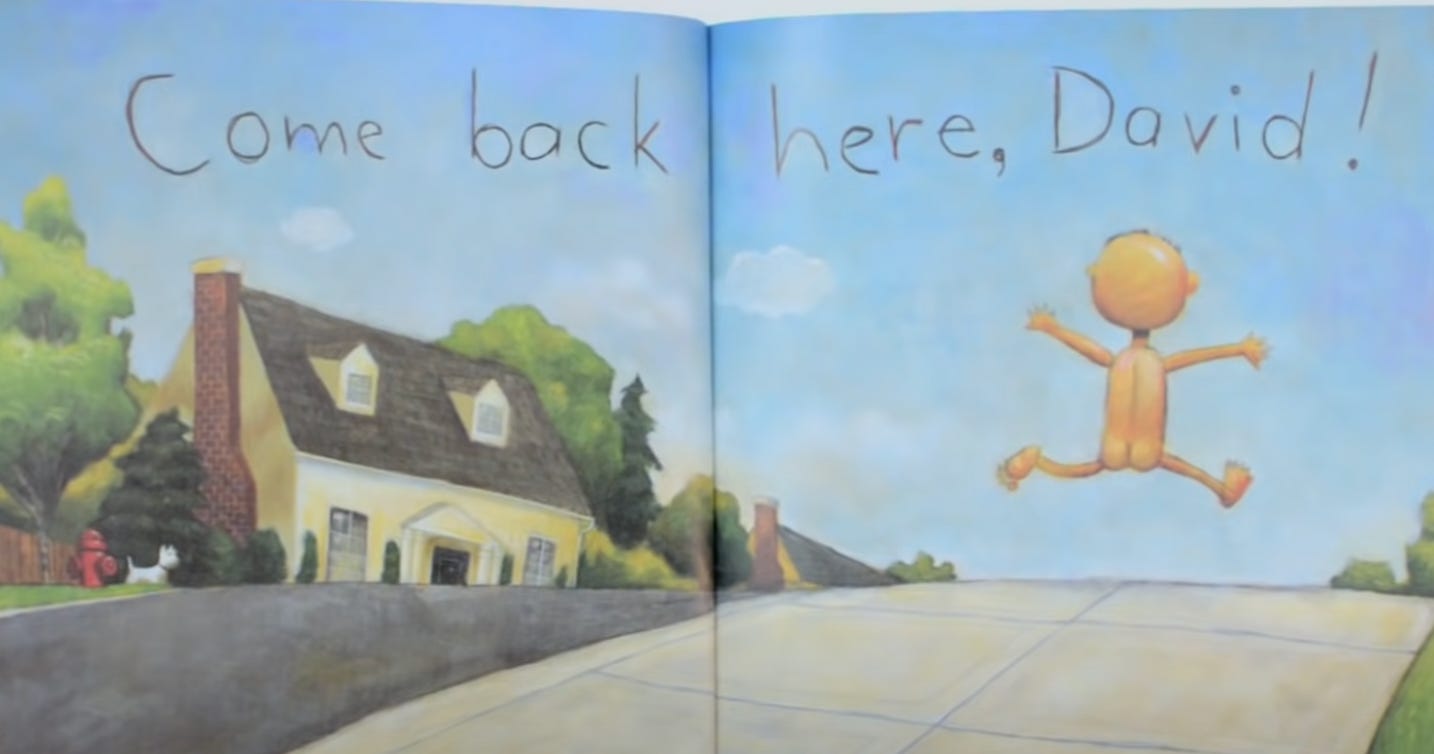
Also targeted was the book No, David! because it included this image.

Well, you simply can’t show Adam and Eve buck naked in the Garden of Eden, can you? Or can the author and illustrator of a children’s book show a boy’s butt.

It would be satisfying if the author or publisher of the targeted books sued the district for defacing them.

Greg Olear is a novelist and journalist. His blog is called “Prevail.” He is author of Dirty Rubles: An Introduction to Trump/Russia. When I was in high school, I memorized poetry. It’s a great gift. He posted this today.

Dear Reader,

Roland Flint, who taught my Introduction to Poetry class freshman year at Georgetown, gave us extra credit for memorizing poems. Back then, my now-beleaguered brain was still in top operating condition, and I loved poetry and admired the professor, so I took full advantage of this. Other, more pragmatic students chose the shortest poems they could find to memorize; to show off, and because it’s not un-useful to be familiar with 250-year-old rhyming-couplet pick-up lines, I went with “To His Coy Mistress.”

With his red beard and his paunch and the glimmer in his eye, Flint was a commanding presence, stocky and stout, and blessed with a booming baritone that he sometimes used to sing Bulgarian folk songs. (You can see him in action here.) To demonstrate what we’d have to do to earn points, he recited a poem that he himself knew by heart. It was called “Two-Headed Calf,” by Laura Gilpin, and it blew all of us away. I memorized it too, and when I’m in the right mood, I still recite it to myself, all four sentences of it, and marvel at its power to move me.

Polycephaly is a genetical blip that in bovines is a death sentence. Calves with two heads—or, more commonly, two faces—are usually stillborn. With extremely rare exceptions, two headed-calves that survive birth die in a matter of days, if not hours. Flint, who grew up on a farm in Nebraska, certainly knew more about this sort of thing than this child of the Jersey suburbs.

Here is Gilpin’s poem, which I have known by heart since 1991:

Two-Headed Calf

Tomorrow when the farm boys find this
freak of nature, they will wrap his body
in newspaper and carry him to the museum.

But tonight he is alive and in the north
field with his mother. It is a perfect
summer evening: the moon rising over
the orchard, the wind in the grass. And
as he stares into the sky, there are
twice as many stars as usual.

Three decades and change later, it still kills me every time.

Why does nature fate some of us to live long, healthy lives, while others suffer in sickness and infirmity? Is there larger purpose to this design, or is it just random probabilities—simple, brutal math?

Gilpin died young. She was a poet of acclaim—she won the Walt Whitman Award in 1976 for her first poetry collection, The Hocus-Pocus of the Universe—with degrees from Sarah Lawrence and Columbia, and taught in the city for a time. Later she became a registered nurse. She worked for Planetree, and was a tireless advocate for its patient-oriented care model. In the late summer of 2006, she was diagnosed with glioblastoma multiforme, an incurable brain cancer marked by terrible headaches, nausea, and (ironically, given that poem) double vision. She died half a year later, at age 56, right after finishing a second poetry collection, The Weight of a Soul.

After two Sundays in a row of breaking down heady novels, I intended this week to share something light, something simple and beautiful that did not require interpretation. For one thing, the news from the last seven days has been particularly bleak. For another, today is March 3—my father’s birthday. He would have been 76.

I considered writing about Roy Orbison, who my dad loved, but there was nothing I could think to say about The Big O that hadn’t already been better expressed by the likes of Bob Dylan and Bruce Springsteen. Then I remembered “Two-Headed Calf.” I hadn’t shared it previously because it is relatively recent. But as both of Gilpin’s books are currently out of print, my hope is that some attention paid to her work might convince a publisher to re-issue her collections.

As I read about Gilpin last night, I came upon her obituary, which contains a quote from one of her poems, “Life After Death,” that I’d never heard before. I tracked it down and read it. This poem, too, requires no interpretation, and seems especially appropriate for my father’s birthday. 

At the end of this ugly week, Dear Reader, I leave you with something beautiful:

Life After Death

These things I know:
How the living go on living
and how the dead go on living with them
so that in a forest
even a dead tree casts a shadow
and the leaves fall one by one
and the branches break in the wind
and the bark peels off slowly
and the trunk cracks
and the rain seeps in through the cracks
and the trunk falls to the ground
and the moss covers it
and in the spring the rabbits find it
and build their nest
inside the dead tree
so that nothing is wasted in nature
or in love.

When an education story is featured by a major media outlet like CNN, you can bet it’s captured mainstream attention.

Many educators have worried about the pernicious agenda of “Moms for Liberty,” which arrived on the scene in 2021 with a sizable war chest.

What is that agenda? Defaming public schools and their teachers. Accusing them of being “woke “ and indoctrinating students to accept left wing ideas about race and gender. Banning books they don’t like. Talking about “parental rights,” but only for straight white parents who share their values.

M4L got started in Florida, as do many wacky and bigoted rightwing campaigns, but it has been shamed recently by the sex scandal involving one of its co-founders, Brigitte Ziegler. The two other co-founders dropped her name from their website, but the stain persists.

CNN reports that this rightwing group is encountering stiff opposition from parents who don’t share their agenda and who don’t approve of book banning.

The story begins:

Viera, FloridaCNN —

In Florida, where the right-wing Moms for Liberty group was born in response to Covid-19 school closures and mask mandates, the first Brevard County School Board meeting of the new year considered whether two bestselling novels – “The Kite Runner” and “Slaughterhouse-Five” – should be banned from schools.

A lone Moms for Liberty supporter sat by herself at the January 23 meeting, where opponents of the book ban outnumbered her.

Nearly 20 speakers voiced opposition to removing the novels from school libraries. One compared the book-banning effort to Nazi Germany. Another accused Moms for Liberty of waging war on teachers. No one spoke in favor of the ban. About three hours into the meeting, the board voted quickly to keep the two books on the shelves of high schools.

RELATED ARTICLEOusted Florida GOP leader Christian Ziegler won’t be charged with sexual battery

“Why are we banning books?” asked Mindy McKenzie, a mom and nurse who is a member of Stop Moms for Liberty, which was formed to counter what it calls a far-right extremist group “pushing for book banning and destroying public education.”

“Why are we letting Moms for Liberty infiltrate our school system?”